Logistics Sector
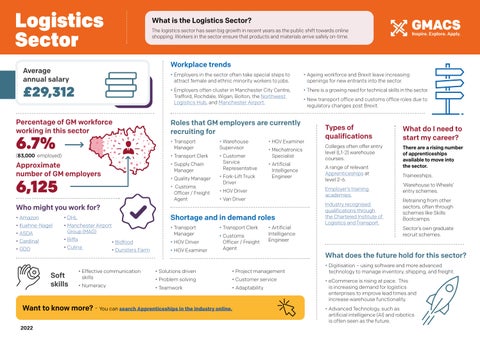
What is the Logistics Sector? The logistics sector has seen big growth in recent years as the public shift towards online shopping. Workers in the sector ensure that products and materials arrive safely on-time.
Workplace trends
Average annual salary
£29,312 Percentage of GM workforce working in this sector
6.7%
• Employers in the sector often take special steps to attract female and ethnic minority workers to jobs.
• Ageing workforce and Brexit leave increasing openings for new entrants into the sector.
• Employers often cluster in Manchester City Centre, Trafford, Rochdale, Wigan, Bolton, the Northwest Logistics Hub, and Manchester Airport.
• There is a growing need for technical skills in the sector.
Roles that GM employers are currently recruiting for • Transport Manager
• Warehouse Supervisor
(83,000 employed)
• Transport Clerk
Approximate number of GM employers
• Supply Chain Manager
• Customer Service Representative
• Quality Manager
6,125
• Customs Officer / Freight Agent
• Fork-Lift Truck Driver
• HGV Examiner • Mechatronics Specialist • Artificial Intelligence Engineer
• HGV Driver • Van Driver
• Amazon
• DHL
Shortage and in demand roles
• Kuehne-Nagel
• Manchester Airport Group (MAG)
• Transport Manager
• Cardinal • GDO
• Biffa • Culina
Soft skills
• Bidfood
• HGV Driver
• Dunsters Farm
• HGV Examiner
• Transport Clerk • Customs Officer / Freight Agent
2022
• Artificial Intelligence Engineer
• Effective communication skills
• Solutions driven
• Project management
• Numeracy
• Problem solving
• Customer service
• Teamwork
• Adaptability
Want to know more? - Y ou can search Apprenticeships in the industry online.
Types of qualifications
What do I need to start my career?
Colleges often offer entry level (L1-2) warehouse courses.
There are a rising number of apprenticeships available to move into the sector.
A range of relevant Apprenticeships at level 2-6. Employer’s training academies.
Who might you work for?
• ASDA
• New transport office and customs office roles due to regulatory changes post Brexit.
Industry recognised qualifications through the Chartered Institute of Logistics and Transport.
Traineeships. ‘Warehouse to Wheels’ entry schemes. Retraining from other sectors, often through schemes like Skills Bootcamps. Sector’s own graduate recruit schemes.
What does the future hold for this sector? • Digitisation – using software and more advanced technology to manage inventory, shipping, and freight. • eCommerce is rising at pace. This is increasing demand for logistics enterprises to improve lead times and increase warehouse functionality. • Advanced Technology, such as artificial intelligence (AI) and robotics is often seen as the future.