PERSONAL, SOCIAL AND EMOTIONAL DEVELOPMENT Talk about their feelings using words like ‘happy’, ‘sad’, ‘angry’ or ‘worried’. Understand gradually how others might be feeling.
Use some of their print and letter knowledge in their early writing. For example: writing a pretend shopping list that starts at the top of the page; writing ‘m’ for mummy. Write some or all of their name Write some letters accurately.
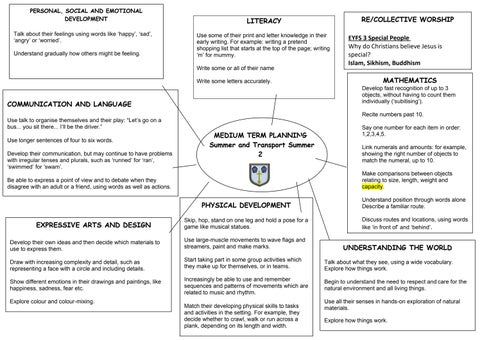
MEDIUM TERM PLANNING Summer and Transport Summer 2
Say one number for each item in order: 1,2,3,4,5. Link numerals and amounts: for example, showing the right number of objects to match the numeral, up to 10. Make comparisons between objects relating to size, length, weight and capacity.
Be able to express a point of view and to debate when they disagree with an adult or a friend, using words as well as actions.
EXPRESSIVE ARTS AND DESIGN
MATHEMATICS
Recite numbers past 10.
Use talk to organise themselves and their play: “Let’s go on a bus... you sit there... I’ll be the driver.”
Develop their communication, but may continue to have problems with irregular tenses and plurals, such as ‘runned’ for ‘ran’, ‘swimmed’ for ‘swam’.
EYFS 3 Special People Why do Christians believe Jesus is special? Islam, Sikhism, Buddhism
Develop fast recognition of up to 3 objects, without having to count them individually (‘subitising’).
COMMUNICATION AND LANGUAGE
Use longer sentences of four to six words.
RE/COLLECTIVE WORSHIP
LITERACY
PHYSICAL DEVELOPMENT
Understand position through words alone Describe a familiar route.
Skip, hop, stand on one leg and hold a pose for a game like musical statues.
Discuss routes and locations, using words like ‘in front of’ and ‘behind’.
Develop their own ideas and then decide which materials to use to express them.
Use large-muscle movements to wave flags and streamers, paint and make marks.
UNDERSTANDING THE WORLD
Draw with increasing complexity and detail, such as representing a face with a circle and including details.
Start taking part in some group activities which they make up for themselves, or in teams.
Talk about what they see, using a wide vocabulary. Explore how things work.
Show different emotions in their drawings and paintings, like happiness, sadness, fear etc.
Increasingly be able to use and remember sequences and patterns of movements which are related to music and rhythm.
Begin to understand the need to respect and care for the natural environment and all living things.
Explore colour and colour-mixing.
Match their developing physical skills to tasks and activities in the setting. For example, they decide whether to crawl, walk or run across a plank, depending on its length and width.
Use all their senses in hands-on exploration of natural materials. Explore how things work.