Progression of knowledge and skills through National Curriculum Music BFS R
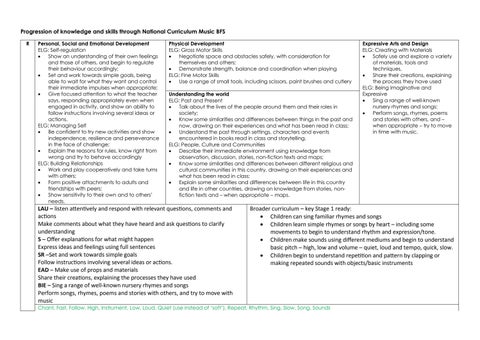
Personal, Social and Emotional Development ELG: Self-regulation Show an understanding of their own feelings and those of others, and begin to regulate their behaviour accordingly; Set and work towards simple goals, being able to wait for what they want and control their immediate impulses when appropriate; Give focused attention to what the teacher says, responding appropriately even when engaged in activity, and show an ability to follow instructions involving several ideas or actions. ELG: Managing Self Be confident to try new activities and show independence, resilience and perseverance in the face of challenge; Explain the reasons for rules, know right from wrong and try to behave accordingly ELG: Building Relationships Work and play cooperatively and take turns with others; Form positive attachments to adults and friendships with peers; Show sensitivity to their own and to others’ needs.
Physical Development ELG: Gross Motor Skills Negotiate space and obstacles safely, with consideration for themselves and others; Demonstrate strength, balance and coordination when playing ELG: Fine Motor Skills Use a range of small tools, including scissors, paint brushes and cutlery Understanding the world ELG: Past and Present Talk about the lives of the people around them and their roles in society; Know some similarities and differences between things in the past and now, drawing on their experiences and what has been read in class; Understand the past through settings, characters and events encountered in books read in class and storytelling. ELG: People, Culture and Communities Describe their immediate environment using knowledge from observation, discussion, stories, non-fiction texts and maps; Know some similarities and differences between different religious and cultural communities in this country, drawing on their experiences and what has been read in class; Explain some similarities and differences between life in this country and life in other countries, drawing on knowledge from stories, nonfiction texts and – when appropriate – maps.
LAU – listen attentively and respond with relevant questions, comments and actions Make comments about what they have heard and ask questions to clarify understanding S – Offer explanations for what might happen Express ideas and feelings using full sentences SR –Set and work towards simple goals Follow instructions involving several ideas or actions. EAD – Make use of props and materials Share their creations, explaining the processes they have used BIE – Sing a range of well-known nursery rhymes and songs Perform songs, rhymes, poems and stories with others, and try to move with music
Expressive Arts and Design ELG: Creating with Materials Safely use and explore a variety of materials, tools and techniques, Share their creations, explaining the process they have used ELG: Being Imaginative and Expressive Sing a range of well-known nursery rhymes and songs; Perform songs, rhymes, poems and stories with others, and – when appropriate – try to move in time with music.
Broader curriculum – key Stage 1 ready: Children can sing familiar rhymes and songs Children learn simple rhymes or songs by heart – including some movements to begin to understand rhythm and expression/tone. Children make sounds using different mediums and begin to understand basic pitch – high, low and volume – quiet, loud and tempo, quick, slow. Children begin to understand repetition and pattern by clapping or making repeated sounds with objects/basic instruments
Chant, Fast, Follow, High, Instrument, Low, Loud, Quiet (use instead of ‘soft’), Repeat, Rhythm, Sing, Slow, Song, Sounds