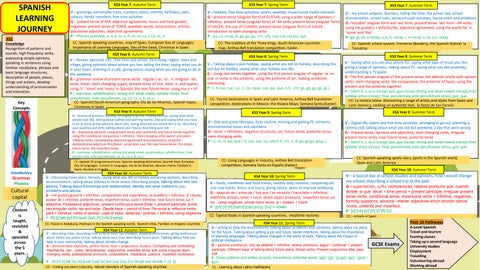
SPANISH LEARNING JOURNEY KS2 Knowledge Recognition of patterns and sounds, high frequency verbs, expressing simple opinions, speaking in sentences using familiar vocabulary, phrases and basic language structures, description of people, places, things and actions, develop understanding of pronunciation and intonation.
Key Concepts
KS3 Year 7: Autumn Term V – greetings, personality traits, numbers, dates, months, birthdays, pets, colours, family members, free time activities G – present tense of SER, adjectival agreement, nouns and their gender, negatives, present tense of TENER, question words, conjunctions, articles, possessive adjectives, adjectival agreements P – Phonics overview, a, o, e, iu, n, ñ, ca, co, cu, j, l,ll, ce, ci CC- Spanish speaking countries, map of Spain, European Day of Languages: Importance of Learning Languages, Day of the Dead, Christmas in Spain KS3 Year 8: Autumn Term V – Review: personal info., free time and school. Describing: region, town and village, giving opinions about where you live, telling the time; saying what you do in your town, ordering in a café, giving prices, saying what you are going to do at the weekend G – grammar review of present tense verbs: regular (-ar, -er, -ir; irregular: ser, tener, hacer; stem-changing: jugar), present tense of vivir, estar, ir, and querer, using ‘a’, ‘some’ and ‘many’ in Spanish, the near future tense- using voy a + inf. P – overview, syllabification, strong and weak vowel, syllable stress: final, penultimate, ante-penultimate, ca, co, cu, v, b, ce,ci CC- Spanish/South American geography, Día de los Muertos, Spanish tapas, Christmas in Spain KS3 Year 9: Autumn Term V – Review of previous learning. Arranging to go out, making excuses, saying what other people look like, talking about clothes and sporting events, Jobs and saying what you have to do at work, giving opinions about jobs, saying what job you would like to do, describing your qualities and skills, talking about your future, describing your job G – Expressing opinions, using present tense, past (preterite) and future tenses together, using the conditional: me gustaría + infinitive , stem-changing verbs querer and poder, reflexive verbs; consolidating adjectival agreement and prepositions, using the demonstrative adjective 'this/these’, using tener que, the near future tense, the simple future tense, the imperfect tense, P – overview, syllabification, strong and weak vowel, accentuation, syllable stress: final, penultimate, ante-penultimate, ca, co, cu, v, b, ce,ci
Vocabulary Grammar Phonics
Cultural capital Content is taught, revisited & upscaled across the 5 years.
CC- Spanish TV programmes/music, Spanish-speaking destinations.,Spanish food, European Day of Languages: Careers in Languages, Día de los Muertos, Mexican rhyme, Football in Spain, Navidad en España
KS4 Year 10: Autumn Term V – Discussing travel plans, festivals, saying what you did on holiday and giving opinions, describing accommodation, talking about holidays in three tenses, Describing people, talking about who you admire, Talking about friendships and relationships, identity and what matters to you, problems and advice, G – me gust(n)/gustaría + infinitive, comparatives and superlatives, se puede(n) + infinitive, if clauses, acabar de + infinitive, preterite tense, imperfect tense, suelo + infinitive, near future tense, Lo + adjective, Possessive adjectives, present continuous tense Estar + present participle, some key irregular verbs, ser and estar, Desde hace + period of time, Personal a, reflexive verbs, para + infinitive, verbs of opinion, uses of estar, deberías / podrías + infinitive, using negatives P - [ll] [j] [ge] [gi] [h] [que] [qui], [h] [v/b] [j/ge/gi] CC- Travel in Andalucia, Festivals in the Spanish-speaking world, Spanish cities, Families in Hispanic countries
KS4 Year 11: Autumn Term
V – describing cities, describing how a city or town has changed, shopping preferences, giving preferences about where you prefer to live, talking about your area, describing future plans, Talking about how you help in your community, talking about climate change G – demonstrative adjectives, perfect tense, estar + prepositions of place, Comparing and contrasting: más/menos, tan…como, tanto/a/os/as, subjunctive, pretertite tense with some irregular stemchanging verbs, prepositional pronouns, prepositions, imperative, passive, imperfect continuous P - [ll] [rr] [í] [ía] [io] [ió] [cua] [cue] [ci] and [ca], [co], [cu] Single and double ‘r’ [v] [j]
CC – Finding out about Colombia, natural wonders of Spanish-speaking countries
KS3 Year 7: Spring Term V – hobbies, free time activities, sports, weather, music/social media interests G – present tense (singular form) of GUSTAR, using a wider range of opinions + infinitive, present tense (singular form) of -AR verbs present tense (singular form) of HACER, the use of CUANDO, present tense (singular form) of JUGAR, Introduction to stem-changing verbs P - a,e,i,o- recap, h, ga, go, gu, r/rr, v/b, cua, cue, cui qui, que CC- The tradition of the Three Kings, South American countries map, Anthea Bell translation competition, Easter.
KS3 Year 7: Summer Term V – my school subjects, teachers, telling the time, the school day, school environments, school rules, extracurricular activities, future plans and ambitions G –‘estudiar’ singular form and ‘we’ form, present tense ‘we’ form –AR verbs, using me gusta(n) + el/la/los/las, adjectival agreement, using the words for ‘a’, ‘some’ and ‘the' P –ge, gi, ce, ci-recap, si,ci, h- recap, r, rr-recap, z, ce, ci,z- recap CC- Spanish school system, Fronteras (Borders), the Spanish festival: la Tomatina KS3 Year 8: Summer Term
KS3 Year 8: Spring Term V – Talking about a past holiday, saying what you did on holiday, describing the last day on holiday, saying what your holiday was like G – Using two tenses together, using the first person singular of regular -ar -er and –ir verbs in the preterite, using the preterite of ser, making sentences interesting P – l, ll, cua, cue, cui, z, ce, cique, cue, qui, que, n,ñ, r/rr, ga, go, gu, ge, gi, j CC- Tourist destinations in Spain and Latin America, Anthea Bell translation competition, destinations in Mexico- the Riviera Maya, Semana Santa (Easter)
V – Saying what you use your phone for, saying what type of music you like; giving a range of opinions, talking about TV, saying what you did yesterday, understanding a TV guide G –The first person singular of the present tense, the definite article with opinion verbs, stem-changing verbs, the comparative, the preterite of hacer, using the present and the preterite together P – Silent h, z, ce,ci (recap) que, gue (recap) strong and weak vowels (recap),final syllable stress (recap): final, penultimate,ante-penultimate stress, gué, qué CC- La música latina- discovering a range of artists and styles from Spain and Latin America, tackling an authentic text, la fiesta de San Fermín KS3 Year 9: Summer Term
KS3 Year 9: Spring Term V – Diet and active lifestyles, daily routine, moving and getting fit, ailments, environmental issues and solutuons G – tener + infinitives, negative structures, ser, future tense, preterite tense, stem-changing verbs P – z, ce, ci, qui, que l, ll, cua, cue, cui, silent h, r/rr, n, ñ, ga, go,gu, ge,gi, j
CC- Using Languages in Industry, Anthea Bell translation competition, Semana Santa en España (Easter)
V – Digital life, sports and free time activities, arranging to go out, planning a cinema visit, talking about what you did last weekend, a day that went wrong G – Present tense, opinions and adjectives, stem changing verbs, irregular present tense verbs, near future tense, preterite tense P – Silent h, z, ce,ci (recap) que, gue (recap) strong and weak vowels (recap),final syllable stress (recap): final, penultimate,ante-penultimate stress, gué, qué CC- Spanish-speaking sports stars, sports in the Spanish world, Spain and Latin America KS4 Year 10: Summer Term
KS4 Year 10: Spring Term V – foods, mealtimes and food trends, healthy daily routines, comparing old and new habits, illness and Injury, giving advice, plans to improve wellbeing G – después de / antes de / hay que / se necesita / hace falta + infinitive, indefinite articles, tener + noun, direct object pronouns, imperfect tense, ya no, , using negatives, simple future tense, si + present + future P - [ch] [r] [rr] [ce/ci] [ca/co/cu], [cu] + vowel CC- Typical foods in Spanish-speaking countries, mealtime routines
V – a typical day at school, studies and opinions, how I would change my school, describing a school trip in the past G – superlatives, suffix -ísimo/a/os/as, relative pronouns que, cuando, donde, lo que, llevar + time period + present participle, irregular present tense verbs, conditional tense, impersonal verbs + Infinitive, negatives, forming questions, adverbs –mente, adjectives which shorten before nouns, preterite and imperfect, P - [z] [ce] [ci] [rr] [r] [ñ] [u]CC – schools in Spain
Post-16 Pathways
KS4 Year 11: Spring Term V – acting to help the environment, talking about problems and solutions, talking about my plans for the future, Talking about getting a job and future career intentions, talking about the importance of learning languages, Talking about changes in the world of work, Talking about the impact of artificial intelligence G – passive avoidance, (no) se debería + infinitive, relatve pronouns, seguir / continuar + present participle, Different ways of talking about future plans, Modal verbs, Present subjunctive after para que P - Stress patterns and written accents, transcribing unfamiliar words, [ge] / [gi] / [j] [ga] / [go] / [gue] / [gui] CC - Learning about Latino trailblazers
GCSE Exams
A-Level Spanish Travel and tourism Evening classes Taking up a second language University studies Employment Travelling Volunteering abroad Working abroad