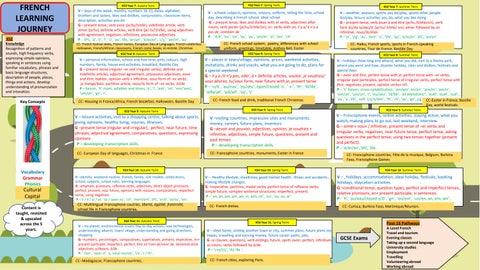
FRENCH LEARNING JOURNEY KS2 Knowledge Recognition of patterns and sounds, high frequency verbs, expressing simple opinions, speaking in sentences using familiar vocabulary, phrases and basic language structures, description of people, places, things and actions, develop understanding of pronunciation and intonation.
Key Concepts
KS3 Year 7: Spring Term
KS3 Year 7: Autumn Term
V – days of the week, months, numbers 16-31, dates, alphabet, brothers and sisters, likes and dislikes, conjunctions, classroom items, description, activities you do G – present tense, verb avoir (je/tu/il/elle), indefinite article, verb aimer (je/tu), definite articles, verb être (je/ tu/il/elle), using adjectives with agreement, negatives, infinitives, possessive adjectives P - SFC, ‘a’, ‘e’, ‘I’, ‘u’, ‘au’, Sfe, ‘en/an’, ‘é/ez/er’, ‘c/ç,’ ‘ain/in’, ‘au’. CC- French festival dates, French names, European Day of Languages, French celebrities, Halloween, French/African classrooms, French comic books, la rentrée, Christmas
V – schools subjects, opinions, colours, uniform, telling the time, school day, describing a French school, ideal school G – present tense, likes and dislikes with er verbs, adjectives after nouns, verb porter (je/tu/il/elle/on), er- verbs with on, il y a/ il n’y a pas de, combien de P - ‘ê/è’, ‘eu’, ‘on’, ‘qu’, ‘ou’, ‘ain/in’, ‘ai’, ‘ien’, ‘ch’ CC- French school system, poetry, differences with school uniform, greetings, timetable, Anthea Bell, Easter
CC- Housing in France/Africa, French breakfast, Halloween, Bastille Day
V – places in town/village, opinions, prices, weekend activities, invitations, drinks and snacks, what you are going to do, plans for a special weekend G – il y a /il n’y pas, aller, à + definite articles, vouloir, je voudrais/ vous désirez, tu/vous form, near future with je, present tense P – ‘o/ô’, ‘au/eau’, ‘eu/œu’, open/closed ‘o’, ‘-s-’, ‘th’, ‘ill/ille’, ‘aille/ail’, ‘eill/eil’, ‘oy’, ‘y’ CC- French food and drink, traditional French Christmas
Cultural Capital Content is taught, revisited & upscaled across the 5 years.
V – leisure activities, visit to a shopping centre, talking about sports, giving opinions, healthy living, injuries, illnesses. G –present tense (regular and irregular), perfect, near future, time phrases, adjectival agreement, comparatives, questions, expressing opinions. P – developing transcription skills.
V –visiting countries, impressive sites and monuments. money, careers, future plans, inventors G –devoir and pouvoir, adjectives, opinion, je voudrais + infinitive, adjectives, simple future, questions, present and past tenses. P – developing transcription skills.
CC- European Day of languages, Christmas in France
CC- Francophone countries, monuments, Easter in France
CC- Multilingual Francophone coutries, liberté, égalité, fraternité, school life in Francophone countries. KS4 Year 11: Autumn Term
V – my planet, environmental issues, day-to-day actions, new technologies, understanding adverts, town/ village, understanding and giving directions, shopping. G –numbers, percentages, comparatives, superlatives, present, imperative, en+ present participle, imperfect, perfect, être en train de/venir de, demonstrative adjectives, y/depuis, à/de. P- ‘-tion’, ‘open o’, ‘a; nasal sounds’, ‘i/y’, ‘r / th’,
CC- Madagascar, Francophone countries.
KS3 Year 8: Summer Term
V – holidays (how long and where), what you did, visit to a theme park, where you went and how, disaster holiday, Likes and dislikes, festivals and special days G – avoir and être, perfect tense with je, perfect tense with –er verbs, irregular past participles, perfect tense of irregular verbs, perfect tense with être, negatives, present, opinion verbs+ inf. P – ‘h’ liaison, stress syllabification, ‘em/am’, en/an’, ‘aim/in’, ‘ain/in’, ‘om/on’, ‘um/un’, ‘r’, ‘eu/oeu’, ‘ill/ille’, ‘ail’aill/eill/eil/’, ‘euill’, ‘ouill’, ‘ouil’, ‘oy’, ‘y’, SSC , soft ‘c/ç/s/tion’, ‘th’, ‘ch’, ‘qu’, ‘gn’, j/g’ CC-Easter in France, Bastille Day, world festivals KS3 Year 9: Summer Term
V – Francophone events, online activities, staying active, what you watch, making plans to go out, last weekend, interview. G – aimer+ noun / infinitive, present tense of –er verbs and irregular verbs, negatives, near future tense, perfect tense, asking questions in the perfect tense, using two tenses together (present and perfect). P – ‘é/er/ez’, SFC, Sfe, CC- Francophone countries, Fête de la musique, Belgium, Burkina Faso, Francophone Games
KS4 Year 10: Spring Term
KS4 Year 10: Autumn Term
V –identity, weekend routine, friends, family, role models, celebrations, school, subjects, school rules, learning languages. G –emphatic pronouns, reflexive verbs, adjectives, direct object pronouns, perfect, present, near future, opinions with reasons, comparatives, imperfect tense, using negatives. P –’è / ê / aî / ai’, ‘œ / open eu’, ‘ch’, ‘ment/ent’, SFC, ‘er/é’, ‘oi/oy’, ‘ien’.
CC- Haiku, French sports, sports in French-speaking countries, Tour de France, Bastille Day
KS3 Year 9: Spring Term
KS3 Year 9: Autumn Term
Vocabulary Grammar Phonics
V – weather, seasons, sports you do/play, sports other people do/play, leisure activities you do, what you like doing G – present tense, verb jouer à and être (je/tu /il/elle/on), verb faire du/de la/des/d’ (je/tu/ il/elle/ on), aimer followed by an infinitive, nous/ils/elles P –’oi’, ‘j/g’, ‘au’, ‘tion’, ‘u’, ‘Sfe’, ‘qu’, ‘é/ez/er’, SFC, ‘an/en’.
KS3 Year 8: Spring Term
KS3 Year 8: Autumn Term
V – personal information, school and free time, pets, colours, high numbers, family, house and activities, breakfast, Bastille Day G – present tense (regular –er and irregular verbs), definite and indefinite articles, adjectival agreement, possessive adjectives, avoir and être, habiter, opinion verb + infinitive, nous form of –er verbs, je mange/bois, partitive article, nous/ils form of –er verbs, il/elle P – liaison, ‘h’ muet, syllables and stress, ‘a’, ‘I’, ‘aim’, ‘im’, ‘em/’am/, ‘om/on’, ‘gn’, ‘r’.
KS3 Year 7: Summer Term
V – Healthy lifestyle, mealtimes, good mental health, illness and accidents., making lifestyle changes. G –imperative, partitive, modal verbs, perfect tense of reflexive verbs, simple future, complex sentence structures, imperfect, present. P –’ en, an, em, am, ain, in, aim, im‘, ’eu‘, ’eu, ou, oi‘ CC- French dishes.
KS4 Year 10: Summer Term
V – , holidays, accommodation, ideal holiday, festivals, booking holidays, staycation activities. G –conditional tense, question types, perfect and imperfect tenses, relative pronouns, en+ present participle, si sentences. P- ’ h’, ‘au/eau/closed o/ô’, ‘gn’, ‘on/om’, ‘un/en, an, em, am‘, CC- Corisca, Burkina Faso, Martinique/Réunion.
KS4 Year 11: Spring Term
V – ideal home, visiting another town or city, summer plans, future plans and hopes, travelling and earning money, future career paths, jobs. G –si clauses, questions, verb endings, future, après avoir, perfect, infinitives as nouns, verbs followed by à/de. P – ‘c+e/i/ç’, ‘ill/-ille ‘, CC- French cities, exploring Paris.
Post-16 Pathways
GCSE Exams
A-Level French Travel and tourism Evening classes Taking up a second language University studies Employment Travelling Volunteering abroad Working abroad