Episcopal School of Acadiana
Lower School Handbook For Students and Parents
Lafayette Campus (PK3 – 5th) 721 E. Kaliste Saloom Rd Lafayette, LA 70508 Phone: (337) 993-2263 Fax: (337) 993-3706
Cade Campus (6th – 12th) PO Box 380 Cade, LA 70519 Phone: (337) 365-1416 Fax: (337) 367-9841 www.ESAcadiana.com
Dear Episcopal School of Acadiana Community, Welcome to ESA! ESA is a learning community, rooted in scholarship and honor, where students and teachers learn and work together to achieve the common goals of academic excellence, leading lives of integrity, and developing the physical and spiritual dimensions of our lives. ESA was founded to provide a model of such an approach to teaching, learning and life for the greater Acadiana community. Our Handbook is best understood as a guideline for common understanding of our basic policies, practices, and approaches. As a framework, it is not intended to provide an exhaustive list of all policies and rules. Such a document or approach would be inconsistent with our school mission and philosophy where freedom, responsibility and accountability in all that we do are our guide stars. As a framework, it provides a philosophical context that we use in deciding matters not covered as policy, and it provides a context for addressing individual cases as the need arises. We are glad that you are with us, and we look forward to growing and learning with you as a member of our community. If you have any questions or concerns, please let us know. Respectfully, Paul Baker, Ph.D. Headmaster Episcopal School of Acadiana
TABLE OF CONTENTS Mission Statement ..................................................................................................................... 1 Vision and Values Statement .................................................................................................... 1 Philosophy of Education ........................................................................................................... 2 School Motto ............................................................................................................................. 2 School Colors ............................................................................................................................ 2 Episcopal School of Acadiana .................................................................................................. 3 Seal and Symbolism.................................................................................................................. 3 Alma Mater ............................................................................................................................... 4 School Prayer ............................................................................................................................ 4 Academics ................................................................................................................................. 5 ACADEMIC CALENDAR ....................................................................................................................................... 5 CURRICULUM ..................................................................................................................................................... 5 REPORTING PRACTICES ...................................................................................................................................... 6 MYESA ACCESS .............................................................................................................................................. 6 GRADING SYSTEM .............................................................................................................................................. 6 GRADING SCALE ........................................................................................................................................ 7 ACADEMIC HONORS ........................................................................................................................................... 7 Academic Ranking ........................................................................................................................................ 7 Headmster’s List ........................................................................................................................................... 7 Honor Roll .................................................................................................................................................... 7 FIFTH GRADE AWARDS............................................................................................................................. 7 SUPPORT SERVICES ............................................................................................................................................ 8 GENERAL ACADEMIC INFORMATION .................................................................................................................. 9 Homework ..................................................................................................................................................... 9 Late Assignments .......................................................................................................................................... 9
Student Life............................................................................................................................. 10 THE HONOR SYSTEM ........................................................................................................................................ 10 ESA Honor Code ......................................................................................................................................... 10 CODE OF CONDUCT .......................................................................................................................................... 10 School Expectations .................................................................................................................................... 11 Disciplinary Responses ............................................................................................................................... 11 Drug and alcohol Policy ............................................................................................................................. 11 ATTENDANCE ................................................................................................................................................... 11 Absences from School ................................................................................................................................. 12 Tardies ........................................................................................................................................................ 13 DRESS CODE..................................................................................................................................................... 14 Spirit Dress ................................................................................................................................................. 15 Physical Education (MOvement) uniforms ................................................................................................. 15 TRANSPORTATION ............................................................................................................................................ 15 Bus Regulations .......................................................................................................................................... 15 Student arrivals/departures......................................................................................................................... 16 GUESTS AND VISITORS ON CAMPUS ................................................................................................................. 19 LIBRARY........................................................................................................................................................... 19 Policies ....................................................................................................................................................... 19 ELECTRONICS ................................................................................................................................................... 19 TECHNOLOGY ................................................................................................................................................... 19 Acceptable Use Policy ................................................................................................................................ 20 The Use of Video Capable Technology on Campus .................................................................................... 21 CHAPEL ............................................................................................................................................................ 21 LUNCH & RECESS ............................................................................................................................................. 22 2019-2020 Lower School Handbook
EXTRACURRICULAR ACTIVITIES ....................................................................................................................... 23
Helpful Information ................................................................................................................ 23 MEDICAL INFORMATION................................................................................................................................... 23 BUSINESS AND FINANCIAL ............................................................................................................................... 25 STUDENT ACCIDENT INSURANCE POLICY ......................................................................................................... 26 ASBESTOS MANAGEMENT ................................................................................................................................ 26 LOST AND FOUND ............................................................................................................................................. 26 BIRTHDAY & HOLIDAY CELEBRATIONS ........................................................................................................... 26 OFFICE HOURS ................................................................................................................................................. 26 SCHOOL CLOSING/EMERGENCY NOTIFICATIONS .............................................................................................. 27 STATEMENT OF NON-DISCRIMINATION POLICY................................................................................................ 27 USE OF SCHOOL NAME, HANDBOOK, AND DIRECTORY .................................................................................... 27
2019-2020 Lower School Handbook
MISSION STATEMENT Episcopal School of Acadiana is a coeducational, independent day school for students in grades pre-K through 12. Its mission is to instill in every student the habits of scholarship and honor. ESA challenges students to develop intellectually, spiritually, and physically.
VISION AND VALUES STATEMENT At ESA, we nurture the twin virtues of freedom and responsibility. We pursue these virtues in the daily life of our school by balancing joy and challenge, inventiveness and tradition, respect and informality, trust and support. We cultivate and celebrate this balance in our vibrant, eclectic community that prizes both individual freedom and cooperation. We take responsibility for what we do and say, and freely use our individual talents and strengths to become energetic citizens who sustain our community by making positive contributions. In order to accomplish ESA’s mission our students are expected to learn, live and grow through the following: Habits of honor develop in our community, which expects the choice of right over wrong. Our code of honor promotes fairness, truth, and honesty; our commitment to honor affords the freedom necessary for responsibility and the confidence that ideas, ideals, and property are respected. Habits of scholarship develop from the relationship between passionate teachers and creative students; fueled by the joy of discovery, self-motivated students exhibit an intellectual vitality which strengthens their beliefs yet inspires an open mind. Students develop intellectually in our nurturing environment where they master skills and knowledge. Students are challenged to learn, think and question critically; students take intellectual risks, learn how to express and support their ideas, and are encouraged to defend their positions. Students experience the Episcopal traditions and liturgies and they are supported in their search to discover a personal relationship with God. Spiritual development follows through sharing meaningful experiences with each other and through offering our leadership and talents at ESA and our services to the larger community. Students’ physical development is grounded in our physical education curriculum that encourages lifelong health and physical activity. Every student acquires physical skills, learns the value of competition and teamwork, and cultivates the ethos of sportsmanship.
2019-2020 Lower School Handbook
PHILOSOPHY OF EDUCATION Episcopal School of Acadiana holds as its basic purpose the development of an academic environment in which a student's intellectual, emotional, social and physical growth are accompanied by a corresponding spiritual and moral growth. We are an Episcopal School, a community which professes the Christian Faith as stated in the Apostles' and Nicene Creeds. Within this environment, and using the resources of the Christian Faith as practiced within the Episcopal Church, we emphasize that true learning is a cooperative effort among students, parents, faculty, administrators and staff to stimulate critical thinking, self-reliance and academic competence in a rapidly changing world. We also believe that each student, upon graduation, should be well-prepared to continue his/her education on the college level. As an Episcopal school, we affirm the educational tradition of academic freedom. The school provides opportunities for each student to achieve self-fulfillment as an individual and as a member of a community. Activities in and out of the classroom help students to recognize the need for self-discipline, a sense of citizenship within the democratic process and the development of their spiritual dimension and moral responsibilities. To these ends, we recognize that superior faculty, as well as supportive and involved parents, are of paramount importance. We recognize the importance of physical well-being in the holistic development of the individual, as well as the role of the arts in our lives as essential to understanding the culture man has created. Recreational activities promote attitudes of fair play, teamwork and leadership. Episcopal School of Acadiana seeks to instill, in each student, self-confidence, an awareness of one's relationship to God and man, and a continuing development of mind, body and spirit.
SCHOOL MOTTO "EXCELLENCE FROM WITHIN"
SCHOOL COLORS Navy Blue and Gray
2019-2020 Lower School Handbook
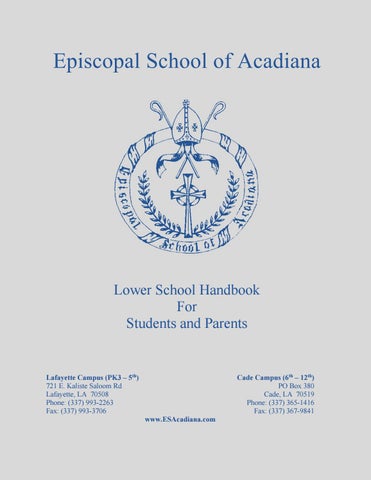
EPISCOPAL SCHOOL OF ACADIANA SEAL AND SYMBOLISM The Episcopal School of Acadiana crest was designed by the late Mrs. Charles (Penny) Godchaux of Abbeville, Louisiana. Circle: Stands for eternity because it is without beginning and without end.1 Crook: "The hooked staff is a pastoral attribute in the church and a symbol of faith. By virtue of the sigmoid significance of the hook, it stands for divine power, communication and connection; because of its spiral form it is a symbol of creative power."2 Chi Rho: Formed by the two crooks - this is the earliest monogram of Christ3 from the first two letters in the word for Christ in Greek. Miter: A traditional headpiece worn by some bishops, emblematic of the highest order of the ministry. Used in this seal to denote that the Episcopal School of Acadiana is a Diocesan School and as such shares the benefit and direction of the Bishop. Jewels within the miter - there are twelve small jewels symbolizing the twelve Apostles. These are centered around a single larger jewel representing Christ. The two crosses on the miter represent the two natures of Christ. Celtic Cross (Iona): Generally associated with the Anglican, hence Episcopal, Church. The sign of the cross was "employed by early Christians to direct special attention to the sacrifice of our Lord and the manner of His death. The cross also taught the earlier Christians, as it does us, the lesson of personal dedication to our Redeemer, who commanded His followers to take up the cross."4 Laurel Leaf: Suggestive of eternity because the foliage does not wilt.51 It is a Christian symbol of triumph. (I Corinthians 9:24 - 27) Colors: Blue - signifies heavenly love and truth; "eternity, faith, and truth." Gold - "symbolizes sovereignty, the sun, love, constancy, dignity, and wisdom."65
1
Symbols of the Church, Carroll E. Whittemore A Dictionary of Symbols, J. E. Cirlot 3 Saints, Signs, and Symbols, W. Ellwood Post 4 The Sign Language of Our Faith, Helen Stuart Griffith 5 Ecclesiastical Embroideries, Beryl Dean 2
2019-2020 Lower School Handbook
ALMA MATER Beneath the Oaks, Amid the Cane Lyrics by Dr. Arthur White Beneath the oaks, amid the cane, my thoughts are always turning back again to the gentle place that formed my youth where I learned to seek and discern the truth. A place of study and a place of play; the place where I made the friends I love today, where excellence we both sought and gained, beneath the oaks, amid the cane. We stretched our minds and our bodies too, as we sought the limits of what we could do, in lab and class, on field or court, for the love of learning or the joy of sport. At times the work was hard, the play it was intense, but as we grew, it gave us confidence that there’s no height that we cannot attain, beneath the oaks, amid the cane. God grant His blessing on this place, guard and preserve it by His grace. In work and play His blessing give; that in His Kingdom may its meaning live. Make us gentle, generous, truthful and kind with gallant courage in both heart and mind, that our blessed fellowship may long remain beneath the oaks, amid the cane.
SCHOOL PRAYER O heavenly Father, who has given us Thy Son, Jesus Christ, to be our Friend and example, help us to understand His friendship, and to do such things as will please Him. Bless us in our work and in our play. Make us gentle, generous, truthful, kind and brave. Keep us in purity of heart, and let the life of our school go on from strength to strength and have its place and meaning in Thy kingdom. All of which we ask through Jesus Christ our Lord. Amen.
2019-2020 Lower School Handbook
ACADEMICS Academic Calendar The Lower School academic year is divided into four quarters.
Curriculum Curriculum components of our early childhood program emphasize the developmental nature of young children and consist of: Gross and Fine Motor Development Social Development Cognitive Development o Language and Emerging Literacy o Mathematics Core curriculum for Lower School students in grades K - 5 consists of instruction in the following content areas: Language Arts (Reading and Writing) Mathematics Social Studies Science Complementary curriculum in grades K – 5 is integrated, whenever possible, with the core curriculum and consists of instruction in: Physical Movement Music Visual Arts French (Grades 3 – 5) Executive Function Technology Design Thinking Enrichment o A key component of the Schoolwide Enrichment Model is participation in enrichment clusters. Enrichment clusters provide opportunities for students to engage in long-term, real-world projects in mixed grade groups that are joined together through common interest. In Enrichment Clusters, students learn and apply the skills and methodologies of professionals in fields related to their areas of interest, and work toward a product, performance, or service for an authentic audience. Enrichment Cluster work is student-directed and teacherfacilitated. Students in grades 3 - 5 participate in one enrichment cluster per year that spans from early October to late March, with approximately 17 sessions in total. Students in 1st and 2nd grade engage in similar work as upper elementary students, but on a shorter timeline. These students participate in two enrichment clusters per year, each lasting seven sessions. PK4 and Kindergarten students develop the skills and mindsets for enrichment clusters through
2019-2020 Lower School Handbook
participation in short-term investigation teams based on shared student interests.
Reporting Practices ESA reports detailed progress to students and parents at the end of each quarter. Reports of Progress are available via myESA usually by 6 pm five academic days after the end of a marking period. myESA ACCESS ESA posts all Reports of Progress and Interim Reports online. Students and parents may access these reports using myESA. Each member of a family has a unique user id and password. Families new to ESA need to follow the link First time on our new site? Forgot your login? ? just below the log in screen and follow the direction to receive their username and password. Each student and parent needs to follow this procedure to receive their individual log on information. MyESA is accessed from the ESA website. Selecting the myESA button from the top right of the ESA website homepage will bring you to the login screen. Once you have logged on to myESA, you may select the child whose report you want to view at the top left in the light green menu bar. Should a family not have access to myESA, they should contact the Registrar and request a hard copy of reports to be mailed home.
Grading System nd
PK3 through 2 grade are non-graded. Each quarter, students receive detailed individual narratives and progress reports indicating growth in specific skills across the curriculum using the following descriptions. 4 Exceeding the standard 3 Meeting the standard 2 Nearing the standard 1 Not meeting the standard Each quarter, 3rd grade students receive letter grades and detailed individual narratives in language arts and mathematics. Student progress in specific skills related to science and social studies is reported using one of the following descriptions: 4 Exceeding the standard 3 Meeting the standard 2 Nearing the standard 2019-2020 Lower School Handbook
1
Not meeting the standard
Fourth and Fifth Grade students receive grades and detailed narratives in all core curriculum courses. Interim reports and/or conference requests are sent at the midpoint of each grading period if there is a significant decline in a student’s work. Teachers will be pleased to discuss your child’s progress and/or grade reports at any point in the grading period by appointment in addition to regularly scheduled parent-teacher conferences at the end of the second quarter. GRADING SCALE ESA uses a grading system that includes pluses and minuses. Letter grades correspond to the following numerical values and grade point equivalent on a student's transcript: A+ = 4.33 A = 4.00 A- = 3.67
A+ = 97– 100 A = 93 – 96 A- = 90 – 92
B+ B B-
= 3.33 = 3.00 = 2.67 F = 0.00
B+ = 87 – 89 B = 83 – 86 B- = 80 – 82
C+ C C-
= 2.33 = 2.00 = 1.67
C+ = 77 – 79 C = 73 – 76 C- = 70 – 72 F = 59 – 0
D+ = 1.33 D = 1.00 D- = 0.67
D+ = 67 – 69 D = 63 – 66 D- = 60 – 62
Academic Honors ACADEMIC RANKING ESA does not academically rank its students. HEADMSTER’S LIST A student must receive a 3.67 grade point average and receive no grade (in any course) below a B- to receive this honor. HONOR ROLL A student will receive Honor Roll recognition provided he or she receives no grade (in any course) below a B-. FIFTH GRADE AWARDS The Headmaster’s Award is presented to the fifth grade student who most exemplifies “excellence from within.” The qualities considered for this award include academic excellence, leadership, and contributions to the well-being of the community.
2019-2020 Lower School Handbook
The St. Barnabas Award is presented to the fifth grade student who maximizes his or her ESA experience.
Support Services Support Services on the Lafayette campus include: Executive Function classes, Academic Support, Learning Center Language Arts instruction, Learning Center Math instruction, and before and after school tutoring. Lower School Executive Function Classes All students in grades 1 through 5 are supported by Executive Function (EF) classes, taught weekly for 30 minutes. EF Classes are taught collaboratively by the school’s learning specialist, the director of the learning center, and the school counselor. The five-year EF curriculum includes: active listening, planning, organizing, advocacy skills, test taking skills, study skills and strategies. The focus and content of the lessons vary as students progress through the grades, matching the academic demands of each grade level. By the end of fifth grade, students have had instruction and practice in all the student skills they need to be successful independent learners in ESA’s middle school. Before and After School Tutoring Before- and after-school tutoring is available for individual students. Typically a student is identified by the classroom teacher or a parent referral. Often tutoring is the first service recommended for a student who is struggling. To initiate tutoring, parents may contact their child’s teacher or the Learning Specialist. Academic Support Academic Support is a contracted service designed to assist students with any or all of the following skills: general study skills and organization; individualized study strategies matched to personal learning styles; reading and vocabulary development; special assistance to students with learning differences. Services vary based on the individual needs of the student. Students meet, one-on-one, with their academic support teacher four days a week for 30 minute sessions in lieu of the student’s French class. Individual objectives are developed for each student in collaboration with the classroom teacher. To initiate Academic Support, parents may contact the classroom teacher or the Learning Specialist. Learning Center The ESA Learning Center is a contracted support service for students with a diagnosed learning difference. Entrance to the Learning Center requires educational testing that identifies average to above-average intelligence and learning difference that interferes with a child’s development of language or math skills. Students work with their Learning Center instructor in lieu of the regular classroom language arts or math block. Each class is ability 2019-2020 Lower School Handbook
grouped in a 1:4 teacher to student ratio. The Learning Center employs the Hill Center Language Arts and Mathematics Models, a unique, research-proven program and service delivery model of explicit, structured, systematic instruction developed by The Hill School in Durham, North Carolina. All Learning Center teachers have attended the Hill Center training and are pursuing or have achieved certified status with IMSLEC. Typically, the discussion about inclusion in the Learning Center comes from the school, but parents are welcome to contact the classroom teacher or the Learning Specialist to initiate a conversation.
General Academic Information HOMEWORK The purpose of homework at the Lower School is to provide reinforcement, enrichment, and development of classroom concepts. Whether the homework assignment is designed as practice of the day’s lesson or to prepare a student for the next day’s lesson, homework should be work a student can complete, or at least attempt, independently. Teachers recognize students’ good-faith efforts to complete homework and use information about any difficulties they may have had with completion to adjust instruction. A parent’s role in homework is to provide a consistent routine and a quiet place for homework. Teachers neither expect nor want parents to feel they must teach their children at home in order to complete homework. Doing so conveys a false assessment to the teacher and masks misunderstandings that the teacher could remediate. Teachers expect good-faith effort toward completion and quality of all work turned in, including homework. A student’s grade will be only minimally affected, if at all, by errors on homework that reflect lack of understanding. LATE ASSIGNMENTS Students are expected to complete and submit all assignments on time. Late assignments may be subject to a grade penalty. When a student is unable to attend school, he or she should contact a fellow student and make his/her best effort to complete the class homework. If a student is absent for three consecutive days, a parent should call the secretary to request missed assignments from the classroom teacher.
2019-2020 Lower School Handbook
STUDENT LIFE The development of personal integrity and excellence of character are primary goals of Episcopal School of Acadiana and have resulted in the creation of the ESA Honor System.
The Honor System ESA HONOR CODE "As a member of Episcopal School of Acadiana, I pledge that I will not lie, cheat, or steal, or withhold information concerning those who do." Honor offenses are lying, cheating and stealing. They are formally defined as follows: Section 1. LYING is defined as presenting a false impression or giving false information to another person. Section 2. STEALING is defined as the taking of another person's property without right or acknowledgement. Section 3. CHEATING is defined as giving or receiving any unauthorized information on any quiz, test, examination or other written work. Plagiarism is a form of cheating. Plagiarism is defined as the representation of work (words, phrases, graphics, ideas or images) of another's not commonly known as one's own, that is, without quotation marks, footnotes or some form of citation. Section 4. WITHHOLDING INFORMATION is defined as refraining from providing important information regarding a violation of the honor code. The Honor System represents the values of the families, students, and faculty who form our community. The Lower School teaches these values and affirms their presence in the character of each student. We recognize that children make mistakes as they learn. We encourage them to learn to accept responsibility for their mistakes and accept the consequences that result. The focus in the Lower School setting is on teaching the honor system and what it means to us as individuals and members of a community.
Code of Conduct By enrolling at ESA, each student agrees to abide by the school’s expectations and the spirit of those expectations, and parents agree to support the school’s policies. ESA is a school community based on strong belief in mutual trust and self-responsibility. Students enjoy privileges and freedoms in day-to-day activities that are based on each student assuming responsibility for his or her actions. It is important for students and parents to know the expectations for conduct set forth by the ESA community. These expectations grow out of genuine concern for each student’s growth and development as a happy and healthy individual guided by strong moral and ethical values.
2019-2020 Lower School Handbook
SCHOOL EXPECTATIONS The Episcopal School of Acadiana expects that every student will: A. Be honest. B. Respect parents, teachers, and fellow students. C. Behave appropriately and in a manner that reflects favorably upon our school. Sportsmanship, courtesy, and appropriate dress are the hallmarks of an ESA student. D. Take pride in keeping the ESA campus a clean and beautiful place. E. Meet all commitments and obligations. F. Respect and care for school property and the property of others. DISCIPLINARY RESPONSES Teachers generally handle minor infractions in the classroom, on campus, or at ESA activities. Teachers may utilize a variety of strategies designed to meet the personality of the child and nature of the situation. Disciplinary action is age appropriate and may include time-outs and loss of free play or other privileges within the school day. Severe or ongoing discipline matters are handled by the Head of Lower School. Parents are notified by the teacher or Head of Lower School in these cases. Students and families should be aware that any disciplinary action may be disclosed to third parties. DRUG AND ALCOHOL POLICY ESA is committed to a drug and alcohol free environment for students at ESA, to providing appropriate drug and alcohol education for our students, and to treating involvement with drugs and alcohol as a health issue as well as a disciplinary issue. Alcohol and drug involvement are violations of the laws of the State of Louisiana and incompatible with the school's mission and its daily operation. PRESCRIBED MEDICATION Students who have medication specifically prescribed by a physician to treat medical conditions and who need to receive doses during the school day must have an Administration of Medication Form completed by the prescribing physician and on file in the main office. Parents are responsible for delivering/receiving all medication to/from the school nurse, who will log the receipt/disbursement of medications into the system. All medications are stored and administered in the nurse’s office. Students are not permitted to carry medication in their backpacks or on their person. See Medical Information in the Helpful Information section of this handbook for more details.
Attendance Students should arrive at school on time every school day. Not only is regular attendance important for the individual student, but also the individual’s participation is important for the group as a whole. ESA’s calendar provides ample time off for our students at strategic points in the academic year. We expect parents to support their students by not removing their child from classes 2019-2020 Lower School Handbook
for anything but the most serious of situations. Students are expected to return from scheduled breaks on the dates designated. The Head of Lower School will designate any student absence as “excused” or “unexcused”. 1.
2. 3. 4.
ABSENCES FROM SCHOOL We are not an elementary school that devotes whole days before a holiday to parties or movies. Each school day is an instructional day; therefore, the school strongly discourages parents from removing students from classes on the days before and after a holiday. All absences must be reported by phone by a parent to the office before 8:30 a.m. If an absence is not reported by 8:30 a.m., parents should expect a phone call from the school, either at home or at their work place. All absences will be considered unexcused until a phone call or a note from a parent is received explaining the nature of the absence so that the Lower School Head can make an “excused” or “unexcused” determination. When a student accumulates 5 or more tardies, or 10 or more absences, either excused or unexcused, there will be a review by the Division Head. Parents should expect a letter home notifying them of the status of the student’s attendance record.
EXCUSED ABSENCES Examples of absences that may be considered excused are: Illness reported by a parent Medical or dental treatment NOTE: Every effort should be made to schedule routine appointments (i.e. medical, dental, orthodontic) and the like during vacations and non-school hours. School sponsored academic, athletic, or extracurricular events Family emergencies Excused Absence Make-up Work Generally, the student is expected to submit all work missed within the same number of days he or she was absent. The student is responsible for speaking with his/her teachers to confirm assignments or to request extra help. Teachers will make every effort to schedule a help session if needed. UNEXCUSED ABSENCES Examples of absences that may be considered unexcused are: Family trips or vacations Participation in non-ESA competitions (club volleyball, soccer, etc.) Attending an entertainment event or social function
2019-2020 Lower School Handbook
ANTICIPATED ABSENCES The ESA school calendar provides ample time for holidays and family vacations at strategic times during the academic year. The school strongly discourages parents from removing students from classes on the days before and after a holiday. An anticipated absence occurs when a student will be absent for one or more days of classes for a planned non-school event. The school needs to be notified of anticipated absences so that they can be evaluated by the school well in advance of the intended date(s) of absence. The evaluation rests with the Head of Lower School. Anticipated absences may be determined to be excused or unexcused. Unexcused Anticipated Absences If the student and family decide to take an unexcused anticipated absence, the school will not require teachers to:
prepare assignments for the time missed provide extra help to enable the student to catch up on work missed provide class notes or other assistance to the student
The student is responsible for submitting all work missed during an unexcused anticipated absence on the day of return. Failure to submit work owed may result in the student receiving zeros on any or all incomplete assignments. Students are expected to be prepared for all academic work that takes place the day of their return. This includes tests, quizzes, papers and any homework assignments. Tests that were missed must be completed by the date designated by the teacher. TARDIES All students are expected to be in their classrooms at 8:00 a.m. Students are tardy if they arrive after 8:00 a.m. Young students who arrive late are put at a disadvantage right from the start of their day. They miss valuable moments to unpack, preview the day’s agenda, and get settled and mentally prepared to be attentive. In addition, late arrivals are highly disruptive to an elementary class in progress. TARDY PROCEDURE Any student reporting late to school must sign in at the receptionist’s office and will automatically be given an unexcused admit slip unless a note from a parent or doctor makes it clear that the tardy was unavoidable. Unacceptable reasons for morning tardies include: Oversleeping for any reason other than documented illness Fatigue Unsubstantiated traffic or car problems Unspecified illness or general malaise Generic notes asking that a student be excused but giving no reason why Non-emergency personal or family errands
2019-2020 Lower School Handbook
SIGN-IN/SIGN-OUT Arrival at School – Parents must bring students who arrive after 8:00 to the reception desk to sign them; students will be given an admit slip for entering class. Early Departure from School – Students who must leave school for any reason other than school monitored events must be signed out by the parent with the receptionist. Students remain in their classrooms until the parent arrives and completes sign out procedures. NOTE: Unless the reason for checking out complies with definition of “excused absence,” a student’s absence from any class due to an early departure from school shall be considered unexcused. SPECIAL CIRCUMSTANCES Special circumstances may arise during the course of the year that require a student to miss an extended period of school or schedule a recurring medical appointment during the academic day. ESA will make every effort to work with students and families to ensure the student does not suffer academically should this occur. To help us prepare a plan of action for the student, parents should meet with the Head of Lower School before any class time is missed.
Dress Code Students are always expected to dress in good taste and in compliance not only with the written code, but also with the spirit of the code. ESA wants to celebrate individuality while teaching students about standards for appropriate dress and the importance of personal appearance. Students should take pride in their appearance and dress neatly and appropriately every day. All students must be in dress code for the entire school day, from 8:00 a.m. to 3:00 p.m. The Dress Code is managed at the discretion of the Lower School Head. Modern fashion for students does not always have a place at school. Students should never wear short skirts, short shorts or tight clothing, and they should never have any exposed waistline or midriff. Shirts: White, gray or blue shirt with same color collar; collar must be visible with any outerwear; any t-shirt or other shirt worn under a uniform shirt must be solid white, gray or navy. No turquoise or aqua shirts. Shirts must be long enough to stay tucked in. Slacks: Khaki, navy or gray. No “green” khaki or navy that appears to be black. No excessively baggy, wide-legged, or long pants. Elasticized bottoms are not allowed. Shorts: School plaid, khaki, navy or gray; must have at least a five inch inseam. A good guideline to check appropriate length is that your fingertips reach the bottom of the hem when standing. 2019-2020 Lower School Handbook
Skirts: School plaid, solid navy, solid khaki, or solid gray; must be hemmed and extend to no more than five inches from the top of the knee. A good guideline to check appropriate length is that your fingertips reach the bottom of the hem when standing. Dresses: School plaid dresses with attached white collar are available for PK and K students. Solid navy dresses are also allowed for any age. Skorts: School plaid, navy blue, gray or khaki Jumpers: School plaid with collared shirt underneath at all times Shoes: Athletic/tennis shoes, worn with socks at all times. No boots or dress shoes. Outerwear: White, navy, or grey sweatshirts, cardigans, pullovers, or vests with no prominent logo other than the school’s logo may be worn in class. The uniform shirt collar must be visible. Outdoor coats may be any color, with no prominent logos other than the school’s logo.
Students may wear navy, brown, or black belts with any item that has belt loops, but belts are not required. Navy, gray or white tights are permitted under uniform bottoms. Students may wear navy sweatpants on particularly cold days. ● All khaki, navy or gray bottoms must be solid colored, without patterns or designs.
SPIRIT DRESS On Spirit Dress days, students may wear an ESA shirt instead of the uniform polo shirt with jeans or uniform bottoms. General guidelines regarding appropriate dress for school apply, and students still need to wear athletic shoes with socks. Generally, every Friday is a Spirit Day, unless announced otherwise to accommodate a special event or occasion. In addition, students are also allowed to wear spirit dress on Enrichment Cluster days, which will be announced by classroom teachers and included on the school calendar. PHYSICAL EDUCATION (MOVEMENT) UNIFORMS Students are not required to wear uniforms during their movement class. Students should wear shorts under skirts, dresses, or jumpers for movement classes.
Transportation BUS REGULATIONS The safety of students using ESA transportation is very important. Therefore, students are required to follow the following regulations concerning bus transportation:
2019-2020 Lower School Handbook
1. Students should arrive at the designated bus stop 5 minutes prior to departure and arrival. The bus will not wait. Parents are responsible for student supervision until bus arrives. 2. While waiting for the bus, students must conduct themselves in an orderly manner. 3. Students may not get out of their seats, throw objects out of the window, harass other students or the driver, or generally behave in a loud or disorderly manner while riding the bus. 4. The bus driver will report any inappropriate behavior to the Head of Lower School. Unacceptable behavior on the bus may result in disciplinary action including but not limited to suspension or expulsion from bus service. STUDENT ARRIVALS/DEPARTURES Students must be dropped off only in the designated areas named below. Dropping off or parking and walking from other locations puts parents and children in the midst of car line traffic where drivers are not expecting to see pedestrians. Follow the one-way pattern for entry and exit into the parking lot during car line hours. Enter ONLY through the one-way entrance that is closest to railroad tracks. Exit ONLY through the one-way exit closest to VieMed (formerly Stone Energy). Do not turn left onto Kaliste Saloom Road during car line hours. Early morning and after school care are administered by a service called REACH. Our receptionist can provide you with the contact information for REACH. MORNING DROP-OFF 7:40 – 8:00 All grade levels Parents may choose to drop students off in the car line circle or to park and walk in through the Enrichment Center (EC) front building. After 8:00, the gates will be closed and all students must enter, accompanied by a parent, through the EC. Morning walk in.
Park in the front parking lot and accompany children into the EC (front building). Before 8:00, it is not necessary to stop at the reception desk. Accompany children through the EC; do not leave them at the front door. If you arrive before duty personnel are in place at 7:35, you may wait with your children inside the EC, in the chapel area, or outside the back door. Children should not be left unattended downstairs, and they may not be upstairs before 7:35. Beginning at 7:40, duty personnel will signal you when it is safe to cross, using the yellow crosswalk. Students can walk themselves to class from there.
Morning car line.
2019-2020 Lower School Handbook
Enter the parking lot using the entrance closest to the railroad tracks (not Elberson Drive). Do not pull into the car line circle, under the canopy, until directed to by duty personnel, beginning at 7:35. At 7:35, cars enter the car line circle in a double line School policy and state law prohibit the use of handheld cell phones while driving on school property. Please observe this important safety regulation and communicate it to anyone who may drop off your children. Students remain in the car until school personnel open the door. Weather permitting, we attend to 8 cars at a time (2 rows of 4 cars). When you are among these 8 cars, put your car in park and remain in the car. Wait for a signal from duty personnel before driving forward out of the car line circle. Cars must merge into one lane to exit. Please be cautious and courteous. NO LEFT TURNS onto Kaliste Saloom are permitted during car line time. Attempting to do so seriously delays and disrupts the car line process for everyone – adults and children - behind the person trying to turn left. The gates will be closed at 8:00. If you arrive after that, you must park, walk in with your child, and complete the sign-in procedure described in the Tardies section of this handbook. AFTERNOON PICKUP Staggered times, depending on grade level
Parents may choose to pick students up in the car line circle or to park and walk in through the Enrichment Center (EC) front building. Afternoon walk in.
Dismissal times: o 2:45 - PK 3 AND PK 4 o 3:00 – K – 5TH grades
Walk in through the EC. It is not necessary to sign in. At the dismissal times indicated above, PK and K students will be seated on the sidewalk between rooms 101 – 105. All other students will be seated outside of their classrooms. If your child is downstairs (PK – 1st grades), you may walk to their classroom and pick them up. If your child is upstairs, (2nd- 5th grades), speak to the duty teacher with the walkie-talkie in the chapel area. She will call your child down to meet you. Students in grades K – 5 will not be dismissed to meet walk-in parents before 3:00, unless prior arrangements have been made, such as for a doctor’s appointment. Parents who arrive early for walk-in pickup are welcome to wait in the chapel area until 3:00. Students often have half-hour classes that run from 2:30 – 3:00, so pulling them out even a few minutes early is depriving them of valuable class time. Car traffic is flowing at the same time, so please be attentive to the signals of duty personnel about when to cross the car line circle.
2019-2020 Lower School Handbook
Afternoon car line.
Enter the parking lot using the entrance closest to the railroad tracks (not Elberson Drive). Do not pull into the car line circle, under the canopy, until directed to by duty personnel. We use a staggered afternoon pickup schedule to regulate traffic. You will be issued colored car line signs. The color indicates your pickup time, based on the grade level of the oldest student in your family. If you arrive before your assigned time, you will be directed to a parking spot to wait until it’s time for you to enter the car line. Pickup times: o 2:45: Families with students in PK3 and PK4 (and no older siblings) may enter the car line. o 2:55: The afternoon bus to Cade campus enters the car line. o 3:00: Families with students in Kindergarten, 1st, or 2nd grade (and no older siblings) may enter the car line behind the bus. o 3:05: The afternoon bus to the ESA Cade campus departs. o 3:10: Families with students in 3rd, 4th, or 5th grade may enter the car line. Display your colored car line sign where it is easily visible – on the dashboard or hanging from a visor or rearview mirror. Extra signs can be obtained from the office if multiple people will regularly pick up children. Please note, only those individuals who have been listed on the car line form as authorized by you will be allowed to pick up children. The car line sign alone is not enough. If we don’t recognize the driver, we will ask them to pull into the parking lot while we call a parent for authorization. School policy and state law prohibit the use of handheld cell phones while driving on school property. Please observe this important safety regulation and communicate it to anyone who may pick up your children. Weather permitting, we attend to 8 cars at a time (2 rows of 4 cars). When you are among these 8 cars, put your car in park and remain in the car. Duty personnel will walk your child to the car and assist them in as needed, including helping with car seats. You may be asked to circle around if your child is not on the walkway and prepared to enter the vehicle. Wait for a signal from duty personnel before driving forward out of the car line circle. Cars must merge into one lane to exit. Please be cautious and courteous. NO LEFT TURNS onto Kaliste Saloom are permitted during car line time. Attempting to do so seriously delays and disrupts the car line process for everyone behind the person trying to turn left. Students who have not been picked up by 3:25 will be put into Reach aftercare. Parents are responsible for fees incurred.
2019-2020 Lower School Handbook
Guests and Visitors on Campus Guests or visitors should check in with the receptionist in Room 101 and receive a visitor badge prior to entering any classroom. This policy includes parents. Even though parents are likely well-known and recognized by the front desk staff, not every teacher on campus knows every parent by sight and, in the name of vigilance for children’s safety, teachers will stop and question any unknown individual is not wearing a visitor’s pass.
Library The library will be open from 8:00 a.m. to 3:00 p.m. and welcome all students who come in for the purpose of study, research and pleasure reading. POLICIES The following are guidelines for the book check outs; however, these guidelines can be adjusted to accommodate the varying needs of readers. PK3 – 2nd grades 3rd – 5th grades
1 week 2 weeks
2 books 3 books
Students who do not demonstrate responsibility in the care of library books and attention to due dates risk losing their library privileges for a time. Students will be given overdue notices, if needed, each week in library time; after 21 days (3 notices), parents will be emailed.
Electronics The use of any electronic device – whether school-owned or personal – for music, video streaming, or gaming during the school day is inconsistent with the mission of ESA and is not permitted. Lower school students have no need for cell-phones or smart watches in the course of the school day; they always have access to telephones by asking any nearby adult. If your child does own a cell phone that you want them to have with them, it must remain in the book sack from 7:35- 3:00. If a teacher hears or sees a cell phone, he or she will collect it and return it directly to a parent.
Technology ESA seeks to foster the pursuit of academic and personal excellence in each child. ESA is committed to preparing its students for working, living and learning as students and leaders in their chosen careers. Technology visions must be flexible in today’s world. What is considered high-tech, top-of-the-line today, is often passé next month. We seek to create an environment where students, faculty, and staff, use innovative technology effectively and responsibly. Technology enhances the way we teach, learn, and communicate with one another at ESA and the world. Excellence in technology education promotes higher-order thinking skills, problem-solving skills, motivates students, and provides another tool to facilitate student learning. Faculty 2019-2020 Lower School Handbook
members benefit from the exchange of new methodologies, resources, and ideas to implement the curriculum. ACCEPTABLE USE POLICY ESA is a community of students, teachers and staff committed to the school’s core values of scholarship and honor. It is out of honorable respect of these values that we share the privileges and responsibilities of becoming and being literate computer users within the school environment and at home. The following statement is an articulation of our responsibility as individuals and as a community to be honorable and ethical users of technology: The use of the ESA network and equipment is a privilege – not a right. Computers and internet access are available to students and faculty through the school network as an educational tool to support the curriculum. It is expected that student and faculty use of computers and the internet will be consistent with the goals, objectives and rules of conduct of ESA as described in the Student Handbook and Codes of Conduct. Individual users of the computer network are responsible for their behavior and communications over those networks. It is presumed that users will comply with ESA’s established standards. These rules apply to computer usage on campus, but also to Upper Elementary students’ use of their school-issued Chromebooks while at home. Because the ESA computer network has limits, and to protect young children from encountering the wrong kind of content on the internet, students must understand that the campus computer network and school-issued devices is to be used for academic or schoolrelated purposes only. With this in mind, the following are not permitted unless directed and supervised by a teacher for classroom purposes: Streaming internet audio or video Bypassing the firewall Game or other entertainment Internet sites Uploading or downloading any type of files from the internet Chat room or social networking sites of any kind Violations may result in the loss of access to technologies on the ESA campus. Files and other communications, both active and stored on local or network hard drives, may be reviewed by the Network Administrator to maintain system integrity and insure that users are using the system responsibly. Finally, the network is provided for students to conduct research and communicate with others. Access is a privilege – not a right. Access entails responsibility.
Chromebooks
2019-2020 Lower School Handbook
Third through fifth grade students will be have access to a school-owned Chromebook for their use in grades 3 – 5. These students are taught keyboarding, digital citizenship, online safety, and facility with various programs and applications for practicing academic skills and producing school products. This instruction is provided in stand-alone classes and through integration into the core-curriculum. The Chromebook remains the property of the school and should be treated as such. No personalization, including downloading apps or programs not directed by a teacher, is permitted. The Chromebooks will remain in the classroom for the most part, but may be brought home for completion of specific assignments or, in individual cases, for catching up on assignments, for an enrichment assignment, or for extra practice and remediation. A Chromebook Usage Agreement details all the expectations for care and use of the device while in the student’s possession. Failure to comply with the agreement is likely to result in the student’s loss of his/her Chromebook for whatever time teachers and the Head of Lower School deem appropriate. The Chromebook, its case, and its charger are expected to be turned in at the completion of a student’s fifth grade year, or departure from ESA prior to that. If desired, parents may purchase their child’s Chromebook at the end of fifth grade; it can be an effective and inexpensive way to comply with the Cade campus bring-your-own-device policy. THE USE OF VIDEO CAPABLE TECHNOLOGY ON CAMPUS No one may take photos or videos while on an ESA campus or at ESA sponsored events without permission. There must be valid educational rationale for such technology to be used on campus, such as accomplishing a particular assignment.
Student Activities and Services Chapel Chapel is an integral part of the school day. It is a time when the school community comes together to celebrate the life of ESA, explore and nourish daily life with God and neighbor, and plan the day. Students are encouraged to play an active and integral part in our chapel services as they grow spiritually and develop relationships of care and trust within the school community. Parents are always welcome to join us for chapel, and they will be notified in advance if their child is to be a presenter or recognized at chapel The Episcopal rite of Eucharist is celebrated monthly. Dates for Eucharist can be found on the school calendar. All students and faculty attend Communion services and, as conscience dictates, participate in the services. Parents specify, on the provided Chapel form, the level of participation they desire for their children.
2019-2020 Lower School Handbook
Lunch & Recess ESA Lower School does not offer food service. Students bring their own snacks for recess. They may bring their own lunches or parents may contract with Lagniappe Lunch to provide delivered lunches for some or all school days. Lagniappe Lunch can be accessed through the MyESA webpage. No carbonated beverage or candy should be brought to school. We model and recommend healthy eating habits. If a student has forgotten to bring a lunch, and the oversight is noticed by morning recess (10:30), he/she will be allowed to call a parent to bring a lunch. If we’re not aware of the lack of a lunch until lunch time, students will be issued a sandwich or Lunchable in order to avoid delaying the student’s return to class after lunchtime. Students are expected to conduct themselves in an orderly manner during lunch and recess and to dispose of trash properly. Students are taught from the earliest grades to clean up after themselves, and this is an ongoing expectation. Students are also expected to be mindful of recycling options when disposing of trash. Families are encouraged to consider waste-free options for lunches, such as bento boxes and reusable containers instead of paper and plastic bags. Each student is required to have a refillable water bottle each day; disposable plastic bottles are not included in Lagniappe Lunch or available on campus. Parents may occasionally bring lunches to their children and/or eat lunch with their children; however, please be mindful of our emphasis on healthy eating and of the tight timelines for lunch and recess so that the visit enhances, rather than disrupts, your child’s school day. Please do not send class treats (such as King Cake at Mardi Gras) without prior approval from the teacher.
Support Personnel Academic Counseling: Lower School students and teachers are supported by a full-time Learning Specialist. Teachers report academic concerns and evidence of the need for enrichment or acceleration to the Learning Specialist, who then helps the teacher gather and record data and make behavior plans and/or learning accommodation plans to address the student’s needs. The Learning Specialist also serves as a liaison with outside providers when testing or other services are indicated, and coordinates tutoring, academic support and learning center services. The Learning Center and the Head of Lower School meet regularly with classroom teachers to review the progress of all students. Parents who have concerns about a student’s progress or level of challenge may contact the Learning Specialist directly, though it is recommended that they include, or begin with, the classroom teacher. Personal Counseling. In addition to meeting with individual students as needed, the counselor works with classes and small groups to teach social skills, conflict resolution, tolerance and other character traits that support the values of ESA. A parent may contact the counselor at any time to seek advice or to request that their child be seen. Teachers and/or the 2019-2020 Lower School Handbook
Head of Lower School may consult with or refer a student to the counselor. Parents will be notified when their child is seen by the counselor.
Extracurricular Activities Lower School extracurricular activities are driven by student interests and may include students from any grade level. Long- or short-term clubs or after-school activities most often begin with a request from a student. Teachers who propose an extracurricular activity, or who agree to facilitate a student-originated one, will notify parents of the days and times. Recurring extracurricular activities include choir and the spring musical. Fifth grade students may opt to participate in middle school sports, utilizing the ESA bus to attend after-school practices on the Cade campus.
HELPFUL INFORMATION Medical Information Health Forms The State of Louisiana requires that student health forms, including immunization, must be on file at ESA. Students are expected to remain up-to-date with immunizations, as required, over the course of the year. Health updates are required for all students and a physician’s report (physical) is required annually on all students. These are to be returned prior to the beginning of school every year for all students. Students with incomplete health records may be denied the opportunity to attend class. All medical excuses for student absences, as well as all statements from doctors about restrictions on activities or diets, must be referred to the Division Office. A return-to-school permit is required after illnesses caused by a communicable disease or lasting five (5) consecutive sick days. A written doctor’s release is required before an athlete may resume play after having been treated by a physician. Our medical form is now on MyESA. It is required that parents update their children’s health information annually and as changes occur. Accurate, up-to-date health information and guardians’ and emergency contact information enables the nurse to accurately assess and treat your child while at school and communicate with you promptly. Health and Wellness Office A full-time nurse is on campus from 7:30 – 4:00 daily to address the immediate health and wellness needs of students and staff. During the school day, the nurse is available for medication dispensing, treating minor injuries, and administering general first aid. It is our school policy to contact parents in the event the student needs to be checked out of school for the remainder of the day. Should your child have special health needs, please contact the school nurse before the start of the school year. Prescription and Over the Counter Medications on Campus
2019-2020 Lower School Handbook
ESA’s Health and Wellness Office stocks OTC medications and general first aid supplies. In order for the nurse to administer these OTC medications and certain prescription medications, sufficient medical information must be provided via MyESA, and must include the student’s physician’s signature. Parents must include any medications their child may take in MyESA. *Even if prescription medications will not be administered while on campus, it is important to list what medications your child takes, as it could alter the treatment given while at school. Students ARE NOT ALLOWED to bring ANY medications to school on their person, including any OTC medications. This is a very important safety precaution as our campus includes students from PK3 – 5th grades. Parents whose children will need medication administered during school hours must have an adult deliver the medication to the health office during regular hours. There are two forms for you to complete: the form on MyESA allows you to enter their prescription medication and the OTC medication form is to be filled out and turned in to the health office. It is a Louisiana State Law that any medications given to students while on campus require a physician signature. Parents who do not wish for the school nurse to administer any medications can select “not applicable;” the nurse will contact parents in the event your child needs or requests medication. Parents whose children will need an OTC medication that the health office does not stock can add that medication to the bottom of the OTC medication form and bring the medication to the health office, where it will be labeled with the student’s name. Common Infirmary Illnesses The following conditions are commonly managed in our health and wellness office. While a comprehensive list of illnesses is not provided, ESA requests the partnership of our parents and guardians in doing their part to keep our community free of contagious illness by recognizing when their child is ill and keeping the student away from campus to receive sound medical treatment and to fully recover before returning. -headaches without other symptoms such as fever and cold will be treated with OTC medication pre-authorized by parent/guardian. -students diagnosed with migraines and having prescription medication at school will be treated according to their prewritten physician’s instructions. -If a student vomits on campus, they will be sent to the health office to be assessed by the nurse. In most cases, parents will be contacted by the school nurse to check the student out of school for the remainder of the day. - If a student vomits on campus and also has an elevated temperature, it is mandatory that the student check out for the day. In this case the student should not come back to school until he/she is fever-free and has not vomited for 24 hours. 2019-2020 Lower School Handbook
- If a student records an elevated temperature, the school nurse will assess the student and consult with his/her parent or guardian. The student may be asked to check out for the remainder of the school day. - A student who is diagnosed with a contagious illness or condition must be cleared by an official doctor’s note to return to school. - If a student is suspected to have lice he/she will be checked thoroughly by the nurse. If lice is confirmed, it is MANDATORY that the student be checked out from school to be treated. *Upon a positive confirmation, siblings attending ESA will also be checked. At her discretion, the nurse may check other students in the classroom as well. It is mandatory that the nurse examine the student with a parent present before returning to class. An informative letter will be sent out by the nurse to all parents in that specific grade informing them of a case of lice.
Business and Financial As outlined in the Enrollment Agreement, the following three options are offered for payment of tuition: A. One annual payment by July 20, 2018 B. Two payments: the first payment by July 20, 2018 and the second payment by November 20, 2018. C. Ten monthly payments beginning July 20, 2018, and ending April 20, 2019 *The two payment plan requires an automatic bank debit on November 20, 2018. This plan option carries a 1.0% monthly interest charge based on the outstanding tuition balance owed from July 20, 2016 until paid in full. *The monthly payment plan requires an automatic monthly bank debit from a designated bank account for the ten months listed and carries a 15% interest payment. Tuition finance fees for installment payments are due and payable each month beginning July 20th and ending April 20th. Transportation charges are billed September 1st. Miscellaneous charges and incidental fees are billed every month beginning September 1st and are due the 20th of the month. If a parent's account is not paid in full or is not otherwise current at either the end of the first semester or the end of the school year, the student’s grades will not be processed and grade reports and transcripts will not be mailed until payment is received.
2019-2020 Lower School Handbook
Student Accident Insurance Policy A student accident insurance policy is provided for all students at no cost to the parents. Application packets for extended 24-hour coverage and dental riders are available in the Business Office and mailed to all parents at the beginning of each year.
Asbestos Management ESA has complied with requirements of the United States Environmental Protection Agency (EPA) in maintaining an asbestos management plan for all of the school buildings. The plan, which was reviewed and approved by the EPA, is available for review by parents and employees between the hours of 8:00 a.m. and 3:00 p.m., Monday through Friday.
Lost and Found Any items found on campus grounds are placed in the Lost and Found in the Swap Shop, located at the side of the chapel in Enrichment Center. Please label all clothing and other personal possessions. Unclaimed items at the end of each school year are either placed in the Swap Shop or forwarded to Goodwill.
Birthday & Holiday Celebrations Arrangements for birthday treats or celebration must be made in advance with the classroom teacher. Each grade level’s teachers will inform parents of their preferred birthday traditions for that class. Simple celebrations are more meaningful and memorable. Parents may, if they choose, participate in Birthday Book Club by assisting their child in selecting and donating a book to the school library in honor of their birthday. Students whose birthdays fall in the summer time may wish to celebrate their “half birthday” during the school year. Party invitation are not allowed be sent to school, or hand-delivered by a child. The school directory contains student and parent address lists to assist students and their families in contacting one another.
Office Hours The main office of the school is open from 7:30 a.m. to 4:00 p.m. Monday through Friday except for the following holidays when it is closed: Labor Day (Monday, September 2, 2019) Fall Break (Thursday, October 10 – Friday, October 11, 2019) Thanksgiving Break (Monday, November 25, 2018 – Friday, November 29, 2019) Christmas Break (Friday, December 20, 2019 – Monday, January 6, 2020) Martin Luther King Day (Monday, January 20, 2020) Mardi Gras Break (Monday, February 24, 2020 – Friday, February 28, 2020) Easter Break (Friday, April 10, 2020 – Friday, April 17, 2020)
2019-2020 Lower School Handbook
School Closing/Emergency Notifications When ESA needs to get critical information out to families, broadcasts are sent out via email and text alerts through the website. It is very important that all families, parents and students, sign up to receive these messages. To receive emergency communications, log into your myESA account at www.ESAcadiana.com. On the Resources page, click on the green Using myESA tile to access a video with instructions on verifying your mobile phone number and signing up for text and email alerts. Occasionally inclement weather requires ESA to close early or not to operate for a day. In addition to text and email alerts, ESA will announce all unanticipated school closures on local television and radio stations.
Statement of Non-Discrimination Policy Episcopal School of Acadiana admits students of any race, color, creed, national or ethnic origin to all the rights, privileges, programs and activities generally accorded or made available to students at the school. It does not discriminate on the basis of race, color, creed, national or ethnic origin in the administration of its educational policies, admission policies, scholarship and loan programs, and athletic and other school administered programs.
Use of School Name, Handbook, and Directory No one is authorized to use the names “ESA” or “Episcopal School of Acadiana” for promotion or solicitation purposes without the expressed, written consent of the Headmaster. The ESA “directory and handbooks for students and parents” and the information contained therein, including the names and addresses of ESA families, faculty and staff, and the names “ESA” or “Episcopal School of Acadiana,” are intended for official use by the school and the private use of the students of ESA and their parents. We ask that our families and friends not use, lend or distribute these for any commercial, political or solicitation purposes. Please contact the Headmaster if you have any questions.
2019-2020 Lower School Handbook