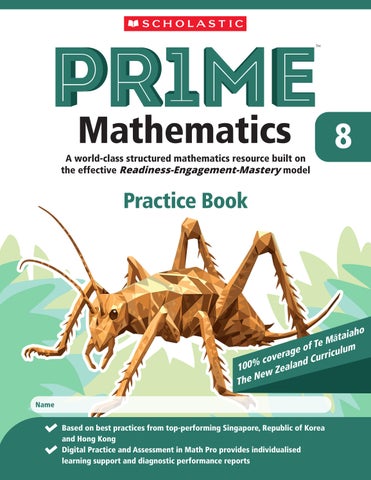
A world-class structured mathematics resource built on the effective Readiness-Engagement-Mastery model TM
Scholastic Mathematics (New Zealand Edition) is a proven structured mathematics resource that now offers 100% coverage of Te M taiaho The New Zealand Curriculum. Based on the best teaching and learning practices of the global top-performers in Mathematics, Singapore, Republic of Korea and Hong Kong, the effective Readiness-EngagementMastery instructional design and features ensure a strong foundation for STEM. Scholastic
TM
Mathematics is based on a pedagogical approach and instructional design that:
• Teaches via problem solving through the systematic development of problem-solving skills and by focusing on the method required to solve the problem, and the problem-solving process. • Is effective, measurable and diagnostic with a learnercentred and teacher-directed approach designed to enable assessment of understanding of concepts and mastery of skills at every step of concept development and learning.
• Advocates active learning and adaptivity with self reflection tools and scaffolded thinking processes. • Incorporates professional learning in the curriculum framework to develop the pedagogical content knowledge of educators to improve classroom practices. • Uses technology to enrich the learning and teaching experience with interactive content for whole-class teaching, extensive resources for teachers and diagnostic practice and assessment for students.
For Students
Practice Book
Teacher’s Guide
Digital ISBN 978-981-4813-24-2
www.scholastic.com
We honour the giant w t , a taonga species of Aotearoa, symbolising the richness of our natural heritage and the responsibility we all share as kaitiaki (guardians) of the environment.
Practice Book
100% coverage of Te M taiaho The New Zealand Curriculum
For Teachers
Coursebook
A world-class structured mathematics resource built on the effective Readiness-Engagement-Mastery model
8
Practice Book 8
• Promotes creative thinking and critical thinking by encouraging learners to innovate and craft alternative solutions to mathematical problems.
• Develops metacognition in learners enabling them to monitor, direct and communicate their thinking process.
o
taiah M f Te o e lum g u a c i r r cove and Cur % 0 10 Zeal w e N The Name
Based on best practices from top-performing Singapore, Republic of Korea and Hong Kong Digital Practice and Assessment in Math Pro provides individualised learning support and diagnostic performance reports
Contents Chapter 1
Whole Numbers
Unit 1
Whole Numbers to 1 000 000 000
Exercise 1.1
Reading and writing numbers up to 1 000 000 000………………………… xx
Exercise 1.2
Identifying values of digits………………………………………………………. xx
Exercise 1.3
Comparing and ordering numbers……………………………………………
Unit 2
Rounding and Estimation
Exercise 2.1
Rounding whole numbers to any specified power of 10………………….
Exercise 2.2
Checking reasonableness of answers in addition and subtraction…….
Exercise 2.3
Checking reasonableness of answers in multiplication or division………
Unit 3
Four Operations
Exercise 3.1
Multiplication and division by powers of 10………………………………….
Exercise 3.2
Using the order of operations…………………………………………………...
Unit 4
Problem Solving
Exercise 4.1
Word problems…………………………………………………………………….
Chapter 2
Properties of Numbers
Unit 1
Divisibility Rules
Exercise 1.1
Divisibility rules for 7 and 11………………………………………………………
Exercise 1.2
Generalising divisibility rules……………………………………………………...
Unit 2
Cube, Prime and Composite Numbers
Exercise 2.1
Identifying cube numbers ……………………………………………………….
Exercise 2.2
Identifying prime and composite numbers…………………………………...
Unit 3
Highest Common Factor
Exercise 3.1
Finding the highest common factor using prime factorisation …………...
Unit 4
Problem Solving
Exercise 4.1
Word problems………………………………………………………………………
Chapter 3
Angles
Unit 1
Angle Measures
Exercise 1.1
Estimating and measuring angles…………………………………………………
Unit 2
Finding Unknown Measures of Angles
Exercise 2.1
Using the properties of angles on a straight line, angles at a point and vertically opposite angles…………………………………………………………
Exercise 2.2
Using the properties of interior angles of triangles and quadrilaterals…….
Chapter 4
2D and 3D Shapes
Unit 1
2D Shapes
Exercise 1.1
Triangles ………………………………………………………………………………
Exercise 1.2
Quadrilaterals………………………………………………………………………..
Exercise 1.3
Polygons ………………………………………………………………………………
Unit 2
3D Shapes
Exercise 2.1
Nets …………………………………………………………………………………….
Review 1…………………………………………………………………….....................................
Chapter 5
Fractions
Unit 1
Fractions and Mixed Numbers
Exercise 1.1
Finding equivalent fraction and simplifying fractions…………………………
Exercise 1.2
Dividing whole numbers to get mixed numbers………………………………..
Exercise 1.3
Converting between improper fractions and mixed numbers………………
Unit 2
Operations on Fractions
Exercise 2.1
Adding and subtracting fractions with different denominators …………….
Exercise 2.2
Multiplying fractions by whole numbers ………………………………………….
Unit 3
Problem Solving
Exercise 3.1
Word problems ………………………………………………………………………..
Chapter 6
Decimals
Unit 1
Representing Decimals
Exercise 1.1
Decimals with 4 decimal places……………………………………………………
Exercise 1.2
Rounding decimals……………………………………………………………………
Exercise 1.3
Decimals in powers of 10…………………………………………………………….
Exercise 1.4
Converting between fractions and decimals…………………………………...
Exercise 1.5
Comparing fractions and decimals ………………………………………………
Unit 2
Four Operations of Decimals
Exercise 2.1
Adding and subtracting decimals………………………………………………....
Exercise 2.2
Multiplication and division by powers of 10……………………………………...
Exercise 2.3
Multiplying decimals by tens ………………………………………………………..
Exercise 2.4
Multiplying decimals by hundreds or thousands………………………………..
Exercise 2.5
Dividing whole numbers or decimals by tens……………………………………
Exercise 2.6
Dividing whole numbers by hundreds or thousands……………………………
Exercise 2.7
Multiplying decimals by a whole number………………………………………...
Exercise 2.8
Dividing whole numbers to get decimal quotients…………………………….
Unit 3
Problem Solving
Exercise 3.1
Word problems…………………………………………………………………………
Chapter 7
Length, Mass, Area and Volume
Unit 1
Measures
Exercise 1.1
Estimating and measuring length, mass, area and volume………………….
Exercise 1.2
Converting units of measurement…………………………………………………
Unit 2
Volume of Prism
Exercise 2.1
Finding volumes of rectangular prisms given area of one face and one dimension……………………………………………………………………………….
Exercise 2.2
Finding volumes of triangular prisms……………………………………………….
Exercise 2.3
Finding volumes of composite solid figures ……………………………………...
Unit 3
Problem Solving
Exercise 3.1
Word problems ………………………………………………………………………
Chapter 8
Integers
Unit 1
Understanding Integers
Exercise 1.1
Reading and placing integers on number lines………………………………
Exercise 1.2
Comparing integers ……………………………………………………………….
Unti 2
Adding and Subtracting Integers
Exercise 2.1
Adding integers …………………………………………………………………….
Exercise 2.2
Subtracting integers ……………………………………………………………….
Unit 3
Problem Solving
Exercise 3.1
Word problems………………………………………………………………………
Review 2…………………………………………………………………….....................................
Chapter 9
Time, Temperature and Data Storage
Unit 1
Time
Exercise 1.1
Estimating and measuring time…………………………………………………..
Exercise 1.2
Converting seconds and milliseconds ………………………………………….
Exercise 1.3
Reading and interpreting timetables ……………………………………………
Exercise 1.4
Using timetables and charts………………………………………………………..
Unit 2
Temperature
Exercise 2.1
Finding temperature………………………………………………………………..
Unit 3
Data Storage
Exercise 3.1
Data storage in secondary storage devices………………………………….
Chapter 10
Percentage and Proportion
Unit 1
Fractions, Decimals and Percentages
Exercise 1.1
Converting between decimals and percentages …………………………...
Exercise 1.2
Converting between fractions and percentages…………………………….
Exercise 1.3
Comparing and ordering fractions, decimals and percentages…………
Unit 2
Percentage of A Whole
Exercise 2.1
Finding a percentage of a whole number ………..………………………….
Exercise 2.2
Finding the whole given the percentage of the whole ……………………
Unit 3
Proportion
Exercise 3.1
Sharing using proportion ………………………………………………………….
Unit 4
Problem Solving
Exercise 4.1
Word problems involving percentage and proportion ………………………
Exercise 4.2
Word problems involving financial plans………………………………………….
Chapter 11
Position and Movement
Unit 1
Position and Pathways
Exercise 1.1
Grid references ……………………………………………………………………
Exercise 1.2
Map reading ……………………………………………………………………….
Unit 2
Transformation
Exercise 2.1
Properties of 2D and 3D shapes under different transformation……………
Exercise 2.2
Transformations in kōwhaiwhai patterns………………………………………….
Chapter 12
Algebra
Unit 1
Algebraic Expressions
Exercise 1.1
Writing and evaluating algebraic expressions involving more than one operation……………………………………………………………………………
Exercise 1.2
Simplifying algebraic expressions with like terms ………………………….
Exercise 1.3
Simplying algebraic expressions with unlike terms ………………………..
Exercise 1.4
Simplying algebraic expressions with brackets …………………………….
Unit 2
Algebraic Equations
Exercise 2.1
Solving linear algebraic equations ……………………………………………
Exercise 2.2
Linear patterns and equations …………………………………………………
Unit 3
Problem Solving
Exercise 3.1
Word problems …………………………………………………………………….
Review 3…………………………………………………………………….....................................
Chapter 13
Speed
Unit 1
Relationship Between Speed, Distance and Time
Exercise 1.1
Finding distance……………………………………………………………………
Exercise 1.2
Finding time taken …………………………………………………………………
Chapter 14
Statistics
Unit 1
Time Series and Relationship Investigations
Exercise 1.1 Posing and planning investigative questions ………………………………. Exercise 1.2
Data collection…………………………………………………………………….
Unit 2
Data Analysis
Exercise 2.1
Double-line graphs ………………………………………………………………
Exercise 2.2
Scatter plots………………………………………………………………………..
Exercise 2.3
Comparing data displays………………………………………………………
Chapter 15
Probability
Unit 1
Relative Frequency
Exercise 1.1
Using relative frequency to show real life probability……………………….
Exercise 1.2
Finding a more accurate relative frequency…………………………………
Unit 2
Chance Experiment
Exercise 2.1
Conducting chance experiments……………………………………………….
Review 4…………………………………………………………………….....................................