PR1ME Maths_Alignment Phases 1, 2 and 3_Updated July 2025
0.1 subitise (recognise without
Big Book 1 - Our Garden Friends Book KA Chapter 1
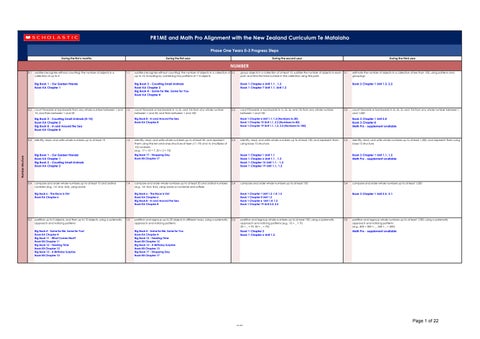
PR1ME and Math Pro Alignment with the New Zealand Curriculum Te Mataiaho
Phase One Years 0-3 Progress Steps
NUMBER
0.2
Big Book 2 - Counting Small Animals (0-10)
Book KA Chapter 2 Big Book 8 - In and Around the Sea Book KA Chapter 8
0.3 identify, read, and write whole numbers up to at least 10 1.3 identify, read, and write whole numbers up to at least 20, and represent them using the ten-and-ones structure of teen (11-19) and -ty (multiples of 10) numbers (e.g., 17 = 10 + 7, 20 = 2 × 10)
Big Book 1 - Our Garden Friends!
Book KA Chapter 1
Big Book 2 - Counting Small Animals
Book KA Chapter 2
Big Book 17 - Shopping Day Book KB Chapter 17
0.4 compare and order whole numbers up to at least 10 and ordinal numbers (e.g., 1st, 2nd, 3rd), using words 1.4 compare and order whole numbers up to at least 20 and ordinal numbers (e.g., 1st, 2nd, 3rd), using words or numerals and suffixes
Big Book 6 - The Race is On!
Book KA Chapter 6
Big Book 6 - The Race is On! Book KA Chapter 6
Big Book 8 - In and Around the Sea Book KA Chapter 8
Book 1 Chapter 1 Unit 1.1
Book 1 Chapter 6 Unit 1.1 , 1.2
Big Book 4 - Some for Me, Some for You!
Book KA Chapter 4
Big Book 11 - What Comes Next?
Book KB Chapter 11
Big Book 12 - Feeding Time
Book KB Chapter 12
Big Book 13 - A Birthday Surprise
Book KB Chapter 13
Big Book 4 - Some for Me, Some for You
Book KA Chapter 4
Big Book 12 - Feeding Time
Book KB Chapter 12
Big Book 13 - A Birthday Surprise
Book KB Chapter 13
Big Book 17 - Shopping Day
Book KB Chapter 17 Book 1 Chapter
Book 2 Chapter 1 Unit 1.1, 1.2 Math Pro - supplement available
1.6 use estimation to predict results and to check the reasonableness of calculations 2.6 use estimation to predict results and to check the reasonableness of calculations 3.6 use estimation to predict results and to check the reasonableness of calculations
Math Pro - Book 1 Chapter 15B 1.1 Estimating answers
0.6 join and separate groups of up to a total of 10 objects by grouping and counting 1.7 join and separate groups of up to a total of 20 objects and find the difference between groups by grouping and counting (e.g., 9 + 6, 7 + _ = 11)
Big Book 4 - Some for You, Some for Me!
Book KA Chapter 4
Big Book 12- Feeding Time
Book KB Chapter 12
Big Book 13 - A Birthday Surprise
Book KB Chapter 13
Big Book 12 - Feeding Time
Book KB Chapter 12
Big Book 13 - A Birthday Surprise
Book KB Chapter 13
Big Book 14 - A Day Indoors
Book KB Chapter 14
Book 2 Chapter 1 Unit 1.3 - content available on MATH PRO
Math Pro - supplement available
Book 3 Chapter 1 Unit 2.5, 3.4 - content available on MATH PRO
identify the nearest ten to any whole number up to 100 3.7 round whole numbers up to 1,000 to the nearest hundred or ten
Book 1 Chapter 19
add and subtract numbers up to 100 without renaming (e.g., 53 + 21, 55 – 32)
Book 1 Chapter 7
Book 3 Chapter 1 Unit 3.2, 3.3 - content available on MATH PRO
add and subtract numbers up to at least 100 (e.g., 43 – 28, 37 + 18)
Book 2 Chapter 2 1.8 explore addition facts up to 10 and their corresponding subtraction facts (families of facts), including doubles and halves
Big Book 5 - Off on a Picnic
Book KA Chapter 5
Big Book 14 - A Day Indoors
Book KB Chapter 14
recall addition facts up to 10, and explore addition facts up to 20 and their corresponding subtraction facts (families of facts), including doubles and halves 3.9 recall addition facts up to 20 and their corresponding subtraction facts (families of facts), including doubles and halves
Book 1 Chapter 2
Book 1 Chapter 3
Book 1 Chapter 4
Book 1 Chapter 7
Book 1 Chapter 17
Book 2 Chapter 9 Unit 1.2
Book 2 Chapter 9 Unit 2.1 - 2.3
identify the relationship between skip counting and multiplication facts for 2s, 5s, and 10s 3.10 recall multiplication and corresponding division facts for 2s, 3s, 5s, and 10s
Book 1 Chapter 19 Unit 2.2
Book 1 Chapter 20
1.9 multiply and divide using equal grouping or counting 2.11 multiply and divide using equal grouping or skip counting (e.g., in 2s, 5s, and 10s)
Big Book 4 Some for Me Some for You
Big Book 12 Feeding Time
Book 1 Chapter 16 and 17
identify and represent halves and quarters as fractions of sets and regions, using equal parts of the whole 2.12 identify, read, write (using symbols and words), and represent halves, quarters, and eighths as fractions of sets and regions, using equal parts of the whole
Big Book 12 Feeding Time
Book KB Chapter 12
Big Book 13 A Birthday Surprise
Book KB Chapter 13
Book 1 Chapter 16
Book 2 Chapter 8
Book 2 Chapter 10
3.11 multiply a one- or two-digit number by a one-digit number, using skip counting or known facts (e.g., 4 × 6, 2 × 23)
Book 2 Chapter 8 Unit 1.1 - 3.2
Book 2 Chapter 10 Unit 1.1 - 2.2
3.12 divide whole numbers by a one- digit divisor with no remainders, using grouping (e.g., 24 ÷ 3, 32 ÷ 4)
Book 2 Chapter 8 Unit 4.1 - 6.1
Book 2 Chapter 10 Unit 3.1 - 4.1
3.13 identify, read, write, and represent halves, thirds, quarters, fifths, sixths, and eighths as fractions of sets and regions, using equal parts of the whole and by positioning on a number line
Book 2 Chapter 12
2.13 directly compare two fractions involving halves, quarters, and eighths 3.14 compare and order fractions involving halves, quarters, and eighths and identify when two fractions are equivalent
Book 1 Chapter 16
Book 3 Chapter 11 Unit 1.2, 1.4, 2,1, 2.2, 2.3 - content available on MATH PRO find a half or quarter of a set using equal sharing and grouping. find a half and quarter of a set by identifying groups and patterns (rather than sharing by ones), and identify the whole set or shape when given a half or quarter
Big Book 12 Feeding Time Book KB Chapter 12
Big Book 13 A Birthday Surprise Book KB Chapter 13
Book 1 Chapter 16
3.15 find a unit fraction of a whole number (e.g., ⅓ of 15), and identify the whole set or amount when given a unit fraction (e.g., “ ¼ of the set is 3, what is the whole set?”)
Book 2 Chapter 12 Unit 1.2 -1.4, Unit 2.1, 2.2
3.16 add and subtract unit fractions with the same denominator (e.g.,⅛ + ⅛ + ⅛ = ⅜) Math Pro - supplement available 2.15 recognise and order New Zealand denominations up to $20 according to their value, make groups of 'like' denominations, and calculate their value.
Book 1 Chapter 20
Book 2 Chapter 11- content available on MATH PRO Math Pro -Book 2 Chapter 11A Unit 1.1A-4.2A
3.17 make amounts of money using one- and two-dollar coins and 5-, 10-, 20-, 50-, and 100dollar notes.
Book 2 Chapter 11 Unit 1.6
ALGEBRA
During
During the first 6 months
During the first year
MEASUREMENT
0.8 directly compare two objects by an attribute (e.g., length, mass (weight), capacity) 1.15 compare the length, mass (weight), volume, or capacity of objects directly or indirectly (e.g., by comparing each of them with another object, used repeatedly)
7 - At The Museum
7 Big Book 7 - At the Museum
During the second year
2.19 estimate and use an informal unit repeatedly to measure the length, mass (weight), volume, or capacity of an object
Book 1 Chapter 10 Unit 1.1 - 1.3
Book 1 Chapter 11 Unit 1.1 - 2.2
Book 1 Chapter 12 Unit 1.1, 2.2
compare and order several objects using informal units of length, mass (weight), volume, or capacity
Book 1 Chapter 10 Unit 1.1 - 1.3 Book 1 Chapter 11 Unit 1.1 - 2.2 Book 1 Chapter 12 Unit 1.1, 2.2
During the third year
3.21 estimate and then reliably measure length, capacity, and mass (weight) using wholenumber metric units (e.g., from tools with labelled markings)
Book 2 Chapter 3 Unit 1.1, 2.1
Book 2 Chapter 4 Unit 1.1, 2.1
Book 2 Chapter 5 Unit 1.1
compare and order objects using metric units of length, mass (weight), or capacity
Book 2 Chapter 3 Unit 1.1, 2.1
Book 2 Chapter 4 Unit 1.1, 2.1
Book 2 Chapter 5 Unit 1.1 2.21 turn, and describe how far an object or person has turned, using full, half, and quarter turns as benchmarks
0.9 connect days of the week to familiar events and daily routines (e.g., the class timetable). identify how the passing of time is measured in years, months, weeks, days, hours
2.22 name and order the months and seasons, and describe the duration of familiar events using months, weeks, days, and hours
3.24 identify the duration of events using years, months, weeks, days, hours, minutes, and seconds
Big Book 9 - A Time for Everything Book KA Chapter 9
name and order the days of the week, and sequence events in a day using everyday language of time
Big Book 9 - A Time for Everything Book KA Chapter 9
Book 1 Chapter 18 Math Pro - supplement available
Book 2 Chapter 13 Unit 3.1, 3.2
Math Pro - Book 2 Chapter 13 Unit 3A
1.17 tell the time to the hour using the language of 'o'clock'. 2.23 tell the time to the hour and half-hour, using the language of ‘past’ and 'o'clock' 3.25 tell the time to the hour, half- hour, and quarter past and quarter to the hour
Book 1 Chapter 18 Unit 2.1 - content available on MATH PRO Book 1 Chapter 18 Unit 2.1, 2.2
Book 2 Chapter 13 2.24 visualise, estimate, and measure the perimeter and area of 2D shapes, using informal units. 3.26 visualise, estimate, and measure: – the perimeter of polygons using metric units – the area of 2D shapes using squares of identical size – the volume of rectangular prisms (cuboids) by filling them with identical 3D blocks.
Math Pro - supplement available
Math Pro - supplement available
Math Pro - Book 5 Chapter 16B Unit 1.2 (volume of rectangular prism)
Big Book
KA Chapter
0.10 identify, sort by one feature, and describe familiar 2D shapes 1.18 identify, describe, and sort familiar 2D and 3D shapes presented in different orientations, including triangles, circles, rectangles (including squares), cubes, cylinders, and spheres
identify, describe, and sort 2D and 3D shapes, including ovals, semicircles, polygons (e.g., hexagons, pentagons), rectangular prisms (cuboids), pyramids, hemispheres, and cones, using the attributes of shapes 3.27 visualise, identify, compare, and sort 2D and 3D shapes, using the attributes of shapes
Book
- Shapes
Big Book 10 - Shapes can Fly Book KB Chapter 10
Big
STATISTICS
1.23 pose a summary investigative question about a group for which the data will have categorical variables (e.g., colour, brand), and anticipate what the data might show
a summary investigative question about a group for which the data will have categorical variables, and anticipate what the data might show (e.g., which outcomes might be more frequent than others) 3.33 pose a summary investigative question about an everyday situation, using categorical data and discrete numerical (whole number) data, identify the variable and group of interest, and anticipate what the data might show
1.29 engage in stories or games that involve chance-based situations and: – decide if something will happen, won’t happen, or might happen – identify possible and impossible outcomes (e.g., for what might happen next).
PROBABILITY
2.36 engage in chance-based investigations about games and everyday situations to:
– anticipate and then identify possible outcomes
– collect and record data
– create data visualisations for frequencies of possible outcomes (e.g., lists, pictures, graphs)
– describe what these visualisations show – answer the investigative question
– notice variations in outcomes (e.g., how often each of the numbers on a dice come up)
3.39 engage in chance-based investigations about games and everyday situations to: – anticipate and then identify possible outcomes – collect and record data – create data visualisations for frequencies of possible outcomes (e.g., lists, pictures, graphs)
– describe what these visualisations show – answer the investigative question
PR1ME and Math Pro Alignment with the New Zealand Curriculum Te Mataiaho
Phase Two Years 4-6 Progress Steps
During year 4
4.1 skip count from any multiple of 100, forwards or backwards in 25s and 50s
Book 3 Chapter 1 Unit 1.1, 2.2
Math Pro -Book 4 Chapter 1 Unit 2.1B
4.2 identify, read, write, compare, and order whole numbers up to 10,000, and represent them using base 10 structure
Book 4 Chapter 1 Unit 1.1 , 2.1 - content on MATH PRO
During year 5
NUMBER
During year 6
4.3 use rounding, estimation, and inverse operations to predict results and to check the reasonableness of calculations
Book 3 Chapter 2 Unit 2.5 (add)
Book 3 Chapter 2 Unit 3.4 (subtract)
Book 3 Chapter 4 Unit 1.7 (Products)
Book 3 Chapter 4 Unit 3.3 (Quotient)
5.1 identify, read, write, compare, and order whole numbers up to 100,000, and represent them using base 10 structure
Book 5 Chapter 1 Unit 1.1 - 1.3 - content on MATH PRO
5.2 identify factors of numbers up to 100
Book 5 Chapter 1 Unit 4.1 - content on MATH PRO
5.3 use rounding, estimation, and inverse operations to predict results and to check the reasonableness of calculations
Book 4 Chapter 1 Unit 3.2-3.4
Book 4 Chapter 2 Unit 2.6
4.4 round whole numbers to the nearest thousand, hundred, or ten 5.4 round whole numbers to the nearest ten thousand, thousand, hundred, or ten, and round tenths to the nearest whole number
Book 3 Chapter 1 Unit 3.2, 3.3
Book 4 Chapter 1 Unit 3.2, 3.3, 3.4
Book 4 Chapter 10 Unit 3.1, 3.2 (Rounding decimals)
6.1 identify, read, write, compare, and order whole numbers up to 1,000,000, and represent them using base 10 structure
Book 5 Chapter 1 Unit 1.1 , 1.2
6.2 identify square numbers and factors of numbers up to 125
Book 5 Chapter 1 Unit 6.2
Book 5 Chapter 1 Unit 4.1 (only up to 100)
Math Pro - Book 6 Chapter 1 Unit 1A.1, 1A.2
6.3 use rounding, estimation, and inverse operations to predict results and to check the reasonableness of calculations
Book 5 Chapter 1 Unit 2.1, 2.2
Book 5 Chapter 2 Unit 1.5, 2.5
6.3 round whole numbers to a specified power of 10, and round tenths and hundredths to the nearest whole number or one decimal place
Book 5 Chapter 1 Unit 2.1, 2.2
Book 5 Chapter 11 Unit 1.5, 2.6, 2.7
4.5 add and subtract two- and three-digit numbers 5.5 add and subtract whole numbers up to 10,000 6.3 add and subtract any whole numbers
Book 3 Chapter 2 Unit 1.1, 1.2 (without renaming)
Book 3 Chapter 2 Unit 2.1 - 2.4 (with renaming)
Book 3 Chapter 2 Unit 3.1 - 3.3 (with renaming)
Book 4 Chapter 2 Unit 1.1
4.6 recall multiplication and corresponding division facts for 4s and 6s 5.6 recall multiplication facts for 7s, 8s, and 9s and corresponding division facts 6.4 recall multiplication facts to at least 10 × 10 and corresponding division facts
Book 3 Chapter 3 Unit 2.1 (Multiplying by 6)
Book 3 Chapter 3 Unit 2.2 (Dividing by 6)
Math Pro - Book 4 Chapter 3 Unit A
4.7 multiply a two-digit by one-digit number and two one-digit whole numbers (e.g.,23 × 5, 7 × 8)
Book 3 Chapter 4 Unit 1.2, 1.3 1.4, 1.5, 1.6
Math Pro - Year 5 Supplement Chapter 2 Unit A
5.7 multiply a three-digit by one-digit number and two two-digit whole numbers (e.g., 245 × 6, 34 × 83)
4.8 divide up to a three-digit whole number by a one-digit divisor, with no remainder (e.g., 65 ÷ 5)
Book 3 Chapter 4 Unit 3.1, 3.2
4.9 identify, read, write, and represent tenths as fractions and decimals
Book 3 Chapter 11 Unit 1.2-1.4 (Compare and Order Fractions)
Book 4 Chapter 10 Unit 1.1, 1.2, 1.6, 1.7 (Decimals)
compare and order tenths as fractions and decimals, and convert decimal tenths to fractions (e.g., 0.3 = ³ ₁₀ )
Book 3 Chapter 11 Unit 1.2-1.4 (Compare and Order Fractions)
Book 4 Chapter 10 Unit 1.9, 1.10 (Decimals)
During year 5
5.8 divide up to a three-digit whole number by a one-digit divisor, with a remainder (e.g., 83 ÷ 5 = 16, remainder 3)
Book 4 Chapter 3 Unit 2.1 - 2.3
5.9 identify, read, write, and represent tenths and hundredths as fractions and decimals
Book 4 Chapter 10
compare and order tenths and hundredths as fractions and decimals, and convert decimal tenths and hundredths to fractions
Book 4 Chapter 10 Unit 2.6-2.7
During year 6
6.5 divide up to a four-digit whole number by a one-digit divisor, with a remainder (e.g., 198 ÷ 7, 4154 ÷ 8)
Book 5 Chapter 2 Unit 2.3
6.5 use the order of operations rule with grouping, addition, subtraction, multiplication, and division
Book 5 Chapter 2 Unit 3.1, 3.2, 3.3, 3.4
6.7 identify, read, write, and represent fractions, decimals (to two places), and related percentages
Book 5 Chapter 3 (Not %)
Book 5 Chapter 8 Unit 1.1 (Not %)
compare and order fractions, decimals (to two places), and percentages, and convert decimals and percentages to fractions
Book 5 Chapter 8 Unit 1.4-1.7 (Not %)
divide whole numbers by 10 to make decimals divide whole numbers by 10 and 100 to make decimals multiply and divide numbers by 10 and 100 to make decimals and whole numbers (e.g., 1.3 × 10 = 13)
Book 5 Chapter 11 Unit 1.1-3.1 - content on MATH PRO Book 5 Chapter 11 Unit 1.1-3.1 - content on MATH PRO Book 5 Chapter 11 Unit 1.1-3.1
4.12 for fractions with related denominators of 2, 4, and 8, 3 and 6, or 5 and 10:
–compare and order the fractions –identify when two fractions are equivalent by directly comparing them, noticing the simplest form (e.g., ³ ₆ = ½ , which is the simplest form)
Book 3 Chapter 11 Unit 1.2
Book 3 Chapter 11 Unit 2.1 - 2.4
4.13 convert (using number lines) between mixed numbers and improper fractions with denominators of 2, 3, 4, 5, 6, 8, and 10
Book 3 Chapter 11 Unit 1.4 (Fractions within a Number line)
4.14 find a unit fraction of a whole number, using multiplication or division facts and where the answer is a whole number (e.g., ⅕ of 40)
identify, from a unit fraction part of a set, the whole set
Book 3 Chapter 11 (A.O is partially covered)
Book 4 Chapter 5 Unit 3.1, 3.2
for fractions with denominators of 2, 3, 4, 5, 6, 8, 10, 12, or 100: –compare and order the fractions –identify when two fractions are equivalent
Book 4 Chapter 5 Unit 1.1-2.4
5.13 convert between mixed numbers and improper fractions with denominators of up to 10
Book 4 Chapter 4 Unit 2.2 - 2.4
5.14 find a fraction of a whole number, using multiplication and division facts and where the answer is a whole number (e.g., ⅔ of 24)
identify, from a fractional part of a set, the whole set
Book 4 Chapter 5 Unit 3.3 (mult fraction of a whole number)
Math Pro - Book 5 Chapter 3A Unit 3, Unit 4
for fractions with denominators of 2, 3, 4, 5, 6, 8, 10, 12, or 100: –compare and order the fractions –identify when two fractions are equivalent –represent the fractions in their simplest form
Book 5 Chapter 3 Unit 1.1-3.1
6.11 convert between mixed numbers and improper fractions
Math Pro - Book 5 Chapter 3A and supplements
6.12 find a fraction or percentage of a whole number where the answer is a whole number (e.g., ⅜ of 48; 30% of $150)
identify, from a fractional part of a set, the whole set
Math Pro - Book 5 Chapter 3A and supplements
During year 4
4.15 add and subtract fractions with the same denominators to make up to one whole (e.g., ⅜ + ⅜ + ²⁄ ₈ = ⁸ ⁄ ₈ = 1 )
Book 3 Chapter 11 Unit 3.1, 4.1
4.16 add and subtract decimals to one decimal place (e.g., 1.3 + 0.2 = 1.5)
Book 5 Chapter 9 Unit 1.1, 1.2, 1.3 - content on MATH PRO
Book 5 Chapter 9 Unit 2.1, 2.2 - content on MATH PRO
4.17 use doubling or halving to scale a quantity (e.g., to double or halve a recipe)
Book 3 Chapter 6 Unit 4.1 - 4.2
Math Pro - Book 4 Chapter 11 Unit 5A
4.18 make amounts of money using dollars and cents (e.g., to make 3 dollars and 70 cents)
Book 3 Chapter 5 Unit 1.3
4.19
estimate and calculate the total cost and change for items costing whole-dollar amounts.
Book 3 Chapter 5 Unit 1.2 - 1.5
During year 5
5.15 add and subtract fractions with the same denominators, including to make more than one whole
Book 4 Chapter 5 Unit 1.1 - 1.2 (adding two and three fractions)
Book 4 Chapter 5 Unit 2.1 - 2.4 (subtracting fractions)
5.16 add and subtract whole numbers and decimals to two decimal places (e.g., 32.55 – 21.21 = 11.34)
Book 5 Chapter 9 Unit 1.4 - content available on MATH PRO
5.17 use known multiplication facts to scale a
During year 6
6.13 add and subtract fractions with the same or related denominators (e.g., ¼ + ⅛ )
Book 5 Chapter 3 Unit 1.1-3.1
6.14 add and subtract whole numbers and decimals to two decimal places (e.g., 250.11 + 135.29 = 385.4)
Book 5 Chapter 9
use known multiplication and division facts to scale a quantity
Pro - Book 5 Chapter 2 Unit 1.6A Book 5 Chapter 2 (Various Units and supplements)
5.18 represent money values in multiple ways using notes and coins 6.16 solve problems involving purchases (e.g., ensuring they have enough money)
create simple financial plans (e.g., shopping lists, a family budget)
Pro - Book 5 Chapter 9 Unit 2.9A, 2.10A MATH PRO supplements to come Term 3 2025
5.19 estimate to the nearest dollar and calculate the total cost of items costing dollars and cents, and the change from the nearest ten dollars.
Book 4 Chapter 10 Unit 3.1 (Rounding decimals to nearest whole number) Math Pro - Book 5 Chapter 9 2.9A, 2.10A
6.17 calculate 10%, 25%, and 50% of whole-dollar amounts (e.g., 50% of $280).
Book 6 Chapter 12 Unit 3.1, 4.1, 4.2 - content available on MATH PRO
During year 4
form and solve true or false number sentences and open number sentences involving multiplication and division, using an understanding of the equal sign
Book 3 Chapter 3
Math Pro - Book 4 Chapter 3B, 3C
4.21 recognise and describe the rule for a growing pattern using words, tables, and diagrams, and make conjectures about further elements in the pattern
During year 5
form and solve true or false number sentences and open number sentences involving all four operations (e.g., 674 + 56 – _ = 671)
MathPro Book 4 Chapter 3 Unit 3A.1, 3A.2 and 3B (more to come by end of July)
5.21 use tables to recognise the relationship between the ordinal position and its corresponding element in a growing pattern, develop a rule for the pattern in words, and make conjectures about further elements or terms in the pattern
In Mindstretchers eg Book 4 Chapter 1 Unit 4.1 (Course Book) - content on MATH PRO Math Pro - Book 5 Chapter 12A
4.22 create and use an algorithm for generating a pattern or pathway.
Book 4 Mission Possible 1 and 2 (Course Book only)content on MATH PRO
5.22 create and use an algorithm for generating a pattern, procedure, or pathway.
Book 5 Mission Possible 1 and 2 (Course Book only)content available on MATH PRO
During year 6
form and solve true or false number sentences and open number sentences involving all four operations, using an understanding of equality or inequality (e.g., 8 × 7 < 8 × 5 + 8 (T or F?)
Book 5 Chapter 2 Chapter 3A.1 Math Pro Supplement Math Pro - Book 6 Chapter 4A Unit 2.1, 2.2
6.19 use tables, XY graphs, and diagrams to recognise relationships in a linear pattern, develop a rule for the pattern in words (i.e., that there is a constant amount of change between consecutive elements or terms), and make conjectures about further elements in the pattern
6.20 create and use algorithms for making decisions that involve clear choices.
Book 5 and 6 Mission Possible (Course Book only)
During year 4
4.23 measure body parts (e.g., the arm) or familiar objects and use these as benchmarks to estimate and then measure length, mass (weight), capacity, and duration, using appropriate metric or time- based units
Math Pro Year 4 Chapter 5A Unit 1 (personal benchmarks)
Math Pro Year 4 Chapter 9 Unit A (grid maps)
Math Pro Year 4 Chapter 13A Unit 1
4.24 use appropriate units to describe length, mass (weight), capacity, and time
Book 3 Chapter 8 Unit 2.1, 2.2 (Length)
Book 3 Chapter 9 Unit 1.1-1.3 (Mass)
Book 3 Chapter 10 Unit 1.1-2.1 (Capacity)
Book 3 Chapter 12 Unit 1.1-2.1 (Time)
4.25 use the metric measurement system to explore relationships between units
Book 3 Chapter 8, 9 and 10
4.26 recognise that angles can be measured in degrees, using 90, 180, and 360 degrees as benchmarks
Book 3 Chapter 13 (Angles - identifying and naming points, lines, line segments, drawing angles)
4.27 tell the time to the nearest 5 minutes, using the language of ‘minutes past the hour’ and ‘to the hour’
Book 3 Chapter 12 1.1-1.2
4.28 visualise, estimate, and measure: –the perimeter of polygons, using metric units (cm and m) –the area of shapes covered with squares or half squares –the volume of shapes filled with centicubes, taking note of layers and stacking.
Math Pro - Book 5 Chapter 16B Unit 1.2, 2.1
MEASUREMENT
During year 5
5.23 estimate and then accurately measure length, mass (weight), capacity, temperature, and duration, using appropriate metric or time-based units or a combination of units
Book 4 Chapter 6 (Length, Mass and Volume)
Book 4 Chapter 15 (Time)
5.24 use the appropriate tool for a measurement and the appropriate unit for the attribute being measured
Book 4 Chapter 6 (Length, Mass and Volume)
Book 4 Chapter 15 (Time)
5.25 use the metric measurement system to explore relationships between units, including relationships represented by benchmark fractions and decimals
Math Pro - Book 5 Chapter 3A More Fractions Unit 5
5.26 describe angles using the terms acute, right, obtuse, straight, and reflex, comparing them with benchmarks of 90, 180, and 360 degrees
Math Pro - Book 5 Chapter 4
During year 6
6.21 estimate and then accurately measure length, mass (weight), capacity, temperature, and duration, using appropriate metric or time-based units or a combination of units
Book 5 Chapter 17
6.22 select and use the appropriate tool for a measurement and the appropriate unit for the attribute being measured
Book 5 Chapter 17
6.23 convert between common metric units for length, mass (weight), and capacity, and use decimals to express parts of wholes in measurements
Book 5 Chapter 3A More Fractions Unit 5.1-5.4 - Math Pro
6.24 visualise, measure, and draw (to the nearest degree) the amount of turn in angles up to 360 degrees
Math Pro - Book 5 Chapter 3A More Fractions Unit 5 Book 5
5.27 describe the differences in duration between units of time (e.g., days and weeks, months, and years), and solve duration-oftime problems involving 'am' and 'pm' notation
Book 2 Chapter 12 Unit 2.1, 2.2 - content available on MATH PRO
Book 3 Chapter 12 Unit 1.2 - content available on MATH PRO
5.28 visualise, estimate, and calculate: –the perimeter of regular polygons (in m, cm, and mm) –the area of shapes covered with squares or partial squares –the volume of rectangular prisms filled with centicubes, taking note of layers and stacking.
Book 4 Chapter 14
Math Pro - Book 5 Chapter 16B Unit 1.2, 2.1
6.25 convert between units of time and solve duration-of-time problems, in both 12- and 24-hour time systems
Book 3 Chapter 12 Unit 1.2, 1.3, 3.1 - content available on MATH PRO
Book 4 Chapter 15 Unit 3.1–3.4 - content available on MATH PRO
6.26 visualise, estimate, and calculate the area of rectangles and right-angled triangles (in cm2 and m2) and the volume of rectangular prisms (in cm3), by applying multiplication.
Book 5 Chapter 16 Unit 2.2
Math Pro - Book 6 Chapter 14A Unit 1
Math Pro - Book 6 Chapter 14A Unit 2
During year 4
4.29 identify, classify, and describe the attributes of polygons (including triangles and quadrilaterals) using properties of shapes, including line and rotational symmetry
Book 4 Chapter 12 Unit 1.1-2.3 - content on MATH PRO
compare angles in 2D shapes, classifying them as equal to, smaller than, or larger than a right angle
Book 3 Chapter 13 Unit 2.1
4.31 identify the 2D shapes that compose 3D shapes (e.g., a triangular prism is made from two triangles and three rectangles)
Book 3 Chapter 14 Unit 1.1-3.1
4.32 visualise, predict, and identify which shape is a reflection, rotation, or translation of a given 2D shape
Math Pro Book 4 Chapter 12A L 1 & 2
4.33 use grid references to identify regions and plot positions on a grid map
interpret and describe pathways, including those involving half and quarter turns and the distance travelled.
Book 3 Chapter 15 Unit 1.1, 2.1, 2.2
Math Pro -Book 4 Chapter 9 Unit 2A
During year 5
5.29 identify, classify, and describe the attributes of: –regular and irregular polygons, using edges, vertices, and angles
–prisms, using cross sections, faces, edges, and vertices
Book 4 Chapter 12 Unit 1.2-1.3 (Identify and name polygons)
Book 4 Chapter 13 Unit 1.1-1.2 (prisms)
During year 6 5.30 GEOMETRY
identify and describe parallel and perpendicular lines, including those forming the sides of polygons
Book 5 Chapter 5 Unit 1.1, 2.1 - content available on MATH PRO
5.31 visualise 3D shapes and connect them with nets, 2D diagrams, verbal descriptions, and the same shapes drawn from different perspectives
Book 4 Chapter 13
5.32 resize (enlarge or reduce) a 2D shape
Math Pro - Chapter 15, L 2A
5.33 interpret and create grid maps to plot positions and pathways, using grid references and directional language, including the four main compass points.
6.27 identify, classify, and explain similarities and differences between: –2D shapes, including different types of triangle –prisms and pyramids
Book 5 Chapter 6 Unit 1.1-1.3
6.28 identify and describe the interior angles of triangles and quadrilaterals
Book 5 Chapter 6
6.29 visualise and draw nets for rectangular prisms
Book 4 Chapter 9 Unit 1.1 - 1.3 Math Pro - Book 5 Chapter 15 Unit 3A
Book 4 Chapter 13 Unit 2.1 - content available on MATH PRO
6.3 visualise, create, and describe 2D geometric patterns and tessellations, using rotation, reflection, and translation and identifying the properties of shapes that do not change
Book 5 Chapter 7 Unit 1.1-1.3
Math Pro - Book 6 Chapter 10 L 3A
Math Pro - Book 6 Chapter 15A Tessellations
6.31 interpret and create grid references and simple scales on maps use directional language, including the four main compass points, turn (in degrees), and distance (in m, km) to locate and describe positions and pathways.
Book 3 Chapter 15 Unit 2.1, 2.2 - content available on MATH PRO
Book 4 Chapter 9 Unit 1.1, 1.2, 1.3 - content available on MATH PRO
During year 4
4.34 use multivariate data to investigate summary and comparison situations with categorical and discrete numerical data, by:
–posing an investigative question that can be answered with data
–making conjectures or assertions about expected findings
Book 3 Chapter 7 Unit 1.1 - 4.1 (Some Ao's covered here)
MATH PRO supplements to come Term 3 2025
4.35 plan how to collect primary data to support answering the investigative question, including:
–deciding on the group of interest
–deciding on the variable or variables for which data will be collected
–taking account of ethical practices in data collection
Book 3 Chapter 7 Unit 1.1 - 4.1 (Some Ao's covered here)
MATH PRO supplements to come Term 3 2025
During year 5
5.34 use multivariate data to investigate summary and comparison situations with categorical and discrete numerical data, by:
–posing an investigative question that can be answered with data
–making conjectures or assertions about expected findings
Book 4 Chapter 7 Unit 1A.1 (Supplement) (Some of Ao's covered here)
MATH PRO supplements to come Term 3 2025
5.35 plan how to collect primary data to support answering the investigative question, including:
–deciding on the group of interest
–deciding on the variable or variables for which data will be collected
–taking account of ethical practices in data collection
Book 4 Chapter 7 Unit 1A.1 (Supplement)
(Some of Ao's covered here)
MATH PRO supplements to come Term 3 2025
use a variety of tools to collect the data, and check for errors in it use a variety of tools to collect the data, check for errors in it, and correct them by re-collecting the data, if possible
Book 3 Chapter 7 Unit 1.1 - 4.1 (Some Ao's covered here)
MATH PRO supplements to come Term 3 2025
4.37 create and describe data visualisations to make meaning from the data, with statements including the name of the variable
Book 3 Chapter 7 Unit 1.1 - 4.1 (Some Ao's covered here)
MATH PRO supplements to come Term 3 2025
4.38 choose descriptive statements that best answer the investigative question, reflecting on findings and how they compare with initial conjectures or assertions
Book 3 Chapter 7 Unit 1.1 - 4.1 (Some Ao's covered here)
MATH PRO supplements to come Term 3 2025
check the statements that others make about data to see if they make sense, using information to clarify or correct statements where needed.
Book 3 Chapter 7 Unit 1.1 - 4.1 (Some Ao's covered here)
MATH PRO supplements to come Term 3 2025
Book 4 Chapter 7 Unit 1A.1 (Supplement)
(Some of Ao's covered here)
MATH PRO supplements to come Term 3 2025
5.37 create and describe data visualisations to make meaning from the data, with statements including the names of the variable and group of interest
Book 4 Chapter 7 Unit 1A.1 (Supplement)
(Some of Ao's covered here)
MATH PRO supplements to come Term 3 2025
5.38 answer the investigative question, comparing findings with initial conjectures or assertions and their existing knowledge of the world
Book 4 Chapter 7 Unit 1A.1 (Supplement)
(Some of Ao's covered here)
MATH PRO supplements to come Term 3 2025
5.39 check and, if necessary, improve the statements others make about data, including data from two or more sources.
Book 4 Chapter 7 Unit 1A.1 (Supplement)
(Some of Ao's covered here)
MATH PRO supplements to come Term 3 2025
During year 6
6.32 use multivariate data to investigate summary, comparison, and time-series situations, by:
–posing an investigative question that can be answered with data
–making conjectures or assertions about expected findings
Book 5 Chapter 14 Unit 1.1, 1A.1 (Supplement) and 2.1-3.2 (Some of Ao's covered here)
MATH PRO supplements to come Term 3 2025
6.33 plan how to collect primary data or how to use provided data, including identifying the variables of interest and, for provided data:
–identifying who the data was collected from –identifying the original investigator’s purpose for collecting the data
–deciding if the source is reliable (e.g., by checking if survey questions appear to be biased towards a particular point of view)
Book 5 Chapter 14 Unit 1.1, 1A.1 (Supplement) and 2.1-3.2
(Some of Ao's covered here)
MATH PRO supplements to come Term 3 2025
collect primary data and check for errors, and provide information about variables in secondary data (e.g., how data was collected for them and possible outcomes for them)
Book 5 Chapter 14 Unit 1.1, 1A.1 (Supplement) and 2.1-3.2
(Some of Ao's covered here)
MATH PRO supplements to come Term 3 2025
6.35 create and describe a variety of data visualisations to make meaning from the data, identifying features, patterns, and trends in context, and including the variable and group of interest
Book 5 Chapter 14 Unit 1.1, 1A.1 (Supplement) and 2.1-3.2
(Some of Ao's covered here)
MATH PRO supplements to come Term 3 2025
6.36 answer the investigative question, comparing findings with initial conjectures or assertions and their existing knowledge of the world
Book 5 Chapter 14 Unit 1.1, 1A.1 (Supplement) and 2.1-3.2
(Some of Ao's covered here)
MATH PRO supplements to come Term 3 2025
6.37 identify, explain, check, and, if necessary, improve features in others' data investigations (e.g., biased survey questions, misleading information or statements).
Book 5 Chapter 14 Unit 1.1, 1A.1 (Supplement) and 2.1-3.2
(Some of Ao's covered here)
MATH PRO supplements to come Term 3 2025
4.40 engage in chance-based investigations with equally likely outcomes by:
–posing an investigative question
–anticipating and then identifying possible outcomes for the investigative question
–generating all possible ways to get each outcome (a theoretical approach), or undertaking a probability experiment and recording the occurrences of each outcome
–creating data visualisations for possible outcomes
–describing what these visualisations show
–finding probabilities as fractions
–answering the investigative question
–reflecting on anticipated outcomes
5.40 engage in chance-based investigations, including those with not equally likely outcomes, by:
–posing an investigative question
–anticipating and then identifying possible outcomes for the investigative question
–generating all possible ways to get each outcome (a theoretical approach), or undertaking a probability experiment and recording the occurrences of each outcome
–creating data visualisations for possible outcomes
–describing what these visualisations show
–finding probabilities as fractions
–answering the investigative question
–reflecting on anticipated outcomes
–(at year 6) comparing findings from the probability experiment and associated theoretical probabilities, if the
6.38 engage in chance-based investigations, including those with not equally likely outcomes, by:
–posing an investigative question
–anticipating and then identifying possible outcomes for the investigative question
–generating all possible ways to get each outcome (a theoretical approach), or undertaking a probability experiment and recording the occurrences of each outcome
–creating data visualisations for possible outcomes
–describing what these visualisations show
–finding probabilities as fractions
–answering the investigative question
–reflecting on anticipated outcomes
–(at year 6) comparing findings from the probability experiment and associated theoretical probabilities, if the theoretical model MATH PRO supplements to come Term 3 2025
and
(Basic) agree or disagree with others’ conclusions about chancebased investigations.
evaluate others’ statements about chance- based investigations, with justification.
identify, explain, and check others’ statements about chancebased investigations, referring to evidence.
PR1ME and Math Pro Alignment with the New Zealand Curriculum Te Mataiaho
Phase Three Years 7 - 8 Progress Steps
During year 7
During year 8
The alignment referenced for year 8 below is applicable for 2025, as year 8 students are currently using PR1ME Book 6. From 2026, year 8 students will be assigned PR1ME Book 8, which will be aligned fully with the year 8 teaching sequence statements of the revised maths and statistics learning area.
NUMBER
7.1 identify, read, write, compare, and order whole numbers using powers of ( e.g., 10,000 = 10 ⁴ )
Math Pro - Year 7 Unit 1.1- 1.3
7.2 find the highest common factor (HCF) of two numbers under 100, and find the least common multiple (LCM) of two numbers under 10
Book 6 Chapter 1 Unit 2.1
Book 6 Chapter 1 Unit 3.1
7.3 use exponents to represent repeated multiplication, and identify square roots of square numbers up to at least 100
Math Pro - Book 6 Chapter 1 Unit 3A.1 3A.2
7.4 use rounding and estimation to predict results and to check the reasonableness of calculations
Book 6 Chapter 1 Unit 1.4, 1.5, 1.6
Book 6 Chapter 2 Unit 1.3, 2.3
7.5 round whole numbers to any specified power of 10, and round decimals to the nearest tenth, hundredth, or whole number
Math Pro Supplement available
Book 6 Chapter 1 Unit 1.4
7.6 recall multiplication facts to at least 10 × 10 and identify and describe the divisibility rules for 2, 3, 5, 9, and 10
8.1 identify, read, write, compare, and order whole numbers and decimals using powers of 10 (e.g., 0.01 = 1 = 10 ²) 100
Math Pro Supplement available
8.2 use prime factorisation to represent a number and to find the HCF of two numbers
Book 6 Chapter 1 1A.1 Math Pro Y8 Supplement 3 Chapter 2 Unit 3.3 Math Pro
8.3 identify and describe the properties of prime and composite numbers up to at least 100 and cube numbers up to at least 125
Math Pro Supplement available
8.4 use rounding, estimation, and benchmarks to predict results and to check the reasonableness of calculations
Book 6 Chapter 1 Unit 1.4, 1.5, 1.6
Book 6 Chapter 2 Unit 1.3, 2.3
8.5 round whole numbers to any specified power of 10, and round decimals to the nearest tenth, hundredth, thousandth, or whole number
Book 6 Chapter 1 Unit 1.4 Y8 Supplement 1 Chapter 1 Unit 3.3 Math Pro
8.6 identify and describe the divisibility rules for 2–11
Y7 Supplement 3 Chapter 2 3.1 Math Pro Y8 Supplement 2 Chapter 2 Unit 1.1,1.2 Math Pro
7.7 multiply whole numbers
Book 6 Chapter 2 Unit 1.1, 1.2
7.8 divide whole numbers by one- or two-digit divisors ( e . g . , 327 ÷ 5 = 65.4 o r 65 ⅖ )
Book 6 Chapter 2 Unit 2.1, 2.2
Book 6 Chapter 6 L 2.1, 2.2, 2.3
7.9 use the order of operations
Book 5 Chapter 2 Unit 3.1, 3.2, 3.3, 3.4 - content available on MATH PRO
8.7 divide whole numbers ( e . g . , 327 ÷ 15 = 2 1. 8 o r 21 ⅘)
Book 6 Chapter 2 Unit 2.1, 2.2
Book 6 Chapter 6 Unit 2.1, 2.2, 2.3
8.8 use the order of operations
Book 5 Chapter 2 Unit 3.1 - 3.4 - content available on MATH PRO
7.10 order, compare, and locate integers on a number line, and explore adding and subtracting integers 8.9 order, compare, add, and subtract integers
Book 6 Chapter 9 Unit 1.1, 1.2
Book 6 Chapter 9 Unit 2.1, 2.2
Book 6 Chapter 9 Unit 1.1, 1.2
Book 6 Chapter 9 Unit 2.1, 2.2
During year 7
7.11 identify, read, write, and represent fractions, decimals (to three places), and percentages
Book 6 Chapter 12 Unit 1.1 - 1.5, 2.2, 2.4
7.12 compare, order, and convert between fractions, decimals (to three places), and percentages
Book 6 Chapter 12 Unit 2.5
7.13 multiply and divide numbers by 10, 100, and 1,000
During year 8
8.10 identify, read, write, and represent fractions, decimals, and percentages
Book 6 Chapter 12 Unit 1.1 - 1.5, 2.2, 2.4
8.11 compare, order, and convert between fractions, decimals, and percentages
Book 6 Chapter 12 Unit 2.5
8.12 multiply and divide numbers by powers of 10
Book 6 Chapter 2 Unit 1.1, 1.2, 2.1, 2.2 Supplement available on Math Pro
7.14 find equivalent fractions, simplify fractions, and convert between improper fractions and mixed numbers
Book 3 Chapter 11 Unit 2.1 - 2.3 - content available on MATH PRO
Book 4 Chapter 4 Unit 2.2 - 2.4 - content available on MATH PRO
7.15 multiply fractions and decimals by whole numbers
Book 6 Chapter 6 Unit 1.1-6.1
7.16 find a percentage of a whole number, and find a whole amount, given a simple fraction or percentage (e.g., “25% is $100, what is the total amount?”)
Math Pro Supplement available
Book 6 Chapter 12 Unit 3.1-4.3
7.17 add and subtract fractions with different denominators of up to a tenth, using equivalent fractions (e.g., ¾ + ⅓ )
Book 6 Chapter 3A Unit 1.2
8.13 find equivalent fractions, simplify fractions, and convert between improper fractions and mixed numbers
Book 3 Chapter 11 Unit 2.1 - 2.3 - content available on MATH PRO
Book 4 Chapter 4 Unit 2.2 - 2.4 - content available on MATH PRO
8.14 multiply fractions and decimals by whole numbers
Math Pro - Chapter 3A Unit 2.1
Book 6 Chapter 6
8.15 find a percentage of a whole number, and find a whole amount, given a simple fraction or percentage (e.g., “75% is $45, what is the total amount?”)
Book 6 Chapter 12 Unit 3.1-4.3
8.16 add and subtract fractions with different denominators, using equivalent fractions
Book 6 Chapter 3A Unit 1.2
7.18 add and subtract decimals to three decimal places, with an emphasis on estimating before calculating 8.17 add, subtract, and multiply decimals, with an emphasis on estimating before calculating
Book 5 Chapter 3 Unit 1.1 - 1.3 - content available on MATH PRO
Book 6 Chapter 6 Unit 1.1-6.1 (Multiplying and Dividing)
7.19 use proportional reasoning to explore multiplicative relationships between quantities (e.g., “If there are 3 red for every 7 blue balls, how many balls are there altogether when there are 18 red balls?”)
Book 6 Chapter 11 Unit 4.1
7.20 calculate total cost and change for any amount of money
Calculating costs throughout Book 4 to 6 in word problems in whole numbers , multiplication and division and percentages and decimals. Eg Book 6 Page 152, 153,160
7.21 apply percentage discounts to whole-dollar amounts.
Book 6 Chapter 12 Unit 4.2
Book 6 Chapter 6 Unit 1.1-6.1
8.18 use proportional reasoning to share with unequal proportions (e.g., “We have 100 stickers to share. For every 1 sticker I get, you get 3. How many do we each get?”)
Math Pro Chapter 14A
Book 6 Chapter 11 Unit 4.1
8.19 create and compare weekly, monthly, and yearly finance plans (e.g., saving plans, phone plans, budgets, and ‘buy now, pay later’ services)
Book 6 Mathematical Modelling pp. 352, 353 (Coursebook only)
8.20 apply percentage discounts.
Book 6 Chapter 12 Unit 4.2
ALGEBRA
During year 7
7.22 form and solve one-step linear equations (e.g., t + 7 = 12, 2s = 14)
Math Pro - Book 6 Chapter 4 Unit 1A.1-1A.5
7.23 find the value of an expression or formula, given the values of variables (e.g., “Calculate w + 12 when w = 4”)
Math Pro - Book 6 Chapter 4 Unit 1A.1-1A.5
7.24 describe and use the commutative, distributive, and associative properties of operations (e.g., a × b = b × a)
Math Pro - Book 6 Chapter 4 Unit 1A.3, Unit 1A.4
7.25 identify the constant increase or decrease in a linear pattern, use variables and algebraic notation to represent the rule in an equation, and use the rule to make conjectures
Book 6 Chapter 4A Math Pro Supplement
7.26 create, test, and revise algorithms involving a sequence of steps and decisions.
Book 5 and 6 Mission Possible
During year 8
8.21 form and solve one- or two-step linear equations (e.g., 5s + 3 = 18)
Math Pro -Book 6 Chapter 4 Unit 1A.1-1A.5
8.22 find the value of an expression or formula, given the values of variables
Math Pro -Book 6 Chapter 4 Unit 1A.1-1A.5
8.23 simplify algebraic expressions involving sums, products, differences, and single brackets (e.g., using the distributive property, 2(x + 3) + 1 = 2x + 6 + 1 = 2x + 7)
Math Pro - Book 6 Chapter 4 Unit 1.5A Math Pro - Book 6 Chapter 4 Unit 1A.1-1A.5
8.24 determine if a pattern is linear and, if it is, write the equation for the pattern and use the equation to make conjectures
Book 6 Chapter 4A Math Pro Supplement
8.25 create, test, revise, and use algorithms to identify, interpret, and explain patterns.
Book 5 and 6 Mission Possible
MEASUREMENT
During year 7
7.27 estimate and then measure length, area, volume, capacity, mass (weight), temperature, data storage, time, and angle, using appropriate units
Book 6 Chapter 7 Unit 1.1-1.5 Math Pro Supplement available
7.28 select and use an appropriate base measure (e.g., metre, gram, litre) within the metric system, along with a prefix (e.g., kilo-, centi-) to show the size of units
Book 6 Chapter 7 Unit 1.1-1.5
7.29 convert between metric units of length, mass (weight), and capacity, using whole numbers and decimals to express parts of a unit (e.g., 724 g = 0.724 kg)
Book 6 Chapter 7 Unit 1.1-1.5
7.30
find speed, given distance and time
Math Pro - Book 6 Chapter 18A Unit 1.3 - 1.5
7.31 read, interpret, and use timetables and charts that present information about duration
Book 4 Chapter 15 Unit 4.1, 4.2 - content available on MATH PRO
7.32 convert between units of time, and solve duration problems that involve fractions of time
Book 5 Chapter 3A Unit 5.1, 5.2 , 5.3, 5.4 - content available on MATH PRO
During year 8
8.26 estimate and then measure length, area, volume, capacity, mass (weight), temperature, data storage, time, and angle, using appropriate units
Book 6 Chapter 7 Unit 1.1-1.5 Math Pro Supplement available
8.27 select and use an appropriate base measure within the metric system, along with a prefix to show the size of units
Book 6 Chapter 7 Unit 1.1-1.5
8.28 convert between metric measurement units, including square units
Book 6 Chapter 7 Unit 1.1-1.5
8.29 find distance, given speed and time; or time, given distance and speed
Math Pro - Book 6 Chapter 18A Unit 1.2, 1.5
8.30
read, interpret, and use timetables, charts, and results that present information about duration
Book 4 Chapter 15 Unit 4.1 - 4.2 - content available on MATH PRO
8.31 convert times to a common unit, such as seconds or minutes, and use decimal units of time (milliseconds)
Math Pro - Book 5 Chapter 3A Unit 5.1, 5.2 , 5.3, 5.4
7.33 calculate the perimeter and area of composite shapes composed of triangles and rectangles. 8.32 calculate the volume of triangular prisms and shapes composed of rectangular prisms.
Book 6 Chapter 14 (Squares and Rectangles)
Math Pro - Book 6 Chapter 14A Unit 2.4
Math Pro - Book 6 Chapter 14B Unit 2.1, 2.2,
GEOMETRY
During year 7 During year 8
7.34 classify and name shapes based on their attributes (e.g., triangles, pyramids)
Book 6 Chapter 5 Unit 2.2
7.35 identify and describe angles at a point, angles on a straight line, and vertically opposite angles
Book 6 Chapter 5 Unit 1.2
Y8 Supplement 5 Chapter 8 Unit 5.1, 5.3, 5.4, 5.6
7.36 visualise, construct, and draw plan views for front, back, left, right, and top views of 3D shapes
Book 6 Chapter 14 B Math Pro
7.37 transform 2D shapes, including composite shapes, by resizing by a whole number or unit fraction
Y7 Supplement 5 Chapter 5 Unit 5.1 Math Pro
7.38 interpret and communicate the location of positions and pathways using coordinates, angle measures, and the 8 main and halfway compass points (e.g., NE, which is 45° E from N).
Book 3 Chapter 15 Unit 2.1, 2.2 - content available on MATH PRO
Book 4 Chapter 9 Unit 1.2, 1.3, 2.1 - content available on MATH PRO
8.33 describe triangles, quadrilaterals, and other polygons in relation to their sides, diagonals, and angles
Book 6 Chapter 5 Unit 1.1, 2.1,
8.34 reason about unknown angles in situations involving angles at a point, angles on a straight line, vertically opposite angles, and interior angles of triangles and quadrilaterals
Book 6 Chapter 5 Unit 1.2
Y8 Supplement 5 Chapter 8 Unit 5.1, 5.3, 5.4, 5.6
8.35 visualise and draw nets for prisms with a fixed cross section
Book 6 Chapter 14 B Math Pro
8.36 recognise the invariant properties of 2D and 3D shapes under different transformations
Y7 Supplement 5 Chapter 5 Unit 5.1 Math Pro
8.37 use map scales, compass points, distance, and turn to interpret and communicate positions and pathways in coordinate systems and grid reference systems.
Math Pro Supplementary Chapter coming Term 3 2025
STATISTICS
During year 7 During year 8
7.39 investigate, using multivariate datasets, summary, comparison, time-series, and relationship situations for paired categorical data by:
–posing an investigative question about a local community matter –making conjectures or assertions about expected findings
Book 6 Chapter 17 Unit 1.1-3.2 (Some of this achievement objective)
Math Pro Supplements to come Term 3 2025
Book 6 Chapter 18 Unit 1.1-1.6 and supplements 1A.1-1B.3
7.40 plan how to collect or source data to answer the investigative question, including:
–determining or identifying the variables needed –planning how to collect data for each variable (e.g., how to measure it) or finding out how provided data was collected –identifying the group of interest or who the data was collected from –building awareness of ethical practices in data collection by strategic questioning of datacollection questions or methods
Book 6 Chapter 17 Unit 1.1-3.2 (Some of this achievement objective)
Math Pro Supplements to come Term 3 2025
Book 6 Chapter 18 Unit 1.1-1.6 and supplements 1A.1-1B.3
collect primary data or gather information about variables in sourced data, create a simple informal data dictionary, and check for errors
Book 6 Chapter 17 Unit 1.1-3.2 (Some of this achievement objective)
Math Pro Supplements to come Term 3 2025
Book 6 Chapter 18 Unit 1.1-1.6 and supplements 1A.1-1B.3
7.42 create data visualisations for the investigation
Book 6 Chapter 17 Unit 1.1-3.2 (Some of this achievement objective)
Math Pro Supplements to come Term 3 2025
Book 6 Chapter 18 Unit 1.1-1.6 and supplements 1A.1-1B.3
8.38 investigate, using multivariate datasets, summary, comparison, time-series, and relationship situations by:
–posing an investigative question about a local community matter –making conjectures or assertions about expected findings
Book 6 Chapter 17 Unit 1.1-3.2 (Some of this achievement objective)
Math Pro Supplements to come Term 3 2025
Book 6 Chapter 18 Unit 1.1-1.6 and supplements 1A.1-1B.3
8.39 plan how to collect or source data to answer the investigative question, including: –determining or identifying the variables needed –planning how to collect data for ech variable (e.g., how to measure it) or finding out how provided data was collected –identifying the group of interest or who the data was collected from –building awareness of ethical practices in data collection by strategic questioning of datacollection questions or methods
Book 6 Chapter 17 Unit 1.1-3.2 (Some of this achievement objective)
Math Pro Supplements to come Term 3 2025
Book 6 Chapter 18 Unit 1.1-1.6 and supplements 1A.1-1B.3
collect or source data, including:
–Checking for errors and following up and correcting them when possible –creating an informal data dictionary with information that will help others know about the context
Book 6 Chapter 17 Unit 1.1-3.2 (Some of this achievement objective)
Math Pro Supplements to come Term 3 2025
Book 6 Chapter 18 Unit 1.1-1.6 and supplements 1A.1-1B.3
8.41 create data visualisations for the investigation, using multiple visualisations to provide different views of the data
Book 6 Chapter 17 Unit 1.1-3.2 (Some of this achievement objective)
Math Pro Supplements to come Term 3 2025
Book 6 Chapter 18 Unit 1.1-1.6 and supplements 1A.1-1B.3
7.43 make statements about the data, including its features and context, in descriptions of distributions 8.42 make statements about the data, including its features and context, in descriptions of distributions
Book 6 Chapter 17 Unit 1.1-3.2 (Some of this achievement objective)
Math Pro Supplements to come Term 3 2025
Book 6 Chapter 18 Unit 1.1-1.6 and supplements 1A.1-1B.3
7.44 communicate findings in context to answer the investigative question, using evidence from analysis and comparing findings to initial conjectures or assertions and their existing knowledge of the world
Book 6 Chapter 17 Unit 1.1-3.2 (Some of this achievement objective)
Math Pro Supplements to come Term 3 2025
Book 6 Chapter 18 Unit 1.1-1.6 and supplements 1A.1-1B.3
7.45 evaluate the findings of others to check if their claims or statements are supported by the data visualisations they use.
Book 6 Chapter 17 Unit 1.1-3.2 (Some of this achievement objective)
Math Pro Supplements to come Term 3 2025
Book 6 Chapter 18 Unit 1.1-1.6 and supplements 1A.1-1B.3
Book 6 Chapter 17 Unit 1.1-3.2 (Some of this achievement objective)
Math Pro Supplements to come Term 3 2025
Book 6 Chapter 18 Unit 1.1-1.6 and supplements 1A.1-1B.3
communicate findings in context to answer the investigative question, using evidence from analysis, considering possible explanations for findings, and comparing findings to initial conjectures or assertions and their existing knowledge of the world
Book 6 Chapter 17 Unit 1.1-3.2 (Some of this achievement objective)
Math Pro Supplements to come Term 3 2025
Book 6 Chapter 18 Unit 1.1-1.6 and supplements 1A.1-1B.3
8.44 evaluate the data-collection methods, data visualisations, and findings of others' statistical investigations to see if their claims are reasonable.
Book 6 Chapter 17 Unit 1.1-3.2 (Some of this achievement objective)
Math Pro Supplements to come Term 3 2025
Book 6 Chapter 18 Unit 1.1-1.6 and supplements 1A.1-1B.3
PROBABILITY
During year 7
7.46 plan and conduct probability experiments for chance-based situations, including undertaking a large number of trials using digital tools, by:
–posing an investigative question
–anticipating what outcomes are possible and which of them are more or less likely to occur
–identifying and systematically listing possible answers to the investigative question
–collecting and recording data
–creating data visualisations for the distribution of observed outcomes
–describing what these visualisations show
–finding the probability estimates for the different outcomes
–answering the investigative question
–identifying similarities and differences between their findings and those of others
–reflecting on anticipated outcomes
–comparing findings from the probability experiment and associated theoretical probabilities, as appropriate
identify, explain, and check others’ statements about chance-based investigations, referring to evidence.
During year 8
8.45 plan and conduct probability experiments for chance-based situations, including undertaking a large number of trials using digital tools, by:
–posing an investigative question
–anticipating what outcomes are possible and which of them are more or less likely to occur
–identifying and systematically listing possible answers to the investigative question
–collecting and recording data
–creating data visualisations for the distribution of observed outcomes and for all possible outcomes for theoretical probability models, where they exist
–describing what these visualisations show
–finding the probability estimates for the different outcomes
–proposing possible theoretical outcomes and associated probabilities, for situations where no theoretical model exists
–answering the investigative question
–identifying similarities and differences between their findings and those of others
–reflecting on anticipated outcomes
–identifying similarities and differences between findings from the probability experiment and associated theoretical probabilities, as appropriate
identify, explain, and check others’ statements about chance-based investigations, referring to evidence.