




All-in-one teaching support with clear explanations, assessments and resources Easy-to-follow structured lesson guidance that simplifies planning and teaching Math Pro for additional digital teaching resources and online professional development
All-in-one teaching support with clear explanations, assessments and resources Easy-to-follow structured lesson guidance that simplifies planning and teaching Math Pro for additional digital teaching resources and online professional development

Strand(s): Number
Scheme of Work
• count
one
two • three
Unit 1: 1, 2 and 3
New Zealand Curriculum Year 0: Number — Number structures
Knowledge ( ★ ) and Practices ( ◆ )
1.1
★ Each whole number has a unique name and numeral.
★ When counting collections, each object is counted once and only once (the one-to-one principle).
★ The last number counted is the number of objects in the collection (the cardinality principle).
Counting collections of up to 10 objects using one-to-one correspondence
◆
◆ Reading and writing whole numbers up to 20
• SB: pp. 1–5
• 6 to 8 opaque bags, with 1, 2 or 3 counters in each bag
• 1 sheet of cardboard
• 1 copy of Number-Dot Card ‘1’ (BM1.1)
• 1 copy of Number-Dot Card ‘2’ (BM1.2)
• 1 copy of Number-Dot Card ‘3’ (BM1.3)
• Count groups of 1, 2 and 3 obj ects arranged in a line
• Identify the last number counted as the number of objects in the group
• Read and write 1, 2 and 3 in numeral form and recognise their number names
Counting and number names for 1, 2 and 3
1.1
Unit 2: 4 and 5
New Zealand Curriculum Year 0: Number — Number structures 2.1
Knowledge ( ★ ) and Practices ( ◆ )
Each whole number has a unique name and numeral.
When counting collections, each object is counted once and only once (the one-to-one principle).
The last number counted is the number of objects in the collection (the cardinality principle).
Counting collections of up to 10 objects using one-to-one correspondence
Reading and writing whole numbers up to 20

Unit
• four •five
• SB: pp. 6–9
• 1 set of Number-Dot Cards ‘1’ to ‘3’ (BM1.1–1.3)
• Counters
• 1 copy of single 5-frame (BM1.4) for demonstration
• 1 cup of 5 counters per student
• 1 copy of single 5-frame (BM1.4) per student
• 1 copy of Number-Dot Card ‘4’ (BM1.5)
• 1 copy of Number-Dot Card ‘5’ (BM1.6)
• SB: pp. 10–13
• SB: pp. 14–16
• Count groups of 4 and 5 objects arranged in a line
• Identify the last number counted as the number of objects in the group
• Read and write 4 and 5 in numeral form and recognise their number names
Counting and number names for 4 and 5
2.1

Unit 3: 1 to 5 New Zealand Curriculum Year 0: Number — Number structures
Knowledge ( ★ ) and Practices ( ◆ )
3.1
★ When counting collections, each object is counted once and only once (the one-to-one principle).
★ The last number counted is the number of objects in the collection (the cardinality principle).
◆ Counting collections of up to 10 objects using one-to-one correspondence
• 1 set of Number-Dot Cards ‘4’ and ‘5’ (BM1.5–1.6)
• 5 counters
• 1 copy of single 5-frame (BM1.4)
• 5 counters per student
• 1 set of Picture Cards: 2 to 5 Objects in Different Arrangements (BM1.7–1.10)
•1 copy of single 5-frame (BM1.4) per student
• Count up to 5 objects arranged in different ways (in a line, 5-frame, array, circular, scattered)
• State the number of objects in a counted set of up to 5 objects without recounting
Counting objects arranged in different ways
Knowledge ( ★ ) and Practices ( ◆ )
3.1
3.2
★ When counting collections, each object is counted once and only once (the one-to-one principle).
★ The last number counted is the number of objects in the collection (the cardinality principle).
◆ Counting collections of up to 10 objects using one-to-one correspondence
• 1 set of Picture Cards: 1 to 3 Objects (BM1.11)
•Count out a given number of up to 5 objects from a larger set of up to 8 objects
Counting from a set
3.2
• 5 sets of 8 counters
• Double-sided tape
• 5 copies of single 5-frame (BM1.4)
• 1 set of Number Cards 1–5 (BM1.12)
• 5 sheets of paper
• 7 counters

• SB: p. 17
• SB: p. 18
• SB: p. 19
• SB: p. 20
• Counters (opt ional)
• 1 copy of single 5-frame (BM1.4) per student (optional)
• 5 counters pe r pair of students
• Chapter Observational Checklist (BM1.13)
• Count up to 5 objects arranged in different ways (in a line, array, scattered)
• Identify the last number counte d as the number of objects in the group
• State the num ber of objects in a counted set of up to 5 objects without recounting
• Count up to 5 objects in a circular arrangement
1
Chapter Assessment
• State the num ber of objects in a counted set of up to 5 objects without recounting
• Identify the last number counte d as the number of objects in the group
• 2 paper clips of different colours per pair of students
• Identify the last number counte d as the number of objects in the group
• 2 sets of Numb er Cards 1–5 (BM1.12) per pair of students
• Read 1 to 5 in numeral form and recognise their number names
2
Chapter Assessment
• Chapter Observational Checklist (BM1.13)
• Chapter Observational Checklist (BM1.13)
• Count up to 5 objects arranged in different ways (in a line, array, scattered)
• Identify the last number counte d as the number of objects in the group
• Write 1 to 5 in numeral form
• State the num ber of objects in a counted set of up to 5 objects without recounting
3
Chapter Assessment
The suggested duration for each lesson is 60 minutes.

Unit 1: 1, 2 and 3
Unit 2: 4 and 5
Unit 3: 1 to 5
Chapter Workout and Assessment
In this chapter, students will count sets of up to 5 objects arranged in different ways. They begin to develop understanding about cardinality, that is, the concept that the last number counted also represents the total number of objects in the set. Students will be able to read and write numbers 1 to 5, recognise each number word, and match the numerals to their quantities.
Students will learn rote-counting routines in the Daily Warm-Up activities to attain the stable-order principle, which continue throughout Year 0 with varying counting benchmarks. Fluent recitation will help students successfully learn ‘how-to-count’ and are instrumental for other counting concepts, such as one-to-one correspondence, cardinality and order irrelevance principle. These counting concepts enable students to eventually count with meaning.
Counting lays the foundation for building students’ understanding about number sequence (cardinal and ordinal) and number comparison, and will prepare them for learning measurement, addition and subtraction in later chapters.
Objective:
• Rote count forwards in 1s from 1 to 5
Objectives:
• Count groups of 1, 2 and 3 objects arranged in a line
• Identify the last number counted as the number of objects in the group
• Read and write 1, 2 and 3 in numeral form and recognise their number names
Activity 1:
Count forwards from 1 to 5
Have students form a circle. Count from 1 to 5. Hold up each finger as you count and have students repeat after you. Repeat 2 to 3 times until they are familiar with reciting numbers 1 to 5.
OBSERVE:
• Do any of the students skip or repeat any number? If so, which ones?
• Do any of the students count in an incorrect sequence, e.g. 1, 2, 4, 3, 5?
• Do any of the students use incorrect number names?
Then, have all students stand up and take turns in the circle to each say a number to count from 1 to 5. The student who says ‘5’ sits down. The next student begins counting from 1 again.
Repeat this procedure several times.
Activity 2:
Count up to 3 objects
Concrete
Hold up 1 finger on your hand and show to students.
Say: I am holding up 1 finger. 1.
Ask: How many fingers am I holding up? (1)
Hold up 2 fingers and show to students. Point at each finger as you count.
Say: I am holding up 2 fingers. 1, 2.
OBSERVE:
Look out for students having difficulty in this concrete stage. For instance, students who
• struggle with associating number counts as they show each finger.
• skip a number when an action or object is performed or taken out.
• says 2 numbers when an action or object is performed or taken out.
Vocabulary:
• count
• one
• two
• three
Materials:
• 6 to 8 opaque bags, with 1, 2 or 3 counters in each bag
• 1 sheet of cardboard
Ask: How many fingers am I holding up? (2)
Do the same for 3 fingers.
Say: Show me 1 with your finger. Show me 2 with your fingers. Show me 3 with your fingers.
Repeat with other actions, e.g. clapping, nodding or jumping, once, twice or thrice, to familiarise students with the numbers ‘1’, ‘2’ and ‘3’, and with counting to 3.
Show students the bags of counters
Materials:
• 1 copy of Number-Dot Card ‘1’ (BM1.1)
• 1 copy of Number-Dot Card ‘2’ (BM1.2)
• 1 copy of Number-Dot Card ‘3’ (BM1.3)
Note: The above blackline masters will be used multiple times.
NOTE: Taking out the counters one at a time models one-toone correspondence while stating the total quantity counted develops students’ understanding of cardinality, that the last number assigned to the last object counted also gives the total number of objects in that set. As the quantities are small, students may also be able to subitise and quickly identify the number of counters by sight.
Explain to them that each bag has 1, 2 or 3 counters. Choose a bag, shake it and have students guess how many counters there are inside. Take out the counter(s), one at a time, and place them onto the sheet of cardboard Have students count aloud with you as you take out each counter. Say: This bag has 1 (or 2 or 3) counters.
Set the bag aside. Have a student choose another bag and repeat the procedure until all the bags have been used.
Read and write 1, 2 and 3
Pictorial Abstract
Show students Number-Dot Card ‘1’ (BM1.1). Point to the dot.
Ask: How many dots are there? (1)
Point to the number 1 on the Number-Dot Card. Say: This is the number 1.
Trace the number 1 on Number-Dot Card ‘1’ with your finger. Have students write the number 1 with their finger in the air.
Write ‘1’ and ‘one’ on the board and read them aloud. Then, draw an object to show the quantity represented by the number. Say: Point to the number 1 anywhere in our classroom. (On the clock etc.) Then, have students hold up one object they can find on their desk or in their bag, e.g. 1 book, 1 pencil etc.
Repeat this procedure for the number 2, then the number 3 using Number-Dot Card ‘2’ (BM1.2) and Number-Dot Card ‘3’ (BM1.3) respectively.
Resource:
• SB: pp. 1–3
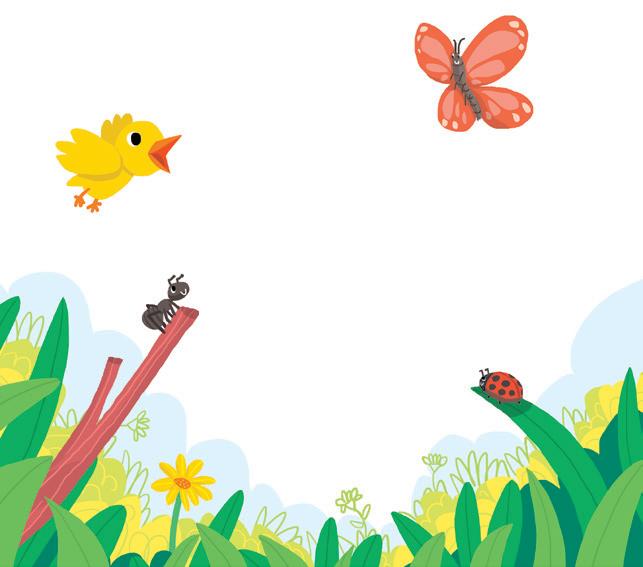
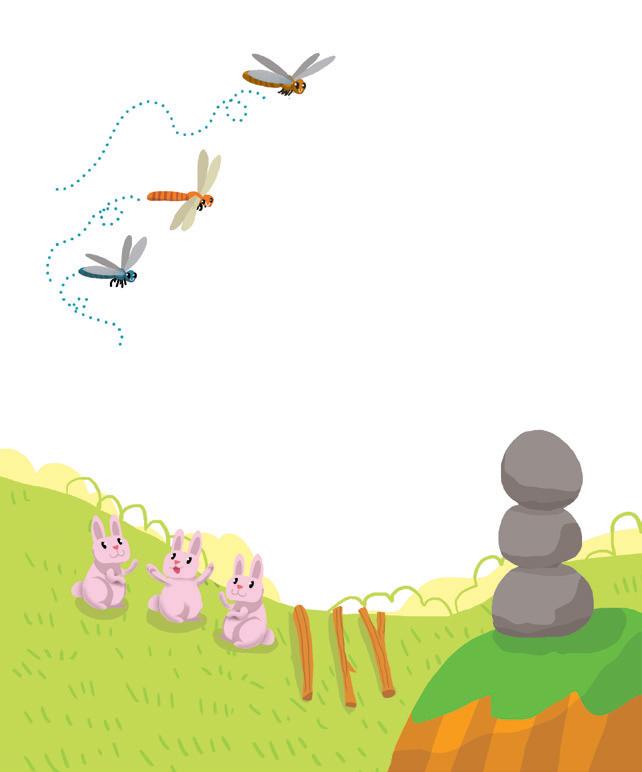
Have students say the number on SB p.1. Then, say how many of each of the objects there are around it, e.g. 1 butterfly, 1 yellow flower. Have students draw 1 object in the dotted box in their Student Book.
Repeat this procedure with the number 2 on SB p. 2 and the number 3 on SB p. 3.
OBSERVE:
Look out for students having difficulty in this pictorial stage. For instance, students who
• are unable to write the numbers ‘1’, ‘2’ and ‘3’.
• struggle with recognising the numerals ‘1’, ‘2’ or ‘3’.
• cannot associate 1 object with the number ‘1’, 2 objects with the number ‘2’ and 3 objects with the number ‘3’.






Resource:
• SB: pp. 4–5
Let's Do Let's
Task 1 provides practice in counting the number of objects in a set and matching it to its corresponding numeral. An example is provided.
Task 2 provides practice in counting the number of objects in a set and writing the corresponding numeral. Guidance is provided.







2 2
3 3

Materials:
• 3 counters per student
Materials:
• 1 set of Number-Dot Cards ‘1’ to ‘3’ (BM1.1–1.3)
Reteach
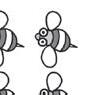
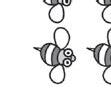
Distribute 3 counters to each student. Refer students to Let’s Learn on SB pp. 1–3. Pick any set of objects, e.g. the bees on SB p. 2. Have them place a counter on each object and count the objects. Then, ask them the 'How many?' question. Repeat the procedure with other sets of objects.
Activity 4: Recognise numbers 1 to 3
Show students Number-Dot Card '1' (BM1.1) and point to the numeral 1 on it.
Ask: What number is this? (1) What do you know about this number? (Answers vary. E.g. I start counting with 1.)
Show students Number-Dot Card '2' (BM1.2) and point to the numeral 2 on it.
Ask: What number is this? (2) What do you know about this number? (Answers vary. E.g. I have 2 eyes, 2 ears, etc.)
Show students Number-Dot Card '3' (BM1.3) and point to the numeral 3 on it.
Ask: What number is this? (3) What do you know about this number? (Answers vary. E.g. I have 3 people in my family, 3 pets, etc.)
Objective:
• Rote count forwards in 1s from 1 to 5
Activity 1:
Count forwards from 1 to 5
Have students form a circle and take turns to each say a number to count from 1 to 5. The student who says ‘5’ sits down. The next student begins counting from 1 again.
Repeat the activity several times.
Objectives:
• Count groups of 1, 2 and 3 objects
Materials:
• 1 set of Number-Dot Cards ‘1’ to ‘3’ (BM1.1–1.3)
Objectives:
• Count groups of 4 and 5 objects arranged in a line
• Identify the last number counted as the number of objects in the group
• Read and write 4 and 5 in numeral form and recognise their number names
Vocabulary:
• four
• five
Materials:
• Counters
• 1 copy of single 5-frame (BM1.4) for demonstration Note: The above blackline master will be used multiple times.
Activity 2:
Count up to 3 objects and show the number
OBSERVE: Does any student use an incorrect counting sequence? If so, where is his/her error?
Show students each of the Number-Dot Cards ‘1’ to ‘3’ (BM1.1–1.3) for 3 seconds and have them show the number with their fingers. Mix up the cards and show them a card again. Then, have students clap the quantity that is shown by the number on the card.
Activity 3:
Count 4 or 5 objects
Concrete
Hold up 4 fingers on your hand and show to students. Say: I am holding up 4 fingers. Count with me. 1, 2, 3, 4. 4 fingers. Point to each finger as you count.
Then, hold up 5 fingers and show to students. Ask: How many fingers am I holding up now? (5)
Say: Let us count together. 1, 2, 3, 4, 5. 5 fingers.
OBSERVE:
• Do students use one-toone correspondence to count out the correct number of objects?
• Can students state the total quantity counted without recounting?
Cut out one of the 5-frames (BM1.4) and show it to students (without identifying it as a 5-frame).
Materials:
• 1 cup of 5 counters per student
• 1 copy of single 5-frame (BM1.4) per student
• 1 set of Number-Dot Cards ‘1–5’ (BM1.1–1.3, 1.5 and 1.6)
Note: This set of blackline masters will be used multiple times.
Materials:
• 1 set of Number-Dot Cards ‘4’ and ‘5’ (BM1.5–1.6)
Ask: What do you see? (Answers vary. E.g. I see 5 boxes. They are in a row. The boxes touch.)
Have students share their thoughts with the class. Explain to them that the row of boxes is called a 5-frame and is used for counting.
Model using a 5-frame to count by placing one counter on the leftmost box of the 5-frame, followed by a second counter beside the first one.
Ask: How many counters do you see? (2)
Continue adding one counter per box, one at a time (from left to right) until the 5-frame is filled. Each time one counter is added, ask students how many counters there are in the 5-frame.
Count up to 5 objects
Concrete
OBSERVE:
Look out for students having difficulty in this concrete stage. For instance, students who struggle with taking out the right number of counters.
Provide each student with a cup of 5 counters and a single 5-frame (BM1.4). Mix up the Number-Dot Cards ‘1–5’ (BM1.1–1.3, 1.5 and 1.6) and place them face down in a stack. Have a student pick a card and identify its number. Then, have all the students count out the same number of counters from their cup and place them on their 5-frame, starting from the leftmost box.
Ask: How many counters are there? (Answers vary.) Is the number of counters the same as the number on the card? (Answers vary.)
Continue the activity until all the cards have been used.
Activity 5:
Read and write 4 and 5
Pictorial Abstract
Show students Number-Dot Card ‘4’ (BM1.5).
Say: Let us count the number of dots on the card.
Point to each dot as you count together with students. Stop at the 3rd dot.
Ask: What comes after 3? (4) Do you see the number 4 anywhere in our classroom? (Answers vary. E.g. On my watch, in a book etc.)
Trace the number 4 on Number-Dot Card '4' with your finger. Have students write it in the air with their finger. Write ‘4’ and ‘four’ on the board.
Repeat the procedure for the number 5 using Number-Dot Card '5' (BM1.6).
Resource:
• SB pp. 6–7
Pictorial Abstract
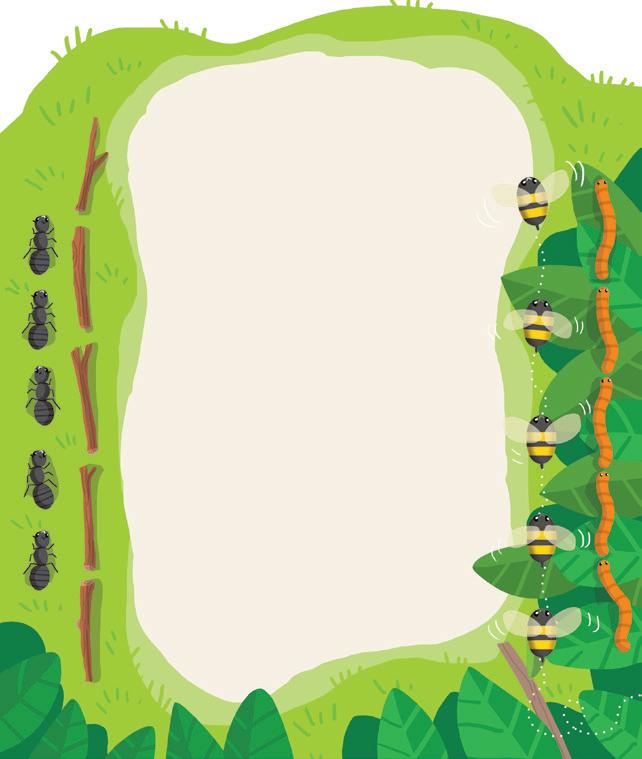
Refer students to SB p. 6. Have students say the number 4 and count the objects that are in groups of 4, e.g. 4 flowers, 4 trees.
Have students draw 4 objects in the dotted box in their Student Book.
Repeat the procedure with the number 5 on SB p. 7.
OBSERVE:
Look out for students having difficulty in this pictorial stage. For instance, students who
• are unable to write the numbers ‘4’ and ‘5’.
• struggle with recognising the numerals ‘4’ and ‘5’.
• cannot associate 4 objects with the number ‘4’ and 5 objects with the number ‘5’.

Resource:
• SB: pp. 8–9
Let's Do Let's Do
Task 1 provides practice in counting the number of objects in a set and matching it to its corresponding numeral.

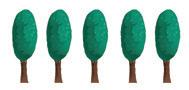



Materials:
• 5 counters per student
• 1 copy of single 5-frame (BM1.4) per student
Task 2 provides practice in counting the number of objects in a set and writing the corresponding numeral. Guidance is provided.
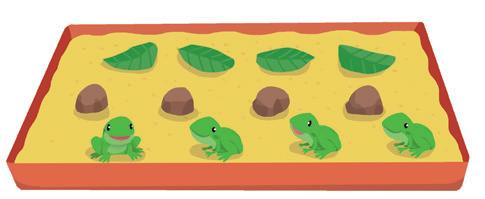
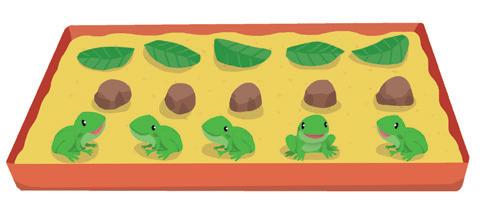
Reteach
Distribute 5 counters and a single 5-frame (BM1.4) to each student. Have students count out 4 and 5 counters using a 5-frame, and ask them the ‘How many?’ question. Ensure students count as they place each counter on the 5-frame.
Activity 6:
Share about how pointing helps in counting
Say: When you were counting the counters, I saw many of you pointing at each counter as you count.
Ask: How did that help you count? (Answers vary. E.g. I count one number when I point at one cube.)
Have students discuss with a partner and share their ideas with the class.
Objective:
• Represent numbers up to 3 Unit 3: 1 to 5
3.1 Counting objects arranged in different ways
Activity 1: Count and show 1 to 3
Show students a number from 1 to 3 using fingers and have them identify the number. Then, get students to clap the quantity that is shown by the number.
Repeat with other numbers and actions, and use different finger patterns, e.g. show 1 finger on one hand and 2 fingers on the other hand.
Objectives:
• Subitise 4 or 5 objects
• Represent numbers 4 and 5
Materials:
• 1 set of Number-Dot Cards '4' and '5' (BM1.5–1.6)
Subitise 4 or 5 objects and represent the number
Show students each of the Number-Dot Cards ‘4’ and ‘5’ (BM1.5–1.6) for 3 seconds and have them show the number with their fingers. Get them to show the same number with two hands, e.g. show 4 with 3 fingers on one hand and 1 finger on the other hand. Mix up the cards and show them a card again.
Objectives:
• Count up to 5 objects arranged in different ways (in a line, 5-frame, array, circular, scattered)
• State the number of objects in a counted set of up to 5 objects without recounting
Materials:
• 5 counters
• 1 copy of single 5-frame (BM1.4)
Count up to 5 objects arranged in different ways
Place 4 counters on a 5-frame (BM1.4)
Ask: How many counters are there? (4)
Rearrange the counters in a line on the table. Ask: How many counters are there now? (4) Rearrange the counters in 2 rows of 2.
Ask: How about now? (4) Did the number of counters change? (No) Explain to students that you did not use more counters or take away any counters.
Ask: What has changed about the counters? (The way they are arranged)
Rearrange the counters in a circular arrangement and then a scattered arrangement and ask students if there are still 4 counters. Say: We can arrange objects in different ways. 4 counters can be arranged in a circle, in a line or scattered everywhere. But the number of counters will not change.
Repeat the procedure with other quantities, e.g. 2, 3 or 5. Start with the 5-frame. After students have identified the number of counters, change the arrangement. Have them note that the quantity does not change.
Materials:
• 5 counters per student
• 1 set of Picture Cards: 2 to 5 Objects in Different Arrangements (BM1.7–1.10)
Note: This set of blackline masters will be used multiple times.
NOTE: By rearranging the counters and having students understand that the total remains the same if nothing has been added or taken away, we develop their understanding of conservation of numbers.
Count and arrange up to 5 objects in different ways
Concrete Pictorial
Prepare the Picture Cards: 2 Objects in Different Arrangements (BM1.7) before the activity.




Distribute 5 counters to each student. Mix up the picture cards. Choose a card (e.g. 2 leaves). Show the card to students.
Ask: How many objects are there? (2) How do you know? (Answers vary.)
After students explain their thinking, have them arrange their counters according to the picture.
Repeat the procedure a few more times with other cards in this set.
NOTE: Having students think about why they chose the answer as 2 helps to improve metacognition, communication skills and reasoning skills.
Repeat the activity with the Picture Cards: 3 to 5 Objects in Different Arrangements (BM1.8–1.10).
OBSERVE:
Look out for students having difficulty in this concrete stage. For instance, students who
• struggle with taking out the right number of counters.
• arranging the counters according to the picture.





Let's Learn Let's Learn
Pictorial Abstract
Materials:
• 5 counters per student
• 1 copy of single 5-frame (BM1.4) per student
Resource:
• SB: pp. 10–11
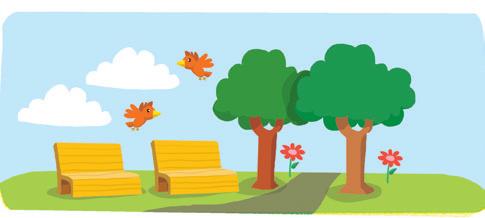
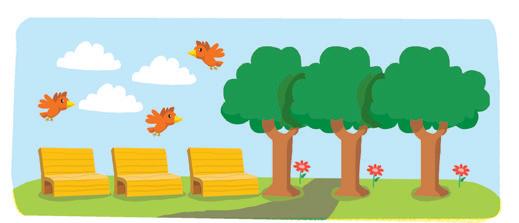
Distribute 5 counters and a 5-frame (BM1.4) to each student. Refer students to Example (a) on SB p. 11. Have them look at the counter and the numeral 1. Ask: How many counters are there in the thought bubble? (1) Can 1 counter be arranged in another way? (No) If necessary, model for students how 1 counter only has 1 arrangement.













Refer students to examples (b) to (e) on SB pp. 10–11. Have them look at the different arrangements in each thought bubble and count the number of counters in each set. Ask students if they think the different arrangements have the same number of counters. Have them try to arrange 2 to 5 counters in an arrangement that is different from those shown in the Student Book. Tell students that they may use a 5-frame to arrange the counters.
Resource:
• SB: pp. 12–13
Materials:
• 5 counters per student
Resource:
• SB: pp. 10–11
OBSERVE:
Look out for students having difficulty in this pictorial abstract stage. For instance, students who
• cannot associate the number of objects with the numbers ‘1’, ‘2’, ‘3’, ‘4’ and ‘5’.
• are unable to recognise the numbers ‘1’, ‘2’, ‘3’, ‘4’ or ‘5’.



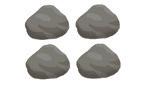
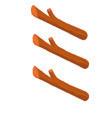
Task 1 provides practice in counting and matching groups with the same number of counters arranged in different ways.


Task 2 provides practice in counting the number of objects in different arrangements and writing the corresponding numerals.


Reteach







4 3 1 3 2 4
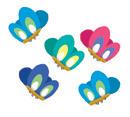


Distribute 5 counters to each student. Have students refer to SB pp. 10–11. As they count, get them to put a counter on each counter for each arrangement in the book.
Especially for circular arrangements, you might want to get students to put one finger on the first counter before counting on.
Objectives:
• Subitise up to 3 objects
• Write 1, 2 and 3 in numeral form
Materials:
• 1 set of Picture Cards: 1 to 3 Objects (BM1.11)
Activity 5:
Count 4 or 5 objects arranged in different ways
Draw 4 objects in a row. Then, draw another 4 objects in an array.
Ask: How many objects are there in each picture? (4) Have students identify that the number of objects in each group is 4, although they are arranged differently. Do the same for 5 objects.
Ask: What is your favourite arrangement? Why? (Answers vary. E.g. I like to count objects in a circle because it is like a game./I like to count objects in a line because it is easy.)
Activity 1:
Subitise up to 3 objects and write the number
Show students Picture Cards: 1 to 3 Objects (BM1.11), one card at a time for 3 seconds.
Have them subitise the objects and write the number on their mini whiteboard or notebook. Then, check their answers.
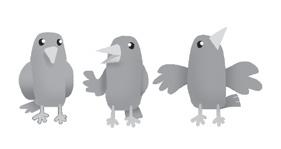


NOTE: To subitise is to be able to look at a group of objects and tell how many there are, without having to count one by one.

Objective:
• Count 4 or 5 objects arranged in different ways
Activity 2: Count 4 or 5 objects in different arrangements
Recap with students counting groups of 4 objects (using students) in different arrangements. For example, have 4 students stand in a line, then have the same 4 students stand in an array and finally, in a scattered arrangement. Each time, have the rest of the class count the students in the group and answer the ‘How many?’ question.
Ask: How many friends are standing here? (4) Did the number of friends stay the same? (Yes) Why is this so? (Nobody left; they just moved around.)
Repeat the procedure for 5 objects (using students).
Objective:
• Count out a given number of up to 5 objects from a larger set of up to 8 objects
Materials:
• 1 set of 8 counters
• Double-sided tape
• 1 copy of single 5-frame (BM1.4)
• 1 set of Number Cards 1–5 (BM1.12) Note: This blackline master will be used multiple times.
Concrete
Have students gather around a table. Place a 5-frame (BM1.4), 8 counters and a set of Number Cards 1–5 (BM1.12) face down on the table.
Have a student volunteer choose a number card and show it to the class. Then count out that many counters from the pile of 8 counters and stick them using double-sided tape on the 5-frame. Get students to count aloud to check if the number of counters is correct. Ask: What number is on the number card? (Answers vary.) Did I count out the correct number of counters? (Answers vary.) Move the 5-frame (with counters on it) aside.
NOTE: Counting out from a larger group develops the cardinality principle, in which students focus on the last number counted or the ‘stopping number’ which gives them the cardinal value.
Materials:
• 4 sets of 8 counters
• Double-sided tape
• 5 sheets of paper
• 2 copies of 5-frames (BM1.4)
• 1 set of Number Cards 1–5 (BM1.12)
Concrete
Prepare a few more sets of 8 counters Invite pairs of students to do Activity 3 until all the number cards and 5-frames have been used. Put up all the 5-frames, including the 5-frame from Activity 3, for students to see.
Invite 5 student volunteers and assign each of them one completed 5-frame. Ask the other students to count and say how many counters there are in each 5-frame. Have each of the 5 volunteers write the number on a sheet of paper and place it next to their 5-frame.
Let's Learn Let's
Resource:
• SB: p. 14
Pictorial Abstract
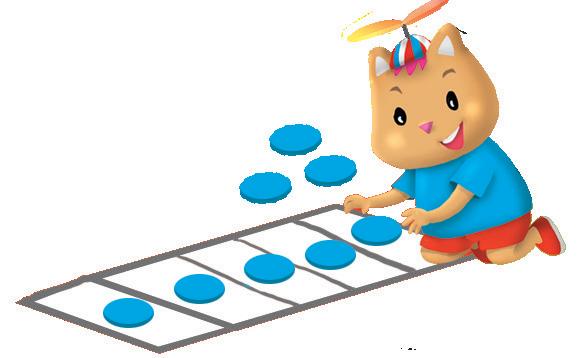
Refer students to SB p. 14. Have them look at the pictures to recall what they did in the earlier activity. Remind students that when they count out a number of objects from a larger set, they can use a 5-frame to help them.

Resource:
• SB: pp. 15–16
Let's Do Let's Do
Task 1 provides practice in counting the number of counters and then drawing the counters in the corresponding 5-frame. An example is provided.


Task 2 provides practice in counting out a given number of objects from a larger set. Students are required to circle the correct number of objects.



Materials:
• 1 set of 6 counters per student
• 1 copy of single 5-frame (BM1.4) per student
Materials:
• 7 counters
Reteach
Distribute a set of 6 counters and a 5-frame (BM1.4) to each student. From the set of 6 counters, have students count out 4 and then 5 counters using the 5-frame, and ask them the ‘How many?’ question. Ensure students count as they place each counter on the 5-frame.
Activity 5:
Share about how to count out 4 or 5 objects
Place 7 counters on the board. Ask students how we can count out 4 counters from the set. Have students share their ideas with the class.
Next, ask students about counting out 5 counters from the set.
Objectives:
• Count up to 5 objects arranged in different ways (in a line, array, scattered)
• Identify the last number counted as the number of objects in the group
• State the number of objects in a counted set of up to 5 objects without recounting
Materials:
• Counters (optional)
• 1 copy of single 5-Frame (BM1.4) per student (optional)
Resource:
• SB: p. 17
Have students look at the picture on SB p. 17.
Use the following questions to encourage discussion.
Ask:
• What animals do you see? (Birds, butterflies, bees, possums and a cat)
• What are the animals doing? (The birds are sitting on the branch. The butterflies are flying around. The possums are climbing up/down the tree. The bees are returning to their hive. The cat is standing under the tree.)
• Do you notice anything unusual about any of the animals? (One of the birds is wearing a hat. The possums are carrying strings of berries. The cat is holding a broom.)
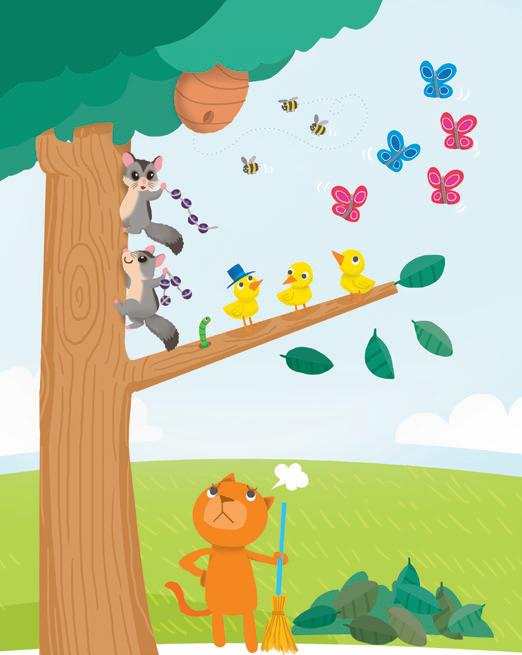
Have students look at the various objects and their arrangements on the Student Book page.
Ask:
• What is there 1 of? (1 beehive, 1 hat, 1 tree branch/tree, 1 cat, 1 broom, 1 worm)
• What are there 2 of? (2 possums)
• What are there 3 of? (3 birds, 3 bees) How are they arranged? (In a row, scattered)
NOTE: The questions assess students’ understanding of counting groups of up to 5 objects in various arrangements and whether they can identify the last number counted as the number of objects in the group.
• What are there 4 of? (4 leaves, 4 red berries, 4 black berries) How are they arranged? (In a row, scattered)
• What are there 5 of? (5 butterflies)
For struggling students, have them place a counter on each object being counted, e.g. when counting the leaves, have students place a counter on each leaf. Students then transfer the counters onto a 5-Frame (BM1.4) to determine the number of counters, which is also the number of leaves.
Have students look at the butterflies.
Ask:
• Are they all the same colour? (No)
• What can you say about the butterflies? (2 out of 5 are blue. 3 out of 5 are red.)
NOTE: The questions assess students’ ability to count out a number of objects from a larger set.
Repeat the questions above for the leaves. (Some are on the tree, some are not.)
Objectives:
• Count up to 5 objects in a circular arrangement
• State the number of objects in a counted set of up to 5 objects without recounting
• Identify the last number counted as the number of objects in the group
Materials:
• 5 counters per pair
• Chapter Observational Checklist (BM1.13)
Resource:
• SB: p. 18
Have students discuss what they have learnt in the topic. Ask:
• What numbers can you count now? (1, 2, 3, 4 and 5)
• If I have 5 beads, can I arrange them in different ways? (Yes)
• Can I arrange 1 bead in different ways? (No)
• Which number do you find the easiest to write? Which is the most difficult to write? (Answers vary.)
Have students work in pairs. Distribute 5 counters to each pair. Get them to look at the counters on SB p. 18. Read the speech bubbles to them. Get them to think about whether Belle or King is correct and why. Then, have them turn and talk to a partner to discuss their thinking. Provide time for pairs to share what they discussed.
Ask: How many counters are there? (5) How can you keep track of your counting? (Answers vary. E.g. By putting my finger on the counter I start counting from.)
Have students verify the number of counters they see on the page by placing a counter on top of each picture. Get them to count as they place their counters.
Optional: Use Chapter Observational Checklist (BM1.13) to assess students.




OBSERVE:
• Do students keep track of where they start counting?
• Do students use different strategies to count objects in a circular arrangement?
Objectives:
• Identify the last number counted as the number of objects in the group
• Read 1 to 5 in numeral form and recognise their number names
Materials:
• 2 paper clips of different colours per pair of students
• 2 sets of Number Cards 1–5 (BM1.12) per pair
• Chapter Observational Checklist (BM1.13)
Resource:
• SB: p. 19
Objectives:
• Count up to 5 objects arranged in different ways (in a line, array, scattered)
• Identify the last number counted as the number of objects in the group
• Write 1 to 5 in numeral form
• State the number of objects in a counted set of up to 5 objects without recounting
Materials:
• Chapter Observational Checklist (BM1.13)
Resource:
• SB: p. 20
Have students play the counting game in pairs. Distribute 2 paper clips (of different colours) and 2 sets of Number Cards 1–5 (BM1.12) to each pair.
Have Partner A place his/her paper clip on the green box of Path A on SB p. 19. Partner B should put his/her paper clip on the green box of Path B. Then, have each student mix up his/her number cards and place them face down in a stack. Partner A picks the top card of his/her stack and tells Partner B the number. Partner A then moves his/her paper clip that many spaces up the path. After that, Partner A tells Partner B how many steps are moved.

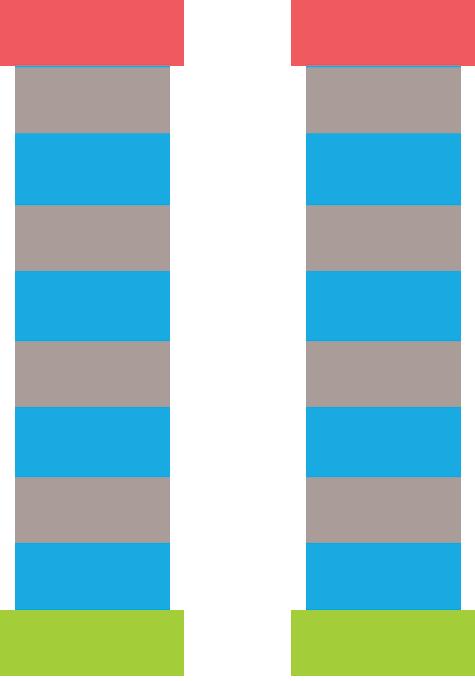
Partner B picks the top card of his/her stack and repeats the procedure. Partners continue to take turns until one of them reaches the red box at the top of his/her path. Partners then start over and repeat the activity if time allows.
Optional: Use Chapter Observational Checklist (BM1.13) to assess students.
Have students count the number of objects in each set and write the corresponding numeral on SB p. 20.
Get them to check each other's work after the activity.
Optional: Use Chapter Observational Checklist (BM1.13) to assess students.



Note: This blackline master will be used multiple times.
Note: This blackline master will be used multiple times.




Note: This blackline master will be used multiple times.








Note: This blackline master will be used multiple times.




Note: This blackline master will be used multiple times.







Note: This blackline master will be used multiple times.




Note: This blackline master will be used multiple times.

New Zealand Curriculum: Practices
Counting collections of up to 10 objects using one-to-one correspondence
1
Subitising (recognising without counting) the number of objects in a small collection (3–5 objects)
Counting collections of up to 10 objects using one-to-one correspondence
2
Subitising (recognising without counting) the number of objects in a small collection (3–5 objects)
Counting collections of up to 10 objects using one-to-one correspondence
Subitising (recognising without counting) the number of objects in a small collection (3–5 objects)
Reading and writing whole numbers up to 20
3