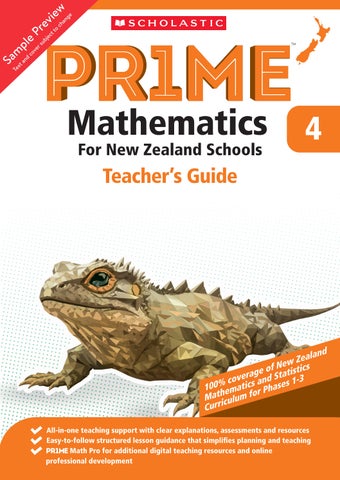
100% coverage of New Zealand Mathematics and Statistics Curriculum for Phases 1-3
All-in-one teaching support with clear explanations, assessments and resources Easy-to-follow structured lesson guidance that simplifies planning and teaching Math Pro for additional digital teaching resources and online professional development
Strand(s): Number, Algebra
Vocabulary
Within 10,000
and Subtraction
Objectives
• CB: pp. 29–30
• Math Pro: Recall
Scheme of Work Unit
• Add within 1,000 without and with regrouping
Let’s Remember
• Subtract within 1,000 without and with regrouping
• Round a 4-digit number to the nearest ten, hundred and thousand
• Use a part-whole bar model or a comparison bar model to represent an addition or subtraction situation
Unit 1: Addition New Zealand Curriculum Year 4: Number — Number structures, Operations
1.1 Knowledge ( ★ ) and Practices ( ◆ )
★ Addition and subtraction can be carried out mentally, using known facts, place value and partitioning, or column methods.
★ Standard written algorithms (e.g. column addition, column subtraction) rely on place value, regrouping, and renaming.
◆ Adding and subtracting up to four-digit numbers
• CB: pp. 31–32
• PB: p. 26
• 1 enlarged copy of Place Value Chart (BM3.1) per group
• Add to 4-digit numbers without regrouping
1.1 Adding without regrouping
• Math Pro: Practice
• Counters
Knowledge ( ★ ) and Practices ( ◆ )
1.2
★ Addition and subtraction can be carried out mentally, using known facts, place value and partitioning, or column methods.
• rename
★ Standard written algorithms (e.g. column addition, column subtraction) rely on place value, regrouping, and renaming.
◆ Adding and subtracting up to four-digit numbers
• CB: pp. 33–34
• PB: p. 27
• 1 enlarged copy of Place Value Chart (BM3.1) per group
• Math Pro: Practice
• Counters
• Add to 4-digit numbers with regrouping once
1.2 Adding with regrouping once
1.3 Knowledge ( ★ ) and Practices ( ◆ )
★ Addition and subtraction can be carried out mentally, using known facts, place value and partitioning, or column methods.
★ Standard written algorithms (e.g. column addition, column subtraction) rely on place value, regrouping, and renaming.
◆ Adding and subtracting up to four-digit numbers
• CB: pp. 35–36
• PB: p. 28
• 1 enlarged copy of Place Value Chart (BM3.1) per group
• Math Pro: Practice
• Counters
• Add to 4-digit numbers with regrouping twice
1.3 Adding with regrouping twice
1.4 Knowledge ( ★ ) and Practices ( ◆ )
★ Addition and subtraction can be carried out mentally, using known facts, place value and partitioning, or column methods.
★ Standard written algorithms (e.g. column addition, column subtraction) rely on place value, regrouping, and renaming.
◆ Adding and subtracting up to four-digit numbers
• CB: pp. 37–38
• PB: p. 29
• 1 enlarged copy of Place Value Chart (BM3.1) per group
• Math Pro: Practice
• Counters
• Add to 4-digit numbers with regrouping three times
1.4 Adding with regrouping three times
Knowledge ( ★ ) and Practices ( ◆ )
1.5
★ Rounding can support predicting or estimating the result of a calculation.
★ Addition and subtraction can be carried out mentally, using known facts, place value and partitioning, or column methods.
★ Standard written algorithms (e.g. column addition, column subtraction) rely on place value, regrouping, and renaming.
◆ Rounding whole numbers to the nearest thousand, hundred, or ten
◆ Adding and subtracting up to four-digit numbers
• CB: p. 39
• PB: p. 30
• Math Pro: Practice
• Estimate to predict the sum of two numbers before calculation
1.5 Estimating sums
• Check reasonableness of an answer in addition
1.6 Knowledge ( ★ ) and Practices ( ◆ )
★ Rounding can support predicting or estimating the result of a calculation.
★ Addition and subtraction can be carried out mentally, using known facts, place value and partitioning, or column methods.
★ Standard written algorithms (e.g. column addition, column subtraction) rely on place value, regrouping, and renaming.
◆ Adding and subtracting up to four-digit numbers
• CB: pp. 40–42
• PB: pp. 31–32
• Math Pro: Practice
• Solve 1-step word problems involving addition
1.6 Solving word problems
Unit 2: Subtraction New Zealand Curriculum Year 4: Number — Number structures, Operations
2.1 Knowledge ( ★ ) and Practices ( ◆ )
★ Addition and subtraction can be carried out mentally, using known facts, place value and partitioning, or column methods.
★ Standard written algorithms (e.g. column addition, column subtraction) rely on place value, regrouping, and renaming.
◆ Adding and subtracting up to four-digit numbers
• CB: pp. 43–44
• PB: p. 33
• 1 enlarged copy of Place Value Chart (BM3.1) per group
• Math Pro: Practice
• Subtract from 4-digit numbers without regrouping
2.1 Subtracting without regrouping
• Counters
Knowledge ( ★ ) and Practices ( ◆ )
2.2
★ Addition and subtraction can be carried out mentally, using known facts, place value and partitioning, or column methods.
★ Standard written algorithms (e.g. column addition, column subtraction) rely on place value, regrouping, and renaming.
◆ Adding and subtracting up to four-digit numbers
• CB: pp. 45–46
• PB: p. 34
• 1 enlarged copy of Place Value Chart (BM3.1) per group
• Math Pro: Practice
• Subtract from 4-digit numbers with regrouping once
2.2 Subtracting with regrouping once
• Counters
2.3 Knowledge ( ★ ) and Practices ( ◆ )
★ Addition and subtraction can be carried out mentally, using known facts, place value and partitioning, or column methods.
★ Standard written algorithms (e.g. column addition, column subtraction) rely on place value, regrouping, and renaming.
◆ Adding and subtracting up to four-digit numbers
• CB: pp. 47–48
• PB: p. 35
• 1 enlarged copy of Place Value Chart (BM3.1) per group
• Math Pro: Practice
• Subtract from 4-digit numbers with regrouping twice
2.3 Subtracting with regrouping twice
• Counters
2.4 Knowledge ( ★ ) and Practices ( ◆ )
★ Addition and subtraction can be carried out mentally, using known facts, place value and partitioning, or column methods.
★ Standard written algorithms (e.g. column addition, column subtraction) rely on place value, regrouping, and renaming.
◆ Adding and subtracting up to four-digit numbers
• CB: pp. 49–50
• PB: p. 36
• 1 enlarged copy of Place Value Chart (BM3.1) per group
• Math Pro: Practice
• Counters
• Subtract from 4-digit numbers with regrouping three times
2.4 Subtracting with regrouping three times
2.5 Knowledge ( ★ ) and Practices ( ◆ )
★ Addition and subtraction can be carried out mentally, using known facts, place value and partitioning, or column methods.
★ Standard written algorithms (e.g. column addition, column subtraction) rely on place value, regrouping, and renaming.
◆ Adding and subtracting up to four-digit numbers
• CB: pp. 51–53
• PB: p. 37
• 1 enlarged copy of Place Value Chart (BM3.1) per group
• Math Pro: Practice
• Subtract from 4-digit numbers with regrouping from thousands
• Counters
• Subtract from 4-digit numbers with regrouping from hundreds, then thousands
2.5 Regrouping from thousands or hundreds
2.6 Knowledge ( ★ ) and Practices ( ◆ )
★ Rounding can support predicting or estimating the result of a calculation.
★ Addition and subtraction can be carried out mentally, using known facts, place value and partitioning, or column methods.
★ Standard written algorithms (e.g. column addition, column subtraction) rely on place value, regrouping, and renaming.
◆ Rounding whole numbers to the nearest thousand, hundred, or ten
◆ Adding and subtracting up to four-digit numbers
• CB: p. 54
• PB: p. 38
• Math Pro: Practice
• Estimate to predict the difference between two numbers before calculation
• Check reasonableness of an answer in subtraction
2.6 Estimating differences
2.7 Knowledge ( ★ ) and Practices ( ◆ )
★ Rounding can support predicting or estimating the result of a calculation.
★ Addition and subtraction can be carried out mentally, using known facts, place value and partitioning, or column methods.
★ Standard written algorithms (e.g. column addition, column subtraction) rely on place value, regrouping, and renaming.
◆ Adding and subtracting up to four-digit numbers
• CB: pp. 55–57
• PB: pp. 39–40
• Math Pro: Practice
• Solve 1-step word problems involving subtraction
2.7 Solving word problems
3: Number Sentences
New Zealand Curriculum Year 4: Algebra — Equations and relationships
3.1 Knowledge ( ★ ) and Practices ( ◆ )
★ Numbers can be compared using “greater than” (>), “less than” (<), and equals (=).
◆ Checking the truth of number sentences and completing open number sentences involving addition and subtraction (e.g. 8205 − 4721 = 3484, true or false ? ; 4200 − __ = 4001)
• CB: pp. 58–59
• PB: p. 41
• Math Pro: Practice
• Determine if a number sentence involving addition and subtraction is true or false
3.1 True or false number sentences involving addition and subtraction
3.2 Knowledge ( ★ ) and Practices ( ◆ )
★ Numbers can be compared using “greater than” (>), “less than” (<), and equals (=).
★ Applying the same operation to both sides of a number sentence preserves the balance.
◆ Checking the truth of number sentences and completing open number sentences involving addition and subtraction (e.g. 8205 − 4721 = 3484, true or false ? ; 4200 − __ = 4001)
• CB: pp. 60–61
• PB: p. 42
• Math Pro: Practice
• Complete open number sentences involving addition and subtraction
3.2 Completing open number sentences involving addition and subtraction
Unit 4: Problem Solving
New Zealand Curriculum Year 4: Number — Number structures, Operations
4.1 Knowledge ( ★ ) and Practices ( ◆ )
★ Rounding can support predicting or estimating the result of a calculation.
★ Addition and subtraction can be carried out mentally, using known facts, place value and partitioning, or column methods.
• inverse operation
★ Standard written algorithms (e.g. column addition, column subtraction) rely on place value, regrouping, and renaming.
◆ Adding and subtracting up to four-digit numbers
• CB: pp. 62–64
• PB: pp. 43–45
• Math Pro: Practice
• Solve 2-step word problems involving addition and subtraction
4.1 Word problems
• CB: pp. 65–68
• Math Pro: Assessment
• 1 copy of Maths Journal (BM3.2) per student
• Solve a non-routine problem involving addition and subtraction using the strategy of drawing a bar model
• Solve a non-routine problem involving addition and subtraction using the strategies of working backwards and guess and check
The suggested duration for each lesson is 1 hour.
Mind stretcher
Chapter 3 Addition and Subtraction
EXPLORE
Let's Remember Let's Remember Recall:
1. Adding within 1,000 without and with regrouping (CB3 Chapter 2)
2. Subtracting within 1,000 without and with regrouping (CB3 Chapter 2)
3. Rounding a 4-digit number to the nearest ten, hundred and thousand (CB4 Chapter 1)
4. Using a part-whole bar model or a comparison bar model to represent an addition or subtraction situation (CB3 Chapter 2)
333 student volunteers from Wellington took part in Ocean Alive's Aotearoa's Coastal Cleanup events in 2026. They collected 1,547 food wrappers and 820 more plastic drink bottles than food wrappers. How many food wrappers and plastic drink bottles did the volunteers collect altogether? How can we solve this problem? Discuss in your group and fill in columns 1 and 2.
Add two 3-digit numbers. Solve 2-step word problems involving addition of 3-digit numbers.
Add two 4-digit numbers. Solve 2-step word problems involving addition of 4-digit numbers.
EXPLORE
Have students read the word problem on CB p. 30. Discuss with students the following questions:
•Have you ever worked as a volunteer in your community?
•Why do you think it is important to take part in community work?
•Why do you think beach cleanup events are important?
Have students form groups to complete the tasks in columns 1 and 2 of the table. Let students know that they do not have to solve the word problem. Ask the groups to present their work.
Tell students that they will come back to this word problem later in the chapter.
Unit 1: Addition
1.1 Adding without regrouping
Let's Learn Let's Learn
Objective:
•Add to 4-digit numbers without regrouping
Materials:
•1 enlarged copy of Place Value Chart (BM3.1) per group
•Counters
Resources:
•CB: pp. 31–32
•PB: p. 26
Stages: Concrete Experience, and Pictorial and Abstract Representations
Have students work in groups. Distribute an enlarged copy of Place Value Chart (BM3.1) and some counters to each group and have students follow each step of your demonstration.
Ask: How can we find the sum of 1,452 and 2,437? (Add)
Write: 1,452 + 2,437 = Draw a place value table on the board and stick counters in it to represent 1,452 and 2,437 as shown on CB p. 31.
Write: Th H T O
Say: First, add the ones. Add 2 ones and 7 ones.
Combine the counters in the ones column of the place value chart.
Ask: How many ones do we have? (9)
Say: We write ‘9’ in the ones column of the answer row.
Write ‘9’ in the ones column of the answer row in the vertical form.
Continue to add the tens, hundreds and thousands using the same procedure as adding the ones.
Say: So, 1,452 + 2,437 is 3,889.
Write: 1,452 + 2,437 = 3,889
Say: The sum of 1,452 and 2,437 is 3,889. Reiterate that we add the ones first, followed by the tens, then the hundreds, and lastly the thousands.
Let's Do Let's
Task 1 requires students to add two 4-digit numbers without regrouping.
Task 2 requires students to add to 4-digit numbers without regrouping.
Let's Practise Let's Practise
Task 1 requires students to add to 4-digit numbers without regrouping.
Task 2 requires students to add two amounts of money up to 4 digits without regrouping.
1.2 Adding with regrouping once
Let's Learn Let's Learn
Objective:
•Add to 4-digit numbers with regrouping once
Materials:
•1 enlarged copy of Place Value Chart (BM3.1) per group
•Counters
Resources:
•CB: pp. 33–34
•PB: p. 27
Vocabulary:
•rename
Stages: Concrete Experience, and Pictorial and Abstract Representations
Have students work in groups. Distribute an enlarged copy of Place Value Chart (BM3.1) and some counters to each group and have students follow each step of your demonstration.
Ask: How do we find the sum of 1,634 and 2,085? (Add)
Write: 1,634 + 2,085 = Draw a place value table on the board and stick counters in it to represent 1,634 and 2,085 as shown on CB p. 33.
Write: Th H T O 1 6 3 4 + 2 0 8 5
Say: First, add the ones. Add 4 ones and 5 ones.
Combine the counters in the ones column of the place value chart.
Ask: How many ones do we have? (9)
Write ‘9’ in the ones column of the answer row in the vertical form.
Say: Next, add the tens. Add 3 tens and 8 tens. Combine the counters in the tens column of the place value chart.
Ask: How many tens do we have? (11)
1.2 Adding with regrouping once
Say: 10 tens can be renamed as 1 hundred. In other words, 10 tens can be regrouped into 1 hundred. We remove 10 counters from the tens column and place 1 counter in the hundreds column.
Remove 10 counters from the tens column and stick 1 counter in the hundreds column.
Say: 11 tens can be renamed as 1 hundred and 1 ten. In other words, 11 tens are regrouped into 1 hundred 1 ten. We write ‘1’ in the tens column of the answer row and ‘1’ above ‘6’ in the hundreds column.
Write the regrouping of the tens in the vertical form.
Continue to add the hundreds and thousands using the same procedure as adding the ones.
Say: So, 1,634 + 2,085 = 3,719.
Write: 1,634 + 2,085 = 3,719
Say: The sum of 1,634 and 2,085 is 3,719.
Let's Do Let's
Task 1 requires students to add two 4-digit numbers with regrouping once.
Task 2 requires students to add to 4-digit numbers with regrouping once.
Let's Practise Let's Practise
Task 1 requires students to add to 4-digit numbers with regrouping once.
Task 2 requires students to add two amounts of money up to 4 digits with regrouping once.
1.3 Adding with regrouping twice
Let's Learn Let's Learn
Objective:
•Add to 4-digit numbers with regrouping twice
Materials:
•1 enlarged copy of Place Value Chart (BM3.1) per group
•Counters
Resources:
•CB: pp. 35–36
•PB: p. 28
Stages: Concrete Experience, and Pictorial and Abstract Representations
Have students work in groups. Distribute an enlarged copy of Place Value Chart (BM3.1) and some counters to each group and have students follow each step of your demonstration.
Ask: How do we find the sum of 2,561 and 1,972? (Add)
Write: 2,561 + 1,972 = Draw a place value table on the board and stick counters in it to represent 2,561 and 1,972 as shown on CB p. 35.
Write: Th H T O 2 5 6 1 + 1 9 7 2
Say: First, add the ones. Add 1 one and 2 ones. Combine the counters in the ones column of the place value chart.
Ask: How many ones do we have? (3) Write ‘3’ in the ones column of the answer row in the vertical form.
Say: Next, add the tens. Add 6 tens and 7 tens. Combine the counters in the tens column of the place value chart.
Ask: How many tens do we have? (13)
Say: 10 tens can be regrouped into 1 hundred. We remove 10 counters from the tens column and place 1 counter in the hundreds column.
Remove 10 counters from the tens column and stick 1 counter in the hundreds column.
Say: 13 tens are regrouped into 1 hundred 3 tens. We write ‘3’ in the tens column of the answer row and ‘1’ above ‘5’ in the hundreds column. Write the regrouping of the tens in the vertical form.
Continue to add the hundreds and thousands using the same procedure as adding the tens and ones.
Say: So, 2,561 + 1,972 is 4,533.
Write: 2,561 + 1,972 = 4,533
Say: The sum of 2,561 and 2,972 is 4,533.
Let's Do Let's
Task 1 requires students to add two 4-digit numbers with regrouping twice.
Task 2 requires students to add to 4-digit numbers with regrouping twice.
Let's Practise Let's Practise
Task 1 requires students to add to 4-digit numbers with regrouping twice.
Task 2 requires students to add two amounts of money up to 4 digits with regrouping twice.
1.4 Adding with regrouping three times
Let's Learn Let's Learn
Objective:
•Add to 4-digit numbers with regrouping three times
Materials:
•1 enlarged copy of Place Value Chart (BM3.1) per group
•Counters
Resources:
•CB: pp. 37–38
•PB: p. 29
Stages: Concrete Experience, and Pictorial and Abstract Representations
Have students work in groups. Distribute an enlarged copy of Place Value Chart (BM3.1) and some counters to each group and have students follow each step of your demonstration.
Ask: How do we find the sum of 2,793 and 3,408? (Add)
Write: 2,793 + 3,408 = Draw a place value table on the board and stick counters in it to represent 2,793 and 3,408 as shown on CB p. 37.
Write: Th H T O
Say: First, add the ones. Add 3 ones and 8 ones.
Combine the counters in the ones column of the place value chart.
Ask: How many ones do we have? (11)
Say: 10 ones can be regrouped into 1 ten. We remove 10 counters from the ones column and place 1 counter in the tens column.
Remove 10 counters from the ones column and stick 1 counter in the tens column.
Say: 11 ones are regrouped into 1 ten 1 one. Ask a student to write the regrouping of the ones in the vertical form.
Continue to add the tens, hundreds and thousands using the same procedure as adding the ones.
Say: So, 2,793 + 3,408 is 6,201.
Write: 2,793 + 3,408 = 6,201
Say: The sum of 2,793 and 3,408 is 6,201.
Let's Do Let's
Task 1 requires students to add two 4-digit numbers with regrouping three times.
Task 2 requires students to add to 4-digit numbers with regrouping three times.
Let's Practise Let's Practise
Task 1 requires students to add to 4-digit numbers with regrouping three times.
Task 2 requires students to add two amounts of money up to 4 digits with regrouping three times.
1.5 Estimating sums
Let's Learn Let's Learn
Objectives:
•Estimate to predict the sum of two numbers before calculation
•Check reasonableness of an answer in addition
Resources:
•CB: p. 39
•PB: p. 30
Stage: Abstract Representation
Write: Find the sum of 3,392 and 5,741.
Say: Let us first estimate the sum of 3,392 and 5,741 before finding the actual sum.
Ask: What do we get when we round 3,392 to the nearest thousand? (3,000) What do we get when we round 5,741 to the nearest thousand? (6,000) What is the estimated value of 3,392 + 5,741? (3,000 + 6,000 = 9,000)
Say: Let us now find the actual sum of 3,392 and 5,741.
Have students add 3,392 and 5,741.
Ask: What is 3,392 + 5,741? (9,133)
Write: 3,392 + 5,741 = 9,133
Say: 9,133 is about 9,000. Since the actual sum is close to the estimated sum, we can say that our answer of 9,133 is reasonable. A reasonable answer is an answer that makes sense.
Let's Do Let's Do and Let's Practise Let's Practise
Task 1 requires students to estimate to predict the sum of two numbers before calculation. They are also required to check the reasonableness of their answer.
Pose the questions in the thought bubble in step 1.
2. Plan what to do.
Point out to students that they can draw a bar model to help them solve the word problem.
3. Work out the Answer.
Draw a bar to represent the number of people who attended the event on Saturday and label it as shown on the page. Then, draw a longer bar to represent the number of people who attended the event on Sunday and label it.
Say: The longer bar represents the number of people on Sunday because more people attended the event on Sunday than on Saturday.
Explain that we place a question mark in the bar model to indicate what we have to find, and label the model accordingly.
Ask: How can we find the number of people who attended the event on Sunday? (Add 1,951 and 836.)
Write: 1,951 + 836 = Have a student work out the sum using the vertical form on the board.
Ask: What was the number of people who attended the event on Sunday? (2,787) Say: 2,787 people attended the drift car racing event on Sunday.
4. Check if your answer is reasonable. Guide students to check their answer by estimating the sum of 1,951 and 836.
1.6 Solving word problems
Let's Learn Let's Learn
1,951 people attended a drift car racing event at the speedway on Saturday. There were 1,207 more adults than children who attended the event on Saturday. 836 more people attended it on Sunday than on Saturday. How many people attended the drift car racing event on Sunday?
1 Plan what to do.
Understand the problem.
2
Work out the Answer 3
I can draw a bar model to compare the number of people who attended the event on each day.
How many people attended the event on Saturday? How many more people attended the event on Sunday than on Saturday? Which piece of information is not necessary? What do I have to find? 1,951 836
Check if your answer is reasonable. 4
Whakaaro
Whakaatu
Tirohia
Mārama
1000+1700+80+7 + Plus Solve the problem in another way.
More people attended the drift car racing event on Sunday than on Saturday. So, add 1,951 and 836 to solve the problem. Write each number in expanded form before adding.
2,787 people attended the drift car racing event on Sunday.
Compare the methods in steps 3 and 5. Which method do you prefer? Why?
Do Let's Do 1. Understand 2. Plan 3. Answer 4. Check 5. Plus
Solve the word problems. Use or draw bar models to help you. Show your work clearly. Next, try solving each problem in a different way. Which method do you prefer? Why?
Understand 2. Plan 3. Answer 4. Check 5. Plus
1. Mrs Brown's family made 3,754 chocolate chip biscuits and 2,615 oat biscuits for a bake sale. They sold all the biscuits. How many biscuits did they bake altogether? 3,754 2,615 ?
Tāpiri 6,369 5,938
2. A bakery sold 4,059 loaves of bread last month. It sold 1,879 more loaves of bread this month than last month. It baked 5,802 loaves of bread last month. How many loaves of bread were sold this month? More loaves of bread were sold this month. I should add.
5. + Plus Solve the problem in another way. Have students try to solve the problem in a different way. Have 1 or 2 students share their methods. If students are unable to solve the problem in a different way, explain the method shown on CB p. 41.
Ask: Which method do you prefer? Why? (Answers vary.)
Let's Do Let's Do
Tasks 1 and 2 require students to solve 1-step word problems involving addition.
1. A library has 837 fiction books and 4,192 non-fiction books. 247 of the books are audiobooks. How many books does the library have altogether?
2. Ben scored 5,936 points in a game. He scored 1,465 fewer points than Tim. Ben played the game for 15 minutes. What was Tim's score?
3. A recycling centre collects 4,209 used plastic bottles each day. It collects 1,584 more tin cans than plastic bottles. How many tin cans does the centre collect each day? Solve the word problems. Show your work clearly.
4. A laptop costs $2,106. A television costs $1,164 more than the laptop. A camera costs $1,322 more than the laptop. How much does the camera cost?
5. A stationery store has 1,965 pencils and 3,027 pens. It stocks 4,778 pencils. How many pencils does the stationery store have now?
Let's Practise Let's
Tasks 1 to 5 require students to solve 1-step word problems involving addition.
EXPLORE
Have students go back to the word problem on CB p. 30.
Ask: Can you solve the problem now? (Answer varies.) What else do you need to know? (Answer varies.)
Students are not expected to be able to solve the problem now. They will learn more skills in subsequent lessons and revisit this problem at the end of the chapter.
Unit 2: Subtraction
2.1 Subtracting without regrouping
Let's Learn Let's Learn
Objective:
•Subtract from 4-digit numbers without regrouping
Materials:
•1 enlarged copy of Place Value Chart (BM3.1) per group
•Counters
Resources:
•CB: pp. 43–44
•PB: p. 33
Stages: Concrete Experience, and Pictorial and Abstract Representations
Have students work in groups. Distribute an enlarged copy of Place Value Chart (BM3.1) and some counters to each group and have students follow each step of your demonstration.
Ask: How can we find the difference between 3,765 and 1,421? (Subtract)
Write: 3,765 – 1,421 =
Draw a place value table on the board and stick counters in it to represent 3,765 as shown on CB p. 43.
Write: Th
Say: First, subtract the ones. Subtract 1 one from 5 ones. We remove 1 counter from the ones column.
Remove 1 counter from the ones column.
Ask: How many ones do we have left? (4)
Say: We write ‘4’ in the ones column of the answer row.
2.1 Subtracting without regrouping
Write ‘4’ in the ones column of the answer row in the vertical form.
Continue to subtract the tens, hundreds and thousands using the same procedure as subtracting the ones.
Say: So, 3,765 – 1,421 is 2,344.
Write: 3,765 – 1,421 = 2,344
Say: The difference between 3,765 and 1,421 is 2,344.
Reiterate that we subtract the ones first, followed by the tens, then the hundreds, and lastly, the thousands.
Let's Do Let's
Task 1 requires students to subtract a 4-digit number from another 4-digit number without regrouping.
Task 2 requires students to subtract from 4-digit numbers without regrouping.
Let's Practise Let's Practise
Task 1 requires require students to subtract from 4-digit numbers without regrouping.
Task 2 requires students to subtract amounts of money with 4 digits without regrouping.
2.2 Subtracting with regrouping once
Let's Learn Let's Learn
Objective:
•Subtract from 4-digit numbers with regrouping once
Materials:
•1 enlarged copy of Place Value Chart (BM3.1) per group
•Counters
Resources:
•CB: pp. 45–46
•PB: p. 34
Stages: Concrete Experience, and Pictorial and Abstract Representations
Have students work in groups. Distribute an enlarged copy of Place Value Chart (BM3.1) and some counters to each group and have students follow each step of your demonstration.
Write: 4,817 – 1,396 = Draw a place value table on the board and stick counters in it to represent 4,817 as shown on CB p. 45.
Write: Th H T O 4 8 1 7 – 1 3 9 6
Say: First, subtract the ones. Subtract 6 ones from 7 ones. We remove 6 counters from the ones column.
Remove 6 counters from the ones column.
Ask: How many ones do we have left? (1)
Say: We write ‘1’ in the ones column of the answer row.
Write ‘1’ in the ones column of the answer row in the vertical form.
Say: Next, subtract the tens.
Ask: Can we subtract 9 tens from 1 ten? (No)
Say: So, we have to regroup. 1 hundred can be renamed as 10 tens. In other words, 1 hundred can be regrouped into 10 tens.
Remove 1 counter from the hundreds column and stick 10 counters in the tens column.
Say: 8 hundreds and 1 ten can be renamed as 7 hundreds and 11 tens. In other words, 8 hundreds 1 ten are regrouped into 7 hundreds 11 tens. We strike out ‘8’ in the hundreds column and write ‘7’ above it. We write ‘1’ beside ‘1’ in the tens column.
2.2 Subtracting with regrouping
once
Write the regrouping of the hundreds and the tens in the vertical form.
Ask: How many tens do we have now? (11)
Say: We subtract 9 tens from 11 tens.
Remove 9 counters from the tens column.
Ask: How many tens do we have left? (2)
Say: We write ‘2’ in the tens column of the answer row.
Write ‘2’ in the tens column of the answer row in the vertical form.
Continue to subtract the hundreds and thousands using the same procedure as subtracting the ones.
Write: 4,817 – 1,396 = 3,421
Say: The difference between 4,817 and 1,396 is 3,421.
Let's Do Let's
Task 1 requires students to subtract a 4-digit number from another 4-digit number with regrouping once.
Task 2 requires students to subtract from 4-digit numbers with regrouping once.
Let's Practise Let's Practise
Task 1 requires students to subtract from 4-digit numbers with regrouping once.
Task 2 requires students to subtract amounts of money up to 4 digits with regrouping once.
Let's Practise Let's Practise
2.3 Subtracting with regrouping twice
Let's Learn Let's Learn
Objective:
•Subtract from 4-digit numbers with regrouping twice
Materials:
•1 enlarged copy of Place Value Chart (BM3.1) per group
•Counters
Resources:
•CB: pp. 47–48
•PB: p. 35
Stages: Concrete Experience, and Pictorial and Abstract Representations
Have students work in groups. Distribute an enlarged copy of Place Value Chart (BM3.1) and some counters to each group and have students follow each step of your demonstration.
Ask: How can we find the difference between 3,560 and 1,824? (Subtract)
Write: 3,560 – 1,824 = Draw a place value table on the board and stick counters in it to represent 3,560 as shown on CB p. 47.
Write: Th H T O
Say: First, subtract the ones.
Ask: Can we subtract 4 ones from 0 ones? (No)
Say: So, we have to regroup. 1 ten can be regrouped into 10 ones.
Remove 1 counter from the tens column and stick 10 counters in the ones column.
Say: 6 tens 0 ones are regrouped into 5 tens 10 ones. We strike out ‘6’ in the tens column and write ‘5’ above it. We write ‘1’ beside ‘0’ in the ones column.
Write the regrouping of the tens and ones in the vertical form.
Ask: How many ones do we have now? (10)
Say: We subtract 4 ones from 10 ones. Remove 4 counters from the ones column.
Ask: How many ones do we have left? (6)
Say: We write ‘6’ in the ones column of the answer row.
Write ‘6’ in the ones column of the answer row in the vertical form.
Continue to subtract the tens, hundreds and thousands using the same procedure as subtracting the ones.
Say: So, 3,560 – 1,824 is 1,736.
Write: 3,560 – 1,824 = 1,736
Say: The difference between 3,560 and 1,824 is 1,736.
Let's Do Let's
Task 1 requires students to subtract a 4-digit number from another 4-digit number with regrouping twice.
Task 2 requires students to subtract from 4-digit numbers with regrouping twice.
Let's Practise Let's Practise
Task 1 requires students to subtract from 4-digit numbers with regrouping twice.
Task 2 requires students to subtract amounts of money up to 4 digits with regrouping twice.
2.4 Subtracting with regrouping three times
Let's Learn Let's Learn
Objective:
•Subtract from 4-digit numbers with regrouping three times
Materials:
•1 enlarged copy of Place Value Chart (BM3.1) per group
•Counters
Resources:
•CB: pp. 49–50
•PB: p. 36
Stages: Concrete Experience, and Pictorial and Abstract Representations
Have students work in groups. Distribute an enlarged copy of Place Value Chart (BM3.1) and some counters to each group and have students follow each step of your demonstration.
Ask: How can we find the difference between 4,235 and 2,697? (Subtract)
Write: 4,235 – 2,697 = Draw a place value table on the board and stick counters in it to represent 4,235 as shown on CB p. 49.
Write: Th H
Say: First, subtract the ones.
Ask: Can we subtract 7 ones from 5 ones? (No)
Say: So, we have to regroup. 1 ten can be regrouped into 10 ones.
Remove 1 counter from the tens column and stick 10 counters in the ones column.
Say: We regroup 3 tens 5 ones into 2 tens 15 ones. Ask a student to write the regrouping of the tens and ones in the vertical form on the board.
Ask: How many ones do we have now? (15)
2.4 Subtracting with regrouping
three times
Say: We subtract 7 ones from 15 ones. Remove 7 counters from the ones column.
Ask: How many ones do we have left? (8) Have a student write ‘8’ in the ones column of the answer row in the vertical form.
Continue to subtract the tens, hundreds and thousands using the same procedure as subtracting the ones
Say: So, 4,235 – 2,697 is 1,538.
Write: 4,235 – 2,697 = 1,538
Say: The difference between 4,235 and 2,697 is 1,538.
Let's Do Let's
Task 1 requires students to subtract a 4-digit number from another 4-digit number with regrouping three times.
Task 2 requires students to subtract from 4-digit numbers with regrouping three times.
Let's Practise Let's Practise
Task 1 requires students to subtract from 4-digit numbers with regrouping three times.
Task 2 requires students to subtract amounts of money with 4 digits with regrouping three times.
2.5 Regrouping from thousands or hundreds
Let's Learn Let's Learn
Objectives:
•Subtract from 4-digit numbers with regrouping from thousands
•Subtract from 4-digit numbers with regrouping from hundreds, then thousands
Materials:
•1 enlarged copy of Place Value Chart (BM3.1) per group
•Counters
Resources:
•CB: pp. 51–53
•PB: p. 37
(a) Stages: Concrete Experience, and Pictorial and Abstract Representations
Have students work in groups. Distribute an enlarged copy of Place Value Chart (BM3.1) and some counters to each group and have students follow each step of your demonstration.
Ask: How do we find the difference between 5,000 and 1,519? (Subtract)
Write: 5,000 – 1,519 = Draw a place value table on the board and stick counters in it to represent 5,000.
Write: Th H T O 5 0 0 0 – 1 5 1 9
Say: First, subtract the ones.
Ask: Can we subtract 9 ones from 0 ones? (No)
Say: So, we have to regroup. There are no hundreds and tens so we have to regroup the thousands. 1 thousand can be regrouped into 10 hundreds.
Remove 1 counter from the thousands column and stick 10 counters in the hundreds column. Then, remove 1 counter from the hundreds column and stick 10 counters in the tens column. Finally, remove 1 counter from the tens column and stick 10 counters in the ones column. As you carry out this process, use the counters to explain that we first regroup 5 thousands into 4 thousands 10 hundreds. Then, we regroup 10 hundreds into 9 hundreds 10 tens. Lastly, we regroup 10 tens into 9 tens 10 ones to get 4 thousands 9 hundreds 9 tens 10 ones. Then, write the regrouping of the thousands, hundreds, tens and ones in the vertical form.
2.5 Regrouping
Ask: How many ones do we have now? (10)
Say: We subtract 9 ones from 10 ones. Remove 9 counters from the ones column. Ask: How many ones do we have left? (1) Write ‘1’ in the ones column of the answer row in the vertical form.
Continue to subtract the tens, hundreds and thousands using the same procedure as subtracting the ones.
Say: So, 5,000 – 1,519 is 3,481.
Write: 5,000 – 1,519 = 3,481
Say: The difference between 5,000 and 1,519 is 3,481.
(b) Stages: Concrete Experience, and Pictorial and Abstract Representations
Have students continue to work in groups and follow each step of your demonstration.
Ask: How do we find the difference between 6,400 and 3,972? (Subtract)
Write: 6,400 – 3,972 = Draw a place value table on the board and stick counters in it to represent 6,400.
Write: Th H T O 6 4 0 0 – 3 9 7 2
Say: First, subtract the ones.
Ask: Can we subtract 2 ones from 0 ones? (No) Say: So, we have to regroup. There are no tens so we have to regroup the hundreds. 1 hundred can be regrouped into 10 tens. Remove 1 counter from the hundreds column and stick 10 counters in the tens column. Then, remove 1 counter from the tens column and stick 10 counters in the ones column. As you carry out this process, use the counters to explain that we can first regroup 4 hundreds into 3 hundreds 10 tens. Then, we regroup 10 tens into 9 tens 10 ones to get 3 hundreds 9 tens 10 ones. Write the regrouping of the hundreds, tens and ones in the vertical form.
Ask: How many ones do we have now? (10)
Say: We subtract 2 ones from 10 ones. Remove 2 counters from the ones column.
Ask: How many ones do we have left? (8) Write ‘8’ in the ones column of the answer row in the vertical form.
Continue to subtract the tens, hundreds and thousands using the same procedure as subtracting the ones.
Say: So, 6,400 – 3,972 is 2,428.
Write: 6,400 – 3,972 = 2,428
Say: The difference between 6,400 and 3,972 is 2,428.
Let's Do Let's Do
Task 1 requires students to subtract a 4-digit number from another 4-digit number by regrouping from thousands.
Task 2 requires students to subtract from 4-digit numbers by regrouping from thousands or hundreds.
Let's Practise Let's Practise
Tasks 1 and 2 require students to subtract from 4-digit numbers by regrouping from thousands or hundreds.
2.6 Estimating differences
Let's Learn Let's Learn
Objectives:
•Estimate to predict the difference between two numbers before calculation
•Check reasonableness of an answer in subtraction
Resources:
•CB: p. 54
•PB: p. 38
Stage: Abstract Representation
Write: Find the difference between 6,346 and 3,482.
Say: Let us first estimate the difference between 6,346 and 3,482 before finding the actual difference.
Have students round 6,346 and 3,482 to the nearest thousand.
Ask: What is the estimated value of 6,346 – 3,482? (6,000 – 3,000 = 3,000)
Say: Let us now find the actual difference between 6,346 and 3,482.
Have students subtract 3,482 from 6,346.
Ask: What is 6,346 – 3,482? (2,864)
Write: 6,346 – 3,482 = 2,864
Say: 2,864 is about 3,000. Since the actual difference is close to the estimated difference, we can say that our answer of 2,864 is reasonable.
Let's Do Let's and Let's Practise Let's Practise
Task 1 requires students to estimate to predict the difference between two numbers before calculation. They are also required to check the reasonableness of their answer.
2.6 Estimating differences
Let's Learn
Find the difference between 6,346 and 3,482.
Estimated difference:
6,346 – 3,482 ≈ 6,000 – 3,000 = 3,000
Actual difference: 6,346 – 3,482 = 2,864 2,864 is about 3,000. The answer is reasonable.
Let's Do Do
To estimate the difference, round each number to the nearest thousand, then subtract.
1. Estimate and then find the actual difference. Use your estimates to check if your answers are reasonable.
a) 4,548 – 1,839 ≈ – = 4,548 – 1,839 = Is your answer reasonable?
b) 9,273 – 2,472 ≈ – = 9,273 – 2,472 = Is your answer reasonable?
Let's Practise
1. Estimate and then find the actual difference. Use your estimates to check if your answers are reasonable.
1. Understand the problem. Pose the questions in the thought bubble in step 1.
2. Plan what to do.
Point out to students that they can draw a bar model to represent the number of items of clothing the factory makes each day.
3. Work out the Answer
Say: The factory makes 5,732 items of clothing each day.
Draw a bar and label it ‘5,732’. Say: 2,495 of the items are hoodies. Split the bar into two unequal parts and label the shorter part ‘2,495’.
Explain that we place a question mark in the bar model to indicate what we have to find. Label the model to show that we have to find the number of T-shirts the factory makes each day.
Ask: How can we find the number of T-shirts the factory makes each day? (Subtract 2,495 from 5,732.)
Write: 5,732 – 2,495 = Have a student work out the difference using the vertical form on the board.
Ask: What is the number of T-shirts the factory makes each day? (3,237)
2.7 Solving word problems
4. Check if your answer is correct.
Ask: How can we check that our answer is correct? (Answers vary. Sample: Add 2,495 and 3,237 to see if the sum is 5,732.)
Write: 2,495 + 3,237 = Have a student show the addition of 2,495 and 3,237 in the vertical form on the board.
Say: When we add 2,495 and 3,237, we get 5,732. Ask: Is our answer correct? (Yes)
Whakaaro
Whakaatu
Tirohia
Mārama
3,000 + 200 + 30 + 7 = 3,237 The factory makes 3,237 T-shirts each day. Compare the methods in steps 3 and 5. Which method do you prefer? Why? + Plus Solve the problem in another way.
The factory makes hoodies and T-shirts. So, subtract 2,495 from 5,732 to solve the problem. Write each number in expanded form before subtracting.
Solve the word problems. Use or draw bar models to help you. Show your work clearly. Next, try solving each problem in a different way. Which method do you prefer? Why?
1. A potato farmer dug 2,608 potatoes from his field. 254 of these potatoes were rotten. How many potatoes were not rotten?
?
2. A South Island sheep and beef farm has 5,893 cows and 3,687 sheep. It sold 1,904 cows. How many cows are left? The farm sold cows. There are fewer cows now. I should subtract.
56
3: Addition and Subtraction Within 10,000
5. + Plus Solve the problem in another way. Have students try to solve the problem in a different way. Have 1 or 2 students share their methods. If students are unable to solve the problem in a different way, explain the method shown on CB p. 56. Ask: Which method do you prefer? Why? (Answers vary.)
Let's Do Let's Do
Tasks 1 and 2 require students to solve 1-step word problems involving subtraction.
Solve the word problems. Show your work clearly.
1. Village X has 8,431 people. Village Y has 2,638 fewer people than village X. How many people are there in village Y?
2. Phoebe earned $5,003 in a month. Tom earned $3,485 in the same month. How much more money did Phoebe earn than Tom?
3. At a school fair, 7,500 loot bags are being given away on a first-come-first-serve basis. About 9,000 people attended the fair. 4,618 loot bags have been given out so far. How many loot bags are left?
4. Factory A and factory B produce 4,793 cans each day. Factory A produces 2,305 cans each day. How many cans does factory B produce each day?
5. 8,000 people visited a carnival on a Sunday. 4,507 children and 3,493 adults visited the carnival. How many fewer adults than children visited the carnival?
6. An orchard has 2,409 apple trees. The orchard has 428 more apple trees than kiwifruit trees. How many kiwifruit trees does the orchard have?
I have learnt to... subtract from 4-digit numbers without and with regrouping estimate differences solve 1-step word problems involving subtraction
Let's Practise Let's Practise
Tasks 1 to 6 require students to solve 1-step word problems involving subtraction.
3.1 True or false number sentences involving addition and subtraction
a) Is 3,617 + 182 = 1,891 + 1,908 true or false?
3,617 + 182 = 3,799
1,891 + 1,908 = 3,799
So, 3,617 + 182 = 1,891 + 1,908 is true.
b) Is 2,105 – 76 = 2,303 – 294 true or false?
2,105 – 76 = 2,029
2,303 – 294 = 2,009 So, 2,105 – 76 = 2,303 – 294 is false.
c) Is 4,509 – 1,821 = 1,096 + 1,592 true or false?
4,509 – 1,821 =
Unit 3: Number Sentences
3.1 True or false number sentences involving addition and subtraction
Let's Learn Let's Learn
Objective:
•Determine if a number sentence involving addition and subtraction is true or false
Resources:
•CB: pp. 58–59
•PB: p. 41
(a) Stage: Abstract Representation
Write: 3,617 + 182 = 1,891 + 1,908
Say: Let us find out whether this number sentence is true or false. A number sentence is true when the values on both sides of the equal sign are the same. There are operation signs on both sides of the equal sign. Let us find the value on the left side before finding the value on the right side.
Ask: What do we get when we add 3,617 and 182? (3,799)
Write: 3,617 + 182 = 3,799
Say: Let us now find the value on the right side of the equal sign.
Ask: What do we get when we add 1,891 and 1,908? (3,799)
Write: 1,891 + 1,908 = 3,799
Ask: Are the values on the left and right sides of the equal sign the same? (Yes)
Say: Since the values on both sides of the equal sign are the same, this number sentence is true.
(b) and (c) Stage: Abstract Representation
Follow the procedure in (a). Lead students to see that the number sentence in (b) is false as the values on both sides of the equal sign are not the same.
Let's Do Let's and Let's Practise
Task 1 requires students to determine if number sentences involving addition and subtraction are true or false.
3.2 Completing open number sentences involving addition and subtraction
Let's Learn Let's
a) 5,442 + 179 = ☆ + 2,386 Find the value of
5,442 + 179 = ☆ + 2,386
Practise
3.2 Completing open number sentences involving addition and subtraction
Let's Learn Let's Learn
Objective:
•Complete open number sentences involving addition and subtraction
Resources:
•CB: pp. 60–61
•PB: p. 42
(a) Stage: Abstract Representation
Write: 5,442 + 179 = ☆ + 2,386
Say: To find the value of ☆, let us work out the value on the left hand side of the equal sign first.
Ask: What do we get when we add 5,442 and 179? (5,612)
Write: 5,612 = ☆ + 2,386
Say: We can draw a bar model to help us represent this number sentence. Draw a bar and label it ‘☆’. Draw a smaller bar joined to the first bar and label it ‘2,368’. Label both parts ‘5,612’. Refer to CB p. 60 to see how the bar model should look like.
Say: One part, which is ☆, and another part, which is 2,386, make a whole, 5,612.
Use the bar model to lead students to see that we subtract a part from the whole to find another part.
Write: ☆ = 5,612 – 2,386
Ask: What do you get when you subtract 2,386 from 5,612? (3,235) So, what is the value of ☆? (3,235)
Say: The value of ☆ is 3,235. Prompt students to check their answer by substituting 3,235 for ☆ in the number sentence.
(b) Stage: Abstract Representation
Follow the procedure in (a) and guide students to find the value of . Draw a bar model to help students see that in the last step of the working, they need to add to find the value of . Refer to CB p. 60 to see how the bar model should look like.
Let's Do Let's and Let's Practise Let's Practise
Task 1 requires students to complete open number sentences involving addition and subtraction.
Unit 4: Problem Solving
4.1 Word problems
Let's Learn Let's Learn
Objective:
•Solve 2-step word problems involving addition and subtraction
Resources:
•CB: pp. 62–64
•PB: pp. 43–45
Vocabulary:
•inverse operation
Have students read the word problem on CB p. 62.
1. Understand the problem. Pose the questions in the thought bubble in step 1.
2. Plan what to do.
Point out to students that they can draw a bar model to compare the amounts of money Mr Peters spent in the two months.
3. Work out the Answer
Draw a bar to represent the amount spent in February and label it as shown on the page.
Say: Mr Peters spent less money in March than in February, so we draw a shorter bar to represent the amount he spent in March. Daw a shorter bar to represent the amount he spent in March.
Ask: How much less money did he spend in March than in February? ($1,965)
Label the difference in spending between the two months in the model.
Explain that we place a question mark in the bar model to indicate what we have to find. Label the model to show that we have to find the amount of money spent in February and March altogether.
Ask: How can we find the amount of money Mr Peters spent in February and March altogether? (First, subtract to find
Unit 4 Problem Solving
4.1 Word problems
the amount spent in March. Then, add the amounts spent in February and March.)
Write: $4,863 – $1,965 = Elicit the answer from students. ($2,898)
Say: He spent $2,898 in March. Since we know the amounts of money he spent in February and March, we can find the amount of money he spent in February and March altogether by adding the amounts of money he spent in February and March.
Write: $4,863 + $2,898 = Elicit the answer from students. ($7,761)
Say: He spent $7,761 in February and March altogether.
Whakaaro Whakaatu
4. Check if your answer is correct. Explain to students that addition and subtraction are inverse operations so they can use one operation to check the answer to the other operation.
Say: Add $2,898 and $1,965 to see if we get $4,863. Subtract $2,898 from $7,761 to see if we get $4,863.
Write: $2,898 + $1,965 = _______
Ask a student to find the sum on the board.
Say: Mr Peters spent $4,863 in February. This matches the word problem.
Write: $7,761 – $2,898 = _______
Ask a student to find the difference on the board.
Say: Mr Peters spent $4,863 in February. This matches the word problem. Our answer is correct.
Besides checking accuracy, students can also check reasonableness by using estimation.
5. + Plus Solve the problem in another way. Have students try to solve the problem in a different way.
Have 1 or 2 students share their methods. If students are unable to solve the problem in a different way, explain the method shown on CB p. 63.
Ask: Which method do you prefer? Why? (Answers vary.)
Let's Do Let's
Task 1 requires students to solve a 2-step word problem involving addition.
Tāpiri
Let's Do Do
Solve the word problem. Draw a bar model to help you. Show your work clearly. Next, try solving the problem in a different way. Which method do you prefer? Why? 1. A bakery sold 1,695 pies last week. It sold 210 more pies this week than last week. How many pies were sold in both weeks?
3,600
More pies were sold this week than last week. I should add.
Tirohia
Task 1 requires students to solve a 2-step word problem involving addition.
Tasks 2 and 3 require students to solve 2-step word problems involving subtraction.
Tasks 4 and 5 require students to solve 2-step word problems involving addition and subtraction.
CREATE YOUR OWN
Have students work in pairs. Get students to create a word problem and exchange the word problem with their partner. Ask students to solve the word problem from their partner. Have a few pairs of students present their work They should first explain how they came up with the word problem and their partner has to explain the solution.
Students should be able to identify ‘David’ and ‘Maia’ as subjects when creating the word problem, and the two sums of money as objects. ‘$3,267’ and ‘$1,089’ should be used in the word problem as amounts of money to be subtracted or added. Guide students to see that ‘more’ can also be used to create a subtraction word problem.
Let's Practise
Solve the word problems. Show your work clearly.
1. Printer A can print 1,374 pages in one hour. Printer B can print 128 more pages than printer A in one hour. How many pages can both printers print altogether in one hour?
2. The total mass of a horse and a giraffe is 1,386 kilograms. The horse has a mass of 585 kilograms. A pony is 480 kilograms lighter than the horse. Find the difference between the mass of the horse and the mass of the giraffe.
3. 7,402 adults took part in a run. 5,963 of them were men. The rest were women. How many more men than women took part in the run?
4. Leah collected 8,000 ring tabs for her art projects. She used 4,915 ring tabs for her first project and 2,586 ring tabs for her second project. How many ring tabs did she have left?
5. A farm had 1,296 cows, 1,113 sheep and 260 chickens at first. Then, the farm sold 264 sheep. How many cows and sheep were left?
Use the given words and amounts to write a 2-step word problem. How did you come up with the word problem?
Next, solve the word problem. Show your work clearly. What did you learn?
4.2 Mind stretcher
Let's Learn Let's Learn
Objectives:
•Solve a non-routine problem involving addition and subtraction using the strategy of drawing a bar model
•Solve a non-routine problem involving addition and subtraction using the strategies of working backwards and guess and check
Materials:
•1 copy of Maths Journal (BM3.2) per student
Resource:
•CB: pp. 65–68
Have students read the problem on CB p. 65.
1. Understand the problem. Pose the questions in the thought bubble in step 1.
2. Plan what to do.
Point out to students that they can draw a bar model to represent the number of cars in each carpark.
3. Work out the Answer. Guide students to draw the comparison bar model as shown on the page. Explain to students that since there are more cars in carpark A than in carpark B, some cars will have to move from carpark A to carpark B in order for both carparks to have the same number of cars.
Say: From the bar model, we know that we should subtract to find the difference between the number of cars in carpark A and carpark B.
Write: 4,687 – 4,667 = 20
4.2 Mind stretcher
Mārama
Whakaaro
Answer 3
Whakaatu
Say: The 20 cars have to be distributed equally between the two carparks so that both carparks have the same number of cars.
Lead students to see that we can use double facts to help us find the number of cars that should move from carpark A to carpark B.
Write: 1 + 1 = 2 10 + 10 = 20
Ask: How many cars should move from carpark A to carpark B? (10)
4. Check if your answer is correct.
Say: We can check if our answer is correct by finding the number of cars in each carpark now.
Write: 4,687 – 10 = 4,677
Say: Carpark A will have 4,677 cars left. Write: 4,667 + 10 = 4,677
Say: Carpark B will also have 4,677 cars.
Ask: Do both carparks have the same number of cars? (Yes) Is our answer correct? (Yes)
5. + Plus Solve the problem in another way. Have students try to solve the problem in a different way. Have 1 or 2 students share their methods. If students are unable to solve the problem in a different way, explain the method shown on CB p. 66.
Ask: Which method do you prefer? Why? (Answers vary.)
Tirohia
Tāpiri
Olive wants to subtract a 4-digit number from a greater 4-digit number. The digit in the hundreds place of the greater number is double the digit in the hundreds place of the number that is less. Find the two numbers.
Let's Do 8 0 –5
Strategy: Work backwards and guess and check
To find the greater number, we can work backwards by adding the number that is less to the difference.
(1) Look at the ones.
6 + ? = 0 or 6 + ? = 10
Since the sum cannot be less than 6, the correct sum should be 10.
6 + ? = 10
6 + 4 = 10
So, the digit in the ones place is 4.
We regroup 10 ones to 1 ten.
(2) Look at the tens.
Add the digits:
1 + 6 + 3 = 10
Regroup 10 tens to 1 hundred. So, the digit in the tens place is 0.
Let's Do Let's
Students are tasked to find the two 4-digit numbers by using the clues given. Students can work backwards to find the greater number by adding the number that is less to the difference. They should deduce that the sum of the digits in the ones place should be 10 since its sum cannot be less than 6. Then, students can add the digits in the tens place to find the digit in the tens place of the greater number.
To find the digits in the hundreds place, students need to guess, check and record the results in a table. Students need to remember that the digit in the hundreds place of the greater number is double the digit in the hundreds place of the number that is less. With this in mind, students should start by guessing ‘1’ as the digit in the hundreds place of the number that is less. Students should then determine the digit of the hundreds place of the greater number is ‘2’. Students will continue this process until they find out that the only possible guess is that the digit 6 is in the hundreds place of the greater number, which is double 3. Lastly, students are to add the digits in the thousands place and conclude that the two numbers are 8,600 and 5,334.
Guess and check: (3) Look at the hundreds.
Digit in the number that is less
Digit in the greater number Check
10 ‘10’ is not possible as it is 2-digit number.
The digit in the hundreds place for the number that is less is ‘3’. The digit in the hundreds place for the greater number is ‘6’. (4) Look at the thousands. 3 + 5 = 8 The two numbers are 8,600 and 5,334.
I have learnt to... solve 2-step word problems involving addition and subtraction solve non-routine problems involving addition and subtraction
EXPLORE
Have students go back to the word problem on CB p. 30. Get them to write down in column 3 of the table what they have learnt that will help them solve the problem, and then solve the problem.
Have a student present his/her work to the class.
Maths Journal Maths Journal
Have students work on the tasks in Maths Journal (BM3.2) independently to check and reinforce their understanding.
Use the rubric provided on page 319 of the blackline masters to score students’ work.