100% coverage of New Zealand Mathematics and Statistics Curriculum for Phases 1-3
All-in-one teaching support with clear explanations, assessments and resources Easy-to-follow structured lesson guidance that simplifies planning and teaching Math Pro for additional digital teaching resources and online professional development
Strand(s): Numbers, Algebra
Vocabulary
120
Objectives Materials Resources
• CB: pp. 1–2
• Math Pro: Recall
• Count within 40 by making tens first, and read and write numbers from 21 to 40
• Write tens and ones as a 2-digit number
Scheme of Work Unit
Let’s Remember
• Describe and complete a number pattern by counting forwards or backwards by twos or tens within 40
• Place numbers within 40 on a number line
• Compare numbers within 40 using place values
Unit 1: Counting, Reading and Writing Numbers
New Zealand Curriculum Year 2: Number — Number structures 1.1 Knowledge ( ★ ) and Practices ( ◆ )
★ The names of numbers between 101 and 120 use ‘one hundred and –’ phrasing.
★ Arranging objects into groups can help when finding their total.
★ Groups of 10s are used to structure and count larger collections.
★ Ten 10s can be renamed as one 100.
◆ Reading and writing whole numbers up to 120, and representing them using base 10 structure
◆ Using te reo M a ori for numbers up to 100
• CB: pp. 3–5
• PB: p. 1
• Math Pro: Practice
• 1 enlarged copy of Place Value Cards (BM1.1)
• 1 bag of rubber bands
• 9 bundles of 10 straws
• 10 straws
• Count by tens within 120
• Read and write tens within 120 — the numeral and the corresponding number word in English, and in te reo M a ori for numbers within 100
1.1 Counting, reading and writing numbers in tens
1.2 Knowledge ( ★ ) and Practices ( ◆ )
★ The names of numbers between 101 and 120 use ‘one hundred and –’ phrasing.
★ Arranging objects into groups can help when finding their total.
★ Groups of 10s are used to structure and count larger collections.
◆ Reading and writing whole numbers up to 120, and representing them using base 10 structure
◆ Using te reo M a ori for numbers up to 100
• CB: pp. 6–9
• PB: p. 2
• Math Pro: Practice
• 1 enlarged copy of Place Value Cards (BM1.1)
• Counters
• Count within 120 by making tens
• Read and write a number within 120 — the numeral and the corresponding number word in English, and in te reo M a ori for numbers within 100
1.2 Counting, reading and writing numbers up to 120
• place value
1.3 Knowledge ( ★ ) and Practices ( ◆ )
★ The base 10 number system is organised by place value (hundreds, tens, and ones for three-digit numbers).
◆ Recognising the place value of each digit in a two-digit number, and a three-digit number up to 120
◆ Adding 100 to a one-digit number
• CB: pp. 10–12
• PB: p. 3
• Math Pro: Practice
• 1 enlarged copy of Place Value Cards (BM1.1)
• Write a 2-digit or 3-digit number up to 120 in hundreds, tens and ones
• Counters
• Base ten blocks
• Recognise the place value of each digit in a two-digit number, and a three-digit number up to 120
1.3 Numbers in hundreds, tens and ones
• even number
• odd number
• Add 100 to a one-digit number
1.4 Knowledge ( ★ ) and Practices ( ◆ )
★ Arranging objects into groups can help when finding their total.
★ Groups of 10s are used to structure and count larger collections.
★ Numbers ending in the digits 0, 2, 4, 6, and 8 are even and numbers ending in 1, 3, 5, 7, and 9 are odd.
◆ Finding the total number of objects up to 120 by separating them into groups (e.g. groups of ten)
◆ Identifying odd and even numbers up to 120
• CB: pp. 13–15
• PB: pp. 4–5
• Math Pro: Practice
• Counters
• Find the total number of objects up to 120 by separating them into groups
• Identify if a group has an odd or even number of objects
• Identify odd and even numbers up to 120
1.4 Counting by grouping
Unit 2: Order of Numbers New Zealand Curriculum Year 2: Number — Number structures; Algebra — Equations and relationships
2.1 Knowledge ( ★ ) and Practices ( ◆ )
★ The whole numbers from 0 to 120 form a sequence.
◆ Comparing and ordering whole numbers up to 120
• CB: pp. 16–17
• PB: p. 6
• Math Pro: Practice
• 1 copy of Number Chart (BM1.2) per student
• Find the number which is 1, 2, 5 or 10 more than or less than a given number within 120
2.1 Finding more than and less than
2.2 Knowledge ( ★ ) and Practices ( ◆ )
★ The whole numbers from 0 to 120 form a sequence.
★ Sequences generated by counting can overlap (e.g. counting in 2s and counting in 5s overlap for numbers that are multiples of 2 and 5).
★ Counting in 3s produces alternating patterns of odd and even numbers.
◆ Counting forwards in 3s from multiples of 3s
◆ Counting forwards and backwards in 2s, 5s, and 10s from any whole number between 0 and 120
• CB: pp. 18–20
• PB: pp. 7–8
• Math Pro: Practice
• 1 copy of Number Chart (BM1.2) per student
• Count forwards or backwards in 1s, 2s, 5s and 10s from any number within 120
2.2 Number patterns
• Count forwards in 3s from multiples of 3s
• Describe and complete a number pattern by counting forwards or backwards in 1s, 2s, 5s and 10s within 120
2.3 Practices ( ◆ )
◆ Approximately locating numbers up to 120 on a partially labelled number line (e.g. 61 on a number line labelled in tens)
• CB: pp. 20-21
• PB: p. 9
• Math Pro: Practice
• Read numbers within 120 on a number line
2.3 Reading number lines
• Locate numbers within 120 exactly on a number line, and approximately on a partially labelled number line
Knowledge ( ★ ) and Practices ( ◆ )
2.4
• approximately
• round
• CB: pp. 22–23
• PB: p. 10
• Math Pro: Practice
★ Rounding to the nearest 10 depends on the value of the ones place; a number line supports this.
◆ Rounding numbers up to 120 to the nearest 10
• Round numbers up to 120 to the nearest ten
2.4 Rounding numbers to the nearest ten
Knowledge ( ★ ) and Practices ( ◆ )
2.5
★ The place value of digits helps with comparing and ordering.
★ Numbers can be compared using ‘greater than’ (>), ‘less than’ (<), and equals (=).
◆ Comparing and ordering whole numbers up to 120
◆ Checking the truth of number sentences involving direct comparisons of whole numbers up to 120 (e.g. 16 > 60, true or false ? )
• greater than • greatest
less than
• least
• CB: pp. 24–26
• PB: p. 11
• Math Pro: Practice
• Base ten blocks
• Compare and order numbers within 120 using place values
2.5 Comparing and ordering numbers
• Use ‘>’ and ‘<’ symbols to compare numbers within 120
• Check the truth of number sentences involving direct comparisons of whole numbers up to 120
Unit 3: Problem Solving
• CB: pp. 27–28
• Math Pro: Assessment
• 1 copy of Maths Journal (BM1.3) per student
• Solve a non-routine problem involving numbers within 120 using the strategy of making a list
3.1 Mind stretcher
• Solve a non-routine problem involving numbers within 120 using the strategy of drawing a picture
The suggested duration for each lesson is 1 hour.
Numbers to 120
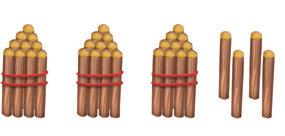
1. Count. Then, write the number in numerals and in words.
5. Compare the numbers. Then, write the missing numbers. 25
2. Count the sticks and write the number.
3. Continue each number pattern. Then, describe the number pattern.
a) 31, 21, 11, Count by b) 25, 27, 29, , , Count by
4. Complete the number line.
is the greatest. is the least.
EXPLORE
The number of countries in each continent is shown below.
North America: 23 South America: 12 Europe: 44 Africa: 54 Asia: 48 Oceania: 14
Arrange the continents in order. Begin with the continent that has the greatest number of countries.
How can we solve this problem?
Discuss in your group and fill in columns 1 and 2.
Chapter 1 Numbers to 120
Chapter Overview
Let’s Remember
Unit 1: Counting, Reading and Writing Numbers
Unit 2: Order of Numbers
Unit 3: Problem Solving
Let's Remember
Recall:
1. Counting within 40 by making tens first, and reading and writing numbers from 21 to 40 (CB1 Chapter 17)
2. Writing tens and ones as a 2-digit number (CB1 Chapter 17)
3. Describing and completing a number pattern by counting forwards or backwards by twos or tens within 40 (CB1 Chapter 17)
4. Placing numbers within 40 on a number line (CB1 Chapter 17)
5. Comparing numbers within 40 using place values (CB1 Chapter 17)
EXPLORE
Have students read the problem on CB p. 2. Discuss with students the following questions:
• How is the world organised?
• How many continents are there?
• What are the continents?
• What countries are in Oceania? How about countries in Asia and Europe?
• How are the countries different?
Have students form groups to complete the tasks in columns 1 and 2 of the table. Let students know that they do not have to solve the problem. Ask the groups to present their work.
Tell students that they will come back to this problem later in the chapter.
Unit 1: Counting, Reading and Writing Numbers
1.1 Counting, reading and writing numbers in tens
Let's Learn Let's Learn
Objectives:
• Count by tens within 120
• Read and write tens within 120 — the numeral and the corresponding number word in English, and in te reo Maori for numbers within 100
Materials:
• 1 enlarged copy of Place Value Cards (BM1.1)
• 1 bag of rubber bands
• 9 bundles of 10 straws
• 10 straws
Resources:
• CB: pp. 3–5
• PB: p. 1
(a) Before the lesson, cut out the place value cards in BM1.1.
Stages: Concrete Experience, and Pictorial and Abstract Representations
Put 10 straws on the table in front of the class. Count the straws with the class and tie them in a bundle of 10 with a rubber band.
Say: There are 10 straws in one bundle. So, this is 1 group of 10. We know that 10 ones is the same as 1 ten.
Write: 10 ones = 1 ten 1 ten = 10
Stick the place value card ‘10’ on the board.
Write: ten
Put another bundle of straws on the table. Guide students to count by tens to find the total number of straws in the two bundles. (10, 20)
Say: So, 2 tens is equal to 20.
Write: 2 tens = 20 ones 2 tens = 20
Stick the place value card ‘20’ on the board.
Write: twenty
Repeat the above procedure for the numbers 30 to 90.
(b) Stage: Pictorial Representation
Have students look at the tens frames in (b) on CB p. 3.
Ask: What number does each tens frame represent? (10)
Say: Let us count the counters in the tens frames. 10, 20, 30, …, 100. There are 100 counters.
Write some tens within 100 on the board. Read aloud the numbers on the board with students.
Say: A numeral is a symbol used to represent a number of objects. The numbers on the board are numerals.
tekau
7 tens whitu tekau
8 tens waru tekau
9 tens iwa tekau one hundred 1 hundred kotahi
(c) Stage: Pictorial Representation
Have students look at the ten-rods in (c) on CB p. 4.
Ask: What number does each ten-rod represent? (10)
Say: Let us count by 10s. 10, 20, 30, …, 100, 110, 120. There are 120 unit cubes.
Stage: Abstract Representation
Write: 12 tens = 120 ones
12 tens = 120
12 tens = 1 hundred 2 tens
Stick the place value card ‘100’ on the board, then stick the place value card ‘20’ on top of the place value card ‘100’ such that they show ‘120’.
Point out to students that ‘120’ is also a numeral.
Write: one hundred and twenty
(d) Stage: Abstract Representation
Recap with students the numbers one to ten in te reo Maori.
Have students look at the words in blue and red in the table on CB p. 4. Explain the base 10 number structure of the numbers in te reo Maori by looking at the words in blue [number (of tens)] and in red [ten(s)]. For example, in te reo Maori, the number thirty is formed by the M aori words ‘3 tens’, which is ‘toru tekau’.
2. Write the numerals.
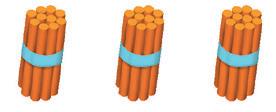
1. Count the tens. Then, write the missing numbers.
2. Write the numerals.
the numbers in English words.
Let's Do
Task 1 requires students to count by tens within 120 and write the number as a numeral.
Task 2 requires students to write the numerals given the number word in English or in te reo Maori.
Let's Practise
Task 1 requires students to count by tens within 120 and write the number as a numeral.
Task 2 requires students to write the numerals given the number word in English or in te reo Maori
Task 3 requires students to write the numbers in words given the numerals.
1.2 Counting, reading and writing numbers up to 120
Let's Learn Let's Learn
Objectives:
• Count within 120 by making tens
• Read and write a number within 120 — the numeral and the corresponding number word in English, and in te reo Maori for numbers within 100
Materials:
• 1 enlarged copy of Place Value Cards (BM1.1)
• Counters
Resources:
• CB: pp. 6–9
• PB: p. 2
Before the lesson, cut out the place value cards in BM1.1.
(a) Stage: Concrete Experience
Stick 44 counters randomly on the board.
Say: Let us count the counters. 1, 2, 3, …, 10. There are more than 10 counters. Let us count the counters again by putting them in groups of 10.
Arrange the counters in rows of 10 as you count. You should have 4 rows of 10 counters and 1 row of 4 counters.
Say: Let us count the counters. 10, 20, 30, 40, 41, 42, 43, 44. There are 44 counters.
Stage: Pictorial Representation
Have students look at the picture in (a) on CB p. 6. Say: Each group shows 10 erasers.
Ask: How many groups are there? (4) How many erasers are there in 4 groups? (40) Stick the place value card ‘40’ on the board.
Ask: How many erasers are not in groups? (4) Stick the place value card ‘4’ on the board. Overlap the place value cards to show 44. Say: 40 and 4 make 44. There are 44 erasers.
Stage: Abstract Representation
Write: 44 forty-four
Point to the numeral and word form of 44 on the board and read them aloud.
(b) Stages: Concrete Experience, and Pictorial and Abstract Representations
Follow the procedure in (a). Get students to count by tens to 110, then count by ones to 112.
1.2 Counting, reading and writng numbers up to 120
Let's Learn
a)
b)
English Place Value Te Reo Maori
ten 1 ten tekau
eleven 1 ten 1 one tekau mā tahi
twelve 1 ten 2 ones tekau mā rua
thirteen 1 ten 3 ones tekau mā toru
fourteen 1 ten 4 ones tekau mā whā
fifteen 1 ten 5 ones tekau mā rima
sixteen 1 ten 6 ones tekau mā ono
seventeen 1 ten 7 ones tekau mā whitu
eighteen 1 ten 8 ones tekau mā waru
nineteen 1 ten 9 ones tekau mā iwa
twenty 2 tens rua tekau
twenty-one 2 tens 1 one rua tekau mā tahi
twenty-two 2 tens 2 ones rua tekau mā rua
twenty-three 2 tens 3 ones rua tekau mā toru
twenty-four 2 tens 4 ones rua tekau mā whā
twenty-five 2 tens 5 ones rua tekau mā rima
twenty-six 2 tens 6 ones rua tekau mā ono
twenty-seven 2 tens 7 ones rua tekau mā whitu
twenty-eight 2 tens 8 ones rua tekau mā waru
twenty-nine 2 tens 9 ones rua tekau mā iwa
thirty 3 tens toru tekau
thirty-one 3 tens 1 one toru tekau mā tahi
thirty-two 3 tens 2 ones toru tekau mā rua
thirty-three 3 tens 3 ones toru tekau mā toru
forty 4 tens whā tekau
forty-one 4 tens 1 one whā tekau mā tahi
forty-two 4 tens 2 ones whā tekau mā rua
forty-three 4 tens 3 ones whā tekau mā toru
Chapter 1: Numbers to 120
(c) Stage: Abstract Representation
Have students look at the words in blue and red in the table on CB p. 7. Explain the base 10 number structure of the numbers in te reo Maori by looking at the words in blue (the tens) and in red (the ones). For example, in te reo Maori, the number thirty-two is formed by the te reo Maori words ‘3 tens 2 ones’, which is ‘toru tekau ma rua’.
Ask students to write the numbers 54 and 89 in te reo Maori by referring to the table on the page.
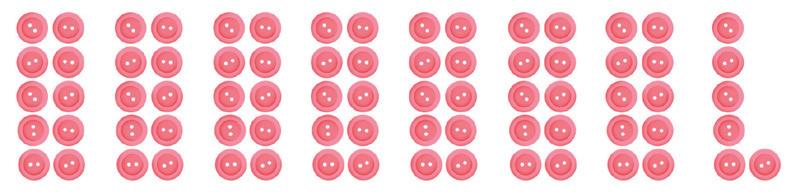
1. Count and write the number of buttons. There are buttons.
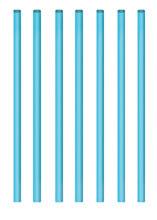
2. Count and write the number of straws. There are straws.
3. Write the numerals. a) sixty-eight b) fifty-two c) one hundred and four 4. Match.
Let's Do Let's
Tasks 1 and 2 require students to count within 120 and write the number as a numeral.
Task 3 requires students to write the numerals given the number words in English.
Task 4 requires students to match the number words in English and in te reo Maori.
Let's Practise Practise
Tasks 1 and 2 require students to count within 120 and write the number as a numeral.
Task 3 requires students to write the numerals given the number words in English.
Task 4 requires students to write the number words in English given the numerals.
Task 5 requires students to match the number words in English and in te reo Maori.
1.3 Numbers in hundreds, tens and ones
Let's Learn Let's Learn
Objectives:
• Write a 2-digit or 3-digit number up to 120 in hundreds, tens and ones
• Recognise the place value of each digit in a two-digit number, and a three-digit number up to 120
• Add 100 to a one-digit number
Materials:
• 1 enlarged copy of Place Value Cards (BM1.1)
• Counters
• Base ten blocks
Resources:
• CB: pp. 10–12
• PB: p. 3
Vocabulary:
• place value
(a) Stage: Concrete Experience
Stick 5 groups of 10 counters and another 3 counters on the board.
Say: Let us count the counters. 10, 20, 30, 40, 50, 51, 52, 53. There are 53 counters.
Stages: Pictorial and Abstract Representations
Have students look at the pictures in (a) on CB p. 10. Copy the place value chart in (a) on the page on the board but leave out the numbers. Explain to students that each bracelet stands for 1 ten. There are 5 tens. Stick the place value card ‘50’ on the board. Write ‘5’ in the tens column of the place value chart. Next, explain to students that each bead stands for 1 one. There are 3 ones. Stick the place value card ‘3’ on the board. Write ‘3’ in the ones column of the place value chart. Overlap the place value cards to show 53. Tell students that there are 5 tens and 3 ones in 53.
(b) Stages: Concrete Experience and Pictorial Representation
Show 75 using base ten blocks. Count the base ten blocks aloud with students.
Point to the ten-rods as you count: 10, 20, 30, …, 70.
Say: The ten-rods stand for 70.
Stick the place value card ‘70’ on the board. Point to the unit cubes as you count: 1, 2, 3, 4, 5.
Say: The unit cubes stand for 5.
Stick the place value card ‘5’ on the board. Say: We have 70 and 5.
Overlap the place value cards to show 75. Say: 70 and 5 make 75.
Stage: Abstract Representation
Write: 75 seventy-five
Copy the place value chart in (b) on CB p. 10 on the board but leave out the numbers.
Guide students to count the number of tens and ones and write in the place value chart.
Say: There are 7 tens 5 ones in 75.
Write: 75 = 7 tens 5 ones
Draw a number bond as shown in (b) on the page. Say: Since 70 is 7 tens and 5 is 5 ones, 75 is 7 tens 5 ones.
Write: 75 = 70 + 5
(c) Stages: Concrete Experience, and Pictorial and Abstract Representations
Follow the procedure in (b). Remind students that 10 tens equal 100.
Point out to students that since there are 0 tens, we write ‘0’ in the tens column of the place value chart.
(d) Stages: Concrete Experience and Pictorial Representation
Write: Add 100 and 2.
Show students 10 ten-rods. Remind them that each ten-rod stands for 10.
Ask: How many ten-rods are there? (10) What number do the ten-rods stand for? (100)
Stick the place value card ‘100’ on the board. Add 2 unit cubes to the 10 ten-rods. Remind students that each unit cube stands for 1.
Ask: How many unit cubes are there? (2) What number do the unit cubes stand for? (2)
Stick the place value card ‘2’ on the board. Ask: What number do these ten-rods and unit cubes stand for? (102)
Overlap the place value cards to show 102.
Say: 100 and 2 make 102.
Stage: Abstract Representation
Write: 100 + 2 = 102
Have students observe that when we add 100 to a 1-digit number, we get a 3-digit number where the ones digit is the 1-digit number and the hundreds digit is 1.
Let's Do Let's
Task 1 requires students to write a 2-digit number in tens and ones and a 3-digit number in hundreds, tens and ones.
Task 2 requires students to add 100 to a 1-digit number.
Let's Practise
Task 1 requires students to write a 2-digit number in tens and ones and a 3-digit number in hundreds, tens and ones.
Task 2 requires students to write 2-digit or 3-digit numbers in hundreds, tens and ones, and vice versa.
Task 3 requires students to add 100 to a 1-digit number.
EXPLORE
Have students go back to the problem on CB p. 2.
Ask: Can you solve the problem now? (Answer varies.) What else do you need to know? (Answer varies.)
Students are not expected to be able to solve the problem now. They will learn more skills in subsequent lessons and revisit this problem at the end of the chapter.
1.4 Counting by grouping
Let's Learn Let's Learn
Objectives:
• Find the total number of objects up to 120 by separating them into groups
• Identify if a group has an odd or even number of objects
• Identify odd and even numbers up to 120
Materials:
• Counters
Resources:
• CB: pp. 13–15
• PB: pp. 4–5
Vocabulary:
• even number
• odd number
(a) Stage: Concrete Experience
Stick 6 counters on the board.
Say: Let us count the counters by putting them in groups of 2.
Put 2 counters in a group and circle the group.
Say: There are still 4 counters left so we continue to put counters in groups of 2.
Repeat the grouping process until there are no counters left.
Ask: How many counters are there in each group? (2)
Lead students to count forwards in 2s.
Ask: How many counters are there? (6)
Stages: Pictorial and Abstract Representations
Refer students to the pictures of cars on CB p. 13 and relate them to the earlier activity.
Say: Let us count the cars by counting forwards in 1s. 1, 2, 3, 4, 5, 6.
Ask: Is it faster to count the cars by counting forwards in 1s or in 2s? (2s)
(b) Stages: Concrete Experience, and Pictorial and Abstract Representations
Follow the procedure in (a) but count the mangoes by grouping them in 5s and in 10s.
(c) Stages: Concrete Experience, and Pictorial and Abstract Representations
Follow the procedure in (a). Point out to students that 12 beans can be put into groups of 2. So, 12 is an even number. Have students see that 15 beans cannot be put into groups of 2. There is 1 bean left over. So, 15 is an odd number.
Say: An even number of objects can be put into groups of 2. An odd number of objects cannot be put into groups of 2. There will be 1 object left over.
Have students try putting other numbers of counters into groups of 2 to find more odd and even numbers.
1, 3, 5, 7, 9 11, 13, 15, 17, 19
The digit in the ones place of an odd number is 1, 3, 5, 7 or 9. The digit in the ones place of an even number is , , , or 0, 2, 4, 6, 8, 10 12, 14, 16, 18, 20
Look at the digits in the ones place. What pattern do you see?
1. Count and write the number of objects. Circle groups of 2, 5 or 10 objects to help you count.
Circle the group that shows an odd number.
2. Cross out the group that shows an even number.
(d) Stage: Abstract Representation
Write on the board the odd and even numbers within 20 in two groups as shown in (d) on CB p. 14. Have students look at the odd numbers and guide them to observe the pattern in the digits in the ones place.
Ask: What digit does an odd number have in the ones place? (The digit 1, 3, 5, 7 or 9)
Extend the list of odd numbers to 29 and have students observe the pattern in the digits in the ones place.
Have students look at the even numbers and guide them to observe the pattern in the digits in the ones place.
Ask: What digit does an even number have in the ones place? (The digit 0, 2, 4, 6 or 8)
Extend the list of even numbers to 30 and have students observe the pattern in the digits in the ones place.
Let's Do Let's Do
Task 1 requires students to find the total number of objects up to 120 by separating them into groups.
Task 2 requires students to identify the group that shows an even number.
Task 3 requires students to identify whether a number up to 120 is odd or even.
Circle the even numbers. 26 37 52 83 100 114
Circle the odd numbers. 18 47 70 95 109 120
Is 107 an even
Let's Practise Let's Practise
Task 1 requires students to find the total number of objects up to 120 by separating them into groups.
Task 2 requires students to identify the group that shows an odd number.
Task 3 requires students to identify even numbers up to 120.
Task 4 requires students to identify odd numbers up to 120.
Task 5 requires students to identify whether a number up to 120 is odd or even.
Unit 2: Order of Numbers
2.1 Finding more than and less than Let's Learn Let's Learn
Objective:
• Find the number which is 1, 2, 5 or 10 more than or less than a given number within 120
Materials:
• 1 copy of Number Chart (BM1.2) per student
Resources:
• CB: pp. 16–17
• PB: p. 6
(a) Stages: Pictorial and Abstract Representations Distribute a copy of Number Chart (BM1.2) to each student.
Guide students to read the numbers on the chart to ensure that they are familiar with number sequences up to 120.
Ask students to circle 13 on the number chart.
Say: Let us count forwards 2 ones from 13. Have students place a finger on 13 and move 2 steps to the right.
Guide them to see that this is the same as counting forwards 2 ones from 13.
Ask: What number are you pointing at now? (15)
Say: 13, 14, 15. 2 more than 13 is 15. Provide another example to guide students to find 5 more than 107.
Unit
2 Order of
Numbers
2.1 Finding more than and less than Let's Learn Let's Learn
(b) Stages: Pictorial and Abstract Representations
Follow the procedure in (a) but guide students to count backwards 5 ones from 56 to reach 51.
Provide another example to guide students to find 2 less than 111.
(c) Stages: Pictorial and Abstract Representations
Ask students to circle 19 on the number chart.
Say: Let us count forwards 1 ten from 19. Have students place a finger on 19 and count forwards 10 ones.
Ask: What number are you pointing at now? (29)
Have students place a finger on 19 again and move it 1 row downwards to 29.
Guide students to see that this is counting forwards 1 ten which is the same as counting forwards 10 ones, and they will still end up at 29.
Say: 19, 29. 10 more than 19 is 29.
Repeat the above procedure to guide students to count backwards 1 ten from 107 to find 10 less than 107.
Let's Do Do
Task 1 requires students to find the number which is 1, 2, 5 or 10 more than or less than a given number within 120.
Let's Practise
Tasks 1 and 2 require students to find the number which is 1, 2, 5 or 10 more than or less than a given number within 120.
Write the missing numbers.
1. Write the missing numbers.
2. Answer the questions.
a) What number is 2 more than 34?
b) What number is 1 less than 50?
c) What number is 5 more than 115?
d) What number is 10 less than 102?
2.2 Number patterns
Let's Learn Let's Learn
Objectives:
• Count forwards or backwards in 1s, 2s, 5s and 10s from any number within 120
• Count forwards in 3s from multiples of 3s
• Describe and complete a number pattern by counting forwards or backwards in 1s, 2s, 5s and 10s within 120
Materials:
• 1 copy of Number Chart (BM1.2) per student
Resources:
• CB: pp. 18–20
• PB: pp. 7–8
(a) Stages: Pictorial and Abstract Representations
Distribute a copy of Number Chart (BM1.2) to each student. Have students locate the number 63 on the number chart and colour the box blue. Get them to count forwards 3 ones from 63.
Ask: What number do you reach? (66) Have students colour the box with the number 66 blue. Ask them to now count forwards 3 ones from 66.
Ask: What number do you reach? (69) Have students colour the box with the number 69 blue. Ask them to count forwards 3 ones from 69.
Ask: What number do you reach? (72) Have students colour the box with the number 72 blue.
Have students look at the blue boxes in the number chart. Guide them to observe that they have counted forwards by threes from 63 to 72.
Write: 63, 66, 69, 72
Tell students that this is a number pattern. Have them see how each number is related to the number before it.
Ask: How are 63 and 66 related? (66 is 3 more than 63.) How are 66 and 69 related? (69 is 3 more than 66.) How are 69 and 72 related? (72 is 3 more than 69.)
Say: Each number in the number pattern is 3 more than the number before it.
Ask: So, how can we find the next number in this pattern? (By adding 3 to the number 72/ by counting forwards in 3s from 72) What is the next number in this pattern? (75) What number comes after 75 in this pattern? (78)
Guide students to observe that this pattern is made up of alternating odd and even numbers.
Point out to them that when we count forwards by 3s, we will get a pattern with alternating odd and even numbers.
The next two numbers in the pattern are 75 and 78.
b) pattern: Start at 89. Count backwards in 2s.
The number pattern is 89, 87, 85, 83.
Each number is 2 less than the number before it.
The next two numbers in the pattern are and
(b) Stages: Pictorial and Abstract Representations
Follow the procedure in (a) but guide students to count backwards in 2s from 89 to 83. Conclude with students that each number is 2 less than the number before it. So, the next two numbers in the pattern are 81 and 79. Have students count backwards in 5s from 89. Write the numbers as they count. Get students to compare the numbers in this pattern with the numbers in the pattern created by counting backwards in 2s. Guide them to observe that some numbers in the two patterns are the same.
Let's Do Let's
Task 1 requires students to describe and continue number patterns within 120.
Task 2 requires students to complete number patterns within 120.
Let's Do Let's Do
1. Describe each number pattern. Then, continue the number pattern.
a) pattern: Start at 28. Count forwards in 28, b) pattern: Start at 80. Count in 80, , , , , 2. Complete the number patterns. a) 85, 80, 75, b) 42, 45, 48, 10s 38 backwards
Task 1 requires students to describe and continue number patterns within 120.
Task 2 requires students to complete number patterns within 120.
2.3 Reading number lines
Let's Learn Let's Learn
Objectives:
• Read numbers within 120 on a number line
• Locate numbers within 120 exactly on a number line, and approximately on a partially labelled number line
Resources:
• CB: pp. 20–21
• PB: p. 9
Stages: Pictorial and Abstract Representations
Draw the number line as shown on CB p. 20 on the board but leave out the curved arrows. Have students look at the first two numbers on the number line and count aloud. (40, 41) Elicit from students that they are counting forwards in 1s. Remind students that the intervals on a number line are equal.
Ask: What does each interval on the number line stand for? (1)
Say: Each number on the number line is 1 more than the number on the left.
Draw arrows from 40 to 41 and from 41 to 42 on the number line and label the arrows ‘1 more’.
Say: Each shape on the number line stands for a number. Let us find the number that the first shape stands for.
Guide students to count forwards in 1s from 40, pointing to each mark as they do so. Count forwards with students from 40 to 42.
Say: The shape stands for 42. Write ‘42’ on the number line.
Repeat the above procedure to guide students to find the number the circle stands for by counting forwards in 1s.
Point to the numbers 50 and 49 on the number line and count backwards. Elicit from students that they are counting backwards in 1s.
Say: Each number on the number line is 1 less than the number on the right.
1. Continue each number pattern. Then, describe the number pattern. a) 88, 86, 84, 82, Count in b) 18, 21, 24, 27, Count in
2. Complete the number patterns. a) 55, 60, 65, b) 17, 15, 13, c) , 110, 100, 90, 80, , 60 d) 36, , , 45, 48, 51
2.3 Reading number lines
Count forwards in 1s: 40, 41, 42 stands for 42.
Count forwards in 1s: 44, stands for
Count backwards in 1s: 50, 49, stands for
Draw arrows from 50 to 49 and from 49 to 48 on the number line and label the arrows ‘1 less’.
Say: Let us now find the number that the triangle stands for.
Guide students to count backwards in 1s from 50, pointing to each mark as they do so. Count backwards with students from 50 to 48.
Say: The triangle stands for 48.
Lead students to see that they can either count forwards or backwards from a known number to find the missing numbers on a number line. Emphasise that they should first identify the number that each interval represents on the number line before finding the missing numbers.
Let's Do
Task 1 requires students to read numbers within 120 on number lines.
Let's Practise Let's Practise
Task 1 requires students to read numbers within 120 on number lines.
Task 2 requires students to find 1, 2 or 5 more than or less than each given number within 120 and locate the numbers exactly on a number line.
Task 3 requires students to locate a number within 120 approximately on a partially labelled on a number line.
a)
2.4 Rounding numbers to the nearest ten
Let's Learn Let's Learn
Objective:
• Round numbers up to 120 to the nearest ten
Resources:
• CB: pp. 22–23
• PB: p. 10
Vocabulary:
• approximately
• round
(a) Stage: Pictorial Representations
Draw the number line in (a) on CB p. 22 on the board but do not label ‘62’.
Guide students to see that there are 10 equal intervals between 60 and 70 and each interval stands for 1.
Invite a student to mark 62 on the number line. Say: 62 is between two tens: 60 and 70.
Ask: How many intervals are there from 60 and 62? (2) How many intervals are there from 62 and 70?(8) Is 62 nearer to 60 or to 70? (Nearer to 60)
Stage: Abstract Representation
Say: Since 62 is nearer to 60 than it is to 70, we say 60 is the ten nearest to 62. When we round 62 to the nearest ten, we get 60.
Write: 62 ≈ 60
Say: We read this statement as ‘62 is approximately 60’.
Explain that ‘≈’ is the approximation sign and it means ‘approximately’.
(b) and (c) Stages: Pictorial and Abstract Representations
Follow the procedure in (a).
For (c), explain to students that when a number is halfway between two tens, we take the greater ten as the nearest ten.
2.4 Rounding numbers to the nearest ten
Let's Learn
a)
(d) Stages: Pictorial and Abstract Representations
Follow the procedure in (a).
Conclude that to round a number to the nearest ten, we look at the digit in the ones place. If it is 5 or greater, we round up. If it is less than 5, we round down.
Let's Do Let's Do
Tasks 1 and 2 require students to round numbers up to 120 to the nearest ten.
Let's Practise Let's Practise
Task 1 requires students to round numbers up to 120 to the nearest ten.
Tasks 2 requires students to round the number of objects up to 120 to the nearest ten.
To round a number to the nearest ten, look at the digit in the ones place. If it is 5 or greater, round up. If it is less than 5, round down.
a) There are 84 cows on a farm. Round the number of cows to the nearest ten. b) 118 children took part in a cross-country race. Round the number of children to the nearest ten.
Let's Practise
2.5 Comparing and ordering numbers
Let's Learn Let's Learn
Objectives:
• Compare and order numbers within 120 using place values
• Use ‘>’ and ‘<’ symbols to compare numbers within 120
• Check the truth of number sentences involving direct comparisons of whole numbers up to 120
Materials:
• Base ten blocks
Resources:
• CB: pp. 24–26
• PB: p. 11
Vocabulary:
• greater than
• greatest
• less than
• least
(a) Stage: Concrete Experience
Have students work in groups. Distribute base ten blocks to each group.
Say: Let us compare the numbers 53 and 47. Have students form the two numbers using base ten blocks.
Ask: Which number is formed by more blocks? (53)
Say: So, 53 is greater than 47.
Stages: Pictorial and Abstract Representations
Have students look at the base ten blocks in (a) on CB p. 24 and relate them to the earlier activity.
Say: Each ten-rod represents 1 ten. Each unit cube represents 1 one.
Copy the place value chart in (a) on the page on the board but leave out the numbers.
Ask: How many tens and ones make 53?
(5 tens 3 ones)
Write ‘5’ and ‘3’ in the place value chart to show 53.
Ask: How many tens and ones make 47? (4 tens 7 ones)
Write ‘4’ and ‘7’ in the place value chart to show 47.
Say: We can compare the numbers by looking at the number of tens and ones in each number. Let us compare the number of tens first.
Ask: Which number has more tens, 53 or 47? (53) Say: Since 53 has more tens than 47, 53 is greater than 47.
Write: 53 is greater than 47. 53 > 47
(b) Stage: Concrete Experience
Have students continue to work in groups.
Say: Let us compare the numbers 53 and 59. Have students form the two numbers using base ten blocks.
2.5 Comparing and ordering numbers
Let's Learn Let's Learn a) Compare 53 and 47.
Ask: Which number is formed by fewer blocks? (53)
Say: So, 53 is less than 59.
Stages: Pictorial and Abstract Representations Have students look at the base ten blocks in (b) on CB p. 24 and relate them to the earlier activity. Copy the place value chart in (b) on the page on the board but leave out the numbers.
Ask: How many tens and ones make 53? (5 tens 3 ones) How many tens and ones make 59? (5 tens 9 ones)
Complete the place value chart to show the numbers 53 and 59.
Say: We can compare the numbers by looking at the number of tens and ones in each number. Let us compare the number of tens first.
Ask: Which number has fewer tens, 53 or 59? (Both numbers have the same number of tens.)
Say: Since both numbers have 5 tens, we compare the number of ones. 3 ones is less than 9 ones so 53 is less than 59.
Write: 53 is less than 59. 53 < 59
(c) Stage: Abstract Representation
Write 53, 47 and 59 in a place value chart. Guide students to compare the number of tens before comparing the number of ones.
Then, guide students to arrange the numbers in order, beginning with the greatest. (59, 53, 47)
compare
compare the
They
99 is the least number. 106 is the greatest number. Arrange the numbers in order. Begin with the least.
1. Write greater than or less than a) TensOnes
Let's Practise Let's Practise
1. Write > or <
Circle
or False.
3. Arrange the numbers in order. Begin with the given number.
2. Write
3. Arrange 86, 49 and 94 in order. Begin with the least. , , Let's Do (least)
(d) Stage: Abstract Representation
Follow the procedure in (c). Highlight to students that in the number 99, there are no hundreds or 0 hundreds.
Let's Do Let's Do
Task 1 requires students to compare two numbers within 120 using place values.
Task 2 requires students to compare two numbers within 120 using the ‘>’ and ‘<’ symbols.
Task 3 requires students to compare and order three numbers within 120.
Let's Practise Let's Practise
Task 1 requires students to compare two numbers within 120 using the ‘>’ and ‘<’ symbols.
Task 2 requires students to check the truth of number sentences involving direct comparisons of whole numbers up to 120.
Task 3 requires students to compare and order three numbers within 120.
Unit 3: Problem Solving
3.1 Mind stretcher
Let's Learn Let's Learn
Objectives:
• Solve a non-routine problem involving numbers within 120 using the strategy of making a list
• Solve a non-routine problem involving numbers within 120 using the strategy of drawing a picture
Materials:
• 1 copy of Maths Journal (BM1.3) per student
Resource:
• CB: pp. 27–28
Have students read the problem on CB p. 27.
1. Understand the problem. Pose the questions in the thought bubble in step 1.
2. Plan what to do.
Point out to students that we can make a list to solve the problem.
3. Work out the Answer.
Say: Since the greatest number is 33 and the least number is 24, the third number is greater than 24 but less than 33.
Ask: What numbers are greater than 24 but less than 33? (25, 26, 27, 28, 29, 30, 31, 32)
Write: 25, 26, 27, 28, 29, 30, 31, 32
Have students read sentence 3 of the problem.
Say: The third number has 3 tens and at least 1 one.
Point to the numbers on the board.
Ask: Which of these numbers have 3 tens and at least 1 one? (31 and 32) Why is 30 not included? (It has 3 tens and 0 ones.)
Say: Since only 31 and 32 have 3 tens and at least 1 one, the third number can be 31 or 32.
Unit 3 Problem Solving
3.1 Mind stretcher
Adele
three numbers
4. Check if your answer is correct. Guide students to check their answer by reading the problem again to check if the problem matches the answer.
Ask: Is 31 greater than 24 but less than 33? (Yes) Is 32 greater than 24 but less than 33? (Yes) Do both 31 and 32 have 3 tens and at least 1 one? (Yes) Conclude that the answer is correct.
5. + Plus Solve the problem in another way. Have students try to solve the problem in a different way.
Have 1 or 2 students share their methods. If students are unable to solve the problem in a different way, explain the method shown on CB p. 28.
Ask: Which method do you prefer? Why? (Answers vary.)
Let's Do Let's
Get students to draw a picture to represent the positions of Oscar and Sarah based on the information given in the task. Explain to students that Sarah is in front of Oscar means that Sarah is closer to the ticket booth than Oscar is. Have them write the queue number of each person. Conclude with students that Sarah’s queue number is 89.
EXPLORE
Have students go back to the problem on CB p. 2. Get them to write down in column 3 of the table what they have learnt that will help them solve the problem, and then solve the problem.
Have a student present his/her work to the class.
Maths Journal
Have students work on the tasks in Maths Journal (BM1.3) independently to check and reinforce their understanding.
Use the rubric provided on p. 300 of the blackline masters to score students’ work.
Practice Book Chapter 1: Answers
Exercise 1.1
1. a) 5; 50; 50 b) 11; 110; 110
2. Match:
forty—wha tekau; eighty—waru tekau; sixty—ono tekau; one hundred—kotahi rau
3. a) sixty b) one hundred and twenty
Exercise 1.2
1. a) 59 b) 103
2. eighty-one; forty-nine; 72; 115
3. Match: 68—ono tekau ma waru; 91—iwa tekau ma tahi; 13—tekau ma toru
Exercise 1.3
1. a) 5; 4; 50; 4; b) 100; 6;
2. a) 55 b) 110 c) 94 d) 107
3. a) 106 b) 101
Exercise 1.4
1. a) 25 b) 44
2. a) Cross out the second group. b) Cross out the second group.
3. a) Circle the first group. b) Circle the second group.
4. Circle 29, 63, 101 and 115.
5. Even number. The digit in the ones place is 0.
Exercise 2.1
1. a) 48; 52; 37 b) 54; 59; 66
2. a) 54 b) 40 c) 110 d) 102 e) 29 f) 80 g) 118 h) 111