



Clear step-by-step guidance for Big Books that accompany each unit of Mathematics Book 0
Practical support for teaching problem solving using rich tasks, discussion, and real-world contexts

Clear step-by-step guidance for Big Books that accompany each unit of Mathematics Book 0
Practical support for teaching problem solving using rich tasks, discussion, and real-world contexts
The cat family is in the garden, counting all their friendly garden visitors.
Students are to help the cats count groups, or sets, of garden creatures from 1 to 5, which are illustrated in a variety of arrangements (straight line/row, 5-frame, array, circular, scattered). Students are also asked to count out a specific number of garden visitors from a larger group. In the activities in Read and Solve, students will read and recognise numerals from 1 to 5, count using one-to-one correspondence, and reinforce cardinality as well as conservation for numbers 1 to 5.

Count up to 5 objects arranged in different ways (in a line, 5-frame, array, circular, scattered) 2, 3, 4, 5, 6, 7, 8 BM1.1
Identify the last number counted as the number of objects in the group 2, 3, 4, 5, 6, 7, 8 BM1.1, BM1.2, BM1.3
Read and write 1 to 5 in numeral form and recognise their number names 4, 6
Use one-to-one correspondence BM1.1, BM1.2, BM1.3
State the number of objects in a counted set of up to 5 objects without recounting 5, 6
Count out a given number of up to 5 objects from a larger set of up to 8 objects 7, 8 BM1.1, BM1.2, BM1.3
New Zealand Curriculum Strand and Element: Year 0: Number — Number structures
Vocabulary: count, how many, one, two, three, four, five
Resource:
• Problem Solving Big Book 1
Introduce the story by posing the following questions.
• What animals do you see when you take a walk outside?
• Which of these animals can fly?
• Which animal is your favourite? What do you like about this animal?
Have students look at the book cover. Read the title to students. Encourage them to guess what the story might be about.
Do a picture walk of the story with students. Have them talk about the cat family and what they are doing on each page.
Lead students in a brief discussion of their thoughts about the story.
Say: Let us read the story to find out more about what the cat family will be doing in the garden.

Resource:
• Problem Solving Big Book 1: pp. 2–3
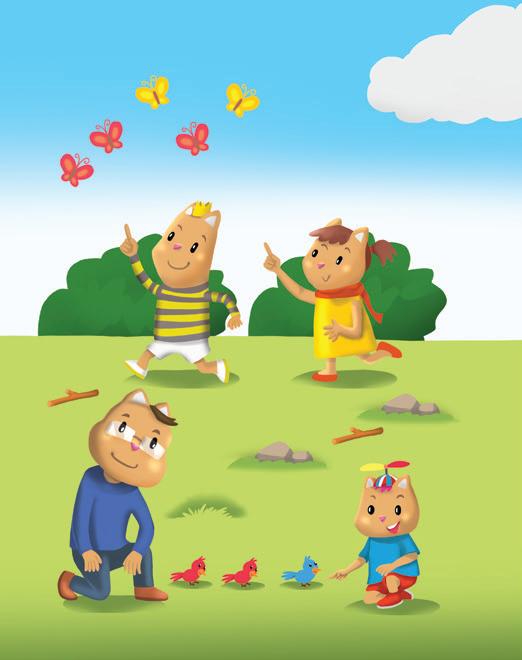
Have students look at the picture on BB pp. 2–3. Encourage them to describe the different garden creatures they see. Read the text to students.
Ask:
• How many butterflies do you see? (5)
Count the butterflies together with students and then ask the ‘How many?’ question to reinforce the concept of cardinality.
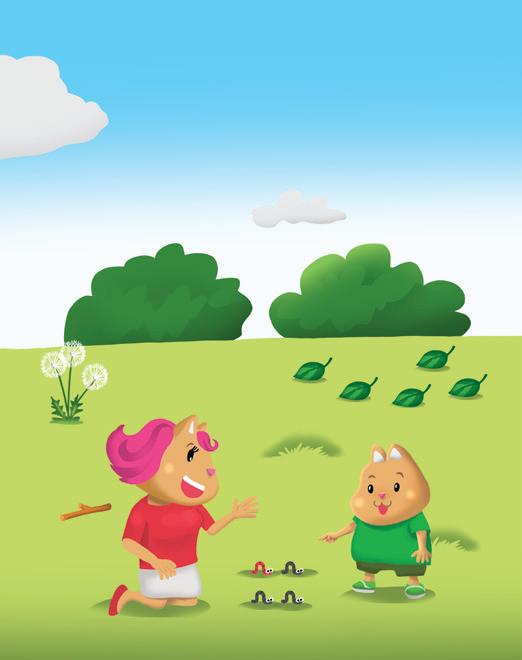
• How many worms are there? (4)
• How are the worms arranged? (2 on top and 2 below)
Count the worms together with students and ask the ‘How many?’ question.
• How many birds do you see? (3)
• How are the birds arranged? (In a row)
Count the birds together with students and ask the ‘How many?’ question.
Materials:
• Sheets of paper for recording answers as necessary
• Sticky notes
Resource:
• Problem Solving Big Book 1: p. 4
Have students identify the numbers in the picture on BB p. 4. Get students to notice that each number is next to a group of garden creatures. Read the text to students.
Ask:
• What number is next to the birds? (3) How many birds are there? (3)
Did Helicopter make the correct number with the stones? (Yes)
• What number is next to the worms? (4) How many worms are there? (4)
Did Bob make the correct number with the twigs? (Yes)
• What number is next to the butterflies? (5) How many butterflies are there? (5) Did King make the correct number with the dandelions? (Yes)
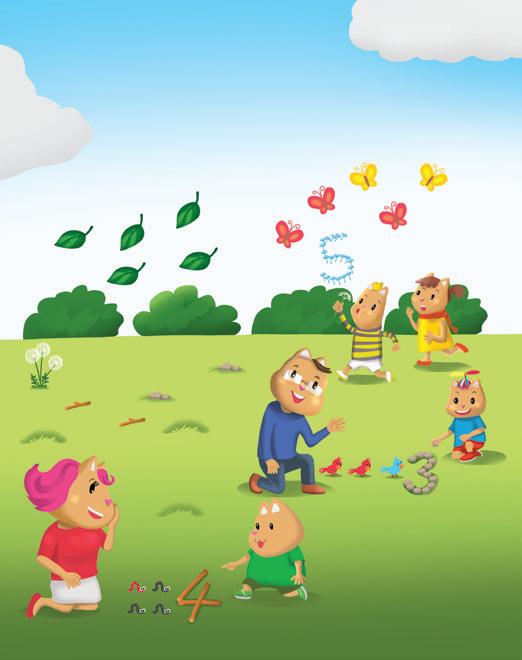
Have student volunteers write each number on a sticky note and place it next to the corresponding number and group of garden creatures. Have the other students check that the number is correct.

Resource:
• Problem Solving Big book 1: p. 5
Point out to students that the birds, worms and butterflies have moved about since they last appeared on BB p. 4.
Read the text on BB p. 5 to students. Ask students to examine the picture on the page and think independently to determine how many butterflies, birds and worms there are. Have students turn and talk to a partner about what they noticed.
Ask:
Materials:
• Sheets of paper for recording answers as necessary
• Pointer stick
Resource:
• Problem Solving Big Book 1: p. 6
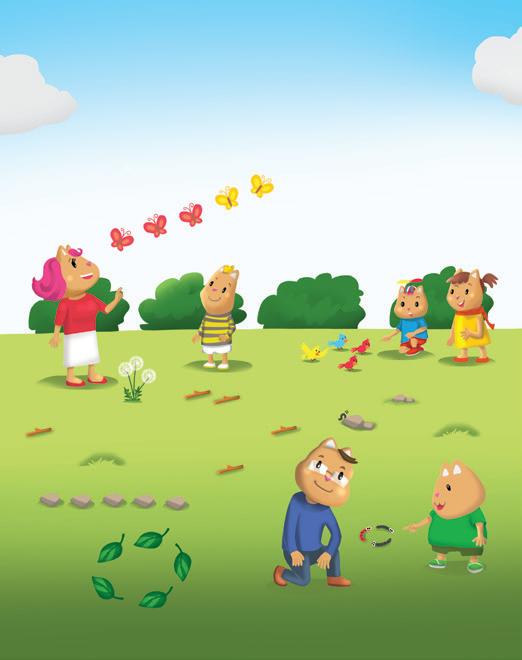
Now they are moving. They are all on the go. How many now? Do you know?
• What did you and your partner notice about the number of garden creatures on this page? (There are still 5 butterflies. There are 3 worms now. One worm is crawling under a rock. There is another bird now.)
• How many of each type of garden creatures did you count? (5 butterflies, 3 worms, 4 birds)
• How are the groups of garden creatures arranged? (Worms in a circle, butterflies in a row, birds scattered) Have student volunteers write the number on a sticky note and place it next to the corresponding number and group of garden creatures. Have the other students check that the number is correct.
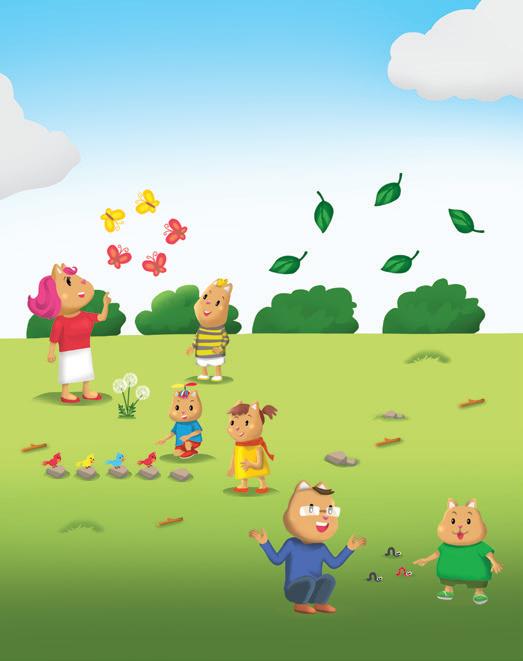
Read the text on BB p. 6 to students. Ask students to think about how the garden creatures are arranged. Have students discuss in pairs how the groups of garden creatures changed their arrangements this time. Have a brief whole class discussion about the different arrangements of garden creatures and whether the quantities of each group of garden creatures has changed. Have a student use a pointer stick to point to the garden creatures in each group one at a time as the remaining students count. Ask the ‘How many?’ question after the completed count of each group to reinforce the concept of cardinality.
NOTE: On this page of the book, the same number of butterflies, worms and birds are illustrated as on page 5, but the groups are arranged in different ways. This helps students to solidify their understanding of cardinality and strengthen their understanding of conservation.
Materials:
• Pointer stick
Resource:
• Problem Solving
Big Book 1: p. 7
Read the text on BB p. 7 to students. Have students talk in pairs about the number of red garden creatures they notice in each group of garden creatures.
Ask:
• What did you and your partner notice about the number of red garden creatures? (2 out of 4 birds are red. 1 worm is red and 2 are not red. 3 out of 5 butterflies are red.)
• How are the worms arranged? (In a straight line from top to bottom)
NOTE: While the worms are arranged in a column, this is also a 1 × 3 array.
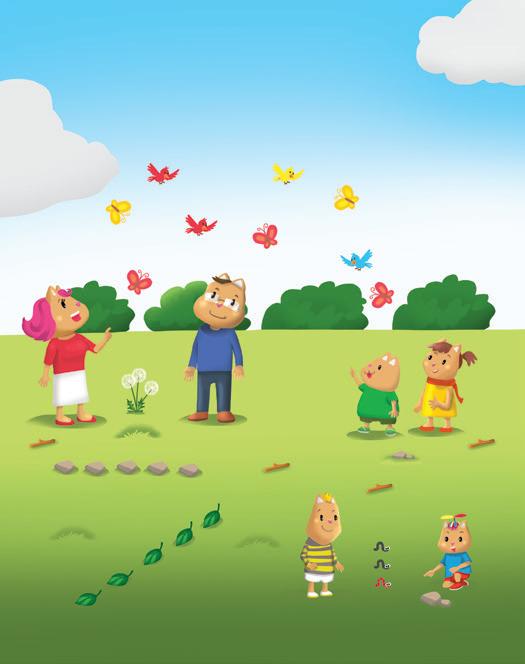
• Is it easy to count the red birds and butterflies? (No, they are mixed up so it’s hard to count them.) What can we do to make counting easier? (Answers vary. E.g. Put a sticker/counter on the creature once it’s been counted; Count with a partner; Count and check with a partner.)
Have a student use the pointer stick to point out the red garden creatures in each group as the remaining students count. Ask the ‘How many?’ question. Repeat by asking another student to point out the garden creatures that are not red.
Materials:
• Sheets of paper for recording answers as necessary
• Pointer stick
Resource:
• Problem Solving Big Book 1: p. 8
Read the text on BB p. 8 to students.
Ask:
• What do you notice about how the garden creatures are arranged on this page? (The butterflies are together, the worms are together and the birds are together.)
• Will it be easier to count the red garden creatures now? (Yes. The red butterflies are together on the stick that Father is holding. The red birds are on Mother’s head. The red worm is at the bottom of the line.)
Have a student volunteer use the pointer stick to point to each type of garden creature with the remaining students counting along. When students finish counting, ask the ‘How many?’ question.
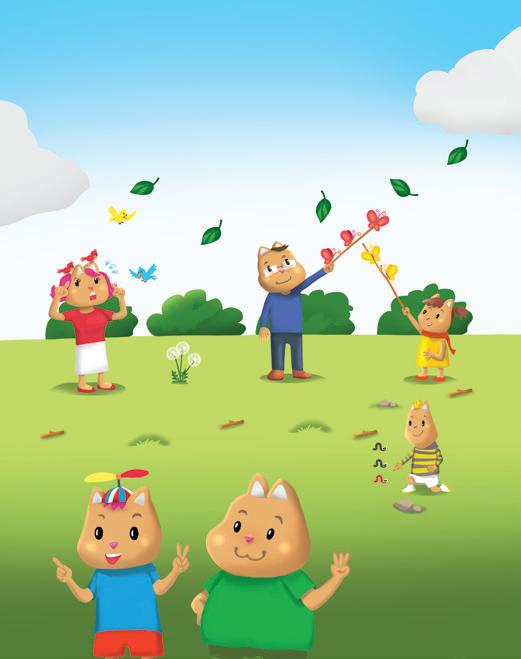
Ask students to turn and talk to a partner about Helicopter and Bob at the bottom of the page. Have them focus on the cats' fingers and what they represent. (Helicopter has 1 finger up on one hand and 2 fingers up on the other hand. Bob is holding up 3 fingers. It’s 1 and 2 and 3. It represents 1 red worm, 2 red birds and 3 red butterflies.)
Materials:
• 1 bag of 10 counters of 2 or 3 different colours per student
• 1 copy of Different Arrangements Work Mat (BM1.1) per student
Arrange the same number of objects in different ways
Distribute a bag of counters and a copy of Different Arrangements Work Mat (BM1.1) to each student.
Have students choose one of the numbers at the top of the work mat (e.g. 4). Get them to count out counters from their bag to form two different arrangements of 4.
Provide time for students to describe their arrangements. (There are 2 red counters in the top row and 2 blue counters in the bottom row; This is a line of 4 counters. This counter is red and the others are yellow.)
Have students count the counters in each other’s representations together and answer the ‘How many?’ question.
Repeat with the numbers 3 and 5.
Ask:
• How is your arrangement different from your friend’s arrangement?
• Did you use counters of one colour or many colours? Is it easier to count the counters when they are of one colour or many colours?
Materials:
• 1 bag of 30 connecting cubes per pair of students
• 2 copies of 1–5 Work Mat (BM1.2) per pair of students
Distribute a bag of connecting cubes and 2 copies of 1–5 Work Mat (BM1.2) to each pair.
Have students represent each number with the cubes. Instruct students to connect the cubes when representing 2 to 5. Have partners check each other’s work.
Materials:
• Coloured pencils
• 1 copy of Colour and Write 1–5 (BM1.3) per student
Distribute a copy of Colour and Write 1–5 (BM1.3) to each student.
Have students follow the instructions: Read the number. Colour the squares to show each number. Write the number in the empty box. An example is provided. Have students check each other's work.
Have students think about what they learnt about counting. Then, get them to share with the class. (It does not matter how objects are arranged, it’s still the same number of objects./It’s easier to count objects in a line./I can show a number in different ways.)
Have students count other objects in the garden:
• number of leaves (5, depicted in various arrangements)
• number of sticks (quantities vary on BB pp. 2–5, quantity is the same on BB pp. 6–8)
• number of stones (quantities vary)
• number of cats (6, arranged in different groups, such as: 4 and 2/ 2, 2 and 2/ 3, 2 and 1)
Read the number. Colour the squares to show the number. Write the number in the box.
1
2
3
4
5
1