
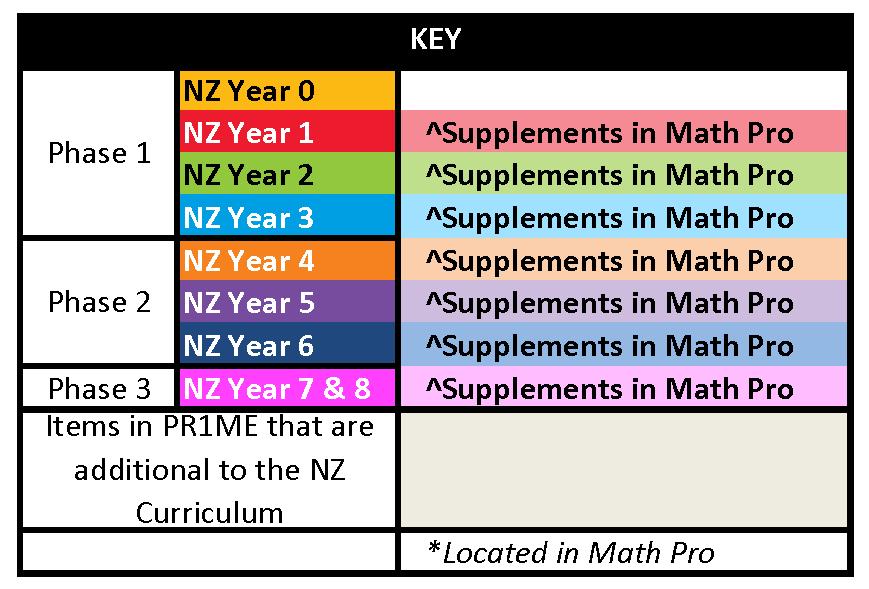
PR1ME Developmental Continuum aligned with the NZ Draft Curriculum 2024
The Developmental Continuum shows the links between learning objectives within and across strands and levels
It provides an overview of prior, current and future learning objectives
New learning is built on prior learning across the levels and how each topic forms the foundation for future learning
PR1ME LEVELS
Rote count within 100 by ones and tens. Count within 100. Count within 100. Count within 1000. Count within 10 000. Read and write a number within 1 000 000—the numeral and the corresponding number word.
Read and write 0 to 10—the numeral and the corresponding number word.
Identify the last number counted as the number of objects in the group.
Read and write a number from 0 to 100—the numeral and the corresponding number word.
Read and write a number within 100—the numeral and the corresponding number word.
Recognize conservation of numbers. Use number notation and place values (tens, ones).
Count on and backwards within 10. Use number notation and place values (tens, ones).
Estimate the number of objects in a group of less than 100 objects.
Count groups of up to 20 objects in different arrangements.
Compare the number of objects in two groups.
Estimate the number of objects in a group of less than 40 objects.
Find the number which is 1, 2 or 10 more than or less than a given number within 100.
Compare and order numbers within 20. Give a number that comes before or after a number or between two numbers within 100.
Understand that the number that comes next is 1 more.
Break apart 4 to 10 objects into two parts.
Write a number bond for 4 to 10.
Count on and backwards by ones, twos or tens within 100.
Describe and complete a number pattern by counting on or backwards by ones, twos or tens within 100.
Find the number which is 1, 2, 3, 4, 5 or 10 more than or less than a given number within 100.
Count on and backwards by ones, twos, threes, fours, fives or tens within 100.
Read and write a number within 1000—the numeral and the corresponding number word.
Use number notation and place values (hundreds, tens, ones).
Find the number which is ones, tens or hundreds more than or less than a given number within 1000.
Count on and backwards by ones, twos, threes, fours, fives, tens or hundreds within 1000.
Describe and complete a number pattern by counting on or backwards by ones, twos, threes, fours, fives, tens or hundreds within 1000.
Describe and complete a number pattern by counting on or backwards by ones, twos, threes, fours, fives or tens within 100.
Read and place numbers within 100 on a number line.
Use grouping in twos, fives and tens to count groups of up to 100 objects.
Compare and order numbers within 1000.
Use ‘>’ and ‘<’ symbols to compare numbers.
Read and place numbers within 1000 on a number line.
Read and write a number within 10 000—the numeral and the corresponding number word.
Use number notation and place values (thousands, hundreds, tens, ones).
Find the number which is ones, tens, hundreds or thousands more than or less than a given number within 10 000.
Identify the values of digits in a 5-digit or 6-digit number.
Compare and order numbers within 1 000 000.
Round a whole number to the nearest ten, hundred or thousand.
Recognize the historical origins of our number system and begin to understand how it developed.
Read and write a number within 10 000 000—the numeral and the corresponding number word.
Identify the values of digits in a 7-digit number.
Compare and order numbers within 10 000 000.
*Identify patterns in a hundred chart. Find all the factors of a whole number up to 100.
Count on and backwards by ones, tens, hundreds or thousands within 10 000.
Find out if a 1-digit number is a factor of a given whole number.
Describe, complete and create a number pattern by counting on or backwards by ones, tens, hundreds or thousands within 10 000.
*Describe and complete a number pattern by repeated addition or multiplication.
Compare and order numbers within 10 000.
Find the multiples of a whole number up to 10.
Round a whole number to the nearest ten thousand, hundred thousand or million.
Find the common factors and greatest common factor of two numbers.
Find out if a number is a common factor of two given numbers.
Relate factors and multiples. Find the common multiples and least common multiple of two numbers.
Find out if a whole number is a multiple of a given whole number up to 10.
3-digit numbers. Use ‘>’ and ‘<’ symbols to compare numbers. Identify multiples of 2, 5, 10, 25, 50 and 100 up to 1000.
ordinal numbers 1st to 10th to indicate position. Give a number between two neighboring pairs of tens within 100. Use ‘>’ and ‘<’ symbols to compare numbers. Round a 3-digit number to the nearest hundred.
Estimate the number of objects in a group of fewer than 10 objects.
Compare the number of objects in two or more groups.
Name a position using an ordinal number from 1st to 100th.
Identify odd and even numbers.
Subitize up to 6 objects. Compare and order numbers within 100. ^To break apart and regroup numbers to 100. ^To break apart and regroup numbers to 1000.
Compose and decompose numbers from 10 to 19 as 10 ones and some more ones.
Use ‘>’ and ‘<’ symbols to compare numbers.
Use the ‘=’ sign to represent equality.
^To use the mathematical processes to connect with te reo Māori or other languages with an explicit base 10 number structure.
Give a number between two 4-digit numbers.
Round a 3-digit or 4-digit number to the nearest ten.
Round a 3-digit or 4-digit number to the nearest hundred.
Round a 4-digit number to the nearest thousand.
Recognize prime numbers up to 20 and find all prime numbers less than 100.
word problems involving common factors and multiples.
a number in
notation.
*Find the value of a number given in exponential notation.
Identify square numbers. ^Identify factors of numbers up to 125.
*Identify triangular numbers. ^Identify, read, write, compare, and order whole numbers and decimals using powers of 10.
*Extend spatial patterns formed from adding and subtracting a constant.
^Identify square roots of square numbers up to at least 100.
^Count to and within 1,000, from any multiple of 100, forwards and backwards in 25s and 50s.
*Extend spatial patterns of square and triangular numbers.
^Use prime factorisation to find the HCF of two numbers.
Make number stories to illustrate number bonds for 5 to 10.
Break a group of 5 to 10 objects into two parts in different ways.
Write a number bond for 5 to 10.
Name the missing part or whole in a number bond.
Name a position using an ordinal number from 1st to 10th.
*Count within 120.
*Read and write a number from 101 to 120—the numeral and the corresponding number word.
Add or subtract within 10. Use picture cut-outs (or other manipulatives) to illustrate the meanings of addition and subtraction.
Act out addition and subtraction stories to illustrate the meanings of addition and subtraction.
Make addition or subtraction stories with the given illustrations.
Count all to add two quantities within 10.
Illustrate addition and subtraction stories and problems with number bonds.
Use drawings to represent addition and subtraction stories.
Make a number story for a given addition or subtraction sentence.
Write a number sentence for a given situation involving addition or subtraction.
Apply the identity, commutative and associative properties of addition.
Observe the answer when 0 is subtracted from a number.
Write a family of four addition and subtraction facts for a given number bond.
Associate the terms ‘sum’ and ‘difference’ with addition and subtraction respectively.
Use a part-whole bar model or a comparison bar model to represent an addition or subtraction situation.
*Identify cube numbers.
Add three or four 3-digit numbers. Estimate sums and differences. Check reasonableness of answers in addition or subtraction.
Add and subtract within 100. Check the answer to addition or subtraction.
Check reasonableness of answers in addition or subtraction using estimation.
Add three or more 1-digit or 2-digit numbers. Estimate sums and differences. Solve 1-step and 2-step word problems involving addition and subtraction.
Check the answer to addition or subtraction.
Solve 1-step and 2-step word problems involving addition and subtraction.
Check reasonableness of answers in addition or subtraction using estimation.
Use a part-whole bar model or a comparison bar model to represent an addition or subtraction situation.
Find pairs of multiples of 50 with a total of 1000 and write the addition and subtraction facts for each number pair.
Mentally add:
- two 2-digit numbers with regrouping
- a 2-digit, 3-digit or 4-digit number to a 3-digit or 4-digit number with regrouping
- three or four 1-digit or 2-digit numbers - three 2-digit multiples of 10
Investigate and generalize the result of adding and subtracting odd and even numbers.
Do mixed operations involving addition and subtraction without parentheses.
Do mixed operations involving the four operations with or without parentheses.
Write simple expressions that record calculations with numbers.
Solve multi-step word problems involving the four operations of whole numbers.
Use a calculator to carry out the four basic operations.
Calculate a sum or a difference on a calculator and check the reasonableness of the answer.
Solve multi-step word problems involving the four basic operations using a calculator.
*Solve challenging word problems involving whole numbers.
Write addition and subtraction facts within 5.
Count on to add or count backwards to subtract within 10.
Identify doubles facts within 20. Find pairs of 1-digit numbers with a total up to 18 and write the addition and subtraction facts for each number pair.
Solve 1-step and 2-step word problems involving addition and subtraction.
Mentally subtract: - a 2-digit number from another 2-digit number with regrouping
- a 2-digit, 3-digit or 4-digit number from a 3-digit or 4-digit number
Interpret numerical expressions without evaluation.
^Use commutative, associative, and identity properties, deciding which operations they work for and which they don't.
Mentally add:
- two or three 1-digit whole numbers within 20
- a 1-digit whole number and a 2-digit whole number within 20
Write a number sentence for an addition or subtraction problem.
Mentally subtract:
- a 1-digit whole number from another 1digit whole number
- a 1-digit whole number from a 2-digit whole number within 20
Check the answer to addition or subtraction.
Use ‘+’, ‘–’ or ‘=’ correctly to complete number sentences.
Find the missing part in an addition sentence.
Find number pairs with a total of 20 and write the addition and subtraction facts for each number pair.
*Identify patterns in an addition chart.
Find pairs of multiples of 10 with a total of 100 and write the addition and subtraction facts for each number pair.
Find pairs of multiples of 100 with a sum of 1000 and write the addition and subtraction facts for each number pair.
Find the missing part in an addition sentence.
Find the missing part or whole in a subtraction sentence.
Find pairs of numbers with a sum of 100 and write the addition and subtraction facts for each number pair.
Find the missing part in an addition or subtraction sentence.
Use the ‘=’ sign to represent equality. Use the ‘=’ sign to represent equality.
Solve multi-step word problems involving four operations of whole numbers.
Add two numbers up to 4 digits by counting on in thousands, hundreds, tens and ones.
Subtract a number up to 4 digits by counting
backwards in thousands, hundreds, tens and ones.
^Explore why the commutative and associative properties do not work for subtraction.
Find the missing part or whole in a subtraction sentence.
^Use estimation to predict and to check the reasonableness of calculations.
Mentally add:
- ones, tens or hundreds to a 2-digit or 3digit number without regrouping
- a 1-digit number to a 2-digit or 3-digit number with regrouping
- tens to a 2-digit or 3-digit number with regrouping
- two 2-digit numbers without regrouping
Solve 1-step word problems involving addition or subtraction of numbers within 20.
*Add and subtract within 40.
*Solve 1-step word problems involving addition or subtraction of numbers within 40.
^Use estimation to predict and to check the reasonableness of calculations.
Find doubles of numbers up to 10. Recognize equal groups and find the total number in the groups by repeated addition.
Find halves of even numbers of objects up to 10 by sharing.
Identify odd and even numbers by sharing.
Use mathematical language such as ‘4 threes’ and ‘3 groups of 5’ to describe equal groups.
Use manipulatives to illustrate the meaning of multiplication and the sharing and grouping concepts of division.
Understand that division can leave some left over.
Tell multiplication and division stories for given pictures.
Write a number sentence for a given situation involving multiplication or division.
Work out a multiplication fact within 40 by repeated addition.
Use arrays to show multiplication sentences.
Associate the term ‘product’ with multiplication.
Mentally subtract:
- ones or tens from a 2-digit number without regrouping
- ones, tens or hundreds from a 3-digit number without regrouping
- a 1-digit number from a 2-digit or 3digit number with regrouping
- tens from a 3-digit number with regrouping
- a 2-digit number from another 2-digit number without regrouping
^Solve true or false number sentences and open number sentences involving addition and subtraction, using an understanding of the equal sign.
Recall multiplying numbers within the multiplication tables of 2, 3, 4, 5 and 10.
Recall dividing numbers using the multiplication tables of 2, 3, 4, 5 and 10.
Observe the commutative and distributive properties of multiplication.
Multiply ones, tens or hundreds by a 1digit number.
Multiply a 3-digit whole number by a 1digit number.
Multiply three 1-digit numbers.
Build up the multiplication tables of 6, 7, 8 and 9 and commit the multiplication facts to memory.
Multiply numbers within the multiplication tables of 6, 7, 8 and 9.
Divide numbers using the multiplication tables of 6, 7, 8 and 9.
*Identify patterns in a multiplication chart.
Multiply a number by 0 or 1.
ones or tens by a 1-digit number.
Use the commutative property of multiplication. Multiply a 2-digit number by a 1-digit number.
Apply the commutative and associative properties of multiplication in computation.
Multiply a whole number up to 3 digits by 10.
Divide hundreds or tens by a 1-digit number.
Divide a 3-digit whole number by a 1digit number.
Investigate and generalize the result of multiplying odd and even numbers.
Know and apply tests of divisibility by 2, 3, 4, 5, 10, 25 and 100.
Multiply or divide a whole number by 10, 100 or 1000.
Multiply a 3-digit or 4-digit whole number by a 2-digit whole number.
Divide a 3-digit or 4-digit whole number by a 2-digit whole number.
Estimate products and quotients.
Multiply or divide a whole number by tens, hundreds or thousands.
Multiply pairs of multiples of 10 or multiples of 10 and 100.
Multiply a 4-digit whole number by a 1digit whole number.
Multiply a 2-digit whole number by a 2digit whole number.
Check reasonableness of answers in multiplication or division.
*Divide a 5-digit whole number by a 2digit whole number.
Solve multi-step word problems involving the four operations of whole numbers.
Use a calculator to carry out the four basic operations.
of the answer.
Count by twos, threes, fours, fives and tens.
Observe the commutative and distributive properties of multiplication.
Build up the multiplication tables of 2, 3, 4, 5 and 10 and commit the multiplication facts to memory.
Multiply numbers within the multiplication tables of 2, 3, 4, 5 and 10.
Use a related multiplication fact to divide.
Divide numbers using the multiplication tables of 2, 3, 4, 5 and 10.
Use a part-whole bar model to represent a multiplication or division situation.
Solve 1-step word problems on multiplication or division using the multiplication tables of 2, 3, 4, 5 or 10.
Associate the terms ‘quotient’ and ‘remainder’ with division.
Divide a 2-digit number by a 1-digit number.
Estimate products and quotients.
Check reasonableness of answers in multiplication or division using estimation.
Use a part-whole bar model or a comparison bar model to represent a multiplication or division situation.
Solve 1-step and 2-step word problems on multiplication and division.
Find doubles of 2-digit numbers mentally.
Find halves of even numbers up to 200 mentally.
*Relate doubling to multiplying by 2. ^Explore why we cannot divide by 0.
*Relate halving to dividing by 2.
Find doubles of 2-digit numbers up to 50 mentally.
Understand the relationship between halving and doubling.
Find halves of even numbers up to 100 mentally.
Recognize and name one half of a whole which is divided into 2 equal parts.
Recognize and name one fourth or one quarter of a whole which is divided into 4 equal parts.
Find one half of a small number of objects by putting the objects into 2 equal groups.
Find one fourth or one quarter of a small number of objects by putting the objects into 4 equal groups.
Use the fraction 1/2 to describe a half of a whole or a set.
Use the fraction 1/4 to describe a fourth or a quarter of a whole or a set.
Find halves and fourths or quarters of a whole or a set.
Recognize and name one half, one third and one quarter of a whole.
Find one half, one third and one quarter of a small number of objects by sharing.
Use the fractions 1/2, 1/3 and 1/4 to describe one half, one third and one quarter of a whole or a set.
Recognize and name halves, thirds and quarters of a whole.
Use the fractions 2/2, 2/3, 3/3, 2/4, 3/4 and 4/4 describe halves, thirds and quarters of a whole or a set.
Recognize that 2/2, 3/3 and 4/4 make a whole.
Find the fraction that must be added to a given fraction to make a whole.
Compare and order fractions which have a common numerator or denominator.
Find doubles of multiples of 10 up to 1000 mentally.
Find doubles of multiples of 100 up to 10 000 mentally.
Find halves of whole numbers up to 200 mentally.
Do mixed operations involving multiplication and division without parentheses.
Do mixed operations involving the four operations with or without parentheses.
Write simple expressions that record calculations with numbers.
Find halves of multiples of 20 up to 2000 mentally.
Find halves of multiples of 200 up to 20 000 mentally.
^Use inverse operations to solve multiplication and division problems.
^Recall multiplication and corresponding division facts for 4s, 6s, 9s, and 10s.
^Form and solve true or false number sentences and open number sentences involving multiplication and division, using understanding of the equal sign.
Interpret numerical expressions without evaluation.
Solve multi-step word problems involving four operations of whole numbers.
Multiply tens or hundreds by a 1-digit number.
Multiply a 2-digit number close to a multiple of 10 by a 1-digit number.
Multiply a 1-digit or 2-digit number by 25 by multiplying by 100 and dividing by 4.
*Solve challenging word problems involving whole numbers.
^Use known multiplication and division facts to scale a quantity.
^Use commutative, associative, and identity properties, deciding which operations they work for and which they don't.
^Recall multiplication facts to at least 10 × 10 and corresponding division facts.
^Explore multiplicative inverses (a number and its reciprocal) in multiplication.
^Recall multiplication facts to at least 10 × 10.
*Divide tens or hundreds by a 1-digit number.
Find doubles of whole numbers up to 100.
Find halves of whole numbers up to 200.
^Use known multiplication facts to scale a quantity.
^Use inverse operations to solve multiplication and division problems.
^Explore why the commutative and associative properties do not work for division.
^Recall multiplication facts to 10 × 10 and corresponding division facts.
Write the sum of a whole number and a proper fraction as a mixed number.
Read and place mixed numbers on a number line.
Use 0, 1/2 and 1 as benchmark fractions. Compare and order mixed numbers on a number line.
Read fractions on a number line.
Compare and order fractions with different numerators and denominators.
Recognize and name equivalent fractions of a given fraction with denominator up to 12.
Find halves, thirds and quarters of a set. Find equivalent fractions of a given fraction using multiplication or division.
*Decompose a mixed number or a nonunit fraction into a sum of fractions with the same denominator.
*Interpret a non-unit fraction as a multiple of a unit fraction.
Write an improper fraction.
Distinguish among whole numbers, proper fractions, improper fractions and mixed numbers.
Read and place positive and negative integers, fractions and decimals on number lines.
Compare and order positive and negative integers, fractions and decimals.
Partition a rectangle into parts with equal areas and express the area of each part as a unit fraction of the whole.
Use the fractions 2/2, 2/4, 3/4 and 4/4 to describe halves and fourths or quarters of a whole or a set.
Recognize and name unit fractions up to 1/12.
Express a fraction in its simplest form. Write an improper fraction as a whole number or a mixed number.
Recognize and name proper fractions.
Identify the numerators and denominators of proper fractions.
Add and subtract like and related fractions within 1 whole.
Solve 1-step word problems involving fractions.
^Add unit fractions.
Write a mixed number as an improper fraction.
Write a mixed number as another mixed number.
Associate a fraction with division.
Express a whole number as a fraction.
Divide a whole number by another whole number and write the quotient as a mixed number.
Add and subtract unlike fractions.
Add two or three like or related fractions with a sum more than 1 whole.
Subtract one or two fractions from a whole number.
Describe and complete a number pattern involving addition and subtraction of fractions with the same denominator.
Use a fraction to represent a part of a set of objects.
Find the value of a fractional part of a quantity.
*Divide a proper fraction by a proper fraction.
Multiply fractions. *Solve 1-step word problems involving the division of a proper fraction by a proper fraction.
*Add and subtract mixed numbers. Describe and complete a number pattern involving positive and negative integers, fractions, and decimals by counting on and backwards.
*Multiply a whole number by a mixed number.
*Solve challenging word problems involving fractions.
*Interpret multiplication as scaling.
*Multiply a fraction or mixed number by a mixed number.
Multiply a fraction and a whole number. *Divide a fraction by a whole number.
Solve 1-step and 2-step word problems involving fractions.
*Divide a whole number by a fraction.
*Convert a measurement of length, mass, volume of liquid or time from a larger unit of measure involving a proper fraction or a mixed number to a smaller unit.
*Convert a measurement of length, mass, volume of liquid or time from a larger unit of measure involving a mixed number to compound units.
*Express a measurement of length, mass, volume of liquid or time in the smaller unit as a fraction of a measurement in the larger unit.
Solve multi-step word problems involving fractions.
Read and write a decimal up to 2 decimal places.
Express a fraction or mixed number whose denominator is a factor of 100 as a decimal.
Interpret a decimal up to 2 decimal places in terms of tens, ones, tenths and hundredths.
Identify the values of digits in a decimal up to 2 decimal places.
Express a decimal up to 2 decimal places as a fraction or mixed number in its simplest form.
Read and write a decimal with 3 decimal places.
Multiply a decimal by 10, 100 or 1000.
Interpret a decimal with 3 decimal places in terms of tens, ones, tenths, hundredths and thousandths.
Identify the values of digits in a decimal with 3 decimal places.
Express a fraction or mixed number with a denominator of 1000 as a decimal.
Express a decimal with 3 decimal places as a fraction or mixed number in its simplest form.
Multiply a decimal by tens, hundreds or thousands.
Divide a decimal or whole number by 10 or tens.
Divide a whole number by 100 or hundreds.
Divide a whole number by 1000 or thousands.
Write tenths or hundredths as a decimal. Read decimals on a number line with intervals of 0.001.
Read and place decimals on a number line with intervals of 0.1 or 0.01.
Compare and order decimals up to 2 decimal places.
Find the number which is 0.1 or 0.01 more than or less than a given number.
Round a decimal to the nearest whole number or 1 decimal place.
Compare and order decimals up to 3 decimal places.
Compare and order whole numbers, decimals and fractions.
Find the number which is 0.1, 0.01 or 0.001 more than or less than a given number.
Complete a number pattern with decimals involving addition and subtraction.
Multiply a decimal by a 2-digit whole number.
Multiply decimals.
*Express a mixed number as a decimal correct to 2 decimal places.
Divide a decimal by a 2-digit whole number.
Divide a whole number by a decimal.
Round a decimal to 2 decimal places. *Divide a decimal by a decimal.
Add and subtract decimals up to 2 decimal places.
Multiply and divide decimals up to 2 decimal places by a 1-digit whole number.
Divide a whole number by a 1-digit whole number and give the quotient as a decimal.
Estimate sums, differences, products and quotients.
Check reasonableness of answers in addition, subtraction, multiplication or division.
Solve 1-step and 2-step word problems involving decimals.
Find pairs of decimals with 1 or 2 decimal places with a total of 1.
Find pairs of decimals with 1 decimal place with a total of 10.
Find doubles of decimals with 1 or 2 decimal places.
Find halves of decimals with 1 or 2 decimal places.
Estimate products and quotients.
Solve multi-step word problems involving the four operations of decimals.
Read and place positive and negative integers, fractions and decimals on number lines.
Compare and order positive and negative integers, fractions and decimals.
Describe and complete a number pattern involving positive and negative integers, fractions, and decimals by counting on and backwards.
*Solve challenging word problems involving decimals.
^Add and subtract decimals to three decimal places, with an emphasis on estimating before calculating.
Interpret integers in everyday contexts. Read and place positive and negative integers, fractions and decimals on number lines.
Read integers on number lines. Compare and order positive and negative integers, fractions and decimals.
Compare and order integers using number lines.
Describe and complete a number pattern involving positive and negative integers by counting on and backwards by ones, twos, threes, fours, fives or tens.
*Understand that absolute value of a number as its distance from zero on the number line.
*Use absolute value to find the magnitude of a positive or negative quantity in a real-world situation.
Add and subtract integers.
Describe and complete a number pattern involving positive and negative integers, fractions, and decimals by counting on and backwards.
^Explore additive inverses (pairs of opposites) in the addition and subtraction of positive and negative numbers.
Describe an object using ‘long’, ‘tall’ and ‘short’. Compare the lengths of two or more objects.
the units of measurements of
*Find the rate by expressing one quantity per unit of another quantity.
*Find a quantity using the given rate.
*Solve word problems involving rate.
Use a ratio to compare two quantities.
Use a ratio to compare a quantity with the total quantity.
Use a comparison bar model to show a ratio.
Use a ratio to compare two quantities given in a comparison bar model. Write equivalent ratios.
Write a ratio in its simplest form.
Find the missing term in a pair of equivalent ratios.
Write a ratio to compare quantities that are in proportion.
Find missing values in a table of equivalent ratios.
Plot pairs of values in a table of equivalent ratios on a Cartesian plane.
Solve word problems involving ratio and proportion.
*Solve challenging word problems involving ratio.
Read and interpret the percentage of a whole.
Express a fraction as a percentage, and vice versa.
Express a decimal as a percentage, and vice versa.
Interpret and understand that 1 whole is 100%.
Express a part of a whole as a percentage.
Compare fractions, decimals and percentages.
Find the value of a percentage of a quantity.
Solve up to 2-step word problems involving percentage, interest, sales tax and discount.
*Solve challenging word problems involving percentage.
^Find a whole amount, given a simple fraction or percentage.
*Convert a measurement of length from a larger unit of measure involving a proper fraction or a mixed number to a smaller unit.
Know imperial units still in common use and approximate metric equivalents.
Compare up to three objects. Arrange objects in order according to their lengths.
Measure using up to 10 non-standard units.
Estimate and measure the length of an object in non-standard units.
Compare the lengths of two or more objects measured in non-standard units.
Estimate, measure and compare lengths in meters or centimeters.
Arrange objects in order according to their lengths.
*Understand that a foot is longer than an inch and a yard is longer than a foot.
Draw a line segment given its length in centimeters.
Measure lengths in meters and centimeters.
Understand that a kilometer is longer than a meter and a millimeter is shorter than a centimeter.
Know the meanings of the prefixes ‘kilo’, ‘centi’ and ‘milli’.
Know the relationship between units of length.
Measure the length of a line segment in centimeters or centimeters and millimeters.
*Convert a measurement of length from a larger unit of measure involving a mixed number to compound units.
*Express a measurement of length in the smaller unit as a fraction of a measurement in the larger unit.
^Use the metric measurement system based on powers of ten to explore relationships between units, including benchmark fractions and decimals.
Choose appropriate units of measure.
Convert a measurement from a larger unit to a smaller unit, and vice versa.
Convert a measurement from a larger unit to compound units, and vice versa.
*Estimate, measure and compare lengths in inches, feet or yards.
*Measure the length of a line or curve in inches.
Measure and compare lengths in kilometers or millimeters.
Choose a suitable unit or tool of measure.
*Draw a line given its length in inches. Solve 1-step and 2-step word problems on length.
Choose a suitable unit or tool of measure when measuring lengths.
Solve 1-step and 2-step word problems on length.
*Measure and compare lengths to the nearest half or quarter inch.
Draw a line segment given its length in centimeters or centimeters and millimeters.
Convert a measurement of length from compound units to a smaller unit, and vice versa.
Compare and order measurements of length in compound units.
Add and subtract lengths in compound units.
*Measure lengths to the nearest half, quarter or eighth of an inch.
*Measure and compare lengths in feet and inches.
*Express feet and inches in inches, and vice versa.
*Add and subtract lengths in feet and inches.
*Measure and compare lengths in yards and feet.
*Express yards and feet in feet, and vice versa.
*Add and subtract lengths in yards and feet.
*Measure and compare lengths in miles.
*Choose a suitable unit of measure when measuring lengths and distances. Solve 1-step and 2-step word problems on length.
^Develop personal benchmarks for estimation and measure length using appropriate metric units.
^Visualise, estimate, and measure the perimeter of 2D shapes, using informal units.
^Estimate the perimeter of a figure made up of 1-centimeter or 1-meter squares.
^ Find the perimeter of a figure made up of 1-centimeter or 1-meter squares.
Measure area in non- standard units. Find the perimeter of a figure made up of 1-centimeter or 1-meter squares.
Find the area of a figure made up of unit squares and half squares.
Measure the perimeter of a figure.
^Measure the perimeter of a figure. Compare areas of figures made up of unit squares and half squares.
Visualize the sizes of 1 square centimeter and 1 square meter.
Find the area of a figure made up of 1centimeter or 1-meter squares and half squares.
Compare areas of figures made up of 1centimeter or 1-meter squares and half squares.
*Visualize the sizes of 1 square inch and 1 square foot.
*Find the area of a figure made up of 1inch or 1-foot squares and half squares.
*Compare areas of figures made up of 1inch or 1-foot squares and half squares.
^Develop personal benchmarks for estimation and measure area using appropriate metric units.
*Solve multi-step word problems involving length.
*Find the area and perimeter of a polygon on a Cartesian plane.
Partition a rectangle into parts with equal areas and express the area of each part as a unit fraction of the whole.
Compare areas and perimeters of figures made up of 1-centimeter or 1-meter squares.
Apply the distributive property to find the area of a rectangle by adding two products.
Find the perimeter of a rectilinear figure given the lengths of all its sides.
Find the area and perimeter of a composite figure made up of squares and/or rectangles.
Find the perimeter of a regular polygon given the length of one side. Solve word problems on area and perimeter of composite figures made up of squares and/or rectangles.
*Find an unknown side length of a figure given its perimeter and the other side lengths.
Find the area and perimeter of a square given one side.
Find the area and perimeter of a rectangle given its length and width.
Draw a square and a rectangle and measure and calculate their perimeters.
Estimate the area of an irregular shape by counting squares.
Find one side of a rectangle given the other side and its area or perimeter.
*Identify the base and height of a triangle.
*Find the area of a triangle using formula.
*Find the shaded area of a figure related to the area of a triangle.
*Find the area of a parallelogram using formula.
*Find the area of a rhombus using formula.
*Find the area of a trapezoid using formula.
Find one side of a square given its area or perimeter.
*Find the area of a composite figure made up of squares, rectangles, triangles, parallelograms, rhombuses and trapezoids.
Solve word problems on areas of squares and rectangles.
*Solve word problems on area of composite figures made up of squares, rectangles, triangles, parallelograms and/or trapezoids.
Solve word problems on perimeters of polygons.
*Find the total surface area of prisms and pyramids using formulae.
*Solve word problems involving total surface area or volume of prisms and pyramids.
*Solve challenging word problems involving area. Compare the volume of liquids in 2
and compare capacities of containers in liters.
Compare the capacities of two or more containers visually.
Arrange containers in order according to their capacities.
Arrange containers in order according to their capacities. Solve 1-step and 2-step word problems on capacity.
Estimate and measure the capacity of a container in non-standard units.
Compare the capacities of two or more containers measured in non-standard units.
Describe an object using ‘heavy’ and
volume of liquid in two containers
Measure and compare volume of liquid in two or more containers in liters.
Tell the difference between volume and capacity.
Measure and compare volumes and capacities in milliliters.
Measure volumes and capacities in liters and milliliters.
Choose a suitable unit or tool of measure.
Solve 1-step and 2-step word problems involving volume and capacity.
Recall the units of measurements of volume of liquid.
Know the relationship between liter and milliliter.
*Convert a measurement of volume of liquid from a larger unit of measure involving a proper fraction or a mixed number to a smaller unit.
*Convert a measurement of volume of liquid from a larger unit of measure involving a mixed number to compound units.
Know the meanings of the prefixes ‘kilo’, ‘centi’ and ‘milli’.
*Express a measurement of volume of liquid in the smaller unit as a fraction of a measurement in the larger unit.
Compare readings on different scales. *Find the volume of a solid made up of unit cubes in cubic units.
Express liters and milliliters in milliliters, and vice versa.
*Visualize a solid that is made up of unit cubes and state its volume in cubic units.
Compare and order volumes in liters and milliliters.
Add and subtract volumes in liters and milliliters.
Solve 1-step and 2-step word problems on volume.
*Visualize the sizes of 1 cubic centimeter, 1 cubic meter, 1 cubic inch and 1 cubic foot.
*Find the volume of a solid made up of 1centimeter, 1-meter, 1-inch or 1-foot cubes.
*Compare the volumes of solids made up of 1-centimeter, 1-meter, 1-inch or 1-foot cubes.
Know imperial units still in common use and approximate metric equivalents.
Choose appropriate units of measure.
Convert a measurement from a larger unit to a smaller unit, and vice versa.
Convert a measurement from a larger unit to compound units, and vice versa.
*Solve multi-step word problems involving capacity.
*Find the volume of a rectangular prism, given its length, width and height.
*Find the volume of a rectangular prism, given area of one face and one dimension.
*Solve word problems involving total surface area or volume of prisms and pyramids.
^Develop personal benchmarks for estimation and measure capacity using appropriate metric units.
*Find the volume of a rectangular prism, given its length, width and height.
*Solve challenging word problems involving volume.
*Find the volume of a rectangular prism, given area of one face and one dimension.
*Find the volume of a solid figure composed of two rectangular prisms.
*Solve word problems involving volume of rectangular prisms.
^Use the metric measurement system based on powers of ten to explore relationships between units, including benchmark fractions and decimals.
*Convert a measurement of mass from a larger unit of measure involving a proper fraction or a mixed number to a smaller unit.
*Convert a measurement of mass from a larger unit of measure involving a mixed number to compound units.
Know imperial units still in common use and approximate metric equivalents.
Choose appropriate units of measure.
‘light’.
Compare up to three objects. Arrange objects in order according to their masses. Estimate, measure and compare masses in grams. Measure masses of objects in kilograms and grams.
the relationship between kilogram and gram.
Explore mass by hefting. Estimate and measure the mass of an object in non-standard units.
PR1ME LEVELS
Arrange objects in order according to their masses.
Measure with a pan balance using up to 10 non-standard units. Compare the masses of two or more objects measured in non-standard units. Choose a suitable unit of measure when measuring masses.
Explore estimation.
Understand a big object is not necessarily heavier than a smaller one.
Solve 1-step and 2-step word problems on mass.
Choose a suitable unit or tool of measure.
Solve 1-step and 2-step word problems on mass.
*Measure and compare weights in pounds or ounces.
*Solve 1-step and 2-step word problems on weight.
Know the meanings of the prefixes ‘kilo’, ‘centi’ and ‘milli’.
*Express a measurement of mass in the smaller unit as a fraction of a measurement in the larger unit.
Compare readings on different scales. ^Use the metric measurement system based on powers of ten to explore relationships between units, including benchmark fractions and decimals.
Express kilograms and grams in grams, and vice versa.
Compare and order masses in kilograms and grams.
Add and subtract masses in kilograms and grams.
Solve 1-step and 2-step word problems on mass.
*Measure and compare weights in pounds and ounces.
*Express pounds and ounces in ounces, and vice versa.
*Add and subtract weights in pounds and ounces.
*Measure and compare weights in tons.
*Know the relationship between tons, pounds and ounces.
*Choose a suitable unit of measure when measuring weights.
*Solve 1-step and 2-step word problems on weight.
Describe an object using ‘big’ and ‘small’.
Compare up to three objects.
Name the days of the week in sequence. Name and order the days of the week. Read a calendar. Know the number of days in a month and in a year.
Link specific days to familiar events. Know that there are 7 days in a week. Name and order the days of the week and months of the year. Read a calendar and calculate time intervals in days and weeks.
Name the months of the year in sequence.
Name the months of the year. Associate months with events.
Link familiar events to months. Know that there are 12 months in a year. Understand the relationships between units of time.
Count the days in a month. Read and write a date. Choose suitable units of measure when measuring time intervals.
^Name and order the months and seasons.
Sequence events in order of ‘morning’, ‘afternoon’ and ‘night’.
Tell time to the hour and half hour on analog and digital clocks. Tell time by 5-minute intervals on analog and digital clocks.
Measure and compare short periods of time in informal ways and using ‘longer’, ‘shorter’, ‘faster’ and ‘slower’.
*Tell time to the quarter hour on analog and digital clocks. Tell time using a.m. and p.m.
Relate time to events of a day. Relate time to events of a day. Express hours and minutes in minutes, and vice versa.
Sequence events according to the time of the day.
^Use a calendar to identify a day given its date. Develop a sense of the duration of daily activities.
^Use a calendar to calculate the number of months, weeks or days until an upcoming date. Measure duration of activities in minutes.
Solve word problems on time.
^Develop personal benchmarks for estimation and measure mass using appropriate metric units.
Convert a measurement from a larger unit to a smaller unit, and vice versa.
Convert a measurement from a larger unit to compound units, and vice versa.
*Solve multi-step word problems involving mass.
Tell time to the second. Calculate time intervals in months. Know the relationship between years, decades and centuries.
centuries.
Measure duration of activities in seconds.
Calculate time intervals in years and months. Calculate time in different time zones.
Express minutes and seconds in seconds, and vice versa.
Express years and months in months, and vice versa.
*Convert
*Express a measurement of time in the smaller unit as a fraction of a measurement in the larger unit.
^Describe the differences in duration between units of time.
*Recognize that a time interval can be expressed as a decimal or in compound units.
*Convert between time intervals expressed as a decimal and in compound units.
^Compare the temperature of objects directly and indirectly.
*Read and measure temperatures in Celsius or Fahrenheit using thermometers.
Express weeks and days in days, and vice versa.
Tell time using the 24-hour clock notation.
Convert time between the 12-hour and 24-hour clock notations.
Compare times using digital and analog clocks.
Find the duration of a time interval given time in 24-hour clock notation.
Read and interpret timetables in 12-hour and 24-hour clock notations.
Use a timetable to solve problems.
Solve word problems on time.
^Develop personal benchmarks for estimation and measure duration using appropriate metric units.
*Interpret speed as the distance traveled per unit of time.
*Read and write units of speed such as km/h, m/min, m/s and cm/s.
*Understand the relationship between distance, speed and time.
*Calculate speed, distance or time taken given two of the quantities.
*Solve word problems involving speed.
*Solve challenging word problems involving speed.
Calculate a rise or fall in temperature. Recognize and name one-cent, five-cent, ten-cent, twenty-cent and fifty-cent coins.
Count and tell the amount of money up to twenty cents in one-cent coins.
Compare two amounts of money between one and ten cents.
Add or subtract amounts of money in one cents up to 10 cents and represent the result with drawings.
and name five-cent, ten-cent, fifty-cent and one-dollar coins.
name five-dollar, tendollar and fifty-dollar notes. Count and tell the amount of money in a group of notes and coins in dollars and cents.
Count and tell the amount of money in a group of coins up to $1.
Exchange a coin for more coins in one denomination.
Make up an amount of money using a group of coins.
Count and tell the amount of money in a group of notes and/or coins up to $100.
Exchange a note for more coins and/or notes.
Make up an amount of money using a group of coins and/or notes.
Read and write an amount of money in decimal notation.
Change dollars and cents to cents, and vice versa.
Make up an amount of money using a group of coins and notes.
Compare amounts of money. Compare amounts of money. Compare two or three amounts of money in dollars and cents.
Read the price of an item and pay for it. Make $1.
Add and subtract money in cents up to $1.
Add and subtract money in dollars up to $100.
Count change like a cashier in a purchasing situation.
Solve 1-step word problems on money.
Identify a line segment and a curve.
Give change for a purchase paid with $1.
Add and subtract money in dollars and cents up to $10.
Solve 1-step and 2-step word problems involving addition and subtraction of money.
Express cents in dollars. ^Estimate the cost to the nearest
simple financial plans.
Identify perpendicular and parallel line segments.
dollar of items costing dollars and cents, and the change from the nearest ten dollars.
^Create
Recognize and name five basic plane shapes: circle, triangle, rectangle, square and hexagon.
Describe objects by their shapes.
Count the sides and corners of a shape. Recognize and name the four basic 2D shapes: circle, triangle, rectangle and square.
Build awareness of attributes: shape, size and color.
Sort and group (and re-sort) plane shapes according to attributes: shape, size and color.
Describe the location of plane shapes using positional and directional words.
Identify plane shapes on real-world objects.
Use plane shapes to create a new shape and items commonly found in the environment.
Identify the sides and corners of a 2D shape.
Name, describe and draw 2D shapes: circle, triangle, rectangle, square, pentagon and hexagon.
Name, describe and draw 2D shapes: pentagon, hexagon, octagon and semicircle.
Draw perpendicular and parallel line segments.
Identify open and closed figures. Recognize that the sum of angle measures in a triangle is 180º.
Find 2D shapes in the environment. Find 2D shapes in the environment. Differentiate between polygons and nonpolygons.
Identify the sides and vertices of a 2D shape.
Sort 2D shapes according to each of these attributes: shape, size and color. Sort 2D shapes according to the following: shape, size, color, number of sides and number of vertices.
Describe and continue a pattern with 2D shapes according to one or more of these attributes: shape, size and color.
*Continue a pattern with 2D shapes according to one or two of these attributes: shape, size, color and orientation.
*Make pictures using shapes.
Fit suitable pieces together to form a 2D shape.
*Make new 2D shapes by combining 2D shapes.
*Name 2D shapes that make up a new shape.
*Copy 2D shapes on a dot grid or square grid.
Identify symmetry in the environment.
Sort 2D shapes by the number of sides, vertices and right angles.
*Make new 2D shapes by combining 2D shapes.
*Name 2D shapes that make up a new shape.
Name polygons according to the number of sides.
Identify and describe properties of triangles and classify as isosceles, equilateral or scalene.
Understand the properties of squares and rectangles.
Use properties of squares and rectangles to find unknown angle measures.
Identify right triangles. Use properties of squares and rectangles to find unknown lengths.
Identify regular and irregular polygons. Find an unknown angle measure in a triangle.
Find examples of polygons in the environment and in art.
Recognize reflective symmetry in regular polygons.
State the properties of a rectangle, a square, a parallelogram, a rhombus and a trapezoid.
Identify rectangles, squares, trapezoids, parallelograms and rhombuses as examples of quadrilaterals and draw examples of quadrilaterals that do not belong to any of these subcategories.
Identify a symmetric figure.
Cut out a symmetric figure from a folded piece of paper.
Complete a symmetric figure given half of the figure and the line of symmetry.
^Compose and decompose 2D shapes using the properties of shapes, other shapes, side lengths, and angles.
^Predict the result of a one-step transformation on 2D shapes.
Make polygons on geoboards. Count the number of lines of symmetry in regular polygons.
Draw polygons on dot grids. Make a symmetric pattern with two lines of symmetry.
Classify polygons using criteria such as the number of right angles, whether or not they are regular and their symmetrical properties.
Recognize rotational symmetry in 2D shapes.
Identify a symmetric polygon. Identify the order of rotational symmetry in 2D shapes.
Count the number of lines of symmetry in polygons.
Draw lines of symmetry in polygons and patterns.
Identify where a polygon will be after a translation and give instructions for translating the shape.
Predict where a polygon will be after a reflection where the mirror line is parallel to one of the sides.
Classify quadrilaterals using parallel sides, equal sides and equal angles.
Draw polygons on the Cartesian plane given coordinates for the vertices.
Predict where a polygon will be after a translation.
Predict where a polygon will be after a reflection where the sides of the shape are not parallel or perpendicular to the mirror line.
Predict where a polygon will be after a rotation about one of its vertices.
Partition a rectangle into parts with equal areas and express the area of each part as a unit fraction of the whole.
Identify and draw lines of symmetry.
Find examples of symmetry in the environment and in art.
*Make a symmetric pattern with one line of symmetry.
*Identify the unit shape in a tessellation. *Identify parts of a circle (radius, diameter, center, circumference).
*Determine if a given shape can tessellate.
*Know the relationship between the radius and diameter of a circle.
*Draw a tessellation on dot paper. *Find the diameter of a circle given its radius, and vice versa.
*Make different tessellations with a unit shape.
*Make a tessellation with two unit shapes.
*Draw a circle with a given radius or diameter.
*Find unknown angle measures involving triangles and quadrilaterals.
^Transform 2D shapes, including composite shapes, by resizing by a whole number or unit fraction of less than one.
^Recognise the invariant properties of 2D and 3D shapes under different transformations.
Recognize and name basic solid shapes: sphere, cylinder, cone and cube. Recognize and name 3D shapes: cube, cuboid, cylinder, cone and sphere.
Name, describe and make 3D shapes: cube, cuboid, cone, cylinder, sphere and pyramid.
Understand that 3D shapes can be formed by nets.
Identify and draw different types of prisms and pyramids.
*Build a solid with unit cubes.
^Visualise, construct, and draw plan views for front, back, left, right, and top views of 3D shapes, using cube models, digital tools, and grid paper.
Describe the attributes of solid shapes: slide, stack and roll.
Identify basic 2D shapes in 3D shapes. Find 3D shapes in the environment. Identify the nets of a cube.
Identify the faces, edges and vertices of prisms and pyramids.
*Visualize a solid drawn on dot paper and state the number of unit cubes used to build the solid.
^Recognise the invariant properties of 2D and 3D shapes under different transformations.
2D Shapes
Identify real-world objects as solids. Sort 3D shapes according to each of these attributes: shape, size and color.
Identify the flat and curved surfaces of a 3D object in the shape of cube, cuboid, cone, cylinder, sphere or pyramid.
Describe the location of solid shapes using positional and directional words.
*Identify a 3D shape that can slide, stack or roll.
Identify the faces, edges and vertices of a 3D object in the shape of cube, cuboid, cone, cylinder, sphere or pyramid.
Identify plane shapes on solid shapes. Describe and continue a pattern with 3D shapes according to one or more of these attributes: shape, size and color.
Use solids to build and compare two structures.
Use 3D shapes to make models.
Sort 3D shapes according to their properties.
*Continue a pattern with 3D shapes according to one or two of these attributes: shape, size, color and orientation.
Use ordinal numbers 1st to 10th to indicate position.
Describe the location of objects using positional words.
Name a position using an ordinal number from 1st to 100th.
Identify, name and draw a point, a line, a line segment and a ray.
Identify an angle.
Compare sizes of angles.
Identify angles on an object or in a shape.
Identify right angles.
Tell whether a given angle is equal to, smaller than or bigger than a right angle and describe it as being right, acute or obtuse.
Identify right angles on an object or in a shape.
Find right angles in the environment.
Draw right angles using a set square.
Recognize that a right angle is a 1/4-turn, 2 right angles is a 1/2 -turn, 3 right angles is a 3/4 -turn, and 4 right angles is a complete turn.
Recognize that a straight line is equivalent to two right angles.
Recognize that a right angle is a 1/4-turn, 2 right angles is a 1/2 -turn, 3 right angles is a 3/4 -turn, and 4 right angles is a complete turn.
Describe the location of plane shapes using positional and directional words. Name a position using an ordinal number from 1st to 10th. Recognize whole, half and quarter turns. Find and describe the position of a box on a grid where the rows and columns are labeled.
Describe the location of solid shapes using positional and directional words. Identify left and right turns. Describe turns using the words 'clockwise' and 'counterclockwise'. Give and follow directions to a place on a grid.
Find examples of prisms and pyramids in the environment and in art.
*Visualize and identify the new solid formed by changing the number of unit cubes of a solid drawn on dot paper.
Understand that cross sections of a prism are of the same shape and size as the parallel faces of the prism.
Understand that cross sections of a pyramid are of the same shape as the base but of different sizes.
Classify prisms and pyramids according to the number and shape of faces, number of vertices and edges.
Identify the nets of prisms and pyramids.
Identify the prism or pyramid which can be formed by a net.
Make prisms and pyramids from nets. Make nets of prisms and pyramids.
Name an angle using notations such as ABC and x.
Recognize that the measure of a right angle is 90°.
Estimate and measure the size of an angle in degrees and classify the angle as acute, right or obtuse.
Draw acute and obtuse angles using a protractor.
Recognize that the sum of the angle measures on a straight line is 180°.
Recognize that the sum of the angle measures at a point is 360°.
Recognize that vertically opposite angles have equal measures.
Find the unknown measures of angles involving angles on a straight line, angles at a point and vertically opposite angles.
Relate turns to right angles. Recognize that the sum of angle measures in a triangle is 180º.
Relate a 1/4 -turn to 90°, a 1/2 -turn to 180°, a 3/4 -turn to 270° and a complete turn to 360°.
Find an unknown angle measure in a triangle.
Understand the properties of squares and rectangles.
Use properties of squares and rectangles to find unknown angle measures.
State the properties of a rectangle, a square, a parallelogram, a rhombus and a trapezoid.
Classify quadrilaterals using parallel sides, equal sides and equal angles.
*Find unknown angle measures involving triangles and quadrilaterals.
^Reason about unknown angles in situations involving angles at a point, angles on a straight line, vertically opposite angles, interior angles of triangles, and polygons.
^Describe an angle using the terms acute, right, obtuse, straight, and reflex, by comparing the angle with benchmarks of 90, 180, and 360 degrees.
Relate turns to right angles. Read and plot coordinates in the 1st quadrant of the Cartesian plane.
Relate a 1/4 -turn to 90°, a 1/2 -turn to 180°, a 3/4 -turn to 270° and a complete turn to 360°.
*Plot corresponding terms from two patterns on a Cartesian plane.
Tell direction using the 8-point compass. *Solve word problems involving the Cartesian plane.
Recognize that when two ordered pairs differ only by signs, the locations of the points are related by reflections across one or both axes.
Read and plot coordinates in all four quadrants of the Cartesian plane.
Draw polygons on the Cartesian plane given coordinates for the vertices.
Participate in a class survey to collect data.
Use everyday language of direction and distance to describe movement of objects.
Follow and give instructions involving position, direction and movement.
^Create a simple map on a grid of sqaures given the description.
Give and follow directions to a place on a grid.
^Interpret and describe pathways, including half and quarter turns and the distance travelled.
Identify where a polygon will be after a translation and give instructions for translating the shape.
Predict where a polygon will be after a reflection where the mirror line is parallel to one of the sides.
^Create a grid map to plot positions and pathways, using grid references and directional language, including the four main compass points.
*Find the distance between two points with the same first or second coordinate.
*Find the length of a side joining points with the same first or second coordinate.
*Find the area and perimeter of a polygon on a Cartesian plane.
Predict where a polygon will be after a translation.
Predict where a polygon will be after a reflection where the sides of the shape are not parallel or perpendicular to the mirror line.
Predict where a polygon will be after a rotation about one of its vertices.
*Solve word problems involving the Cartesian plane.
Plot pairs of values in a table of equivalent ratios on a Cartesian plane.
^Use map scales, compass points, distance, and turn to interpret and communicate positions and pathways in coordinate systems and grid reference systems.
^Pose summary investigative questions that classify objects or individuals into groups or categories, and anticipate what the data might show
^Use the statistical processes to: – pose summary investigative questions about a group and for which the data will have categorical variables – investigate an area of interest and things students are curious about
Collect and record data in a list or table and present it as a pictogram.
Collect and record data in a tally chart and a frequency table.
Collect and present data in a graph. Identify the data to collect to answer a set of related questions.
Distinguish between statistical questions and those that are not.
^Collect data for one variable by making observations or questioning others, and discuss how the data-gathering process might affect other people
^Pose summary investigative questions about a group for which the data will have categorical variables, and anticipate what the data might show
Read and interpret a tally chart and a frequency table.
^Use the statistical processes to:
– plan ways of collecting data and survey questions, with support
– investigate different survey questions and how they can be interpreted by others
^Use the statistical processes to: – pose an investigative question with support – investigate an area of interest and things students are curious about
^Pose summary investigative questions about everyday situations, using categorical data and discrete numerical (whole number) data, including about identifying the variable and the group of interest, and anticipate what the data might show.
^Use survey and data-collection questions to collect data, identify who and what the data measures, and discuss how the datagathering process might affect other people
^Use the statistical processes to:
– pose an investigative question with support
– investigate an area of interest and things students are curious about
^Investigate summary and comparison situations with categorical and discrete numerical data, using multivariate data, by – posing summary and comparison investigative questions that can be answered with data – making predictions or assertions about expected findings
^Use the statistical processes to investigate school-related issues of interest.
Collect and present data in an appropriate data display.
Write a statistical question and explain what data could be collected to answer the question.
Draw conclusions from data and identify further questions to ask.
Distinguish between categorical data and numerical data.
^Plan how to collect primary data to support answering an investigative question, including:
– deciding on the group of interest
– deciding the variable(s) for which data will be collected
– taking account of ethical practices in data collection
Collect and present data in a bar line chart.
Collect and record data in a frequency table.
^Use the statistical processes to:
– collect data using data cards, recording, and tally sheets
– investigate different ways of collecting data
^Collect categorical data for more than one variable.
^Use the statistical processes to:
– plan ways of collecting data and survey questions, with support
– investigate different survey questions and how they can be interpreted by others
^Use the statistical processes to:
– investigate topics of interest
– explain and justify primary and secondary data, sensitive topics or questions, and ethical practices for data collection and use
^Investigate summary and comparison situations with categorical and discrete numerical data, using multivariate data by
– posing summary and comparison investigative questions that can be answered with data
– making predictions or assertions about expected findings
^Use the statistical processes to:
– plan ways of collecting data and survey questions, with support
– investigate different survey questions and how they can be interpreted by
^Use the statistical processes to:
– collect data using data cards, recording, and tally sheets
– investigate different ways of collecting data
^Collect, record, and sort data, or use secondary data sources provided by someone else.
^Use the statistical processes to:
– collect data using data cards, recording, and tally sheets
– investigate different ways of collecting data
^Use a variety of tools to collect data, and check for errors in the data.
^Use the statistical processes to investigate school-related issues of interest.
^Use the statistical processes to investigate methods for collecting secondary data.
^Plan how to collect primary data to support answering an investigative question, including:
– deciding on the group of interest
– deciding the variable(s) for which data will be collected
– taking account of ethical practices in data collection
^Investigate summary, comparison, and time-series situations, using multivariate data to:
– pose investigative questions that can be answered with data
– make predictions or assertions about expected findings
^Use the statistical processes to investigate school-related issues of interest.
^Plan how to collect primary data or how to use provided data, including identifying the variables of interest and, for provided data:
– identifying who the data was collected from
– identifying the original investigator’s purpose for collecting the data
– deciding if the source is reputable, by checking if any survey questions appear to be biased towards a particular point of view
^Use the statistical processes to:
– investigate topics of interest
– explain and justify primary and secondary data, sensitive topics or questions, and ethical practices for data collection and use
^Uuse a variety of tools to collect data, check for errors in the data, and correct errors by re-collecting the data, if possible.
^Use the statistical processes to investigate methods for collecting secondary data.
^Use the statistical processes to:
– investigate topics of interest
– explain and justify primary and secondary data, sensitive topics or questions, and ethical practices for data collection and use
^Describe information about variables in secondary data by using publisherprovided data dictionaries.
^Use the statistical processes to investigate methods for collecting secondary data.
^Investigate, using multivariate datasets, summary, comparison, time-series, and relationship situations for paired categorical data by:
– posing investigative questions about local community matters
– making predictions or assertions about expected findings
^Use the statistical processes to:
– represent summary, comparison, relationship, and time-series investigative questions
– investigate a broad area of interest before fine-tuning a specific investigative question
Sort and group up to 10 objects by color or pattern.
Sort and count data to create a 3-column or 3-row picture graph of up to 10 objects per category.
Present data in a list.
Collect and record data in a list and present it as a pictogram.
Read and interpret a list. Present data given in a list as a block graph.
Present data in a table. Collect and record data in a table and present it as a pictogram.
Read and interpret a table. Present data given in a table as a block graph.
Collect and record data in a tally chart and a frequency table.
Read and interpret a tally chart and a frequency table.
Group objects in a Carroll diagram using different criteria. Sort data in a Carroll diagram with 2 or 3 criteria.
Sort data in a Carroll diagram with 1 criterion and read the Carroll diagram.
Make a simple pictogram using one-toone representation.
Collect and record data in a list or table and present it as a pictogram. Make, read and interpret a bar graph with a scale of 1 or greater.
Read and interpret a pictogram. Make, read and interpret a pictogram with a scale of 1, 2, 3, 4, 5 or 10.
Visually compare data. ^Use the statistical processes to:
– investigate how different representations show the same information
– explain and justify what a graph shows using ‘I notice …’ statements
Present data given in a list or table as a block graph.
*Make, read and interpret a line plot with a scale marked in whole numbers, halves or quarters.
^Use the statistical processes to: – represent data using data cards, frequency tables, picture graphs, pictographs, dot plots, and bar graphs
– investigate how different representations show the same information
– explain and justify what a graph shows using ‘I notice …’ statements
^Plan how to collect or source data to answer investigative questions, including – determining or identifying the variables needed
– planning how to collect data for each variable (e.g., how to measure them when collecting) or finding out how provided data was collected
– identifying the group of interest or who the data was collected from
– building awareness of ethical
^Use the statistical processes to:
– represent using a diagram who, what, and how to measure
– investigate appropriate situations
– explain and justify variables and groups of interest when working with secondary data
^Collect data, including
– checking for errors, following up and correcting them when possible
– creating data dictionaries that include information for others about the context
^Source ready-to-use data, and provide information about the variables using provided data dictionaries.
^Use the statistical processes to:
– represent data using a range of tools (e.g., spreadsheets, recording sheets)
– investigate secondary data
– explain errors in data and justify why they are errors
*Represent the relationship between two variables using equations, tables and graphs.
Collect and present data in a graph.
*Make, read and interpret a line plot.
Interpret a graph. Collect and present data in a bar line chart.
Compare the impact of representations where scales have different intervals.
Consider the effect of changing the scale on the axis.
*Represent the relationship between two variables using equations, tables and graphs.
Read and interpret a conversion graph.
Present data in a pie chart.
^Choose statements that best answer the investigative question
^Use the statistical processes to:
– connect descriptions with data visualisations and analysis questions with features of the visualisations
– investigate ways of reflecting on findings to determine if they make sense with what they already know
– explain why some statements answer the investigative question and some do not
^Agree or disagree with others’ statements about simple data visualisations.
Read and interpret a block graph. ^Choose statements that best answer the investigative question, reflect on findings, and compare them with anticipated outcomes.
*Make, read and interpret a line plot with a scale marked in whole numbers.
^Use the statistical processes to: – connect descriptions with data visualisations and analysis questions with features of the visualisations – investigate ways of reflecting on findings to determine if they make sense with what they already know – explain why some statements answer the investigative question and some do not
*Make, read and interpret a line plot with a scale marked in whole numbers, halves, quarters or eighths.
^Create and describe data visualisations for summary and comparison investigations that make meaning from the data, with statements including the name of the variable.
Complete, read and interpret a line graph.
Make, read and interpret a dot plot.
^Use the statistical processes to: – investigate how different representations show the same information
– explain and justify what a graph shows using ‘I notice …’ statements
^Choose statements that best answer the investigative question
^Identify relevant features in others' data visualisations, connect these to descriptive statements, agree or disagree with the statements, and suggest improvements.
^Use the statistical processes to explain and justify, using agree-with and disagree-with descriptive statements, and suggest ways to improve.
^Use the statistical processes to: – connect descriptions with data visualisations and analysis questions with features of the visualisations – investigate ways of reflecting on findings to determine if they make sense with what they already know – explain why some statements answer the investigative question and some do not
^Agree or disagree with the statements made by others about chance situations.
^Use the statistical processes to: – investigate appropriate situations – explain and justify using ‘I notice’ statement about data visualisations, selecting the visualisation that best represents the data
^Choose the best descriptive statements to answer the investigative question, reflecting on findings and how they compare with initial predictions or assertions.
^Use the statistical processes to: – connect statements with data visualisations to answer an investigative question, and to connect initial predictions or assertions with actual findings – investigate appropriate situations
^Create and describe data visualisations for summary and comparison investigations that make meaning from the data, with statements including the names of the variable and group of interest.
^Use the statistical processes to:
– investigate appropriate situations
– explain and justify using ‘I notice’ statement about data visualisations, selecting the visualisation that best represents the data
^Answer the investigative question, comparing findings with initial predictions or assertions and their existing knowledge of the world.
Describe
plot.
Make, read and interpret a histogram.
Describe the distribution of data in a histogram.
^Match statements made by others with features in simple data visualisations, and agree or disagree with the statements.
^Check the statements that others make about data to see if they make sense, using information to clarify or correct statements where needed.
^Use the statistical processes to: – connect statements with data visualisations to answer an investigative question, and to connect initial predictions or assertions with actual findings – investigate appropriate situations
^Use the statistical processes to investigate, interpret, critique, and check the claims made about data presented in tables, pictographs, bar graphs, line graphs, and pie charts.
^Check and, if needed, improve the statements others make about data, including data from two or more sources.
^Use the statistical processes to investigate, interpret, critique, and check the claims made about data presented in tables, pictographs, bar graphs, line graphs, and pie charts.
Recognize that the number of intervals may affect the shape of the histogram.
*Present data in a waffle diagram.
*Read and interpret a waffle diagram.
*Present data in a scatter graph.
*Read and interpret a scatter graph.
*Describe the center, variability and shape of a data distribution in a dot plot or histogram.
Find the mean, median and mode of a set of data.
Find the mean given the total amount and the number of items.
Find the total amount given the mean and the number of items.
Know that mean, median and mode are measures of center of a set of data.
Describe a distribution using mean, mode and median.
Compare the mean, median and mode of a set of data and discuss which one best describes the set of data.
Solve word problems involving mean, median and mode.
*Find the interquartile range of a set of data.
*Find the mean absolute deviation of a set of data.
*Describe the variability in a data set using the interquartile range or mean absolute deviation.
*Know that interquartile range and mean absolute deviation are measures of variability of a set of data.
*Describe a distribution using interquartile range and mean absolute deviation.
*Compare the interquartile range and mean absolute deviation of a set of data and discuss which one best describes the set of data.
*Describe the center, variability and shape of a data distribution in a dot plot or histogram.
*Make a box plot.
*Describe the distribution of data in a box plot.
*Compare the distribution of data in two box plots.
*Solve challenging word problems involving statistics.
^Create and describe a variety of data visualisations that make meaning from the data, identifying features, patterns, and trends in context, including the variable and group of interest.
^Use the statistical processes to: – investigate appropriate situations – explain and justify using ‘I notice’ statement about data visualisations, selecting the visualisation that best represents the data
^Answer the investigative question, comparing findings with initial predictions or assertions and their existing knowledge of the world.
^Use the statistical processes to: – connect statements with data visualisations to answer an investigative question, and to connect initial predictions or assertions with actual findings
– investigate appropriate situations
^Identify, explain, check, and, if needed, improve features in others' data investigations.
^Use the statistical processes to investigate, interpret, critique, and check the claims made about data presented in tables, pictographs, bar graphs, line graphs, and pie charts.
^Create and describe data visualisations for summary, comparison, relationships, and time-series investigations, using multiple visualisations to provide different views of the data and including features and context in descriptions of distributions.
^Use the statistical processes to: – represent data using dot plots, bar graphs, frequency tables, time-series graphs, two-way tables or graphs, scatter plots, fractions, proportions, and percentages
– investigate how different data visualisations show different features of data and give different information – explain and justify patterns, trends, and features of data visualisations
^Communicate findings in context to answer an investigative question, using evidence from analysis, considering possible explanations for findings, and comparing findings to initial predictions or assertions and existing knowledge of the world.
^Use the statistical processes to: – connect statements with data visualisations to answer an investigative question
– investigate appropriate situations – explain findings, and justify initial predictions or assertions given the findings
^Examine the data-collection methods, data visualisations, and findings of others' statistical investigations to see if their claims are reasonable.
^Use the statistical processes to explain and justify critiques of data visualisations and collection methods.
Group objects in a Venn diagram using different criteria.
Sort data in a Venn diagram with 2 or 3 criteria.
Sort data in a Venn diagram with 1 criterion and read the Venn diagram.
Venn Diagram s
^Use the statistical processes to:
– connect relative frequency in words (e.g., two out of three) to fractions (e.g., 2/3)
– investigate games of chance and list possible outcomes
– use the statistical enquiry cycle (PPDAC) for chance-based investigations
– explain, justify, and use the language of probability (impossible, unlikely, possible, likely, certain) and its ordering from impossible to certain.
^Engage in chance-based investigations about games and everyday situations to:
– identify possible outcomes
– collect and record data
– create visualisations for frequencies of outcomes (e.g., lists, picture, graphs)
– describe what these data visualisations show
– answer chance-based investigative questions
– notice variations in outcomes (e.g., how often each of the numbers on a dice come up)
^Engage in chance-based investigations about games and everyday situations to:
– anticipate what might happen
– identify possible outcomes
– collect and record data
– create data visualisations for frequencies of possible outcomes
– describe what these visualisations show
– answer investigative questions
– reflect on anticipated outcomes
– notice variations in outcomes
^Engage in chance-based investigations with equally likely outcomes by:
*Identify events that will happen, will not happen or might happen.
List all the possible outcomes in a chance experiment or situation.
– posing investigative questions
– anticipating what might happen
– identifying possible outcomes for the investigative questions
– generating all possible ways to get each outcome (a theoretical approach)
or undertaking a probability experiment and recording the occurrences of each outcome
– creating data visualisations for possible outcomes
– describing what these visualisations show
– finding probabilities as fractions
– answering investigative questions
– reflecting on anticipated outcomes
^Use the statistical processes to:
– connect relative frequency in words (e.g., two out of three) to fractions (e.g., 2/3)
– investigate games of chance and list possible outcomes
– use the statistical enquiry cycle (PPDAC) for chance-based investigations
– explain, justify, and use the language of probability and its ordering from impossible to certain.
^Explain and question statements about chance-based situations, with reference to data
^Agree or disagree with others’ conclusions about chance-based investigations.
Identify events as being ‘certain’ or ‘uncertain’ to happen.
^Use the statistical processes to:
– connect relative frequency in words (e.g., two out of three) to fractions (e.g., 2/3)
– investigate games of chance and list possible outcomes
– use the statistical enquiry cycle (PPDAC) for chance-based investigations – explain, justify, and use the language of probability (impossible, unlikely, possible, likely, certain) and its ordering from impossible to certain.
^Use the statistical processes to:
– connect the chance of an outcome occurring with fractions, decimals, and percentages
– investigate everyday chance-based situations using physical activities and technology.
Identify events as being ‘possible’ or ‘impossible’ to happen.
Describe events as being ‘equally likely’, ‘more likely’, ‘less likely’, ‘most likely’ or ‘least likely’ to occur.
Identify events as being ‘likely’ or ‘unlikely’ to happen.
Compare and order chances of events occurring from least likely to most likely to occur, and vice versa.
*Identify when two events can happen at the same time and when they cannot, and know that the latter are called ‘mutually exclusive’.
^Engage in chance-based investigations, including those with not equally likely outcomes, by:
Find the probability of an event and express it as a fraction or a decimal.
– posing investigative questions
– anticipating what might happen
– identifying possible outcomes for the investigative questions
– generating all possible ways to get each outcome (a theoretical approach)
or undertaking a probability experiment and recording the occurrences of each outcome
– creating data visualisations for possible outcomes
– describing what these visualisations show
– finding probabilities as fractions
– answering investigative questions reflecting on anticipated outcomes
^Agree or disagree with others’ conclusions about chance-based investigations, with justification.
^Use the statistical processes to:
– connect the chance of an outcome occurring with fractions, decimals, and percentages
– investigate everyday chance-based situations using physical activities and technology.
Recognize that probabilities range from 0 to 1 and relate it to their likelihood of happening.
Understand the difference between theoretical and experimental probabilities.
Find the theoretical and experimental probabilities of an event.
*Conduct chance experiments, using small and large numbers of trials, and present and describe the results using the language of probability.
^Engage in one-stage, chance-based investigations, including those with not equally likely outcomes, by:
– posing investigative questions
– anticipating what might happen
– identifying possible outcomes for the investigative questions
– generating all possible ways to get each outcome (a theoretical approach) or undertaking a probability experiment and recording the occurrences of each outcome
– creating data visualisations for possible outcomes
– describing what these visualisations show
– finding probabilities as fractions
– answering investigative questions
– reflecting on anticipated outcomes
– comparing findings from probability experiments and associated theoretical probabilities, if the theoretical model
it
^Interrogate statements that others make about one-stage, chance-based situations, referring to evidence.
Identify visual patterns in the environment.
Describe, copy and extend AB, ABC and AAB shape, sound and action patterns.
Describe and complete a number pattern by counting on or backwards by ones, twos or tens within 100.
Describe and complete a number pattern by counting on or backwards by ones, twos, threes, fours, fives or tens within 100.
Describe and continue a pattern with 2D shapes according to one or more of these attributes: shape, size and color.
*Continue a pattern with 2D shapes according to one or two of these attributes: shape, size, color and orientation.
Describe and complete a number pattern by counting on or backwards by ones, twos, threes, fours, fives, tens or hundreds within 1000.
*Identify patterns in a hundred chart. Complete a number pattern with decimals involving addition and subtraction.
*Identify patterns in an addition chart. Describe, complete and create a number pattern by counting on or backwards by ones, tens, hundreds or thousands within 10 000.
Describe and complete a number pattern involving positive and negative integers by counting on and backwards by ones, twos, threes, fours, fives or tens.
^Use the statistical processes to:
– connect the chance of an outcome occurring with fractions, decimals, and percentages
– investigate everyday chance-based situations using physical activities and technology.
^Plan and conduct probability experiments for chance-based situations, including undertaking a large number of trials using technology, by:
– posing investigative questions
– identifying outcomes for the investigative question posed and anticipating what might happen
– deciding on the number of trials, the tools to be used, and the recording method
– collecting and recording data
– creating data visualisations for the distribution of observed outcomes and (year 8) for all possible outcomes for theoretical probability models where they exist
– describing what these visualisations show
– finding the probability estimates for the different outcomes
– proposing possible theoretical outcomes and associated probabilities for situations where no theoretical model exists
identifying similarities and differences
^Agree or disagree with others' conclusions by interrogating their probability experiments.
^Agree with or challenge claims and identify misconceptions in relation to chance-based situations.
^Use the statistical processes to:
– represent outcomes using systematic approaches and technology
– connect probabilities with proportional reasoning, fractions, and percentages
– investigate games of chance, patterns in possible outcomes, and theoretical and experimental distributions
– explain and justify probability estimates and claims about chancebased situations
Describe and complete a number pattern involving positive and negative integers, fractions, and decimals by counting on and backwards.
^Determine if a pattern is linear and, if it is, write the equation for the pattern and use the equation.
Transfer patterns to a different format. Describe and continue a pattern with 3D shapes according to one or more of these attributes: shape, size and color.
*Continue a pattern with 3D shapes according to one or two of these attributes: shape, size, color and orientation.
^Recognise and describe the unit of repeat in a repeating pattern, and use it to predict further elements using the ordinal position.
^To give step-by-step instructions, and identify and correct errors as they are followed.
*Identify patterns in a multiplication chart.
Find the missing part or whole in a subtraction sentence. Find the missing part or whole in a subtraction sentence.
*Solve 1-step word problems by finding missing numbers in addition or subtraction sentences.
*Describe and complete a number pattern by repeated addition or multiplication.
Describe and complete a number pattern involving addition and subtraction of fractions with the same denominator.
*Generate two number patterns from given rules and identify the relationships between corresponding terms.
^Use tables to recognise the relationship between the ordinal position and its corresponding element in a growing pattern, develop a rule in words, and predict further elements in the pattern.
^Use the formula function of a spreadsheet to explore the effect of changing the value of a variable on the results.
Write simple expressions that record calculations with numbers.
Use a letter to represent an unknown number.
Interpret numerical expressions without evaluation. Write an algebraic expression in one variable.
Find the value of an algebraic expression by substitution.
*Identify parts of an expression using mathematical terms (sum, term, product, factor, quotient, coefficient) and view one or more parts of an expression as a single entity.
*Find the value of an algebraic expression given in exponential notation.
*Simplify an algebraic expression in one variable.
*Add or subtract two terms with a common factor using distributive property.
*Write equivalent expressions for algebraic expressions made up of terms with common factors.
*Identify equivalent expressions. Solve word problems using algebraic expressions.
*Understand what an equation is.
*Identify an algebraic equation.
*Use substitution to determine whether a given number makes an equation true or false.
*Solve an algebraic equation.
*Analyze the relationship between dependent and independent variables using a table and write an equation to express the dependent variable in terms of the independent variable.
*Represent the relationship between two variables using equations, tables and graphs.
*Solve word problems by forming an algebraic equation or inequality.
^Identify the constant rate of change and fixed value for a linear pattern, writing the equation using variables and algebraic notation to represent the rule, and using the rule to make predictions.
Find the missing part in an addition sentence.
Find the missing part in an addition sentence. Find the missing part in an addition or subtraction sentence.
*Identify an inequality.
*Use substitution to determine whether a given number makes an inequality true or false.
*Represent the solutions of an inequality of the form x > c or x < c on a number line diagram.
*Solve an inequality and represent the solutions on a number line diagram.
*Solve word problems by forming an algebraic equation or inequality.