PR1ME Mathematics – Year 8 Teacher's Guide (Sample)
100% coverage of New Zealand Mathematics and Statistics Curriculum for Phases 1-3
All-in-one teaching support with clear explanations, assessments and resources Easy-to-follow structured lesson guidance that simplifies planning and teaching Math Pro for additional digital teaching resources and online professional development
Strand(s): Number
Scheme of Work
Vocabulary
• CB: p. 190
• Math Pro: Recall
Objectives
• Use a fraction to represent a part of a set of objects
• Solve 2-step word problems involving multiplication and division
Let’s Remember
Unit 1: Finding Ratio New Zealand Curriculum Year 8: Number — Number structures and operations
1.1 Knowledge ( ★ ) and Practices ( ◆ )
★ Ratios can be used to describe proportional relationships and unequal division of a whole
★ Ratios, fractions, and percentages can all represent proportional relationships between two quantities
• ratio • term
• CB: pp. 191–193
• PB: p. 120
• Math Pro: Practice
◆ Expressing the division of quantity into two parts as a ratio
• Use a ratio to compare two quantities
1.1 Using a ratio to compare two quantities
1.2 Knowledge ( ★ ) and Practices ( ◆ )
★ Ratios can be used to describe proportional relationships and unequal division of a whole
★ Ratios, fractions, and percentages can all represent proportional relationships between two quantities
◆ Expressing the division of quantity into two parts as a ratio
• CB: p. 194
• PB: p. 121
• Math Pro: Practice
• Use a ratio to compare a quantity with the total quantity
Using a ratio to compare a quantity with the total quantity
1.2
1.3 Knowledge ( ★ ) and Practices ( ◆ )
★ Ratios can be used to describe proportional relationships and unequal division of a whole
★ Ratios, fractions, and percentages can all represent proportional relationships between two quantities
◆ Expressing the division of quantity into two parts as a ratio
• CB: p. 195
• PB: p. 122
• Math Pro: Practice
• Use a comparison bar model to show a ratio
• Use a ratio to compare two quantities given in a comparison bar model
1.3 Using a bar model to show a ratio
Unit 2: Problem Solving New Zealand Curriculum Year 8: Number — Number structures and operations
2.1 Knowledge ( ★ ) and Practices ( ◆ )
★ Ratios can be used to describe proportional relationships and unequal division of a whole
★ Ratios, fractions, and percentages can all represent proportional relationships between two quantities
◆ Dividing a quantity into two parts, given the part : part or part : whole ratio
• CB: pp. 196–199
• PB: pp. 123–125
• Math Pro: Practice
• CB: pp. 200–201
• Math Pro: Assessment
• 1 copy of Maths Journal (BM7.1) per student
• Solve word problems involving ratio
2.1 Word problems
• Solve non-routine problems involving ratio using the strategy of drawing a bar model
2.2 Mind stretcher
The suggested duration for each lesson is 1 hour.
Chapter 7 Ratio
Chapter Overview
Let’s Remember
Unit 1: Finding Ratio
Unit 2: Problem Solving
Let's Remember
Recall:
1. Using a fraction to represent a part of a set of objects (CB4 Chapter 8)
2. Solving 2-step word problems involving multiplication and division (CB5 Chapter 4)
EXPLORE
Have students read the word problem on CB p. 190. Discuss with students the following questions:
• How many siblings do your parents have?
• How many siblings do you have?
• Are there more adults than children in your community?
• How do you think the number of workers for every person aged 65 or older will change over the next 10 years?
• How many working adults do you think are needed to support each retiree?
• Should the younger generation prepare for their retirement? why?
Have students form groups to complete the tasks in Columns 1 and 2 of the table. Let students know that they do not have to solve the word problem. Ask the groups to present their work.
Tell students that they will come back to this word problem later in the chapter.
Unit 1: Finding Ratio
1.1 Using a ratio to compare two quantities
Let's Learn Let's Learn
Objective:
• Use a ratio to compare two quantities
Resources:
• CB: pp. 191–193
• PB: p. 120
Vocabulary:
• ratio
• term
(a) Stage: Pictorial Representation
Have students look at the pictures in (a) on CB p. 191.
Ask: How many bananas are there? (2) How many apples are there? (3)
Stage: Abstract Representation
Write: 2 3
Say: We can compare the number of bananas and the number of apples by writing a ratio.
Write: ratio
Write ‘:’ between 2 and 3. Explain to students that ‘2 : 3’ means that the ratio of the number of bananas to the number of apples is 2 : 3.
Say: The ratio is read as ‘2 to 3’. The two quantities, 2 and 3, are the terms of the ratio. 2 is the first term and 3 is the second term.
Write: term
Say: Since the number of apples is 3 and the number of bananas is 2, the ratio of the number of apples to the number of bananas is 3 : 2.
Write: 3 : 2
Say: 2 : 3 is not the same as 3 : 2.
Explain that the order of the terms in the ratio is important and it follows the order of the items we are comparing.
(b) Stage: Pictorial Representation
Have students look at the pictures in (b) on CB p. 191.
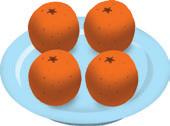
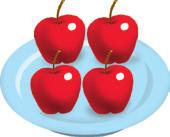
Ask: How many oranges are there? (12) How many apples are there? (4) Is there an equal number of fruits on each plate? (Yes) How many plates of oranges are there? (3) How many plates of apples are there? (1)
1 Finding Ratio Let's Learn Let's Learn
You will learn to... • use a ratio to compare two quantities
1.1 Using a ratio to compare two quantities
a) There are 2 bananas and 3 apples.
The ratio of the number of bananas to the number of apples is 2 : 3
The two quantities we are comparing form the terms of the ratio.
first term → 2 : 3 ← second term
We read the ratio 2 : 3 as 2 to 3.
The ratio of the number of apples to the number of bananas is 3 : 2
2 : 3 is not the same as 3 : 2.
We use a ratio to compare quantities. a : b is a ratio.
The quantities we are comparing form the terms of the ratio. ‘a’ and ‘b’ are the terms of the ratio.
a : b is read as a to b b : a is read as b to a. They are not the same.
b) Each plate has the same number of fruits.
We can compare the number of oranges and apples by comparing the number of plates of each type of fruit. The ratio of the number of plates of oranges to the number of plates of apples is 3 : 1, not 3 plates : 1 plate.
The ratio 3 : 1 does not tell us the actual number of fruits.
A ratio compares quantities. The quantities being compared may have units, but we do not write the units in the ratio.
Year 8: Number — Number structures and operations
Stage: Abstract Representation
Say: Since each plate has the same number of fruits, we can compare the number of oranges and apples by comparing the number of plates of oranges and apples.
Write: 3 1
Say: We can compare the number of oranges and the number of apples by writing a ratio
Write ‘:’ between the numbers 3 and 1.
Explain to students that ‘3 : 1’ means that the ratio of the number of oranges to the number of apples is 3 : 1.
Say: The ratio 3 : 1 does not tell us the actual number of fruits. It only compares the number of plates of oranges and number of plates of apples. In a ratio, the two original quantities being compared may have units, but we do not write the units in the ratio.
1. Write the ratios.
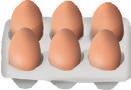
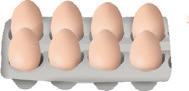
Sarah uses a ratio to compare the number of eggs.
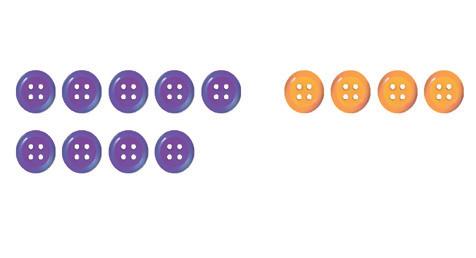
a) The ratio of the number of blue buttons to the number of orange buttons is :
b) The ratio of the number of orange buttons to the number of blue buttons is :
Let's Practise Let's Practise
1. Write the ratios.
a) The ratio of the number of toy aeroplanes to the number of toy boats is :
b) The ratio of the number of toy boats to the number of toy aeroplanes is :
2. Write the ratios.
a) The ratio of the length of the rectangle to its width is :
b) The ratio of the width of the rectangle to its length is :
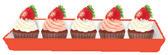
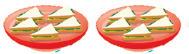
3. Write a ratio to compare the numbers of cupcakes and sandwiches. cupcakes sandwiches
The ratio of the number of cupcakes to the number of sandwiches is 2 : 5. OR The ratio of the number of sandwiches to the
Let's Do Let's
Task 1 requires students to use a ratio to compare two quantities.
Let's Practise Let's Practise
Task 1 requires students to use a ratio to compare two quantities.
Task 2 requires students to use a ratio to compare two measurements of length.
Task 3 requires students to use a ratio to compare two quantities arranged in equal groups.
THINK ABOUT IT
Have students work in groups to discuss the tasks. Ask the groups to present their answers.
Have students observe that the cartons do not contain the same number of eggs. So, when we write the ratio to compare the number of brown eggs and the number of white eggs, we cannot compare the cartons of eggs directly. The ratio of the number of brown eggs to the number of white eggs is 12 : 8. Conclude that Sarah is not correct.
The ratio of the number of brown eggs to the number of white eggs is 2 : 1.
Is Sarah correct? Why do you say so?
Sarah is not correct. She should not compare the number of cartons of eggs directly because there are different number of eggs in the cartons.
Think of a time in your daily life when you need to use ratios. What did you learn about using ratio to compare two quantities? brown eggs white eggs
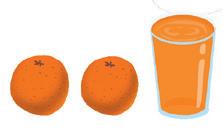
use 2 oranges to make 1 cup of orange juice. The ratio of the number of oranges to the number of cups of orange juice is 2 : 1. So, use 4 oranges to get 2 cups of orange juice. When we use a ratio to compare the number of objects put in groups, we can do so by comparing the number of groups only if the groups have the same number of objects.
Reiterate to students that when we use a ratio to compare the number of objects put in groups, we can do so by comparing the number of groups only if the groups have the same number of objects.
Make use of the examples presented by the groups to let students understand the importance and usefulness of ratios.
EXPLORE
Have students go back to the word problem on CB p. 190.
Ask: Can you solve the problem now? (Answer varies.) What else do you need to know? (Answer varies.)
Students are not expected to be able to solve the problem now. They will learn more skills in subsequent lessons and revisit this problem at the end of the chapter.
1.2 Using a ratio to compare a quantity with the total quantity
Let's Learn Let's Learn
Objective:
• Use a ratio to compare a quantity with the total quantity
Resources:
• CB: p. 194
• PB: p. 121
Stages: Pictorial and Abstract Representations
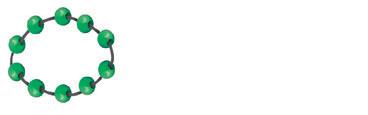
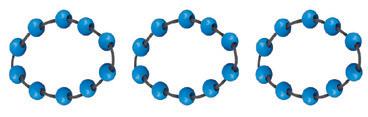
Have students look at the pictures on CB p. 194.
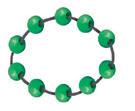
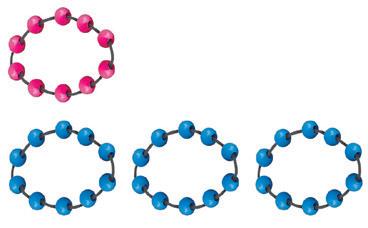
Ask: Does each string have the same number of beads? (Yes) How many strings of green beads are there? (1) How many strings of blue beads are there? (3)
Say: We can compare the number of strings of green beads and the number of strings of blue beads by writing a ratio.
Write: 1 : 3
Say: The ratio of the number of strings of green beads to the number of strings of blue beads is 1 : 3.
Ask: What is the ratio of the number of strings of blue beads to the number of strings of green beads? (3 : 1)
Write: 3 : 1
Have students look at the pictures on the page again.
Ask: How many strings of beads are there altogether? (4)
Say: We can compare the number of strings of blue beads and the total number of strings of beads by writing a ratio There are 3 strings of blue beads. There are 4 strings of beads altogether.
Write: 3 : 4
Say: The ratio of the number of strings of blue beads to the total number of strings of beads is 3 : 4.
Ask: What is the ratio of the number of strings of green beads to the total number of strings of beads? (1 : 4)
Write: 1 : 4
Let's Do Let's and Let's Practise Let's Practise
Task 1 requires students to use a ratio to compare a quantity with the total quantity.
1.3 Using a bar model to show a ratio
Let's Learn Let's Learn
Objectives:
• Use a comparison bar model to show a ratio
• Use a ratio to compare two quantities given in a comparison bar model
Resources:
• CB: p. 195
• PB: p. 122
Stages: Pictorial and Abstract Representations
Have students look at the beads on CB p. 195.
Ask: Does each string have the same number of beads? (Yes)
Say: We can draw a bar model to show the ratio of the number of strings of beads.
Ask: How many strings of green beads are there? (1)
Say: We draw 1 unit to represent 1 string of green beads.
Draw a unit to represent the string of green beads and label it as shown in the bar model on the page.
Ask: How many strings of blue beads are there? (3)
Say: We draw 3 units to represent 3 strings of blue beads.
Draw 3 units to represent the 3 strings of blue beads and label them as shown in the bar model on the page.
Say: We can compare the number of units to find the ratio of the number of strings of green beads to the number of strings of blue beads. The ratio is 1 : 3.
Write: 1 : 3
Have students compare the bar model and the pictures of the strings of beads. Highlight the relationship between the number of units in the bar model and the number of strings of beads.
Say: Even though the ratio 1 : 3 means 1 unit to 3 units, the ratio is written as 1 : 3, not 1 unit : 3 units. We do not write the units in the ratio.
Let's Do Let's Do and Let's Practise
Task 1 requires students to use a ratio to compare two quantities given in a comparison bar model.
Unit 2: Problem Solving
2.1 Word problems
Let's Learn Let's Learn
Objective:
• Solve word problems involving ratio
Resources:
• CB: pp. 196–199
• PB: pp. 123–125
1. Have students read the word problem on CB p. 196.
1. Understand the problem. Pose the questions in the thought bubble in Step 1.
2. Plan what to do.
Say: We can draw a bar model to help us solve the problem.
3. Work out the Answer
Say: The ratio of the volume of oil in Barrel A to the volume of oil in Barrel B is 5 : 3. So, 5 units represent the volume of oil in Barrel A and 3 units represent the volume of oil in Barrel B.
Draw a comparison bar model as shown on the page.
Say: There are 125 litres of oil in Barrel A. Label ‘125 L’ in the model as shown on the page.
Say: We want to find the volume of oil in Barrel B.
Label the volume of oil in Barrel B in the model with a question mark.
Say: From the model, we see that 5 units represent 125 litres.
Write: 5 units → 125 L
Ask: How can we find the value of 1 unit? (Divide 125 litres by 5.)
Write: 1 unit → 125 ÷ 5
Ask a student to work out the division on the board to find out that 1 unit represents 25 litres.
Write: 1 unit → 125 ÷ 5 = 25 L
Ask: How many units represent the volume of oil in Barrel B? (3) How can we find the volume represented by 3 units? (Multiply 25 litres by 3.)
Write: 3 units → 3 × 25
Ask a student to work out the multiplication on the board to find out that 3 units represent 75 litres.
Say: The volume of oil in Barrel B is 75 litres.
4. Check if your answer is correct. Guide students to check their answer by writing the volume of oil in Barrel A as a fraction of the volume of oil in Barrel B and then simplify the fraction.
Write: 125 75
Ask: What is the simplest form of 125 75 ? (53)
Say: Since the fraction is the same as the given ratio, the answer is correct.
5. + Plus Solve the problem in another way. Have students try to solve the problem in a different way.
Have 1 or 2 students share their methods.
If students are unable to solve the problem in a different way, explain the method shown on CB p. 197.
Ask: Which method do you prefer? Why? (Answers vary.)
2. Have students read the word problem on CB p. 197.
1. Understand the problem. Pose the questions in the thought bubble in Step 1.
2. Plan what to do.
Say: We can draw a bar model to help us solve the problem.
3. Work out the Answer.
Say: The ratio of the number of kererū to the total number of kererū and tūī is 2 7 So, 2 units represent the number of kererū and 7 units represent the total number of kererū and tūī.
Ask: How many units represent the number of tūī? (5)
Say: The ratio of the number of kererū to the number of tūī is 2 5
Draw a comparison bar model as shown on the page.
Say: There are 658 kererū and tūī altogether.
Label ‘658’ in the model as shown on the page.
Say: We want to find the number of tūī. Label the number of tūī in the model with a question mark.
Ask: How many units represent 658? (7)
Write: 7 units → 658 1 unit → 658 ÷ 7 =
Get students to work out the value of 1 unit. Write the answer 94 on the board.
Say: To find the number of tūī, we have to find the value of 5 units.
Write: 5 units → 5 × 94 =
Ask: What is the value of 5 units? (470)
Say: There are 470 tūī.
5
125 L
Barrel A
Barrel B ?
The volume of oil in Barrel B is 3 5 of the volume of oil in Barrel A.
3 5 of 125 L = 3 5 × 125 = 375 5 = 75
The volume of oil in Barrel B is 75 litres.
Compare the methods in Steps 3 and 5. Which method do you prefer? Why?
1. Understand 2. Plan 3. Answer 4. Check 5. Plus
2. In a nature reserve, the ratio of the number of kererū to the total number of kererū and tūī is 2 : 7. If there are 658 kererū and tūī altogether, how many tūī are there?
Understand the problem. Mārama 1
Plan what to do. Whakaaro 2
Work out the Answer Whakaatu 3 + Plus Solve the problem in another way. Tāpiri
What is the ratio of the number of kererū to the total number of kererū and tūī? How many kererū and tūī are there altogether? What do have to find?
I can draw a bar model to help me solve the problem.
658 kererū tūī ?
7 units → 658 1 unit → 658 ÷ 7 = 94 5 units → 5 × 94 = 470 There are 470 tūī.
7 units – 2 units = 5 units
The ratio of the number of kererū to the number of tūī is 2 : 5.
4. Check if your answer is correct. Guide students to check their answer by working backwards.
Say: If there are 470 tūī, we can find the value of 1 unit by dividing 470 by 5.
Ask: What is 470 ÷ 5? (94)
Write: 470 ÷ 5 = 94
Say: 7 units represent the number of kererū. To find the number of kererū, we multiply 7 and 94.
Ask: What is 7 × 94? (658)
Say: Since there are 658 kererū and tūī altogether, our answer is correct.
5. + Plus Solve the problem in another way. Have students try to solve the problem in a different way.
Have 1 or 2 students share their methods. If students are unable to solve the problem in a different way, explain the method shown on CB p. 198.
Ask: Which method do you prefer? Why? (Answers vary.)
Let's Do Let's
Task 1 requires students to solve a word problem involving finding a part given a part : part ratio and the difference between the two parts. Task 2 requires students to solve a word problem involving finding a part given a part : whole ratio and the other part.
2. At a rangatahi holiday camp, the ratio of the number of boys to the total number of boys and girls is 5 : 8. How many girls are there if there are 75 boys?
boys girls 75 ?
Let's Practise
Solve the word problems. Show your work clearly.
1. The ratio of roses to tulips in a bouquet is 5 : 7. If a florist used 30 roses to make several such bouquets, how many tulips did she use?
2. Daniel and Amelia shared an amount of money in the ratio 9 : 4. If Amelia received $100, what was the amount of money shared?
3. The ratio of Jenny’s height to the total height of Jenny and Rachel is 5 : 13. Rachel is 57 centimetres taller than Jenny. Find Jenny’s height.
4. A painter mixed some blue paint and red paint to make purple paint. The ratio of red paint to purple paint is 4 : 7. If 51 litres of blue paint were mixed in, how much purple paint did he make?
5. To prepare drinks for a whānau gathering, Whāea Lani uses some lemon juice and water in the ratio 4 : 7 to make lemonade. She has 35 litres of lemon juice at first and uses 35 litres of water to make the lemonade. How many
CREATE YOUR
OWN
The ratio of the number of pies to the number of sausage
Tony bakes is
: 3. If he bakes 12 fewer sausage rolls than pies, how many pies does he bake?
Read the word problem. Change the numbers in the word problem. How did you decide what numbers to use?
Let's Practise Let's Practise
Task 1 requires students to solve a word problem involving finding a part given a part : part ratio and the other part.
Task 2 requires students to solve a word problem involving finding the whole given a part : part ratio and one part.
Task 3 requires students to solve a word problem involving finding a part given a part : whole ratio and the difference between the two parts.
Task 4 requires students to solve a word problem involving finding a part given a part : whole ratio and the other part.
Task 5 requires students to solve a word problem involving finding a quantity that is decreased. Students are expected to find a part given a part : part ratio and the other part.
CREATE YOUR OWN
Have students work in pairs. Get students to create a word problem and exchange the word problem with their partner. Ask students to solve the word problem from their partner. Have a few pairs of students present their work. They should first explain how they decide what numbers to use and their partner has to explain the solution.
Students should choose numbers that are reasonable. Encourage them to draw a comparison bar model to help them visualise and solve the problem.
2.2 Mind stretcher
Let's Learn Let's Learn
Objective:
• Solve non-routine problems involving ratio using the strategy of drawing a bar model
Materials:
• 1 copy of Maths Journal (BM7.1) per student
Resource:
• CB: pp. 200–201
Have students read the problem on CB p. 200.
1. Understand the problem. Pose the questions in the thought bubble in Step 1.
2. Plan what to do.
Say: We can draw a bar model to help us solve the problem.
3. Work out the Answer
Say: The funds are split between the local marae development project and the youth sports programme in the ratio 4 : 3. So, 4 units represent the fund for the local marae development project and 3 units represent fund for the the youth sports programme.
Draw a comparison bar model as shown on the page.
Say: The total amount raised is $490. Label ‘$490’ in the bar model as shown on the page.
Say: So, 7 units represent $490.
Write: 7 units → $490
Ask: How can we find the value of 1 unit? (Divide $490 by 7.)
Write: 1 unit → $490 ÷ 7
Ask a student to work out the division on the board to find out that 1 unit represents $70.
Write: 1 unit → $490 ÷ 7 = $70
Ask: How many units represent the funds for the local marae development project? (4) How can we find the amount for 4 units?
(Multiply $70 by 4.)
Write: 4 units → 4 × $70
Ask a student to work out the multiplication on the board to find out that 4 units represent $280.
Say: $280 was used for the local marae development project.
Say: 20% of $280 was used to buy native seedlings and tools.
2.2 Mind stretcher
Let's Learn
Wiremu and his class raised $490 at a local community fair by selling whakairo and crafts. He split the funds between a local marae development project and a youth sports programme in the ratio 4 : 3. 20% of the funds for the local marae development project was used to buy native seedlings and tools. How much money was used to buy native seedlings and tools?
Mārama 1
Understand the problem.
2
Plan what to do.
Whakaaro
Work out the Answer
How much money was raised at the local community fair? How was the fund split between the two projects? What percentage of the marae development funds was used to buy native seedlings and tools? What do I have to find?
can draw a bar model to help me solve the problem.
Whakaatu 3 marae ? $490 sports
7 units → $490 1 unit → $490 ÷ 7 = $70 4 units → 4 × $70 = $280 $280 was used for the local marae development project.
100% → $280 1% → $280 ÷ 100 = $2.80 20% → 20 × $2.80 = $56 $56 was used to buy native seedlings and tools.
Tirohia 4
Check if your answer is correct.
20% → $56 1% → $56 ÷ 20 = $2.80 100% → 100 × $2.80 = $280 4 units → $280 1 unit → $280 ÷ 4 = $70 7 units → 7 × $70 = $490 My answer is correct.
Ask: How can we find 20% of $280? (Answer varies. Sample: First, find 1% of $280 by dividing $280 by 100, then multiply the result by 20 to find the answer.)
Ask a student to work out 20% of $280 on the board to get the answer $56.
Say: So, $56 was used to buy native seedlings and tools.
4. Check if your answer is correct. Guide students to check their answer by working backwards. First, have students find 100% given that 20% is $56. Next, have them represent this result as 4 units and use it to find the value of 7 units, which is the amount of funds raised.
Ask: Does this amount match the total amount raised? (Yes)
Say: Since the values match the total amount raised, our answer is correct.
5. + Plus Solve the problem in another way. Have students try to solve the problem in a different way.
Have 1 or 2 students share their methods. If students are unable to solve the problem in a different way, explain the method shown on CB p. 201.
Ask: Which method do you prefer? Why? (Answers vary.)
Let's Do Let's Do
This task provides practice in solving a word problem involving ratio and fraction using the strategy of drawing a bar model. Students are required to find the whole, then find a part using the part : part ratio.
Have students first find the fraction of the money that Mike spent on food and books and then find the amount of money he spent on food and books. Next, get students to draw a comparison bar model to represent the given ratio of the amount of money Mike spent on food to the amount of money he spent on books. Guide them to observe from the bar model that 11 units represent $462. Have them find the amount of money 1 unit represents so that they can find the amount of money Mike spent on food. Lead students to conclude that Mike spent $210 on food.
EXPLORE
Have students go back to the word problem on CB p. 190. Get them to write down in Column 3 of the table what they have learnt that will help them solve the problem, and then solve the problem.
Have a student present his/her work to the class.
Maths Journal Journal
Have students work on the tasks in Maths Journal (BM7.1) independently to check and reinforce their understanding.
Use the rubric provided on page 305 of the blackline masters to score students’ work.
Exercise 1.1
Practice Book Chapter 7: Answers
1. a) 3; 5 b) 5; 3
2. a) 9; 7 b) 7; 9
Exercise 1.2
1. a) 5; 4 b) 4; 5 c) 9; 4
2. a) 7; 10 b) 7; 17 c) 17; 10
Exercise 1.3
1. a) 1; 3 b) 4; 3 c) 1; 4 2. a) 9; 7 b) 7; 9 c) 7; 16
Maths Journal Maths Journal
1. Explain how to use a ratio to compare two quantities.
2. Discuss the usefulness of using ratios to compare quantities.
3. Describe how ratios differ from percentages and fractions when comparing quantities.