Essential Mental Arithmetic makes it easy for teachers to provide work for different abilities within a class or group, using two Entry Tests to help you select the right book for each student or class. Students working a varying levels of below aged related expectations can work on the book best suited to their needs. This means that all students will be working at their own pace, giving you the time to support those who need your help, including those with additional needs or disabilities.
Two Essential Mental Arithmetic Entry Tests are available in this guide:
• Entry Test A is suitable for students working at a lower Key Stage 2 level and covers Essential Mental Arithmetic 1 to 3
• Entry Test B is suitable for students working at a upper Key Stage 2 level and covers Essential Mental Arithmetic 4 to 6
Both Entry Tests are designed to help you establish the starting point for each student. You may wish to test all the class or, if you are already using the series, only those whose competency in mathematics you are unsure of.
Administering the Entry Tests
Before administering the Entry Tests, ensure that you have a sharp pencil, a photocopy of the appropriate test and some spare paper for each student. Entry Tests can also be downloaded from our website: www.schofieldandsims.co.uk/free-downloads
Explain to the student or the class the following points:
• the purpose of the test is to make sure that the maths work they do on a daily basis is at a suitable level – not too easy or too difficult for them
• only the individual and the teacher will know the results of the test
• the test is not timed but is likely to take up to an hour
• the questions are arranged to become increasingly difficult as they work through the test
• there will come a point when they are unable to answer any more questions – and at this point they may read quietly so as not to disturb others who are still working
• they should try to do their best.
You may then distribute the Entry Test and tell students to start.
Marking the Entry Tests
Use the Entry Test marking keys on page 8 to mark the test. One mark is given for each correct answer. Where a question has two parts, give half a mark for each part.
The table below indicates which Essential Mental Arithmetic book will be most suitable for each student, based on their Entry Test score.
Entry Test Entry Test score
Entry Test A
Entry Test B
Next step
0–13 Begin with the Essential Mental Arithmetic Book 1.
14–18 Would benefit from working on Essential Mental Arithmetic 1 for consolidation but, if confident, could start Essential Mental Arithmetic 2.
19–28 Begin with Essential Mental Arithmetic 2.
29–33 Would benefit from working on Essential Mental Arithmetic 2 for consolidation but, if confident, could start Essential Mental Arithmetic 3.
34–40 Begin with Essential Mental Arithmetic 3.
41–45 Would benefit from working on Essential Mental Arithmetic 3 for consolidation but, if confident, could start Essential Mental Arithmetic 4.
46–50 Begin with Essential Mental Arithmetic 4.
0–15 Take Entry Test A for more information or begin with Essential Mental Arithmetic 3.
16–20 Begin with Essential Mental Arithmetic 4.
21–25 Would benefit from working on Essential Mental Arithmetic 4 for consolidation but, if confident, could start Essential Mental Arithmetic 5.
26–29 Begin with Essential Mental Arithmetic 5.
30–33 Would benefit from working on Essential Mental Arithmetic 5 for consolidation but, if confident, could start Essential Mental Arithmetic 6.
34–40 Begin with Essential Mental Arithmetic 6.
41–50 Achieving well but, for consolidation, work on Essential Mental Arithmetic 6.
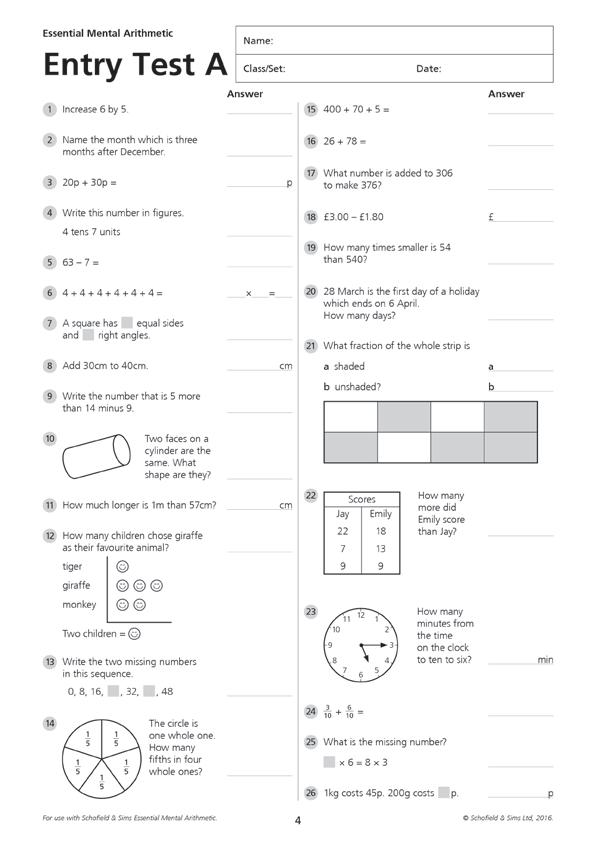
Entry Test A
1 Increase 6 by 5.
2 Name the month which is three months after December.
3 20p + 30p = p
4 Write this number in figures.
4 tens 7 units
5 63 – 7 =
6 4 + 4 + 4 + 4 + 4 + 4 = × =
7 A square has equal sides and right angles.
8 Add 30cm to 40cm. cm
9 Write the number that is 5 more than 14 minus 9.
10 Two faces on a cylinder are the same. What shape are they?
11 How much longer is 1m than 57cm? cm
12 How many children chose giraffe as their favourite animal?
13 Write the two missing numbers in this sequence. 0, 8, 16, , 32, , 48
14 The circle is one whole one. How many fifths in four whole ones?
26 +
17 What number is added to 306 to make 376?
18 £3.00 – £1.80 £
19 How many times smaller is 54 than 540?
20 28 March is the first day of a holiday which ends on 6 April. How many days?
21 What fraction of the whole strip is a shaded a b unshaded?
How many more did Emily score than Jay?
How many minutes from the time on the clock to ten to six? min
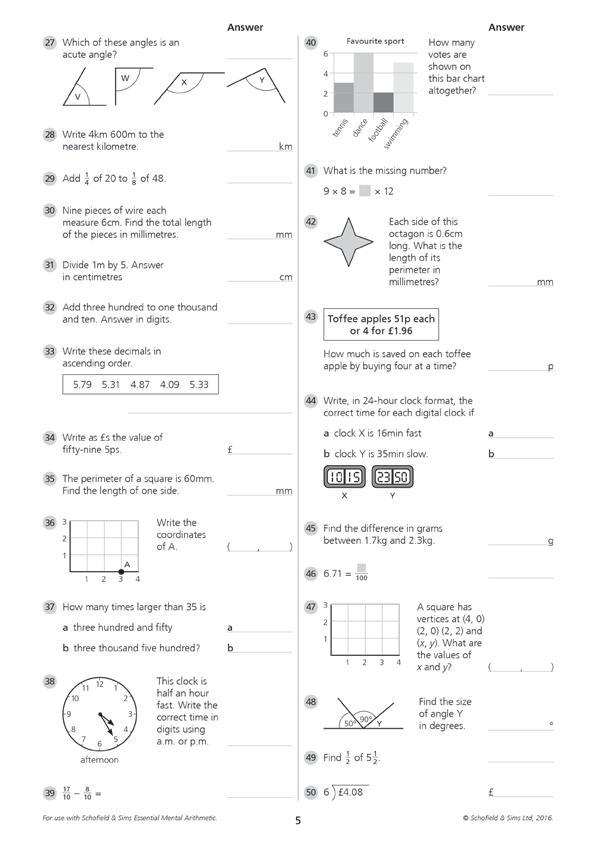
27 Which of these angles is an acute angle?
28 Write 4km 600m to the nearest kilometre. km
29 Add 1 4 of 20 to 1 8 of 48.
30 Nine pieces of wire each measure 6cm. Find the total length of the pieces in millimetres. mm
31 Divide 1m by 5. Answer in centimetres cm
32 Add three hundred to one thousand and ten. Answer in digits.
33 Write these decimals in ascending order.
5.31 4.87 4.09 5.33
34 Write as £s the value of fifty-nine 5ps. £
35 The perimeter of a square is 60mm. Find the length of one side. mm
36 Write the coordinates of A. ( , )
40
How many votes are shown on this bar chart altogether?
41 What is the missing number? 9 × 8 = × 12
42 Each side of this octagon is 0.6cm long. What is the length of its perimeter in millimetres? mm
43 Toffee apples 51p each or 4 for £1.96
How much is saved on each toffee apple by buying four at a time? p
44 Write, in 24-hour clock format, the correct time for each digital clock if a clock X is 16min fast a b clock Y is 35min slow. b
37 How many times larger than 35 is a three hundred and fifty a b three thousand five hundred? b
38 This clock is half an hour fast. Write the correct time in digits using a.m. or p.m.
45 Find the difference in grams between 1.7kg and 2.3kg. g
46 6.71 = 100
47 A square has vertices at (4, 0) (2, 0) (2, 2) and ( x, y ). What are the values of x and y? ( , )
48 Find the size of angle Y in degrees. ° 49 Find 1 2 of 5 1 2 50 6
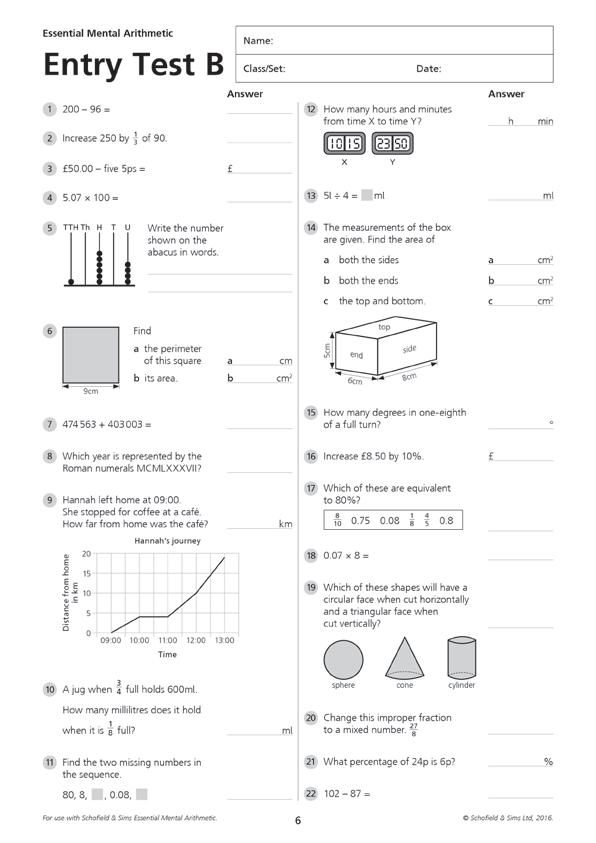
Entry Test B
1 200 – 96 =
2 Increase 250 by 1 3 of 90.
3 £50.00 – five 5ps = £
4 5.07 × 100 =
5 Write the number shown on the abacus in words.
Name:
Class/Set: Date:
12 How many hours and minutes from time X to time Y? h min 13 5l ÷ 4 = ml ml
14 The measurements of the box are given. Find the area of a both the sides a cm2 b both the ends b cm2 c the top and bottom. c cm2
6 Find
7 474 563 + 403 003 =
8 Which year is represented by the Roman numerals MCMLXXXVII?
9 Hannah left home at 09:00. She stopped for coffee at a café. How far from home was the café? km
15 How many degrees in one-eighth of a full turn? °
16 Increase £8.50 by 10%. £
17 Which of these are equivalent to 80%?
18 0.07 × 8 =
19 Which of these shapes will have a circular face when cut horizontally and a triangular face when cut vertically?
10 A jug when 3 4 full holds 600ml How many millilitres does it hold when it is 1 8 full? ml
11 Find the two missing numbers in the sequence.
8, , 0.08,
20 Change this improper fraction to a mixed number. 27 8
21 What percentage of 24p is 6p? %
22 102 – 87 =
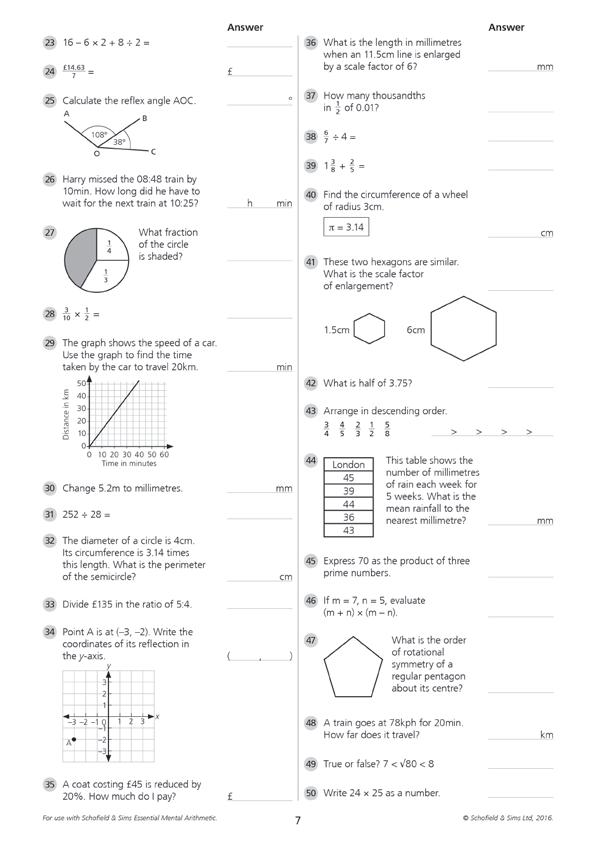
23 16 – 6 × 2 + 8 ÷ 2 =
24 £14.63 7 = £
25 Calculate the reflex angle AOC. °
26 Harry missed the 08:48 train by 10min. How long did he have to wait for the next train at 10:25? h min
27 What fraction of the circle is shaded?
28 3 10 × 1 2 =
29 The graph shows the speed of a car. Use the graph to find the time taken by the car to travel 20km. min
36 What is the length in millimetres when an 11.5cm line is enlarged by a scale factor of 6? mm
37 How many thousandths in 1 2 of 0.01?
38 6 7 ÷ 4 =
39 1 3 8 + 2 5 =
40 Find the circumference of a wheel of radius 3cm. π = 3.14 cm
41 These two hexagons are similar. What is the scale factor of enlargement?
30 Change 5.2m to millimetres. mm
31 252 ÷ 28 =
32 The diameter of a circle is 4cm. Its circumference is 3.14 times this length. What is the perimeter of the semicircle? cm
33 Divide £135 in the ratio of 5:4.
34 Point A is at (–3, –2). Write the coordinates of its reflection in the y -axis. ( , )
42 What is half of 3.75?
43 Arrange in descending order.
44
35 A coat costing £45 is reduced by 20%. How much do I pay? £
This table shows the number of millimetres of rain each week for 5 weeks. What is the mean rainfall to the nearest millimetre? mm
45 Express 70 as the product of three prime numbers.
46 If m = 7, n = 5, evaluate (m + n) × (m – n).
47 What is the order of rotational symmetry of a regular pentagon about its centre?
48 A train goes at 78kph for 20min. How far does it travel? km
49 True or false? 7 < √80 < 8
50 Write 24 × 25 as a number.
Entry Test A marking key Entry Test B
Overview
Essential Mental Arithmetic is a highly effective way of providing additional support to students who have not met age-related expectations in maths at the end of Year 6.
Many students require extra help at the start of secondary school to build a solid understanding of maths basics and bring them up to speed with the Key Stage 3 curriculum. The series helps you identify gaps in understanding and deliver targeted, individualised intervention.
Six workbooks to close the Key Stage 3 gap
The series comprises six graded workbooks designed to close the foundational knowledge gap for students starting Key Stage 3, systematically covering the essential mental maths skills from the primary curriculum required for success in secondary maths. Each book delivers:
• a personalised learning path matched to ability
• outcome-assessed tests to track progress
• targeted practice to build mental agility and confidence.
Getting started with Essential Mental Arithmetic
Essential Mental Arithmetic offers a structured and effective approach to developing confidence and fluency. The series is organised by ability rather than age, so we recommend students use the free Entry Tests to decide on the most suitable starting point before beginning regular practice.
1. Initial assessment – Assess what level students are working at using the Entry Tests that are available in this guide or as a free digital download on the Schofield & Sims website.
2. Rigorous, daily maths practice – Schedule 10–20 minutes a day for students to work through part of an Essential Mental Arithmetic book test. Many schools find that the easiest time to fit in Essential Mental Arithmetic sessions is either at the beginning of the day, as an early morning starter, or as homework.
3. Effective marking and feedback – Organise weekly group marking sessions to quickly and easily identify areas of difficulty and provide immediate feedback.
4. A positive maths culture – Encourage children to take pride in the development of their maths skills and monitor their own progress using the Progress Tests and Achievement Charts in each book.
More ways to use Essential Mental Arithmetic
Essential Mental Arithmetic may be used in many different ways, including:
• maths recovery, to assess new or struggling students and to improve mental fluency
• paired work, allowing students who lack confidence in some concepts to discuss the questions and think of possible ways to answer them
• group or whole-class work, working through a set of questions with a group of students after they have answered them
• homework, with parents and carers encouraging children to explain their working methods.
Individual test structure
Each book test is in three parts, A, B and C.
Part A: contains questions where the use of language is kept to a minimum, and symbols and numbers are used.
Part B: contains questions where mathematical language is used.
Part C: contains written questions that involve one- or two-step problem solving.
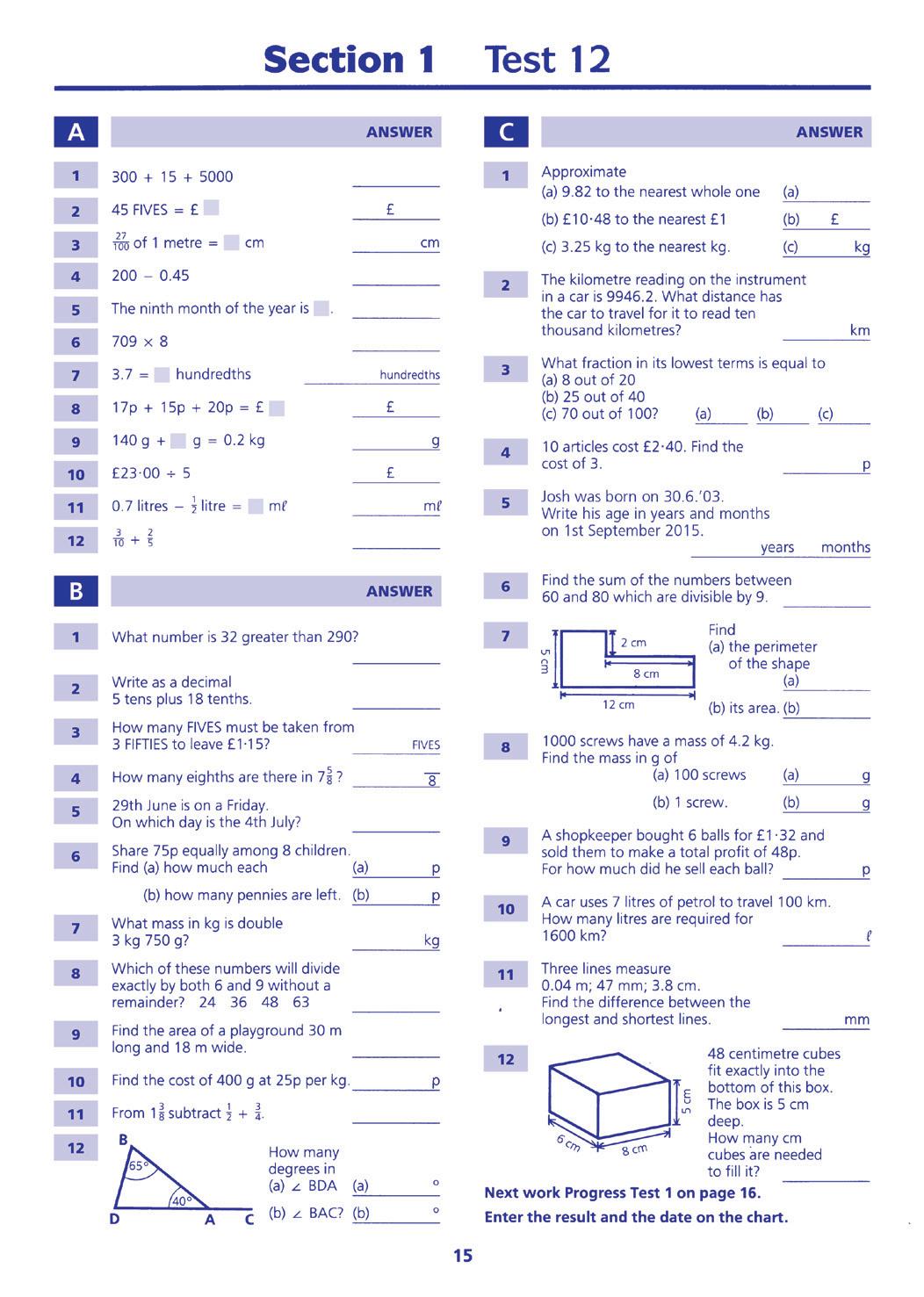
This page is from Essential Mental Arithmetic 4
Why is Essential Mental Arithmetic so effective?
• breadth: The wide range of topics covered means that students must apply their full knowledge and skills in answering each question, demonstrating what they know, as well as what they may have forgotten
• depth: The rich blend of question types in each book not only improves students’ vocabulary and mathematical reasoning skills, but also develops their conceptual understanding of number
• progress: Each test builds on the previous test, revising topics already covered, while at the same time challenging pupils to tackle more complex problems.
Essential Mental Arithmetic, which has already delivered outstanding results in many schools, gives all students the skills and confidence they need to use maths effectively in everyday situations – whether at school, at work or in other aspects of daily life. Ideal for regular and intensive use, the carefully differentiated questions develop students’ functional maths skills to their full potential, giving plenty of opportunities for practice and helping them to become fully numerate.
About this series
Every Essential Mental Arithmetic book is divided into three sections, each comprising 12 one-page tests presented in a standard format that students will quickly become familiar with. Each test in Essential Mental Arithmetic contains:
• Part A: 10 questions where use of language is kept to a minimum – based on the signs =, +, −, × and ÷
• Part B: 10 questions using number vocabulary – particularly the language associated with the four signs
• Part C: 10 questions presented in word form as one- or two-stage problems.
A useful Language of Maths glossary on the inside front cover helps to develop students’ number vocabulary. Two 10-minute Progress Tests are provided, with accompanying Results Charts, and final Check-up Tests on number, money and measures help student and teacher to identify any gaps in understanding.
Full list of books available
1
2
3
4
5
1848 4
1849 1
07217 1850 7
1851 4
07217 1852 1
1853 8
Place your order by phone: 01484 607080 email: sales@schofieldandsims.co.uk or online: www.schofieldandsims.co.uk