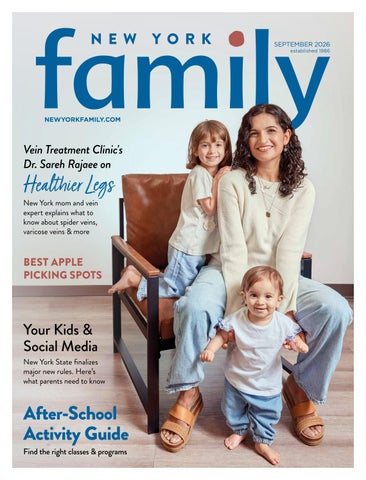
SEPTEMBER 2026 established 1986
NEWYORKFAMILY.COM
Vein Treatment Clinic's Dr. Sareh Rajaee on
Healthier Legs New York mom and vein expert explains what to know about spider veins, varicose veins & more
BEST APPLE PICKING SPOTS
Your Kids & Social Media
New York State finalizes major new rules. Here’s what parents need to know
After-School Activity Guide Find the right classes & programs
Westfield, NJ ranked ninth safest U.S. city
SCAN HERE
Thinking of moving? We should talk.
theisoldicollection.com
FOR SALE
UNDER CONTRACT
UNDER CONTRACT
414 Hillside Avenue Westfield, NJ 5 Bedrooms | 5.2 Baths Price Upon Request
564 Highland Avenue Westfield, NJ 6 Bedrooms | 4.2 Baths $2,695,000
220 Wychwood Road Westfield, NJ 4 Bedrooms | 3.1 Baths $1,495,000
UNDER CONTRACT
JUST LISTED
COMMERCIAL
199 Lincoln Road Westfield, NJ 5 Bedrooms | 2.2 Baths $1,695,000
402 N. Euclid Avenue Westfield, NJ 5 Bedrooms | 4.1 Baths $1,895,000
502 East Broad Street Westfield, NJ For Sale: $2,999000 For Rent: $11,750
Frank D. Isoldi, Coldwell Banker Real ty Broker Sales Associate 209 Central Avenue, Westf ield, NJ 07090 Cell: 908.787.5990 Off ice: 908.233.5555 Web: theisoldicollection.com Facebook: @theisoldicollection Instagram: @f rankdisoldi X: @HomesWestf ield LinkedIn: Frank D. Isoldi ©2026 Coldwell Banker Realty. All rights reserved. Coldwell Banker Realty fully supports the principles of the Fair Housing Act and the Equal Opportunity Act. Operated by a subsidiary Anywhere Real Estate Advisors LLC. Headline from a published GO Banking Rates report. Available at gobankingrates.com
FALL OPEN HOUSE: October 17 & November 14
Register Now!
Grades 6-12 + PG | Day & Boarding | Long Island, NY Contact Us: 631-686-1600 | admissions@knoxschool.org September 2026 | New York Family 3
CONTENTS
SEPTEMBER 2026 NewYorkFamily.com
pg. xx
pg. xx pg. 31
pg. 46
pg. 20
FEATURES
STORIES & COLUMNS
FAMILY FUN
12 | Tech New York Finalizes New Social Media Rules for Kids
6 | Editor’s Letter
46 | Family Fun Apple Picking Spots
14 | Cover: Vein Treatment Clinic’s Dr. Sareh Rajaee on Healthier Legs New York mom and vein expert explains what to know about spider veins, varicose veins, and more. 16 | Back to School Why Kids Get Sick When School Starts 30 | Education The Best Bilingual Schools to Consider 38 | Education The Best Boarding Schools to Consider 44 | Parenting What Every Parent Should Know About Childhood Grief
4 NewYorkFamily.com | September 2026
8 | Money 11 Ways to Cut Costs on Grocery Bills 20 | Activities Finding the Right After-School Activities 26 | Health Back-to-School Health Tips for Parents
48 | Calendar The Best Family-Friendly Events Happening This Month
DIRECTORIES 22 | Directory After-School Listings
28 | Health 6 Essential Health Checkups Men Need 34 | Special Needs Tips for Building Individualized Support
ON THE COVER
40 | Ask the Expert What Your Child Isn’t Saying
Vein Treatment Clinic’s Dr. Sareh Rajaee
50 | Mom Stories Moms Who Say Nope
Stylist: Karilyn Prisco | karilynprisco.com
Photo: Alphonse Telymonde | @Telyfoto Inc | Telyfoto.com
Experience Luxury Living In Manhattan
Elegant, Large 2, 3 and 4 Bedroom Rental Residences Call For Availability - No Fee .SLU^VVK I\PSKPUNZ HYL MV\UK PU [OLZL Ä UL ULPNOIVYOVVKZ! TriBeCa . FiDi . Battery Park North . Fashion District . Lincoln Square . Murray Hill . Midtown East . Upper East Side
glenwoodnyc.com uptown 212-535-0500 | downtown 212-430-5900 All the units include features for, and Glenwood provides reasonable accommodations to persons with disabilities, as required by FHA. EQUAL HOUSING OPPTY
September 2026 | New York Family
5
EDITOR’S NOTE
PUBLISHER: Clifford Luster EDITORIAL DIRECTOR: Donna Duarte-Ladd ASSOCIATE PUBLISHER: Erin Brof ADVERTISING DIRECTOR: Stacie Goldberg EDITORIAL LEAD: Jeannine Cintron DEPUTY EDITOR: Danielle Ramos EVENTS EDITOR: Shara Levine ASSOCIATE DIGITAL EDITOR: Soe Kabbabe EDITORIAL ASSISTANT: Alexa Lutter PARTNERSHIP MANAGERS: Lauren Alperin, Lauren Anchin, Mary Cassidy, Chris Cunnington, Lori Falco, Shelli Goldberg-Peck, LynnMarie Hanley, Lisa Herlihy, Janine Mulé, Nina Spiegelman, Gwen Tomaselli MARKETING & STRATEGY DIRECTOR: Rosalia Bobé MARKETING & EVENTS COORDINATOR: Ashley Rivera MARKETING ASSISTANT: Lorens Morris MEDIA SALES ASSISTANT: Ruston Ropac ART DIRECTOR: Leah Mitch WEB DEVELOPER: Sylvan Migdal GRAPHIC DESIGNERS: Arthur Arutyunov, Connie Sulsenti EDITORIAL CONTRIBUTOR: Soe Kabbabe
Reset, Ready Summer isn’t quite over, but school is back, which means calendars are filling up, routines are returning, and before we know it, fall will be here. It’s time for new teachers, new schedules, packed backpacks, and figuring out how we’re going to fit it all in. And if there’s one thing New York parents know, it’s that the calendar doesn’t stay empty for long. Our cover story this month features Vein Treatment Clinic’s Dr. Sara Rajaee. This New York mom and Yale-trained vascular surgeon explains why aching, swelling, spider veins, and varicose veins shouldn’t be ignored, and what you can do about them. This issue is packed with resources to help you jump right in. Our After-School Guide (page 20) is filled with activities, classes, and programs to help you find something your child will love after that bell rings. Of course, back to school also means
more contact, which means… germs. In Why Kids Get Sick When School Starts (page 16), we look at why those first weeks back can bring on the sniffles, and what parents should know. And what is back to school without a few rules? We break down New York’s new social media rules for kids (page 12) and what this means for families. We also have Back-to-School Health Tips for Parents (page 26), 6 Essential Health Checkups Men Need (page 28), and 11 Ways to Cut Costs on Grocery Bills (page 8), because between school supplies, activities, and everything else, September can get expensive fast! Here’s to fresh starts, getting back into the flow, and squeezing every last bit out of these final summer days before fall takes over. Happy September!
GET IN TOUCH Share your feedback and ideas about family life in New York! Email us at editorial@newyorkfamily.com and tag us at #newyorkfamily
6 NewYorkFamily.com | September 2026
CONTACT INFORMATION ADVERTISING: (718) 260-4554 Advertising@NewYorkFamily.com CIRCULATION: (718) 260-8336 Tina@NewYorkFamily.com ADDRESS: New York Family Media/Schneps Media 15 MetroTech Center, Seventh Floor Brooklyn, NY 11201
PRESIDENT: Victoria Schneps-Yunis CEO: Joshua Schneps COO: Clifford Luster
New York Family is the recipient of 7 Parenting Media Awards for 2025, including Gold awards for both Design and Editorial for our monthly print publication. New York Family is published monthly by Queens Family Media, LLC. Reproduction of New York Family Media in whole or part without written permission from the publisher is prohibited. All rights reserved. ©2026 Queens Family Media, LLC
A welcoming, inclusive, and bilingual environment for students in grades Pre-K 3 through 12. At Kennedy, we offer a curated curriculum of French/English and Japanese/English programs that foster cultural fluency and global citizenship. Preschool and Kindergarten Lower School and Upper School 9th Grade International Track International Baccalaurate
Open House Saturday 10/24 Learn more:
Midtown East locations near Grand Central Terminal and the United Nations
September 2026 | New York Family
7
MONEY
11 Ways to Cut Costs on Grocery Bills BY DANIELLE RAMOS
I
know I’m not the only mom who watches her grocery bill climb each week and stresses about how to pay for it all. According to the USDA, a typical family of four with two parents and two school-age kids spends between $1,018 and $1,675 per month nationally, depending on their budget. Most households land somewhere in the middle, around $1,387 a month. And if you live in New York, you already know groceries cost more here than almost anywhere else, so realistically, we are spending $1,400 to $1,700 a month, sometimes more, which is truly insane. To help offset those costs, here are 11 ways New York families can save money on groceries right now. Split Your Shopping Between Two or Three Stores The one-stop, loyal-shopper era of our parents’ time is pretty much over. A lot of families now have a new, regular rotation: a discount grocer for staples, Trader Joe’s or Costco for a few favorites, and the closest supermarket for whatever’s on sale that week. Most of us don’t have time to grab every deal, so pick two or three stores you like and trust and stick with them. Check Out Discount Grocers At Aldi and Lidl, everyday prices for staples like milk, eggs, bread, chicken, and produce are typically 20–40% lower than at traditional supermarkets. These stores have become noticeably better stocked and more pleasant to shop in over the past few years. The catch is you won’t find many name brands, and almost everything on the shelf is the store’s own label. That’s what makes the savings possible. Giving up brand names is an adjustment, but it helps you save. Lidl has recently become known for its fresh bakery, and both stores carry decent produce sections, so you can get more than just canned goods. Most of a weekly shop can be done at Aldi or Lidl, and you can save
8 NewYorkFamily.com | September 2026
your big local supermarket for the one or two brands your family won’t budge on. It’s a small tweak, but it can be the biggest change you can make to save. Use Trader Joe’s for Select Items Trader Joe’s has so many inventive and tasty items, but it isn’t a discount grocer in the Aldi sense. It’s also not going to beat supermarket prices on milk, eggs, or chicken breast, but it does excel in frozen food, snacks, and a handful of pantry items, where quality is high, and prices are low. Frozen vegetables, frozen fruit for smoothies, frozen dumplings and appetizers, a long list of snacks beat both the regular supermarket and the name-brand version on price, and without the quality dip you sometimes get with generics. The trick is to go in with a short, specific list and stick to it. Trader Joe’s doesn’t carry the range a family needs to cover a week’s worth of groceries; it doesn’t sell diapers and has limited household, beauty, and pet supplies. Rely on Store Brands Check your supermarket’s own value line: Stop & Shop has Nature’s Promise, and ShopRite has Bowl & Basket. Store-brand
pasta, cereal, butter, and frozen vegetables are typically 25–30% cheaper than name brands and, in blind taste tests, have been shown to be indistinguishable from name brands. Start with pantry basics like flour, rice, beans, canned tomatoes, and frozen fruit. Plan Dinner Around What’s on Sale This can be the one habit that most affects your grocery bill. Instead of deciding what’s for dinner on Tuesday and then shopping for it, flip the order: check the weekly flyer or app first to see what’s on sale, and build the week’s meals around that. See which meats, fish, or veggies your family regularly enjoys are discounted that week, and plan your menu around the sale items. It only takes about 10 minutes on a Sunday, and it can be the difference between a $150 week and a $220 one. I have planned meals like this since I had kids, and if I didn’t, I would not be able to make it work. Stock Up When Something You Use Regularly Goes on Sale Along the same lines, when a staple your family eats every week, like pasta sauce, chicken breast, diapers, hits a real low price, buying two or three instead of one. Then you won’t pay full price next month. This only
HOME away from
HOME The MastersSchool, School,five-day five-dayboarding boarding students students enjoy AtAt The Masters enjoy the thebest bestof of both worlds: vibrant campus life during the week and time at home both worlds: vibrant campus life during the week and time at homewith with familyon onthe the weekends. weekends. family Set a sprawlingcampus campusoverlooking overlooking the the Hudson Hudson River, Set onon a sprawling River, our ourSchool Schoolbrings brings together five- and seven-day boarding students from 6 states and 21 countries together five- and seven-day boarding students from 6 states and 21 countries and day students from 120 local zip codes. and day students from 120 local zip codes.
Discoverfive-day five-dayboarding boarding at at Masters Masters during Discover duringour our Open House on October 17: bit.ly/4ghUDZ3 Open House on October 17: bit.ly/4ghUDZ3
Hear from Zach ’27, from Zach ’27, aHear five-day boarder, a five-day boarder, about why he loves the about why he loves the balance of academics, balance of academics, athletics and community. athletics and community.
49 Clinton Avenue | Dobbs Ferry, NY | 914-479-6420 | mastersny.org September 2026 | New York Family 9 49 Clinton Avenue | Dobbs Ferry, NY | 914-479-6420 | mastersny.org
MONEY
works for things you were buying anyway and either have a long shelf life or can be frozen. Hit the Frozen Aisle Frozen fruits and vegetables get picked and frozen at peak ripeness, and they won’t go bad in three days after you forget about them. There is no way to gauge exactly when your family will want more or less fresh fruit, so having frozen on hand is a lifesaver and a money-saver. Think of how many times you’ve thrown out old and wilted veggies and fruit. Do the Membership Math at Box Stores Costco and BJ’s memberships both run $60– $65 a year. If you’re already buying diapers, paper towels, or rotisserie chicken weekly, the savings on those alone usually cover the fee within a month or two. But if you start buying things you wouldn’t normally buy just because the unit price looks good, that can quickly eat your savings. How many families have gotten a 24-pack of a snack their kids didn’t even like, or something they don’t really need, and then it’s $20 in the trash?
10 NewYorkFamily.com | September 2026
To get the most value, keep a running list of exactly what you buy each month. Rice, oats, and paper products are the safest bulk bets across the board, and they don’t spoil. You can also split a membership with another family member or friend. Cook From What’s Already in the Fridge Before Buying More I recently began doing this, adding a day or two before heading to the store by using what we have instead. You can easily make a soup from a half bag of vegetables, leftover rotisserie chicken or beans, and rice. It saves money and prevents food waste. Mix Up Simple Items Meals like rice bowls, big pots of
soup, and pasta with whatever vegetables you have are inexpensive and can be family favorites. It’s an easy way to stretch protein, use up odds and ends, and avoid buying any additional special ingredients. Make a List and Stick to It It sounds almost too simple to mention, but writing a list is something I learned from my mom, and it is still one of the most effective ways to save money (and sanity). You bypass impulsive spending and make shopping easier because you’re not mentally scrambling in a crowded store with kids in tow. You don’t have to do all of this at once. Start with a few, and the savings may add up faster than you’d think.
DISTINGUISHED HISTORY,
MODERN THINKING
A forward-thinking private school built on centuries of success M A K E YO U R H I S TO R Y
Harrow New York welcomes girls and boys in Grades 6 through 12. Co-Ed | Grades 6-12 | Day School | 5-Day Boarding | 7-Day Boarding Applications are now being accepted for the upcoming academic year. Scholarships and financial aid may be available.
500 Montauk Highway, Oakdale, NY harrownewyork.com September 2026 | New York Family
11
SOCIAL MEDIA
New York Finalizes New Social Media Rules for Kids What parents need to know BY DANIELLE RAMOS
I
admit I do the very thing we tell our kids not to do. I get in bed, pull out my phone, and catch up on social media. It’s the one quiet time in a hectic day, and most of the time, my algorithm pulls me right in. It’s pretty difficult to keep our kids from doing the same when it’s just so tempting, and that’s partly why Gov. Kathy Hochul and New York State are stepping in. Governor Kathy Hochul and Attorney General Letitia James released in the July the final rules for the SAFE for Kids Act, a law aimed at dialing back the features that make social media so hard for kids to put down. The rules spell out exactly how companies have to verify users’ ages and get parental sign-off before turning on certain features for anyone under 18. What Is the SAFE for Kids Act? At its core, this law hands parents more control over their kids’ social media experience and takes aim at the features built to keep people scrolling. The biggest target is the algorithm-driven feeds, the endless stream of videos and posts an app serves up based on everything you’ve ever clicked, watched, or lingered on. New York officials argue these feeds aren’t just convenient; they’re engineered to keep kids hooked, and that’s contributing to some genuinely unhealthy habits. Under the new rules, platforms can’t just switch on that personalized feed for an under-18 user by default. They’ll need verified parental consent first. Changes Kids Will See Kids aren’t getting kicked off social media,
12 NewYorkFamily.com | September 2026
but the experience is going to look different once this kicks in: • The for you style feed will be turned off by default, unless a parent opts in • Instead of algorithm-picked content, teens will mostly see posts from accounts they follow • Notifications go silent between midnight and 6 am for minors, unless parents say otherwise • Kids can still search, browse, and use the app
minimum data necessary, and they can’t hang onto it longer than needed.
Companies Will Verify Age There will be age verification, and before a platform can unlock those restricted features, it has to confirm the user is an adult. Companies have a few ways to do that. They can verify a phone number or email, have users upload a photo or short video, or use other approved age-check tools. And platforms have to offer at least one way to do this that doesn’t require a government ID. Whatever method they use, New York’s rules say they can only collect the
Why New York Is Doing This State officials point to research linking heavy social media use, especially algorithm-driven feeds, to rising rates of anxiety, depression, sleep problems, and eating disorders among kids and teens. This law, which will take effect soon officially becoming active on January 25, 2027, isn’t a standalone effort. It’s one piece of a broader push in New York to protect kids online, alongside new rules on child data privacy, AI safety, and smartphone bans in schools.
What Parents Can Do Parents get to say yes or no to these features, and they can change their mind later if they want to loosen or tighten things up. If a parent says no, their child isn’t locked out of the app entirely. They can still search, browse, and use the parts of the platform that don’t rely on algorithmic feeds or overnight notifications.
Licensed & Lab-Tested Wellness
1720 Second Ave (89th and 90th Sts) OCM-RETL-24-000021
~1 Hour Delivery for 2000+ Lab-Tested Cannabis Flowers & Products
334 East 73rd St (1st and 2nd Aves) OCM-CAURD-23-000038 For use only by adults 21 years or older. Keep out of reach of children and pets. In case of accidental ingestion or overconsum ption, contact the Poison Center hotline (800) 222-1222 or 911. Please consume responsibly. Cannabis can be addictive. Concerned about your canna bis use? Contact the NYS HOPE Line by texting "HopeNY", calling (877) 8-HOPENY, or visiting: oasas.ny.gov/HOPELine
September 2026 | New York Family
13
SPONSORED CONTENT
Vein Treatment Clinic’s Dr. Sareh Rajaee on What Your Legs Are Telling You Tackling spider veins, varicose veins, and CVI — for legs that look better and feel better
A
s parents head into September, there is organizing to do, lists to make, and new schedules for the family adapt to. It’s also a time for a reset and a reminder for parents to focus on their own health. Like so many of us, you have probably been going back and forth about seeing a specialist for your leg health. Parents are always juggling a lot and assume symptoms like Persistent aching, heaviness, swelling, itching, cramping, or visible veins are something to live with, but this should not be your new normal. Dr. Sareh Rajaee of Vein Treatment Clinic, powered by VIP Medical Group, hears this all the time. A mother of two and a Yale-trained, board-certified vascular surgeon specializing in venous disease, says one of the biggest misconceptions is that vein disease is only cosmetic. “They think it only affects women or older people,” she says. “They assume symptoms like heavy, tired legs, swelling, itching, or cramping couldn’t possibly be vein-related.” The reality is different. Chronic venous insufficiency, or CVI, affects roughly 40 percent of the population and is often overlooked. CVI develops when weakened vein valves allow blood to flow backward and pool in the legs. For Dr. Rajaee, helping patients understand what is really happening begins before treatment is ever discussed. It begins with trust. For busy parents who are used to putting everyone else first, feeling heard can be the first step toward finally seeking care. Ask what guides her as a physician, and she answers without hesitation: compassion, equity, and honesty. She believes every patient deserves to feel heard, not rushed. Every patient deserves an honest conversation about treatment options, recovery, and expectations. And every patient deserves the same level of care, regardless of who they are or why they walked through the door. “I want every patient to feel truly heard,” she says. “Our job isn’t just clinical expertise. It’s making people feel cared for.”
14 NewYorkFamily.com | September 2026
and understanding how blood moved through the body. “I never pictured myself as a surgeon because I didn’t think I had the personality for it,” she says. “But the mechanics behind blood flow made sense to me.” “I sometimes joke that I’m basically a plumber for the human body.”
Dr. Sareh Rajaee of Vein Treatment Clinic Finding the Right Specialty Medicine wasn’t always the obvious path, even if it was encouraged at home. “If I’m being totally honest, my parents were a huge push toward medicine,” Dr. Rajaee says with a laugh. “There’s a running joke that Iranian parents are happy with three career choices for their kids: medicine, law, or engineering.” She actually began in biomedical engineering because she loved science, math, and figuring out how things worked. But after a while, she realized something was missing. “I wanted human interaction,” she says. “I’ve always loved helping people.” Medical school introduced her to several specialties. At first, she thought primary care or pediatrics would be the right fit, but neither felt quite right. Then she was assigned to a vascular surgery rotation. A mentor, Dr. Jeff Slaiby, changed the way she thought about surgery. She loved the precision of the work, the fine needlework,
Why She Chose Venous Medicine After completing her residency at Yale, Dr. Rajaee practiced vascular surgery in Brooklyn, treating arterial disease, performing dialysis access surgery, and caring for patients with vein disease. Eventually, she chose to focus entirely on venous medicine. As she began building a family, focusing on venous medicine allowed her to create a more sustainable life as a mother while continuing to practice the precise, handson medicine she loved. Professionally, it also gave her the opportunity to help more patients through office-based care. “What I love most is how many people I can help,” she says. “Since these procedures are done under local anesthesia right in the office, I get to know my patients and see their symptoms improve and their confidence return.” The Symptoms Patients Learn to Live With Many of those patients arrive assuming nothing can be done. Dr. Rajaee encourages people to pay attention if they regularly experience heaviness, swelling, tiredness, itching, or cramping in their legs. Visible veins are another sign worth discussing with a specialist, especially if varicose veins run in the family. An evaluation may include a noninvasive ultrasound, which allows the physician to see how blood is moving through the veins and determine whether venous reflux is contributing to the symptoms. “It’s far more common than most people realize,” she says.
Most patients return to work or their normal routine the same day. Walking is encouraged immediately after treatment, and downtime is generally minimal, with temporary soreness or bruising. “It’s an entirely different experience from what vein surgery used to require.”
Photos by Alphonse Telymonde
What Pregnancy Can Do to Your Veins Pregnancy is one of the times when many women first notice changes in their legs. Blood volume increases. Hormones relax the vein walls. The growing uterus adds pressure on the veins in the pelvis. Together, those changes can make existing vein disease worse or cause new symptoms to appear. Some women improve after delivery. Others continue dealing with discomfort. Dr. Rajaee recommends compression stockings throughout pregnancy and says most insurance plans cover them. She’s also seen women who struggled through pregnancy because of untreated varicose veins. “I’ve seen patients with significant varicose veins become genuinely miserable once pregnant,” she says. “Some develop blood clots in those veins during pregnancy. Those patients often wish they’d been treated
beforehand.” For women who already have significant symptoms and know they’re planning a pregnancy, she generally recommends having that conversation before trying to conceive. The good news is that vein disease is very treatable, she says, and today’s treatments are highly effective and minimally invasive. Treatment Has Changed Dr. Rajaee says vein treatment has changed dramatically. Treatments that once required traditional surgery, general anesthesia, and long recoveries can now often be performed in the office using minimally invasive techniques. That matters because most patients don’t have time to put life on hold. “Everyone is busy—working, raising families, barely finding time for themselves,” she says. “Very few people can afford a long recovery.”
Care Built on Trust For Dr. Rajaee, medicine has always been about more than the procedure itself. She knows that coming to a specialist can feel overwhelming, whether someone is worried about symptoms or nervous about treatment. “Going to the doctor, especially for a procedure or an unexplained symptom, can feel scary,” she says. “Building real rapport helps patients feel calm and cared for.” It’s something she and her colleagues have prioritized from the beginning. She says the practice was built around physicians who share a commitment to excellent care, honest communication, and a patient experience grounded in trust. For patients, that means leaving with more than answers. It means understanding what may be causing their symptoms, what their options are, and what comes next. “Our practice started among friends and like-minded colleagues who wanted to deliver excellent care and make patients happy,” she says. “That’s still our culture.” If aching, heaviness, swelling, itching, cramping, or visible veins have become part of your routine, an evaluation can help determine whether underlying vein disease is the cause. All treatments are performed in the office with little to no downtime, and medically necessary care is covered by most patient’s insurance plans. Dr. Sareh Rajaee sees patients at Vein Treatment Clinic in the Financial District and Downtown Brooklyn. Explore Vein Treatment Clinic locations across the New York metropolitan area. veintreatmentclinic.com/familymagazine
Vein Treatment Clinic Manhattan, Financial District 156 William St Suite 302 New York, NY 10038 917-933-1223 Vein Treatment Clinic Downtown Brooklyn 188 Montague St 10th Floor Brooklyn, NY 11201 917-524-8892 September 2026 | New York Family
15
BACK TO SCHOOL
Why Kids Get Sick When School Starts A pediatrician explains what’s normal BY DANIELLE RAMOS
W
hen my kids were in grade school, the end of summer was all backpacks, last-minute summer reading, a new box of pens and pencils, and, without fail, the back-to-school illness. Within a couple of weeks of the first day, somebody was coming home with a cold or a cough or a sore throat that was clearly going around the whole school. Is it normal, though? Getting sick right when school starts up always felt like some kind of rite of passage, but I wanted to actually know how much of it is expected, and whether there’s anything parents can do differently. So we talked to Dr. Kristina Melchert, Chief of Pediatric Hospital Medicine at Maria Fareri Children’s Hospital at Westchester Medical Center, about why illnesses spike once school’s back in session, which viruses show up most, and what families can actually do to cut down the risk. When kids go back to school, it seems like everyone catches something in the first few weeks. Is that unavoidable? It’s certainly common, but it’s not completely unavoidable. When children return to school, they’re suddenly spending hours each day in close contact with dozens of other children, sharing classrooms, supplies, and germs. Over the summer, many families have less exposure to the viruses that circulate in schools, so those first few weeks back often create the perfect environment for respiratory illnesses to spread. The good news is that each exposure helps build immunity, and for many children, the frequency of illnesses decreases as they get older. What do kids usually come down with when school reopens? The most common illnesses are the everyday respiratory viruses that cause colds,
16 NewYorkFamily.com | September 2026
coughs, congestion, sore throats, and fevers. Rhinovirus, the virus responsible for the common cold, is especially active in the early fall. We also see enteroviruses, which can cause fever, cold symptoms, or hand-footand-mouth disease. In addition to viral infections, pediatricians often see an increase in bacterial illnesses such as strep throat and impetigo as children return to close contact with classmates. COVID-19 continues to circulate year-round, and influenza typically begins increasing later in the fall and winter. How do you know if your child always getting sick each year is normal, or something to worry about?
For younger children, especially those in daycare, preschool, or the early elementary years, having multiple viral illnesses each year is normal. In fact, many healthy children can experience six to eight respiratory infections annually, and sometimes more. What matters is how they recover between illnesses. If a child is growing well, has good energy between infections, and isn’t experiencing severe or unusual infections, frequent colds alone usually aren’t a sign that something is wrong with their immune system. What can parents actually do to help their kids stay a little healthier through all the back-to-school sicknesses? Parents should focus on the habits that
September 2026 | New York Family
17
BACK TO SCHOOL
reduce exposure and support overall health. Encourage regular handwashing, teach children to cover coughs and sneezes, keep them home when they’re truly ill, and stay up to date on recommended vaccinations. Vaccines remain one of the most effective tools we have to prevent serious illness and missed school days. Just as importantly, make sure children are getting enough sleep, staying physically active, and eating a balanced diet. These measures won’t eliminate illness, but they can reduce risk and help children recover more quickly when they do get sick. If you look at the basics, like sleep, food, vitamins, and hygiene, what makes the biggest difference? If I had to prioritize, I would focus on four things: sleep, hygiene, nutrition, and vaccination. Adequate sleep plays a critical role in immune function, and many children return to school after a summer of later bedtimes. Handwashing remains one of the simplest and most effective ways to reduce the spread of infections.
18 NewYorkFamily.com | September 2026
"Over the summer, many families have less exposure to the viruses that circulate in schools, so those first few weeks back often create the perfect environment for respiratory illnesses to spread." A balanced diet supports overall health, and staying up to date on recommended vaccines, including the annual flu vaccine, helps protect children from some of the illnesses most likely to disrupt school attendance. Most healthy children who eat a varied diet do not need special immuneboosting supplements or vitamins. What are some things parents swear by that
might not be doing much or might even backfire? Many products are marketed as “immune boosters,” but most have little evidence showing they prevent common childhood illnesses. Parents can end up spending significant money on supplements that provide little benefit. Another common misconception is that exposure to germs should be avoided at all costs. While no one wants their child to be sick, encountering common viruses is a normal part of childhood and helps the immune system develop over time. Finally, unnecessary antibiotic use can do more harm than good because most backto-school illnesses are caused by viruses, not bacteria. Antibiotics should be reserved for infections where they are truly needed, such as strep throat or impetigo. I tell parents all the time that the goal isn’t to prevent every childhood illness. That’s impossible. The goal is to reduce the risk of serious illness and keep children healthy enough to learn, play, thrive, and enjoy being kids.
September 2026 | New York Family
19
ACTIVITIES
Finding the Right After-School Activities
F
rom sports and dance to academic enrichment, art, music, and more, kids have plenty of ways to spend their time after school. But with a new school year come new schedules, and finding the right balance can take some thought. Here’s how to choose activities your child will enjoy without overloading the family calendar. The Benefits of Getting Involved After sitting at a desk all day, kids need opportunities to move around, play, and simply enjoy being kids. Physical activities can be a great way to help them get some energy out and reset after a busy day at school. After-school activities provide an ideal environment in which to nurture social skills and confidence,” says Shawna Stewart, program accounts specialist at MakerState LLC, a STEM enrichment program in Manhattan. “They teach children the value of working as a team to achieve a mutual goal—a skill that will benefit them in their future occupations.” Whether it’s joining a soccer team, taking an art class, learning an instrument, or trying something completely new, extracurriculars give kids a chance to explore their interests, make friends, and discover what they love. How to Find What Your Kid Loves There’s no need for kids to find their passion right away. Younger children may enjoy trying a few different activities before settling on a favorite, while older kids may have a better sense of what interests them. “By middle school, if not before, students should be experimenting with a diverse set of after-school endeavors that align with any interests they express,” says Kat Cohen, Ph.D., college admissions counselor and founder of IvyWise, an educational consulting company. When it comes to selecting an activity, give your child some say in the decision. For younger kids, a ranking system can help. Make a list of activities your child enjoys or would like to try, and ask them to rank their
favorites. The goal is for them to feel like they have a voice in how they spend their time. And if they try something and decide it’s not for them? That’s okay, too. Part of growing up is figuring out what you like— and what you don’t. How to Figure Out a Workable Schedule Figuring out your kid’s individual threshold can be tricky, especially when the school year gets going and calendars start filling up. “Start with one after-school activity, then gradually add more as your child seems able to handle a more intense schedule,” Dr. Lieberman suggests. It’s important to make sure your kids don’t lose sight of the things that matter to your family, academics, family dinners, downtime, and simply having time to be a
20 NewYorkFamily.com | September 2026
kid. Siblings may also have very different activity levels and interests. “Every student is different, so there is no magic number of hours that should be devoted to after-school activities,” Dr. Cohen says. Most importantly, pay attention to how your child is feeling. Are they excited to go? Do they come home happy and energized, or overwhelmed and exhausted? “Use your intuition to really understand your child’s interests and favorite hobbies,” says Megan Gallagher, a TED Talk speaker, best-selling author, and mental health advocate for teenagers. “As a parent, the best thing you can do is to be present and show up.” Whatever you choose, remember that there’s no perfect after-school schedule. The goal is to give your child opportunities to have fun, make friends, try something new, and discover what they love.
WHERE YOUNG PERFORMERS TAKE THE STAGE
Confidence. Creativity. New friends. Big moments. Classes include: Musical Theater Film Sketch Comedy Improv Scene Study Technique Teen Ensemble & More.
Ages 4–18
Our acting classes help kids and teens express themselves, make friends, and discover the joy of performing.
Ask about our Pre-College Intensive for a true conservatory experience. (Ages 14 - 18 Only)
Spots fill fast. Save yours today.
atlanticactingschool.org | admissions@atlantictheater.org | 76 Ninth Ave, Ste 313, New York, NY | 212.691.5919 September 2026 | New York Family 21
AFTER-SCHOOL PROGRAMS & ACTIVITIES DIRECTORY | Special Advertising Supplement
Atlantic Acting School
Ballet Academy East
Virtual Summer Camps 76 Ninth Ave., Suite 313, New York, NY 212-691-5919 education@atlantictheater.org atlanticactingschool.org Atlantic Acting School offers exciting Fall theater classes for young performers ages 4–18! Atlantic’s afterschool and weekend classes give your rising star the opportunity to play, explore, build confidence, and form lasting friendships, all while developing their creativity and craft. With classes in musical theater, sketch, improv, scene study, film & TV, and more, there’s something for every young performer. Each class has its own unique focus while remaining rooted in the Atlantic Technique. Fall registration is now open, enroll today and let your young performer take the spotlight!
1651 Third Avenue, 3rd Floor, New York, NY 10128 info@baenyc.com 212-410-9140 BalletAcademyEast.com Ballet Academy East Young Dancer Division classes, ages 18 months-6 years, focus on discovering and developing each child’s potential while instilling a lifelong love of dance. Children will gain increased coordination, self-confidence, musicality, strength, and creativity through the school’s unique structured syllabus. Classes are led by the gifted and highly experienced BAE faculty. Dance, grow, learn, and be inspired this fall at BAE!
Bloomingdale School of Music 323 W. 108th St. New York, NY 10025 registrar@bsmny.org 212-663-6021 bsmny.org
Bloomingdale School of Music has served New York families for over 60 years. Students of all ages and skill levels can study more than 20 instruments with a vetted faculty of professional musicians. Programs include private lessons, beginner group classes, orchestras, vocal and jazz ensembles, guitar ensembles, music theory, and more. Private instruction is personalized, and 30-minute trial lessons are available for $30. Enrollment is ongoing, with seasonal promotions and free family events offered year-round.
Collina Italiana 1556 Third Avenue, Suite 602603, New York, NY 10128 info@collinaitaliana.com 212-427-7770 collinaitaliana.com/children Collina Italiana Children’s Programs offers engaging Italian language programs designed for children of all
ages and levels. Through stories, games, music, art, and conversation, young learners develop their Italian skills while discovering the beauty of Italian culture. With group classes, private lessons, workshops, and immersive camps, Collina Italiana creates a fun and supportive environment where children can build confidence, creativity, and a lifelong connection to the Italian language.
German Language School of Greater New York Manhattan classes: East 65th St. Long Island classes: Garden City and Franklin Square kidslearngerman@aol.com 212-787-7543 german-american-school.org The German Language School of Greater New York* has taught German to children since 1892. The school welcomes children
SCAN TO LEARN MORE taylorschool@ptdc.org
646-214-5807
FALL SEMESTER September 28 January 30 TAYLOR DANCE EAST: 551 Grand St. New York, NY 10002
TAYLOR DANCE WEST: 307 W 38th St 9th Fl. New York, NY 10018
22 NewYorkFamily.com | September 2026
Young Dancer, 18 mos.-6 yrs. Primary, 6-7 yrs. Pre-Professional, 7-19 yrs. Children + Teen, 7-14 yrs. Adult Dance and Fitness
Reach. Grow. Achieve.
SCAN TO LEARN MORE BalletAcademyEast.com 212-410-9140 | info@baenyc.com
Discover the joy of skateboarding Juniors Ages 3-6 Fall I · 9/12-11/5 Fall II · 11/6-1/29
Now booking private lessons & birthday parties NEW! Tribeca Outdoor Class
Kids & Teens Ages 5-15 Fall · 9/12-1/29
Williamsburg 58 N 9 St PLG 140 Empire Blvd hello@skateyogi.com
AFTER SCHOOL
STEAM
More Than an After-School Program. It's a Real Makerspace. Students St S tud den entss a ents ages ge es 4–16 4–16 4– 6d design, esig es ign, ig n, b n, build, uild ui d, a an and nd invent with real att Ma MakeInspires, in nve vent w ith it h re eal a ttools oo ools olss a M ak ke eIn nspir sp pir ires es,, a network STEAM makerspaces. afterne n ettw wor ork k of of S TEAM TEAM TE Mm aker ak ersp er spa aces ac es. s. Fa Fall all ll a f erft erer school start September ssc cho ool programs pro ogr gra ams st am ta arrt Se Sept pttem p mbe ber 14 ber 4— weekly across 60+ hands-on week we eek ekly ly ssessions esssi e s on onss ac cro rosss 6 0+ h 0+ an and nds ds-o s-o on curricula, cu c urrrric icul ula ul a, with a, witth pickup p ck pi kup p ffrom rom ro m se sselect sele ele ect ct schools. sch choo ools. ools lss.
Register now · Use code FIRST for 10% off Robotics
Engineering
3D Printing
Coding
Rocketry
Animation
Minecraft
And More
Brooklyn | Chappaqua | Darien | Mamaroneck | Upper East Side
MakeInspires.com September 2026 | New York Family
23
AFTER-SCHOOL PROGRAMS & ACTIVITIES DIRECTORY | Special Advertising Supplement
of all backgrounds. Lower grades receive bilingual instruction; upper grades are taught in German. Accredited by NY State Regents since 1911, the school’s students complete the FLAC exam. College-bound students take AP training, and pupils are encouraged to take A1/A2 exams. *dba German-American School Association
Launch Math + Science Centers 173 West 81st Street, New York, NY, 10024 info@launchmath.com 212-600-1010 launchmath.com Launch Math + Science Centers offers exciting and educational STEM classes and camps for kids from kindergarten to 7th grade. Children discover the magic of chemistry, explore the science of space, create architectural structures, code a roving robot – and that’s
just the beginning! Launch also offers one-on-one math enrichment and intensive math tutoring for students in grades K-8. For the past 15 years, Launch has delivered engaging STEM programs for children throughout New York City. Real-life rocket scientist Scott Heifetz founded Launch with one mission in mind: to inspire children to love and learn math and science.
MakeInspires Upper East Side: 1642 York Ave, New York, NY, 10028 Brooklyn: 230 Huntington St, Brooklyn, NY, 11231 nyc@makeinspires.com, brooklyn@makeinspires.com 212-933-4392, 347-227-7483 makeinspires.com Students ages 4–16 design, build, and invent with real tools and technology at MakeInspires STEAM makerspaces. For over 15 years, young makers have explored 60+ original curricula, including 3D
printing, woodworking, coding, electronics, and engineering. After-school programs begin September 14 in Brooklyn, Chappaqua, Mamaroneck, and the Upper East Side. Registration is open at makeinspires.com; first-time families save 10% with code FIRST. Kids turn ideas into projects while building creativity, problemsolving skills, and confidence.
Play On! Studios 263 West 86th Street, New York, NY 10024 info@playonstudios.com 347-709-4149 playonstudios.com Play On! Studios offers theater classes on the UWS that are guaranteed to give kids a great experience full of acting, music, and fun! Whether your child is just starting out, or ready for Broadway, we’ve got the class for them. Creative Drama, Theater Lab, Musical Theater Revue, and Musical Theater Performance classes
Unlock the Beauty and Culture of Italy for your Child JOIN THE COLLINA ITALIANA COMMUNITY
• • • • •
Summer mini camp (ages 3-8) Morning classes (ages 1-3) After school (ages 2-16) Private and Semi-private Lessons Specialty Workshops
Collina Italiana Italian Language and Cultural Center www.collinaitaliana.com info@collinaitaliana.com 212-427-7770 24 NewYorkFamily.com | September 2026
all offer different levels of commitment for busy kids. Classes are available for grades PreK-8, after school or Saturdays!
SKATEYOGI 58 North 9th Street @ Kent Ave., Williamsburg 140 Empire Blvd @ Bedford Ave., Prospect Lefferts Gardens Tribeca Skatepark 718-484-9777 skateyogi.com Discover the joy of skateboarding with SKATEYOGI! At their two indoor skate spaces, SKATEYOGI offers skateboarding programs in a fun, creative environment for all ages (ages 3 to adults). This fall they will also offer an outdoor program at Tribeca Skatepark. Their two Brooklyn locations are also easily accessible from the Bedford Ave L station (Williamsburg) and Prospect Park B/Q (PLG). An open-level format welcomes absolute beginners to experienced skaters.
Skateboard rental is included for all on-site programs.
Taylor Center for Dance Education / The Taylor School
Sokol
551 Grand Street, NYC, 10002 307 W. 38th Street, 9th Floor, NYC 10018 taylorschool@ptdc.org 646-214-5807 taylorschool.org The Taylor Center for Dance Education offers year-round youth programs through the Taylor School. The fall semester (9/28/26 - 1/30/27) offers dance instruction for toddlers to teens at every experience level. Students build strength, confidence, musicality, creativity, and a strong technical foundation while developing their own artistic voice and an understanding of the Taylor technique and repertory. Additional dance genres include ballet, jazz, breaking/hip hop, tumbling/ acro, capoeira, and more. Afternoon and weekend classes are offered at the two locations, for ages 2 – 18. Join for a free trial class and open house in September!
420 East 71st Street, New York, NY 10021 office@sokolnewyork.org 212-861-8206 sokolnewyork.org For more than a century, Sokol has inspired children and adults through programs that foster physical, social, and personal growth. Offering gymnastics, dance, circus arts, and fitness, Sokol provides a welcoming environment where participants build confidence, strength, and skills. Age-appropriate gymnastics encourages safe progress, while dance develops technique and expression. Circus arts foster creativity, teamwork, and resilience. Yoga and Pilates support flexibility, strength, posture, and wellness, guided by expert instructors in a supportive community.
September 2026 | New York Family
25
HEALTH
BACK-TO-SCHOOL HEALTH TIPS FOR PARENTS BOOST YOUR IMMUNE SYSTEM WITH DAILY VITAMINS
CONSIDER A FLU SHOT
Give your immune system the support it needs to keep up with busy days
Back-to-school season often means increased exposure to germs
Vitamin C – Supports immune health
• Helps reduce the risk of seasonal illness
Vitamin D – Helps support bones, muscles, and immunity
• Protects both parents and children
Vitamin B – Supports energy and metabolism
• Talk with your healthcare provider about what’s right for you
Magnesium – May help with sleep and muscle health Zinc – Supports immune function and overall wellness TIP: Talk with your healthcare provider about which supplements are right for you.
ADD PROBIOTICS TO YOUR ROUTINE
TIP: Schedule your flu shot early in the school year.
PRIORITIZE SELF-CARE • Connect with friends or family for emotional support
• Try Kimchi Kombucha • Support gut health with fiber-rich fruits and vegetables. TIP: Helps maintain overall wellness and supports your body’s natural defenses
• Try essential oils to help reduce stress. Lavender Chamomile Lemon Geranium Bergamot TIP: Always follow safety guidelines and dilute oils properly
MAKE SLEEP NON-NEGOTIABLE
Help support immunity, mood and energy Helps support immunity, mood & energy Create a consistent bedtime routine. Avoid scrolling, emails, and household tasks right before bed. TIP: Reserve late-night work and projects for only a few nights a week.
26 NewYorkFamily.com | September 2026
mom-owned business
new york Family Partner
Play On! StudiOS
Play On! Studios Brings the Magic of Theater to Upper West Side Kids
P
lay On! Studios on West 86th Street has been sparking creativity and confidence in kids since 2011. Founded by lifelong theater educator and mom of two Lena Moy-Borgen, this vibrant program offers drama classes and camps where young performers learn much more than just how to put on a show—they discover a lifelong love of the arts and themselves. Moy-Borgen, who started teaching theater as a teenager, calls herself a “grown-up theater kid.” Her journey from middle school drama assistant to the helm of one of Manhattan’s most beloved youth theater programs is fueled by passion and purpose. “My favorite activity growing up was always drama class,” she says. “Now it’s my job—and
I feel like the luckiest person in the world.” What truly sets Play On! apart is its deeply personal approach. “I’m not just the director—I’m also a parent,” Moy-Borgen explains. “I care about the experience of every child. My goal is for them to walk away with joy, growth, and an appreciation for theater.” That care is evident in every detail: performances are always free for families, and scholarships are available for students who need them. The Play On! team is just as dedicated. From assistant teachers who lead games and choreography to musical directors who guide live performances (never a pre-recorded track in sight), the staff creates a nurturing, professional
atmosphere. Some team members are even Play On! alumni who return to help out after high school. Moy-Borgen gives special credit to her assistant director, Emily Viega, who plays a key role in teaching, stage management, and day-to-day operations. “She’s my righthand lady—I couldn’t run this business without her,” Moy-Borgen says. Whether your child is a seasoned performer or simply curious, Play On! Studios is a place where imagination, teamwork, and confidence take center stage. Play On! Studios 263 West 86th Street info@playonstudios.com playonstudios.com
September 2026 | New York Family
27
HEALTH
6 Essential Health Checkups Men Need BY DANIELLE RAMOS
T
raditionally, Men’s Health Month is in June, but the point behind it shouldn’t be only about one month of awareness. Men’s health isn’t just personal. It affects the people who count on him: kids, partners, the whole family. Regular checkups and screenings keep men around and able to show up for the people who need them, including themselves. To help you support the men in your life, we’re sharing expert insight from Dr. Joseph Alukal, director of the Men’s Health Program at NewYork-Presbyterian, with clear, decadeby-decade checklists. “There is no demographic that utilizes healthcare resources less than men between the ages of 18 and 45, followed closely by men ages 45 to 64,” says Dr. Joseph Alukal, a urologist at NewYork-Presbyterian/Columbia University Irving Medical Center and an associate professor of urology at Columbia University Vagelos College of Physicians and Surgeons. Dr. Alukal breaks down the key health screenings and doctor’s visits men should have at every stage of life.
Checklist for Men in Their 20s & 30s Primary care visit: Once a year. “It’s important to have a relationship with a doctor you trust, whom you can check in with and figure out how to get screened or tested as soon as possible if needed,” says Dr. Alukal. “Even if you’re in your 20s and 30s and are generally healthy, take this opportunity to create a relationship with a doctor you are comfortable with.” Blood test screening: Once a year. “The blood work that’s being done includes things like measurements of white and red blood cells, blood chemistry, blood sugar, and cholesterol,” says Dr. Alukal, explaining that this allows physicians to assess your risk for conditions like diabetes, kidney disorders, and heart disease. Expert’s Take: Your primary care doctor might also perform other screenings, like a urine test, to check for kidney disorders, liver problems, and diabetes. “All these things together actually become a really good screening platform for things like diabetes, which causes so many other health problems,
blood cancers like leukemia or lymphoma, and kidney failure, which can happen in a patient who has uncontrolled blood pressure,” says Dr. Alukal. Checklist for Men in Their 40s & 50s Primary care visit: At least once a year or as often as needed. Routine blood test screening: At least once a year or as often as needed. Colonoscopy: With more young people being diagnosed and dying of colon cancer in recent years, the American Cancer Society recommends starting screening at age 45, earlier if you have a family history of colon cancer. For those without a history of colon cancer, it’s generally recommended to get a colonoscopy every 10 years after the initial screening. PSA (prostate-specific antigen) blood test: Once a year starting at age 55, or earlier if you have a family history of prostate cancer. Skin cancer screening: Once a year. More frequently, if there is a family history of skin cancer or a history of prolonged sun exposure. Cardiology screening: At least once a year or as needed, especially if you have a family history of heart disease. Expert’s Take: “The strong recommendation from the American Urological Association is to get a prostate exam and a PSA, a blood test that indirectly measures prostate cancer risk, at age 55,” says Dr. Alukal. “While the manual prostate exam is definitely something that patients need at least once a year once they turn 40, the PSA test has become a very controversial test and for good reason — it’s not perfect. That’s why I always encourage men, once they’re in their 40s, to speak with their doctor, share their family history of prostate cancer, if any, and move forward from there” “Prostate cancer behaves differently than,
28 NewYorkFamily.com | September 2026
say, colon cancer, so I recommend working with a urologist to determine when to start screening. You can then have the discussion about the PSA test, its risks and benefits, and whether you need to get one.” Checklist for Men in Their 60s & Older Primary care visit: At least once a year or as often as needed. Routine blood test screening: At least once a year or as often as needed. Colonoscopy: Varies for each individual and depends on family history of colon cancer and the colonoscopy results. For most people who are at average risk, once every 10 years after turning 45. Prostate exam and/or PSA blood test: Once a year. Skin cancer screening: Once a year. More frequently, if there is a family history of skin cancer or a history of prolonged sun exposure. Cardiology screening: At least once a year or as needed, especially if you have a family history of heart disease. Expert’s Take: “I try to get patients in this age range to think of these visits as yearly tune-ups,” adds Dr. Alukal. “It’s like taking your car in for an oil change. What we’re trying to do is head off any problems before they happen.” Checklist and tips provided courtesy of Dr. Joseph Alukal and NewYork-Presbyterian Health Matters. Joseph Alukal, M.D., director of the Men’s Health Program at NewYork-Presbyterian, is a urologist at NewYork-Presbyterian/Columbia University Irving Medical Center and NewYorkPresbyterian Westchester. He is also the Andrew Sabin Family Foundation Associate Professor of Urology at Columbia University Vagelos College of Physicians and Surgeons.
Connecting our Youngest Learners to Each Other and the World 10 Global Campuses. One Shared Philosophy.
Register for an Event 2s – Grade 12
Learn more about our NYC campus dwight.edu/newyork/admissions
September 2026 | New York Family
29
EDUCATION
BILINGUAL EDUCATION Helping kids grow up confident, connected, and culturally fluent
I
n a state where more than half of households speak a language other than English, bilingual education has become an essential part of New York’s classrooms. These programs do more than teach vocabulary and grammar — they nurture cultural identity, build empathy, and help students bridge communities while gaining the tools to thrive in a multilingual world. For families considering this path, the options can feel both exciting and overwhelming. To make the search easier, we’ve rounded up standout bilingual schools from across NYC to the suburbs that reflect it’s diversity and richness.
Collina Italiana
The École
1556 Third Avenue, Suite 602-603, New York, NY 10128 646-247-3869, info@collinaitaliana.com collinaitaliana.com
115 East 22nd Street, New York, NY 10010 646-410-2238 theecole.org
Children develop Italian language skills while discovering Italy’s traditions, creativity, and culture in a fun, immersive environment. Collina Italiana offers language programs for children ages 1–16, including Mommy & Me classes, toddler morning drop-off, after-school programs, private and semi-private lessons, Saturday workshops, and year-round mini camps, including summer and school-break sessions. Teens can also prepare for Italian language certification exams. With small class sizes and experienced instructors, students learn through music, stories, games, hands-on activities, and conversation, making language acquisition both natural and engaging. Whether your child is taking their first steps in Italian or building greater fluency, Collina Italiana inspires confidence, curiosity, and a lasting connection to the Italian language and culture.
Located in New York City’s Flatiron District, The École is an independent French-American school offering a truly bilingual education from Pre-Nursery through Middle School. Combining the rigor of the French curriculum with the creativity and inquiry of American pedagogy, The École develops students who are genuinely biliterate, academically accomplished, and at home in both cultures. In small classes, native-speaking teachers challenge students to think critically, communicate confidently, and approach learning from multiple perspectives. Students consistently demonstrate strong academic achievement and, after 8th Grade, are accepted to many of New York City’s most sought-after high schools and leading schools elsewhere. The École prepares students not simply to succeed in two languages, but to thrive in an interconnected world with curiosity and confidence.
German International School New York 50 Partridge Road, White Plains, NY 10605 914-948-6513, admissions@gisny.org gisny.org
German Language School of Greater New York Manhattan classes held on East 65th St. 212-787-7543, kidslearngerman@aol.com german-american-school.org
The German Language School of Greater New York* has taught German to children since 1892. Initially for German immigrants, it now welcomes children of all backgrounds. Lower grades receive bilingual instruction, while upper grades are taught in German. Accredited by NY State Regents since 1911, students complete the FLAC exam. College-bound students take AP training, and all are prepared for A1/A2 exams. *dba German-American School Association
As an independent, bilingual Pre-K through Grade 12 college preparatory school, GISNY provides both expat and local families with an exceptional, future-focused education. Rooted in a German-inspired, internationally minded approach, GISNY fosters curiosity, creativity, and critical thinking. Students are encouraged to experiment, collaborate, and innovate in a supportive, academically rigorous environment, with an award-winning STEM program and signature MakerSpace. Just outside New York City, their beautiful Westchester campus offers wide-open green spaces for outdoor activities for all grades. Through GISNY’s Nature-Based Early Childhood Education program, Pre-K and Kindergarten students spend most of their school day outdoors, learning, exploring, and playing. Graduates leave GISNY with the skills, confidence, and global perspective to thrive anywhere in the world. Bus service available from UES and UWS!
Kennedy International School 225 East 43rd Street, New York, NY 10017 212-681-1877, admissions@kennedyinternational.org kennedyinternational.org
Kennedy International School offers fully bilingual programs from preschool through 12th grade (ages 3–18). Located in the heart of Manhattan, the school provides instruction in French, Japanese, and English, following curricula that meet the French Ministry of Education standards, the New York State Education Department, and the Japanese Ministry of Education. Beginning in grades 9 and 10, students may also choose an English-only track. The Kennedy experience culminates in the International Baccalaureate Diploma Programme (IBDP) in grades 11 and 12. Kennedy International School’s transformative education fosters global citizenship and cultural competence within a truly diverse international environment, while maintaining rigorous curricula in all offered languages.
L’Alliance New York Preschool 22 E 60th St, New York, NY 10022 212-355-6100, preschool@lallianceny.org lallianceny.org/preschool-manhattan
L’Alliance New York’s Preschool is a French immersion program for children ages 2½ to 5 designed to foster learning as a multicultural exploration of curiosity. Part of L’Alliance New York, the Preschool was founded in 2012 at our Manhattan location to offer engaging French immersion instruction to the youngest French learners.
EDUCATION
Lycée Français de New York 505 East 75th St., Upper East Side 212-369-1400 lfny.org/admissions
At the Lycée, Balanced Bilingualism Starts Early. At the Lycée Français de New York, the Preschool program builds a strong foundation in French, the essential first step toward true bilingualism. In Nursery, children learn through 100% French immersion. In PreK and Kindergarten, the program is 80% French and 20% English. In an English-dominant city, giving French greater weight early on may seem counterintuitive. But 90 years of experience shows it is the strongest path to balanced bilingualism in French and English. Why does that matter? Bilingualism is about more than speaking two languages. It is about helping children to think, learn, and connect across languages and cultures, building the flexibility to thrive in a connected world.
Pusteblume International Preschool 244 West 14th Street 212-206-1137, Info@pusteblumenyc.org pusteblumenyc.org
Established in 2012, Pusteblume International Preschool is the only licensed, independent preschool for children ages 2 to 5 offering German or Spanish language immersion in Manhattan. The school also provides a dual language program where the children participate in both language tracks in a weekly alternation. In addition to the preschool program, Pusteblume offers after school and enrichment classes, holiday and summer camps - all open to students from other schools.
A unique French-American school in the heart of Manhattan. The École is an independent, ol French-American bilingual school nity serving an international community of Maternelle-to-Middle School students in New York City.
Find out more: theEcole.org
32 NewYorkFamily.com | September 2026
NY State Accredited Language Program
L’Alliance Preschool: Nurturing Global Citizens,
One Child at a Time
Give your child a joyful entry to school life at L’Alliance Preschool, a French-immersion program for toddlers ages 2 ½ to 5
Applications Open For School Years 2026–2027 & 2027–2028
Apply Today!
www.German-American-School.org
For More Information Email: Kidslearngerman@aol.com
22 East 60th Street New York, NY 10022 646-388-6612 preschool@lallianceny.org lallianceny.org
Expand your child’s world with GISNY. Bilingual B ilingual German-English P re-K through grade 12 program Pre-K Nature-based early childhood education on our 20-acre campus in Westchester Global university access with Diploma program Dual Dip ploma p rog gram Award-winning STEM program and MakerSpace
JUST S NORTH O OF MANHATTAN!! O BUS SERVICE FROM UES AND UWS
GET TO KNOW US!!
Open Houses Oct. 3 & 24 September 2026 | New York Family
33
SPECIAL NEEDS
Tips for Building Individualized Support Self-direction via OPWDD BY DONNA DUARTE-LADD
F
or many families navigating developmental disability services, it all can feel like a lot because IT IS. If you are receiving Office for People With Developmental Disabilities (OPWDD) services, you have made some big strides in your child’s care. While OPWDD is a tremendous resource, the aid is structured around what agencies can offer, and while this is a huge help, it may not always be fully attuned to what your child truly needs. That’s why many of us parents eventually find our way to something called Self-Direction via OPWDD. Like most helpful resources I learn about that can help my child, I learned about them from other parents. These are parents who have their children receiving services through OPWDD. As my son got older, the options didn’t feel aligned with what he needed on a daily basis. And while services are always super appreciated, I knew that we needed different support. Around that same time, I spoke with a fellow mom whose daughter, now an adult with Rett Syndrome, had been using Self-Direction for years. Hearing her perspective made the service feel like the next step. Hearing how this family had built their life around it successfully helped push me to explore Self-Direction more seriously. I immediately brought this up to our care manager, who is a subcontractor through OPWDD, but I was told it might not be the right fit because I was always busy at work and it might be too stressful for me. She was right; most parents are overwhelmed, and show me a special needs parent who doesn’t have a lot on their plate! It wasn’t until my son was assigned a more supportive care manager, not just of my child, but also of helping me navigate the paperwork that Self-Direction entails, that I felt really supported. What is Self-Direction? In layperson’s terms, Self-Direction is a
service option through OPWDD that allows families to design and manage the support for their child rather than relying solely on traditional agency-run programs. In simple terms, it gives families more control over how services are delivered and what their child’s support system actually looks like day to day. All self-direction classes, care has to all be approved, will explain more on this in a bit. Instead of fitting into a pre-set schedule or program, families participating in SelfDirection can hire their own support staff, create individualized routines, and design services that reflect their child’s interests, strengths, and goals. How Self-Direction Works While it’s called Self-Direction, families aren’t navigating the process alone. The model includes several key roles that help support families along the way: Broker: A broker helps families create a support plan and identify goals for their child. They also help determine how to allocate the approved budget to support those goals. Basically, they are in charge of the money approved for spending. This still means you have to be aware of the budget, how it is being spent, and the adjustments needed to stay within the yearly budget. Luckily, you are not alone. With a good broker, you will have check-ins monthly, if not bi-weekly. Fiscal Intermediary (FI): The FI handles the administrative side of things—payroll, taxes, and compliance—so support staff can
34 NewYorkFamily.com | September 2026
be paid, and the program remains in compliance with OPWDD regulations. They are who approve every single submission. Direct Support Professionals (DSPs): These are the staff members families hire to work directly with their child. DSPs might spend time with a child in the community, work on life skills, support social development, or help with everyday routines. One of the biggest differences between Self-Direction and traditional services is flexibility. Supports do not have to happen only during standard program hours or inside a facility. They can take place at home, after school, on weekends, or out in the community. For many families, that flexibility allows their child to build real-life skills in environments where they feel comfortable. Self-Direction also allows families to choose the people who support their child. Instead of rotating staff assigned by an agency, parents can hire individuals who genuinely connect with their child and understand their personality, communication style, and needs. That level of consistency can make a meaningful difference. Getting Started Getting started, however, isn’t as simple as signing up. My first step was attending an online seminar (start here: opwdd.ny.gov/getstarted/ front-door), which is required before moving forward in the Self-Direction process. Families participate in the training and receive a certifi-
GERMAN & SPANISH LANGUAGE IMMERSION our children learn organically and joyously
established
2012 Preschool ages 2 to 5
244 West 14th Street, NYC, NY 10011
212-206-1137 | info@pusteblumenyc.org
After School
Camps
ages 3 to 9 and open to students from other schools
www.pusteblumenyc.org September 2026 | New York Family
35
SPECIAL NEEDS
cate before they can continue to the next steps. The seminar walks through the basics of how Self-Direction works and what responsibilities families take on when choosing this path. After that comes the registration process—and with it, a fair amount of paperwork. There are forms to fill out, approvals to move through, and meetings to help establish the program’s structure. Like many things within disability services, it requires patience and time. We are still fairly new to Self-Direction, and I’m learning as I go. One of the things I’m figuring out right now is how to manage the paperwork and the financial side of things. In some cases, families have to pay for certain items or services upfront and then submit the paperwork for reimbursement. For me, that has often meant putting expenses on my credit card and waiting to be reimbursed later. This part can be stressful, as it means that if you do not get an invoice pre-approved for the class or activity you are taking, the agency that manages your child’s Self-Direction budget will need to pay it and then be reimbursed.
Not every family can float expenses like this, and I think about it often. While Self Direction creates opportunities for more personalized support, the logistics can sometimes pose barriers that families must navigate carefully. The Promise of Self-Direction At its core, Self-Direction was designed to create more individualized support systems. This is a support that recognizes your child’s life plan may require individualized services to meet the goals set for them. This includes what their IEP states and what their care team is helping you work through to best support your child. The real shift is this: instead of trying to fit your child into an existing structure, the structure is meant to adapt to the child. For example, right now, my son, who is a little over six months in, is an eloper, which means water can be dangerous. So we have him in swim classes. For me, this shows him that pools are for swimming, and there are rules about how you get into the pool and how you swim. This is a life-safety skill. Of course, there is a trade-off. More flexibil-
ity also means more responsibility. Parents often find themselves interviewing staff, managing schedules, communicating with support workers, and staying organized with paperwork and planning. Many families describe Self-Direction as empowering—but also demanding. Still, I come back to the reason we started. Self-Direction offers the possibility of building support that truly fits my child—support that aligns with his personality and how he experiences the world. Right now, we’re still early in the process. I’m learning how to submit paperwork, how reimbursements work, and how the entire system fits together. Like many things in parenting a child with different needs, it’s a mix of hope, trial and error, and a lot of learning along the way. But even at this early stage, I can see why so many families talk about Self-Direction as a turning point. It offers something that can sometimes feel rare in complex systems: the chance to build supports around your child’s real life. And for many parents, that possibility is worth the learning curve.
NEW YORK FAMILY PARTNER
A Custom Home That Truly Has It All 402 N. Euclid Avenue, Westfield, NJ 5 Bedrooms | 4.1 Baths | $1,895,000
Perfectly blending timeless charm with modern luxury, this custom-built 2022 home is ideally located near Mindowaskin Park and vibrant downtown Westfield. Thoughtfully designed to complement the neighborhood, this exceptional home offers 5 bedrooms, 4.1 baths over four finished levels of living space. A mahogany front porch, cedar clapboard siding with James Hardie shake accents, and Andersen divided-light windows create timeless curb appeal. Inside, 9-foot ceilings and hardwood floors enhance the home’s elegant design. The gourmet kitchen features 42” Fabuwood cabinetry, quartz countertops, a prof-grade 36” six-burner range, and an open layout ideal for entertaining. A firstfloor bedroom and full bath provide flexibility for guests or a home office. The second floor boasts a luxurious primary suite with dual walk-in closets and a private
36 NewYorkFamily.com | September 2026
spa-like bath, three additional bedrooms, a full hall bath, and a convenient laundry room. The finished third floor offers a private office or flex space. The finished lower level features a recreation room with custom bar, den, full bath, abundant storage, and year-round comfort. Additional highlights include a heated detached 1 -car
garage with a 100-amp subpanel for EV charging, a spacious patio with gas BBQ hookup, and a serene bluestone pond with water features. An exceptional home in one of Westfield’s most desirable locations. Frank D. Isoldi. Coldwell Banker frankisoldi@gmail.com, 908-787-5990
Apply for Spring 2027!
With 60 years of innovative education experience and multiple entry points for all high school aged students, the curriculum culminates in a B.A. degree from Bard College, completed sooner than the traditional college degree timeline. Day and boarding options available.
30 Seminary Drive, Barrytown, New York Learn more simons-rock.edu
Discover Ross: Excellence in Education 7:1
22
Student to Teacher Ratio
After-school clubs and sports for N–5
87%
66+
of Ross Seniors were accepted into their 1st or 2nd collegiate choice
Acres across two beautiful campuses in Bridgehampton and East Hampton
90+
320
Electives for 9–12
Student Body Size
21
#1
Countries Represented
Ranked Boarding School in New York *Niche 2025
Learn more at ross.org! EARLY CHILDHOOD–GRADE 6, DAY 739 BUTTER LANE BRIDGEHAMPTON, NY GRADES 7–12, DAY + BOARDING 18 GOODFRIEND DRIVE EAST HAMPTON, NY
September 2026 | New York Family
37
EDUCATION
BOARDING SCHOOLS F or some families, the traditional day-school experience isn’t the only path to a great education. Boarding school is a big decision, but it can also open the door to an exciting new experience for students that extends beyond the classroom. These schools offer structured learning environments, built-in academic support, and a strong sense of community, all in one place to help your child blossom. Many also provide top-notch extracurriculars, college prep, and opportunities to foster leadership and confidence. The right school can provide the structure and support your child needs to thrive, now and in the future. Here are some excellent programs to consider.
EF Academy New York 582 Columbus Ave, Thornwood, NY 12533 914-495-6056, academy.ny@ef.com efacademy.org/en-us/new-york
Located on a beautiful campus in Thornwood, New York, EF Academy offers American students a global education without leaving home. The student body represents more than 40 countries, creating an international community where students learn alongside classmates from different cultures, perspectives, and experiences. Students can choose from the IB Diploma Program and a range of AP courses, with pathways designed to support their interests and university goals. A welcoming community includes day students as well as 5-day and 7-day boarders, offering flexibility for families while keeping every student connected to campus life. With a diverse community, personalized academics, and a welcoming campus, EF Academy provides an international high school experience in Westchester.
Harrow International School New York 500 Montauk Highway 631-869-1572, admissions@harrownewyork.com harrownewyork.com
The Harvey School 260 Jay Street, Katonah, NY 10536 914-232-3161, ext. 113, admissions@harveyschool.org harveyschool.org, harveyschool.org/open-house
The Harvey School invites prospective boarding students and their families to attend their Fall Open House on Saturday, October 24, 2026 from 9:00am to 12:00pm on their beautiful hilltop 125-acre campus in Westchester County, Katonah, NY. Five-day boarding offered for students in grades 9-12 for both domestic and international students. Board during the week and still have family time at home on weekends. Rigorous academics and competitive athletics, a thriving arts program, 70+ electives to enhance curriculum, and a kind, caring community where students are truly known. Harvey teachers know their students well and guide them to embrace their strengths and discover their passions while feeling confident to be themselves as they strive to become who they want to be.
38 NewYorkFamily.com | September 2026
Harrow International School New York, situated on an extraordinary 170-acre Long Island waterfront campus between New York City and the Hamptons, offers a prestigious boarding and day school for grades 6–12. Rooted in 450 years of British traditions, this IB World School blends rigorous academics with real-world readiness. Flexible options include 5-day boarding with weekend returns, 7-day boarding, or day school. The campus sits minutes from the LIRR and within easy reach of Long Island MacArthur, JFK, and LaGuardia airports, simplifying arrivals for families near and far. Small class sizes ensure personalized attention, while a strong individual care system fosters leadership, confidence, and character. With a global student body and a values-driven community, Harrow New York nurtures well-rounded, future-ready individuals. Learn more at harrownewyork.com.
The Knox School
The Masters School
541 Long Beach Road, Saint James, NY 11780 631-686-1600, admissions@knoxschool.org knoxschool.org
49 Clinton Avenue, Dobbs Ferry, NY 10522 914-479-6420, admission@mastersny.org mastersny.org
At The Knox School, being known changes what’s possible. On its Long Island waterfront campus, students in grades 6–12 join an intentionally small, globally diverse boarding and day community where a 6:1 student-teacher ratio ensures they are seen, valued, and understood. Faculty know each student as a learner and as a person, helping them see possibilities they may not yet recognize in themselves. With 35 AP and Honors courses and 20 dual-enrollment college courses, personalized academic pathways challenge students to grow, while arts, athletics, and leadership opportunities encourage new interests and meaningful risktaking. Along the way, students build confidence and a sense of purpose, ready to thrive in college and beyond. At Knox, students don’t simply prepare for what’s next. They discover who they can become.
The Masters School’s 5-day boarding program offers students the best of both worlds: an immersive boarding experience during the week and time with family on weekends. From Sunday evening through Friday, students live on a beautiful 96-acre campus in Dobbs Ferry, New York, where they benefit from faculty mentorship, evening study sessions, athletics, the arts, and a close-knit residential community. With peers from across the country and around the world, students form lasting friendships while developing independence, confidence, and a strong sense of responsibility. They are encouraged to explore their interests, take on new challenges, and make the most of a vibrant campus life. At Masters, students become part of a community where they are known, supported, and encouraged to grow.
Ross School 18 Goodfriend Drive, East Hampton 631-907-5400 ross.org
Ross School’s mission is to change how education meets the future by fostering interdisciplinary, integrated thinking and innovative leadership, engaging fully in the global community, and facilitating lifelong learning. A co-educational boarding school (grades 7–12 and postgraduate) and day school (preschool–12th grade and postgraduate), Ross is located on two beautiful campuses in East Hampton and Bridgehampton, New York, about two hours east of New York City. Serving approximately 320 students and attracting a world-class faculty, the school offers a global, integrated curriculum with engaging courses in science, math, arts, humanities, and wellness, along with opportunities for independent study, competitive athletics, extracurricular activities, and travel. With an emphasis on direct personal experiences, inquiry through primary sources, and hands-on interpretation and analysis of information, Ross School prepares students for success beyond the classroom. The school boasts a strong college placement program, with 100% of applicants receiving acceptances at competitive colleges and universities.
Simon’s Rock at Bard College 30 Seminary Drive, Barrytown, NY 12507 845-752-5600, admit@sr.bard.edu simons-rock.edu
Simon’s Rock at Bard College is an early college that allows students to begin full-time college studies at a younger age. With multiple entry points for all high school aged students, the curriculum culminates in a B.A. degree from Bard College, completed sooner than the traditional college degree timeline. Located just minutes from Bard College’s main campus, Simon’s Rock offers boarding and day student options. September 2026 | New York Family
39
ASK THE EXPERT
What Your Child Isn’t Saying Dr. Shefali and the quiet clues your child may need help BY DANIELLE RAMOS
I
first discovered Dr. Shefali Tsabary years ago on Oprah’s Super Soul Sunday, right when her book The Conscious Parent came out. I was fascinated and absolutely loved how she prioritized a child’s emotional world. Her perspective felt both intuitive and deeply compassionate. It was a philosophy I fully embraced and still do. Dr. Shefali is a clinical psychologist, New York Times bestselling author, and the founder of the Conscious Parenting movement, and she’s spent her career helping parents see past achievement and behavior to what’s actually going on inside a child. Her upcoming books, Raising Conscious Daughters and Raising Conscious Sons (available for pre-order now, releasing September 15, 2026), get into how cultural expectations and emotional conditioning shape the way girls and boys grow into themselves. We recently caught up with Dr. Shefali, and she shared powerful insights into what parents often miss when children seem “fine” on the outside, and how we can raise kids who aren’t just successful, but emotionally connected, resilient, and grounded in their own inner voice. What’s here is just a taste of everything Dr. Shefali shared with us. The full two-part conversation is online at NewYorkFamily.com, where it goes even deeper.
A lot of kids seem to be doing everything right. They get good grades, are involved in sports, and have packed schedules, but underneath that, many are struggling. What signs are parents often missing? The signs are often hiding in plain sight — and often, can be picked up through nonverbal signs such as fatigue, sleeplessness, loss of appetite, and joy. The child who is anxious and stays up at night, or overly perfectionistic and worries about every score and grade. The one who loses sleep or appetite. Or the one who gets agitated easily. All of these are signs of a child who feels like they are in a pressure cooker of performance and achievement. Most of the time, the more a child looks perfect on the outside, the greater the likelihood that they are flailing on the inside. When children are pushed to perform and when childhood becomes an endless resume of achievements, it is often at the price of their well-being. A child who seems “fine” by every external measure but is exhausted, compliant, and joyless is not fine. Parents miss this because we’ve been conditioned to confuse performance with well-being. When a child is achieving and high functioning, we stop asking questions. What I see again and again in my work is kids who have become exquisitely attuned to what earns them love—the grades, the trophies, the full calendar—and have learned to
40 NewYorkFamily.com | September 2026
suppress everything that might cost them that approval. Our children will always choose connection over authenticity. A daughter who says “I’m fine” when you ask how she’s doing. A son who goes quiet the moment you start talking to him. The withdrawal, the flatness, the loss of spontaneous laughter. These are the signs. The truth is that no child enters the world hungry for gold stars. That hunger is learned. It grows in those moments when a child discovers that achievement buys approval. When we praise the grind, we’re teaching fear. They learn to be afraid of being ordinary. And the child who has built their entire identity around external achievement doesn’t know how to tell you they are drowning, because the performance is who they believe they are. How is this constant comparison and performance pressure showing up in children emotionally, especially in terms of anxiety, perfectionism, and self-doubt? It is showing up as a generation that has learned to perform and base their choices on the external validation of strangers rather than to feel. And the body always tells the truth, even when the child can’t. Nearly sixty percent of teen girls now report persistent sadness—the highest percentage ever recorded. Rates of self-harm, eating disorders, and suicidal ideation have surged. Girls as young as nine are describing body
ʹʴʿʿ ʥʣʥʩ ʶʿʴˆˆʸˆ ʹ˂˅ ˌ˂ˈˇʻ ʴˁʷ ʴʷˈʿˇˆ ʹˢ˥ ˠˢ˥˘ ˧˛˔ˡ ˔ ˖˘ˡ˧˨˥ˬʟ ˆˢ˞ˢ˟ ˛˔˦ ˢ˙˙˘˥˘˗ ˔˙˙ˢ˥˗˔˕˟˘ ˣ˥ˢ˚˥˔ˠ˦ ˙ˢ˥ ˖˛˜˟˗˥˘ˡ ˔ˡ˗ ˔˗˨˟˧˦ʡ
˅ʸʺʼˆˇ˅ʴˇʼ˂ˁ ʼˆ ˁ˂ˊ ˂˃ʸˁ ʺˬˠˡ˔˦˧˜˖˦ʟ ʷ˔ˡ˖˘ʟ ʶ˜˥˖˨˦ ʴ˥˧˦ʟ ˔ˡ˗ ʹ˜˧ˡ˘˦˦ ˖˟˔˦˦˘˦ ˕˘˚˜ˡ ˆ˘ˣ˧˘ˠ˕˘˥ ʤʧ˧˛ ˔ˡ˗ ˥˨ˡ ˧˛˥ˢ˨˚˛ ʽ˔ˡ˨˔˥ˬ ʦʤ˦˧ʡ
˪˪˪ʡ˦ˢ˞ˢ˟ˡ˘˪ˬˢ˥˞ʡˢ˥˚ ˢ˙˙˜˖˘ʳ˦ˢ˞ˢ˟ˡ˘˪ˬˢ˥˞ʡˢ˥˚ ʥʤʥʠʫʩʤʠʫʥʣʩ ʧʥʣ ʸ ʪʤ˦˧ ˆ˧˥˘˘˧ ˁ˘˪ ˌˢ˥˞ ˁˌ ʤʣʣʥʤ
Reimagine Public Education at our 4 Campuses in Inwood and Washington Heights. FREE TUITION! Arts, Athletics and Afterschool Programs Enroll@schoolinthesquare.org www.schoolinthesquare.org
PreK-12th grade 2026-2027 ¡APLICA HOY! APPLY TODAY! September 2026 | New York Family
41
ASK THE EXPERT What Is “Algorithmic Abduction”?
dysmorphia. These are the visible symptoms of a generation placed under constant surveillance, ranked by strangers, and taught that a photo with too few likes is evidence of their own inadequacy. The resulting anxiety is inevitable. When every post is a potential verdict on your worth, the nervous system stays in a near-constant state of alarm. And over time, perfectionism becomes the coping mechanism—if I just get it right enough, I will finally be safe. For boys, the manifestation is different, but the wound is the same. Their anxiety shows up as withdrawal, numbness, rage, or disappearing into screens for hours. We misread this as apathy or defiance, when in fact it is a boy whose nervous system has pulled the emergency brake. He is overloaded. He doesn’t have words for it. And the culture around him is not offering any. Why do so many girls today seem caught between high achievement and deep selfdoubt? And how do you support a daughter in a culture that still expects girls to be accommodating, capable, and emotionally responsible for everyone else? Because she has been given two impossible scripts and told to perform both at once. Be brilliant but be agreeable. Achieve everything, but don’t take up too much space. Be strong but not loud. Be confident, but make sure everyone is comfortable. These are contradictory expectations. And the girl caught between them cannot win, so she internalizes the failure as her own. What we have done, generation after generation, is train our daughters to silence their inner voice—to override it, dismiss it, apologize for it, or trade it for approval, safety, and belonging. The girl who keeps achieving but doubts herself has not failed to develop confidence. She has succeeded in a conditioning that taught her confidence is dangerous. Supporting a daughter in this culture requires one foundational shift: we must stop praising her compliance and start honoring her voice. When she disagrees with you, don’t redirect her back to politeness. Stay present. Let her speak. Ask what she feels. When she says no, don’t penalize her for it—recognize it as her first act of self-authorship. The more often she hears herself speaking, and the more often you receive what she says without trying to fix or diminish it, the more she learns that her inner world has value. That is the anchor. Without it, even the most ac-
In Dr. Shefali’s words: Algorithmic abduction is what happens when the most formative years of a child’s life, the years meant for discovering who they are, are hijacked by technology that is designed not to support their development, but to monetize their attention. Our children’s minds are being rewired to crave stimulation and validation instead of creativity or reflection. Distraction is always available and often chosen over stillness. The very qualities that once defined childhood, like boredom or curiosity, are being overridden and replaced with two-dimensional interaction and synthetic intimacy. For our girls, I call it the algorithmic abduction of girlhood. For our boys, it is
complished girl remains convinced that she is not enough. You’ve written about boys facing a growing crisis of disconnection. What are you seeing in your work, and why does emotional shutdown seem to increase as boys get older? Boys are starving for belonging, and for a language they were never given. And as they get older, the gap between what they feel and what they are permitted to express becomes so vast that shutdown becomes the only manageable option. Here is what happens neurologically. When stress hits a boy, his first response is alarm. It is survival. And if fighting or fleeing doesn’t feel possible, his nervous system does the next thing it knows: it freezes. He goes blank. “I don’t know.” From the outside, that looks like indifference or apathy. What it actually is, is a boy saying with no words at all, “I am overloaded and I don’t know how to let you in.” And then culture doubles down. From toddlerhood, boys are told to stop crying, to be tough, to shake it off. In fact, adults use fewer emotion words with boys than with girls and move them more quickly away from their big feelings. So a boy learns two things fast: vulnerability is unsafe, and the only emotions that are permitted are jokes or numbness. By adolescence, the armor is built. This is a crisis of boys who could not find a safe place to put their pain, because no one taught them that pain could be survivable. If you could change one thing about the way the next generation is being raised, what would you want to shift most? I would shift this: the belief that our
42 NewYorkFamily.com | September 2026
the algorithmic abduction of boyhood. The mechanism is the same: a slow, deliberate hijacking of their attention, imagination, and identity. What is particularly dangerous is how invisible this process is. A girl isn’t being forcibly kept from herself. She’s being lured, one scroll at a time, through a hall of mirrors that makes her feel seen while ensuring she never truly is. And for boys, the threat escalates even further: AI companions now enter the spaces where only parents once had access. AI companions are experts at mimicking attunement, never challenging, and always agreeing. The algorithmic abduction is a battle beyond attention and is now a fight for connection. —Dr. Shefali Tsabary
children are here to fulfill us. So much of what we call parenting is actually a project of the ego—an unconscious attempt to repair our own wounds through our children, to prove our worth through their achievements, to be seen as good parents so we can feel that we ourselves were worth something. We load them with our own unfinished business before they are old enough to put it down. When we parent from that place, we cannot truly see the child in front of us. We can only see what they represent to us. And a child who is not truly seen cannot develop a genuine sense of self. They become, instead, a carefully constructed performance for us, for the world, for the algorithm, and they lose access to the only thing that will carry them through real life: their own authentic center. What I would ask parents to do—beginning today, not when they feel ready—is turn inward. Look honestly at the unmet needs you are carrying into the room with your child. Ask yourself what wound you are trying to heal through their success. Notice when your anxiety is speaking instead of your wisdom. That work, unglamorous, slow, and often painful, is the most powerful thing any parent can do for their child. Conscious parenting is about showing up awake. Attuned. Emotionally available. And above all, real. When children experience parents who are genuinely present—not performing parenthood, but actually in the room, actually meeting them—they can finally stop performing, too. That is what I want for the next generation. Children who know who they are beneath all of it.
¬ «
QBSUZ 611&3 8&45 4*%& 6 61 611& 3 8&45 4*%& 3 8&45 4*%& *
September 2026 | New York Family
43
PARENTING
What Every Parent Should Know About Childhood Grief Expert guidance for families as the school year begins BY EDIL CUEPO
M
y mom died of stage 4 breast cancer when I was 13. I was the eldest daughter, with a younger brother and sister who came after me. My mom’s death was something the adults around me — including my dad — were seemingly afraid to touch or bring up. It’s as if saying something about her would somehow make me experience the loss more. But losing a parent isn’t something you forget while you’re in the middle of reading a book or playing with friends. It’s just like how one doesn’t forget where they live, or when their birthday is. It’s something you’re constantly aware of. If adults didn’t talk about it, my siblings and I didn’t either. From the time my mom died, we rarely talked about her at home. There were pictures of her around the house, and our dad took us to visit her grave every Sunday, without fail. But there were no stories being exchanged, no memories said out loud. Only silence. Kids learn from adults. If our dad didn’t know how to talk about my mom, we didn’t either. In school, I just wanted to be like all my friends. It’s not every day you meet another kid without a mom or dad. It’s not because kids like me don’t exist, but because people tiptoe around it or avoid it altogether. Two years before my mom died, a friend of mine in elementary school lost her mom to cancer, too. I remember going to the funeral. A year later, she moved to a different school. She was the only other person I knew who didn’t have a mom. We never talked about her loss, either. Today, I lead marketing at Comfort Zone Camp, the organization built to give other
kids what my siblings and I didn’t have: a fun, safe place to bring our grief to, and a community of other kids like us. Founded in 1998, Comfort Zone Camp expanded to New York after 9/11 to support children who lost a parent in the Twin Towers, and has served grieving families here ever since. I wasn’t alone in the way I felt alone. According to the 2026 Child Bereavement Estimation Model (CBEM), 1 in 11 children in the U.S. will lose a parent or sibling before they turn 18 (Source: CBEM). In New York, that number is 1 in 13 — slightly lower than the national average, but it still means that in a classroom of 25 kids, roughly two are statistically carrying a loss like mine, often
44 NewYorkFamily.com | September 2026
without anyone around them knowing what to do about it. For parents of grieving kids, backto-school isn’t just backpacks and school supplies. Milestones like this are a reminder of time passing without their loved one. For a bereaved kid, it may mean bracing for the first day of school without their #1 supporter: a mom, a dad, or a sibling. It’s why now is a good time to talk about what grieving kids actually need, and how the adults around them can do better than the adults around me did. “Children grieve differently than adults,” says Lynne Hughes, founder and CEO of Comfort Zone Camp. “They don’t wear black and mourn 24/7. They often compartmen-
talize their grief and grieve in short bursts. Adults often miss it and dismiss it because it doesn’t mirror their own grief. It’s important to know this does not mean kids are not grieving.” That mismatch is part of why childhood grief so often goes unrecognized. A child who seems “fine” in September might struggle in ways that look nothing like sadness — trouble focusing, irritability, withdrawing from friends — and the adults around them may not connect it back to a loss that happened months or years earlier. For many adults, childhood grief doesn’t just resolve on its own. “Grief doesn’t wait for permission to be processed, so when it doesn’t get metabolized in childhood, it waits,” says Gina Moffa, a grief and trauma therapist. She sees it resurface at transition points: a client becomes a parent themselves, or their own child reaches the age they were when the loss happened. “It often looks less like sadness and more like a disproportionate reaction to something small,” Moffa says. “A snapped response to a partner forgetting to call. A wave of dread every October.” The stakes of leaving that grief unaddressed are measurable. According to the 2025 CBEM National Report, bereaved children are twice as likely to experience significant challenges at home, and 97% of teachers believe grief adversely impacts a student’s learning. The report also shows 1 in 4 youth who die by suicide were bereaved. The effects can also follow a child well into adulthood: bereaved youth are 175% more likely to develop a substance use disorder as adults. For a parent working through their own grief while raising a grieving child, Moffa says the goal isn’t to have all the answers. “What your child needs isn’t a parent with all the answers or perfect ways of grieving — it’s a parent willing to stay in the room while the hard feelings move through,” she says. “Naming your own experience honestly, even something as simple as ‘this is bringing up
“Children grieve differently than adults. They don’t wear black and mourn 24/7. They often compartmentalize their grief and grieve in short bursts. Adults often miss it and dismiss it because it doesn’t mirror their own grief. It’s important to know this does not mean kids are not grieving.” something for me too,’ models exactly what you want your child to learn.” Grieving kids often carry guilt that has nothing to do with reality. “A common response to grief is guilt—and it’s often an unrealistic guilt about a situation they couldn’t control,” says Hughes. “’If I knew CPR, I could have saved them,’ or ‘If I hadn’t been acting up that day, they wouldn’t have had a heart attack. That guilt often goes unspoken — which means it goes unaddressed, too, unless a parent knows to look for it. So what do grieving kids actually need from the adults raising them? Hughes points to a few essentials: Validate whatever they’re feeling. There’s no one way and no right way to grieve. Whatever they are thinking and feeling, let them know that it’s okay and normal to feel those feelings, and prepare them for the feelings to change over time. Help them make some sense of the loss. Kids will struggle with the why. Be honest in age-appropriate language. It’s okay to say, “I don’t know why this happened, but we are going to get through this. We are going to be okay.” Model healthy coping skills and self-care. Kids are going to take their cues from their parents on how—and how not—to grieve. If you never talk about your loved one, neither will they. Talk about your loved one by referencing them in conversation: “Your dad loved this song.” It’s okay to show the emotions of grief and then share what you do to feel better: “I get sad, then I cry, and I feel better.” “I get angry, then I journal or go for a walk, and then I feel better.” Then ask them: what do
According to the 2025 CBEM National Report, bereaved children are twice as likely to experience significant challenges at home, and 97% of teachers believe grief adversely impacts a student’s learning.
they do when they’re sad? Some of this applies specifically to parents and guardians. But the first two — validating a child’s feelings, and not needing to have the answer to why — apply to any adult in a grieving child’s life. Teachers, coaches, grandparents, and family friends worry they’ll say the wrong thing or upset a child, but avoiding their loss only leaves a child feeling more isolated and alone. Saying their loved one’s name out loud, or simply not changing the subject when their person comes up, can matter as much coming from a teacher or a coach as it does from a parent. These days, as a mom of two, I think about my childhood a lot. I wonder how different it would have been if my siblings and I were able to express how we actually felt about our loss and missing our mom on milestones like the start of a new school year. The truth is, we didn’t even have the words to express it with each other. As a 13-year-old, I understood I couldn’t get my mom back. But I wish everyone around me didn’t have to feel so uncomfortable with my loss. I wish I had the permission (and encouragement) to express how much I missed her and remember her throughout my childhood, just like any other kid talked about their mom. I wish they had asked me more about her. A grieving child doesn’t need us to have the right words. But they need us to make room for theirs. If we can offer that space and the willingness to sit with our own discomfort, then no child has to feel as alone in their grief as I once did. If you’re worried about a child’s safety or your own, the 988 Suicide & Crisis Lifeline is available 24/7 by call or text. Edil Cuepo is the Chief Marketing Officer at Comfort Zone Camp, the first-ever nonprofit bereavement camp for kids in the US. She lost her mother to breast cancer at 13, and now reminds every woman to know her breast density and check for lumps regularly. Edil lives in Rockaway Beach, New York, with her husband and two kids. September 2026 | New York Family
45
FAMILY FUN
APPLE PICKING Orchards Near NYC BY ALEXA LUTTER AND KAITLYN RIGGIO
Macoun, McIntosh, and Stayman/Winesap.
s summer winds down, apple-picking season is just around the corner! With the school year on the horizon, weekends are the perfect time to escape the city and enjoy a day at a local orchard. From crisp apples ready for the basket to fresh cider, pies, and plenty of kid-friendly attractions, including hayrides, playgrounds, and farm stands, these orchards offer more than just picking. They’re a chance to turn a simple outing into a full day of family fun.
Just 1–1.5 Hours Away! Dr. Davies Farm 306 NY-304, Congers, NY (845) 268-7020 1 hr 10 min from Midtown Warm apple pie days are here! Visit Dr. Davies Farm starting at the beginning of September. Check the website for exact dates; reservations are not required. to pick apples for all your delicious fall desserts. You will be able to pick from 5,000 trees, with 27 different varieties of apples, spanning over 65 acres. Bring the whole family (even the dog!) for a great outing that everyone will enjoy during the fall season. Keep in mind that the farm is cash-only, so come prepared if you plan to buy anything from the farmstand while you’re there. It is open daily from 9 am to 6 pm. Single admission is $20 per person, which includes access to the orchard and one Half peck bag (7-10lbs.) If five in your party, you can buy a group admission, $72, one-half bushel bag (25-30lbs). Children under the age of 3 are free with adult admission.
A
1 Hour and Under Demarest Farms 244 Wiermus Road, Hillsdale, NJ (201) 666-0472 40 min from Midtown PYO Apples will return on August 29th. The apple orchard is open from September to October, Weekends and Holidays from 8 am to 5 pm. Hayrides run on weekends and holidays from 8 am to 4:30 pm. Fun fact: Even after the apple season, check the website for events such as Demarest Farms Halloween Family Light Show, Orchard of Lights, and Winter Lights Petting Zoo. Some of their tasty apples include Cameo, Cortland, Empire, Fuji, Gala, Golden Delicious, Honeycrisp, McIntosh, Mutsu (Crispin), Red Delicious, Snap Dragon, and Zestar. $8.62 ticket per person (ages 2 and over), which includes free parking, entrance to the apple orchard, and playground. Pick your own bag for a group is $21.55. Demarest Farms is still using a reservation system for apple picking this year, so be sure to make a reservation in their system ahead of time. Hillview Farms 223 Meyersville Road, Gillette, NJ (908) 647-0957 50 min from Midtown Make the trip to Hillview Farms to pick seasonal apples! Apple picking starts in September and lasts until October. Open 9 am to 6 pm daily! You can’t go wrong with the classic red apple, but make sure to take home a few other delicious options, such as Cortland, Empire, Fuji, Granny Smith, Golden Delicious, Jonagold, Jonathan,
Riamede Farm 122 Oakdale Road, Chester, NJ (908) 879-7762 1 hr 20 min from Midtown With 40 types of apples, Riamede Farm has opened its apple picking! Get a taste of their ripening apples, or check out their other varieties as they begin to ripen over the course of the fall season. Farm Passes are required for entry and should be purchased prior to arrival. Be sure to check their online calendar for specific openings! Harvest Moon Farm & Orchard 130 Hardscrabble Road, North Salem, NY (914) 485-1210 1 hr 20 min from Midtown Be part of the excitement at Harvest Moon, the biggest time of the year. This familyowned and operated apple orchard is welcoming its main harvest with a variety of delicious apples. Bring the family to visit the orchards for apple picking and their farm store, which has farm-raised meats and dairy products.
46 NewYorkFamily.com | September 2026
The store is open 9 am to 5 pm, daily. Stuart’s Fruit Farm 62 Granite Springs Road, Granite Springs, NY (914) 245-2784 1 hr 20 min from Midtown Stuart’s Fruit Farm has been a proud familyoperated farm since 1828. Starting Sep. 6, from 10 am-5pm, bring your family along for the start of the apple-picking season, with an array of apples to choose from! There are over 20 varieties of apples to choose from, spread across the months of September and October. Alstede Farms 1 Alstede Farms Lane, Chester, NJ (908) 879-7189 1 hr 20 min from Midtown Alstede Farms invites your family to pick their crisp, seasonal apples for the fall season. Kids will be thrilled to see and learn how food grows as they pick their own for a healthy snack. Bring home this delicious fruit for making traditional homemade apple pie, cider, and delightful pastries. Choose from over 50 different varieties. Check the website “What Can I Pick Today” for updates. Don’t forget to check out the other fun activities offered on the farm, such as the tractor-drawn wagon ride, seeing the sunflower field, and more! Tickets must be purchased online in advance, utilizing time slots. Apple Ridge Orchards 101 Jessup Road, Warwick, NY (845) 987-7717
Over an Hour and a Half Apple Dave’s Orchard 82 Four Corners Road, Warwick, NY (845) 772-1242 1 hr 40 min from Midtown Apple picking season at Apple Dave’s Orchards begins August 29th. Take home a variety of apples like McIntosh, Cortland, Honeycrisp, Gala, Empire, Jonagold, Rome Beauty, Red Delicious, Macoun, Fuji, and Golden Delicious apples. You can also visit their farm store, which sells fresh-pressed apple cider, apple donuts, pies, flowers, and seasonal items. Admission is $5 per person on weekends – free on non-holiday weekdays.
1 hr 30 min from Midtown Kick off the fall season by visiting the most scenic and rustic pick-your-own farm. Just 60 miles from New York City, you can pick from a variety of 20 different apples throughout the Hudson and Warwick Valley starting Aug. 30th. Have a fun and educational experience as you spend time at the orchards apple picking. They even have smaller trees that little ones can reach! Open to the public from 9 am to 5 pm on Saturday and Sunday. No reservations required! Lawrence Farms Orchards 306 Frozen Ridge Road, Newburgh, NY (845) 562-4268 1 hr 30 min from Midtown Take a drive to Lawrence Farms Orchards and make it a family day out! Enjoy the beautiful scenery of the farm and have a blast picking a variety of apples. By the end of August, Gala and Ozark Gold will be available. Check this chart to see what apples are available each month through October. Open 9 am to 4 pm, daily. Admission is $6 per person Monday through Thursday and $9 per person on weekends and holidays. Children under 2 years old are free. Season passes available. Barton Orchards 63 Apple Tree Lane, Poughquag, NY (845) 227-2306 1 hr 30 min from Midtown Switch up your typical weekend plans and take a family car ride to Barton Orchards.
These apples are known for being the best in the area, and there are over 120 acres of apple trees to pick from. Check the times for apple picking on their online calendar. As we move through the fall season, a variety of different apples will be available for picking, such as Early Golds in August, Jonamac apples in September, and Ida Reds in October. Masker Orchards 45 Ball Road, Warwick, NY (845) 986-1058 1 hr 30 min from Midtown Masker Orchards is a go-to for familyfriendly apple picking in the Hudson Valley region (you can even bring the dog). Apple picking kicks off Saturday, September 5th! With 14 varieties of apples ripening throughout the season at Masker Orchards, you’re sure to find all of your family’s favorites. To help make sure of this, they put together an approximate ripening guide! Fishkill Farms 9 Fishkill Farm Road, Hopewell Junction, NY (845) 897-4377 1 hr 30 min from Midtown Fishkill Farms has been part of the Morgenthau family for over 100 years and invites your family for the apple picking season. This 270-acre apple orchard offers a variety of fruits and vegetables throughout the year that you can pick. Be sure to check online for upcoming times to make your family’s reservation!
Harbes Family Farm 5698 Sound Ave, Riverhead, NY (631) 683-8388 2 hrs from Midtown Harbes Orchard opens on August 29th. The star attraction at the 78-acre Harbes Family Farm is the breathtakingly beautiful apple orchard. Featuring 27 different varieties, the orchard uses an innovative trellis system to grow apples that are within reach of even the smallest of hands. Admission prices vary based on dates and packages. Be sure to check the website for a complete breakdown. Enjoy tons of family-friendly attractions, such as hayrides, corn mazes, and delicious treats! Bishop’s Orchards 1355 Boston Post Road, Guilford, CT (203) 453-2338 2 hrs from Midtown Bishop’s Orchards takes pride in growing the highest quality fruits to enjoy year after year from their family to yours. They grow over 20 varieties of apples that suit all your needs for cooking, gifts, or a quick snack on the go. Apples are readily available from late August to late October. On site, they grow over 20 kinds of apples. Hank’s PumpkinTown 240 Montauk Hwy, Water Mill, NY (631) 726-4667 2 hrs from Midtown Hank’s PumpkinTown in Water Mill, NY, is well-known to families for its amazing apple picking and over 30 acres of fall family fun! It costs $35 to pick one peck (about 10 pounds of apples). After you’ve had your fill of apple picking, wander over to the wooden playground, maze park, face painting, and gem mining. The Market has yummy, freshly baked pies, cookies, cupcakes, candy apples, and ever-popular cider donuts. September 2026 | New York Family
47
calendar BY SHARA LEVINE
MANHATTAN
AGES: All WHAT: Celebrate African American culture at this lively parade featuring marching bands, majestic floats, community organizations, celebrities, and more! WANT TO GO?: Free. africanamericandayparade.org
Improv 4 Kids WHEN: Saturdays, 3 – 4:30 pm through Dec. 26 WHERE: Broadway Comedy Club, 318 W. 53rd St., Hell’s Kitchen AGES: 5 – 8 WHAT: The whole family is invited to this interactive musical comedy show, where every performance is improvised based on audience suggestions and participation. WANT TO GO?: $25. (347) 915–3050. improv4kids.com
Family Afternoon: Tarot! Renaissance Symbols, Modern Visions
Summer on the Hudson: West Side County Fair WHEN: Sunday, Sept. 6, 1 – 6 pm WHERE: Pier I in Riverside Park South, West 70th St., Upper West Side AGES: All WHAT: Enjoy a full day of county fair magic in Manhattan with live bands, sideshow performers, carnival amusements, local vendors, and cotton candy. WANT TO GO?: Free. nycgovparks.org
Table of Silence Project 9/11 WHEN: Friday, Sept. 11, 8 – 9 am WHERE: Josie Robertson Plaza, Lincoln Center, 10 Lincoln Center Plaza, Lincoln Square AGES: All WHAT: This performance is a call to action for peace, commemorating lives lost and honoring the courage and bravery of all those affected by acts of terror, war, and oppression of freedom. WANT TO GO?: Free. (212) 501–3132, lincolncenter.org
Sweet New Year: Rosh Hashanah Creations
Sweet New Year: Rosh Hashanah Creations at the Children’s Museum of Manhattan WHEN: Sept. 11 – 12, Friday and Saturday, 10 am – 5 pm WHERE: Children’s Museum of Manhattan, 212 W 83rd St., Upper West Side AGES: 8 and younger WHAT: Celebrate the Jewish New Year with art inspired by sweetness, reflection, and new beginnings. WANT TO GO?: Included with admission: $18. (212) 721–1223, cmom.org
Uptown Kid Lit 2026 WHEN: Sunday, Sept. 13, 11 am – 4 pm WHERE: Pat’s Lawn at Inwood Hill Park, 33 Indian Road, Inwood AGES: 8 and younger WHAT: Young readers will have the chance to meet local authors and illustrators as they present new books, lead story times and activities, readings and discussions, workshops, and more.
48 NewYorkFamily.com | September 2026
WANT TO GO?: Free. wordupbooks.com
The 100th Annual Feast of San Gennaro WHEN: Sept. 17 – 27, see website for schedule WHERE: Mulberry St., Little Italy AGES: All WHAT: Spanning 11 blocks in the heart of Little Italy, “The Feast of All Feasts” showcases Italian culture and traditions with authentic Italian fare, live entertainment, and old-world charm. WANT TO GO?: Free. sangennaronyc.org
57th Annual African American Day Parade WHEN: Sunday, Sept. 20, 12:30 – 6 pm WHERE: 111th St. -136th St. at Adam Clayton Powell Jr. Blvd., Harlem
WHEN: Saturday, Sept. 26, 1 – 4 pm WHERE: The Morgan Library & Museum, 225 Madison Ave., Murray Hill AGES: 5 – 10 WHAT: Discover your favorite objects in this new exhibition with a family-friendly gallery guide, create tarot cards– inspired art, and enjoy a live performance in the historic library. WANT TO GO?: Free with admission. (212) 685–0008, themorgan.org
2026 Mid-Autumn Festival WHEN: Saturday, Sept. 26, 2 – 5 pm WHERE: China Institute, 40 Rector Street, 2nd Fl., Downtown Manhattan AGES: All WHAT: Celebrate one of China’s most beloved traditions, with an afternoon of performances, handson workshops, and cultural activities. WANT TO GO?: $15; $6 ages 12 and younger. (212) 744–8181, chinainstitute.org
Alice in Wonderland the Musical WHEN: Sept. 26 – Nov 8, Saturdays, 3 – 4 pm and 7 – 8 pm, Sundays, 11 am – noon and 2 – 3 pm WHERE: The Players Theatre, 115 MacDougal St., Greenwich Village AGES: 3 and older
SEPTEMBER WHAT: Tumble down the rabbit hole with the wonderfully wild, wacky and whimsical cast of characters in the musical adaptation of Alice in Wonderland. WANT TO GO?: $34 – $50. (212) 475–1237, theplayerstheatre.com
BRONX 30th Anniversary Central American Independence Day Parade WHEN: Sunday, Sept. 13, 11 am WHERE: Happy Land Memorial Monument, 1976 Crotona Pkwy., West Farms AGES: All WHAT: This festive celebration of Central American culture and pride honors those who have made a lasting impact on the Central American community in New York and beyond. WANT TO GO?: Free. garifunaexperience.com
Ferragosto Festival in Bronx Little Italy WHEN: Sunday, Sept. 13, noon – 6 pm WHERE: Ferragosto Festival, Arthur Ave. & East 187th., Belmont AGES: All WHAT: This special day in the community is filled with Italian culture, delicious food, wonderful live entertainment, and great fun. WANT TO GO?: Free. ferragosto.com
Fall 2026 Arts & Crafts Fair WHEN: Sept. 19 – 20, Saturday
calendar
and Sunday, 11 am – 7 pm WHERE: City Island Ave. from Bay St. to Schofield St., CIty Island AGES: All WHAT: Walk City Island Avenue for local art, crafts, jewelry, clothing, fresh air, food, and live music! WANT TO GO?: Free. cityislandchamber.org
Kids on the Move! Equilibrium for the Equinox WHEN: Sunday, Sept. 20, 1:30 – 2:30 pm WHERE: Wave Hill, 675 W 252nd St., Riverdale AGES: 3 – 8 WHAT: Kids will find early signs of autumn, reminders of summer, and a chance to explore their balance on the beautiful Wave Hill grounds. WANT TO GO?: Included with admission: $4 – $10. (718) 549– 3200, wavehill.org
BROOKLYN Gabby’s Dollhouse MEOWseum Discovery Days WHEN: Sept. 11 – 13, Daily, 10 am – 5 pm WHERE: Brooklyn Children’s Museum, 145 Brooklyn Ave., Crown Heights AGES: 8 and younger WHAT: Step into the colorful world of Gabby’s Dollhouse for dancing, hands-on activities, meet & greet, and more. WANT TO GO?: $15; $5 Meet & Greet tickets per family or group. (718) 467–8800,
Table of Silence Project 9/11 at Lincoln Center brooklynkids.org
Bus Festival WHEN: Saturday, Sept. 19, 10 am – 3:30 pm WHERE: Emily Warren Roebling Plaza at Brooklyn Bridge Park, 1 Water St., DUMBO AGES: All WHAT: Climb aboard and explore the evolution of NYC’s bus fleet, enjoy activities for all ages, meet the heroes who keep our city moving, and snap a picture-perfect photo of vintage vehicles. WANT TO GO?: Free. nytransitmuseum.org
Brooklyn Book Festival Children’s Day WHEN: Saturday, Sept. 26, 10 am – 4 pm WHERE: Brooklyn Borough Hall, 209 Joralemon St., Downtown Brooklyn AGES: All WHAT: Enjoy a unique day of readings, workshops, performances, book signings, and art projects with favorite authors and illustrators. WANT TO GO?: Free. brooklynbookfestival.org
The Atlantic Antic™ 51st Anniversary Festival
Summer on the Hudson: West Side County Fair at Riverside Park South
WHEN: Sunday, Sept. 27, noon – 6 pm WHERE: Atlantic Ave. from Hicks St. to Fourth Ave., Cobble Hill AGES: All WHAT: Enjoy international
food, fine arts and crafts from around the world, nonstop live music and entertainment, a kids’ area, and more at Brooklyn’s oldest and largest street festival. WANT TO GO?: Free admission. (718) 875–8993, atlanticave.org
QUEENS The Amazing Maize Maze WHEN: Saturdays and Sundays, 11 am – 4 pm, Sept. 7, 11 am – 4 pm through Nov. 1 WHERE: Queens County Farm Museum, 73-50 Little Neck Pkwy., Floral Park AGES: All WHAT: Find clues, solve puzzles, and make your way to Victory Bridge at New York City’s only corn maze. WANT TO GO?: $17; $10 ages 3-11; free for ages 2 and younger. queensfarm.org
17th Annual NYC Unicycle Festival WHEN: Sept. 5 – 6, Saturday and Sunday, noon – 5 pm WHERE: 34th Ave. bet. 69th St. and Junction Blvd., Jackson Heights AGES: All WHAT: Enjoy the unique sport of unicycling with races, workshops, exhibitions, and games like unicycle basketball and hockey, and even try riding one yourself! WANT TO GO?: Free admission. nycunifest.com
September 2026 | New York Family
49
MOM STORIES
Moms Who Say Nope Why motheres don’t need permission to protect their peace — or explain it BY DONNA DUARTE-LADD
A
s the school-year energy builds and calendars start to fill up, the invisible weight of everyone else’s needs, sign-ups, snacks, feelings—may already be inching back onto your shoulders. I think about that weight often. I’ve been carrying it for a while, probably since I became a mom. But especially after my youngest was diagnosed as autistic, and I realized something had to give. Or I was going to lose something. And that something... was me (!!!). So I did what I had to do: I got unapologetically protective of my time. Merciless, even. I started speaking up— taking a firmer stance on how I spend my day-to-day. Not in a telenovela way (a Mexican soap opera where every word is súper dramática), but in a way that gave me some breathing room. Some grace. And it’s not a checklist. It’s not a hack (though I do love a good hack). It’s this: You’re allowed to say no. I don’t mean saying no to your kids; that’s a different conversation for another day. I mean the things you don’t want to say yes to, but feel like you should. The stuff that pulls at your sense of responsibility, loyalty, or just being a ‘good’ person. Not because you’re overwhelmed (though you probably are). Not because your calendar is already full (also, yes). But because “no” isn’t selfish. It’s a boundary. A pause. A decision.
Why Saying No Feels So Wrong (and Isn’t) For many of us, saying no goes deep. And I get it. I have friends who don’t flinch when setting boundaries, and I watch them like: teach me your ways. But for some of us, there are reasons, emotional, cultural, generational, why that word catches in our throat. Elise Loehnen, author of On Our Best
Behavior, puts it beautifully. She writes not just about saying no, but about why we struggle to defend our time and our needs in the first place: “We struggle to move forward because we spend too much time defending our ‘goodness,’ stuck in the binary that if you’re not impeccable in your behavior, across the arc of time, then you must be bad.”Oof. We are taught, especially as women, to make others comfortable. Be palatable. Pleasant. Easy. But maybe comfort isn’t the goal. Maybe clarity is. Research backs it up. A study in the Journal of Consumer Research found that people who said “I don’t…” instead of “I can’t…” held stronger boundaries, because it framed the decision as a choice, not an excuse. And that’s what this is: a choice. A shift. A reclaiming. Look to the Young (and the Really Young—aka Our Kids) I think about the young generation here. They sometimes get a bad rap. I’ve been trying to borrow a little from them, and even the really Gen Alpha lately. They’re not afraid to say no. They’re not twisting themselves, their words,
50 NewYorkFamily.com | September 2026
or actions to make us comfortable. If something is outside their comfort zone, it just… is. Sure, sometimes their delivery misses the mark (and if you’re parenting a Gen Alpha kid, you may be getting more eye rolls than full sentences). But, the message is clear: they know how to prioritize themselves. And moms? We could use some of that. That doesn’t mean we toss “no” around carelessly or use it as a shield. Just like “yes,” a “no” is powerful. It deserves to be used with purpose. I’m not saying no to the nonnegotiables. I still show up for my kids. I care for my ailing mom. My friends, when I can genuinely make time for. Obviously, I’m there for the people I love. But I’ve started looking for the edges, the moments I can protect. The invitations I don’t need to accept. The obligations that drain me more than they serve me. As Brené Brown said (because she always gets it right): “Clear is kind. Unclear is unkind.” Saying no shouldn’t come with stress or drama, yours or anyone else’s. It should come with what you’re asking for in the first place: a little room to breathe.
Partner with Us
Want to reach engaged parents across New York City?
Collaborate with the New York Family Media team to spread the word about your launches, promotions and news. Reach us by emailing info@newyorkfamily.com or calling 718.260.4554
A K-12+ PRIVATE SCHOOL MEETING ALL LEARNERS WHERE THEY ARE
Visit and learn about New York’s only K-12+ independent inclusion school Saturday, October 25 • 10:30 AM-12:30 PM 5 Hanover Square in Lower Manhattan Students are welcome and activities will be provided! Generous financial assistance is available Spaces are open in all grades Call 212-769-1699 x10105 or email admissions@theidealschool.org
Scholarships & Tuition Assistance
Located at 5 Hanover Square in Lower Manhattan with 5-borough accessibility
www.theidealschool.org