panorama
Winter 2026
The Science of Snowflakes Page 4
Birds Around the Clock Page 5
Conservation Actions Page 8
WELCOME Dear Friends, This coldest and coziest season is full of fascinating contradictions. Its serene yet harsh beauty brings us both thrilling snowy adventures and moments of peaceful reflection. Some of our local wildlife rests, others have departed for warmer destinations, while many endure the harsh conditions with impressive adaptations. In this issue of Panorama, discover new ways to experience and appreciate winter. Feel the joy of unexpected colors that brighten our trails, from vivid red winterberries to the soft blues and purples cast across fresh sparkling snow. Learn how snowflakes form their intricate patterns, each one shaped by temperature, humidity, and a unique path through the clouds. This season’s articles also feature wildlife's’ different rhythms and how we can help nature thrive. Whether it’s a White-breasted Nuthatch calling under the midday sun, an Eastern Screech Owl’s moonlit hunt, or an American Woodcock dancing at dusk, each species offers a glimpse into the many ways animals adapt to the 24-hour cycle. As we continue through the winter months, learn how to make this a season of stewardship by supporting birds, protecting waterways, and caring for the habitats we cherish. We are also thrilled to share our latest Art Gallery exhibit showcasing photography by our own Creative Lead, Zoe Finney. On display from mid-January through March, her striking images capture magical moments from around the Center’s 185 acres. Another of this season’s highlights is The Barbara Stover and Susan Bell Birding Academy’s second term, which includes multi-day certificates, single-session seminars, guided hikes, field experiences, club gatherings, and more. New certificates include Uncovering Bird Behavior (January), Introduction to Bird Language (March), and Dabblers & Divers: Ducks of Schlitz Audubon (April). Beyond birding, winter at Schlitz Audubon is filled with fresh opportunities for learning, fun, celebration, and connection. Join us for themed hikes, festive family events, hands-on arts and humanities workshops, wellness experiences, and adventures for nature-loving kids—something for every age and interest! As you enjoy this issue, I hope you find inspiration to step outside, explore the trails, join a program, or simply pause to appreciate the season’s quiet gifts. Winter has so much to offer and we look forward to sharing it with you!
BOARD OF DIRECTORS Officers Evan Kirkstein President Joseph A. Camilli Treasurer Carrie Nichols Secretary John Schaub VP-Governance Barbie Brennan Nelson VP-Development Directors Thomas Bausch Jane Bell Alexandra Stankiewicz Krems Jonathan T. Luljak Benjamin T. Pavlik Jeff Rusinow Past Presidents John H. Kopmeier, Jr. Philip R. Smith Dennis L. Fisher Terrence K. Knudsen Thomas J. McCutcheon Thomas B. Fitzgerald Randolph H. Dean Stephen F. Geimer Thomas J. Drought David K. Hoover John S. McGregor Margarete R. Harvey Timothy J. Gerend John Grunau Aliah Berman Shane Delsman Director Emeritus Dorothy K. Vallier (1910-2013)
Warmly, CREDITS FOR PANORAMA
HELEN BOOMSMA Executive Director
Director of Marketing & Visitor Experience Nancy Quinn Creative Lead Zoe Finney
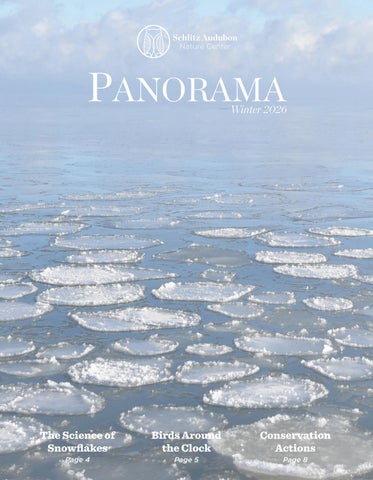
Front cover: Ice pancakes on Lake Michigan at the Center
Admission
FREE admission to Members Adult: $10 | Youth: $7 (ages 3 — 17) 2 and Under: Free | Military: $7
Hours
Monday-Sunday | 8:30am-5:00pm Schlitz Audubon is an independent, locally supported partner of the National Audubon Society.
1111 East Brown Deer Road | Milwaukee, WI 414-352-2880 | www.schlitzaudubon.org 2
Marketing & Communications Specialist Anna Ostermeier
Winter 2026 | www.schlitzaudubon.org
SEASONAL SIGHTINGS
Winter's Unexpected
COLORS
MIMI NORMAN Environmental Educator Winter may seem to be lacking in color, with vibrant autumn hues fading quickly to a landscape of browns, whites, and evergreen. However, finding other colors is possible if you pay close attention, and it can be an entertaining challenge for your next winter walk! Red is not only found in holiday decorations and mistletoe in doorways. True to its name, the winterberry is a flowering bush within the holly family that’s found year-round but only produces its scarlet-toned berries during our coldest months. This plant, along with other shrubs like chokeberry and American holly, is vital to supporting wildlife—particularly birds—through the season. If you look up, you may spot the vivid red feathers of one of the animals relying on these berries: the male Northern Cardinal. They begin to molt in early fall, and many of their new feathers are tipped with gray until the winter months are upon us. By midwinter, most cardinals are at their brightest! Orange can be more difficult to find in nature, but looking to the horizon at dusk can help. In fact, sunsets appear most brilliant in winter, and science offers insight into why. Humid conditions in warmer times of the year can subtly dull the colors of a sunset, scattering the light before it hits our eyes. Therefore, the low humidity as the temperature drops allows for more intense corals, pinks, and oranges. Yellow is more common in winter than one might expect. Most assume that all trees with needles are evergreen, but the phylum conifer includes a species called the tamarack, which turns bright yellow in early autumn, its needles falling soon after. These needles, as well as grasses that have lost their chlorophyll, can light up your walk with shades of yellows and golds. Green can be found beyond coniferous trees. Overwintering and migrating waterfowl can be spotted on Lake Michigan and in our wetlands, displaying flashes of green plumage. The male of many duck species, called the drake, have a noticeable green hue on their heads. The well-known Mallard drake has a fully green head separated from its brown body by a solid white stripe, while the North American Common Merganser’s fully green head contrasts sharply to its mostly white body. Blue & Purple hues are created in many forms during the winter, caused by the dry air scattering blue and purple light wavelengths more effectively. The snow may appear purple or blue toned in the light, or the sky more vibrant. A surprising source is small patches of blue-stained snow often found near rabbit scat, a clue to the cause of this curious sight: rabbit urine, typically the eastern cottontail. As their usual meals of green grasses and leaves disappear, they shift their sights to woody vegetation, like the twigs of the non-native European buckthorn that contain a chemical which turns a purpley-blue color when exposed to sunlight.
Winter 2026 | www.schlitzaudubon.org
3
EDUCATION
The Science of
SNOWFLAKES CASSIE RINCON Environmental Educator
No two snowflakes are exactly the same. If you have ever captured one on your mitten and looked at it closely, the crystalline structures can tell you about its journey and why it looks different than other snowflakes. It all starts with a dust particle in a cloud. The water in the cloud begins to condense on that particle, and from there, the snowflake begins to form. Every snowflake will take on a hexagonal shape due to the molecular structure of water, but the final shape can vary depending on the environmental conditions as it develops. There are 121 different types of snowflakes that fall into eight categories: stellar dendrites, needles and columns, capped columns, fernlike stellar dendrites, diamond dust crystals, triangular crystals, twelve-branched snowflakes, and rimmed snowflakes and graupel. As each snowflake travels its own path through the clouds, the unique temperature and humidity along the way determine its growth structure. When the temperature is just below freezing, a hexagonal plate begins to form. If the humidity remains low as the snowflake falls, it keeps this shape. With more water in the air, the snowflake is able to grow branches and form dendrites from the six points of the plate. This is the shape people are most familiar with. All the dendrites start as a stellar dendrite, but if
4
the snowflake has more time in the clouds and encounters more moisture, it can grow smaller sidebranches, resembling a fern. Smaller dendrites fall when the temperature is just below freezing, whereas larger dendrites make an appearance when the temperature is around 5° Fahrenheit and humidity is high. Between 23 to 14° Fahrenheit, snowflakes can form into needles and columns. These columns have much of the same shape as a standard No. 2 pencil. Sometimes these columns are hollow and sometimes, if the temperature cools to 21° Fahrenheit or below while they're forming, they become capped as plates grow on the ends. Collisions in the clouds can create different types of shapes. When two dendrites clash into each other, they form a twelvebranched snowflake. If small droplets of water, called rime, clash into a snowflake and freeze onto the surface, it creates a form called graupel. Often mistaken for true hail, which is a solid piece of ice, graupel is sometimes referred to as soft hail because it breaks apart easily. No matter what snowflakes look like, once they reach the ground, they provide us with an abundance of recreational activities like snowshoeing or sledding down your neighborhood hill. Next time you enjoy a fresh snowfall, catch a few flakes to find clues about their journeys through the clouds!
Winter 2026 | www.schlitzaudubon.org
FEATURE
Bird Behaviors Around the Clock
ANNA OSTERMEIER Marketing & Communications Specialist
With contributions from:
LAINE COTTELEER, TOM FINLEY, AND ERIN TOOHEY
5
FEATURE
I
f you’re an early riser, you’ve probably heard the trees and skies come alive just before dawn—chirps, trills, and rustling wings greeting the sun. Night owls, on the other hand, might catch the quiet calls of creatures that wait for darkness to become active. Like people, animals follow different daily rhythms depending on when they have the most energy and are best equipped to thrive. In the natural world, this rhythm is described in three ways: diurnal, nocturnal, and crepuscular. Diurnal species are most active during the day, nocturnal species come alive at night, and crepuscular species prefer the in-between hours of dawn and dusk. Each approach to the 24-hour cycle has evolved over time, shaped by food sources, predators, competition with others, and temperature. This spring, you might encounter three birds at Schlitz Audubon that exemplify these rhythms: the White-breasted Nuthatch (diurnal), the Eastern Screech Owl (nocturnal), and the American Woodcock (crepuscular). Together, they offer a window into how and why animals spend their days and nights on different schedules. WHY ANIMALS KEEP DIFFERENT HOURS There’s no single “best” time to be active; each schedule offers its own set of tradeoffs for survival. Animals have adapted behaviors and physical characteristics to maximize the advantages while avoiding drawbacks. Diurnal wildlife, such as the White-breasted Nuthatch, benefit from full daylight. It’s easier to find food, spot potential mates, and navigate their environment under the sun’s warming rays. However, daylight also makes them more visible to predators such as Cooper’s and Sharp-shinned Hawks. The nuthatch’s short tail helps it balance with its head up, giving a wider field of vision to spot danger, while its small, light body allows it to dart swiftly through trees to evade predators. Nocturnal animals, like the Eastern Screech Owl, take advantage of the quiet night’s cover of darkness. They avoid the hotter months’ midday heat and reduce competition from daytime hunters by us-
6
ing exceptional low-light vision and finely tuned hearing. While they rest in tree cavities during the day, their bark-like feathers keep them hidden from predators such as large mammals and hawks. Crepuscular species, including the American Woodcock, find their niche in the edges of the day. Twilight offers cooler air, reduced competition, and lower light that provides some protection from predators, though daytime hunters may still be active and posing a risk. Woodcocks have evolved long, flexible bills and large, keen eyes positioned high and far back on their heads, which allow them to forage in dim light while watching for danger at the same time. Though these categories help us understand general patterns, nature rarely follows a strict clock. As the seasons shift, food becomes more or less available, predators come or go, and nesting demands change, birds adjust their schedules accordingly. An owl feeding a growing brood might hunt earlier in the evening and a woodcock facing a cold snap may stretch its foraging into daylight hours. Flexibility is key to survival. Now, let’s imagine a typical early April day and night at Schlitz Audubon for each of these three birds. DAWN The Eastern Screech Owl is ending its night. The male often makes one final hunting trip before returning to the tree hollow where his mate is sitting on their eggs. He may bring her a meal or cache it for later before settling in to rest, his feathers blending seamlessly with the tree bark. Out in open fields and along forest edges, the American Woodcock is finishing up its own night shift. After many hours of foraging using its slender, flexible bill to “feel” for earthworms underground, it may perform a few last “peent” calls before hunkering down in the leaf litter. The male is less likely to perform his famous acrobatic flight displays at dawn, as he’s tired from the previous evening’s courtships and knows the risk of predation grows as more light fills the landscape. Meanwhile, the White-breasted Nuthatch
Winter 2026 | www.schlitzaudubon.org
FEATURE is just starting its day. After spending the night tucked inside a tree cavity or dense branch cluster, it flits energetically from trunk to trunk. With its distinctive “yank-yank” call, the nuthatch scours the bark for insects. Mornings are its busiest hours, when sunlight and warmth stir insects into action. Nesting season is fast approaching, so couples may also seek a site to start their new brood. MIDDAY The nuthatch continues its rounds but at a slower pace, taking time to rest between foraging trips. It keeps a sharp eye on the sky for hawks and crows. The woodcock lies low in the tall grass or prairie edge, motionless and hidden. Its camouflage is exceptional—brown, gray, and rust tones matching last year’s fallen leaves. Here it avoids daytime predators and waits for darker, safer hours to feed and mate. The screech owl rests. Its camouflage is so precise that even seasoned birdwatchers might overlook it. DUSK The nuthatch makes its final foraging trips, filling its belly for the night ahead. When the light begins to dim, it retreats into a safe tree hole or dense evergreen to roost. The woodcock, however, is just warming up. At twilight, males take to the air for one of the most extraordinary courtship displays in North America. After a few nasal “peent” calls, the bird spirals upward in widening circles—sometimes climbing hundreds of feet—before plummeting back down in a musical, fluttering descent. Males defend their territories vigorously
and forage between displays, replenishing energy.Their flamboyant dance is strategically performed at dusk, when it’s still visible enough to capture the attention of females without making them too vulnerable to daytime predators. When not watching the males, females search for suitable ground where they can dig out their small, shallow nests. As dusk deepens, the screech owl awakens and begins hunting, gliding silently between trees. His feathers are designed to muffle sound, allowing him to approach unsuspecting prey. Mates keep in touch through even-pitched trills or “bounce songs,” and the male brings his mate a meal of small mammals, birds, or insects he captures. As a relatively small prey owl, he must stay alert as he moves through the woods, watching for larger owls that may pose a threat. NIGHT The screech owl is now fully active under the moon’s soft beams. He perches silently, listening for the faint rustle of a mouse or splash of a frog. With one swift, soundless swoop, he strikes. Between hunts, he rests and surveys, his round yellow eyes glowing. Though the male does most of the hunting during nesting season, the female may take a break from sitting on their eggs to stretch her downy wings and find a tasty morsel. The woodcock resumes foraging, bobbing rhythmically as it searches for worms by probing the soil with its long bill. Its large, sensitive eyes allow it to move comfortably even in near darkness. The nuthatch is fast asleep in its roost, feathers fluffed to conserve warmth, hidden from nighttime predators. EXPERIENCE THEM AT SCHLITZ AUDUBON Each of these species, and the many other animals that share our local ecosystem, has found ways to survive within the 24hour rhythm. Their behaviors, shaped by countless generations of evolution and adaptation, allow them to coexist in the same habitats. For those who enjoy viewing wildlife at Schlitz Audubon, understanding these patterns offers a new layer of appreciation. Visit the Feeder Grove or take a morning Bird Walk to spot nuthatches gobbling up seeds or clambering headfirst down trees. Join us for Woodcock Walks in early spring to watch their remarkable sky dances at dusk. Experience wild screech owls during an evening Owl Prowl or meet our resident screech owl ambassadors, Baron von Screech and Gimli, during our Raptor Programs. From sunrise songs to midnight calls, every time of day at Schlitz Audubon holds its own story of survival.
7
EDUCATION
Make Winter a Season of Stewardship
8
Winter 2026 | www.schlitzaudubon.org
EDUCATION ANNA OSTERMEIER
Marketing & Communications Specialist The quiet hush of winter and the New Year invite us to slow down, reflect, and connect with what matters most. The natural world offers us many gifts throughout the year: the joy of spring bird song, the peace of a forested stroll, and everyday necessities, like clean air and water. We can reciprocate by taking conservation actions as individuals and alongside our community of neighbors, friends, family members, and coworkers. SALT RESPONSIBLY TO PROTECT OUR WATERWAYS Winter salting helps keep roads and sidewalks safe, but it comes with a hidden cost. As snow melts, excess salt washes into rivers, lakes, and groundwater, harming freshwater plants and animals. Thankfully, there are steps you can take to prevent this pollution. Before reaching for the salt, grab a shovel. Clearing snow early and often reduces the need for salt in the first place. If you do need a deicer, choose wisely. Traditional rock salt (sodium chloride) loses effectiveness below 15°F and is hard on the environment. Gentler options include calcium magnesium acetate (works to 20°F) and calcium chloride (works to -20°F). Sand provides traction at any temperature but should not be combined with a deicer. Spread salt sparingly—aim for gaps between the grains, not a layer or pile of white. A single 12 oz. coffee mug of salt is effective for a 20foot driveway or 10 sidewalk squares. After the snow has passed, sweep up and store unused salt to prevent it from washing away. For more information, visit the Wisconsin Salt Wise website. PROVIDE FOOD AND WATER FOR BACKYARD BIRDS Many birds overwinter in Wisconsin, like the charismatic Blackcapped Chickadee and lively Northern Cardinal. You can help them persevere through the colder months by providing food and water, with the added benefit of more opportunities to observe these feathered companions.
them! Create brush piles by stacking branches into a pyramid, layering boughs and leaves for insulation. Discarded Christmas trees are another great option for instant shelter. Install roosting boxes designed to hold multiple birds or repurpose birdhouses by cleaning them out and insulating them with foam weatherstripping to keep in warmth (don't forget to remove it in the spring!). To avoid disturbing hibernating wildlife, be sure to check compost heaps and bonfire piles before digging or lighting. VOLUNTEER! If you prefer to stay cozy inside, try citizen science projects like Snapshot Wisconsin, which uses trail cameras to monitor wildlife statewide, informing management decisions. At Schlitz Audubon, our Feeder Watch program runs from early November to late April and lets volunteers spend peaceful hours in our Great Hall identifying birds in our Feeder Grove observation area.
Winter food can be scarce, and birds need to eat more just to stay warm. Fill feeders with high-energy foods like sunflower seeds, suet, peanuts, and mealworms. Aim to refill daily, especially in the late afternoon to help birds through long, cold nights. Avoid window collisions by placing feeders either within 3 feet of the window or more than 10 feet away. Outside of the winter season, you can also plant trees and shrubs that provide winter fruit such as hackberry, juniper, serviceberry, crabapple, highbush cranberry, and nannyberry.
If you love being outside and active amongst beautiful landscapes, try joining our Land Stewardship team! In winter we focus on removing harmful, invasive buckthorn, making way for diverse native plants to thrive and support local wildlife.
Water is just as critical, as melting snow costs birds valuable energy. Place a sturdy birdbath in a sunny, sheltered spot and refresh it regularly. You can purchase a heated birdbath or swap in a new saucer of water each morning. Avoid antifreeze or glycerin—they’re harmful to birds.
EMBRACING WINTER CONSERVATION TOGETHER Every small action makes a difference. When we act together, our impact multiplies; conservation is more powerful, and more joyful, when it’s shared. So don’t go it alone! Invite a friend, family member, neighbor, or coworker to join you in these actions.
CREATE SHELTER FOR WILDLIFE Animals need safe, warm spaces to conserve energy, hide from predators, and take cover from storms—and we can help provide
At Schlitz Audubon, we’re here to support you and your community every step of the way. Let’s make this a season of connection, stewardship, and collective action for the wild places we love!
Want to take your skills further? Sign up in January for the Wisconsin Master Naturalist program to join a statewide network of skilled volunteers dedicated to conservation, citizen science, and environmental education.
Winter 2026 | www.schlitzaudubon.org
9
DEVELOPMENT
Opening Doors to Nature Across Milwaukee
ANNA OSTERMEIER
Marketing & Communications Specialist For over 20 years, our Early Childhood Education Urban Outreach Program has introduced young learners in Milwaukee's central city to the wonders of nature-based learning. Thanks to support from the Richard and Ethel Herzfeld Foundation, our longstanding partnership with Next Door Milwaukee has ensured that thousands of children have experienced meaningful, developmentally rich encounters with the natural world. Nature-based learning offers profound benefits for early childhood development, yet many Milwaukee children face significant barriers to experiencing it—ranging from limited access to green spaces to financial challenges around transportation and outdoor gear. Support from the Herzfeld Foundation removes these obstacles by underwriting educator time, materials, classroom resources, student busing costs, and weather-appropriate gear. With these barriers eliminated, children can explore freely in nature, engage their senses, and build foundational STEM, social-emotional, and motor skills. Through our partnership with Next Door Milwaukee, we collaborate with leadership and educators across multiple classrooms at the organization’s Capitol Heights and Metcalfe Park campuses. Funding allows us to serve about 150 students each year, all of whom receive recurring, hands-on environmental education aligned with Next Door Milwaukee classroom themes and early learning standards. Each month, every class participates in one field trip to Schlitz Audubon and two in-classroom visits, creating a consistent rhythm of engagement that deepens learning and builds comfort in the outdoors. During visits to the Center, we immerse children in exploration across our forests, prairies, wetlands, and the Lake Michigan 10
shoreline. They climb logs, listen for bird calls, search for animal tracks, investigate seasonal changes, and meet live Animal Ambassadors. In their classrooms, our educators lead sensory-based lessons using natural materials, storytelling, music, movement, and introductory science—all designed to spark curiosity, support developmental milestones, and promote school readiness. The outcomes of this program have been transformative. Participating children have demonstrated remarkable growth in their ability to observe, interact with, and respect nature. They have also developed independence and problem-solving skills, having learned to put on their own outdoor gear and move through landscapes that change dramatically throughout the year. Perhaps most importantly, they no longer see the outdoors as a distant concept, but as a living, breathing environment that they can interact with, understand, and care for. The program also has a meaningful impact on teachers. Our educators learn the needs and goals of Next Door Milwaukee teachers and students, and in turn provide experiences that help integrate nature themes into everyday curriculum and model environmental education strategies. As a result, teachers have reported greater confidence in weaving nature-based activities into their instruction and increased student engagement. The Herzfeld Foundation and Next Door Milwaukee are essential partners in providing these life-shaping experiences. We extend our deep gratitude for their shared commitment to Milwaukee’s youngest learners. Together, we are cultivating curiosity, confidence, and a lifelong connection to the natural world that can continue to grow long after the school year ends.
Winter 2026 | www.schlitzaudubon.org
DEVELOPMENT In Memory Of John Stephen Anderson Anonymous (2) Susie Apple Bruce and Susan Barrow Jonathan Beal Robert and Kathy Brumder Peter and Roberta Buening Carr Family Fund at the Greater Cedarburg Foundation Sallie Davis Lena and Jim Dawson Jeanne Dolan Buffy and Steve Duback Pamela Frank Rick and Barbara Frank Jon and Ann Hammes Libby and Bill Hansen Honest Game Mary and Ted Kellner Sharon, Sophia, and Sarkis at Kirkland & Ellis LLP Al and Kathy Krug Diane Lane Jean Lemorande Marian and William Nasgovitz Christopher and Anne Noyes Bob and Peggy Schuemann Eleanor Seaman Warren and Sue Smith Martha Smithback Janet Spero Andrew Stefanich Madonna and Jay Williams Christopher and Sally Wilson Carol Argus Dan and Linda Argus Humphrey "Stu" Desmond Wilson Conservation Trust Gary Fait Shannon Arrieta Sarah Fait Alison Pedone Tom Fitzgerald Willard Walker
Wade and Stephanie Lynton Mark Miekley John U. Olson and Elin Blakstad The Oplinger Family Pamela and Mike Rediker Jim Simon Diana Slaughter John and Elizabeth Steiner Sarah and Steve Zimmerman Quiang Ma The Bernstein Family
Great Lakes Film and Graphics
Norm Sorenson Kathleen Ballwahn Mary and Mark Lanners Tina Sorenson
Perseus – Barred Owl In Honor of Vicki Little Beth McAleer
In Honor Of David. D. Becker Barbara J. Becker Susan and Steve Bell Ellen Schneiderman and Jim Stein Boomerfest Patrick Cronin Rhonda Downey Katy and James Hoover Stefani Miller Elizabeth Ragalie Monica Birdsong DeBrot Anonymous David Dorn Dorn Family Charitable Fund Randall and Paula McLean Jacquie Chrisien Jonathan and Amanda Stone Max Rasansky
Raptor & Animal Sponsorships
Caron Gray Steven Gray Carolina Gurski
Darwin – Turkey Vulture In Memory of Jake and Hattie Michelle Herro
John B. Gray Rebecca Gray
In Honor of Mirren, Elliot, and Simon Edelman Maggie Smith-Edelman
Matson Brumder Holbrook Anonymous Suzy and John Brennan CBRE, Inc. Kathy, Fred, Laurie, Ries, and Katherine Hansen Henry S. Lynn, Jr.
Loki – American Crow In Memory of Arleen J. Klug Jeffrey R. Klug
Otis – Peregrine Falcon Invest Answers
Diane Weber Gautier Penny Freedman
Paul Michael Hauer Mark Hauer
Freyja – American Kestrel Russell Johnson
Richard Richter Justine and Connor Gibson
Athena – Barn Owl Mary McCormick Kim Schleicher
Bryan Hartsook David and Jill Aschebrook Kevin Burke Cheryl Hoffarth Ruekert & Mielke, Inc. Mitchell and Lauren Yoder
Claire and John Harty Maria MacNeil Kelsey Schoenknecht Juliana Schwehr
Sky Walker – Red-tailed Hawk Dorthy Zajac Valkyrie – Bald Eagle In Honor of Michael Logan Sheila Wordell Willow – Northern Saw-whet Owl In Honor of Becky Sather Erin Dembrowski Zari – Great Horned Owl In Honor of Patti Benson Tom Benson In Honor of Asher Zucker Story Zucker David and Patricia Daniels Eddie – Ornate Box Turtle In Honor of Amelia Arnold Jennifer Wilson In Honor of Robin Regan John Regan In Honor of Everen Wilson Jennifer Wilson Emerson – Common Snapping Turtle In Honor of Guy Theune Amy, Kelly and Christopher Block, Don and Linda Hook, and June Jenny and Cody O’Neil
Wedding Ceremony Trees In Honor of Samuel Alberts and Jessica Leep Frederick Leep
In Honor of Adeline Louise Kuzniewicz Alex Kuzniewicz
In Honor of Josh Butz and Emily McCann Mary Ferwerda
Anonymous Henry Bissegger Jane Blake Barbie Brennan Nelson and Chad Nelson Emily Cain Thomas Daub Dave and Monica DeBrot Johnathan Fischer and Katie Bandurski Reese George Suzanne Grocholski and Brandon Wilborn Susan Groh David and Sheila Haas Marylis Hansen
Kyle Alcaraz and Maggie Seer Peter Amundsen and Brenna Osiecki Rev. Matt Aspin and Rev. Denise Cawley John Burroghs and Jean DePrey Hailey Cairney and Ethan Hindes Megan Giese and Kyle Hartwig Marcus Grimm and Sara Kuczkowski Kirstyn Heino and Michael Karasch Matt Keating and Valerie Krc Alexandra Leska and Adam Peterson
Winter 2026 | www.schlitzaudubon.org
Gifts listed in this issue were received between 4/1/2025 – 9/30/2025 11
Schlitz Audubon Nature Center 1111 East Brown Deer Road Milwaukee, Wisconsin 53217
WINTER 2026 PANORAMA
U.S. Postage
PAID
Milwaukee, WI Permit No. 4168