Small manufacturers: The ‘backbone’ of the community by Matthew Clark mclark@scbiznews.com
growth plan includes investing more in e-commerce technology to broaden the reach of Vapor Apparel’s brand. “We are constantly innovating,” Bernat said. “We have market places and we have market segments. Then we have product segments and all of those are places we need to innovate.”
G
rowth in South Carolina’s manufacturing sector is strong, with the value of its shipments and services topping $112 billion in 2015, according to the U.S. Census Bureau. While it seems intuitive to attribute that growth — up from $73.5 billion in value in 2009 — to major companies like BMW, Boeing or Honda, Chuck Spangler says that would be an incorrect assessment. Spangler, president and CEO of the S.C. Manufacturing Extension Partnership, said South Carolina has 4,900 manufacturers employing 100 or fewer and, of that number, nearly 3,900 have 20 or fewer employees. All this makes smaller manufacturers a much bigger than expected player in the state’s economy. “People look at that data and just think ‘wow,’” Spangler said. The largest concentration of small manufacturers is in the Upstate, Midlands and Lowcountry. According to SCMEP data, Greenville County has 376 manufacturing companies with 20 or fewer employees. Spartanburg County has 237, while Charleston County has 220. Richland and Lexington counties have 136 and 135, respectively.
Small roots in apparel
One such manufacturer is Vapor Apparel. The North Charleston-based apparel company employs between 40 and 50 at its Lowcountry headquarters and its new production facility in Union County in the Upstate. During the summer, cofounder Chris Bernat said that number
On the high seas
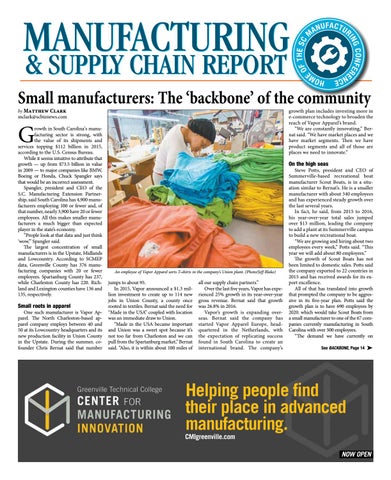
An employee of Vapor Apparel sorts T-shirts in the company’s Union plant. (Photo/Jeff Blake)
jumps to about 95. In 2015, Vapor announced a $1.3 million investment to create up to 114 new jobs in Union County, a county once rooted in textiles. Bernat said the need for “Made in the USA” coupled with location was an immediate draw to Union. “Made in the USA became important and Union was a sweet spot because it’s not too far from Charleston and we can pull from the Spartanburg market,” Bernat said. “Also, it is within about 100 miles of
all our supply chain partners.” Over the last five years, Vapor has experienced 25% growth in its year-over-year gross revenue. Bernat said that growth was 26.8% in 2016. Vapor’s growth is expanding overseas. Bernat said the company has started Vapor Apparel Europe, headquartered in the Netherlands, with the expectation of replicating success found in South Carolina to create an international brand. The company’s
Steve Potts, president and CEO of Summerville-based recreational boat manufacturer Scout Boats, is in a situation similar to Bernat’s. He is a smaller manufacturer with about 340 employees and has experienced steady growth over the last several years. In fact, he said, from 2015 to 2016, his year-over-year total sales jumped over $13 million, leading the company to add a plant at its Summerville campus to build a new recreational boat. “We are growing and hiring about two employees every week,” Potts said. “This year we will add about 80 employees.” The growth of Scout Boats has not been limited to domestic sales. Potts said the company exported to 22 countries in 2015 and has received awards for its export excellence. All of that has translated into growth that prompted the company to be aggressive in its five-year plan. Potts said the growth plan is to have 690 employees by 2020. which would take Scout Boats from a small manufacturer to one of the 67 companies currently manufacturing in South Carolina with over 500 employees. “The demand we have currently on See BACKBONE, Page 14
➤
14
www.gsabusiness.com
MANUFACTURING & SUPPLY CHAIN REPORT
March 6 - 19, 2017
In 2015, Vapor Apparel announced a $1.3 million expansion for its Union facility. That expansion is expected to create up to 114 new jobs. The 30,000-square-foot facility in Union houses the company’s domestic cut and sew division. (Photos/Jeff Blake) BACKBONE, continued from Page 13
➤
what we are producing along with what we are planning to do to get into new markets – meaning developing new models for markets we aren’t in – is a big reason for that growth,” Potts said.
Competing with the ‘big boys’
While larger manufacturers like
BMW and Boeing grab headlines, neither Bernat nor Potts believe they are in any kind of competition with larger manufacturers in the state for employees, business or incentives. “I’ve actually had conversations with economic development people. I guess it is pretty typical that the noise is all over the BMWs and the Volvos,” Potts said. “I do think there is more credibility for the
home-grown business. We were started in the state, our employees are all from the state and we spend all of our money in the state.” And neither of them feels left out of the state’s overall economic picture. In fact, both said their growth is what keeps the state’s economic engine purring. “Here is the thing about small manufacturing … it is where the real job growth is,” Bernat said. “When I interview people for positions, I like to point out there are a lot of folks that want to be part of something larger than themselves, but not in a setting with thousands of other people.” No matter the size of the manufacturer, the impact across other sectors remains the same, according to Spangler. He said for every one manufacturing job created, up to three service jobs are created depending on the sector. “They are the backbone of the community,” Spangler said. “It goes back to the numbers, and most people think it’s the big guys, but it is those small- to medium-sized guys.”
Diversification key to small manufacturers
One distinction Bernat and Potts have from most other small manufacturers in the state is the audience they cater to. Vapor Apparel and Scout Boats are not dependent on larger OEMs for business, which puts them in a minority, Spangler said. Having a diversified manufacturing portfolio is a goal SCMEP sets for any small manufacturer in the state. Spangler said more diversification means less dependence on one particular sector, so that if that sector were to experience a decline, the blow would not be as big to the smaller manufacturer because they have more to offer on the market. “We really try to help them get the right certification to be in the right supply chain so they can bid on more work,” Spangler said. “We have a marketing program to
help these guys diversify and pick up more clients and more sales so they aren’t so dependent on just one client. There is help with strategy to work with their market portfolio, and they truly need to understand their costs.” Getting other manufacturers to the same place as companies such as Vapor Apparel and Scout Boats is the end game for SCMEP programs. “We love those because they can really build their own brand,” Spangler said. “There are a lot of those in South Carolina and they aren’t limited by OEMs. They are only limited by their ability to market, but those companies have great potential.” He added the climate for bringing in new manufacturers — small and large — remains such that he believes the sector in South Carolina will only get better … and larger. “It’s blowing my mind how we are still growing,” Spangler said. “We average about 19 to 20 international companies coming in that have never done business in North America and that seems to stay up. And when you have that, I think the future is going to be great.” Reach Matthew Clark at 864-235-5677, ext. 107 or @matthewclark76 on Twitter.
March 6 - 19, 2017
THE
PEOPLE Compiled by Jenny Peterson, Associate Editor SC Biz magazine
Local manufacturers are not only an economic driver for communities, but
MANUFACTURING & SUPPLY CHAIN REPORT
Kena Greene
customer service representative, Vapor Apparel
Jimmy Dendy prints schedule manager, Vapor Apparel
“I’ve been working here for a little over a year and got promoted to production lead. I was working back there for about a year when I got promoted to lead in August and then got promoted to sales team in December. For me to get promoted twice in a year, that’s awesome. There’s definitely growth here. I’ve learned a whole lot and now, since I’m in sales, I’m learning the front end. I already know the back end.”
“I’ve been here four years. Definitely here, if you come in and do a good job, and want to do a good job, you are definitely rewarded. I wasn’t looking to be a screen print supervisor, I just did my job and started making suggestions on how to run things differently, and management took it to heart and they like to hear suggestions on how to make things better. They are great employers.”
Patrick Goodwin
Arravian Wilson
www.gsabusiness.com 15
Sherri Hart finishing supervisor, Scout Boats
“My family owned an auto body shop and my mom would show me how to do finishing work, painting and touch ups. Work here is right up my alley. I’ve gotten three raises in 13 months. It’s definitely really cool; my neighbor, sister and brother-in-law all work here. The owners care a lot for my family and have so much respect for everyone who works here.”
these companies also offer meaningful employment for residents, with plenty of opportunities for advancement. Employees on the production side are often trained on-site, which prepares them for a longterm career in the state’s manufacturing sector.
team lead, small parts division, Scout Boats
production helper, U.S. Waffle
“I was driving by one day “This is my first time workand saw a jobs hiring on a ing in a plant, ever. I love sign on the side of the road. it, I actually love it. I like I’ve been here a year and the way everybody works four months. I’m now the together, I love that. Evteam lead of the small parts division that I eryone is treated fairly and there is a lot of started in.” diversity. It’s a great place and great learning experience and there’s a chance for growth. I look forward to getting moved up to a new position.”
Myriam Alberio line leader, U.S. Waffle
“I’ve been working here for a year and six months. When I first started, I was a general helper on the line and worked my way up. Now, I’m a line leader; I have my own line and I do the best I can. I organize everything how they want it to be organized and it’s a new challenge.”
16
www.gsabusiness.com
March 6 - 19, 2017
MANUFACTURING & SUPPLY CHAIN REPORT
S.C. MANUFACTURING By the Numbers
NUMBER OF MANUFACTURING COMPANIES WITH UNDER 20 EMPLOYEES, BY COUNTY 1. 2. 3. 4. 5. 6. 7. 8. 9. 10. 11. 12. 13. 14. 15. 16. 17. 18. 19. 20. 21. 22. 23.
Greenville: 376 Spartanburg: 237 Charleston: 220 Richland: 136 Lexington: 135 York: 133 Anderson: 119 Horry: 115 Pickens: 68 Beaufort: 63 Florence: 58 Oconee: 54 Dorchester: 53 Berkeley: 51 Aiken: 45 Laurens: 40 Sumter: 39 Greenwood: 38 Orangeburg: 36 Georgetown: 32 Kershaw: 29 Lancaster:28 Chesterfield: 27
54
19
376 237 68
16
119
21
40
21 2
6 9
28
12
22
38
24. 25. 26. 27. 28. 29. 30. 31. 32. 33. 34. 35. 36. 37. 38. 39. 40. 41. 42. 43. 44. 45. 46.
133
29 136
135
27 6
7
25 58
39
9
45
6
12
11
15
36 13
6
2 9
32
51
53 15
115
220
22 63
0-50
51-100
101-200
201-300
Darlington: 25 Jasper: 22 Newberry: 22 Abbeville: 21 Chester: 21 Cherokee: 19 Union: 16 Colleton: 15 Willamsburg: 15 Barnwell: 13 Clarendon: 12 Fairfield: 12 Marion: 11 Calhoun: 9 Edgefield: 9 Hampton: 9 Dillon: 7 Bamberg: 6 Lee: 6 Marlboro: 6 Saluda: 6 Allendale: 2 McCormick: 2
301-400
YEAR-OVER-YEAR
The number of manufacturing jobs in South Carolina dipped during the Great Recession, but is on a growth trend again. This is a look at the number of employment jobs in the month of July since 2006.
260,000 240,000 220,000 200,000 2006
2007
2008
2009
2010
2011
2012
2013
2014
2015
2016
Source: U.S. Bureau of Labor Statistics State and Area Employment, Hours and Earnings.
March 6 - 19, 2017
MANUFACTURING & SUPPLY CHAIN REPORT
These BMW X models await loading for export from the Port of Charleston. BMW Manufacturing Co. reported exporting a record 287,700 X models from the Spartanburg plant in 2016. (Photo/Provided).
BMW Manufacturing exports $9.53B in 2016 by Matthew Clark mclark@scbiznews.com
I
n 2016, BMW Manufacturing Co. exported 287,700 X models, accounting for nearly 70% of all vehicles manufactured — 411,171 — by the Spartanburg facility. The number of models exported is a new record for the plant. All told, the manufacturer exported 86% of the 287,700 X models along with coupes through the Port of Charleston in 2016. The value of the X models and coupes exported from the Upstate plant was $9.53 billion, according to the BMW Group and the U.S. Department of Commerce. The remaining 14% of X model exports were moved through ports in Savannah, Ga., Brunswick, Ga., Jacksonville, Fla., Miami and Everglades, Fla. Knudt Flor, BMW Manufacturing Co. president and CEO, said the “export figures reinforce BMW’s commitment to South Carolina and the United States,” in a news release. “Our vehicles are in high demand. Customers from 140 countries around the world are eagerly awaiting our vehicles,” Flor said, in the release. “We build our product with precision and pride every day.” Flor took over for previous CEO Manfred Erlacher in December 2016. The value of exports the company
BMW FACTS
moved through the Port of Charleston is slightly less than the $9.8 billion value of vehicles exported through the port in 2015, but still higher than the $9.2 billion exported in 2014. But, the company said the Spartanburg facility was still the leading U.S. automotive exporter by value in 2016. The plant is undergoing a $1 billion upgrade as the company prepares to build the new X7 model, which is expected to start production sometime in 2018. Robots and additional tooling are part of the current phase of construction inside the 1.2-million-square-foot body shop. The upgrade also includes the addition of 200,000-square-feet to the X5/X6 hall where the X7 will also be built. Since opening the plant in 1994, BMW Manufacturing Co. has produced over 3.7 million vehicles and the BMW Group had invested $7.8 billion into the facility as of Dec. 31, 2016, according to BMW Manufacturing. “There’s no overstating the value BMW has brought to South Carolina since opening its doors in Spartanburg County over 20 years ago,” said Gov. Henry McMaster, in the release. “The fact that the same facility that represented such a commitment to our state is now the leading automotive exporter in the country is something that all South Carolinians should be proud of.” Reach Matthew Clark at 864-235-5677, ext. 107 or @matthewclark76 on Twitter.
BMW Manufacturing Co., based in Spartanburg, exported $9.53 billion through the Port of Charleston in 2016, according to the company. That included 86% of the 287,700 X models produced by the plant during the year. In all, the Spartanburg facility exported 70% of its total production of 411,171 vehicles during the year.
www.gsabusiness.com 17
18
www.gsabusiness.com
MANUFACTURING & SUPPLY CHAIN REPORT
March 6 - 19, 2017
Upstate industrial property market finishes record year by Matthew Clark mclark@scbiznews.com
N
o matter what market report one reads, the underlying message is the same: The Upstate industrial property market had a stellar year in 2016. Industrial buildings under construction jumped as more than 3 million square feet of property was under construction through the fourth quarter of 2016. Overall vacancy wavered between 6.8% and 7.6% with the variance dependent on the size of the market researched. Bryana Mistretta, South Carolina research coordinator for Colliers International, said in her report the nearly 8 million square feet of industrial space was absorbed in 2016, compared to 2.4 million square feet absorbed in 2015. “The high absorption rate is due to three major industrial drivers pushing the demand for industrial space in the market: advanced materials manufacturing, logistics and automotive,” Mistretta said in her report. According to NAI Earle Furman’s industrial market report for the fourth quarter, construction of industrial buildings “continue to be very strong” as 1.5 million square feet of industry space was completed in the fourth quarter across Greenville, Spartanburg and Anderson counties. Towers Rice, industrial division broker for NAI Earle Furman, said total sales volume in the industrial space was down by seven transactions and 25% in sales volume compared to the same nine-month period in 2015. “Demand is strong, but the supply is limited and statistics like this indicate a lack of available product,” Rice said, in his market report. Across all three counties and their respective submarkets, there is 170,590,422 square feet of marketrentable area, according to CBRE. Asking rates for industrial space averaged $3.37 per square foot per year and net absorption in the fourth quarter was 790,877 square feet. Of the absorbed square footage, over 340,000 square feet was speculative industrial space, according to the CBRE report. “For the first time in two years, the total amount of speculative space on the market decreased,” the CBRE report said. “During this economic cycle, 3 million square feet of speculative development has occurred, of which 59% has been leased.” Here are some of the industrial
property deliveries reported during the fourth quarter, according to Colliers International: • The 50,000-square-foot build-tosuit facility for Proper Polymers and 161,600-square-foot build-tosuit facility for Magna International were both delivered this quarter by Becknell Industrial in Greenville County. • The 184,000-square-foot Draxlmaier expansion is now complete. • Phase I of the Toray campus at 2202 Moore Duncan Highway is now complete. The facility is 750,000 square feet. • 1560 International Drive, a 30,000-square-foot building, is now complete in Spartanburg County. • A 70,000-square-foot warehouse delivered this quarter at 1672 Old Highway 14 South in Greenville County. Looking ahead into the second quarter of 2017 and beyond, researchers suggest continued strength in the industrial market. Rice said “we will continue to be successful in attracting global expansion due to favorable labor relations, competitive taxes and efficient logistics that make it easy to do business here.” Mistretta said trends show developers and investors will continue to pick up undeveloped industrial land to “capitalize on the demand for Class A, tilt wall space within the market.” “Additionally, developers will begin to develop speculative buildings larger than the market has seen historically,” Mistretta said. “The recent capital investment of several companies in the advanced materials manufacturing, automotive and logistics sectors will continue to promote rapid absorption of new space coming to the market.” In his 2017 Southeast U.S. Real Estate Market Outlook, CBRE’s Brian Reed said the expectation is for not just availability of industrial space, but the asking rates for that space to continue to rise into 2018. “The strong economic momentum in the market has attracted a wide array of developers to the market,” said Reed, in the report. “Several are actively constructing speculative product with many more pursuing build-to-suit opportunities.” He said the high market growth coupled with the region positioning to be a significant distribution hub is likely to “produce strong returns” for the region. Reach Matthew Clark at 864-235-5677, ext. 107 or @matthewclark76 on Twitter.
March 6 - 19, 2017
MANUFACTURING & SUPPLY CHAIN REPORT
INDUSTRIAL SPACE MARKET STATISTICS Greenville Pickens
Buildings: 76 Total vacancy rate: 8.6% Asking Rental Rate (NNN): $2.60
Spartanburg
Buildings: 1,126 Total vacancy rate: 6.3% Asking Rental Rate (NNN): $3.77
Buildings: 891 Total vacancy rate: 7.9% Asking Rental Rate (NNN): $3.32
Oconee
Buildings: 47 Total vacancy rate: 9% Asking Rental Rate (NNN): $2.33
Union
Buildings: 25 Total vacancy rate: 0.4% Asking Rental Rate (NNN): $3.00
Laurens Anderson
Buildings: 274 Total vacancy rate: 5.3% Asking Rental Rate (NNN): $2.65
Buildings: 80 Total vacancy rate:1.5% Asking Rental Rate (NNN):$2.47
Cherokee
Buildings: 65 Total vacancy rate: 15.6% Asking Rental Rate (NNN): $2.67
Total
Buildings: 2,584 Total vacancy rate: 6.9% Asking Rental Rate (NNN): $3.29 Source: Colliers International Q4 2016 Industrial Market Report
www.gsabusiness.com 19
20
www.gsabusiness.com
MANUFACTURING & SUPPLY CHAIN REPORT
March 6 - 19, 2017
Boeing workers vote down unionization by Liz Segrist lsegrist@scbiznews.com
B
oeing S.C. workers rejected unionization in February, meaning the Boeing Co. will maintain a direct relationship with workers at the 787 Dreamliner campus in North Charleston, according to a news release from the International Association of Machinists and Aerospace Workers. The vote was overwhelming, with 2,097 out of 2,828 workers — 74% — choosing to reject unionization through the IAMAW. Around 3,000 production workers out of the 8,000 employees were eligible to vote in the election, which took place throughout the day at Boeing’s North Charleston facilities. The National Labor Relations Board will certify the results. “We’re disappointed the workers at Boeing South Carolina will not yet have the opportunity to see all the benefits that come with union representation” said Mike Evans, lead S.C. organizer for the Machinists union. “But more than anything, we are disheartened they will have to continue to work under a system that suppresses wages, fosters inconsistency and awards only a chosen few.” Evans and other union representatives are on their way back to the union office in North Charleston for a news conference.
For Boeing leadership and anti-union workers, the election results are a big win. Boeing and the IAM have campaigned fiercely over the past few months, with a flood of advertisements, all-company meetings and union rallies. Boeing S.C. leaders have repeatedly said they want to have a direct relationship with the North Charleston employees. They said unionization would have impeded workers’ ability to brainstorm and collaborate on solutions to production issues. Unionization of the Boeing plant — one of the largest manufacturing facilities in South Carolina — would have come as a shock in a typically anti-union red state. South Carolina has the lowest unionization rate in the country, with 2.1% of the state’s workforce represented by a union in 2015, according to the latest data from the Bureau of Labor Statistics. Many politicians, including former Gov. Nikki Haley, are fiercely opposed to unions planting roots in the state. Many have said unionization would hurt state efforts to recruit and retain companies. South Carolina has become known as a manufacturing powerhouse in recent years as Boeing, Volvo, Mercedes-Benz, Michelin and BMW have either set up shop or expanded longtime operations. With union membership in general declining in recent years, securing such a
major win in South Carolina would likely have served as a big selling point for future campaigns across the country. The union had promised to negotiate for more consistent work schedules, more respect from management and higher wages. Workers have said they want wages on par with Washington counterparts, who also work on 787s. Boeing has said wages are dependent on each region’s cost of living. Some workers have argued that Charleston’s rising popularity has made it a more expensive place to live and that their wages are not keeping pace. One Boeing S.C. employee, who relocated from New York to work in composite manufacturing at the North Charleston facility, said, “People are not used to decent-paying jobs here.” “A lot of people in South Carolina haven’t had the opportunity to make this kind of money before, so maybe they don’t feel like they have the self-worth to ask for higher wages,” said the worker, who asked to remain anonymous but verified employment with a badge. “But we are not being paid equally for the product we build compared to Washington state workers who do the same work.” Boeing leaders have said the union will make money off workers’ dues while making promises it cannot necessarily keep, depending on how negotiations go. “The IAM has made a lot of empty
Boeing S.C. workers rejected unionization in February. (Photo/File)
promises in this campaign, in an attempt to get votes,” Boeing spokeswoman Elizabeth Merida said previously in an email. “The union wants teammates to believe that they will get Seattle wages in South Carolina, but in reality, the IAM negotiates pay based on the region. ... No matter what the IAM claims, the truth is that pay and benefits are open to negotiation in the collective bargaining process. Wages and benefits can stay the same, go up, or go down. There are no guarantees.” Reach staff writer Liz Segrist at 843-8493119 or @lizsegrist on Twitter.
March 6 - 19, 2017
MANUFACTURING & SUPPLY CHAIN REPORT
www.gsabusiness.com 21
Upcoming courses offered by the South Carolina Manufacturing Extension Partnership March 9 — Value Stream Mapping
SCMEP opens North Charleston center Staff Report
gsanews@scbiznews.com
T
he S.C. Manufacturing Extension Partnership has opened a Business Learning Center at the Lowcountry Graduate Center in North Charleston, according to a news release. Short-term courses will be offered at the LGC to provide training and workforce development for manufacturing companies. Course topics include ISO 9001 auditor training, 8D problem solving, frontline leadership and lean six sigma, the news release said. The course schedule can be viewed online. “Our goal is to increase the maturity of the local supply chain in support of
the emerging automotive and aviation industries in the Lowcountry,” Brian Kuney, regional vice president for the S.C. Manufacturing Extension Partnership, said in the news release. The partnership is a private, nonprofit group that operates under the U.S. Department of Commerce to promote innovation and industrial competitiveness, the news release said. The Lowcountry Graduate Center, which is located at 3800 Paramount Drive in North Charleston, offers graduate degrees and certificates through other institutions, including the College of Charleston, The Citadel, the Medical University of South Carolina, the University of South Carolina, Clemson University, Anderson University and S.C. State University.
This is a one-day event to teach participants how to develop a value stream map for their facility’s use. Participants are trained to use the powerful Value Stream Mapping tool to create a current state map for a case study company.
March 15 — Value Engineering Fundamentals
All manufacturers have at least some products that fail to meet expectations through a combination of high costs and poor performance. Value Engineering is a highly effective tool for reducing costs and improving product performance. Specifically, this seminar will focus on identifying and driving down cost in mechanical assemblies while improving quality and performance.
March 16 — Good Ideas Aren’t Enough
Does your company come up with great initiatives, but fail to execute them well? You’re not alone. Learn the common pitfalls to avoid, and practices to employ to make consistent progress on executing key strategic initiatives. This session is part of the C-Suite Series and is designed specifically for company owners, Presidents, Board Members, and C level executives.
March 20-23 — ISO 9001:2015 & ISO 14001:2015 Certified Lead Auditor
This unique training option allows you to take four full days of classes and achieve certificates stating that you have successfully completed the Exemplar Global Certified Quality & Environment Management System Lead Auditor courses. The course is a comprehensive training in lead auditor techniques, methodology, practices and skills. For more information on these and other courses offered by SCMEP, visit http://www.scmep.org/events
22
www.gsabusiness.com
MANUFACTURING & SUPPLY CHAIN REPORT
March 6 - 19, 2017
Anderson County developing new manufacturing center by Teresa Cutlip tcutlip@scbiznews.com
A
nderson County economic developers are working to promote the county’s new opportunity – the Anderson County Technology and Manufacturing Center. Located between Anderson and Pendleton on Highway 76 in Sandy Springs, the 220-acre park already features an entrance, a sign and some landscaping. It is a project of Innovate Anderson, a public/private community development organization that supports the efforts to bring jobs and investment into Anderson County. Burriss Nelson, director of Anderson County Economic Development and Innovate Anderson, said the county closed on the land late last year for $3.9 million. He recently announced plans for a spec building on the site – a 50,000-square-foot spec building that will be designed and built to be expandable to 100,000 square feet. The pad will already be available for the expansion opportunity should it ever materialize, he said. “We are rough grading two 100,000-square-foot pads in the corner adjacent to the gas station that sits
We have about 200 industries in the county. Most people don’t know that. BURRISS NELSON, DIRECTOR OF ANDERSON COUNTY ECONOMIC DEVELOPMENT AND INNOVATE ANDERSON
The new Anderson County Technology and Manufacturing Center is in Sandy Springs along Highway 76. (Photo/Teresa Cutlip)
at the corner of Highway 76 and Milwee Creek Road,” Nelson said. “We are seeking an investor/developer that will partner with the county to build a 50,000-square-foot spec building on one of the 100,000-square-foot pads.” Marketing Anderson County as a viable option for new projects is a pri-
mary mission according to Ron Latimer, project manager with Anderson County Economic Development. He said the county has missed out on potential projects “because we didn’t have pad-ready sites.” Now, with the Anderson County Technology and Manufacturing Cen-
ter, Nelson said the county feels it has more bullets in the gun. He said the county has acreage at Alliance Industrial Park — located near Williamston, vacant land at the Clemson University Advanced Materials Center owned by Innovate Anderson and a site with over 200 acres along Highway 86 near Piedmont — the county’s closest site to BMW Manufacturing Co. in Spartanburg County. “We have about 200 industries in the county. Most people don’t know that,” he said. “You ride up and down I-85 in Anderson County and all you see are trees and farms. It’s not like riding through Greenville and Spartanburg where you can see all the businesses. “People think that we are rural. They don’t know what all we have until they get off the interstate and ride through.” Since 2010, 4,247 manufacturing jobs have been announced in Anderson County, totaling $2.88 billion in investment. Ninety thousand people are in the county’s labor force. “Our unemployment rate, 3.7%, is the lowest I remember in my 25 years of doing this.” Reach Teresa Cutlip at 864-235-5677, ext. 103, or @SCBIZTeresa on Twitter.