06 MESSY CHIC
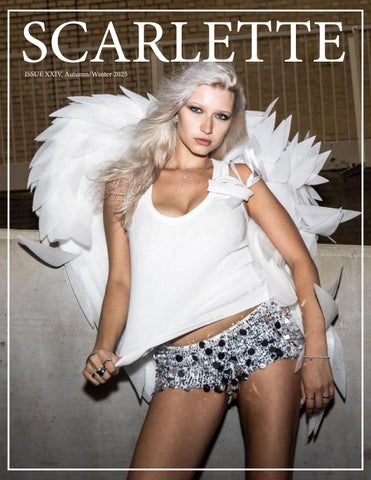
FRONT COVER: Averie Ison [Fallen Angels] Photo Credit: Sandra Fu
BACK COVER: Jolie Austin [Fem & Frame] Photo Credit: Maggie Harkins
Author: Kat Gallaugher
Photographers: Abby Nocera, Allison Ho, Ellis Berry
Layout: Abby Nocera, Gracie Puhalj, Mitch McLaughlin
Photo Credit: Abby Nocera
When first hearing the term “messy chic,” you may fear it's just another fleeting micro-trend, impossible to keep up with and gone in the blink of an eye. In reality, the aesthetic transcends trends: it’s timeless, ageless and trendless. Messy chic is all about embracing imperfection, leaving one thing unfinished to create an effortless nonchalance.
Messy chic is closely associated with the fashion and attitude of French women, with their iconic no-makeup look, unstyled hair and perfectlytailored minimalist wardrobes. Developing your own style and that elusive “je ne sais quoi” that radiates confidence and individuality is more important than consuming fast fashions trends you’ll discard by the next season.
As French icon Coco Chanel once said, “Before you leave the house, look in the mirror and take one thing off.” Don’t rely on overly trendy items. Instead, achieve this effortless approach by wearing highquality, basic pieces and allowing your personality and energy to be the focus.
Photo Credit: Ellis Berry
Photo Credit: Abby Nocera
with the bohemian.
Birkin was a complex and influential woman who created her own path, famously stating in 1969, “I don’t care much about expensive couture clothes.” She rejected the hip-hugging silhouettes popular in the 1960s and cultivated an effortless style that felt authentic. Beyond fashion, she advocated for women’s healthcare, animal activism and human rights, proving that messy chic is about much more than appearance.
Photo Credit: Ellis Berry
Photo Credit: Allison Ho
Photo
Photo Credit: Ellis Berry
Embodying this aesthetic means embracing imperfection. Birkin reflected on aging in an interview with Zoe Ruffner for Vogue, saying, “40 is, I think, a great, great age for a girl, 40 and even 50. It’s a lovely age because girls are as fragile as when they’re 15, and they don’t know what’s coming up.”
This style isn’t just ageless— it improves with time. Growing older and giving yourself permission to evolve enhances your confidence, which naturally translates into a more poised and effortless style.
influencer Camille Charriere, in an interview with Alexa Chung, model and television personality, also highlighted the beauty of imperfection, calling stretch marks “quite chic.”
The effortless quality of messy chic comes from acknowledging traits deemed “imperfections” by society: freckles, wrinkles and stretch marks being just a few examples. Embrace them rather than trying to conceal or fix them. In a society that pressures women to appear perpetually youthful and perfectly composed, messy chic challenges these norms by celebrating natural complexity, self-assuredness and comfort in one’s own skin.
Fashion
Photo Credit: Abby Nocera
Photo Credit: Allison Ho
Photo Credit: Ellis Berry
In today’s world of picture-perfect filters, where photos are edited and bodies reshaped to fit societal expectations, this authentic selfexpression is not only refreshing but necessary. The “clean girl aesthetic,” where everyone has the same body, the same slicked back bun and the same items even down to their ever changing, ever trending water bottle, is not only unrealistic—it’s harmful.
Messy chic, in contrast, values diversity, individuality and selfexpression through clothing. Fashion should be about wearing what makes you feel comfortable and confident. Core staples of the messy chic wardrobe often include perfectly fitted white T-shirts, high-rise wide-leg jeans, cashmere sweaters and classic brown boots.
Achieving this effortless style goes deeper than replicating a list of items, though. Instead of focusing on name brands or replicating looks, try going through your closet and picking out pieces you wear because you really and truly love them.
Photo Credit: Abby Nocera
Messy chic style is a reflection of your complexity and individuality. As fashion stylist Mac Rose of Phika Styling notes in her Youtube video, “Forget Everything You Know About Getting Dressed and Start Here,” “you cannot get dressed to either look smaller or trendier. That is not a sustainable goal.” In an interview with Metrosource, Tim Gunn, American fashion academic and TV personality, said the same thing—achieving an effortless look requires knowing your body and proportions.
True nonchalance is cultivated by observing what you wear repeatedly, understanding how it makes you feel and investing in items that resonate with your personal aesthetic. Buying into cheap trends will never capture your true personal style, and it certainly won’t make you chic.
Shoot Leads: Sabrina Li & Summer Neds | Models: Ava Barrett, Kate Flanagan, Yu Liu, Ziya Patel, Shekinah Tuazon, Sultan Alshaye, Melanie Tran | Stylists: Allison Ho & Amelia Weiker
Author: Reegan Davis
Photographers: Abby Nocera & Sherry Lam assisted by Mariah Kunesh
Layout: Jada Davis, Sherry Lam, Morgan Cartwright
Photo Credit: Abby Nocera
better yet, is there a time and place for both? The line between dressing to a certain degree of professionalism versus dressing to represent your personal identity is thin, and societal trends have made it difficult to determine what the standard for dressing should be. According to Emma Feria, the Editor-In-Chief for The Tartan, Gordon College’s official student newspaper, fashion affects more than how people carry themselves or what they look like—it changes how they’re perceived.
Mariah Kunesh
Photo Credit: Sherry Lam
Photo Credit: Abby Nocera
Dress codes began to set in after the well-known court case Tinker v. Des Moines Independent Community School District, when high school students wore black bands around their arms to protest the Vietnam War. According to the Free Speech Center at Middle Tennessee State University, school systems began shifting towards a dress-coded system in the 1980s and 1990s, embedding school uniforms in public and private schools across the country.
Photo Credit: Sherry Lam
Photo Credit: Abby Nocera
Formally stated dress codes aren’t the only thing holding society to a certain fashion standard—it is universally understood that “business casual” is the norm for events such as interviews, career fairs, meetings or dayto-day jobs. Employers are more likely to hire someone and take someone seriously if they look put together and organized. According to Student Affairs at Texas A&M University, appearance matters and can demonstrate a sense of respect, increasing your chances of success in the workplace.
But what happens when sophisticated attire sacrifices authenticity for formality? There are many benefits to dressing to represent personal style while still being professional, this mixing aiding in self-confidence, opportunities to show peers personal interests and an encouragement of workplace diversity.
Photo Credit: Abby Nocera
Photo Credit: Sherry Lam
Photo Credit: Abby Nocera
According to the Indian Institute of Fashion Technology, fashion is “a powerful form of non-verbal communication, speaking volumes about your personality, values, and mood before you even say a word.”
Being able to dress in clothes that people actually enjoy wearing is not only important— it’s fun. Many iconic characters are known for their unique style, and it is simply a part of what makes that character entertaining to watch on screen. Phoebe Buffay from “Friends” is a great example of this. What one might see as “chaotic,” she sees as something that perfectly represents her personality. Often seen in bright colors, funky hats and patterns, Phoebe’s style beautifully encapsulates her quirky character.
Photo Credit: Abby Nocera
Photo Credit: Sherry Lam
Photo Credit: Abby Nocera
While a chaotic, personal style may differ from a sophisticated business look, this does not make one superior to the other. Both of these styles have different settings in which they are appropriate.
Everyone defines personal style differently. Dressing in more poised, business attire can be somebody’s favorite way to dress. With the recent trending of the “office siren” style, articles of clothing such as mini-skirts, button-up collared shirts and large, chunky glasses frames have been trending.
Photo Credit: Abby Nocera
Photo Credit: Mariah Kunesh
Photo Credit: Sherry Lam
Margot Robbie stunned as Barbie in every outfit they put her in—audiences were introduced to the character in her pink gowns and bows and left the theater with a vision of Barbie in a yellow sundress and Chanel purse. In the final scene of the film, Barbie arrives at an appointment, her hair in a messy bun paired with a brown buttonup coat.
This look is far more sophisticated than anything Robbie wears in the first scenes of the film. Barbie went into her appointment with subtle hints of her personal style with a pink purse and pink Birkenstock sandals, incorporating her authenticity into a more formal look.
Styling yourself to align with a dress code does not have to conflict with dressing authentically. There is no right or wrong style, and unique opportunities throughout everyday life allow people to try different outfits for different scenarios. Find a balance between the two—from a corporate day in the office to casual outings with friends, you can demonstrate chicness while still showing off your beautiful, true self.
Photo Credit: Mariah Kunesh
Shoot Leads: Abby Nocera & Emerson Lepicki | Models: Belle Atkins, Chenai Mutsago, Jane Anabila, Madeline Schmidt, Mia Ross, Morgan Cartwright, Sophie Wu | Stylists: Gracie Puhalj, Jordyn Weisleder | Hair & Makeup: Gracie Puhalj
Photo Credit: Abby Nocera
Author: Sabrina Li
Photographers: Maggie Harkins, Sandra Fu, Shreya Jain assisted by Sneha Mukherjee
Layout: Mariah Kunesh assisted by Madison Hall
Photo Credit: Sneha Mukherjee
There’s a stereotype that says immigrant children are notably more focused in science,
Sandra Fu
Photo Credit: Maggie Harkins
Photo Credit: Sneha Mukherjee
For those who have left their place of origin, there’s a fraying feeling that centers on displacement and homesickness. More often than not, this feeling does not go away.
The bittersweet ache surfaces after celebrating a holiday abroad with a small, makeshift version of a tradition that, back home, would include an entire family. How can you get through terrible days knowing that your support system is miles away? It gets especially complicated when the very people who came abroad to find new experiences and education realize that their new residence, the United States, is engaged in conflicts with their home country. Is this a betrayal? At the end of the day, how do you know where home truly is?
We see this idea of home everywhere: in movies, stories and art. It’s brought together with entangling scents, sounds and memories; the specific aroma of a childhood kitchen, the familiar cadence of a local dialect and the unspoken comfort and ease of belonging in a community.
Photo Credit: Maggie Harkins
Photo Credit: Sandra Fu
Photo Credit: Sneha Mukherjee
Held close to many children of immigrants is a duality that bridges past generations with our current society. The weight of their dreams and sacrifices lie heavy on the shoulders of their children, and success slowly turns into a justification for praise. Risks of being too “white washed,” or too distant from the roots that our parents hold close never really go away. Even in the country we’re born and raised in, it is incredibly easy to feel perpetually “other.” We’re marked as outsiders, even to our parents.
Yet within this sense of dissonance lies a strength. Liminal space is not void, but a place for building resilience and cultivating empathy. Seeing multitudes of perspectives from our parents, friends and even ourselves develops an appreciation for our heritage, no matter where we are physically.
Photo Credit: Sandra Fu
Photo Credit: Shreya Jain
Photo Credit: Sneha Mukherjee
Photo Credit: Maggie Harkins
Photo Credit: Shreya Jain
Photo Credit: Sandra Fu
Photo Credit: Maggie Harkins
This longing for a physical return may never fully disappear, but there is a wonderful hope laying in the depths of such complexity. What was once a source of pain is now a fertile soil in which growing identities and blooming communities can grow.
Our journey is not to erase the longing for one home, but to expand on the definition of home, itself. Build a new sense of belonging through cherished fragments of the past and the wonderful possibilities of the present. Home can eventually become the courage you need to carry your roots with you, wherever you are planted.
Shoot Leads: Maggie Harkins, Vani Modi, Cherod Bowens | Models: Avani Dhyani, Maylatt Eyassu, Neha Bhatnagar, Pragalya Arumugam, Siya Patil, Vani Modi | Stylist: Sneha Mukherjee
Photo Credit: Sneha Mukherjee
fem
Author: Siya Patil
Photographers: Cora Hernandez & Maggie Harkins
Layout: Ruby McGrievy, Daniel Kuhn, Jupiter Justice
Fashion has always been a language of expression; a way to tell stories that words alone cannot capture. In Fem and Frame, we explore one of these enduring dualities: the coexistence of femininity and masculinity. Too often, these energies are framed as opposites —softness against strength, fluidity against structure and tenderness against toughness. But what happens when we stop treating them as binaries and instead view them as complements; two halves of a whole?
This shoot reimagines those forces not in conflict, but in conversation. A blouse drapes against sharply tailored trousers; a blazer frames the ease of a flowing lace; a corset and a collared shirt share the same space without competing. Accessories extend this interplay—pearls beside chunky watches and a briefcase balanced by a delicate scarf. These contrasts signal not confusion but complexity. Even footwear becomes part of the dialogue—combat boots grounding the lightness of a chiffon skirt or pointed heels sharpening the line of wide-legged pants. Each look resists the idea that strength belongs only to masculinity or softness only to femininity. Instead, it insists both can live within one.
Photo Credit: Maggie Harkins
Yet in today’s political climate, such blending feels especially charged. Across headlines and debates— from schools reprimanding boys in nail polish to viral backlash against girls wearing suits at prom— identity is narrowed into categories, and expressions of gender are policed with an intensity that reveals how unsettled society still is by fluidity.
To wear clothing that mixes these energies is to quietly resist the idea that people must fit neatly into boxes. Society has long dictated how femininity and masculinity should look, behave and be expressed. The very idea of a “frame” carries tension—does it define us, or does it confine us?
Historically, fashion has been a site where these questions are negotiated. The defiance of women donning trousers in the early twentieth century, and David Bowie and Prince blurring gender lines through performance and dress made waves. Each era has witnessed moments where clothing challenged not only aesthetic conventions but also the social rules about who could embody certain traits. Fem and Frame extends that legacy into the present, where androgyny, fluidity and hybridity feel less like a provocation and more like a call for something real.
Photo Credit: Maggie Harkins
Photo Credit: Cora Hernandez
What makes this vision especially resonant today is how presentation— how we dress, carry ourselves and choose to be seen—has become so heavily politicized. Across debates on gender and identity, clothing is treated as evidence, as though an outfit can testify for or against someone’s right to belong.
Laws, school dress codes and cultural battles often revolve around controlling who gets to wear what—as well as what those choices are allowed to mean. A young boy in nail polish, a girl in a suit or a nonbinary student in a skirt all become flashpoints for larger anxieties about the erosion of norms, the blurring of gender roles and the visibility of queerness. In that sense, every outfit is read as a statement,
Photo Credit: Maggie Harkins
Photo Credit: Cora Hernandez
Photo Credit: Maggie Harkins
Photo Credit: Cora Hernandez
Fem and Frame disrupts this fixation by refusing to play along. It shows that duality is natural, that fluidity is not confusion but truth and that identity cannot be legislated into rigid categories. Arguments about dress codes, gendered expectations and standards of “appropriateness” highlight how fragile traditional norms are when confronted with fluid expression.
By pairing lace with leather or silk with structured suiting, Fem and Frame asserts that style can be a form of political resistance—a refusal to let identity be dictated by arbitrary rules or rigid expectations. Fashion becomes evidence not of conformity, but of agency, reclaiming the right to be seen exactly as one chooses.
For many others, dressing across gendered lines is not simply about trend but about authenticity. Clothing becomes a mirror, affirming that wholeness does not require conformity. In this sense, Fem and Frame is not only about fashion photography, but also about the lived experiences of those who choose to wear their truth.
In a world where the freedom to express gender expansively is contested, Fem and Frame suggests another truth: that multiplicity is not weakness, but wholeness. The blending of edge with grace—strength with softness—creates a vision of identity that is resilient precisely because it refuses to be reduced. When we allow ourselves to dress in ways that feel authentic, even if they confuse or disrupt the “rules,” we reclaim control over our own narrative.
Photo Credit: Maggie Harkins
frame, the masculine and the feminine coexist, not in opposition but in balance. That balance is what gives the images their power. It is also what gives us permission to imagine beyond the constraints we inherit, toward a vision of identity that is free, dynamic and fully our own. In blending suits with silks, boots with pearls and toughness with tenderness, fashion offers not only style but also a model for a more expansive understanding of self.
Ultimately, this shoot leaves us with a reminder: fashion is not trivial, nor is it merely decorative. It is a language, and like all languages, it can be used to uphold norms or to break them apart. Fem and Frame chooses the latter. It insists on dialogue rather than division; possibility rather than prescription. And in doing so, it asks each of us to consider: what might it look like if our frames were not cages, but canvases?
Photo Credit: Cora Hernandez
Shoot Leads: Jasmine Freeman & Maggie Gu | Models: Cherod Bowens, Daniel Kuhn, Heartly Phipps, Icarus Deshazer, Jolie Austin, Lexi Korff, Lizzie Garver, Mia Schwind, Sammy Chavez | Stylist: Heartly Phipps | Hair & Makeup: Jasmine Freeman & Sammy Chavez
Photo Credit: Maggie Harkins
Author: Icarus Deshazer
Layout: Addison Kennedy
“Don’t be a drag, Just be a queen,” Lady Gaga says in her hit song, “Born This Way”—and in the past decade, more and more people have done exactly that: grown into their queendom. Throughout the turn of the 21st century, the world of drag has experienced a meteoric rise across the globe, from the Philippines to Paraguay. Here in Columbus, Ohio, the drag scene has found another place to call home.
Photo Credit: Sumner
Queens big and small flock to this global hotspot, and it has become a staple stop for traveling drag shows such as RuPaul’s Drag Race: Werq the World Tour. Taking a closer look at this local scene is an important part of understanding one surprisingly prevalent part of what makes up the so-called “Buckeye life.”
To preface this deep dive, it is important to briefly look at the history of drag and how it has evolved over the years. Drag is one of the most overt forms of gender expression and nonconformity, and for many members of the LGBTQIA+ community it serves as a fundamental pillar and representation of their identities.
According to BBC’s “The Fabulous History of Drag,” the fundamental act of gender impersonation can trace its origins as far back as ancient Greek performers, back when women were not allowed to be actors, resulting in men taking on all of the woman roles in performances. Drag as we know it, however, emerged in its more contemporary form in mid-1900’s New York.
The drag scene at the time was seeing sudden growth in the wake of the Stonewall riots, and participants were often scrutinized, discriminated against and even criminalized. The term “drag queen” was used to describe those who participated in underground drag balls or pageants, with “drag” meaning wearing clothes of the other sex and “queen” meaning gay man.
Nowadays, the world of drag has evolved into much more. It transcends gender, as any member of any gender or sexuality can participate and portray themselves as they desire. And while drag queens often present themselves in incredibly overt, feminine ways, there are also drag kings who conversely present themselves in overtly masculine ways.
It is also important to keep in mind that although plenty of drag queens prefer to use female pronouns, there are still many who would like to be referred to in other ways and others still who don’t care at all. As renowned drag queen RuPaul Charles once said in his autobiography, “Lettin’ It All Hang Out,” “You can call me he. You can call me she. You can call me Regis and Kathie Lee; I don’t care! Just so long as you call me.” Part of the beauty of drag is that it allows you to be seen in the way you want to be seen.
Located right across the street from Union Cafe, one of the first gay bars in Columbus well known for their Sunday drag brunches, this premier entertainment hotspot is well known for its dance parties, cabarets, and themed events.
Axis has birthed well known drag queens such as Nina West, host of Axis’s annual “Heels of Horror” show, 2008 winner of the Entertainer of the Year award and recurring member on “RuPaul’s Drag Race.” Together, such as their weekly drag shows on Wednesday nights and their drag brunches on Sunday mornings, both of which feature amazing local drag queens from all across the region.
Drag is obviously so much more than the big names on the big screen. Here in Columbus, Ohio, drag has found many places to comfortably settle in. In any corner of the city you can find drag shows and pageants, local queens and all sorts of different events to partake in.
One would be remiss not to start with Axis, heralded as the largest dance club
Photo Credit: Sumner Howells (@scumner.world on Instagram)
Working in tandem with Union Cafe, they run the Union Station Cafe, a charitable organization that opened up in 2001 to support the LGBTQIA+ community. Union Station Cafe donates to people in need as well as advocacy initiatives, simultaneously coordinating with providers of critical services as a way to give back to the community that has supported them.
Another essential spot is District West, located downtown on North 5th Street. For the past decade they have held an annual Miss Gay Ohio, a drag pageant that invites queens from all around central Ohio to compete and show off their skills. A high-energy showcase of beauty and talent, they also donate their proceeds to local nonprofits as a way of giving back to their community.
At shows such as this, you may find yourself watching local Queen Edna Envy Mwah. She was able to offer her personal experience in the wonderful world of Columbus drag. Having entered the scene at the age of 17, she said that it was a very supportive and empowering community.
“It was easy for me to find and make friends. I went out almost every night, making connections and performing as much as possible,” she said in an interview. “I like to think of getting in drag as putting on my superhero suit. Through drag, I get to become all the female characters I always wanted to be as a little gay boy.”
Photo Credit: Sumner Howells (@scumner.world on Instagram)
She gained priceless connections in her Columbus drag family, consisting of other local queens such as Virginia West, Maya Bizness, Clinica Deprecious, Maja Jera, Seranade Tits and Glitter Tits. In her time here and with this newfound family, she was better able to truly come into her own.
The persistent presence of drag has had profound effects on style, fashion and what it means to express your true self. Mwah said that “Edna” is an important part of being able to love and express her true self, with stylistic inspiration from people from Zelda to Violet Chachki.
In short, drag empowers. Nina West’s works served as an inspiration for Sia’s 2016 Coachella outfit, and the Ohio State University even recently hosted Rupaul’s “Werq the World” tour at the Wexner Mershon Auditorium right here in the heart of Ohio’s capital. Drag’s presence in Columbus has built an incredible sense of community on many levels and has served as a bastion of LGBTQIA+ visibility and advocacy since its inception. Its continued and growing local relevance has been nothing short of a boon for the people of this city.
The next time you are pondering how you want to spend your weekend, check out what sort of drag events are in your area and perhaps even take some time to get to know the queens themselves. It is something certain to leave you better than when you started.
Photo Credit: Averie Ison
Beauty standards. Created from cultural expectations and history, they vary greatly around the globe. And yet, they remain an unconscious and guiding force throughout the world. No matter where or why the specific standard exists, the pressure to fit a specific mold impacts the psyche of all who encounter them.
When was the first time you encountered beauty standards? When were you able to describe the pressure of fitting into Western beauty ideals? For many, the demand came long before they could even put the experience into words.
We still felt it: in a comment, a picture or an article written in a magazine. We found something to be self-conscious about. It was the sudden viewing of
ourselves through an external gaze; how we were perceived. It is this that becomes the death of innocence and the loss of the wonder of youth— when anything seems possible and freedom is nigh. Instead, we must “fit in”—and fix ourselves to do so.
Photo Credit: Sandra Fu
These standards slip into everything—sometimes obvious, sometimes invisible. Diets trend on TikTok and outfits are policed in comment sections—even questions like ‘college grads, what are we wearing this summer?’ reinforce the idea that different identities must follow a certain look. Conformity is key, or at least that’s what people think. It has long been proven that social media negatively impacts mental health. Thousands of flawless and unattainable faces, bodies and lives bombard us on the daily,seriously harming the psyche of young people.
Girls and women are especially vulnerable to the pressures of conformity. Even the smallest “flaws” can worm their way into our brains and become all we think about. And it doesn’t have to be based on looks, either. An interest or passion can suddenly be deemed “cringe” and altogether dismissed. Even activities like reading or writing now can be labeled“performative.”
Adolescents and teenagers are especially vulnerable to this pushed idea of conformity. With photographs and videos
everywhere, every movement is memorialized online and subjected to scrutiny.
According to a study from the National Library of Medicine, this period of development marks the moment that people start looking to their peers rather than their parents for validation and assurance. As the study states, “such interactions intertwine self-evaluation with digital perceptions of beauty and success, profoundly impacting psychological well-being”.
Photo Credit: Sandra Fu
Already an issue, the rise of social media platforms such as Instagram and TikTok are exacerbating the mental health crisis. The most recent studies show that 95% of children ages 13–17 report using a social media platform and nearly 40% of children ages 8–12 use social media.
Although TikTok requires users to be at least 13 years of age, The Post says that about 25 million TikTok accounts belong to children 11 or younger. This number does not take into account children consuming content through their parents’ or older friends’ accounts.
Photo Credit: Farrah Mobydeen
As an increasingly large swath of the adolescent age group utilizes social media, it is no longer a surprise to see children promoting anti-aging creams like Retinol or begging their parents for Drunk Elephant products. The anti-aging market has always been massive, but never have children—especially so early in life—been so trapped in its clutches.
Social media has forced younger generations to grow up too fast. The preteen—or tween—market has all but disappeared over the last few years. Stores that Gen Z would consider classics, like Justice or Claire’s, have closed their doors, both businesses declaring bankruptcy within the past few years.
As Lawrence Berger, one of the owners of Claire’s, said, “Claire’s is one of those rare brands that defines a stage of life - old enough to buy your first lip gloss, but still young enough to believe it could change your world.” Today, there is no more transition period; growing up is immediate and inevitable.
Photo Credit: Farrah Mobydeen
Photo Credit: Sandra Fu
As we age, we tend to hide our interests and passions in an effort to fit in; to do what is “popular.” This shift is especially true in high school, in which an insular community pushes students to mold themselves to the mean.
In this type of setting, it is more difficult to find people who are similar to you and to build a community. And, of course, middle and high schoolers can be cruel—nearly 20% of high schoolers report bullying, according to the National Bullying Prevention Center.
But there is a light at the end of the tunnel. The pressure to conform will never go away, nor will the clear existence of beauty standards, but as we get older we open ourselves back up to vulnerability.
Photo Credit: Sandra Fu
Photo Credit: Averie Ison
Photo Credit: Sandra Fu
Photo Credit: Farrah Mobydeen
Our worldviews grow as we look back to childhood and remember the joy received from things now lost. We wear an “emo band” T-shirtor proudly announce the shows we watch and the books we read. There is a push back against conformity and an effort to spread selflove for and acceptance of what makes us different.
We can reclaim what has been lost. We can take back what we pretended to hate, thinking it wasn’t cool enough. The wonder and joy found in doing and being what we love will never be completely lost. Confidence and self-love shine through, even in a dingy world that longs to stifle it.
Shoot leads: Averie Ison & Mia Schwind | Models: Abby Nocera, Allison Ho, Audrey Zhang, Averie Ison, Charlotte Conn, Emma Erlenbusch, Jose Aviles, Maddy Bellisari | Stylist: Jonas Rogers | Hair & Makeup: Charlotte Conn
Photo Credit: Averie Ison
Author: Prithi Srinivasan
Photographers: Maylatt Eyassu, Sierra Hudson, Yu Liu
Layout: Emerson Lepicki, Ella Maher, Hala Alyounes
Popularized in Italy, so-called “mask culture” dates way back to before the 12th century. Venice—once the capital of the Venetian Republic— is known by many names, the most interesting being “The Masked City.” According to a video essay from medieval YouTuber “Metatron,” the city was a huge international financial center and is the birthplace of the Venetian Carnival.
Masquerading became incredibly popular in 12th century Italy, with enthusiasm regarding the annual Venetian Carnival booming in the Medieval Era. During this carnival season, people dressed up in traditional clothing and wore masks out and about. These masked gatherings were intended to be a celebratory space, free from the shackles of societal expectations—an inclusive festival which allowed people from different backgrounds to mingle, unbothered by economic disparities.
This culture quickly spiraled, and according to an article from the London Museum, people in Venice wore masks daily to conceal their identity while engaging in prohibited or shunned activities. The mask allowed for people to engage in taboo activities like gambling, and women could wear what they wanted without the fear of being publicly shamed.
Because of this masked culture, citizens felt comfortable speaking their minds in public and didn’t fear any repercussions. Everyone had a voice, and everyone was able to hide behind the mask of
Photo Credit: Yu Liu
anonymity to express the socially not-so-acceptable parts of themselves.
Masquerade balls in fictional stories traditionally depict sultry settings, where the royal falls for the pauper. And believe it or not, this idea does have a grounding in reality—such balls did allow for the poorer sectors of society to escape poverty for a short while, feeling as though they were equals to their high society counterparts.
Masquerade balls as we know them were popularized in 18th century London according to the London Museum, drawing on the appeal of luxurious mystery to engage an exclusive crowd.
While public masquerades were still a buzzing phenomenon, the elitist side of masquerades was heavily embraced by aristocrats and royalty, using masquerade balls as more than just parties. These were lavish displays of luxury, wealth and art. They allowed for spaces where royalty could shed their public image and high society standards, engaging insensual behavior, scandalous-ness and gossip.
Photo Credit: Mylatt Eyassu
Photo Credit: Sierra Hudson
Masks were once a symbol of festivities and celebrations—of freedom of speech and being oneself. Now, though, they have now evolved to hold many different meanings. For example, we use masks to hide who we truly are; quite counterintuitive given that masks were once used to promote selfindulgence and expression.
Using physical and metaphorical masks in modern day helps to hide the parts of us that we feel disgust for, be them facial features hidden with makeup and surgeries or parts of our body that have been deemed “unattractive” by society. There are parts of our personality that others may find hard to digest, and thus we find them so as well, banishing them and neatly tucking them away in the face of expectations that we hold ourselves to.
Photo Credit: Maylatt Eysassu
Photo Credit: Sierra Hudson
Photo Credit: Maylatt Eyassu
Photo Credit: Sierra Hudson
Photo Credit: Yu Liu
Photo Credit: Maylatt Eyassu Photo Credit: Sierra Hudson
Photo Credit: Sierra Hudson
Photo Credit: Maylatt Eyassu
Technology has not helped with this phenomenon. The rise of social media has provided a platform for individuals of all age groups from all over the world to partake informally in a variety of cultures and subcultures, carefully curating their own digital personas so as to be perceived in a way that they desire.
People pose to be rich online to feel better about their lives and escape their “lesser” reality. The internet has always been a place of escapism—a metaphorical mask—which allows one to perform their identity.
And in a version of the world that is fighting to be more accepting, why do we struggle so much with authenticity? Why are we constantly trying to socially one-up each other when instead we could be supporting one another? Why do we all want a village but never want to be a villager?
Today, almost everyone wears a mask whether they realize it or not. Be it big or small, colorful or black, sheer or opaque, our performances only put us in boxes.
It’s a dangerous dance—we vie for external validation, still falling victim to the insecurities that we tried to
mask in the first place. Instead of being freed from social norms, we end up feeding into them.
Just as masquerade masks are tediously crafted from different materials and are often intricately and intentionally made, so are we. What starts as natural exploration can quickly fall victim to performance art, masking from the world in a way that simultaneously protects and damages ourselves.
When something is worn so often and so well, it’s easy to forget that it’s even there. Take a look in the mirror; can you still take your costume off, or is it a part of you?
Photo Credit: Maylatt Eyassu
Photo Credit: Yu Liu
Photo
Shoot lead: Summer Neds | Models: Aliyse Stokes, Hala Alyounes, Kallyn Buckenmyer, Kelsie Goane, Mia Robinson, Michelle Cai, Summer Neds, Yaashita Bobba | Stylist: Emerson Lepicki | Hair & Makeup: Hala Alyounes
Author: Olivia Schweinhagen
Photographers: Cora Hernandez & Marin Zbawiony assisted by Hala Alyoune
Layout: Eleanor Winemiller, Kathryn McFarland, Preethi Vaithianathan
Photo Credit: Marin Zbawiony
Roll your white gloves up to your elbows, fixing each finger so it fits just right. Smooth the pink satin of your dress and feel the rough ridges of a too-tight corset through the fabric. Listen to how champagne heels click against the marble of castle floors, echoing through great halls. Is this really the look of a hero?
Through the years, tales of heroes and villains have floated through families, parents regaling their children with stories of good versus evil; happiness versus fear; light versus darkness. And it always looks the same—some evil witch in a black cloak shows up to destroy the kingdom, and the princess, with or without the help of a prince, stands strong in the face of danger, bringing brightness back once and for all.
But why is it that vampires can’t stand the sun? All Gothic folklore aside, there is a reason that the light defeats darkness time after time. Without this trope, Gandalf could have never crawled out of hell as “Gandalf the White,” “the Dark Side” in George Lucas’s “Star Wars” might just be called “the side” and brides would never wear white to weddings, only to be widowed in black.
Equating light colors with “good” and dark ones with “bad” is nothing new. According to Monuments of Victoria, the color black has always been associated with power, darkness and most importantly, grief.
Wearing black to funerals has been a prevalent practice since the Romans reigned supreme, gaining significant traction in the 19th century with Victorian-era women. In this period, widows were expected to wear black for four full years after the death of their husbands, only being able to incorporate colors like purple and gray in their later “half-mourning” stage.
The same intensity was true of the color white. According to Michael Pastoureau’s “White: The History of a Color,” the color is typically representative of purity, wisdom, peace, beauty and cleanliness. And in typical Western literature, these are extremely positive ideals. Even a bride wearing white to a wedding reflects the idea of new beginnings, whereas the black garb traditionally surrounding funerals are indicative of harsh permanence; of something ending.
Given the severity of this color culture, it’s no wonder that motifs based in color have persisted in modern media and folklore. It doesn’t stop here, though. Heroes might wear white, with villains opting for a darker color scheme, but people in the real world choose daily how to best represent themselves through fashion.
Personal style is directly tied to identity and individuality; it makes perfect sense that spring, a season full of fresh growth and returned warmth, would inspire light, bright and colorful clothing trends. The same goes
for winter and fall—as the sun sets earlier, we tend to return to muted tones and protective hues of black, red, brown and gray, wrapping ourselves in the same shades that fall from the trees.
According to The Good Trade, this seasonal color coding isn’t a recent development. In fact, fabrics in the English Tudor period were popularized based on availability and cost. The article said that it was forbidden for anyone under the rank of “knight of the garter” to wear the color crimson, due to price and production.
Photo Credit: Hala Alyounes
Photo Credit: Marin Zbawiony
Photo Credit: Cora Hernandez
Culture also plays an extremely important role in these delineations: “In India, red is the most traditional color for brides because it represents prosperity and purity…In many Western countries black is worn for mourning, though in some east Asian cultures, white is preferred for funerals, as it’s a nod to the natural cycle of life.”
Colors have always meant something; choosing to wear them on your body means more. And in this modern period of political turmoil and daily news overloads, how you decide to present yourself can be more than a fun fashion choice—it can be a form of resistance.
Yes, the princesses and knights in the stories wear bright clothing, gleaming in the sunlight. Sometimes, though, our villains aren’t so easily recognizable. In today’s world, not every bad guy hides behind a corner in a dark robe with a poison apple. They can be all around us; on television shows, a rogue Instagram post or even in the White House.
Photo Credit: Cora Hernandez
Things aren’t black and white anymore, despite what the fairytales might tell you. The magic of such stories, however, must live on. When all hope seems lost, hearken back to the tales of old. Only, this time, ditch the white gloves and satin dress for one of your favorite pieces— a leather jacket or the brightest pair of pants in the thrift store; anything that makes you feel like yourself—to fight hard for what you believe in.
Photo Credit: Marin Zbawiony
ISSUE XXIV, Autumn/Winter 2025