A GUIDE TO
FERTILITY
when are women & men most fertile?
terminology
suggests that lifestyle factors (e.g. drinking, smoking, being over weight) can affect the timing of ovulation and the production of sperm.
There is only a specific time in each menstrual cycle when it’s possible to get pregnant. This ‘fertile window’ is generally close to the time of ovulation in the middle of a woman’s menstrual cycle if she ovulates. Because most women do not know on which day of the month they ovulate, contraception is recommended to avoid pregnancy. Men do not have a ‘fertile window’ because sperm is continually formed and stored in the testicles. Research
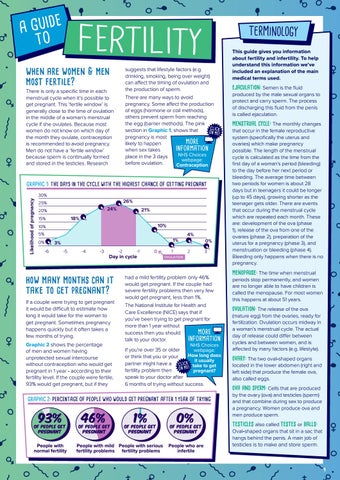
There are many ways to avoid pregnancy. Some affect the production of eggs (hormone or coil methods), others prevent sperm from reaching the egg (barrier methods). The pink CLICK section in Graphic 1, shows that ON ME! pregnancy is most MORE likely to happen INFORMATION when sex takes NHS Choices place in the 3 days webpage: before ovulation. Contraception
GRAPHIC 1: THE DAYS IN THE CYCLE WITH THE HIGHEST CHANCE OF GETTING PREGNANT Likelihood of pregnancy
30%
26%
25%
24%
20%
21%
18%
15%
10%
10% 5% 0%
1%
3% -6
-5
-4
-3
-2
-1
Day in cycle
how many months can it take to get pregnant? If a couple were trying to get pregnant it would be difficult to estimate how long it would take for the woman to get pregnant. Sometimes pregnancy happens quickly but it often takes a few months of trying. Graphic 2 shows the percentage of men and women having unprotected sexual intercourse without contraception who would get pregnant in 1 year - according to their fertility level. If the couple were fertile, 93% would get pregnant, but if they
0
1
4% 2
0% 3
OVULATION
had a mild fertility problem only 46% would get pregnant. If the couple had severe fertility problems then very few would get pregnant, less than 1%. The National Institute for Health and Care Excellence (NICE) says that if you’ve been trying to get pregnant for more than 1 year without MORE success then you should INFORMATION talk to your doctor. NHS Choices
If you’re over 35 or older webpage: How long does or think that you or your it usually partner might have a CLICK take to get ! E M fertility problem then ON pregnant? speak to your doctor after 6 months of trying without success.
GRAPHIC 2: PERCENTAGE OF PEOPLE WHO WOULD GET PREGNANT AFTER 1 YEAR OF TRYING
93%
of people get pregnant
People with normal fertility
46%
of people get pregnant
1%
of people get pregnant
People with mild People with serious fertility problems fertility problems
0%
of people get pregnant
People who are infertile
This guide gives you information about fertility and infertility. To help understand this information we’ve included an explanation of the main medical terms used.
ejaculation: Semen is the fluid
produced by the male sexual organs to protect and carry sperm. The process of discharging this fluid from the penis is called ejaculation.
menstrual cycle: The monthly changes that occur in the female reproductive system (specifically the uterus and ovaries) which make pregnancy possible. The length of the menstrual cycle is calculated as the time from the first day of a woman’s period (bleeding) to the day before her next period or bleeding. The average time between two periods for women is about 28 days but in teenagers it could be longer (up to 45 days), growing shorter as the teenager gets older. There are events that occur during the menstrual cycle which are repeated each month. These are: development of the ova (phase 1), release of the ova from one of the ovaries (phase 2), preparation of the uterus for a pregnancy (phase 3), and menstruation or bleeding (phase 4). Bleeding only happens when there is no pregnancy. menopause: The time when menstrual periods stop permanently, and women are no longer able to have children is called the menopause. For most women this happens at about 51 years. ovulation: The release of the ova
(mature egg) from the ovaries, ready for fertilization. Ovulation occurs midway in a woman’s menstrual cycle. The actual day of release could differ between cycles and between women, and is affected by many factors (e.g. lifestyle).
ovary: The two oval-shaped organs located in the lower abdomen (right and left side) that produce the female ova, also called eggs. ova and sperm: Cells that are produced
by the ovary (ova) and testicles (sperm) and that combine during sex to produce a pregnancy. Women produce ova and men produce sperm.
testicles also called testes or balls:
Oval-shaped organs that sit in a sac that hangs behind the penis. A main job of
testicles is to make and store sperm.
1
when should you start trying to get pregnant? Because the fertility of women declines, many women want to know at what age they should try to get pregnant to have a good chance of having the family they want. Researchers have created a chart that may help women make that decision. To use the chart you need to know: 1. The size of family you would like (e.g. 1, 2, or 3 children) 2. Whether you would be willing to use fertility treatments (e.g. IVF) if you or your partner could not become pregnant naturally 3. Your desired certainty that you will achieve the family size you want (e.g. 50%, 75%, or 90% sure). Graphic 4 shows when a woman would need to start trying to get pregnant to have the number of children she wanted. For example, the pink numbers show that if a woman wanted to be 90% certain that she would have at least 3 children without ever using fertility treatment, then she would need to
1.0 0.8 0.6 0.4 0.2 0 20
25
30
35 40 Age shown in years
lifestyle (e.g. smoking) factors. A good indicator of how a woman’s fertility will decline is the age her mother reached menopause. Men are not born with their sperm and they produce sperm daily. Men’s fertility also starts to decline around age 40. The decrease in fertility is caused by the decrease in the number and quality of the sperm they produce. Men can have fertility problems even if they can still have sex and have an ejaculation.
45
50
If you are concerned about your age and your fertility, you may consider having your fertility tested. Fertility tests for men and women are available at pharmacies, online and at MORE fertility clinics. INFORMATION You can discuss NHS Choices your fertility with webpage: your doctor. Protect K CLI C E! ON M
your fertility
GRAPHIC 4: MAXIMUM FEMALE AGE AT WHICH COUPLES SHOULD START TRYING TO GET PREGNANT FOR 1, 2, OR 3 CHILDREN AND FOR A 50%, 75% AND 90% CHANCE OF REACHING THE DESIRED FAMILY SIZE WITH AND WITHOUT USING FERTILITY TREATMENT4
WITHOUT IVF
Graphic 3 shows that on average there is a slight decline in women’s fertility around age 27, and then a significant decline at around age 35. Women’s fertility will continue to decrease every year, whether or not she is healthy and fit because the number or quality of the eggs decreases with age. How quick a woman’s fertility declines will depend on a combination of genetic and
Men
Women
WITH IVF
Women are born with a fixed number of eggs in their ovaries. At birth, most women have about 2 million eggs, at adolescence that number has gone down to about 300,000, at age 37 there remains about 25,000. By age 51 when women have their menopause only about 1000 eggs remain. The quality of the eggs also gets poorer as women get older. All other things being equal the number and quality of the woman’s eggs determines her fertility.
GRAPHIC 3: MONTHLY FERTILITY RATE SHOWN BY THE AGE OF WOMAN3
Relative Fertility Rate
at what age does fertility begin to decrease?
CHANCE OF MEETING FAMILY SIZE GOAL
1 CHILD
2 CHILDREN
3 CHILDREN
50%
41 yr
38 yr
35 yr
75%
37 yr
34 yr
31 yr
90%
32 yr
27 yr
23 yr
50%
42 yr
39 yr
36 yr
75%
39 yr
35 yr
33 yr
90%
35 yr
31 yr
28 yr
start trying for a family at 23. But, she could start aged 36, if she was willing to use fertility treatment and have a lower certainty (50%) of having 3 children (see blue numbers). Women can use this chart with their partner to decide when to start trying to get pregnant.
MORE INFORMATION
CLICK ON ME!
NHS Choices webpage: Planning your pregnancy
2
what is infertility? Infertility is a disease of the reproductive system defined by the failure to achieve a pregnancy after 12 months or more of regular unprotected sex (without contraception) between a man and a woman. Around 9 to 15% of couples will have fertility problems. Infertility can affect men and women. Infertility in women can be due to ovulation problems (number or quality of eggs, regularity of the menstrual cycle) or problems with the fallopian tubes (e.g. blockage) or uterus (e.g.
What are the signs and symptoms of infertility? The most obvious sign of infertility is when the woman does not get pregnant, despite having regular unprotected sex for 12 months or more. Changes in a woman’s period can also be a sign of infertility and severe period pains can be a result of infertility. The inability of a woman to get pregnant could be due to the male partner having a fertility problem. There are usually no signs of male infertility. A man usually has to have medical tests to find out if he has a fertility problem, because his ability to have sex and ejaculate can be normal even if he has fertility problems. Men who have an undescended testicle or who have had mumps during puberty
GRAPHIC 6. FERTISTAT SELF ASSESSMENT TOOL6
CLICK ON ME!
Sometimes both partners miscarriage). Women can can have fertility problems have fertility problems even MORE or sometimes the cause may if they still have a period. INFORMATION be unknown. In general 20% Infertility in men is most often NHS Choices of fertility problems are due due to poor sperm quality webpage: Infertility to the woman, 20% due to the or quantity (number). Sperm man, and 20% to both or to movement can also cause unknown causes. fertility problems because the sperm is less likely to reach the egg. If you are concerned about your fertility, you may be interested in the Fertility problems in men can also NHS’s Fertility Self Assessment tool, be due to childhood illnesses such as which will provide more information the mumps when mumps occur during about infertility and could help you to puberty. Men can have problems decide if and when to seek medical ejaculating, which makes it difficult advice about fertility. to have sex and to father a child naturally. could be at risk of fertility problems. If you have been having any of the signs or symptoms mentioned in Graphic 5 and are concerned about your fertility, the National Institute for Health and Care Excellence (NICE) says that you should talk to your doctor about having an assessment of your fertility. You may also be interested in the NHS ‘Fertility Self Assessment tool’, which could help you to decide if and when to seek help from your doctor.
MORE INFORMATION
CLICK ON ME!
Learn more about causes of infertility and diagnosis on the NHS Choices’ webpage: Infertility
what are the main preventable causes of infertility? There are activities that can reduce fertility. The top 3 activities that can affect your fertility are: 1. Being overweight with a body mass index over 25 (You can find out your body mass index on the NHS Healthy Choices website: www.nhs.uk/tools/pages/ healthyweightcalculator.aspx). 2. Smoking more than 10 cigarettes a day. 3. Drinking too much alcohol - more than 6 glasses of wine, 6 pints of beer, 5 pints of cider, or 14 glasses of spirits a week.
GRAPHIC 5: SIGNS THAT COULD SUGGEST AN INFERTILITY PROBLEM5 The following can suggest that a woman has a fertility problem:
>
BNORMAL PERIODS (BLEEDING A DIFFERENT THAN NORMAL)
PERIODS (DAYS IN CYCLE > IRREGULAR DIFFERENT EVERY MONTH)
CYCLE LESS THAN 21 DAYS > PERIOD CYCLE MORE THAN 35 DAYS > PERIOD
>
NO PERIODS
>
SEVERE PERIOD PAIN
Changing to a healthier lifestyle (e.g. stopping or reducing smoking, drinking or losing weight) can improve your chances of getting pregnant and of having a healthier pregnancy and baby. There are many websites and apps to help you live a healthier life. To identify your level of risk for fertility problems see the NHS ‘Fertility Self Assessment tool’ or the FertiSTAT ‘Self Assessment tool’ at www.FertiSTAT.com (Graphic 6)
MORE INFORMATION
NHS Choices webpage: Live well
CLICK ! O N ME
3
what reproductive technologies are available to influence fertility?
A reproductive technology is a technique used to influence human reproduction. There are many technologies that can be used, based on what is the reproductive goal.
Some of the most common techniques along with a brief description, common reasons for use, and success rates are shown in Graphic 7.
GRAPHIC 7: REPRODUCTIVE TECHNOLOGY OPTIONS
TECHNIQUE
DEFINITION
PURPOSE
SUCCESS RATE
CONTRACEPTION
• Barrier and non-barrier methods of preventing pregnancy
• Prevent pregnancy
• Highly effective, when used correctly
EGG FREEZING
• First part of IVF cycle (injections of hormones) to stimulate eggs which are removed from ovaries and frozen for later use. Risk of Ovarian Hyperstimulation Syndrome
• Postpone having children • Increase chances of pregnancy at an older age
• New technology so not a lot of data. Varies based on age of women when freezing eggs. If freezing under age 35 better chance of future pregnancy
• Using the eggs, sperm or embryo donated by another person or couple to have a child
• Not able/desiring to conceive by heterosexual sex
• Varies. Good outcomes for people who don’t have fertility problems and using donor egg/ sperm for social reasons (LGBT, single)
• Single women/men
• Use of donor eggs for age-related infertility increases chance of pregnancy. On average 25-40% success rate if eggs from donor under 35
DONOR EGGS, SPERM, EMBRYO
• LGBT • Disability • Infertility in women over 35 • Male infertility
MEDICALLY ASSISTED REPRODUCTION (MAR)
• Treatments that can help individuals get pregnant without sex
• Fertility problems • Unable to have sex
• Use of donor sperm dependent on age of woman, and what type of treatment using (IUI or IVF) • MAR can increase chance of pregnancy but can’t fully compensate for age-related infertility
– IVF
• Common method to help people conceive. Embryo created with egg and sperm and placed in the woman’s womb
• About 25% of IVF treatments result in live birth when women use own eggs
– ICSI
• IVF cycle with single sperm injected into egg
• Similar to IVF success rates
– IUI
• Method where sperm placed directly in woman’s womb
• 16% live birth for women under 35 • 11% for women 35-39 • 1-5% women 40-44 • Less than 1% women over 44 • Depends on cause of infertility and whether fertility drugs used
Leaflet design: Scarlet Design Int. Ltd. 2017
References
Graphic 1: Adapted from Colombo & Masarotto (2000). Daily fecundability: First results from a new database. Demographic Research. Retrieved from http://www.demographic-research.org/volumes/vol3/5/3-5.pdf Graphic 2: Adapted from Evers, J. L. H. (2002). Female sub fertility. Lancet, 360, 151-159. Graphic 3: Reprinted from Trends in Endocrinology and Metabolism, 18, Broekmans, F. J., Knauff, E. A. H., te Velde, E. R., Macklon, N. S., & Fauser, B. C. Female reproductive ageing: current knowledge and future trends, p. 59, 2007, with permission from Elsevier. Adapted by permission from BMJ Publishing Group Limited. [Delaying childbearing: effect of age on fecundity and outcome of pregnancy, van Noord-Zaadstra et al., 302, p. 1363, 1991] Graphic 4: Habbema, J. D. F., Eijkemans, M. J. C., Leridon, H., & te Velde, E. R. (2015). Realizing a desired family size: when should couples start? Human Reproduction, 30, 2215-2221. By permission of Oxford University Press. Graphic 5 & 6: Bunting, L. & Boivin, J. (2010). Development and preliminary validation of the Fertility Status Awareness Tool: FertiSTAT. Human Reproduction, 25, 7, 1722–1733.
Produced by the Cardiff Fertility Studies Research Group ©2016. School of Psychology, Cardiff University, Tower Building, 70 Park Place, Cardiff, CF 10 3AT
4