Right next to Odense railway station is the Danish Railway Museum – a living museum filled with trains, stories and experiences for both children and adults. Here you can explore historic locomotives and carriages, take a ride on the mini train and learn how the railway has shaped Denmark.
The museum is housed in a authentic engine shed and features atmospheric exhibitions, fun activities and plenty of space for curiosity and play. It is easy to find – just a few minutes’ walk from Odense Railway Station.
Open every day all year round.
The Danish Railway Museum – Unforgettable experiences in the heart of Odense
jernbanemuseet.dk
Editor’s Note
Dear reader,
After a spring in which the cold seemed reluctant to loosen its grip, the season finally appears to be turning, and with the lighter days and warmer air might follow an urge to start looking at summer plans; we are here to offer inspiration.
In this issue of Scan Magazine, we turn our attention to some of the season’s most inspiring experiences across Sweden, Norway and Finland. From breezy seaside resorts and boutique hotels to culinary delights rooted in the local landscape and wellness experiences designed to restore both body and soul, our summer theme offers plenty of reasons to start planning your next Nordic getaway. For those drawn to art and culture, we also visit three centrally located galleries and art spaces in Helsinki, offering inspiration for a rewarding cultural escape.
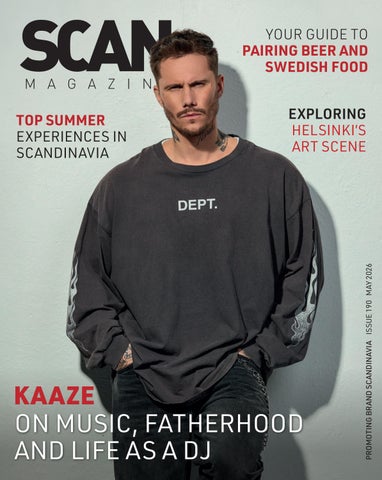
As summer edges closer, so too does the season of festivals, late nights and dance floors. Fittingly, our cover feature introduces Swedish DJ Mick Kastenholt, better known as KAAZE. Having just released his single Invincible, dedicated to his three-year-old daughter, he talks about the long road to success, life as an artist,
and shaping a career that allows him to be the best possible father. Summer also brings with it the pleasure of food and drink enjoyed at a slower pace, and in this issue, beer sommelier Malin Norman explores how to pair beer with Swedish food favourites – from familiar summer dishes to more unexpected matches.
Finally, as always, design, culture and creativity run throughout the issue. From Danish ceramics found in Michelin-starred restaurants to Swedish jewellery and Scandinavian garden essentials, our design pages are full of treats for you and your home.
We hope our magazine offers plenty of inspiration for making the most of the long, light Nordic days and nights, and that you enjoy reading it as much as we enjoyed making it.
Signe Hansen, Editor
SCAN MAGAZINE
In this issue
COVER FEATURE
6 KAAZE – on success and fatherhood
Having just released his single Invincible, dedicated to his three-year-old daughter, Swedish DJ Mick Kastenholt, aka KAAZE, talks about how taking the long road to success has served him well, and about his work to shape his career in a way that allows him to be the best possible father.
DESIGN
10 Ceramics, jewellery and garden must-haves
From homemade wardrobe staples that will make you feel stylish, comfortable and capable, to handmade Danish ceramics that have made their way into restaurants and homes all over the world – our Design pages are bursting with creative energy. We also look at a Swedish jewellery design success story promoting individuality and independence, and a collection of Scandinavian design essentials for your garden.
FOOD AND DRINK
24 Beer collaborations, coffee with a conscience, and a sweet treat
Beer sommelier Malin Norman explores the charms of beer collaborations, a Swedish coffee brand on a quest to revolutionise the world of coffee shares its story, and our plant-loving food writer Katharina Kjeldgaard tempts with a simple recipe for a rhubarb crumble that will make summer seem sweeter.
SPECIAL THEMES
34 Top summer experiences in Sweden, Norway and Finland
Breezy seaside resorts, culinary delights with ingredients sourced from the local landscape, and wellness treats for the body and soul – the days when summer in Sweden, Norway and Finland meant a basic cabin in the woods are long gone. In this theme, the region’s amazing landscapes, unique boutique hotels, and mouthwatering food experiences will make you want to go online and book straight away.
58 Nordic knitting and yarn
An essential part of Nordic heritage, knitting has reached a whole new level since the pandemic. In this theme, we explore one of the region’s leading knitting festivals, distinctive knitwear designs, and local yarn enthusiasts from Denmark to Iceland.
MINI THEME
68 Inspiring galleries and art spaces in Finland
For those seeking a deeper encounter with Finnish art and culture, this mini theme presents three centrally located galleries and art spaces in Helsinki, offering inspiration for a rewarding cultural getaway in the Finnish capital.
SPECIAL FEATURES
32 Wagner in Viking Land
Staged inside Lejre’s spectacular Viking Hall, Wagner’s opera Die Walküre (The Valkyrie) will, in June, be brought into a setting that echoes the Norse myths that inspired its creation. Inspired by Wagner’s idea of an all-encompassing artwork, conductor James Sherlock shares the vision behind this spectacular project.
54 Pairing beer with Swedish food favourites
In this feature, beer sommelier Malin Norman talks to an expert in her field to help you find the best beer matches for your favourite Swedish summer dishes. If you are into beer and Swedish food, this is a mustread, and you are sure to find a few surprises too.
CULTURE
100 Camille Norment
Our special feature shines a light on the extraordinary work of Norway-based artist Camille Norment and her current exhibition at the stunning Gallery F15 in Moss.
102 Events, music and film highlights
Where to go and what to experience this month?
Our Culture Calendar rounds up the best arts events across the Nordics, music columnist Karl Batterbee recommends new Nordic pop numbers to sing along to, and illustrator Maria Smedstad ponders the charms of a Swedish cabin. Meanwhile, film and TV columnist Anders Lorenzen takes a look at the Scandinavian participants at this year’s Cannes Film Festival,
KAAZE –on fatherhood and the lon g road to success
By Signe Hansen | Photos supplied by Urban Rebel PR
What does life look like for one of the world’s top 100 DJs? Scan Magazine talks to Swedish DJ KAAZE, aka Mick Kastenholt, about fatherhood, staying mentally and physically fit through a demanding tour schedule and how, almost without noticing it, he slowly made his way to the top. If you thought that DJing was all about parties and living like there is no tomorrow, think again.
Currently in the midst of his global Invincible tour, named after his recent single dedicated to his three-year-old daughter, the DJ, producer and songwriter has reached a level that most in his industry can only dream of. 12 years after creating his stage alias KAAZE, he is playing some of the most iconic venues and festivals in electronic music, from Ministry of Sound to Tomorrowland and Ibiza clubbing meccas Amnesia and Ushuaïa.
Yet his ascent has not come through one explosive breakthrough, but through steady, incremental progress – in a way that seems to reflect a quintessentially Scandinavian sense of persistence and groundedness. “I had to take the long road,” he says. “It was a very slow process for me, but also a very blessed one. I’ve seen so many careers rise and fall quickly. When it goes up fast, it often comes down fast too. I’m grateful that it took time, because that makes you more solid. Your roots grow deep.”
That slow build also meant there was no single moment when everything changed. Progress came gradually until the scale of what he had built became clear almost retrospectively. “One day, I took a step back, looked at what was happening and realised, wow, I’ve come this far without even noticing,” he recalls.
Over the years, that persistence has earned him a solid place on DJ Mag’s list of leading DJs and collaborations with some of the biggest names in the industry, including Calvin Harris, Steve Aoki and David Guetta. Last year, he could add
a sold-out debut tour of North America to the list. Yet his proudest achievement, he says, happened far from the DJ booth.
A different perspective
“Even though we’re talking about music, my first thought is my daughter,” he replies, without hesitation, when asked about his proudest moment. In 2023, the year his daughter, Seven, was born, something also shifted in his career. “I
truly believe that my daughter has had a massive impact on my career,” he continues. “My mindset as a businessman changed after she was born. I started looking at things very differently.”
Having worked his way up through the ranks of the world’s DJs with his progressive house and big-room electronic dance music, the early 2020s and the COVID pandemic gave him time and reason to pause and reconsider his vision. The result was a shift towards a darker, techno-leaning sound, while also bringing him closer to the roots of his original style and audience. The response was enthusiastic. In 2024, DJ Mag ranked him
at no. 48, with his new style being described as “hot techno.”
“In terms of my career, I would say that my biggest achievement was when I went back to my root sound,” he says. “I moved a little closer to where I started and saw an incredible reaction. That was a major moment for me, because I could finally see my music speak for itself.”
Working smarter, not harder
The arrival of his daughter made Kastenholt reconsider the structure of his career. His aim now is to work smarter rather than harder, allowing fatherhood to shape the pace of his professional life.
In the midst of a tour taking him all over the world, from New Zealand to Hong Kong and New York, that means planning around the time he spends with her.
“My tour schedule is very packed, but it’s planned so I’m always available when I’m supposed to have her, even if that means a lot of extra flights,” he explains.
Being the father he wants to be when he returns home also means staying disci-
plined while touring. A committed fitness enthusiast, Kastenholt sees routine as essential to staying mentally and physically fit in a job built around late nights, long flights and festival stages. “I’m trying to build a good structure around my job so that I can be the best father and be 100 per cent myself when I’m with my daughter,” he says. “For me, that means not drinking alcohol, going to the gym every day and keeping that routine on tour. When I fly home to my daughter, I
want to be fully recharged. I would never want to be hungover because of a show the day before.”
A 360-degree experience
While KAAZE is now one of the world’s leading DJs, he can still walk down the street largely unnoticed in his home country. In fact, despite having played venues and festivals across the world, he has yet to perform officially as KAAZE in Sweden. “I was very inspired by Swedish House Mafia,” he recounts, “but I have never officially played in Sweden as KAAZE.”
Elsewhere, the picture looks different. His last performance at Ministry of Sound in London sold out, and ticket holders for his upcoming show on 29 May can expect something even more ambitious. “The growth in London has been really cool to see,” he says. “We sold out last time, and now we wanted to do something special with a 360-degree production. The booth will be in the middle of the club, with everyone around it, so it becomes more intimate and everyone feels connected while I’m DJing.”
At the same time, Kastenholt is preparing the launch of Se7en Records, a label named after his daughter. “It will be a credible label, and genre will not matter,” he stresses. “It will be about uniqueness. I don’t want to release track after track; I want to handpick each release and give it the attention it needs.”
For Kastenholt, the label also reflects the shift that fatherhood has brought to his career. His own profits from Seven Records, he says, will go towards savings for his daughter’s future. “Before my daughter was born, everything was driven by milestones and achievements, and wanting to become the biggest DJ in the world,” he says. “I still have those goals, but I look at them differently now. I was too focused on the results and not enough on the journey. That has been the biggest shift. I’m much more grateful now, and I’m enjoying the journey.”
www.iamkaaze.com
Instagram: @iamkaaze
YouTube: @KAAZEOfficial
About KAAZE
Real name: Mick Kastenholt
From: Helsingborg, Sweden
Profession: DJ, producer and songwriter
Sound: mainstage electronic music with roots in European techno and rave culture
Signature style: often described by fans as Hot Tekno
DJ Mag: ranked in the Top 100 DJs Poll since 2021
Known for: high-energy performances, melodic techno-driven productions and major collaborations
Collaborations/remixes include: Steve Aoki, David Guetta, Calvin Harris, Sam Smith, Tiësto, Hardwell, KSHMR and Ricky Martin
Notable venues and festivals: Ministry of Sound, Amnesia, Ushuaïa, Parookaville, EDC, Don’t Let Daddy Know and Beats For Love Festival.
Recent and upcoming highlights: debut North America and Canada tour, RESONANCE; Head Rush EP with Steve Aoki; upcoming 360° London show; Invincible tour. Launching SE7EN Records later in 2026.
Fashion Diary
As May turns spring to summer, we witness the last growth spurt of the season. It’s warmer, brighter, and the dreary days of winter are but a distant memory. Celebrate this delightful season with lighter clothes, earthy colours and accessories to match the blossoms sprouting everywhere.
By Celina Tran | Press photos
Polos are a frequent feature in fashion diaries and articles, and not without reason.
A classic staple fit for any wardrobe, they are great for everyday wear but can also be zhuzhed up for more formal occasions.
The Jeremy striped knitted cotton polo has a simple silhouette and is made from 100 per cent cotton, making it breathable and soft as the days get warmer. Its stripes offer that youthful, fun, and somewhat preppy boater look – a versatile choice for the casual and casual-smart occasions spring and summer has to offer.
Jeremy striped knitted cotton polo in navy, EUR 120 www.adaysmarch.com
With blue skies and days of seaside bliss ahead, we need accessories that not only match but also serve the environment around us. Les Deux has exactly what you need.
Worldwide weekend bag: This sporty nylon weekend bag with an embroidered logo is perfect for short trips as well as everyday wear. It has that blue, preppy look that goes perfectly with the brand’s new spring and summer collection.
Encore organic baseball cap: At first, one might think to pair the weekend bag with the navy version of this cap, but you’d be surprised at how well a nutty, earthy brown goes with blue. The simple colour, design, and shade also make it suitable for everyday wear.
Finally, our last must-have is denim shorts, but not just any pair. The Samandla shorts from Samsøe Samsøe have a straight, but almost ballooned leg. The playful seam and side slit pockets bring a nostalgic feeling to these. Tuck your t-shirt inside or outside for a youthful look or elevate by pairing with a loose linen shirt. Samandla shorts in dark indigo, EUR 140 www.samsoe.com
Want to look like the coolest person in your vicinity this May? Throw on these suede pants from Rotate Birger Christensen, a simple, tight-fit white t-shirt with some text on it, and a pair of sunnies with dark tinted glasses. Match with the brand’s oversized suede jacket – also made from soft goat suede –for a modern yet funky, coordinated look, as well as the chance to throw it over your shoulder as you strut down the cosmopolitan streets like you came straight out of a movie.
Straight suede pants in brown, EUR 420 www.rotatebirgerchristensen.com
The warm weather might have been slow to arrive this year, but with summer just around the corner the sun has finally decided to join us, which means dresses, florals and frills! The vintage-inspired Bonne dress from Danish Skall Studio has a light and sweet pastoral feel, with short elastic-cuffed sleeves and that 100 per cent cotton spring softness. Perfect for strolling around Mediterranean cities or coastal towns in the coming season, but also great for gambolling through the fields this May.
Bonne dress, EUR 325 www.skallstudio.com
Now this is a top that will catch the attention of the room. The Trinola top in a stunning deep lichen green is a minimalistic piece; suspended from slender straps, with long drapes on each side, not to mention a beautiful open back. A capsule wardrobe piece, it can be worn as it comes, but for a whole new set of tops, use your imagination, tying skills, and have at the silky drapes.
Trinola top in deep lichen green, EUR 300 www.bymalenebirger.com
A ceramic expression where depth lies in the surface
Defined by subtle forms, tactile surfaces and the special glazes that have become her hallmark, the ceramics of Sarah Oakman have found their way to homes and Michelin-starred restaurants all over the world. Yet, working on Bornholm, the ceramicist remains rooted in a careful process, inspired by nature and shaped over more than a decade of testing, refinement and material curiosity.
By Signe Hansen | Photos: Stine Albertsen
Ten years after founding Oh Oak in Nexø, Oakman has created a distinct ceramic universe that has added a dash of colour and tactility to a wide range of settings, from private homes to trendy cafés and Michelin-starred restaurants.
What ties it all together is a ceramic language rooted in feeling as much as function. “I try to stay true to the core DNA of my work,” Oakman says. “I want to make ceramics that feel good in the hand and awaken something in people. It should tell a story about where it comes from.”
Today, Oakman works with a small production team at Matter - House of Craft, where visitors can encounter both the
finished ceramics and the process behind them.
From Copenhagen to Bornholm
Originally trained as a schoolteacher in Copenhagen, Oakman, then 27, quickly sensed that another path was calling. In 2012, she moved to Bornholm with her husband and their children. What was meant to be a temporary move to study glass and ceramics at the island’s design school in Nexø turned into a new life.
At the school, she met her creative partner, glass artist Maj-Britt Zelmer Olsen, with whom she opened a small shared workshop and studio. The family stayed, the children thrived, and soon the island’s raw landscapes began to shape Oakman’s work in a way that came to define her new path. “Nature is very present here, both summer and winter, just in completely different ways,” she says. “And because Bornholm is geologically so different from the rest of Denmark, I use it a great deal in my work – both as a visual source of inspi-
Ceramicist Sarah Oakman, the woman behind Oh Oak. Photo: Rasmus Kvist
ration and directly, through materials like sand, clay and stones.”
In 2019, Oakman and Olsen took over a 600-square-metre former shipyard hall in the harbour of Nexø, which they turned into Matter - House of Craft, a shared space for production, exhibitions, and craftsmanship.
A decade glaze
When looking at Oakman’s designs, one senses a restraint in the form that allows the surfaces to do more without letting the piece lose its Nordic simplicity. “Glaze is my great passion,” she says. “I’ve spent many years immersing myself in glaze development – trying to keep the form simple and let the glazes move and evolve. Sometimes that happens through those reactive craters, and sometimes through much more subtle shifts in colour across the surface.”
One of the most striking examples is the Crater Cup, which has become one of her best-known pieces. Developed in collaboration with the Copenhagen coffee bar Prolog, it was shaped around both ritual and function. The curve had to suit the aroma of the coffee, the small foot had to lift the cup slightly, and the textured exterior was designed to provide both grip and a degree of insulation. The result is a piece with a highly recognisable surface, but also a carefully considered use, which helps explain its lasting appeal among coffee enthusiasts.
Alongside it sits the IWA series, another of the ceramicist’s most popular collections. Inspired by Japanese tea culture and by the traditional tea bowl, the pieces are filtered through her own quieter, more Nordic expression. The series illustrates Oakman’s continuous search for inspiration both within and beyond Denmark. “When you live on a small island like Bornholm, I believe it’s imperative to keep travelling and expanding your horizon,” she stresses.
In search of the perfect pink Oakman’s love of glaze, she explains, originates from the tension between the highly technical and the more instinctive. “It requires a great deal of knowledge and a certain kind of nerdiness. The idea that you can almost calculate
your way towards an aesthetic expression – I find that deeply interesting,” she says. “At the same time, it’s also something extremely creative and intuitive.”
Consequently, some glazes emerge quickly; others take years. Her search for the right pink, for instance, has stretched across more than a decade. “I’m still trying to find the perfect pink,” she says. “I’ve been working on that since 2012, and I still haven’t quite succeeded.” It is a small but telling detail. In Oakman’s work, the point is not simply to produce, but to keep refining – to test, adjust and look again until the right surface reveals itself.
www.ohoak.com
Instagram: @oh_oak
Photo: Oh Oak
The distinctive crater cup is one of Oh Oak’s most popular designs.
Clothes to make, wear and feel proud of
From Denmark, Wardrobe By Me has built a global following for sewing patterns shaped by Christina Albeck’s no-nonsense, timeless designs and fashion-industry expertise. The idea is simple: handmade clothes should be wearable, comfortable, and timeless. The patterns are designed as modern wardrobe staples – pieces that people return to again and again.
By Signe Hansen | Photos: Wardrobe By Me
This year, Wardrobe By Me marks its tenth anniversary, a milestone for a brand that has found a clear niche in a crowded sewing market. Its patterns span both womenswear and menswear, combining Scandinavian restraint with ease, versatility and a quietly normcore approach to everyday dressing. “We create patterns for the clothes you wear all the time,” says Albeck. “Not party clothes, but the pieces you reach for again and again.” It is a design language grounded less in novelty than in usefulness, and that has been part of the concept’s appeal from the beginning.
Since launching in 2015, the company has grown from a single digital pattern
sold online into an international business with customers around the world.
From fast fashion to DIY pattern design
The design DNA of Wardrobe By Me strongly reflects Albeck’s own background. Before founding Wardrobe By Me, she spent many years in the fashion industry as a technical designer, working with construction, fit, product descriptions, and product development. Trained in the US in the 1990s, she knew pattern cutting intimately, but she had also become weary of the rhythm of seasonal fashion, with its repeated demand for the new.
When she discovered the online sewing community – and, with it, the growing interest in digital patterns – the idea came quickly. “It was really my core competence,” she says. “It hardly existed in Denmark, so I simply went for the whole world. It was a very naive way of thinking, really, but that was how it started.”
Founder and owner Christina Albeck.
What followed was a modest but energetic beginning, supported by a network of testers who sewed samples, shared images, and helped build the company’s early online community. Soon it had developed into a full-time business.
Patterns that trigger creativity
From there, the collection expanded into a broader wardrobe of designs sold primarily as digital downloads, supported by video tutorials and detailed instructions, and later also as paper patterns sold in fabric shops around the world.
The customer base is equally varied: experienced dressmakers, curious beginners, and a steadily growing group of men. “Women still sew the most, but you would be surprised by how many men sew,” Christina Albeck says. That has helped make Wardrobe By Me stand out in another respect, since menswear is not treated as an afterthought. “The few brands that have men’s patterns often stop at a t-shirt and a sweatshirt,” Albeck says. “But we create a real wardrobe for men too.”
The sewing tutorials on YouTube also reflect the diversity of the customer base. Rather than teaching sewing in an overly prescriptive way, they are designed to
help people learn by making, whether they respond best to text, images, or simply trying things out for themselves.
Clothes worth making
That practical approach also shapes the philosophy behind the brand. For Albeck, the pleasure of sewing lies partly in the process – in concentration, skill, and the satisfaction of making – but the finished garment must justify the time spent on it. “When finished, it has to be clothes that you want to wear and feel proud of wearing,” she says. “You should enjoy it when someone says, ‘Where did you get that?’ and you can answer, ‘I made it myself.’”
In that sense, Wardrobe By Me is not simply selling patterns, but offering a route to clothes that feel more personal and more lasting, clothes that you can make, wear, and feel proud of.
www.wardrobebyme.com
Facebook: Wardrobe By Me
Instagram: @wardrobebymepatterns
Bringing art and everyday living together
Since opening in 2019 with artworks from just 11 artists, Kræss has grown into a colourful universe representing more than 400 artists. What has not changed is the guiding idea behind it: everything is handmade, carefully selected and produced with a strong focus on sustainability. For customers, that means access to standout pieces for the home that feel personal rather than mass-produced.
By Signe Hansen | Photos: Kræss
In Copenhagen’s vibrant Nørrebro neighbourhood, Kræss has built a space where artworks, ceramics, glass and interior design objects come together in a visual world shaped by colour, edge and individuality. The store grew out of a conversation between co-owner Erica Mølgaard and her business partner, Jonatan Harring. At the time, Mølgaard was training as a psychomotor therapist, but had always worked creatively with her hands. She also felt that something was missing in the art scene. “It can be incredibly difficult for artists to break through if they do not have the right education or access to the right places,” she says. “We wanted to give them a chance to show their work that has some personality, is special, more colourful and less generic.”
Six years later, the shop has doubled in size, expanded online and represents
more than 400 artists. Yet, the sense of personality remains central to the concept. Kræss meets with artists, looks for a distinct visual language and selects and curates work to create an accessible and original collection. The result is a shop with a strong identity and a loyal following. “Some people come from far away to visit us, while others stop by because they have had a bad day and want to look around and feel inspired,” Mølgaard says. “That means everything to us.”
Sustainability is also built into the way Kræss works. The business has stayed committed to handmade production and rejected mass production, even when cheaper options would have made growth easier. Its fine art prints are produced on demand in the store, on exclusive Hahnemühle matte art paper, which both reduces waste while preserving a high level
of quality on every artwork. “We have held on to the idea that people should know that what they are getting, is unique,” Mølgaard explains. “It is made by a person, with a vision, many hours of work, not just by a machine.”
That combination of craftsmanship, curation and care has become Kræss’ signature. Customers are not simply buying a product, but taking home a small part of an artist’s universe – wrapped, packed and lovingly sprinkled with a handful of star glitter.
www.kraess.dk
Facebook: Kræss
Instagram: @kraess.store
Soulful design, a celebration of individuality
More than a jewellery brand, ZAZA&LILI is the story of determination and a sense of freedom. It is also a celebration of the founder’s twin daughters – and any woman who wants to express her individuality.
By Malin Norman | Photos: Zelli of Sweden AB
After 20 years as an agent in travel retail for various brands, Madeleine Jarl started her own jewellery brand in 2015. “With ZAZA&LILI, I wanted to share more than just a jewellery collection,” says the founder and managing director. “I wanted to share a part of my story.”
Inspired by her twin daughters, Kenza and Ellin, and her past experience as a competitive springboard diver and an international fashion model, the brand embodies love, perseverance and the strength of going your own way. Madeleine is certainly not your typical entrepreneur; selftaught, learning by doing every step of the way, she has set her own path and built her brand from a deeply rooted passion.
Madeleine Jarl, founder and managing director.
ZAZA&LILI is not just about designing jewellery; it is about blending beauty and intention. “The brand is a personal journey, inspired by my daughters and shaped by the support of so many people on the way – people who believe in what we’re building,” reflects Madeleine. “It’s also about staying true to what really matters, even when things don’t go according to plan.”
Scandinavian simplicity, Parisian flair
The Swedish entrepreneur moved to Paris at age 19 and worked as a model for ten years, for iconic fashion brands such as Dior and Lancôme. Later, in 1995, she set up her own agency in travel retail and inflight services – products sold onboard airlines for instance, which has clearly inspired her business acumen and creative expression. Instead of selling other designers’ creations, she eventually decided to set up her own jewellery business.
“I’m Swedish by origin but French at heart,” she says. “My creativity feeds on cultural contrasts: Scandinavian minimalism, discretion and clean lines, mixed with Parisian elegance and femininity, and a dash of what I happened to encounter during my travels around the world as a model. I’ve always been curious about new cultures, and I believe it gives the designs that something a little bit extra.”
An international brand already from the outset, ZAZA&LILI is available onboard numerous airlines and in the web shop. “As I had long-established contacts in travel retail, through my own agency, it was only natural that this became the main sales channel for the brand,” explains the founder. The designs are also customised for inflight consumers with adjustable rings, extendable necklaces and so on, which means that the range of jewellery is suitable for a wide audience.
Always looking for innovative ways to make luxury and beauty both accessible and ethical, Madeleine set up another brand in 2015. After a few successful years with ZAZA&LILI, she decided to create a new collection with minimalist jewellery for the modern man. Airlines had repeatedly asked her about jewellery for the male segment and MÄN, meaning men, was launched just after the pandemic.
Praised business leader and World Champion
The journey has been a successful one with ZAZA&LILI often highlighted in the press, including named Jewellery of the Year 2025 – Sweden in LUXlife Magazine and mentioned as one of 10 Best Companies to Watch in The CEO Viewpoint as well as in The CEO Vision. Also, MÄN has received numerous awards, including Best Men’s Bracelet Brand – Scandinavia at LUX Global Excellence Awards.
But the entrepreneur herself has also been acknowledged, for instance as one of the five Most Pioneering Business Leaders to Watch in The Inc Magazine And she has been featured as a top inspirational leader by The Executive Lens.
“This recognition means a great deal to me and reflects a journey shaped by creativity, dedication and the people who inspire me every day,” she says.
Not only is Madeleine an inspirational entrepreneur; she is also a World Champion springboard diver in the Masters category. “As a child, I loved standing on the edge of the diving board, ready to take a step into the unknown. Competing on a high level internationally, already at a young age, helped me develop discipline and courage – and to overcome my fears. This has also helped me in my businesses.”
At the age of 50, Madeleine decided to take up competing again, and that too proved a fruitful decision: impressively, she become a World Champion in 2019. “If my story can encourage just one person to follow their own idea or dream, then all this feels even more worthwhile. It’s never too late to pursue your dreams, whatever people might think,” Madeleine says with a smile, and adds; “I’m just getting started.”
Scandinavians’ enthusiasm for design does not stop at the living room. Increasingly, gardens, patios and terraces are becoming extensions of the home, with design companies offering everything from rustic bird feeders to minimalist outdoor sofas that will take your outdoor oasis to the next level. Below, you find a selection of our favourites.
By Signe Hansen | Press photos
Forno Spin – Morsø
A fun fact that not a lot of people know about Scandinavians is that we’re one of the most BBQloving people on the planet, and in recent years it’s not just regular grills that are getting us excited. Outdoor pizza ovens are having their moment too, and Forno Spin from the traditional Danish foundry business Morsø makes it easy to see why. Reaching 400°C in around 20 minutes and with an electrically rotating pizza stone, it delivers a crisp, bubbling pizza in just one to two minutes. Moreover, with Morsø’s characteristic combination of cast-iron heritage, clean lines and functional design, it turns the terrace into a stylish little pizzeria.
Price: DKK 5,499 www.morso.dk
Sundsö patio set – IKEA
If your patio is looking a bit dull and colourless, this summery yellow Sundsö patio set from IKEA makes it so easy and inexpensive to brighten it up that you can do so without further hesitation. Ideal for those who don’t want to spend hours comparing products before getting started on spring. Unlike many products from the Swedish design giant, the set comes preassembled and can be easily folded and put away when winter returns.
Price: GBP 95 www.ikea.com
Grower Greens – Brafab
With Grower Greens from the historically rooted Swedish outdoor furniture brand Brafab, you may not even need green fingers to help your plants thrive – or at least look their best while they do. Available in two sizes, the taller model features two shelves and two heating zones, making it ideal for growing different plants at once. With adjustable feet, tempered glass, a removable roof, shelves and climbing rings, it brings practical elegance to gardens, terraces and balconies.
Two shelves: EUR 445 www.brafab.com
Ease portable lamp – Muuto
Lighting has long been one of Scandinavian design’s great strengths, balancing atmosphere, with function and simplicity. From Copenhagen-based Muuto, the Ease portable lamp reinterprets the traditional table lamp in a compact, carriable form, perfect for any outdoor space and adventure. The lamp comes in a range of colours, with its gently touching top and base giving it a light, sculptural character that will ensure no one mistakes it for just a convenient solution – even if it is that too.
Price: DKK 1,285 www.muuto.com
Cortivo bird feeder – Ferm Living
Nothing creates spring bliss quite like the sound of songbirds happily chirping away, and with this bird feeder from Danish design firm Ferm Living, your feeding station will bring joy not only to feathered visitors, but also to any design enthusiast passing by. Crafted from corten steel with a developed rust patina, the feeder adds rustic charm to terraces and gardens and comes with both a stand and a hook.
Price: GBP 109 www.fermliving.co.uk
Outdoor Market folding sofa – HAY
If we needed more proof that Scandinavians’ love of design borders on fanaticism, this blue outdoor market folding sofa with beige stripes from Copenhagen-based HAY might be it. Foldable and portable, it means you never have to be separated from the stylish minimalist sofa no Scandinavian home should be without. Available in a range of colours, it’s a must-have if you can find any excuse for it – and that should not be too difficult. With handles on both the seat and back, plus a matching fabric bag, it’s made for gardens, beaches, picnics and wherever else summer takes you.
Price: DKK 2,499 www.hay.com
The colours and creativity of nature
Inspired by nature, cloud formations, and soft sea creatures, the art of Katja Bjergby reflects the same light, playful energy that comes through when speaking to the artist herself. After more than a decade of practice, her work is bringing a sense of vitality and affirmation to homes and workplaces across Denmark and beyond.
By Signe Hansen | Photos: Lukas Bukoven
There is an immediate lightness to Bjergby’s work, but beneath it lies something more grounded – a commitment to joy, play and self-expression. Many choose to place her pieces in intimate spaces, including bedrooms, drawn to their uplifting presence. “My work carries both strength and spontaneity,” Bjergby says. “What I often hear is that it makes people feel more alive – it reminds them that there’s more within them, and that they are allowed to shine as they are.”
For those who live or work with her pieces, the effect is often immediate. The colours, shapes and subtle shimmer combine to infuse the spaces they adorn
with the soft lightness of the clouds, the colourful vivacity of the sea, and the untamed energy of nature.
From business school to ceramics
Talking to Bjergby, one has not the slightest of doubts that this is a person who loves what she does. But while she has loved drawing ever since she was a child, as an adult it took her a little while to dare to trust her creative energy.
After completing her studies at Copenhagen Business School, she enrolled in a folk high school focused on art – a turning point that led her to continue her training in visual arts and ceramics at the Teachers College of Art and Craft. She later went on to teach art, while developing her own practice alongside it. “I was making my own work more and more,” she recalls. “At some point, I felt that I had to follow it properly.”
A decade on, her practice has become firmly established. After years in a shared studio, she now works from her home on a houseboat on Holmen in Copenhagen, al-
Photo: Katja Bjergby.
lowing her to move fluidly between daily life and creative process. “It’s quite special to have it all around me,” she says. “I can step in and out of the work, and return to it with fresh eyes.”
Working between mediums
Today, Bjergby continues to work across paintings and ceramics, allowing her to move freely between different rhythms. “There’s a different energy in the two,” she says. “Painting is more immediate, whereas ceramics takes time. It’s slower and more tactile.”
Her paintings include a series of acrylic works on paper, featuring fantastical, colourful creatures that playfully float through space, impossible to look away from. Inspired by the skies, the paintings start out as doodles on paper. Like with the other media she works in, the process is always driven by joy.
“I always choose the one that makes me smile, and love that I’m the one in control of how they look—that it’s my expression. I can give them as many limbs and forms as I want, inspired by patterns I absorb from
books and exhibitions,” Bjergby enthuses. “It becomes a playful, instinctive process driven by joy, imagination and creation –it’s a childlike excitement which I think it’s important to preserve as an adult.”
Art that lifts you up
Regardless of the medium, her figures do not arrive fully formed but grow out of loose, wandering lines and impressions. Shapes stretch, shift, and take on a life of their own, guided more by instinct than intention. “It’s a bit like doodling when you’re on the phone,” she says. “It just flows.”
Alongside her own pieces, she also creates works on commission for private
homes, offices and hospitality venues. Whether it is a single painting or a larger installation, the process remains the same. “It’s about sensing what fits the space,” she says. “And creating something that feels good to be around.”
Reflecting on her work with businesses in particular, she adds: “We’re so influenced by what we look at every day – and when art brings positive energy, it can benefit both employees and visitors, creating an atmosphere where people feel uplifted and more open to thinking creatively.”
www.katjabjergby.dk
Facebook: Katja Bjergby kunst
Instagram: @katjabjergby
Many of Katja Bjergby’s ceramic works are inspired by soft underwater organisms.
Photo: Katja Bjergby.
Artist Katja Bjergby.
Photo: Katja Bjergby.
Brew collabs with friends from the South
Collaborations between breweries across borders are an exciting part of beer culture. Brewers get to share ideas, invent a new recipe, and often brew the beer together onsite. And consumers get to taste something new and unexpected. Recently, a friend told me about a few Spanish-Swedish brew collabs that are worth checking out.
By Malin Norman
Drunken Bros, a brewery based in Zamudio, Basque Country, released a collab with four other breweries in November last year. Together with Laugar, also from Basque Country, and La Grua, from Cantabria, they joined forces with Bustad Brewing Co from Lidköping and AKiA Brygghus from Kungsbacka in Sweden.
Described as super ultra mega drinkable, their vibrant hazy IPA called Marvin is brewed with three types of hops: Citra for bright citrus and tropical fruit notes, Kohatu for some stone fruit and a herbal touch, and Nelson Sauvin for a white grape character. Referred to as a liquid celebration of the collaborative spirit, Drunken Bros states: “It’s the kind of beer that can only emerge when several hands, minds, and hop lovers align.”
In March this year, Madrid-based Oso Brew Co brewed a Double IPA together with Brewski from Helsingborg. The beer, called OSKI, is an aromatic explosion of grapefruit and lime, ripe mango and passion fruit, plus a hint of pine resin. A tribute to modern hop culture, this DIPA is bold yet surprisingly drinkable, or as Oso Brew Co declares: “once you try it, there’s no going back.”
Collaboration between Swedish and Spanish breweries is not a new thing though. For instance, Naparbier, located in Noáin, Navarra, and Beerbliotek, from Gothenburg, jointly released two beers in 2018. First out was a West Coast IPA called Stop me if you think you heard this one before, brewed in Spain. Their second collab beer, brewed in Sweden, was a dry farmhouse-style IPA
named Hacerse el Sueco (meaning to pretend not to hear or notice).
Apart from creating beer magic together, collabs like these go beyond brewing. They offer opportunities for brewers to experiment, but they also grow communities, strengthen bonds, and might even surprise and delight consumers.
Malin Norman is a Certified Cicerone®, a certified beer sommelier, a BJCP certified beer judge, and a member of the British Guild of Beer Writers.
Photo: Josh Olalde on Unsplash
Rhubarb crumble with a chewy caramelised topping
If you love rhubarb like me, then you must try this recipe. It’s a rhubarb crumble that I return to again and again.
By Katharina Kjeldgaard
The topping is slightly chewy and pairs perfectly with the tart rhubarb layer underneath. It’s simple to make, yet full of flavour and texture. Best served with a dollop of crème fraîche or a scoop of vanilla ice cream.
Tip: let it cool before serving. The topping firms up and becomes crisper as it cools. I promise, it’s worth the wait.
Amount: 6-8 people
Easy to make
Time: 50 minutes
Ingredients:
Rhubarb layer
500 g rhubarb (about 7 stalks of rhubarb, depending on size)
50 g sugar
2 tbsp grated lemon zest
Caramelized crumble
150 g butter
50 ml light syrup
50 ml whipping cream
150 g sugar
150 g rolled oats
100 g all-purpose flour
To serve:
crème fraîche
vanilla ice cream
Instructions:
1. Preheat the oven to 175°C (conventional oven). Trim the rhubarb and cut it into pieces of about 1 cm. Place in a bowl and toss with sugar and grated lemon zest. Transfer to a pie dish (about 25 cm in diameter).
2. Heat the butter, syrup and cream in a large pan until melted and combined.
3. Meanwhile, mix the remaining dry ingredients in a new bowl.
4. Add the dry ingredients to the pan and stir until everything is well combined. This takes about 3–5 minutes, and it’s fine if it bubbles slightly.
5. Pour the caramel mixture over the rhubarb and spread it out with a spoon. It doesn’t have to look neat, as it will spread during baking.
6. Bake for about 30–35 minutes.
7. Serve warm or cold, preferably with crème fraîche or vanilla ice cream.
Katharina Kjeldgaard is a Danish food blogger, influencer and cookbook author from Copenhagen., Her blog is one of the most-read vegetarian food blogs in Denmark, always focused on locally sourced ingredients, full of delicious recipes and never boring. She has three little kids and loves going to markets, being in nature – and cooking with all kinds of vegetables and legumes.
Blog: beetrootbakery.dk
Instagram: Beetrootbakery
More than just a beverage: Cultivating happiness in the world of coffee
With the aim of setting a new standard for how a coffee business can operate without causing harm, Lykke Coffee Farms is doing things differently. Working closely together with coffee farmers in Uganda, Peru, El Salvador and Brazil, the pioneering team behind the sustainable coffee project is also generously sharing their business idea with partners around the world. The goal is that enjoying a cup of coffee can be a small but conscious act of doing good.
By Malin Norman | Photos: Lykke Coffee Farms
It all starts on the farms where the coffee grows. As a responsible coffee producer, Swedish company Lykke Coffee Farms creates better conditions for the farmers, shares knowledge and builds relationships with them – all in the name of coffee. Its business model is transparent, organic and sustainable. A gamechanger, no doubt.
Founded in 2020 by a team of entrepreneurs with heaps of previous experience in the world of coffee, Lykke is made up of coffee roasters, baristas and other specialists. “We want to make
a difference in the industry,” says Johan Damgaard, co-founder and CEO at Lykke. “No-one and nothing should be harmed in order for us to enjoy a good cup of coffee. For us, this means being transparent every step of the way –from what happens on our coffee farms abroad, to how we do business with our partners around the world, to our roasting operations in Sweden and Finland.”
Letting farmers run the show
Quickly, it becomes clear that Damgaard loves talking about coffee farming and sustainability, and how to turn things
upside down in the industry. “Coffee is one of the most traded commodities in the world. With Lykke, we want to challenge the usual way of doing things,” he says. “Basically, it starts by cutting out the middleman in the process. Instead, we have our own farms and coffee projects in Uganda, Peru, El Salvador and Brazil –where we cultivate coffee together with the local farmers.”
The Lykke way of growing coffee is organic, without mono-cultures and in perfect harmony with people and nature, as it should be done. The co-founder explains:
“Our project is based on an ambitious dream of changing an unsustainable industry into a more economically, socially and environmentally sustainable business for all involved – but most of all for the coffee producers.”
The business model is circular; Lykke owns farms and also runs different projects together with coffee farmers, and the profits are shared with the local farmers. “In each location, we set up a basecamp where we can experiment with ecology and coffee processes, as well as share our knowledge with our coffee growing neighbours, helping them to improve and perfect their already good coffee into amazing coffee, which they can then charge more for,” says Damgaard.
“This way, we’re not only making a full circle, being both producer and buyer, but we’re also creating work opportunities and better conditions for the farmers.”
Partners and coffee scouts
One of Lykke’s initiatives is the Coffee Scout Project in Uganda. The project aims to support and educate local farmers in working in a more climate-smart way, from providing facilities for cleaning and processing coffee beans, to teaching new pruning techniques that help the plants produce more cherries, and ultimately more coffee beans.
Premium quality and sustainability are key, and so is a design that stands out in
the market. Developed under the same ethos of doing things differently, Lykke’s vibrant and easily-recognisable branding and packaging have already become a hit amongst consumers in Sweden and abroad. And the design has won numerous awards, for instance the prestigious D&AD Award for packaging design in 2021. The brand has also released a number of exciting limited edition projects, such as the Aarke x Lykke collab together with Lars Pilengrim.
Perhaps surprisingly, the Lykke team is more than happy to share its successful concept, so that more businesses can
have a positive impact. Already introduced in Helsinki, Finland, the partner model is also being implemented in Estonia and Japan, so far. “Becoming a Lykke partner means joining a group of like-minded, independent and market-specific roasters that seek a coffee identity with a mission and the resources to support long-term success,” says Damgaard. “By building volume, together, we can have even greater impact.”
Happiness in a bag of coffee
But what about the coffee? Lykke has a broad range of espresso, filter brew, single origin and capsules, as well as tea and
matcha, available in the web shop, at selected retailers, and at Lykke’s own cafés in Stockholm and Helsinki.
A clear hit in the line-up is Happiness in a Bag, a bright, fruity and beautifully balanced medium roast coffee. Malin of Hökarängen is another, with a bit more intensity and depth without being too dark. And Bam Bam is described as a daily hero in a cup – smooth, sweet and balanced, ready to make your day even better.
These are just a few of the products, and no doubt Lykke will continue its global mission to make the world a happier and better place, by way of coffee. “We think of ourselves as a true part of the coffee community,” says Damgaard, and adds; “Our Lykke train continues its steady journey, why don’t you join us along the way?”
www.lykkegardar.se
Facebook: Lykke Kaffegårdar
Instagram: @lykkecoffeefarms
Delicious flavours, just like nature intended
Honey from Bibruket is harvested with care for bees and nature. Honouring one of nature’s most fascinating products, this small producer offers a range of light and mild honeys, as well as dark and powerful versions. Regardless of product, the well-being of the bees is at the forefront.
By Malin Norman | Photos: Bibruket
With a passion for beekeeping, sustainability and taste experiences, the family-run business Bibruket creates premium products – including fantastic single flower honeys – with respect for nature and the bees that make everything possible.
The small business maintains its own beehives and ensures that the bees always have the best conditions, including access to natural sources of nectar and pollen. “Our honey is carefully harvested to preserve the taste and nutritional properties,” says Linda Klintefjord, who runs Bibruket together with her husband and sister-in-law. “Strong and healthy bee colonies are a prerequisite for both honey production and long-term sustainability.”
In the facility in Ängelholm, the team develops new versions of honey, always
with a focus on premium quality and innovative sensory experiences. Not all honeys are the same, highlights the co-owner. “Our range of single flower honey is characterised by the nectar collected from a specific type of plant. In a way, it’s similar to terroir in wine.”
One of Bibruket’s most popular products is Åkerböna, a single flower honey from the field bean plant. “Field bean is an
elegant and well-balanced honey with fruity notes, a light acidity and hints of juniper wood and gin spices. The most striking is the taste of peach candy,” says Klintefjord. “It may be Sweden’s version of acacia honey. It’s great for adding to your breakfast yogurt or fresh fruits and berries.”
Another favourite is Klöver, a single flower honey that originates from white clover fields. “For this honey, we collaborate with farmers for pollination, so this is a real win-win,” smiles Klintefjord. “Clover honey is mild, sweet and sour, with notes of hay and lemongrass. Perfect when you want to sweeten something with honey without it being overpowering.”
bibruket.se
Facebook: Bibruket
Instagram: @bibruketshonung
Bibruket offers tastings, for those who want to explore the world of honey. You will learn more about this natural product, how you can use it, and of course taste your way to your own favourite.
The organic fertiliser giving crops a nutritional boost
There is organic and then there is completely, unequivocally organic. Seaweed specialist Warbergs Tångbruk belongs to the latter. This additive-free plant fertiliser, made from algae harvested on Sweden’s west coast, transfers the rich spectrum of nutrients naturally found in seaweed to the fruit, vegetables and other crops it helps nourish.
By Nina Bressler | Photos: Warbergs Tångbruk
The story of Warbergs Tångbruk is one rooted in love; love for the sea as well as for the coastal area of Sweden where the founders, Jakob and Rosita Ahlstedt, met and built their life together. “The business started as we were looking for the right way to give back to the nature that has given us so much through the years,” says Jakob Ahlstedt, co-founder of Warbergs Tångbruk. “I spent my summers surfing the waves outside of Varberg, and this is where Rosita grew up. It’s a beautiful place on earth.”
In 2019, they began experimenting. Inspired by traditional practices which used seaweed as plant nourishment long before chemical fertilisers and scientifically underpinned by Jakob’s background in life sciences, the first batches
were created in their home. With simple tools and plenty of curiosity, they began selling bottles from a milk crate outside their house as well as to local shops. Interest was immediate, and today they work with over 100 independent resellers across Sweden, with ambitions to expand throughout the Nordic region and into Germany.
“Seaweed is an exceptional plant with properties that no land-based plant material can match. Beyond nitrogen, phosphorus, and potassium, it contains a wide array of minerals and bioactive compounds that supports stronger root systems, increased resilience and healthier, more vibrant plants,” Ahlstedt says. “In fact, it is scientifically proven that algae-based plant fertiliser can enhance the nutritional value of the fruit, berries and vegetables it is used to grow.” All algae is sustainably sourced from seaweed that has naturally washed ashore, and the fertiliser is made entirely without additives, relying solely on the plant’s natural properties.
Though ambitions are high, with expanded sales and academic collaborations to contribute to existing research about this exceptional natural resource, the essence remains the same: organic algae and organic growth in harmony with an everlasting love for the sea.
www.warbergstangbruk.se
Instagram: @warbergstangbruk
Jakob Ahlstedt, co-founder.
Rosita Ahlstedt, co-founder.
Experience Wagner’s Valkyrie in a Danish Viking hall
Staged inside Lejre’s spectacular Viking Hall, in June Wagner’s opera Die Walküre (The Valkyrie) will be brought into a setting that echoes the Norse myths that inspired its creation. The project – led by conductor James Sherlock and the brainchild of stage director Ida Kiberg and Sagnlandet’s Charlotte Franzdatter – turns the hall into more than just a venue: it becomes part of the drama itself, merging music, architecture and history in one immersive experience.
By Signe Hansen
Walking through the reconstructed medieval landscape of Lejre, entering the historic replica of a Viking king’s Great Hall and sitting down to enjoy an operatic masterpiece, the audience of The Valkyrie at Lejre is set for a multi-dimensional musical journey. Indeed, while many opera lovers will have experienced this work on more traditional stages, much of this production’s power lies in its unique setting.
Kongehallen, built on an original Viking site, is not just a theatrical backdrop but a fully realised historical reconstruction. Its carved beams, central fire pit and intimate seating place the audience and performers in unusually close proximity. For Sherlock, the hall was the in-
spiration for the whole concept: “My jaw dropped when I first saw it,” he recalls. “And even now, after many site visits, I still get goosebumps thinking about making theatre here.”
Wagner’s vision of total art
In this ‘in-the-round’ setting, Wagner’s monumental creation can be experienced on a human scale, up close to the action, with the orchestra resonating throughout the vast wooden chasm of the hall, the structure itself becoming an active part of the music drama. This adds an extra layer to Wagner’s own concept of Gesamtkunstwerk: the total artwork, where music, text, drama and visual form become one. Here, the landscape lives and
breathes the very Norse history that so fascinated the composer, lending his enveloping vision a further dimension.
“Wagner’s immersive worlds describe the vastness of our human inner experience,” Sherlock explains. “The greatest art provides us with ways to explore the fullness of that experience. And with Die Walküre, an opera that focuses on close, highly-charged relationships, this particular space will bring a visceral immediacy and intimacy to these powerful, personal encounters.”
The Nordic opera scene
For the conductor, the production also reflects a broader artistic outlook shaped by his years working across the Nordic region. Raised in Britain, but trained on Finnish podiums and now based in Copenhagen, he highlights the North’s willingness to support new formats and take artistic risks.
“In Denmark,” he notes, “we cannot work in the same way that countryside opera
Photo: Sagnlandet Lejre and Ole Malling
festivals do in the UK or US, with private and corporate sponsorship and a large wealthy suburban audience base. Instead, we are blessed with foundations that really invest in high-quality work, who are prepared to support unique concepts, and an audience that is open-minded. We are grateful for all of this, since it allows for creative freedom – in this case to attempt something that has not been attempted before.”
A staging grounded in history
This staging is shaped by a strong commitment to Norse historical authenticity and Viking-age sources. Costumes and props are developed in collaboration with the historians at Sagnlandet Lejre, including textiles expert Lone Brøns-Pedersen, whose knowledge ensures that materials, colours and construction reflect historical realities. This means that iconic horned helmets, so often associated with Nordic myths but in actual fact a theatrical embellishment, are set aside in favour of the genuine article.
As with finding balance between historical precision and artistic interpretation, so the musical side of the production combines established Danish opera stars in the larger roles, and outstanding young talents playing the Valkyries themselves. Emerging artist Laura Helene Hansen entered the national consciousness as one of the stars of DR’s recent television series The Next Diva, and here she appears alongside established names including Jens Søndergaard, a regular on the Danish Royal stages. He plays the role of Wotan (the Germanic
form of the Old Norse name Óðinn), king of the gods, whose gradual loss of power drives much of The Ring’s tension.
The backbone of the orchestra is provided by the Danish Chamber Players (known locally as Ensemble Storstrøm), whose outstanding chamber-music skills support the production’s emphasis on clarity, intimacy and responsiveness.
An experience shaped by place In this unique space, the audience experience begins as you drive through the magical landscape, walk up to the Kings Hall standing atop the hill, and settle into a world where legend and history feel as one. “When you think about great theatre,” Sherlock reflects, “it’s not just what happens on stage – it’s the whole journey that draws you in.” And with a longer-term age to stage the whole Ring cycle, the creative team and the curators at Sagnland-
et have been delighted to discover an ever-increasing network of intersecting Wagner and Norse history aficionados.
director Ida Kiberg (right) in the Kings Halls at Sagnlandet Lejre.
Peter Rahbek
Dates and tickets
In the World of the Vikings – Wagner’s Die Walkure (The Valkyrie) in Kongehallen, Sagnlandet Lejre – 7, 10, 12 and 14 June 2026
Tickets are available via Billetto.dk under Valkyrien. Further information at sagnlandet.dk
The conductor
James Sherlock is a British-born conductor based in Copenhagen, known for his work across the symphonic and opera repertoire. He is particularly active in the Nordic and Baltic regions, including conducting at the Danish, Norwegian and Finnish National Operas during 2026. @sherlockconducts www.jamessherlock.me
Conductor James Sherlock. Photo: Janis Porietis
Jens Søndergaard, singing Wotan, King of the Gods. Photo: Det Kongelige Teater
The Viking hall at Lejre. Photo: Sagnlandet Lejre
From left: Development director Charlotte Frantzdatter, Sagnlandet Lejre textiles expert Lone Brøns-Pedersen (costumes and props), singers John Olsen (Siegmund) and Signe Asmussen (Sieglinde), and
Photo: Sagnlandet Lejre /
EXPERIENCESTOPSUMMERINSWEDEN
Top summer experiences in Sweden
With more travellers seeking space, nature and cooler summer destinations, Sweden offers an attractive alternative to crowded resorts and overheated cities. From coastal spa hotels and classic boutique stays to emerging wine regions, local food traditions and design-led retreats, the country’s summer offering combines relaxation, culinary discovery and easy access to nature – all within reach of the rest of Europe.
By Signe Hansen
Sweden’s lakes and coastlines have long defined its summer appeal, but today they form part of a broader travel experience shaped by wellness, gastronomy, design-led hotels and easy access to nature. Across its regions, a growing number of hotels, restaurants and destinations are shaping a slower, more restorative kind of travel, where wellness, local gastronomy, coastal landscapes and memorable accommodation come together.
In this special theme, we journey through some of Sweden’s most inviting summer experiences. At Villa Sjötorp, a classic boutique hotel dating back to 1901, guests can enjoy peace and quiet, carefully renovated historic surroundings, meetings
and conferences, and an award-winning restaurant built around local produce. In north-western Skåne, Terra Skåne is putting Sweden’s emerging wine region on the map, bringing together nine vineyards in a joint initiative that invites visitors to discover Swedish wines all year round.
Further north, KUST Hotel & Spa in Piteå offers a premium weekend escape with design-led rooms, a full-service conference floor, a spa terrace, renowned restaurant and sky bar, all inspired by the journey of the Piteå River from mountain to coast. Värdshuset Lindgården, on the island of Gotland, serves classic Swedish cuisine with French influences in the heart of Visby, while Åhus Seaside offers
coastal luxury with stylish rooms, spa facilities, restaurant experiences, celebrations and meetings set along one of Sweden’s most beautiful beaches.
Together, these destinations show a Sweden shaped by fresh air, good food, thoughtful hospitality and time to slow down. Whether for a restorative spa weekend, a culinary journey, a business retreat or a summer escape by the sea, Sweden offers experiences that feel both easy to reach and far removed from the ordinary.
www.visitsweden.com
Photo: Åhus Seaside
Photo: KUST Hotel & Spa
Beachside resort for pure luxury
Set along one of Sweden’s most beautiful beaches, Åhus Seaside offers pure coastal luxury. The exclusive spa hotel is a sanctuary for the senses – with space for relaxation, culinary experiences, celebrations and meetings.
By Malin Norman | Photos: Åhus Seaside
A holiday paradise awaits by the beautiful beach Täppetstranden in Åhus. This fantastic location has long been a popular haunt for holiday makers and since the 1960s, the spot has housed accommodation and restaurants in different forms. In 2022, the exclusive Åhus Seaside spa hotel opened its doors, with 72 stylish rooms, conference facilities, a luxurious spa and a fantastic restaurant.
“The atmosphere at Åhus Seaside is calm, soothing and harmonious,” says Emma Persson, marketing manager. “It’s a place where you can truly unwind and make time for what you enjoy most. Whether that means good food, a relaxing spa or exciting activities – there is room for it all.”
The modern spa is a harmonious oasis inspired by the sea, the beach and the surrounding nature. “Enjoy the warm water in one of our relaxation baths, book a wonderful treatment, or follow a guided
meditation in our spa lounge,” says Persson. “Then you can go for a dip in the sea, raise the temperature in the sauna afterwards, and complete your visit with our bath ritual.”
In the bistro-style Seaside Restaurant, the team combines modern Swedish cuisine with international influences – Toast Skagen, rainbow trout, Steak au Poivre and Chicken Bourguignon are just a few of the delicious dishes on the menu. On Fridays and Saturdays, dinner is accompanied by live music from the piano bar,
for a chilled atmosphere. On Fridays, Åhus Seaside also offers after-work – perfect for rounding off the week with friends or colleagues.
For work meetings and conferences, Åhus Seaside has modern facilities that create space for creativity and new ideas – with the sea as a backdrop. “Our conference facilities are located on the top floor, with a roof terrace and seaside views. It’s a truly inspiring setting,” says the marketing manager, and adds: “As our guest, you can stroll along the beach, indulge in beautifully crafted meals with panoramic views, and let the atmosphere embrace you.”
ahusseaside.com
Facebook: Åhus Seaside
Instagram: @ahusseaside
Unbeatable atmosphere at classic boutique hotel
Dating back to 1901, Villa Sjötorp was once the private summer residence of Swedish engineer Carl Emil Haeger. After careful renovation, it serves as a welcoming boutique hotel, a well-regarded restaurant, and a meeting place – for those who seek peace and quiet, delicious food from local producers, and a space for meetings and conferences.
By Malin Norman | Photos: Villa Sjötorp
In 1881, engineer Carl Emil Haeger founded one of Sweden’s largest paper industries, Edet Bruk. At that time, many families spent their summer holidays at the historic seaside destination Lyckorna, a coastal community that was booming thanks to its balmy climate, with famous guests such as Victor Hasselblad, Viktor Rydberg and King Oscar II.
“My great-grandfather Carl Emil Haeger designed the house himself,” says Ellika Mogenfelt, who owns and runs Villa
Sjötorp. The building was manufactured in parts at the carpentry factory in Lilla Edet, and then transported on barges along the Göta River to Lyckorna, where it was eventually finished in 1901.
In 1995, Ellika bought her great-grandfather’s summer residence, which was well-preserved but in need of some care and attention. “The location is insanely beautiful, with great historic significance,” she says. “My main drive has been to protect the house.” After years
of careful renovation, Villa Sjötorp now operates as a boutique hotel with 14 guest rooms, an award-winning restaurant, a fantastic garden and supreme sea views.
Award-winning culinary experiences
As Ellika explains, this part of western Sweden has fantastic local produce. “The forests offer game, mushrooms and berries. There is well-known cheese production at small local dairies, and the fertile farmland provides conditions for grain cultivation and animal husbandry,” she says. “And, last but not least, Bohuslän’s seafood is the best in the world.”
The restaurant at Villa Sjötorp has created a menu based on great ingredients, rather than trends. Praised for its culinary offering, including the Historic Hotels
Gourmet Award from Historic Hotels of Europe, the restaurant is recognised by the 360 Eat Guide for its sustainability focus and high quality. “Our kitchen is ambitious, we don’t compromise on quality,” explains the owner. “We prefer to use the expression ‘good food’ rather than luxury and gourmet, even though that’s exactly what it is. Everything served in the restaurant comes from our own kitchen and is mainly based on locally and organically produced ingredients.”
Sustainability has been at the core since the start. “We’ve worked in this way for more than 30 years now, it’s our view of how to take care of nature’s resources,” says Ellika. “We collaborate with local activity companies and local food producers to create a good relationship.”
Stay all year round at Villa Sjötorp
Open throughout the year, all seasons at Villa Sjötorp have their charm, says the owner: “Autumn, with its calming colours and crisp air, is a great time to enjoy walks in the forest and along the stunning sea front. Nothing beats a warm sauna and a pleasant drink by the fireplace before a scrumptious dinner.”
In summer, the garden is blooming and guests are often seen relaxing with a glass of wine, taking in the evening sun. “We’re always looking forward to summer here, and we have plenty of entertainment coming up, such as live music in the garden.”
Art, culture and summer entertainment
The summer entertainment kicks off on 6 June, Sweden’s national day, when musicians from the Hvitfeldtska Gymnasium in Gothenburg will pay homage to Swedish music production during the 1970s-1990s. On 12 July, there will be a seafood bonanza with dance and rock ’n’ roll. “We will serve selected seafood from Bohuslän and invite you to dance and wonderful live music,” says Ellika. On 25 July, the popular band Johan Björklund Dynamic Flavours returns to Villa Sjötorp. And on 31 July, Johan Stengård, one of Sweden’s leading saxophonists, will perform with George Keczán on piano.
For guests interested in art and culture, Ellika suggests day-trips to Pilane Sculpture Park, the Nordic Watercolor Museum,
the World Heritage Site at Tanumshede and the shell banks in Uddevalla. Families often appreciate a day trip to Nordens Ark and Havets Hus in Lysekil, and the region offers plenty more, including adrenaline-filled water sports, golf at Lyckorna golf course, as well as scenic hiking routes on Bredfjället, which rises majestically over Ljungskile, for some peace and quiet.
“Villa Sjötorp is a meeting place for private individuals and companies where culture, history and nature embrace visitors and create a calm atmosphere,” the owner concludes. “Above all, our guests should feel comfortable and at home when they come to stay.”
villasjotorp.se
Facebook: Villa Sjötorp
Instagram: @villasjotorp
Terra Skåne: A new wine region in southern Sweden
Terra Skåne is a new initiative with the aim to promote the wine and wineries in northwestern Skåne – with large, established vineyards and up-and-coming producers – offering a range of award-winning wines and unforgettable culinary experiences.
By Malin Norman | Photos: Studio E
“It’s about joining forces and telling a common story about the wine landscape that has emerged,” says Kitt Granvide, marketing manager at Båstad Tourism and Business. “Terra Skåne is based on our unique location, climate and soil. Here, wines are produced that take their cue from a Nordic climate, with long and bright summers, innovative growing methods, and a craft that develops every year.”
Large, established vineyards as well as more up-and-coming producers are part of Terra Skåne, raising international curiosity. “There is enormous knowledge and passion among the wine producers and through this collaboration, we want to make it easier for more people to discover
Swedish wines and visit the region,” says Granvide. “But wine is just part of the story; Terra Skåne is also about the meeting between the landscape, the food and the
Vineyard.
people. Expect a mix of extraordinary culinary, cultural and outdoors experiences.”
From sparkling to white, red and orange Sitting atop a ridge with breathtaking green rolling hills that border the vast sea, the region’s microclimate and welldrained soil is ideal for winemaking. The initiative currently includes nine vineyards, all driven by heaps of passion, innovative thinking and big ambitions.
“We have a fantastic mix in Terra Skåne. Together, the vineyards offer a range of incredible wines, from sparkling to white, orange and even red wine, which might surprise people. Visiting the vineyards is an exciting experience, with tastings, guided tours and events such as planting in spring and harvest days in September.”
Proof of its international appeal, Terra Skåne will host the global final of Star Wine List on 15 June. “Previous finals have been taking place in major cities such as
Halldora
London, Vienna and Stockholm,” says Granvide. “We’re proud of the opportunity, and it will be a memorable experience for the sommeliers and guests who come from all over the world to the Swedish wine region.”
Culinary escapades and cycling along the coastline
The region is also famous for its distinct farm-to-table identity, where quality and authenticity are at the core. The culinary scene tempts with a variety of wonderful dining experiences year-round – from exclusive fine dining, such as star chef Magnus Nilsson’s Furuhem in Båstad and Titti Qvarnström’s new venue in Allium, to seaside bistros and cosy hideaways – where local ingredients and Scandinavian cooking take centre stage. Another must is Holy Smoke BBQ in Nyhamnsläge, which is where the finalists at Star Wine List will be dining in June.
A visit to the countryside also means the opportunity to buy groceries directly from the producer; eggs, new potatoes, cheese, organic meats, vegetables and berries, the list goes on. You will find everything from small carts with freshly harvested produce by the roadside to larger farm shops.
When visiting Terra Skåne, you will encounter varied nature with stretches of coastline and dramatic rock formations
with views of the sea. It is a place where you can enjoy the fresh sea air and take in the beautiful nature. Known for its golf courses, the area also offers fantastic hiking along coastal trails, through rolling landscapes and forests, and over Hallandsåsen.
Granvide recommends going for a bike ride along Kattegattleden. “This route offers a combination of spectacular nature, beautiful coastline and wonderful experiences at the vineyards,” she says. “Along the route, stop by the vineyards, stroll among endless vines, deepen your knowledge of winemaking in a Nordic climate, and taste fantastic wines.”
For more information, see terraskane.se
Terra Skåne – the Swedish wine region:
Aftonmora Winery
Gamla Södåkravägen 306
263 92 Jonstorp aftonmora.se
Aplagården Boutique Winery
Ekebyvägen 27
253 74 Helsingborg aplagarden.com
Arild’s Vineyard
Lillavägen 71
263 73 Arild arildsvingard.se
Halldora Vineyard
Barkåkravägen 171
262 91 Ängelholm halldora.se
Kullabergs Winery
Lyckerisvägen 52
263 76 Nyhamnsläge kullabergs.se
Ljungbyholm Winery
Ljungbyholmsvägen 231
269 71 Förslöv ljungbyholmsvingard.se
Lottenlund Estate
Lottenlundsvägen 2
254 76 Allerum lottenlundestate.se
Thora Winery
Dalen 22
269 95 Båstad thoravingard.com
Vejby Winery
Västraljungbyvägen 319
26651 Vejbystrand vejbyvingaard.com
Arild’s Vineyard.
Aftonmora Winery.
Check in at northern Sweden’s design hotel – for the perfect summer weekend
At KUST Hotel & Spa, you can leave the world behind for a while. This gem in the north of Sweden offers something quite special – a premium experience that also reflects Piteå River’s journey from the mountains to the coast.
By Malin Norman | Photos: KUST Hotel & Spa
Described as a design hotel, the award-winning KUST Hotel & Spa is quite extraordinary. Opened ten years ago, it features 97 rooms, four seasonal suites, a conference floor with full service, a renowned restaurant, a spa terrace – and northern Sweden’s highest located sky bar.
With its well-established concept, the hotel takes guests on a journey along the mighty Piteå River, from the mountains to the sea. It is a story in 14 chapters, one for each floor, and everything is inspired by the nature, culture and flavours of the river valley. The spa is an entire floor of relaxation, baths and treatments with nature’s own products. Meanwhile, at Restaurant Tage, guests can expect well-prepared food made with ingredients from the region – inspired by the local food tradition and craftsmanship.
“Here you leave everyday life behind, check into your room and start the
weekend with dinner at Restaurant Tage followed by a drink in our sky bar. After a good night’s sleep, we serve a tasty breakfast buffet and then our relaxing spa ritual awaits you on the spa floor,” says Sabina Jonsson, hotel manager. “We have all the ingredients for a perfect summer weekend.”
For the hotel’s 10th anniversary, the celebration continues throughout the year with activities, special offers and an anniversary menu at Restaurant Tage, located at the top of the building with stunning views. “Our anniversary is important for locals too, as people here have a special connection to KUST Hotel,” smiles Jonsson.
Since the opening, both KUST Hotel and Restaurant Tage have won numerous awards, including Swedish Design Award, Grand Travel Awards and World Luxury Hotel Awards. “It’s an honour to be recognised and we feel a great sense
of gratitude,” says the hotel manager. “It’s acknowledgement of the heart and care that we put into every detail in the hotel.”
Piteå is a bustling summer destination – often called the riviera of the Nordics – with the long sandy beaches at Pite havsbad and the beautiful archipelago. And there is plenty of fun coming up this summer. For instance, teams from all over the world will visit the city to play football under the midnight sun at Piteå Summer Games, 26-28 June. And of course, the big festival Piteå Dansar och Ler is set to attract a huge audience again this year, 22-26 July.
www.hotellkust.se
Facebook: KUST Hotell & Spa
Instagram: @hotellkust
The best of Gotland served on a plate
Visby’s classic restaurant Värdshuset Lindgården is where to experience the best of what Gotland has to offer – tasty food, produced locally and served in a beautiful setting.
By Malin Norman | Photos: Värdshuset Lindgården
Located in the historic heart of Visby, among cobbled streets and mulberry trees, Värdshuset Lindgården first opened its doors in 1968. Today, the traditional restaurant is nothing less than an institution. “There are not many places left like this,” says Frida Domnauer, who runs the business since 2015. “Many locals have fantastic memories from Lindgården, and we want to honour that heritage.”
Offering classic Swedish cuisine with French influences and a premium wine list, the restaurant has been classified as Very Fine Level by White Guide, which also states: “Every town should have an inn like Lindgården. Home cooking and classic dishes prepared with expertise and great local ingredients.”
The team works in close collaboration with local farmers, which ensures high-quality produce and minimises food waste through smart solutions. “Gotland has fantastic farmers and producers,”
says Domnauer. “It’s an island with people who are passionate about what they do, which is incredibly inspiring.”
As part of the local project Sustainable Plejs, Lindgården is on a continuous sustainability journey, involving everything from energy-efficient LED lights to the ongoing renovation of the restaurant’s kitchen, which will reduce energy consumption and make work easier for the staff. Ultimately, Lindgården aims to
take care of the environment, the food and the people.
In addition to the culinary experience, the setting is unbeatable. The leafy, tree-shaded courtyard is perfect for summer evenings, with a Mediterranean atmosphere. The gin bar, located in the garden during summer and in the dedicated gin room the rest of the year, serves gin from Gotland, elsewhere in Sweden and further afield. And for those who want to stay the night, Hotell Lindgården has 41 cosy guest rooms.
Whilst Gotland is a well-known summer destination, the island is as beautiful off season. “In autumn, the local pantry is bursting, and the island is not as crowded,” says Domnauer. “September is a fantastic month for culinary experiences, with the harvest weeks, and then comes the truffle month – Gotland is famous for its truffle, people come from all over the world to experience it. At Lindgården, we embrace this prolonged season. For us, this is what sustainability is all about.”
lindgarden.com
Facebook: Lindgårdens Värdshus
Instagram: @vardshusetlindgarden
EXPERIENCESTOPSUMMERINFINLAND SpecialTheme:
Becoming one with the wilderness
In Finland’s far northeast, where forests stretch uninterrupted for kilometres, lies Bear Kuusamo – the country’s northernmost bear-watching site. Here, seeing a wild brown bear is a near-certainty, offering visitors a rare encounter with an animal that has, for centuries, mastered the art of avoiding humans.
By Ndéla Faye | Photos: Piritta Paija
For founder Pekka Veteläinen, the local marshlands and forests are familiar. He has spent a lifetime building his career around nature services and developing an instinctive understanding of the wilderness that now shapes every Bear Kuusamo experience. That deep connection with the region made one thing clear: this remote corner of Finland, where bears and wolverines have long roamed, offered exceptional possibilities for respectful wildlife encounters.
The first viewing hide was built along a ridge that bears had used for centuries as a natural migration corridor between Finland and Russia. At first, only a handful of bears appeared. But over time, as
the surrounding forests were protected by Veteläinen and human presence remained minimal and respectful, something remarkable happened. “The bears began to trust us,” he says.
That trust, patiently earned over nearly two decades, is what allows Bear Kuusamo to boast an extraordinary 99 per cent bear-sighting rate between May and late September. Confidence in those odds is so strong that the company even offers a bear guarantee: if a guest does not see a bear, they are invited back free of charge at any time, even years later.
Set within 600 hectares of protected bogland and old-growth forest, the Bear
Kuusamo viewing site forms part of a vast ecological area stretching east to Paanajärvi National Park, which in turn connects to Oulanka National Park. Every aspect of the operation is built around one guiding principle: to keep the animals wild, free and therefore safe.
Bear Kuusamo’s carefully insulated hides minimise disturbance, while its ongoing conservation work protects habitats for all taiga species, from capercaillie and Eurasian three-toed woodpeckers to the elusive wolverine.
Close encounters
“No two bear-watching experiences are ever the same, and we never know in advance what will happen,” Veteläinen says. “Wild bears move entirely on their own terms – and that’s part of the magic.”
From inside the modern log cabins, every detail of the wilderness feels heightened: the distant calls of bears,
the sudden beat of an eagle’s wings overhead, the stillness of ponds reflecting the soft northern light. In summer, mother bears arrive with playful cubs born in winter dens just months earlier. By June, the mating season offers the possibility of witnessing dominant males clash or bear pairs move silently together through the forest.
White-tailed eagles, waders and, in spring and early summer, even wolverines often add their own unexpected appearances to the evening.
With no age limits, Bear Kuusamo welcomes everyone from seasoned wildlife photographers to families with young
children. Bear Kuusamo has seven viewing cabins of varying sizes that allow private groups, families and photographers to enjoy the wilderness at their own pace. The largest hide is fully accessible, ensuring wheelchair access to the northern wild.
For visitors seeking a deeper immersion, overnight stays transform the excursion into a true wilderness retreat, with private facilities, comfortable beds, binoculars and everything needed for professional photography.
Exploring the region
Kuusamo itself is often described as Finland’s nature capital, known for its
wild rapids, lakes and rugged northern landscapes. Bear-watching can easily be paired with day trips to Oulanka National Park or the atmospheric fells of Riisitunturi National Park. Finland’s most celebrated hiking route, the Karhunkierros Trail, winds through Oulanka, offering dramatic viewpoints and shorter walks for visitors wanting to extend their time in the wild.
Reaching Kuusamo is easy: a short flight from Helsinki or a scenic drive from elsewhere in the Nordics brings visitors straight to this northern haven. The nearby Ruka ski resort and Kuusamo region offer accommodation ranging from wilderness lodges and lakeside cottages to traditional hotels.
Bear Kuusamo offers a complete immersion into one of Europe’s last great wildernesses and a chance to feel what it means to become part of the landscape itself. Whether arriving as a seasoned wildlife photographer or simply as someone drawn to Finland’s wild north, visitors leave with an intimate connection to the region’s beauty and the unforgettable memory of seeing its most majestic animals in their natural habitat.
www.bearkuusamo.com
Facebook: karhukuusamo
Instagram: @karhukuusamo
Bear Kuusamo offers visitors the unique opportunity of watching brown bears in their natural habitat.
A place to work, rest and breathe
On Finland’s southern coast, between the windswept beaches of Hanko and the charming seaside town of Ekenäs, Skogshyddan AIR offers both atmospheric accommodation and a year-round residency for artists, researchers and creative professionals. Set inside a beautifully restored century-old log house by the sea, it is a place designed equally for deep creative work and complete relaxation.
By Ndéla Faye | Photos: Skogshyddan AIR
In the tiny village of Skogby, where only a handful of permanent residents live and the sea is just steps away, visitors can settle into either deep creative work or a slower coastal stay in a beautifully restored century-old wooden house.
The story begins with a house that had been abandoned for 20 years. When Susanna Kankare first bought the old timber building, it was meant to be her retirement dream: a place where she could slow down and enjoy a quieter pace of life. But the house, and the life that grew around it, had other plans.
Before long, she had moved in with her family, lovingly restoring the building over the years, room by room. Today, she
shares the house with her children, dogs, cats and chickens, giving it a warmth that sets the experience apart from a conventional residency or holiday stay.
Year-round, the house welcomes artists, researchers, cultural professionals and creative teams for residency periods, typically lasting around a month, and families are welcome too. “I dreamt of creating my own artist residency for a long time, and eventually I decided it was time to turn that dream into reality,” says Kankare.
One of the residency’s greatest strengths is Kankare herself. With a background spanning design, cultural networks, project work and people-centred facilitation, she is an active and dedicated host, helping connect residents with local and international artists, researchers, galleries and collaborators across multiple fields.
During the summer months, the house’s four apartments are also available as atmospheric accommodation for other vis-
itors looking for a slower coastal escape –whether for a weekend of archipelago exploration, a longer summer stay, or a few restorative days by the sea.
The luxury of stillness
This merger of inspiring, creative workspace and peaceful getaway is part of the place’s appeal. Creative guests have the privacy needed for serious artistic or focused academic work, while holidaymakers are drawn by the same calmness, surrounding nature and warm hospitality.
The sea is just a stone’s throw from the house, and the forest begins at the edge of the garden. The surrounding archipelago opens out into sandy beaches,
rocky coves and kayaking routes, all within easy reach. Guests can borrow bicycles and kayaks, spend evenings in the sauna, or occasionally join the Kankare family on boat trips through the surrounding waters.
In summer, guests spend their days swimming, walking in the archipelago, enjoying dinners at local village restaurants or taking spontaneous day trips to Turku, the iconic seaside town of Hanko, or the design haven of Fiskars Village.
Skogshyddan’s large backyard provides the perfect setting for a summer kitchen, where communal dinners and shared cooking sessions give guests the chance
to get to know one another as well as the Kankare family. These informal evenings often become a natural extension of residencies and getaways, bringing together visitors over food, conversation and the famous Nordic nightless nights.
This summer, the concept expands further with accommodation aboard a former archipelago cruise vessel moored safely in Skogby’s old harbour. Staying in its cabins offers the cosy experience of falling asleep to the sound of waves and a gentle sea breeze.
A house that honours its past
The house includes four self-contained apartments, each thoughtfully updat-
The house has four self-contained apartments, each with a living room, modern kitchen, bathroom and fireplace.
ed for contemporary living with a living room, modern kitchen, bathroom and a fireplace. Shared spaces include a communal lounge, courtyard sauna and a laundry room.
Part of the charm lies in how thoughtfully the building has been restored. Rather than stripping away its age in pursuit of polished luxury, Kankare chose a slower, more responsible approach that prioritises sustainability, excellent indoor air quality and respect for the original architecture.
Traces of the building’s long life remain visible in its original log walls, giving the interiors warmth and authenticity. At the same time, the apartments are fully suited for modern living year-round, with wood heating and air-source heat pumps ensuring comfort in winter and coolness during summer heatwaves.
Remote yet perfectly connected
Despite its sense of remoteness, Skogby is surprisingly easy to reach. There is a
direct train connection to the village, with both Helsinki and Turku just over an hour away. “It is, at the same time, in the middle of nowhere, yet perfectly connected,” Kankare says.
There is also plenty to see and explore in the wider Raasepori region. Medieval castle ruins, the design legacy of Fiskars Village, Ekenäs’ Old Town with its wooden houses, Mustio Manor and the beautiful Ekenäs Archipelago National Park all offer inspiration within easy reach.
Whether visiting for a focused residency period or a restorative coastal holiday, Skogshyddan’s magic lies in the sense of remoteness, the stillness of the surrounding nature and the easy opportunities to meet and connect with others. “We can say with a good conscience that we have all the ingredients for a good life here,” Kankare says.
www.skogshyddanair.com
Instagram: @skogshyddan_air
Exploring the Finnish summer by sea
A highlight of summer in Finland is sailing its coast and the north Baltic Sea, exploring the archipelago’s islands and coves. Sailing is a way of life during the long Nordic summer days. With the Nordic Expedition Sailing Society (NESS), visitors can experience life at sea aboard the Anny Von Hamburg, a classic schooner built in 1914 and lovingly restored.
By Molly McPharlin | Photos: Nordic Expedition Sailing Society.
Constructed in Germany where she survived both world wars, the Anny Von Hamburg has a colourful history, flying under various flags and owners before coming into the hands of Jan Rautawaara and Juha Pokka in 2022. Between them, the two Finnish sailors have years of experience sailing the waters of various locations including the Arctic, the Pacific Islands, and the Horn of Africa. With a plan of restoring the schooner and offering environmentally friendly charters on the Baltic Sea, they brought Anny to Finland. In the summer of 2024, she made her maiden voyage as a charter vessel with NESS.
The interior of Anny is reminiscent of that of a luxury yacht from the golden sailing era of the late 19th century. “There are five guest cabins with queen-sized beds and a comfortable lounge area,” says Rautawaara, who with Pokka, acts as captain
of the Anny. “One of the cabins even offers a private bathtub.” Moreover, the main dining room has a generous dining space for 14 people as well as a fireplace and library, and the ship is fully heated for winter excursions.
NESS organises both day excursions and longer trips abord Anny. “We can take up to 30 guests out for a day or up to ten for weekend trips along the Finnish coast,” says Rautawaara. “We also arrange longer 7-to-10-day voyages on special request.”
Journeys take in the local sights, nature and islands located around the archipelago, also during winter, where expeditions sail through ice and snow, offering an authentic Nordic adventure.
During charters, NESS can arrange different activities, such as wreck diving,
fishing, sightseeing tours, sauna visits, and exclusive dinners. In winter, you can even go horse riding on the ice. “The most pleasant sailing area stretches from the southern coast of Finland to the Åland Islands and over to Stockholm,” says Rautawaara. “Visitors can help sail the boat or just enjoy the perfect summer day at sea with a refreshing drink.”
The classic schooner Anny Von Hamburg was built in 1914.
EXPERIENCESTOPSUMMER
Visit Sørlandet for the best of Norwegian history, culture and untouched nature
Often celebrated as Norway’s favourite summer playground for families, visitors might be surprised to find that Sørlandet has plenty more to offer for couples, groups of friends, and those seeking culture and nature all year round.
By Celina Tran
With its white wooden towns, dramatic coastlines, and deep-rooted traditions, the Southern pearl of Norway has long been a beloved summer destination for young families. Still, the region has much more to reveal. Beyond coastal charm and the famous Dyreparken Zoo, there is art that emerges from old industrial spaces, a history that saturates cobbled streets and mountain hotels, and of course, the ever-present Norwegian nature.
“Sørlandet is truly a year-round region,” says Hege Julianne Nevestad, manager at Visit Sørlandet “With its short distances, you can easily get from the coast and archipelago to Setedal’s mountains and skiing trails, with or without a car.”
Whether you want to feel the soft salt air of Skagerak, witness Kristiansand’s bustling art scene, or descend beneath the ocean for an underwater dinner, Sørlandet has everything you might seek for your next adventure.
Art, heritage and living traditions
At the heart of Southern Norway’s cultural renaissance stands Kunstsilo in Kristiansand. Housed in a striking former grain silo, Kunstsilo was named the World’s Most Beautiful Museum at Prix Versailles 2025, one of the world’s most renowned design and architecture awards. Inside, visitors encounter an impressive collection of Nordic modernist art, presented in a space where architecture and creativity come together.
Creativity thrives throughout Southern Norway. Once home to young Henrik Ibsen, who wrote his first play, Catilina, here, the Ibsen Museum is a modest apothecary that gives visitors an insight to the formative years of one of the world’s most influential playwrights.
“The apothecary setting is complete with his original writing desk and herb garden. With his 200th birthday coming in 2028, the museum in Grimstad is increasingly becoming a cultural landmark,” says Nevestad. “For museum lovers, there’s also KUBEN Aust-Agder Museum and Archives in Arendal, a modern museum that showcases the region’s maritime heritage, local stories and identity.”
If you are seeking a more immersive cultural stay, however, Sølvgården Hotel & Feriesenter brings traditional craftsmanship into focus. Rooted in Setesdal’s renowned silverwork heritage, the hotel celebrates local design and folklore,
Solvgarden hotell dance. Photo: Adrian Leversby, Visit Norway
offering guests a chance to experience Norwegian traditions up close.
Of course, Setesdal itself is a beautiful valley steeped in living culture. Known for its UNESCO-recognised folk music traditions, national costumes, and storytelling heritage, it is a place where both nature and culture come together. “It’s also a great place to go hiking, both for hiking enthusiast and beginners alike,” stresses Nevestad. “Setesdal offers great views without being too demanding, and there are plenty of opportunities for different activities.”
Sea shells on the shore…and beneath it?
The majestic peaks of Setedal are only the beginning of the region’s nature experiences. One must not forget the mighty coastline, which so often denies Southern Norway. Here, iconic lighthouses tower against the North Sea.
Lindesnes Lighthouse is the oldest lighthouse in Norway and marks the country’s southernmost point. Here, waves crash against rugged rocks while views of raw nature stretch out on the horizon. Further west, the beautiful Lista Lighthouse offers a more tranquil, coastal charm.
“Lista Lighthouse is surrounded by a wide landscape and is connected to all the Lista beaches, making it the perfect
escape for those seeking peace at the windswept seaside. For those who enjoy birdwatching, there’s also plenty of birdlife and open space.”
And while the sea and its towering coastal guardians are quite a sight, there is also adventure beneath – quite literally. Europe’s only underwater restaurant, Under, combines fine dining with marine observation. With local ingredients such as sea truffles, clams, and kelp, its seasonal 10-12 course tasting menu are designed to be a culinary journey in a panoramic setting. “Guests descend five meters be-
low sea level to dine and are surrounded by very real underwater scenery as they do. It’s probably one of the region’s most unique experiences,” says Nevestad.
Off the beaten track
If windy coasts and underwater exploration are not quite what you are looking for, there is always the beloved Flekkefjordbanen rail biking, which offers a unique, gentle way to explore the landscape. Cycling along a disused railway line, travellers pass through tunnels, over bridges and alongside lakes, all at their own pace, an experience that perfectly captures Sørlandet’s unhurried spirit. “Best of all is that you avoid mass tourism here,” says Nevestad. “There’s a sense of calm. People take their time, talk to you, and for many, that slower pace is exactly what they’re looking for.”
In Southern Norway, the boundaries between art, nature and heritage blur. A lighthouse becomes a cultural landmark, a hotel becomes a story of craftsmanship, and a landscape becomes a source of inspiration. The region is both a collection of sights and a connected experience shaped by a warm and welcoming atmosphere.
Checked in, locked up: Welcome to Fengselshotellet in Arendal
Situated in the stunning Norwegian coastal town of Arendal, Fengselshotellet is one of few hotels that can firmly and wholeheartedly boast a unique stay. Unique indeed, guests here check into a place where cell service has a whole new meaning, and where serving hard time can actually be quite comfortable.
By Celina Tran | Photos: Fengselshotellet
When you hear Arendal, what springs to mind might be coastal charm, a lively dockland, or a rich cultural life. While the pearl of the Norwegian south offers all that, it is also home to something slightly less dreamy. Fittingly named, Fengselshotellet (the Prison hotel) in Arendal welcomes guests into what was once a high-security prison dating back to 1862, with hard labour replaced by fresh linens and a sea breeze.
While the boutique hotel offers modern comforts, it is still deeply dedicated to its history and architecture. Guests check in only to be locked up into former cells, or
rather reformed, minimalist snugs – cell block chic, if you will. Original features such as heavy doors, narrow corridors, and iron details all remain firmly in place, giving the experience an authenticity you will not find in your average getaway.
From sentences to suites
Founded in 1862, Arendal Prison was a neo-romantic style, high-security prison built to house convicted criminals imprisoned for anything from a few months to a life sentence. The conditions, which consisted of isolating cells and small outdoor areas, were so harsh that inmates were not meant to stay there longer than a year at a time before being transferred, and remained largely unchanged until its closing in 2020.
Towards the end of its lifetime, a reformed prisoner named Audun Garthe was serving an old sentence in Arendal Prison, when rumours began to circulate about the prison being put up for sale.
“I had fallen outside of society at a young age and gotten involved with the criminal world, so at the time when these rumours were going around, I was thinking about
how the space could be used to educate not only young people, but also police students, prison guards, and wider society about crime and how to prevent it among youth,” says Garthe, general manager and founder of Fengselshotellet. “At first, I was trying to convince other people to buy the prison, but I couldn’t get enough investors. When it was finally bought in 2020, I figured why not just text the owner, Frode, with my idea, and soon he replied to set up a meeting.”
After this, Garthe set out to refurbish the hotel. While he wanted people to feel like they were in a prison, it should not come without its comforts – new beds, art, and furniture all rooted in a prison theme.
“When we opened in 2022, I was still wearing an ankle monitor and serving the last of my sentence, possibly making me the only person in the world who’s gone from prisoner to prison director during their sentence,” he laughs.
Guided tours, crime festivals, and… kidnappings?
Today, the hotel welcomes guests from all over the world. Some choose the full experience where they stay in cells overnight, others might choose to partake in guided tours or other activities.
Garthe gives those who are interested a detailed tour around the grounds, starting in the holding cell and stretching throughout the prison. Along the way, he talks about the inmate experience, as well as the prison’s rich history and many tales,
including the one about Norway’s biggest prison break that took place in 1999.
“We also have treasure hunts, true crime rebuses, and murder mysteries to be solved in a holding cell. There’s a karate room on the third floor, an activity room in the basement with table tennis, arcade games, air hockey, and a cinema,” says Garthe.
But this is not just a novelty stay. The hotel leans into its past with stories, tours, and a touch of dark humour, inviting visitors to reflect on the building’s history while enjoying a sentence they will not want to escape, all while helping towards rehabilitation efforts and the prevention of youth criminality. “It gives me a chance to talk about how people often end up outside society and in these environments, how bullying is related to crime, and preven-
tion, which is at the very heart of the project,” says Garthe.
The hotel gives 10 per cent back to crime preventative work and gives schools free tours and talks. To fundraise for this, it hosts an annual true crime festival at the end of August every year, where everyone from victims and rehabilitated criminals to celebrities and spies come to talk and learn. “To learn from crime, we must understand it. Through our work, we’re trying to reach out to the next generation,” Garthe stresses.
At Fengselshotellet in Arendal, the verdict is clear: this is one lock-in experience worth committing to.
www.fengselshotellet.no
Facebook: Fengselshotellet i Arendal
Instagram: @fengselshotellet
At home in the Norwegian highlands
Set in the Norwegian mountains of Skjåk, Billingen Seterpensjonat offers a stay shaped by nature, local food, and a sense of continuity with the past. Formerly a seterysteri, it still carries its history in its buildings, surroundings and food, offering a quiet insight into an older way of life.
By Thea Johansen | Photos: Billingen Seterpensjonat
Surrounded by forested slopes and open highland terrain, Billingen Seterpensjonat feels removed from everyday life. Yet it is only 50 kilometres from Geiranger, making it an easy detour for those seeking a quieter mountain experience.
Today, Billingen is run by Marianne Stensgård and her husband Arnstein, together with their three daughters. The family also runs nearby Stensgård farm, where they keep beef cattle. Their hands-on involvement shapes the whole experience, from the rhythm of daily life to the warm welcome and attentive care that define each guest’s stay.
Rather than following a fixed concept, Billingen is shaped by a way of hosting that lets things unfold naturally. Stensgård describes it as “an adventurous breathing space,” pointing to an experience rooted in nature and a calm, unhurried pace.
With the surrounding mountains and the river Tora running through the garden, nature is always present, but never imposed. Guests are encouraged to head out on various marked trails or simply stay in and enjoy a warm waffle in the café.
For Stensgård, the approach is tied to human connection. “We feel like we’re doing something meaningful, creating a place where people slow down, share stories, and enjoy a taste of the Norwegian mountain life,” she says.
Food is a natural extension of this philosophy. Ingredients are drawn from the surrounding land – grown, foraged, hunted, and shaped by the seasons.
In the kitchen, Stensgård and her daughter Brita prepare dishes that reflect this proximity. “We get to be part of the entire value chain,” she explains
– an intimate continuity between land, kitchen, and table. The three-course dinner is accompanied by stories from the farm’s past, naturally weaving the experience together.
The landscape, together with the history and thoughtful approach, creates a cohesive experience. The aim is not to offer something extravagant, but something complete. As Stensgård puts it, the hope is that guests leave feeling “replenished with good food, beautiful nature, and maybe a bit of care.”
www.billingen.no
Facebook: billingenseterpensjonat
Arnstein and Marianne Stensgård.
A taste of Nissedal
By Thea Johansen | Photos: Janne Jøvlie Rønneberg
Set in the landscape of Nissedal, Nylende Gard is a family-run farm offering a direct connection between local produce and the people behind it. Run by Arnt Erik Evja and Janne Løvlie Rønneberg, together with their two children, the farm is made accessible through a small, self-service shop where customers can find high-quality, locally produced food.
What began as a potato stand has gradually developed into a farm shop built from restored cabins, open around the clock. Here, visitors will find the farm’s own meat products, alongside a selection of goods from other Norwegian producers – from juices and honey to cured meats and seasonal produce.
For the family, quality starts with the animals. Sheep and cattle graze freely across fields and mountain pastures depending on the season, contributing to both animal welfare and the final product. “They live a good life,” Rønneberg proudly states.
The aim is to offer more than just food. “It doesn’t get more local than this,” she explains. “It’s not just a piece of meat – you feel much closer to it.”
While the farm itself only welcomes guests at certain seasons, the shop remains an accessible way to experience it. Located close to one of Nissedal’s many cabin areas, it has become a natural stop for both locals and visitors.
With its beautiful nature, the area draws visitors year-round, from skiing in
winter to hiking and cycling in the warmer months, making Nylende Gard a natural stop for those looking to bring a taste of the region home.
www.nylendegard.weebly.com
Facebook: Nylendetelemark
Instagram: @nylendegard
Photo: Magnus Carlsson
Tasty beers for Sweden’s favourite summer dishes
As summer approaches, so do the opportunities to celebrate – end of school, christenings, perhaps a birthday party – and of course Midsummer is on the horizon. For inspiration on how to match some of Sweden’s favourite summer dishes with tasty beer, look no further than our guide with beer recommendations and tips on what to keep in mind when pairing beer and food.
By Malin Norman | Photos: imagebank.sweden.se
When looking for a suitable beer to enjoy with food, you can think of beer as one of the flavour components in the dish, the only difference being it is in a glass and not on the plate. American craft beer styles, as it turns out, include many great options to please the tastebuds. “Hops can be very food friendly while beer’s natural carbonation will scrub the palate clean, leaving the mouth refreshed and ready for the next bite,” says Lotte Peplow, US craft beer ambassador for Europe at the Brewers Association.
In fact, American craft beer has a long heritage in Sweden, dating back to the mid-2000s when the global craft beer boom was gaining momentum. “Swedish beer drinkers, known for their curiosity and discerning tastes, were quick to appreciate the full-flavoured, hop-forward, high quality of American
craft beer and embraced it with open arms,” she explains. “Today, Sweden is the largest market for American craft beer in Europe.”
Swedish meatballs and savoury sandwich cake
Let us start with the main star. Sweden has become globally renowned for its delicious meatballs, which are still a staple in everyday home cooking. Meatballs are also part of many restaurant meals and found on most smörgåsbord. They are usually served with mashed potatoes, gravy or brown sauce, lingonberry jam, and pickled cucumber. “Few things are more Swedish than meatballs,” says Peplow. “They will be best paired with the bold, intense, hop-forward profile of an American IPA that will echo the deep, rich flavour of the meat and contrast with the sweet, fruity lingonberries.”
No celebration in Sweden is complete without a smörgåstårta. The savoury sandwich cake is made of layers of bread, filled and decorated with mayonnaise or crème fraîche, prawns and eggs, or cold cuts, cheese and vegetables. The beer ambassador’s recommendation: “Smörgåstårta can be heavy on creamy fillings and features a variety of flavours, allowing the hazy IPA style to play its part. With its subdued bitterness, soft mouthfeel and juicy/fruity hop character, this style is versatile enough to cut through the fat content while enhancing the varied flavours of the dish.”
Toast Skagen, pickled herring and cured salmon
Salmon is served at most traditional holidays in Sweden, including Midsummer. How the salmon is cooked varies though – it can be cured, smoked or grilled. Cured salmon, or gravlax, with boiled potatoes and dill sauce is a classic combo. “This dish literally means buried salmon, consisting of raw salmon cured with salt, sugar and dill,” explains Peplow. “The delicate, salty and herbal flavours call out for a clean, crisp, re -
Photo: Lola Akinmade Åkerström
Photo: Jakob Fridholm
freshing accompaniment that will not overpower the dish, such as a pilsner.”
A popular dish is Toast Skagen, created by restaurateur Tore Wretman in the 1950s. The appetiser is made with buttered toasted bread and a topping of fresh prawns, mayonnaise, dill and red onion. “The light, briny flavour of the shrimp, often with a spritz of lemon, pairs well with an American wheat beer,” says Peplow. “The beer’s characteristic flavour notes of spices and orange peel perfectly balance the seafood’s acidity and gentle salinity on the palate.”
Pickled herring is another delicacy in Swedish cuisine. In fact, it has been a staple since medieval times. The herring is first cured with salt, which is later removed and replaced with flavourings. Onion, sherry, mustard and dill are some of the versions available. Pickled herring is typically enjoyed with rye bread, sour cream and potatoes, and similarly to cured salmon, it works a treat with a crisp lager or a pilsner.
And what about dessert?
We must not miss out on the treats, as Swedes do have a real sweet tooth. The classic kladdkaka is a Swedish take on mud cake or brownies. This delicious, rich chocolate cake is quick and easy to bake, and can be found in most cafés.
Brownie-style desserts pair well with dark beers featuring a malt-forward profile, which complements the rich chocolate. An obvious choice is milk stout, but also try stout or porter with elevated coffee notes – chocolate and coffee, a superb combo – or a brown ale.
Sweden’s all-time favourite pastry is the cinnamon bun, however, made from sweet cardamom dough with butter, sugar and cinnamon. Surely, this sweet and moreish treat cannot, and should not, be paired with beer? Just try it, you might be surprised, says Peplow: “The full, rich malt sweetness of a stout or an imperial stout will match the sweet, spicy flavours of the pastry, giving a
harmonious pairing in which both food and beer complement each other.”
There is plenty to keep in mind when pairing beer and food, it seems. “A common rule of thumb is to match strength with strength. Pair delicate dishes with lighter craft beers and strongly flavoured dishes with intense, more assertive beer styles,” says Peplow, and adds: “Next time you’re considering a flavour adventure, tempt your tastebuds with American craft beer and traditional Swedish foods. You won’t be disappointed!”
For more information on Swedish culinary delights, check www.visitsweden.com
Upcoming US craft beer roadshow:
The Brewers Association organises an exclusive US craft beer roadshow in Sweden 26-27 May, when legendary craft breweries will take over the taps. Representatives from Deschutes Brewery, Revolution Brewing and West Sixth Brewing Co, among others, will be on hand to pour beers.
Ugglan in Stockholm, Tuesday 26 May, from 5pm Sonoro in Uppsala, Wednesday 27 May, from 5pm
Lotte Peplow, US craft beer ambassador for Europe at the Brewers Association. Photo: Brewers Association
Photo: Anna Hållams
Photo: Jakob Fridholm
Three main interactions when pairing beer and food:
Complementing
Look for harmonious flavours between the ingredients and the beer, for example roasted duck breast with a brown ale or dubbel, or the light acidity of a witbier with a salad and vinaigrette dressing.
Contrasting
Contrasting is the most challenging interaction on the palate and works best when the dominant flavour of the dish contrasts against the main flavour profile of the beer, for instance the tropical flavour notes of an American IPA with an intensely, hot, pepper-spiced dish or curry.
Cutting
Beer cuts through the fat of rich, succulent and creamy foods to cleanse the palate and leaves the palate feeling refreshed, clean and ready for the next bite. The bitterness of hops lifts fat from the palate and a sweet finish cuts away acidic flavours leaving a pleasant sensation in the mouth. Sour and tart flavours can cut away sugary and fruity notes, and carbonation diffuses the richness of the food.
Source: Brewers Association
Photo: Magnus Carlsson
NORDICKNITTING &YARNSpecialTheme:
Yarn, landscape and local spirit in Thy
Set between the Limfjord and the North Sea, Wool Days Thy has quickly established itself as a festival where knitting is only part of the story. Under the direction of Lotte Littau Kjærgaard, the event brings together craft, landscape and local engagement, turning the small town of Hurup Thy into a meeting place for knitters from Denmark and abroad.
By Signe Hansen | Photos: Wool Days Thy
In Hurup Thy, yarn has a habit of escaping the exhibition stands. It turns up in shop windows, in art installations along the road, and in conversations between visitors who have come for a weekend of yarn, sea air and community feeling. “My ambition is clear,” says Lotte Littau Kjærgaard. “I want to create Denmark’s most scenic knitting festival – of such high quality that enthusiasts from Denmark and abroad return, year after year.”
To do so, Kjærgaard combines craft with community and stunning nature, while the set-up is professional enough to attract serious exhibitors, skilled teachers and returning guests from both Denmark and abroad. That balance – local in spirit, ambitious in scale – is what gives the festival
its character and has enabled it to move from its original location on Fanø to Thy, without losing its audience.
From business success to knitting adventure
The story behind Wool Days Thy thoroughly proves that the world of knitting has no lack of female ambition and drive. In 2000, Kjærgaard co-founded Creativ Company in Holstebro with Peter Nørgaard, building it into one of Europe’s leading creative products businesses. In 2016, she and her business partner sold half their shares, and in 2021, she stepped away from day-to-day operations. By then, the company had grown to around 300 employees – and Kjærgaard was ready for something new.
That new chapter arrived when Fanø Strikkefestival held its final edition in 2023. Having just relocated to Thy with her husband, Kjærgaard promptly contacted the organisers, secured the right to continue the concept, and introduced the first Wool Days Thy in 2024. The response was immediate. Nearly 6,000 visitors came over three days in the first year, exhibitors signed on from the start, and the festival quickly established itself
as a visible new cultural event in the area.
“The support has been overwhelming,” she says. “From the municipality to local businesses, associations and residents –people have really backed it.”
A community venture
The local backing is visible from the moment visitors arrive. Rather than keeping the festival tucked away in a single venue, Wool Days Thy stretches across Hurup Thy. Hurup Hallerne serves as the main hub for exhibitors, stage events, food and gathering spaces, while workshops and communal dining continue elsewhere in town. Between them runs Garnruten, the decorated route that leads guests from the festival grounds into the centre, past shops, green spaces and knitted installations.
“It’s important to us that Wool Days Thy doesn’t become a closed party down at the festival site,” Kjærgaard says. “We want people to come into town as well.”
That is why the streets are dressed for the occasion, and why more than 150 volunteers help shape the experience. They guide visitors, help with logistics and contribute to the sense that this is not simply a festival placed in Hurup Thy, but one woven into the town itself.
The setting strengthens that feeling. Thy is open, wind-cut and slightly severe in the best possible way, with sea, fjord and national park all close enough to influence both mood and programme. Alongside professional exhibitors from Denmark and abroad, the festival offers a packed stage programme with talks, sofa knitting
sessions, music, treasure hunt and yarn bingo, while the side programme includes around 30 high-quality workshops led by Danish and international teachers.
For instance, one workshop takes place in Lodbjerg Church, where participants work with knitting inspired by the church interior and the surrounding nature of National Park Thy. Another, held at the historic Lodbjerg Lighthouse, begins with foraging for plant materials before exploring their use in natural yarn dyeing. A third workshop, created with SMK Thy and Naturlandsbyen, includes a tour of the museum’s Living Landscapes collection before participants develop knitting inspired by the colours, shapes and patterns of the art.
Knitting with a wider purpose
That wider sense of purpose also runs through the festival’s charitable project. in 2024, knitters made comfort shawls
for SIND. This year, the focus shifts to Mødrehjælpen, with visitors invited to knit small hats that will be displayed during the festival before being passed on through local branches.
The idea is practical, generous and entirely in keeping with the spirit of the event.
“It’s important to me to create something that allows more people to help other people through their knitting,” says Kjærgaard. “We have this large platform of engaged knitters, so why not use it to do something good for others as well?”
In that sense, the project says something essential about Wool Days Thy. It is a festival built on the belief that handwork matters – as culture, as community and as a way of partaking in the world.
www.wooldays.dk
Facebook: Wool days Thy
Instagram: @wooldaysthy
Pearls, shimmer and female forms – raw femininity in knitting
With her distinct design profile of colour, glitter and tactile detail, Mette Henius has created a knitwear universe of her own. At the heart of Henius Knitwear is what she calls raw femininity – a design language shaped not only by her love of texture and shimmer, but also by years spent defending the right to remain visibly feminine in a fast-paced corporate world.
By Signe Hansen | Photos: Henius Knitwear
Today, that sensibility shapes the business as a whole. From her shop in the centre of Rønne on Bornholm, Mette Henius offers a true treat for knitwear enthusiasts, with yarns, accessories, workshops and a pattern collection that presently includes 80 designs and many more in the making.
“I like combining something raw with something feminine,” she says. “There should always be something that feels beautiful and a little striking, whether that’s colour, pearls, sequins or shimmer. I want to create designs that stand out, but also pieces that women can style in different ways and that feel good wearing. You can knit all the designs without the glitter and pearls as well, with any yarn that works.”
Her distinct thoughts on design and femininity have quickly made Henius a well-known name in the world of knitting. Featured in both podcasts and TV shows, customers from all over the world find their way to her designs through the web shop, the boutique, and social media accounts.
From international career to boutique on Bornholm
Taught by her mother, Henius learned to knit as a child and made her first design while still at school. The wish to build a life around creativity stayed with her, but for years she chose the security of salaried work in a senior international role, with long days, weekend work and more than 225 travel days a year.
At 53, she decided to start again. She left corporate life, spent months refining the concept, moved to Bornholm and opened Henius Knitwear in a small space in March 2020. “I had been thinking about it for years,” she says. “And I thought: if I’m going to put that many
hours into my life every day, I want to do it in my own business.”
In the years since opening, the business has grown steadily, and she now launches around 10 to 12 designs a year. She has also become known through teaching and talks as well as podcast and television appearances (the show Nu strikker jeg is available on TV2 Play).
Designs shaped by experience
In her designs, Henius draws inspiration from the female form, the garments that she herself would want to wear, and the restrictions she once encountered in her professional life. “There were times when I was told not to wear something feminine to work because then I wouldn’t be taken seriously,” she says. “That provoked me enormously.”
That tension became productive. Her answer was to create knitwear that celebrates feminine designs and decorations. Pearls, sequins and shimmer recur, but so does close attention to fit, proportion and practicality. Many of her garments are intended to move easily between settings – under a blazer during the day, without it in the evening. “I want women to be able to style my designs in many different ways,” she says. “They should work for everyday life, but also for dinners, parties or wherever else you are going.”
That same thoughtfulness carries into the technical side of her work. She avoids abbreviations to make patterns easier to follow, and before launching a new pattern, each design is knitted by 30 test knitters to ensure that individual differences in knitting techniques are accounted for.
Knitting calm
Alongside the designs themselves, service has become a defining part of the business. Customers can buy in person or online, and Henius often advises them directly on colours and yarn combinations. Sometimes that means walking them through the boutique virtually before opening hours, helping them compare shades in the right light. It is a slower way of working, but one that suits her approach; for her, knitting is not only about making clothes, but
about concentration, calm and mental space. “When I sit and knit, it gives me peace,” she says. “Your brain works a little, and then it relaxes. You go into a kind of bubble, and your thoughts can simply flow with the stitches.”
That sense of calm is something she has seen in others too, including people dealing with stress. It is also central to the way she thinks about work itself. Her days are still long, but now the hours belong to something she has built herself. “I probably work just as much as before,” she says. “But it’s my own business. I can decide, I can change things quickly, and even if I earn less some months, I’m happier. It’s my baby, and that means everything.”
www.heniusknitwear.com
Facebook: heniusknitwear
Instagram: @heniusknitwear
Knitwear designer and founder of Henius Knitwear, Mette Henius.
Wool, warmth and community
Set in the thriving local community of Østerbro in Copenhagen, Ulden is shaped as much by conviction as by commerce. With yarn in an abundance of colours and materials, the shop exudes its owner’s love of craft, sustainable living and community, while offering responsibly sourced wool and natural fibres.
By Signe Hansen | Photos: Nanna Wilms
With a myriad of colours, patterns, needles and tools presented in a homely and relaxed space, Ulden provides a welcoming and inspiring hub for yarn enthusiasts. Saturated by creative energy, the shop is not the result of a strategic business plan, but rather the realisation of the longheld dream of its founder, occupational psychologist Lone Aller. “The women in my family have always done all sorts of needlework, and I think I always carried a dream of opening a yarn shop,” she says. “When exactly the right premises suddenly became available, I felt I had to see whether it could work.”
That exploratory approach also shapes the shop’s atmosphere, which Aller de -
scribes as an extension of her home –relaxed, tactile and welcoming, rather than display-like. Shelves hold around 5,000 different colours, inviting customers to handle the yarn and compare shades for themselves. “What matters to me is sustainability, community and the green transition, and all of those things suddenly came to life here in the shop,” she explains.
This focus also means that customers can rest assured that natural fibres have been responsibly sourced, with a focus on biodegradability, energy use and animal welfare. “Yarn sits somewhere between fashion and agriculture,” Aller says. “You have to ask how the animals have been treated,
what the production process looks like, and whether the supplier pays attention to energy use and dyeing.”
What matters just as much is what the craft and materials give back to the people who work with them. People often speak about the calm they find in knitting and crochet, but Aller, drawing on her background as a business psychologist, also emphasises the sense of competence that comes with making something by hand. “When times are unsettled, it’s wonderful to be able to do something with your hands,” she says. “Not only because it quietens the mind, but because it makes you feel capable.”
Alongside the physical store, the online shop allows customers from all over Denmark to explore the store’s inspiring collections.
www.ulden.dk
Facebook: Ulden
Instagram: @ulden.butik
Founder and owner Lone Aller.
Fiber frenzy with Maro
With luxury fibres, accessories and everything a knitter could wish for gathered under one roof, Maro in Reykjavík is a yarn lover’s heaven.
By Celina Tran | Photos: Maro
Anna Karen Sigurðardóttir is a veterinarian with a PhD in biomedical sciences and she was working as a veterinary pathologist when Maro came up for sale. The business had first cast on as an online shop in 2019 before opening a physical store in 2020, just as the pandemic sparked a global knitting revival. Growing demand allowed Maro to move into a larger space in 2022, where it continues to flourish today.
“My husband and I had been looking for business opportunities and decided to jump on the opportunity,” she says. “Today, we’re a family run yarn shop that offers high-quality, imported yarn from trusted Nordic brands, along with luxury brands. We’re focused on offering top tier service, and we try to keep our store stylish in accordance with the fashion direction knitting has taken in recent years.”
While Iceland’s beloved Lopi, the traditional sheep wool, remains part of the
country’s knitting DNA, Maro invites customers to branch out and experiment. “Maro provides customers with the choice of high-end yarns that are often times much softer and easier to work with than Icelandic sheep wool,” says Anna. “Some of my personal favourites include Cashmere Classic from Cardiff Cashmere, Gepard Pura Lana or Filcolana Peruvian. Isager Silk Mohair and Knitting for Olive Merino are also perfect choices for people with sensitive skin.”
Alongside its wool selection, Maro offers knitting materials, Re:Designed leather bags, and carefully selected accessories to elevate your home knits. As a veterinarian, Anna focuses on sustainability and animal welfare in yarn production, so regardless of what you are knitting, there is comfort in knowing that the yarn is of high quality and responsibly sourced.
In a world that often moves at a breakneck speed, yarn work offers an opportunity
to slow down, cast on, and let ideas take shape. From soft merino to delicate mohair, Maro’s selection is designed to inspire both seasoned knitters and knitting newbies, making it easier than ever to pick up the needles.
www.maro.is
Facebook: Maro
Instagram: @maroverslun
An Icelandic hub for crafts and yarn
In the middle of Covid, Garn Í Gangi took shape in the hallway of textile designer Sveina Björk Jóhannesdóttir’s home. In February 2021, it moved to its current premises in central Akureyri, northern Iceland, with artist Íris Eggertsdóttir joining as co-owner. Since then, Garn Í Gangi has grown into a thriving yarn boutique and meeting space for handicraft enthusiasts.
By Molly McPharlin | Photos: Borghildur Ína Solvadóttir
“We have a passion for everything yarn, its colours and textures; it’s the driving force behind our store,” says Eggertsdóttir. “We sell yarn from European brands, as well as Icelandic yarn that is hand-dyed by local dyers, and we also dye our own yarn in store.”
Customers come from all over Iceland and with the online store, Garn Í Gangi is also able to easily supply customers around the world. Locals come for the yarn but also for the community. Once a week, the store hosts a craft morning where people can work on their craft and enjoy the cosy and inclusive environment. “Travellers from abroad mostly want to buy Icelandic wool while our local customers are looking for a place to meet, a local shop where they can talk about patterns, yarn and ideas,” says Eggertsdóttir. “People
are always welcome to come in, hang out and seek guidance for their projects.” The shop also holds pop-up sales with local dyers and designers throughout the year, as well as a series of knitting seminars.
Besides the meetups, Garn Í Gangi offers regular workshops in knitting, crochet and embroidery, as well as other crafts. “We listen to the interests of our customers and what they want to learn,” says Eggertsdóttir. Yarns come in a variety of price ranges and materials and are ethically sourced and plant dyed.
Crafts such as knitting and crochet have seen a resurgence in recent years as people look for shared activities that allow them to spend time with others without the use of screens. “Making things with our hands has always been really impor-
tant to us,” says Eggertsdóttir. “It’s particularly nice to see interest from young people.”
In the future, Garn Í Gangi would like to expand its own brand of yarn and develop more exciting new products for the Icelandic market. “As long as we’re still having fun and are passionate about the craft, we’ll be here.”
www.garnigangi.is
Facebook: Garn í gangi
Instagram: @garnigangi
YouTube: Garn í gangi
Garn Í Gangi stocks equipment for various types of handicrafts.
The future of children’s fashion:
One step at a time
BabyMocs, described as the world’s first vegan children’s brand, rethinks children’s accessories from the ground up. With an ambitious mission to help create a more sustainable planet one small step at a time, the company started in the most literal sense: with vegan shoes and accessories for children, made to last.
By Nina Bressler | Photos: BabyMocs
The story of BabyMocs began almost by accident. Founder and CEO Frida Grundström was looking for gifts for her friends’ kids, but was frustrated by a narrow selection defined by gender-coded products of poor quality. Instead, she designed her own, using pineapple fibres, sourced at a manufacturer, and the rest is, as you say, history. “Kids products are often created with a short lifespan, unsustainable materials and a fast fashion mindset. BabyMocs was founded as the antidote to this,” she says.
“We use exclusively vegan, natural materials and maintain a consistent range of neutral, high-quality designs that will look good for years to come. It’s designed with a seasonless approach, to reduce overproduction and encourage a more mindful consumption,” Frida continues.
BabyMocs comes with a quirk: the range is available in kids as well as adult size, for an opportunity to match across the whole family. The Matching Sunglasses remain the brand’s bestselling icon – an enduring bestseller that defined its signature look and opened the door to a full family matching universe.
Community has been key since the beginning and while the brand has grown fast, the team remains small and handson, with Frida’s parents still in charge of packing orders from their local warehouse. BabyMocs is sold through shops in Stockholm and web shop, along with more than 300 retailers around the world.
“BabyMocs is defined by a love for the brand and the entrepreneurial grit: we’ll never lose sight of what’s important, the small moments that make the jour-
ney worthwhile,” Frida says. The aim is to be the natural and obvious choice for children’s accessories. While the brand is projected for further expansion, action with a sense of purpose is essential. Frida concludes: “We’ll remain cantered around connection: to our customers and the planet. We’re applying that small business mindset on a large operational scale – it’s not just about measuring financial growth, but what feels meaningful to the heart.”
www.babymocs.com
Instagram: @babymocs.official
Frida Grundström, founder and CEO.
BabyMocs store in Stockholm.
Timeless toys from the heart of Sweden
From a small village in southern Sweden to preschools and playrooms around the world – Viking Toys has spent over five decades proving that simplicity and quality never go out of style.
By Linnéa Mitchell
Viking Toys was founded in 1974 by Gösta Kjellme. Growing up around a family-run petrol station and workshop, Kjellme loved cars. That, combined with a playful mindset, steered him into the toy business — setting out to create toys of the highest possible quality. Armed with a suitcase full of samples, he soon secured his first sale in South Africa, laying the foundation for what would become a truly global brand.
“Dad quickly realised that the need for simple but high-quality toys was universal, no matter the culture,” says Maggie Kjellme. Together with her two sisters, Josephine and Caroline, she has taken over the family business, something that came pretty naturally having grown up with their fathers’ clients around the dinner table – more or less part of the family. Despite the fact that Viking Toys is now selling in more than 40 countries, its headquarters is still located in Torsås,
Småland. The company’s core philosophy has also remained unchanged. “Our products are simple toys of high quality, made to endure and allow children the freedom to use their imagination,” Maggie explains.
This thinking is reflected in the company’s six S principle: safe, soft, simple, silent, strong and sustainable. The toys are designed to encourage open-ended play, allowing children to create their own stories rather than follow pre-set narratives. Batteries, lights or sound effects will never be part of product development.
Over the years, Viking Toys has become a trusted name in preschools and educational environments, where durability and safety are essential. Ingrained in this focus is, of course sustainability, something that the company does not compromise on, with increasing use of bioplastics and recycled materials — and a long-term ambition to transition the entire range.
In an industry shaped by fast trends and digital distractions, Viking Toys offers a quieter alternative. While children today may move earlier towards screens, the company remains committed to analogue play — believing that it plays a vital role in creativity and development.
Looking ahead, the vision is clear: to continue creating toys that not only stand the test of time, but also to contribute to a more conscious future. Because sometimes, the simplest toys are the ones that matter most.
www.vikingtoys.se
Facebook: Viking Toys
Instagram: @viking_toys
Photo: Mikaela Adolfsson
Photo: Viking Toys
Photo: Cindi Koski
Durable toys. Photo: Mikaela Adolfsson
INSPIRINGGALLERIES ANDARTSPACESIN FINLAND
The art of exchange
Inside Helsinki’s historic Train Factory, where industrial heritage merges with buzzing contemporary culture, Makasiini Contemporary opens a bold new chapter, marked by an expanded programme and sharpened international focus.
By Ndéla Faye | Photos: Emilia Usvalaakso
Makasiini Contemporary was founded in 2016 and it has built a reputation of having an ambitious programme, long-term artist collaborations and an international outlook that has been set in its identity since the very beginning.
The gallery is located in Vallila, one of the city’s most culturally vibrant former industrial districts. Following its move from Turku to a significantly larger space in Helsinki in late 2025, the gallery now
operates on an even broader stage that aligns perfectly with its curatorial ambition. “The new space allows us to realise projects on a much larger and more diverse scale, while bringing us closer to international networks and a wider audience,” says the gallery’s founder and director Frej Forsblom.
The building’s architecture itself has become an active part of the programme: the gallery includes three exhibition
spaces totalling 750 square metres, impressively high ceilings and windows that bring in generous natural light.
The gallery’s exhibition programme focuses on contemporary art that engages with current artistic, social and cultural dialogues. Exhibitions span a wide range of media and practices, reflecting the diversity of the gallery’s represented artists and its commitment to artistic experimentation and critical inquiry.
A space for dialogue
What has distinguished Makasiini Contemporary since its founding is its ability to combine curatorial flexibility and ease with an ambitious exhibition programme.
Ola Kolehmainen’s The Art of Looking and Seeing vol. 2 invites viewers to engage with Western intellectual and visual history.
The gallery represents a roster of both Finnish and international artists, balancing established names from around the world with a strong commitment to showcasing emerging talent. “Roughly half of the represented artists come from outside Finland. This shows a deeply embedded internationalism in our operations, which has been present from the start,” Forsblom says.
The gallery’s operations are guided by a staunch knowledge of the art field and Forsblom’s own background; his relationship with art was built early on, which is reflected in the zeal and curatorial precision of Makasiini Contemporary’s programme.
In practise, it is also visible in Makasiini Contemporary’s collaborations and regular participation in international art fairs as well as the way Finnish artists are placed in dialogue with international practition-
ers. For the gallery, active exchange of ideas, current themes and artistic thinking across borders is paramount.
This spirit of exchange also shapes the gallery’s newest initiative, the Sunday Dialogues series. Held every four weeks, the event brings together exhibiting artists for an open conversation about their practices, exhibitions and the ideas shaping their work, moderated by Forsblom. “We want the gallery to be seen as an open and approachable space and a place where conversations, encounters and new openings in the field of contemporary art can happen,” stresses Forsblom.
This spring’s programme
This spring, Ola Kolehmainen’s The Art of Looking and Seeing vol. 2 invited viewers into the history of Western thought and visual representation through works photographed in European museums and palaces.
Another standout this season has been Luis Olaso’s Albero, a striking series of canvases built around clear, vibrant colour surfaces overlaid with carefully balanced forms, pushing painting toward a meditative formal precision. Meanwhile, Sampo Apajalahti’s Private Melancholy moved through the intimate territory between photography, observational drawing and imagination, creating a psychologically resonant body of work.
Upcoming exhibitions continue the gallery’s momentum, with solo shows by Finnish artists including Eemil Karila, Tiina Pyykkinen, and Jaakko Hukkanen, each reflecting the gallery’s commitment to distinctive contemporary voices.
Art across borders
Makasiini Contemporary actively contributes to the circulation of contemporary art across borders through sustained engagement with international markets and institutions. “We develop long-term collaborations that support artists across different stages of their careers. We also work closely with them to strengthen their artistic development, visibility and positioning within an international context,” Forsblom says.
The gallery’s move to Helsinki has further amplified this vision. Now firmly embedded within a broader ecosystem of art, design and creative exchange, it invites visitors to experience what happens when exceptional art and meaningful conversations intertwine.
www.makasiinicontemporary.com
Facebook: MakasiiniContemporary
Instagram: @makasiinicontemporary
Luis Olaso’s oil and acrylic works in his installation Albero
Sampo Apajalahti, Private Melancholy. His works are based on photographs, observational drawings and imagination.
Ola Kolehmainen, Great Council Venice (1172-1797), 2024.
A journey into creativity and Finnishness
In the heart of Helsinki, one of Finland’s most renowned architectural gems now offers a new way to experience the essence of the country.
Finlandia Hall’s permanent exhibition, Visions of Alvar Aalto, transforms the iconic building into an immersive journey through creativity, nature and national identity. It explores the lives and legacy of architects Alvar, Aino and Elissa Aalto, tracing the roots of their imagination through architecture, design and history.
Visitors are invited to immerse themselves in the intertwining stories of the Aaltos, the history of Finlandia Hall, and the essence of Finnish identity. “As the exhibition’s new name suggests, this is a journey to the very roots of Aalto’s creativity. Visitors gain insight into how nature, creativity, and human connection shaped not only Alvar Aalto’s work, but also the idea of Finnishness itself,” says Heidi Roth, marketing manager at Finlandia Hall.
Completed in 1971 as the masterpiece of Alvar Aalto, Finlandia Hall remains one
Space for art
of Helsinki’s essential cultural landmarks. Its marble surfaces, sculptural interiors and intricate design details make the building a destination in its own right.
Alongside the grand exhibition, visitors can enjoy the beautiful Finlandia Café & Wine and its summer terrace overlooking the charming Töölö Bay, as well as browse the design shop. For those wishing to stay longer, the historic apartments of Finlandia Homes offer atmospheric accommodation, thoughtfully restored in Aalto’s spirit. Originally designed as staff residences inside Finlandia Hall, the apartments now offer guests the rare opportunity to spend the night inside a living work of architecture.
“For anyone curious about Finnish architecture, design, or the secret behind Finland as the happiest country in the world and our profound relationship with nature, this is an excellent place to begin,” Roth says.
For nearly three decades, Forum Box in Helsinki has carved out a space for contemporary art that is shaped as much by its artists as its history.
Forum Box is home to over 100 artist members, all active contributors to Finland’s contemporary art field. Its model is distinct: there is no single curator, but instead, exhibitions are programmed collectively, reflecting a multiplicity of voices and practices.
Founded in 1996 by sculptor Kain Tapper, the non-profit cooperative was born from a simple but ambitious aim: to sustain an independent platform that enriches Finnish cultural life. The gallery is located in a former cold storage facility owned by the city, transformed in the late 1990s through a renovation led by architect Juhani Pallasmaa – and, notably, by the artists themselves.
Since opening in 1999 with a landmark exhibition featuring Anthony Caro and Richard Serra, organised in collaboration with Kiasma Museum of Contemporary Art, the space has retained its raw, industrial character.
That character is central to its appeal. “There’s no other space like this in Finland,” says Forum Box’s executive director, Kamilla Billiers. “The space is not a neutral white box, but the history of the building is always present, which creates a dialogue between the artwork and its surroundings. The building’s structural strength even allows for large-scale and heavy works that many institutions cannot accommodate.
Forum Box hosts monthly exhibitions alongside a wide range of live events – from performance art and concerts to discussions and interdisciplinary collaborations. It also functions as an important incubator for emerging artists, often serving as a stepping stone in their careers. “Supporting artists at different stages is fundamental to our mission. We’re part of the broader ecosystem that sustains contemporary art in Finland,” Billiers concludes.
Visions of Alvar Aalto official photo. Photo: Finlandia Hall
Photo from Riikka Anttonen’s exhibition, Acorn Hunt (2024). Photo: Anna Autio
Forum Box’s facade with Satu Rautiainen’s Garden of Empathy (2025). Photo: Navid Afzalnia
The part of intimacy no one talks about – until now
Let us be honest: while intimacy is often portrayed as effortless and carefree, the reality can be…slightly more complicated. For many women, the moments or even one day after sex come with a less glamorous follow-up – something the founders of Swedish brand Aima Sense have aptly coined afterleak.
By Linnéa Mitchell | Photos: SA Creative Mind
It is not exactly dinner table conversation, yet it is surprisingly common. In fact, a survey conducted prior to launching discovered that a vast majority of women had, at some point, declined penetrating sex simply to avoid the practicalities that follow.
“Why hasn’t anyone solved this?” founders Cecilia Lantto Belin and Karin Belin, two sisters from northern Sweden, recall thinking.
That question became the starting point for Aima Sense, a Scandinavian wellness
brand on a mission to bring ease, confidence and a touch of innovation to an overlooked part of everyday (sex)life.
Their hero product is a cleverly designed after-sex tampon, intended for use just a few minutes post-intimacy. Unlike its traditional counterpart, it is soft, adaptable and designed to absorb fluid from all angles – a small intervention with a surprisingly big impact.
“It’s about removing that lingering worry about next day surprises while you’re in a meeting at work,” co-founder Cecilia explains. “So, you can simply enjoy the moment – and what comes after.”
The range also includes gentle, biodegradable wipes and a nourishing oil formulated with natural ingredients such as olive and almond oil, offering a soothing final step. Together, they create a simple routine that feels less like a chore and more like self-care.
The response has been enthusiastic. Customers describe a newfound sense of ease and freedom – many even noting fewer disruptions to their intimate PH-balance, which can come with little swimmers.
Building a brand in this space is not without its hurdles. Online censorship is a daily battle, demanding higher levels of creativity around marketing language. “We spend our lives trying to talk about the product without talking about the product, which is tiring,” says Cecilia. “But that only highlights how needed this conversation is. For us, it’s more than just a product – it’s about women’s right to enjoy sex as much as men.”
With an approved patent in Sweden and several pending across Europe, UK (soon available at Boots) and the US, Aima Sense is poised for global growth – gently challenging taboos and proving that even the most unspoken problems deserve thoughtful solutions.
Long live (sex) equality!
www.aimasense.se
Facebook: Aima Sense
Instagram: @aimasense
Founders Karin Belin (left) and Cecilia Lantto Belin (right). Photo: By Salamon.
Sun protection, shaped by nature
On a mission to contribute to change, Suntribe offers a new generation of natural sunscreen products. Its award-winning sunscreens protect your skin, your health, and the planet – all at once, without any question marks.
By Malin Norman | Photos: Suntribe
Swedish brand Suntribe was founded in 2016, by a group of friends who saw a gap in the market for sunscreen products. “Having lived in Australia for several years, when coming back to Europe I was surprised that I couldn’t buy mineral sunscreen anywhere,” says co-founder Karl Roos.
The pioneering founders developed the original recipe that is still used for the brand’s Zinc Sticks and Zinc Tins. The idea is straight-forward: Suntribe never uses dangerous or synthetic chemicals, or any unnecessary ingredients. Its products are effective, safe and gentle – on both skin and nature.
“Our mission is to contribute to change. We want to help reduce the number of chemical sunscreens being used in the industry, by providing a worry-free natural alternative,” says Roos. “At the outset, we focused on surfers, like ourselves, but eventually broadened the customer base. Now our products appeal to anyone who wants to switch to natural and mineral based sunscreens, including adrena-
line-seeking surfers, weekend hikers and laidback beachgoers.”
Suntribe’s sunscreens are made of natural minerals that protect from both harmful UVA and UVB rays, and stay on the surface of your skin instead of being absorbed – acting as a physical barrier. Ideal in particular for sensitive skin, children and during pregnancy, mineral sunscreens are also considered the safest choice for marine life.
“63 per cent of ingredients in the most popular chemical sunscreens in Europe are classified as dangerous for human health and/or the environment,” explains Roos. “Mineral sunscreens, however, are much healthier and bear no risk to human health or the planet’s well-being when formulated with the right ingredients. They also offer additional benefits, such as instant sun protection after application.”
Suntribe’s Organic Mineral Sunscreen SPF 30 has been named Best Reef-Friendly Sunscreen by Daily Mirror, praised
for the organic ingredients and coconut scent. Another award-winning product is the naturally vanilla-scented Baby and Kids Mineral Sunscreen, which has been named Best Sun Cream by THE MUM MARKETPLACE.
The newest addition to the line-up is Organic Mineral UV Shield SPF 50, a daytime essential that has already won awards, for instance silver in the Best Non-Toxic Skincare category at the TMM Awards.
The 100 per cent natural UV Shield will not clog your pores or leave your skin greasy – perfect to wear under makeup or on its own. “The UV Shield is our first ever invisible SPF 50 sunscreen, with zero tint and zero additives” adds Roos. “It marks the beginning of a new generation of sunscreen from Suntribe.”
MK Estetisk Hudklinikk: Redefining aesthetic care with trust and precision
Combining advanced, medically approved technology with a deeply personalised philosophy, MK Estetisk Hudklinikk in Kristiansand, Norway, offers treatments ranging from laser and injectables to skin rejuvenation, but always tailored to the individual client.
By Celina Tran | Photos: MK Estetisk Hudklinikk
In an industry often defined by quick fixes and glossy promise, MK Estetisk Hudklinikk values consideration and integrity. Tucked away in southern Norway, the clinic has built its reputation not on trends but on trust, something that founder Kamilla Farstadvoll considers the true cornerstone of aesthetic care. “For me, this has never been just about treatments,” she says. “It’s about creating a space where people feel safe, seen and genuinely cared for.”
That philosophy shapes every aspect of the clinic. Rather than overwhelming clients with an extensive menu, the focus is on clarity and personalisation.
Each treatment, from laser hair removal to injectables and body contouring, is carefully adapted to the individual. The aim is not dramatic transformation, but
subtle refinement: results that look natural and feel right.
“Aesthetic medicine comes with a responsibility,” Farstadvoll explains. “We always prioritise what is right for the client, even if that means saying no. Honest guidance is just as important as the treatment itself.”
Expertise and empathy
Established with the ambition of offering more than a standard beauty service, the clinic was born out of a gap in the market, namely a need for a place that could combine the best of advanced technology with genuine human connection. “MK Estetisk Hudklinikk is a modern clinic focused on advanced treatments within skin health, skin improvement and aesthetic medicine,” says Farstadvold.
The clinic offers a wide range of treatments, including laser hair removal, in-
jectables, body contouring and other innovative procedures designed to deliver visible yet natural results.
“We use the latest technology and the most up-to-date methods on the market, ensuring that our clients always receive treatments of the highest quality. Our goal is to combine medical safety with aesthetic understanding, so that every client receives a treatment carefully tailored to their needs and wishes,” she says. “What truly makes us unique, however, is the combination of expertise and a very personal approach. “We don’t just treat skin, we meet people.”
From the first consultation to follow-up care, the experience is designed to feel collaborative rather than transactional. Clients are encouraged to ask questions, share concerns and take an active role in shaping their treatment plans. It is an approach built on dialogue, not persuasion.
Safety and integrity
At the core of the clinic are four guiding values: quality, safety, respect and integrity. These principles are reflected in rigorous professional standards, continuous staff development and carefully designed routines, but also in the softer details, such as the warmth with which clients are welcomed. “We want people to feel that they’re in expert hands,” Farstadvoll says, “but also that they’re being met with kindness.”
This balance has resonated with the clientele, and since opening, the clinic has be-
come the region’s highest recommended clinic, supported by a loyal client base, consistent word-of-mouth and online reviews. “That trust means everything to us and when clients come back or recommend us to others, it shows that we’ve built something real,” she adds.
Looking ahead, the ambition is to continue evolving without losing sight of these foundations. And perhaps that is what modern aesthetics is really about; not changing who you are, but feeling comfortable in your own skin. “For us, growth is not about scale alone, but about pre-
serving quality and identity. We want to keep developing our treatments and strengthening our team, but always in a way that stays true to who we are.”
In a fast-moving industry, that sense of groundedness stands out. Trends may shift, and technologies will continue to evolve, but the clinic’s philosophy remains steady: thoughtful treatments, honest advice and a deep respect for the individual.
Magical evenings, with the world’s greatest dinner show
For 35 years, Wallmans has entertained nearly six million people, with a whirlwind of great food and sparkling entertainment – always with the guest in focus. What started as Sweden’s first dinner show is continuing to deliver, and expand, its festive programme.
By Malin Norman | Photos: Wallmans
The foundation for Wallmans was laid by the late entertainment profile and entrepreneur Hasse Wallman in the 1950s. Bringing bands like The Beatles and Rolling Stones to Sweden in the 1960s, he was also behind successful musicals including Cats and Annie Get Your Gun. “Hasse was the Swedish version of Walt Disney,” remembers Mikael Gordon-Solfors, co-founder and CEO of Wallmans Group Nordic, and son of legendary saxophonist Dexter Gordon. “Without a doubt, he was the king of entertainment in Sweden.”
Together, Hasse and Mikael founded the International dinner show concept, then called Wallmans Salonger, in 1991. The most festive place in town, Wallmans takes guests on a journey through decades of music and the flavours of a well-composed surprise menu – here, the food is just as important as the show.
Since its opening, Wallmans has been synonymous with unforgettable evenings filled with glamour, passion and worldclass entertainment. The performers, who are also the evening’s serving staff, make sure that guests feel welcome, forget the world for a while, and create lifelong memories.
“Wallmans was the first venue in Sweden to offer dinner shows as a concept,” says Mikael. “The combination of great food, sparkling shows and performers who take special care of their audience proved to be incredibly successful and over the
years, we’ve had around six million guests coming to our shows in Sweden, Norway and Denmark.”
This year, Wallmans celebrates its 35th anniversary, and the team has spiced up the experience further, including a spectacular anniversary show. “Expect the unexpected,” the CEO says with a smile. “A dinner show at Wallmans is an experience beyond the ordinary. More than just a show, it’s a feast filled with the good things in life – and we have some fun surprises up our sleeve.”
Another concept by the same founders is Golden Hits, which opened its doors in 1992. “Also a dinner show, as well as a nightclub and a karaoke bar, Golden Hits has more of a kitschy and humorous feel to it,” says Mikael. “It’s like a high-energy Swedish entertainment institution – with non-stop hits on stage and in the legendary night club, as well as culinary hits served on the plate.”
Wallmans
(Stockholm – Copenhagen – Oslo) wallmans.com
Facebook: Wallmans Stockholm
Instagram: @wallmansstockholm
Mikael Solfors, co-founder and CEO of Wallmans.
Hotel of the Month, Finland
A central Helsinki stay with character
In Helsinki’s Design District, a historic Art Nouveau building offers modern comfort and a home-like feeling in a stunning setting.
By Ndéla Faye | Photos: Home Hotel Jugend
Home Hotel Jugend is located in a striking building that was completed in 1903, originally designed in the Jugend architecture style and inspired by themes from Finland’s national epic, Kalevala
Originally built for The Polytechnic Student’s Union, the building has a layered history. Some of that past still surfaces in small details, one of the meeting rooms was used as a secret casino and a concealed exit once used by guests leaving late at night. Today, the hotel combines a historic setting with modern guest rooms.
Home until you’re home
“Our hotel’s concept centres on creating a homely and convenient experience where everything is just right. We blend effortless comfort and hassle-free stays with a genuine, down-to-earth simplicity, ensuring that every guest feels welcome and at ease,” says Klaide Roschier, the hotel’s general manager. This is reflected in thoughtful details found in the ho-
tel rooms, such as books and radios. For visitors looking to unwind, the wellness facilities include a gym and a large sauna, along with a neurosonic divan designed to support relaxation and recovery.
Home Hotel Jugend’s speciality is that breakfast, afternoon fika and a homemade buffet dinner are included in the room rate, making it an easy and practical base for visitors exploring the city and beyond.
A distinctive setting for events
Home Hotel Jugend offers several meeting and function rooms equipped with modern technology. At the centre of its event spaces is Jugend Hall, a striking venue often used for conferences and private events, with the capacity to host up to 200 people.
The hotel’s central location makes it easy to get around the city, with Helsinki Central Railway Station, along with many
of the city’s restaurants, bars and cultural sites all within walking distance.
Home Hotel Jugend combines historic architecture with practical comfort. Whether visiting Helsinki for a conference, a private event or a longer city break, the hotel offers a balance of convenience and char-
acter, with its striking Art Nouveau setting providing a distinctive, memorable and uniquely beautiful backdrop for any stay.
Business travel with room to breathe on Norway’s wild west coast
Set between sea and mountains on Norway’s wild west coast, Stad Hotell is a place where boardroom conversations give way to fresh perspectives, and where business stays become something far more memorable.
By Andri Papanicolas | Photos: Stad Hotell
There are hotels you book because they are convenient, and then there are hotels you remember because they change the pace entirely. Stad Hotell, located in the small village of Leikanger on the Stad peninsula, belongs firmly in the latter category.
On paper, it is a boutique coastal hotel with 32 rooms, a restaurant, a large conference hall, several meeting rooms and a growing reputation for tailored corporate retreats. In reality, it is something more unusual: a base for experiencing one of Norway’s most dramatic coastal landscapes, while also offering companies an alternative to standard conference culture.
“The hotel is important, of course,
but people come here for the whole destination — the mountains, the ocean, the history, the atmosphere. The hotel is part of that experience,” says Marita Ervik at Stad Hotell.
The property is built around a restored sjøbu, or a fishermen’s reception dating back to 1911. Over the years, the building has served as a fish reception, fish processing facility, cold store, timber store and even wartime storage site. Today, it forms the historic heart of the hotel, now known as Furebuda.
The first hotel rooms were completed in 2017, followed by a second building in 2019. Together, the old and the new create a striking blend of local heritage and modern comfort. The original names and stories of the buildings have been preserved, and local history remains part of the guest experience. “It’s very much a mix of old and new,” says Ervik. “We’ve kept the names, the materials and the history alive while creating a modern hotel around them.”
A destination, not a stopover
Stad Hotell is not a place people stumble across accidentally. The roads are nar-
row, the village is small, and the setting feels far removed from mainstream tourism. That, however, is precisely the point. “People are often surprised when they arrive,” Ervik says. “They do not expect to find a hotel like this here.”
And yet the location is exactly what gives Stad Hotell its appeal. Out here, the landscape does much of the talking. Nearby Hoddevik beach is famous for its white sand and thriving surf scene, while the surrounding mountains offer accessible hiking routes with sweeping views over the open sea. Guests can visit Selje Monastery, explore stories from the Viking era, or simply take in the weather, light and changing moods of the coast.
For international travellers, the scenery can feel almost cinematic. For business travellers, it offers something even more valuable: distance from routine.
Rethinking the corporate stay
Rather than offering a fixed corporate template, the team creates conference and retreat packages for each group. “We tailor stays all the time,” says Ervik. “We have ready-made packages, but most of the time we adapt them to the group — their size, their goals and the kind of dynamic they have.”
Guided mountain walks are often recommended for leadership teams working on strategy, change or alignment. Walking side by side, rather than sitting oppo-
site each other around a table, can make a big difference. “When you are outside and moving, the conversation changes,” she explains. “There are no screens, no boardroom table, and often people listen better and speak more freely.”
Other options include surfing for trust-building and shared challenge, yoga to create calm and mental clarity. The point is to create space for genuine connection, better dialogue and renewed energy. “Our vision is that guests leave with recharged batteries, new motivation and perhaps a sense of achievement,” she says.
Strong
local roots
Food is another important part of the experience. Fish served in the restaurant comes from Ervik Group, the hotel’s owners and one of Norway’s leading longline-fishing companies. That connection matters not only in terms of quality, but also in terms of values. The emphasis on longline-caught fish reflects a
more responsible and sustainable fishing method than large-scale trawling.
Those ties to Ervik Group also say something important about Stad Hotell’s wider role. The hotel is part of a local business ecosystem that has helped generate growth and employment in the area over several decades, making it more than just a standalone hospitality business.
Guests eat breakfast at the water’s edge. The atmosphere is warm rather than formal, and the ambition is not to impress through excess but through authenticity. “We want people to feel welcome, calm and looked after,” says Ervik.
Out here, at the edge of Norway, business travel becomes less about getting away from work and more about getting closer to what matters.
www.stadhotell.no
Facebook: Stad Hotell
Instagram: @stadhotell
Album of the Month, Denmark
By Signe Hansen | Photos: Ensemble Hermes
Musical innovation, birdsong and video art
Based in Aarhus and shaped by a spirit of experimentation, Ensemble Hermes continues its work with immersive, cross-disciplinary sound, most recently with a new collaboration with composer Christian Balvig. Promising a meditative, cinematic intensity, the forthcoming album Find and You Will Seek is set for release on 22 May.
For Ensemble Hermes, a chamber ensemble of seven young professional string players, the project reflects a natural extension of the ensemble’s artistic direction. As double bassist Malte Schmidt-Hemmet explains, the project grew out of earlier collaborations with Balvig. “It felt like a natural match, because the music he writes encourages attention and presence,” he says. “Balvig has written this music specifically for Hermes –for our unusual instrumentation and for the people we are.”
For Balvig, known for his compositions for a wide range of leading bands and ensembles as well as his work across film and television, the album draws on a fascination with listening as a way of being in the pres-
ent moment. Referring to the recently released single The BirdSuite II – Praesentia, Balvig says: “BirdSuite is inspired by spring birds that somehow always remind us to be
present when we’re walking around in our own thoughts during spring.”
The collaboration will also be brought to life in a series of release concerts across Denmark later this spring. In Aarhus and Copenhagen, the performances will be accompanied by a specially created video installation by Kaspar Vig. “We’re very excited to share the music with people,” Schmidt-Hemmet says: “With Vig’s video installation, it will be a truly immersive experience.”
www.ensemblehermes.dk
Release concerts
27 May Ansgars Kirke, Odense
28 May Folkegaarden Festival, Aalborg
29 May Gnisten, Ry
30 May Musikhuset Aarhus (with Kaspar Vig)
1 June Basement, Copenhagen (with Kaspar Vig)
Christian Balvig (front) and Ensemble Hermes.
Attraction of the Month, Sweden
Time travel through science, art and ideas at Gustavianum
In the historic heart of the city of Uppsala, one hour north of Stockholm, stands one of Scandinavia’s most remarkable academic landmarks. Gustavianum museum, part of Uppsala University, offers visitors a journey through centuries of scientific discovery, art and human curiosity – all within Sweden’s oldest preserved university building.
By Linnéa Mitchell | Photos: Gustavianum, Uppsala University Museum
“The jewel in our collection is actually the building itself,” says Cecilia Ödman, antiquarian at Gustavianum. The building was constructed in the 1620s and was named after the then king of Sweden, Gustav II Adolf. “The architecture and beautiful staircase are the most obvious historic signs, but there is something about the atmosphere too – you can sense the layers of history as soon as you enter the building,” says Ödman.
Its exhibitions reflect the institution’s centuries-long pursuit of knowledge. All collections on display have a direct link to the history of the building as well as the university; the so called study collections, still used by the students today. “That’s why you find a mummy and contemporary art under the same roof,” says Ödman.
The highlight for many is the spectacular anatomical theatre created by the bota-
nist Carl von Linné’s predecessor, Olof Rudbeck the Elder, in the 1660s. One of the oldest surviving anatomical theatres in the world, it sits dramatically at the top of the building beneath a distinctive cupola. Its circular wooden seating once allowed students and scholars to observe dissections performed entirely in daylight from windows above.
Another must-see is the extraordinary Augsburg Art Cabinet, a lavish 17th century curiosity cabinet containing nearly 1,000 objects and sometimes described as the internet of the 1600s. It remains the only completely preserved cabinet of its kind in the world.
Among the many other treasures is the original thermometer developed by the scientist Anders Celsius – a small instrument that changed how we measure temperature across the globe.
This summer, Gustavianum will also present a major exhibition featuring works by renowned Swedish artist Bruno Liljefors, exploring both his groundbreaking artistic vision and his early concerns about humanity’s impact on nature.
The best thing about the museum, according to Ödman, is its digestible size; it does not take weeks to explore. Also adding value is that all tours are guided by the university’s students. Gustavianum offers a uniquely intimate encounter with the history of ideas – and the people who shaped them.
www.uu.se/gustavianum
Facebook: Gustavianum
Instagram: @gustavianum
Museum building. Photo: Mikael Wallerstedt
Augsburg Art Cabinet.
Photo: Augusto Mendes
Celsius thermometer. Photo: Mikael Wallerstedt
Anatomical theatre ceiling.
Culture Experience of the Month, Sweden
Connecting industrial heritage with the digital world
Every summer, Verket organises Avesta Art – a contemporary art exhibition with artists from around the world. Opening on 23 May, Earthly Bodies Born of Love will feature installations, moving images, sound, video games, textiles and sculptures.
By Malin Norman
“This year’s Avesta Art investigates how industrial history and digital systems are interconnected,” says Karolina Aastrup, who co-curates the exhibition alongside her colleague Sona Stepanyan. “The old ironworks becomes an active part of the exhibition. It’s a magnificent location, enticing visitors’ imagination even before they enter the building.”
In The Earth is the Ear of the Bear and Penelope, Tuomas A. Laitinen draws on Nordic folklore and Greek mythology, using ultrasonic speakers. “Sounds appear and fade as you move, drawing you into a hypnotic and intimate experience,” explains Aastrup. “Invisible to the eye, you can certainly feel it in the body.”
Textile installations by Diana Orving will be on display including Nebulae, which descends from the 17-metre-high ceiling and appears as a giant fluffy cloud. Small Void by Alice Bucknell is a two-player computer game on how we communicate and try to connect, even when under-
standing breaks down. Also by Bucknell, Ground Truthing explores how we perceive and understand the Earth through satellites, data, and digital models.
In Selma Selman’s video Motherboards, visitors can follow the dismantling of electronic devices to extract gold. Here, technology is presented as something shaped by – and in turn shaping – how people live and work. Similarly, in Beyond Signals II, Theresa Traore Dahlberg works with metal from disused 3G and 4G systems. “It centres on what’s left behind, and on how value shifts over time,” says the curator. “The metal carries traces of its past and in its new form, the material persists, still marked by what it once was.”
Avesta Art also presents River Biographies by Lundahl & Seitl. It explores the relationship between bodies and landscapes, where the river is not separate from our being, but already part of it. At certain times, participants are guided through a choreographed sequence in
which vision is limited and other senses are amplified.
And last but not least, the site-specific Where Should We Begin? by Oleksandr (Sasha) Kutovyi creates a dystopian landscape, drawing attention to one of the most dangerous places to work when the ironworks was in operation. Aastrup adds; “It focuses on the memory of the labour and the power structures that continue to shape life today.”
In addition to Avesta Art’s exhibition, visitors can explore the history of the ironworks, join guided tours, and take a well-deserved break in the museum’s café.
verket.se Facebook: Verket/Avesta Art Instagram: @avestaart
Top left: Lundahl & Seitl, River Biographies (workshop process). Photo: Clement Morin. Top middle: Diana Orving, Shapeshifter
Reopened with a clear new vision, Fanø Krogaard brings fresh energy to one of the island’s best-known addresses. Just 12 minutes by ferry from Esbjerg, the inn combines thoughtful hospitality with honest culinary experiences and a deeply relaxed sense of place. Behind it are co-owners and sisters Mette and Mie Hyttel and head chef Kasper Elmholdt Pedersen – long-time friends and professional collaborators united by a shared belief in quality without pretension.
By Signe Hansen | Photos: Fanø Krogaard
Set in Nordby with sweeping views across the Wadden Sea, Fanø Krogaard has the kind of location that instantly lowers your stress levels. The ferry arrives, the pace shifts, and the island’s particular blend of history, sea air and quiet begins to take hold. “There is something about Fanø that meets you already on the ferry,” says Mette Hyttel, who manages the inn’s daily operations. “Your shoulders drop, there is a sense of calm, and you feel that you do not have to perform – you can simply relax.”
For Hyttel, the project was a genuine return to her roots. Raised in Esbjerg and brought up in the hospitality trade, she had gone on to work as a buyer at Magasin in Copenhagen. But when her family aired the idea of buying the inn in 2019, she
found herself drawn back to the island and into the process of shaping what the inn could become.
Pedersen, meanwhile, brought a notably strong culinary background. Trained at Henne Kirkeby Kro, he later worked at Geist in Copenhagen, spent two years in Canada and helped launch restaurants in Shanghai, winning heaps of culinary awards in the process. “He is very good at making simple things taste good,” Hyttel says. “That was exactly right for the inn.”
That philosophy runs through the kitchen as a whole. Fanø Krogaard’s food is rooted in familiar, flavourful dishes made with local and fresh ingredients, shaped by seasonality, ecology and animal welfare, and prepared with respect for the clas-
sical Danish kitchen. As Hyttel puts it; “It should not have to be anything other than good quality.”
The sense of ease continues throughout the house. With 25 rooms spread across the main building and adjoining houses, as well as three welcoming lounges for dining, a library, an orangery and spaces for communal dining and seasonal events, the inn feels less like a staged hotel than a welcoming home away from home.
www.fanoekrogaard.dk
Facebook: fanoekrogaard
Instagram: @fanoekrogaard
Hostess and co-owner Mette Hyttel.
Historic stays by the Hardangerfjord Restaurant of the Month, Norway
Set along the edge of the Hardangerfjord, Thon Hotel Sandven offers more than just a place to stay. With its rich heritage, striking location and curated experiences, the hotel has become a destination in its own right. Here, the newly renovated Sjøhuset Restaurant & Pub brings together history, atmosphere and cuisine.
By Thea Johansen | Photos: Thon Hotel Sandven
For hotel director Marie Skutlaberg Kjøsnes, the essence of the hotel is rooted in its past. “Guests don’t simply visit –they sit in historic surroundings, capturing the atmosphere,” she explains.
Rather than reshaping the past, the hotel has preserved it. The original buildings have been carefully restored, allowing their details to remain visible and relevant, while newer additions create modern comfort.
Character and history
One of the most special places is the ladies’ salon. It is the kind of room that
naturally slows you down, where guests tend to linger a little longer, taking in the details and the sense of history in the walls. As Kjøsnes explains; “Many feel drawn into a completely different world.”
This is where afternoon tea is served, adding a quiet sense of occasion to the setting. Defined by original interiors and carefully considered details, the experience becomes about more than what is on the table. It is less about recreating something from the past, and more about allowing the atmosphere to speak for itself. There is something special about enjoying a warm cup of tea in these surroundings, dining from plates that have been part of the house for generations.
Sjøhuset by the water
Down by the water, Sjøhuset Restaurant & Pub completes the experience. Dat-
ing back to 1857, the building has served various purposes over the years before recently being reopened as a restaurant and pub.
Today, it feels like a natural extension of the hotel. The atmosphere is more informal, making it just as relevant for locals as it is for hotel guests. Some stop by for a full meal, others for a drink or a casual evening by the fjord.
The kitchen works with what the region offers. Fish from the fjord, fruit from local farms, and cider from Hardanger all find their way onto the menu. The focus is not on reinventing, but on balancing tradition, local food and flavours that appeal to most tastes. The result is food that feels grounded, thoughtful, and closely connected to its surroundings.
“In the middle of a postcard”
The fjord is not just a view here, it is part of the stay. Just steps from the hotel, the garden opens towards the water, where guests move easily between sitting, swimming and simply taking in the surroundings. On warmer days, it is not unusual to see people jumping straight into the fjord before settling back with a local drink in hand. “Here, guests are sitting in the middle of a postcard,” Kjøsnes says.
From here, the wider Hardanger experience opens up. Guests can explore near-
by highlights such as Steinsdalsfossen, join a RIB boat tour on the fjord, or enjoy a family day at Hardangerbadet with tickets gifted by the hotel.
For those looking for a slower pace, experiences such as yoga, sauna sessions and fjord floating are easily accessible. Guests can also take part in the region’s well-known cider culture, either through tastings at local farms or curated experiences hosted at Sjøhuset.
Whether the stay is active or more relaxed, everything is close enough to feel within easy reach, while still allowing the hotel itself to remain a base to return to between experiences.
Space for both small and large occasions As part of a larger hotel group, Sandven
has the capacity to host everything from quiet weekend stays to weddings, conferences and larger gatherings. This flexibility is central, while still maintaining a personal approach. “The idea of creating those golden moments is something the team returns to, regardless of the occasion,” says Kjøsnes.
That might mean adjusting details for a private stay or planning larger events from start to finish. “We do our utmost when we receive a request,” she adds. The experience is built around what guests are looking for in their stay – whether that is rest, activity, or something in between.
A stay that feels considered
In the end, what defines a stay at Sandven is not a single feature, but how everything comes together. The history, the setting, the food, and the service each play their part, without competing for attention. For Kjøsnes, the goal is clear, to give guests “that warm feeling that they have been seen and well taken care of.”
It is a simple ambition, yet one that reflects the hotel as a whole – a place where things are done with care, and where the experience feels both effortless and genuine.
Nestled in Iceland’s bustling capital, Reykjavík Art Museum celebrates creativity and community with engaging exhibitions and invites visitors to experience the country’s ever-evolving story of contemporary art.
By Nane Steinhoff | Photos: Reykjavík Art Museum
Reykjavík Art Museum is considered Iceland’s largest visual arts venue, renowned for championing both established and emerging artists. Rather than being contained within a single structure, the museum operates across three unique venues: Hafnarhús, Kjarvalsstaðir, and Ásmundarsafn. Each venue offers its own unique atmosphere, background and pace, forming a vibrant network of artistic spaces. “Together, they allow us to tell multiple stories at once: about artists and practices, about Reykjavík as a city, and about how visual culture evolves in close dialogue with social and physical surroundings,” explains museum director Markús Þór Andrésson.
Three locations, one goal
“At its core, the museum was established to safeguard and activate Reykjavík’s visual art heritage while remaining fully engaged with the present,” says Andrésson. The museum is therefore built on
preserving, reinterpreting and critically re-examining artist-led projects and notable individual collections, including those of Erró, Ásmundur Sveinsson, and Jóhannes S. Kjarval.
Importantly, since its opening in 1973, the museum has been more than just a storage space. It was designed to be an active public venue where art could
Ásmundarsafn Museum.
reflect and respond to social changes, urban growth, and cultural shifts. As Reykjavík expanded, both in population and culture, the museum helped provide structure and continuity to these changes. It aimed to connect new ideas with history and make memory part of everyday experience. Today, each of the museum’s three venues embodies a different facet of this very ambition.
Hafnarhús, positioned in Reykjavík’s historic old harbour, stands out as “the most outward-looking space,“ according to Andrésson. Once a bustling warehouse, the space symbolises renewal and transformation by embracing contemporary experimentation and regularly featuring exhibitions that blur the lines between artistic disciplines, including media, performance, sound, and time-based installations. Its reputation for energetic displays is further enhanced by its dedication to the works of Erró, one of Iceland’s most renowned post-modern artists.
Kjarvalsstaðir, on the other hand, offers a different speed as the space focuses on works of one of Iceland’s most influential and recognised artists, Jóhannes S. Kjar-
Markús Þór Andrésson, museum director.
val, Icelandic modernism and painting traditions, “though never as something fixed or closed,” says Andrésson.
The third of the houses, Ásmundarsafn, was designed by sculptor Ásmundur Sveinsson as both a home and studio, and challenged conventional exhibition formats. Andrésson explains: “It’s almost the inverse of the white cube: a highly personal, idiosyncratic environment where sculptures, contemporary projects, architecture, and landscape merge.”
Exhibition highlights
This summer, Hafnarhús’s special focus will be international and contemporary with the exhibition Karin Sander 1957–2057, which will showcase some of the most impressive works of the Berlin-based conceptual artist. “The exhibition invites visitors to see themselves – literally – become part of the work through scanning, replication, and sitespecific interventions,” says Andrésson.
At the other end of the spectrum, at Kjarvalsstaðir, Big Little City turns inwards and embraces the local and the quirky. The exhibition presents a focused and lively depiction of Reykjavík’s urban history, unique architecture, and idiosyncratic scale through art, design and visual culture. Andrésson adds: “Together, these exhibitions capture the museum’s distinctive balance – anchored in Reykjavík’s character while fully engaged with the wider contemporary art world.”
This balance also reflects Reykjavík Art Museum’s belief that art is not merely an object to be viewed, but a way of generating knowledge. Many exhibitions therefore function not simply as displays, but as research-based environments that include archives, writings, performances, and public conversations. “We don’t aim to define what Icelandic art is; rather, we’re interested in what it does – how it thinks, how it acts, and how it responds to the world,” explains Andrésson. “Our exhibition programme tends to move between two poles: careful historical reassessment and bold contemporary production.”
Beyond exhibitions, the municipal museum is deeply woven into Reykjavík’s cultural life and works closely alongside schools, artists, communities and
scholars. Outreach programmes, education, workshops, artist talks, and art installations in the capital’s public spaces are meant to nurture creativity across all ages.
Whether exploring Reykjavík for the first time or returning as an art lover, Reykjavík Art Museum offers a journey into the creative heart of Iceland. “The museum becomes a place of dialogue – between past and present, between local experience and global conversations, and between artists and audiences,” concludes Andrésson. “In a world that often demands quick conclusions, we try to hold space for complexity, uncertainty, and questions that do not resolve easily.”
www.listasafnreykjavikur.is/en
Exhibtion at Hafnarhus, Erró: Remix – including a selection of Scapes.
Exhibition at Kjarvalsstaðir, Guðrún Kristjánsdóttir: Traces.
Kjarvalsstaðir Museum.
Hafnarhús Museum.
Food Producer of the Month, Norway
A legacy of flavour and family at Slakteren i Søgne
Slakteren i Søgne is more than a butcher’s shop – it is a living part of Southern Norway’s history. For over a century, the business has been rooted in craftsmanship and a deep connection to the local community.
By Andri Papanicolas | Photos: Slakteren i Søgne, Janne Holmen
Today, Slakteren i Søgne (meaning the Butcher in Søgne) is run by Elise Holmen, who has quite literally grown up among the counters, cuts and customers. “I started helping out when I was just 10 years old,” Holmen says. “And I’ve really just been here ever since.”
The shop was run by her father for around 40 years before she officially took over in 2017. Today, Slakteren i Søgne employs 18 people, and a strong sense of community is central to everything they do. From early mornings preparing fresh displays to producing over 200 in-house products, the days are busy but always filled with energy and humour.
“We’re very close-knit,” Holmen explains. “Even on hectic days, people are in a good mood. It can be chaotic, but it feels like family.” That same warmth ex-
tends to their customers. Many are regulars who return time and again, drawn by both the quality of the products and the personal service.
In an age of mass production, Slakteren i Søgne stands firmly for something different. Everything is made on-site using clean, high-quality ingredients and traditional methods, with a strong focus on pure and honest food. “People want real, clean food,” says Holmen. “They want to know what they’re buying.”
All products are gluten-free, and even the sausages are crafted without additives or preservatives. From freshly prepared cuts to generous catering options such as open sandwiches, cured meat platters and traditional buffets, the team can create almost anything their customers need. A tradition rarely found in modern supermarkets.
In a world where convenience often outweighs flavour, Holmen and her team continue to show that truly great food begins with knowledge, care and respect for the raw ingredients.
Perhaps the most meaningful chapter of the story is still being written. The experienced butcher’s 21-year-old daughter has already joined the business, completing formal training and now specialising as an apprentice sausage maker. “It means a lot that she wants to carry it forward,” she says. “This is not just a job — it’s something we believe in.”
www.slakterenisogne.no
Facebook: slakterenisogne
Left and right: Generous platters featuring cured meats, cheeses and fresh produce are a popular choice for gatherings and celebrations. Middle: Janne Holmen represents the next generation of craftsmanship, bringing both tradition and fresh energy into the family business.
International Hotel of the Month, Poland
Blow Up Hall: A luxury hotel buzzing with life and art
In the urban centre of Poznań in Poland, within the post-industrial walls of a former red-brick brewery, the five-star Blow Up Hall hotel stands as a beacon of modern design and creative energy, offering guests an immersive experience unlike any other.
By Nane Steinhoff | Photos: Tomo Yarmush
Poznań is having a moment. The Polish city blends historic charm, lively cafés and creative energy, offering visitors rich culture, affordable dining and walkable streets. Here, in the urban heart stands a boutique hotel unlike any other: Blow Up Hall. The five-star hotel seamlessly mergers art, hospitality and cosy minimalism, featuring Polish artists’ works, rotating art installations, and creative collaborations within every corner of its striking 19th century industrial architecture.
The striking interior with its subdued colour palette is also reflected in the hotel’s 21 petit, chic and deluxe rooms, as well as spacious apartments. Each space is uniquely decorated and equipped with custom-made furniture by Polish artisans. Beyond its remarkable aesthetic,
Blow Up Hall offers tailored experiences for every guest. “At Blow Up Hall, we’re focused on creating personalised experiences and events that aren’t common,” says PR and marketing strategy manager Patrick Carrini. “We’re trying to reimagine luxury within Polish hospitality.”
On the culinary side of things, the restaurant arte treats guests to a feast for the senses, blending fine dining with creativity, exquisite flavours, classic French techniques, Scandinavian aesthetics and a wealth of Polish products such as Antonius caviar and black truffle – all enriched by influences from across the globe.
Meanwhile, b.bar offers expertly crafted cocktails, coffee creations and sumptuous desserts, as well as a bistro menu, making it the perfect spot to unwind and sa-
vour the hotel’s vibrant atmosphere. For those that want to escape the hustle and bustle entirely, the intimate wellness area offers a steam sauna, relaxing massages and soothing cosmetic treatments.
Whether seeking inspiring art installations, innovative hospitality or an unforgettable dining experience, Blow Up Hall invites those that seek more than just accommodation to experience the creative pulse of Poznań.
www.blowuphall.com/en
of the Month,
Poland
Design, dining and heritage in the heart of Warsaw International Hotel
Part of the globally recognised Nobu Hospitality portfolio, Nobu Hotel Warsaw introduces an international outlook to Poland’s capital. It brings together hospitality, design and dining with a clear, cohesive vision, positioning it as a fullpackage lifestyle destination.
By Ndéla Faye | Photos: Nobu Hotel Warsaw
Nobu Hotel Warsaw offers luxury accommodation in the heart of Warsaw for visitors seeking elegance, rest and a chance to re-energise. Founded by world-renowned chef Nobu Matsuhisa and Robert De Niro, the Nobu brand carries a strong identity, known worldwide for its unparalleled hospitality, design and culinary excellence.
Located partly in a restored Art Deco heritage building on the site of the former Hotel Rialto, the property merges the past and present effortlessly. The hotel’s sleek modern wing alongside Japanese minimalism offers a balanced contrast to the building’s historic façade.
This interplay creates what hotel manager Stefan Bauer describes as a two worlds in one concept, where historic character meets contemporary design, and a global outlook intertwines with the vibrancy of Warsaw’s central Śródmieście district.
The hotel features 115 rooms and suites, a state-of-the-art fitness centre, versatile meeting and event spaces, and the flagship Nobu Warsaw restaurant. The accommodation is designed with precision, and its interiors combine natural materials, muted tones, glass and oak, alongside signature Nobu beds and spa-like marble bathrooms with rainfall showers, soaking tubs and yukata robes.
Wellness is an integral part of the Nobu Hotel experience through the Japanese philosophy of shiawase; an emphasis on long-lasting happiness and well-being. Guests can unwind at the Nobu Spa, which provides a range of wellness treat-
Executive Chef Joshua Treacy.
ments, or make use of the sauna, steam rooms and fitness facilities, with a focus on restoring balance as much as providing comfort.
World-class dining experiences
The hotel is built around its flagship restaurant, Nobu Warsaw, which serves the brand’s iconic Japanese-Peruvian cuisine. “For many of our guests, the culinary offering is not an add-on, but a defining part of their stay,” says the hotel manager.
The restaurant’s vision is based on the philosophy of its founder, Nobu Matsuhisa, and carried across the brand’s global locations. “Nobu Warsaw is essentially a local expression of a consistent, overarching global mindset,” Bauer explains.
At the core of Nobu restaurants is what Matsuhisa calls the Nobu style: a blend of traditional Japanese cooking with influences from Peru, where Matsuhisa worked during his early career. Signature dishes such as Black Cod Miso – marinated for days and baked to a caramelised finish – and Yellowtail Jalapeño, Rock Shrimp Tempura and an array of tiraditos, sashimi and sushi highlight the brand’s spirit of fusing cultures and cuisines.
The bar follows the same idea, with cocktails featuring yuzu and matcha and sake, alongside a curated selection of Japanese whiskies, sake, shochu and traditional spirits.
Matsuhisa’s philosophy remains simple, as Bauer summarises: “The idea is to relax, enjoy good conversation, and leave happy.” It reflects a broader approach to hospitality rooted in care and attentiveness, often associated with Japanese omotenashi.
A mix of culture, history and modern life
Beyond dining and accommodation, the hotel also functions as a versatile events venue in the city centre. Flexible event spaces, private dining rooms, smaller conference suites, and the Sake Bar provide a setting for everything from corporate gatherings to private celebrations.
Outside the hotel, Warsaw itself is fast emerging as one of Europe’s most compelling city break destinations. Its thriving arts and culture scene includes galleries, design spaces, and live music, while a growing hospitality landscape includes rooftop bars, cocktail venues, and a strong café culture, alongside the revival of modern Polish cuisine.
Landmarks such as Royal Castle Warsaw and Łazienki Park reflect the city’s layered history, while institutions like the POLIN Museum of the History of Polish Jews give visitors deeper cultural insight.
Warsaw’s identity has been shaped by cycles of destruction and reconstruction, particularly after World War II, when much of the city was meticulously rebuilt. Today, its cobbled Old Town streets and pastel façades sit alongside a modern glass skyline.
These contrasts – between historic and modern, resilient and forward-looking – are reflected in Nobu Hotel Warsaw, where heritage and contemporary design come together to mirror the city’s layered identity. For guests, this translates into a stay with a strong culinary focus and a sense of luxury.
www.nobuhotels.com/warsaw
Facebook: nobuhotelwarsaw
Instagram: @nobuhotelwarsaw
International Museum of the Month, Lithuania
Discovering Lithuania’s past at Kaunas Ninth Fort Museum
Inside Kaunas Ninth Fort Museum, in the heart of Lithuania, every stone and every corridor reveals Lithuania’s layered history and invites visitors to reflect and discover at every turn. This remarkable, 50-hectare site, shaped by war, memory and resilience, offers a varied line-up of immersive exhibitions through the nation’s most transformative 20th century stories.
By Nane Steinhoff | Photos: Martynas Plepys
Kaunas Ninth Fort Museum is a dialogue between the past and the present. A place where history and memory are etched into concrete and steel. The Ninth Fort has stood witness to Lithuania’s most turbulent chapters. Its century-old walls have seen the chaos of war, the suffering of prisoners, and the horrors of Nazi occupation. Each transformation, from military stronghold to labour prison, transfer station, and ultimately a site of mass murder, has left its mark on the structure.
Constructed in 1913 as part of Kaunas Fortress, it was transferred to the Ministry of National Defence in 1918. From 1924 to 1940, it served as a division of Kaunas Hard Labour Prison, before be-
coming a transfer point for political prisoners sent to forced labour camps during the Soviet occupation 1940–1941. The darkest period followed between 1941 and 1944, when approximately 50,000 people, including 30,000 Jews, were murdered. In 1959, the Ninth Fort was transformed into a museum and in 1984,
the memorial complex and monument were established to commemorate the victims. The fort’s underground was opened to the public in 1997, marking a new chapter in its role as a site of remembrance and education.
Today, the authentic historical site of the Ninth Fort features original architectural elements such as the underground galleries and invites visitors to retrace the steps of those who suffered and resisted. Museum director Marius Pečiulis says: “Our spaces allow visitors not only to learn history but to experience it firsthand. Today, the museum strives to merge architecture and memory into a living dialogue that invites us to reconsider the past and its meaning in the contemporary world.”
A living dialogue
Exploring Kaunas Ninth Fort Museum allows visitors to engage with four significant eras of history, each vividly preserved within the fort’s structure. Presented in the original Ninth Fort, which
was completed in 1913, the four primary themes are communicated through an elaborate programme of permanent exhibitions.
The Nazi Occupation exhibitions powerfully document the horrors endured from 1941 to 1944 and commemorate Holocaust victims from Lithuania and other countries. They highlight the tragic fate of the Kaunas Ghetto, honour saviours of Jews and recount the escape from the Ninth Fort, carried out by 64 prisoners during Christmas in 1943.
The Soviet Occupation exhibition, on the other hand, highlights the fort’s use as a holding site for political prisoners (1940–1941) and features documents, photographs, letters and personal items.
The Kaunas Hard Labour Prison exhibitions reveal the fort’s use as a prison during the interwar period (1924–1940). Criminal and political inmates, including women from 1934, faced strict routines and harsh conditions. Visitors can discover original punishment cells and recreated walking yards.
Last but not least, the Kaunas Fortress exhibition transports visitors into the Ninth Fort’s original barracks and semi-caponier, highlighting the fort’s construction and its wider military significance. Guided tours explore underground galleries, showcasing the
positions of the artillery guns and garrison, providing an immersive experience and a direct connection to Kaunas’s military past.
An immersive approach
For those seeking to learn even more about the fort’s history, the innovative guided tours offer unique journeys and showcases even more details for those interested in a particular subject. Visitors can explore the fort’s varied history, learn more about the Holocaust and mass murder, discover underground galleries and fortification mechanisms, gain insights into its role as a hard labour prison, and much more.
Through these exhibitions and guided tours, the museum fosters a deeper un-
derstanding of Lithuania’s traumatic past and its relevance to modern society.
As one of the largest monumental sites in Europe, Kaunas Ninth Fort Museum helps visitors reflect on the past and appreciate its relevance today. As Pečiulis emphasises: “Kaunas Ninth Fort Museum is a place where every visitor will have the opportunity to explore, learn, understand and, most importantly, directly touch history.” Ultimately, he says, memory here is not passive. It is active and immersive. The Ninth Fort invites all to become participants in its story, ensuring that the architecture of remembrance continues to shape Lithuania’s present and future.
www.9fortomuziejus.lt Facebook: 9fortomuziejus
The defensive wall of the Ninth Fort.
The Ninth Fort and the Monument to Commemorate the Victims of Nazism.
Photo: Andrius Aleksandravičius
A new generation in focus at MO museum International Culture Experience of the Month, Lithuania
At MO Museum – one of Lithuania’s leading contemporary art institutions – a new major exhibition turns its attention to the youngest adult generation. Gen Z. All at Once, curated by Michal Novotný and co-curated by Marius Armonas, brings together twenty artists born between 1993 and 2001, who were born and live and/or work in countries across Central and Eastern Europe: Lithuania, Latvia, Estonia, Slovakia, Georgia, the Czech Republic, Ukraine, Poland, Bulgaria, Romania, Croatia and Hungary.
By Signe Hansen | Photos: Rytis Šeškaitis / MO Museum
Rather than offering a single narrative, the exhibition invites visitors to explore the diversity of artistic approaches emerging from a generation shaped by digital technologies, climate anxiety, changing ideas of identity and work, and the renewed reality of war.
According to MO Museum director Milda Ivanauskienė, the project began as a conversation about Lithuanian and Czech art during a visit to National Gallery Prague, but soon expanded into a broader regional perspective. “For MO Museum, this exhibition reflects a desire to open new dialogues – to move beyond dominant Western art narratives and explore artistic processes along less familiar paths,” she says.
Curator Michal Novotný’s interest in this generation began nearly a decade ago while teaching at the Academy of Arts, Architecture and Design in Prague,
where he noticed a distinctly new type of student entering the classroom. Over time, he came to see them as the first generation to spend most of their adolescence on social media – something that profoundly shaped their self-perception and sense of identity.
One of the defining features of Gen Z, he says, is the merging of digital and physical realities. In this environment, public and private, intimacy and exposure, production and leisure are no longer separate but coexist simultaneously: “Generation Z
has grown up within this permeability. For them, contradiction is not a problem to be resolved, but a structural condition. It is no longer either/or, but both.”
Rather than presenting a fixed portrait of a generation, the curators chose to focus on individual artistic perspectives. Although the participants come from eleven countries, they do not aim to represent their nations as a whole. Instead, the exhibition developed as an open-ended process of discovery. In this way, its themes and connections emerged gradually through research, ultimately guiding the selection of artists and works.
The result is a timely and thought-provoking exhibition that highlights individual artistic voices while also asking what connects a generation coming of age in an era of constant acceleration and uncertainty.
10am–8pm www.mo.lt
MO Museum
Pylimo str. 17, LT-01141 Vilnius, Lithuania Hours: Wednesday–Monday
Gen Z. All at Once On display until 30 August, 2026
Gen Z. All at Once at MO Museum in Vilnius, Lithuania.
A piece of happiness in the Lüneburg Heath International Holiday Experience of the Month, Germany
In the heart of the scenic Lüneburg Heath nature reserve, between Hamburg and Hanover, Stimbekhof invites guests to unwind amid tranquil nature. With its cosy rooms, mindful retreats and heartfelt hospitality, this peaceful hideaway blends rustic charm and modern comfort for a truly rejuvenating escape.
By Nane Steinhoff | Photos: Michael Poliza / Stimbekhof
Originally built in 1920, the property comprises a group of charming reedthatched houses, a historic granary, and a former horse stable, all of which were lovingly transformed by Jovitha James, Sabrina Bohlen and Björn Bohlen, three seasoned hospitality professionals. Driven by a shared desire to create something of their own, they left their city careers behind to pursue rural entrepreneurship, ultimately falling in love with Stimbekhof at first sight and taking ownership in 2021. Today, their joint passion radiates throughout the property.
What makes Stimbekhof truly special is “its blend of idyllic nature, serenity, and contemporary comfort,” says Björn Bohlen. Visitors – including dogs – are welcomed into a relaxed environment where formalities are set aside. The 30,000-square-metre estate is dotted with peaceful hideaways, inviting hammocks under leafy canopies, and cosy
corners in the reading room or by the fireplace.
The team values regionality and sustainability, reflected in the space’s design as well as local dishes like the Landhaus breakfast and apple-spelt waffles. In the evening, guests share bread, cheese and other treats in small bowls and on wooden boards in the Schnuckenstall, fostering community through a self-serve, sharing-style evening meal.
Each of the 27 rooms and suites is individually styled, with unique layouts, charm-
ing details like exposed timber beams, and modern touches. In summer, guests can book a glamping tent with modern amenities, while a British-inspired tea experience brightens up the cooler months. Wellness at Stimbekhof focuses on mindful relaxation. Guests can unwind in the Finnish sauna or participate in a range of yoga, breathwork and meditation retreats, led by external instructors (all require advance booking). For those wanting to venture out, the idyllic surroundings offer a perfect escape from daily life, with hiking and e-bike adventures just beyond the doorstep.
For those looking for heartfelt hospitality and genuine relaxation, Stimbekhof promises a true piece of happiness in Lower Saxony.
www.stimbekhof.de
The Landhaus suite. Photo: Stimbekhof
The Lüneburg Heath is a scenic nature reserve.
A meeting place for flavours and ideas International Restaurant of the Month, Estonia
There are cities you visit for the landmarks, and then there are cities you remember for the feeling. Tartu belongs firmly to the latter. Estonia’s spirited university city is brimming with ideas, youth and culture – and is fast becoming one of the Baltic region’s most exciting culinary destinations.
By Ndéla Faye | Photos: Puente. Restoran & Ruum. Tartu
Few places capture the essence of Tartu quite like Restoran Puente. Cosmopolitan, confident and endlessly curious, the restaurant feels like a natural extension of Estonia’s vibrant university city, where creativity and culture meet at every turn. Located in one of Tartu’s repurposed industrial quarters, Puente immediately draws guests into its world. The old factory’s high ceilings and rustic walls lend the space a striking sense of history, while the minimalist interior keeps the mood contemporary, elegant and warm.
A bridge built from experience
The restaurant’s name means bridge in Spanish, and for owner and executive chef Mati Lüdimois, it is the perfect expression of a life shaped by unexpected turns and kitchens around the world. His path into food was anything but conventional. “I actually started in law,” says Lüdimois with a laugh. “I moved to Spain as a student, and then restaurants pulled me in. What began as casual work became a calling.”
That calling took him far beyond anything he had imagined. He worked his way
through the restaurant ranks in Spain before moving into hospitality consulting, all while staying close to the kitchen. Later, he helped launch two restaurants in Tallinn, spent time as a private chef in Central Europe, and then accepted what he describes as the most unusual offer of his life: working as a private chef for the Saudi Arabian crown prince.
“Every kitchen, every chef, every country taught me something. I’ve been lucky to work with extraordinarily talented chefs from all over the world, and every experience added another layer to how I think about flavour,” he says.
When he eventually returned to Estonia, another unexpected opportunity emerged: a call from Tartu about a striking restaurant space in an old industrial
Puente’s executive chef, Mati Lüdimois.
Photo: Rene Lutterus
building. For Lüdimois, the offer was impossible to resist – and the rest is history.
Comfort food without boundaries
At Puente, Lüdimois’ global experiences come together in what he calls fusion comfort food: cuisine with fine-dining precision but none of the pretentiousness. “The quality should be exceptional, but I want my food to be easily approachable and made from simple, good-quality ingredients,” he explains.
The menu often draws on Nikkei influences – the thrilling dialogue between Japanese and Peruvian cuisine – while also weaving in touches of Spanish and Mediterranean cooking, all paired with a distinctly Nordic sense of balance and aesthetics. At Puente, there are no rigid boundaries, and dishes are designed to be shared, explored and experienced together.
A city that shares the same spirit
That sense of bold creativity and lasting impression feels perfectly in tune with the city itself. Since the founding of the University of Tartu in 1632, the city has thrived on the meeting of science, art and youthful energy and a buzzing nightlife.
Tartu is a wonderfully walkable city, where nearly everything is within 15 min-
utes on foot. Part of its charm is found in the contrasts: the neoclassical grandeur of the university’s main building, highrise buildings and plenty of street art, the tranquil beauty of the Emajõgi riverbanks, the medieval echoes of the Old Town, and the creative pulse of former industrial districts like Aparaaditehas, home to Puente.
More
than a meal
For travellers seeking a reason to venture beyond Tallinn, Tartu offers something genuinely refreshing: culture, cre -
ativity and a vibrant spirit that lingers long after the trip ends.
Puente embodies all of it. “Food should bring people together, and that’s what Puente is about. It’s the bridge between my experiences, but it’s also between guests, cultures and ways of seeing the world,” Lüdimois concludes.
www.puente.ee
Facebook: Puente. Restoran. Ruum Instagram: @puentetartu
Photo: Mana Kaasik
Netcompany – a Danish stock with great potential
Hans-Henrik Nielsen, co-developer of the 3-Point Playbook, shares the principles behind the successful investment strategy and a case study of the Danish Netcompany stock.
By Hans-Henrik Nielsen, MyStockScanner.com
A Danish growth case on the radar: systematic analysis of Netcompany
In a volatile stock market, discipline is often the difference between success and failure. It is essential to have a firmly defined strategy that you execute for every single trade. At MyStockScanner, we have refined our investment approach over the years into what we call the 3-Point Playbook.
The strategy is built around three nonnegotiable questions that a stock must be able to answer “yes” to before it finds its way into the portfolio:
1. Is it a quality company? (Fundamental data)
2. Is there attractive potential? (Valuation)
3. Is the timing optimal? (Technical momentum)
I review a current case regarding the Danish software company Netcompany.
1. Is Netcompany a quality company?
When we assess quality, we remove gut feelings and let the data speak. We look for companies with a solid track record and positive future prospects.
The Danish software company Netcompany currently achieves a quality score of 55 out of 100 in our quantitative model. This is slightly below our ideal target. Revenue is growing nicely every year. Earnings per share (EPS) have been under pressure for a few years, but it appears that they have found their form now. Margins and return on capital are reasonable and expected to rise. The company carries some debt, but they have an interest coverage ratio of approximately 5–6, meaning they will not
face immediate trouble servicing their interest payments.
2. Is there attractive potential?
Quality alone is not enough; the price must also be right. We use our proprietary value graph to look 1–2 years into the future. Here, we weigh analysts’ expected earnings against the historical multiples (P/E ratios) that the market has previously been willing to pay for the stock.
For Netcompany, analysts expect earnings of DKK 24.44 per share in two years. Based on this estimate, we have outlined three scenarios for potential returns:
• Bear Case: +55.9%
• Standard Case: +96.8%
• Bull Case: +134.9%
These cases are based on Price/Earnings ratios ranging from 25 to 39, which is very conservative when looking at the stock’s history. While historical returns are never a guarantee, the range indicates an asymmetric risk/reward profile with significant upside.
3. Is the timing optimal?
Even the best stock can remain stagnant for years if the market is looking the other way. Therefore, we only buy into stocks that exhibit an established upward trend.
Hans-Henrik Nielsen, co-founder of MyStockScanner.
Together with British Fintech expert Liam Flavelle, HansHenrik developed the 3-Point Playbook – a comprehensive analytical framework now available to private investors through the MyStockScanner membership.
Hans-Henrik has been active in the stock market since 1987. For the past 15 years, he has mentored thousands of private investors, teaching them how to achieve consistent returns with peace of mind by combining a robust strategy with the right tools.
In 2025, the 3-Point Playbook Model Portfolio at MyStockScanner delivered a return of 34.48%.
Disclaimer: Investment involves risk. Past performance is not indicative of future results. Consult with a financial advisor before making investment decisions.
Looking at Netcompany’s price action, the stock is in an uptrend, and the price is currently above the moving averages on the chart. The price has found support at a previous peak level, and both of our MTI indicators at the bottom of the chart have turned green.
Conclusion
At the time of writing, Netcompany meets our criteria for quality, potential, and timing. Of course, this can change quickly, but we find it to be an exciting candidate. We currently hold the stock in our model portfolio – a portfolio that in 2025 alone generated a return of 34.5% by following this exact, stringent 3-Point Playbook model.
3 Other Scandinavian stocks at MyStockScanner
• Sweden: Boliden
• Sweden: Skanska
• Denmark: ISS
Nordic contenders at Cannes Film Festival
Fresh off the Nordic Oscar success, the focus now shifts to the next major date in the awards season – the prestigious Cannes Film Festival, running from 12 to 23 May.
By Anders Lorenzen | Photo: Courtesy of STUDIOCANAL
In 2025, Joachim Trier’s Sentimental Value won the Grand Prix at the Cannes Film Festival. This year, a host of Nordic films and co-productions have been announced across the festival’s various selections.
In competition
In the main competition selection is Fjord by Romanian filmmaker Cristian Mungiu. A Nordic co-production between Norway, Denmark, Finland and Sweden, the film is Mungiu’s sixth and his first to take place outside his home region. It features an accomplished Nordic and international cast, led by US actor Sebastian Stan, who portrayed Donald Trump in Danish-Iranian filmmaker Ali Abbasi’s award-winning The Apprentice.
In Fjord, a Norwegian-Romanian couple move from Romania to Norway with their five children, hoping to live closer to their faith. Their new life in an isolated coastal village seems idyllic at first, but their
strict religious upbringing of the children is called into question when their daughter turns up at school with bruises.
Out of competition
Danish director Nicolas Winding Refn is back at Cannes with the thriller, Her Private Hell, an English language film featuring an international cast taking place in Tokyo.
Nordic co-productions
The Austrian/Swedish co-production Gentle Monster, the Norwegian/Nepalese co-production Elephants in the Fog (Tinihāru), and the Norwegian/Rwandian co-production Ben’Imana could also add to Nordic success in the main competition.
Outside competition, we have Eivind Landsvik’s first feature film Low Expectations (Lave Forventninger) – a Norwegian/Danish co-production. The film has been chosen for the Director’s Fortnight selection.
Also in Director’s Fortnight, we have the Norwegian/Thai co-production 9 Temples To Heaven (9 Wat Su Sawan) and the Finnish/French co-production Viva Carmen (Carmen, L’Oiseau Rebel).
In the Critic’s Week selection, we have the Danish/Mexican co-production Six Months in a Pink and Blue Building (Seis meses en el edificio rosa con azul) and the Norwegian Yemen/Jordan/French/ German/Dutch/Qatar co-production The Station (Al Mahattah).
Anders Lorenzen is a Danish blogger and film and TV enthusiast living in London.
Sebastian Stan and Jeremy Strong.
Challenging and inspiring audiences through art
Camille Norment is difficult to define. A multimedia artist, Norment’s work does not offer answers to questions. Instead, she explores the world and, in doing so, raises more questions. Her new solo exhibition Lemma Dilemma at Galleri F15 in Moss, Norway, incorporates sound, sculpture, and installation to explore nature, history, and community in a way that provokes reflection on our shared experience of life.
By Molly McPharlin
Norment’s career did not begin solely in visual art. “I originally studied comparative literature because it examined the world critically through different media,” she says. “At the same time, I was making expressionist-style paintings and photorealistic stipple drawings, built from tiny dots of ink on paper.”
Music and movement were also present early on. “As a child, I studied dance and piano,” Norment continues. “My mother wanted me to become a concert pianist, but I was not interested in performing
someone else’s work. I wanted to compose my own. When I later focused on art during my MFA at New York University, I realised that the critical skills I had developed through comparative literature were also relevant as a visual artist.”
A background of exploration
Norment’s background is as varied as her art. Besides her studies in literature and her MFA, she participated in the Whitney Museum Independent Study Program, where she met her partner, Norwegian artist Knut Åsdam. Norment even spent three years in the late 1990s in Silicon Valley working for the co-founder of Microsoft, Paul Allen’s, think tank, Interval Research. “There were all kinds of people working there – artists, musicians, philosophers,” Norment recalls. Eventually, she moved to Norway in the early noughties where she has been based since, though
Portrait of the artist Camille Norment. Photo: Herman Dreyer
she frequently exhibits back in the US and in other corners of the world.
Norway as home
Norway offered a new beginning. “Although we had not planned to stay for long, I was quickly drawn to the way Norway made it possible to balance career, family and personal life,” Norment says. She was also struck by the way Norwegian society made space for children. “You could go to a restaurant in Grünerløkka and there would often be a play area, or somewhere clearly intended for them,” she says. “You can see the connection between a country that prioritises children’s welfare and one that believes in supporting the welfare of all its residents.”
Norment’s studio in Oslo has become a space for experimentation, with projects varying in content, scale and expression. She moves between media, including large-scale installation, sculpture, drawing and performance. Many of her works explore sound and vibration, drawing viewers into the immediacy of the moment – a focus also reflected in her instrumental work with the Camille Norment Trio. “I want to create experiences that are meaningful in themselves, that move through ideas, but don’t necessarily settle on a conclusion,” she says. “It’s important that visitors can spark their own curiosity when they view my work and find their own meaning.”
Norment’s new exhibition at Galleri F15, Lemma Dilemma, has been a rewarding project to create. As one of Norway’s most prominent artists, she was already known to the gallery through exhibitions at venues such as Bergen Kunsthall, the Munch Museum, the National Museum and Astrup Fearnley Museum, as well as through
her representation of Norway at the 2015 Venice Biennale. Galleri F15 had also encountered her work through MOMENTUM, the Norwegian biennial with which the gallery is closely connected. For Lemma Dilemma, Norment has created each work specifically for the gallery space. “There’s usually a demand for larger installations from me, so it has been wonderful to create pieces for a more intimate space back in my studio,” she says.
Galleri F15 and Lemma Dilemma
Galleri F15 is one of the most innovative galleries in Norway. Located in the coastal city of Moss in the southeast of the country, it was established by the Brandstrup family in 1966 as a centre for contemporary art that, over the years, has evolved from a gallery into a museum. One of the exciting aspects of the space is the level of artists it draws and the freedom of expression which it offers those who exhibit. From Anish Kapoor and Marina Abramovic to Katie Paterson and now Camille Norment, Galleri F15 regularly attracts cutting edge artists from around the Nordic region and wider world.
For the Gallery, Norment fit their aim of focusing on engaging art that raises questions and elicits conversations beyond the exhibition space. “Camille is a well-established and widely recognised artist whose artistic presence resonates with audiences and engages critically with history, power structures, and lived experiences,” says Maria C. Havstaam, curator of Lemma Dilemma and interim director at Galleri F15.
For Norment, the works in Lemma Dilemma are often personal while at the same time made to challenge the audience. One piece, entitled Just, acts as a physical obstacle to visitors moving forward through the exhibition. “It’s a barrier, in the same way there are elements in life that exclude or bar us,” she reflects. “It’s a destabilisation. It confronts each viewer differently.” As with previous work, Norment continues to raise thought-provoking questions that inspire rather than answer.
GalleriF15 in Moss, Norway. Photo: Eivind Lauritzen
Your May music mixtape
From Icelandic cool to Finnish trap, here’s something a little different for your playlists this month.
Isac Elliot’s latest album Mansion Music has been blowing up in his native Finland this spring. It’s been a start-to-finish staple for me these past few weeks; on repeat with highlights aplenty standing out. But the song Reissumies has really bedded in as one of his all-time best. It’s likely the combination of the Scandipop melody mixed with the expensive trap production and peppered with those distinct Baroque undertones. It’s quite the intoxicating concoction he’s poured up for listeners, so it’s no wonder it’s been going down so well at home.
Another multiple-masterpiece album that’s been delivered recently is Wildfire – by Sweden’s golden girl Loreen. From the Siapenned Feels Like Heaven to the Eurovision-winning Tattoo, there are lots of gems to be unearthed. But there’s one new song in particular that hasn’t been given the sin-
Monthly Illustration
gle treatment (yet…) but which deserves its flowers, its moment in the sun and its time to shine. On True Love, she’s managed to strike that balance between the kind of song that she loves doing and the kind of song that the fans of her biggest hits want her to do. And this labour of love has got biggest-hit potential written all over it.
And now, three hot new tunes from Iceland, which should have every hipster heart beating to their rhythm this month. What sounds like a timeless radio staple being revived via an on-trend hyperpop remix is actually the adorable new single from dóttir.x. Stay With Me is the first single from her debut EP out in June and based on this taster, we’re in for a treat and a half. The Icelandic band ex.girls, meanwhile, have served up something for those kids of the ‘90s and those kids that wish they had been. City of Fear evokes both
Holiday cottage
Sweden gets many things right. Holiday cottages – in my personal experience – are not one of them. My husband and I are currently deciding where to go for our summer holiday. The choices are: a house with a pool in the beautiful Andalucian mountains, surrounded by lemon trees, charming restaurants and stunning vistas; or a terrible annex in a swampy field in south Sweden. At almost twice the price.
“This doesn’t sound right,” my husband exclaims, genuinely confused. “They’re charging a cleaning fee, but still expect guests to do the cleaning, be out of the house by 7am, and bring all their own bedding and towels.” He clicks through picture after picture, hoping to find just one angle of one room that doesn’t resemble a 1970s crime scene. “This place says it sleeps four,” he continues. “But it looks like three of the beds are actually a wooden platform above the toilet…”
Parking, electricity, rowing boat featured in the ad, views of rowing boat featured in the ad are not included in the price. But there will be a shelf of tatty games missing most of their pieces, a cupboard that smells of mouse, a (decent) cheese-slicer and a drawer containing a few pens, a mystery key and half a stick of mosquito repellent. And you’re guaranteed to come away with a new understanding of just
By Karl Batterbee
the clubland ravers and the indie-scene misbehavers of the decade, giving both references a fresh new glow. Finally, international megastar Laufey deserves all that global attention for her brand-new single Madwoman. It’s a jazzy lil’ piece with a retro sheen so glaringly camp it’ll have you putting an involuntary Fosse spring in your step.
www.scandipop.co.uk
By Maria Smedstad
how flat pillows can be. It’s hard not to be left with the feeling that the hosts really don’t want anyone to come.
So, who does come? Danes, as it turns out, who leave glowing reviews. Which begs the question: are Danish guests charmed by something I’m tragically unable to see? Or are their holiday cottages even worse than ours?
Maria Smedstad moved to the UK from Sweden in 1994. She received a degree in Illustration in 2001, before settling in the capital as a freelance cartoonist, creating the autobiographical cartoon Em. Maria writes a column on the trials and tribulations of life as a Swede in the UK.
Scandinavian Culture Calendar: May 2026
It’s going to be a May filled with music, as some of the biggest local and international names head out to see audiences across Scandinavia. And the biggest music stage of them all – the Eurovision Song Contest – will be finding its 70th winner, with the Nordic nations once again taking all of the pre-Contest hype and headlines.
By Karl Batterbee
Marcus & Martinus – The Room (8 and 9 May)
The Norwegian twins have come a long way since their debut in 2012, when they were just ten years old. Now, with a 14year career to look back on and celebrate, the duo perform two of their biggest shows to date. On 8 and 9 May they’ll perform at the Unity Arena in Oslo and the Avicii Arena in Stockholm, respectively. This comes off the back of a European tour, during which they promoted songs from their latest album, The Room, as well as plenty of classics and fan favourites. Longtime followers of the pair will know that they can expect more than just vocals
at these shows, with some mind-blowing choreography and spectacular lighting displays on offer, too. Their music suits large-scale settings like this best of all.
Oslo, Stockholm www.marcusandmartinus.com
Hard Cut (until 17 May)
Helsinki Contemporary has organised the presentation of a selection of paintings by Jon Koko (Sweden), Marie Rud Rosenzweig (Denmark) and Marlon Wobst (Germany), in the brand-new group exhibition Hard Cut. All three artists construct multi-layered paintings that play with the
flatness of the picture plane in distinctive ways. Each explores the human condition through depictions of landscapes, objects or architecture, in styles that verge on abstraction; resulting in a unique experience for each viewer. The exhibition is running until the middle of May, so if you’re in the Finnish capital, this is your chance to see something special.
Helsinki www.helsinkicontemporary.com
The 70th Eurovision Song Contest (12 – 16 May)
The Nordic nations are once again creating all the headlines when it comes to the Eurovision Song Contest, which will be coming to us live from Vienna in Austria for its 70th edition in May. The bookies have an overwhelming favourite to win the competition in 2026, and that’s Finland. The country will be represented by
Norwegian twins Marcus & Martinus are staging two of their biggest shows to date this summer, in Oslo and Stockholm. Photo: Tove Floss
Linda Lampenius x Pete Parkkonen, with their song Liekinheitin. Already a huge number one at home for them (on both the singles chart and the radio airplay chart), the song has taken on a life of its own internationally, too, despite being performed in Finnish. Pete’s rock vocals merged with strings by classical violinist Linda is striking a chord with many, and bookies aren’t offering odds any higher than 2.5/1.
Next most-favoured is Denmark, who hasn’t been seen in the upper echelons of the pre-Contest betting odds for many years. Responsible for the hype is Søren Torpegaard Lund and his atmospheric pop bop in Danish, Før Vi Går Hjem. His performance at Denmark’s Melodi Grand Prix (which he won) in February seems to have sealed the deal for many, with his glass-box staging bringing some fresh visuals to the art of the pop performance. It’s likely to make an even bigger impact with some Eurovision-sized budget behind it.
Also in the Top 10 of the bookies odds is Sweden, who currently holds the record for most Eurovision Song Contest victories with Ireland; both countries are on seven wins apiece. For the 2026 Contest, the Swedes are sending My System, a raved-up banger that’s bathed in laser lights during its performance. The song has spent two months at number one in Sweden and seems like an obvious lock-
in to take over the charts of Europe later in the summer (and not least the dance floors).
If pre-Contest hype is to be believed, it looks very likely that Eurovision Song Contest fans will be heading to the Nordics next May, with the winner of this year’s edition getting to host the show in 2027. www.eurovision.com
Olivia Dean - The Art of Loving (14 – 17 May)
British soul artist Olivia Dean is currently on her biggest tour to date, which included four sold-out nights at the O2 Arena in London, and she’s arriving to the Nordics this month! She’ll play Copenhagen, Oslo
and Stockholm on 14, 16 and 17 May, respectively, where she’ll no doubt further cement her status as one of the most captivating voices in neo-soul and pop. Following the success of her albums Messy and The Art of Loving, Olivia Dean has become a permanent fixture in the Top 10 of the charts across the globe. Once audiences in Europe get to see her, the artist will be commencing a much-anticipated tour of the US throughout the summer. Copenhagen, Oslo, Stockholm www.oliviadeano.com
Film Stills by Malla Hukkanen (throughout May)
Film still photographs, colloquially known as simply stills, are not freeze frames from the film reel, but rath-
Søren Torpegaard Lund has taken Denmark to the top of the pre-Contest Eurovision betting odds for the first time in many years.
Photo: Nikolaj Thaning Rentzmann
FELICIA will represent Sweden at the Eurovision Song Contest after spending two months at number one back home, with My System. Photo: Ninja Hanna
Malla Hukkanen will showcase her extensive career in film still photography via a brand-new exhibition in the Finnish capital this summer. Kauas pilvet karkaavat, 1996 / ohj. Aki Kaurismäki, Sputnik oy
er photographers’ reinterpretations of scenes. The still photographer steps in with their camera once the scene has been shot, with the goal of capturing the atmosphere of the scene (and at times of the entire film) into a single image. Marja-Leena “Malla” Hukkanen has photographed film stills for more than four decades and is one of the few Finnish photographers who have devoted their entire career to film still photography. This brand-new exhibition presents Hukkanen’s series Shadows in Paradise, based on Aki Kaurismäki’s films. Also on display are stills and behind-the-scenes photos from films selected by Hukkanen herself from across her career. Helsinki www.valokuvataiteenmuseo.fi
Newkid at Stockholm Under Stjärnorna (27 May)
Get ready for a magical early summer evening when Newkid brings his music to Stockholm Under Stjärnorna, as the iconic rooftop location is transformed into the city’s hottest live stage. With a voice that cuts deep and an energy that’s been proven to be contagious, Newkid has cemented his place as a big star on the Swedish pop scene. Now he’s taking his biggest hits high above the Swedish capital up for an exclusive open-air gig. Later in the summer, the venue will also host shows by Fanny Avone, Rymdpojken, Myra Granberg and Jubël. Stockholm www.sthlmunderstjarnorna.com
One of Sweden’s most popular live performers, Newkid will take the stage at an iconic Stockholm venue in May. Photo: Press image
Following four sold-out shows at the O2 Arena in London, one of the biggest popstars in the world right now is coming to the Nordics in May. Photo: Press image
Scan Magazine Issue 190 May 2026
Published 05.2026
ISSN 1757-9589
Published by
Scan Client Publishing
Executive Editor
Thomas Winther
Creative Director
Mads E. Petersen
Editor
Signe Hansen
Copy-editor
Malin Norman
Graphic Designer
Mercedes Moulia
Cover Photo Supplied by Urban Rebel PR
Contributors
Anders Lorenzen
Andri Papanicolas
Celina Tran
Hans Henrik Nielsen
Karl Batterbee
Katharina Kjeldgaard
Linnea Mitchell
Malin Norman
Maria Smedstad
Molly McPharlin
Ndela Faye
Nina Bressler
Signe Hansen
Thea Johansen
Sales & Key Account Managers
Emma Fabritius Nørregaard
Evelina Duned
Mette Tonnessen
Veronica Rafteseth
Advertising marketing@scanmagazine.co.uk
To Subscribe scanmagazine.co.uk/subscribe
Scan Magazine Ltd
3rd floor, News Building, 3 London Bridge Street, London SE1 9SG, United Kingdom www.scanclientpublishing.com info@scanmagazine.co.uk www.scanmagazine.co.uk
Scan Magazine® is a registered trademark of Scan Magazine Ltd.
This magazine contains advertorials/promotional articles
The Hard Cut exhibition in Helsinki promises to offer viewers something extraordinary. Marlon Wobst, Kanal. Photo: Eric Tschernow
Norrøna Canvas Telemark
Mountain Bike Heaven
Discover Canvas, Norrøna’s extraordinary mountain bike hotel. An exclusive hideaway for adventures, delicious cuisine, and peaceful moments surrounded by truly unique nature. Welcome to Telemark, Norway.
Wagner VALKYRIE
Director: Ida Fogh Kiberg
King’s Hall Lejre June 2026
Müllertz, Signe Asmussen, John Olsen, Matilde Wallevik, Julie Husballe Hansen og Ensemble Storstrøm