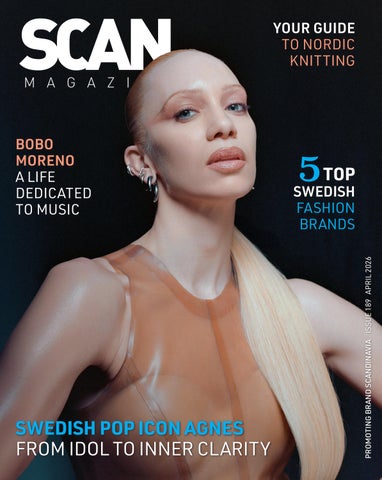
Scan Magazine, Issue 189, April 2026

Page 1


SCAN MAGAZINE

BOBO MORENO A LIFE DEDICATED TO MUSIC

SWEDISH POP ICON AGNES FROM IDOL TO INNER CLARITY

At The Salmon, we don’t just serve seafood — we tell its story. From Norwegian salmon and fresh shellfish to oysters and scallops, our kitchen celebrates the very best of what Norway’s waters have to offer. And while you dine, our Knowledge Centre takes you behind the scenes of one of Norway’s greatest natural treasures. Taste, learn, discover.

Open daily 11:30–22:00 — for lunch, dinner, and everything in between. Reservations recommended. Strandpromenaden 11, Tjuvholmen, Oslo thesalmon.com

SPACE AND TIME TO BREATHE, IN KAUNAS

If you are looking for a relaxing weekend getaway, we have a treat for you. In the charming city of Kaunas, in the heart of Lithuania, rush-hour stress and urban inconveniences feel like a distant memory. When here, you can set your own pace.

The slow rhythm of Kaunas is felt physically first. Even on weekday mornings, people are not rushing – they walk leisurely, always finding time for a coffee with an acquaintance. Taking time simply to be, to watch the city wake up, to sit on a bench along Laisvės Alėja – one of Europe’s longest pedestrian streets – is part of the Kaunas way of life.

In the heart of Kaunas’ Old Town, a peaceful greenery awaits in Santaka Park, where the rivers Nemunas and Neris meet. In Žaliakalnis, the century-old Oak Grove invites wandering, while a refreshing pine forest awaits in Panemunė. Or perhaps you prefer a walk along Kaunas Lagoon, admiring Pažaislis Monastery, where time seems to stand still?

In Kaunas, heritage from the Middle Ages blends with its modernist architecture, part of a UNESCO World Heritage site. The city is home to numerous museums, while historic districts welcome visitors to former homes of artists and public figures, like an open-air museum telling stories inside and out.

With a diverse cultural programme, boredom never sets in. Music lovers are in for a treat, as Darius and Girėnas Stadium hosts global stars such as André Rieu, Lenny Kravitz, A$AP Rocky and Pitbull. In the city centre, venues include the charming cinema Romuva, Lithuania’s oldest.

Kaunas is a city of stylish cafés and restaurants. Its gastronomy scene is full-flavoured, offering local specialities and Michelin-star dining. During your visit, your taste buds will be delighted. Don’t miss the legendary farmers’ market near Kaunas Castle, open on Saturdays.

Everything in Kaunas comes down to freedom. The freedom to choose – a slow morning, a long lunch or a lively evening; quiet time in nature or the sights of the city. Kaunas also offers the luxury of not choosing at all – simply taking it all in.

Editor’s Note

Dear reader,

As spring unfolds, many people may feel a new creative energy bubbling or the urge to return to old pursuits. This sense of renewal is at the heart of this issue, where craft, creativity and personal expression are in full bloom.

For those looking for inspiration to take up or expand a creative craft, our knitting theme will offer plenty of ideas. Brimming with inspiring women, head-turning patterns and sustainable handmade materials, it showcases the best of the region’s rich knitting traditions.

Talking of head-turning and inspiring, our cover star, Swedish pop icon Agnes, falls into both categories. In conversation with our Scandipop columnist, Karl Batterbee, she reveals how 20 years in the music industry have shaped her view of herself and the world around her.

While Agnes rose to fame after winning Idol 20 years ago, our special feature explores a different version of a life devoted to music. At 60, Bobo Moreno, one of Denmark’s most accomplished singers,

has just released his first solo album with original music. His story is driven by a love for music and a continuous desire to explore, evolve and contribute.

Beyond individual stories, this issue also celebrates experiences and objects that enhance everyday life. As always, we present a host of places to visit, stay and eat, alongside a range of distinctive Scandinavian designs, including a special theme on Swedish design and fashion.

Whether expressed through craft, music or design, a common thread runs through it all: the desire to create and bring joy.

We hope this issue will do that too, and that you will enjoy reading it as much as we enjoyed creating it.

SCAN MAGAZINE

In this issue

COVER FEATURE

8 Agnes – from Idol winner to confident pop icon

Having just released her latest LP Beautiful Madness, Swedish pop icon Agnes speaks with Scan Magazine and shares her thoughts on her two decades in the industry. Expect to meet an artist with confidence, deciding the rules of her own party.

DESIGN

14 Unique golf accessories, bold knitwear and wardrobe basics

From a uniquely Norwegian golf accessory to timeless basics and Faroese knitwear, this month’s Design pages explore Scandinavian creativity through colour, texture and playful charm. On our We Love This pages, we present everything you need for successful spring hosting, while our Fashion Diary offers a host of ideas to lighten up your wardrobe.

FOOD AND DRINK

24 Beer, friendships, and a crunchy treat Beer sommelier Malin Norman reflects on the borderless friendships created through a shared love for beer. Meanwhile, author and food blogger Sofia Nordgren shares a delicious recipe for homemade granola, sure to make anyone invited over for breakfast fall in love with your kitchen skills.

SPECIAL THEMES

26 Sweden’s top fashion brands – brilliance and bravery

In this special theme on Swedish fashion, we meet five very different fashion and design brands that all share one thing: a drive to create. From sparkling jewellery to comfortable slippers and pioneering outdoor wear, craft, quality and innovation are at the core of it all.

34 The best of Nordic knitting – a bonanza of creativity and colour

This theme is, literally, bursting at the seams with creativity. Find inspiration in the stories of women who quit their jobs to pursue their dreams, beautiful patterns, hand-dyed yarn and traditional spinneries.

66 Made in Sweden

– where sustainability meets individuality

In this theme, we explore a handful of Swedish brands that all honour the nation’s reputation for innovativeness and craftsmanship. From stylish recycling solutions to long-honoured craftsmanship and tempting new spirits, you are sure to be impressed by the stories and the people behind them.

SPECIAL FEATURE

56 Bobo Moreno – a lifetime in music

When Bobo Moreno decided, at the age of 20, to make music his profession, the industry looked very different from what it does today. Nonetheless, the 60-year-old has just released his first solo album with original material. We had the pleasure of talking to the accomplished singer; the result is a captivating and, at times, surprising story of a life dedicated to music and bringing joy.

CULTURE

116 Culture – events, music and film highlights Where to go and what to experience this month? Our Culture Calendar rounds up the best arts events across the Nordics, music columnist Karl Batterbee recommends new pop numbers to sing along to, and illustrator Gabi Froden ponders which women had the most fun in the past – those at British tea parties or Viking shield maidens. Meanwhile, film and TV columnist Anders Lorenzen takes a look at the Scandinavian wins at this year’s Academy Awards.

Embrace your ‘Beautiful Madness’ with Agnes

Swedish pop royalty Agnes pairs music with mindfulness on her latest LP Beautiful Madness, the follow-up to 2021’s four-time Swedish Grammy-nominated album Magic Still Exists. The star speaks with Scan Magazine, sharing some words of wisdom we might all benefit from.

is currently celebrating 20 years as a recording artist.

Agnes

Agnes’ moment of Beautiful Madness has arrived at an important milestone for the singer, as she celebrates the 20th anniversary of her victory on the second series of Idol, which was the start of her two-decade career as a recording artist. “It’s so surreal when you hear that number,” admits the Vänersborg-born Agnes: “I can’t even understand it… 20 years!”

Replacing rose-tinted glasses with Balenciaga Covered Eyes

Shortly after that Idol win, a Number 1 single and album was achieved by the girl who had become Sweden’s newest pop idol at just 17 years of age. A second Number 1 album happened for her less than a year after her debut, but it was not until her third album – 2008’s Dance! Love! Pop! – that Agnes started to break through internationally. And what a breakthrough it was. The album’s biggest single was Release Me, a song that became a major smash across the globe, becoming one of the biggest hits of the year in the UK, where it peaked inside the Top 3.

All this time later and Agnes’ music continues to draw people to the dance floor in large numbers. The first single from the Beautiful Madness album was Balenciaga Covered Eyes; an exploration of the contrast between external glamour and inner fragility that is experienced on a night out at a club, with those ponderings set to pounding house beats and piano. “It all started with an image of a person at a party, appearing confident on the surface but experiencing something else inside,” Agnes reveals. “It came from wanting to write something I myself would want to hear when going out on weekends.”

Interesting things happen when we stop chasing perfection

Contrast is a running theme throughout the album, and Beautiful Madness is not only its title, but an embodiment of the soul of the album, encapsulating Agnes’ life experiences in recent years; embracing contradictions, showing both strength and vulnerability, while releasing the pursuit of perfection. “It’s

about having a lot of questions and not really having it all figured out. It was the first time in my life where I felt, honestly, it’s OK to be complex. It’s ok to feel and think a lot of things at the same time. You don’t have to simplify yourself.”

Beautiful Madness can serve as a therapy session if you are open to it, cheering you on and encouraging you to lower your walls and step outside of your comfort zone. All set to the most invigorating dance music, of course. From digging deeper into whatever might be holding you back (Trigger), to keeping your pride in check and abandoning your vanity (EGO), Agnes clearly encourages listeners to break down your barriers and follow your dreams (MILK). “I’ve realised that it’s precisely in the contradictions, in the madness and the unfinished, that life actually feels alive. That’s what Beautiful Madness is,” Agnes explains, adding: “Life is a beautiful madness, and it’s when we stop chasing perfection that the truly interesting things happen.”

The ultimate self-help anthem

On 1 January 2026, Agnes made quite a cunning move, releasing the ultimate self-help anthem, Wake Up, as a precursor to the album. With jaw-dropping clarity, she had a message to accompany all of those New Year’s resolutions made the night before. “It all started with the lyrics,” Agnes confirms. “It just came to me: ‘wake up, honey, you’re living in the past / you and I are so much more than our history / raise your standards / perspective is always a key to your truth’. And I looked at it in a playful way of talking to yourself. I hate the idea of thinking you know who you are and how to do things. You can always change, and you can always find new ways of looking at yourself, and other people and the world. Wake Up is a playful way of getting out of that stagnant idea of who you are.”

Agnes sings her mantras of self-worth with such clear conviction that as a listener you cannot help but envy someone who seems like they have arrived at the place of complete self-acceptance. But that is not the case at all: “It’s definitely

Agnes was the winner of the second series of Sweden’s Idol TV show, in 2005.
Agnes achieved huge success outside of Sweden with global chart smashes such as Release Me.

going to be a lifelong journey,” laughs the singer. “But that’s also so inspiring. So many times, it has happened to me… You think you’ve got it all figured out. And then one year later and you’re somewhere else completely. I think that’s so important, to always be open. Because everything can change.”

“This is a party I want to invite people to” As well as returning with a new album, Agnes has been getting out there to perform it for fans, too, with two soldout shows having already taken place in London and Stockholm this year. “Those two shows,” the artist recalls, “that was a pretty overwhelming experience. It had been 12 years since I last had my own live show. To see all these people showing up and singing along, it was so beautiful.”

More gigs will follow in 2026, as well as some festival appearances confirmed in both Sweden and the UK. And Agnes is looking forward to seeing those crowds again: “When you’re making the music, you’re in your own little bubble. You go to the studio, and you work with a little group of people, so much in your own world. To then go up on stage and to see the people who are listening to the music, to be able to connect with them and to see the reaction of people crying and singing along… I’m so grateful. It’s just a beautiful way of spending your time.”

Surprisingly for an artist two decades into her career, her appreciation for performing in front of a live crowd is actually quite a new experience: “When I was younger, I had a lot of stage fright. I think it was because I didn’t know what it was all about. How do I want to express myself? What do I want to say? How should it look? How should it sound?”

Now, Agnes is an artist with full confidence in her answers to those questions. “This is a party I want to invite people to. And now I feel like I know exactly how I want this party to be. That’s the new chapter in life, to meet people and to sing and dance. I’m not religious, but I’m spiritual. And music is such a spiritual thing.”

Six months after its release, Agnes’ EGO single is still in the upper echelons of the Swedish radio airplay chart.

Fashion Diary

April in Scandinavia is all about light. Longer days, softer shadows, and wardrobes that shift from heavy layers to breathable structure. This month is about styling monochrome neutrals such as cream, khaki, black and denim, and finishing the look with one confident pop of colour.

These Italian-made naturally elasticated viscose-cotton-rubber cords are hand woven and subtle, but they elevate your trousers immediately. They are more about texture than colour, and manage to add depth without screaming, which is perfect for spring, summer, and even early autumn.

The braided elastic belt, EUR 65 www.asket.com

If there is a pop of colour needed, no better way to do it than with a fresh red. If red is not for you, the comfortable merino beanie is available in 34 different colours – add bold ones for a bit of pizzazz!

Merino wool beanie in standard red, EUR 35 www.colorfulstandard.com

The return of double denim isn’t ironic anymore and this time, we should make it chic and confident. These relaxed straight legs have a classic five pocket and are perfect for any capsule wardrobe. Along with the denim jacket, wear them with a plain tank and clean sneakers for a casual look, or add brown leather loafers, a colourful hand-knit Sophie scarf, and a big pair of sunnies to elevate the outfit, and it’ll look as if you just rolled out of a movie set. Straight fit jeans in blue, EUR 195 www.holzweileroslo.com

A classic straight cut and open neckline tank top can seem too relaxed and simple, but layer it correctly and it will feel intentional. Let it sit clean against denim, or wear it under a cool bomber or oversized leather jacket. And should the April sun get too warm, you can easily peel off any outer layers. Elmer white, EUR 87 www.livid.no

An elegant oversized yet tailored coat crafted from organic cotton twill with a natural wind-repellent finish. With a refined collar and dropped shoulder nodding to the classic workwear shape, it’s the type of coat you can throw over everything, whether going to the shop, work, or out for a formal dinner. Wear it open over tonal layers – cream knit, ivory tee, offwhite trousers, and so on – so that the khaki frames the look rather than dominates it, then add a pop of colour with a scarf, hat, light gloves, or all three! Joe coat twill in classic khaki, EUR 845 www.aiayu.com

Crafted in Italy, the Castellare bag feels modern, directional, and flexible. Wear it crossbody for day wear, then shorten the strap and carry it higher on the shoulder for the evening – same bag, but completely different attitude.

Castellare grained leather shoulder bag in mandorla, EUR 590 www.atelieratp.com

Kitten heels are having a moment. They’re practical without losing femininity, not to mention the attitude that comes with. The criss-cross straps add subtle tension, which is perfect against soft fabrics. Criss-cross leather slingback pumps in black, EUR 119 www.stories.com

This Alpaca knit is more than just a scarf; it’s a texture piece. With a sharp triangular presence and a fluffy feel that softens the sharp silhouette, it can be worn to keep the lingering cold at bay, but also just as an accessory. Drape it around your shoulders for that timeless, preppy look, or wear it as a headpiece with a pair of big, black sunnies!

Pus

in cream white, NOK 800 www.auroraverkstedbutikk.no

Scarf Trekant
Alpakka

EINSTAKT: A Faroese fashion tale woven in wind and wool

On the windswept archipelago of the Faroe Islands, knitting patterns are like stories passed down from one generation to another. In recent years, Tórshavn-based brand EINSTAKT has become a meeting point between heritage and modern design, where centuries-old techniques are reimagined for a contemporary wardrobe.

At the heart of modern Faroese knitting, there is a small, independent label redefining what modern Nordic fashion can look like when rooted firmly in place, people and purpose. Meaning unique in Faroese, EINSTAKT certainly lives up to its name.

Based in Tórshavn, EINSTAKT’s products are both a reflection of its environment and a tribute to it. Its silhouettes are timeless, its knitwear intricate, and with a deeply considered approach to production, EINSTAKT blends heritage craftsmanship with contemporary design, offering garments that feel as enduring as the landscapes that inspire them.

A knitting odyssey

EINSTAKT was born under a completely different name, in a completely differ-

ent city. Shortly after its founder and designer, Beinta Poulsen, finished her education as a fashion designer in Copenhagen, she started a storefront that made knitwear for women. It did not take long for the store to gain recognition, and soon, the Copenhagen Vision Fashion Fair brought it into the eye of a broader international audience.

“It was a great success and we saw orders from all over the world,” says Poulsen. “We went international, and I had the chance to take my designs to fashion fairs everywhere, yet I couldn’t help but notice how I never got to meet the actual consumers that wore my designs.”

The distance between designer and wearer felt too great, too impersonal, so Poulsen made a bold decision: to return home. “I came back to the Faroe Islands in 2013, which gave me the opportunity to reassess what I wanted for a clothing brand. I decided to narrow my focus and return to my original dream of having a small shop, which is how EINSTAKT came to be.”

While EINSTAKT shifted Poulsen’s focus from global expansion to local connection, her designs have done anything but stay out of the international eye. Since opening, they have been featured in publications such as ELLE, Harper’s Bazaar and Vigour, and her designs are worn by an international celebrity clientele. “I’m very happy that EINSTAKT is recognised by stylists everywhere, but it’s nice to be back on the Faroe Islands where I can meet the consumer and maintain a close-knit community. Here, the brand’s story isn’t lost between myself and the buyer.”

A modern Faroese voice

It is on the Faroe Islands that the designs truly blossom and come to life. Before any design degrees or fashion fairs, Poulsen was born onto an archipelago where the knitting tradition was woven into everyday life. Poulsen herself began knitting at the age of five, and today continues to draw on Faroese patterns from across the ages, some dating back more than a century.

“When designing, I try to honour the existing knitting traditions by drawing from old patterns and repurposing them for a modern wardrobe. It’s a lovely way for us to share the Faroese traditions, but also to bring our history with us.”

And of course, it is impossible to speak of EINSTAKT without speaking of nature, not just in terms of sustainability in pro-

duction, but also as a muse. The wild, untamed nature shows itself in all the designs, from earthy tones that mirror the shifting skies and rugged terrain, to textures that echo the tactile richness of wool and landscape alike. There is a sense of resilience in the garments, perhaps a reflection of island life itself. “Most of my inspiration is taken from the beautiful nature on the islands, as well as the tranquillity it brings. We have a lot of respect for the land, which we want to translate through the designs, but also to reflect in how we produce our garments.”

In an industry often driven by speed and excess, EINSTAKT takes a deliberately slower path. Knitwear is made in small batches, ensuring minimal waste and maximum care. Once designed, the patterns travel through a network of around 60 Faroese women, many of whom are

retired and simply for their love of and skill in knitting. For non-knitted pieces, they repurpose leftover surplus fabrics from larger fashion houses into new garments. “One of our most popular pieces now was designed 12 years ago, and last year it was seen on Skye Aurelia at New York Fashion Week,” Poulsen says.

The careful balance between preservation and innovation defines the brand’s aesthetic: classic yet contemporary, familiar yet fresh. Every piece is designed to remain relevant beyond quick fads and passing trends, and the high-quality mixed Faroese wool ensures that the garments will last just as long as the wearer chooses to use them.

www.einstakt.com

Facebook: EINSTAKT

Instagram: @einstakt_official

Colourful essentials crafted to last

With its collection of colourful basics in natural materials, Danish brand Jalfe has quietly built a loyal international following. Known especially for its ultrasoft merino wool, its collection combines durability and comfort with a carefully curated palette and a commitment to responsible production. Behind the brand stands a mother–daughter team, Jane and Josefine Bredstrup, united by a shared interest in textiles and colour.

From a small shop in Svendborg to an internationally recognised label, Jalfe has grown steadily over the past two decades. Today, the brand is stocked across Europe and beyond, with a particularly strong presence in Germany and Switzerland. Yet its foundation remains simple: creating garments people return to over time. “We want to make clothes that people truly enjoy wearing – pieces they come back to again and again,” says owner Jane Bredstrup.

The appeal lies in the balance between thoughtful design, material quality and a clear sense of identity, where colour and consistency play a central role.

From craft shop to clothing line

The story of Jalfe began in 2001, when Jane Bredstrup opened a small arts and crafts shop in Svendborg, selling handmade items inspired by natural materials, many of which she made herself. Over time, the assortment expanded to include more clothing, but a key element was missing. “We needed something simple to wear underneath everything else – something natural, comfortable and easy to combine,” she explains.

That need led to the brand’s first product: a long-sleeved blouse in 100 per cent merino wool, introduced in 2008. Initially sold in the shop, the design gradually gained traction, finding its way into oth-

er retailers and onto international trade fairs. Growth came steadily, driven by demand. “We could see there was a market for it,” Bredstrup recalls.

Over time, the collection expanded to include organic cotton, introduced in response to customer demand for lighter materials. Today, Jalfe’s products are distributed across several European markets, as well as further afield.

Colour, quality and consistency

At the core of Jalfe’s design philosophy is the idea of creating timeless, functional basics. Rather than following seasonal collections, the brand works with what it describes as an organic flow, where new designs and colours are introduced gradually while others are phased out. “We don’t work with traditional seasons,” says marketing manager Josefine Bredstrup. “The goal is to create pieces that work all year round and remain relevant over time.”

Central to the collection is merino wool, valued for its softness, breathability

and temperature-regulating properties. “Many customers tell us that they usually can’t wear wool, but they love ours,” she says. Equally distinctive is the colour palette. With more than 25 shades and numerous stripe combinations, Jalfe’s best-selling styles offer a wide range of options while maintaining a coherent expression. “We love working with colours and combinations,” says Josefine. “It’s about creating harmony.”

The garments are designed to move with the body, using knitted fabrics that provide flexibility, comfort and longevity, allowing them to remain part of a wardrobe for years.

A family business with a conscious approach

Behind Jalfe is a close-knit team, where family plays a central role. Of the roughly ten people involved in the business, more than half are family members, creating a working environment shaped by collaboration and shared values. “We all take part in different aspects of the business,” says Josefine. “It’s very handson – from design to packing orders.”

Sustainability is reflected in both materials and production. Jalfe works exclusively with natural fibres, including mulesing-free merino wool and organic cotton, and collaborates with European manufacturers under regulated working conditions. Equally important is the brand’s approach to production itself. By avoiding fastchanging collections and instead maintaining a stable core range of lasting garments, Jalfe reduces waste and encourages long-term use.

Looking ahead, the team continues to explore new materials and possibilities, guided by the same principles that shaped the brand from the beginning. For now, however, the details remain under wraps. As Jane Bredstrup notes with a smile, something new is in the works – but for the time being, it remains a closely guarded secret.

www.jalfe.dk

Facebook: JalfeDenmark Instagram: @jalfe_denmark

Merino shirt and skirt.
Merino shirt in Violet melange.

Bringing Nordic traditions to the world of golf

The recently launched Ørn Golf Co. specialises in premium golf headcovers in knitted wool with designs inspired by traditional Norwegian knitwear patterns. Combining functionality with an appreciation for craftsmanship and a celebration of Nordic heritage, the headcovers offer a twist on a classic piece of golfing gear.

Golf is a sport that requires careful attention to detail, so golfing accessories should follow suit. As a keen golfer, Ørn Golf Co.’s founder Eivind Griffith Brænde understands the importance of function, durability and style in golfing gear: “I appreciate high-quality products that are thoughtfully crafted and that stand out.”

The brand’s name is rich in meaning. In Norwegian, ørn means eagle, evoking qualities of strength, precision and grace. For golfers, an eagle is a significant achievement worth striving for. When pronounced in English, the word sounds like earn – a subtle reminder that on the golf course, just as in other areas

of life, success must be achieved through intention, effort and dedication.

Combining the best of natural materials with the rich heritage of Scandinavian knit design, the new line of headcovers has so far garnered great feedback from golfers around the world. “We’ve spent a long time on our product development,” Griffith Brænde says. “Details matter in golf, and we’ve carried that truth with us when it comes to our designs –everything has to be right, from the way they look to how they feel.”

After extensive experimentation and testing, Ørn Golf Co. has landed on a range of premium headcovers it is proud to bring to the world of golf. For the discerning golfer who values both performance and style, this is an ideal accessory.

The varied designs pay homage to traditional Nordic knitting patterns, and the colour palettes also draw on the typical

shades used in classic Norwegian knitwear. The long design process has resulted in a stylish range of headcovers with an expression that is simultaneously timeless and contemporary.

“I thought Nordic knitting traditions would fit in well with the world of golf, so we took a deep dive into the rich world of knitting patterns and gathered plenty of inspiration,” Griffith Brænde explains. “We’ve developed designs with classic, elegant expressions that I believe suit the game of golf very well.”

Elevating the golfing experience

Crafted from 100 per cent wool, the headcovers protect golf-club heads from damage and scratches during both play and transport. The high-quality wool headcovers offer excellent protection against the elements and ensure equipment remains fresh and protected. Since wool is an odour-resistant, self-cleaning material, the headcovers are low-maintenance. “Wool is a fantastic material that is perfectly suited to this purpose,” Griffith Brænde says. “These products are made to be used, so they have to be premium quality and built to last.”

Designed in Norway and made in Europe, the production process involves a knitting technique that ensures extra interior protection and elasticity, making the headcovers more durable. A naturally elastic material, wool lends itself well to function

and durability – over time, the headcovers will adapt to fit each club perfectly.

Ørn Golf Co. takes pride in using 100 per cent pure wool – a natural, biodegradable fibre with qualities that feel at home on the golf course. “Golf is played in nature, so it feels right to choose materials that belong there,” Griffith Brænde says. “Our headcovers are real, quality products that reflect Norwegian traditions –and the choice of wool is as much about performance and feel as it is about sustainability.”

The range of headcovers is designed to fit most clubs in different size categories, and there are pattern variations on every size so golfers can find the correct club easily when they’re on the field. Ørn Golf

Co.’s well-crafted pieces have character, offering a refined, eco-friendly alternative to the mass-produced, synthetic products that dominate the market today. They ship globally, bringing Nordic craftsmanship to golfers around the world.

“We want to be part of the golf experience of those who value products that are real and well-made, and who appreciate the tradition and history behind our brand,” Griffith Brænde adds, concluding: “Our goal is to bring Norwegian aesthetics to the world of golf and provide trusted products that elevate the golfing experience for golfers across the world.”

orngolf.com  Instagram: @orngolfco

We Love This

With spring in full swing and April blossoms all around us, it‘s time to gather with friends and loved ones for some long-needed chitchat, fun and flavours – perhaps even head back to the great outdoors. Whether opting for a fancy picnic or a chill garden lunch among colourful shrubberies, here’s everything you need for successful spring hosting.

Broste Copenhagen – Limfjord white wine glass

April is the perfect time for crisp, refreshing and zesty tones, so bring out your favourite bottle of white wine and these funky Limfjord glasses from Broste Copenhagen. With a hammered yet soft wavy look, these clear mouth-blown glasses are not only a sight for sore eyes, but will undoubtedly also serve as a talking point around the table.

Limfjord white wine glass, EUR 17.50 www.brostecopenhagen.com

BITZ – Gastro cake stand in cream

No dinner is complete without dessert. Serve your braided buns, cupcakes or two-tiered cake on this footed cake stand from the iconic Danish brand BITZ. Made from sturdy stoneware, the stand is finished with a cream-coloured glaze and is perfectly dishwasher-, microwave-, oven- and freezer-safe. Despite its Scandinavian minimalism, the reactive glaze makes every piece one of a kind. Gastro cake stand in cream, EUR 49.95 www.bitzliving.com

Muubs – Glass Ripe Low in smoked brown

As part of Design Concept Denmark, Muubs aims to create products that are based not only on design but also functionality and quality. Its Ripe series reflects this through a collection of ribbed glasses that are not only fun to look at but will fit easily in your hand. These Ripe Low glasses are ideal for everything from everyday use to fun, low-lit dinners, and the smoked brown colour adds a bit of edge to a traditional table setting. Glass Ripe Low in smoked brown, EUR 15 www.muubs.com

Inspired by the gingham patterns in soft, quilted textures, the mouth-blown Laranne bowl from ByOn adds a bit of texture to the tablecloth. It can be used both as a piece of decoration or a serving dish for nuts, desserts, salads – anything a light spring palate might desire. Want to take it even further? Why not elevate its soft shades with a pop of colour in the food, perhaps some pomegranates or edible flowers.

Bowl Laranne M in off-white, SEK 549 www.byondesign.com

Hadeland Glassverk – Gilde Drum carafe

Now this is a fun addition to the table, sure to get people talking. The Gilde Drum carafe comes in a set of four, with each guest getting their very own abstract-art-piece-turned-carafe. Even more curious, Norwegian designer Inger Magnus has not designed the glass to stand on the table but rather as a cork in the carafe.

Gilde Drum Carafe, set of 4, EUR 36.95 www.hadeland.com

Mateus – Oyster bowl in forest green

Avid travellers might recognise a hint of Portugal in the stunning glaze of Mateus’ bowls, whether in forest green or any of the other colours – and for good reason. The iconic Oyster design is a love marriage between Swedish design and Portuguese craftsmanship. Inspired by the soft, organic shapes and patterns of the ocean, each hand-painted stroke of glaze leaves a unique imprint, so every bowl is truly one of a kind.

Oyster bowl in forest green, EUR 43.50 www.mateuscollecion.com

Olsson & Jensen – Eden dinner plate in white Sometimes, plain tableware is necessary to allow the food to shine. The Olsson & Jensen Eden dinner plates have a sense of minimalism, yet their scalloped edges give the table that little extra oomph. Beautifully crafted in stoneware, these white plates come in a set of four. Eden dinner plate in white, EUR 25 www.olssonjensen.se

From karaoke bar in Beijing to taproom in Barcelona

Beery friendships extend across the world. They can enhance your understanding of a country’s history and culture, of the locals’ flavour preferences, perhaps even lead to blurry encounters in karaoke bars – and surprising reunions in Catalonian taprooms.

Last autumn, I judged a beer competition in Beijing, China. It’s one of my favourite beer judging experiences, but I’m not entirely sure why. Perhaps it was the excitement of being in a never-before visited country, so far away, judging a new competition. Or maybe it was because of a particular karaoke bar.

Let me explain. I had never been to a karaoke bar before, as it was my firm standpoint not to set my foot in one, ever. It just didn’t appeal to me, the spontaneous singing challenges and the far from tasty mainstream beers. But when in China…something happened. Convinced by a group of local beer judges, I found myself in one of Beijing’s many karaoke bars one evening.

Watching how they couldn’t wait to take the stage in the small neon-lit room, to

blurt out Celine Dion’s My Heart Will Go On, Dire Strait’s Walk of Life or some Chinese superhit, was beyond fascinating. Somehow, baskets filled to the brim with beer appeared, and I had an out-of-body sensation of being in a movie. One of my brave European colleagues even did a high-level performance of Despacito, to the delight of the local crew, and me of course. That evening was mindboggling, as was my self-inflicted headache the following day.

Fast-forward to Barcelona Beer Challenge last month. I had the funny feeling of recognising one of the other beer judges, but I couldn’t place him in my memory. When visiting a taproom after judging one day, we happened to sit next to each other and started talking about this and that, as you do. All of a sudden he mentioned karaoke, and lightning struck. Yes! Indeed, we were

both judging in Beijing and part of the group of troublemakers going to that karaoke bar.

Looking through photos on his phone, he quickly found me in a few, sitting across the table filled with beer bottles, applauding whoever was on stage and cheering with the person next to me. The same for me; there he was in my photos, in the blurry karaoke bar in Beijing. And once again at the same table, sharing beers and funny stories in a taproom in Barcelona.

Malin Norman is a Certified Cicerone®, a certified beer sommelier, a BJCP certified beer judge, and a member of the British Guild of Beer Writers.
Photo: Tommao Wang on Unsplash

Granola with dried cranberries

There is something very comforting about a jar of homemade granola sitting on the kitchen counter.

Toasted oats, nuts and warm spices drifting through the house while the granola bakes slowly in the oven. This granola is simple and made with ingredients that you likely already have in your pantry. Rolled oats, nuts, seeds and a touch of sweetness come together in the oven until crispy and golden brown. The sweetness from the apple juice and the syrup is balanced by the sourness from the cranberries.

This is a recipe that invites you to make it your own. Use raisins instead of cranberries, or cinnamon instead of cardamom. Experiment and see what happens. Which one becomes your favourite?

Homemade granola turns a few simple ingredients into something crunchy, wholesome and special. Serve it over yoghurt, milk or with fresh berries. Or why not just enjoy it by the handful?

Ingredients:

5 dl | 200 g rolled oats

2 dl | 150 g nuts of your choice, e.g. hazelnuts, cashews and almonds

1 dl | 60 g sunflower seeds

1 dl | 100 ml concentrated apple juice

3 tbsp maple syrup

2 tsp cardamom

1 dl | 55 g dried cranberries

Instructions:

1. Preheat the oven to 175°C.

2. Coarsely chop the nuts.

3. In a baking bowl, combine rolled oats, nuts and sunflower seeds.

4. In a separate bowl, combine apple juice, maple syrup and cardamom.

5. Pour the apple juice mixture over the rolled oats and stir until well combined.

6. Line a baking sheet with parchment paper and spread out the granola evenly.

7. Bake in the middle of the oven for about 20 minutes, or until golden brown. Stir every five minutes.

8. Let cool completely, then add the dried cranberries.

9. Store in an airtight container.

Winner of the best Regional Cookbook at the Guild of Food Writers Awards 2022, Sofia Nordgren lives with her family in a small town in Sweden, working as a photographer, content creator and plant-based cookbook author. Cooking and baking have always been a hobby of hers and on top of that, she has a passion for nature, gardening and slow, seasonal living. Foggy mornings, cinnamon buns, and playing with her kids are among her favourite things in life. Sofia Nordgren also runs the successful blog, The Nordic Kitchen.

FASHIONTOPSWEDISHBRANDS2026 SpecialTheme:

Subtle brilliance – anytime, anywhere

What began as a simple observation of something missing in the market has grown into one of the most recognisable jewellery brands in Sweden. astrid&agnes was founded in 2005 while its male counterpart AROCK launched in 2008. Both brands came with a clear idea from the start: expressive and timeless jewellery for every occasion, accessible to everyone.

Sofie Axelsson is the hairdresser who turned entrepreneur after noticing a gap in the market. At the time, oversized pieces with a sense of glamour were surprisingly hard to find within an affordable range. astrid&agnes was established to change that. The brand took an unconventional route into retail, first selling the collections through hair salons and quickly gaining traction, worn by celebrities and spotted in the media.

Sales channels expanded to jewellery shops and twenty years on, the brand has become an established household name in Sweden and abroad.

astrid&agnes

Inclusivity has always been central to the brand identity, reflected in the name. “We selected the names, Astrid and Agnes, to appeal to women at all stages of life. We create with a wide audience in mind:

no specific age group and no fixed style,” Sofie Axelsson, CEO and founder, says. “There should be something for everyone. Whether your style is minimal or bold, classic or modern, there’s a piece of jewellery made for every occasion. From the milestones – weddings, celebrations and anniversaries – to everyday life, with work and relaxed moments with friends and family.”

All work takes place at their office in the city of Varberg, on the west coast of Sweden. Despite its growth, the company remains close-knit. With a team of eight employees, plus sales representatives and international partners, it is a collaborative environment where creativity thrives. Sofie designs every piece with her

astrid&agnes creates jewellery for every occasion, big or small.
AROCK creates timeless pieces for a male audience.

team, working closely with long-standing manufacturing partners to ensure consistency and quality.

AROCK

In 2008, the company expanded further with the launch of AROCK, a line dedicated to men’s jewellery. The idea emerged from repeated customer requests about similar pieces designed with a male audience in mind. AROCK took shape with a focus on stainless steel and leather, materials with a masculine feel that are both natural and durable – stylish with a timeless touch.

Today, astrid&agnes and AROCK are both firmly established in Sweden, with around 180 retailers across the country and a growing international presence. Norway has become a strong market over the past eight years, with around 100 stores, and expansion into Germany is already underway. While e-commerce continues to grow, the brand remains deeply rooted in physical retail, with approximately 90 per cent of sales coming through resellers. “We’re increasing our online presence through our website to reach new customers and strengthen the brand, but the stores remain incredibly important to us. The relationships that we’ve developed with our resellers are simply essential to our business,” Axelsson says.

Quality material for durable pieces

“Quality has been key from day one,” Axelsson explains. “Our collections are made from stainless steel, genuine leather, high-grade crystals, and real freshwater pearls. The decision to move away

from traditional precious metals like silver and gold has been deliberate: stainless steel offers durability, longevity, and a refined look but without pushing prices beyond reach.”

The design philosophy has remained consistent over the years: clean, Scandinavian lines with attention to detail. While trends come and go, the goal is always to create jewellery that lasts, both physically and stylistically. Pieces should be wearable across seasons to be easily combined with new additions over time.

Jewellery for every occasion

Jewellery is both deeply personal but also an appreciated gift. From Mother’s Day to birthdays and weddings, astrid&agnes and AROCK have naturally found their place in the gifting segment. This idea expanded further last year with the launch of a small lifestyle collection, including glassware and tray sets,

as well as a children’s line designed for ages five to 12.

As the brand celebrated 20 years last year, there is no sign of slowing down – quite the opposite. While the brand is maintaining its firm grip on its current markets in the Nordics and Europe, new opportunities are spotted across the pond. “We’ve seen our jewellery on celebrities in Los Angeles, which is exciting, and completely in line with our ambitions; we’re constantly looking for exciting opportunities to grow and expand our reach. In the end, it’s about the joy of creativity and seeing our creations worn with pride – simply how it adds character to outfits on people all over the world,” Axelsson concludes.

www.arockman.com

www.astrid-agnes.com

Instagram: @arock_official

@astridoagnes

TikTok: @astridoagnes, @arock_offical

Neo ring. Photo: astrid&agnes
Sierra ring. Photo: astrid&agnes
Sofie Axelsson, founder and CEO.

Timeless fashion for a modern lifestyle

Jumperfabriken celebrates the strength and femininity of women. Inspired by craftsmanship traditions and the elegant fashion of the past, this Swedish brand offers carefully crafted knitwear, dresses and jumpers – modern classics with a feminine fit. This spring sees a new collection in collaboration with Carl Larsson-gården in Sundborn – a meeting of colour, craftsmanship and Swedish heritage.

Founded in 2007, Jumperfabriken is a Gothenburg-based fashion brand that celebrates the strength and femininity of women. “Our ongoing goal is to create wardrobe favourites that make women feel stylish, well-dressed and confident, whether they’re heading to an important meeting or a festive occasion,” says founder Elisabeth Synnes.

With more than 20 years of experience in the fashion industry, Elisabeth set up her brand with the timeless elegance of past fashion in mind. “When I look through photo albums from the 1950s, 1960s and 1970s, I’m struck by how tasteful everything was back then,” she says. “It was common to make your own clothes,

for example by knitting, and things were really made to last.”

Jumperfabriken designs modern versions of classic garments, crafted from carefully selected materials. The range is broad: knitwear, dresses and jumper sets with a feminine fit. Classic yet suitable for today’s lifestyle and wardrobe – to be worn and loved. The brand has also expanded its universe with the men’s collection Olle by Jumperfabriken, inspired by the same timeless Scandinavian aesthetic.

Jumperfabriken x Carl Larsson-gården

At the end of March, a new collaboration with Carl Larsson-gården was launched – a meeting of colour, craftsmanship and Swedish heritage. “The collaboration unites timeless design with the artistic heritage of Carl and Karin,” says Elisabeth. “Influenced by artists Carl and Karin Larsson’s colourful home in Sundborn, we’ve created a limited-edition collection where every

detail carries traces of craftsmanship and everyday beauty.”

Carl Larsson-gården in Sundborn is an icon in Swedish interior design and family life, and Jumperfabriken’s founder has a particular fondness for Karin’s design approach. “Her creative joy and personal style have truly inspired me when creating this new collection,” she says. “Karin did things her own way; she’s a role model for female entrepreneurs. With this collection, I also want to promote the importance of sisterhood in design.”

Swedish design meets playful nostalgia

It is clear that Elisabeth is passionate about colours and patterns. With her brand, she wants to offer a range of beautiful garments, created from carefully selected natural materials that will last for a long time, both in terms of quality and design. Elegant in style, yet comfortable to

wear – the women’s and men’s collections from Jumperfabriken are ageless.

Honouring the Swedish knitting tradition, vintage prints and the playful spirit of the 1960s and 1970s, this year’s summer collection celebrates vibrant nature, joyful colours and feminine silhouettes. “Soft pastels and leafy greens blend with bright flower hues, printed on airy linens, crisp cotton poplins and delicate lace,” says Elisabeth. “Every piece brings a touch of effortless charm.”

Jumperfabriken’s collections are available in the web shop, in the concept store in Stockholm, as well as selected retailers across Sweden.

www.jumperfabriken.com

Facebook: Jumperfabriken

Instagram: @jumperfabriken

TikTok: @jumperfabriken

Jumperfabriken’s concept store: Skånegatan 80, Stockholm

Opening hours: Monday – Friday 11am-6pm Saturday 11am-4pm

Jumperfabriken’s founder Elisabeth Synnes.

Outsiders by nature: Farther, wilder and freer

Rooted in Swedish heritage and sustainability, Haglöfs is a progressive outdoor performance brand with its eyes firmly set on the future. Thinking outside the box, drawing outside the lines, living outside the comfort zone – outsiders by nature. This season sees exciting new initiatives, including a new black standard. Scan Magazine catches up with the pioneers to hear more.

Haglöfs, one of the oldest outdoor brands in the world, has over 100 years of heritage defined by quality and durability.

Founded by carpenter and visionary Wiktor Haglöf in 1914, it has developed into a progressive outdoor performance brand dedicated to pushing the boundaries of the dreaded comfort zone.

“From humble beginnings, our story has since evolved, and so has our offering,” says Victor Adler, chief marketing director. “Seeking constant progress, we’ve ventured into new territory, creating technical designs that set a new standard in craftsmanship and committing to do all we can to ensure that the outdoors will still be there for future generations to explore.”

The brand’s journey into more technical performance equipment includes sponsoring expeditions to Nepal in the 1970s, as well as Swedish mountaineer Göran Kropp’s adventures in the 1990s. This is also when the L.I.M Series was introduced, with lightweight, packable and versatile outdoor essentials. “In a

world obsessed with excess, our design process leads to a clean and minimalist aesthetic,” says Adler. “Our L.I.M Series challenges every gram, to maximise the feeling of freedom outdoors. It’s built around the idea that if you head out with less, you’ll be free to experience more.”

A new pre-dyed standard for black

In collaboration with Polartec, a new initiative has been introduced by Haglöfs this spring. Standard Issue Black™ is a shared pre-dyed black standard designed to simplify sourcing and reduce the environmental footprint associated with fabric dyeing and colour development.

“Black is the most used colour in outdoor apparel, yet it’s rarely the same shade from one fabric to another,” explains Adler. “Across the industry, countless versions of black are developed and dyed separately, creating unnecessary complexity and impact. We aim for long-lasting gear, lower-impact materials, and industry collaboration to reduce unnecessary variation in the

outdoor industry and support more responsible product development.”

This is demonstrated through Black Capsule, a limited edition collection created using existing Polartec leftover fabrics in multiple black shades. Rather than creating something new, the capsule brings these variations together to make the implications of today’s fragmented approach to black visible, and to set the context for a shared standard going forward.

Olympic race suit and L.I.M Horizon

The technical expertise of Haglöfs extends not only to expeditions and new standards, but also to the Olympics. As an official partner of the Swedish Olympic Committee (SOK), Haglöfs was entrusted with designing the official

race suit for Sweden’s alpine skiing disciplines and ski cross at the 2026 Winter Olympics in Milano Cortina.

The L.I.M Series, which was launched in the late 1990s, has also evolved over the years and this spring sees the addition of the new L.I.M Horizon collection of footwear that is thinner, lighter and free of anything that is not absolutely necessary for performance. Engineered for comfort and freedom, L.I.M Horizon includes four lightweight shoe models for a wide range of activities, terrains and weather conditions, featuring the latest technologies from Vibram and GORE-TEX.

More forward-thinking collections are in the pipeline from the Haglöfs innovation lab, such as apparel and backpacks for ski touring. In the meantime, check

out the Vassi series, for pushing boundaries on the mountain, and the Latnja collection, for losing yourself in moments of adventure.

Adventurous Haglöfs ambassadors

“At Haglöfs, we see ourselves as outsiders by nature, combining a true love for the outdoors with a spirit of being progressive and to always challenge the status quo,” elaborates the marketing director. “This also extends to our ambassador team, who really embody the outsiders by nature spirit.”

Professional skier Alex Hackel from Boston is the newest ambassador for the brand. Known for redefining modern freeskiing through creativity, authenticity and community-driven storytelling, Hackel represents a new generation of athletes who push boundaries both on and off the mountain.

“Alex embodies what it means to be an outsider by nature,” adds Adler. “He moves beyond traditional competition formats and brings creativity, individuality, and purpose to everything he does. That mindset mirrors Haglöfs own heritage, rooted in Scandinavian nature and driven by innovation.”

www.haglofs.com

Facebook: Haglöfs

Instagram: @haglofs

Victor Adler, chief marketing director.
Alex Hackel, new brand ambassador.

A lifestyle experience with Nordic simplicity and comfort

Shepherd of Sweden has a long history in making classic slippers. Maintaining a focus on thoughtful, functional and long-lasting products, the much-loved brand is broadening its range with Scandi Ease, a stylish new collection made from soft suede and breathable natural materials, just in time for spring.

Best known for its classic, comfy sheepskin slippers, perfect for everyday use and snuggling up on the sofa, Shepherd of Sweden is something of a cult name. “We’re proud to be able to offer a premium product that’s cherished by customers around the world, whether they receive it as a gift or buy it for themselves,” says Linda Broman, CEO. “Lots of people say that once you’ve tried Shepherd, you can’t go back!”

Since its beginnings in 1982, Shepherd of Sweden’s products have perhaps become more associated with the autumn and winter seasons. However, in recent years the brand has seen a boom in hybrid designs; sandals and shoes that can be worn indoors and outdoors – great for heading to the gym or lounging around in the garden – year-round.

This spring, Shepherd of Sweden is broadening the range further with Scandi Ease, a collection of clogs, loafers and espadrilles made from soft suede and breathable natural materials. “Our new collection captures the essence of Scandinavian simplicity and modern ease,”

says Broman. “This is another step towards becoming a year-round brand. Regardless of season and location, you’ll find a suitable product in our line-up.”

The design is inspired by Scandinavian nature and history – where simplicity and function are key. The combination of craftsmanship and pure Scandinavian design makes for beautiful, timeless and genuine products, which more and more people seem to appreciate these days.

The natural materials are also longlasting, which is crucial for sustainability. “This certainly isn’t fast fashion. Our products are designed to last and to be part of everyday life for years to come,” smiles Broman. “With the fast-paced tempo these days, we can help provide a sense of calm to your everyday life, with our comfy yet stylish products – all made from natural materials.”

www.shepherdofsweden.com Facebook: Shepherd of Sweden  Instagram: @shepherdofsweden Linkedin: @shepherdofsweden

Nature’s beauty – forged in silver and gold

The island of Tjörn in the archipelago off the west coast of Sweden is famous for its natural beauty, and Silver Wijk adds a gilded touch to the landscape. In a converted barn, the silversmith and entrepreneur Emelie Wijk Lundberg has created a space for craftsmanship, selling handcrafted jewellery and interior design shaped by nature and personal stories.

Wijk Lundberg was born into a family of artists and craftsmen. The day after graduating from her art and design studies, she started her own jewellery company at just 22 years old. “I grew up surrounded by drawing, ceramics and metal. My grandmother was an art teacher and one of the Gothenburg Colourists, and my family were my mentors – I wouldn’t be where I am today without them,” she says.

The company was founded in 2002, and its main shop and forge have existed since 2007. The summer boutique in Björholmens Marina opened in 2024. The latest move is an increased focus on the online shop to make the pieces accessible all year round, beyond its usual local reach.

While most inspiration comes from nature, with collections named Dragonfly, Drops, Bumblebee, Orchid, Tulip and

Anemone, custom orders push the range into new and unexpected areas. “Custom made jewellery is an exciting challenge every time. It’s about finding my personal expression in a new field that fits the vision of the client. It’s an opportunity to evolve my craft every time,” says Wijk Lundberg.

Every piece of jewellery begins in the forge and is produced in small series, always using recycled silver, gold and stones. All design and most production takes place in Sweden while some parts are handled by handpicked manufacturers in Thailand or Italy, to enable a fairer price point made by the most skilled craftsmen in the world.

Next year’s 25th anniversary is approaching, and Silver Wijk is aiming to level up with a careful balance between local events and a greater borderless reach. “I

want to create a small destination, both online and physical: a place people turn to for quality and genuine craftsmanship, and a destination where people can stop, have a coffee and discover premium quality jewellery and interior design – no matter the time of the year,” Wijk Lundberg concludes.

www.silverwijk.se

Instagram: @silverwijk

Founder Emelie Wijk Lundberg.

BESTOFNORDIC KNITTINGSpecialTheme:

Needles, nature and community in the marsh –discover Denmark’s top knitting experience

Set against the vast skies and open landscapes of southern Jutland, Masker i Marsken is more than a knitting festival. Rooted in nature, mindfulness and local collaboration, it brings together craft and community in a festival that spans generations, with a particular focus on introducing younger audiences to the calming qualities of handwork. For knitting enthusiasts, this is an event that should not be missed.

From its early days, Masker i Marsken has been guided by a clear vision: to create an experience that goes beyond yarn and needles. Today, the festival spans more than 100 events across multiple locations, welcoming thousands of visitors each year. “It was clear from the beginning what it should be about,” says co-founder Marianne Kalb. “Knitting, the marshland, and mindfulness –those three elements have stayed with us from day one.”

Founded in 2021 and launched in Tønder the following year, the festival has grown steadily, now attracting around 3,000

visitors. Alongside workshops, talks and exhibitions, it offers concerts, communal dining and cultural events, creating what the founders describe as a “total experience” where everyone can participate, regardless of budget or skill level.

From a fun idea to a festival in the marsh

The story of Masker i Marsken began far from Denmark, during a mindfulness retreat in Crete in 2021. Here, Marianne Kalb and Kirsten von Wildenradt met two fellow knitters, and what started as a latenight conversation quickly evolved into a concrete idea. “We said: we’d love to make our own knitting festival – and then we did,” Kalb recalls.

Back home, the idea persisted. Within weeks, the group had created a concept, opened a Facebook group and received an overwhelming response, with hundreds expressing interest almost immediately. “There were 500 people in the group over

Due to the festival’s focus on inclusivity across generations, entry is free for children and young people.

the weekend, all saying yes – where can we buy tickets?” Kalb says.

From the outset, the location was central. The marshes around Tønder were not just a backdrop, but a defining element. “We really wanted to show the place we come from,” explains von Wildenradt. “It’s a unique landscape, and it means a lot to us to share that with others.” What followed was a rapid transformation from idea to reality, driven by professional experience in communication and a strong sense of purpose. Within a year, the first festival was underway.

Experiences shaped by landscape and atmosphere

While knitting remains at its core, the festival is designed as a multi-layered experience. Events range from workshops and talks to concerts and social gatherings, with an emphasis on atmosphere and immersion. Around a third of the programme is free, ensuring accessibility while allowing visitors to shape their own experience.

Nature plays a central role in this. One of the most popular events invites participants to walk and knit at dusk along the Wadden Sea. “You walk out into the landscape, knit as the light fades, and end the evening with food,” Kalb explains. “It brings together knitting, nature and mindfulness in a very direct way.”

Elsewhere, concerts held in historic church spaces create a quiet, reflective

setting where music and knitting merge. “People sit together, listening, knitting – it creates a sense of calm without us having to say it explicitly,” says von Wildenradt.

Across the festival, this careful attention to atmosphere is key. Visitors are greeted by volunteers, guided through the area, and immersed in an environment shaped as much by creative energy as by programme.

A festival driven by purpose and participation

Beyond the festival weekend, Masker i Marsken is sustained by a strong commitment to inclusion and engagement, particularly among younger generations. Entry is free for children and young people, and year-round activities introduce craft as a tactile, creative and mindful practice.

For von Wildenradt, the focus is not simply on teaching technique. “It’s not about learning to knit a dishcloth,” she says. “It’s about understanding what happens when you work with your hands – the calm it can create.”

This approach has had a visible impact. From school programmes to informal knitting groups, young people are increasingly engaging with the craft on their own terms. At the same time, the festival continues to evolve, bringing in international designers and experimenting with new formats while remaining rooted in its original vision.

Alongside workshops, talks and exhibitions, the festival programme includes concerts, communal dining and cultural events.

Run as a voluntary, non-profit initiative, the festival is powered by more than 200 volunteers and a deeply engaged local community. For its founders, that collective effort is central to its success. What emerges is not simply an event, but a shared experience – one that demonstrates how a traditional craft can create connection across generations, geographies and ways of life.

www.maskerimarsken.dk

Facebook: maskerimarsken

Instagram: @masker_i_marsken

Masker i Marsken takes place 23-25 October, 2026.

Scan Magazine readers can receive a discount on the all-access pass by using the code knitting26 when booking.

Masker I Marsken is named after the beautiful marsh that defines the landscape of Tønder. Photo: Bjarke-Petersen

Knitting stories of Nordic beauty and equality

Though Hanne Rimmen’s name is widely associated with classic Nordic knits, the Danish knitwear designer has always been about far more than colour combinations and beautiful patterns. For her, knitting is also about culture, equality and the right to express ideas through craft. Her recent book on the Danish knitting movement, Hønsestrik, explores how yarn and needles once became tools of activism – and how knitting continues to carry stories about history and identity.

Over the last two decades, Rimmen has built a creative universe in which knitting is both a craft and a form of storytelling. Patterns become narratives, and garments become carriers of meaning shaped by culture and personal expression. “Knitting tells stories about time and place,” she says. “You can often see where people come from simply by looking at the patterns of their knitwear.”

Knitting entered Rimmen’s life early and gradually developed into a professional practice. Trained as a schoolteacher and later working as an illustrator, she always kept yarn and needles close at hand, de-

signing garments inspired by everyday life and the stories surrounding her.

Over time, these designs grew into a broader body of work, and today Rimmen shares the creative and historical dimensions of knitting with an international community of knitters through designs and writing, teaches knitting and design, and gives talks on knitting as a cultural narrative.

Rediscovering hønsestrik

The story behind Rimmen’s recent book Hønsestrik began with an unexpected invitation to coffee at the leading Danish publisher Gyldendal. Initially, the discussion centred on a possible book about Nordic knitting traditions, a field Rimmen had long explored through both research and design.

But during the meeting, another idea emerged. “I told them that if something was truly interesting right now, it was ac-

Through her book Hønsestrik, Hanne Rimmen has revived the idea of knitting as a tool for activism.
Through two decades of work, Hanne Rimmen has become a bit of an icon within the world of knitting.

tually hønsestrik,” she recalls. “It’s not just a knitting style – it’s a story about women, equality and activism.”

Hønsestrik, which emerged in Denmark during the 1970s, grew out of the feminist movement of the time. Rejecting rigid knitting patterns and conventional fashion ideals, women began creating colourful garments filled with symbols, slogans and playful motifs. The sweaters became statements – expressions of independence, creativity and resistance to the expectations placed on women.

The style was pioneered by Danish knitter and author Kirsten Hofstätter, whose original books on hønsestrik were initially rejected by traditional male-dominated publishers before she eventually published them herself. For Rimmen, revisiting the movement was therefore also about recognising the woman who started it. “There are generations today who don’t know this story,” she explains. “They don’t realise that knitting was used as a form of activism.”

Her book, therefore, moves beyond patterns alone. It begins by recounting the history of the women who created the movement, before guiding contemporary knitters through techniques, colour exploration and adaptable patterns designed for modern makers. Rather than rigid instructions, the patterns encourage experimentation. “The idea was to invite people into that creative freedom,” she says. “To show that knitting doesn’t have to follow fixed rules.”

Knitting as expression

While Hønsestrik reflects one historical moment, Rimmen’s broader design work draws on a wide range of inspirations. Nordic knitting traditions remain central, but architecture, travel and colour experimentation also play a role. “I love colour,” she says. “I might not wear every colour myself, but I’m fascinated by how they interact.”

Her designs often combine traditional Nordic motifs with new influences gathered from travels and visual observations. Graphic lines in buildings, landscapes and textiles can all find their way into knitted form. For Rimmen, knitting patterns are a kind of visual language that evolves over time.

Yet the expressive dimension of knitting also extends beyond aesthetics. Inspired

by the legacy of hønsestrik, some of her work explores how knitting can communicate ideas and values. In one design, a knitted message reads The Future Is Female, while another project features the Greenlandic flag.

At first, she hesitated about expressing opinions through her work. “I thought: I’m a designer, not a politician,” she says. “But the more I explored the story of hønsestrik, the clearer it became that knitting has always been a way to communicate.”

Knitting beyond borders

In today’s global knitting community, the communicative power of knitting can reach far beyond national borders. Through online platforms, Rimmen’s patterns are downloaded by knitters across the world. Sometimes, she notes, the connections created through knitting can feel surprisingly powerful. “I can see knitters in both Russia and Ukraine downloading the same pattern,” she says. “I find that very moving.”

For Rimmen, that quiet connection captures the enduring strength of knitting. Through yarn and needles, ideas and creative communities extend surprisingly far. She also hints that another book may already be in the works – and although the details remain under wraps for now, one thing is certain: it will involve knitting.

www.hannerimmen.dk

Facebook: Hanne Rimmen - Ny Nordisk Strikdesign

Instagram: @hannerimmen

Hanne Rimmen is widely associated with beautiful classic Nordic knitwear designs.
In some designs, Rimmen combines classic Nordic traditions with Hønsestrik influences.

The story of Icelandic wool

In the far reaches of the North Atlantic, where moss-covered lava fields meet sweeping highlands, a quiet industry has endured for over a millennium. Here, sheep roam freely across rugged terrain shaped by fire and ice, their wool evolving alongside the landscape itself. At the heart of this story stands Ístex, a company rooted not only in production, but in preservation, community, and identity.

Founded in 1991 by farmers, Ístex remains a rare example of a vertically integrated wool enterprise. Today, it is still largely owned by those same farmers and their families, with around 90 per cent of shares held within the agricultural community. “We are all about making value from wool for farmers,” says Siggi Gunnarsson, CEO of Istex.

Ewe-nique sheep and Ram-arkable fibres

The value chain of wool begins long before the wool reaches the spinning mill. Across Iceland, family-run farms – typically home to 200-300 sheep – dot the coastal lowlands and stretch toward

the highlands. These farms are built on generations of knowledge, dating back to Viking settlers who first relied on sheep for survival in a harsh and unpredictable climate.

During the summer months, Icelandic sheep roam freely across vast, untouched highlands, grazing on resilient vegetation and contributing to the delicate balance of the ecosystem. When autumn approaches and Arctic winds gather strength, they are brought back to the farms, where they are sheltered and nourished through the winter on locally grown hay.

This rhythm of life has shaped one of the world’s most distinctive natural fibres. Icelandic wool is dual-coated, consisting of tog (the long, strong outer fibres) and þel (the fine, insulating inner fibres). Together, they create a material that is lightweight yet warm, breathable yet water-repellent, and remarkably durable. “The wool is dual fleece with the strong

and durable outer tog and the soft inner þel,” Siggi explains. “And of course, Icelandic wool is clean and sustainable, free of unwanted chemicals like pesticides, hormones, and herbicides.”

Threading softly

Ístex collects between 98 and 99 per cent of all wool produced in Iceland, making it a central pillar of the country’s wool economy. From collection, the journey continues to the company’s washing plant in Blönduós, where wool is cleaned using geothermal water and renewable energy in a process designed to produce no CO2 emissions. It is then transported to the spinning mill in Mosfellsbær, where the iconic Lopi yarn is created.

“We have a clear direction to protect, innovate, and promote the heritage of the Icelandic wool industry and the unique characteristics of the Icelandic sheep breed globally,” says Siggi. “Our main business is making Lopi yarn, which we sell all around the world.”

Yet Ístex is more than yarn. Through its expanding portfolio, the company produces woven blankets and wool duvets, bringing Icelandic wool into homes across continents. Throughout this process, the essence remains unchanged: a commitment to quality, sustainability, and the people behind the product. “Few in the wool industry are connected across the entire production chain – from the unique

Icelandic sheep and farmers to washing, production, design, and the end customer,” Siggi notes. “That connection is very important to us.”

Happy flock, happy fleece

Animal welfare is another cornerstone of the Icelandic wool story. The country’s geographic isolation has protected its sheep from many diseases and pests common elsewhere, reducing the need for antibiotics or chemical treatments. Practices such as mulesing and dehorning are not part of Icelandic farming, and veterinary oversight ensures high standards of care.

For Ístex, sustainability is an inherited responsibility, one that is owed not only to their community but also to the landscape. Icelandic wool is biodegradable, recyclable, and part of a natural carbon cycle, offering a compelling alternative

to synthetic fibres that contribute to microplastic pollution.

Still, the wool industry is not without its challenges. Global markets fluctuate, demand shifts, and traditional crafts must compete with fast fashion. Gunnarsson explains that Ístex approaches these realities with pragmatism and a sense of partnership. “We are always looking for friends and partners, never a quick or one-time sales,” he says. “The wool industry goes in cycles up and down. We need to help when we can.”

At its core, Ístex wants to keep the circle of Icelandic wool intact. This means creating value from local resources, supporting the farming community, maintaining sustainability and quality, and preserving a cultural heritage that stretches back over a thousand years. “The main goal is to keep the circle of Icelandic wool going,” Gunnarsson says.

In a world increasingly disconnected from the origins of what we wear and use, Ístex offers transparency, continuity, and authenticity. From the windswept highlands to the hum of the spinning mill, every thread tells a story, not just of wool, but of a people and a place where tradition and innovation are woven tightly together.

www.istex.is, www.istexwool.is Facebook: Ístex-Lopi Instagram: @istexlopi

Ístex turns Icelandic wool into its iconic Lopi yarn.

A green universe of colours

Among the first to introduce hand-dyed yarn to a wider knitting community in Denmark, Charlotte Spagner and her business Handdyed continue to set the bar high. From her workshop in northern Jutland, Spagner produces yarn dyed in small batches, powered partly by solar energy and centred on untreated and, when possible, organic wool. Soon, knitting enthusiasts will be able to follow in her footsteps as her new book, a guide to hand dyeing, is landing in bookstores this month.

Having begun as experiments with colouring for Spagner’s own weaving projects, today Handdyed.dk ships hand-dyed yarn to customers across Scandinavia and beyond. The business now includes knitting patterns, yarn kits and books, but colour and a love for natural materials and quality remain the heart of the business. “In everything creative I’ve done, colours have been the most important part,” Spagner says. “But I am also passionate about sustainability and organic production – it saturates everything we do here on the farmstead and, of course, also the hand-dyeing.”

Today Handdyed.dk offers around 170 colours across a range of yarn qualities, many of them organic and made to order to avoid waste. However, customers need not worry about waiting to get started on their new knitting project, as made-to-order products are made on the day of order and shipped the next day.

From medicine to yarn dyeing

That Spagner would open a yarn business might have seemed unlikely to most who met her during her previous career. Trained as a medical doctor, she worked in healthcare for ten years while raising four children. Alongside her profession, she continued knitting and weaving, exploring different textile techniques whenever she had time. “I was always creative,” she explains. “I just couldn’t quite work out what that creativity should become.”

Then, more than a decade ago, she took leave from her medical work to spend

A love for colours and sustainability is the hallmark of Charlotte Spagner’s knitwear designs.

more time with her children. During that period, she began experimenting more seriously with weaving. In order to achieve the colours she wanted for her projects, she started dyeing her own yarn with plant colours. “I imagined weaving large wall hangings,” she says. “So, I started dyeing my own yarn for those weaving projects and experimenting with textile dyes.”

At first, the yarn was only used for her own work. Soon, friends began asking for skeins, followed by friends of friends. Around the same time, hand-dyed yarn was beginning to appear in Denmark, inspired partly by developments abroad. “There were only a few of us then,” Spagner says. “It was something quite new in Denmark.”

Though Spagner initially opened a physical store in Aalborg, the company today sells primarily through its web shop and supplies yarn to shops in Denmark and abroad, including Norway, Iceland, and the Faroe Islands.

Staying true to craft

As interest developed, Spagner moved from plant colours to traditional colours. but maintained the focus on a sustainable and ethical production.

From the beginning, she chose to dye only untreated wool rather than superwash-treated yarn. “We decided early on that we would only dye untreated wool,”

she says. “It’s technically more difficult, so we had to learn other ways of dyeing.”

Sustainability also shapes how the workshop operates. The dye studio runs partly on solar energy from its own solar panels, and dye processes are designed so that the yarn absorbs almost all of the pigment. “When we finish dyeing, the water is almost completely clear,” Spagner explains. “We spend a lot of time developing the colours, so the yarn absorbs the dye.”

A life of knitting and colour

Alongside yarn production, Handdyed.dk now includes knitting patterns, yarn kits and workshops. For Spagner, designing and knitting have gradually become the bulk part of her work. “What I mainly do now is knit and design,” she says. “I feel

very privileged that I’ve been able to make time to do that.”

Another dream that Spagner recently fulfilled was the creation of her first book, Garnfarvning med syrefarver (Yarn colouring with acid-based colours) published by Bogoo 29 April, 2026. The book opens up the universe of hand-dyeing to the reader, and if it is up to Spagner, it will soon be followed by another.

www.handdyed.dk

Charlotte Spagner’s first book, Garnfarvning med syrefarver (Yarn colouring with acid-based colours), published by Bogoo, will hit bookstores 29 April, 2026.

Charlotte Spagner in her workshop.

From kitchen sink to global yarn brand

What began as a small, experimental project at a kitchen sink has grown into an internationally recognised yarn brand with reach stretching from Denmark to China. Today, Sysleriget is based in Risskov, just outside beautiful Aarhus, where founder Malene Mortensen’s high energy and passion for hand-dyeing continue to shape a business that is steadily expanding.

There is an immediacy to Malene Mortensen’s presence that reflects the drive behind her business’s success. During the interview, she wears a finely knitted sweater in softly shifting tones –the kind of nuanced colour play only hand-dyed yarn can achieve – while a colourful ongoing knitting project is draped over the edge of a table in the background. What began as a hobby has long since taken over both her work life and much of her free time. “Prior to taking up hand-dyeing, I had spent around 25 hours a week training for triathlons,” she says, before adding with a laugh: “But at some point, I realised that I would rather spend my time with yarn.”

Today, her company employs a small team, operates both a web shop and a physical store in Risskov, and supplies retailers across Europe and beyond – including emerging markets in Asia.

From experimentation to enterprise

The origins of Sysleriget can be traced back to a moment of realisation. Having encountered hand-dyed yarn in a store, Mortensen was struck both by its beauty and its staggering price tag. But rather than accepting it as out of reach, she decided to try colouring it herself. “I thought: if others can do it, then so can I – so I started experimenting at home with food colouring and vinegar in my kitchen sink, and before long people were asking if they could buy it,” she recalls.

What began informally soon developed into a business. Initially run alongside her work as a retirement advisor, Sysleriget grew to a point where continuing both was no longer feasible. The decision to leave

a stable career was significant, but for Mortensen it was also necessary. “I wanted to practice what I preached as a retirement advisor – don’t wait to follow your dreams. I didn’t want to sit as an 80-yearold and wonder what would’ve happened if I’d taken the leap,” she explains.

Opening a physical store in 2021 marked another milestone, transforming the business from a home-based operation into a visible brand.

Colour, material and individuality

At the heart of Sysleriget lies a distinctive approach to colour. With a palette of more than 100 shades in rotation, Mortensen works intuitively, drawing inspiration from a wide range of sources. “Inspiration can come from anywhere,” she says. “It might be a photograph, or just something that happens when colours mix.”

The materials themselves are carefully selected. The focus is on protein fibres such as merino wool, and silk mohair, chosen for both their dyeing properties and tactile qualities. “If I don’t like working with a yarn myself, I won’t use it,” Mortensen explains.

This focus on quality and control has also shaped the development of a new product line. Mortensen set out to develop her own factory-dyed collection in partnership with an Italian spinner

with whom she has had an ongoing collaboration. “I’ve been asking them for years,” she says. “They kept saying no – that they couldn’t make it the way I wanted. But I knew exactly what I was looking for, so I just kept asking. After five years, they finally agreed.”

The result is a collection of 16 colours, developed to match her hand-dyed palette while offering a consistent alternative and expected to launch in the autumn.

Growth rooted in craft and identity

While Sysleriget has grown into an international business, its philosophy remains grounded in a hands-on approach to craft and production. At the same time, the brand has expanded its reach significantly. Retailers now span multiple countries, including China, where interest in Scandinavian craft and aesthetics is growing rapidly. “The Chinese middle class is looking towards Scandinavia,” Mortensen explains. “They see what we do here – the

designers, the yarn, the whole aesthetic –and they want to be part of that.”

Despite this global presence, growth is approached with caution. For Mortensen, expansion is not an end in itself, but a balance between ambition and sustainability. “Of course, it would be exciting to grow even more,” she says. “But it also has to make sense. I’d rather build a solid business, a good place to work for myself and my team, than grow just for the sake of growth.”

In that sense, Sysleriget continues to reflect its origins. Its international reach may be growing, but its foundation remains firmly rooted in a quintessentially Scandinavian approach – where a work life driven by passion goes hand in hand with quality and individuality.

www.sysleriget.com

Facebook: sysleriget

Instagram: @sysleriget

Founder and owner of Sysleriget, Malene Mortensen.
Mortensen works intuitively when creating new colours.

A youthful take on Faroese knitting tradition

Katrin Sølvará, a young knitting enthusiast from the Faroe Islands, has literally been turning heads with her original Faroese-inspired knitwear designs. Bold flowers, strong colours and youthful cropped silhouettes have made her knitting patterns widely shared online, and what began as a small creative project has quickly grown into Solvara Knitwear, a thriving knitwear business.

Now based in Denmark while studying International Business Communication, Sølvará balances university life with a thriving knitting pattern business. Having knitted since she was a teenager, for her knitting is a way of interpreting the traditions of her Faroese home in a contemporary way. “My starting point is often something traditional – Faroese cables or colour work – but I like to place it

in a modern context,” she explains. “For me, it’s about showing that these techniques can still feel relevant and playful today.”

The development of Solvara Knitwear gained unexpected momentum shortly after she moved to Denmark. Within weeks, her designs began circulating widely on social media. “It was quite a

funny combination,” she recalls. “My social media suddenly started growing a lot, and then I happened to walk into a local yarn store wearing my Daisy Sweater. They asked to take a photo and shared it on their Instagram, and suddenly everything seemed to happen at once.”

Learning the craft and finding a voice

Although knitting plays a central role in Sølvará’s life today, her relationship with the craft began in a more hesitant way. She was taught to knit by her grandmother around the age of thirteen, focusing on technique, such as cables and sock heels. At the time, however, the results did not particularly appeal to her. “I thought those cable patterns looked

The Daisy pattern immediately garnered much positive attention both online and on the street.

terribly old-fashioned – very grandmother-like,” she says with a laugh.

Instead, she began experimenting. Using fine sock yarn and small needles, she started shaping small, knitted animals, inspired partly by crochet toys she had seen online. “They became strange little combination animals – a bit like characters from Alice in Wonderland,” she says. “But I really enjoyed the process of figuring things out myself.”

After a period exploring other creative pursuits, Sølvará returned to knitting in her early twenties. This time, she began following patterns more closely but quickly felt the urge to modify them. “Many of the patterns available were beautiful basic sweaters,” she explains. “But I felt like I was missing something. I wanted something wilder – maybe five colours, two types of cables, something that really stood out.”

Solvara Knitwear itself began quietly during the Covid years as a small hobby project. “At first, it was just something fun on the side,” she says. “But right now it’s almost like a full-time occupation – I even bring my knitting to lectures.”

Designs that combine tradition and playfulness

One design in particular has become closely associated with Solvara Knitwear online: the Daisy Sweater. The now rec-

ognisable flower motif grew out of Sølvará’s experiments with traditional Faroese colour work patterns while preparing to knit part of a national costume.

“I found a traditional pattern with a flower motif,” she explains. “The flower itself was beautiful, but the way it was positioned felt slightly off to me. So, I began rotating it and adjusting the surrounding shapes. The idea was still rooted in tradition, but with a playful twist.”

The result proved unexpectedly popular. Even before the pattern was released, the sweater began attracting attention. “The first time I wore it into a yarn shop, some-

one immediately asked what it was and whether I had designed it myself,” Sølvará says. “At that point, the website was already up and running, but I wasn’t selling anywhere near the amount I do now.”

While the Daisy pattern remains a hallmark, Sølvará has since expanded the catalogue with pieces such as the Chloe Sweater, a simpler design with subtle decorative details. “I try not to release patterns too quickly. It takes time to develop a pattern properly,” she explains, adding: “But knitters notice that care.”

Passion as the driving force

Despite the rapid growth of Solvara Knitwear, Sølvará’s ambitions remain grounded. “When I started, I thought it would be nice if a little knitting income appeared in my account now and then,” she says. “But now it has become something I do only because I genuinely love it.”

At the same time, she does not necessarily envision Solvara Knitwear as her sole career. Maintaining a balance between creative work and other professional pursuits remains important. “I think it’s healthy for me to keep it as something I do alongside other work,” she explains. “That way it stays a passion rather than something that adds pressure.”

www.solvaraknitwear.com

Facebook: solvaraknitwear

Instagram: @solvaraknitwear

Katrin Sølvará’s knitting patterns are inspired by the traditions and colour work of her Faroese homeland.

Tradition spun into wool: The story of Snældan

For more than 75 years, the family-owned spinning mill Snældan has been producing yarn and knitwear in the Faroe Islands. Founded in 1949 by Carl Olsen and now run by his grandson Carl Jóhan Olsen, the mill has stayed in the same family for three generations. Today, it remains the only spinning mill of its kind on the islands. From wool spun into high-quality yarn to traditional Faroese sweaters, the factory continues to keep long-standing knitting traditions alive – traditions that are now experiencing renewed interest both locally and abroad.

Located by the fjord in the small village of Strendur, Snældan’s production process remains local from start to finish. Wool is carded and spun at the mill itself before being knitted into sweaters, jackets, beanies and other garments, all rooted in Faroese knitting patterns that have been part of the islands’ knitting culture for generations.

“We choose to stay with the traditional style – there are not many producers

left making this type of knitwear,” explains Maja Olsen, head of sales. “Modern knitwear is often made from finer and softer wool, such as alpaca. However, we see the value in tightly knitted woollen sweaters. They’re warm, durable and breathable, while also naturally sustainable, eco-friendly, and comfortable to wear.”

A bit of an institution in itself, the old factory building also opens its doors to visitors upon request and in 2021, even welcomed the Danish queen.

Through ups and downs

The history of the company stretches back to 1949, when the founder – also named Carl Johan – established the mill after a hand injury forced him to change profession from furniture making. What began with just a few spinning machines pro-

Snældan’s sweaters are knitted in traditional styles, warm, durable and breathable. Photo: Jóhanna Thomsen
Photo: Jóhanna Thomsen

cessing wool into yarn for local customers soon developed into a small family business producing hand-knitted garments. The factory machinery still reflects that early period. “It’s an old factory going all the way back to 1949, and we still use a carding machine from around 1950,” says Olsen. “People are often surprised when they visit and see that the old machines are still running.”

The spinning mill has since been passed down through three generations – from founder Carl Olsen to his son Odmar Olsen, and today, to his grandson Carls Jóhan Olsen – with each generation continuing and reshaping the mill to what it is today.

In 1985, under Odmar Olsen, the spinning mill faced a major crisis due to declining demand for Faroese wool, known for its warm, durable qualities,

which made it ideal for outerwear but not for skin contact. “When down jackets and fleece became popular, the demand for wool products declined sharply. They used to export socks and sweaters made from Faroese wool, but that ended in 1987,” explains Olsen. By 1985, the spinning mill was almost forced to close, with only a few products still being supplied locally in the Faroe Islands. “To survive, they had to rethink the business. They began working with a different kind of wool – mainland wool – which is the type we use today.”

Wool to suit the times

Today, most of the yarn is made from 100 per cent wool, primarily from the Falkland Islands, which provides a softer fibre better suited for garments worn close to the skin. A smaller portion of the range still uses Faroese wool, valued for its natural lanolin and durability.

Combined with decades of experience and a reputation for high-quality products, the Olsen family’s adaptability means that the spinning mill is once again thriving. Today, as the only one of its kind left on the Faroe Islands, it stands as a landmark of the nation’s resilience and traditions.

“For us, the important thing is that the yarn is pure wool,” Olsen says. “It’s used a lot for parts of the Faroese national costume where the fabric needs to be felted, so it has to be 100 per cent wool.”

Snældan’s knitwear and yarn are sold in the company’s own shops in Tórshavn and Strendur, as well as a handful of retailers abroad and through the company’s online shop.

www.snaldan.fo Facebook: Snaeldan Instagram: @snaeldan1949

Owner, Carl Jóhan in the front and his brother Kristian in the back. Photo: Maja Skaale Olsen
The Snældan spinning mill has been in the same family for three generations. Photo: OPH foto
Photo: Jóhanna Thomsen
Photo: Kate Jordan Davidsen

Lindberg Strik –knitting, community and connection

With a strong connection to its local neighbourhood in Copenhagen’s Sydhavnen, Lindberg Strik is more than a yarn shop; it is a community hub known for its events and welcoming atmosphere. Founded by Louise Lindberg Heldmann, the shop has quickly become a favourite among knitting enthusiasts, offering a carefully selected range of yarns and distinctive products such as buttons from a fourth-generation Italian producer and locally sourced wool from Sydhavnstippen.

From the street, Lindberg Strik blends naturally into the rhythm of the neighbourhood; people pop in to say hello, and Louise and her colleagues spend a great deal of time waving to familiar passers-by. Inside, shelves are filled with yarns in a wide range of qualities and colours, while a cosy sofa area

and long table invite customers to stay a little longer. Louise, who grew up in Sydhavnen, is present every day, and the shop reflects both her background and her approach. Trained as a social worker, she brings a strong sense of social awareness to the space. “We’ve created a shop where people can also

just come in to say hello,” she says. “For me, it’s important to have places where people can meet.”

That focus on people is central to the shop’s identity. Service plays a key role, not only in helping customers choose yarn, but in supporting them through their projects. “If something doesn’t work, you can always come down, have a cup of coffee, and we’ll figure it out together,” Louise explains.

In just a few years, Lindberg Strik has become a popular destination for both locals and visitors driving to or from Copenhagen, while its web shop has

extended its reach to customers across Denmark and beyond.

Creating connections through events

The social dimension of Lindberg Strik is most visible in its many events. Regular knitting cafés and clubs bring people together around shared projects, while collaborations with local businesses create new formats.

One example is the knitting club held in partnership with Sydhavnens Vinbar, a nearby wine bar, where participants meet to knit, talk and, of course, enjoy a glass of wine. “We try to create spaces where people can meet and share ideas,” Louise says. “There’s a real need for that sense of community.”

The shop also hosts events for international residents, where knitting becomes a way to connect people and support integration. Participants gather to knit, practise Danish and exchange experiences. “It’s about creating a place where people feel welcome, whether they are local or new to Denmark,” she explains.

Yarns, buttons and local wool

Alongside its social focus, Lindberg Strik offers a broad, carefully selected range of yarns. The assortment includes wellknown Scandinavian brands as well as smaller producers, reflecting Louise’s

preference for quality and craftsmanship. “I try to find yarns that I think are genuinely good,” she says. Then, demonstrating her fondness for inclusivity, she adds: “Of course, we also have a couple of weird synthetic yarns for the kids to get started on – I think that’s just as important, for them to have something to play around with. It’s about helping people discover the joy of working with their hands.”

A particular point of pride is the locally sourced wool from Sydhavnstippen. Sheep graze on the former landfill site, helping to maintain the landscape, and

their wool is collected, spun in Denmark and sold in the shop. “It doesn’t get much more local than that,” Louise notes.

The shop also carries a selection of distinctive accessories, including a selection of buttons sourced directly from a small, family-run producer in Italy. For Louise, these details are part of a broader philosophy of supporting smaller makers and creating a varied, personal selection.

Driven by ideas and community

That philosophy extends into the way that Lindberg Strik continues to develop. Louise is constantly working on new ideas, from projects such as knitting events under open skies and collaborations with well-known Instagrammers such as Nearly Danish Dame.

Of course, Louise’s dedication to her shop also means long working days, and she admits to some less-fun aspects, like the many administrative tasks, but her motivation remains simple. “It’s my fifth child,” she says, referring to her family as well as the time and energy invested in the business. “I’ve made my hobby into my job,” she reflects. “And that’s what makes it all worth it.”

www.lindbergstrik.dk

Facebook: Lindberg Strik

Instagram: @lindbergstrik

Owner and founder of Lindberg Strik, Louise Lindberg Heldmann, with her dog Iris.

Yarn inspired by a lifetime of colour

Raised in a family where conversations about colour combinations were part of everyday life, Joan Boesen has spent most of her working life thinking about shades, tones and how they work together. When she rediscovered knitting after many years away from it, it ignited a new passion. Through Painter’s Yarn, she now hand-dyes yarn in rich, layered colours that bring depth, character and a sense of individuality to the finished knit.

From its colourful workshop and showroom in Central Jutland, Painter’s Yarn has grown into a small but well-known name in the knitting world. The brand specialises in hand-dyed yarn produced

in small batches, with colours that combine vibrancy and subtle depth.

“I like colours that suit people,” Joan explains. “Colours with depth. That is some-

thing we often hear about our yarn – that the colours have depth. It comes from my background. I’ve worked with colours all my life, and even though you can’t transfer colours directly from the paint world to yarn, you can use the same principles of what suits people. Colours should complement the skin and work with the mood of the moment.”

Today, painter’s yarn has a strong following amongst experienced knitters, with the yarns sold through selected yarn shops in Denmark, Greenland and the

Inspirationally, Joan Boesen started hand-dyeing yarn in her early 50s and took the leap to start a new business at 55. Photo: Per Bille

Faroe Islands, as well as directly through the company’s web shop and at knitting festivals across Scandinavia.

From paint to yarn

Although Painter’s Yarn may now appear as a fully-fledged business, it was established step by step after Joan spent nearly 30 years working with colour consultancy within her family’s paint company. In the later years, knitting quietly returned to her life after a long pause. “I had not knitted for about twenty years,” she says. “Then I started again and discovered hand-dyed yarn. I became completely fascinated and curious about how it was made.”

Joan began dyeing yarn for her own projects, but as she was eager to explore all aspects of the process, the skeins quickly accumulated. Through online knitting groups, she started selling small amounts, then set up a modest display in the family paint shop and eventually a web shop. Interest grew steadily, and during COVID, things took off.

“At one point, I was getting up early in the morning to dye yarn in my garage before going to work. In the evening, I packed orders. Eventually, it became too much to combine, and I realised that I had to decide,” she recalls. “I was 55, so it had to be now if I wanted to give it a go, and I knew that I would regret it if I didn’t.”

In 2021, she opened the doors to her showroom and workshop and stepped out of her family’s paint business. Today, she is assisted in the practical aspect by her husband, and her daughter, currently on

maternity leave, is also employed in the business.

Yarns with depth and personality

The Painter’s Yarn collection is built around a stable core palette of around 80 colours, complemented by seasonal add-ons and special projects. Joan works with a wide range of fibres – including wool, silk, alpaca, mohair and yak – most of them soft enough to be worn directly against the skin. “I want yarn that feels good to knit with and good to wear,” she says. “If you’re going to spend many hours knitting something, it should be comfortable and last a long time.”

While more dramatic speckled and variegated colours appear in the collection, the most popular shades are often the calmer semi-solid tones that knitters can easily combine. Each colour reflects a genuine fascination with and love for colours. Among them are Deep Blue, a yarn inspired by the famous colour created by artist Yves Klein. “It was incredibly difficult to get the right tone,” Joan explains. “At first, it was too cobalt blue, but gradually I moved it towards a deeper ultramarine shade – some colours keep evolving.”

Creativity through choice

While colour remains the heart of Painter’s Yarn, Joan also sees the company as part of a wider knitting community. To support talented Danish designers, the showroom displays models of their patterns, and Joan truly enjoys helping customers create their own individual colour combinations to make the designs come alive. “We spend a lot of time help-

ing people put colours together – it’s an essential part of my work – how shades interact and what suits different people has been part of how I think for my entire life,” she stresses.

In Joan’s view, the renewed popularity of knitting is closely connected to the many talented and creative new Danish designers offering pattern designs that make knitting feel modern again. Hand-dyed yarn, she believes, plays its own role in that development. “Hand-dyed yarn gives knitting more life and depth of colour,” she says and rounds off: “And, of course, we work with it because we love colours –because life is just too short for dull yarn.”

www.paintersyarn.dk

Facebook: Painters Yarn

Instagram: @Paintersyarn

Depth, character and originality define the yarn from Painter’s Yarn.
Photo: Per Bille

A love of the outdoors, Icelandic knits and warm wool

Driving up to Nordisk Garn is not quite like arriving at an ordinary yarn store. Horses stand in the fields on either side of Vengedalen farm, and inside the old barn shelves are filled with Icelandic and Norwegian wool, knitting books, patterns and sweaters. What meets visitors here is not only yarn but also an experience shaped by a love of the outdoors, slow living, and traditional Nordic designs.

Run by the couple Lillijan Pawelczyk and Jesper Purup along with Anders Pawelczyk, Pawelczyk’s son, Nordisk Garn is part of the family’s shared life on the farm. Their life centres around the 30 Icelandic horses living there, and it was from their passion for these horses that other parts of the business gradually grew. “The horses were really the driving force behind everything here. They were what we started with on the farm, and they still shape a lot of what we do,” says Pawelczyk. Spending much time outdoors

with the horses, the family became passionate about the qualities of the Icelandic sweater, and this passion eventually led to the opening of Nordisk Garn on the farm. “Often when we ride, even in winter, we only wear our Icelandic sweaters, and that says a lot about the quality of the Icelandic wool that they are made from and which we sell,” says Pawelczyk.

A journey shaped by family and rural life

Nordisk Garn is located at Vengedalen farm, which Pawelczyk and Purup bought in 2007, but the path towards Nordisk Garn was shaped by events that began much earlier. After a serious traffic accident and a profound family loss, Pawelczyk could no longer continue working in her former role as a nursery teacher. When she met Purup, they began building a different kind of work life around the farm, first

Life at Vengedalen farm centres around the Icelandic horses.

through Icelandic horses and guided riding tours, later through a riding shop and saddle business.

Through their work with Icelandic horses, the couple spent much time in Iceland, where Pawelczyk developed a fondness for the traditional Icelandic sweater –a passion that eventually inspired the yarn business. During the pandemic, Jesper began building a new website for the farm and contacted a wholesaler about selling the Icelandic yarn that Pawelczyk loved to knit with. Not long after, the woman who owned Nordisk Garn – someone the family already knew –suggested that they buy her business instead of starting from scratch.

At the time, Nordisk Garn had already both a web shop and a physical shop, though on a smaller scale. What appealed to the family was not only the business itself but also the fact that it already held some of the same values they were drawn to: wool, outdoor life, and a Nordic sense of place. “The common thread for us is the setting around it all,” says Purup. “It’s about wool, outdoor life, Nordic culture and Icelandic sweaters – but also about creating a business and a lifestyle with room for a cup of coffee and a bit of calm.”

Yarn, quality and honest guidance

For the Purup family, the important thing is not simply to stock many products, but to offer yarn with origin and coherence. The yarn comes exclusively from Icelandic Istex and Norwegian Rauma and Hillesvåg. “For us, it matters that the yarn

is produced where the sheep are,” says Pawelczyk. “We’re very loyal to the idea that things should be made in the country where the wool comes from.”

That philosophy also shapes the way customers are helped in the shop. The sweaters hanging on the walls have been knitted by Pawelczyk herself, and her fondness for knitting allows the family to understand a pattern before recommending it to others. “Knitting the designs allows us to help our customers understand how the yarn behaves, how the garment fits and whether the instructions truly work in practice,” explains Pawelczyk. “We don’t just want to sell yarn for the sake of selling yarn. We want people to be happy with what they make.”

The guidance that grows out of that experience has become an important part of what draws people to the farm shop. Cus-

tomers frequently travel long distances, sometimes after first discovering Nordisk Garn online. When they arrive, they tend to stay for quite some time, browsing the shelves, discussing projects and often sharing a cup of coffee while considering colours and designs.

According to the family, it is not unusual for visitors to spend several hours there. The pace is deliberate and unhurried, reflecting the wider atmosphere of the farm itself. “A knitting project should not become a bad conscience,” says Pawelczyk. “There are already so many unfinished projects lying around in people’s homes. What matters is that people have a good experience knitting the sweater and that they actually end up using it.”

www.nordiskgarn.dk

Facebook: nordiskgarn

Instagram: @nordiskgarn

Lillijan and Anders Pawelczyk.
Jesper Purup.
The unique warm quality of Icelandic wool makes the Icelandic sweater ideal for the outdoors.

Knitting for a slower lifestyle

Knitwear designer Mette Fisker is also a full-time traveller and, at the same time, homeschools her children. Inspired by traditional Nordic knitting as well as what she encounters on her travels, she designs beautiful modern knitting patterns –and promotes knitting as part of a slower lifestyle.

Mette Fisker founded Fisker Knit in 2023, with a desire to build and share her own creative universe with fellow knitters around the world. Her designs are playful yet classic, and are thoroughly tested by herself and multiple test knitters before they are released in her web shop.

“Knitting is part of Nordic culture, and it has been part of my life for as long as I can remember,” she says. “I was lucky to grow up surrounded by strong, creative women who taught me the value of making things with your hands. My grandmother first introduced me to knitting when I was a child, and that early spark has grown into a lifelong passion.”

For Mette, knitting is an integrated part of a slower lifestyle and a contrast to modern high-paced society with ever-changing fashion trends. It requires time, thought and effort, and you can

create beautiful and personal garments that last. “I try to combine knitwear design with a different lifestyle, travelling and homeschooling my children, giving myself time to experience and create. Many of my patterns are influenced by the places and landscapes we visit,” she says. “It’s amazing to see how it also opens doors – people get curious when they see me knitting, it sparks conversations and gives a community feeling.”

Inspired by Nordic simplicity and clear lines, Mette also adds some characteristic elements, sharp contrasts, and varied textures and techniques to her designs. One of her best-selling patterns is the Woodstock Sweater, a light and fluffy oversized mohair sweater pattern with distinct ribbed edges. “It’s the perfect allround sweater that you can wear in winter over a shirt or blouse, or as a light sweater in summer.” Another popular pattern is

the Fisker Sweater, a relaxed, oversized sweater with a characteristic brioche yoke and a simple stockinette body.

In the range of patterns, you will find tees, dresses, skirts and a jacket. “I’m looking to see how far you can go in terms of creating your own wardrobe,” the designer smiles. She has also just introduced a free beginner-friendly sweater pattern with accompanying video tutorials, hoping to empower beginner knitters and enable them to create something beautiful.

www.fiskerknit.com

Facebook: FiskerKnit

Instagram: @fiskerknit

A haven for yarn lovers in the heart of Aarhus

More than 45 years after opening its doors, City Stoffer & Garn continues to thrive when many similar shops have long since disappeared. What began as a fabric shop has evolved into a vibrant physical and online yarn and fabric mecca, shaped by experience, adaptability, and a familiar approach to service. Today, founder Mariann Therkildsen still works on the shop floor, while her daughter Camilla helps manage the business.

Set in the heart of Aarhus, City Stoffer & Garn has a unique standing among its customers. Some people have been coming for decades, and occasionally a grandmother will come in with her daughter and grandchildren, simply because they have always done so. “After a couple of hours on the shop floor, a new employee once asked me: do you really know all your customers, Mariann?” Therkildsen recounts with a small laugh. “And I actually do. Even though we have a lot of people coming through, I know nearly everyone –in our day and age, that’s pretty amazing.”

While the store started out with fabric, over the years yarn has taken over an increasing share and has gradually become the main focus. Today, shelves are packed with a wide spectrum of colours and qualities and a range that reflects a careful

balance between established favourites and newer trends. From Norwegian and British yarns to smaller, independent brands and hand-coloured yarn, the selection is guided by quality and experience. “If we don’t think it’s good enough, we don’t bring it in. We do knitting tests to ensure that everything is the right quality,” Therkildsen explains. With 14 employees, all knitting enthusiasts, the business is busier than ever.

In 2022, Camilla Therkildsen joined the company, bringing a different perspective to the business. While her mother remains rooted on the shop floor, Camilla focuses more on the web shop, trends and buying. “We complement each other,” she says. “My mother has an incredible eye for what works, and I follow what’s happening in the market.”

The sense of familiarity extends beyond the family itself. Many employees have been part of the shop for decades, and customers can follow them and their knitting projects on the shop’s buzzing social media channels. But beyond this personal atmosphere, the shop’s continued success rests on the owner’s incredible know-how, ensuring that no customer leaves without finding what they need. “It’s a shop that has everything,” stresses Mariann Therkildsen.

www.citystoffer.dk

Facebook: citystoffer

Instagram: @citystoffer

Founder and owner Mariann Therkildsen and her daughter Camilla Therkildsen.

Bobo Moreno: On his first solo album and four decades in music

For decades, Bobo Moreno, one of Denmark’s most accomplished and versatile vocalists, has interpreted the music of others. From jazz standards to soul and pop, he has lent his voice and unfaltering commitment to countless collaborations and live performances. Now, at 60, he is releasing his first solo album with original material.

After a life dedicated to music, Bobo Moreno has released his first solo album with original songs. Photo: Liselotte Risell

When Bobo Moreno decided at the age of 20 to make music his profession, the industry looked very different from what it does today, where 150,000 songs are uploaded to streaming services daily.

One might say that he has, arguably, chosen the most challenging time to release his first solo album. Of course, that assessment depends on the motives behind the album release.

Talking to Moreno, one might get the impression that the decades that have passed and the limited earning potential of music publishing have perhaps removed rather than added distractions.

“There’s so much music out there today,” he says. “You have to accept that you’re just one small voice in a very large field, but for me, it’s not about competing – it’s about contributing. About putting something into the world that comes from me, and hopefully connects with people in its own way.”

In the decades that have passed since he decided to pursue music as a profession,

Moreno has built a career as one of Denmark’s most respected vocalists, moving between genres and ensembles with ease, performing with leading Danish ensembles, including the DR Big Band, and collaborating with Elvis Presley’s original backing band TCB and the Memphis Boys.

Growing up with music

Having grown up surrounded by professional musicians, it was perhaps not surprising that Moreno would choose the path he did. While pregnant, Moreno’s mother, an American, travelled to Denmark where she met his stepfather, Bo Stief, a Danish bass player at the Montmatre jazz house in Copenhagen. The affection was immediate and would come to define not just her life but the life and career of her then unborn son.

“In our home, wherever we lived, there would always be musicians rehearsing,” Moreno recalls. “And above all, music playing constantly on the stereo. As a child, I would just sit there, pulling out records and playing them – that was my babysitter, so to speak.”

His love of music did not come only from his stepfather, though; his mother also introduced him to a broad spectrum of music, singing and sharing her knowledge. However, when Moreno decided to become a singer, it was his stepfather who showed him the direction he eventually followed. “He started guiding me towards all the classic vocalists –Sinatra, Tony Bennett, Nat King Cole,” Moreno explains. “He didn’t push me in a certain direction, but he showed me where the good stuff was. That gave me a sense of what mattered musically.”

Big bands, album success and an Elvis cruise

Although Moreno’s career evolved through a series of collaborations and opportunities rather than a single, defined path, a breakthrough in the early 1990s brought him into a wider musical context. It came in 1993 with the duo Peaches & Bobo alongside American singer Peaches Lavon. Their album Simple Emotions, produced by Rugsted & Kreutzfeldt, was well received in both

Photo: Thomas Roger Henrichsen

Dedication and a willingness

to step outside his comfort zone have defined Bobo Moreno’s career.
Photo: Flemming Grøn
Photo: Thomas Roger Henrichsen

record stores and on radio. “That project put me in a new position,” he says. “Suddenly I was doing lead vocals in a studio setting, where you have to communicate the song in a very direct way.”

Other developments came more unexpectedly. A last-minute call to step in for a missing singer for The A-Team, which was opening the Copenhagen Jazz Festival, led to a long-standing role within the big band scene. “They called me the day before a concert and asked if I could step in,” Moreno recalls. “After that, I became part of the band and almost overnight, I was known as a big band singer. That opened up a whole new part of my career.”

Among the other defining collaborations on his CV are his work with the TCB Band, The Sweet Inspirations, and the Memphis Boys, the studio musicians behind many of Elvis Presley’s most iconic recordings. The latter collaboration led to many performances in Nashville and Memphis, as well as an invitation to perform on an Elvis-themed cruise. “That was five days on a ship where everything was Elvis,” he says. “People dressed up as Elvis, and different groups performing his music on different stages. It was a lot of fun – a very surreal kind of experience.”

Throughout it all, however, Moreno has kept a level head, and with gigs mainly centred in Denmark, he has been able to return home to his wife Liselotte and their three children most nights. Something he admits has been a perk not afforded to many musicians. “I’ve been able to sleep in my own bed most of the time,” he says. “And still be there the next morning – to be part of daily life, to make the packed lunches and all those things.”

High standards

That it has taken four decades for Moreno to release his own songs and his first solo album is not because the desire was not there earlier. Actually, he says, it has been something he wanted to do ever since he began singing, but the more time he spent interpreting and

performing the material of some of the world’s best singers and songwriters, the higher the bar became. “It has taken a long time to get to a place where I felt that the songs passed my own quality control – something I could stand by and live with,” he confesses. “I’ve been listening to the best of the best all my life, and in a way that damages you a little bit – because the bar becomes very high.”

The album itself moves within a pop framework, but reflects a broad range of influences. There are touches of soul and funk, elements of country, and a clear love of classic songwriting throughout. Some songs draw directly on personal experience, including the song Never Went Back Home inspired by his mother’s journey from the United States to Denmark.

Having released the album in February, his first performance of the songs proved that even after four decades in the industry, music can still move him in new ways. “I recently did a concert where I only played songs that I had written myself,” he says. “And that’s something you can’t really compare to anything else. It’s so personal and very gratifying. You’re working from a completely different set of emotions.”

A life in balance

Releasing his album at 60, Moreno proves that he has the courage to continue moving outside of his comfort zone, even in an ever-changing music industry, a quality that has defined his career from the very beginning. “Every time you step outside what you know, you gain something. It all adds up over time, and you keep expanding,” he stresses.

Indeed, while Moreno’s decision to finally publish his own solo record might at first seem like a significant shift in perspective, it is more a reflection of his continued desire to widen his own and others’ musical experiences. “I’ve had the pleasure of listening to so many great artists all my life. I want to participate,” he says, and concludes, “I want to give something that originates from me and that brings people the same kind of joy that I have felt. That’s the main thing for me.”

www.bobomoreno.dk

Facebook: Bobo Moreno Music

Instagram: @bobomorenomusic

Bobo Moreno’s album Missing Pieces is available on streaming services such as Spotify, iTunes and YouSee.

Photo: Flemming Grøn

Life-long discovery of birds and nature, up close

Lars Jonsson is considered one of the world’s foremost painters of birds and nature. Working primarily in the field, Jonsson paints directly from the visual impressions he gains through his telescope. For more than 20 years, his art has been displayed at Museum Lars Jonsson at Vamlingbo Rectory – one of Gotland’s top attractions with a popular restaurant, a lush garden and a garden shop, plus a varied cultural programme and a nature centre.

Artist, writer and ornithologist Lars Jonsson is known for his work in wildlife art, with a particular focus on birds. His interest in birds has followed him since childhood – he started painting birds aged four – and impressively, the artist exhibited

at the Swedish Museum of Natural History when he was only 15 years old. In the 1970s, Jonsson received international recognition for his illustrated field guides on birds, and he has published no less than 15 books under his own name.

Regularly shown at art galleries and museums in Sweden, including Millesgården and Prince Eugen’s Waldemarsudde, Jonsson’s work can also be seen across Europe – recently at Johannes Larsen Museum in Kerteminde, Denmark – as well as in the USA. Last year’s highlight was the exhibition invisibilis at Liljevalchs in Stockholm, which showcased a life-long career and a large number of newly produced works.

The artist has also travelled extensively and favours the Arctic environment, where he paints polar bears and rare

A new dawn, oil on canvas, 2025.

birds, and he has contributed to conversation projects and long promoted awareness of nature and biodiversity. In 2002, Jonsson received an honorary doctorate from the Faculty of History and Philosophy at Uppsala University.

Observing the action in the field

With his knowledge and observation skills, Jonsson has undoubtedly revolutionised the world of bird painting. Known for working primarily in the field nowadays, Jonsson paints directly from the visual impressions he gains through his telescope – capturing the birds in their natural habitat, and the action as it happens. Some say that Jonsson even manages to transmit the personality, facial expression and soul of the birds.

Jonsson’s observations, depicting the lives of birds in nature, are crucial in the process of achieving the famously realistic paintings. “When working in the field, I’m experiencing what’s happening here and now, in the moment,” he says. “Some-

thing always happens and, simply put, with my paintings and sketches, I want to convey that same feeling of being in the present. That’s the motif.”

Jonsson completes many watercolours whilst still out in the field, even some oil paintings, but also continues working on some motifs back in his large studio. With

Artist Lars Jonsson.

his art, Jonsson strives to awaken the desire in others to preserve nature, which he himself already experienced as a young field biologist.

Permanent exhibition in Vamlingbo Born in Stockholm in 1952, Jonsson has lived in Hamra, southern Gotland, for some 50 years. Here, where he visited during childhood summers and fell in love with the island, he draws inspiration from the natural beaches and the rich birdlife in the open landscapes.

Clearly, Jonsson’s heart is still in southern Gotland. This is also where in 2004 he opened Museum Lars Jonsson at Vamlingbo Rectory, which functions as his own permanent exhibition space. The display of sketches and paintings changes regularly and often reflects the season and the artist’s current projects and travels.

In the museum, visitors can see oil paintings, watercolours and sketches from Jonsson’s own collections. “It’s fantastic to have a permanent exhibition so close to where I live,” reflects Jonsson. “Many of my motifs are from Gotland. Also, I can exhibit works directly at the museum, even the same day as something is finished.”

Top destination for culture and nature

Previously owned by the Swedish Church, Vamlingbo Rectory is one of the

best preserved rectory environments in Gotland. The rectory itself was completed in 1779, and the grand construction testifies to the parish’s former importance. The church, which was built in the 13th century, once had the highest church tower in Gotland, but it burned down in 1843.

Over the years, various development projects have been carried out and since 2015, the rectory and the garden belong to Lars Jonsson’s estate. In addition to the display of Jonsson’s work, Vamlingbo Rectory also houses a popular restaurant and boutique, and is surrounded by a lush garden. In fact, this is one of

Gotland’s top tourist attractions – ideal for a day excursion.

Located at the rectory, Vamlingbo Kulturscen also offers a programme with music, theatre and lectures, and Vamlingbo Chamber Music Festival takes place every year at the church. At Naturum Gotland, run by the Swedish Environmental Protection Agency and the County Administrative Board on Gotland, visitors can see an exhibition about Gotland’s nature and geology, for some true Jonsson inspiration.

larsjonsson.se/museum Instagram: @larsjonssonbirdart

The museum grounds also house a popular restaurant and is surrounded by a lush garden.

Museum Lars Jonsson, Vamlingbo, Gotland

Open 2 April – 4 October 2026

Daily during peak season. Check the website for more details.

Where else to see Lars Jonsson’s work in 2026:

28 March – 17 May 2026

Strandlinjer

Pumphusets konsthall, Borstahusens konstförening

6 June – 7 September 2026

Skisser och målningar

Ljungbergsmuséet, Ljungby

29 August – 1 November 2026

Ögonblick vid stranden

Falsterbo

Konsthall, Falsterbo
Evening hiker, Morkulla, watercolour, 2008.
Living with the wind, oil on canvas, 2007.

Stylish Scandinavian design for conscious consumers

With a love for genuine craftsmanship and sustainable design, Vävaren i Båstad makes high-quality, stylish linen products from OEKO-TEX certified yarn, for conscious consumers.

Vävaren i Båstad is one of Sweden’s oldest still-active weaving mills, founded in 1949. Anki and Per Dahlqvist acquired the business in 2008. “We were on holiday in Båstad, on the Bjäre Peninsula, and fell in love with the place,” says Anki. “We saw that the weaving mill was for sale and took the opportunity. At the time, we had no experience in weaving and sewing, but learned from the knowledgeable staff already in place.”

The Dahlqvists love genuine craftsmanship and sustainable design, and they saw great potential in the weaving mill, including its Dornier looms – the RollsRoyce of weaving machines. Since they

took over, they have continued to develop the business, including the addition of more weaving machines. The couple’s ambition to keep the business and craftsmanship alive also means that they never compromise on quality, sustainability or working conditions.

By selecting the best long-fibre linen yarn and making products with the same yarn thickness and thread density as always, they can guarantee a quality and feel that mass-produced textiles cannot match. “Our philosophy is the same as when the business was founded: buy fewer things, and choose high quality and timeless designs – so that you can use the products longer,” says Per.

Stylish Scandinavian design

Vävaren i Båstad makes textiles in 100 per cent linen, including bed linen, bath towels, hand towels, tablecloths, napkins

and other home furnishings. The range consists of four parts: timeless classic patterns, natural washed linen goods in solid colours, modern colourful designs, and a circular range of vintage goods and waste-smart products.

Linen has many properties that make it suitable for home textiles – and it ages beautifully, as explained by Anki. “Linen has high absorbency, dries quickly, does not pill and is naturally antibacterial. It also adapts to the temperature – it warms when it’s cold and cools when it’s hot,” she says.

One of the current collaborations is Lin i Kvadrat, a collection of towels, napkins, placemats, cushions and potholders designed by award-winning Swedish designer Eva Jemt. Combining form, function and colour, every square is made with the same care and craft.

Linen a sustainable crop

Linen derives from the flax plant, a sustainable crop. The cultivation benefits biodiversity and requires neither irrigation nor artificial fertilisation. Vävaren i Båstad only uses long-fibre Western European linen, traceable according to Masters of Linen and certified according to OEKO-TEX.

“Unfortunately, there’s no commercial cultivation of flax plants for linen in Sweden today, flax is only grown for linseed

oil,” says Per. “Instead, the best flax plants for linen grow in France and Belgium, where the climate has been more favourable in recent decades.”

Linen lasts a long time, and Vävaren i Båstad offers customers free repairs as well as a 20 per cent recycling bonus when they return something that they no longer use. In addition to their weaving business, Anki and Per also participate in projects aimed at reintroducing flax cultivation for linen in Sweden.

Fine dining and boutique hotels

Loved by private consumers, the products from Vävaren i Båstad are also in demand from fine dining restaurants, such as Restaurant Ergo in Stockholm, as well as boutique hotels including Furuhem, a new initiative co-owned by famous chef Magnus Nilsson, previously at Fäviken.

For those who are visiting the Båstad area, there is plenty more to see. Next door to

the weaving mill, you will find Norrviken Gardens, an oasis of floral beauty, as well as Ravinen with its diverse programme of art, design and music.

“We’re constantly amazed by the beauty of the Bjäre Peninsula: long sandy beaches, dramatic cliffs, picturesque harbours and lush forests,” smiles Anki. “It’s been 18 years since we moved here and took over the weaving mill, and we’ve never regretted our decision.”

www.vavarenibastad.se

Facebook: Vävaren i Båstad  Instagram: @vavarenibastad

Guided tours

During summer, Vävaren i Båstad offers free guided tours twice per week. You will get to see the weaving mill and all steps in the production, from yarn to finished product. In the boutique, you can browse the range, including the vintage outlet.

Per and Anki Dahlqvist.

TreCe – where design meets functionality in the workplace

With more than five decades on the interior design scene, Swedish company TreCe has established itself as a key player in smart storage and furniture solutions for offices and public spaces.

It does not take an expert to know that being a storage and furniture business in Scandinavia comes with pretty strong competition – without mentioning any names. This is why it is even more impressive that TreCe has managed to establish itself as number 1 in the Nordics. However, it is not surprising – the furniture is aesthetically appealing, functional and sustainable. An architect’s dream, you might say.

What began as a local family business (run by founder Göran Carnock and his two sons) in Norrköping has evolved into an international brand with customers across Europe and a growing presence in North America. Despite this expansion, the company’s Swedish identity remains central.

“This is very much a Made in Sweden approach. More and more companies

are moving production abroad, but we don’t. It’s important both for quality and for our sustainability work,” says the company’s marketing manager Annelie Wahlgren.

TreCe’s furniture can be found in spaces ranging from offices and gyms to airports and major shopping centres. What they all share is a focus on solving practical needs in modern workplaces, and with versatile product ranges like Kloss (meaning block) there are literally no limits – hence its success. Everything can be bespoke.

A key part of TreCe’s work is making sustainability visible in everyday environments. The company has become particularly known for its design-led recycling bins, where functionality and aesthetics go hand in hand. “We create products that are attractive enough

to stand out in a room. When recycling solutions are visible and easy to reach, people are more likely to use them,” Wahlgren explains.

Sustainability also shapes the company’s product development. Recently, TreCe took another step by introducing water-based lacquer for its storage furniture to improve indoor environments. The company has also partnered with the organisation CleanSea to help remove plastic waste from Swedish coastlines.

Meanwhile, the workplace itself is changing with more offices requiring flexible solutions for storage and organisation. Guided by design, quality and sustainability, TreCe continues to develop solutions for the workplaces of the future. “We want people to feel that they are moving through environments that are both beautiful and responsible,” says Wahlgren. “And above all, there is always a solution.”

www.trece.se

Facebook: TreCe AB

Instagram: @treceab

Kitex3.
Hightower Popsicle.
KLOSS, Design Kauppi & Kauppi.

Local bouncy wool: Nature’s

gift for restful sleep

In the heart of Värmland, a small-scale mattress maker transforms locally sourced wool – once considered waste – into non-toxic mattresses. The result? A bed that lets you wake up refreshed, cradled by nature’s own functional material.

At Swedish Wool Mattress Company, tradition meets innovation. Based in Kil, the small team crafts high-quality mattresses, cushions and interior details, using Swedish wool and time-honoured techniques.

Each piece is designed for a non-toxic lifestyle, in perfect harmony with the sheep that provide the raw material. ”Wool is a highly technical fibre. The springy feature combined with the right fabric lets us replace foam materials with this craft,” explains founder Sandra Ottersten. “A wool mattress naturally regulates temperature, cleans itself, and is fully biodegradable. It’s supportive yet soft for your nerve-endings, giving information to your brain to relax.”

Ottersten, one of Europe’s few trained mattress artisans, brings a strong commitment to understanding the chemicals found in modern homes. “For years,

I’ve been mindful of what I wear, eat, and surround myself with,” she shares. “My passion for wool and toxic-free living deepened during my apprenticeship with a Parisian mattress maker seven years ago.”

The team crafts each mattress to your sleep style and body’s needs, offering guidance on firmness and fabric, with options for the latter including European hemp fabric and natural organic wool. “Wool craftsmanship is inherently circular,” Ottersten notes. “It’s a material that you can reuse endlessly. For instance, we’ve remade a mattress from 1973, which was first made in Italy.”

With small showrooms in Stockholm, Gothenburg and Halland/Skåne, Swedish Wool Mattress Company aims to make conscious living more accessible. “My goal is to inspire people to choose minimalistic and natural. You don’t need to

replace your whole bed to benefit from wool,” Ottersten concludes.

Ottersten is also a voice for Swedish wool and local production, co-hosting the forum Wool Talks together with Borås Science Park, Nordiska Textilakademin and Arena svensk ull. Wool Talks is an annual forum advocating the use of local wool.

www.swedishwoolmattresscompany.se Facebook: Swedish Wool Mattress Company  Instagram: @swedishwoolmattresscompany

Swedish wool practices:

- Regenerative practices: Swedish and Nordic wool producers prioritise pasture-based systems, which enhance soil health and biodiversity. Grazing sheep can preserve open landscapes where needed and promotes carbon sequestration.

- Animal welfare: strict EU regulations and even stricter Swedish regulations ensure ethical treatment and high welfare standards.

A modern distillery pushing the boundaries of flavour

Gothenburg’s first distillery is a creative home to spirits, cocktails and flavours. In the vibrant area Gamlestadens Fabriker, Ego Distillers innovates award-winning products, with a sense of curiosity and playfulness.

At the end of 2024, Gothenburg’s first distillery and cocktail bar opened its doors in SKF’s historic engine room at Gamlestadens Fabriker. Here, the team distils spirits on site and designs cocktails inspired by flavours from around the world.

Founders Johan Hagman and David de Courcy are on a mission to shape the future of craft spirits. With their modern distillery and cocktail bar, they have already produced a line-up of four award-winning products – gin, vodka, akvavit and absinth – and with plenty more in the pipeline.

Ego Distillers is a pioneer in flavour, if you will. Experimenting in small batches

with unexpected ingredients and combinations, the founders are pushing the boundaries of what flavour can be. “It’s

our goal to find the future of flavour,” says Hagman. “We’re not very traditional. Instead, we want to challenge what has already been done.”

Different products, same identity

The founders are proud of their flagship products. “Our gin, vodka, akvavit and absinth have different personalities, yet with the same flavour identity,” says de Courcy. “With great ingredients, precision and time, we create products that have balanced flavours. The elements should not compete with each other, but rather result in an elegant, rich flavour and a smooth mouthfeel.”

Ego Gin was the distillery’s first product. “It took over 100 attempts, with small adjustments along the way,” reflects de Courcy. “In our gin, we’ve included 12 botanicals, including juniper, coriander and citrus peel – one ingredient is still

David de Courcy and Johan Hagman.

kept a secret – and if we were to remove one of them, the balance would be off.”

Last year, Ego Gin won gold at the World Gin Awards and gold in the Dry Gin category at the Gin & Tonic Awards Sweden.

Another award-winning product is Ego Vodka, which won silver at the World Vodka Awards 2025. Hagman explains: “Our vodka is clean yet with a distinct soul. We made it with vanilla orchid and crystals, for another flavour dimension.”

Unexpected flavours are also served up by the team in for instance Ginarita –made with freshly baked pizza margarita and bergamot, and new products are coming, such as tequila, rum, and an orange liqueur. “We also experiment with barrel-aged gins,” adds de Courcy. “People seem to love our innovative approach. And with our cocktail bar on site, we get instant feedback from customers and can tweak if need be.”

One of Gothenburg’s top experiences Ego Distillers is located in the area Gamlestaden, just a few minutes by tram from the central station. This historical part of Gothenburg has been transformed into an up-and-coming hub for contemporary culture. In SKF’s old engine room in Gamlestadens Fabriker the ball bearing was invented, and this is where the distillery makes its praised spirits today.

At Ego Distillers, industrial charm and artisanal precision meet in a setting

Experience the distillery action: Distillery tour and tasting

Go behind the scenes with a guided tour and tasting of the award-winning line-up, plus whatever the team happens to be working on at the moment. Explore the story of the distillery and the founders’ thoughts on flavour.

Saturday distillery lunch

At a table set amidst the boilers and tanks in the distillery, you will be served a delicious two-course lunch. Every week has a different theme, and you will find out about current flavour experiments and the ideas behind them.

GT Workshop

This session is dedicated to the classic Gin & Tonic. You will learn how gin, tonic, temperature and technique come together in the glass. The founders explain about balance, botanicals, and why small details make a big difference.

that invites both flavour experiences and social moments. “The combination of industrial heritage, high-quality spirits and great atmosphere makes our distillery a destination for anyone who wants to discover Gothenburg’s burgeoning food and drink scene,” smiles Hagman. “On Fridays or Saturdays, we also have a DJ – for a Manhattan vibe.”

For those who want to get closer to the craft, Ego Distillers offers a range of experiences. In an unpretentious set-

Cocktail Session

An evening where you can create your own cocktails, with a focus on the craft rather than recipes. Together with a skilled bartender, you will build cocktails with the distillery’s own spirits, syrups and flavours.

ting, you can participate in gin tastings, cocktail workshops and guided tours to get an insight into the process, from raw materials to finished spirit, and taste the result along the way.

egodistillers.com

Facebook: Ego Distillers

Instagram: @egodistillers

Premium liquorice – addictively tasty

A new generation of premium liquorice is taking the stage. Pastillfrabriken makes the tastiest liquorice, which also happens to be sugar-free, gluten-free and vegan. So, you can fully enjoy your soft, salty and addictive treat.

Founded in 2014 in Gävle, Pastillfabriken has an ambition to make sugar-free sweets with pride, heart and curiosity. Using traditional craftsmanship methods, the company produces premium liquorice for conscious candy lovers. “We make candy that feels modern yet grown up, genuine and tasty,” says Erik Vestin, CEO. “And we’re not shy, our goal is to become the most loved brand for premium sugarfree liquorice in the Nordics.”

Pastillfabriken is well on its way, with a best-selling range of pastilles that combines intense flavours and smooth textures. Part of the company’s success is listening to consumers’ preferences and inventing new irresistible flavour combinations in its lab. The flagship product, Supersalt Premium Lakrits, is a favourite in many supermarkets and boutiques around Sweden – a country where liquorice is immensely popular.

Hallon Saltlakrits is a sure hit too, perfectly balancing tangy raspberries and

salty liquorice, and then covered with salmiak powder and freeze-dried Swedish raspberries. Another bold choice is Salmiak Chili Explosion – with a touch of fiery, hot chili.

New this year is Supersalt Lakrits Viol, a perfectly balanced combination of soft violet and liquorice. “Here, we’ve created a harmonious flavour experience, with an intensely salty surface and a soft core of smooth violet and premium liquorice,” says the CEO. “It’s a bit retro – salty liquorice with a twist.”

All liquorice products are free from gluten, sugar and gelatine, made from a natural resin – gum arabic – from the Acacia tree and flavoured with real raw liquorice. Naturally sweetened and surrounded by a generous layer of salmiak powder, the pastilles slowly melt on your tongue.

In addition to its liquorice range, Pastillfabriken also has sour candy, flavoured with tropical passion fruit and lime, as

well as refreshing, zesty apple. ”They are unreasonably sour,” smiles Vestin. ”And, as with our liquorice, the sour candy is full of flavour.”

Pastillfabriken’s products are available at some 500 retailers around Sweden. The company is also expanding internationally, beginning with Finland, Denmark and Germany, allowing more people to experience its intense, long-lasting and utterly irresistible flavours.

pastillfabriken.com

Facebook: Pastillfabriken

Instagram: @pastillfabriken

A slower, warmer way to experience Norway’s mountains

In Rauland, where marked trails, wide skies and candlelit evenings set the pace, Austbø Hotel offers guests something increasingly rare: the chance to truly unwind.

In a world of overstimulation and endless choice, Austbø Hotel in Rauland offers something refreshingly simple. Here, there are no sprawling spa complexes, no indoor activity parks and no pressure to fill every moment. Instead, guests are welcomed into a warm, family-run hotel where the fire is lit, the candles are real, the food is generous, and the surrounding nature does the rest.

For owner Ivar Magnesen and his family, that slower rhythm is not just part of the hotel’s appeal — it is the whole point. “We wanted to create a family hotel, a calm place where you can let your shoulders drop and just be yourself,” he says. “It’s simple here, but very personal.”

A return to the hotel’s roots

Austbø Hotel’s story stretches back to 1942, when it first opened as Rauland Fjellstoge, a traditional mountain lodge. Over the following decades, it grew into a hotel, and in 1987 it took on its current name. When Magnesen and his family

bought the property in 2021, however, they were effectively starting from scratch.

The hotel had been closed for some time during the pandemic, and its identity had shifted over the years. The family’s vision was to return it to something closer to its original spirit: a welcoming mountain hotel rooted in peace, comfort and genuine hospitality.

Today, that vision is clearly felt throughout the property. Austbø Hotel is open yearround and has 27 rooms, but it retains an intimate, homely atmosphere. Guests are encouraged to settle into a sofa by the fireplace, read a book, knit, talk, or simply sit quietly and enjoy the feeling of being far away from everyday stress. “It should feel like a home away from home,” says Magnesen. “You don’t need to dress up for dinner. You can come as you are.”

The luxury of less

That relaxed, low-key approach is also what makes both the hotel and Rauland stand out. This is not a destination built around big-ticket attractions or constant entertainment. Instead, visitors come for the authentic Norwegian mountain experience: skiing in winter, hiking in summer, fresh air, marked trails, fishing lakes, and a strong sense of local life. “It’s not about having too many choices,” Magnesen says. “That can actually be a good thing, especially for families. You can relax without feeling like you’re missing out on loads of things.”

That philosophy is likely to resonate strongly with international readers. For travellers used to busy schedules, crowded places and highly programmed holidays, Austbø Hotel represents a different kind of luxury, based on space, stillness and simplicity. Rauland offers room to breathe, but without feeling remote or inaccessible. Local shops, cafés and experiences remain close at hand, and visitors can easily interact with the people who live there.

A destination shaped by nature

Set near Hardangervidda, the vast mountain plateau that defines much of southern Norway’s interior, Rauland is a destination for all seasons. In winter, guests at Austbø Hotel have access to Rauland Skisenter and around 150 kilometres of prepared cross-country trails, including routes that pass right by the hotel.

In summer, the area is known for hiking, kayaking, fishing and gentle family activities. Marked walking routes are espe-

cially popular with international visitors, while museums and cultural attractions add another layer to the experience. Vinje municipality, where Rauland is located, is also known for its cultural heritage and artistic history, making this a destination where nature and culture go hand in hand. There are no artificial thrills here — just mountain landscapes, quiet waters and the pleasures of the outdoors.

Food, firelight and local connection

Back at the hotel, the restaurant lies at the heart of the experience. The menu is built around Norwegian traditions, with hearty portions and familiar flavours rather than fine-dining formality. “We’re known for serving proper portions,” says Magnesen with a laugh. “If people have been out walking or skiing, they want a good meal.”

That sense of comfort extends into every detail. Austbø still uses candles and a real wood fire, small touches that guests notice and remember. The hotel has also become an important meeting place for the local community, hosting everything from family celebrations to gatherings for residents throughout the year. That may be one of its greatest strengths. Austbø Hotel is not just somewhere to stay; it is part of the fabric of Rauland itself.

For travellers seeking the glossy and the grand, there are plenty of other places to go. But for those in search of warmth, authenticity and a more grounded version of Norway, Austbø Hotel offers something far more lasting.

www.visitrauland.com/austbohotell Facebook: Austbø Hotell

Outdoor adventures start right at the doorstep, with easy access to lakes, trails and activities.

Canvas Telemark: A carefully composed escape into Norwegian nature

Set on a small, wooded island in Telemark, Norrøna Canvas Telemark feels less like a hotel and more like a thoughtfully orchestrated experience. Here, nature is not simply a backdrop; it is the main character, shaping every moment from arrival to departure.

Tucked away in the forests of Telemark, Norrøna Canvas Telemark offers a rare kind of escape, one that feels both remote and carefully considered. This offgrid retreat created by the Norwegian outdoor clothing and equipment brand Norrøna, invites guests to experience nature not as spectators, but as participants. With its blend of understated comfort, curated activities and deep respect for the surrounding landscape, it represents a new direction in Scandinavian travel.

“Norrøna Adventure is our experience branch, a natural extension of what we create,” says Christian Schmidt, chief experience officer at Norrøna. “Normally, we take people to some of the most

beautiful destinations in Norway and abroad, creating carefully planned adventures in nature. Canvas Telemark,

however, is our brand’s first fully owned destination.”

From idea to island community

“The whole idea started with a respect for the nature in Telemark, as well as a fascination with how mountain biking can open it up to visitors,” says Schmidt.  Since then, this spark of imagination has

been translated into a distinctive physical space. The camp is built like a small island community with yurts inspired by traditional Kyrgyz tents, rendered in muted earth tones. Wooden bridges connect the structures, and the forest trails begin quite literally on your doorstep. “Here, you move straight from the breakfast table into the woods,” he says.

At the heart of the experience is mountain biking. Guests ride world-class trails guided by experienced locals, using high-end bikes from Specialized, but the experience extends far beyond the trails. Meals are treated as an integral part of the journey and are made from local ingredients and served communally.

“When guests arrive, they’re welcomed by local host Thomas Svendsen, whose incredible knowledge of the area helps anchor the experience. He knows the trails, the people, and the rhythm of this place better than most,” Schmidt says.

The atmosphere encourages a shift in pace, and after a day outdoors, guests can unwind in a wood-fired sauna by the water, soak in an outdoor bathtub, or simply retreat to the quiet of their yurt.

Schmidt says that it is not one single feature that makes Canvas Telemark unique, but the sum of its details. The scale is intentionally small: a maximum of 34 guests, gathered around two long communal tables, a sauna that sits just five metres from the water’s edge, and a floating fire pit that almost hovers on the lake itself.

“And perhaps the most wonderful of all is the peace: the late evenings lying in your

yurt and looking up through the window, hearing how the wind catches the canvas, the sound of wood crackling in the stove. The contrasts. The presence.”

It offers a different kind of luxury that is less about polish and more about authenticity. Heat comes from firewood, and social life centres around flames rather than screens. The camp operates off-grid, free from traffic noise and unnecessary distractions. “Of course, there’s space here to do a lot, but also to do very little,” says Schmidt. “While mountain biking is the core, guests are equally welcome to run, hike, practice yoga, swim, or simply do nothing at all,” Schmidt adds.

Canvas, community and connection  Interestingly, the destination has also over time become popular with companies seeking an alternative to traditional offsites. “We believe in genuine encounters between people, whether it’s

colleagues, family members, or friends. Companies like to come here to get away from the meeting room, and to connect through conversations that happen around the fire and not around a screen,” says Schmidt.

In addition to connection and community, Canvas Telemark holds sustainability high on its list of priorities. The camp has been constructed so it can be removed without leaving permanent traces, and the kitchen prioritises local sourcing. “The aim is to create a form of hospitality that is both responsible and deeply connected to its surroundings,” he adds.

Canvas Telemark is not an isolated project, but part of a broader ambition to create the world’s best outdoor products and experiences. “The idea is to invite more people into nature, not just by lowering the threshold, but by designing experiences that are genuinely appealing and accessible. Canvas serves as a starting point for this vision,” says Schmidt.

If you need a break from the hustle and bustle of everyday life, Canvas Telemark invites you to step into nature, to slow down, and rediscover the value of simply being present.

destinations.norrona.com

Facebook: Norrøna Canvas Telemark  Instagram: @norronacanvas

Golf Club of the Month, Norway

Kongsvinger Golfklubb: A tee-riffic forest fairway escape

Are you an avid golfer searching for the perfect holiday destination? Or perhaps you are new to the game and ready to pick up a club for the first time? Combine sport and stunning scenery with a trip to Norway, where Kongsvinger Golfklubb offers a peaceful escape from city noise and busy deadlines

Deep in the forests of Eastern Norway, just ten minutes from the centre of Kongsvinger, lies one of Scandinavia’s most distinctive forest golf courses. Already on the drive to Liermoen, the forested area where the 18-hole course is set, you will feel a shift in pace. Here, the road narrows, the air sharpens, and the scent of pine becomes unmistakable. Upon arrival, you will find that the course offers far more than a round of golf, it offers a true nature break from the hustle and bustle.

Where nature shapes the game

The golf club was founded in 1989, originally operating a nine-hole course by Sigernessjøen Camping. In 2005, the crew opened the current 18-hole championship course at Liermoen, a

scenic forest and multi-use area just outside town, and in 2012, Kongsvinger Golfklubb finally adopted its present name. “Today, we have around 1,100 members and it’s the largest sports club in the municipality,” says general manager Daniel Larsson.

The course itself has earned a reputation as one of the finest forest layouts in the Nordic region, having been voted Norway’s best golf club. And no wonder; the course itself feels sculpted rather than constructed, with fairways winding naturally between pine-lined corridors that shield players from urban noise.

Here, morning rounds can unfold beneath a veil of mist rising between the

trees. By afternoon, you might spot shafts of sunlight filtering through the canopy, illuminating bright strips of fairway against darker woodland. In autumn, the forest floor glows with copper and gold, creating a dramatic backdrop for every swing.

“Our vision is to offer what we call golfing joy in the forest,” says Larsson. “It’s where the silence and nature combine with the course to give you the very best experience, as well as a break from the busy everyday life outside.”

Indeed, it is not unusual to hear the distant tapping of a woodpecker as you line up a putt. The city feels far away, even though it is only minutes from the clubhouse.

A destination beyond the fairways

At the heart of the golf club lie a clear set of values: inclusivity, ambitiousness and respect. These principles guide daily operations and shape the atmosphere that members and visitors encounter, explains

Larsson. “We’re a club for everyone, no matter your age or skill level,” he says.

The club offers comprehensive practice areas, professional coaching and a wellstocked pro shop. Beginners can take their first swings in a supportive environment, while experienced golfers find a course that consistently tests and refines their game. Besides the main and prac-

tice court, there is free equipment rental, changing rooms and shower facilities, as well as a well-equipped shop.

The club’s facilities also support its focus on the social side of the sport. The clubhouse, which is located in the multi-purpose building on site, is operated by the club itself. Here, guests may grab a coffee in between rounds or end their

games with a well-deserved lunch at the restaurant run by the on-site chef.

The clubhouse terrace, affectionately referred to as the 19th hole, is also a natural gathering point. With full licensing rights, summer guests might choose to enjoy long evenings under the Nordic sunset.

“To cater for all visitors, we also work with different local hospitality spots to offer different types of accommodations. There’s everything from the historical hotels near Kongsvinger Fortress, to traditional cabins in the forests, or even camping sites if you’re driving through with your camper van,” says Larsson.

And if you are only briefly in Norway, not to worry. Oslo Airport is only about an hour’s drive away, giving you the chance to turn a long layover into a fun experience with some of the area’s best sights included. “Whether you’re a new golfer or a professional, everyone’s more than welcome to Kongsvinger Golfklubb,” Larsson concludes.

www.kongsvingergolf.no

Facebook: Kongsvinger Golfklubb

Instagram: @kongsvingergolf

Attraction of the Month, Denmark

Exploring the art of being free with one of Scandinavia’s leading female artists

Nestled in the picturesque Østre Anlæg in Copenhagen, the Hirschsprung Collection offers an extraordinary art collection spanning the Danish Golden Age, the Skagen Painters and the Symbolists. This season, the museum presents an inspiring exploration of the life and work of Hanna Hirsch Pauli, one of the most significant Scandinavian artists of the period around the Modern Breakthrough.

Housed in a historic building in Stockholmsgade, the Hirschsprung Collection is something of a hidden gem for art lovers and history enthusiasts alike. Established in 1911, the museum houses Danish masterpieces by leading artists such as C. W. Eckersberg, Anna Ancher, P.S. Krøyer and Vilhelm Hammershøi –offering visitors a journey through key movements in Danish art history.

In the current special exhibition, HANNA HIRSCH-PAULI – The Art of Being Free, around 60 works by the Swedish artist are presented in dialogue with ten works by Danish artists from the museum’s own collection. “We wanted to introduce one of Scandinavia’s greatest painters to a Dan-

ish and international audience,” says curator Rasmus Kjærboe. “She is celebrated in Sweden but remains relatively unknown outside its borders. This exhibition gives visitors the opportunity to discover just how remarkable an artist she was.”

The exhibition grew out of a multi-year research project led by PhD and curator at Nationalmuseum Stockholm, Carina Rech, and has been developed in collaboration with the museum.

The art of being free

Born in Stockholm in 1864 into a prosperous Jewish family, Hanna Hirsch Pauli showed an early interest in art. Facing multiple significant barriers due to both

her gender and Jewish background, she pursued her ambitions with determination and independence.

She first trained in Stockholm before travelling to Paris in the 1880s – then the centre of the international art scene. There, she encountered new artistic movements and a cultural atmosphere that offered far greater personal freedom than she had known at home.

“She was an exceptionally independent artist,” Kjærboe explains. “She insisted on shaping her own career and travelled to Paris to immerse herself in the newest artistic movements. Even when she married the artist and critic Georg Pauli, they made an agreement that they would always remain equals in their artistic careers.”

This strong sense of independence runs throughout Hirsch Pauli’s work and life –and forms the central theme of the exhibition.

The Art of Being Free explores the work and life of leading Swedish artist Hanna Hirsch Pauli.

A pioneer among female artists Paris would prove transformative. It was here that Hirsch Pauli developed the bold brushwork and vibrant palette that became central to her artistic style, influenced by the Impressionist movement and the wider artistic experimentation of the time. She became known for her naturalistic paintings and particularly for her portraits. Through these works, she captured members of the cultural elite of Stockholm as well as friends, family and fellow artists. The result is a vivid portrait of intellectual and social circles at the turn of the century.

“She is part of a generation of women who were among the first in the Nordic countries to establish themselves as professional artists,” Kjærboe says.

“Many of them have later been slightly overlooked in art history, even though they played an important role in shaping the artistic landscape of their time.”

Interestingly, Hirsch Pauli rarely depicted herself as a mother in her paintings. Instead, she often portrayed her husband together with their children – a subtle but striking choice that reveals the complex ways she navigated identity, family and professional life.

Toward the end of her life, however, she began to turn her gaze inward. “In her later years she becomes more introspective,” Kjærboe notes. “Those self-portraits are quite moving – she studies herself as an ageing woman with great honesty and without vanity.”

A treasure trove of Danish art and history

The Hirschsprung Collection itself forms an important part of the experience. Founded by art collectors Pauline (1845–1912) and Heinrich Hirschsprung (1836–1908), the museum was designed by prominent architect H. B. Storck. He created a building of timeless beauty, with mosaic floors, elegant skylights and richly decorated interiors.

“The museum blends Italian Renaissance influences with a warm, homelike atmosphere,” says curator Camilla Klitgaard Laursen. “It’s a place where visitors can slow down and truly engage with the art.”

Alongside the current exhibition, visitors can explore works by Krøyer, Ancher and other renowned Skagen painters in the museum’s permanent collection. Indeed, for those unable to travel to Skagen itself, the Hirschsprung Collection offers a rare opportunity to experience this artistic world in the heart of Copenhagen.

www.hirschsprung.dk

Facebook: Den Hirschsprungske Samling Instagram: @hirschsprungskesamling

The exhibition Hanna Hirsch Pauli – The Art of Being Free is on view at the Hirschsprung Collection in Copenhagen from 18 February to 16 August 2026.

Set in the heart of Copenhagen, the Hirschsprung Collection offers visitors a journey through key movements in Danish art history.

Hotel of the Month, Norway

Oslo’s all-access concierge

Just one minute from Oslo Central Station, Clarion Hotel The Hub does not shield guests from the capital’s buzz – it draws them straight into it. With music in the lobby, honey on the roof and a festive season that transforms an entire floor, it has quietly positioned itself as the city’s unofficial concierge.

The Hub Bar is a popular spot for both hotel guests and locals.

Step off the Airport Express train and you are, quite literally, on the doorstep of this landmark hotel. Clarion Hotel The Hub is located next to Oslo Central Station. But convenience alone is not what defines it. “Our concept is that we take ownership of the city we’re in,” says Victoria Skaarer, marketing manager at the hotel. “Whether you’re here for business or a weekend away, we know where you want to go and what’s happening in the city. In that sense, we want to be Oslo’s concierge.”

A vibrant meeting place, 24/7

The hotel’s vision is clear: it aims to be a vibrant meeting place, around the clock. It is not just a phrase on a website, but something infused in the atmosphere and the building itself. “It should always feel like something is happening here,” says Skaarer. “That’s why we have DJs playing at check-in. Guests immediately feel that there’s energy.”

The lobby flows into the Hub Bar on the ground floor, where travellers, locals and conference guests gather over burgers and craft beers. Upstairs, restaurant Norda on the 13th floor offers a different tempo. Panoramic views of the capital, carefully curated wine lists and

a menu rooted in seasonal Nordic ingredients. “You don’t come here just to sleep,” Skaarer says, before adding with a smile: “Although you do sleep very well. You come here because you want to experience something.”

With 810 rooms, The Hub is Strawberry’s flagship property and Norway’s largest hotel. Yet despite its scale, many guests remark on the sense of warmth. Entering the hotel, you will experience Scandinavian design principles like nat-

On the rooftop, beehives produce honey used in the hotel’s kitchen and bar, as well as microgreens.
Clarion Hotel The Hub offers 810 rooms, making it Norway’s largest hotel.

ural materials, soft lighting and open yet intimate spaces.

Solo travellers, in particular, appreciate the social layout. “Absolutely, you can come alone,” Skaarer explains. “If you’re open to meeting people, you can sit in the bar and there’s always something going on. It feels natural to be there on your own.”

Oslo at your feet

Positioned in the very centre of the capital, the hotel does not compete with the city, it amplifies it. “We can’t expect guests

to come to Oslo and never leave the building,” says Skaarer. “Our job is to help them discover what’s happening outside.”

Reception staff keep track of concerts, exhibitions and new restaurant openings. Partnerships with local operators ensure that guests are directed to ex-

periences that reflect the city’s evolving character. At the same time, the capital remains compact and close to nature. “You can be skiing one hour and swimming in the Oslofjord the next,” she adds.

The hotel’s role is to connect those contrasts, making the transition from urban pulse to open air effortless.

Restaurant Norda on the 13th floor combines panoramic views over Oslo with seasonal Nordic ingredients.
During the festive season, parts of the hotel transform into a Christmas-themed experience.

Authentic flavours

For many international visitors, Norwegian food is associated with fjords, fishing villages and Arctic landscapes. At The Hub, that sense of authenticity is distilled into a metropolitan setting. On the roof, beehives produce honey that is used throughout the hotel. For example, in making burger buns, desserts and drinks. Microgreens are sourced from the 3rd and 13th floors and appear across the restaurant’s menu, too. The emphasis is on short-travelled ingredients and responsible sourcing.

“We grow some of our own produce, we have solar panels on the roof, and we work actively to reduce food waste. Even small changes, like adjusting plate sizes at breakfast, make a difference,” Skaarer stresses. For travellers with limited time, the message is clear: it is possible to taste contemporary Norway without boarding another flight further north.

Good neighbours

Community engagement is another pillar of the hotel’s identity. Through its Good Neighbour initiative, the team supports local organisations and projects in the surrounding area. From partnerships with educational programmes to contributions supporting vulnerable groups, the ambition is to be an active presence in the neighbourhood.

“We want to take care of our local area, and we choose partners who reflect our values,” Skaarer says.

When Christmas takes over

If the hotel’s energy is constant throughout the year, it reaches a new level in December. Christmas at The Hub has become one of the hotel’s most recognisable annual events. An entire floor is transformed into a festive universe, with themed lobbies dressed in trees and rooms with mistletoe bedding and ornaments.

Outside, the opening of the Christmas season draws thousands to the square in front of the hotel to watch the grand opening rooftop concert, in collaboration

with Oslo’s winter market. “It’s our biggest investment of the year,” Skaarer explains.

New Year’s Eve follows in the same spirit, with growing numbers of guests choosing to celebrate in-house. This includes dedicated tables for solo diners who prefer to ring in the year together with others in the same situation.

A hotel that mirrors its city

Ultimately, The Hub’s strength lies not in separating itself from Oslo, but in reflecting it. Lively yet considered, contemporary yet grounded in local values, it embodies the capital’s dual nature: urban and outdoorsy, international and distinctly Nordic.

Whether visiting for business, a weekend escape or a mid-winter celebration, guests find themselves in the centre of a building that feels very much alive. And if they are unsure where to begin? That, as Skaarer suggests, is exactly what a concierge is for.

www.strawberry.no/hotell/norge/oslo/ clarion-hotel-the-hub

Facebook: clarionhotelthehub Instagram: @clarionhotelthehub

Hotel of the Month, Sweden

SOEDER Countryhouse & Kitchen –a table in the countryside

Tucked away on the Bjäre Peninsula in southern Sweden, SOEDER Countryhouse & Kitchen offers a retreat shaped by good food and wine, thoughtful hospitality, and the rhythm of the countryside. With only a few rooms and a shared dinner table, the boutique hotel invites guests to slow down and settle into a different pace of life.

The story of SOEDER begins with a shared dream. Owners Michael and Marianne Bittel, a couple who met while working in the wine industry, spent years travelling and discovering inspiring hospitality concepts along the way. However, it was the smaller places that stayed with them long after the journey ended.

When the opportunity came to create something of their own, the vision was clear: a small, intimate getaway, centred around food, wine and personal hospitality – and this is exactly what they have created.

Farmhouse character

The property housing SOEDER dates back more than a century and was original-

ly built as a farmhouse. Over the years, it evolved into a private country home, before the Bittel couple carefully transformed it into the boutique hotel it is today.

Rather than dramatically redesigning the house, they chose to preserve its character and atmosphere, allowing the building’s history to remain visible while adding carefully selected details.

“We tried to respect the house,” Michael explains. Many of the interior details are carefully chosen objects connected to the Bjäre Peninsula and the couple’s travels, from historical prints and photographs to pieces that reflect the local culture and landscape.

An intimate countryside escape

With only four guest rooms, SOEDER is intimate. The scale allows the hosts to create the kind of stay they value themselves: personal, unhurried and centred on genuine connection. Michael describes meeting and interacting with guests as “both inspiring and enriching.”

Marianne & Michael Bittel.
Photo: Dennis Camitz

The house sits quietly in the landscape of the Bjäre Peninsula, “surrounded by golden fields,” as Michael describes it. Here, the countryside stretches gently toward the Kattegat coast, offering a peaceful contrast to the lively seaside town of Båstad just a short drive away. Guests often set out by bicycle provided by the hotel to explore the area’s small villages, farm shops and galleries, following winding country roads through open farmland. The sea is close by, and many visitors take the opportunity to bathe in the ocean or walk along the shoreline.

Back at the house, the pace naturally slows. The garden extends across more than an acre of land, with quiet corners where guests linger with a book or a glass of wine. There is also a wood-fired sauna and an outdoor bathtub available for rent, offering a warm, simple ritual after a day outdoors. As Michael says: “SOEDER is a place for calm and peace.”

Around the table

At SOEDER, the evenings are spent gathered around the table. Food and wine are at the heart of the experience, shaped by the many years that the Bittels spent working in the wine industry and travelling through Europe’s culinary regions. “We have a passion for what’s behind a good bottle of wine,” Michael says.

The menu changes every night, guided by what the owners source from nearby farms and local markets that day, and the honey served at the table comes

from beehives on the property. The philosophy is honest: “Keep the dishes simple and let the ingredients speak for themselves,” Michael explains.

The name SOEDER, meaning south, reflects more than the hotel’s location. It also nods to southern Europe, where meals are meant to be shared and enjoyed slowly. Each evening, guests take their seats around a single communal table, often as strangers but rarely leaving that way. Conversation unfolds as carefully chosen wines are poured and plates begin to arrive.

Much of the food is served tapas-style, encouraging guests to share flavours together. As the evening continues, dinner becomes more than a meal. Stories are exchanged, glasses refilled, and the table settles into the warm rhythm of a slow evening. “It’s almost like meeting up with friends and family,” Michael says.

A place to return to Looking ahead, the Bittels have no plans to expand SOEDER. Its small scale is part of what makes the place special. “The moment we expand the number of guests, we lose the sense of intimacy,” Michael says. This is what the couple believes makes a difference.

Instead, the focus remains on refining what already exists: a house where guests feel genuinely welcome and where each stay carries its own small moments. “Our ambition is that everybody has at least one unique experience,” he says. It might be a long dinner that stretches late into the evening, a quiet glass of wine in the garden, or a conversation shared across the table with people who were strangers only hours before.

www.soedercountryhouse.com

Facebook: soedercountryhouse

Instagram: @soedercountryhouse

Museum of the Month, Norway

Journey through Norwegian art and imagination with Nasjonalmuseet

In the heart of Oslo, between the waterfront of Aker Brygge and the stately Oslo City Hall, a new landmark has quickly become one of Scandinavia’s most exciting destinations for art and culture lovers. Join close to a million other visitors every year in experiencing the Norwegian National Museum’s many visual flavours, from world-famous masterpieces to immersive spaces inspired by Norwegian folklore.

Norway’s National Museum, Nasjonalmuseet, opened the doors to a brandnew building in 2022 and has since worked towards a simple yet important ambition – to create a museum for everyone. “Our mission is to research, preserve and share Norwegian art,” says director Ingrid Røynesdal. “But equally important is making sure people feel welcome here. We want to be the museum for all of Norway.”

Visitors to Oslo in the coming months can look forward to experiencing iconic works, including the original version of The Scream by Edvard Munch, enchanting encounters with characters from Norwegian fairy tales and, of course, new exhibitions exploring architecture, life, death and pioneering female artists.

A new face for age-old art

While the current building is new, the museum’s story stretches back more than a century. The institution known today as Nasjonalmuseet was created in 2003 through the merger of four major pre-existing Norwegian museums: the National Gallery of Norway, the Museum of Contemporary Art Norway, the Norwegian Museum of Decorative Arts

Nasjonalmuseet. Photo: Nasjonalmuseet/Børre Høstland
Nan Goldin, Kathleen in the Taxi to Greer’s Funeral. Chicago, 1996. © Goldin, Nan / BONO

and Design, and the National Museum Architecture. “The goal was to gather Norway’s artistic heritage under one institution,” says Røynesdal.

Nearly two decades later, that vision got footing on newer, bigger grounds when the museum opened its new building at the waterfront in 2022, designed by architect Klaus Schuwerk. The scale of the museum is striking. Covering 54,600 square metres, it is the largest art museum in the Nordic region, yet only a portion of that space is dedicated to public galleries. “We hold around 400,000 works of art, architecture and design,” Røynesdal explains. “Only a fraction can be displayed at any one time, so much of the building is devoted to the essential work behind

the scenes: preserving, researching and caring for the country’s artistic heritage.”

With so much to see and do, visitors might want to grab a bite in between or after taking in the sights. You need not go far for plenty of good dining options, because the museum houses five dining venues celebrating Norwegian culinary traditions, a popular bakery-style bollebar serving sweet buns in countless variations, and a rooftop terrace with sweeping views across the city to Akershus Fortress and the Oslofjord.

Munch madness, folklore and fun

At the heart of the museum lies the permanent collection display. Spanning two floors and showcasing around 6,500

works, it offers an extraordinary journey through centuries of Norwegian and international art, architecture and design.

One of its undeniable highlights is the room dedicated to Edvard Munch, where visitors can encounter the very first painted version of The Scream from 1893. The haunting masterpiece is widely regarded as one of the most iconic images in art history. “We also exhibit major works by other key figures in Norwegian art history, including Christian Krohg, as well as artists associated with the country’s national romantic movement,” says Røynesdal.

Another beloved space is the fairy-tale room, where the imaginative universe of

The Fairy Tale Room. Photo: Nasjonalmuseet/Børre Høstland
The Munch Room. Photo: Nasjonalmuseet/Børre Høstland
Edvard Munch, The Scream, 1893.
Photo: Nasjonalmuseet/Børre Høstland
Director Ingrid Røynesdal. Photo: Nasjonalmuseet/Ina Wesenberg

Norwegian folklore comes to life. Here visitors encounter mysterious creatures like Nøkken, as well as iconic magical landscapes illustrated by artists such as Theodor Kittelsen and Erik Werenskiold. Among the highlights is Kittelsen’s celebrated painting Kvitebjørn kong Valemon, inspired by the folk tales collected by Peter Christen Asbjørnsen and Jørgen Moe. “We also recently secured a long-term loan of another iconic work of Norwegian art history, Birkebeinerne, which means that we can give visitors the chance to experience this dramatic national narrative painting up close,” says Røynesdal.

Architecture, female art, and the end of life

Alongside the permanent displays, Nasjonalmuseet hosts an ambitious programme of temporary exhibitions throughout the year. In 2026, several shows shine a spotlight on women who pursued artistic careers at a time when the art world was largely dominated by men. “Opening this spring is Wenche Selmer. What Can You Live Without?, which is an exhibition dedicated to the influential female Norwegian architect Wenche Selmer,” says Røynesdal.

From May, visitors may experience Asta Nørregaard: Truth and Beauty, the first museum exhibition devoted to Asta Nørregaard, one of the most sought-after portrait painters of her time. The same

month, Don’t Be Afraid. An Exhibition about Death opens, which explores how art can help us confront the inevitability of death. Combining historical objects such as urns and death masks with contemporary artworks, it invites visitors to reflect on one of life’s most universal, yet difficult experiences.

“Meanwhile, architecture enthusiasts can head to the recently reopened National Museum – Architecture, where the exhibition BOOM! examines how the baby boom after the Second World War transformed

architecture and urban planning,” adds Røynesdal.

From world-famous masterpieces to mythical creatures lurking in the forests of Norwegian folklore, Nasjonalmuseet offers a cultural journey unlike any other. And as spring turns into summer in Oslo, is there ever a better time to experience the best of Norway’s art scene?

www.nasjonalmuseet.no Facebook: Nasjonalmuseet Instagram: @nasjonalmuseet

From the exhibtion BOOM! Photo: Nasjonalmuseet/Annar Bjørgli
Wenche and Jens Selmer, Summer House on Fjelldalsøy (Fjelldals island), 1960. Photo: Max Creasy, 2025
Asta Nørregaard, Portrait of Elisabeth Fearnley, 1892. Photo: Privat eie

From the Tuscan hearth to the heart of Oslo Restaurant of the Month, Norway

On a crisp spring afternoon in Oslo, the scent of burning oak drifts through a lightfilled dining room in Briskeby. Flames crackle in a grand, open hearth, and with the first bite, you are transported south to the rolling hills of Tuscany. At Antonietta Oslo, the heat is bold and the flavours are unmistakable.

At Antonietta, everything begins with the fire. The oak logs in the central, open hearth burn steadily throughout service, meaning that from the very first bite, the flavours are deep, smoky, and unmistakably Tuscan. “Our kitchen and restaurant are built around the wood-fired grill, and we draw inspiration from the Tuscan produce and traditions,” says general manager Theo Harnois Forsberg.

The restaurant’s story began in the medieval village of San Casciano dei Bagni, with the wonderful Antonietta. She learned to cook from her mother, who in turn learned from hers, and all her life, she has carried wood to the fire, chosen the finest cuts from the local butcher, rolled fresh pasta, harvested and simmered sauces from vegetables from the garden.

For decades, she has cooked quietly for family and guests, one of those being Norwegian music producer Tor-Erik

Hermansen, who met Antonietta during a trip 25 years ago and instantly fell in love with her cooking, and has continued holidaying with her annually for nearly a quarter of a century. “Tor-Erik felt that Antonietta’s flavours truly deserved their own restaurant,” says Forsberg.

After a decade-long search for a place to build a central fireplace and a grill that fired oak logs as Antonietta does, Antonietta Oslo opened its doors to the public in September 2024.

Fun, fire and flavour

The menu is rooted in Antonietta’s recipes and techniques, as well as the smoky flavours of Tuscany. With her expertise at the helm, the staff has created a Tuscan grill concept with a refusal to compromise on quality and authenticity.

“The wood-fired grill defines the kitchen,” says Forsberg. “We have an incredible signature dish – grilled langoustines with brown butter, parsley oil, rendered San Daniele fat, finished with a scorching flambadou. Another highlight is our grilled Costata di Manzo, a Ribeye steak on the bone, sourced from gold-winning steak providers, Sashi. There’s also the lasagna al forno, layered with veal and three cheeses, and a delicate tartar with the finest Tuscan olive oil, Amalfi lemon and green pepper.”

Whether you stop by for a glass of wine, a quick bite, or a romantic plate of authentic pasta, the flame sits at the very centre – shaping every dish that leaves the kitchen and bringing a taste of Tuscany to the heart of Oslo.

www.antonietta.no

Instagram: @anonietta_oslo

Helsinki’s cosy Mediterranean escape Restaurant of the Month, Finland

Inside a lovingly restored 19th century wooden villa, diners can enjoy a true gem in Helsinki’s dining scene: a restaurant serving authentic and honest food in a setting that feels both extraordinary and entirely familiar.

Elm’s ambition is disarmingly simple: to serve reliable, no-fuss and delicious food in a relaxed setting. Behind the restaurant are entrepreneurs Albert Franch Sunyer, Luka Balać and Carlos Henriques. The trio are also known for Helsinki’s pioneering restaurant Nolla and its younger sibling Nolita. While Nolla has gained international recognition for its zero-waste philosophy, Elm takes a deliberately more relaxed approach. The atmosphere is casual, the menu straightforward and the experience designed to feel effortless.

Mediterranean roots, Nordic ingredients Elm has positioned itself as something of a cosy living room: a place where friends and families gather and lively conversation becomes part of the restaurant’s warm atmosphere. The cooking draws heavily on the Mediterranean traditions that the founders grew up with, blending Portuguese, Spanish and Serbian influences. Olives, lemons and other flavours typical of Southern European cuisine bring brightness and depth to the dishes.

While Finnish seasonal vegetables and produce from local farmers form the foundation of the menu, the team’s strong ties to Portugal, Serbia and Catalonia have also allowed them to build a network of dedicated European farmers who share their values. “We source our produce

within Europe and follow the European growing season. Anything we can source locally, we get from as close to the restaurant as possible,” Henriques explains.

That philosophy is reflected in the small details of the menu, which changes weekly. Grilled fish and octopus, seasonal vegetables, hearty salads and pasta dishes regularly feature on the menu. So too does the restaurant’s much-loved French toast, which briefly disappeared from the menu before returning quickly by popular demand.

A local favourite Henriques was determined that Elm would be somewhere people can return to regularly – not only for special occasions, but for an ordinary Tuesday lunch, a glass of wine or a spontaneous dinner with friends. “We wanted to create a place where people always feel welcome; a restaurant that people can count on. For us, hospitality means genuine encounters and interactions,” he says.

This sense of reliability is reflected in Elm’s daily rhythm: the restaurant is open six days a week throughout the year, closing only on Sundays and during the Christmas and New Year holidays.

Just as important as the food is Elm’s role in the neighbourhood. From the windows on one side, the view stretches across the leafy slopes of Kaivopuisto, one of the

city’s most beloved parks, where locals stroll towards the seafront or gather on the grass on summer evenings. On the other side, views of Helsinki’s bustling city centre and its buildings unfold in their historic grandeur.

The restaurant is located on the firstfloor corner of Puistokatu 4, a building that serves as a hub for ecological research, cultural work and dialogue on sustainable futures. Elm’s own approach to sustainability fits naturally within that framework.

In the summer months, tables spill out onto the terrace, where the park’s greenery and the villa’s wooden façade

create the feeling of being far from the centre of the capital, even though you are only minutes away.

Elm’s success lies in how naturally its different elements come together: thoughtful cooking, neighbourhood warmth and its location in a historic villa between park and city. The restaurant has created something surprisingly rare –a place that is both special and effortlessly part of everyday life, making it easy to see why so many diners return again and again.

www.restaurantelm.fi

Instagram: @elm.puistokatu4

TikTok: @restaurant.elm

Elm founders (from left to right) Luka Balać, Carlos Hernandes and Albert Franch Sunyer. Photo: Emma Ranne

Campo de’ Fiori, the Italian eatery in Josephines gate, has become an institution for Oslo-dwellers; a place to find authentic Italian food and great wine in a convivial and warm setting.

Eliasfoto.pic-time.com

Since April last year, residents of the Gimle area in Frogner – one of Oslo’s most sought-after neighbourhoods – have had their own local version of the successful Italian restaurant. Or rather, they have two. In Bygdøy Allé, one of Oslo’s most elegant streets, Osteria Campo and Norum Grill opened last year. The man behind them is Fabio Pezzoli, one of Campo de Fiori’s owners.

Community rebellion

This time, however, Pezzoli can thank the neighbours for being able to open at all.

“There have been many different restaurants here over the past 20 years. The owner of the building wanted to give the property to a supermarket, but the neighbours rebelled, forcing him to change plans, and he asked me to take over,” Pezzoli explains.

He and his associates immediately jumped at the idea and now, a year later, Osteria Campo and Norum Grill are a reality. “Osteria Campo is inspired by Campo de’ Fiori, both in terms of the menu and when it comes to the design. Norum Grill, on the other hand, is a French-inspired brasserie with Italian and South American dishes too,” Pezzoli explains, adding that although located next to each other, the two restaurants have separate kitchens.

The common denominator for both restaurants, however, is quality, in terms of the ingredients and the care with which they are prepared, as well as the accom-

panying wine. “We have a wine cellar with more than 3,000 different wine labels,” Pezzoli highlights.

Norwegian ingredients, Italian know-how As at Campo de’ Fiori, many of the ingredients are sourced in Norway. “Norway gives you the opportunity to buy really high-quality produce locally,” Pezzoli points out, referring not only to the world-famous Norwegian seafood, but also the milk – which is used to make Italian cheese.

“I’m collaborating with a cheesemaker from Apulia who makes mozzarella and burrata at his laboratory in Oslo, and it’s excellent. Sometimes he even comes and makes the cheese in the actual restaurant in front of the guests,” Pezzoli says.

Rigatoni alla Vaccinara

Pezzoli’s Norwegian-Italian fusion expands into other areas, with some of his chefs now Norwegian. Many of them worked part-time at Campo de’ Fiori during their studies, and Pezzoli says it was important to him to be able to offer them the possibility of full-time employment after graduation. “They are very good, and it’s important to us to know that we have qualified staff in the kitchen, staff that know how to handle food, that make sure the kitchen is clean and organised – that’s also a part of our job,” Pezzoli underlines.

Pezzoli, who is Roman of birth, still puts much emphasis on Roman dishes in his

restaurants; guests can enjoy quintessential Roman dishes like the Amatriciana or the Rigatoni alla Vaccinara – a traditional Roman dish made with ox tail and cocoa. “We’ve had it as dish of the day at Campo de’ Fiori for a while, and people are loving it,” Pezzoli says, smiling.

At Osteria Campo, on the other hand, one of the big hits has been the spaghetti with tomato, capers, olives and scampi from Northern Norway – another example of how Italian cooking tradition and Norwegian ingredients can form a winning team.

A terrace for long summer evenings

The customers seem to agree. After a year in business, Pezzoli is happy to say that their efforts have paid off: the new restaurants are fully booked every evening.

Pezzoli explains that he and his team are now working on the terrace – though already open, he wants to make sure the outdoor setting is as beautiful and inviting as possible when the bright Norwegian summer evenings arrive.

And as for himself, he says that dividing his time between three restaurants is tiring but manageable. “It’s tiring at times, but the satisfaction in seeing how guests enjoy the food and the place compensates for all the work we’ve put in,” he says.

www.camposteria.no

Facebook: osteria.campo

Instagram: @osteriacampo

Experience of the Month, Norway

Nye Hjorten Teater –a new stage for Trondheim

In Trondheim, Nye Hjorten has opened its doors with a clear ambition: to create a theatre that is also a meeting place. Here, performances, music, food and conversation combine into an all-encompassing experience. This spring, the venue presents We Will Rock You, bringing Queen’s iconic songs to the stage.

Part theatre, part meeting place, Nye Hjorten Teater was created as a modern entertainment house where different cultural experiences meet under one roof. You may start the evening with dinner, move into the auditorium for a performance and end the night with a drink. With ambitious stage productions and a programme that ranges from musicals to smaller performances, live jazz and film screenings, the venue aims to bring new energy to Trondheim’s cultural scene.

The name Hjorten carries deep roots; the original Hjorten theatre was a lively entertainment venue and social hub, all the

way back from 1867 to 1947. The new theatre draws inspiration from that history while establishing its own identity, “rising from the ashes,” as theatre director, actor and playwright Mads Bones phrases. The goal is to shape a theatre that reflects Trondheim today.

Saturday all week

The idea of making Saturday last all week was part of the philosophy at the original Hjorten theatre, a place where people gathered not just for performances, but for an evening out. Nye Hjorten has carried that legacy forward. Saturday, as Mads Bones explains, “is the day you treat yourself a little extra. It’s a kind of lighthouse of the week.”

The ambition is simple: to recreate that feeling every evening. Visitors might come for a show, meet friends for dinner, or simply spend time in the beautiful ven-

Photo: Antero Hein
Photo:

ue. In an age of streaming and individual screens, the theatre aims to offer something different: a space where audiences sit in the same room and experience the same moment. “We want people to experience things together – like a giant campfire,” says Bones.

Designed to be noticed

Located in the heart of Trondheim, Nye Hjorten Teater was designed to be noticed, drawing inspiration from the confident cultural buildings of larger European cities – “It shines like a red ruby,” states Bones.

Its tower echoes the copper tones of Nidaros Cathedral’s spire, linking contemporary design with the city’s historic skyline. Inside, the impact is immediate. The interior unfolds in layers of velvet, deep reds and playful patterns. Designer Anemone Wille Våge experimented with form, colour and texture to create a space that is bold yet intimate, dramatic yet welcoming, resulting in a dreamlike, timeless space.

An evening at Nye Hjorten

The venue runs its own kitchen, and the restaurant functions as an integral part of the house. It is here that the experience begins for many visitors; in the restaurant, where the team strives to create an atmosphere so inviting that guests start planning their next visit before the food even reaches the table. Guests are welcome, whether they are attending a performance or not, but the

connection between dining and theatre remains intentional.

Live music further shapes the atmosphere, with a jazz band performing every other Friday – reflecting Trondheim’s long-standing reputation as one of Norway’s leading jazz cities.

On stage, the programme is deliberately broad. The theatre presents both large musical productions and smaller performances centred on storytelling. Performed by a carefully curated ensemble described by Bones as new stars, focusing on delivering song, dance and acting at the same high level. “We want the big, image-rich musical adventures that almost make you dizzy, but also intimate productions where the word is at the centre,” he explains.

Queen takes the

stage

The theatre’s major production this spring is We Will Rock You, the musical built around the songs of Queen. Completed in 2001, it imagines a dystopian future where individuality and live music have disappeared, themes that feel strikingly relevant today.

Rather than importing an existing version, Nye Hjorten Teater chose to create its own interpretation. “We wanted to reinterpret the story ourselves,” says Bones. The production combines choreography, staging and visual spectacle into a largescale musical experience – the kind of show that leaves audiences stunned.

The moment on stage

For Bones, the true magic lies in the moment itself. Every performance is unique, shaped by the energy between stage and audience. What happens on stage exists only in that moment “It’s here and now, every single time,” Bones states. Since opening, audiences have responded enthusiastically, with standing ovations and returning visitors filling the seats.

Looking ahead, Nye Hjorten Teater aims to contribute not only to Trondheim’s cultural life but to Norwegian performing arts more broadly. The goal is clear: to be both a local meeting place and a stage with national and international reach.

www.nyehjortenteater.no

Facebook: nyehjortenteater

Instagram: @nyehjortenteater

Theatre director Mads Bones.
Photo: Even Blomsnes Solheim
Photo: Studio Dreyer Hensley

From local waterpark to mountain destination Experience of the Month, Norway

In the heart of Setesdal, where the river Otra winds between pine forests and high mountain plateaus, lies the mountain village of Hovden. With around 3,000 cabins in the municipality and a steady rhythm of skiers, hikers and holidaymakers passing through, Hovden has long been known for its outdoor lifestyle. But last year, one attraction has redefined the destination: Hovden Fjellbad.

Hovden Badeland was among Norway’s first waterparks, with the original facility opening in 1990. For decades, it served as a beloved gathering place for cabin guests and locals alike until a fire ravaged the spa department in 2022.

“We were then stuck at a crossroad, contemplating what to do – continue as a waterpark or perhaps use the opportunity to try something new,” says general manager Torvald Gautland. “We decided that if we were rebuilding anyway, we might as well go big.”

In the following days, Gautland, who is a former baker and pastry chef with no architectural background, began to draw some simple sketches of an aqueduct stretching over the slopes. “The architect said at the opening that it was such a wild idea he wouldn’t have suggested it himself, even if he had thought of it,” he laughs.

In the end, the fire became the catalyst for a destination project with expansions, redesigns, and an investment of a whooping NOK 160 million. On 27 September 2025, the expansion finally opened, carrying a new name with big ambitions: Hovden Fjellbad.

Today, Hovden Fjellbad offers everything from a 25-metre swimming pool with dedicated lanes for training, a diving tower at 1, 3 and 5 metres, a 70-metre water-

Photo: Adrian Leversby @ Visit Norway

slide with timing system, and a 65-metre obstacle river where guests float through rapids in large rings – and, of course, a new, swanky wellness area. Moreover, an integrated modern fitness centre makes the complex as much a training arena as a leisure facility.

Swimming above the ski trail

Suspended above a cross-country ski trail is the famous aqueduct, an infinity pool stretching across the landscape. From the water, swimmers can look toward the peaks of Hovdenuten and Nos and down to the river Otra. “It’s fun to see people walking or skiing under you while you’re swimming,” Gautland says.

Not to worry, both Hovden itself and Hovden Fjellbad are year-round destinations. In winter, you can enjoy how steam rises into the crisp mountain air while headlamps flicker along the trail below. If that is too cold for you, no need to fret – there is a whole world of fun waiting inside. For those with children, the family pool is kept at a comfortable 30 degrees, and there is a shallow

splash pool for the littlest ones, allowing even the youngest visitors a safe introduction to water.

“If you’re looking to sit back and relax, however, the wellness department offers saunas, steam baths, a cold plunge and relaxation zones,” says Gautland. “After 1pm, the area is reserved for adults, and the lounge offers refreshing drinks and small bites.”

For sauna enthusiast, the Otra sauna stands near the riverbank, offering panoramic views of the flowing water and surrounding mountains. Here, you can step straight out from intense heat into the sharp mountain air.

A year-round mountain destination

Of course, Hovden Fjellbad does not stand alone, and visitors to the area can partake in a range of activities. Hovden is home to a well-developed ski centre, extensive alpine slopes and 160 kilometres of cross-country trails. “In snow-rich years, you can even continue skiing all the way into May,” says Gautland.

In the milder seasons, Hovdenuten offers sweeping views and exciting adventures. Hiking newbies might seek out Børtemannsbekken, and some routes are accessible for prams and wheelchairs. With plenty of untouched nature, those who want to see wild animals might spot reindeer and other creatures roaming the highlands, and fishing can easily be combined with day trips, too. “After hours outdoors, whether skiing, hiking or skating on the local rink, a dip in the warm pools provides the perfect ending to a day full of activity,” says Gautland.

Hovden Fjellbad has become a gathering place for all ages. Here, children test their courage from the diving tower, fitness enthusiasts complete interval sessions in the training pool, and parents relax in the wellness lounge while children race down the slide once more. Everything you might need is effortless and available. Forgotten goggles, floaties, or grabbed the wrong swimming trunks? No worries, Hovden Fjellbad has everything you need, including a lovely café for when the hours of fun leave you peckish!

If you are sick of the city, seeking a new adventure, or perhaps just need a few days to kick back and immerse in quiet nature, look to Hovden Fjellbad in Setedal. You will find a warm 32-degree aqueduct waiting for you with spectacular sights on all ends.

www.hovden.com/hovden-fjellbad

Facebook: Hovden Fjellbad

Instagram: @hovdenfjellbad

Photo: Adrian Leversby @ Visit Norway
Aqueduct exterior.

A harbour wide open Experience of the Month, Norway

In July 2026, Stavanger’s historic harbour will transform into a sea of sails, music and international camaraderie. As dozens of majestic tall ships arrive for the Tall Ships Races, the city opens its harbour, and its heart, to visitors from around the world, offering a rare chance to experience Norway’s maritime heritage and warm hospitality up close.

From 22–25 July, Stavanger hosts The Tall Ships Races, one of Europe’s largest free family festivals, marking the event’s 70th anniversary. Between 350,000 and 450,000 visitors are expected to fill the waterfront during the four-day celebration, where historic sailing vessels, cultural events and youthful energy come together in the very heart of the city.

A city shaped by the ocean

Stavanger’s relationship with the sea stretches back over 900 years. When construction began on Stavanger Cathedral in 1125, craftsmen travelled

across the North Sea from England, arriving by ship. From that moment, the ocean became the region’s main connection to the outside world. Therefore,

hosting the Tall Ships Races is a natural continuation of this story.

During the festival, tall ships from around the world sail directly into the historic harbour basin, docking along quays just within walking distance of cafés, parks, museums, and medieval streets.

“You sail straight into the historic city centre,” says Knud Helge Robberstad, from the Tall Ships Races Stavanger organisation. “Everything is within walking distance – the cathedral, the harbour, the old wooden houses and the city parks. That closeness creates a very special atmosphere.”

Sailing, friendship and young adventurers

At the heart of the Tall Ships Races is not just the ships, but the young people sailing them. Around 2,000 young sailors, mainly aged 15–25, will arrive in Stavan-

A fleet of tall ships approaches the harbour under sail, offering a striking sight on the open water.

ger on board the vessels. At least half of every crew must fall within this age group, a core value that has shaped the races since the beginning in 1956.

The concept was created as a farewell to the era of sailing ships, but it quickly became something more meaningful: a way of bringing young people together across borders and cultures in the years following World War II.

Life on board the ships is far from leisurely. Trainees stand watch, climb the rigging, handle sails and help navigate across open water. The experience often pushes the youngsters far outside their comfort zone, but it also creates strong bonds and unforgettable memories. Many participants describe the voyage as a life-changing experience. “Very quickly, a sense of community develops on board,” says Robbestad. “You may arrive not knowing anyone, but you leave with friends from all over the world.”

A festival open to everyone

One of the most distinctive aspects of the Tall Ships Races is its accessibility. The entire harbour festival is free and open to the public. Visitors can stroll along the quays, board the ships, meet international crews and experience the vessels up close. Cultural events, concerts and performances take place throughout the waterfront area, with a strong focus on regional artists and emerging musicians. The festival stretches for roughly one and a half kilometre along Stavanger’s harbour, from the Stavanger Concert

Hall to the Norwegian Petroleum Museum. There are no gates, fences or ticket checkpoints, and the city itself becomes the festival ground.

For locals, the event feels like a grand community celebration. Families walk along the harbour together, children explore the ships, and grandparents share stories of Norway’s maritime past.

Discovering western Norway

For international travellers, Stavanger also offers an ideal gateway to the landscapes of western Norway. Within a short distance of the city, visitors can hike to the world-famous Preikestolen (Pulpit Rock), which towers above the Lysefjord. The nearby Ryfylke islands offer peaceful villages, fruit farms and scenic cycling routes, while the long sandy beaches of Jæren provide an unexpected coastal landscape rarely associated with Norway.

Back in the city, visitors can explore Gamle Stavanger, one of Europe’s best-preserved wooden house districts, with narrow streets and thousands of historic wooden homes.

Stavanger has also developed a reputation as Norway’s culinary capital, with restaurants focusing on local produce, fresh seafood and regional flavours shaped by the mild coastal climate and long summer daylight.

When the sails fill the harbour

The highlight of the Tall Ships Races often comes at the very beginning and at the very end. When dozens of tall ships sail into Stavanger’s harbour together, their massive masts creating a forest of rigging against the summer sky, the spectacle is unforgettable. Just as memorable is the departure, the fleet leaves the harbour and heads back to sea, sails catching the wind as the race continues towards the next port.

For a few days in July, Stavanger becomes a meeting point between nations, generations and cultures. A harbour open to the world, just as it has been for centuries.

www.stavanger.kommune.no/the-tallships-races/ Facebook: tallshipsstavanger Instagram: @Tallshipsstavanger

A forest of masts fills the harbour.

Experience of the Month, Norway

At sea level –slow travel and coastal connection

On Norway’s southern coast, where smooth skerries meet the open sea and life moves to a quieter rhythm, Kote Null offers something increasingly rare in modern travel: the chance to connect, breathe deeply, and feel part of the natural world.

Set in the archipelago outside Gjeving, Kote Null is built on a simple but powerful idea: that people should be able to enjoy the sea without degrading it. Rather than high-speed sightseeing or mass tourism, the company focuses on small groups, low-impact experiences, and a deeper connection with the coastline. “We wanted to show that you can enjoy the sea and the surrounding nature without harming it,” says founder Nina Noem Hansen. “That has been very important to us from the beginning.”

strong bond to the area, the company began as a way to create meaningful activity on the water while protecting the landscape that makes the coastline of Southern Norway so special.

Today, it has grown into one of the region’s most distinctive experience providers, known for freediving, seaweed safaris, kayaking, coastal culture and year-round sea-based adventures.

A quieter way to discover Norway

Many travellers come to Norway dreaming of mountains, steep fjords and dramatic wilderness. But Kote Null offers another perspective: the gentle, intricate beauty of the southern coast, where sheltered waters, small islands and open

That philosophy has shaped Kote Null from day one. Founded by locals with a
A vibrant underwater landscape reveals the richness of Norway’s coastal ecosystem.
Photo: Sara Godthelp Vågsmyr Photo:

horizons create a landscape that invites exploration at a slower pace.

This is not adrenaline tourism. There are no loud engines or rushed itineraries. Instead, guests paddle quietly through narrow sounds, pause for coffee in their kayaks, forage along the shoreline, or slip beneath the surface on a freediving session that feels as meditative as it does adventurous. “Freediving fits perfectly with our spirit,” says Noem Hansen. “It’s calm, it’s about connecting with yourself, using your body, and experiencing nature in a quiet way.”

That sense of stillness is central to the Kote Null experience. Guests do not need specialist skills or extreme levels of fitness. The aim is to make the sea accessible. The emphasis is on low-threshold participation, with expert local guidance and a sense of ease that allows visitors to relax into the landscape. For many, the result is unexpectedly powerful.

“After two hours in the sea, people come back feeling like a new person,” Noem Hansen says. “You have used your body, but at the same time, you have had a slow pulse the whole time. You kind of fall into your own world, accompanied only by the life under sea and your own breath that you have complete control over. People forget everything else.”

Sea, culture and sustainability

Kote Null is based in an old boat-building workshop by the waterfront. It is a weathered, much-loved building called

Litt over havet, meaning a little above sea level. The name is fitting. Kote Null itself refers to sea level, reflecting both the company’s identity and its close relationship with the sea.

From here, guests head out into the surrounding seascape, but the experience extends beyond activity alone. Coastal history, local food traditions and environmental awareness are woven into everything Kote Null does. Seaweed safaris, for example, are about far more than foraging. Visitors learn how to harvest and prepare seaweed, how to use it in cooking, and how to see the coastline with new eyes. In the company’s restaurant, dried seaweed becomes bread, seasoning and butter. Out in nature, it becomes a conversation about respect, beauty and resources.

“If you learn how to treat seaweed and make something delicious from it, you start seeing it in a completely different way,” Noem Hansen says. “You realise that it is beautiful. That is what we want people to feel, not just about seaweed, but about nature in general.”

For Kote Null, this is where sustainability begins, not with slogans, but with affection. If people care about something, they are more likely to protect it.

Small groups, big experiences

Another defining feature is scale. Kote Null keeps its groups deliberately small, often around four to 12 people, allowing guests to experience nature in a more intimate and personal way. “That is when you get the feeling that you are almost alone,” says Noem Hansen. “There may be more seals and birds than people.”

It also means that each trip carries a strong sense of place. The guides are locals, with family histories tied to the islands, skerries and harbours nearby. They do not simply lead tours; they share the coastline as something lived, remembered and loved.

Above all, Kote Null offers a reminder that travel does not have to be loud to be transformative. Sometimes, the most memorable journeys happen at sea level. Slowly, quietly, and with salt on your skin.

www.kotenull.no

Facebook: kotenull

Instagram: @kotenull

Small groups offer shared experiences and moments of stillness.

Experience

of the Month, Denmark

A magical encounter in the heart of nature

Set between forest paths and the still surface of a large lake, Alpacapark offers something rare in Denmark: an experience that feels almost otherworldly. Just an hour from Copenhagen, visitors step into a landscape where time slows, and the gentle presence of alpacas creates an immediate sense of calm.

“Even before seeing the alpacas, people are like: wow, this is magical,” says founder Katja Piil. With their large, expressive eyes, soft wool and distinct personalities, alpacas have a quiet, disarming charm that lends them an almost spiritual presence, often surprising first-time visitors. For Katja, her personal fascination gradually developed into a wish to share the magic of alpacas with others. I was completely fascinated by them,” she explains. “Over time, I noticed what being with the alpacas did to my own nervous system. Being with them changes something in you.”

Alpaca experiences are well established in countries such as the UK and Germany, but in Denmark, they remain relatively new. As one of the frontrunners, Alpacapark offers a chance to discover this

unique form of nature-based experience in an enchanting Danish setting. Among its offers are guided walks, alpaca hygge where you hang out with the alpacas, and overnight stays within the enclosures.

“When staying in one of our tiny homes, you’re sure to wake up to curious animals nearby. You don’t just watch them,” Katja says. “You become part of the herd.”

Each alpaca has a name and its own personality – some curious and sociable, others more cautious. During guided walks, guests are paired with an alpaca and move through the landscape in small groups, allowing time to take in both surroundings and the animal at their side. The animals themselves set the tone. “If you arrive with too much energy, they move away,” Katja explains. “If you want to be close, you have to slow down.”

Run as a family project, Alpacapark is home to 38 alpacas and five llamas. A small farm shop offers a range of products, including yarn spun from the park’s own animals, each named after the individual alpaca.

www.alpacapark.dk

Facebook: alpati.dk

Instagram: @alpati_alpacapark

Photo: Annika Surry
Photo: Alpacapark

NATURE IS CLOSER THAN YOU THINK

Experience natural history in a grand setting at Naturama, where the past and the present are brought to life through lively storytelling. During peak season and at weekends, there are always workshops, tours, and presentations to enjoy. Activities are available for all ages and are delivered by our guides in multiple languages.

At Fjord&Bælt you get to experience world-class architecture and take a journey through the Danish seas, when we open our new main building in 2026. Dive into our exhibition exploring the fascinating history of marine mammals on earth through hands-on activities and research, and visit otter garden, where you can meet our newest resident: the European otter.

Modular furniture built for a durable legacy Design Studio of the Month, Sweden

In an age of disposable culture and fleeting trends, Bülow + Cox is taking a different approach. Founded by Nicolai, a Danish award-winning architect, and Caitlin, a British retail expert, the brand is rooted in a simple but ambitious idea: to create furniture that evolves with its owner. Blending Scandinavian minimalism with British sensibility, their designs aim to be not just contemporary, but enduring –bespoke pieces that can grow with a home for decades.

The story of Bülow + Cox began in Stockholm in 2022. Nicolai, with a background in landscape architecture and an inherent fascination for structure and form, and Caitlin, shaped by years in fashion and retail, recognised a gap in the market: furniture that could adapt as life changes – a statement piece made

to endure. Unable to find it, they set out to craft it themselves.

Organic growth for sustainable living

While the business already has existed for a few years, the founders recently began ramping up their activities on a serious scale. The couple connect from their

home on a small island in the Stockholm archipelago to talk about a journey that grew from an idea to a concept and into a finished product. “We’ve been determined to grow with deliberate steps to enable a product that completely fulfils our vision. We’re not leaving anything to chance. Our company ethos – simplicity, quality and heritage – is embedded in our DNA and impacts all decisions we make, from how we grow to the final product,” says Caitlin Cox, co-founder and owner.

Despite several offers of investment, they have chosen to remain independent, to secure product integrity without external pressures of profit and rap-

The Macaron shelf and the Tiramisu table. Photo: Aidan Catterall Byrne

id expansion. “Much as our furniture, our business is here for the long run. It means that we need to feel confident in every decision we make, big and small: from establishing our business model down to the choice of screws. That’s how we believe that we can create a brand that will stand the test of time,” says Nicolai Bülow-Rousting, co-founder and owner.

Minimalist perfection

The company’s furniture is a refined construction system. A shelving unit that can be expanded, reconfigured or adapted as needed, allowing it to grow alongside its owner. Start with a single shelf and add another one when life demands it. Moving to a larger home does not mean replacing what you already have, but rather that the system evolves with the space. This adaptability and longevity is a key element of the company’s sustainability ethos.

The oak is sourced from the Slavonian forests of Central Europe, a region known for its distinctive pale timber, which retains its light tone over time and develops a uniform patina as it ages. The brass components are produced by a manufacturer specialising in high-precision metalwork, where accuracy is critical. This ensures that every connection within the system is both seamless and durable with a combination of materials that gives the collection a unique character.

Expand as life grows

For Bülow + Cox, sustainability is not just about sourcing the best materials, but also about longevity. “If a product never needs replacing, that’s the most sustainable outcome,” Cox explains. Keeping in line with Scandinavian design traditions, their collections are crafted to last for generations with the choice of materials and execution remaining central to their approach.

In contrast to the mass-produced furniture that dominates much of the market, their choice to work with solid oak and precision-crafted brass is made to secure a legacy that endures time and use. “Each detail is deliberate. Our craft is intentional: the shelves are equally a standout piece while also blending in perfectly with the different phases of a home,” says Bülow-Rousting.

The design has resonated strongly beyond Scandinavia. While the brand distributes within the Nordic region,

growing interest comes from the UK, Switzerland, Italy, and the United States. “Our shelves are unlike anything else on the market: it’s a modular flat-pack system that allows customers to build a set of shelves that fits their unique home –completely adaptable to what the individual wants,“ says Bülow-Rousting while adding, in true Danish style: “It’s a bit like Lego.”

A business built for the next generation

The company’s collection consists of the modular shelves along with a coffee table. A lighting collection is set to launch in 2027, designed to integrate with their existing system.

Bülow + Cox’s vision is both ambitious and personal, with a name that reflects its owners’ intentions: a long-lasting, family-driven business, with products that can be passed down through generations.

www.bulowcox.com

Instagram: @bulowcox

The founders, Nicolai Bülow-Rousting and Caitlin Cox. Photo: Kajsa Lorentzon
Photo: Kajsa Lorentzon
Photo: Aidan Catterall Byrne
Brass frame in detail. Photo: Kajsa Lorentzon
The Tiramisu table. Photo: Aidan Catterall Byrne

A house of history, culture and community in Bergen Event Venue of the Month, Norway

Just outside the centre of Bergen, in the historic surroundings of Kalfaret, stands an elegant 19th century villa with an extraordinary story to tell. This is the home of Bergen Deaf Center – a place where history and community come together.

The house itself was built in 1869 by shipowner and industrial pioneer Peter Jebsen as a summer residence. Carefully restored to its original grandeur, it now serves as both a cultural centre and a gathering place, where past and present meet under one roof.

The organisation behind it, NDF Bergen and Vestland, traces its roots back to 1880, when deaf individuals founded the first deaf association in Bergen (Bergen Døvstumme Institut).

Although the organisation has evolved, the house is still widely known as Bergen Deaf Center. For members and the wider network, it remains the natural name for the building – the meeting place, the centre and the heart of the community. The name lives on, reflecting the strong connection between people and place.

A living history

Peter Jebsen himself played a key role in developing Norway’s railway infrastructure, including Vossebanen and Bergensbanen, and lived a remarkable life both as a businessman and a local politician. Today, his legacy lives on in the building itself, which has been carefully restored to its original gran-

Bergen Deaf Center, a historic 19th century villa located in the Kalfaret area of Bergen.
Historic display in the King Haakon VII Room.

deur and now serves a very different but equally meaningful purpose.

Stepping inside, visitors are met with an atmosphere that blends heritage with contemporary relevance. The building is home to a knowledge and museum department dedicated to deaf culture, language and history.

The museum was officially opened on 5 June, when Rune Anda, head of the museum committee and one of the driving forces behind the project, addressed the audience: “We want this to be a place where people can learn, reflect and feel inspired. It’s about sharing our culture, our language and our history – not only with the deaf community, but with society as a whole.”

The museum captures this journey. Visitors can learn about important milestones such as the right for deaf individuals to obtain a driving licence in 1967, access to interpreting services, and the recognition of Norwegian Sign Language as an official language. For Anda, the message is clear: “Many victories have been won over the years, but the journey is not over. This house represents both our history and our continued commitment to making everyday life better for future generations.”

Unique celebrations

Yet the house is not only about history – it is very much alive. In addition to its cultural role, Bergen Deaf Center functions as a charming and versatile event venue. With its elegant interiors, high ceilings

and thoughtful details, it offers a distinctive setting for everything from weddings and anniversaries to corporate gatherings and festive celebrations. “We are proud to open our doors and invite people in,” says Sigrun Ekerhovd. “Whether it’s a wedding, a celebration or a professional event, we want guests to feel both welcome and inspired by the surroundings.”

The main hall accommodates up to 90 seated guests and offers flexible layouts to suit different occasions. A small stage at one end provides the perfect focal point for speeches, performances or presentations, while modern audiovisual equipment ensures events run smoothly. In addition, a spacious lounge area invites guests to relax and mingle in comfortable surroundings.

The venue also features a fully equipped kitchen, allowing hosts the freedom to arrange catering according to their preferences – whether preparing food themselves or working with external suppliers. On warmer days, guests can step out onto a large terrace, ideal for enjoying fresh air in a peaceful, scenic setting.

Easy access

Accessibility and location are key advantages. Situated just a short distance from Bergen city centre, the building is easily reached on foot, by train or by car, with parking available nearby. Despite its proximity to the city, it retains a sense of calm and privacy that makes any event feel special.

In a world where heritage buildings often become static monuments, Bergen Deaf Center stands out as something far more dynamic. It is a place where stories continue to be written, where traditions are honoured, and where new connections are made every day. “For us, this is more than a building,” Ekerhovd says. “It’s a home for community, culture, advocacy and pride.”

www.kalfaret-selskapslokale.no www.ndfbergen.no

Facebook: NDF Bergen and Vestland

Instagram: @ndfbergenvestland

Artist of the Month, Norway

Painting to create balance

Bright colours and joyous strokes define the art of Beate Krogh, who paints both to express and cultivate happiness. Scan Magazine talks to the Norwegian artist, about how art helps her create a better balance in life.

Photo: Sigve Vea

“Painting makes me happy. I like to paint when I’m happy, but I also realise that when I’m down, taking the time to paint is likely to make me happy again.” The reasoning of Norwegian artist Beate Krogh, also known as Bea Paintings, is simple and straightforward. As she speaks, she frequently bursts into a contagious laughter that seems to come from the same source that inspires much of her art; her paintings burst with joy and full of bright, happy colours.

Of light and darkness

A self-taught artist, Krogh started painting 15 years ago and has not stopped since. To her, it is about using art to create balance in her own life and, in turn, the lives of her audience and clients. “It’s about light and darkness, isn’t it?” she says and continues: “Creating a balance between the two. What matters most to me is the feeling of being able to do that.” She accompanies the last sentence with a broad smile.

Krogh explains that some of her friends have also suggested that her paintings reflect the balance that she has found in her own life and in her relationships, and she admits that might be true. “All

art is a self-portrayal, isn’t it?” she asks rhetorically.

Yet, the joy reflected in her current pictures was not always that dominant. Many of her motifs are of independent but lonely queens; like her personal favourite called simply Lonely Queen.

Krogh explains that when she started painting, she never set out to paint a

lonely queen, but still ended up doing so and was struck when someone pointed it out to her. “I suppose I experienced that myself – how important it is to be a queen in your own kingdom,” she says.

Another of her personal favourites – and equally telling of the path art has taken her on – is The Power of Human Beings, which depicts a ring of fire with a group of women in the middle. “It shows how strong women can be when we stand together,” Krogh explains.

Success rests on layers of failures

The self-awareness reflected in her titles is characteristic for the way Krogh goes about her artistic work. She explains that she almost always works on several paintings at the same time, perhaps leaving one canvas to rest as she waits for the inspiration she needs to complete it. “Each of my paintings consists of several layers and many failures. That’s where the joy comes from – when I, in the end, manage to overcome them.”

Although self-taught, Krogh is hesitant when it comes to seeking a formal art education. She is afraid it might damage her creativity rather than give it a boost.

Beate Krogh in her atelier.
Vinterlys over fjorden. Photo: Pål Bikset

“I just can’t find any pleasure in being told what to do or having to squeeze what I do into a given shape,” she explains.

Selling is important

Krogh is fortunate – she can justify her choice, knowing that her art is popular with clients. While she has a small gallery along with other artists, Krogh’s by far most important sales channel is her Bea Paintings web shop.

“To me, selling pictures is a very tangible proof that people like what I make and that’s important to me – much more so than knowing that my paintings were exhibited in that gallery or the other,” she says in a frank manner which is rather rare for artists.

She explains that she also accepts pre-orders. “I’m sometimes hesitant because I realise that working on pre-or-

dered paintings creates a stress I don’t necessarily want. But at the same time, I enjoy the feeling of being able to live up to expectations and I recognise that working with pre-orders makes me develop in a way that I might not have otherwise,” she explains.

While most of Krogh’s motives come from her own feelings and emotions, Norwegian nature plays a significant role, too. Krogh explains that about half of her motifs are drawn from the area around her hometown, Mo i Rana, in Northern Norway.

Where many artists draw inspiration from the melancholy of autumn and from Norway’s forceful winters, Krogh, unsurprisingly perhaps, admits that she prefers summers to winters. “I’m inspired by the sun and by warm weather,” Krogh says –and laughs again.

www.beapaintings.com

Facebook: BeaPaintings

Instagram: @bea_paintings

Beate Kroghs really is a queen in her own kingdom.
Sky kables. Photo: Pål Bikset
Photo: Pål Bikset

A fairy tale escape in the Latvian countryside International Experience of the Month, Latvia

Located in the peaceful countryside of western Latvia, a beautifully preserved neoclassical manor invites visitors to step into centuries of history and experience it in the present day.

Built in the early 19th century, Padure Manor’s estate is one of the bestpreserved manor houses in Latvia. It offers an enchanting setting for everything from weddings to romantic getaways and private retreats. The manor is located about a two-hour drive from Riga and just a short distance from the historic town of Kuldīga – a UNESCO World Heritage Site –where visitors can explore charming streets, cafés and restaurants.

The manor was originally built by James Lewis Balfour, a member of the distinguished Balfour clan. Much of its historic splendour remains intact both inside and out. Original wooden floors and doors, paintings, grand staircases, ornate ceiling decorations and magnificent ceramic stoves have all been carefully preserved, allowing visitors to experience the atmosphere of a bygone era.

Surrounding the manor house is a two-hectare park lined with centuries-old linden avenues. The tranquil grounds provide a picturesque setting for

photo shoots or simply a peaceful retreat into nature.

Since taking over the estate in 2015, owner and manager Jānis Lazdāns has made restoring the manor his personal mission. Piece by piece, he has worked to bring the historic building back to life while preserving its authentic character. The restoration is ongoing, guided by the belief that heritage buildings should be lived in, celebrated and shared.

Stays at the manor can be tailored to whatever guests wish: a cosy romantic escape, a historical getaway, a destination wedding or an exclusive private event. Everything can be arranged, from hosting, catering and photography to full event planning. Guests can also simply take the keys and enjoy the manor entirely on their own, or simply rent a room in it.

“For many of us, the world of the aristocracy has seemed intriguing since childhood,” Lazdāns says. “Celebrations in a beautiful manor, dining rooms glowing

with candlelight, music in the halls, paintings on the walls and large windows overlooking a private park. At Padure Manor, that dream can become reality.”

Lazdāns also believes that staying in a historic manor should be accessible. With rooms starting from 70 euro per night, or the entire manor available for under 300 euro for up to six people, the experience is well within reach.

For travellers seeking a truly unique escape – where history, nature and gastronomy meet – the manor offers a peaceful setting filled with heritage and a fairytale-like, magical atmosphere.

www.paduremanor.com

Facebook: PaduresMuiza

Instagram: @paduresmuiza

AcadeMedia –Swedish stock with great potential

Hans-Henrik Nielsen, co-developer of the 3-P oint Playbook, shares the principles behind the successful investment strategy and a case study of the Swedish AcadeMedia stock.

A Swedish growth case on the radar: a systematic analysis of AcadeMedia

In a volatile stock market, discipline is often the difference between success and failure. It is essential to have a firmly defined strategy that you execute for every single trade. At MyStockScanner, we have refined our investment approach over the years into what we call the 3-Point Playbook.

The strategy is built around three mandatory questions that a stock must be able to answer with a “yes” before it finds its way into the portfolio:

1. Is it a quality company? (Fundamental data)

2. Is there attractive potential? (Valuation)

3. Is the timing optimal? (Technical momentum)

Below, I review a current case regarding the Swedish education/school company AcadeMedia.

1. Is AcadeMedia a quality company?

When we assess quality, we remove gut feelings and let the data speak. We are looking for companies with a solid track record and positive future prospects.

AcadeMedia currently achieves a strong quality score of 75 out of 100 in our quantitative model. Revenue is growing nicely every year, and earnings (EPS) are following this upward trend. Margins are stable, as is the return on capital. If one were to point out a weakness, it is that the company carries a fair amount of debt. Fundamentally, however, AcadeMedia is a fine quality company.

2. Is there attractive potential?

Quality alone isn’t enough; the price must be right as well. We use our proprietary valuation graph to look 1-2 years into the future. Here, we weigh analysts’ expected earnings against the historical multiples (P/E ratios) that the market has previously been willing to pay for the stock.

For AcadeMedia, analysts expect earnings of SEK 12.20 per share in two years. Based on this estimate, we have outlined three scenarios for the potential return:

• Bear-case: +5.4%

• Standard-case: +31.8%

• Bull-case: +58.2%

While historical returns never provide a guarantee, this range indicates an asymmetric risk/reward profile with significant upside. There is no guarantee these returns will materialise, but they indicate a solid case with good potential.

3. Is the timing optimal?

Even the best stock can remain stagnant for years if the market is looking the other way. Therefore, we only buy into stocks that exhibit an established upward trend.

Looking at AcadeMedia’s price chart, the stock has been in a nice uptrend over the past few years. However, the stock has moved somewhat sideways since the autumn of 2025. Our trend indicator now shows “double green” (see the red

arrows), which is a technical signal that institutional investors (the “big money”) are entering the stock. This confirms that momentum has shifted in favour of the buyers.

Conclusion

At the time of writing, AcadeMedia meets all three criteria in our playbook. The company combines fundamental quality with an attractive valuation and a strong technical setup.

We therefore have the stock on our watchlist for the portfolio—a portfolio that in 2025 alone generated a return of 34.5% by following this exact, stringent 3-PointPlaybook model.

3 other Scandinavian stocks at MyStockScanner

• Finland: Fortum Oyj

• Norway: Norsk Hydro

• Denmark: Maersk B

Hans-Henrik Nielsen. co-founder of MyStockScanner.

Together with British Fintech expert Liam Flavelle, Hans-Henrik developed the 3-Point Playbook – a comprehensive analytical framework now available to private investors through the MyStockScanner membership.

Hans-Henrik has been active in the stock market since 1987. For the past 15 years, he has mentored thousands of private investors, teaching them how to achieve consistent returns with peace of mind by combining a robust strategy with the right tools.

In 2025, the 3-Point Playbook Model Portfolio at MyStockScanner delivered a return of 34.48%.

Disclaimer: Investment involves risk. Past performance is not indicative of future results. Consult with a financial advisor before making investment decisions.

Springtime Scandipop sounds

Five fresh finds to make your playlist (scandi)POP!

Swedish artist Elliot has got his second album coming out in 2026 and going by the first taste of new single He Already Got You (Love), that’s something to get very excited about. Despite its themes of longing, the song ends up being somewhat deliriously feel-good. This is pure, jangling-guitarinfused joy!

The Finnish producer Valentino Indy is out with his latest release, blending a Middle Eastern-inspired beat with a sound reminiscent of the poolside dance-pop that went big in the Balearics in the early ’10s. Both reference points on their own are normally a win for me anyway, but together they’re sounding spectacular on Back To You

Sweden’s Miss Li serves us a fresh variation of her premium pop sound every time

Monthly Illustration

and we chug down every last bit of it, on each occasion. Her latest concoction, Jack & Coke, comes with a post-chorus that’s as invigorating as a bourbon and cola chaser of your choice. She’s keeping us fed. And watered.

Finnish pop legend Kaija Koo is celebrating 40 years as an artist in 2026. And what better way to mark the occasion than via a collaboration with the biggest Finnish pop artist of today, Isac Elliot. The concept of such a pairing is, of course, kind of camp! And thankfully they’ve taken that and run with it… From the song itself (Latu On Auki) to the accompanying visuals to promote it, it’s all just rather fabulous really!

(Ginger) Lo and behold – a fresh, nu-disco cover of one of the most iconic Swedish pop

Tea parties or shield maidens?

Everyone loves a good old period drama, and we all know that the British ones are the absolute best. String quartet covers of pop hits and grandiose hallways dressed in insane amounts of flowers – it’s light-hearted, sexy and super entertaining. Gossip, corsets and a lot of romping. It lets us think that the 1800s were just a brilliant time. Who wouldn’t want to eat colourful sweets while a dapper man and a gilded carriage wait to take you to a grand social event? British dramas make the past look really fun. We basically get all the aesthetics without any of the misery. Escapism at its very best.

It makes me wonder if the Brits are showing us the past we wished we had lived in, and the Scandinavians the past we are glad we missed out on. Because Scandinavian oldtime dramas look a bit different. Instead of sparkling balls, you get Vikings fighting in

the mud. It’s significantly less glamorous and a lot more violent. Sometimes, it’s just people walking around looking for the best tree to make a mast out of.

I’m torn between the two representations of the past. One looks fun, colourful and

songs of all time – Troll’s 1989 number 1 Jimmy Dean. If you’ve never heard the original, give it a spin. But do give duo Ginger Lo’s interpretation a blast first, though – they’ve created a splendid introduction to the song for a new generation of music lovers.

www.scandipop.co.uk

romantic. The other looks like hard work in a damp place where everything would smell of fish. But then there’s the nagging suspicion that it might still have been better to be a Viking shield maiden than a piece of property, dressed up to catch the most advantageous match?

What would you choose?

Gabi Froden is a Swedish illustrator and writer, living in Glasgow with her husband and two children. Her children’s and YA books are published in Sweden by Bonnier Carlsen and Natur&Kultur. www.gabifroden.com

The Nordic night of glory

Regular readers of this column will know that I had high hopes for the Nordic region to take home an Oscar at last month’s Academy Awards. But that it was to take home two surpassed even my most optimistic scenarios.

When I checked the results of the world’s most prestigious film awards, I would have been surprised if the Norwegian film Sentimental Value (Affeksjonsverdi) had not won Best International Film. The Academy did not disappoint, awarding the prize to the highly acclaimed film by Norwegian–Danish filmmaker Joachim Trier.

More surprising, perhaps, was the win for the Danish-produced documentary Mr Nobody Against Putin. Directed by Copenhagen-based American filmmaker David Borenstein, the film was produced by Made in Copenhagen alongside veteran Danish producer Helle Faber. The film was also Denmark’s official submission for this year’s Academy Awards in the Best International Film category, although it was not shortlisted. Instead, its quiet but unsettling portrait of a Russian schoolteacher documenting state propaganda struck a chord with the documen-

tary board, ultimately securing the Oscar for Best Documentary Feature.

Meanwhile, the Oscar for Sentimental Value adds to its growing number of accolades, which also includes the Grand Prize of the Festival at the 2025 Cannes Film Festival and a Golden Globe win. So far, the film has picked up 70 wins and 302 nominations! An impressive achievement, even considering the film’s star cast of top-level Nordic actors, including Swedish veteran Stellan Skarsgård, Denmark’s Jesper Christensen and Hollywood star Elle Fanning.

Unsurprisingly, the award was met with considerable enthusiasm in Norway, where the film industry views it as an important step towards the international recognition long enjoyed by its Scandinavian neighbours. As put by Morten Ståle Nilsen, a film and TV critic for the Norwe-

gian newspaper VG: “We have long lived in the shadow of more ‘mature’ movie nations like Sweden and, in more recent times, Denmark. Last night, we climbed out of that shadow.”

For UK-based readers, Mr Nobody Against Putin can be streamed on BBC iPlayer and Sentimental Value on the streaming platform Mubi.

Anders Lorenzen is a Danish blogger and film and TV enthusiast living in London.
Joachim Trier accepts the Oscar with the cast. Photo: Trae Patton, The Academy.
Helle Faber poses with the Oscar.
Photo: Richard Harbaugh, The Academy.

Scandinavian Culture Calendar: April 2026

Hundreds of venues are opening up for free during Stockholm’s Kulturnatt, while a music festival like no other will make culture vultures flock to Aarhus in Denmark. And this month, we also have Finnish pop legends and Swedish newcomers heading out on tour, while Professor Brian Cox attempts to expand the minds of many across Denmark, Norway and Sweden. Read on for your pick of the top cultural happenings in April.

Arja Saijonmaa (from 2 April)

Across the Nordics, she’s one of the most beloved singers of all time and now, five decades into her career, Arja Saijonmaa is ready to embark on a brand-new concert tour. Titled Laulu Vapaudelle (Song for Freedom), the spirited artist will tell her incredible life story to audiences through her most beloved songs and memories. The unique and personal tour, which will take in multiple dates and cities throughout Finland and Sweden, is named after Saijonmaa’s autobiography published in October. It’s the artist’s first extensive tour in a long time, and after the concerts, Saijonmaa will hold meet and greet sessions where fans will have the opportunity to meet their longtime idol.

Various cities across Finland and Sweden www.saijonmaa.com

Brian Cox: Emergence (from 6 April)

Professor Brian Cox is coming to Scandinavia in April with his new-new show Emergence. The performance will set out to take the audience on a fascinating journey through the universe, the origins of life and the mysteries of nature. Following the success of his Horizons show, which was seen by nearly half a million people globally, Cox is returning with what promises to be an even bigger and more visually spectacular experience. With his unique ability to combine science, philosophy and art, Cox is in demand for the manner in which he makes complex ideas both understandable and inspiring. Emergence is a celebration of the intricacy of the universe and an

Five decades into her career, the beloved Arja Saijonmaa is going on her first extensive tour in many years. Photo: Peter Knutsson

exploration of the laws of nature that sculpted it. You’ll no doubt walk away from it with plenty to dwell on!

Various cities across Denmark, Norway and Sweden www.briancoxlive.co.uk

Yaeger (10 April)

2025 was another big year for Yaeger, with major festival appearances around Sweden and Europe. Now, the rising Swedish pop artist will perform her biggest solo concert yet at Slaktkyrkan in Stockholm. After first gaining acclaim with her 2023 EP Jaguar, Yaeger will release her debut album Piratebae on 10 April; this show will be the first opportunity to experience it live. Fans and the pop curious can expect a powerful and emotional live experience from one of Sweden’s most promising new talents. Stockholm, Sweden www.yaeger.se

Darin (from 10 April)

Darin’s Akustisk tour is heading to six cities across Sweden in April (followed by four dates in Stockholm in May), after kicking off in Gothenburg and Malmö

Professor Brian Cox is taking his new show Emergence to various cities across Denmark, Norway and Sweden in April. Photo: press image
After a summer of playing the biggest festivals in 2025, Swedish singer Yaeger is playing her biggest headline show in Stockholm this month. Photo: press image

in March. The Swedish pop icon has put together a stripped-back, acoustic tour of concert halls that puts what his fans love most of all right at the centre: the voice, the songs and the stories behind them. Early reviews have revealed that it’s an experience which is close, personal and filled with those moments that only happen when artist and audience meet without any barriers. It’s a chance to experience Darin, who recently celebrated 20 years as an artist, in a way that rarely comes around.

Various cities across Sweden www.darinofficial.com

Edith Karlsson: From Dawn Till Dawn (from 17 April)

From April to September, the Museum of Contemporary Art Kiasma in Helsinki will present a brand-new exhibition by sculptor Edith Karlson. In Dawn Till Dawn, the artist has created a world inhabited by humans, animals and mythical creatures. Here, her work delves into the primal nature of humanity, exploring how instinctual desires lie hidden beneath the polished façade of societal

convention. She’s created figures whose features often merge, creating enigmatic forms that make it difficult to discern where one ends and another begins. Visitors can look forward to experiencing a touch of the surreal! Helsinki, Finland www.kiasma.fi

Kulturnatt (18 April)

For one night a year, the Swedish capital becomes an even bigger playground for anyone who is even slightly enamoured with the world of dance, architecture, music, theatre, literature and many more aspects of cultural life. Everyone is invited to experience Stockholm’s diverse cultural offering, as the city’s various museums, theatres and cultural institutions switch up their admission rules from the other 364 days of the year. From 6pm local time to midnight, some of the most iconic venues of Stockholm will be opening their doors to the public, with free admission for everyone. Literally hundreds of events are being planned, so check the website for the full programme ahead of time, to make

the most of this incredible opportunity. Stockholm, Sweden www.kulturnattstockholm.se

SPOR Festival (22 – 26 April)

A festival in Aarhus for contemporary music and sound art, SPOR has for two decades created a platform for stronger connections within the international art and music scenes. At the heart of the SPOR festival is, of course, all the fantastic new music and sound art that is created annually. Work is selected based on its likelihood to challenge the audience. In the words of the organisers, there are very few safe choices in SPOR’s programming. They want to give audiences butterflies in the stomach, while showcasing that year after year the genre is thriving and developing rapidly. At SPOR 2026, attendees will be able to experience established, upand-coming and international composers, works and musicians, for whom the festival makes a virtue of establishing a platform.

Aarhus, Denmark www.sporfestival.dk

Darin’s new tour allows his fans to experience the Swedish pop icon in a way that’s more intimate than ever before. Photo: press image
Sophia Sagaradze is just one of the acts attendees can look forward to at the 2026 edition of SPOR Festival in Aarhus. Photo: Mari Liis

Scan Magazine Issue 189 April 2026

Published 04.2026

ISSN 1757-9589

Published by Scan Client Publishing

Print

H2Print

Executive Editor

Thomas Winther

Creative Director

Mads E. Petersen

Editor

Signe Hansen

Copy-editor

Malin Norman

Graphic Designer

Mercedes Moulia

Cover Photo

Swim Club IMG

Contributors

Anders Lorenzen

Andri Papanicolas

Celina Tran

Eva-Kristin Urestad

Gabi Froden

Hans Henrik Nielsen

Karl Batterbee

Linnea Mitchell

Malin Norman

Molly McPharlin

Ndela Faye

Nina Bressler

Signe Hansen

Sofia Nordgren

Thea Johansen

Sales & Key Account Managers

Emma Fabritius Nørregaard

Evelina Duned

Mette Tonnessen

Advertising marketing@scanmagazine.co.uk

To Subscribe scanmagazine.co.uk/subscribe

Scan Magazine Ltd

3rd floor, News Building, 3 London Bridge Street, London SE1 9SG, United Kingdom www.scanclientpublishing.com info@scanmagazine.co.uk www.scanmagazine.co.uk

© All rights reserved. Material contained in this publication may not be reproduced, in whole or in part, without prior permission of Scan Magazine Ltd.

Scan Magazine® is a registered trademark of Scan Magazine Ltd.

This magazine contains advertorials/promotional articles

From April to September, the Museum of Contemporary Art Kiasma in Helsinki will present a brand-new exhibition by sculptor Edith Karlson. Photo: Andrej Vasilenko

Norrøna Canvas Telemark

Mountain Bike Heaven

Discover Canvas, Norrøna’s extraordinary mountain bike hotel. An exclusive hideaway for adventures, delicious cuisine, and peaceful moments surrounded by truly unique nature. Welcome to Telemark, Norway.

Right next to Odense railway station is the Danish Railway Museum – a living museum filled with trains, stories and experiences for both children and adults. Here you can explore historic locomotives and carriages, take a ride on the mini train and learn how the railway has shaped Denmark.

The museum is housed in a authentic engine shed and features atmospheric exhibitions, fun activities and plenty of space for curiosity and play. It is easy to find – just a few minutes’ walk from Odense Railway Station.

Open every day all year round.

The Danish Railway Museum –Unforgettable experiences in the heart of Odense

jernbanemuseet.dk

Turn static files into dynamic content formats.

Create a flipbook