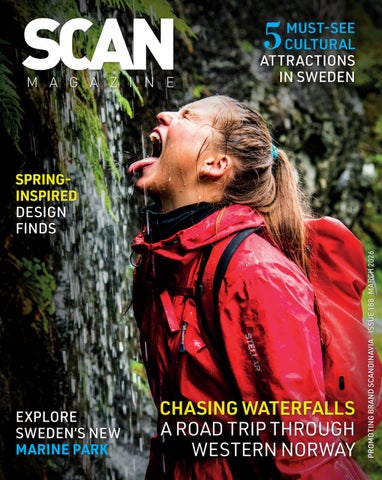
SPRINGINSPIRED DESIGN FINDS

EXPLORE
SWEDEN’S NEW MARINE PARK
CULTURAL ATTRACTIONS IN SWEDEN 5
CHASING WATERFALLS A ROAD TRIP THROUGH WESTERN NORWAY

![]()
SPRINGINSPIRED DESIGN FINDS

EXPLORE
SWEDEN’S NEW MARINE PARK
CULTURAL ATTRACTIONS IN SWEDEN 5
CHASING WATERFALLS A ROAD TRIP THROUGH WESTERN NORWAY


Dear reader,
The snow is melting, small baby flowers are breaking through the soil, and on some days sun rays may even make you squint a bit. Spring is slowly starting its battle against winter in Scandinavia, and in this issue of Scan Magazine, we celebrate the season’s awakening by taking a deep dive into the region’s natural landscapes.
Spring in particular is a magical time to explore the many impressive waterfalls that shape Norway’s magnificent landscape. In our cover feature, we do just that, taking you on a road trip through ten roaring, foaming spectacles that showcase the power of nature. Further into the magazine, our special feature explores the waters across the border in Sweden. Here, we take a look at the newly established Nämdöskärgården National Park, a pioneering marine protected area that offers travellers a stunning landscape while highlighting marine conservation.
For those who want to nourish mind and body by combining revitalising nature hikes with intriguing cultural experiences, our theme on Sweden’s top cultural attractions will be just the thing. Combining art, history, and both contemporary and historic architecture, it offers something to interest all tastes and ages.
As always, we also present a host of exciting places to visit, stay, and eat, as well as a range of unique Scandinavian designs and international favourites. So, if you’re looking for inspiration for your next holiday, your home, or simply a moment of escape, just turn the page.
We hope you enjoy reading this issue as much as we enjoyed putting it together.

Signe Hansen, Editor

6 Norway’s most spetacular waterfalls
Unknown to many, Norway is home to some of the world’s highest waterfalls, and spring offers the perfect conditions to experience them at full force. In this cover feature, we follow a dramatic road trip through western Norway, crossing fjords, mountains and forests to discover ten powerful waterfalls – with two vibrant city stops along the way.
14 Spr ing forms and bold knitwear
From flower-inspired interiors to experimental knitwear, this month’s Design pages we present spring-inspired objects that bring organic softness into the home, and meet Danish designer Laura Dalgaard, whose sculptural knits challenge traditional ideas of knitting through bold patterns and novel objects.
20 Beer community, a comforting classic, and Danish wine bravery
Beer sommelier Malin Norman reflects on the strength of the global beer community, inspired by Dutch beer expert Ferry Wijnhoven and his growing Beer Geeks network. Meanwhile, food writer Katharina Kjeldgaard shares a simple but versatile leek quiche recipe, and we meet a Danish winery that’s redefining Nordic wine.
24 Sweden’s top cultural attractions – where history meets art and play
From beloved children’s literature and one of Europe’s best-preserved 18th century court theatres to bold contemporary architecture, this theme explores some of Sweden’s most inspiring cultural experiences. Whether your interests lie in art, opera, history or innovative design, these pages offer ideas for a culture-filled journey across Sweden.

12

32 Sweden’s new marine national park
Just an hour by boat from Stockholm lies Nämdöskärgården National Park, a pioneering marine protected area where conservation and low-impact tourism meet. Explore a striking island landscape shaped by nature and history while learning how biodiversity protection and visitor experiences are carefully balanced.
40 Unique coastal stays in Norway
From remote island retreats to scenic seaside accommodation, this mini theme highlights distinctive coastal escapes where nature takes centre stage.
68 Events, music and screen highlights
Where to go and what to experience this month?
Our Culture Calendar rounds up the best arts events across the Nordics, music columnist Karl Batterbee recommends new Nordic pop numbers to celebrate spring, and illustrator Maria Smedstad ponders on a distinctive feature of early spring in the Nordics. Meanwhile, film and TV columnist Anders Lorenzen presents the films to watch out for in 2026’s award ceremonies.

Unknown to many, Norway is home to some of the world’s highest waterfalls – and with spring offering the best conditions to experience them, there has never been a better excuse to take that Norwegian road trip you always dreamed of. Here, we present a spectacular route through and over fjords, fjells and forests, taking in ten awe-inspiring waterfalls – and two buzzing city destinations.
By Signe Hansen


As spring warms the air, snow melts high in the mountains, rivers swell, and Norway’s many waterfalls roar back to life. From gentle soothing flows to breathtaking foaming cascades – surrounded by tall pines and with the earthy scent of wet moss and mist engulfing you, a tour through Norway’s waterfalls will give you more than stunning pictures for your social media (though you are certain to get that too). It is the perfect way to fully exploit the meditative and restorative effect of nature and its powers.
Why? Because embarking on an improvised trip into the mountains might be just the thing for some, but most of us feel more at ease when we have a destination and purpose. A waterfall road trip offers just that with an inspiring itinerary through western Norway’s most spectacular natural landscapes – from roadside torrents to fjord-side icons, and hiking through pines and peaks.
Some natural displays are effortless, visible from the car, while others invite short
walks or longer hikes through forest and valley terrain. Along the way, you will find cabins, farm stays, guesthouses and small fjord communities that allow you to slow down and fully immerse yourself in the soothing effect of the landscape. The route suggested here begins in Bergen and ends in Stavanger and totals roughly 25 hours of driving.
Bergen – a natural starting point
With a well-connected airport and a stunning perspective towards fjords and fjells, Bergen is an ideal place to begin your tour. A historic ambience, and a host of culture and culinary offers, combined with an enchanting edge-of-thelandscape setting, allow for the perfect warm-up before heading out to fjords and mountains. Plan at least one overnight stay here to savour the city’s charm and start slowing down. Tip: many hotels offer the option of making a packed lunch from the breakfast buffet. Take advantage of this to avoid wasting time looking for lunch on the way. This goes for all legs of the tour as the remoteness
of many sites means that few have lunch options nearby.
Next stop: Laukelandsfossen – approx. 3 hours’ drive.
Laukelandsfossen
– close to the road, full of force
With a stop at Laukelandsfossen in Dalsfjorden, you can start off your tour strong without overexerting yourself. Close to the road, the 135-metre-tall waterfall pours through a narrow gorge with a raw, immediate presence. It is an easy stop, and with a width of up to 100 metres at its peak, it can be seen from several viewpoints along the fjord. One of the viewpoints, from a bit further away, is the Heile Berget Parking just after the Dalsfjord Bridge, where you will also find an information board and the start of several stunning hikes. Bring your lunch and find a spot to take in the landscape before heading on.
Next stop: Huldefossen – approx. 1.5 hours’ drive.
Huldefossen
– quieter water, slower pace
At Huldefossen, approximately 20 minutes after the town of Førde, where you might enjoy a fresh cup of coffee or light meal at the local Conditori Olefine Hafstadgården, the rhythm shifts. The entry to the waterfall passes through the signed parking area of the Mo and Jølster Upper Secondary School, from which a 500-metre path follows the river through woodland and over a small wooden bridge, with smaller cascades and rushing sections of water making for an enchanting walk. The Hulde waterfall itself has a 90-metre-long fall and is one of the most photographed waterfalls in western Norway.
Just 15 minutes’ drive from the waterfall, you will find the stunningly located Jølstraholmen Nature Hotel and its Instagram-worthy River Suites, set right by the wild Jølstra River. Hotel facilities also include cabins and rooms as well as a restaurant and a riverside sauna to warm up after a refreshing dip in the river.
Next stop: Seven Sisters (Geirangerfjord) – approx. 4 hours’ drive, with several scenic stops along the way.
The Seven Sisters are the most famous of the spectacular waterfalls that define Geirangerfjord, creating a breathtaking sight best experienced from the water. No few-

er than seven separate streams plunge dramatically down the steep mountainside, falling around 250 metres into the fjord below. The falls lie near Knivsflå, an abandoned mountain farm clinging to the cliffs above the fjord, adding an extra sense of drama to the landscape.
Boat trips on Geirangerfjord provide the best vantage point and run regularly from the town of Geiranger, with most excursions lasting around 90 minutes. Geiranger also offers plenty of options to rest your head before embarking on next day’s adventure, many of which, like the Grande Fjord Hotel, with stunning views.
Next stop: Volefossen – approx. 3 hours’ drive.

Volefossen and Skjulka Waterfall – a glimpse of Jostedalsbreen National Park
Among the many waterfalls that characterise the landscapes around Jostedalsbreen National Park, Volefossen and Sulkja Waterfall offer two contrasting ways to experience the valley. Volefossen is the easy showstopper, cascading powerfully just beside the Briksdalsbreen parking area, where visitors first enter this glacier-carved landscape. Fed by meltwater, the falls deliver an immediate sense of scale and energy without requiring any hiking, making them a natural stop en route to the glacier. For those wanting to venture a little further into the mountains, Sulkja Waterfall provides a more active extension to the day. Reached via a hike of roughly 1.5 hours, the trail climbs through lush terrain and quieter surroundings, rewarding walkers with a more secluded and immersive waterfall experience.
Next stop: Vettisfossen – approx. 3.5 hour’s drive.
Vettisfossen – an unregulated giant
Just outside Jostedalsbreen National Park, in the dramatic Utladalen valley near Årdal, lies Vettisfossen, widely regarded as one of Norway’s most spectacular waterfalls. With a free fall of 275 metres, it is Northern Europe’s highest unregulated waterfall and was recently voted Norway’s most beautiful. A newly built viewing platform now allows hikers to experience the full vertical drop safely and in extraordinary detail. Reaching it

requires a hike through Utladalen, beginning from the car park at Hjellefossen, following a scenic gravel road for about five kilometres to Vetti Gard before climbing roughly an hour up the mountainside to the viewpoint. The roundtrip with stops will take 4-5 hours and get your pulse up. It will also provide an experience you will not soon forget, with several smaller waterfalls along the route and Vettisfossen providing a spectacular finale. After this hike, you might want to head straight for bed, and one option for doing so is the Vetti Gard, a farm turned tourist station with simple accommodation and meals (during summer months). Another possibility is Utladalen Camping & Svalheim Gard, which offers simple cabins and camping facilities. A bit further away Klingeberg Hotel offers a nice location and hotel service with fjord location.
Next stop: Vøringsfossen – approx. 2 hours’ drive.
Vøringsfossen
– Norway’s classic waterfall Vøringsfossen is the classic headline waterfall – and for many, the most beautiful in Norway. Here, vast quantities of water plunge 182 metres from the Hardangervidda plateau into the dramatic Måbødalen valley, creating a truly cinematic scene. Spectacular viewing plat-
near the historic Fossli Hotel offer sweeping views into the gorge, while a striking step bridge crossing the river above the waterfall allows visitors to experience the scale and power from multiple angles. New walkways and viewing points continue all the way down towards Fossatromma, making the landscape accessible without losing its wild character. Before heading on, enjoy a relaxed lunch in the hotel’s cafeteria, weather permitting, on the terrace with a view of the waterfall (hotel and cafe opens mid-May)
Next stop: Steinsdalsfossen - approx. 1.5 hour’s drive.
Steinsdalsfossen – behind the curtain
Just west of Norheimsund, Steinsdalsfossen is one of Norway’s most accessible and enjoyable waterfall experiences. Easily reached from Route 7, the falls are impossible to miss, tumbling dramatically beside the road and inviting travellers to stop. A large car park sits directly opposite, and from there it is only a two-minute walk to the main attraction: a path that passes safely behind the curtain of water. Here, visitors can feel the force and hear the roar at close range while remaining surprisingly dry, making the experience both thrilling and family-friendly. Over the years, the area has been developed with concrete walkways and viewing platforms to handle the steady flow of visitors, giving it a more managed feel than many of Norway’s wilder waterfalls. Even so, Steinsdalsfossen remains a worthwhile stop.
Next stop: Låtefossen – approx. 40 minutes’ drive.
Låtefossen
– mist, stone and roadside power
Låtefoss is a roadside classic, where twin streams crash down beneath an old stone bridge. It is the kind of stop that requires no planning – you simply pull over, step out, and feel the spray. In spring, it often delivers the full experience, from misty air to roaring sound.
Next stop: Langfossen – approx. 20 minutes’ drive.


Langfossen – fjord-side spectacle
Langfossen is one of Norway’s true showstoppers, tumbling more than 600 metres from the mountainside into the waters of Åkrafjorden below. Frequently listed among the world’s most beautiful waterfalls, its immense scale is immediately striking – especially in spring and early summer, when meltwater turns the cascade into a roaring white ribbon stretching almost from peak to fjord. The waterfall is easily admired from the roadside along E134, where parking areas allow visitors to stop and feel the spray up close, but those wanting a deeper experience can continue all the way to the top. A demanding but rewarding hike climbs steeply above the falls, opening views across fjord and mountains that feel far removed from the traffic below.
Just eight minutes’ drive from Langfossen, you will find the stunningly located Fivelandsneset Fjordhytter, two exclusive micro cabins perched on the cliffs above Åkrafjorden, offering panoramic views and stylish interiors.
Next stop: Månafossen – approx. 3.5 hours’ drive.
Månafossen – a rewarding hike
Månafossen, the largest waterfall in Rogaland, drops 92 metres in a powerful free fall. The hike is moderately demanding but only takes about 20-30 minutes with several viewpoints along the way

providing plenty of motivation. The arrival feels like a small revelation – the waterfall appears suddenly and dramatically, spilling out of the cliff into the landscape below. A lot of people combine visiting the enormous Månafossen with a visit to the beautiful Lysefjorden and Preikestolen. The starting point to Månafossen is well signed from Eikeskog.
Next stop: Stavanger – approx. 1 hour’s drive.
Stavanger – an urban overnight
If your tour through the breathtaking fjords, national parks, and forests or Western Norway has left you missing any comforts, Stavanger is sure to make amends. With approximately 120,000 inhabitants, the city is the fourth biggest in Norway and presents an intriguing

combination of new and old, with sights including its 10th century the cathedral and its historic neighbourhood. Known as Norway’s oil capital, the city boosts a vibrant cultural and culinary scene and an international vibe with hotels in all price ranges.
Of course any part of this route can be extended, shortened or skipped – whether you want to just take a couple of short drives from your city getaway to admire the beauty of the water cascading from the roadside, walk right into the stream or pack your backpack to get the silence and distance of a mountain peak, Norway’s waterfalls are sure to give you a taste for the powers of nature.
For more information, visit: www.visitnorway.com

Pastels, petals, and that gorgeous perfume of spring can only mean one thing: March is here! As the days slowly warm, make sure to spruce up your wardrobe with a touch of colour and some fun, new textures to celebrate the world stirring back to life.
By Celina Tran | Press photos


Designed as a versatile year-round layer, this roomy field jacket from Asket is crafted from durable, water-repellent double twill, which is ideal for any light rain and transitional weather that might come with March.
The field jacket in dark navy, EUR 300 www.asket.com

As you get all our pastels out for spring, don’t forget a good pair of bright jeans. Made in Italy, these Alex Arigato jeans have detailing such as hand-stitched embroidery, inverted pockets, and metal hardware that elevates their classic silhouette. Pair with literally anything – that’s the magic of a classic pair of jeans. Invert relaxed jeans, EUR 250 www.axelarigato.com


A relaxed take on the classic polo, this sweater combines casual ease with refined detailing. It features a short button placket, Milano-knit collar and ribbed trims for a bit of elegant everyday detailing. Sanino polo in Sky Writing, EUR 160 www.samsoe.com
Just because spring is here, it doesn’t mean it will not get chilly. A timeless essential, this cashmere scarf is designed to be worn season after season, and is as versatile as it’s luxurious. It goes very well over coats, but can also be styled casually with knitwear. Cashmere scarf in red, EUR 600 int.toteme.com

Made by eco-conscious, Swedish brand BITE Studios, this one-shoulder, lightweight Italian organic wool crepe poncho dress drapes beautifully. The scarflike strap wraps softly around the neckline, adding fluidity and movement to its classically Scandinavian minimalist shape.
Solstice poncho dress in black, EUR 920 www.bitestudios.com

A soft, romantic silhouette, this wide-hem circle skirt from GANNI is everything you want for spring –light, airy, and almost fairy-like in its colour and movement, all while grounded in a rich wool. Effortless to style with knits, blouses or oversized coats, it is a go-to as the days get warmer. Perhaps to be paired with brown boots?
Peacoat wool circle skirt in Ballerina, GBP 330 www.ganni.com

Moena redefines the classic ballet flat with a sharper, more sculptural personality. Sleek and refined, yet effortlessly wearable, this Nappa leather, pointed ballerina has a distinctive silhouette that feels modern, sleek, and elegant.
Moena linen Nappa ballet flats in Linen, EUR 390 www.atpatelier.com
Founded in 2008 by Sanne Sehested, Gestuz was inspired by the attitude and energy that Sehested’s own vintage wardrobe gave her. Crafted from an Alpaca blend, this soft-buttoned cardigan features a robbed collar and relaxed, dropped shoulders. The fluffy knit makes it cosy for everyday wear, and the soft yellow gives your wardrobe that perfect touch of spring.
AlphaGZ cardigan in Frozen Dew Melange, EUR 160 www.gestuz.com/en-eu


From leopard-print sweaters to knitted computer sleeves and sculptural flowers, the work of Laura Dalgaard challenges traditional conceptions of knitwear. Educated at the Danish Royal Academy of Fine Arts, the knit-book author has built a distinctive design universe merging Nordic knitting traditions with pop culture and international references. Here, she tells Scan Magazine how knitting became her favourite medium and why she cannot stop creating.
By Signe Hansen | Photos: Laura Dalgaard Knit
Nearly a decade after first establishing Laura Dalgaard Knit, the designer has created a striking collection of patterns and curated yarn kits that invite knitters into a defined yet playful aesthetic world. The designs are bold, often graphic, and unmistakably her own. “It has to be original,” Dalgaard says. “It shouldn’t just be a new version of something that already exists. At design school, you learn both to copy and to understand why something works, but for me, the important thing is moving beyond that. I don’t want to make a version of a sweater that

someone else has already designed. It has to stand on its own.”
Her approach has led to a loyal following amongst knitters as well as several collaborations with fashion brands such as American Anthropology and Danish Baum und Pferdgarten.
Some people have loved knitting since their first meeting with the craft, but not Dalgaard. As a child, she resisted her two grandmothers’ attempts to teach her to knit, but at 25, pregnant and after several rejections from art and design schools, she was introduced to the craft by a friend and teacher during what she describes as a difficult period. “Having the material in my hands and creating something was very healing at that time. I think a lot of people who have had that same experience – picking up knitting when they
needed something calming and grounding. Just working with the yarn, feeling it and making something slowly, was very pleasing for me.”
Shortly after giving birth, she was admitted to the Danish Royal Academy of Fine Art, School of Design. Initially drawn to graphic design, she shifted to textiles and ultimately specialised in knitwear, using her final project year entirely on knitting. Her finishing project garnered wide attention and interest and since graduating in 2018, she has worked exclusively with knit. In knitting, she found both a pragmatic business model that gave her the flexibility she needed as a young single mother and a means to pursue her continuous urge to create. Today, her daughter, now 16, helps out in her business.
Patterns, yarn and art
During the last decade, Laura Dalgaard Knit’s distinctive visual language has drawn an international community of knitters, with patterns released in both Danish and English. In 2022, she was invited to create a book of patterns, resulting in the publication of En samling af strik af Laura Dalgaard. In the book, she gathers some of her most recognisable designs, shaping them into a story that reflects her approach to knitwear as both craft and design.
Collaborations and exhibition pieces have further expanded that universe – among


them a maritime-inspired sweater created for the Danish Maritime Museum, where traditional references meet unexpected colour and form. Meanwhile, some designs, like the Nordic Mix, which combine traditional Nordic patterns with graphic sharpness and Eastern symbols, have taken on a life of their own abroad, circulating widely among experienced knitters. For Dalgaard, accessibility remains central. “I like the democratic aspect,” she says. “Not everyone can afford to buy a finished hand-knitted sweater, but they can knit it themselves.”
When it comes to the creative process behind the designs, it begins well before the first stitch is cast on. Ideas are gathered slowly – through sketches, books,

exhibitions and mood boards. “The whole world is available as inspiration,” Dalgaard says, “but I need to limit it to create my own universe.”
That sense of focus also shapes how she thinks about responsibility and longevity. ”I believe that when something takes time and requires craftsmanship, it creates a different kind of attachment. You understand what it takes to make it, and that makes you want to keep it,” she says.
Knitting, she goes on to explain, is defined by both structure and freedom. The craft and material come with technical limitations, yet those very constraints open new possibilities, and sometimes a specific yarn can become the inspiration for an entire design. It is that balance – between practical boundaries and creative exploration – that has made her work stand out and catch the eye of both fashion brands and home-knitters.
Now, having focused mainly on the patterns and yarn packages for the last few years, she hopes to return to something she tried her hand at early on – producing her own hand-knitted sweaters for fashion brands. “I can’t stop exploring,” she says, and concludes; “What really excites me is allowing myself to invent something new.”
www.lauradalgaard.com
Instagram: @lauradalgaardlaura

Scandinavians may be known for their love of minimalist, functional design, but that does not mean we shy away from the soft aesthetic of organic forms. Adding a bold dash of colour or softness to any room, we present a selection of flower- and plant-inspired designs, from big, bold blooms to understated, gentle silhouettes –designs that bring the essence of spring right into your living room.
By Signe Hansen

House on the Hill throw – Anderssen & Voll
The House on the Hill throw expresses a quiet longing for summer, sunlight, nature and carefree holidays, perfect for March! Designed by the Norwegian duo Anderssen & Voll for Røros Tweed, the throw combines technical craftsmanship with poetic storytelling. Soft tones and subtle imagery create an atmosphere reminiscent of open landscapes and spring light, making it equally suited for warmth and decoration. NOK 2,300 www.rorostweed.com

Bonbonniere turnip – Henning Koppel
The humble turnip might not be the first plant you think of bringing into your living room, but this bonbonniere from Georg Jensen is both charming and stylish. Created by Henning Koppel, the bonbonniere carries the prolific designer’s trademarks: organic shapes inspired by nature and a combination of soft shapes and shiny, hard steel. This recently updated version, in pale oak and stainless steel, gives the classic design a more contemporary feel, which adds a stylish dash of nature to any room – also perfect for a spring-inspired present.DKK 899 www.georgjensen.com

Unikko guest towel – Maija Isola
Stylish and eye-catching, this guest towel from Marimekko features the iconic Unikko pattern, one of the most recognisable floral prints in Scandinavian design. Made from 100 per cent organic cotton terry, it combines softness and functionality while bringing the colours of spring right into your bathroom. Available in more sizes. EUR 20 www.marimekko.com
Acorn lamp – 365° North
With its charming, acorn-inspired silhouette, Bolia’s Acorn lamp captures the playful elegance of nature in an instantly endearing design. The soft fabric shade diffuses a gentle light, while details in FSC®-certified oak add warmth and tactility. Designed by 365° North for Bolia, the Acorn collection comes in several variations – enough, almost, to create your own little oak forest. From DKK 18,499 www.bolia.com

Åkande stool – Jonas Lyndby Jensen Åkande, meaning Water Lily in Danish, defines a striking furniture series by Jonas Lyndby Jensen, a previous recipient of the Finn Juhl Prize. The Åkande stool, which can also function as a side table, draws clear inspiration from the soft curve of a floating leaf, while the tactile quality of wood enables the living, organic expression that characterises the series. The result is a piece that feels both timeless and quietly romantic in its softness. DKK 3,652 www.onecollection.com


MÄVINN cushion cover – Maria Vinka
Made from cotton, this soft, decorative cushion cover from IKEA features a playful, nature-inspired design and handcrafted details. The colours and pattern are easy to match with other textiles, bringing a lush spring feeling into the home. Handmade through IKEA’s collaboration with social enterprises around the world, this particular piece is produced by the Jordan River Foundation, supporting female artisans by providing stable employment and economic independence. SEK 199 www.ikea.com
Never before have I been so convinced by the strength of the beer community. “How come, in these uncertain times?” you might ask. Let me tell you.
By Malin Norman
In December last year, I met Dutch beer sommelier Ferry Wijnhoven on a trip exploring beer in Belgium. In between brewery visits, he told me about a beer community he started back in 2013. Not often do I admit to being surprised by what I hear, but I was stunned by his story. Over the years, his humble Facebook group called Beer Geeks has grown into a community of more than 18,000 members.
Apart from sharing beer topics online, the group also organises for instance brewery tours, tastings and walks. A few couples have even met through these real-life meetings, but there’s yet to be a Beer Geeks baby, as far as we know.
This community is a safe space for many to share their thoughts on beer and more. In fact, the Beer Geeks also started a topic called de kroeg – meaning the pub – something that was particularly appreciated during Covid. Some members even told Ferry
that they got through the pandemic thanks to this group.
Another Covid-related initiative was the #DAT calendar, with a different brewery per day to drink a beer from, to show support. Breweries started making #DAT boxes, followed by live streams where the Beer Geeks could enjoy the beers together, get a tour of the brewery and talk to the brewers online. “This was very helpful for many. Not only financially, but also mentally,” Ferry told me.
What’s even more impressive, the Beer Geeks started a brewing collaboration for charity in 2018. So far, they have raised more than 522,000 euro for the Dutch ALS foundation. Isn’t that just fabulous? Some 80 breweries have taken part this year, and the 2026 edition – No Time Like Now – is set to be released mid-March.
The power of a community doing it together like this is enormous. And since
meeting Ferry and hearing about the Beer Geeks, I’m even more convinced that beer is not just about beer – it’s also about the people who enjoy the beer and what they can accomplish, together.


This is one of my go-to quiches. It’s one of those simple dishes that feel both comforting and fresh.
By Katharina Kjeldgaard
The soft, gently cooked leeks pair beautifully with eggs and cheese, while a touch of lemon, thyme and nutmeg adds a bit more flavour. What I also like about this quiche is how versatile it is. It works for lunch, dinner and even the next day. It can easily be adapted with different vegetables, herbs or cheeses, depending on the season and what you have on hand.
Tip: Try adding vegetables like spinach, mushrooms or asparagus for extra depth. You can play with fresh herbs or a little extra lemon to suit your taste.
Amount: 6
Easy to make
Time: 40 minutes
Ingredients:
Pastry
120 g wheat flour
120 g whole wheat flour
35 g sesame seeds
1 tsp coarse salt
100 g cold butter
3 tbsp water

Instructions:

Filling
2 tbsp olive oil
3 leeks (both the white part and the green part)
1 tsp dried thyme
1/2 tsp nutmeg
zest of 1/2 lemon
juice of 1/2 lemon
1/2 tsp coarse salt
1/2 tsp freshly ground pepper
100 ml milk
4 eggs
75 g grated cheese
1. Cut the butter into cubes and rub it into the flour, sesame seeds, and salt in a bowl.
2. Br ing the dough together with water until you can form a firm ball. Refrigerate for at least 20 minutes.
3. Roll out the dough with a rolling pin and place it in a greased quiche tin (26 cm). Prick the base with a fork.
4. Blind-bake for 15 minutes at 200°C.
5. Slice the leeks into thin rings. Heat the olive oil in a pan and sauté the leeks over medium heat until they become translucent and tender. It takes about 10 minutes.

A dd salt, pepper, thyme, nutmeg, lemon zest, and lemon juice. Fry for about 1 minute. Then turn off the heat and remove the pan from the stove.
7. W hisk the milk and eggs together in a bowl. Add all the cheese and mix well.
8. Spread the leeks evenly over the pre-baked crust, then pour the egg mixture over. Use a fork to gently mix everything together.
9.Bake the quiche for 25–30 minutes in the middle of the oven at 200°C, or until set when you insert a fork in the centre.

Katharina Kjeldgaard is a Danish food blogger, influencer and cookbook author from Copenhagen., Her blog is one of the most-read vegetarian food blogs in Denmark, always focused on locally sourced ingredients, full of delicious recipes and never boring. She has three little kids and loves going to markets, being in nature – and cooking with all kinds of vegetables and legumes.
Blog: beetrootbakery.dk
Instagram: Beetrootbakery


Breaking with tradition, produced organically and shaped by the climate of Northern Jutland, the cool-climate wines of Guldbæk Vingård are, in many ways, the perfect companion to New Nordic cuisine. Fresh, acidity-driven, and expressive, the style favours balance over richness and precision over excess.
By Signe Hansen | Photos: Guldbæk Vingård
Located in the gently undulating landscape of northern Denmark, Guldbæk Vingård is owned and run by three generations of the same family. From the beginning, the aim was not to replicate established European styles or create a large-scale production, but to explore the qualities of the Danish soil and climate.
“These are acidity-driven wines – fresh, juicy and fruit-led,” explains co-owner Kim Thrysøe. “We have even been described by a wine writer as Denmark’s most New Zealand-style vineyard.”
The comparison reflects both climate and mindset. Early on, Jess Weaver, a New Zealand-trained winemaker, joined the vineyard and brought with her a willingness to experiment and push boundaries.
“Jess hasn’t been afraid to take the wines right to the edge,” says Thrysøe. “It might be tempting to aim for something familiar, like white Burgundy, but our climate
is better suited to more acidity-driven wines. Here, freshness matters more than butter, oak and exotic flavours.” It is a style, he adds, that works particularly well with the lightness of the New Nordic kitchen – vegetarian dishes and fish, rather than heavy sauces or big grilled cuts.
From the outset, Guldbæk Vingård chose to work organically and starting from scratch made it possible to tailor the production around sustainable goals, including selecting the Solaris grape, a variety resistant to fungal diseases and grown without pesticides. The cooler climate further contributes to the wines’ character, naturally resulting in lower alcohol levels, typically around 11–12 per cent.
Today, the wines are served at leading Danish restaurants, including Svinkløv Badehotel, Alimentum and Michelin-starred Domestic in Aarhus. International blind
tastings have further strengthened the vineyard’s reputation, with several silver and gold medals awarded, particularly for its sparkling wines. For Thrysøe, who later trained as a sommelier, the success reflects a wider shift in attention towards Danish wine. “People are starting to realise that something interesting is happening in Danish wine,” he says.
For those interested in experiencing and tasting these exciting developments firsthand, Guldbæk Vingård welcomes visitors for guided tours, tastings with or without food, events, and more.
www.guldbækvingård.dk
Facebook: GuldbaekVingard
Instagram: @guldbaekvingaard


From a beloved children’s book universe and one of Europe’s best-preserved 18th century court theatres, to a pulsating modern icon of culture and sustainability. Here are our picks for unmissable cultural experiences on your next trip to Sweden.
Are you curious about how artists create their works? An Astrid Lindgren fanatic? Interested in opera or new and sustainable architecture? Sweden boasts countless exceptional cultural attractions, many of which also offer a taste of the country’s stunning architecture, fascinating history and innovative playfulness.
On the following pages, we present our selection – spanning the capital’s most cherished attractions and the lesser-known gems that rarely make it onto standard tourist lists. Whether you seek artistic insights and reflection, breath-
taking views and awe-inspiring art, or sustainable ideas and innovative architecture, you will find it in Sweden.
Add world-class service, award-winning cuisine, and pristine nature to explore in between your cultural adventures, and we guarantee your getaway in Sweden will nourish both the mind and the soul.
For information about travel, accommodation, attractions and more, please visit: www.visitsweden.com


Nestled on the picturesque island of Royal Djurgården in Stockholm, Waldemarsudde is a real cultural treasure, widely recognised as one of Sweden’s most blooming – and beloved – art museums.
By Linnéa Mitchell
Waldemarsudde is often described as an allkonstverk (a total work of art), where nature, parkland, garden, architecture, art and design come together as a unified whole – a vision shaped by its former owner, Prince Eugen (1865–1947), the youngest son of King Oscar II of Sweden. “This was a profound wish of the prince himself and something we work hard to honour,” says museum director Karin Sidén. The estate’s architecture, designed by Ferdinand Boberg, reflects this vision, blending elegance with functionality.
Prince Eugen showed an interest in art early in life. However, unlike most royals who dabbled in art as amateurs, Eugen pursued it as a serious lifelong vocation, making a name for himself as a talented landscape painter and a respected art collector. He also loved nature. “Second
to art, I think flowers are my greatest joy,” he wrote in a letter in 1901, shortly after moving into the stunning seafront estate. During his many travels across Europe, he was inspired by parks and gardens, and collected flower seeds for his own garden, not least from Tunbridge Wells in England. He also purchased the many sculptures on display (often with a specific location in mind).
Much effort and preparation have therefore been put into this year’s main exhibition opening in March 2026, Det blommande – Konst & Botanik (In Bloom – Art & Botany). Visitors will be able to immerse themselves in botanical art from near and afar, explore botanical symbolism and the role of plant illustration in science. The programme also includes in-depth talks about the museum’s unique plant collection – still referred to
as “the prince’s flowers” – and the sensory impact of flowers, complemented by concerts and special events. “This exhibition is at the core of our identity, and will infiltrate the entire museum for the whole spring and summer,” says Sidén.
While the majority of the museum’s annual 400,000 visitors come in summer, Waldemarsudde can be enjoyed yearround by all ages. Whether you are drawn by the art and the natural beauty of the seven-hectare park and gardens or want to have a coffee in the quaint garden café or join a painting course, this is a gem that should not be missed. Let the blooming art exhibition provide the perfect reason to visit and experience why it remains one of Stockholm’s most treasured cultural landmarks.
www.waldemarsudde.se
Facebook: Prins Eugens Waldemarsudde instagram: @prinseugenswaldemarsudde
14 March – 13 September, 2026

For three decades, Junibacken has opened up a world of stories for children. In a time when children are reading less – even as the need for language, imagination and empathy grows – Junibacken plays a vital role in inspiring young readers.
By Malin Norman | Photos: Junibacken
The story of Junibacken began 30 years ago. Astrid Lindgren is one of the most read children’s book authors in the world, but she wanted Junibacken to be a place where other children’s book authors and illustrators could be spotlighted and inspired too. Children’s books are at the heart of the business, and visitors can explore this magical world of imagination together.
With nearly 300,000 visitors from around the world per year, Junibacken is incredibly popular. ”Junibacken is Sweden’s leading culture experience for children and grown-ups,” says CEO Kajsa Me-

din Hansen. “With children’s books as a basis, we show the way to the magic between the pages. We want to evoke emotions, start conversations and create memories – and hopefully inspire a lifetime of reading.”
At Junibacken, children and culture are taken seriously. The anniversary year 2026 will be both a celebration of 30 years in the world of fairy tales and a promise for the future – with new initiatives that will attract more children to discover the joy of reading.
The Story Train and Baker Bengtsson
The main attraction is the Story Train, which goes on a journey through Astrid Lindgren’s children’s book landscape. Illustrator Marit Törnqvist was commissioned to create the fairy tale setting, where you can meet beloved characters
such as Madicken, Ronja Rövardotter and the Lionheart Brothers plus many, many more.
The audio is available in 16 languages, and Swedish speakers have the wonderful opportunity to hear Astrid’s voice along the ride. “There is something quite special about seeing children, regardless of language, get involved in the stories together,” says Medin Hansen. “The Story Train is an experience that often stays with them long after the visit.”
At Junibacken, there is an abundance of other activities to explore, including the exhibition Baker Bengtsson at Junibacken (Bagar Bengtsson på Junibacken) – a tribute to Lennart Hellsing’s playful joy of language and Poul Ströyer’s illustrations.
And there is much more to discover. Junibacken also has its own theatre, as well as Sweden’s largest children’s bookshop, offering a broad range of books for all ages, carefully selected by its dedicated staff.
Sweden’s largest Moomin’s play valley
In the garden, you can experience Sweden’s largest Moomin playground. Discover scenes from the beloved books Moominpapa’s memoirs, Who will comfort Toffle? and Comet in Moominland by Tove Jansson. Here, young and old can have fun together and enjoy the Moomin books for the first time, or all over again.

Another initiative to help increase children’s reading is Lässtegen (The reading ladder), in collaboration with publisher Rabén & Sjögren, launched last spring. It quickly became one of the country’s biggest investments in reading aloud in preschool. In total, over 2,700 preschool groups have participated – with around 61,000 children around the country.
“Together, the preschool groups have reported over 34,000 story times, an indication that reading aloud has gained an even more obvious place in the everyday life of preschools,” says Medin Hansen. “Children who listen to stories have a larger vocabulary, better language comprehension and stronger foundations for learning. A good start to reading is simply a good start in life.”


No doubt, Junibacken is not just a place for playing, it is a movement for children’s reading. “Junibacken has never been more important. Getting children to read develops their language and builds imagination and empathy,” adds Medin Hansen. “We want books to be a natural part of children’s upbringing – it makes a real difference, now and for the future.”
www.junibacken.se
Facebook: Junibacken
Instagram: @junibacken_stockholm
YouTube: junibackenstockholm

another form.

Drottningholm Court Theatre is a unique 18th century theatre in Europe. The oldest theatre in the world to regularly use the original stage machinery, it also has a surprisingly playful interior. Today, it offers new productions of 17th and 18th century operas and attracts audiences from around the world. This summer sees Monteverdi’s masterpiece The Coronation of Poppea, celebrations of not one but two queens, and much more.
By Malin Norman | Photos: Drottningholm Court Theatre
Built in 1766 at the request of Queen Lovisa Ulrika, Drottningholm Court Theatre is one of the world’s best-preserved 18th century theatres and has been a UNESCO World Heritage Site since 1991. “The theatre is internationally unique in that its original 18th century stage machinery is still regularly used,” explains Anna Karinsdotter, artistic and managing director.
Playful sleeping beauty, awakened Under the reign of King Gustaf III, the son of Queen Lovisa Ulrika, the cultural

life in Sweden flourished. Upon his death in 1792, the theatre closed. Literary historian Agne Beijer discovered a sleeping beauty when he opened its doors in 1921. “The theatre had been untouched since the end of the 18th century,” confirms Karinsdotter. “After replacing the ropes and installing electricity, the magnificent theatre was reopened.”
Located on Lovön just outside Stockholm, the theatre is constructed of simple materials and playfully decorated using paint, stucco, and papier mâché. The wooden stage machinery is operated by hand, including wind, thunder and cloud machines, as well as trapdoors and moving waves. “The theatre is one of illusions, built to trick the eye,” smiles Karinsdotter. “They loved special effects back then. It’s very cleverly done, like a magic box.”
To preserve the original features, visitors can only experience the theatre on one of the guided tours, which run from May to September, or during the artistic activities. “It’s like stepping into a time machine and ending up in the Enlightenment,” says Karinsdotter. “On our guided tours, you’ll find out the secrets of theatre life in the 18th century and learn about the subtleties of the wooden stage machinery.”
The activities at Drottningholm Court Theatre combine high artistic quality with care for the historical environment and serve as an international meeting place for the performing arts.
This season, the theatre turns its artistic focus towards Italy. The highlight being Claudio Monteverdi’s masterpiece The Coronation of Poppea, with eight performances from 1-15 August. Musical director Francesco Corti will conduct an artistic ensemble of the highest international standard, the role of Poppea will be preformed by the celebrated Italian soprano Giulia Semenzato, and internationally renowned Benjamin Lazar will be directing.
The programme also includes concerts, a children’s performance, and events and exhibitions connected to the celebration of H.M. Queen Silvia’s 50 years as Queen of Sweden, plus the 400th anniversary of Queen Cristina’s birth. “Our commitment to preserve the theatre for

future generations remains at the heart of our work,” says the artistic and managing director. “Young audiences will be invited to experience an enchanting production, while our Academy continues to expand its activities across artistic, craft, and scholarly disciplines.”
In addition to the theatre’s appeal, Drottningholm is an important cultural destination. The area offers the opportunity to combine performing arts with visits to Drottningholm Royal Palace, go for walks in the historic parks surrounding the palace, including the 17th century Baroque park and the 18th century English landscape park.
A must-visit is the Chinese Pavilion, a fairy tale palace. The summer palace was

a birthday surprise to Queen Lovisa Ulrika from King Adolf Fredrik in July 1753. The beautiful building features Chinese-inspired Swedish Rococo furniture, antique Chinese objects and decorative elements – including original Chinese silk and paper wall coverings.
“This is an ideal day trip,” adds Karinsdotter. “Go for a stroll in the parks, visit Drottning-ningholm Royal Court and the Chinese Pavillion, and come see us at the Court Theatre. Soon, the sun, the music and the warmth will return to Drottningholm, and we’re looking forward to a spectacular season.”
dtm.se
Facebook: Drottningsholms Slottsteater
Sweden
Instagram: @drottningholmsslottsteater


Sara kulturhus has become somewhat of a global phenomenon. One of the tallest wooden structures in the world, it houses leading art museums and concert halls, restaurants, a city library, theatre and hotel. It goes without saying, this is the cultural hub of the North.
By Malin Norman | Photos: Jonas Westling
Opened in 2021, Sara kulturhus in Skellefteå’s city centre is bursting with creativity. The building consists of two art institutions, Skellefteå Konsthall and Museum Anna Nordlander, as well as Västerbottensteatern, the regional theatre association. In addition to six stages for cultural events, the city library is also located here, plus three restaurants and The Wood Hotel by Elite.
Upon opening, the building quickly became a hub for locals and visitors seeking entertainment, enlightenment or simply a dynamic space to meet. In a constant state of creative activity, Sara kulturhus is bustling with events and exciting exhibitions. Authors’ talks, improvisations, guided tours, art workshops and after-work events also mean that there is something for everyone.
“Our concert diary is jam-packed with musicals, Swedish artists, cultural personalities and international talents,” says Anna Jirstrand Sandlund, CEO. “Last year was a big success, with over 700,000 vis-
its. Two highlights included the comedy duo Leif & Billy, with 15 sold-out shows, and KAJ, with a record number of visitors for a single performance. With more than 66,500 concert tickets sold, it’s clear that Sara kulturhus has become the cultural hub of northern Sweden.”
In addition to its own activities, last year visitors to Sara kulturhus also generated an additional SEK 25 million for the city, including hotel stays, restaurant visits, shopping, and so on. “Giving back to our community, Sara kulturhus has also generated SEK 2.8 million for local associations by involving them in hosting and managing the cloakroom.” This has become an important part of the cultural centre’s way of contributing to and strengthening the society in which it operates.
Another initiative with sustainability in focus is Sara Kulturskog in collaboration with Holmen, one of the largest forest owners in Sweden. “For each event held, a tree is planted as a symbolic thank you,”
explains Jirstrand Sandlund. Inaugurated last fall, Sara Kulturskog now contains around 400 pine trees. “This initiative connects culture and local forestry, and gives cultural experiences a longer and more lasting resonance.”
All the wood used in building Sara kulturhus was collected from within a 120-kilometre radius, which significantly reduced emissions during its construction, and every tree has been replanted, demonstrating the project’s circular approach to production. “We take pride in our home and the nature that surrounds us, and by bringing Sara kulturhus to life, we have brought the forest into the city in a ground-breaking way,” concludes Jirstrand Sandlund.
www.sarakulturhus.se
Facebook: sarakulturhus
Instagram: @sarakulturhus


Skissernas Museum – Museum of Artistic Process and Public Art houses the world’s largest collection of sketches, models and prototypes for Swedish and international public artworks. Here, visitors can explore the creative process behind some of the world’s most significant public art, discovering the sketches, plans, images and objects that shaped the final works.
By Malin Norman
Founded in 1934 at Lund University, Skissernas Museum is a world-class art museum with a clear focus: the artistic process and art in public space. The museum is home to the world’s largest collection of creative-process works and public art and includes 30,000 objects from across the globe. “You really need to come and see it for yourself. It’s mindboggling,” says Annie Lindberg, museum director.
In the large exhibition halls, modern and contemporary art meet – from small pencil drawings to colourful monumental paintings and large-scale plaster sculptures. You will find sketches by international artists such as Barbara Hepworth, Henri Matisse, Sonia and Robert Delaunay, Henry Moore and Fernand Léger. Plus, one of Europe’s
foremost collections of sketches by Mexican monumental painters such as Diego Rivera and David Alfaro Siqueiros. And the Swedish hall displays works by Sigrid Hjertén, Isaac Grünewald and Siri Derkert, and contemporary artists such as Linn Fernström, Carolina Falkholt and Ann Edholm.
“The sketches provide insight into the artists’ working methods, how ideas are explored and how works of art take shape,” explains Lindberg. “They also raise important questions about our public spaces, democratic processes and history writing: who decides over our public spaces and how they are designed? Which voices are heard? What role do memorials and monuments play in the writing of history, in democracy and in freedom of expression?”
The art in our shared public spaces is not only an expression of aesthetic values, it is also identity-creating and expresses the times we live in, believes the museum director. “Memorials and monuments are one of our most expressive forms of public art,” she says. “They shape our shared spaces, arouse emotions and become arenas for conversations about identity, history and democracy. They tell us who we once were – and who we choose to pay attention to today.”
In addition to the main exhibitions, the museum presents temporary exhibitions with both contemporary and older artists every year. And a rich and varied programme is offered for all ages with guided tours, artist talks, lectures, concerts, performances, creative workshops and much more. You can also enjoy delicious food on the terrace of the museum’s award-winning restaurant, with views across the Sculpture Park.
skissernasmuseum.se
Facebook: skissernasmuseum
Instagram: @skissernasmuseum
Just an hour by boat from Stockholm awaits Nämdöskärgården National Park, a pioneering marine protected area where conservation and low-impact tourism intertwine. Here, visitors can explore a striking coastal landscape shaped by both nature and history, guided by rangers who carefully balance biodiversity protection with welcoming and informing curious explorers.
By Nane Steinhoff

“The powerful silence, the lapping of waves, and the roaring storms,” smiles Ann-Sofi Andersson when asked what she enjoys most about her place of work. While talking, she gazes across the wild, windswept landscape dotted with rocky islets, skerries and red wooden houses from the 19th century. Andersson works as a ranger in Nämdöskärgården National Park, the second addition to Sweden’s marine national park network.
As Sweden’s first marine national park in the Baltic Sea (Kosterhavet Marine National Park opened on the country’s west coast in 2009) and the country’s 31st national park, it was officially inaugurated on 5 September last year. Located southeast of Stockholm, in Stock-
holm County, the park covers around 25,000 hectares of which a whopping 97 per cent are sea habitat. With high biodiversity above and below the water, the marine park focuses on protecting the pristine habitats, as well as fostering low-impact tourism activities such as hiking and kayaking.
Andersson works on Bullerö, one of the national park’s approximately 1,000 islands, which also acts as its main entrance. From here, visitors can explore everything the park has to offer, from abundant wildlife to vast landscapes. While it is the wild nature most visitors come to experience, the archipelago also boasts a rich history, stretching back centuries.

Historically, its remote location and myriad rocky islets made it attractive to traditional fishing communities, whose presence is still echoed in the rustic boathouses and cottages scattered across the islands. The nature has been further shaped by the cultivation, grazing, and haymaking of many generations. Even today, cows and Gotland sheep are used for nature management purposes, as their grazing prevents overgrowth and maintains biodiversity.
In the early 20th century, the island of Bullerö became particularly famous as the retreat of Bruno Liljefors, the renowned Swedish wildlife artist, who hosted many prominent cultural figures at his hunting lodge. The lodge has since

been converted and now serves as an information centre about the marine park, showcasing exhibitions about the life of Bruno Liljefors and the archipelago’s natural history. Over the years, Bullerö has transitioned from private ownership to protected status, playing a vital role in regional conservation efforts and, more recently, becoming an integral part of Sweden’s ambitious marine national park initiatives.
Previously a teacher, Andersson started working on Bullerö several years ago when the island formed part of a protected nature reserve long before the marine park’s establishment. In addition to Bullerö, the Långviksskär nature reserve also existed in the area already. Together with fellow rangers and other key stakeholders, she dedicated considerable effort to making the marine park a reality. “Establishing a national park in this particular area has long been on the agenda,” she explains. “Mainly because of the unique landscape that should be preserved for all time, but also because a large part of the area has been stateowned for a long time. In Sweden, national parks must be state-owned.”
Nämdöskärgården and its protection are part of Sweden’s national focus on nature and ocean conservation efforts. Re-
cently, the government banned bottom trawling – one of the most destructive fishing methods – in Sweden’s marine national parks, a ruling that will come into effect by July 2026.
Now that the archipelago has officially been turned into a marine national park, Andersson hopes that more information can be gathered about the local biodiversity’s current state to further protect it. To date, the ranger team has put measures in place to protect wild vegetation and preserve the landscapes shaped by farming over centuries, as well as combat invasive species such as the American mink. First
introduced for fur farming in the 1920s, the species now poses a major threat to local biodiversity. In two northern bays of Bullerö, shallow water protection zones prohibiting the use of anchors and motorboats have further been established to protect Nämdöskärgården’s diverse underwater world.
The park’s waters, shaped by varying depths, wave exposures, and seabed types, provide habitats for a wealth of marine species, from shoals of fish darting through eelgrass beds and bladder wrack belts, to vast mussel banks and various seabirds nesting on rocky skerries. On land, coastal forests and wildflower meadows with their own unique flora and fauna dominate. “The area is home to waterfowl and wildlife such as roe deer, moose, and seals,” adds Andersson. “You can see majestic sea eagles almost daily, and if you’re lucky, you can even spot otters.”
In contrast, Ann Aldeheim, project coordinator for the non-profit association Nämdö Green Archipelago, which seeks to establish the first biosphere reserve in the archipelago, explains the main issues the region’s underwater habitats face: “All the problems of the Baltic Sea – eutrophication, toxins, overfishing, algal blooms, and so on – naturally affect this area as well.” It is precisely this fragile balance between thriving biodiversity and a mul-


titude of threats that the new marine national park seeks to tip in favour of nature conservation. “Increased visitor pressure can also lead to greater wear on nature,” adds Aldeheim, highlighting the need for sustainable low-impact tourism such as snorkelling, hiking and kayaking.
One of the biggest obstacles to inspiring more people to care about nature conservation is that it is difficult for them to love and protect what they do not know. Responsible low-impact tourism focused on enjoyment, rather than exploitation, can help bridge this gap. “Visitors play an important role in the area. To care about nature, you need to build a relationship with it; something you can only gain by experiencing it,” explains Aldeheim, highlighting the national park’s aim to make the archipelago’s exceptional biodiversity more

accessible to visitors. “Visitors can educate themselves, share their knowledge with others, and become ambassadors for nature.” She highlights that, by directing visitors to the right places, sensitive areas can be protected and that sustainable tourism, when done right, can have a positive impact on the local community by creating jobs and providing a basis for year-round public services; something that “the Stockholm archipelago truly needs.”
Only accessible by boat, Nämdöskärgården offers an unparalleled sense of
freedom with self-sufficient and lowimpact adventures. Visitors can explore on foot along one of the many hiking trails, explore by boat or kayak, stay in some of the rustic, nature-focused cabins and small campsites, or even wild camp which is allowed under Allemansrätten (Right of Public Access) in the area for a night or two. Regardless of the chosen way and season to explore Nämdöskärgården, “a visit is always a fantastic experience,” says Andersson and rounds off: “The horizon, the bare skerries, and the beautiful tones of sky and sea make the area one of the most beautiful.”
Good to know:
- Dur ing peak season (between June and September), regular boat services run from Stavsnäs Vinterhamn to Bullerö and Rågskär, as well as Skogavik on Braka.
- Guided tours are available during peak season.
- Bring your own food and drinks, as none are sold within the park.
- Recommended accommodation options within or near the park include Bullerö, Idöborg, and the conveniently located island of Dalarö.

In the centre of the city of Bodø, travellers from around the world can explore the Sámi lifestyle and culture through Saltfjell Sámi Adventures. Run by the local Oskal family, the tour company invites visitors to meet their reindeer, try Sámi cuisine, and enjoy the tradition of storytelling.
By Molly McPharlin | Photo: Åsa Edling
“We share an honest and nuanced perspective of Sámi culture as we live it today,” says Anne Margaretha Oskal, head of Saltfjell. “History is essential to understand the present. Like many indigenous people around the world, we have experienced colonisation and assimilation. These challenges have strengthened our resilience.”
Saltfjell’s adventures take place in both their lavvu, the traditional Sámi tent, and with their reindeer. “Inside the lavvu, we gather for stories, reflections, and to share Sámi food culture,” says Oskal. “This is an intimate atmosphere defined by warmth and stillness.”
Saltfjell has worked with all types of groups, from business groups to school
children. The number and type of reindeer present in the experiences they offer vary according to the animal’s needs. “In spring, for example, we enter a new reindeer herding year. Calves are born and you may encounter newborn reindeer. We have other animals that have grown up alongside us. You may experience the warmth of a reindeer embrace.”
Sámi communities stretch across northern Europe, from Norway and Sweden into Finland and Russia. Although Saltfjell focuses on the experiences of Sámi in Norway, they are considered one people, regardless of political systems and national borders. They welcome guests from around the world and are united by a genuine interest in

meaningful encounters with indigenous cultures. “To keep Sámi culture alive, it must be lived,” Oskal says and rounds off: “Through mutual understanding and respect, both for our own culture and for that of others, Saltfjell helps to create a foundation where the next generation can grow up with security, belonging, and pride.”
www.saltfjellsami.com
Facebook: Saltfjellsami
Instagram: @Saltfjellsami
TripAdvisor: Saltfjell Sami


Marking its 40th anniversary, Sámi Dáiddaguovddáš welcomes visitors into a crossborder meeting place for contemporary Sámi art, connecting voices from Sápmi, while encouraging individual artistic expression. Rooted in Sápmi, the centre serves as a leading exhibition arena for international Sámi contemporary art and a cultural meeting place where travellers and art lovers alike can encounter Sámi culture through contemporary perspectives.
By Signe Hansen
Set in Karasjok, in the heart of Norwegian Sápmi, the Sámi Centre for Contemporary Art presents contemporary exhibitions spanning generations, techniques and geographies. Spacious galleries allow artists to work on a large scale, creating immersive encounters with Sámi art. Over the years, the institution has become known not only for its exhibitions but also for its role as a cultural gathering place. As CEO Line Kalak explains, the vision has always been clear: “To create a meeting place where Sámi contemporary art can be experi-

enced on its own terms while remaining open to dialogue with the wider world.”
As Norway’s leading international centre for Sámi contemporary art, the institution works to support and promote Sámi artistic expression in Europe and across Indigenous regions. The ambition is not only to display art, but also to create understanding of contemporary artistic expression while giving space to new and experimental practices.
From small beginnings to a central institution
The history of Sámi Dáiddaguovddáš reflects the broader development of Sámi contemporary art itself. Founded in 1986, the centre emerged at a time when Sámi artists were largely absent from the wider art scene. In Karasjok, the home of renowned Sámi artist Iver Jåks – known for combining traditional Sámi materials
with contemporary expression – became available, and he opened his house to fellow artists, where the first exhibitions were held. The initiative, established by artists and volunteers, began in modest premises but quickly gained momentum. As interest grew, the need for larger spaces followed, and today the centre occupies one of the largest exhibition venues in Northern Norway, operating as a foundation with a consistent yearround programme.
Today, the gallery presents around eight exhibitions each year, selected through an open call process shaped by an artistic council from the Sámi art community. While the centre remains deeply committed to Sámi audiences and artists, it increasingly welcomes international visitors who come to Karasjok seeking insight into Sámi culture. “The centre was created to give visual artists, craftspeople, artistic photographers and others within the visual arts a dedicated place to exhibit their work – it is about showing the breadth of Sámi contemporary art,” Kalak notes.
A new exhibition season
The exhibition programme emphasises diversity and artistic experimentation. Visitors encounter both contemporary artworks and traditional forms such as duodji and dáiddaduodji, reflecting the fluid boundaries between art, craftsmanship and cultural practice within Sámi contexts. The upcoming exhibition season, opening on 20 March, continues this focus with an exhibition by Liselotte Wa-

jstedt, whose multidisciplinary practice explores memory, identity and landscape through film, textiles and installation, showing how Sámi artists often move freely across media and narrative forms.
Centred around the work IN BETWEEN, the exhibition moves through what is described as a possible wormhole in time – a state between life and death, memory and body, cosmos and earth. Through parallel worlds and the concept of Sáivu, a place beyond time, the work explores identity as something that can dissolve and be reshaped. “IN BETWEEN is a poetic exploration of the spaces in between, where identity can dissolve, mirror itself and be recreated, and where it finally becomes possible to be oneself,” explains Kalak.
Alongside exhibitions, the centre will host special events connected to its 40year anniversary, aiming to involve audiences of all ages and strengthen dialogue between artists and the public
A philosophy rooted in connection Underlying the centre’s work is a philosophy centred on cultural identity, artistic freedom and cross-border collaboration. This is reflected in the Sápmi Triennale, a large collaborative initiative whose inaugural edition spans 2024 to 2026. The triennale brings together prominent art venues across Norway, Sweden and Finland, including Oulu Art Museum, linked to Oulu European Capital of Culture 2026.
“Sámi art is deeply rooted in tradition and identity. It acts as a vital force in


the cross-border dialogue between the Sápmi cultures in Norway, Sweden and Finland, and Russia showcasing both a rich cultural heritage and contemporary artistic expression,” stresses Kalak. Designed to engage both specialists and a wider public, the triennale welcomes artists, researchers, curators and art historians while fostering exchange across local and international contexts.
For visitors, a trip to Sámi Dáiddaguovddáš offers more than exhibitions. The gallery shop extends the experience, supporting contemporary Sámi artists and duodji practitioners through books, artworks, jewellery, music and handcrafted items – offering a tangible connection to the artistic traditions and contemporary expressions that define the centre’s work.
www.samidaiddaguovddas.no Facebook:
SamiCenterForContemporaryArt Instagram: @samidaiddaguovddas


In the heart of Lofoten, where the mountains plunge into the Vestfjord, the historic fishing village of Ure has been reborn. Today, food, nature and remoteness combine to create a unique coastal getaway.
By Andri Papanicolas | Photos: Ure Lodge
Ure has been a bustling hub of activity since the 16th century, but today it offers something rarer: silence, comfort, and a deep connection to the Arctic elements. Ure Lodge and the upcoming Ure Hotel are located in the centre of the village, offering an Arctic base shaped by sea and mountains. The rhythm of life follows the sea, the weather and the shifting light.
The restaurant at Ure is housed in a restored fiskerheim (fisherman’s home) from 1865. The building itself reflects the philosophy of the place: preservation over replacement, continuity over reinvention. The approach in the kitchen is guided by what the surrounding area provides, from the sea to the mountains.
The full menu consists of twelve courses, with seafood considered the culinary highlight.
Salmon supports much of the operation, but the chefs also work closely with local boats that deliver cod, saithe and halibut directly to the quay. The menu extends beyond fish. Local game plays an important role, offering many visitors a first introduction to ingredients such as venison and moose. All sourced from within a 40-minute radius.


Later in the season, the restaurant offers Lofoten lamb. The lamb come from sheep that graze on the mountainsides close to the restaurant all summer long, adding an extra element of flavour to the meat.
Much of what ends up on the plate is gathered nearby. Berries, mushrooms and seaweed are harvested locally, reflecting practices that have long been part of life in northern Norway, now adapted to a contemporary kitchen.
Out into the elements
Life at Ure is shaped not only by food but also by the surrounding environment. One of the experiences offered is a Northern Lights safari by RIB boat, taking guests away from artificial light and into open water.
This is a different kind of approach to hunting the Aurora Borealis. When the engine is turned off when out on the water at nighttime, it gets completely dark and still. Guests tell stories afterwards about how the sky comes alive and the light feels closer than ever.
During daylight hours, the same boats are used for eagle safaris along the coast. Encounters with white-tailed sea eagles are common, particularly in winter. On a recent trip, 16 sea eagles were spotted in a single outing.
A village perspective
Behind the hospitality offering is a strong local presence. Ure Lodge is
owned by a family that has been active in the area since the 1970s, with an emphasis on maintaining year-round life in the village.
The ambition is to encourage people to return from the cities. Ure has successfully managed to breathe life into the village again and create a community where people help each other. Sustainability at Ure is not presented as a trend but as a practical necessity. The village’s future depends on maintaining a balance between development and preservation.
Old buildings are restored rather than replaced, and the business works closely with local suppliers, schools and kin-
dergartens. Family recipes for smoked salmon sit alongside collaborations with seaweed divers and fishermen, linking present-day operations to earlier generations.
With a new boutique hotel and spa scheduled to open in 2026, Ure continues to develop at a measured pace. Guests may spend the evening in a floating sauna after a swim in the fjord, or sit down to a meal built around ingredients sourced from nearby valleys and waters.
Several of the rooms look directly out across the Vestfjord, while others are positioned closer to the mountains, offering different perspectives on the same dramatic surroundings. Evenings are often unstructured, shaped by the weather, the light and the meal served that day, rather than a fixed programme.
Nature here is ever-present, shaping both daily life and the guest experience. At the edge of the quay, with the Vestfjord stretching beneath the big skies or glowing in the midnight sun, Ure offers something increasingly rare: a sense of scale, quiet and authenticity grounded in the land and sea that have always defined it.
www.ure.no
Facebook: Ure-Lodge
Instagram: @urelodge


In the heart of Norway, just a short ferry ride from the mainland, lies the small island of Dønna. Here, the Norwegian Sea unfolds against a landscape of mountains and shoreline. Sjøhuset Dønna invites guests to slow down and be present in this landscape – whether through yoga by the sea, a quiet sauna after a winter swim, or long summer evenings beneath the midnight sun.
By Thea Johanson | Photos: Kassandra Rognstad
Home to a humble 1,400 inhabitants, Dønna offers a calm rhythm of life. It is here that Sjøhuset was created as an intimate retreat shaped by nature, expansive views, and a philosophy of slow living. With sea views in every direction and days guided by light, weather and the seasons, the Bed & Breakfast invites guests to step out of their everyday pace and into something quieter – to pause and take a deep breath.
Founder and yoga instructor Kjersti Aaker describes the island as a Norway in miniature, a place where visitors can experience the vastness of Norwegian nature in a single place. Just a 25-minute ferry ride from the mainland, Dønna feels both accessible and distinctly removed.
It was the island’s quiet simplicity that inspired the creation of Sjøhuset, a carefully restored retreat rooted in its sur-
roundings. Historic buildings have been brought back to life, and the yoga shala itself is crafted from reclaimed windows, allowing the landscape to remain a constant presence indoors.
Life at Dønna invites stillness and peace. Yoga is offered year-round, including dedicated yoga weekends and retreats, complemented by sauna experiences and refreshing dips in the Norwegian Sea. Summer brings long days under the midnight sun, swimming, kayaking, boat trips, cycling on quiet roads, and mountain hikes with panoramic views. In winter, the snow-covered landscape and dark skies create ideal conditions for witnessing the Aurora Borealis as well as winter fishing, cold-water bathing, and ski trips in the surrounding mountains.
Run by Kjersti and her husband Trond, Sjøhuset Dønna welcomes up to 10 guests
at a time, offering an open, unpretentious atmosphere with space for rest and reflection. Solo travellers, couples, families, and small groups are all welcome, and the hosting remains personal, with the option of special requests and tailored stays. Above all, Sjøhuset invites guests seeking tranquillity, nature and slow travel to experience a quieter, more attentive way of being.
Bed & Breakfast:
Contact: kjersti.aaker@hotmail.no
Facebook: Sjøhuset-Dønna-Helgeland Booking via airbnb: Hel(t) hjem i Dønna, Norge
Yoga:
www.yogalaven.no
Facebook: yogalaven
Instagram: @Yogalaven


In the eastern part of Lofoten, where jagged peaks plunge into the Vestfjord and the horizon opens into a full 360-degree panorama, Offersøy Feriesenter has grown from a family dream into a beloved coastal destination.
By Celina Tran | Photos: Offersøy Feriesenter
More than 40 years ago, Offersøy Feriesenter opened its doors to guests for the first time. What began as a small and hopeful family venture has since become a success story rooted in locality, stunning nature, and quality service. “My parents had always dreamed of starting something of their own. When a road connection finally reached the village in 1977, they saw the opportunity,” says general manager Gunnar Fenes. “And we’ve been here ever since. It’s such a beautiful place.”
The resort offers fishermen’s cabins, rooms and a campsite, along with a café, restaurant, marina and meeting facilities. Despite being just an hour and a half from the nearest airport, the setting feels blissfully removed from the rush of everyday life. Tucked away from major roads, it is strikingly peaceful, with little traffic and even less noise.
Yet tranquillity does not mean inactivity. In recent years, the waters off Offersøy have offered exceptional fishing, especially for halibut. “You don’t have to go far,” Fenes explains. “Five to 20 minutes by boat and you reach excellent fishing grounds.”
Fenes says that halibut catches range from eight kilos to over 100, and the record stands at an impressive 217 centimetres! Cod, saithe, wolffish and late-summer mackerel also add to the variety – plenty for all fishing fanatics.
From March to September, which are peak season for sea fishing, guests can join experienced local guides on dedicated halibut trips.
At Restaurant Lille Offersøy, Fenes’ wife Vibeke celebrates the plentiful local ingredients with her menu: grilled
stockfish, bacalao, Arctic charr and even whale steak all reflect the coastal pantry. “There are also many other activities and opportunities around. There is a playground for children, canoe and kayak rentals, diving opportunities, sauna and outdoor jacuzzi, and of course, plenty of space for hiking,” says Fenes.
Marked trails range from gentle coastal walks to more demanding mountain terrain, with views towards the Stetind mountain, which rises dramatically from the fjord landscape. While you are there, make sure to check out the local eagle or moose safaris too. “No matter what you do here, it’s important to us that our guests have a good time and get the best service and stay possible,” stresses Fenes.
Indeed, for those craving a break from the hustle and bustle of everyday life, this peaceful maritime haven offers just that: a pace set by nature, striking sights and fresh catches.
www.offersoy.no
Facebook: Offersøy Feriesenter
Instagram: @offersoyferiesenter


In 2024, Finland’s Saimaa region was awarded the title European Region of Gastronomy. Here, local ingredients and flavours can be enjoyed in harbours, on forest paths and alongside roadside stops, turning travel in the region into a flavour-filled journey.
By Ndéla Faye | Photos: goSaimaa
Lined by forests and the shores of the largest lake in Finland, the Saimaa region is one of the country’s most striking travel destinations, represented by the cities of Imatra, Lappeenranta, Mikkeli, Savonlinna and Varkaus.
For many visitors, the journey of exploring the Saimaa region begins in Lappeenranta, on the shores of Lake Saimaa. The city is shaped as much by water as its rich history, mixed in with a relaxed lakeside atmosphere where people gather simply to sit, talk and eat well.
History and lakeside treats
That relaxed atmosphere is particularly tangible at the Lappeenranta Fortress. Within its 18th century ramparts stand the Cavalry Museum, the Commandant’s House and Finland’s oldest Orthodox church, which are reminders of the region’s mixed history and layered culture. Inside the fortress visitors will also find Majurska House, built in the 1800s as a residence for a Russian officer.
Today, the wooden building houses Majurska Café, beloved for its quark, apple
and berry tarts, baked on site using longkept recipes. Located in the same building is also a small shop selling design products and handmade items by local artisans, continuing the house’s long tradition of craftsmanship.
“From the fortress, the natural next step is to head toward the harbour – often called the city’s living room,” says Natalja

Zeleznjakova, marketing coordinator at goSaimaa. Stretching along Saimaa’s longest waterfront promenade, it is a lively ribbon of summer life, filled with restaurants, cafés, a public sauna, a sandy beach, cruises departing across the lake, and the famous sandcastle sculpture delighting visitors and locals each year. Fried muikku – small vendace fish, crisp and salty – is part of a typical snack, best eaten by the promenade, while enjoying the scenery and sunshine.
Moored at the harbour, the ship restaurant Prinsessa Armaada serves delicious dishes made with local ingredients, such as local fish and game – and paired with tasty beers from nearby Tuju brewery.
Following the water to Imatra
The region’s culinary tour can also be explored further, with many visitors opting to embark from Lappeenranta to Imatra and onwards around Lake Saimaa.
In Imatra, the impressive Imatrankoski rapids are released from their dam daily, releasing the full force of the rapids in a spectacular show. This free event is hugely popular, drawing hundreds of visitors to witness the power and beauty of nature in action.
Beside the rapids lies Kruununpuisto, Finland’s first nature reserve, founded in 1842. Its paths lead to the picturesque Imatra State Hotel, which overlooks the rapids and is often regarded as one of the most beautiful buildings in the country.

In the middle of Imatra, the Vuoksi Fishing Park forms a hidden oasis of calm, where visitors can fish, hire equipment, smoke their catch or stay overnight in cottages or at the campsite. At the heart of the fishing park is Café Wanha Virveli, which is said to serve the best traditional salmon soup in the region. The soup is rich and comforting, made with locally sourced salmon.
A short drive away, Parikkala is home to one of the region’s most unusual cultural attractions, drawing tens of thousands of visitors each year. The Parikkala Sculpture Park is the life’s work of artist Veijo Rönkkönen, who spent nearly five decades creating more than 550 concrete figures across a half-hectare garden.
Along the route, a pleasant pause awaits at Iloisen Pässin Maalaispuoti: a small, family-run restaurant, café and local food shop, where travellers can slow down and enjoy the region’s offerings. The menu highlights locally sourced ingredients and includes specialities such as bison burgers prepared with locally raised bison, as well as pike perch burgers for a unique alternative. The adjoining shop sells products from over 70 local producers and artisans.
Not far away in Uukuniemi, Juholan Biisoniareena continues the story in a renovated barn. The restaurant is renowned for its pizzas – the most famous being Aortanrepijä, or Aorta Ripper, which draws in visitors from across Finland,

including many travelling from Helsinki just to try it. The restaurant’s atmosphere is relaxed and convivial, with an à la carte menu alongside more casual bistro dishes, serving locally produced food, right down to the gelato made from milk from a nearby dairy farm.
“The Saimaa region offers a chance for visitors to explore both major tourist attractions as well as places slightly off the beaten path and enjoy the many culinary delights the region has to offer,” Zeleznjakova says. The Saimaa region is dotted with hidden gems, from small cafés and promenades and harbours with summer terraces to fishing parks and roadside restaurants, all showing how culture and cuisine come together to create something truly special.
Café Majurska www.kahvilamajurska.fi
Prinsessa Armaada www.prinsessaarmaada.fi/en
Vuoksi Fishing Park www.vuoksenkalastuspuisto.fi/en
Parikkala Sculpture Park www.patsaspuisto.net
Iloisen Pässin Maalaispuoti www.iloinenpassi.fi
Juholan Biisoniareena www.gosaimaa.com/en/ juholan-biisoniareena
GoSaimaa www.gosaimaa.com Facebook: goSaimaa Instagram: @GoSaimaa

In the Åland archipelago lies an oasis of calm: three private islands, perfect for conferences, celebrations and peaceful getaways. With personalised service and a discreet, attentive staff, Silverskär has, for over 30 years, created a destination to which guests return year after year.
Silverskär, Sviskär, and Klobben are just a half-hour’s drive from Mariehamn’s harbour and airport. Perched on smooth red granite cliffs, dotted with wildflower meadows and traditional red wooden buildings, each island hosts only one group at a time, making this the ultimate private luxury.
The main island, Silverskär, is ideal for larger gatherings or conferences, with sea views, saunas and a selection of houses and cottages, each with its own style and character. The island of Klobben, recognised as one of Finland’s top 100 hidden gems, can accommodate up to 40 guests and blends rustic charm with comfort. Sviskär offers 28 hectares of electricity-free solitude, a log cottage and a wood-heated sauna; perfect
for those wanting to truly disconnect from their busy everyday lives.
Food is at the heart of the island experience. Guests enjoy a full-service experience with a private chef, who prepares meals using high-quality local ingredients while highlighting the archipelago’s culinary traditions and seasonal flavours.
Activities are equally varied, from kayaking, fishing and boat trips to yoga and meditation. “The peacefulness of the islands is instantly tangible. The surrounding scenery and nature take centre-stage, whether it’s a family celebration, a corporate retreat or simply taking time to unwind,” says Kickan Sundblom, co-owner of Silverskär Islands.
By Ndéla Faye | Photos: Silverskär


www.silverskar.ax
Facebook: Silverskär
Instagram: @silverskarislands
By Molly McPharlin | Photos: Heinola Museums
Located in the idyllic city centre of Heinola, less than two hours from Helsinki, Heinola Art Museum occupies a set of beautifully preserved wooden buildings, among the town’s oldest. Since first opening its doors in 1991, the space has been delighting visitors with its exciting exhibitions and historic architecture.
Originally the home and workspace of local merchant Alexander Toropoff, Heinola Art Museum offers temporary exhibitions of both national and international importance. In addition, the museum houses the permanent collection of the Minister P. J. Hynninen Art Foundation Library, comprising around 4,000 volumes, as well as the Spranger and Henry Lönnfors collection, which showcases European porcelain from the 18th to 20th centuries.
Having undergone renovation and restoration work in 2025, Heinola Art Museum is now fully accessible and welcomes all
visitors. Designed by master carpenter Jacob Nygrén, many of the building’s details, such as its tiled stoves and painted decorative ceilings, have been preserved. “These refined interiors are particularly evident in the Empire-style library and porcelain room,” says Riitta Koskinen of Heinola Art Museum. “It’s a perfect building to visit for anyone interested in preservation, architecture and renovation.”
Throughout 2026, the museum will host a variety of exhibitions. In March, there will be a photography display of the work of Svante Gullichsen, a young Finnish pho-
tographer who has exhibited both in Finland and internationally. And from May to September, the museum will feature the vibrant art of Stockholm-based artist Mari Rantanen. Koskinen says: “We welcome everyone to come visit our museum and see all it has to offer.”
www.heinola.fi/museot www.svantegullichsen.com www.marirantanen.com


Blending genres and blurring musical boundaries, the Artos Festival extends the artistic vision of the Artos Quartet beyond the concert stage. Conceived as a concentrated expression of the ensemble’s wide-ranging interests, the Aarhus-based festival brings together classical traditions, Nordic influences and cross-genre collaborations in a format that mirrors the quartet’s own curiosity and collaborative spirit.
By Signe Hansen
Launched in 2022, the festival grew out of the ambitions of the Artos Quartet, an Aarhus-based ensemble known for its collaborative and genre-crossing approach.
“We’re four musicians based in the Aarhus area who wanted to bring some fresh musical energy to the city,” explains cellist and festival director Brian Friisholm.
That vision remains central to the festival’s identity, with programmes that move freely between established repertoire and lesser-known discoveries.
This year’s theme, which focuses on the Nordic countries coming together in music, builds on its breadth. Alongside the famed works of composers such as Carl Nielsen, Jean Sibelius and Edvard Grieg, audiences will encounter overlooked Nordic voices and works by contemporary composers, including Daníel Bjarnason, often presented in unexpected
contexts. “We mix the cards,” Friisholm notes, describing a format where soloists reappear in different constellations and genres overlap across the programme.
Cross-genre exploration is particularly evident in collaborations that draw on folk and jazz traditions. One highlight is the appearance of Swedish nyckelharpa player Erik Rydvall, whose distinctive instrument introduces a fresh Nordic sound world. Friisholm describes him as “a fantastic representative of an instrument many people don’t know — suddenly world-famous from film soundtracks, but above all an exceptional musician.”
Elsewhere, the programme features Icelandic soprano Karín Torbjörnsdóttir and a visiting string quartet from Oslo, alongside music by Greenlandic composer Arnannguaq Gerstrøm and appearances by
Denmark’s Jacob Gade Talenthold. Running parallel to the main programme is a strong educational focus, with young musicians taking part in concerts and collaborations throughout the week.
The festival also unfolds across multiple venues, from concert halls and churches to cafés and informal city spaces; on the final day, an informal pop-up crawl will present a series of informal pop-up concerts throughout the city’s vibrant Latin Quarter.
www.artosfestival.dk
Facebook: Artos Kvartetten
Instagram: @artoskvartetten


Grünerløkka has long been Oslo’s playground for creatives, night owls and food lovers. In a lively corner of the area, you will find a place that feels more like a house party than a traditional restaurant. In just under two years, Jimmy’s has carved out its own lane in the capital’s competitive food scene.
By Celina Tran | Photos: Jimmys
Walk down Leirfallsgate on a busy evening and you will hear it before you see it: the low thrum of music, glasses clinking, laughter spilling onto the pavement. Warm light glows from the windows, drawing you closer. Grünerløkka has no shortage of character, but step through the doors at Jimmy’s, and the neighbourhood’s pulse feels amplified.
Perhaps you are drawn in by the gold sign and cosy lights, but once inside, the energy speaks for itself. What began as a wine bar has grown into a lively restaurant where music plays at just the right level, the room feels full without being crowded, and the scent of good food fills the air. Somewhere between a relaxed dinner spot and a casual night out, Jimmy’s is the

kind of place where one glass turns into two, and no one is in a rush to leave.
From wine bar to full-blown restaurant
When Jimmy’s opened in May 2023, the plan was modest: a wine bar with “a little more food than a typical wine bar,” but the guests had other ideas. “When people started ordering the entire menu, we realised that we probably had to start making some changes,” says founder Lars Jimmy Örnewald.
What started as a few snacks to accompany the wine quickly evolved. Not only the menu had to expand, but they found themselves needing to set seating times to manage the demand.
“There is so much good food around Oslo, many excellent and fun restaurants, but one thing we felt that our area was missing was a place like this, where the food is great and the atmosphere is even better,” he explains. “While the food obviously also has to be good, we wanted to create

something that wasn’t just about food or drink. It’s about having a great time.”
Fun, fresh, and unpretentious Örnewald is clear about the kitchen’s philosophy: “We don’t focus on unique culinary experiences, but just make good food. We’re not reinventing the wheel, but rather rolling it forward.”
In an era obsessed with novelty, Jimmy’s leans into true pleasure. The tartar and smoked bone marrow have already become classics, staying on the menu longer than most dishes. The Galician entrecôte on the bone – a full kilo served with generous sides – is unapologetically indulgent. Iberico ribs with sweet barbecue sauce and blue cheese dip have also become recent crowd favourites. And then, of course, the calamari. “In the summer, I dare say we have the world’s best calamari,” he says, only half joking. The


calamari is made exclusively when fresh Norwegian squid is available, a quiet nod to the founder’s own maritime roots.
Born and raised in Gothenburg, the sea became a defining part of his life. Despite three decades in the food industry, he trained and worked as a boat captain, and diners at Jimmy’s can still sense how the sea runs through his cooking – even if the captain’s hat has long since been replaced by a restaurant apron. “We focus on seasonal ingredients, working to get the best out of them. Local produce is also prioritised, and our carefully curated wine list is always evolving to compliment the dishes and the atmosphere,” he says.
The evolution of a vibe “We’ve warmed up now,” Örnewald says after nearly two years. The menu now changes at a “raging pace,” not to mention the team’s expansion.

A second restaurant has opened at Aker Brygge (Stranden 30), bringing the Jimmy’s energy to the waterfront. Meanwhile, Jimmy’s Pizza is taking shape in Frogner, marking the move into yet another neighbourhood. “Today, everyone wants something more than just good food and drink. They want an experience. Add amazing service and music you can sing along to, and you get very far,” says Örnewald.
Jimmy’s understands modern dining as theatre – not in a pretentious way, but in the sense that mood, soundtrack, and human connection matter as much as plating. Here, good music makes up the architecture, and the staff are co-creators of your perfect night out. Why not test it for yourself next time you are around?
www.jimmysoslo.no
Facebook: Jimmy’s Instagram: @jimmysoslo


Following in the footsteps of their late father, a pioneer who introduced Indian food in Sweden in the 1970s, brothers Jimmy and Ricky Singh Ahluwalia bring us on a journey to honour his legacy and showcase authentic Indian flavours in the restaurant concept Daawat. When Scan Magazine talks to the brothers, their passion and devotion becomes evident – every bite at Daawat tells their story.
By Malin Norman | Photos: Daawat
Daawat is more than a restaurant serving delicious meals, it is an award-winning culinary concept, a colourful journey in flavours, if you will. With three busy venues in Gothenburg, and plans to expand in Sweden and beyond, Daawat offers Indian cuisine where every spice brings its own story to the dish.
But let us start from the beginning. The passionate restaurateur Surjit Singh Ahluwalia moved to Sweden in 1971 and set up the country’s first authentic Indian restaurant. In 1976, he married Meena
Ahluwalia, who also moved to Sweden to support her husband in his restaurant business. Playing a fundamental role in introducing the rich Indian cuisine to a Swedish audience, over the years the relentlessly hardworking Surjit opened an impressive number of restaurants and became somewhat of a culinary celebrity.
Generational shift, honouring a great legacy
When Surjit opened his first restaurant, he also introduced a world of spices and aromas, and culinary traditions that had
never been seen before in Sweden. It was a challenge, no doubt, to capture the essence of Indian food, where recipes are passed down from generation to generation, in a country so far away. “Our father travelled to India to seek out top suppliers and to handcraft the best mixes of spices, to offer some of the best dishes from India,” says Ricky.
Opened in 2016, Daawat was Surjit’s 18th venue – where he once again showcased the diversity of Indian food. Their father sadly passed away five years ago, and Jimmy and Ricky now run Daawat, alongside their mother Meena, with proud devotion to their father’s legacy.
“Indian food and culture is a big part of our upbringing and deeply rooted in our lives. Growing up with Indian parents in Sweden, we’ve been building a bridge
between the cultures, one dish at a time,” continues Jimmy. “They were both pioneers and we received a fantastic education in entrepreneurship. In our family, we have spent over 50 years honouring this heritage and the importance of serving exceptional food.”
Daawat, a festive meal – mixing art and love
Daawat offers a fresh take on Indian food, with creative and respectful interpretations. In fact, the word Daawat means a festive meal – and guests will not be disappointed. In the buzzing kitchen, every dish is a piece of art, and amongst guests Surjit’s legacy is still evident.
“Our father was the heart and soul of his restaurants, always chatting to guests, making sure they were happy. Even though he’s no longer with us, his spirit and passion remain,” says Ricky. “We have such a great team, everyone is committed to bringing guests on a fantastic Indian culinary journey. Having a meal in one of our restaurants should be an experience!”
The menu includes classic dishes and regional favourites – with a focus on northern Indian cooking. Expect deep flavours and balanced spices. You will find for instance creamy butter chicken and smoky tandoori grills, as well as fragrant vegetarian curries and flavourful biryani. And each dish is prepared to order, with time-honoured techniques.
At Daawat, the colourful interior, the vibrant atmosphere, and the flavourful


dishes create a sense of harmony. “It’s an art to bring everything together into one unit and we constantly strive to develop further,” says Jimmy. “What’s most important is that our dishes hit the balance between flavour and heat. Instead of following trends, we trust our own intuition and do it our way, and guests seem to appreciate what we do.”
Carrying the torch for authentic flavours
The restaurant in Masthugget was the first in the Daawat concept, opened in 2016. In Sisjön, the brothers introduced the second venue in 2022. And last year, a third restaurant was added to the business, in Eriksberg. “We’re looking forward to seeing what this summer will bring, to all three of our Daawat restaurants,” smiles Jimmy.

You can find Daawat at three locations:
Masthugget
Första Långgatan 30, Göteborg
Sisjön
Datavägen 1, Göteborg
Eriksberg
Ostindiefararen 11, Göteborg
Not surprisingly, the concept has received plenty of recognition, by experts and guests. For instance, Daawat has received TripAdvisor’s Travelers’ Choice Award consecutively from 2018 to 2026, praised for its authentic, flavourful cuisine and warm, attentive service. Daawat also received a White Guide recommendation in 2024, for flavours that hit the roof.
“At the end of the day, we never compromise on flavour, and we’re driven by a desire to constantly improve,” adds Ricky. “You should be able to smell, taste and feel the quality, the authenticity, and the service seen in authentic Indian cooking.”
daawat.se Facebook: Daawat Instagram: @daawat.sweden


Once a working-class district in Helsinki, Hakaniemi is a buzzing, bohemian neighbourhood in the heart of the city. Since 2023, it is home to Restaurant 305, which serves bold, flavour-driven comfort food in a relaxed setting, blending international influences with traditional Nordic cooking.
By Molly McPharlin | Photos: Silja Minkkinen
Janne Keskevaari, owner and head chef at Restaurant 305, brings 16 years of experience in the dining industry. After more than six years at Helsinki’s Michelin-starred Restaurant Grön and a second-place finish in Finland’s Chef of the Year competition in 2022, he decided that it was time to open his own establishment. “Together with my business partners, I searched for the right location for about six months,” says Keskevaari. “When we found this beautiful 19th century building with pillars and large, elegant windows, we immediately knew that it was the one.”
Since opening, the main goal of Restaurant 305 has been to create a friendly, cosy neighbourhood bistro where everyone feels welcome. “We want guests to enjoy delicious food and drinks and to build a healthy and safe environment for staff –
where they genuinely love what they do.” says Keskevaari. “At 305, we always have space for walk-ins, whether someone wants to have a cocktail or go all-in with the tasting menu.”
The menu changes every 6-8 weeks and highlights ingredients at their peak season, and local products whenever possible. “Restaurant 305 represents a new generation of the Helsinki restaurant scene,” says Keskevaari. “We keep things simple and recognisable while offering excellent value for money. With each new menu, we continuously try to refine and improve while never forgetting comfort and great flavours.”
Restaurant 305’s success was recognised in 2024, when it was awarded a Michelin Bib Gourmand for offering exceptionally
good food at moderate prices. “This is the highest honour we could ever dream of. It reflects the values that guide and run our business,” says Keskevaari. “At the same time, truly special dining experiences can be found in many types of restaurants. That’s the wonderful thing about Finland. We have a great, diverse restaurant culture. The food scene alone is a reason to visit the country.”
www.ravintola305.fi
Instagram: @ravintola305


Located along Finland’s emerald coast, in the south-western archipelago, Fagerholm is an exclusive private island reserved for a single group at a time. Corporate groups, family gatherings and private retreats share the same concept: complete privacy, supported by a discreet on-site team, who quietly shapes each stay.
By Ndéla Faye | Photos: Fagerholm Island & Marc Goodwin at Archmospheres
“Fagerholm isn’t a hotel; it’s a hosted experience. We offer our guests privacy and discretion, comfort and connection. Every detail – from arrival to departure –is distinctive and thoughtfully tailored,” says Serena Koivurinta, owner and operator at Fagerholm. Her family has cared for the island for years, restoring its historic buildings with patience and respect for their heritage, while working closely with the surrounding archipelago community and local tradespeople; the same network that has historically sustained life in the region.
For over three centuries, the island of Fagerholm has served maritime life: first
as a customs station, and later as a base for the Finnish Coast Guard overseeing the Baltic shipping lanes. Today, the Koivurinta family continues this legacy with care and intention, preserving the island’s heritage while offering guests a private four-hectare island retreat.

Fagerholm is open year-round and accessible by boat or helicopter, providing an exclusive escape shaped entirely around its visitors. Here, it is not only the island’s natural beauty that defines the experience, but the rare freedom it offers: a private setting that adapts seamlessly to its guests, intuitively refined to suit the purpose of each stay.
Many of the island’s historic buildings remain, with the oldest – a stone house that once served as a customs station –

dating to the 1700s. The buildings have been lovingly restored and renovated while still preserving their heritage maritime character.
At the centre of Fagerholm stands the Main House, a 1960s coast guard building, recently extensively renovated to balance its history with contemporary comfort. Energy needs are supplemented by solar energy and geothermal heating, reflecting Fagerholm’s commitment to sustainability.
The accommodation blends seamlessly into the surrounding archipelago scenery, and inside the nature-inspired Nordic interiors and custom-made Finnish furniture showcase local carpentry and craftsmanship. Shared living spaces, an open-plan kitchen and 12 guest bedrooms comfortably accommodate eight to 20 guests, while larger events of up to 40 guests can be arranged with additional accommodation nearby.
Local traditions and sauna rituals
During the summer months, the island’s long days dissolve into the famed Nordic nightless nights. Guests arrive to experience the region’s rich cultural traditions: Midsummer magic, flower crowns, and crayfish suppers by the sea that stretch late into the evening.
They also come for quieter pleasures: the stillness of early mornings, the hush of evening light, the soft wash of water against the rocks, and the unhurried rhythm of island life. Fagerholm is a place to inhabit the archipelago on its own terms, at a pace that suits each visitor.


Fagerholm’s three saunas – a rare smoke sauna, a small wood-heated shoreline sauna, and a contemporary indoor sauna overlooking the sea – offer a profound immersion into Finnish island traditions. Each sauna brings its own pace of unwinding, and as the heat builds, a plunge into the sea often completes the ritual. “Together, the saunas form a defining element of the island experience, often playfully referred to by guests as Fagerholm’s informal sauna triathlon,” Koivurinta says.
Cuisine guided by the seasons and the sea
Dining lies at the heart of the Finnish archipelago experience, and at Fagerholm it is largely defined by seasonality and locality. The island’s on-site team prepares daily meals using local produce and fresh catch from the archipelago, alongside traditional staples such as gravadlax, new potatoes, seasonal vegetables, and homemade archipelago bread.
Drinks, too, come from nearby, from akvavit to gin and whiskey from Nagu

Distillery. Each stay can also be personalised: guests may request a private chef, distillery visits, wine tastings, or cocktail-making sessions, allowing dining to complement the experience.
A blank canvas for bespoke experiences
Beyond its natural beauty, unparalleled exclusivity and first-class personalised service, Fagerholm is distinguished by its capacity to adapt completely to its guests. Every experience on and around the island is bespoke – from wellness itineraries, archipelago nature experiences, kayaking excursions, guided yoga, to immersive cultural traditions.
“The island itself is a blank canvas, ready to become exactly what each group needs it to be,” says Koivurinta. Fagerholm provides an exquisite and private setting, where every aspect of the experience is carefully curated to the desires of its guests.
www.fagerholm.fi
Instagram: @fagerholmisland


At Raudondvaris Manor in Lithuania’s Kaunas district, visitors can explore noble life firsthand through interactive workshops and immersive tours that bring the Renaissance estate’s centuries-old history to life.
By Ndéla Faye | Photos: Raudondvaris Manor
Raudondvaris Manor is steeped in centuries of noble lineage and has long served as a centre of culture, learning and social life. Today, that legacy lives on through a growing programme of immersive activities that transform the historical monument into a space for discovery, creativity and play.
Considered one of the finest surviving Renaissance-style residences in Lithuania, the origins of Raudondvaris Manor trace back to the noble Radvila (Radziwiłł) family, although construction began in the early 17th century.
In recent times, the manor’s educational and experiential programme has expanded significantly, offering activities

for visitors of all ages. “While Raudondvaris remains committed to preserving its historical and cultural heritage, it now presents that legacy through interactive experiences designed to engage contemporary audiences,” says the manor’s director, Snieguolė Navickienė.
Highlights include The Legend of Count Benediktas Tyszkiewicz and the Hidden Treasure, where visitors become explorers, solving puzzles and uncovering hidden symbols throughout the manor. Visitors can also try 19th century parlour games, partake in historical leisure traditions and join the immersive cellar tour
Let There Be Darkness!, exploring historic lighting methods and everyday noble life. Meanwhile, Would You Survive Manor Etiquette? transports visitors to the Tyszkiewicz family’s golden age, delving
into the rules and social customs of early 20th century etiquette.
Art, innovation and creative dialogue
Raudondvaris Manor also houses an Arts Incubator in the castle’s former stables. The space hosts resident artists working in textiles, ceramics, design, architecture, ethnoculture and sustainable crafts. In addition to creating their own projects, residents lead workshops, educational programmes and open sessions for visitors.
Maintaining a dialogue between history and contemporary innovation is central to the manor. Immersive audio experiences, Raudondvaris Dramaturas, created with AI tools, offer a fresh way to explore the estate’s past. The first instalment, a cinematic-style journey weaving the manor’s history with the romance of Sigismund Augustus and Barbora Radvilaitė, won the 2025 national Tourism Innovation of the Year award from Travel Lithuania. A second, The Invisible Inhabitants of the Castle, explores quieter and more mysterious layers of the manor through sound and storytelling.
In spring 2025, the manor also launched The Return of Count Tyszkiewicz / When the East Met Raudondvaris, a project that brings history to life through performances, projections, digital reconstructions, and community participation. Visitors can now explore the digital reconstruction inside the castle, experiencing a contemporary interpretation of the estate through art and technology.

“Together, these initiatives highlight that Raudondvaris Manor is more than a historical site. The manor has evolved into a contemporary cultural centre where past traditions intersect with modern technology, education and creative practise,” says Navickienė.
Soon, visitors will be able to spend the night at Raudondvaris Manor, as renovations currently nearing completion are transforming part of the building into cosy accommodation. Guests can enjoy a subtle sense of historical romance, with views of the meticulously maintained manor park evoking a sense of romantic elegance and charm.
Celebrating the region’s rich cultural heritage
Each year on 6 July, Raudondvaris Manor comes alive for the historical festival Lithuania at Raudondvaris Manor, celebrating the State of Lithuania and the coronation of King Mindaugas. The festival, known for its warm and festive atmosphere, brings visitors together


for an engaging celebration of historical, cultural and culinary heritage. The event includes traditional crafts and medieval-era amusements as well as performances by both amateur and professional artists.
In winter, Raudondvaris becomes a magical setting for the Kaunas District Christmas Tree Lighting Ceremony. With a bustling Christmas market, an outdoor ice rink as well as concerts, musical theatre and ballet performances, the event draws in families and visitors alike.
The centuries-old manor is bustling yearround with cultural events that connect visitors to the region’s heritage. “Year after year, Raudondvaris continues to evolve, inspiring and captivating visitors with its immersive experiences, vibrant events and stunning setting,” the director concludes.
www.raudondvariodvaras.lt
Facebook: Raudondvario Dvaras
Instagram: @raudondvariodvaras


In the heart of Lithuania, in Kaunas, stands Kaunas Ninth Fort Museum, where the architecture itself serves as a living narrative. Bearing witness to the country’s most traumatic and transformative 20th century experiences, this unique site, sprawling across 50 hectares, is much more than just a museum.
By Nane Steinhoff | Photos: Arvīds Barānovs / Eaglewood Pictures
Kaunas Ninth Fort Museum is a dialogue between the past and the present. A place where history and memory are etched into concrete and steel. Museum director Marius Pečiulis says: “At the Ninth Fort, architecture itself becomes a narrative – from the century-old fortress walls to the 32-metre brutalist monument that speaks today of responsibility and our shared humanity.“
The Ninth Fort has stood witness to Lithuania’s most turbulent chapters. Its century-old walls have seen the chaos
of war, the suffering of prisoners, and the horrors of Nazi occupation. Each transformation, from military stronghold to labour prison, transfer station, and ultimately a site of mass murder, has left its mark on the structure. Constructed in 1913 as part of the Kaunas Fortress, it was transferred to the Ministry of National Defence in 1918. From 1924 to 1940, it served as a division of Kaunas Hard Labour Prison, before becoming a transfer point for political prisoners sent to forced labour camps during the Soviet occupation in 1940–1941.
The darkest period followed between 1941 and 1944, when approximately 50,000 people, including 30,000 Jews, were murdered.
In 1959, the Ninth Fort was transformed into a museum, and in 1984 the memorial complex and monument were established to commemorate the victims. The fort’s underground was opened to the public in 1997, marking a new chapter in its role as a site of remembrance and education.
Today, each era is physically present, layered in stone and concrete, inviting visitors to retrace the steps of those who suffered and resisted. Pečiulis adds: “Our spaces allow visitors not only to learn history, but to experience it firsthand. Today, the museum strives to merge architecture and memory into

a living dialogue that invites us to reconsider the past and its meaning in the contemporary world.”
Brutalism as a statement
The architecture of the Kaunas Ninth Fort Memorial Complex, commemorating the victims of Nazism, was designed carefully to meet its symbolic significance. Sculptor Alfonsas Vincentas Ambraziūnas and architects Vytautas Vielius and Gediminas Baravykas drew inspiration from brutalism, a movement defined by geometric shapes and rough, unadorned concrete surfaces. The 32-metre-tall monument, constructed from raw concrete, dominates the site. Its sculptural groups, symbolising pain, hope and liberation, stand as stark reminders of the agony and determination of the victims. The entire memo-

rial, from the low concrete fence marking the massacre site to the museum building and connecting pathways, speaks to the brutality and resilience etched into Lithuania’s collective memory.
A living dialogue that shapes the future
Today, the museum is a vibrant institution, committed to education and reflection, as well as collecting, preserving, and presenting material and spiritual cultural assets that illuminate Lithuania’s 20th century history. Through exhibitions, guided tours and cultural events, the museum fosters a deeper understanding of Lithuania’s traumatic past and its relevance to modern society. The museum’s team continuously upgrades infrastructure and services, ensuring accessibility and authenticity for all visitors.
The museum further stands as a beacon for international cooperation and civic awareness, developing international relations and cooperating with other museums, research centres, educational and scientific institutions, as well as state institutions around the world to foster historical memory and promote international dialogue.
As one of the largest monumental sites in Europe, Kaunas Ninth Fort Museum serves as a memorial complex and educational centre, helping visitors reflect on the past and appreciate its relevance today. As Pečiulis emphasises: “Kaunas Ninth Fort Museum is a place where every visitor will have the opportunity to explore, learn, understand and, most importantly, directly touch history. We invite you not only to visit, but also to create the museum together. Everyone’s contribution will help us shape a cultural space that is open to all and inclusive, contributing to a better understanding of our history and civic awareness.” Ultimately, he says, memory here is not passive. It is active, immersive, and vital. The Ninth Fort invites all to become participants in its story, ensuring that the architecture of remembrance continues to shape Lithuania’s present and future.
www.9fortomuziejus.lt Facebook: 9fortomuziejus


As Estonia’s first registered berry winery, Valgejõe Veinivilla stands at the forefront of a locally rooted and sustainable wine movement. Run by mother and son Tiina Kuuler and Gregor Alaküla, the estate – also Estonia’s northernmost winery – works exclusively with local berries, fruits and grapes. Their vegan-friendly wines are now poured in some of the best restaurants in Estonia, redefining the taste of the north.
By Signe Hansen
Set in an old forester’s house in the village of Valgejõe, on the edge of Lahemaa National Park, Valgejõe Veinivilla winery combines a love for the local with international ambition. “For us, using local raw materials isn’t a marketing choice; it’s our identity. We want our wine to taste of the North—to capture the crisp air and the specific character of our own soil in every glass,” says Tiina Kuuler, head winemaker.
Since opening in 2014, the winery has steadily built a reputation for precision and originality, and its wines are, today, served at some of the nation’s best restaurants. “Our wines fit into fine dining because they offer something unexpected. A crisp rhubarb sparkling wine paired with scallops, or a deep lingonberry wine with venison, creates a ‘wow’ moment
that a traditional grape wine might not,” says Gregor Alaküla, who, like his mother, is a trained sommelier.
The story of Valgejõe Veinivilla began not in a vineyard but in a career change. Tiina, originally a journalist, spent a decade teaching hobby winemakers and running a wine club before the family recognised the untapped potential of Estonian berries. From the outset, the focus on local raw materials was not a marketing angle but a defining principle. “Our goal is simple: if you were to taste our wine in a pitch-black room, you should be able to tell exactly which berry it’s made from. We don’t want to hide the fruit behind additives; we want its natural acidity and aroma to shine. It makes our wines clean, structured, and very expressive,” explains Kuuler.
That philosophy continues in the cellar. The wines are made with as little water as possible and are vegan-friendly, avoiding animal-based fining agents.
Sustainability is equally embedded in daily practice. Solar panels supply electricity, and cleaning in the winery relies largely on boiling water rather than harsh chemicals. Visitors can experience this ethos first-hand through tastings, workshops and nature-based dining experiences, including woodland dinners and wine-themed orienteering.
Valgejõe Veinivilla is accessible yearround by public bus from Tallinn.
www.veinivilla.ee
Facebook: veinivilla
Instagram: @veinivilla


Located in one of the oldest streets in Riga’s Old Town, Carillon Aparthotel offers the perfect base for visitors who enjoy the comfort and freedom of having their own space. Drawing inspiration from Riga’s celebrated Art Nouveau architecture, the property combines historic character with contemporary and tastefully furnished apartments to offer business travellers a stylish home away from home.
By Signe Hansen | Photos: Carillon Aparthotel / Keystone Collection
Set within a carefully restored historic block in the very heart of the Latvian capital, Carillon Aparthotel places guests within walking distance of Riga’s major attractions, business hubs and embassies. The building forms part of a traditional city block, with multiple entrances and a small inner courtyard that provides a quiet space to pause. Inside apartments, fully equipped kitchens – including ovens, toasters and, in some spaces, washing machines – make the apartments particularly suited to extended stays. In addition to the individual facilities, the hotel features a gym and a 24/7 reception.
The design concept centres on what the team describes as “living like a local.” Janis Vilisons, chairman of the board at Keystone Management, explains: “The Art Deco and Art Nouveau style is part
of this idea of living like a local. You can feel Riga’s atmosphere and history inside, but we are not compromising on quality. We are trying to preserve the history, and at the same time provide modern comfort.”
Opened in December 2025, the hotel is the result of a two-year restoration process, which was, due to the building’s historic status, not without challenges. Working under strict heritage regulations, the team uncovered unexpected structural issues behind walls and ceilings, requiring significant additional investment to reinforce and rebuild parts of the structure. However, as with its sister property, Konventa Sēta Hotel, preserving the historical features was not seen as optional but as essential to the project’s DNA.
The two hotels form part of the Keystone Collection, a new local hotel group focused on high-quality properties that honour and preserve Riga’s architectural heritage. The aparthotel primarily welcomes business travellers, diplomats and embassy staff on longer assignments, alongside families who appreciate the flexibility of apartment living.
In truth, while the hotel aims to offer a home away from home, few places can match the style and comfort of Carillon Aparthotel.
carillon.keystonecollection.com Facebook: carillonaparthotel Instagram: @carillonriga


Nestled between the historic Wawel Royal Castle and the lively Jewish quarter of Kazimierz, the Stradom House Autograph Collection stands as a testament to Krakow’s rich heritage. Housed in a majestic 14th century building, this new fivestar Marriott hotel offers an unforgettable experience in Krakow, perfect not just for leisure but also for business events, weddings, and product premieres.
By Signe Hansen | Photos: Stradom House Autograph Collection
From the moment you arrive, you are immersed in a world that seamlessly blends tradition with modern luxuries. This combination has also made the Stradom House a favoured destination in the worlds of fashion, culture, and art.
“The venue is regularly visited by celebrities and influencers, who rave about its lifestyle-driven vibe and unique design,” explains Izabela Lis-Ozimek, general manager of the hotel, adding: “Stradom House is the perfect place to feel like a true star.”

Indeed, you may already have seen Stradom House on the screen, where it is, for instance, featured in a Krakówshot promotional clip for the series Emily in Paris
The hotel also offers numerous spaces for business meetings, including conference rooms with state-of-the-art audiovisual equipment and an intimate library. ”The events held at Stradom House – like parties, concerts, business meetings or cultural activities – are sure to remain in the memory of our guests forever,” says Lis-Ozimek.
On top of that, the hotel is known for the Chapel Loft, which, at 155 square metres, is the most luxurious suite in Krakow. No wonder the hotel has received numerous international awards,
including the Michelin Key and the World Luxury Hotel Awards 2024 (as the best city hotel in Poland) as well as the Town & Country Hotel Awards 2024.
A history entwined with that of Krakow Dating back to the 14th century and the reign of King Casimir the Great, the dazzling building has, over the centuries, housed a monastery, a hospital, and the headquarters of a military command, uses that have inscribed it in the history of the former Polish capital.
In 2013, a new chapter began when the property was purchased by Angel Poland Group, which specialises in creating luxury residences. The investor decided to restore the building to its former splendour while preserving its historic character and beautiful classical architecture. The restoration process involved a series of in-depth studies and the collaboration of world-class architects, archaeologists and conservators and took no less than 10 years. In the course of it, remarkable discoveries were made, including a unique archaeological dig – a medieval dugout boat was found. “Stradom House pays homage to the traditions and history of Krakow,” says Lis-Ozimek.
Feel like a star
One of the true gems of the Stradom House is the best bar in Krakow, Hedwig’s club. Housed in an outstanding desacralised baroque chapel, this captivating space sets the stage for unforgettable events. “Here you can sip world-class cocktails inspired by art and indulge in a carefully curated selection of wines, as

the enchanting ambience transports you to a realm of refined elegance,” says LisOzimek. “It’s a one-of-a-kind place on the map of Poland and Eastern Europe.”
Modern luxuries for mind and body Culinary delights also abound at Stradom House. At the Stradomska 12 restaurant, the menu explores the idea of modern Polish cuisine. “It’s the best Polish restaurant in Krakow which pays tribute to the tradition and modern trends,” says Lis-Ozimek.
For a taste of the Mediterranean, Gaia restaurant, with its romantic patio, offers a night of food sharing and meaningful connections.
Meanwhile, at the SÓL Wellness, a sanctuary of tranquillity awaits. Immerse yourself in the soothing waters of the

20-metre indoor pool, unwind in the steamy saunas, or rejuvenate your body in the state-of-the-art gym. The adjoining SÓL Spa offers a range of treatments prepared in cooperation with London-based skin specialist Alexandra Soveral. Many guests describe this place as “the best spa in Krakow.”
Spoiling the mind, Stradom House’s art gallery showcases a diverse collection of artwork by top artists from across the globe, including esteemed Polish artists such as Wilhelm Sasnal, Bronislaw Chromy and Dorota Buczkowska, as well as famous international ones, including Katherine Bradford, Gideon Rubin and Jonas Wood.
“We are committed to fostering a dynamic and ever-evolving artistic environment, and we welcome artists from around the world to draw inspiration from our creative atmosphere and to participate in curated events that celebrate the fusion of different art forms,” says Lis-Ozimek.
Beyond its luxurious amenities and exceptional dining experiences, the hotel’s unique blend of history, culture, and modern comforts has captured the imagination of travellers, making it a destination in its own right. Whether you are an entrepreneur, culture enthusiast, culinary adventurer, or seeker of relaxation, Stradom House offers to add a touch of the extraordinary to your stay in Krakow.
stradomhouse.com
Facebook: stradomhouse
Instagram: @stradomhouse


Set on the quiet shores of Lake Peipus and framed by tall pine forest, Kurro Nature Spa will offer a place to step away from the constant noise of modern life. Here, nature is not a backdrop but a presence – reflected in the architecture, the spa rituals and the gentle, welcoming ambience. When opening in autumn 2026, the new Estonian retreat will invite guests, including families, to slow down, breathe deeply and simply be.
By Signe Hansen | Photos: Kurro Nature Spa
Created as a response to a world that is becoming faster and more stressful, Kurro Nature Spa offers an opportunity to slow down and revitalise in nature. “Already upon arrival, you notice your breathing deepen, your pulse slow, and an indescribable sense of calm settle in,” says CEO Killu Maidla, when describing the effect of the place. “Everything that once caused tension or stress feels insignificant here, among the tall pine trees.”
Indeed, comfort and nature take centre stage at Kurro. 96 rooms, a breathtaking spa suite, an extensive spa and an ambitious restaurant tempt beneath

the pines, while glass, timber and natural textures create a constant reminder of the many revitalising experiences awaiting guests in the beautiful surrounding landscape.
Rooted in place
Inseparable from the land itself, the vision for Kurro originated with a private landowner who grew up in the region. Having seen young people move away and traditional industries decline, the spa represented a way of giving back to, and sharing the beauty of, his childhood home. As Maidla explains: “It definitely started with the location. We wanted to create a place where people can truly feel the power of nature, relax deeply and, at the same time, not give up their comfort.”
The name Kurro itself is a tribute to the area’s past. Once known as Väike-Kurro –little Kurro – the village later became known as Uusküla, meaning new vil-
lage. By returning to the old name, the spa signals its intention to honour earlier generations and local heritage. That heritage is distinctly reflected in the culinary direction of the spa’s restaurant, which draws on local recipes and long-standing food traditions. Ingredients are sourced from nearby farmers, hunters and foragers, with an emphasis on forest produce and freshwater fish.
The setting is equally compelling. Lake Peipus, one of Europe’s largest lakes, stretches to the horizon, its far shore marking the border with Russia, while the immediate landscape is characterised by sandy beaches, birdlife and deep forest. However, although cherished by nature lovers, hunters and birdwatchers, the area remains relatively unknown to mainstream tourism – a seclusion that reinforces the sense of retreat.
A chance to replenish
Designed by Estonian architect Joel Kopli of KUU Arhitektid, the spa is conceived as a cluster of volumes that read as a small forest settlement rather than a single dominating structure. All areas are internally connected, but not through traditional long, straight corridors. Instead, guests encounter shifting perspectives and new framed views of trees and lake at every five to ten meters.
At the heart of the property lies a 1,500-square-metre spa area, including a 25-metre pool, multiple saunas and

dedicated wellness treatment rooms. While the spa is designed as a sanctuary, it is not adults-only. “Our spa is family-friendly,” Maidla notes. “We have aimed to build the concept so that families with children and couples do not cross routes too much. You still have lots of privacy and quietness, even though families are welcome.”
Separate zones ensure that those seeking silence can find it, while families have access to dedicated pools, play areas and outdoor activities.
Beyond facilities, Kurro Nature Spa is shaped around nature and local traditions, something which is, for instance, reflected in guided forest walks and foraging sessions to introduce guests of all

ages to local knowledge about the plentiful berries, mushrooms and medicinal herbs.
The intention is not to create a one-night stopover but a destination for immersion. Surrounded by forest and water, guests are encouraged to align with natural cycles – walking the three-kilometre forest trail, swimming in the lake in summer, or following ski tracks through the snow in winter. Indoors, yoga sessions, a library and quiet co-working spaces offer space for reflection.
For Maidla, it is all about creating the opportunity to do something truly rare: “Our aim is that this is the place where you slow down, where you turn your mobile phone off, put it in a drawer and let it be there for the rest of your stay.”
www.kurrospa.ee
Facebook: kurrospa
Facts
Nearest airports: Tallinn Airport (approx. 2 hours by car); Tartu Airport (approx. 1 hour by car)
Facilities: 25-metre pool, multiple saunas, wellness treatments, restaurant focused on local produce, yoga room, fitness, tennis court, library, forest trails
Opening in autumn, 2026
Reservations open from April
Hans-Henrik Nielsen, co-developer of the 3-Point Playbook, shares the principles behind the successful investment strategy and a case study of the Swedish Bilia stock.
By Hans-Henrik Nielsen, MyStockScanner.com
A Swedish growth case on the radar: a systematic analysis of Bilia
In a volatile stock market, discipline is often the deciding factor between success and failure. Having a clearly defined strategy to execute for every single trade is essential. At MyStockScanner, we have spent years refining our investment approach into what we call the 3-Point Playbook.
The strategy is built upon three non-negotiable questions that a stock must answer with a definitive “yes” before it earns a place in our portfolio:
1. Is this a high-quality company? (Fundamental data)
2. Is there attractive potential? (Valuation)
3. Is the timing optimal? (Technical momentum)
Below, let us walk through a current case study of the Swedish car dealership group Bilia, to demonstrate the strategy in practice.
1. Is Bilia a quality company?
When assessing quality, we remove intuition from the equation and let the data speak. We look for companies with a solid track record and positive future outlooks.
Bilia currently earns a strong quality score of 80 out of 100 in our proprietary quantitative model. The company delivers on key metrics: Earnings Per Share (EPS) is in an upward trend, and revenue shows steady growth. Most notably, analysts have consistently revised their earnings expectations upward for the coming years. Fundamentally, Bilia is a quality-approved case.

2. Is there attractive potential?
Quality alone is not enough; the price must be right. We utilise our proprietary valuation model to look 12–24 months ahead. Here, we weigh analyst earnings estimates against the historical multiples (P/E ratios) that the market has historically been willing to pay for the stock.
For Bilia, the consensus expects earnings of SEK 11.70 per share in two years. Based on this estimate, we have outlined three potential return scenarios*:
• Bear-case: +17.4%
• Standard-case: +43.4%
• Bull-case: +80.4%
While historical returns are never a guarantee, this range indicates an asymmetric risk/reward profile with significant upside potential.
3. Is the timing optimal?
Even the best stocks can languish for years if the market is looking elsewhere. Therefore, we only enter positions in stocks exhibiting an established uptrend.
*Data as of 24/02/2026


Examining Bilia’s price chart, the stock has performed impressively over the past six months. Our trend indicator currently shows Double Green, a technical signal suggesting that institutional capital – the smart money – is entering the stock. This confirms that momentum has shifted in favour of the buyers.
Conclusion
At the time of writing, Bilia meets all three criteria in our playbook. The company combines fundamental quality

with an attractive valuation and a strong technical setup. Consequently, we have added the stock to our portfolio watchlist – a portfolio that, in 2025 alone, generated a 34.5% return by strictly following the 3-Point Playbook model.
3 Other Scandinavian stocks to have in mind from MyStockScanner.com
Finland: Huhtamaki Norway: Norsk Hydro Denmark: ISS
Hans-Henrik Nielsen. co-founder of MyStockScanner.

Together with British Fintech expert Liam Flavelle, Hans-Henrik developed the 3-Point Playbook – a comprehensive analytical framework now available to private investors through the MyStockScanner membership.
Hans-Henrik has been active in the stock market since 1987. For the past 15 years, he has mentored thousands of private investors, teaching them how to achieve consistent returns with peace of mind by combining a robust strategy with the right tools.
In 2025, the 3-Point Playbook Model Portfolio at MyStockScanner delivered a return of 34.48%.
Disclaimer:
This analysis is provided for demonstration purposes only and should not be construed as investment advice. The case study may have evolved significantly between the time of analysis and the publication of this article.


This month, we have Scandi songwriters using everything from Vivaldi to Whitesnake as their inspiration; and coming up with some superb new sounds in the process.
The legend, the lady, the Lykke! Swedish music icon Lykke Li is back with the first taste of her sixth album, THE AFTERPARTY, which is coming out in May. The LP was recorded with a 17-piece string orchestra in Stockholm, and the new single Lucky Again hints at the string-laden beauties ahead of us; setting the tone by including a sample of Max Richter’s re-composition of Vivaldi’s Four Seasons
Two of Finland’s finest bands have forged a fivesome in the name of further greatness. Trio KUUMAA and duo Emma & Matilda have come up with a super-sweet composition in Ihan Kohta Ohi, which even has a surprise switch of key as the former gives way to the latter. This is a pop pairing with plenty of thought behind it, and it makes for a really enjoyable listen.
In 1991, my dad bought our very first camcorder for the family. I used it to document my day, creating a wobbly record of what a spring morning in northern Sweden looked like from the viewpoint of a short 12-year-old. 35 years later, my dad sent me the footage in the post. And just like that, I was transported back to that time and that feeling of the not-quite-spring months of Norrland.
Are you familiar with the word slask? Slask is the combination of melting snow and dirt that occurs when the temperature rises above zero. Six months’ worth of road grit, dog mess, snuff and mud slowly resurfaces through the uneven layers of grey slush. When you try to jump over a particularly unpleasant bank of this stuff, you are 100 per cent likely to end up in a rivulet of more of the stuff on the other side, which is 200 per cent likely to be deep enough to swallow your boot whole. The temperature of this melting
Icelandic collective Hr. Eydís & Erna Hrönn have been packing audiences into venues around the Nordic nation with their shows which pay homage to the music of the ’80s. All the while, they’ve also been releasing their own original songs; each of which takes inspiration from their favourite era of music. Now, they’re out with their very first release in English – Maniac For Love. And fans of ’80s rock will notice that it’s not just the production which pays a respectful nod to that decade, but the lyrics, too. The spirit of Whitesnake, Europe and Bon Jovi lives on, resurrected and infused with that inimitable skill for crafting a catchy melody that comes from the music makers of the north.
In 2026, Sweden’s Miss Li celebrates 20 years as an artist, embarks on her biggest tour ever and releases her 11th album. New

snow is somehow colder than actual snow, and your socks will never dry again.
So noteworthy is the slask that I used the camcorder to slowly zoom in and out on the ground, the lens blurring on the filthy surface. Barely audible over the freezing spring winds is my depressed monologue on the state of it. At one point, I’m singing
By Karl Batterbee

single Dansa Med Mig Själv is the suitably large-scaled single that’s going to kick off such a special year – a bop-worthy anthem for waving goodbye to self-doubt and those critical voices inside your head.
www.scandipop.co.uk
By Maria Smedstad
to myself, presumably some method of self-soothing – a sad hymn about the summer that I suspect will never arrive. At the end, however, the recording gains a sudden new tremble of optimism. In amongst the monochrome is a tiny glimpse of colour. Green! And that’s the thing about living in the frozen north. You learn to appreciate the joy of very small things. And the value of dry socks.
Maria Smedstad moved to the UK from Sweden in 1994. She received a degree in Illustration in 2001, before settling in the capital as a freelance cartoonist, creating the autobiographical cartoon Em. Maria writes a column on the trials and tribulations of life as a Swede in the UK.


At the time of writing, it remains to be seen whether Nordic cinema will celebrate success at Berlinale — one of Europe’s leading film festivals — and at next month’s Academy Awards, but there’s plenty of Nordic optimism for the festival circuit; we look at some of the reasons why.
As most people will know by now, the Norwegian film Sentimental Value (Affeksjonsverdi) is nominated for Best International Film at next month’s Academy Awards, along with a host of other honours. But there are several other names worth keeping an eye on later in the year.
A Nordic top contender is Fjord, a Romanian-Norwegian production directed by Cristian Mungiu, set in Norway. It tells the story of a Romanian-Norwegian couple struggling for acceptance in the wife’s remote Norwegian hometown. The co-production, in addition to being set in Norway, included several Nordic co-producers.
Finnish director Klaus Härö’s new drama Blue Baby (Hetki ennen valoa) could be
in contention for festivals in the second half of 2026, with production expected to wrap by summer. The film unfolds amid a healthcare crisis and centres on a nurse, a mother and a newborn with a severe heart condition.
The Danish production Woman, Unknown (Kvinde, Ukendt) is still in production, but is rumoured to be completed in time for Cannes. The drama, directed by Danish-Egyptian May elToukhy, centres around a woman set to marry an older man but harbouring some disturbing secrets.
The adaptation of Knut Hamsun’s Growth of the Soil (Markens grøde), directed by Hans Peter Moland, is slated to be ready for the summer and autumn
By Anders Lorenzen
festivals. The epic story is set in the barren wilderness of rural Norway, featuring a strong cast.
“We all have some quite unique voices coming out of our countries,” said Lizette Gram Mygind, festival consultant at the Danish Film Institute, reflecting on the Nordic titles to watch in 2026.


We’ve got pop queens and we’ve got rock legends. We’ve got film festivals for kiddies and fiction fairs for grownups. We’ve got famous operas and we’ve got Finnish art exhibitions. In short, we’ve got a lot of culture going on across the Nordics this month! Read on and take your pick.
By Karl Batterbee
Of Monsters And Men: The Mouse Parade (12 – 14 March)
Icelandic band Of Monsters And Men are leaving their island in the north to head out on tour, promoting their latest album All is Love and Pain in the Mouse Parade And of course they’re paying visits to their Nordic neighbours, with stops in three Scandinavian capital cities. The more succinctly titled The Mouse Parade Tour hits Oslo, Stockholm and Copenhagen in the middle of March. Since their breakthrough with Little Talks in 2011, Of Monsters And Men have established themselves as one of Iceland’s most successful musical exports. After a multi-year break during which members focused on solo projects and family life, the band has returned not just with new material, but also renewed energy and fresh spirit.
Oslo (12 March), Stockholm (13 March), Copenhagen (14 March) www.ofmonstersandmen.com
Molly Sandén (20 – 21 March)
After a year filled with successful album releases (yes, more than one!) and acclaimed festival appearances in Norway and at Way Out West, Molly Sandén is ready for the next big step in her already stellar career. In March, she will per-

form two of her biggest concerts ever: at Avicii Arena in Stockholm and Scandinavium in Gothenburg. With them, Molly Sandén once again solidifies her position as one of Sweden’s biggest and most beloved artists. During these two evenings in March, she promises to bring together the disco shimmer of her Strawberry Blonde album, the melodic reflection of recent chart smash Blåögd and, not least, her famous ability to create a sense of closeness with an audience even on the largest of stages.
Stockholm (20 March), Gothenburg (21 March)
www.mollysanden.com
Madama Butterfly (21 March to 27 May)
One of the most famous classical operas due to its impeccably beautiful music, Madama Butterfly continues to fascinate audiences in 2026. It is one of two beloved Puccini operas being performed at Kungliga Operan in Stockholm this season. In director Sofia Adrian Jupither’s version, with its heavy dose of realism, the contrast between gentle music and hard reality becomes a heart-rending experience. It’s a new version of the classic, tailored especially towards today’s audiences.
Kungliga Operan, Stockholm www.operan.se
Stockholm International Film Festival Junior (23 – 29 March)
This festival for children and young people aged between six and 19 showcases high-quality films from around the world, many of which rarely reach a wider audience. With free screenings, the festival is a space that inspires future filmmakers, actors and film enthusiasts to explore and deepen their connection to the world of cinema. Stockholm International Film Festival Junior is more than just a festival for children and young people, however. Through their film competitions 1 Minute Film and Best Pitch, young participants get the chance to win great prizes and have their films shown on the big screen.
The young audience also plays a key role in shaping the festival; through the Junior Group initiative, it is the children that get to select the winner of the Bronze Horse prize.
Various cinemas around Stockholm www.stockholmfilmfestival.se/junior
Carnival de ABREU (20 – 21 March)
Throughout her 20-year career, ABREU has released a cavalcade of gold and platinum hits and established herself as one of the biggest stars in Finnish pop music; one that continues to shine brightly today. By now she has become known for her energetic, international-level stage


show that leaves no audience member indifferent: the artist’s festival-season set became one of the most talked-about live performances of last summer. It makes sense, then, that ABREU has since been working on the biggest live show of her career so far; conquering Veikkaus Arena in the Finnish capital. When the show went on sale, it sold out so quickly that a second date was hastily added. And it’s no surprise the concert has become such a hot ticket; after the shows, ABREU will be taking a career break for a few years. Veikkaus Arena, Helsinki www.veikkausarena.fi
For two months in 2026, Our Land, For All will be a celebration to mark the 20th anniversary of the Association of Finnish Fine Arts Foundations. This one-ofa-kind exhibition is bringing together art and fashion, exploring how personal and national identities have been shaped across different eras. It highlights how values, body ideals, clothing and our relationship with nature influence and challenge cultural imagery and national narratives. Our Land, For All has made room for a wide range of voices and viewpoints, inviting visitors to consider whose stories the nation of Finland is built on, and who it belongs to. The exhibition will feature Finnish
classics beloved by many, rarely seen contemporary artworks, new acquisitions by the foundations and contemporary fashion. A must-see for Finns and the Finn-curious!
Kunsthalle, Helsinki www.taidehalli.fi
Northern Europe’s largest festival for crime fiction is held every Spring at FÆNGSLET, the infamous former state prison in Horsens. Visitors have the chance to meet popular and interna-

tional writers, publishers and speakers in what no one can deny embodies the atmosphere of crime fiction. And where better than the nation that is arguably considered the capital of Crime Fiction in recent decades, Denmark! This festival has a focus on paying tribute to and celebrating crime literature and the genre in all its forms. For its 2025 edition, the fair attracted approximately 7,700 attendees over the weekend, with around 100 authors and speakers participating. Horsens, Denmark www.krimimessen.dk


Scan Magazine Issue 188 March 2026
Published 03.2026
ISSN 1757-9589
Published by
Scan Client Publishing
Print H2Print
Executive Editor
Thomas Winther
Creative Director
Mads E. Petersen
Editor
Signe Hansen
Copy-editor
Malin Norman
Graphic Designer
Mercedes Moulia
Cover Photo
Fjord Norge / Mattias Fredriksson
Contributors
Anders Lorenzen
Andri Papanicolas
Celina Tran
Hans-Henrik Nielsen
Karl Batterbee
Katharina Kjeldgaard
Linnea Mitchell
Malin Norman
Maria Smedstad
Molly McPharlin
Nane Steinhoff
Ndela Fayé
Signe Hansen
Thea Johanson
Sales & Key Account Managers
Emma Fabritius Nørregaard
Evelina Duned
Mette Tonnessen
Advertising marketing@scanmagazine.co.uk
To Subscribe scanmagazine.co.uk/subscribe
After a 20-year career, Finland’s ABREU is taking a career break and signing off with two massive arena shows in the Finnish capital. Photo: Press image
Scan Magazine Ltd
3rd floor, News Building, 3 London Bridge Street, London SE1 9SG, United Kingdom www.scanclientpublishing.com info@scanmagazine.co.uk www.scanmagazine.co.uk
© All rights reserved. Material contained in this publication may not be reproduced, in whole or in part, without prior permission of Scan Magazine Ltd.
Scan Magazine® is a registered trademark of Scan Magazine Ltd.
This magazine contains advertorials/promotional articles


Right next to Odense railway station is the Danish Railway Museum – a living museum filled with trains, stories and experiences for both children and adults. Here you can explore historic locomotives and carriages, take a ride on the mini train and learn how the railway has shaped Denmark.
The museum is housed in a authentic engine shed and features atmospheric exhibitions, fun activities and plenty of space for curiosity and play. It is easy to find – just a few minutes’ walk from Odense Railway Station.
Open every day all year round.

jernbanemuseet.dk