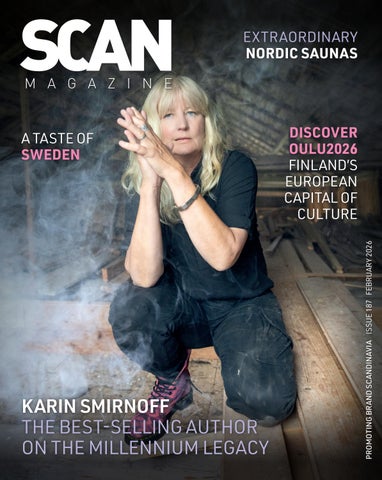
Scan Magazine, Issue 187, February 2026

Page 1


SCAN MAGAZINE

Events with maximum security: 24-hour cancellation period!

Plan your next meeting, conference, or event at the DENKQUARTIER at Lindner Hotels & Resorts. Benefit from our modern facilities, a dedicated team, your personal DENKQUARTIER expert, and our impressive range of services:

• Free cancellation up to 24 hours before the start of the event

• No minimum purchase, no prepayment required

• Response to your inquiry within 24 hours

• No complicated contracts

• Double World of Hyatt™ points

FURTHER INFORMATION AT lindnerhotels.com/en/denkquartier

ENQUIRE NOW WITHOUT OBLIGATION +49 171 5302 105 | events@lindnerhotels.com

Editor’s Note

Dear reader,

It might be the understatement of the year to say that we in Scandinavia have had our fair share of drama since the turn of the year.

But while the headlines of the past month may have been unsettling, they have not put life on hold. The region’s strong display of respect, democracy and unity may have hijacked global attention, but other defining values continue to flourish; collaboration, creative integrity, and respect for the environment pulse through the stories of our magazine.

Whether we are speaking with the entrepreneurs behind some of Sweden’s most innovative culinary brands or the fiery souls striving to make 2026 the most spectacular year in history for Oulu, Finland’s European Capital of Culture, one thing is evident: Scandinavia is full of people driven not by monetary gain, but by creative fire and lifelong dedication — and that is what sets their work apart.

Creative fire — even creative restlessness — is also part of the recipe for the enormous success of this month’s cover star, Karin Smirnoff.

Taking a pause from her current project, her third Millennium novel, she talks to Malin Norman about greenwashing, violence and power — just some of the gripping themes that have captivated her readers.

Finally, for those in need of a brief reprieve, our special feature explores some of Scandinavia’s most spectacular saunas — after reading it, they are all on my bucket list!

On top of that, as always, we explore a host of original designs, inspiring destinations and alluring hotels. So, for an uplifting and inspiring journey through all things Scandinavian — and a welcome break from the world of international politics — just turn the page.

We hope you enjoy reading our magazine as much as we enjoyed making it.

SCAN MAGAZINE

In this issue

COVER FEATURE

6 Karin Smirnoff on the Millennium legacy

In this month’s cover feature, Scan Magazine’s Malin Norman talks to best-selling Swedish author Karin Smirnoff about power, greenwashing, restlessness – and, of course, her continuation of the iconic Millennium series.

DESIGN

12 Love and spring in the air

On our Design pages, we combine winter warmth with early hints of spring. From Scandinavian fashion brands and knitwear designers to thoughtful Valentine’s gifts and timeless interiors, we present design rooted in creativity, functionality and Nordic aesthetics.

LIFESTYLE AND FOOD

20 Comforting raspberry cookies, hoppy beer and culinary journeys

This month, food columnist Sofia Nordgren shares a classic recipe for raspberry thumbprint cookies, while beer expert Malin Norman shares her hoppy adventures in Italy. We also present two culinary experiences that take the concept of a culinary journey very literally.

SPECIAL THEMES

28 Discover Oulu2026, Finland’s European Capital of Culture

As Oulu steps into the spotlight as European Capital of Culture 2026, we explore how Arctic nature, culture, art, and community come together to form a year-long cultural programme and unique experiences across northern Finland.

46 A taste of Sweden

From pioneering food and drink producers to iconic, beloved brands rooted in Swedish culture, this theme highlights the companies shaping contemporary Swedish food culture. Craftsmanship, sustainability and flavour take centre stage, inspired by landscape, season and tradition.

SPECIAL FEATURES

36 Spectacular Nordic saunas

In need of a moment of calm? Our special feature explores some of Scandinavia’s most extraordinary saunas, from a cave-hidden adventure to serene, waterside locations. This is where architecture, nature and well-being meet with steam, ice and water.

88 Nordic noir on paper

This feature visits Nordic noir: works on paper from Edvard Munch to Mamma Andersson, a major exhibition at the British Museum, bringing together works by more than 100 Nordic artists. We explore how curators are presenting the region’s rich tradition of graphic art, from Munch’s legacy to contemporary Nordic voices.

CULTURE

90 The best new events, film and music in Scandinavia

In this month’s Culture section, music columnist Karl Batterbee highlights new Nordic sounds, while our film and TV column explores the Norwegian film Sentimental Values. We also present the upcoming cultural events and exhibitions to look out for across the region.

Karin Smirnoff: Sweden’s best-selling author on the northern connection, power and restlessness

The first book in Karin Smirnoff’s praised trilogy about Jana Kippo has recently become a drama series on Swedish Television, and her latest instalment in the pulse-raising Millennium series was released in English last year. Now, she is working on her third Millennium story, once again taking Lisbeth Salander and Mikael Blomkvist on a thrilling showdown in northern Sweden. Scan Magazine talks to the author about men’s violence against women, the powers challenging the North, and restlessness as a driving force.

Best-selling author Karin Smirnoff’s books have seen great success in both Sweden and internationally – with hundreds of thousands of copies sold, several titles translated, and many nominations and awards received.

Smirnoff first had her breakthrough with the critically acclaimed debut novel Jag for ner till bror (My Brother), which was shortlisted for the prestigious August Prize in 2018 and named Best Novel of the Year by the Swedish Booksellers’ Association. In 2022, she took over the

torch for Stieg Larsson’s epic Millennium series, but more on that later.

From acclaimed debut to TV series

In Jag for ner till bror, Smirnoff introduced readers to the stubborn yet vulnerable Jana Kippo, who returns to the family’s farmhouse in the sparsely populated northern Sweden to see her brother.

Set in a rural community and steeped in darkness, the story follows Jana Kippo’s pursuit of love and art and has captivated audiences and critics worldwide.

This first of Smirnoff’s books is now a drama series on Swedish Television, with over a million streams so far. “The end result is surprisingly good,” admits Smirnoff. “What is perhaps missing in the TV series is the process of Jana Kippo developing as an artist; how trauma can be used for creativity instead of self-destruction.”

With roots in northern Sweden, Smirnoff is no stranger to the rural setting. “For me, it was natural to set the books about Jana Kippo in a place similar to my village. When you grow up in a place, it also gives you great access to small details; how the snow settles on the trees, how the fields look in February, how things smell and feel at certain times of year,” she ponders.

“It’s not easy to live in the North; it’s cold and dark, and the weather works against you large parts of the year. But you also have a great sense of freedom. This mix shapes the people who live here.”

What attracts many readers, and now viewers, is Smirnoff’s straightforward, concise style and constant narrative drive in the storyline. In her books, and in our chat, she is refreshingly direct. “What I want is to move readers, emotionally, but without going over the top. Jana Kippo, for instance, doesn’t cry when she gets sad; instead she gets furious. I’m a big fan of revenge stories.”

Two more books about Jana Kippo followed, and the heroine has become an important character for many readers.

“In my books, I include a lot of violence. It’s a tough subject that I’m trying to understand myself, how it arises and what it consists of,” she says. “It can be violence between a man and a woman – more than a third of women in the world will at some point be subjected to violence – but it can also be violence against a whole population. Ultimately, it has to do with power. And we need to continue the conversation, in order to be able to do something about it.”

Continuing the Millennium legacy

The epic Millennium series is one of Sweden’s biggest literary successes internationally, with more than 100 million

Books by Karin Smirnoff, in order of publication:

Jag for ner till bror (2018), English

translation: My Brother (2022)

Vi for upp med mor (2019)

Sen for jag hem (2020)

Sockerormen (2021)

Havsörnens skrik (2022), Millennium 7,

English translation: The Girl in the Eagle’s Talons (2024)

Lokattens klor (2024), Millennium 8,

English translation: The Girl with Ice in Her Veins (2025)

copies sold worldwide. The first three books by journalist Stieg Larsson were published posthumously, after his passing in 2004. Journalist David Lagercrantz was commissioned to write three further instalments, before Smirnoff took over the reins.

Her first Millennium book, Havsörnens skrik (The Girl in the Eagle’s Talons), was published in 2022. Whilst Larsson’s main characters remain, in Smirnoff’s book Lisbeth Salander and Mikael Blomkvist cross paths further north, in Gasskas – a fictive town with only 20,000 inhabitants. In addition to the pulse-raising murder plot readers expect from the Millennium series, this is also a story about powerful interests, capitalism and greenwashing in northern Sweden.

In Smirnoff’s Millennium sequel, the eighth instalment in the series, Lokattens klor (The Girl with Ice in Her Veins), she once again places Lisbeth Salander and Mikael Blomkvist in Gasskas, where tensions rise as a global corporation exploits the town’s natural resources. The book has received praise from the likes of British author Lee Child, who says in a statement: “Lisbeth Salander is back-and maybe better than ever. Karin Smirnoff’s take is both respectful of the past and ready for the future-altogether remarkable.”

Keeping the northern connection

An underlying theme in Smirnoff’s storylines is the mentioned greenwashing, a challenge facing northern Sweden. “A lot is happening right now, with global corporations spending billions on projects such as developing new wind parks and mines. The money is rolling in, quickly, but at the cost of local communities, and in particular the Sámi people and their reindeer herding,” she says, but is also clear to point out: “I’m not against these developments in general, but we need to think critically about the long-term impact on both the communities and the environment.”

Smirnoff and Larsson share common ground in their interest in men’s violence against women, but also in their

northern roots; both authors were born in Västerbotten county. When speaking to Scan Magazine, Smirnoff is working on her third book in the Millennium series, and she reveals that it is set in northern Sweden and includes reopening Gasskas’ old mine, called The Pit, which has been found to contain rare earth minerals.

“I’ve spent six years of my life in the Millennium world, and after this I’m just about ready to move on with my own projects,” the author says, but what those projects might be is not certain. Likely, another book about Jana Kippo is on the cards, something that Smirnoff has mentioned in other interviews as well. She also plans to write a piece for Norrbottensteatern, possibly also a book about Paris, where she lived for a few years.

What becomes obvious is Smirnoff’s free spirit, or as she says herself, her restless soul; before writing books, she used to be a journalist and photographer, an entrepreneur with a street food venue, and she still owns a wood products company. She appears fearless, keen to always make progress, ready to take on any challenge and see where it takes her. The restlessness is an important driving force, it seems.

“Writing a book is a huge project, something I didn’t think I could master being so restless, but as it turns out, it wasn’t as hard as I thought. Writing needs to be fun though, and it’s more fun when I don’t know exactly what’s going to happen in the story – that’s why I never plan my books,” she smiles, and adds; “I don’t think about the reader. When writing, I’m in that world on my own, and I like to be surprised.”

Fashion Diary

Combining the cosiness of winter with the playfulness of early spring, February brings a fresh breath of air to the fashion scene. Below, we present some of this month’s standout pieces, emerging trends, and the designers boldly redefining style within the framework of Scandinavian minimalism.

When it’s freezing outside, make sure that your neck, feet, head, and hands are covered. Take a tip from the icy Norwegians and keep your digits cosy with these 100 per cent leather gloves from Moods of Norway, combining warmth with timeless elegance.

A refined take on everyday knitwear, A Day’s March presents the Jarrow mohair cardigan in a deep indigo blue. Crafted from a soft blend of kid mohair and wool, the cardigan offers warmth with a light, tactile feel, and its regular fit, V-neck silhouette and buttoned front create a timeless shape. It’s perfect for layering – versatile, relaxed, and still dressed up. Jarrow mohair cardigan in indigo blue, EUR 270 www.adaysmarch.com

Johan gloves in brown, NOK 300 www.moods.no

Winter dressing meets Scandinavian precision in J.Lindeberg’s Alon 3L down parka. Designed for demanding climates, the parka combines a recycled three-layer shell with insulating duck down to create a lightweight yet protective outer layer. Functional elements such as a detachable hood, sealed seams and a streamlined magnetic closure ensure comfort in unpredictable weather, while the clean black finish keeps the look refined and contemporary. A dependable cold-weather piece that doesn’t compromise on style. Alon 3L down parka in black, EUR 525 www.jlindeberg.com

Rooted in Norwegian heritage, the Roset windproof sweater by Dale of Norway is designed for both performance and style. It’s made from lightweight Norwegian wool – the best of the best when it comes to insulation.

Roset windproof men’s sweater in pinegreen offwhite, EUR 549 eu.daleofnorway.com

Winter may be nearing its end, but the Nordic chill still calls for thoughtful layering. Laley’s soft pink leg warmers bring both warmth and personality to cold-weather dressing, crafted in a fluffy rib-knit that feels as cosy as it looks. Designed to be styled with tights, denim or even bare legs, they add a playful pop of colour while keeping you comfortably wrapped as the season lingers a little longer.

Leg warmers in soft pink, NOK 299 www.laley.no

In the month of love, it feels only right to put in a little extra effort. Add these gold-plated freshwater pearl earrings for a touch of sophistication – perfect for that Valentines’ dinner date.

The long earrings, EUR 150 www.camillapihl.com

When temperatures drop, comfort becomes non-negotiable. That doesn’t mean your style has to follow suit. Line of Oslo’s Holmes trousers offer an elevated solution for everyday dressing, blending warm ease with refined design. Made from a soft mix of merino wool and cashmere, they feature ribbed detailing at the waistband and hems, giving the silhouette both structure and fluidity. Equally suited for work or weekend errands, the trousers pair with the matching Katy Round knit or a light-toned poncho, finished with classic black shoes for a look that’s both practical and quietly sophisticated.

Holmes AW25 trousers in antracite, EUR 230 www.lineofoslo.com

A tailored double-layered silhouette gives this coat from & Other Stories a refined edge with the built-in shawl collar draping effortlessly over the shoulders for an elegant finish. Easy to style and endlessly versatile, it pairs seamlessly with classic black boots and layers beautifully over almost any outfit, making it a go-to piece for polished everyday dressing.

Jarrow mohair cardigan in indigo blue, Fringed shawl wool coat, EUR 349 www.stories.com

A love of knitting made to last

For more than four decades, knitting has been a constant thread in the life of Trine Ellegaard. What began as a childhood hobby has evolved into Knitamore – a creative universe shaped by patience, curiosity and a deep fascination with nature. With carefully crafted patterns, hand-dyed yarn, and an upcoming book on plant dyeing, Ellegaard’s work reaches far beyond Denmark, connecting knitters worldwide through a shared love of slow, thoughtful making.

Having knitted since she was just five years old, Ellegaard is the founder and creative force behind Knitamore. Combining the English word knit with the Italian amore, the name is a quiet declaration of love – and perhaps a subtle hint at the borderless appeal of the brand. Through knitting patterns, yarn, workshops and books, Knitamore has built an international following, but sustainability and the tactile pleasure of the craft have remained front and centre. “For me, nature and sustainability are fundamental,” Ellegaard says. “Knitting can be a quiet form of protest against the fast pace of life. You choose to make something slowly, with care, and you keep it for many years.”

Alongside pattern design and constant experiments with colour and materials, Ellegaard is currently finishing her first book. The business involves her entire family – from modelling knitwear to winding skeins and helping with administration. Knitting, for her, is not a trend but a way of life shaped over more than 45 years.

Knitting, nature and colours – a way back into life

Trained in literature and communication, Ellegaard spent years working and teaching within those fields. Gradually, however, a desire for something more tactile began to surface. “I had this feeling that I was sitting in front of a computer screen while life was passing by outside,” she explains. “I needed something sensory, something handmade.” Knitamore began quietly, alongside paid work. In 2021, she launched a web shop and a handful of patterns. In 2024, she left her full-time job to focus on writing her book and developing Knitamore. Then, last autumn, she took

Trine Ellegaard is the creative force behind Knitamore. Photo: Savannah Liv Ellegaard
The Winter Rose Sweater, the most popular design from Knitamore.
Trine Ellegaard’s two daughters, Savannah and Sophia, wearing the Callie Sweater and Callie Cardigan.

the final leap – quitting her part-time work to become fully self-employed, with Knitamore and her authorship as her sole income. “It’s almost five years ago since I started,” she says. “And it still feels like the right decision.”

Alongside Knitamore, Ellegaard writes the popular gardening and lifestyle blog frahaventilmaven.dk inspired by her passion for gardening and cooking with natural ingredients. Eventually, this passion also led to an interest in plant dyeing, and what began as curiosity soon turned into systematic exploration. “I started dyeing and thought: what can you actually use? What gives colour? How do you control it?” she explains. After hundreds of experiments – more than a thousand colours tested and documented – the idea for a book emerged.

Her forthcoming publication, Tinctoria, is the first volume of a two-part work on natural dyeing. The first focuses on plant dyes found in Danish nature, while the second will explore more exotic materials. “When something fascinates me, I need to understand it fully,” Ellegaard says. “That’s how I work.”

Developing patterns and patience

Despite her many other projects, Ellegaard publishes at least twelve patterns a year, depending on their complexity, and works methodically through every stage of development. “There’s something about slowness that really appeals to me,” she explains. “I like taking the time to do things thoroughly and properly.”

Each design moves through sketching, yarn selection, multiple test knits and fittings across sizes before photography and release. The process is demanding, but it is precisely this care that knitters respond to. Feedback consistently highlights the clarity of the patterns and the quality of the fit. “People tell me that they enjoy knitting from my patterns,” Ellegaard says. “That the patterns work, that they’re easy to follow – and that makes them want to knit more.”

Workshops form another important part of Knitamore, offering Ellegaard the chance to step away from what can otherwise be solitary work. “It’s important for me to meet people,” she says. “Designing is wonderful, but it’s also lonely. Workshops allow me to connect with others who love yarn as much as I do.” Today, she is invited to festivals, yarn shops and folk high schools, and runs workshops all over Denmark.

The final leg of Knitamore is a small collection of hand-dyed yarn, coloured in small batches, with each skein treated

as a unique piece rather than a uniform product. “I work with small pots and bottles. Every batch is different,” Ellegaard notes.

Slowing down and taking inspiration from nature

Rooted in the desire to slow down, feel and savour life, Knitamore was never conceived as a fast-growing brand chasing fashion cycles. Rather, it pushes back against overconsumption and fleeting trends. “You can be inspired by Instagram, of course, but I prefer timeless, simple pieces with strong details rather than something that’s just fashionable right now,” says Ellegaard and rounds off: “For me, it’s important that you can make your own quiet stand by choosing one thing over another. Yarn costs money, but knitting costs time – and what you make can last for many years.”

www.knitamore.com www.ravelry.com/stores/trineellegaard-designs Facebook: Knitamore Instagram: @knitamore_knitwear

Den store guide til botaniske farvematerialer og plantefarvning
Trine Ellegaard Bogoo
Tinctoria is due to be published in May 2026.
In her upcoming book, Tinctoria, Ellegaard explores the world of plant colours. Photo: Allan Trolle
Photo: Allan Trolle

We Love This: Thoughtful gifts of love

Though Valentin’s Day has not been embraced as widely in Scandinavia as in other parts of the world, the North is not completely immune to its romance. Flowers, jewellery, and chocolates are among the most common gifts associated with this day of love. However, in the name of sustainability, we have chosen to focus on a selection of romantic gifts that will last, or even (for the less fortunate) outlast, the romantic feelings they symbolise. Perfect if you want to signal that your love is more than a fleeting feeling, and that you care for the world around you, too.

Grow by Carolina Wetterling

If your loved one is a fan of sustainable, durable and thoughtful gifts rather than glitter and heavy price tags, this stylish yet endearing mini greenhouse from Design House Stockholm is sure to melt their heart. Made of mouth-blown glass, the greenhouse is designed by Stockholm-based designer Caroline Wetterling and is available in three sizes. It can be used indoors to grow flowers or as a nursery for plants in their early stages. Most romantic, of course, would be to gift this little greenhouse with a homegrown plant inside it, signalling originality, style and effort, all in one gift. Price, medium: EUR 50 www.designhousestockholm.com

Nimbus table mirror by Krøyer-Sætter-Lassen

“If I were as beautiful as you, I would want to look at myself all the time.” Cheesy as this line is, somehow the sentiment behind it is rather sweet, and if combined with the romantic Nimbus table mirror from Audo Copenhagen, it might even indicate a touch of originality. Designed by Krøyer-Sætter-Lassen, a Copenhagen-based design studio, the mirror updates the classic looking glass for modern interiors with a delicate frame in polished or bronzed brass and a gently curved, halo-like stand. In short, it is as beautiful to look at as it is to look into, and may serve both practical and decorative purposes.

Price: EUR 140  www.audocph.com

Komo mini vases Calm by Ferm Living

You do not need a florist’s wrap or a perfectly composed bouquet to make flowers feel special. The Komo mini vases Calm from Ferm Living are made for the smaller, more personal gestures – a few stems picked on a walk, a single flower from the garden, or the first anemones gathered with your children. The trio features softly rounded, slightly chubby forms that feel warm, calm and quietly playful. Designed to be grouped together or styled individually. Our tip: place them discreetly in your loved one’s home, with carefully selected blooms to create a moment of surprise, joy and beauty.

Price: DKK 249

www.fermliving.dk

Marimekko Unikko duvet cover by Maija Isola

If you love flowers but hate the idea of gifting the exact same thing as every other love-stricken human in history, this striking Unikko duvet cover from iconic Finnish design house Marimekko is the perfect alternative. Designed by Maija Isola in 1964, Unikko has since become one of the most recognisable prints in international design history. In short, this is a gift that not only symbolises love and originality, but also a playful hint of mischievous thoughts – and it is sure to last far longer than any bouquet could.

Price: EUR 119

www.marimekko.com

Sansevieria poster by Berit Mogensen Lopez

If you love the romance and beauty of flowers but hate the idea of gifting something that wilts within a week, the Sansevieria poster by Paper Collective offers a thoughtful alternative. Designed by Danish artist Berit Mogensen Lopez, the motif combines abstract botanical forms with a refined layering technique that creates depth and movement. Printed on 100 per cent paper, it is a gift that brings colour, calm and beauty into the home –without ever wilting.

Price: DKK 300

www.nordicnest.com

Love Birds by Kay Bojesen

Almost every Danish home has at least one Kay Bojesen figure, and once you have seen them, you never forget them. With their unmistakable shapes, friendly expressions and timeless appeal, Bojesen’s wooden animals have become woven into everyday life and collective memory. The Love Birds are no exception. Standing beak to beak like devoted turtle doves, they are both decorative and quietly symbolic – a perfect reminder of the affection, togetherness, and care you feel in your relationship.

Price: DKK 849.95 www.rosendahl.com

Colour, craft and character: Inside Knit by Moltrup

From her small workshop at her home in Jutland, Danish Christine Moltrup Holm dyes every skein of Knit by Moltrup yarn herself. Working with natural fibres such as merino, silk and alpaca, she colours small batches by hand, building each shade through a slow, deliberate process. The yarn is made to be knitted and worn, but its depth and variation offer more than function. Some customers begin projects straight away; others appreciate the air of craft and beauty that the yarn brings to their home.

Colour is at the centre of everything Holm does. With hundreds of pigments to work from, she blends and layers shades intuitively, experimenting with techniques and combinations. Some colours become permanent parts of the range; others appear as themed collections. A recent Harry Potter-inspired series has attracted customers who approach the yarn as something to collect as well as knit. “Not all hand-dyed yarn ends up becoming a sweater,” she says. “For many, it has a decorative value in itself.”

Holm’s passion for hand-dyeing began in 2019, when she began dyeing yarn in her kitchen, experimenting with colours and writing knitting patterns alongside. At first, it was a hobby business, driven by curiosity rather than commercial am-

bition, but when the pandemic arrived, something shifted. “Especially during the second lockdown, a lot happened,” she says. “People were at home, and working with yarn became something meaningful.” Demand for both patterns and yearn grew quickly, and within a short time, she decided not to return to her teaching job after her maternity leave ended.

Soon after, Knit by Moltrup moved from the kitchen into a dedicated small workshop built in 2022, designed specifically for dyeing and production. Solar panels cover the roof, supplying much of the energy – a conscious choice aligned with Holm’s focus on responsible production.

Today, Holm’s customers range widely, and though her main product is her unique

hand-coloured yarn, she also offers factory-made yarn, natural yarn, patterns, and workshops. What connects her customers is an interest in materials that feel personal and distinctly made. For Christine, that sense of individuality is essential. “The fact that it is hand-made by me right here and not in a factory, gives it that special craft quality,” she says.

www.knitbymoltrup.com

Facebook: Knit-by-Moltrup

Instagram: @knitbymoltrup

Christine Moltrup Holm, owner and founder of Knit by Moltrup.
Knitwear made from knitting patterns and hand-dyed yarn from Knit by Moltrup.

Wet hops, fresh hops and Tipopils

When judging Harvest Beers in Italy last year, I immersed myself in all things hops. Not literally, but knowledge-wise. I also tried Tipopils, the first-ever dry-hopped Pilsner, an iconic beer I had only heard about. Let’s just say it was a hop-loaded experience.

During a presentation by the European Beer Consumers’ Union (EBCU) last year, I found out that the Italian Pilsner called Tipopils is the brainchild of Agostino Arioli, founder of the brewery Birrificio Italiano. He brewed Tipopils back in 1996, which is also the symbolic birth date of Italian craft beer.

A few months later, in connection with a beer competition in Campogalliano, I had the chance to try Tipopils myself when the judges visited a bottle shop the evening before the competition – and wow, this beer didn’t disappoint. Italian Pilsner is an unfiltered, unpasteurised lager inspired by German and Czech Pilsners, gently dryhopped with noble hops. Basically, it’s a sessionable yet elegant hop-forward lager, a beer that suits me perfectly.

Trying Tipopils was just one of many hop-related experiences in Italy as the main purpose of my visit was judging Harvest Beers, a competition dedicated to beers brewed with wet hops and fresh hops. To be frank, whilst I had seen these terms men-

tioned many times before, I wasn’t entirely sure what they actually meant.

Well, now I know. Wet hops is harvested and rushed to the brewery for immediate brewing, or at least within 24 hours. A hop farmer, who was also judging, told me that as soon as hops is harvested it starts to wilt, just like freshly mown grass – so the sooner you brew with wet hops, the better. Fresh hops, on the other hand, is harvested, dried and then used within a few weeks.

When judging Harvest Beers, we tried a range of beer styles, all with different intensity of grassy, herbal, citrussy, fruity and floral notes from the hops. A week later when winners were announced, I wasn’t surprised to hear that Birrificio Italiano had won gold for Tipopils Harvest in the wet hops category and silver for Extra Hop in the fresh hops category. What a fantastic brewery.

This month, I’m heading back to Italy to judge the 21st edition of Birra dell’Anno, a competition that showcases the best

of Italian craft beer, and I can’t wait to try some more Italian Pilsners!

Malin Norman is a Certified Cicerone®, a certified beer sommelier, a BJCP certified beer judge, and a member of the British Guild of Beer Writers.
Photo: Unsplash

Raspberry thumbprint cookies

Raspberry thumbprint cookies are a classic treat that pairs perfectly with coffee, both for everyday moments and birthday parties.

They are easy to bake and require only a few ingredients, often already in the pantry. Butter, sugar and flour are mixed into a soft dough and shaped into small balls. A small indentation is made in the centre and filled with raspberry jam (or strawberry, if you prefer), preferably homemade if you have. While baking, a warm aroma fills the kitchen, and the cookies turn lightly golden. The result is crisp edges with a soft, tangy centre. They are just as appreciated at a cosy countryside coffee table as in the city and enjoyed by all ages. Storage instructions are not needed since they will be gone in a blink of an eye.

Amount: 20 cookies

Ingredients:

240 g all-purpose flour

90 g granulated sugar

1 tsp baking powder

1/2 tsp bourbon vanilla powder

200 g butter or margarine, room tempered 100 ml raspberry jam

Instructions:

1. Preheat the oven to 200°C.

2. In a bak ing bowl, combine all dry ingredients.

3. Dice the margarine and add to the dry mixture.

4. Use your fingers to work the dough until it just comes together.

5. Divide the dough into 20 equally sized pieces and roll each piece into a ball.

6. L ine a baking sheet with parchment paper, and place the cookie dough balls on it.

7. Make sure that there are a generous amount of space between the cookies, since they will float out in the oven.

8. Use your thumb to make a little hole in each dough ball.

9. F ill the hole with raspberry jam.

10. Bake in the middle of the oven for 10-15 minutes.

11. Let cool on the baking sheet before serving.

Winner of the best Regional Cookbook at the Guild of Food Writers Awards 2022, Sofia Nordgren lives with her family in a small town in Sweden, working as a photographer, content creator and plant-based cookbook author. Cooking and baking have always been a hobby of hers and on top of that, she has a passion for nature, gardening and slow, seasonal living. Foggy mornings, cinnamon buns, and playing with her kids are among her favourite things in life. Sofia Nordgren also runs the successful blog, The Nordic Kitchen.

Cooking the catch in Northern Norway

By combining ancient fishing traditions with modern hands-on nose-to-tail butchery, Hooked on Lofoten offers an experience where visitors not only observe nature, but engage with it through taste, craft and storytelling.

Andri Papanicolas | Photos: Hooked on Lofoten

In the dramatic Lofoten archipelago in northern Norway, a local company is helping to turn the tide on mass tourism. “We want to offer the kind of tours we would want to experience ourselves when travelling,” says Erlend Angelsen, co-founder of Hooked on Lofoten. “It shouldn’t feel like a tourist machine. It should feel like a group of friends going on a trip.”

Hooked on Lofoten was born out of a desire to create an intimate alternative to crowded buses and boats, focusing in-

stead on smaller groups and slower experiences. Guides have time to learn guests’ names, answer questions and build real connections throughout the day.

From sea to table

At the heart of the experience is a concept known as Hooked and Cooked. It creates consistency throughout the day, connecting the ocean directly to the dinner plate. The journey begins on the boat. When a guest catches a fish, typically Atlantic cod or, in winter, migratory Skrei, it is not simply placed in a bucket. Instead, it is handled with care. “When fish are handled roughly, stress hormones build up, and that has a clear impact on taste,” Erlend explains, emphasising the importance of animal welfare.

From boat to kitchen: the catch is taken straight to Nyvågar Rorbu Hotel for preparation.
A local guide in familiar waters, Erlend Angelsen draws on a lifetime of fishing in Lofoten.

Each fish is lifted gently, stunned quickly to minimise stress, and bled in running water. This process not only prioritises the well-being of the fish, but also ensures noticeably higher culinary quality than net-caught fish that may have struggled for hours before being landed.

What happens next further distinguishes the experience from standard fishing trips. Drawing inspiration from traditional meat butchery, Erlend breaks down the fish using a nose-to-tail philosophy directly on the boat, explaining the characteristics of each cut along the way. “A butcher cuts a pig into different parts based on the qualities of the muscles. We do the same with fish,” he says.

Rather than producing only standard fillets, guests are introduced to up to six different cuts from a single fish, including belly meat, which Erlend describes as the juiciest part. The tail is even carved to resemble a lamb shank, offering a visual reminder of how familiar techniques can be applied to seafood.

A taste of the catch

Once back on land, the catch is delivered to partner Nyvågar Rorbu Hotel. The hotel is located on the idyllic waterfront, equipped with authentic Lofoten rorbuer (fishermen’s cabins). It is also worth mentioning that the hotel holds the second largest Aquavit collection in the country.

At the restaurant, the chefs will prepare a multi-course sharing menu based on the catch of the day. The meal becomes a natural continuation of the experience rather than a separate event. “Guests know that this is the fish they caught, and that creates a sense of appreciation and excitement,” Erlend says.

Restaurant staff note that guests arriving from Hooked on Lofoten are particularly engaged with the meal, asking questions and sharing stories from the day at sea. “The waitresses tell us that they enjoy serving guests from our trips, because they are happy to be there and to eat what they have caught themselves,” he says.

A part of a wider cycle

The model supports a circular local economy. Guests pay for the trip, the catch generates value for the restaurant, and the experience encourages visits to local museums. “It’s a win-win for everyone. I also believe it means a lot for travellers to feel that they are contributing rather than taking something away from the local community,” Erlend says.

Winter and spring are particularly good times to visit Lofoten. While the landscape is quiet, the ocean is not. “It’s the perfect time. This is when the Atlantic cod comes in to spawn,” he says.

The experience is also steeped in local history. Guides share stories of how stockfish from Lofoten helped finance the construction of Nidaros Cathedral in Trondheim, and how a shipwreck in the 15th century established a trade route with Italy that still exists today. During the trip, guests are offered a taste of dried stockfish on board, connecting the stories they hear to the flavours of the region.

Operating from Kabelvåg, away from the busiest tourist hubs, the company offers a simple guarantee: no fish, no pay. “I have never been on a fishing trip without catching fish,” Erlend laughs, noting that while the promise is light-hearted, it reflects confidence in local knowledge and conditions.

Whether it is the act of fishing itself, wildlife sightings along the way, or the surrounding landscape, the aim is to offer a grounded encounter with Northern Norway. As Erlend puts it: “We prioritise fewer guests, but better quality.”

www.hookedonlofoten.com

Facebook: Hooked on Lofoten - Outdoor Tours

Instagram: @hookedonlofoten

Pater Noster

‒ a home on the horizon

On a remote island along Sweden’s west coast sits a red lighthouse with over 150 years of history. Pater Noster is now an award-winning design hotel and a culinary destination, with gastronomy deeply rooted in the location. Here, you can feel the wings of history and taste the flavours of the sea – but it is also a place where art, architecture and nature meet, and where all your senses are amplified.

The legendary lighthouse Pater Noster used to guide sailors for more than 150 years. Located on the small island Hamneskär, off Sweden’s west coast, the 19th century lighthouse keeper’s residence has been reimagined as a stylish nineroom hotel, where guests come to unplug and experience the raw beauty of the sea.

For many, spending time on a secluded island is pure luxury. Pater Noster is elevating this to an all-inclusive experience with transport, food and activities catered for, yet with genuine personal service, and

sleeping no more than 22 guest at a time. As of last year, families and groups can also book their own residence – for even more privacy.

The 20-minute boat ride from Marstrand is part of the experience; a mental transition where your pace changes. “It’s a place for the senses, not a traditional resort,” emphasises Mirja Lilja Hagsjö, co-founder and CEO. “On the island, you will experience nature and tranquillity, whilst actually being in the present. Regardless of season and weather, it brings a sense of calm.”

From king of lighthouses to award-winning hotel

A windswept and exposed island, sailors have long feared the waters surrounding Hamneskär. Hence, the lighthouse Pater Noster – the king of lighthouses

–was eventually built in 1868. In fact, P ater Noster is Latin for Our Father, a prayer that has been repeated by sailors countless times before the ships dared to approach the island.

Generations of lighthouse families lived on the island, operating the lighthouse and supplementing their livelihood with fishing and small-scale cultivation. Together, the families created a community in harmony with the sea, the weather and the surrounding nature. Decommissioned in 1977, the lighthouse no longer serves an official function. However, it remains a cherished landmark, symbolising guidance, inspiration and a sense of direction in life.

After careful renovation, the team behind the hotel opened the door to the former lighthouse keeper’s home again in 2021. Its secluded setting and history make for an unforgettable experience. “As the three wooden houses were home to the lighthouse keepers and their families, you will get a real feeling for what life was like here,” explains Lilja Hagsjö. “The lighthouse and surrounding buildings had a purpose and they carry their story. This is history lived, not staged.”

Since its opening, Pater Noster is considered one of the world’s foremost design

hotels, with awards including World’s Best Hotel Concept and the Grand Tourism Prize (Stora Turismpriset). The nine rooms, all with beautiful sea views, are individually decorated with a homely mix of hand-picked antiques, local vintage finds and artwork.

“We have guests from all over the world; couples, families, celebrities and their friends – but what happens on the island, stays on the island,” smiles Lilja Hagsjö. “This is one of the world’s most paparazzi-unfriendly places, so many guests appreciate the privacy they get here.”

Culinary destination with food inspired by the sea

The culinary experience is one of the main reasons to visit Pater Noster. Under the guidance of head chef Johan Bengtsson and with high-quality local produce in focus – including ingredients from the lighthouse keeper’s garden – the kitchen

team draws inspiration from the sea and creates delicacies shaped by the place and the seasons.

Back in the days, the kitchen was crucial for the families living here, and the team maintains the importance, for instance by inviting Michelin-star chefs and the likes of Linnea Jarnrot, winner of Sweden’s Master Chef 2025. Guests can also choose where to enjoy their meals; some want the sea as a backdrop, whilst others prefer the lighthouse master’s living room, for instance.

“The goal is to give our guests more than just a good meal; we want to give them a new experience and knowledge,” says Lilja Hagsjö. “Our head chef is also a marine biologist and professional diver. His knowledge and expertise on food from the ocean results in unique menus with ingredients such as seaweed, which is a big part of our menu as a flavour enhancer.”

In the historical wine cellar, which used to function as a food cellar for the lighthouse families, Pater Noster hosts exclusive Champagne and wine tastings. The knowledgeable sommelier and co-founder Anders Rasmusson has hand-picked wines and Champagne of the highest quality. Guests can also try the island’s

own beer, Pater Noster, a lager brewed by Vega Brewery in Gothenburg.

Not surprisingly, last year Pater Noster was named winner in the category The Special Ones at the Culinary Hotel Awards, which celebrates extraordinary hotel experiences that elevate Sweden’s position on the international hotel map.

Where art, architecture and nature meet Hamneskär is a nature reserve and sustainability is crucial, with the utmost respect for the environment and quality rather than quantity at the core of Pater Noster’s operations – something that guests will also learn more about during a stay.

In 2024, Pater Noster became the world’s first sponsor of Green Cubes. This is a pioneering Greentech initiative from Hexagon subsidiary R-Evolution. The following year, the team was awarded Sustainability Step of the Year in the Gothenburg region.

“Just as the lighthouse has been a beacon for seafarers for over a century, we want to be a beacon for climate action, by rais-

Pater Noster is open from April to November, with opening hours depending on the weather. You can also visit for the day and explore art, visit the lighthouse, enjoy a lunch in the sun, and go for a dip in the sea. During July and August, the summertime café is open as well.

ing awareness and taking concrete steps towards a more sustainable future,” says Lilja Hagsjö. “One of our missions is also to make sure that guests leave with more knowledge about the sea than when they arrived. We give the ocean a voice.”

The island also hosts exhibitions with a focus on nature and oceans, such as Art & Science of Water in collaboration with art

gallery UpOnWalls, which includes work by internationally renowned fine art photographers Lara Zankoul (Lebanon) and Christy Lee Rogers (USA) – the dining room features an underwater photograph by Christy Lee Rogers, for instance, marking the start of art on the island. The exhibition at Pater Noster changes every year.

Tjörn

– Island of Art

Within close proximity of Pater Noster is the island Tjörn, which is the municipality where Hamneskär belongs. Pater Noster is part of the art initiative Tjörn – Island of Art, a concept that offers visitors a cultural experience in a magnificent natural setting. It includes Pater Noster with its outdoor photo art exhibitions, the Nordic Watercolour Museum in Skärhamn, and Skulptur i Pilane.

Beautifully located by the waterfront, the Nordic Watercolour Museum features contemporary watercolour art by artists such as Gunilla Bergström and Lars Lerin, as well as international stars including Hans Op de Beeck and René Magritte. This year, the museum presents an extensive exhibition of watercolours and drawings by two of Denmark’s most important artists of the post-war period – Asger Jorn and Per Kirkeby – as well as an exhibition about Finnish picture book illustration, and an exhibition with Britta Marakatt-Labba’s embroidered narratives. The museum’s award-winning architecture blends indoors and outdoors with sea and light, and the 2026 programme reflects the museum’s breadth and seasonal rhythm. The Nordic Watercolour Museum, which celebrated its 25 anniversary last year, is open all year round.

Skulptur i Pilane is an open-air exhibition of contemporary sculpture, with a seasonal art experience where new works

are introduced every year – in dialogue with history and nature. Pilane is best known for its extensive Iron Age burial ground, with around 90 graves dating back 1,500-2,000 years. Here, in the middle of the cultural landscape, you will find world-famous sculptures including the iconic 14-metre-high sculpture Anna by Spanish artist Jaume Plensa – who gazes protectively over Pater Noster. Pilane is a meeting place for music, art and audiences in one of Sweden’s most evocative outdoor settings. Celebrating its 20th anniversary this year, Pilane will feature an exhibition by Tony Craig, as well as works by Erik Langert and Per Svensson.

Guests can combine art tours and workshops in the three destinations – a perfect day excursion, with the opportunity to enjoy both art and nature.

Without a doubt, the Pater Noster lighthouse continues to stand proud-

ly through the changing seasons and shifting weather – a meeting place for art, architecture and nature.

en.paternoster.se

Facebook: Pater Noster - A home on the horizon

Instagram: @paternostersweden

LinkedIn: pater-noster-a-home-on-thehorizon

What not to miss at Tjörn – Island of Art

Spring weekend escape, 10 April – 5 June

To celebrate the opening of the season, Pater Noster offers a weekend package for those who want to stay longer, with time to deepen the experience and follow the rhythm of the island.

Taste of Bohuslän, 17-18 April

Star chefs including winner of Sweden’s Master Chef 2025, Linnea Jarnrot, will visit Pater Noster in April – for an exciting meeting between history, place and contemporary times.

Tony Craig exhibition, 14 May – 27 September

In celebration of Skulptur i Pilane’s 20th anniversary, it presents a large exhibition by Tony Craig. Pilane opens on Thursday 14 May and closes for the season on Sunday 27 September.

Open-air concert, 27 June

As part of Bohuslän Chamber Music Festival, Skulptur i Pilane will host an open-air concert where classical music meets contemporary sculpture under the open sky.

Lisa Miskovsky concert, 28 July

When summer is at its most vibrant, Pater Noster transforms into a magical music scene with one of Sweden’s most appreciated singer-songwriters, Lisa Miskovsky.

Lobster Package 21 September - 31 October

Lobster fishing has a long tradition on Pater Noster, with the black gold being a welcome addition for the lighthouse families. Experience how tradition meets adventure in the archipelago.

For more information and updates on upcoming events, check Pater Noster’s website.

The world-famous 14-metre-high sculpture Anna by Spanish artist Jaume Plensa can be seen at Skulptur i Pilane. Photo: Peter Lennby
The Nordic Watercolour Museum in Skärhamn showcases contemporary watercolour art. Photo: Per Pixel Petersson

DISCOVEROULU2026: FINLAND’SEUROPEAN CAPITALOFCULTURE

Where the Arctic complements the city

Until now, Oulu has remained somewhat of a hidden gem, despite its long-standing status as an Arctic city defined by four distinct seasons and its reputation as a centre for education, technology and cultural production. This year, as European Capital of Culture 2026 – together with 39 surrounding municipalities – Oulu is stepping into the spotlight, amplifying its strengths.

The city of Oulu is proud of how its geography has shaped its identity: this is an Arctic city where dense urban life exists side by side with snow-covered forests, frozen rivers, coastal paths and vast open skies. “Oulu is unique because the Arctic and the urban environment intertwine effortlessly here. Visitors can experience high-level culture, education and technology in the middle of a northern landscape that shapes everyday life,” says Samu Forsblom, programme director of Oulu2026.

Oulu2026 is set to be a landmark cultural celebration, with a programme that includes nearly 700 projects and thou-

sands of events for both tourists and locals to enjoy.

Embracing the Arctic’s winter darkness and Sámi culture

Oulu’s Arctic identity is deeply embedded in the city. From winter into spring, the Oulu2026 programme’s theme is the Arctic itself: cold climates, northern ecologies and Sámi culture. “Winter, ice, polar nights and snow serve as inspiration for artistic work here,” Forsblom says.

Among the standout programmes is Risku, which will highlight Sámi culture and identity through a number of events, including opera, concerts, visual arts

and seminars – with the highlight being the Sámi National Day on 6 February.

Sámi culture’s presence in Oulu is significant: the city is considered the largest centre in Finland where Sámi people live outside of Sápmi, and Sámi voices have been integral to the Oulu2026 programme’s Arctic narrative.

Winter also brings internationally accessible productions such as Lumipallo (The Snowball) musical, performed

Photo: Visit Oulu
Ulla Pirttijärvi & Ulda will perform modern Sámi music as part of the Dálvemánnu event programme. Photo: Sanna Krook

with English subtitles, making northern storytelling open to global audiences toward the end of 2026.

Summer in the city

When the snow makes way to spring and summer, bringing light-filled nights, green riverbanks, the Oulu2026 programme leans into themes surrounding communal urban culture. City spaces –from parks, paths, squares and waterfronts – become stages for shared experiences. Highlights include PLAY, which is open all year, where renowned art gallery Fotografiska Tallinn meets Oulu2026 in a group exhibition designed specifically for Oulu2026.

Climate Clock intertwines art with science and nature to inspire environmental awareness and reconnect us with nature’s time. The production features several permanent works, which are located –with the exception of the ones in Oulu city centre – in natural settings such as forests, rivers and seashores, highlighting local pride in the surroundings.

“There are a number of hiking routes that combine art and nature for visitors to explore. They reflect Oulu’s identity: culture and art are not confined by walls, but exist on the many nature trails, or in the middle of a neighbourhood,” Forsblom notes.

Many of the events blur boundaries between art, movement and environment,

offering visitors an embodied way of experiencing the North.

An ever-growing hub for innovation, art and technology

In the autumn, attention turns to one of Oulu’s longstanding strengths: technology. Known for decades as an Arctic and northern IT hub, the city uses Oulu2026 to explore the intersections of art, innovation and future thinking.

Lumo Art and Tech Festival is a ten-day international festival that combines art and technology through a variety of art and technology encounters at multiple venues, from light art and sound art to diverse forms of digital art.

Oulu’s ambition is clear: to position itself as a city where creative experimentation and technical expertise complement one another. There will be a number of quirky ideas, such as Polar Bear Pitching, where startup companies pitch to potential investors while being immersed in an avanto, a hole drilled into ice. In addition, the Winter Swimming World Championships, among other notable winter events, will also be held in Oulu.

Food plays a significant role in the Capital of Culture year, particularly through initiatives like Arctic Food Lab, which highlights local ingredients shaped by the North’s short growth season. The result is food that is pure, nutrient-rich

and distinctive. “These weather conditions create flavours and qualities you can’t replicate elsewhere,” says the programme director.

“As European Capital of Culture, creativity will become an even more integral part of Oulu’s Arctic DNA. Oulu 2026 is a collective effort, bringing together everyone from grassroots organisations and local artists to international corporations and global creators,” Forsblom says. But the year is not designed as a one-off event. Instead, it marks the beginning of a lasting shift in how the region thinks about urban space, culture, nature, technology and art.

www.oulu2026.eu

Facebook: Oulu2026 - European Capital of Culture 2026

Instagram: @oulu2026official

In November 2026, the Lumo Art & Tech Festival will bring together international art and technology. Photo: Avidly
Food culture is an important part of the Oulu2026 programme, and Arctic Food Lab offers northern flavours and hospitality all year round. Photo: Lauri Kaikkonen
Choi Hung Estate, Day two (2023) by Pelle Cass, from Oulu2026’s exhibition, PLAY. Photo: Pelle Cass

Where culture takes many shapes

In Oulu’s city centre, Cultural Centre Valve operates as a space for culture, connections and collaborations. Open year-round and free to enter, its activities and events programme are shaped by the people who use the space.

With Oulu serving as the European Capital of Culture this year, the cultural calendar across the city looks exciting. As one of Oulu’s central cultural institutions, Valve plays a key role in the programme.

“Valve is a well-established cultural centre with around 250,000 annual visitors. We’re looking forward to using the momentum of Oulu2026 to highlight the strength and diversity of our local community and the range of talent here, as well as showcasing and facilitating collaborations between national and international artists,” says Pauliina Eronen, head of Cultural Centre Valve.

Valve is open throughout the year, every day of the week, and is located in a build-

ing that combines a late 19th century structure with a contemporary extension. The centre houses two theatre stages, a

cinema, art and photography galleries, as well as several event and meeting spaces and a café, making it one of the most active cultural sites in the city.

Valve is particularly known for its festival programme, and collaboration is a key aspect of its operations. In 2026, the centre will host more than 20 festivals, with around a thousand performances across the year.

Valve’s 2026 event programme has something for every taste and all ages, ranging from contemporary circus and acrobatics acts to dance, film, literature, photography and art exhibitions as well as many concerts and performances.

Showcasing contemporary art and culture in their many forms

Oulu is often described as the largest Sámi village in Finland, with around 1,000 Sámi people living in the Oulu2026 region. Dálvemánnu Festival brings to-

Duo Hildá Länsman & Tuomas Norvio perform at Dálvemánnu Festival at Valve on Tuesday, 3 February.
Photo: Julien Riikonen

gether Sámi artists and creatives from across the North, with many events held at Valve. The festival culminates on Sámi National Day on 6 February.

Valve’s exhibitions are free and part of the Oulu2026 programme. The centre houses four galleries, including the Photo North – Northern Photographic Centre’s gallery, which showcases photography in diverse forms and explores themes such as empathy, community and climate change. Across the other galleries, several exhibitions are on view, including Held Meanings, in which artists Kemê Pellicer and Arlene Tucker examine symbolism and cultural heritage.

Community-based projects form another key part of Valve’s programme. For example, artists Tellervo Kalleinen and Oliver Kochta-Kalleinen are creating The

Most Valuable Clock in the World together with the people of Oulu. The large mechanical-electronic artwork is built from personally meaningful moments donated by residents and will tour across the Oulu2026 area, including Valve.

“Oulu is a multicultural city, and we are proud that the exhibitions at Valve reflect the many ways in which people in Oulu and beyond engage with culture, and are very much a part of shaping it,” says Mari Aholainen, head of general cultural services in Oulu and director of Cultural Centre Valve.

Valve’s upcoming programme features a number of performances by Finnish and international contemporary dance acts, and highlights include the Festival of Augmented Dance, Finland’s first festival exploring the intersection of dance

and technology as well as Stretch Further, a major international dance event that explores identity through a number of expert speeches, lectures, panel discussions, audience work projects, dance performances, films and evening clubs.

The Festival of Augmented Dance will be held in November, and will include a large-scale outdoor video projection created with the participation of over 1,000 local residents, blending performance, community and innovation.

Aholainen describes the café as the heart of Valve. This summer, it will host a photography exhibition series focusing on the smiles of minorities and people experiencing loneliness in Oulu, combining a photography competition, courses and exhibitions.

Valve’s extensive and diverse programme is bound to offer something for every taste and interest, opening new windows into the many forms culture can take. “We are looking forward to welcoming visitors all year round to experience the variety of ways culture lives and evolves in this city, and to experience how it brings people together,” Eronen, head of Cultural Centre Valve concludes.

www.kulttuurivalve.fi

Facebook: Kulttuuritalo Valve

Instagram: @kulttuurivalve

By combining dance and technology, the Festival of Augmented Dance offers new ways for people to discover dance as an art form.
Valve is a cultural centre for all ages, open seven days a week, and located in Oulu city centre.
nabbteeri: mutant and nondurable exhibition is on view at Photo North Gallery until 26 April.
Photo: nabbteeri

Liminka, a charming countryside destination near Oulu

A close-knit community of businesses in the Oulu region have joined forces, to establish a full service destination. In Liminka, in the countryside near Oulu, you can immerse yourself in soulful yoga and have a glass of wine afterwards in the upstairs wine barn, enjoy a lovely meal and stay the night at the B&B Villa Helmi and check out the stylish boutique or perhaps go for a ride on one of the horses.

IsaJOOGA was founded in 2017 to support women’s well-being through yoga, movement, and mindful living. The company’s founder is Isa Kemola, whose personal journey through stress, burnout and life transitions led her to develop a practice that is both grounding and empowering.

The company offers classes, online programmes, retreats and coaching that encourage women to reconnect with their bodies, reclaim their energy, and live with more presence and joy. “IsaJOOGA is built on the belief that yoga is not only physical exercise – it’s a path to self-awareness, strength, and inner calm,” explains the founder.

Based in an old barn, the IsaJOOGA experience is characterised by warm guidance, clear structure, and an emphasis on real-life well-being. “We focus on practical transformation, not performance,”

stresses Isa. “The classes are designed to fit into busy lives, helping women find balance in everyday routines.”

Warm atmosphere at the Wine Barn

Isa is also behind the Wine Barn, founded in 2020 together with partner Charlie Comyn-Platt. Upstairs from the yoga studio, the Wine Barn blends rustic charm with modern comfort. The building’s design reflects a love for natural materials and simple, timeless aesthetics – a place

where guests feel at home, as if they have entered a private, cosy gathering space.

The concept is bringing people together through high-quality wine, a relaxed atmosphere, and memorable experiences. “Our vision is a warm, welcoming place where friends and strangers can celebrate life’s moments in an elegant yet unpretentious setting,” says Isa with a smile. “We want to provide a place where time slows down, conversations deepen, and celebrations feel effortless.”

The Wine Barn offers a carefully curated selection of wines, along with local drinks and seasonal tastes. The menu is designed to be simple, elegant and honest – crafted to match the relaxed, communal spirit of the venue.

Stylish boutique and passion for horses

Another local business is OLENo Oy, formed in June 2025 by two friends with a shared passion for beautiful things, nature and animals. Kaisu Luukkonen and Marjut Pihlaja faced the same reality; they no longer wanted to continue with their professions, instead it was time to start something new and make dreams come true. Currently, the company consists of

Photo: Pitojen Helmi
Photo: Wine Barn

two business areas: Kotoisa Mylläämö and SilkkiTurpa.

Kotoisa Mylläämö specialises in women’s fashion, jewellery, accessories, interior décor, and more. The boutique opened its doors in September, in an old traditional Finnish log house from the 19th century, and the web shop opened in November. “Our aim is to offer a different variety of styles and brands to those generally offered in stores around the Oulu region,” says Kaisu. “The brands all represent femininity, aesthetic beauty and flattering designs to bring out the best in women.”

The other part of OLENo Oy is SilkkiTurpa, which provides animal assisted services to small groups, such as riding lessons, courses on how to handle animals, and camps. “We offer different packages involving the surrounding nature and the animal co-workers on our little farm –horses, ponies, hens and a rooster, two old funny ducks, sheep, cats and dogs,” smiles Marjut.

The small farm is planning its first summer camps and retreats. “Most importantly is that our animals have a life that’s typical of the breed; they live in herds, feed as naturally as possible, and spend as much time outside as possible,” say Kaisu and Marjut. “It’s important to remember that the herd is their family, not us. We’re just their staff!”

Luxurious yet grounded B&B Villa Helmi and catering

And last but not least, Pitojen Helmi offers Bed & Breakfast Villa Helmi as well as catering services. The company was founded in 1991 by Anne Kiljo-Pietilä and Raimo Pietilä, in order to arrange and host events such as Christenings and weddings. Today, the business is run by Anne and her two daughters, Elina and Senni.

The 200-year-old estate is characterised by traditional wooden walls, creating a sense of a small community hidden from the outside world. Guests can also try the farm’s escape rooms, with games based on true stories from the estate. “The idea is to offer something beautiful and meaningful, a place where everyone feels warmly welcomed and equally treated,” reflects Anne. “Creating everything from scratch makes a big difference, and we like to add new twists to tradition.”

Here, local food is served: grain from the farm’s fields, berries picked from the yard and nearby forest, meat from the local area, and so on. Chef Senni adds: “The recipes come from our grandmothers, and some are even older. In this way, we honour traditions, history, and, of course, our roots.”

To find out more, see the businesses’ shared account on Instagram: @GentleGroundingLiminka

IsaJOOGA www.isajooga.com Instagram: @isajooga_studio

Wine Barn www.winebarnliminka.com Instagram: @winebarnliminka

Kotoisaan Mylläämöön kotoisamyllaamo.fi Instagram: @kotoisamyllaamo

SilkkiTurpa www.silkkiturpa.fi Instagram: @silkkiturpa

Pitojen Helmi, B&B Villa Helmi www.pitojenhelmi.fi Instagram: @pitojenhelmi, @bbvillahelmi

Photo: Silkkiturpa
Kotoisa Mylläämö boutique. Photo: Kotoisa Mylläämö
Photo: Pitojen Helmi
The founders of the Gentle Grounding Liminka project. Photo: Huuru Media Oy / Joona Mäki

Enjoying the seaside, all year round

Just a stone’s throw from Oulu’s city centre, Nallikari By the Sea resort offers visitors a rare combination: the convenience of the city and the calm of the sea. With its plentiful opportunities for outdoor activities, stunning scenery and cultural events, this Arctic destination invites discovery year-round.

Despite its reputation as a favourite summer holiday destination for locals and tourists alike, Nallikari is far from seasonal. Its namesake beach – often described as the most beautiful sandy stretch in the Bothnian Bay, and by some, in all of Finland – is right next to the resort. “Our location is unique: visitors can be in the city in minutes, yet still enjoy the peace and quiet of seaside life surrounded by nature,” says Katja Vuorio, head of international sales at Nallikari.

Outdoor activities are available all year, including kayaking, swimming, hiking, or simply relaxing and enjoying the long days by the sea in the summer. In winter, the region transforms into a magical Arctic wonderland, offering a unique chance to experience life in the north.

Nallikari Safaris offers private and daily public excursions year-round, from sightseeing day trips to snowshoeing,

fatbiking, ice fishing, Northern Lights tours, and visits to reindeer farms or to see Santa Claus.

The resort’s restaurants have a selection of dining experiences and options, from wood-fired pizza to local Finnish specialties, while its accommodations range from contemporary to traditional.

The Nallikari Aalto boutique-style hotel boasts sea views, with some rooms featuring private hot tubs on the balcony, perfect for watching the Northern Lights in the winter, or experiencing the nightless nights, when the sun does not set during the summer months.

Guests can also choose from a selection of villas and cosy cottages, or stay at the camping site, which accommodates tents, caravans and even winter caravan pitches for those wanting a seasonal camping experience. “Guests can choose a spot that

fits their plans, whether that’s a romantic escape, a family holiday, or a solo retreat in nature,” Vuorio says.

Families will particularly enjoy the Vauhtipuisto amusement park, while a visit to one of Oulu’s most iconic landmarks, the Nallikari lighthouse, is another must.

It is no wonder Nallikari is such a beloved destination among many. With its combination of accessibility, proximity to Oulu’s cultural offerings and a wealth of yearround activities, it is a place where lasting memories are made.

www.nallikari.fi

Facebook: Nallikari

Instagram: @nallikari

Photo: @visitoulu

Reset in an idyllic wooden cabin in northern Finland

Set near the wild, flowing Kiiminkijoki River in northern Finland, just 25 kilometres from the city of Oulu, Liisa Rehu’s Finnish wooden cabins offer a cosy blend of tradition and modern comfort. Surrounded by nature, they provide an ideal base for exploring the raw beauty of the country’s Arctic region.

Built from locally sourced pine logs, handcut into wooden frames, the cottages were completed in 2023 and today offer the perfect base for travellers wishing to immerse themselves in peace and nature. “Our cottages are truly a work of Finnish craftsmanship,” says Rehu. “The interiors use five different types of Finnish wood: pine, spruce, aspen, birch, and alder.”

The cottages are designed and built with longevity in mind, using only natural materials. Even the insulation between the logs is made of flax. The walls are decorated with Rehu’s own photographs of Finnish nature.

With a versatile layout, the cottages can accommodate multiple types of getaways. “Families come to visit. The cottages are

flexible, with sleeping areas both up and downstairs, depending on the building,” says Rehu. “We’ve also hosted stag and hen parties, birthdays, sauna nights, even

work-away events and business travellers. Visitors come from all over Finland and other countries as well.”

The area is rich in outdoor activities, from skiing in the winter season to hiking, fishing, and boating on the Kiiminkijoki River in warmer months. During hunting season, hunting opportunities can be organised on the surrounding farmland. Nearby, Oulu

offers a wealth of cultural activities and restaurants that celebrate both Arctic cuisine and international fare. “People come to our cottages to relax and escape stress,” says Rehu. “It’s a special place where you can breathe and unwind in the silence, with the only sounds coming from the birds singing.”

www.kynsilehdonmatkailu.fi

Facebook: Kynsilehdon matkailu Liisa & Moss Wonderland

Scandi sauna surprises: A story of steam, ice and immersion

Across the UK, sauna culture has firmly entered the mainstream. Yet, long before the UK discovered the restorative power of heat, the Nordic countries were perfecting this ritual. In this feature, travel writer Nane Steinhoff explores some of the most unusual saunas across the Nordics, from subterranean steam rooms carved into rock to architect-designed floating sanctuaries.

A quiet revolution is sweeping the UK. A wellness movement centred on mindfulness, well-being, and the remarkable effects of heat and cold. As a long-term resident of Brighton, I have watched swimming groups of all ages embrace the Channel’s icy waters throughout winter, often after a session in one of the

new wood-fired beach saunas that have sprung up all along the coast. This trend is not just about novelty; a 2011 study found that winter swimmers experience a boost in white blood cells, strengthening the immune system. Other reported benefits include improved mood, better circulation, and deeper sleep. Heat, too, offers signif-

icant advantages. Sauna bathing relieves aches and pains, aids relaxation, and supports cardiovascular health. The process of sweating in the sauna opens pores, flushes out toxins, and cleanses the skin. Used alongside a cold plunge – known as contrast therapy – circulation can be boosted and muscle recovery sped up.

Mirror barrel sauna at Isbreen The Glacier.
Photo: Théo Stora

Nordic roots: sauna as a way of life

Though Britain and the world are waking up to the joys of sauna, in Scandinavia, these rituals have been integral for millennia. In Finland, sauna culture dates back as far as 7,000 BC and has been recognised by UNESCO for its significance. The earliest saunas here were simple pits dug into the earth, heated by stones warmed over a fire. According to Dalva Lamminmäki, a sauna culture researcher at the University of Eastern Finland, these primitive steam rooms were covered and water was thrown over heated stones to create steam. While similar practices have existed globally – Roman baths, Mayan sweat lodges, the Russian banya, Turkish hammam, and Native American inipi all harnessed the power of heat for physical and spiritual cleansing – it is the Finnish word sauna that has become universal.

From humble beginnings as firewarmed pits, the sauna tradition spread throughout Scandinavia and beyond, inspiring a global appreciation for the

restorative power of heat and steam. Today, the Nordic sauna experience has evolved, offering everything from rustic wooden huts to strikingly modern and unique sauna adventures.

Going underground

Beneath the forest floor in Sweden’s Dalarna region, for example, the Adventure Mine offers an extraordinary underground sauna experience. Set 80

metres below ground in a former mine, this candle-lit sauna is carved into rock, featuring atmospheric chambers and a crystal-clear pool for cooling off. Off the Map Travel, a Nordic adventure specialist, describes it as “a deeply Scandinavian kind of luxury: Minimalist, grounding and entirely about contrast.”

Fjord views included In Norway, Isbreen The Glacier offers a

Arctic Bath. Photo: Arctic Bath.
Adventure Mine in Dalarna. Photo: Malin Englund
Loggers Lodge in Swedish Lapland.
Photo: Loggers Lodge, Tanveer Badal
Loggers Lodge in Swedish Lapland.
Photo: Loggers Lodge, Tanveer Badal

remarkable sauna perched on the edge of a pristine fjord, surrounded by the Finnmark Alps. Guests stay in luxurious geodesic igloos at the glacier’s base, with spectacular views of peaks and, often, the Northern Lights. “Our Forest Sauna has become one of our most cherished experiences because of its intimate and secluded setting on the outskirts of our birch forest,” says Christine Cecilie Gaffney, owner and CEO of Isbreen The Glacier. “The moment the trees open up to reveal the fjord and mountains feels almost magical. The sauna sits right by a mostly private fjord, giving guests the rare chance to swim year round or roll in the snow between sessions, and many choose to follow the classic Scandinavian practice of cooling off in the nude.”

Full seclusion

For those seeking true isolation, Loggers Lodge in Swedish Lapland is the place to go. Surrounded by untouched Arctic wilderness, the nearest neighbour is over three miles away. The rustic

log cabin features a wood-fired sauna, open-flame dining, and the peace of snow-laden forests.

Striking design

One of the most architecturally exciting saunas is Arctic Bath, also in Swedish Lapland. This circular sauna and spa floats on the Lule River, its bold design echoing the region’s bathing traditions while embrac-

ing modern aesthetics. Guests can stay in stylish cabins on the water or riverbank. The centrepiece is a round spa with a variety of saunas, a cold plunge pool, hot baths, and outdoor terraces.

Floating on a lake

Another unique sauna experience in Swedish Lapland awaits at the Floating Safari Camp on the Råne River delta.

Aurora Spa at Camp Ripan. Photo: Björn Wanhatalo
Sky Lagoon’s geothermal lagoon. Photo: Sky Lagoon

Accessible only by boat in summer and snowmobile in winter, this floating suite offers an off-grid hideaway amidst unspoilt nature. Drift off to the sounds of wilderness or watch the Northern Lights from the world’s first floating glamping camp above the Arctic Circle. Amenities include a wood-burning sauna, changing area, and an inviting hot tub on deck.

Geothermal power

Iceland, famed for its volcanic landscapes, is a mecca for geothermal wellness. At Sky Lagoon, you will find not only an oceanside geothermal lagoon but also a sauna with sweeping views of the Atlantic – a perfect blend of elemental power and Nordic serenity.

Soaring high

Completing the list of standout sauna retreats, Helsinki’s SkySauna, set to reopen in April 2026, provides a truly elevated experience – quite literally. Set atop a panoramic wheel, it offers visitors the chance to enjoy gentle steam with spectacular views of the city and harbour as they circle high above the Finnish capital.

All these remarkable destinations underline the enduring Nordic tradition of marrying wellness, design, and a deep connection to nature. As wellness travel shifts towards meaningful experiences, these Scandinavian sauna rituals offer more than relaxation as they nurture a sense of tradition, a profound connection to place, and the elemental satisfaction of embracing both heat and cold.

Sauna at The Fell, a rustic log-cabin lodge in Finnish Lapland. Photo: The Fell
Photo: Blue Lagoon Iceland
Floating Safari Camp in Swedish Lapland. Photo: Floating Safari Camp

Explore Denmark’s most unexpected attractions

Denmark is celebrated for many things – beautiful architecture, a world-leading culinary scene, and historic landmarks that draw millions of visitors each year. However, not all attractions worth seeing make the postcards. In this theme, we explore the lesserknown sites and sights, places that surprise, delight and quietly challenge expectations.

Fairytales, Tivoli, hygge, smørrebrød and an uncommonly photogenic royal couple – when asked what they associate with Denmark, these are just some of the things people all over the world will readily name. Less widely known is the fact that scattered between Denmark’s cities, landmarks and museums, a growing number of small-scale attractions are taking shape far from the beaten path. Driven by the genuine passion and curiosity of people who care about more than numbers, size and profit, these experiences offer authentic experiences that will linger for years to come.

So, if you are ready to step off the beaten track, to meet the creative minds shaping Denmark in unexpected ways, and to be the first among friends to uncover places few have heard of, these pages are for you.

We begin with a visit to Alpacapark – an unlikely and quietly charming experience in the Danish countryside. Set on the edge of the thriving village of Gyrstinge, the park offers encounters defined by warmth, gentle humour and a surprising sense of depth.

www.visitdenmark.dk

By Visit Denmark
Photo: Daniel Villadsen
Photo: Daniel Overbeck
Photo: Christoffer Anias Sandager

Slowing down the alpaca way

Warm, curious and softly woolly – somewhere between a spirit animal and an oversized teddy bear – alpacas have an instant, almost comic charm that makes shoulders drop and smiles appear. For Katja Piil, founder and owner of Alpacapark, their gentle, uplifting effect lies at the heart of her work. She has devoted herself to sharing the calming presence of her alpacas through carefully shaped experiences.

Tucked away in the Danish countryside, about an hour from Copenhagen, Alpacapark feels like an unlikely find, offering guided alpaca walks, immersive alpaca hygge experiences, and overnight stays where guests quite literally live among the animals. For Katja, the project started as a hobby, driven by a desire to better understand alpacas. “I was completely fascinated by them,” she explains. “I took courses, learned how to train them, and began helping new owners. Over time, I noticed what being with the alpacas did to my own nervous system.”

That insight shaped the direction of Alpacapark. Although Katja later trained as a mindfulness instructor, she is clear that what she offers is not therapy. “It’s about creating experiences focused on calm and presence,” she says. “The alpacas do most of the work themselves.”

The most popular experience is the alpaca walk, where guests are carefully

matched with an animal and led through the landscape by an experienced guide. Group sizes are kept small to ensure a good experience for both animals and visitors. A different rhythm unfolds during alpaca hygge, where guests spend time quietly among the herd. Clear boundaries allow the alpacas to retreat when they wish – something that Katja believes is key. Highly sensitive to human body language and energy levels, the animals respond immediately to stress. “If you arrive with high energy, they move away. If you want to be close to them, you have to slow down. Their way of being changes our way of being,” she says.

Over time, Alpacapark has grown into a family-run lifestyle project. Katja, her husband Rasmus and their two grown children are all involved, and today the park is home to 38 alpacas and five llamas, all with distinct personalities and names. Overnight guests can stay in shelters or tiny houses set within the enclo-

sures, waking to curious noses at the window. “They are very curious and observe everything,” Katja says. “You become part of the herd.”

For those who wish to take home more than just the memory, a small farm shop sells a selection of quality products, including blankets and keepsakes such as locally produced yarn spun from the park’s own alpacas, each named after the individual alpaca.

www.alpacapark.dk

Facebook: alpati.dk

Instagram: @alpati_alpacapark

Photo: Annika Surry

Transforming Skåne’s apples into award-winning beverages

In the heart of Skåne, in the idyllic village of Sövde by Lake Sövdesjön, Sövde Musteri transforms local apples into award-winning beverages – through a combination of tradition, craftsmanship and uncompromising quality.

Sövde Musteri is not just a producer – it is a destination for everyone who appreciates genuine flavours, small-scale production, and beverages with a clear identity. The business is based in a historic brick building dating back to 1894, where apple must and cider production has been a natural part of life for generations.

Since 2009, Sövde Musteri is run by Anna and Bonny Håkansson, who have further developed the range and modernised production, while preserving the artisanal heritage. The result is one of Sweden’s most interesting ranges of apple must, cider and apple distillate –

produced in small batches with focus on taste, quality and character.

Craft cider, apple distillate and Äpplefrost

On the farm, nature guides production. Only local, fresh ingredients are used, and the range follows the rhythm of the seasons. The harvest determines – not the other way around. Each product is made in limited edition, which ensures both quality and exclusivity.

The line-up includes craft ciders, classic apple juice and innovative flavour combinations such as rhubarb and el-

derberry, as well as the signature product, Äpplefrost. Made from carefully selected apples, it has an intense, fresh and fruity character.

The inspiration comes from ice wine, but Äpplefrost is unique in its kind – a mix of apple distillate and ice-frozen apple must, allowed to mature for a few years on oak barrels to develop depth, complexity and roundness. The result is an elegant spirit that works a treat as an aperitif or with dessert – or with the classic goose dinner in autumn.

Since the distillery was added in 2012, Sövde Musteri has established itself as Sweden’s largest producer of barrel-aged apple distillate bottled as single cask. The distillate can be compared to a Nordic equivalent of calvados – but with a distinct Skåne identity. Each cask gives its own

character, and during tastings, visitors can experience how vintage, cask type and ageing time affect taste and aroma.

Gold medal awarded with rescued apples

Since 1957, Sövde Musteri has rescued thousands of tons of apples from gardens around Skåne and transformed them into appreciated beverages. Last year, Sövde Musteri won gold at the Swedish Championship in Must & Cider for its apple must, an unsweetened, non-alcoholic beverage made from rescued, pressed apples. Part of the jury’s verdict reads: “A very beautiful, fruity and complex must with hints of dried fruit, ripe exotic fruit and balanced spiciness.”

The producers have also started making perry, or pear cider, an alcoholic beverage made from fermented pears. “We’ve found trees for our pear cultivation and although it’s a long-term project, this spring everything will get underway with planting, irrigation systems and everything needed for a good cultivation,” reveals Bonny. “So, in 5-7 years’ time, we can offer you a completely unique pear cider.”

This is an exciting time for craft cider in Sweden, according to Bonny. “Traditionally, Swedish cider has been sweet, more like an alcopop, but a few producers have started making craft cider,” he says. “We’re on that journey and hope to help develop Skåne as a cider destination.”

This summer, the farm sales will be up and running, with the opportunity to buy a few bottles to bring home. Why not make a day of it? Sövde Musteri is located right by a lake with a beach, sauna boat and kayak rental. The area is popular with cyclists and has splendid hiking trails too, and close by is a popular Adventure Camp and even a helipad.

www.sovdemusteri.se

Facebook: Sövde Musteri  Instagram: @sovdemusteri

A journey in flavour, from farm to glass

Craft distillery Skånska Spritfabriken never compromises on flavour. With a passion for honest ingredients, true craftsmanship and modern innovation, the close-knit team makes award-winning spirits in southern Sweden. At a time when provenance, sustainability and authenticity matter more than ever, Skånska Spritfabriken stands out by treating spirits like agriculture – not industry.

On a farm in Södra Sandby outside Lund, craft distillery Skånska Spritfabriken is run with heaps of passion and care, and its award-winning line-up is the result of Skåne’s rich terroir, the team’s dedication to quality and flavour, and a generous pinch of curiosity.

“With Skåne as our pantry, we ferment, distil and store spirits in our distillery,”

says Jan Rothman, co-founder and master blender with a background in wine and champagne from California’s Napa Valley, now focused on Nordic spirits craftsmanship. “Our craftsmanship is more than just a process – it’s our way of celebrating local ingredients and the richness of Skåne’s nature. Every bottle is a manifestation of our values.”

Flavour sovereignty and ingredient-driven spirits

Formed in 2011, Skånska Spritfabriken was the answer to entrepreneurs, Jan Rothman and Kim Paulin’s search for the best way to utilise windfall apples in Skåne, apples with world-class flavour. “The shift from Champagne houses to

Left, Jan Rothman, co-founder and master blender with blender Lars Ohlsson.

a farm in Skåne was a conscious move towards ingredient-driven spirits,” explains Rothman. “Our discussions about windfall apples gave birth to the idea of making spirits, namely Pommeau and Swedish calvados, and apples are still part of our DNA.”

In 2012 the company’s its first product was officially launched, an apple brandy that was distilled in France from Swedish ingredients. Production eventually moved to Södra Sandby, where it is still based.

In 2016, the team introduced London Dry Gin – a balanced gin with plenty of character that is still the company’s best-seller. Just a year later, in 2017, Rothman received a call from International Wine & Spirit Competition (IWSC). He recalls: “Our London Dry Gin had been named the world’s best gin for Gin & Tonic!”

Award-winning approach

Soon, Europe, the US and Asia were knocking on the distillery’s door. “Our aim was to create a perfect gin that we wanted to drink ourselves. Our products have been recognised internationally for consistency – spirits that perform equally well neat, in cocktails, and with tonic,” says Kim Paulin, co-founder and marketing manager.

Over the years, the producer has received plenty of other awards, such as Grand Gold for its Blue Dry Gin at Paris Wine & Spirits Trophy. Skånska Spritfabriken has also been awarded Best of & Gold in the categories Dry Gin and Original Tonic at the latest Sweden Gin & Tonic Awards.

In 2024, Skånska Spritfabriken was named Beverage Producer of the Year, with the following motivation; “with constant innovation and exciting new thinking, the winner continues to create their beverages using our most local ingredients.”

“Awards and prizes are a seal of quality that what we do is good,” reflects Paulin. “Of course, we’re proud, and it makes us want to use what grows in the soil around

us even more. And use what others proudly grow in our vicinity.”

Products based on terroir

Calling themselves spirit farmers, the team works with fermentation, distillation and maturation in the same way as winemakers – guided by soil, season and patience. And Skånska Spritfabriken will continue to develop new products based on local terroir.

“Skåne is known for its agriculture and great conditions, for instance barley malt for making whisky,” explains Rothman. “If you have great ingredients, you can make tasty products. We want to make the best of what we have in southern Sweden and support our local farmers.”

Winter Sparkle

5 cl Dry Blue Gin

2 cl fresh lime juice

1–2 cl syrup

Egg white

10 cl Indian tonic

Frozen blueberries or a sprig of rosemary for garnish

Shake Dry Blue Gin, lime juice, syrup and egg white in a shaker. Fill with ice and shake again. Strain into a glass and top with Indian tonic.

Together with Sweden Rock, one of Scandinavia’s largest rock and metal festivals that attracts around 40,000 fans annually from around the world, Skånska Spritfabriken has released a flavour explosion based on Swedish sugar beet. Positioned between a liqueur and a shot, the natural taste of Feel the Beet is carefully refined with caramelised sugar and subtle flavour of buttery toffee and smooth vanilla. “Feel the Beet challenges the idea that premium spirits must be rooted in colonial raw materials,” adds Rothman. “Instead, it reframes sugar beet – a cornerstone of Scandinavian agriculture – as a flavour carrier with its own identity.”

New products and limited editions are in the pipeline, with a clear connection to the season and location. Responding to the growing demand for sophisticated alcohol-free options, the distillery is also launching Gin & Tonic Strawberry Rose in March, designed with the same botanical precision as its spirits.

spritfabriken.com

Facebook: Skånska Spritfabriken

Instagram: @skanskaspritfabriken

Experience the art of distilling

Visitors are invited behind the scenes to experience distillation as a living craft – tasting directly from stills and oak barrels and gaining insight into decisions normally kept within the distillery walls.

Kim Paulin, co-founder and marketing manager.

Sweden’s favourite stone-baked home pizzas

At Tony’s Pizza in Nyköping, skilful bakers make delicious stone-baked pizzas the traditional way. Each one is made by hand, before being frozen for perfect freshness. That is why this Swedish frozen pizza brand is one of the nation’s favourites.

The story of Tony’s Pizza began when Danne Gerasovski opened the restaurant Pizzeria Fazana in Nyköping in 1976. Naturally, his son Tony Gerasovski, founder of Tony’s Pizza, grew up as part of the family restaurant, and after pursuing a different career and gaining entrepreneurial experience in other areas, he decided to get back into the family business. Tony did well, and aged 26 he participated in the Swedish Pizza Championship where he was named Sweden’s Best Pizza Baker –and that was how the idea and the journey of Tony’s Pizza began.

Tony realised that there was a need for good quality, premium, frozen pizzas on the market. “The idea came about on a Sunday, actually!” he laughs. The project began in 2013 and Tony’s dream of making pizzas of the same high quality as those in the family restaurant, but available frozen in the local grocery stores, became a reality in February 2014. The great reception of the products saw the demand for Tony’s Pizza skyrocket. In 2015, after six months of doing everything himself, Tony began a

larger-scale production at Konservkompaniet’s premises in Nyköping.

His sister Tanja joined the company, and they managed to get a central listing at ICA supermarket for several of their products. Coop became a customer too, and other supermarkets and convenience stores quickly followed. Today, the business employs 42 people and is still growing.

“We bake and make products that we’re really proud of, using locally sourced ingredients as much as possible. Everything is made from scratch with

solid craftsmanship; even the pizza boxes are created with the genuine experience in mind,” Tony explains.

New in the line-up is Tony’s Hot Honey, a flavourful sauce that combines the natural sweetness of real honey with a balanced heat from habanero and ancho. Tony reveals; “This sauce is perfect if you want to give your food an extra twist. Drizzle over a freshly baked pizza, use as a glaze for grilled meat, or top crunchy snacks.”

Last year, nearly five million pizzas were baked by hand, frozen and distributed. The successful brand is continuing its mission to bring delicious Tony’s Pizza to pizza lovers.

www.foodster.se

Facebook: foodsternykoping

Instagram: @tonyspizzafabrik

From farm to table –with a delicious crunch

Hands up if you, too, are a crisp devourer. This globally beloved snack comes in endless brands and flavours, but few can pride themselves on the same quality and traceability as crisps producer Larssons i Viken – where the devil, and all the flavour, is in the detail.

The boy on the front of the bag serves as a symbol of Larssons i Viken’s origins as a family business firmly rooted in Swedish soil. “The boy is my father, Ture Larsson, who was born and raised on the farm where the entire production takes place: from growing the potatoes to producing, packaging and managing every aspect of the business. We’re a small team of family members, and the boy connects the brand to our history – from the farm in Skåne that’s been with us through generations, to modern day where our crisps are travelling the world to new customers,” says Bertil Larsson, owner of Larssons i Viken.

The celebrated crisps are crafted with uncompromising quality and intense attention to detail. Only the finest seasonal potatoes are chosen, grown in the Skåne soil that is famously well-suited to the crop. The spices are pure and

carefully sourced, free from artificial additives. Each batch is gently cooked in small quantities at lower temperatures to prevent trans fats, fried in 100 per cent rapeseed oil from a local producer widely regarded as one of Sweden’s finest. By preserving the natural potato starch, the crisps achieve a crisp, signature crunch.

Larssons i Viken is sold in selected farm shops, hotel chains and delis, in addition to their own shop adjacent to the farm. “Our production cycle is an ecosystem completely rooted in nature, which makes a sustainable approach a natural part of our operation mode. Nothing goes to waste, and any potatoes or cooked batches that don’t meet the standard become food for our pigs, who certainly enjoy this delicacy as much as we do,” says Larsson.

While the most popular flavour is green asparagus, liquorice remains the most polarising – decidedly not for some, yet completely addictive to others. The range encompasses anything from barbeque, apple cider vinegar and aged cheese to selections that place the spotlight on specific potato varieties, with seasonal selections and root vegetables. Irrespective of the flavour, a taste sensation is guaranteed in every bag.

www.larssonsiviken.se

Instagram: @larssons_chips_viken

Bertil Larsson.

Worldwide obsession with Swedish candy

Swedish candy is trending across the world, with countless TikTok videos and long queues at candy stores in cities such as London, New York and Los Angeles. Aroma produces some of Sweden’s favourite candy, with millions of people devouring its jelly raspberries, fruit boats and irresistible red hearts. The new obsession is sour candy, and Aroma delivers.

What Swedes have known for decades, the world is now discovering. “The past few years have seen a trend on social media with influencers around the world

tasting Swedish candy,” says Carina Norman, marketing manager at Aroma. “What people seem to appreciate is the natural flavours and soft textures – and the variety available.”

Sweden has some fantastic producers of high-quality candy, and one of the success stories is Aroma Godisfabriken. Founded in 1921 by Gottfrid Eklund and Max Forslund in Stockholm, the privately-owned company has its production in Stockholm, Torshälla and Bengtsfors –making it one of few confectionary companies still manufacturing candy in Sweden.

Whilst Swedes consume the most candy in the world – with around 15 kilos consumed per person every year – Aroma’s candy is available as far away as New Zealand, China, South Korea, and the US, and the demand is increasing.

Aroma’s assortment includes a range of treats loved by generations, including mouth-watering jelly raspberries, liquorice boats and fruit boats, and foam bananas. The signature product is the box of red jelly hearts – a perfect Valentine’s Day gift, whilst the green jelly frogs, an instant success when launched in 1935, are still one of the best-sellers. Aroma also produces chocolate candy, such as chocolate peanut squares and chocolate-covered toffee, with Rainforest Alliance certified and palm oil free chocolate.

When asking consumers what type of candy they prefer, for the first time, sour candy has surpassed traditional sweet jelly. The trend can be seen clearly, as explained by Carina. “In response to this development, Aroma has launched new products where sour flavours are in focus,” she says. “Last Christmas, we introduced a sour foam Santa in Sweden, which became a winner straight away. This year, we’re launching it across the Nordics, and I’m convinced that it will set new records!”

www.aroma.se

Instagram: @aroma_godisfabriken

52 Places to Go in 2025

The best art and architecture of 2024

Worlds Greates Places

A Must-Visit For European Art Lovers

experience the nordic

Kunstsilo is one of Northern Europe’s most innovative art museums located on Norway’s stunning southern coast. Housed in a reimagined 1930s grain silo it is home to the world’s largest collection of Nordic modernist art — the renowned Tangen Collection — and a dynamic programme of rotating international exhibitions.

Kristiansand, Norway kunstsilo.no

Lovingly creating music in Norway for a global audience

Founded in 2008 by saxophonist Vegard Landaas and sound engineer Thomas Wolden, LAWO Classics had a clear goal from the beginning: to become a serious classical label based in Norway, giving Norwegian musicians a home and guaranteed involvement in the music production process.

“We have produced over 500 albums and numerous radio and television productions since our creation,” says Landaas. “In 2025 alone we had 57 unique releases, most of them full albums.” LAWO is built on three measures of success; Norwegian musicians should be measured against their international colleagues in works by composers such as Mozart and Beethoven; the music label should document music written in Norway today; and its catalogue should span a range of orchestral, vocal, and chamber music. “Together with our artists, we are building a strong catalogue that competes internationally. The most important thing is the listening experience we give to the audience,” Landaas stresses.

Though LAWO began as a Norwegian project, with Norwegian composers and performers still at its core, the label has grown internationally, reaching a global audience through international reviews

and distribution. “Our releases are sold worldwide through all major streaming services,” says Landaas. “But even though our activities have become more global, we feel a strong commitment and connection to Norwegian musicians. This is part of our identity and essential to who we are as a label.”

A new project for Landaas and LAWO is managing Oslo’s Rainbow Studio, one of the world’s most renowned recording studios. Founded in 1984 by the famous recording engineer and jazz guitarist Jan Erik Kongshaug and celebrated for its acoustics and technical excellence, the studio holds a prominent position in international recording history and attracts both Norwegian and international artists. “Combining Rainbow Studio and LAWO gives us tremendous advantages,” says Landaas. “We can elevate Norwegian and international productions to an even higher level. This is an essential part of

LAWO’s future, both artistically and strategically.”

Many artists describe LAWO as a closeknit company, a music label that invests time, care and resources into their projects. “A number of our musicians have long-standing, collaborative relationships with us, producing many albums over the years,” says Landaas. “Such relationships create a family-like atmosphere. Currently, I’m preparing music scheduled for release in 2026, working closely with different artists on 45 upcoming releases. Classical music is fundamentally about humanity. I’m fortunate to collaborate with so many outstanding people and help them create something deeply personal.”

Composer Mirsaeed Hosseiny Panah, saxophonist Eli Marie Helgeland Davidsen, Mats Kirkebø, Astrid Jenssen Solstad, and Eivind Holmboe Leifsen at Rainbow Studio.
Baritone Halvor Festervoll Melien, composer Øyvind Meland, and producer Vegard Landaas.
Composer Mirsaeed Hosseiny Panah, soprano Amalie Kongssund, and producer Vegard Landaas at Rainbow Studio.

Tine Thing Helseth

“Growing up, everyone played an instrument, so it felt natural,” Helseth says. The country has a history of community bands, often supported by families and given space to practise, often in local schools. “The popularity of ‘korps’ can go up and down for kids, but when I started it was popular,” she says. These early experiences have led Helseth to a vibrant career, both within her native country and internationally.

tour about one or two times a year,” she says. The group is committed to outreach and ensuring their music is accessible to a wide audience. “I enjoy being a model of inspiration, especially for kids.”

For the past 20 years, Helseth has played with artists all over the world, recording and performing as a soloist and with orchestras. “The beauty of music is that we don’t necessarily have to speak the same language to communicate. We can play together and understand one another,” she says. This shared love of music led to the creation of TenThing, an all-female brass ensemble formed in 2007 by Helseth. “We are intentionally all-female and Tine Thing Helseth began playing the trumpet as a child, inspired by both the brass music tradition in her native Norway and her parents’ musical hobbies.

sic Festival, held annually in the coastal town of Risør in southern Norway. “We love putting together the programme each year and contemplating who would have a good time playing together,” she says. “Classical chamber music is at the heart, but other types of music, such as jazz, are included as well. During the festival, the whole town is filled with music.”

Collaboration is at the heart of much of what Helseth enjoys about her job as a musician. She loves sharing the experience of making music with many different people. It’s one reason she also works as a trumpet professor at the Norwegian Academy of Music in Oslo. For Helseth it is “one of the greatest things I do.”

It is also why working with her label, LAWO, feels right to her. “I was with SIMAX and then EMI, which is a major label. Moving to LAWO felt very natural to me,” says Helseth. “It’s good to be closer to home. There is something intimate and close-knit about it. It’s collaborative, a small family.”

Another passion of Helseth’s is her role as artistic director of Risør Chamber Mu-
Tine Thing Helseth in concert.
Photo: Catalina Filip
Tine Thing Helseth’s October 2025 album, Echoes

Engegård Quartet

Norway’s Engegård Quartet is a perfect example of a musical ensemble successfully combining its local roots with a global outlook and ambition.

Conceived in Nusfjord, a tiny fishing village in the Lofoten Islands, Engegård Quartet is an international ensemble with members from both Norway and the UK. At the heart of Engegård Quartet is its members’ deep commitment and love for the core classical repertoire.

“We’re loyal to our Northern Norwegian roots and are constantly expanding the traditional music we play from the region, but we also hugely enjoy exploring other partnerships and programmes, irrespective of geography and genre,” says Arvid Engegård, a founding member of Engegård Quartet. “But right now, we’re getting to grips with all of Beethoven’s quartets, which we see as the very backbone of the string quartet repertoire.”

Recording has played an integral part in the musical career of the group. “We’ve been honoured to collaborate with some wonderful producers who have helped Engegård Quartet reach even

greater heights than we would alone,” says Engegård. The quartet is about to release the Complete String Quartets by Mozart on LAWO Classics. “This has been a long journey, which started when we began playing together 20 years ago,” he says. “The recording process started with the Prussian Quartets in 2015. Mozart’s musical language

speaks very directly to all of us, so this is a collection we’re really excited about and proud of.” The ensemble has also recently recorded four pieces they commissioned and premiered. ICE Quartet, by Julian Anderson; Fanfare and Carillon, by Philip Dutton; and Dusk Shimmers, by Therese Birkelund Ulvo. “We have close connections to each of these composers, and each piece has been composed with us, and where we live, in mind.”

Being a part of LAWO has been an important aspect of Engegård Quartet’s artistic experience. “We’ve had the good fortune to record with several prestigious labels. LAWO really creates a positive working environment for their artists, helping us to develop and reach out to our audience,” says Engegård.

Engegård Quartet’s members celebrate 20 years together this season and have recently welcomed Amanda Håøy Horn as their new second violinist. “It’s a very positive thing for us to have two women and two men in the group,” says Engegård. “Our combined talents help us to be the best versions of ourselves.”

The album cover of the Engegård Quartet’s Mozart String Quartets from LAWO Classics.
The Engegård Quartet on the coast in Norway. Photo: Engegård Quartet

Gisle Kverndokk

Gisle Kverndokk discovered opera as a child. Coming from a musical family, Kverndokk studied flute and piano at the local kulturskole, or cultural school, in Norway, and played in wind bands and orchestras. When opera came along, he was hooked.

“How can you tell a story with music? I was fascinated. I learnt to read music very fast and started to compose,” Kverndokk remembers. “There was a radio programme on NRK (the Norwegian version of the BBC), The Composer’s Workshop, for children who wanted to learn to compose. My first composition was performed there by musicians from the radio orchestra. I was twelve.”

Over the years, Kverndokk has enjoyed collaborating with musicians both in Norway and around the world. “I’ve worked with Tine Thing Helseth on my composition Three Pictures, which was wonderful. She’s a great musician,” he says. “I’ve worked with all the major orchestras in Norway. I’ve had great projects with Stavanger Symphony Orchestra and in Trondheim. Recently, I’ve also had two operas performed with the outstanding Arctic Philharmonic.”

Kverndokk has a special relationship with singers. “I have so many singer friends, and I love to write for them,” he says. “In the last year, I have written four major vocal works for great singers here and abroad. And working with The National Opera of Oslo has been a highlight of my career. I’m proud of our opera house here in Oslo. There is nothing like it. I especially enjoy working with the children’s chorus. They are amazing!”

Currently, Kverndokk has several projects about to be completed with LAWO. “This spring, we’ll record my songs for baritone, performed by the fabulous Norwegian singer Håvard Stensvold. The main work is a song cycle, Songs about Autumn and Winter, a kind of Nordic Winterreise,” he says. “A new collection where I’ve used text by the Norwegian actress and author Liv Ullmann, called Tide, will also be premiered soon,

and we hope to record that. And I’m writing a new opera. Babette’s Feast, for Opera Nordfjord, a special opera house on the northwest coast of Norway.”

Kverndokk appreciates the special relationship LAWO creates with its artists. “LAWO is unique,” he says. “It’s the only recording company in Norway that continuously releases Norwegian classical music. Their hard work and passion are incredible, and I can’t think of producing without them. They mean so much to me and my colleagues.”

www.lawo.no

The Norwegian composer Gisle Kverndokk. Photo: David Dawson
Composer Gisle Kverndokk and producer Vegard Landaas of LAWO Classics. Photo: LAWO Classics

Mentalskolen: Where coaching meets academic depth

Standing at the forefront of coaching education in Norway, Mentalskolen unites the classical hands-on coaching approach with the academic depth it so often lacks. Offering multi-level certifications, specialised programmes, and a strong learning community, the school equips students with the skills, insight, and credibility required to excel in modern coaching.

As coaching becomes an increasingly recognised tool for personal growth, leadership development, and organisational transformation, the demand for education that blends rigorous theory with hands-on practice has never been greater. Yet in many Western countries, coaching has long existed in a fragmented space celebrated by practitioners, questioned by academia, and often misunderstood by the public.

This is the gap that Norway’s Mentalskolen has committed to closing. With nearly 100 students per semester, a multi-level certification structure, and a growing reputation for scientific integrity, the school has established itself as one of Norway’s most forward-thinking centres for coaching education.

A marriage of practical and theoretical

Coaching has evolved dramatically over the last few decades, influenced by research in positive psychology, motivation studies, neuroscience, and behavioural science. Yet education within the field often falls into one of two extremes: theory-heavy academic programmes with limited practical tools, or highly prac-

tical coaching schools with insufficient grounding in research.

Mentalskolen was created to offer a third option, namely a place where these two worlds strengthen one another rather than compete.

“Academic psychology offers decades of research into well-being, motivation, and human behaviour, but little in the way of real-world coaching tools. Meanwhile, coaching schools provide strong practice-oriented training often with too little focus on research. When this all comes together, we can develop the best coaches. That’s what we at Mentalskolen aim to do,” says founder Jeanette Sleveland.

Mentalskolen’s curriculum is designed to be practical enough to be applied in real life situations, while working towards a point where it can both collaborate with and withstand academic scrutiny.

Operating both online and from its base in Ski, Mentalskolen educates around 100 students each semester. Its five-tier

Jeanette teaching.

structure includes four core levels leading to certification, and an advanced tier for specialisation, with more paths on the way.

Each level of education draws on research in psychology, neuroscience, behavioural science, and communication. Students learn how thoughts and emotions develop, how habits take shape, how the nervous system regulates behaviour, and how change can be facilitated safely and ethically.

“We’re myth-busters, and we’re highly critical of what we teach. We’re always looking at the things we say, and if we feel we don’t have the evidence to claim something, we replace it with something that has better evidential and scientific grounds.”

This has helped Mentalskolen become one of only four institutions in Norway approved under the new Norsk Bransjestandard for Coaching, a national quality stamp that outlines what professional coaching competence should look like, and it now aims for the international ISO certification.

A diverse, ambitious community of learners

While coaching still suffers from cultural stereotypes, often imagined as some-

thing wishy-washy, the reality inside Mentalskolen’s classrooms looks entirely different. “Most of the people with us are goal-oriented, successful individuals who’ve already achieved a lot and see more potential in themselves. They’re ambitious people,” Sleveland says.

Students span across all ages and come from HR, leadership, health, sports, business, education, the public sector, and more. Many use the training to strengthen their professional roles; others aim to build coaching practices focused on performance development, youth support, behavioural change, and organisational growth, especially with a great number of students coming from leadership roles.

This diversity enriches classroom dialogue and gives students exposure to real-life perspectives they can later draw upon in coaching sessions.

To match the field’s development, Mentalskolen is adding several new programmes. Corporate coaching is already established, and a brand-new performance coaching programme has just started earlier this year, with an expanded line-up of international guest lecturers to follow. In response to increasing demand for support in lifestyle, resilience and well-being, a programme for health coaching is coming later in the year.

These additions reflect a broader trend and demonstrate that coaching is no longer just about motivation, but is a sophisticated, multi-disciplinary practice.

“The best part is following our students’ development and seeing the massive change, not just professionally but in their own lives. It’s lovely to see how they take the acquired skills and apply them to their coaching jobs or leadership roles, how they challenge themselves and in turn make a difference in other people’s lives,” says Sleveland. “Our goal as a school is to educate Norway’s, and the world’s, best coaches.”

www.mentalskolen.no

Facebook: mentalskolen

Instagram: @mentalskolen

Podcast: Changing Minds

Mariann coaching. Photo: Monica Hellem

BEVERAGEINNOVATIVEBRANDS FROMSCANDINAVIA

Stockholm’s craft beer hub by the water

At Nya Carnegiebryggeriet, you can enjoy the popular 100W IPA and Kellerbier, experimental brews and collaborations, or why not try a beer brewed with rice or liquorice? In its standout location by the water, the brewery also hosts an amazing gastropub with a vibrant atmosphere.

Nya Carnegiebryggeriet has a solid history, dating back to Sweden’s oldest registered brand, Carnegie Porter from 1836, then brewed in Gothenburg. This beer has long been the dominating porter in Sweden and is still available for distribution. In 2014, Nya Carnegiebryggeriet was formed as a collaborative joint venture between Carlsberg Sweden and Brooklyn Brewery from the US, becoming an instant success.

Set in a converted old Luma light bulb factory in the dynamic neighbourhood of Hammarby Sjöstad, the microbrewery produces a wide array of tasty beers.

”With Nya Carnegiebryggeriet, we wanted to bring our passion for unique fla-

vours and high-quality beer to life and create beer with character. Every beer has a story to tell,” says Lise Ljungman, marketing manager.

Brew master is Chris Thurgeson, who has been part of the team since the beginning. With extensive experience from large and small breweries in Sweden and the UK, where he comes from, Thurgeson leads a diverse team of brewers. Together they create every beer style you can imagine; from lager and pilsner to New England IPA, sour beer and pastry stout.

100W IPA, Kellerbier and novelties

The brewery’s best-seller is 100W IPA, a pale and unfiltered West Coast IPA with heaps of citrus and pine notes. It was brewed in celebration of the 100th brew, about a year after opening, and became a huge success so has remained in the lineup. The name 100W pays tribute to the old light bulb factory.

Kellerbier is the signature beer that attracts people to the brewery and gastropub, and it is the brewers’ own favourite. The unfiltered lager is stronger than a standard Kellerbier, with a malty,

Photo: Julia Viklund

bready backbone and big hop aroma and bitterness. Another highlight is Neon IPA, a modern, hazy and balanced New England IPA with a lot of fruity notes from four types of hops.

Aurora Borealis and Aurora Australis are two beers with the same base but with different hop profiles; one from the northern hemisphere and the other from the southern hemisphere. “These two beers were released in 2025, and this year we have a similar project: New World and Old World,” reveals Ljungman. “These two Double IPAs have different hop profiles; New World is brewed with hops from the US and Australia, and Old World has hops from Germany and the UK.”

The team continues to push the boundaries and has recently test brewed a Vienna lager with liquorice, brewed sour beer

with hibiscus flowers and Sichuan pepper, experimented with tea, and brewed beer with only Swedish ingredients.

Rescued strawberries and purified water Nya Carnegiebryggeriet also aims for circular brewing as seen in PU:REST, Sweden’s first beer brewed with purified waste water, a collaboration between Nya Carnegiebryggeriet, IVL Swedish Environmental Institute, and Carlsberg Sweden. Together, they wanted to challenge preconceived notions about waste water and instead see it as a solution for the future.

Another recent collaboration is the fruity sour beer Halo Sour Strawberry & Lime brewed together with Rscued, who are experts in transforming leftover fruits and berries from grocery stores into tasty drinks.

No doubt, there is always something exciting going on at this brewery. Ljungman concludes: “Sustainability is key and we are constantly looking at innovative ways of brewing and using resources, as well as experimenting with ingredients for a modern twist on classic beers!”

www.nyacarnegiebryggeriet.se Instagram: @nyacarnegiebryggeriet

Brewery tour and beer tasting: Visit Nya Carnegiebryggeriet to learn more about beer on a brewery tour followed by a beer tasting, have a bite to eat in the gastro pub, or just enjoy a beer in the bar.

Opening hours: Tuesday: 11am-10pm

Wednesday and Thursday: 11am-11pm Friday: 11am to midnight

Saturday: 1pm to midnight

Drinks designed for moments

In a consumer landscape saturated with drinks, Hidalko takes a different approach to alcohol. The company doesn’t simply craft beverages; it curates experiences.

“There are many drinks in the world. We’re not here to make the best drink in the world, but we want to create the full package,” says Nicolas Arkkila, Hidalko’s head distiller. Each bottle, each can, each cocktail is designed with a specific context in mind, and the brand’s attention to detail applies to both its image and taste.

Hidalko’s tagline, “Imaginary Spirits,” nods to ideas that are still forming, and spirits that are distilled and shaped by imagination, mood, setting and intention. Launched just last year, the Finland-based distillery and drinks company is preparing its existing range for wider release, with new concepts already in development and set to follow soon.

At the forefront is The Lombe gin, designed for elegance and ease. Its Art Deco-inspired bottle reflects the sophisticated simplicity of the spirit itself: a classic profile with subtle, unexpected touches.

The Lombe flows naturally into the brand’s signature cocktail, the Lombe Sour: Hidalko’s take on the gin sour, hitting a sweet-and-sour balance perfect for

sweltering summer evenings or even as a zesty digestif, finished with a rosé pepper garnish that brings a playful edge to the refined drink.

With a crisp finish, the companion Lombert Long Drink opens up the gin’s flavour with surprising nuance, offering a contemporary interpretation of Finland’s iconic gin-based long drink, or lonkero, one of the world’s earliest ready-to-drink cocktails.

Elevating drinks to a new level

Looking ahead, Hidalko plans to expand its portfolio with a vodka designed for living it up, a liqueur and a line of alcoholic hard seltzers.

“Without a container, even the finest drink is just a puddle on the ground. The first question, then, is whether it belongs in a plastic cup or a champagne bottle, for example,” explains Mira Ala-Kantti, Hidalko’s art director. Creating a drink means considering every detail, from presentation to reverse-engineering what kind of drink fits a specific moment. “We want to elevate drinks – and the way they’re enjoyed –to a new level, across new places and categories,” Ala-Kantti says.

Hidalko has been offering tastings and glimpses into the world the brand is building at festivals in Finland. For Hidalko, the drink itself is only one part of the story, with the rest completed through image, taste – and the moments that align with it perfectly.

www.hidalko.fi Instagram: @hidalkoliquor

The Lombe gin and Hidalko’s signature cocktail, the Lombe Sour.

IMAGINARY SPIRITS

Pure and natural alcohol-free sparkling drinks, made with care

For over 40 years, KontioMehu has been farming and cultivating berries. Today, the small family business is Finland’s leading producer of alcohol-free sparkling drinks, known for its use of pure ingredients, respect for nature, and a fresh, unique taste. When enjoying its beverages, the taste of tradition is evident.

Based in northern Karelia, KontioMehu makes alcohol-free sparkling drinks and high-quality juice concentrates. Its most popular product, Lehtikuohu, is an alcohol-free sparkling drink made from blackcurrant leaves, known for its unique process and irresistible fresh taste.

The story of Lehtikuohu began in 2008 when Pasi Kiiskinen, the company’s CEO, who had taken over the business from his parents, found a label for a blackcurrant leaf beverage in an old box

of labels belonging to his mother. She had produced small amounts of traditional currant leaf juice for her customers, and Pasi came up with the idea to add some fizz to the beverage.

Offering it to a number of respected chefs for tasting, Pasi was encouraged by their comments and began developing Lehtikuohu, expanding the company’s operations to also cover alcohol-free sparkling drinks. Whilst the production of Lehtikuohu is carried out with the same

level of care and precision as in traditional wine or Champagne-making, no fermentation takes place at any stage. As a result, no alcohol is created or present at any point in the process.

Lehtikuohu has won several prizes, including a blind tasting review of Finnish alcohol-free sparkling drinks published in spring 2025. It was ranked first as the only five-star Finnish alcohol-free sparkling drink. Impressively, three other products from KontioMehu were also ranked in the top ten – including 2nd, 3rd and 7th positions.

The secret to sparkling success

For over 40 years, this family-owned business has skilfully cultivated and processed berries. Set up by Pasi’s parents,

the small operations initially focused on farming blackcurrants and selling the berries to contract buyers, and eventually also included a facility for pressing juice.

In 2004, Pasi took over and began producing alcohol-free sparkling drinks a few years later, including the award-winning Lehtikuohu. Over the years, thanks to the expertise passed down from his parents and an entrepreneurial spirit, Pasi expanded capacity and operations, including installing a bottling line. What we know as KontioMehu today is the result of his efforts.

So, what is the secret to KontioMehu’s great-tasting alcohol-free sparkling drinks? Firstly, the high-quality beverages have been produced with a deep respect for nature and using only pure, natural ingredients, without any artificial flavourings or colourings. The taste of real ingredients speaks for itself.

“We handle the entire production process ourselves,” says Pasi. “During the summer season, we employ local young people to hand-pick blackcurrant leaves, which are processed immediately after harvesting. The berries and rhubarb used in our other products are sourced locally from areas close to our production facilities.”

In addition to high-quality products, he explains that one of the company’s strengths has always been friendly and customer-oriented service: “We strive to

be transparent and sincere, which means, for example, that we know exactly where our raw materials come from.”

Continuous innovation and refresh

The future looks sparkling bright, as KontioMehu is currently expanding its production facilities, a project set to be completed in May. “This represents an important milestone for us, as the larger facilities will enable more efficient production, improved delivery reliability, and a more pleasant working environment for both production and administration,” says Pasi.

Exporting is part of the company’s future plans, with hopes of reaching markets beyond Finland. Continuous innovation is important, too, as explained by the CEO: “Product development is a natural part of our work, and it also includes innovating entirely new products.” This spring, the brand’s labels will also undergo a visual refresh. Pasi adds: “The redesign gives our products a well-deserved, modern facelift.”

kontiomehu.com

Facebook: KontioMehu

Instagram: @kontiomehu

KontioMehu’s CEO, Pasi Kiiskinen, at the production facilities.
Hand-picking blackcurrant leaves from the fields.
Lehtikuohu bottling process on the production line.

Kombucha with the flavours of Norway

Tucked away in northern Norway sits Senja Island, with its rugged coastline and cosy fishing villages. It is also the home of Senja Roasters, a specialty roaster producing Wild Animals Kombucha, a vibrant and aromatic tea-based drink.

Wild Animals Kombucha was inspired by the Nordic traditions of foraging, preserving and fermenting local ingredients, reflecting the Norwegian wilderness. “After coffee roasting, kombucha was a natural next step,” says Juan Manuel Gonzalez Mantero of Senja Roasters. “It’s playful, alive, and rooted in craftsmanship and curiosity.”

Wild Animals Kombucha was developed in collaboration with Wandering Owl, a small-group tour operator based in nearby Tromsø. “Both companies share a deep respect for nature and sustainable values,” says Mantero.

Fresh and lively, each kombucha is fermented and left unpasteurised to retain its probiotic qualities. Different variations are named after local animals. Cheeky Fox is

a bright combination of lemon and mint, Wacky Moose is smoother with hints of rhubarb and vanilla, Groovy Otter has the spiciness of ginger and tang of lingonberry, Naughty Bear is a distinctive black currant, and Jolly Owl enjoys notes of apple and cinnamon.

Containing only a small amount of naturally occurring caffeine, the kombuchas give

a gentle, refreshing lift. Mantero says: “Our flavours are inspired by what nature offers on Senja Island, and wild and seasonal ingredients shape our creativity. We refine each recipe through extensive tasting, sometimes adding subtle touches like spices or aromatic plants – cinnamon,

ginger, mint – when the balance feels right.” In 2026, the first non-flavoured, specialty tea kombucha will hit the market.

Each kombucha works well as a food pairing beverage, similar to dry cider or natural wine. “They’re an ideal alternative to alcohol and go particularly well with cheese, Nordic dishes, Asian-inspired cuisine, and plant-based meals,” says Mantero. “Step by step, we want to bring our kombuchas to new audiences as we expand southwards –first Oslo, then beyond Norway.”

www.wildanimalskombucha.com Instagram: @wildanimalskombucha

Hotel of the Month, Sweden

An urban oasis in the heart of Malmö

Bang in the middle of Malmö, you will find Sweden’s leading boutique hotel. It is an oasis with stylish rooms, a fabulous restaurant, and a lush lobby bar with a DJ. New this season is the revamped Lillies Cocktail Bar, a hidden gem at the back of the hotel with an intimate vibe. For locals and visitors, there is plenty of fun awaiting at MJ’S.

MJ’S is not just any hotel. You can of course check in for the night – the hotel has 83 lush rooms where you will feel right at home, but you can also devour a meal in the stunning atrium, listen to music in the lobby, and sip your favourite cocktail in one of the hotel’s two bars.

In MJ’S restaurant, guests can enjoy a playful Mediterranean-inspired menu, with rich and familiar flavours and some unexpected surprises. Breakfast at MJ’S is taken seriously, too, with a fine selection of the best produce. And on Saturdays, why not start the day with a rowdier vibe and never-ending drinks at brunch?

“Whether you’re sharing Mediterranean bites in our green oasis with your crew or savouring solo sips at the bar, it’s all about celebrating life at MJ’S,” says

Marielle Eriksson, revenue manager. “We’ve got flavours that will transport you across continents, while you soak up the Malmö magic.”

The lobby bar is open every day and serves seasonally crafted cocktails. And on 6 February, MJ’S opens the revamped Lillies Cocktail Bar. It is discretely hidden away at the back of the hotel – like a speakeasy in New York – if you know, you know. The team promises unforgettable evenings, with exclusive cocktails in an intimate atmosphere. “From now on, your Friday nights belong at Lillies,” smiles Eriksson. “Doors open at 6pm, cocktails will be flowing, and every sip is expertly crafted just for you.”

The hotel’s interior is chic, with plenty of colours and patterns, feathers and palm trees – creating a vibrant yet welcom-

ing atmosphere. In addition to the hotel, restaurant and bars, MJ’S also houses two chambres séparées for private parties such as birthday celebrations, hen dos and baby showers, meetings and events for up to 100 people. It even has a private garage – in pink – with EV charging.

MJ’S has recently been named Sweden’s Leading Boutique Hotel by the World Travel Awards, and it has won the category Boutique Hotel – Business & Leisure Boutique Hotel at the MUSE Hotel Awards, an international competition that celebrates the best and industry leading hotels.

www.mjs.life

Instagram: @mjshotel

MJ’S is located in the heart of Malmö and just 30 minutes from Copenhagen Airport.

MJ’S Hotel, Bar & Restaurant Mäster Johansgatan 13 211 21 Malmö, Sweden

Hotel of the Month, Denmark

The forest escape you did not know you needed

Tucked deep inside the vast beech forests of Gisselfeld Castle, The Woodland Lodge offers a rare blend of restorative calm, historic ambience, and quiet concentration. Here, guests come to recharge among the trees. Recognised with several awards, including Most Charming Hideaway Hotel, the retreat has become a sought-after escape for travellers seeking nature, stillness and a slower rhythm.

Set in a historic forester’s residence on the edge of Gisselfeld’s lush woodlands, The Woodland Lodge feels both intimate and expansive. Eight generously sized double rooms flow through the high-ceilinged house, where large English-style windows frame treetops and shifting forest light. The atmosphere is quietly luxurious: classic furniture, soft colours, and an aesthetic that honours the building’s heritage. Around the lodge, winding paths lead to natural oases, stargazing clearings, and cycling and walking routes to the many attractions of Gisselfeld Castle.

“People are surprised by how deeply the forest affects them,” says owner Anette Maria Syska. “Cortisol levels drop dramatically within two hours in the woods. You feel your body settling. Guests always say that they hadn’t realised how much they needed the quiet until they arrived.”

A house shaped by nature and history

The Woodland Lodge is housed in the former forester’s residence for Gisselfeld Castle, built in 1906 by Martin Nyrop, the architect behind Copenhagen City Hall. The result is a lodge with unusually generous rooms, detailed woodwork, and windows that seem designed for watching the forest breathe.

“The house has a remarkable flow, and a lot of the historic details remain intact,” Syska explains. “Some rooms still have their original washbasins; it’s very charm-

Owner Anette Maria Syska.
Large windows, beautiful lighting and charming original details define the rooms of The Woodland Lodge.

ing, and guests often comment on that, saying it’s almost like at an old seaside hotel from the movies.”

Creating Flowcus in the forest

Today, the vision of slowing down shapes the lodge’s signature concept, Flowcus, which blends time outdoors with focused work sessions and clam oases for every guest. Companies arrive to rethink strategies or write scripts; authors settle in to finish manuscripts; and individuals book a single room for a night or five simply to find peace.

“It’s not inefficiency,” Syska adds. “It’s the opposite. When people slow down they think better. Those who come for holidays just enjoy the calm, but those who come to work often tell us it’s some of the most productive time they’ve ever had.”

Interior warmth and thoughtful service

Inside, the lodge is furnished with a gentle, lived-in aesthetic built around 80–90 per cent reused pieces. Historic furniture and vintage finds give each room its own charm and character, and the Woodland Vintage Shop allows visitors to take a piece of that atmosphere with them.

“People fall in love with old handcrafted design,” she says. “We make a virtue of craftsmanship and the timeless. It resonates with the guests.”

Summer brings Woodland Glamping, with a canvas tent overlooking every shade of green. Weekends often include guided walks, slow-tempo forest journeys, with wild snacks foraged from the forest floor. The lodge’s event calendar continues to grow with tailored experiences, from strategy sessions in open-air tents, writing weekends to stargazing evenings.

“We tell the stories of the star formations and explain the effect of darkness on the body while guests lie on field beds under the sky, drinking warm spiced juice,” Syska says. “It’s incredibly special.”

Explore Gisselfeld and slow down

Located within Destination Gisselfeld, many attractions and restaurants are within easy reach of the lodge: the famous

Forest Tower, the atmospheric conservatory Paradehuset, and Veras Verden’s handpicked country-design shop. Visitors are often struck by the scale of the landscape architecture and the sense of history – HC Andersen was inspired to the fairy tale The Ugly Duckling at Gisselfeld Castle, and the castle recently opened for guided tours.

“This area has a special peace,” Syska reflects. “People often wish that they’d booked two nights instead of one. They come for the stillness, the aesthetic, and the chance to really breathe just one hour from Copenhagen.”

www.thewoodlandlodge.dk

Facebook: thewoodlandlodgedk

Instagram: @thewoodlandlodgedk

Market Hall of the Month, Norway

A house of food: Oslo’s very own Mathallen

Along the banks of the Akerselva river, in Oslo’s revitalised Vulkan district, stands a building that hums with life, flavour and history. Mathallen Oslo is more than a food hall; it is a gathering place, a showcase for Norwegian produce, and an essential stop for visitors who want to understand Norway through its food.

Mathallen is housed in a former factory building dating back more than 120 years. Once part of Oslo’s industrial backbone, producing steel components and railway bridges, the building is now protected and preserved. As the industry slowed in the 1970s, the structure lingered in partial disuse for decades before new life was breathed into it.

“We bought the building in the Vulkan area because it was worth preserving, and we saw great potential in the old industrial site, centrally located in Iski,” says Frode

Rønne Malmo, manager and co-founder at Mathallen. “At the same time, I was working on the idea of a food hall in Oslo. I felt that we were missing something.”

A culinary hub

That something was a place where quality ingredients and passionate producers could exist outside the dominance of supermarket chains. “Too much of the food market was controlled by grocery chains, but I knew that there were better raw materials out there, not to mention Norwegian producers who needed a place to introduce what they make.”

When the historic factory building at Vulkan became available, the vision came together. Extensive technical upgrades were made inside, but the industrial soul was kept intact. Concrete floors, open

Photo:

spaces and exposed structures now frame a warm and welcoming food experience across 4,400 square metres.

Since opening in 2012, Mathallen has established itself as the city’s culinary heart, welcoming locals and tourists alike. What sets it apart is perhaps its breadth. With more than 30 shops, eateries, cafés and bars, it is designed to meet various purposes. “It’s a large place with room for everyone,” says Malmo. “Some people come to shop, some come to eat, others to learn, meet people, or simply experience Norwegian food culture.”

Malmo describes Mathallen as a house of Norwegian food, a place that did not previously exist in Oslo. “There’s something for everyone here. In addition to Norwegian flavours and food traditions, we’ve also become an international food hall now.”

A place without pressure

For visitors, the size and variety mean they can find everything they need in one place: fresh meat and fish, fruit and vegetables, cheese, baked goods and specialty products, alongside a wide variety of dining options, from casual cafés to sit-down restaurants and bars.

Walking through Mathallen feels like travelling the world. The food offering spans continents, and known eateries include

Atelier Asian Tapas, Bistro Budapest, Helt Vilt, and Paradis Gelateria, and more. “Mathallen is a trip around the world, but the focus is always on Norwegian raw materials, quality and flavours,” Malmo says,

Among the many offers, Malmo recommends Vulkanfisk, which combines a seafood shop with a bar. “They have extremely high quality, loyal customers, and it’s become very popular,” he says. “Another personal favourite is Barramon, our pincho and wine bar! When I

sit there, it feels like I’m in Spain, like a food market in Barcelona.”

The most important thing about Mathallen is that it is designed for spontaneous and relaxed experiences. There is no need to book tables, no obligation to spend a certain amount, and always somewhere to sit.

“It’s important to us that this is a place where you don’t feel pressured to do or buy anything. You choose how much you spend and what you eat. You can let what you smell, see and hear inspire you,” says Malmo. “Whether you come with children, a date or your mother-in-law, it should be easy and low-stakes, yet fun and inspiring.”

Mathallen also plays an active role as an educational and cultural space. Throughout the year, it hosts tastings, food events and courses, covering themes such as vegetarian cuisine from around the world, street food, wine tastings, French flavours, Mexican tacos and sauce-making for special occasions.

For visitors seeking an authentic taste of Norway, there may be no better place to start.

mathallenoslo.no

Facebook: Mathallen Oslo Instagram: @mathallenoslo

Kenneth and Viktor from Hopyard.

Barthbryggo: Where fine dining meets Norwegian history Restaurant of the Month, Norway

In the historic heart of Mosjøen, where colourful 19th century wooden buildings line the riverbank, a new culinary landmark has emerged. A beautifully restored trading post turned fine dining destination, Barthbryggo blends history, craftsmanship, and Northern Norwegian flavours, inviting guests on a journey through booth time and flavour.

Along Mosjøen’s historic Sjøgata, something new has taken shape behind freshly restored facades. As the new year throws its doors open, so will Barthbryggo, a restaurant and place where Northern heritage meets modern gastronomy.

When Hallbjørn and Bente Berg-Hansen bought the old Barthgården property in the spring of 2023, they did not fully realise the scale of what they had set in motion. “When we got the opportunity to purchase this beautiful place in the soulful and historic Sjøgata, it felt like

the perfect setting to realise our dream,” says Bente. “We thought we were buying one building, but it turned out to be an entire trading post – three historical buildings and a garden!”

That discovery would mark the beginning of a long and transformative journey. Over two and a half years, the couple poured blood, sweat and tears into restoring the entire site, preserving its 19th century soul while shaping it for a new purpose. The main building, Barthbryggo, dates back to 1890, while the smaller house on the property, built in

1865, became the unexpected home of their first venture: Huset i Gato.

Wine and local flavours

Since opening in 2024, Huset i Gato has established itself as a beloved wine bistro in Mosjøen, known for its seasonal menu, small plates and carefully curated wine list. Its warm atmosphere and

contemporary approach to local flavours drew attention from across Norway, even earning a nomination in the Star Wine List Awards for Best Newcomer 2024.

As successful as Huset i Gato has become, it was always just the first chapter. While Huset gave the Berg-Hansen couple the opportunity to begin shaping

their story and explore the kind of experience they wanted to create, Barthbryggo represents the full expression of that vision through a more personal, multi-course tasting-menu experience.

The taste of the North

Turning a 19th century trading post into a restaurant for the modern era was no small task. For 18 months, local craftsmen worked meticulously to restore the buildings. In total, more than 15,000 hours of work went into the renovation, much of it focused on preserving the original structure while ensuring that the building could meet today’s standards.

The wine cellar of Huset i Gato.
Huset I Gato.

Barthbryggo and its adjoining outbuilding were raised, straightened and connected by a discreet glass corridor, a feature that allows universal accessibility without compromising the site’s heritage character. The result is an interior that feels both historic and new, where old timber beams meet soft lighting, polished stone, and a sense of quiet elegance.

“Our vision is to become a natural meeting point for both locals and visitors, as well as a place that sparks curiosity, enthusiasm and pride. When people talk about Mosjøen, we want Barthbryggo to be part of that story,” says general manager Stefka Vasileva.

Inside, the building unfolds as a layered experience. On the first floor is Dyna-

mitten Lounge and Bar, named after the building’s historic tenant, H.R. Barth, who once sold explosives here. Upstairs, the main restaurant opens onto views of the river Vefsna and the mountain Øyfjellet, with an open kitchen where guests can watch the chefs at work.

The best of Northern Norway

In said kitchen, head chef Simone Ristagno and executive chef Per Theodor Tørrisen bring together international inspiration and Nordic simplicity. The menu is seasonal and built around the best produce that Northern Norway has to offer: fish from nearby waters, vegetables from local farms, and ingredients sourced through trusted producers.

“The quality of the raw ingredients will always be our guiding principle,” says Tørrisen. “We want to work with the best producers and suppliers in Nordland to create dishes that highlight both our region’s purity and its diversity.”

The menu is designed as a tasting journey, complemented by curated wine pairings from Barthbryggo and Huset i

Gato’s extensive wine cellar. “Our goal is to express the freshness and clarity that define Northern Norway. We’re inspired by the landscape around us, and the short distance between fjord, mountain and forest gives us incredible opportunities when it comes to raw materials,” adds Ristagno.

A

culinary journey in historic settings

A meal at Barthbryggo is a carefully crafted experience, from the first welcome to the final sip. While the restaurateurs value the precision and art of fine dining, they aim to soften the formality often associated with it. Still, Vasileva explains that the quality is maintained through service, ingredients, presentation, and the careful attention to atmosphere and detail.

“Our aim is to create a destination in Mosjøen where people gather to experience genuine joy through food, warm hospitality, and a vibrant atmosphere,” says Stefka. “Barthbryggo should be a place with soul, a house filled with history, personality, and a passion for the good life.”

The team envisions Barthbryggo as a natural meeting point for both locals and travellers, and a place that sparks curiosity, enthusiasm and pride. Guests are invited to connect not just with the food, but with the people behind it. Every dish, every glass, and every inter-

action is guided by care, craftsmanship and authenticity.

In the restored heart of Sjøgata, Barthbryggo stands as a celebration of both history and renewal. Here, Northern Norway’s past and present meet over a table of good food, good wine, and good company.

www.barthbryggo.no

Facebook: Barthbryggo / Huset i Gato

Instagram: @barthbryggo

Hallbjørn and Bente Berg-Hansen.
CEO Stefka Vasileva.
Head chef Simone Ristagno and excecutive chef Per Theodor Tørrisen.

Restaurant of the Month, Finland

The art of inspiring flavours

Restaurants Magu and LOBO, in central Helsinki, exemplify chef Felipe Moya’s vision and skill in creating dishes and spaces that are intentional, inspiring and inviting.

Chilean-born chef Felipe Moya’s work is guided by precision and deep respect for ingredients, from sourcing to the careful minimisation of waste. At Magu and LOBO, diners are invited to trust the process and experience a chef working at the height of his craft. That mastery has not gone unnoticed: Moya was recently shortlisted among the top three for Head Chef of the Year 2025.

Ecological values are at the core of Moya’s ethos. At Magu, this is evident in the food as well as in recycled glassware, restored furnishings and a kitchen that minimises waste, reuses equipment and favours slow, traditional preparation methods.

This year, the plant-based restaurant celebrates its eighth anniversary – and shows no signs of slowing down. “Our mission is simple: to use what grows in nature, to experiment, to expand the palate and to inspire,” Moya says.

Despite its fine-dining format, the 9and 14-course menus are approachable and accessible, appealing both to ve -

gans and to diners simply curious about what can be created using plants. The result is fine dining that feels refined yet grounded, guided by seasonal menus conceived as self-contained narratives. Vegetables, berries and mushrooms are preserved during warmer months, allowing the kitchen to remain creative throughout the winter.

Heritage on the plate

Located in Helsinki’s Katajanokka district, LOBO offers a five-course menu as well as add-ons, which can create an eight-course menu experience – with a seasonal, convivial bistro-style approach. For Moya, it is the clearest expression of his dual heritage, where Nordic ingredients – mushrooms, lake fish, roots and herbs – meet Latin influences and Chilean home cooking. “You’ll eat things you recognise, but in a way you’ve never had them before. The dishes are windows into my memories,” he says.

He recalls cooking under a laurel tree in Chile, with an open fire crackling and a football match playing unnoticed in the

background, as everyone focused on the food and company. “LOBO is about comfort, discovery and sharing a table,” Moya says.

Together, Magu and LOBO reflect a chef’s vision and practice where rooted food is, above all, an act of connection.

Restaurant Magu

www.maguhelsinki.fi

Facebook: Magu Helsinki

Instagram: @maguhelsinki

LOBO

www.ravintolalobo.fi

Facebook: Ravintola LOBO

Instagram: @ravintolalobo

Chef Felipes Moya’s work and innovation are driven by strong ecological values.
Left: Magu is a plant-based restaurant, with seasonal menus crafted as self-contained culinary narratives. Middle: Nordic ingredients meet Latin influences and Chilean home cooking at bistro-style restaurant LOBO.Right: Magu Restaurant. Photo: Andrew Taylor

Cultural Attraction of the Month, Sweden

Historical continuity and artistic innovation at the palace theatre

Confidencen stands as a living monument to Swedish cultural history, with the country’s oldest preserved Rococo theatre still in active use and enchanting audiences. Take the opportunity this season to experience the magic of the buzzing theatre, including Confidencen Opera & Music Festival, which presents a unique female edition.

Located in the heart of Ulriksdal Palace Park, Confidencen has a rich and varied history. The theatre was built in the 1750s by Queen Lovisa Ulrika, who received it as a wedding gift. With the help of architect Carl Fredrik Adelcrantz, the former manège, originally built in the 1670s, was transformed into a fully equipped theatre in the latest Rococo style, with room for an audience of 200. The adjacent inn was turned into grand salons for the royal family and their guests.

Swedish theatre flourished during the late 18th century, however it fell into disrepair after the assassination of King Gustav III in 1792 and spent more than 200 years in hibernation. Princess Christina and world-renowned opera singer Kjerstin Dellert were behind Confidencen’s revival in the 1970s.

“The theatre has been carefully restored to its former glory and is buzzing with activity once again,” says Madeleine Onne, dancer at the Royal Swedish Court and now theatre director and CEO of Confidencen. “It stands as a living monument of the origins of Swedish theatre history, and thanks to Kjerstin Dellert this is also a modern-day and inclusive venue. Every season, we have a broad programme of concerts, theatre, ballet and opera performances in an authentic 18th-century setting. Our aim is that everyone should feel welcome.”

The palace theatre opens for the season on 30 April and stays open until September. A highlight is Confidencen Opera & Music Festival, which kicks off on 30 July. This year’s edition celebrates women composers of the Baroque with a fully staged opera production and a selection

of concerts with opera arias honouring queens, amazons, and heroines.

“Just a short journey by taxi or bus from Stockholm’s city centre, you get an unforgettable experience in a fantastic setting – it’s crazy beautiful,” smiles Onne. “Go for a walk in the park, watch a performance, and enjoy a glass of Champagne in the theatre’s tent. It’s well worth a visit!”

confidencen.se

Facebook: Confidencen Ulriksdals slottsteater  Instagram: @confidencen

Confidencen Opera & Music Festival 2026, Female Edition

From 30 July, La Liberazione with Ann Hallenberg, Kristina Hammarström and Martin Vanberg

12 August, concert: Femmina forte

– A Jubilee Tribute

14 August, concert: En confidence

– In Wilhelmina’s Footsteps

Confidencen Slottsallén 3, 170 79 Solna
Left: Court singer Ann Hallenberg as Alcina in La Liberazione by Francesca Caccini. Photo: Klara G. Middle: Auditorium and stage. Photo: Shomei. Right: Exterior of the theatre. Photo: Linn Sandholm

The unmissable shopping village for high-quality finds Shopping Experience of the Month, Finland

Strategically located just 20 minutes from the centre of Helsinki, and eight minutes from the airport, Helsinki Outlet offers a unique shopping paradise that simply must be experienced.

At the stylish stores at Helsinki Outlet, visitors can go treasure-hunting among more than 60 well-known international and domestic brands, all at affordable outlet prices. The brand mix includes Finnish gems such as Marimekko, Lumene cosmetics and Luhta sportswear, and Nordic classics, for example Peak Performance and Helly Hansen, as well as international icons, including Tommy Hilfiger, Calvin Klein, Samsonite, and Levi’s.

Some of the carefully selected brand stores are the only ones in Finland, offering selections you will not find anywhere else. The selection ranges from fashion, shoes, and accessories to outdoor equipment, beauty, and home decor. In addition

to the always-available outlet prices and special deals, Tax-Free service is available in all stores for international shoppers.

Those who travel with the family are also in for a treat. Leo’s adventure park features trampolines, climbing spots and a series of slides. Meanwhile, food lovers can enjoy delicacies in the various restaurants and cafés. Restaurant Villa Severino deserves a special mention: with a homemade Neapolitan-based menu and authentic stone-oven pizzas, it has become a hit among locals and visitors alike.

Before your visit, make sure to check the centre’s website, where you can browse the full brand listing and discover the

latest sales, promotions, pop-ups, store openings, and events. You can also download the Helsinki Outlet Friends app for exclusive discounts, rewards points and benefits.

Free parking and extended opening hours add to the convenience of shopping. The outlet is open Monday – Saturday 10am to 8pm and Sunday 10am to 6pm.

helsinkioutlet.fi

Facebook: helsinkioutlet

Instagram: @helsinkioutlet

Helsinki Outlet is a must-visit for shoppers who love to make a good deal.
Text & Photos: Helsinki Outlet

Carl-Henning Pedersen & Else Alfelts Museum is one of a small number of artist museums in Denmark. The iconic museum building opened in 1976 and was designed by the renowned C. F. Møller Architects.

The circular main building blends harmoniously into the area’s geometric landscape laid out by the landscape architect C. Th. Sørensen.

C.F. Møller Architects has overseen several expansions of the museum since it opened –most recently in 2015, when the museum was linked to the circular “Angli” building, originally built in 1965 as a textile factory by the same practice.

Carl-Henning Pedersen & Else Alfelts Museum www.chpeamuseum.dk

Festival of the Month, Norway

Gospelfest 2026: The choir

is back

Have you always wanted to join a choir but never found the courage to? This year’s Gospelfest might be your chance. Here, you can join hundreds of other participants, from your local librarian to Grammy-nominated gospel musicians, and celebrate the power of music.

There is something almost magical about a group of people singing together. The body relaxes, the heart lifts, and a sense of community pulses through every note. Standing in a choir, voices intertwining, your shoulders drop, stress melts away, and for a moment, the world narrows to rhythm, harmony, and joy. That is the experience at Gospel Explosion, Norway’s premier gospel choir project, where hundreds of singers come together to create something greater than themselves.

Founded by Leif Ingvald Skaug in 2015, Gospel Explosion has grown into a nationwide celebration of gospel music, uniting singers across cities and generations. “There’s a lot of joy and unity in

gospel music,” Skaug says. “Building a community is important to us. And singing in a choir has excellent health-promoting benefits – it brings joy, and you spend time with other people who love music. Nobody is left out, and your only risk is making new friends.”

This year, Gospelfest evolves into three separate events, spreading the gospel magic across Norway: 6–8 March in Oslo, 13–15 March in Bergen, and 17–19 April in Trondheim.

The first two cities will host Grammynominated Ricky Dillard, one of the world’s finest gospel conductors, who brings singers and musicians from New G, alongside Skaug and Aril Schøld from Stavanger Gospel Company. Trondheim will feature British artists and conductors Volney Morgan and Stephanie Sounds, together with Skaug, leading the choir in a grand finale at Olavshallen. It will be an intense, first-time experience for the Trondheim stage also welcoming Kine L Fossheim and Knut Anders Sørum, some of Scandinavia’s powerful singers.

“Just gathering people across borders and getting them to sing is huge in itself,” Skaug says. “The festivals are open to an-

Stephanie Sounds (UK) comes back to the Gospelfest in Trondheim.
Photo: Morten Wanvik
Leif Ingvald Skaug, founder and leader of Gospel Explosion. Photo: Gospel Explosion

yone who loves to sing. There are no auditions, no barriers; only an invitation to join, to lift your voice, and to feel the music wash over you.”

The benefits of singing together

The sensory experience of Gospel Explosion is immersive. Imagine walking into a rehearsal hall buzzing with anticipation, where hundreds of singers arrange themselves in rows, waiting for a conductor’s signal. When the first chords strike, there is magic. More than anything, there is a physical thrill in being part of hundreds of voices, a collective heartbeat of sound.

As much as it is about performance and community, singing is also about well-being. Research shows that singing releases endorphins, reduces stress, strengthens memory, and even lowers blood pressure. Participants often leave rehearsals feeling lighter, happier, and more connected than when they arrived. “Harmony is not created with a single voice, it’s born when many voices unite,” says Skaug.

The festival also fosters human connection beyond music. Meals, workshops, and informal gatherings allow singers to share stories, swap tips, and build friendships that last far beyond the stage.

Gospel Explosion’s family of choirs in Oslo, Bergen, Trondheim, and Indre Østfold comprises hundreds of regular members, but the festival always welcomes newcomers, offering a unique opportunity to experience gospel on an electrifyingly epic scale. “Everybody should try singing in a gospel choir during their lifetime, it’s a truly special experience,” Skaug says.

Beyond the music, Gospel Explosion is about spreading hope, joy, and peace. The word gospel itself means good news, and through these festivals, participants experience that message firsthand in every note sung and moment shared. It is a festival that nourishes both the body and the soul, and one where the act of singing becomes a celebration of life, connection, and collective energy.

For those who have ever wanted to experience the thrill of being part of a choir, Gospel Explosion offers the perfect opportunity. Whether in Oslo, Bergen or Trondheim, the invitation is simple: join the choir, lift your voice, and feel the joy that comes from singing together. And if you are not interested in singing but still want to enjoy the music, simply come and enjoy the concert at the end of each Gospelfest!

www.gospelexplosion.no

Facebook: Gospel Explosion

Instagram: @gospelexplosion_norway

Grammy-nominated Ricky Dillard (US), one of the world’s finest gospel conductors, will be amongst participants at this year’s Gospelfests in Oslo and Bergen.
Aril Schøld leader in Stavanger Gospel Company comes to Oslo. Photo: Svein Robert Solberg
Volney Morgan (UK) is coming to Trondheim.

Festival of the Month, Finland

Enjoying music, art and nature in Finland

Provinssi music festival began with the dream of hosting a David Bowie concert. In the late 1970s, a group of music lovers in the Finnish city of Seinäjoki formed an association to bring culture, music and art to their community. The dream came true in 2004, when David Bowie finally played at the festival. 22 years later, Provinssi is still going strong.

“We’re one of the oldest and most beloved music festivals in Finland,” says Aino-Maria Paasivirta, head promoter at Provinssi. “Our lineup consists of familiar favourites and exciting emerging acts. In terms of genre, we’re proudly crossover – a festival for all music fans.”

In the past, international artists such as The Prodigy, Foo Fighters, and Patti Smith have played. This summer, Bad Omens will play along with domestic A-listers such as Kuumaa, Käärijä, Lauri Haav, and other exciting names. “Our audience is mainly Finnish. We have a dedicated fan base who we love,” says Paasivirta. “But we always have international visitors as well.”

Easily accessible, Provinssi’s site is surrounded by stunning nature. “To get to listen to live music here is an unforgettable experience,” says Paasivirta. Seinäjoki also has several restaurants and cultural venues worth exploring. “Restaurant Juurella was our excellent VIP partner last summer,” Paasivirta says. But most of all, she stresses,

International Getaway, Germany

Provinssi is a celebration of music. “There’s always something new and exciting happening. Our goal is to be a fun, creative and safe festival for all.”

The festival welcomes all ages, with tickets for children under six free and reduced for 13-17-year-olds.

www.provinssi.fi

Facebook: Provinssi

Instagram: @provinssi

YouTube: Provinssi

Experience the beauty of doing more with less

Nestled in the heart of Hahnenklee, where the forests, lakes and winding trails of the Upper Harz beckon, Cozy Cabins is redefining what it means to holiday in this beloved region. Born from three friends’ desire to bring “something new and different” to the Harz region, the tiny houses offer a modern, sustainable and unique Harz retreat.

“Our core idea from the very beginning was to create something sustainable, extraordinary and minimalist for travellers seeking a conscious break in nature,” says Stefanie Rümmler, one of Cozy Cabins’s co-founders. Together, they thoughtfully converted two shipping containers into sustainable

tiny houses using natural materials and attention to detail.

Amidst a lush forest setting, guests can now choose between the sunny Cabin Süd, with a spacious sun awning, and Cabin Nord, which boasts a private barrel sauna. Plenty of space between the two houses guarantees complete privacy.

Inside the cabins, guests are greeted by a warm, contemporary interior that feels both spacious and snug. Large windows and glass terrace doors draw the tranquil woodland in, promising a restorative connection with nature. Outside, amidst the Hahnenklee and Harz National Park, scenic lakes, forests, mountains, hiking paths and

picturesque towns offer endless opportunities for adventure, serenity, culture, culinary discoveries, and nature experiences.

Whether you seek an active getaway or a relaxing escape, Cozy Cabins invites you to disconnect, unwind and breathe deeply –right in the heart of the Harz region.

www.cozy-cabins.de

Facebook: cozy.cabins.harz

Instagram: @cozy.cabins.harz

Eurovision sensation Käärijä will return to Provinssi this summer. Photo: Sari Soininen
Everyone is welcome at Provinssi. Photo: Emma Kautto

International Hotel of the Month, Germany

Where family holidays find new meaning

Nestled in the heart of the Mecklenburgische Seenplatte – or Mecklenburg Lake District – BEECH Resort Fleesensee stands as a testament to the evolution of the modern family retreat. With a family-friendly apartment concept, free childcare options, a wide range of leisure activities in nature, and flexible dining, from buffets to cook-at-home boxes, it offers the perfect base for a nature-filled family adventure.

The Mecklenburg Lake District is one of Germany’s most beautiful natural landscapes. With a patchwork of lakes, forests and well-marked hiking and cycling trails, the area embodies tranquillity, making it an ideal setting for families seeking both outdoor adventure and relaxation. Nearby, Müritz – Germany’s largest inland lake – and attractions such as the BÄRENWALD Müritz bear sanctuary add to the area’s appeal with memorable nature-based experiences for all ages.

Amidst this stunning nature, the idea for BEECH Resort Fleesensee was born out of the desire “to rethink holidays and create something more relaxed, communal, and closer to what families really need,” says the resort’s general manager Michael Lüdtke. “We wanted to create a place where all generations instantly feel

welcome, offering space for both shared moments and individual relaxation.”

Architecturally, the resort’s diverse holiday apartments in the car-free complex draw inspiration from Scandinavian country style, with modern timber construction, clean lines, and natural materials. “Large windows, modern amenities and thoughtful layouts provide ample space for families and blend modern design with a sense of closeness to nature and comfort,” notes Lüdtke.

At its core, the resort’s relaxed, natural atmosphere is designed for families. Here, community develops naturally through shared meals, games, or outdoor explorations. Guests enjoy the freedom of having their own apartment combined with ample opportunities to spend time

together in the resort’s communal facilities. Children are entertained by BEECH mascots Eddi and Ewi, creative childcare programmes, and the AQUAFUN adventure pool, while parents can unwind in the adjacent wellness area with fitness and sauna rooms or visit one of the resort’s three restaurants, knowing their loved ones are cared for.

“Everyone can shape their stay in whatever way feels right,” explains Lüdtke. Above all, “it’s about spending time together, experiencing ease, and enjoying your holiday without rigid schedules.”

www.beechresort-fleesensee.com Facebook: BEECHResort.Fleesensee

Instagram: @beechresortfleesensee

Exterior view of BEECH Resort Fleesensee. Petting zoo.
Aquatic adventures at AQUAFUN.
Living area of a maisonette apartment.

Two palaces, one heritage: Beauty, history and art in Latvia International Museum of the Month, Latvia

Hidden in the serene Latvian countryside of the Semigallia region, Rundāle Palace stands out as a rare, visually and historically striking sight. Designed in the 18th century as a ducal residence, it unites architecture, interiors and garden in a single, carefully orchestrated vision. In summer, flowers take centre stage – through garden festivals, exhibitions and a rose garden at its seasonal peak – while nearby, Mežotne Palace offers a quieter, Neoclassical counterpoint beside the Lielupe River.

Built between 1736 and 1740 for Ernst Johann von Biron, Duke of Courland and Semigallia, Rundāle Palace was designed to impress. Biron, a close confidant of Empress Anna of Russia, commissioned the leading court architect of the Russian Empire, Francesco Rastrelli, to create a residence that reflected his power and refinement.

This is the only building that features Rastrelli’s early architectural design, unaltered still today. After a long interruption caused by Biron’s exile, construction

resumed in the 1760s with craftsmen from across Europe completing the interiors and introducing Rococo style. Lightfilled rooms unfold in a sequence of ornament, colour and movement, where floral motifs, shells and asymmetry soften the grandeur. As museum director Laura Lūse explains, Rundāle was never intended as a country manor: “Rundāle is not just a manor house – it was built as a true royal residence. Its Rococo interiors create a sense of lightness and joy. It is elegant but never overwhelming.”

As a result, the palace is a beautiful blend of styles, cultures and artistry that you will not find elsewhere, especially not in its exceptionally well-preserved state. Of the thousands of manor complexes which once shaped Latvia’s economic and social life, only 20 per cent stand today, and none survived with intact furnishings and artwork. “Rundāle is the only place where

Rundāle Palace Museum offers a unique insight into life in one of the duke’s palaces in the 18th century.

you can truly see how life would have looked in one of the duke’s palaces in the 18th century,” stresses Lūse.

When the garden takes the lead

Outside, the palace opens onto a 10-hectare French formal garden designed as an extension of the architecture itself. Gravel paths, clipped hedges and ornamental parterres draw the eye outward, while symmetry and surprise play equal roles –a hallmark of Baroque garden design.

At the heart of it all lies Latvia’s largest historical rose garden, home to more than 2,300 varieties. In early summer, the garden is at its most vibrant, and this moment is celebrated with the annual Garden Festival, held in late June.

The festival transforms the grounds into a lively cultural landscape. Dance performances from different eras, music, circus acts, workshops and children’s activities unfold among the flowerbeds, while market stalls offer plants, crafts and seasonal treats linked to Latvia’s Midsummer traditions. By evening, concerts by choirs and classical musicians lend the garden a softer, more contemplative mood. It is festive without feeling crowded – a celebration that encourages wandering, pausing and lingering.

Beyond the formal garden, a forest park once used for ducal hunting now offers shaded walking trails, free to explore and ideal for slowing the pace after a busy day.

Flowers on canvas and in context

Inside the palace, summer continues in a more reflective key. Alongside perma-

nent exhibitions such as From Gothic to Art Nouveau and the Church Art exhibition, this year Rundāle will host seasonal shows that deepen the garden experience rather than compete with it.

An exhibition, Allure of Flowers, opening on 25 May, explores how plants were understood, cultivated, and depicted in European art in the 17th and 18th centuries. “Flower paintings reveal more than beauty alone – they tell stories of trade routes, scientific discovery and symbolism, showing how exotic plants reached Europe and how bouquets were carefully composed to convey meaning,” explains Lūse. “There will also be some surprising elements, large-scale floral installations and unexpected, contemporary twists, created to quite literally take the visitors’ breath away.”

A quiet finale at Mežotne Palace

For travellers keen to extend their historic journey, Mežotne Palace is just half an hour away. Completed at the beginning of the 19th century, its restrained Neoclas-

sical architecture creates a calmer, more introspective atmosphere.

Nestled beside the Lielupe River, the palace sits within an English-style landscape park that invites slow exploration. In summer, a floating pedestrian bridge links the grounds to the opposite bank, where an ancient hill fort survives as an archaeological monument. With fewer exhibitions and a gentler rhythm, Mežotne offers space to absorb architecture, landscape and silence.

Together, Rundāle and Mežotne offer two distinct yet complementary insights into the history of Latvia: one exuberant and flower-filled, the other serene and reflective - both rooted in a shared respect for history, a commitment to preservation, and a passion for renewing and sharing Latvia’s unique cultural heritage.

www.rundale.net

Facebook: Rundāles pils/Rundāle Palace; Mežotnes pils

Instagram: @rundalespils

Nestled beside the Lielupe River, Mežotne Palace presents a restrained neoclassical architecture and beautiful landscape

International Restaurant of the Month, Latvia

Riga’s bowls of brothy delight

Shōyu is a standout success in contemporary dining. Founded by Artjoms Ļašenko, the authentic ramen restaurant achieved international recognition within just two years of opening and is now the only ramen restaurant in Europe to have received the Michelin Bib Gourmand award three times. Not too bad for a humble noodle.

What began as a passion project has become one of Riga’s most soughtafter dining destinations, attracting both locals and international visitors with its unwavering commitment to authentic Japanese ramen.

At the core of Shōyu’s philosophy is craftsmanship. In the open kitchen, nearly everything is prepared by hand. The noodles are made fresh every day using a carefully developed blend of flours, including high-quality Japanese varieties, ensuring the right texture and bite. The team also works closely with local farmers to source chicken, duck and other meats, allowing Shōyu to produce up to 300 bowls of ramen daily without compromising on quality. For Ļašenko, excellence comes before profit. “The noodles are key,” he explains. “I’m happy to earn less as long as they’re exceptional.”

The menu centres on traditional Japanese ramen, built on deep, layered broths that require hours of preparation. These are complemented by classic starters such as gyoza and tempura, along with cocktails and desserts that round off the experience. While ramen in Japan is typically eaten immediately, Shōyu has subtly adapted its recipes, so the noodles maintain their texture for longer, accommodating Western dining habits while staying true to Japanese technique.

Shōyu’s rapid rise was helped by early recognition from leading food influenc-

ers, placing it among the top places to eat in Riga and the wider Baltic region. That momentum has only grown with Michelin’s attention, sparked in part by praise from respected food voices Anders Husa and Kaitlin Orr. Today, Shōyu stands among a small global group of around 50 ramen restaurants to hold the Bib Gourmand distinction.

The restaurant’s interior reflects Japanese minimalism with natural influences. Mossy green tones, wave-like wooden details and soft, dim lighting create a warm, intimate atmosphere. Communal dining is encouraged, making Shōyu feel lively yet welcoming, while a lush outdoor terrace offers a relaxed setting during the warmer months.

Looking ahead, Ļašenko remains focused on refinement over expansion. By inviting guest chefs from Japan and continuing to educate his team, his goal is simple: to keep improving and to ensure that every bowl of ramen lives up to Shōyu’s glowing reputation.

www.shoyu.lv

Instagram: @shoyu.riga

Nordic noir on paper

Bringing together around 150 works from 100 different artists, Nordic noir: works on paper from Edvard Munch to Mamma Andersson celebrates the rich tradition of printmaking across the Nordic region. On display at the British Museum in London, the exhibition features artists such as Edvard Munch and Olafur Eliasson, drawing on one of the finest collections of Nordic works on paper outside the region.

The exhibition is the culmination of a five-year collecting strategy dedicated to strengthening the British Museum’s holdings of post-war Nordic art. While Scandinavia is sometimes perceived as culturally homogenous, Nordic noir deliberately challenges that notion. Instead, it highlights the individual characteristics, histories and artistic approaches of the Nordic countries, while also addressing shared themes that cut across borders.

Jennifer Ramkalawon, curator of modern and contemporary Nordic graphic art at the British Museum, describes the project as an extended process of discovery. “This project was a five-year voyage of discovery,” she says. “These countries have so much creativity to offer, with contemporary artists exploring themes

of nature, the environment, identity and heritage.” She adds that many of the artists featured are well known in their home countries, but less familiar to international audiences. “This exhibition aims to showcase the incredible array of talent from the Nordic lands to a wider UK and international audience – many of them are on display for the first time.”

That ambition is underpinned by a landmark collecting initiative supported by a substantial grant from the AKO Foundation. The programme resulted in the acquisition of almost 400 works by Nordic artists, significantly expanding the Museum’s collection and building on the Nordic prints purchased during the 1990s. Together, these acquisitions form the foundation of the exhibition and reflect a long-term commitment to preserving Nordic graphic art for future generations.

From Munch to the present day

The exhibition opens with two woodcut prints by Edvard Munch, one of the most influential and internationally recognised artists to emerge from the Nor-

Don’t look to the horizon - look down and around, 2024, Olafur Eliasson. Courtesy of the artist and i8 Gallery, Reykjavik © The Trustees of the British Museum. Watercolour and glacial ice
Left: The Old Fisherman, 1897, Edvard Munch. Photo: © The Trustees of the British Museum. Woodcut on Japan paper. Middle: The Fallow Deer, 2016, Mamma Andersson. Reproduced by permission of the artist © The Trustees of the British Museum. Handprinted colour woodcut on rice paper. Right: My Mother, 2019 Vanessa Baird. Reproduced by permission of the artist © The Trustees of the British Museum. Watercolour

dic region. From this starting point, the exhibition follows a chronological narrative, exploring how graphic art flourished and evolved after Munch’s death in 1944. Prints and drawings from 1945 to the present day reveal how later generations of artists have engaged with, extended and challenged his legacy of emotional intensity and artistic experimentation.

As the exhibition unfolds, visitors encounter a wide range of themes. Nature appears as a recurring presence, often accompanied by a strong sense of urgency around environmental preservation. Fjords, mountains and forests are not simply depicted as landscapes, but as spaces bound up with identity, memory and responsibility. Other works delve into Norse mythology, inner struggles with mental health, post-war anxiety and the shadow of the Cold War. Feminism and the rights of the Indigenous Sámi people also emerge as important threads, reflecting the social and political concerns that have shaped Nordic societies in the post-war period.

Alongside Munch, featured artists include Mamma Andersson, Olafur Eliasson, John Savio, Vanessa Baird, Yuichiro Sato, Fatima Moallim and John Kørner. Seen together, their works demonstrate not a single Nordic style, but a rich plurality of voices, techniques and perspectives.

Preserving art for future generations Xerxes Mazda, director of collections at the British Museum, places the exhibition in a longer institutional context. “It has been almost 30 years since the British Museum devoted a show to Nordic graphic art,” he says. “Thanks to the generosity of AKO Foundation, we have been able to build one of the best collections of Nordic art outside the region, investing in and exploring how artists such as Mamma Andersson have developed the legacy of an artist like Edvard Munch.” He emphasises that Nordic noir also reflects the Museum’s broader mission: “The collecting strategy behind it showcases the British Museum’s commitment to acquiring works for the

nation, preserving the work of both upand-coming and established artists for future generations.”

With only a limited time left to see it, the exhibition is a must for art lovers

living in or visiting London who wish to explore Nordic art beyond the familiar names and discover the graphic traditions that continue to shape it today.

www.britishmuseum.org

Nordic noir: works on paper from Edvard Munch to Mamma Andersson is a free exhibition and runs from 9 October 2025 to 22 March 2026 in Room 90 at the British Museum.
Untitled, 2016, Per Kirkeby. Reproduced by permission of the artist’s estate © The Trustees of the British Museum. Monotype in green, yellow and black ink
Fiskere, 1942, Henrik Finne. Reproduced by permission of the artist’s estate © The Trustees of the British Museum. Colour woodcut
Understanding the Impact of Architecture 12, 2020, John Kørner. Reproduced by permission of the artist © The Trustees of the British Museum. Colour lithograph

Call it a comeback! Fresh Scandipop finds for February

It’s been over three years since we were gifted with her HARD album, but now Tove Styrke has answered our prayers and returned; and perhaps addressed them, too, by calling her comeback single Prayer. There’s a new album to come this autumn too, called The Afterparty – titled so because Tove says it feels like we’re currently living in the afterparty of our time. If that’s the case, Prayer sounds like the moment we’re being administered the last rites… It’s glorious.

Also back with fresh music for the first time in over three years, Swedish soul icon Janice returns via new single Let Go, Let Love Soothing sounds abound, and it’s pure joy to hear that vocal put to record again; even

Monthly Illustration

more so on a production with two more Scandipop faves at the helm – Ji Nilsson and MARLENE aka Pure Shores. Let Go, Let Love, Let this breath of fresh air into your lives!

Along with the announcement of her new album Sexistential arriving on 27 March, queen of the Swedish music scene Robyn has released two brand-new songs – the title track plus Talk To Me. The latter is the most all-out poptastic she’s sounded in a very long time. Fuelled by the urgent need to arrive at a certain destination alluded to in the lyrics, Robyn is giving us what we want most of all in exchange – a big pop climax! The title track, meanwhile, sees her showcase the other side of Robyn; the

Bread. Why is it so hard to find good bread in the UK?

When I first came over as a wide-eyed Scandi back in the day, I found it impossible to eat the square sponges that the Brits would layer with jam, fish paste and cucumbers, then cut into tiny triangles to make it posher. Now, after raising children here, my standards have dropped due to parental exhaustion, and I will consume things I used to consider horrible.

Someone told me that food like cheese and bread in the UK is square because it was easier to pack when feeding the army during the Second World War. I have no idea whether this is true, but it offers a decent excuse.

These days, a lot of supermarkets offer bread baked on the premises, but that bread is still heavily processed. If you are lucky enough to live near a bakery, it is likely to be one of two types: one that only bakes white bread or

one that bakes sourdough and charges half your lifetime savings for it. Sure, I can bake some bread myself. But again, due to the fact that I have a job, children and a million other things to do, it happens rarely.

When my mum visits, she brings fresh yeast from Swedish supermarkets, because she

kind of Robyn we got on classics such as Konichiwa Bitches and Criminal Intent. She gives us that no-holds-barred attitude in full; and she raps it to us.

www.scandipop.co.uk

cannot comprehend why anyone would bake with dry yeast. I never saw dry yeast growing up, but now it is all I can find if I do bake. I know I sound like a snob, an annoying middle-class Scandi snob. But it comes from a deep love of bread. I want to buy a fresh whole meal bun and a rye loaf locally. But I can’t. So, I eat the square sponges and cry into my tea, which is superior in all ways.

Gabi Froden is a Swedish illustrator and writer, living in Glasgow with her husband and two children. Her children’s and YA books are published in Sweden by Bonnier Carlsen and Natur&Kultur. www.gabifroden.com

Three all-time Swedish pop greats have started the year off on the comeback trail

Sentimental Value – the talk of Nordic cinema

This month, we focus on the talk of Nordic cinema right now, the Norwegian film Sentimental Value (Affeksjonsverdi). Directed by one of the rising stars of Nordic Cinema, Norwegian/Danish filmmaker Joachim Trier, the film promises to run away with all the headlines in 2026.

Following the sisters Nora and Agnes in their reunion with their estranged father Gustav, the film features an international and Nordic A-list cast, including the internationally renowned Swedish actor Stellan Skarsgård and the American actor Elle Fanning.

Sentimental Value has already picked up a host of accolades and nominations. It took home the Grand Prize of the Festival at the 2025 Cannes Film Festival, received six nominations in the Critics’ Choice Awards, and an astonishing eight at the Golden Globes, where Stellan Skarsgård won Best Performance by a Male Actor in a Supporting Role. Moreover, it’s one of 15 films shortlisted in the Best International Film category in the

Academy Awards – the only film from the Nordic countries still in the running. The shortlist will be narrowed down to five films this month, which will be the official nomination selection ahead of the March awards ceremony. At the time of writing, Sentimental Value has scooped 37 wins and 235 nominations.

Trier, who has a Danish father and a Norwegian mother, was born in Denmark and raised in Norway. He received his cinematic education in Denmark first, then in the UK. He likely got his cinematic inspiration from his father, Jakob Trier, who was a sound technician and his grandfather Erik Løchen, a wellknown Norwegian filmmaker and artist at the time.

Already in 2006, Trier’s debut feature film, Reprise, won him rave reviews and international recognition and in 2007, Variety named him one of 10 Directors to Watch. He’s no stranger to the Academy Awards either. In 2021, he was nominated for best screenplay for his fifth feature film, The Worst Person in the World (Verdens verste menneske)

If you haven’t yet had the pleasure of watching his work, what better time to do so than a cold February day.

Anders Lorenzen is a Danish blogger and film and TV enthusiast living in London.
Director Joachim Trier, and actors Renate Reinsve, Stellan Skarsgård, Inga Ibsdotter Lilleaas and Elle Fanning at a Q&A for Sentimental Value
Photo: Colleen Sturtevant , CC BY-SA 4.0, via Wikimedia

Scandinavian Culture Calendar: February 2026

We’ve got Nordic popstars touring across each other’s countries, plus musicals, fairs, cabaret and a royal orchestral centennial going on! There are plenty of great reasons to set foot outside in February.

Sigrid (4 – 6 February)

She recently graced the cover of Scan Magazine and now Sigrid is off out on tour for 2026, promoting her latest album There’s Always More That I Could Say. It kicked off in her native Norway at the end of January, lands in Finland, Sweden and Norway in early February, and will continue around the rest of Europe until the end of March. After a period of rest and writing, last summer Sigrid made a return to her favourite place – the stage! She embarked upon the festival circuit, performing for thousands of fans across Europe. Now, though, she’s about to sing in smaller, more intimate settings for the fans who have been with her from the start. Helsinki (2 Feb), Stockholm (4 Feb), Copenhagen (5 Feb) www.thisissigrid.com

After playing her native Norway in January, Sigrid visits Finland, Sweden and Denmark in February. Photo: Press Image

Stockholm Art & Antiques Fair (11 – 14 February)

Regardless of whether you’re a collector, a beginner or just curious, this fourday event is billed as a completely new experience for everyone who appreciates art, design, vintage and antiques. On 1114 February, the doors will be open to a fair that unites the best from the past and the present. Here, exclusive antiques, high-class art, iconic design and soughtafter vintage objects meet in a historic industrial environment where each work takes its rightful place – all carefully selected by Sweden’s leading art and antique dealers.

Nacka Strandsmässan, Stockholm www.artantiquesfair.se

Paris! The Show (13 – 15 February)

A very special live experience is landing in the Finnish capital this February, having been touring the world since 2014. Paris! The Show is a crowd-pleasing tribute to classic French artists, iconic French songs and the cabaret culture of the French

capital in the post-war era. Paris! The Show is about a young American, Emily, who dreams of a bohemian life as an artist in Paris. In Montmartre, she befriends Édith Piaf, who is working as a waitress, and her friend Charles Aznavour. The show highlights the music of the most

than 600 performances

famous French singers of all time, such as Jacques Brel, Yves Montand, Charles Trenet, Lucienne Boyer and Gilbert Bécaud. A charismatic cast of performers, along with a live band and atmospheric staging create an evocative musical experience that appeals to all ages.

Savoy Theatre, Helsinki www.savoyteatteri.fi

& Julia (premiere 19 February)

The hit musical & Julia, based around superstar-songwriter Max Martin’s catalogue of hits, is finally being staged in

The Stockholm Art & Antiques Fair has been carefully curated by some of Sweden’s leading art and antique dealers. Photo: Stockholm Art & Antiques Fair
The cast of the Swedish production of the Max Martin jukebox musical, & Julia. It has its premiere this month. Photo: Peter Knutson
After more
in 50 countries, Paris! The Show lands in Finland for three days in February. Photo: Press Image
Danish pop icon MØ is touring Scandinavia throughout February. Photo: Press Image

Max’s homeland of Sweden. For several years, the audience favourite and critically-acclaimed musical has filled the halls of the West End and Broadway. & Julia is a modern and humorous reinterpretation of Shakespeare’s classic work Romeo & Juliet, but in which the story takes completely new turns, and everything is turned on its head. The musical features songs from the pen of Max made famous by Backstreet Boys, Britney Spears, Robyn, Taylor Swift, Katy Perry, Ariana Grande and many more. Cirkus, Stockholm www.cirkus.se

MØ (17 – 27 February)

Ten years into her career, Danish artist MØ is entering a new era – freer, rawer and more personal than ever. Now, the next chapter is underway. Throughout the beginning of 2026, MØ is heading out on tour again to showcase this, and she’s dedicating the month of February to the Nordics! Her new show is an honest and liberating portrait of an artist who has let go of old frameworks and found a home in something new. MØ herself describes it as a kind of inner revolution

– a celebration of change, contradictions and daring to be whole.

Helsinki (17 Feb), Copenhagen (20 Feb), Aarhus (21 Feb), Gothenburg (25 Feb), Stockholm (27 Feb) www.momomoyouth.com

500 years with the Royal Swedish Orchestra (events throughout February)

In the history of the Royal Swedish Orchestra, 2026 is going to be marked

as a truly special time. This is the monumental year when the orchestra is able to celebrate its fifth centenary. Celebrations will be held throughout 2026, with the Royal Swedish Opera venue offering a host of concerts, guided tours, talks and even ‘Children’s Saturdays’. In February, some of the highlights on offer are productions of Figaro Gets A Divorce, Der Ferne Klang and Juliet & Romeo Operan, Stockholm www.operan.se

2026 is the monumental year when the Swedish Royal Orchestra is able to celebrate its fifth centenary, and the Royal Swedish Opera has events throughout February and beyond.
Photo: Kungliga Operan and Henrik Halvarsson
Photo: Kungliga Operan and Markus Gårder

VÆB (20 February – 11 March)

Icelandic pop duo VÆB have become one of the Nordic nations’ breakout music acts over the past 12 months. This is mainly thanks to a star-making performance at the Eurovision Song Contest, during which the boys broke Iceland’s non-qualification streak, taking their country into the Grand Final. Their song RÓA was an instant hit with viewers, going on to become one of the most streamed entries of the year, currently with 30 million plays on Spotify alone. Now they’re taking their show, The Boat Tour, around Europe; visiting the Nordic countries throughout February and March, with Austria, Germany, the UK and Ireland pencilled in beyond that.

Trondheim (20 Feb), Oslo (21 Feb), Helsinki (26 Feb), Stockholm (27 Feb), Copenhagen (11 March) www.vaeb.is

The Icelandic brothers take their live show across Europe after their international breakthrough last year. Photo: Corinne Cumming / EBU

Scan Magazine Issue 187 February 2026

Published 02.2026

ISSN 1757-9589

Published by

Scan Client Publishing

Print

H2Print

Executive Editor

Thomas Winther

Creative Director

Mads E. Petersen

Editor

Signe Hansen

Copy-editor

Malin Norman

Graphic Designer

Mercedes Moulia

Cover Photo

Camilla Höglund

Contributors

Anders Lorenzen

Andri Papanicolas

Celina Tran

Emma Rödin

Gabi Froden

Karl Batterbee

Malin Norman

Molly Mcpharlin

Nane Steinhoff

Ndéla Faye

Nina Bressler

Signe Hansen

Sofia Nordgren

Sales & Key Account Managers

Emma Fabritius Nørregaard

Evelina Duned

Mette Tonnessen

Advertising marketing@scanmagazine.co.uk

To Subscribe scanmagazine.co.uk/subscribe

Scan Magazine Ltd

3rd floor, News Building, 3 London Bridge Street, London SE1 9SG, United Kingdom www.scanclientpublishing.com info@scanmagazine.co.uk www.scanmagazine.co.uk

© All rights reserved. Material contained in this publication may not be reproduced, in whole or in part, without prior permission of Scan Magazine Ltd.

Scan Magazine® is a registered trademark of Scan Magazine Ltd.

This magazine contains advertorials/promotional articles

Oscar Törnå, Skaters at Sunset by the Village Creek. Photo: Stockholm Art & Antiques Fair

Turn static files into dynamic content formats.

Create a flipbook
Issuu converts static files into: digital portfolios, online yearbooks, online catalogs, digital photo albums and more. Sign up and create your flipbook.