The Student Newspaper of Stoneleigh-Burnham School Volume 7: Issue 1 October 17th, 2025
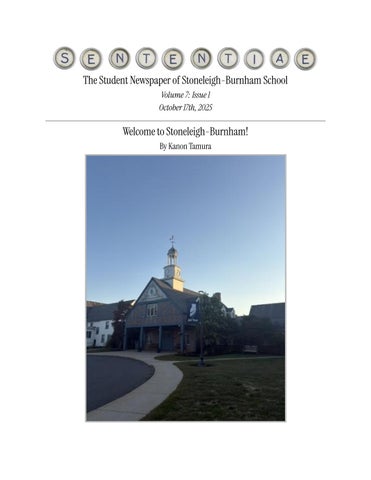
Welcome to Stoneleigh-Burnham! By Kanon Tamura
Untitled
By Kanon Tamura
Her Smile
By Abygail Youmell I don’t like to smile much now not because I forgot how, or because I’m not happy. I am happy. But every time I do, I see her. The girl with scraped knees and summer freckles, smiling like the world had never given her a reason not to. Her hair was always messy, and she never had a care in the world. She was too busy chasing sunsets, making wishes on airplanes, believing that tomorrow could only get better. That little girl is me. I still smile like her sometimes not as often as I used to, but enough to remember what it felt like to be her. Life’s different now. People are harder to read, and finding real friends feels like guessing the right answers to questions no one asks out loud.
Sometimes I think about her how she didn’t care what she looked like or what people thought about her. She just lived life to the fullest, And maybe I’ve changed grown quieter, a little more careful with the things I share, the people I trust, the pieces of myself I keep. But when that old smile slips out, it reminds me that even if the world feels heavier now, she’s still there just a little older, a little smarter, but still me.
Untitled By Morgan Bliss-Vandeurse
The writer: I grasp a pen as some do lanterns, searching for light in the dark hallways of memory. Every word is a step, every line a window
I push open to let the air move through me. You enter my sentences, a shadow embroidered in each metaphor. I want to write you whole, to tie your silences in ink, to show the world the music in your absence. But stories don't healthey only mirror the pain, and I return to the page again and again, hoping this time I'll write myself free. - Ashes in the Garden I cannot let you go. Your name clings to my breath like smoke that will not rise, like a hymn no one will complete. In dreams you returna spark tearing the silence, a flame that burns the dream to ash. I wake with the taste of ash. You'd make an ash tray Out of a garden To smoke the beauty of the earth I hold you close, but my arms are a wound. The tighter I grip, the deeper it severs.
The body recalls what the tongue cannot. And so I countone, two, three, fouras if rhythm alone might calm the ghost of you. But the truth is: I am not free to forget. You dwell in the marrow of words unspoken, and every line I write bends toward you.
Iridescent Longing By Lydia Wilson Bright Bright blue Bright pink, Green Orange RedYou never said The colour that represents You, So I’ll use the rainbow Iridescent shades, on the value scale An aura.
They ALL fly away from Your lightYou always do what’s right I see You come I see You leave I see You dancing in the trees I want You here I want You near braiding flowers in Your hair ‘BFF’ I never left Until four months ago I said I’d never go And now I wish…
Stoneleigh-Burnham EcoLetter Where Style Meets Sustainability and Social Justice By Ruby Rowan-Decker The fashion industry has never been perfect. Whether playing a role in establishing gender norms, crafting culture, or more recently, affecting the environment, fashion has secured its place in our society as a tool for change with endless possibilities for harm and good. Fashion has long been a major contributor to environmental harm, with huge companies churning out trend after trend using unethical labor practices and carbon-heavy supply chains. But today, a new generation of designers is pushing for something different. They’re not just making clothes; they're rewriting the rules. In this issue, we spotlight two creative forces leading this shift: Anna Molinari, a New York based designer giving waste a second life through avant-garde fashion, and Bethany Williams, a London based innovator merging environmental design with radical social impact.
Anna Molinari - Trash Queen keeps Environment Clean In the fast-paced world of New York fashion, Anna Molinari is taking a chance on slow fashion, turning trash into treasure – literally. Her brand, Instinct, transforms discarded materials like plastic forks, beer tabs, duct tape, and bubble wrap into bold, high-fashion pieces that challenge our perceptions of beauty and waste. “If it can be made once, why not extend its life?” — Anna Molinari What sets Anna apart is her playful, DIY approach. Her pieces are innovative yet high fashion while adding accessibility through her presence on social media. Through TikTok and Instagram she’s been sharing her process, encouraging people to see potential in what others throw away and showing viewers that they can do this too! Her message is simple but powerful: sustainability should be instinctual, a natural part of how we live, dress, and create.
Bethany Williams - Fashion through a different lens On a similar note, Bethany Williams recognizes that fashion is about more than just clothes. Since founding her label in 2017, she has shown the fashion world that style, sustainability, and social justice don’t just coexist, they thrive together. Each of her collections is made in collaboration with organizations based in social justice,; ranging from women’s shelters to prison rehabilitation programs. Not only are her garments constructed from recycled or organic materials, her initiatives are constructed with the same care, designing with and for communities. “Fashion can be more than clothing, it can be a tool for change.” — Bethany Williams Her groundbreaking work hasn’t gone unnoticed. From receiving the Queen Elizabeth II Award for Design to being named a finalist for the LVMH Prize and recognized by the BoF 500, Bethany has carved a space where ethical practice and artistic innovation are inseparable. Bringing light to sustainability in fashion is helpful in itself! She’s not just designing clothes, she’s designing a blueprint for what a truly responsible fashion industry could look like!
Sustainability Must Be for Everyone Let’s be honest, sustainable fashion is often marketed to those who can afford it. $200 recycled cotton tees don't match every aesthetic, and they make much of the movement out of reach for the average buyer. But it doesn’t have to be that way. As much as timecapsule wardrobes have been trending, we shouldn’t have to take all creativity out of fashion. Which is why designers like Williams and Molinari are so important. What eco activists often miss about the sustainable fashion industry is that clothes carry more weight than their usability. They have long impacted social movements and become a keystone of many cultures. It is simply unrealistic to have four basic clothing items recirculate in everyone’s closet forever. This is
why environmental movements seem so out of reach for many. We deserve to have ethical fashion and express ourselves. Designers like Bethany Williams are already combining social equity and sustainability, partnering with organizations to give back to the community. Meanwhile, Anna Molinari proves that sustainable fashion doesn’t have to require wealth, just creativity, intention, and maybe a few bottle caps or bubble wrap sheets. “As great as high fashion is for getting eyes on sustainable fashion, it's important to recognize who gets to participate in its future.” The movement must aim higher: accessible, and inclusive, fashion for all.
Why This Matters In a world where fast fashion dominates, the work of designers like Anna and Bethany reminds us that change is possible and already happening! Whether you’re drawn to Anna’s playful upcycling or Bethany’s mission-driven collaborations, both offer a vision of fashion that’s more thoughtful, more ethical, and more human.
3 Ways to Join the Sustainable Fashion Movement 1. Buy Less, Choose Well – Support brands and designers that prioritize people and the planet. 2. Get Creative – Try upcycling old garments or exploring local thrift stores before buying new. 3. Stay Informed – Follow sustainability-focused designers, podcasts, and publications to stay inspired and engaged.
Final Thoughts The future of fashion isn’t mass-produced. It’s intentional, inclusive, and sustainably made.
Thanks for reading!
My Bestfriend By Valentina Hernandez I'm scared of what these heartless souls can offer, no this isn't about a person or animal. but rather something I can't comprehend. a non living, but living being. what does this mean for our society? will I be able to have a job? is my future being robbed? will they come swarm us in mobs? maybe I'm over thinking this. but this will never be done it's here to stay, and it's only just begun.
The Environmental Harm of Generative AI
By Mica Hastings In recent years, generative AI has improved rapidly and become a norm in modern day society. Now that it's become as big as it has, there have been concerns about the impact on human life. With image, text, and sound generation, will artists be able to find jobs? How else will this impact creative industries? How do we know what’s real and what isn’t? But what about the dangers that the media isn’t covering? Something that affects more than just us.
How does AI work?
Artificial Intelligence runs on algorithms. Algorithms are self-improving sets of rules or instructions that teach the machine a certain task with the data it can access. AI needs to be trained. This can be done multiple ways: providing labeled information, letting it learn on its own through patterns and structures, or learning from its environment with occasional feedback. The IT infrastructure required for AI is kept in data centers. Both AI data centers and traditional data centers contain parts like servers, storage systems and networking equipment, but AI data centers are more complex. Many of their aspects would overwhelm a traditional center such as an additional graphics processing unit (GPU), cooling units, and networks.
Why should we be worried? As previously mentioned, the machines that run AI use a lot of energy, more than traditional data centers, and require separate cooling units to counteract the heat they generate. This can be done multiple ways: air cooling (fans), chilled water cooling (cold water flowing through pipes), cooling towers (water is sprayed and reused after evaporation), and direct liquid cooling (direct liquid on chips). To cool massive amounts of insanely fast computers using methods that mostly use water, typical data centers may use about 300,000 to 500,000 gallons of water per day while larger centers may
use 1 to 5 million gallons. AIWaterUsage.com shows live estimations of how much water large companies use, and the average of this data shows that large companies from 4/10/25 to 9/17/25 (a little over 5 months) have used a mean of about 152,497,221.8 gallons of water. This use of billions of gallons of water affects the surrounding areas over time. Microsoft owns many data centers across Iowa. In July of 2022, Microsoft pumped about 11.5 million gallons of water, about 6% of all the water in the district (without their own supply, so this is residents’ drinking water). AI data centers are also some of the biggest electricity consumers in the world due to a lot of the electricity needed to train AI coming from fossil-fueled power plants. In 2021, scientists at the University of California at Berkeley released a research paper estimating that training alone took 1,287 megawatt hours of electricity, producing about 552 tons of carbon dioxide. This is enough electricity to power 120 average US homes for a year.
What can we do? AI has been integrated into almost everything electric and digital. Admittedly, it won’t be easy. But, change cannot happen without participation, so the best action you can take is to try. ● Phase out AI altogether ○ Avoid AI camera filters on social media ○ Avoid websites that generate images/sound ○ Avoid products with AI generated images ○ Avoid websites with generative text (ChatGPT, chatbots, etc) ● Find alternatives ○ Commission artists ○ Look up online tutorials/guides/tips for art and writing ○ Have your friends/family review projects instead of AI A big complaint from people trying to phase out AI is the AI overview that is integrated into most search engines (specifically Google.) Here’s a few potential alternatives: ● Ecosia
○ Cons: Uses AI to enhance searches ○ Pros: AI overview can be turned off, a climate-based engine that plants trees for every few searches ● DuckDuckGo ○ Cons: Uses AI to enhance searches ○ Pros: All AI features can be turned off ● Dogpile ○ Cons: Doesn’t have its own app, therefore must be accessed through a different search engine on mobile devices
Local News
By Macy Buxton and Lennon Phillips
Plastic Packaging
SBS is moving towards a plastic packaging-free dining hall! As you may have noticed, the dining hall has started using much less small individual plastic packaging and has replaced it with bulk items, such as the butter dishes. We would love to see the bulk items used as often as possible. Small plastic individual food packaging contributes to more than 35 percent of the plastic pollution in our oceans and landfills today. It is incredible to see that we at SBS are doing our part to reduce our plastic usage and hopefully help make our planet plastic-free! https://www.agreenerfuture.ca/food-waste-for-action-guide/wrh/food-packaging-waste-guide
Green house
Eco-leaders are in the process of setting up a fundraiser to afford the necessary renovations for the greenhouse to be functional. Hopefully, with everyone's contributions, we can have a thriving greenhouse that will open opportunities for community gardening and very local food on our plates in the dining hall!
Single-stream recycling
As of this summer, Greenfield has switched to single-stream recycling. This means that for individual households, cardboard and plastic can be recycled in one bin, which will be picked up
by new trucks. The new trucks will be automated and result in reduced emissions because they will have to idle less. Greenfield received a $2.05 million grant from the United States Environmental Protection Agency’s Solid Waste Infrastructure for Recycling (SWIFR) grant program to fund the switch to automated, single-stream recycling.