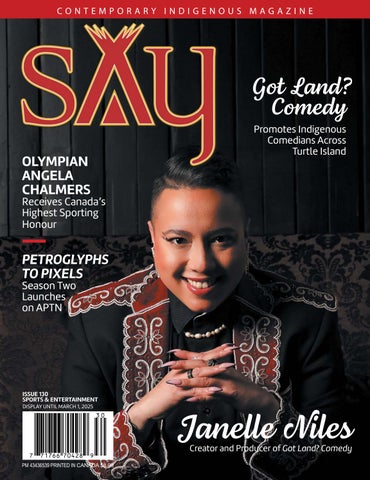
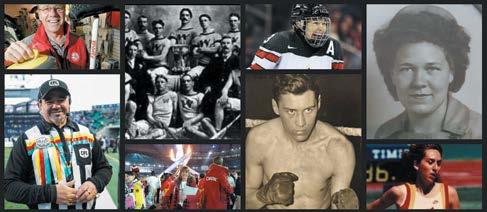
Promotes Indigenous Comedians Across Turtle Island
OLYMPIAN ANGELA CHALMERS
Receives Canada’s Highest Sporting Honour
PETROGLYPHS TO PIXELS
Season Two Launches on APTN
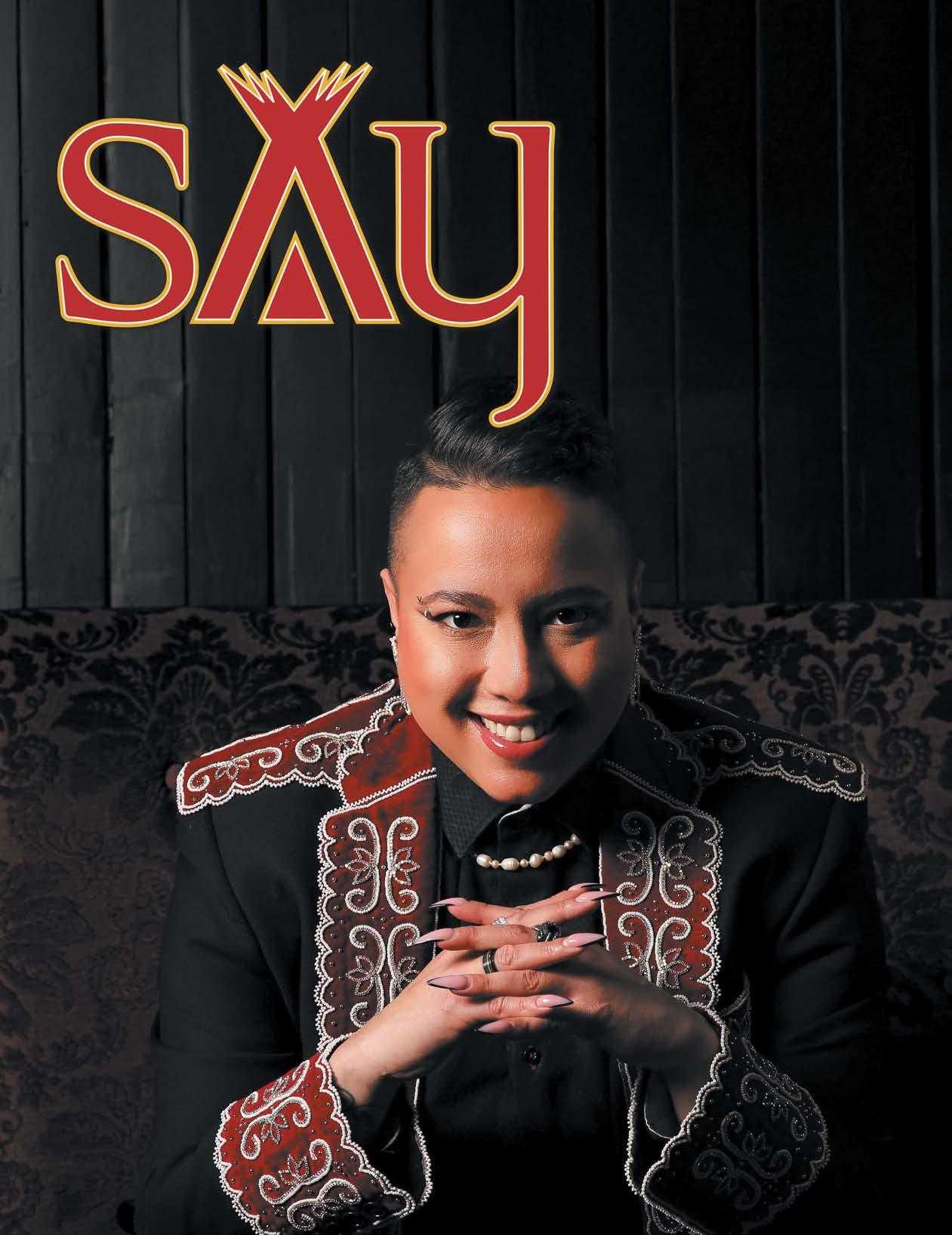
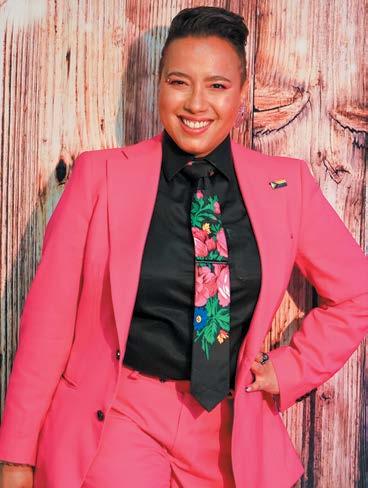
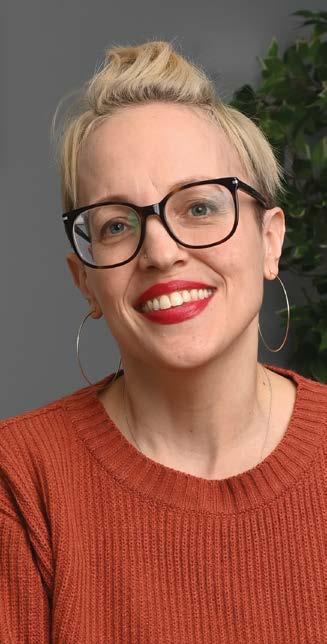
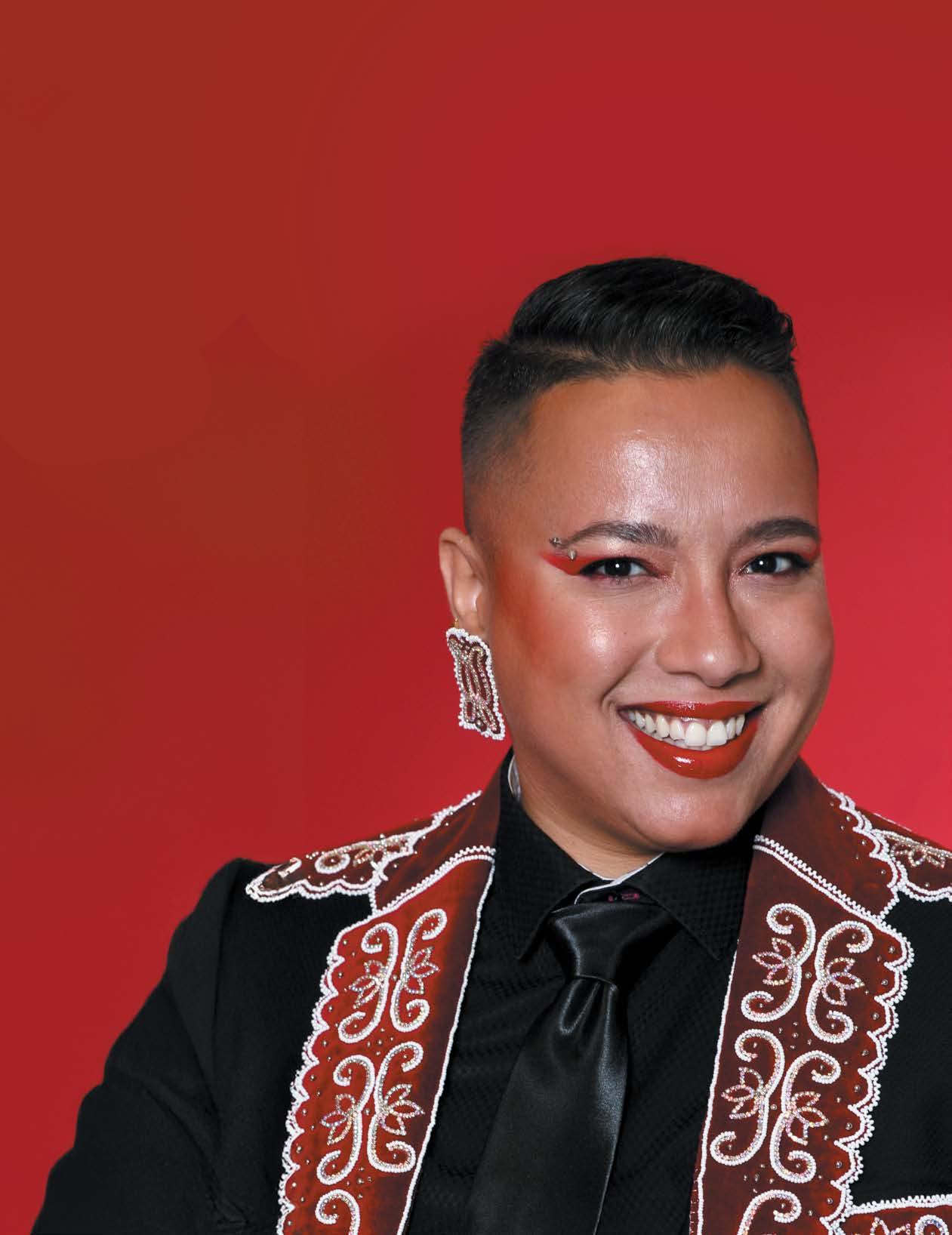
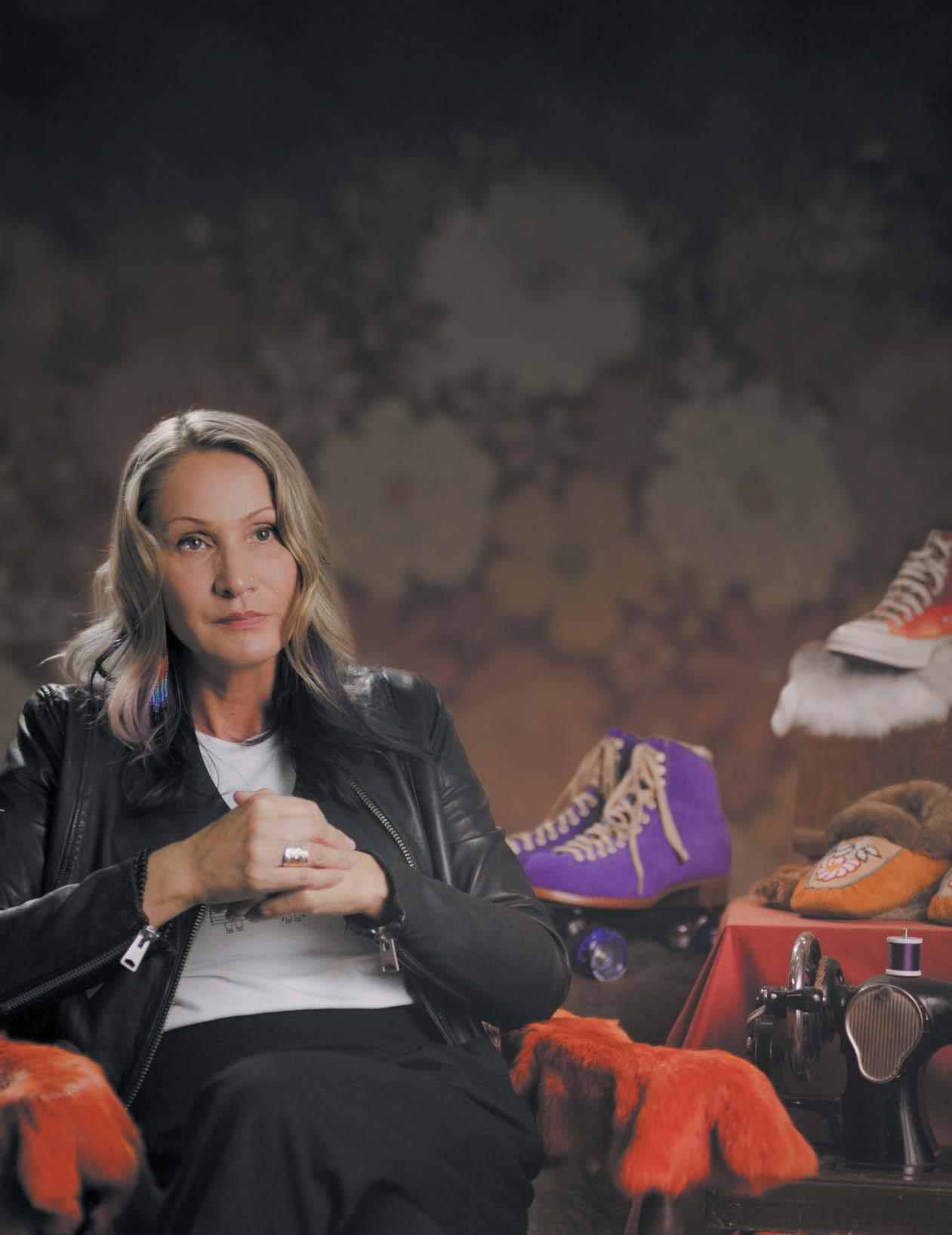
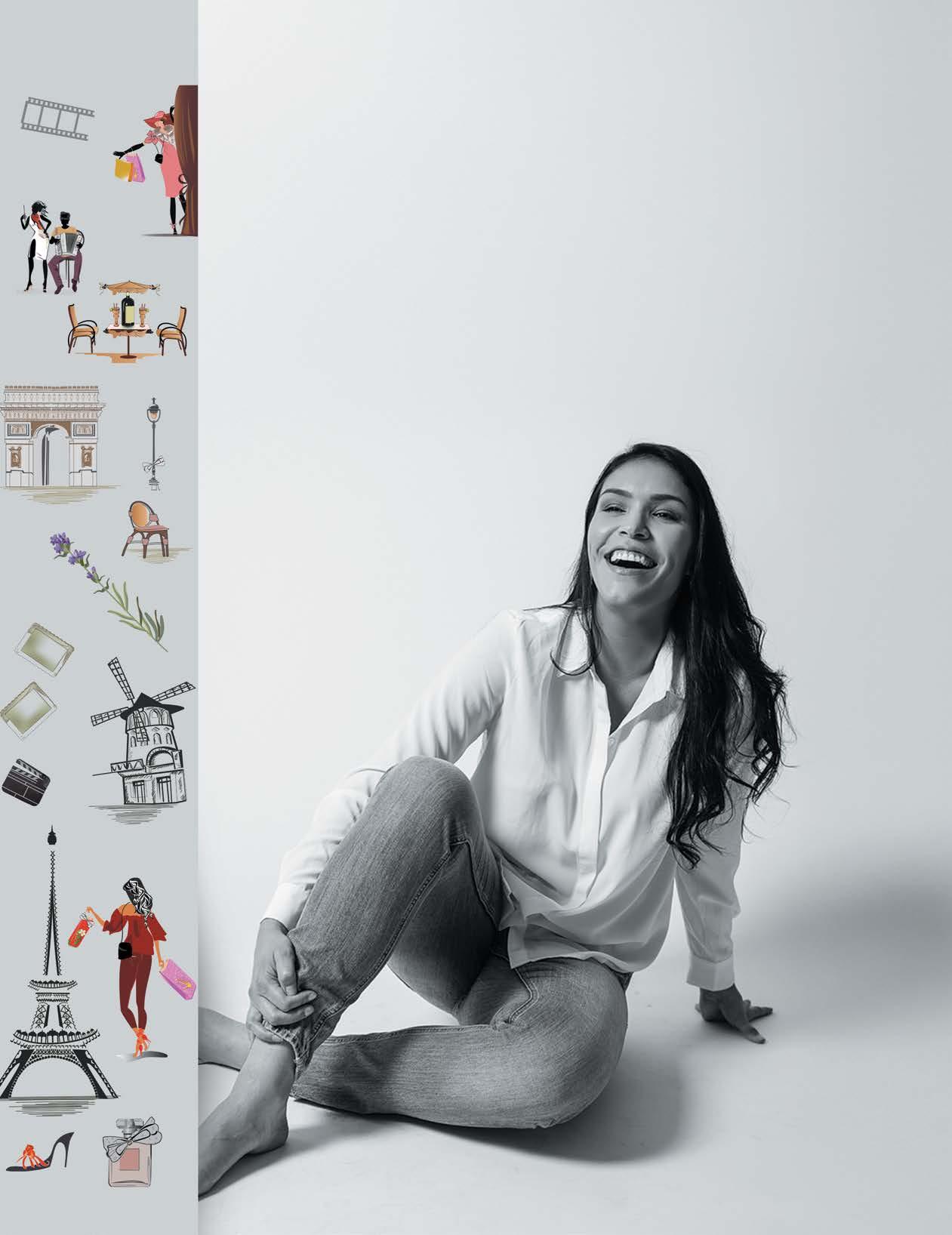
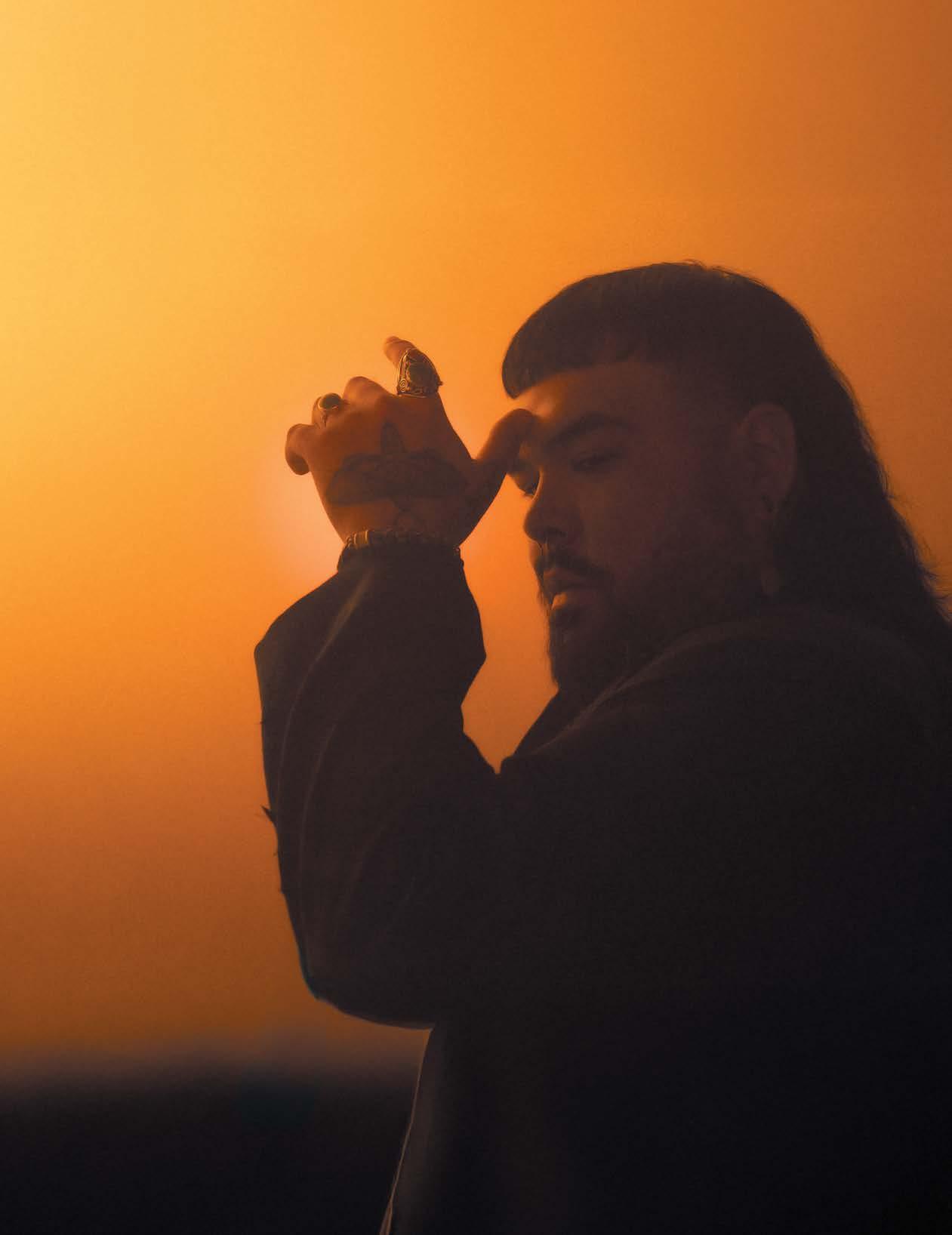
The Got Land? Comedy show just celebrated five years on the circuit, and creator/producer Janelle Niles has big plans to continue raising the profile of Indigenous comedy on a global scale.
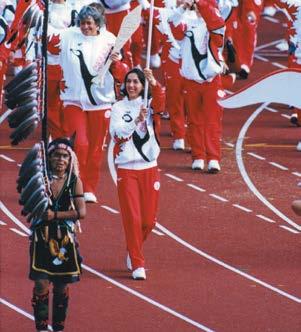
Known as one of the best middle-distance runners in the world, Angela Chalmers is an empowering role model for women and Indigenous youth and recently received the Order of Sport Award, Canada’s highest sporting honour.
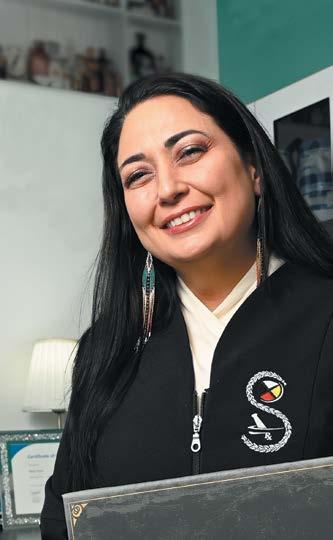
Neda Debassige Toeg runs the first Indigenousowned and operated compounding pharmacy on a reserve in Canadian history. Cynthia Eastman is a remedial massage therapist who wasn’t afraid to reinvent herself and open her own business. Learn more about these inspiring entrepreneurs.
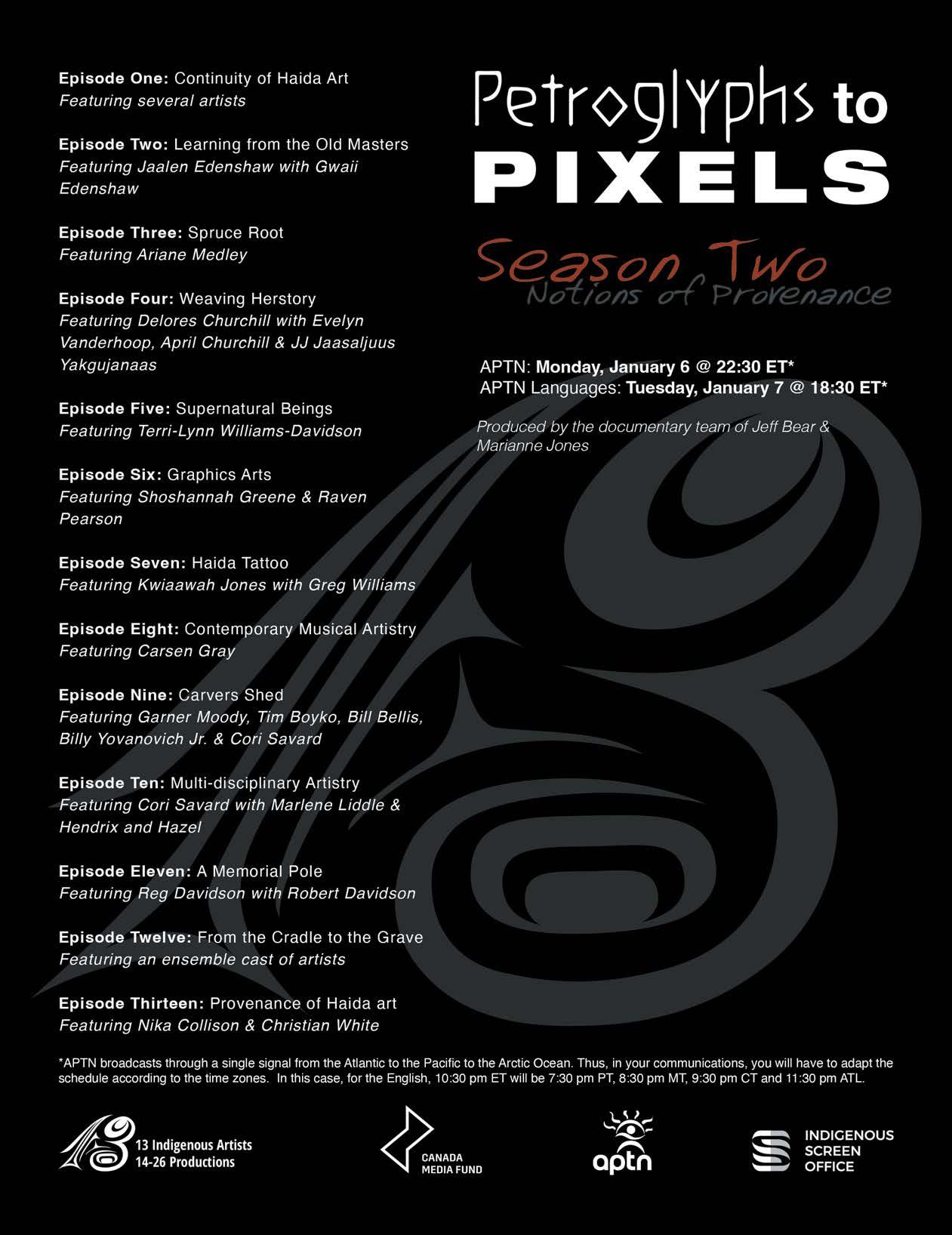
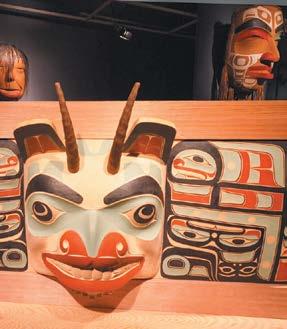
Season two of the documentary series Petroglyphs to Pixels features Haida artists, and through these stories, the notions of provenance, issues of ownership, and custody are explored.
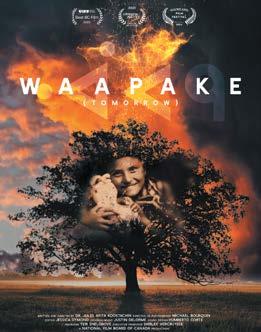
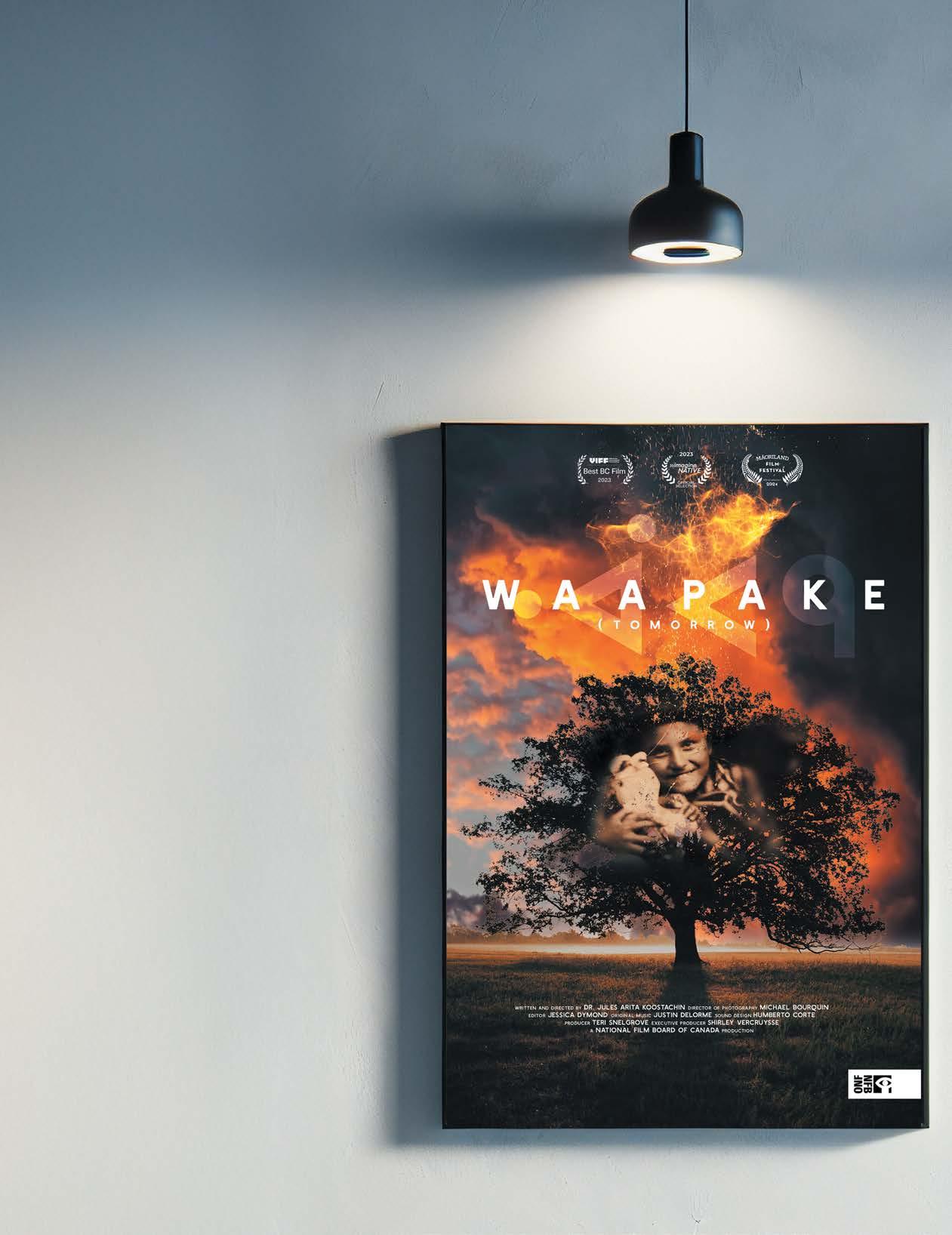
A deeply personal story, WaaPake (Tomorrow) is a powerful, mustsee documentary directed by Dr. Jules Arita Koostachin at the National Film Board of Canada.
Cover photo by Rob Morgan
Neda Debassige
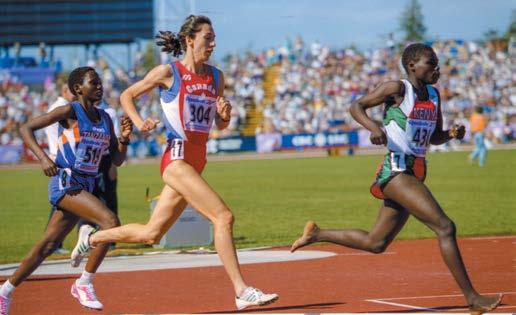
Angela Chalmers, 1994 Commonwealth Games
EDITOR’S MESSAGE
“If I’ve kicked the door in, I’m just trying to stand here and leave it open for everybody else.”
~ Actor Lily Gladstone on being the first Native American woman nominated for Best Actress at the Oscars.
Actors like Lily Gladstone, Jillian Dion, and the iconic Tantoo Cardinal, who appeared in last year’s Martin Scorsese-directed feature Killers of the Flower Moon, are prime examples of what it means to stand firm and not give up. Before landing her role as Mollie Kyle in the film, acting alongside Indigenous ally Leonardo DiCaprio, Gladstone was planning to leave the industry after repeatedly having difficulty finding roles. But she dug deep and tried again, showing the world what it means to be resilient. And as the quote above states, Gladstone holds the door open for other talented Indigenous artists to blaze their own path.
Janelle Niles, featured on the cover, also opens a space for Indigenous comedians to be themselves on a stage that has been overlooked in the entertainment industry. The creator of Got Land? Comedy, she acknowledges that there are other incredible Indigenous comedy shows out there, and she hopes to see more collaboration between shows and Indigenous comedians. “We’ve got to support each other because everyone is doing great work,” she says. Read more starting on page 14.
“Dig deep. Find that one reason that stops you from quitting.”
~ Waneek Horn-Miller
Elite and professional athletes, like actors, are exceptional at their chosen craft and possess qualities like discipline, resilience, and teamwork that are required for greatness. Some athletes are not only incredibly gifted physically but also take great pride in their communities and contribute to the greater good through their platforms as role models. In this issue of SAY Magazine, we highlight Angela Chalmers’ incredible athletic career and delve further into the nomination opportunities that celebrate Indigenous excellence in sport.
Keep reading to learn more about incredible documentaries, fashion, sports, and broadcasting—stories that will inspire us to believe in ourselves no matter our dreams.
~ Danielle Vienneau, Editor-in-Chief
SAY MAGAZINE Volume 23, Issue 6
SAY Magazine is a bi-monthly publication that publishes six issues a year—one issue every eight weeks.
SAY Magazine is published by Spirit of Youth Enterprises Inc.
Website and Social Media: Sphere Media Agency info@spheremediaagency.com
Submissions are welcome Articles, letters, queries, etc. should be sent by email to the editor at editor@saymag.com.
SAY Magazine assumes no responsibility for submitted material.
SAY Magazine assumes no responsibility for statements made by advertisers or in submitted material.
Graphics, photographs, editorial content and other printed material that are created by SAY Magazine are the property of Spirit of Youth Enterprises Inc. and may not be used without written permission from the publishers.
Printed in Canada
ISSN: 1707-3049
GST: 856627534RT0001
This project has been made possible [in part] by the Government of Canada
SAY Magazine acknowledges that we publish in Treaty One Territory, at the crossroads of the traditional lands of the Anishinaabe, Cree, Oji-Cree, Dakota and Dene Nations, and at the heart of the Métis Nation homeland.
As a diverse team of both Indigenous and ally collaborators, we strive to embrace, embody and live the truth that we are all Treaty people. All our relations!
Connect with us: facebook.com/saymagazine twitter.com/saymagazine instagram.com/say_magazine pinterest.ca/saymagazine linkedin.com/company/say-magazine
calendar of EVENTS 2025
JAN 27-29
Cannexus25: National Career Development Conference
The 18th annual Cannexus Conference by CERIC is a bilingual hybrid conference focused on career and workforce development in Canada. The in-person portion will be held at the Shaw Centre. Ottawa, Ontario, Canada cannexus.ceric.ca
FEB 25-27
AFOA Canada National Conference – Empowering
People for the Next Generation
With ample networking opportunities and an interactive trade show, explore innovative strategies and share success stories that uplift Indigenous communities and honour traditions.
Halifax, Nova Scotia, Canada afoa.ca/events/conferences
FEB 25-27
International Indigenous Tourism Conference (IITC)
The world’s largest Indigenous Tourism Congress, IITC is a gathering of industry professionals, community leaders, entrepreneurs and partners dedicated to promoting and celebrating the vibrant world of Indigenous tourism.
A four-day gathering that brings Indigenous youth from across Canada together to participate in ceremonies, workshops, and educational experiences, enabling them to build a toolkit to inspire and empower others.
Victoria, British Columbia, Canada gatheringourvoices.ca
APR 8-9
Soaring: Indigenous Youth Empowerment Gathering
Indigenous high school students nationwide will learn about career and post-secondary education options by participating in interesting, informative, and engaging workshops, as well as about financial support and meeting Canada’s top employers.
Vancouver, British Columbia, Canada indspire.ca/events
APR 27-29
Annual First Nations Major Projects Coalition (FNMPC) Conference
Discover how leading global businesses achieve commercial success and sustainability by integrating Indigenous Nations—their rights, principles, and perspectives—into their business practices.
Toronto, Ontario, Canada fnmpc.ca/conference
MAY 14-15
2025 Vision Quest Conference & Trade Show
This annual event focuses on Indigenous business, community, and economic development and offers delegates incredible networking opportunities and a trade show experience.
RBC Convention Centre Winnipeg Winnipeg, Manitoba, Canada vqconference.com
MAY 26-28
2025 ICCE National Conference: Honouring All Our Relations – Embracing Indigenous Perspectives on Cumulative Effects
From an Indigenous perspective, consider how the cumulative effects of economic expansion and industrial development activities affect every person, place, and thing.
Vancouver, British Columbia, Canada icce-caec.ca/events
January 24, 1951 – November 4, 2024
A Legacy of Justice and Reconciliation
By Danielle Vienneau
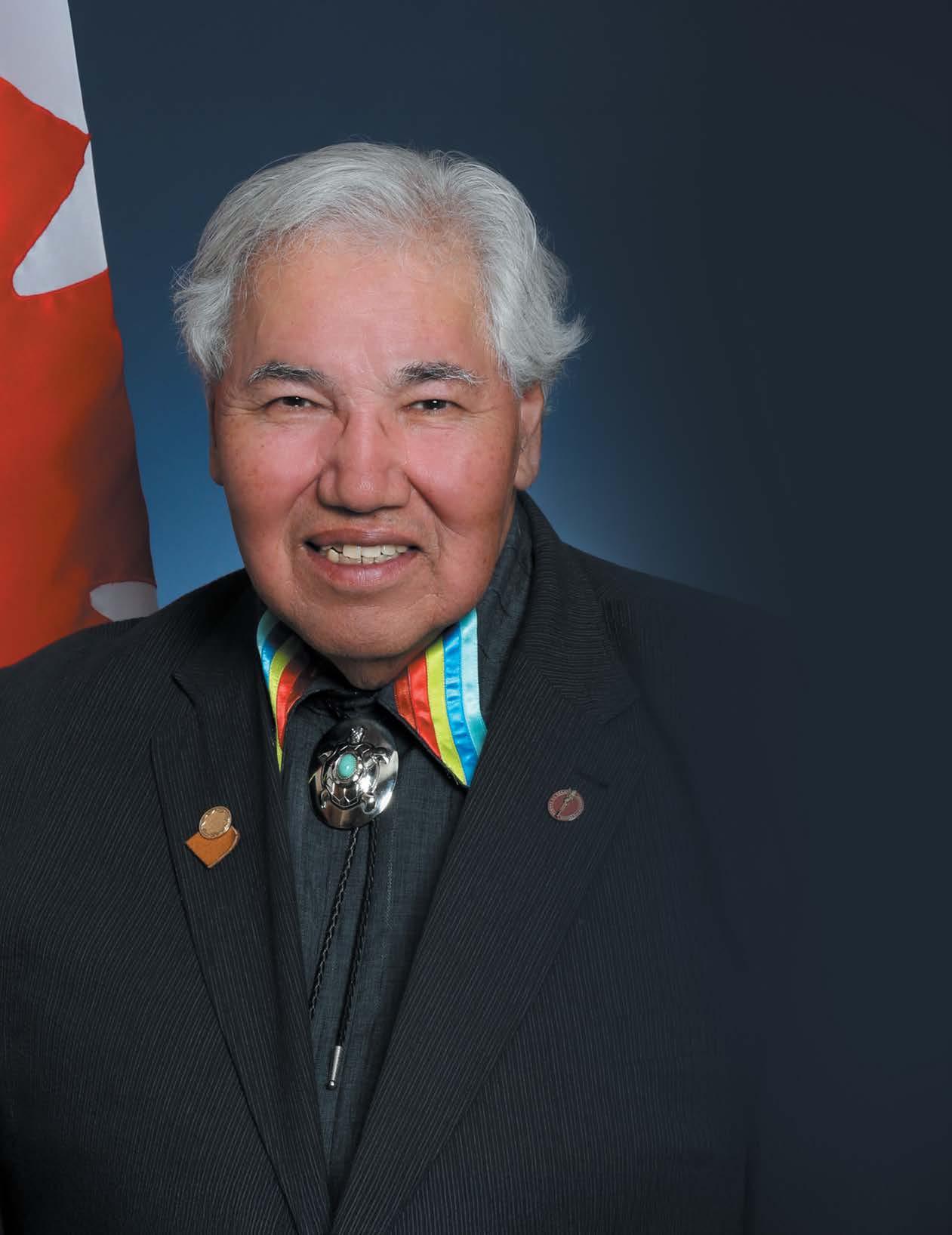
The Honourable Murray Sinclair was a leader of profound influence, a champion of Indigenous rights, and an architect of reconciliation whose work reshaped Canada’s legal and cultural landscape. His unwavering commitment to fairness and equity has left an indelible mark, inspiring generations to strive for meaningful change. SAY Magazine extends its deepest sympathies to his family, friends, and the many communities profoundly impacted by his life and legacy.
When Cochrane Sinclair LLP sought to redefine its mission around justice and reconciliation, Murray Sinclair’s involvement brought unparalleled depth and authenticity to its vision. Joining the firm not just as a figurehead but as an integral leader, Sinclair infused his values into the very foundation of the firm’s work. His guidance helped solidify Cochrane Sinclair as a beacon of advocacy, particularly for Indigenous communities.
“Murray’s influence will continue to guide us in all we do,” says Harold (Sonny) Cochrane, Partner at Cochrane Sinclair LLP. “His presence and leadership were a light for everyone at the firm. As he taught us, we’re committed to fulfilling his vision for fairness, respect, and equity in every legal challenge we undertake.”
Sinclair’s time with Cochrane Sinclair LLP was transformative for everyone involved. His belief in building bridges between legal frameworks and Indigenous communities became the cornerstone of the firm’s approach to justice. “His legacy has become our compass, guiding our commitment to reconciliation, justice, and empowerment within Indigenous communities and beyond,” Cochrane reflects.
The loss is felt deeply by those who worked closely with him. “Murray’s work in pursuing justice and Indigenous rights has forever impacted Canada and me personally. I am so grateful to have had the opportunity to spend time with him and to know his big and gentle heart,” shares Shawn Scarcello, Partner at Cochrane Sinclair LLP. “His legacy will
guide us as we strive to make meaningful change. I will miss him dearly.”
“It’s a devastating loss for our firm, our country, and humanity at large,” says Max Faille, Managing Partner of Cochrane Sinclair’s Vancouver office. “We are fortunate to have walked the earth alongside such greats and all the more fortunate to be in a firm that he helped guide and inspire each day. He touched the lives of countless individuals and stirred the conscience of a nation as few have. He did so with fearless moral eloquence, clarity, warmth, compassion, and an abiding sense of humour that was as true to his Cree and Anishinaabe roots as his life’s work. He was my hero.”
Sinclair’s impact extended well beyond the courtroom. He championed a broader understanding of justice that incorporates respect, equity, and the recognition of Indigenous voices within Canada’s systems. His leadership wasn’t confined to his legal achievements; it was deeply personal, inspiring those around him to embrace reconciliation as a way of life, not just a goal.
Cochrane Sinclair LLP remains steadfast in its commitment to advancing the values Sinclair championed. “Our mission is to honour his memory by upholding these principles in all we do, carrying forward his dedication to a future where justice and equality are within reach,” explains Cochrane.
At SAY Magazine, we celebrate the Honourable Murray Sinclair as a symbol of resilience and justice and as a catalyst for change whose vision will continue to guide future generations. His legacy is a reminder that true reconciliation requires relentless dedication, compassion, and courage—qualities he exemplified throughout his life. Murray Sinclair’s light will remain undimmed as his work continues through those he inspired.
Danielle
Vienneau, Editorin-Chief with SAY Magazine, believes in the power of sharing positive stories to inspire greatness in others. To submit your story, email editor@ saymag.com
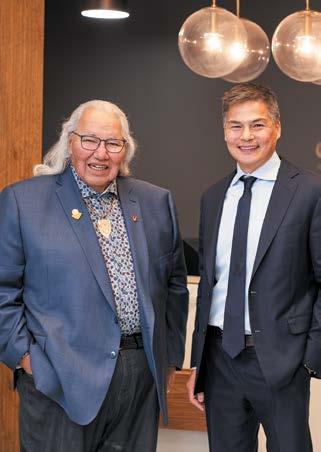
Murray Sinclair and Harold (Sonny) Cochrane
In-Depth Look at Indigenous Broadcasting Policy
By Jeff Bear
When the first Canadian television signals became available in 1932 at very low bandwidth, it happened in Montreal, Quebec. The experiment lasted only three years and did not include Indigenous people, nor was there ever any discussion about us as a people or as participants in the broadcast system. In the same year, the first Canadian Broadcasting Act was established.
The first amendment to the Broadcasting Act came four years later when, on November 2, 1936, the Crown corporation, CBC, was established and initially focused its growth on radio. At no time in this early conception did Indigenous people receive any consideration whatsoever. There were no Indigenous programs, and Indigenous languages were never heard on the airwaves. English and French quickly became dominant across a landscape regardless of the 52 distinct Indigenous languages.
It wasn’t until 1946 that television became a part of daily Canadian life. Many televisions were available in cities and towns near the United States border. From its earliest days, American programming, its values and culture, were seen on screens by wealthy, mostly white citizens.
In 1958, the CBC created a Northern service, but no one listened to it. After public demands in 1960, the corporation broadcasted the Northern Service in the Inuktitut language. That was the key: people speaking up about their rights to hear news in their own language.
CBC North became a catalyst for change and today broadcasts in 12 distinct indigenous languages—but only in the north. Sixty-five years later, CBC has yet to fulfill its promise of being truly national. It has steadfastly
refused to broadcast Indigenous languages on its national service.
Why has the CBC not provided an Indigenous language program on the leading television network? Part of the rigid stance comes down to the role of a crown corporation: their license obligations come from the Canadian government, which created laws that pushed Indigenous people to the sidelines. The official position is that Canada is made up of two founding nations, English and French. The historical timeline of the Broadcasting Act has been exclusionary, stating in its many amendments that Canada comprises two official languages.
As a young Indigenous person growing up in the southern regions of Canada, I never saw any programming of relevance. My heroes were a mix of simple characters: The Rifleman, Rin Tin Tin, Andy of Mayberry, The Beverly Hillbillies, and, of course, Ed Sullivan. Each of the popular programs was American and steeped in a maledominated culture that rendered women subservient to men. If there were ever any “Indians,” they would receive the same treatment. Even Ed Sullivan's Topo Gigio was a white puppet with an Italian name.
Canadian television didn’t completely ignore us. Adventures in Rainbow Country, with a Cree actor from Mistassini, Quebec, was broadcast in the late 1960s. Nearly a decade later, another show, Beachcombers,
was launched on the West Coast. Three of its cast members were Pacific Coast Indigenous people. Yet, the Indigenous were always cast as “good little Indians” assimilated to mainstream life.
Three decades of tumultuous change created significant social change. First, the beatniks of the 1960s came to celebrate Indigenous people in existential ways. The beatniks, and later the hippies, mimicked the Indigenous attire, headbands, earrings and painted faces. Leather moccasins and vests became the haute couture of a rebellious era. Pivot to the future. Alberta (AB) and British Columbia (BC) were strange bedfellows in Indigenous broadcast policy. Indigenous people in AB had signed treaties, including Métis peoples, the only Métis in Canada with a recognized land base. In BC, a vast majority of First Nations did not sign treaties. Their land was all unceded territory. AB had three Indigenous languages, while BC had
about 27 distinct dialects. Not only were the politics different, but the relationship with the Crown was on different levels regarding language and culture.
Activism in Canada among Indigenous intellectuals grew. In every province and territory, silos of astute and politically aware Indigenous youth began to make noise. When Jean Chretien developed a policy paper—First Nations labelled “The White Paper”—a young lawyer named Harold Cardinal published a rebuttal called “The Unjust Society.” The reaction in the Indigenous world was visceral. Chretien’s policy was eventually defeated, fueling a new era of democracy.
By 1979, the federal regulator had seen something amiss. A small team of policy staff and the office of a Canadian Radiotelevision and Telecommunications Commission (CRTC) Commissioner took notice. Commissioner Real Therrien
Indigenous Peoples have the right to establish their own media in their own languages and to have access to all forms of non-Indigenous media without discrimination.
~ Article 16 of
UNDRIP
proposed a study, which came with the Therrien Report. Therrien’s committee was pleased to find many voices from “Indian Country.” Among those voices were CRTC insiders, writer Patrick Tourigny, in the north, a young broadcast journalism graduate from the Yukon, George Henry, an Inuit broadcaster Rose Marie Kuptana, Manitoba lawyer Ron Nadeau, and a young upstart Maliseet troubadour Jeff Bear (me).
We all made presentations to the Therrien research endeavour. We were all working for Indigenous-owned media outlets that the Canadian government had established in 1972, a project named The Native Communications Program. There was a decade of rapid growth during which time Native Communications Inc. (NCI) of
Manitoba built radio and TV stations that broadcast culture and language relevant to Indigenous Manitoba, The Inuit Broadcasting Corporation was established, and another 11 non-profit societies were established to help fill the gap left by CBC and a handful of private broadcasters.
The Therrien Report was the catalyst that helped to launch the modern era of the Indigenous broadcast policy. We have come quite far in the Canadian consciousness. At first, we were Native. Then, we became Aboriginal. And now we are Indigenous. And it would take another government task force, The Caplan Sauvageau Task Force on Broadcast Policy, and eventually a Royal Commission on Aboriginal People to help launch our first national Indigenous television network.
In 1991, the Broadcasting Act was amended to recognize “our special place” within Canadian society.
The image test pattern on old TVs was often an Indian-head portrait or a set of calibrated lines and shapes. The test pattern was used to calibrate and troubleshoot television equipment and was often broadcast outside programming hours.
In 1991, the Broadcasting Act was amended to recognize “our special place” within Canadian society. Perhaps the most significant springboard came in the Report of the Royal Commission on Aboriginal People, RCAP.
The 1991 report was controversial in government circles, but it helped to give credibility to what has been said all along. Canada has not kept its promises in treaties, which was acknowledged by the United Nations in Geneva. A majority adopted the United Nations Declaration on the Rights of Indigenous People UNDRIP on September 13, 2007.
Article 16 of UNDRIP states: Indigenous Peoples have the right to establish their own media in their own languages and to have access to all forms of non-Indigenous media without discrimination.
In 2017, the CRTC announced a Public Consultation, and a review is underway.
The first CRTC report was released in 2022. In that report, the last quote in the document was one of the sayings I have adopted from the late Chief Clarence Jules. Sr. Chief Jules once said, “You can’t fix a flat tire by yelling at it.” Indeed, we must be the force that maintains the wheels of change. Moving forward, self-determination will be the fuel and catalyst that drives our ambitions in broadcast policies, Indigenous laws, and regulations.
For more information regarding Canada’s current Indigenous broadcasting policy, visit crtc.gc.ca/eng/comm/ppl/pol.htm.
Jeffrey Bear is a creator, writer, and director focusing on Indigenous content. A multi-media expert with over 30 years of experience in television broadcasting and journalism, Bear seeks to follow a story, the movement of his people in society, and to try and capture the nuances of those pursuing social and environmental justice.
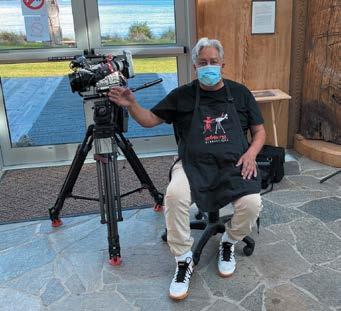
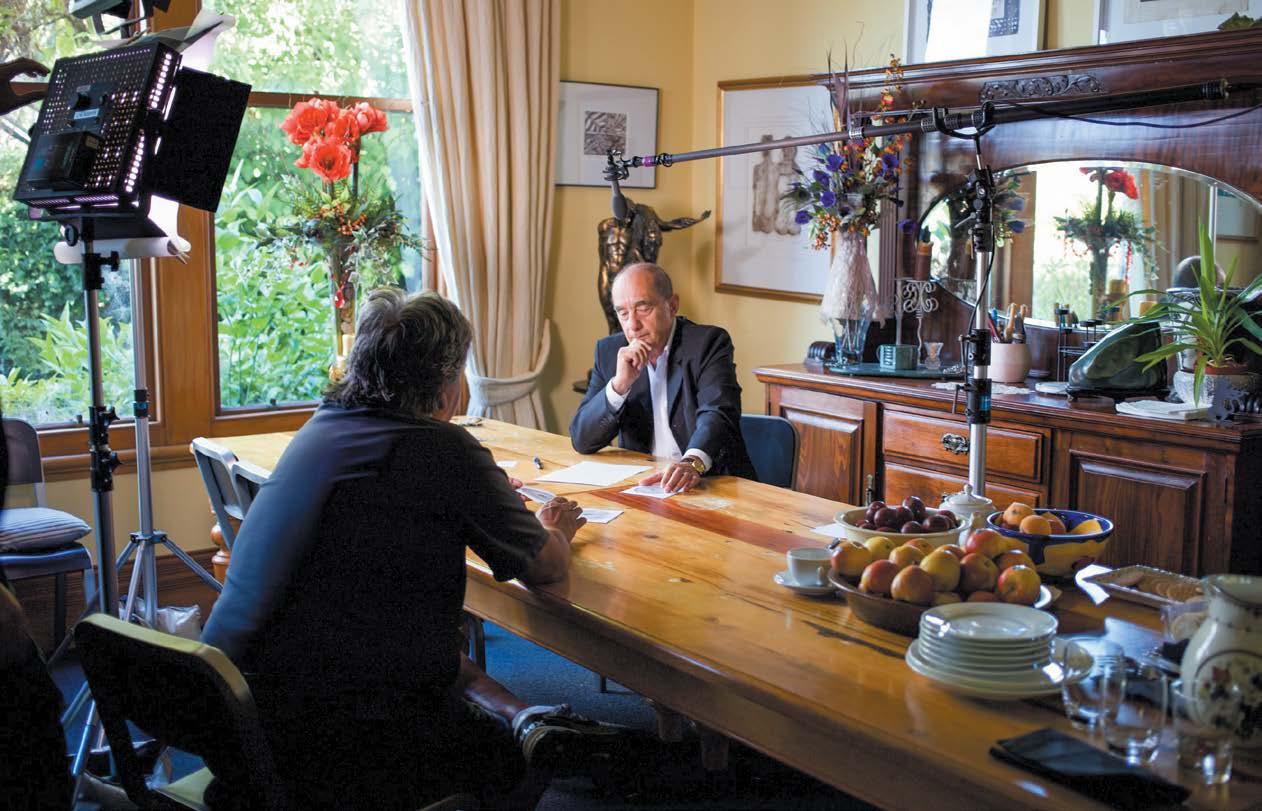
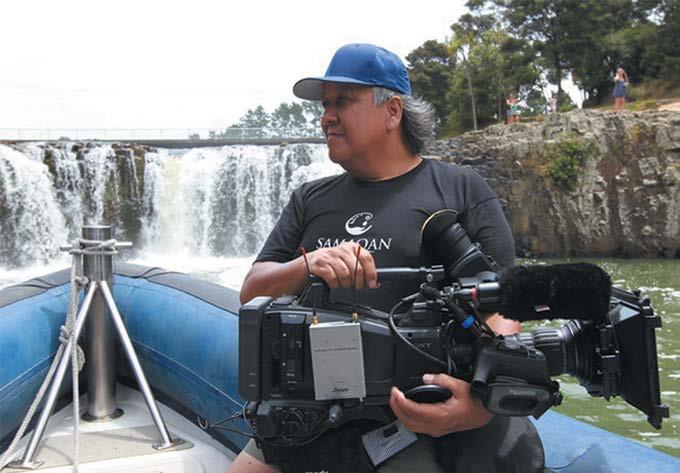
Jeff Bear interviewing Judge Ed Durie in New Zealand
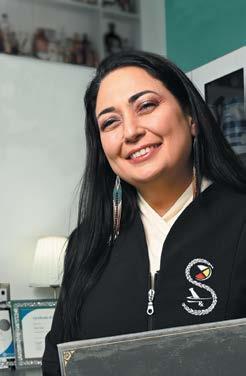
NEDA DEBASSIGE TOEG
Sponsored by:
SWEETGRASS PHARMACY AND COMPOUNDING (SGRx) - M’CHIGEENG, ONTARIO
The Sweetgrass Pharmacy and Compounding (SGRx) in M’Chigeeng is the first Indigenous-owned and operated compounding pharmacy on a reserve in Canadian history. It is the brainchild and passion of Neda Debassige Toeg, the owner and clinical pharmacist. Compounding is the skill and ability to create individualized patient care and dosing, which aligns with Debassige Toeg’s focus on pain management, autoimmune disorders, and cancer treatment.
Debassige Toeg observed the best and worst practices in other pharmacies and created a model that consists of the pharmacist being easily accessible to patients while adding her own touch of intimacy and warmth with a dash of bling.
Before opening the pharmacy, she explored other career options to make a real difference in her
community. First, she started in politics, working on Parliament Hill, where she learned about policy and funding processes. From there, she considered becoming a physician. “But in the end, I took a side trip into pharmacy and ended up loving it because pharmacy is the only type of healthcare where a patient can come in anytime and see a healthcare professional.”
Giving back to the community is very important to Debassige Toeg. She strives to educate patients on how to improve their health and to inspire youth about the types of careers they can have. Debassige Toeg is passionate about her staff and the importance of training and mentoring them to build community involvement and improve healthcare.
“My staff are the reason I wake up in the morning. Patients are a very close second, but my staff inspires me to dream bigger. They are all Indigenous, and many of them are from M’Chigeeng. They range from high school students up to 65 years old.” She invests in her staff by sending them on a week-long intensive compounding course. “It opens up this world of something they’ve never even thought possible.”
When it came to funding, Debassige Toeg worked with two different Indigenous Financial Institutions (IFIs). First, she developed a business plan with Waubetek, the local IFI. Then, when it was time to build the pharmacy and have a business model that did not require land as collateral and to get expertise more closely associated with her field of business, with the support of her Chief, Linda Debassige, Debassige Toeg transferred to the Two Rivers
Community Development Center IFI. “The wonderful thing about researching is finding out about the different IFIs. We discovered that you don’t have to use your land as collateral and that other IFIs might have unique backgrounds and are aware of your small business and expertise. And those are the ones that you need to find.”
Debassige Toeg advises people to “Stop hanging out with people criticizing your big dreams. Instead, start hanging out with people who support you and challenge you to dream bigger. Look for mentors.” She recommends that as your dreams change, you should also seek new mentors.
“Every time I can pay my staff is a gift from the Creator,” she says. “There is no way, when you look at opening a pharmacy, especially a compounding pharmacy in the middle of COVID, that we should have survived. And not only did we survive – we flourished. But, my God, what a gift it is to hire as many staff as possible, send them for training, invest in them, and give them pay raises every time they take on a new responsibility or learn a new skill. That’s a gift.” She mentions that it’s her patients who keep her going. “Especially the patients who come in and tell me, ‘I’m just popping in to say that you’ve changed my life and thank you for all you do.’ That’s another amazing gift.”
“My patients and fabulous staff inspire me to get up every morning, go to work, and never give up. And I thank the Creator every day for this wonderful opportunity to serve my people.”
CYNTHIA EASTMAN
SAGE AND STONE REMEDIAL MASSAGE - WINNIPEG, MANITOBA
You’re never too old to reinvent yourself. Believe in yourself and know you’re never too old to start something new.
~ Cynthia Eastman
Cynthia Eastman is a remedial massage therapist and the owner of Sage and Stone Remedial Massage. She radiates positive energy as she explains the importance of caring for her clients’ minds, bodies, and spirits.
Before becoming a massage therapist, Eastman worked as an educational assistant, but it wasn’t enough for her. “I do love working with kids, but it didn’t give me that feeling of passion and drive that keeps me going. Sometimes you need that. I just wanted to honour myself and help others with their wellness path through massage.” While she had wanted to start this business when she was younger, Eastman began her career later in life. “I wanted to do this when I was nineteen, but at the time, I didn’t have a lot of confidence in myself, and I struggled with a lot of things, including alcohol. When I was forty-four, I thought, ‘What am I waiting for?’ I went for a massage, and while talking to the therapist, I said, ‘You know, I wish I had done this years ago.’ And she said, ‘You’re not too old to do this.’ So, two days later, I signed up for college, and now I’m living the career path I’ve always wanted.”
Eastman is a graduate of the Wellington College of Remedial Massage Therapy. She started her training in 2019, and then the pandemic hit, which complicated the process. She worked towards graduation while juggling part-time work, being a fulltime mother, and attending school part-time. As graduation approached, Eastman needed to decide whether to work for someone else or be her own boss. While contemplating this decision, she learned that a healer who had helped her earlier had studio
Sponsored by:
space available for rent. Eastman felt it was “the universe showing me what I needed to do” and arranged to rent the space.
“I’ve always been someone who loves to beat to my own drum, so to speak. I like to do my own thing. So, I wanted to try it on my own, go out, give it a shot, and be the boss.”
Eastman worked with the Manitoba Métis Federation (MMF) and the Louis Riel Capital Corporation to start her business. “I was introduced to an amazing woman named Genevieve who helped me with the process, the micro-loan, everything I needed, and even things I didn’t think I needed to help me get the business started.” Eastman noted that she didn’t know where to start with her business plan, but the Louis Riel Capital Corporation was terrific and provided support. “I’m just so grateful for everything the organization has done for me.”
Eastman faced various challenges, including her father’s passing, as she started her business. However, she does not see these issues as a reason to give up on her dreams. Instead, she believes that while personal problems can take your breath away, they can also keep you focused. “I feel that for some people, when you’re in the eye of the storm, having something to focus on can push you further. Challenges aren’t forever, and it’s pretty great once you reach the finish line on the other side.”
“You’re never too old to reinvent yourself. Believe in yourself and know you’re never too old to start something new. I just turned forty-eight, and I’m finally living my best life. It’s a wonderful feeling.”
Laughter Is Good Medicine
By Danielle Vienneau
We’ve all heard it, “it takes more effort to frown than it does to smile” and “laughter is the best medicine.” Evidence shows that laughter increases oxygen intake, stimulates vital organs, including the heart and muscles, and increases endorphins released by the brain. The psychological and physiological benefits of laughter are staggering and free, I might add. We know that laughter can’t heal all ailments; there’s a place for traditional and pharmaceutical medicines and other forms of therapy that people need, but that’s not what this article is about. Even Charlie Chaplin said, “A day without laughter is a day wasted.”
We could all use a little more joy in our lives, and laughing is something that everyone can do, but it takes a special person to make others laugh. Janelle Niles, creator and producer of the Got Land? Comedy show knows this first-hand. A Two-Spirit Black-Mi’kmaq woman from Sipekne’katik (seh-beh-gen-nehh-gahdii) First Nation in Nova Scotia, she uses comedy not only as entertainment but as a way to educate and advocate—a doctor of comedy, if you will.
Got Land? Comedy launched in 2019 and is a stand-up Indigenous comedy show where First Nation, Inuit and Métis entertainers tell jokes and share individual life stories. The show was created to express solidarity with humour, and with a roster of 35 comedians from every province and territory in Canada, all comedy genres are represented.
SAY Magazine introduced readers to Got Land? two years ago and felt it was time for an update. We recently spoke with Niles and Patrick Cheechoo, one of the comedians on the Got Land? roster since the very beginning.
From Constance Lake First Nation, Cheechoo is Mushkeego Cree. He’s been performing on stages and perfecting his craft since 2012. He says it all began with a shaky five-minute set. “The paper was just rattling in my hands as I was doing it,” he explains. In 2014, he won Thunder Bay Comic Idol amongst 14 competitors and that was the confidence boost he needed to continue pursuing comedy.
“Patrick Cheechoo is a fantastic comedian. He headlines 99 per cent of my shows and brings a lot to the table of Indigenous comedy,” says Niles. “I always say that he is the Salt of the earth NEESH. When you think of an Indigenous comedian, you think of Patrick Cheechoo. He’s amazing.”
Cheechoo has travelled across Canada and the United States, performing in shows with friends and fellow comedians Ron Kanutski, the 2010 Thunder Bay
Comic Idol, and Todd Genno, the 2012 Thunder Bay Comic Idol. He appreciates the opportunity to appear in showcases produced by his peers Niles and Kanutski. “I really appreciate all the work they put into promoting First Nations and Indigenous comedy.”
Ever since he was a child, Cheechoo has made people laugh. In his professional life, he has spoken at many conferences as an emcee and found ways to incorporate jokes into his speeches. “People thought I was funny,” he says. “I was part of a volunteer group that did the Aboriginal Day Gala in Thunder Bay, an annual celebration of Indigenous talent in Thunder Bay, Ontario and that’s where I did my first five minutes of comedy and loved it.”
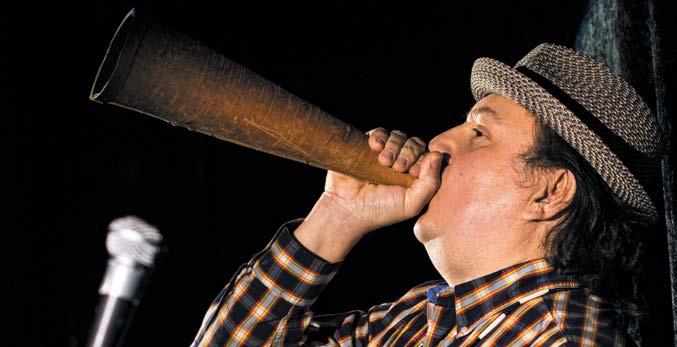
Cheechoo was known for telling stories and jokes even before his days as an emcee. “I think First Nations people like to share,” he explains. “Whenever you have three or more together, it’s this laughter all the time, and that’s where I got my start.” His show elaborates on his life experiences, and as an avid hunter, Cheechoo likes to incorporate jokes from his hunting adventures, including animal calls.
“One of my most memorable shows was when we did a free show in La Loche, Saskatchewan, as part of their healing after an incident at one of the schools,” he says. “It was a memorable show because we performed at a relatively large elementary school, with about 450
Patrick might have only been doing comedy for about 12 years, but it feels like he’s been doing it his whole life. He’s like my comedy elder. I look to him for guidance. He keeps me humble. We have meaningful conversations on the road, and we’re always laughing. Patrick is good people and he’s an amazing comedian. He’s our best closer. ~ Janelle Niles
Patrick Cheechoo at Yuk Yuks
Photo credit: Erik Stolpmann
students and faculty in the audience. Until then, I mainly performed in front of an adult audience,” explains Cheechoo. “My show involves storytelling and a lot of wildlife/animal calling, bird calling, and stuff like that. It went over really well with the kids. They started calling back to me, especially when I did some geese calls. It was awesome!”
Eventually, Cheechoo moved southeast to the Ottawa region, where he met Niles and joined the Got Land? team. Five years later, he is still involved and looking forward to continuing his journey as a comedian.
“Patrick might have only been doing comedy for about 12 years, but it feels like he’s been doing it his whole life. He’s like my comedy elder. I look to him for guidance. He keeps me humble,” says Niles. “We have meaningful conversations on the road, and we’re always laughing. Patrick is good people and he’s an amazing comedian. He’s our best closer.”
Married with five children and three grandchildren, Cheechoo credits much of his success to his wife. “She’s helped to create my best material. I appreciate that she has a wonderful sense of humour and is super intelligent, so it makes for some great jokes when we work together. I credit her during my show because she’s so funny.”
Comedy is not Cheechoo’s only gig—he is an artist and a photographer and works a full-time job for a tribal council.
Cheechoo appreciates the opportunities he’s had through Got Land?, including being a part of various festivals and a showcase for Just for Laughs, Yuk Yuks Comedy Club, and, more recently, the Guelph Comedy Festival. Another highlight from his travels thus far was performing in Iqaluit, Nunavut, at the Arctic Comedy Festival—a bucket list item made possible through his involvement in Got Land? Comedy. “I look forward to being at more comedy festivals, but I think the most fun I have is when I’m in First Nation communities, so that’s what I’m looking forward to doing more of.”
In addition to a circuit that has Got Land? comedians travelling across Canada to cities, rural communities, colleges, universities and special events, most shows can be seen at Festivals nationwide throughout the year.
“Our mandate is to express solidarity,” says Niles. “I’m a very political comedian, but Patrick is not. He’s a real jokester—a talent splendour for our show. So you get “hard” at the beginning and then softer afterward. It’s about using humour and laughter as a channel of solidarity,” explains Niles.
“Before Patrick, it was Don Kelly who would headline in earlier shows. Patrick fills a vital spot in our roster of amazing Indigenous comics because making those Elders laugh is tough. After all, they have a different life experience and relevance,” says Niles. “So we need a mix of relatable people on several fronts.”
“I have six candidates pending, but the comedy business can be intimidating. Many people are reluctant to put themselves out there and present themselves. But this is how the comedy business works: You have to be yourself”, says Niles.
The Got Land? show can be seen in Ottawa two to three times a year, and
I believe the comedy scene has neglected Indigenous comedians, and we have something to say. Just because we’re Indigenous comedians doesn’t mean we only perform for Indigenous people. We perform globally and nationally. I want to ensure that the rest of the world knows we’re still here. ~ Janelle Niles
Got Land? - Vision for the Future
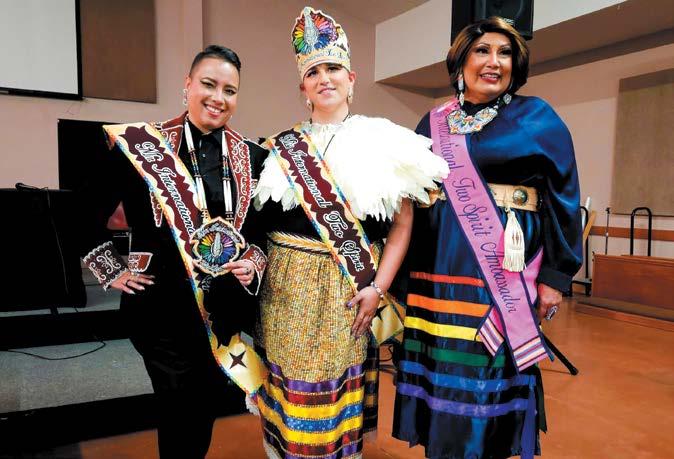
37th Annual International Two-Spirit Gathering in Oklahoma, United States. From left to right: Janelle Niles (Mr. International Two-Spirit), Ahyoka Youngdeer (Miss International Two-Spirit), Mellor Willie (Two-Spirit Ambassador)
for the last two years they have performed at the National Arts Centre in Ottawa, Ontario—a highly sought-after event that Niles hopes will become an annual event for Got Land?
With five years under her belt, Niles has some big goals for the next few years. We’ve performed the Got Land? show in the United States, in upper New York State several times, and through a collaboration with a Native American College in Oklahoma. It was fantastic, but we want to bring more of the meat and potatoes to the States,” she says. “It takes a lot of paperwork, but we could visit so many Indigenous communities down south by going on tour and having a showcase. It’s bigger and a little more complicated than here in Canada, but we can do it.” In addition to expanding more into the United States, she hopes to see Got Land? on the big screen one day soon.
“I believe the comedy scene has neglected Indigenous comedians, and we have something to say,” explains Niles. “Just because we’re Indigenous comedians doesn’t mean we only perform for Indigenous people. We perform globally and nationally. I want to ensure that the rest of the world knows we’re still here. I want to give everybody a chance in the spotlight. I would like a comedy special where we can have as many Indigenous comedians as possible on the big screen.”
“I would also like to acknowledge that there are other incredible Indigenous comedy shows in Canada, not just Got Land?” says Niles.“I am very proud that there are more of us, and I would like to see us collaborate and work together. We’ve got to support each other because everyone is doing great work.”
“I don’t want another book written about Indigenous comics like there
was with comedian/actor Charlie Hill (Mohawk/Cree),” explains Niles. “There’s a book about how Indigenous comics can’t get along, and I’m thinking, ‘Not on my watch.’”
Speaking with Niles, her energy is almost palpable—you can’t help but smile. Her belief in others and willingness to support them is unmatched, and Cheechoo can attest to that. Through Got Land? Niles promotes aspiring comedians, novice comedians and professionals. Got Land? is not an agency; therefore, every comedian can be booked independently. “I want people to understand that Got Land? exists because we wanted to promote Indigenous comedians (for free) across Turtle Island, and we needed a hub for people to find us.”
In addition to her success in comedy, Niles is a role model and advocate
for Two-Spirit individuals across Turtle Island, something she takes very seriously. Recently, Niles was crowned Mr.Two-Spirit International 2024 at the 37th Annual International Two-Spirit Gathering in Oklahoma in November. “This recognition reinforces that our existence is acknowledged, protected, and validated,” says Niles. “I will be a voice for others to ensure our culture is kept in our Two-Spirit identity, implemented throughout our journeys as Two-Spirit Ambassadors and for my Two-Spirit kin.”
Niles’ work as an advocate will no doubt be a part of the legacy she is building. Her craft, her gift, is our medicine. She has worked tirelessly to advance Got Land? and with a stage to speak her mind, her political humour, clever witticism, and jokes will undoubtedly impact this world and improve it with laughter.
Petroglyphs to Pixels:
How Thoughts and Ideas Become Art
By Danielle Vienneau
In January, the highly anticipated season two of the documentary series Petroglyphs to Pixels will air on APTN.
An Urban Rez Production, Petroglyphs to Pixels, is a documentary series exploring how thoughts and ideas lead to art creation—a distinctly human impulse since the beginning of time. The series is the brainchild of Urban Rez Productions’ co-founder Jeff Bear Maliseet (Wolastoq) from New Brunswick and colleague Marianne Jones, Haida from Skidegate, Haida Gwaii. Bear’s career spans over 30 years of storytelling in various forms of digital media, with his focus on Indigenous sources as his expertise, including the critical voices of our times.
Bear has consistently advocated for narrative sovereignty and has been at the forefront of Indigenous-led media since the 90s when he was the only Indigenous person working at CBC Television for a program called The Journal. In addition to his many accolades, he was one of the original members of APTN’s first-ever board of directors,
eventually stepping down and realizing he could make a more significant impact behind the camera and connecting directly with others, something he has done successfully as an independent producer for decades. SAY Magazine was honoured to interview Bear to learn more about the series and the inspiration behind his work.
The first season of Petroglyphs to Pixels, themed Continuity in Indigenous Art, captured the brilliance of some of the top artists in contemporary Indigenous art from across Canada, 13 First Nations, Inuit and Métis artists to be exact.
In episode 13 of season one, Bear shares his family story and his “Wolastoq Point of View” as he speaks about his experiences, the significance of language, and the various interpretations and understandings of “art.”
In talking with SAY Magazine, Bear acknowledges his inspiration, which has always been his guide—his family.
Jeff Bear
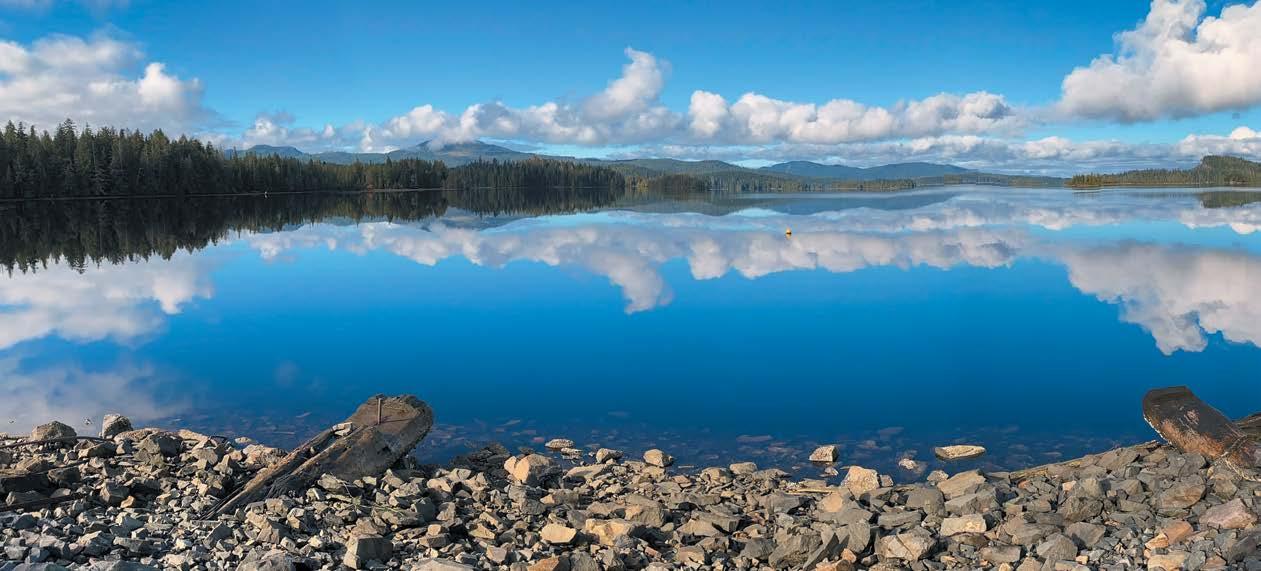
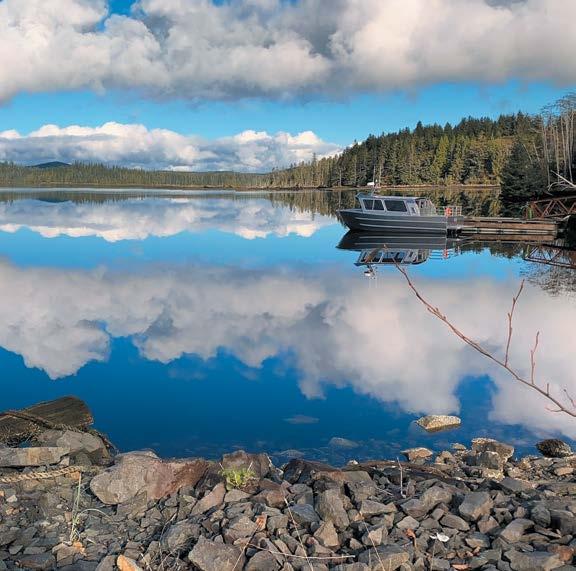
Masset Inlet, Haida Gwaii
“The source of my inspiration comes down to my parenting,” he says. Bear, the youngest of eight children, grew up in his community of Tobique First Nation in New Brunswick and remembers his upbringing fondly. “I come from a long line of canoe builders and people who worked with beads, ash, birchbark, pottery, and textiles. My parents were both artists. They taught my siblings how to make baskets, the first form of artistry my parents practiced.” Being the youngest, Bear always felt loved and respected by his parents and siblings. It wasn’t until he began attending Indian Day School and later integrated into the town school system that he became aware of the cruelty and racism that was everpresent. Bear’s experiences and deep love of his family and Wolastoq culture would set the stage for a successful yet demanding career in the media industry, advocating and bringing forward Indigenous stories.
Like the many projects he has advocated for and produced over his three-decade career, Petroglyphs to Pixels illuminates how art is defined, what it means to be an artist, and the historical and cultural significance of art in relation to everyday life and societal function.
Season two of Petroglyphs to Pixels was produced during the pandemic while the world was in lockdown. Bear and Jones had to pivot to continue moving the docuseries forward. Instead of seeking out stories from across the country, the focus shifted to the artists living in the exact location of the production duo in Northern British Columbia’s Haida Gwaii. This shift allowed the series to explore the unique and rich Haida art culture, providing a deeper understanding of this ancient art form.
“Haida art is probably one of the oldest Indigenous art forms that exists in Canada,” says Bear. “Some might argue that others are, but we have evidence here that it predates colonization by several centuries.”
With their COVID bubble established, Bear and Jones moved forward with the second season of Petroglyphs to Pixels. Focusing on Haida art, season two features curators, knowledge keepers, and artists of many genres. Through these stories, the notions of provenance, issues of ownership, and custody are explored. Bear explains that provenance is the chronology of a historical object’s ownership, custody, or location. Museums use the term to verify authenticity and authorship,
Art is many things. It is personal. It is political, passionate and poetic. Art is sensual, fun, a remedy, a healing agent for pain and loss. Art releases ideas to inspire others. Art moves a nation. Art will bring our spirit back.
~ Jeff Bear
Jeff Bear
which helped establish a chain of custody and title.
“This is the crossing point for Indigenous people who now dismantle the concept of a historical object to rightfully define objects of art as a box of treasures,” he says. “Personal, community, and heritage drive continuity in Indigenous art—this is our provenance.”
“Indigenous people are the originators of most of the art in Canadian museums. For argument’s sake, I propose the chain of titles for Indigenous art comes back to us,” says Bear. “Across the world, hundreds of museums hold one form of Indigenous art. Galleries, art shows, and biennales across the globe have taken on exhibitions of the new wave, the outstanding and multi-tiered contemporary Indigenous art movement. But we turn pages back and look at provenance: How and why was Indigenous art looted? What forces were at play to ensure it did not disappear?”
Bear continues to explain, “In the Pacific Northwest, there is present-day evidence that Indigenous art was not stamped out by colonization. There are signs everywhere of its survival, abstraction, and contemporaneity. On Vancouver Island, along the Sunshine Coast, and among all coastal First Nations, the continuity of art is indisputable. The common place to showcase this is embodied in the potlatch system, where all works of significance are shown and displayed, often for the first time.”
This is particularly acute in the one island that sits offshore, some 150 nautical miles from the Canadian mainland, an archipelago called Haida Gwaii. “On the islands, many artists practice various techniques and mediums,” says Bear. “In some cases, art has survived centuries of global exploitation, social pressure, and circumstances that have tried to shake its provenance.”
In addition to his production work, Bear has also taught documentary script writing at the College level. As the interview with Bear wrapped up, SAY Magazine asked what advice he gives young Indigenous writers and storytellers, particularly those working in the media industry. He says, “All art forms come from an idea. You can learn a craft and turn it into an art. Believe in yourself, where you come from, and know the people you’re writing about. Get to know the parents and family members of the people you’re profiling because that’s where their value system derives from.”
One of Bear’s passions is being culturally accurate in his storytelling and projects, so he encourages others to celebrate their history. “Rewrite your history and correct the mistakes of the past.”
Tune into APTN to view season two of Petroglyphs to Pixels, which starts Monday, January 6, 2025, at 22:30 ET* on APTN and in Indigenous languages on Tuesday, January 7 at 18:30 ET*.
Danielle Vienneau, Editorin-Chief with SAY Magazine, believes in the power of sharing positive stories to inspire greatness in others. To submit your story, email editor@ saymag.com.
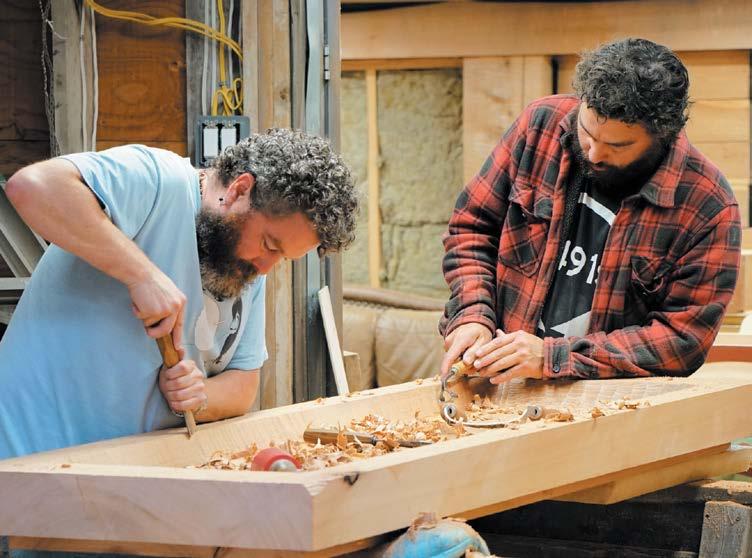
Haida Artists Gwaai and Jaalen Edenshaw
Haida Artist Cori Savard
Celebrating Indigenous Excellence in Sport
Indigenous athletes, coaches, and officials have significantly contributed to Canada’s sporting legacy. Across the country, initiatives recognize and celebrate these achievements through Canada’s Sports Hall of Fame and the Manitoba Indigenous Sports Halls of Fame, amongst others. These organizations are tributes to athletic excellence and platforms for educating future generations about the rich history and contributions of Indigenous Peoples in sport.
The Manitoba Indigenous Sports Hall of Fame and Museum, in particular, honours and publicly documents the countless ways Indigenous Peoples have served as athletes, coaches, and builders in Manitoba. A virtual resource created by the Manitoba Aboriginal Sports and Recreation Council (MASRC), the Hall of Fame and Museum serves as a tool to share First Nations, Métis, and Inuit stories of excellence, resilience and success in the world of sport.
Nomination Opportunities Across Canada:
British Columbia:
The BC Sports Hall of Fame celebrates Indigenous athletes through the Indigenous Sport Gallery. Nominations are accepted year-round, with a deadline of June 30 annually. Nominate here: bcsportshall.com/nominate
Alberta:
While Alberta does not have a standalone Indigenous Sports Hall of Fame, athletes may be recognized through provincial initiatives or national programs.
Saskatchewan:
The North American Indigenous Athletics Hall of Fame (NAIAHF) honours Indigenous athletes across North America. Nomination deadlines vary. Learn more: naiahf.org
Manitoba:
The Manitoba Indigenous Sports Hall of Fame (MISHOF) accepts nominations yearround. The following induction is in April 2025, with a February 28, 2025 nomination deadline. Nominate here: masrchof.com/nominations
Ontario:
Ontario supports Indigenous athletes through initiatives like the Tom Longboat Awards, which recognizes top Indigenous athletes annually.
Quebec and Atlantic Provinces: While Quebec and Atlantic provinces do not have a dedicated Indigenous Sports Hall of Fame, athletes can be recognized nationally or through regional programs like the Tom Longboat Awards.
National Recognition:
The Canada Sports Hall of Fame highlights Indigenous athletes and builders, with nominations accepted year-round. The deadline for the upcoming cycle is January 31. Nominate here: sportshall.ca
Indigenous Sport Recognition in the United States:
National Native American Hall of Fame (NNAHOF):
Established in 2016, it honours Native Americans making significant contributions across fields, including sports. Annual ceremonies coincide with National Native American Heritage Month. Learn more: nativehalloffame.org
North American Indigenous Athletics Hall of Fame (NAIAHF): Recognizing athletic leadership across North America since 2022, this Hall inspires future generations by celebrating outstanding individuals and teams.
Indian National Finals Rodeo Hall of Fame:
This organization honours the achievements of Indigenous rodeo athletes since 1976.
Montana Indian Athletic Hall of Fame: Celebrates Indigenous athletes from Montana who serve as role models for youth. These initiatives across Canada and the US honour past achievements and inspire a future where Indigenous athletes continue to excel on and off the field. Supporting these programs preserves a rich legacy of sporting excellence.
Photo courtesy of the Manitoba Aboriginal Sports and Recreation Council (MASRC)
Olympian
Angela Chalmers
Recognized for Remarkable Achievement In Sport
Angela Chalmers was born in the Birdtail Sioux First Nation, Manitoba, with the talent to run and the drive to succeed. She has had an incredible journey as an Indigenous athlete in Canada, drawing on remarkable reserves of strength and resilience to become one of the best middle-distance runners in the world. On October 23, representing athletics, Chalmers’ extraordinary accomplishments were recognized with the Order of Sport Award, Canada’s highest sporting honour, presented by Canada’s Sports Hall of Fame.
Co-hosted by Hall of Famers Alex Despatie and Waneek HornMiller, the 68th Order of Sport Awards took place at the Canadian Museum of History in Gatineau, Quebec. Before the award was presented to Chalmers, Horn-Miller spoke fondly about her role model, “This person holds a very special place in my journey and my heart. I remember the year she won this momentous medal— the first ever for an Indigenous woman in this country,” said Horn-Miller. “I was 16 years old. It was two years after the Oka Crisis. I had quit my sporting career and parked it, thinking it would never happen. And I was in a lot of turmoil.”
Horn-Miller continued, “I sat down to watch the summer Olympics. I will never forget watching her run and what it
meant to me. It reignited my desire and my belief. And it set that fire aflame in me that took me all away to the Olympics. Role models like her save lives. They inspire, and they give hope. And you, Angela, gave me hope.”
Chalmers’s crowning achievement came in 1992 when she became the first Indigenous woman from Canada to win an Olympic medal, securing bronze in the 3000m race in the Barcelona Games, fulfilling a promise to her late father. Retiring from competition in 1997, Chalmers remains a passionate advocate for drugfree sport and an empowering role model for women and Indigenous youth in Canada.
“I am truly humbled today,” expressed Chalmers. “For me, the best part of receiving this award is getting to thank people who
Photo Courtesy of Canada’s Sports Hall of Fame Digital Collection.
helped and inspired me along the way.” She recognized where her journey began: the Nanaimo Track and Field Club. “I was nine years old when I started running, and I learned to fall in love with competing with that track club.” Chalmers thanked the many people who believed in her—those who created exceptional training regimes, helped her develop her physical talents, and helped her with her overall mental health.
Chalmers particularly remembers needing to find a way to relax and sleep during the Barcelona Games in the Olympic Village. “Getting it right under pressure requires the right mindset. I had to get to a place where I felt calm and relaxed,” she says. “I learned to visualize my grandmother. I would imagine her and her sweetgrass. She used to plait our hair, my sisters and I, and put little leather strips on the bottom, and I would try to evoke that. I’m so grateful for those memories from my grandmother that helped me to get to a peaceful and tranquil place.”
Chalmers rounded out her acceptance speech with a special thanks to her family, especially her siblings, who were her most challenging competitors and biggest supporters while growing up. “My family was my inspiration, my motivation. And when I was running, their love and support really lifted me, especially when I was struggling.”
About Angela Chalmers
Raised in a military family, Chalmers moved to Vancouver Island, British Columbia (BC), as a young girl. There, she raced her brothers and sisters in the coastal rainforests. This environment helped her develop the mental toughness and exceptional competitive drive that distinguished her as an aspiring distance runner. At 13, Chalmers’s family returned to Manitoba after her father was posted back to Shilo.
In high school, Chalmers regularly won track races and made personal sacrifices to improve her abilities as a young athlete. She was honoured with the Sioux name Dusmanwe, which means “Walk Fast Woman.” With determination, she cultivated rigorous self-discipline and extraordinary personal accountability, approaching each race as an opportunity to achieve her goals rather than seeking recognition or accolades.
While attending the University of Northern Arizona on an athletic scholarship, Chalmers earned All-American honours eight times and won the NCAA Cross-Country Championship in 1986. She won a bronze medal in the 3000m at the 1985 Summer Universiade and a silver in the same event at the Pan American Games. At the 1990 Commonwealth Games, she became the first female athlete to win gold in the 1500m and 3000m races, and,
1994 Commonwealth Games. Photo courtesy of BC Sports Hall of Fame
as previously mentioned, she made history in 1992 at the Barcelona Summer Olympic Games.
In 1994, she served as Canada’s flag bearer on home soil at the Commonwealth Games in Victoria, British Columbia, where she successfully defended the 3000m race with another Gold Medal performance.
Chalmers has dedicated her efforts to helping young people in Canada build self-esteem through healthy living and sports. She has connected with Indigenous youth facing substance abuse and trauma and volunteered as a spokesperson for BC’s Department of Education to aid initiatives that reduce dropout rates in these communities. Beyond her competitive achievements, she exemplifies the importance of hard work and reciprocity, honouring her Indigenous roots while creating opportunities for future generations to achieve their dreams.
The Order of Sport Award
The Order of Sport was established in 2019 by Canada’s Sports Hall of Fame in Calgary, Alberta. This national award recognizes Canadians who have achieved remarkable sporting accomplishments and are committed to educating others about the transformative power of sport. The award also emphasizes the cultural significance of sport in Canada. It connects outstanding sports champions to the greater good while promoting shared values such as respect, equality, fairness, and openness. Additionally, it highlights sport as a vital foundation for diversity, inclusion, and accessibility in Canadian communities.
In addition to Chalmers’s recent Order of Sport Award, Canada’s Sports Hall of Fame will add a new chapter featuring Chalmers’ story and achievements to their most significant education initiative, the Indigenous Sport Heroes Education Experience—a resource that gives educators entry points into Indigenous education through the diverse world of sport from an Indigenous perspective.
The recorded live stream of the 68th Annual Order of Sport Awards is accessible with a free membership to beyondthewin.ca.
WaaPake (Tomorrow)
WaaPake (Tomorrow) is a deeply personal documentary that explores Dr. Jules Arita Koostachin’s family’s confrontation with lateral violence and generational trauma caused by residential schools in Canada. WaaPake begs the question, “Who are we without our pain?”
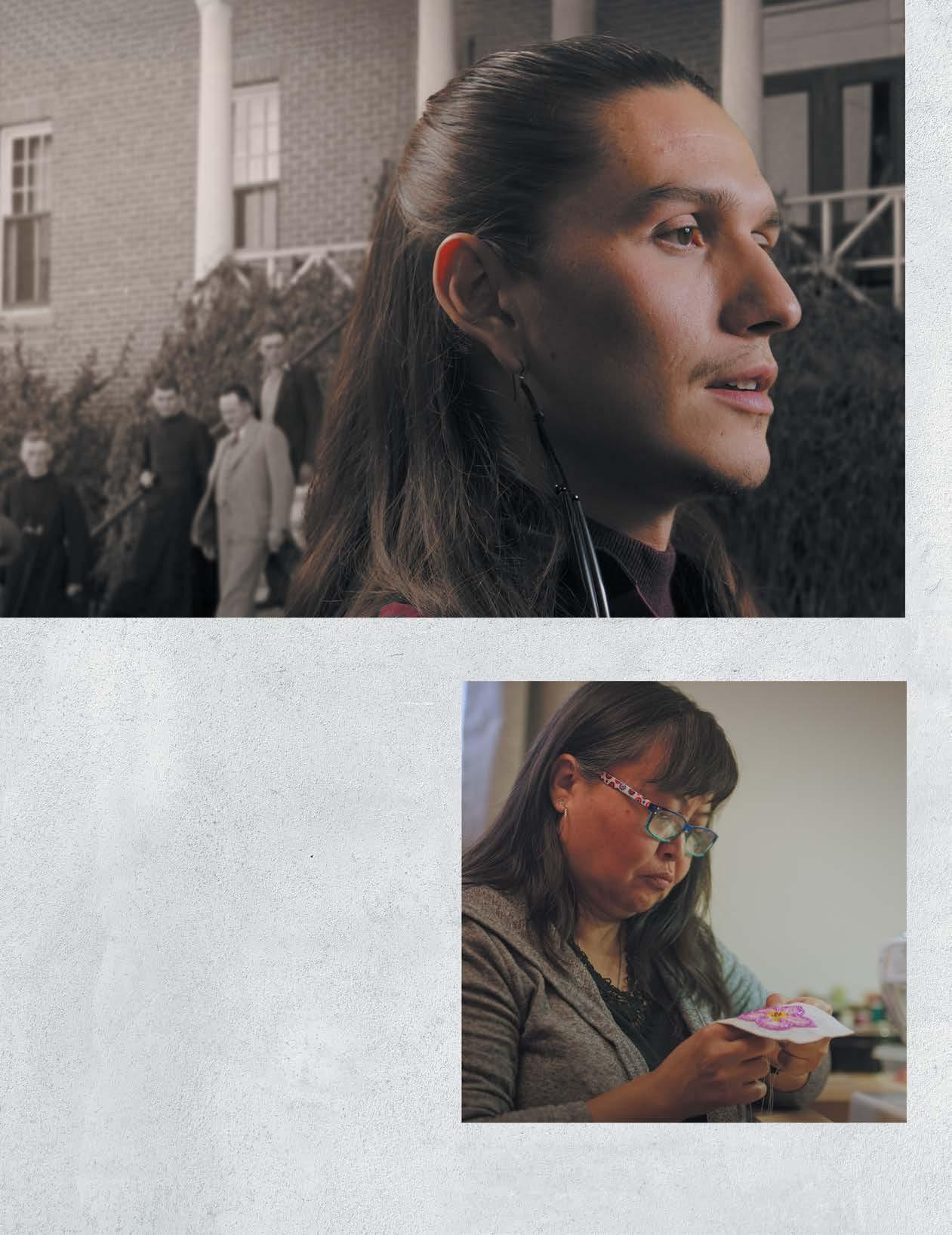
Dr Jules Arita Koostachin, Attawapiskat First Nation, Director of WaaPaKe.
WaaPaKe is an invitation to unravel the tangled threads of silence and unite in collective freedom and power.
Directed by Koostachin and produced by Teri Snelgrove at the National Film Board of Canada, WaaPake is a powerful narrative that amplifies Indigenous voices and breaks down barriers, encouraging healing and empowerment by sharing painful truths.
For generations, the suffering of residential school Survivors has radiated outward, impacting Indigenous families and communities. Children, parents and grandparents have contended with the unspoken trauma manifested in the lingering effects of colonialism: addiction, emotional abuse and broken relationships.
In her courageous efforts to help the children of Survivors, including herself and her family, Koostachin makes the difficult decision to step in front of the camera and participate in the circle of truth. She is joined in this courageous act of solidarity by members of her immediate family and an array of voices from Indigenous communities across Turtle Island. Moving beyond burying intergenerational trauma, WaaPaKe is an invitation to unravel the tangled threads of silence and unite in collective freedom and power.
Released in 2023, WaaPaKe has been featured at various festivals and won numerous awards, including Best BC Film at the 2023 Vancouver International Film Festival and a Director’s Guild of Canada Award nomination. Its success and recognition are a testament to the power of its message and the skill of its creators, making it a must-see documentary this season.
Most recently, Dr. Jules Arita Koostachin was recognized for her bold vision and unwavering commitment to truth. She received this year’s DOC Institute Honours and was recognized with the DOC Vanguard Award on December 4, 2024—unanimously determined by a jury of peers from the documentary field. The Vanguard Award recognizes a mid-career filmmaker whose work heralds a voice to watch. Her work behind the camera with last year’s WaaPaKe drew attention and solidified this honour.
Available in English and French. Audiences can watch WaaPake free of charge on nfb.ca.
Asivak Koostachin, Attawapiskat First Nation.
Photo credit:
Images from the film
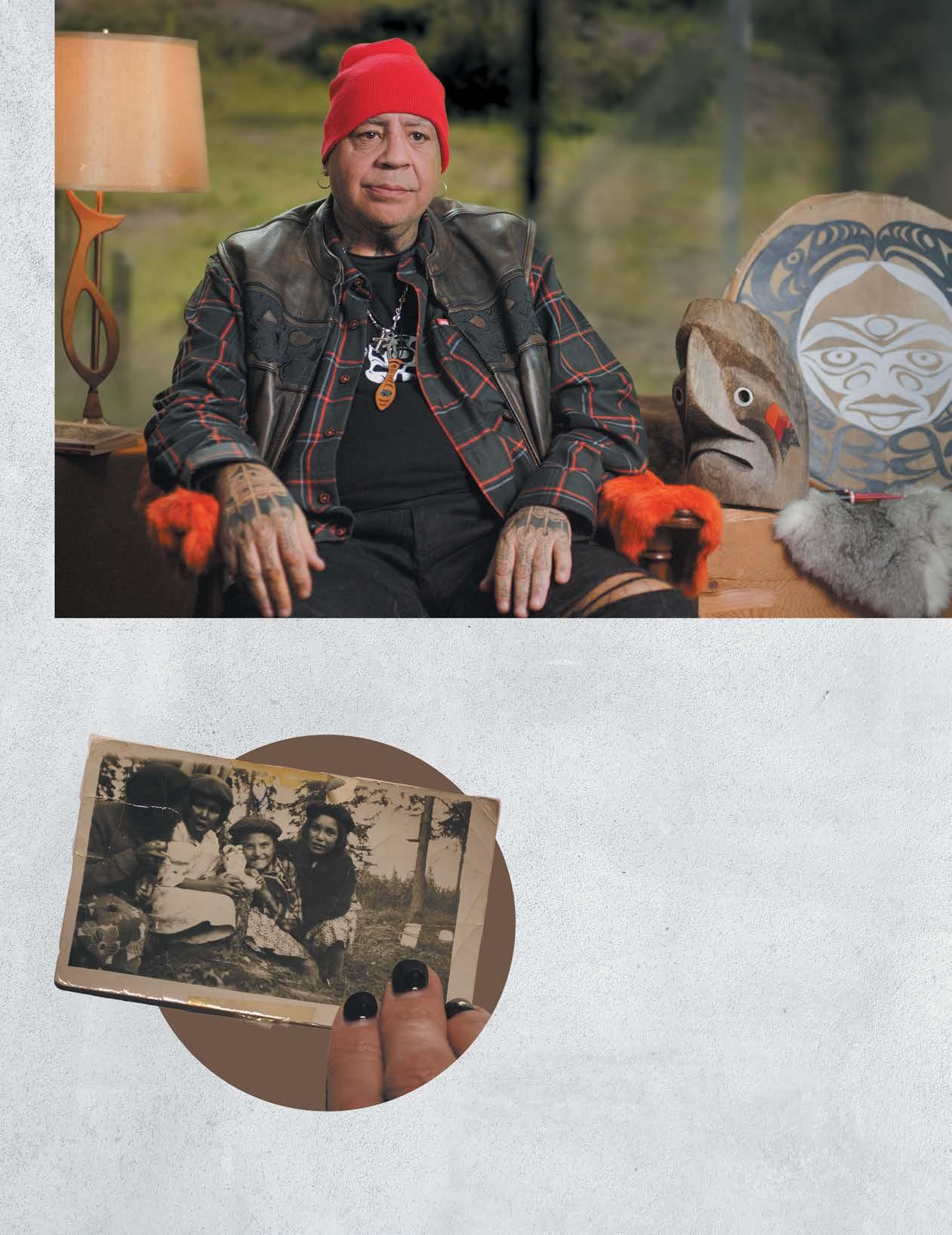
Maisie Smith, Champagne and Aishihik First Nations
About the Director
Dr. Jules Arita Koostachin (Attawapiskat) is an award-winning filmmaker, mother, writer, performance artist and academic. With her background in community work, social justice themes emerge in her films, alongside bravery, healing, connection and humour. Koostachin honours her Cree-speaking grandparents who raised her and her mother, a residential school Survivor/warrior. Koostachin’s accomplishments include raising four sons while pursuing academics and artistry. She graduated from Concordia University’s Theatre program and then on to Ryerson University’s Documentary Media master’s program, receiving early recognition with an Award of Distinction and an Academic Gold Medal for her thesis documentary film Remembering Inninimowin. Koostachin went on to do her Ph.D. in Indigenous documentary and protocols and processes through the Institute of Gender, Race, Sexuality and Social Justice program at the University of British Columbia.
Joseph Dandurand, Kwantlen First Nation.
Rita Okimawinninew, Attawapiskat First Nation, and her siblings - archive picture
Dreams Take Flight to Paris
By Danielle Vienneau
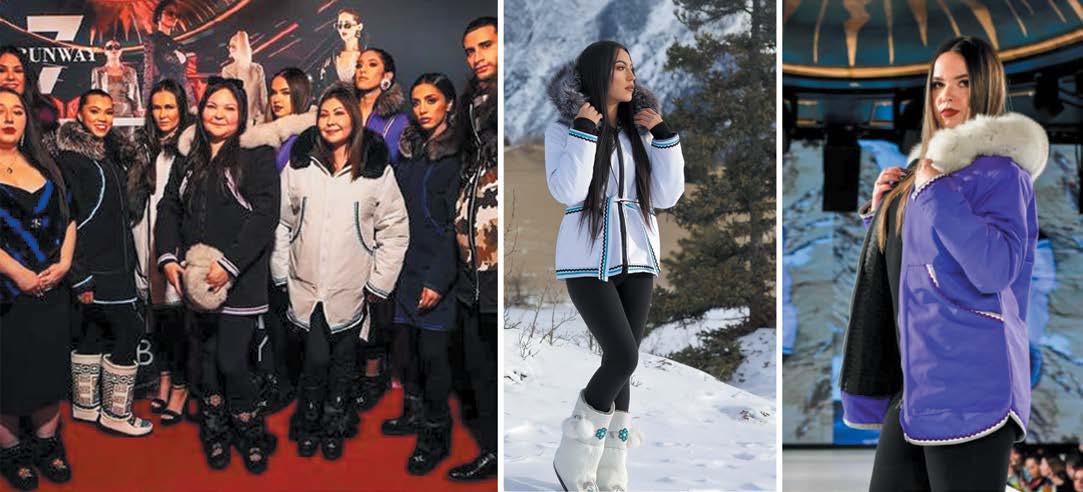
Designer Dorathy Wright and model Lucy Kemp are headed to Paris, France, in the Spring for the opportunity of a lifetime.
Photo credit: Vanheyst photography
Lucy Kemp, Model
The two met only a few months ago at the CRAFTED 2024 event at the Winnipeg Art Gallery (WAG) and Qaumajuq. For the fashion show portion, Kemp was assigned to be one of the models for Wright’s fashions and textiles. The two hit it off immediately, and the conversation quickly turned to a potential opportunity in Paris.
Wright is a self-taught quilter and artist with over 10 years of professional experience. Creativity and innovation are deeply embedded in the fabric of her bloodline. She comes from a family of talented Gwich’in artists from Inuvik, Northwest Territories. She has always dreamed of seeing her designs walking down a runway in Paris, France— regarded as the world’s fashion capital since the 16th century.
“My mom taught me how to sew when I was young,’ says Wright. “I’ve always had a great interest in fashion, and as a youth, I bought as many fashion magazines as possible. When I was eight, I created my first piece: I turned an old dress into a dining gown by adding faux fur and then modelled it for my family. I hope to inspire and encourage others, especially my children.”
In the last few years, Wright has strongly desired to design couture with a traditional flair. She’s participated in many significant events, including Indigenous Fashion Week in Toronto, Ontario, New York Fashion Week and LA Fashion Week.
“Paris had been reaching out since I did the New York show last year,” explains Wright. “They asked me to go in September, but I definitely wasn’t ready.” After going back and forth with her contacts in Paris, Wright decided she could have designs ready to be seen in March 2025. Once the commitment was made, it was important for Wright to confirm some of her own Indigenous models, and Kemp was more than
happy to be a part of the journey to Paris. Wright needs up to seven models to wear her designs in Paris, fitting seven different people, including quick changes and on-the-spot alterations. In addition, the models going to Paris all live in other locations, from the Yukon to Manitoba and the United States. This presents a unique set of challenges as a designer prepares for a significant show.
Wright originally planned to attend a particular show in Paris and then quickly pivoted when the show expressed a need for a specific aesthetic not in line with Wright’s values. “I know some shows want to see the models first, and some even want to talk to them, but when they said “no” to some of the models I had already selected, I knew this wasn’t the show for me,” says Wright. “My brand is very inclusive, and I want to stay true to that and my models, no matter where I show my collection.”
Wright plans to showcase 12 different looks on the catwalk at Paris City Fashion Week, where her signature parkas will be displayed. She hopes to attract buyers from the Circumpolar North, including Canada, Denmark, Finland, and Norway.
Known for her focus on colour, line, and texture, Wright represents her Gwich’in heritage through her traditional designs that are also stylish and practical. She is a true master of her craft, creating designs quickly and using only an image in her mind as the template for her detailed parkas and covers. She combines modern and traditional elements using layers of fabric that become works of wearable art.
Wright plans to bring the wow factor to Paris and hopes her collection will captivate the viewer’s spirit and emotions, sparking a sense of mystery, excitement, and joy. “The parka that I wore for Dorathy in the Winnipeg show was outstanding; it was extra,” says Kemp. “Apart from the beautiful
Sewing has become my quiet time from all the chaos in my life. It’s a relaxing, peaceful and productive thing for me. I identify with sewing because it connects me to my culture. This is one thing that I can pass down to my children so that they hopefully carry this tradition with them. I especially want them to see me become who I’ve always wanted to be: a great designer and a master of my craft. I want them to know that they can accomplish anything they desire with great determination and heart.
~ Dorathy Wright
beadwork detailing along the outer edges, it also had what looked like a lace overlay on the parka. It was very detail-oriented and gorgeous. Her designs are sure to turn heads.”
After Paris, Wright wants to focus on building her brand and entering a larger market. Currently, her parkas are only sold to and available from a few buyers in Canada.
In addition to designing, Wright teaches throughout the Yukon and the Northwest Territories and looks forward to running a workshop in the Winnipeg area soon. “I teach people to make their own parkas, and I run workshops in Northwestern Canada,” she says. “I want to help people create the designs they want and walk away with a beautiful finished product that they made. Sometimes, it takes three to four days.”
She thinks back to when she first started turning her passion into a business. “I’m a single parent, and I’ve got four kids,” she says. “When I left my husband nine years ago, I was pregnant. It’s been a struggle for a long time, but I hustled and sewed. I started with something minimal. I had a skill, and I had a bit of fabric. I started to sell my work. I started to build and invest more and more in my business and myself.”
Wright secured a small grant from the ITI economic development fund through the government of Northwest Territories. With that, she bought more material and a bigger sewing machine. “It just snowballed to where I am now,” Wright explains. For her, sewing is a way of life, and she celebrates it by sharing her knowledge and selling and donating many of her creations. “Sewing makes me happy and has supported my family for 10 years. I am so thankful for everything.”
Hailing from Winnipeg, Manitoba, Kemp is also thankful for her experiences and to those who believed
in her, giving her the confidence to pursue modelling a little later than most. Her experiences will now lead to fulfilling her dream of walking down the runways of Paris and meeting other talented people in the fashion industry.
Throughout her 20s, Kemp focused on getting a degree and finding her professional footing. She also married during this time, so other priorities kept her busy. Kemp is Oji-Cree and a member of Berens River First Nation, Manitoba. She is in her mid-thirties and only began modelling six years ago, finally reaching out to an agency after years of encouragement from family and friends.
“Growing up, I was pretty insecure about my height, but I eventually (and literally) grew into it,” says Kemp. It took her years to embrace her height and accept that’s how God designed her, and for a reason. “I finally decided to lean into it and fully accept who I am and how I look and see what would come of it in the modelling world,” says Kemp.
“Within the last decade, I think people began to realize that Indigenous people were beginning to reclaim space, in so many different professional areas, and particularly there was recognition that there should be more of that in the modelling industry,” says Kemp.
“I figured I had nothing to lose, so I submitted a couple of photographs, and I filled out a quick form on a modelling agency’s website, Swish Model Management, and got a call from a recruiter the next day.”
From there, Kemp started attending workshops, and within a month, she was offered her first modelling job. Up until now, most of her jobs have been local. She has modelled for Warehouse One and worked for local designers such as Evelyn Thora of EMK and Lennard Taylor, based in Winnipeg’s Exchange District. Kemp
Photo
FASHION
has also walked the runways for several shows, including the Wonderful Wedding Show and Cancer Care Manitoba’s Guardian Angel Benefit show.
Modelling has been an encouraging experience for Kemp thus far—a nice contrast to her busy career as a Care Plan Analyst with TIPI Insurance, an Indigenous-owned insurance brokerage. “I wasn’t particularly hopeful initially because I was ‘older’ and am not the stereotypical smaller-sized model. But it’s been encouraging because things like ageism and racism are going slowly the way of the dodo.” she says hopefully. “Other places need to catch up with the times, more so on an international scale—there needs to be more Indigenous faces, so I am glad to be able to be a part of this industry representing Indigenous Peoples.”
With the opportunity to travel internationally, Kemp fulfills a bucket list item. “I’m realizing a dream come true,” she says. “Travelling to Paris is fantastic. I love the idea of being on an international runway, but there’s more to it than that for me. It’s so significant because our voices need to be heard, and our faces need to be seen. I’m so blessed that one of the designers at the WAG show happened to be Dorathy, and we happened to have a moment to talk. She took the time to follow up with me, and now it’s all just fallen into place.”
Wright and Kemp are looking forward to their trip to Paris in the spring; however, a substantial amount of work must happen before then. Getting to the international stage in the fashion industry is not as easy as just being invited or having your application accepted. It can be very costly. Most often, designers, like the models themselves, have to fund their way, which means fundraising and applying for grants to ensure all parties can attend, making it a successful event. “Even finding models willing to travel can be challenging for many designers,” explains Kemp. “So I am happy to have the opportunity to showcase Dorathy’s designs. As I continue working in this industry, I hope to bring light to other up-and-coming Indigenous designers.”
Wright also hopes to inspire and support other Indigenous designers, including her sister, Linda Wright, a fabric designer who draws inspiration from the Western Arctic and Sahtu regions. Linda plans to turn one of her signature paintings, “Inspired Dancers,” into a fabric that Wright can use in her collection. It’s a special full-circle moment for the Wright family.
SAY Magazine wishes Wright and Kemp all the best as they prepare for their journey to Paris, France.
Danielle Vienneau, Editorin-Chief with SAY Magazine, believes in the power of sharing positive stories to inspire greatness in others. To submit your story, email editor@ saymag.com.
Dorathy Wright (center) with models at New York Fashion Week
Model Echo Gatensby
Model MIKAELLA
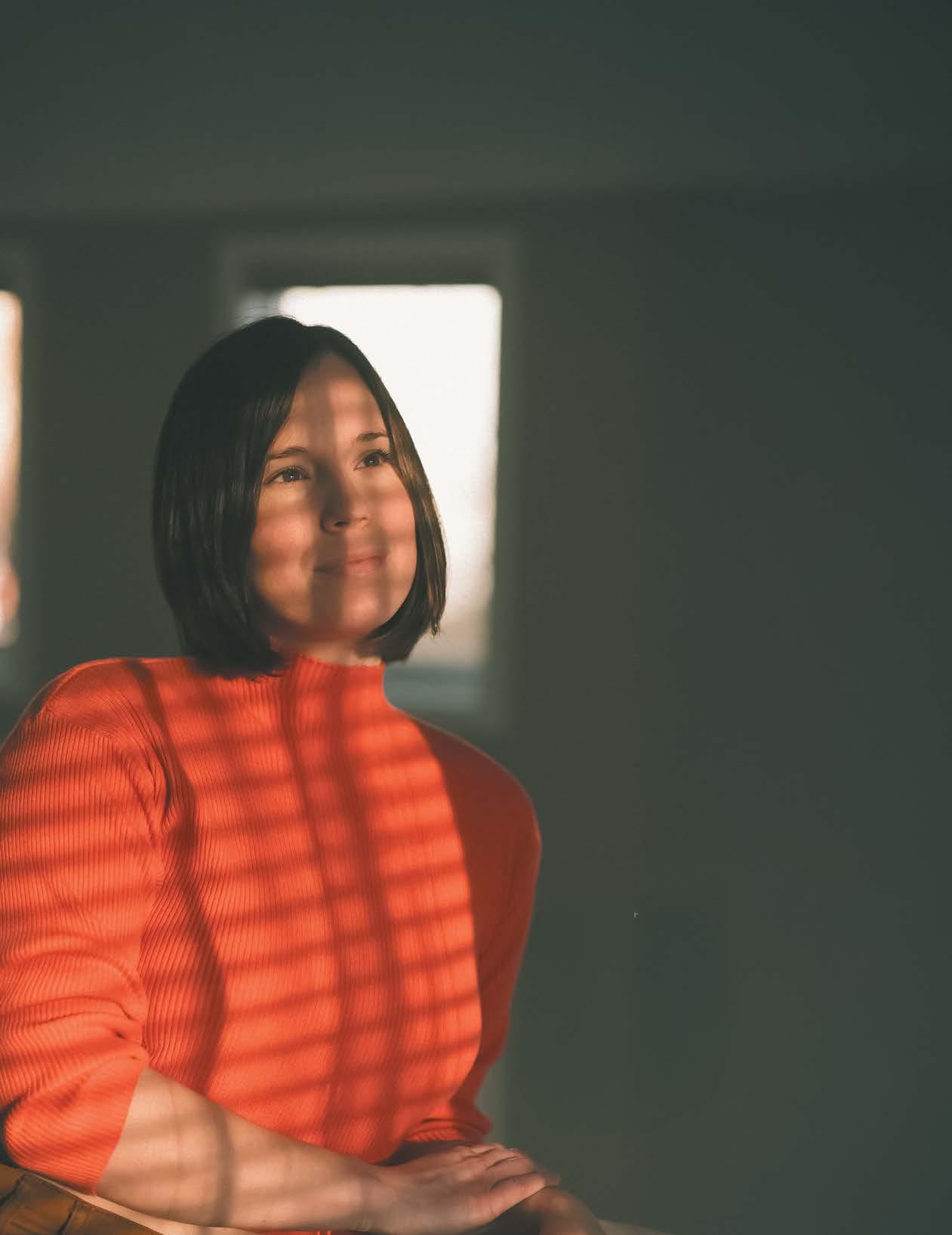
LivWade
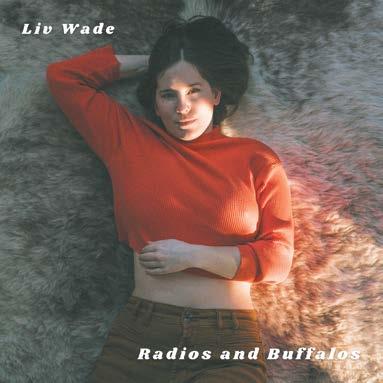
With a breathtaking sound and brilliant storytelling, queer, Two-Spirit artist Liv Wade is sure to captivate listeners with her latest and fifth EP, Radios and Buffalos.
WWade’s family originally hails from the Red River Métis Nation and later settled in Pine Bluff, near The Pas in northern Manitoba. Now residing in Cowichan Valley, British Columbia, her Métis and Scandinavian roots and profound personal journey significantly influence her music, revealed in Radios and Buffalos.
Her songs are inspired by Canadian icons such as Leonard Cohen, Ron Sexsmith, Kathleen Edwards, and Sarah Harmer—artists she listened to extensively from a young age. In her teens, she combined this passion with her studies at the Royal Conservatory of Music. This led to her participation in residencies at the esteemed Banff Centre for the Arts and Creativity and Manitoba’s Indigenous Music Program.
Wade released her debut studio album, Resilience, in 2017, marking her first collaboration with Winston Hauschild (known for working with Hannah Georgas, Mike Edel, and Hollow Twin). This collection earned her a nomination for Best New Artist at the Indigenous Music Awards. She followed it up in 2019 with A Piece of Paradise, produced by Jim Bryson, and later released Know Your Medicine in 2022.
With Radios and Buffalos, Wade is eager to showcase her musical versatility. Released by Merilainen Music Inc., the EP features a range of sounds, from the sultry pop of the lead single, “Stay With Me,” to the cinematic grandeur of “Slow Motion.” This heartwarming, string-laden track highlights Wade’s crystal-clear vocals
and innate melodic talent. It exemplifies how she and her trusted producer, Hauschild, crafted a cathartic and healing sound. The songs weave together personal experiences into engaging narratives that delve into themes of reawakening and selfdiscovery.
LIL MIKE and FUNNY BONE
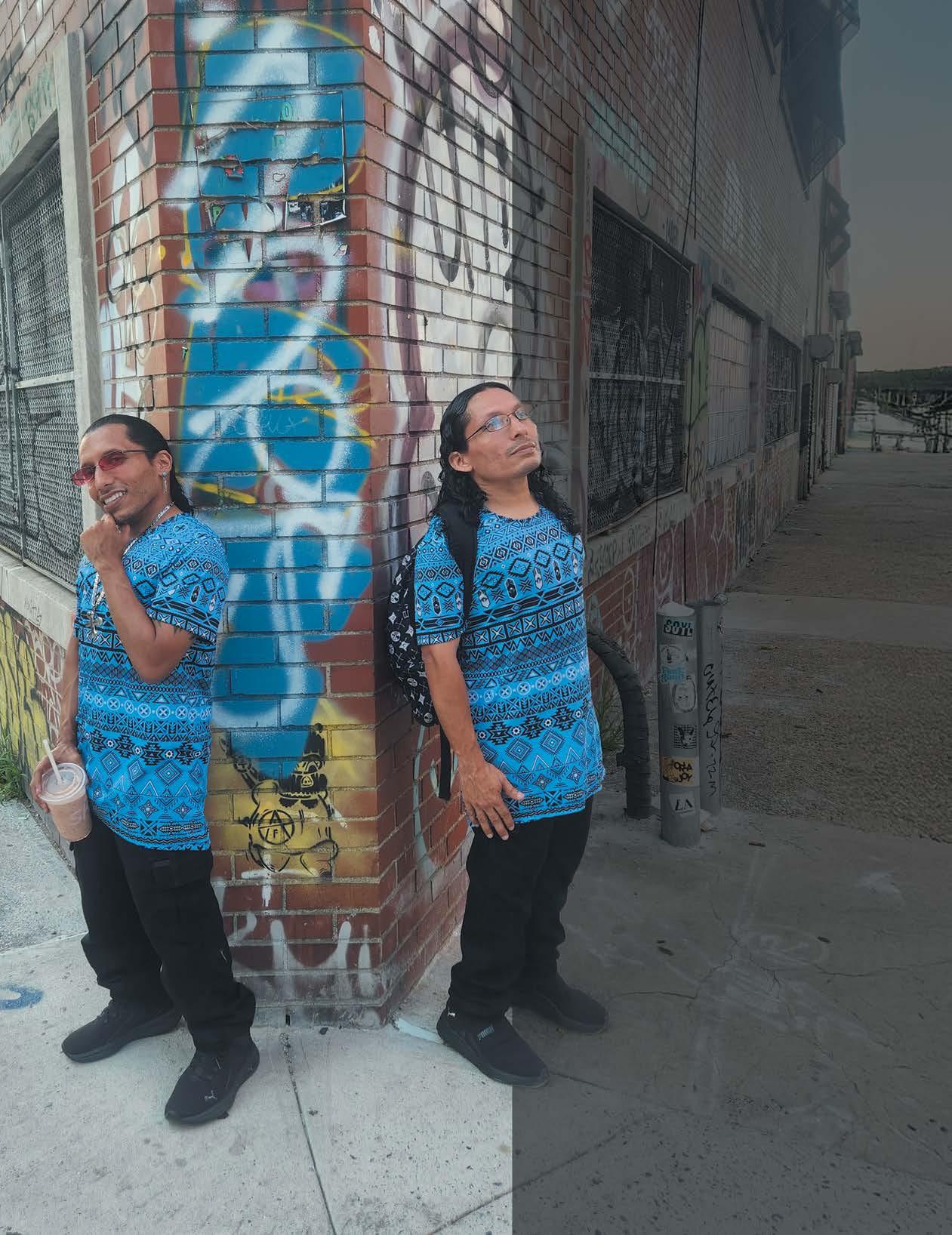
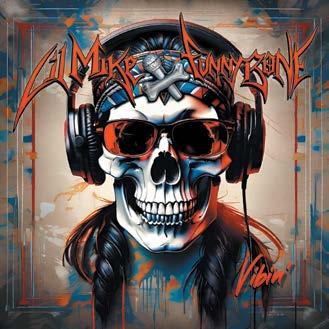
Emmy-nominated duo Lil Mike and Funny Bone are multiaward-winning Native American brothers, recording artists and actors known for appearing on the groundbreaking series Reservation Dogs, America’s Got Talent, and more. Their latest album, VIBIN, has been released on all streaming platforms. Together, they are known as MIKE BONE, an Indigenous hip-hop duo from Oklahoma City, representing the Pawnee and Choctaw Nations. MIKE BONE is considered legendary in the music industry, boasting over 27 years of experience.
The duo diverges from the typical rap scene by using positive lyrics; one of their songs emphasizes that it’s “More Than Music.” Despite receiving multiple record deal offers, they have remained independent to preserve their artistic integrity, as highlighted in their song “Hold Me Back.” They are dedicated to entertaining and inspiring audiences by performing at various venues, from arenas to public schools and everything in between.
Raised by a single mother of five, MIKE BONE has gone from being locally famous to attaining global recognition, climbing the charts, and making a positive impact. Even when opening for other artists, they consistently steal the show. In addition to their music career, MIKE BONE also engages in speaking events covering various topics, including bullying, drug and alcohol prevention, and pursuing dreams, often incorporating humour whenever possible.
You can learn more about their story by watching the award-winning documentary Looked Over but Never Overlooked on YouTube. Their YouTube channel features a wealth of content, including behind-the-scenes footage, music videos, television
interviews, and more. Despite facing challenges such as homelessness, gang violence, and discrimination, they have maintained their faith in God and have emerged as performance icons.
Sebastian Gaskin
How does an emotional aftermath transform into a creative breakthrough?
For Torontobased multiinstrumentalist, singer-songwriter, and producer Sebastian Gaskin, the process begins by immersing himself in his experiences. He luxuriates in the deep feelings of all-consuming love, navigates the turbulent waters of heartache, or engages in challenging conversations.
First, he creates a blueprint on the guitar, jotting down lyrics on a fresh notes page, then fills the blank space with whatever the song requires. This approach reflects an artist who is unafraid to explore their inner self. Through this creative process, he produces a sonic offering that embraces our numerous broken pieces while reminding us that love and vulnerability are acts of resistance.
Gaskin’s music intentionally defies genre classifications rooted in bold intuition and instinct. He draws inspiration from the timeless creativity of Bill Withers and the musical skill of John Mayer while also incorporating a playful lyrical style reminiscent of Post Malone and Pro Era. A talented producer and arranger, Gaskin has an exceptional ear for collaboration. He has worked with producers like Evan Miles (known for his work with dvsn and renforshort) and Milano (of Icona Pop fame) to explore and enhance new elements of his sound.
“Writing songs has always been a form of therapy for me. I can always count on the soothing aspect of getting my thoughts out,” says Gaskin about the importance of songwriting in his life.
Growing up in the Tataskweyak Cree Nation in Northern Manitoba during the early 2000s, Gaskin was surrounded by diverse musical influences. His mother often tuned the radio to country stations, while on weekends, he would watch his grandmother, a respected community leader, perform Southern gospel classics. After a cousin introduced him to Metallica’s iconic sound and heavy riffs, he decided to pick up a
guitar. As a teenager, he found endless inspiration exploring music forums on Tumblr. On some days, he would delve into British indie rock, while on other days he became captivated by Chief Keef’s 808 beats.
His debut EP, Contradictions, released in 2019, was a dynamic and slow-burning meditation on desire. It showcased a masterclass in restraint and featured patient, asymmetrical melodies paired with ambertoned vocals. Following a whirlwind 2021, he received a Western Canadian Music Award for R&B Artist of the Year and the Kevin Walter’s Songwriting Award. Additionally, he was selected to participate in the Allan Slaight Juno Masterclass.
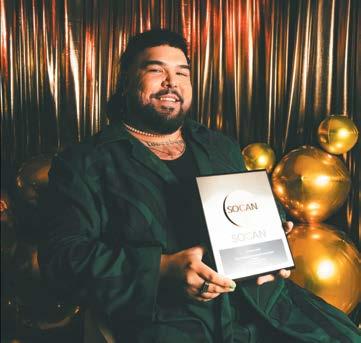
Gaskin has performed at various venues and festival stages worldwide, supporting artists such as Common, T-Pain, Feist, and the Sam Roberts Band, among others. In 2024, he won two SOCAN Awards, including the Vince Fontaine Indigenous Song Award. His forthcoming debut album will be released under the Indigenous-owned music company Ishkōdé Records and Universal Music Canada.
Writing songs has always been a form of therapy for me. I can always count on the soothing aspect of getting my thoughts out.
MUSIC INTERVIEWS
by LARRY K.
fanshawec.ca/FNMI#apply
Manitoba
casinosofwinnipeg.ca
National
nacca.ca
Petroglyphs to Pixels
petroglyphstopixels.com
NEXT ISSUE
BUSINESS & ECONOMICS
SAY Magazine’s next issue will celebrate the people and companies taking an Indigenous-first approach, empowering Indigenous businesses and entrepreneurs, uplifting our communities, and creating extraordinary opportunities for advancement and prosperity.
Share your stories to amplify voices and perspectives that support the growth and development of the Indigenous economy.
Deadline for bookings and submissions: Publication date: February 15, 2025 January 15, 2025
At SAY Magazine, we value your voice and your stories. We welcome your submissions throughout the year as we strive to include diverse voices and contemporary Indigenous lifestyles in every issue. Your stories are integral to our mission to promote and celebrate Indigenous cultures and experiences.
Submit your story for consideration Share an upcoming event Place an ad Sponsor a story
Criteria for submissions: • Up to 500 words • High resolution image(s) • 2-3 sentence biography Contact Us: Advertising: sales@saymag.com •
May the new year bring peace, abundance, good health and new opportunities.