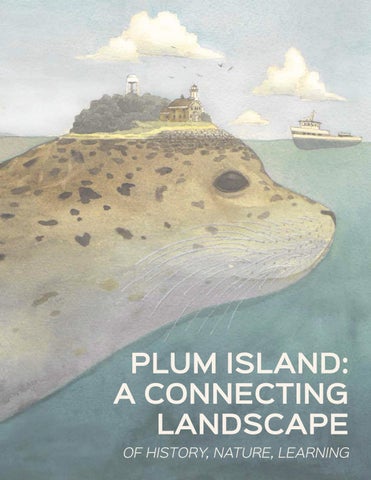
PLUM ISLAND: A CONNECTING LANDSCAPE
OF HISTORY, NATURE, LEARNING
PLUM ISLAND: A CONNECTING LANDSCAPE Beautiful and mysterious Plum Island is an 822-acre, inspiring landscape about a mile and a half off the eastern tip of Orient Point, New York, where Long Island Sound and the Peconic Estuary mix with clean, oxygen-rich, ocean waters. It is a landscape that connects people with history, nature, and opportunities to learn the stories of America. Ecologists and other scientists are learning and sharing the story of high biodiversity on the island, in its surrounding waters, and as part of an island chain and coastal ecosystem. Historians and archaeologists are investigating the island’s earliest human uses.
Plum Island’s transformations since the 1640s—from Native American dispossession under colonialism to private ownership to military use and then to a world class foreign animal disease laboratory—and its possible future uses intrigue people nationwide. We have come together as a region to envision Plum Island’s future: a combined nature preserve and place where people can enjoy spectacular scenery, conduct research, and learn about culture and history. This future—which celebrates Plum Island’s past; protects its ecological value; and unites people with equitable public access and educational opportunities— may begin modestly yet will depend on partnerships and commitment. Ideas for Plum Island follow.
3
BE IMMERSED IN THE RAW BEAUTY OF LONG ISLAND SOUND
2 1
Windswept, surrounded by biologically rich waters, and hosting significant ecological communities, Plum Island invites us to visit, learn, and continue ecological research. A marine eelgrass meadow, a natural community declining in New York, could be an underwater research site.
1
While absorbing panoramic views of coastal and freshwater landscapes, visitors will enjoy passive recreation, nature observation, and historic site interpretation through equitable public access tourism and educational opportunities or a sensitively-sited extension of New York’s trail system. Access would be managed for ecosystem protection.
2
Guides and guests will celebrate specifically planned and managed areas of cultural, military, and natural heritage, learning how the island’s location and its geological and ecological attributes have influenced uses by wildlife, plants, and people over the ages. “Friends of Plum Island” will help to secure and steward the natural resources of the island.
3
6 5
ENCOUNTER THE CULTURE & HISTORY OF AN EARLY AMERICAN COASTAL LANDSCAPE
4
The iconic Plum Island Lighthouse, a National Register historic site overlooking turbulent Plum Gut, will be restored and reused for tours and tales of mariner rescues. Visitors will read interpretive signs and maps along historical pathways and elevated walkways. Areas with cultural and historical significance will be managed carefully to ensure compatibility with natural processes.
4
Day visitors will enjoy learning about National Register historic site Fort Terry to appreciate an especially significant example of an Endicott-Taft coast defense post remaining in the country. At a dedicated Plum Island visitor center located at Orient Point, or on the island, people can also learn of earlier uses of Plum Island by Native Americans, colonists, and subsequent owners. Archaeologists will conduct sensitively-undertaken research to expand understanding of our shared cultural heritage.
5
Researchers and students might use a small field station and dormitory in an adaptively refurbished building for academic studies and overnight stays. Some visitors will find the history of the Plum Island Animal Disease Center’s research and vaccine development greatly interesting.
6
9
7
8
Through partnerships with federal, state, county, and local governments, nonprofit organizations, Friends of Plum Island, and volunteers, Plum Island will become a place of study, conservation, and ecological restoration. Researchers will study the island’s exemplary marine rocky intertidal zone; maritime bluffs, beaches, and dunes; and eelgrass beds and nearshore marine biology. Conservation efforts will demonstrate how natural areas can rebound and thrive.
7
CONSERVE A RARE NATURAL ECOSYSTEM Academic researchers and students could study sensitive natural areas by special permission. Researchers could study a wide variety of coastal, ecological, marine, and island systems, species, and other topics. Day visitors will be inspired viewing wildlife at a 96-acre freshwater wetland and join guided walks to learn about natural communities and the island’s 229+ bird species and 111 species of conservation concern.
8
Harbor seals haul out on the rocks at Plum Island during the winter in the largest numbers anywhere in New York. Sea turtles, harbor porpoises, and whales use the surrounding waters. Advancing the conservation potential of this critically valuable natural resource area, in 2019 New York created the Marine Mammal and Sea Turtle Protection Area around Plum, Great Gull, and Little Gull Islands. Subtidal habitats are rich in biological diversity.
9
10
ADAPT STRUCTURES FOR JOBS WHILE PRESERVING A NATIONAL TREASURE
11
Plum Island sparks the imagination for adaptive re-use of its facilities, offices, and infrastructure. Repurposed office and auditorium space could host meetings, conferences, or other events and be used by researchers, staff, and administration. The future of existing laboratory spaces remains unclear, due to configurations and historical uses.
10
The property also includes the former research center’s dedicated 9.5-acre support and ferry facility at Orient Point. The Orient Point site would provide access to the island for workers and visitors. It has an existing welcome center and offices that could be upgraded to include a museum and visitor center, showcasing Plum Island’s history, cultural heritage, and ecosystems. We predict countless “Eureka!” moments once people travel to Plum Island for work or pleasure.
11
ENVISION PLUM ISLAND PRESERVE: Conservation: Partnerships—federal, state, county, and local governments; schools; not-for-profit organizations; Friends of Plum Island; volunteers.
Historic Preservation and Cultural Heritage: Fort Terry, Plum Island Lighthouse; past Native American uses of this part of the Montaukett Indian Nation’s historical territory.
Visitor Center: Natural and Indigenous cultural heritage, history.
A CONNECTING LANDSCAPE Ferry: From Orient Point, NY.
Sustainability: Equitable, managed ecotourism, connections to trail system.
Friends of Plum Island: Partnerships for security and support. Two of the organizations in the Preserve Plum Island Coalition (PPIC), Save the Sound and The Nature Conservancy, sought to bring the PPIC’s multitude of voices together with those in government, academia, business, and others to discern, develop, and articulate a common vision for Plum Island. Resulting was Envision Plum Island, a two-year process involving hundreds of stakeholders between 2018 and 2019. We have illustrated the resulting overall vision for Plum Island in this brochure to inspire even more ideas and participation. We wish to celebrate Plum Island’s past; protect its ecological value; promote economic and environmental sustainability; and unite people with nature preserve, research, and educational opportunities.
•
Image Credits Original art by Scott Bluedorn. Photography in order of appearance and clockwise on pages: Story 1: James Dineen; Chris Pickerell at Cornell Cooperative Extension; Ariel Shearer; Robert Lorenz Story 2: Unknown; Tom Kmetzo; Robert Lorenz; Robert Lorenz Story 3: Louise Harrison (background); New York Natural Heritage Program; cluster: A.J. Hand, New York Natural Heritage Program, B. Van Valen at bvanvalenphotography.com, New York Natural Heritage Program; Robert Lorenz Story 4: Robert Lorenz (ferry background) and Louise Harrison (ferry foreground) Renderings and concepts throughout by Pirie Associates. Plum Island Preserve Vision Concept map by The Nature Conservancy.
Design and layout graciously provided by Haddad & Partners.
Thank you to Save the Sound’s major supporters of the Envision Plum Island report: The Community Foundation of Eastern Connecticut Fisher Family Fund at the Community Foundation for Greater Buffalo The Geoffrey C. Hughes Foundation The Jaeger Family Fund Chester Kitchings Family Foundation Michael S. and Carolyn W. Levine Henry D. Lord Ruth Lord Charitable Trust The M.L.E. Foundation Overhills Foundation Robert F. Schumann Foundation The M. & H. Sommer Foundation Tortuga Foundation John T. and Jane A. Wiederhold Foundation and thanks to ALL our funders of the Save Plum Island project.
The Nature Conservancy thanks Knapp Swezey Foundation, Michael & Georgie McConnell, John & Donna Potter, and William & Maude Pritchard Charitable Trust.
Learn more: read the Envision Plum Island public report at preserveplumisland.org/envision-report For questions or copies: write info@savethesound.org or call (203) 787-0646