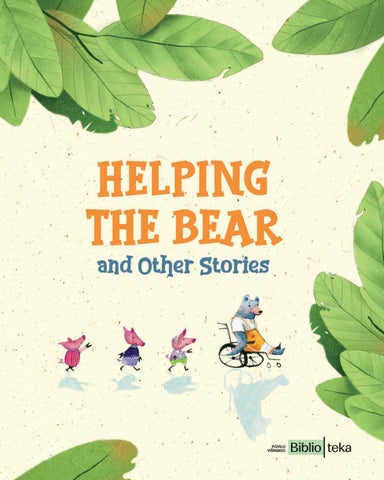
Once, a bear fell from a tall oak tree. He’d wanted to treat himself to some bee honey, but he slipped. Before you could say crash and bang , he was on the ground with two broken legs. He needed a wheelchair until his legs healed.
‘Oh, dear,’ whined the visiting pigs. ‘Poor bear! Surely you need a lot of assistance. We’ll gladly help – just tell us if you need anything.’
‘Oooh, thank you,’ said the bear. ‘Luckily, I can still do a lot on my own.’
‘But there must be something we could do,’ said the pigs.
‘Well, I’d like to visit Aunt Squirrel, who lives far away,’ said the bear. ‘Maybe you could push my wheelchair if my paws start to hurt too badly.’
‘Of course!’ said the pigs. ‘We’d love to walk you there.’
So off they went. The bear pushed himself in the wheelchair. Trot, trot, trot, the pigs trotted happily behind him in single file.
At first, the path was level and well-trodden, but soon they reached the first little hill. The bear gave the hand rims a firm push.
‘Poor creature,’ thought a passing rabbit, seeing the bear in the wheelchair. ‘He’s working so hard, while those lazy pigs are just wandering about instead of helping!’
‘Can I help you?’ the rabbit offered. ‘My legs are strong and fast.’
‘Very nice of you,’ said the grateful bear, ‘but for now, I can manage on my own.’
‘I see,’ said the rabbit, surprised, and hopped on his way.
After a while, the middle pig asked, ‘Do your paws hurt already?’
‘No,’ said the bear with a smile. ‘Not at all.’
In the dark forest a doe noticed the little procession.
‘Poor thing,’ she thought when she saw the bear in his wheelchair. ‘And those lazy pigs, just scratching themselves on the trees! They should be helping him!’
‘Tell me, sir,’ the doe said respectfully, ‘do you need any help? I’d gladly assist.’
‘Very kind of you, my dear lady, but there’s no need.’
‘Really?’ said the doe, surprised. ‘Well, should you change your mind, do call me!’
‘Thank you!’ said the bear, touched by her kindness. ‘But there’s no need at all. The pigs will help me.’
By midday, their path led over a large hill. The road was dry and paved, but the slope grew steeper and steeper.
‘Now your paws surely hurt at least a little,’ said the youngest pig. His own legs ached quite a lot.
‘I do feel them a bit,’ admitted the bear, but I can still manage on my own.’
‘This stubborn bear,’ thought the
eldest pig. ‘How obstinate he is!’
In the afternoon, they reached a broad field. The pigs happily buried their snouts in the soil.
‘Nom nom nom!’
they grunted in delight.
The bear paused to catch his breath. After a short rest, he resumed pushing his wheelchair.
‘You must need some assistance, surely!’ said a horse, trotting up beside him. He grabbed the wheelchair and gave it a swift push.
‘You certainly can’t count on those pigs – stuffing their faces in the field!’
‘Thank you, but there’s no need,’ protested the bear. ‘While I can manage myself, my friends – the pigs – are very reliable.’
‘Ah, I see,’ neighed the horse. ‘Safe journey, then.’
As the sun touched the horizon, the travellers neared their destination. One last bend and they would reach the old oak tree, where the bear’s aunt lived in a hollow.
‘But why won’t you let us help you?’ grumbled the eldest pig. ‘We’ve walked with you the whole way, but you didn’t let us help at all. Even our legs are sore – how sore your arms must be! And now everybody thinks we’re heartless!’
‘They are sore indeed,’ admitted the bear. ‘But I feel best when I can do things on my own. That makes me proud of myself. And when I’m proud of myself, I’m happy.’
With all his strength, the bear gave the wheelchair one last firm push. When he reached the oak tree without any help, he let out a cheerful cry:
‘Hooray! I’ve made it!’
‘Hello, my dear bear!’ said Aunt Squirrel, delighted at his visit. ‘I’d invite you in for tea, but I know you can’t reach my hollow.’
‘Oh, but I can,’ said the bear. ‘That’s what my little helpers are here for!’
The pigs put their heads together and came up with a plan. They wove a basket out of branches, placed the bear inside, tied it to a rope, fixed a pulley to the oak tree, and hoisted the bear high into the air – right up to the squirrel’s house.
Excited, the squirrel clapped her paws and treated them all to a nice meal, while the old oak tree rustled mightily.
When I Grow Up
Majda Koren, illustrated by Greta Alice
My name is Zagi. My fur is green and soft. My eyes are as blue as the sky. I am as tall as you. I live far away. Come, I’ll show you!
We sit in a rocket. The engines go VROOOOM, VROOM, VHOOSH!
We race past thousand suns and planets. Some stars are small and white, others are larger and yellow. The largest are red. We’re getting closer to my planet! The rocket descends silently. A parachute opens, and the rocket sways like a dandelion seed before landing on a lake.
The lake house is my home. Look through the window!
I’m cuddling in my mum’s lap.
‘Zagi, who are you going to be when you grow up?’ Mum asks.
‘I’m going to be an astronaut! I’ll float through space. I’ll SWOOSH past our window in my rocket and wave to you!’
I imagine I’m an astronaut.
I race through space in my rocket. VROOOOM, VROOM, VHOOSH!
I meet other creatures in other rockets.
Some rockets are pointy like arrows, others are round like saucers.
They carry creatures from all over the universe.
Some are furry, some are scaly.
Some have bare skin, and others have colourful feathers.
I wave to everyone I meet.
A round red rocket just darted past! Inside is an astronaut with feathers and a long green beak. I wave to him.
I’ll SWOOSH past our window in my rocket and wave to you!
‘And what if you’re not an astronaut? Who are you going to be when you grow up?’ she asks.
‘Then I’ll be a pastry chef! I’ll knead dough, beat eggs, bake cakes and biscuits, decorate them, make creams, and cook marmalade. Every day, I’ll bring you a biscuit or two!’
I close my eyes and MMMMM, I smell vanilla and cinnamon.
In a large bowl, I’m whipping cream. The cream rises – any moment now, it’s going to spill over the top!
I stop whipping, run my finger along the edge of the bowl, and wipe away the extra cream.
I lick my finger – YUM, YUM! It’s so sweet!
I open my eyes and think:
‘Perhaps I’d rather not be a pastry chef.’
‘Then who are you going to be when you grow up?’ Mum asks again.
‘When I grow up, I’ll race cars. I’ll win the gold medal! I’ll bring it to you so you can see it!’
I close my eyes and hear people cheering:
‘Well done, Zagi, well done! Yaaay!’
I open a newspaper, and there’s my picture. I’m standing on the podium with a gold medal around my neck and a bouquet in my hands. A man from TV asks me how I feel.
‘I am very happy about winning first place!’ I tell him.
‘But what if you don’t compete in races? Who are you going to be when you grow up?’ Mum keeps asking.
‘You know what? I might be a truck driver. It’ll drive a freezer truck, delivering boxes of ice-cream cones and bars. I’ll deliver all the ice-cream – but I’ll save one ice-cream bar just for you!’
I close my eyes. I’m driving the truck. There are pictures of ice-creams on the freezer. The engine is purring, and I drive here and there, left and right on winding roads. I drive up and down hills.
I stop when an animal crosses the road.
I stop when the traffic light turns blue.
I go again when the pink light shines.
And in the freezer, hundreds of ice-cream cones and bars are travelling with me!
My mum tickles me again:
‘But what if you’re not a truck driver? Who are you going to be when you grow up?’
‘I’ll be a florist! I’ll grow potted plants, water them and transplant them.
I’ll make bouquets for brides, bouquets for birthdays, and small bouquets like the ones lovers give to each other.’
I close my eyes. I’m walking among vases filled with flowers. Every vase holds something different. I choose and pick. I’ll make a bouquet for a princess celebrating her birthday. Some flowers have thorns – OUCH! This one’s pricked me!
I open my eyes. My mum is smiling.
‘Zagi, do you know who you’ll be when you grow up?’
I think my mum is teasing me.
‘You know what, Mum? When I grow up, I’ll be your child and you’ll be my mum. I’ll come to hug you, just like I’m hugging you today!
Because you smell the nicest – better than the flowers in the flower shop, better than biscuits, the best in the whole universe!’
I close my eyes.
My mum embraces me.
I’m so cosy and warm in her arms.
Mister Mole and the Lost and Found Office
Sashko Dermansky, illustrated by Lisa Penedo
Mister Mole wanted to be helpful. However, he did not know how.
He loved travelling to different parts of the forest through underground tunnels. Mister Mole would often find lost things on the ground.
At home, Mister Mole would put everything he had found in a big box. As time passed, the number of items would grow and grow. One day, Mister Mole looked at all the findings and thought, ‘Someone might be missing these.’
Then a brilliant idea struck him!
Above the entrance to his house, Mister Mole put up a sign: ‘Lost and Found Office (Find Missing Things Here).’
Everyone around knew: if you lost something, you would need to visit Mister Mole. Animals were grateful to him for the help.
One day, the trouble came.
Mister Mole could not find his glasses all morning. He looked on the table, under the bed, on the windowsill…
‘They are nowhere to be found…’ Mister Mole said, confused. ‘What shall I do? I can barely see anything without my glasses. Everything around is blurry and fuzzy.’
Suddenly, his house shook. Dishes clanked, windowpanes clattered, and something outside stomped:
‘THUD! THUD! THUD!’
Mister Mole looked out, only he did not have his glasses on. Something big and grey was outside.
‘Looks like a storm cloud,’ Mister Mole decided. ‘That is what was banging. Thunder is in the air.’
‘I am not a cloud, I am the Elephant!’ a voice was heard from outside. ‘It was me walking so loudly.’
And the elephant stomped in place, ‘THUD! THUD! THUD!’
‘In that case, you will not fit here!’ Mister Mole said. ‘Wait outside, please. I will find my glasses and be right there. Just sit on that bench…’
‘Thank you,’ the Elephant said and sat on the bench.
Then – CRUNCH!
‘What was that?!’ Mister Mole said, alarmed.
‘I think… I found your glasses.’
The Elephant stood up.
‘I accidentally sat on them,’ the Elephant said. ‘I am sorry, but they are quite broken now.’
Mister Mole was annoyed and angry. He clenched his fists, his heart started beating really fast and his face got flushed. However, he understood that the Elephant was not at fault. He did not intend to break the glasses. Besides, he apologized.
The Mole took a few deep breaths and counted from one to ten: ‘One... two... three... four... five... six... seven... eight... nine... ten.’ Then the Mole’s fists unclenched, his heart slowed down and his face returned to its normal colour. Yet he was still sad. He sulked and entered the house.
Then, knocking on the door was heard. Someone Grey walked it.
‘Come in,’ Mister Mole said politely. ‘However, I cannot see who you are. The Elephant sat on my glasses.’
‘That’s a shame,’ Someone Grey sighed. ‘But he did not mean to, did he?’
‘No, he did not mean to. And who may you be?’
‘You can recognize me easily by my ears. Here, touch them.’
Mister Mole touched the ears. They were long and warm.
‘You must be the Rabbit,’ guessed Mister Mole.
‘That’s right!’ the guest laughed. ‘I am looking for my carrot that I lost.’
The Mole started looking through the box. He took out something long and yellow.
‘Is this it?’ he asked the Rabbit.
‘This is a banana. The carrot is firmer and smells different,’ the guest replied.
The Mole smelled the banana and grew sadder.
‘I cannot help others without my glasses…’
The Rabbit left, but the door soon creaked again. Someone Red came in.
‘Hello. I am looking for my nut that I have hidden and forgotten where it is.’
‘Who might you be?’ sullen Mister Mole asked. ‘I cannot see, for the Elephant has sat on my glasses.’
‘But he did not mean to, right?’ Someone Red asked sympathetically.
‘No, it was an accident. May I touch your ears?’ Mister Mole inquired. ‘I would like to know who you are.’
‘I am more recognizable by my tail,’ Someone Red said.
Mister Mole touched the tail; it was very soft and fluffy.
‘You must be the Squirrel.’ Mister Mole guessed.
‘Exactly!’ the Squirrel laughed. ‘So, do you happen to have my nut?’
Mister Mole found something round in the box.
‘No, that is not my nut,’ the Squirrel murmured. ‘It’s some kind of a ball. Do not despair, though, you did your best.’
She left the Lost and Found Office with empty hands.
Then Someone Round entered the house.
‘Hello! I lost a glove when I was gardening.’
‘I do not recognize you,’ Mister Mole sighed. ‘The Elephant sat on my glasses.’
‘But he did not mean to, right?’ Someone Round asked.
‘No. It happened by accident. May I touch you to recognize?’
‘Better not, for I am prickly,’ the stranger said. ‘Here, listen to what I can do, and you will immediately recognize me.’
Someone Round started to loudly and whimsically puffing and chomping:
‘Puff-puff-puff! Chomp-chomp-chomp!’
‘Oh, I know!’ Mister Mole exclaimed. ‘You are the Hedgehog!’
‘Good job! You are excellent at guessing,’ the Hedgehog said. ‘Do you happen to have my glove?’
Mister Mole took something soft out of the box.
However, it was not a glove, but a sock.
‘That’s not it…’ the Hedgehog said.
Mister Mole was silent. He was ashamed and upset.
‘I understand you‘re feeling down. You did all you could,’ the Hedgehog consoled him. ‘You are not at all at fault.’
‘Without my glasses, I cannot be helpful. My Lost and Found Office is pointless and fake.’
The Hedgehog left. Mister Mole was miserable. And then someone knocked on the door again.
Someone Grey, Someone Red, and Someone Round were standing at the entrance.
‘Here,’ they said in unison. ‘This is for you.’
The Elephant’s trunk came through the entrance and put down new glasses into Mole’s hands!
‘This is a gift from us all!’
Mister Mole put on the glasses. Suddenly, everything around became clear, colourful, and familiar.
‘Dear Rabbit! Here is your carrot! Dear Squirrel! Here is your nut! Dear Hedgehog! Here is your glove! Dear Elephant... ’ Mister Mole got confused. ‘What were you looking for, exactly?’
‘I was looking for new friends,’ the Elephant said. ‘And I found you all!’
‘Hoorah!’ Mister Mole said. ‘So, my Lost and Found Office is actually real!’
The Colour-blind Chameleon
Marta Curtis, illustrated by Raimonda Nabažienė
C was a chameleon who lived in the forest of southern Africa. C was very curious, always full of questions. He loved to sit on the highest branch and look for different things. Every day, he would wait for the sun to rise and watch the drawings made by the rays of light on the giant leaves. There were days when they looked like dancing dragons.
And he would stay there until the wind woke up. Sometimes, it awoke with such force that the whole forest danced. And looking at the leaves shaking, he imagined they were birds longing to fly.
He often asked his friends about the things he saw, heard and felt, but they didn‘t seem to understand him.
‘Have you seen that old, rolledup leaf?’ C asked. ‘It‘s
making a tunnel, so the ants don‘t get rained on.
And the spider webs that look like trampolines? I wish I were as light as an insect and could jump from one to another.’
‘What about the clouds? Yesterday, the tyrannosaurus, the velociraptor and the brachiosaurus strolled across the sky. They were moving very slowly, I didn’t know where to, but they looked toward my branch and I waved “hello”. I don’t know if they saw me, but then the sky turned grey, dark grey, very dark grey, and suddenly they disappeared. Maybe they’ll come back tomorrow.’
When it rained, one could hardly see the tree trunks that almost vanished in the dark. The forest slowed down, all the animals had suddenly paused and fallen silent. Sometimes, C would unroll his long tongue to collect rainwater. He loved the taste of the water falling from the sky and would stand there, listening to the sound of raindrops.
And suddenly, the forest would become an orchestra, with the sound of drops falling on the branches, leaves, and even on him — splash, bang, bang, splash.
Sitting on his branch, C changed colours as he thought about both good and bad things.
‘How can you hide if you don‘t even know what colour you‘re wearing?’ the other chameleons asked.
C didn‘t know the the green of plants and hope, or the red of anger and strawberries. He didn‘t know the blue of the sea or the blue of serenity, nor the yellow of the sun and joy. He couldn’t see the colours of happiness nor the colours of sadness, so he often perceived things differently. One day, thinking his friend was wearing the colours of happiness, he leapt from the tree onto him, just to play. But his friend didn’t like it and grew even angrier. ‘Didn’t you see I was wearing dark colours?’ chameleons spoke like that.
They wore their emotions. If they were angry, they dressed in dark colours, and if they were happy, they dressed in bright colours.
But C didn’t understand the world only in black and white. He saw greys, lots of greys, and he saw light and details, lots of details. Yet, he still didn’t know how to answer, ‘How will I know where to hide if I don’t know what colour I am?’
Once, while he was thinking and with one eye spinning, spinning, spinning in search of an answer, he found a different tree. He zoomed in with one eye until he was very close to its bark. And there he stood, watching how that tree was dressed, when suddenly he noticed something:
‘They look just like scales! That‘s odd,’ C thought. ‘They even look like mine. When I‘m angry, they rise and become spiky and darker, just like those on the tree.’ He remembered his father’s anger, the way he darkened, and laughing with his friends and how his scales turned softer and smoother.
‘I don‘t need to know the colours to hide.
Or to tell if someone is happy, sad or angry. I know everyone‘s skin and how the forest changes. I know the soft skin of roses and that of old leaves that look like paper. I know my friends’ scales when they‘re angry and the way they disappear into the branches. And I know the smells. Those who want to catch me smell bad, so I always run away in time.’
C’s scales gradually grew smoother and smoother, lighter and lighter — like the petals of a delicate flower. Suddenly you couldn‘t even see C, hidden among the flowers.
Winged Hooves
Olha Kryshtopa, illustrated by Teja Milavec
When Sonia draws, the world around her stops. The air fills with warm breaths and snorts. The girl seems to feel the smell and sense the gaze of shiny brown eyes. Sonia draws horses –that is her favourite thing to do.
Sonia traces a line, as though the horse in her drawing hits the ground with its hooves — clip-clop, clip-clop. She shades –and seems to be able to touch the smooth hair.
Horses are Sonia’s greatest love. She does not draw anything else, for only horses are her best friends.
Mom first took Sonia to the stables on the town outskirts when the girl refused to go to school. Noise, dust, many people around — brrr... it all scared Sonia, made her head hurt, brought her to tears, so she asked not to go back. Then her mom talked with someone and took her to Petrovych, girl’s dad’s friend, who owned the stables.
Since then, every evening and weekend, the girl visits the place. During the school break, she practically lives there. Sonia not only rides horses, but also tidies up after, feeds and brushes them. She likes to breathe in the smell of their hair when she cleans the horses — sniff... sniff... ahh... And when the animal gently takes a piece of sugar from Sonia’s palm with its velvety lips — crunch crunch — the amazed girl stands still.
Sonia does her homework sitting comfortably in hay heaps. Lately, Sonia lingers by the stall of a newcomer named Thunder.
Thunder is a young horse. He had a hard time at the stables where he was kept, and there are wounds on his sides. He anxiously shivers — brrr... — when Petrovych approaches him and does not allow the doctor to come close. When Sonia watches the horse, her heart starts beating faster — lub-dub, lub-dub — as if it is Thunder hitting his hooves — clip-clop, clipclop.
Sonia watches Thunder from afar. The horse is gorgeous, and his black hair seems almost purple.
Drawing Thunder is now something Sonia needs to do. She has been sitting by his stall at the stables for several days. She rarely glances at the horse. She knows how hard it is to be watched. And the horse breathes calmer and calmer each day as she sits on the hay nearby, happily snorting— pffrrt! — when she approaches.
‘If we don’t treat Thunder’s injuries today, they will get infected,’ the doctor tells Petrovych. ‘We might lose the horse like this.’
‘I do not know how to calm him down; he doesn’t let anyone come closer,’ Petrovych answers.
This makes Sonia really upset. She approaches the adults.
‘I can treat Thunder’s wounds,’ she says, looking down.
‘You?! No way, he is dangerous!’ the doctor says fearfully.
Petrovych is silent, carefully looking at the girl.
‘You know,’ he says, ‘we can try…’
‘But – ’ the doctor is shocked.
‘The colt is already used to her. She has been sitting near him for a week. He knows her, knows her smell. We should try it. We will stay close and, if necessary, hold the horse.’
In a few minutes, Sonia is already near Thunder, who is anxiously snorting — huff, huff... The girl does not look into his eyes, holding a few pieces of sugar in her outstretched palm. ‘Thunder…’ Sonia says quietly. ‘Dear boy…’
She feels warm and wet breath on her palm and soft lips carefully picking up sugar. The horse is panting: his wounds
hurt. Sonia caresses his forehead, and the horse’s nose carefully brushes the girl’s hair.
‘You are hurting,’ the girl whispers. ‘I understand, poor Thunder, you are hurting; but it will pass, dear friend, you will get better, dear, dear, dear friend….’
Thunder calms down at hearing Sonia’s words, twitching his ears. Black skin under her hands shivers; however, she is not afraid: the horse trusts her, considers a friend, and the girl knows it.
Sonia continues treating Thunder for a few days, cleans him, brushes and cuts his mane. The horse is lovely. As he started to heal, he looked calmer and happier.
The summer went by, and vacation was over; Sonia and Thunder’s friendship, however, remained strong. The girl visits the stables only after school and on weekends. She still does her homework sitting near the horse; after finishing it, she starts drawing her friend. Sonia’s entire sketchbook is dedicated to horses, mostly filled with portraits of Thunder, whom the girl gave winged hooves.
Daphne Lost her Tail
Evelina Daciūtė, illustrated by Catarina Glam
One morning, puppy Daphne woke up, stretched out, and was about to wag her tail. However, there was nothing to wag: where the tail should have been, it was gone. Daphne looked under the bed. Under the table. Between the sofa cushions. Nothing. She rummaged through the toy and shoe boxes. She poked her nose into the most deliciously smelling cupboard. But there, too, she couldn‘t find the tail.
‘Maybe it is in the yard?’ Daphne ran around all the nooks and crannies, dug through the bushes and flower beds, and raked through last year‘s pile of leaves, but the tail was nowhere to be found.
Daphne knew that there were dogs that were born without tails. But Daphne wasn‘t one of those. She was born with the most beautiful tail, grew up with it, and had no intention of parting with it. Daphne missed her tail very much.
A cat named Kitty was basking in the sun in the yard.
‘Hello, Kitty. Did you happen to see my tail?’ asked Daphne.
‘No, I didn’t. Did you look in the bushes?’
‘I did.’
‘Did you look in last year’s pile of leaves?’
‘I did.’
‘Hmmm… It seems like it’s really gone. Are you feeling bad without a tail?’
‘Very bad.’
‘Until you find it, I can lend you mine. I’m not going anywhere today.’
Kitty handed the tail to Daphne, and she, after thanking her for a long time, set off to look further.
At the neighbor’s fence, Daphne noticed the peacock Dove.
‘Hello, Daphne. You look strange today,’ he noticed.
‘I lost my tail, and Kitty lent me hers.’
‘That’s a nice gesture of Kitty. But maybe mine would suit you better?’ suggested Dove. The peacock was very proud of his tail and showed it to everyone in a row.
‘Why not,’ Daphne agreed. ‘Let‘s try.’
Daphne and Dove exchanged tails. They both decided that the peacock‘s tail would be perfect for the puppy, and he himself would walk with the cat‘s tail for now. Daphne said goodbye and walked on, looking in all directions for her tail, hoping to see it somewhere.
In the meadow near the city park, the piglet Foggy was digging a trench.
‘Peacock Dove, is it you?’ he asked, briefly lifting his snout from the ground.
‘No, Foggy, this is not Dove. This is me, Daphne. I lost my tail, and Kitty helped me, offering hers. And then I exchanged her tail for Dove‘s feathered one. Until I find my own, I will walk with the borrowed one.’
‘Ahaaa... I understand now. It will be difficult for you to search with such a big and heavy tail, you will get tired. You better take mine: it is small, light, and does not get stuck anywhere.’
‘You‘re right, Foggy,’ Daphne agreed and they swapped tails.
The piglet‘s tail was really very light and for a while the puppy was happy with the successful exchange. However, Daphne soon realized that she had nothing to wag: the piglet‘s tail was not adapted for that. The puppy really liked to wag her tail: it was half the pleasure of a walk. The piglet‘s tail was not suited for that.
A pony named Whereride was nibbling on the grass in the city park.
‘Hi, Whereride. How beautifully you wag your tail,’ Daphne praised the pony.
‘Hello, Daphne. Sometimes it makes me so tired. I would love to have a quieter tail.’
‘Maybe we can swap?’ suggested the puppy. ‘Foggy’s tail is one of the quietest I‘ve ever worn.’
The pony glanced at the piglet‘s tail, thought for a while and finally agreed. Daphne, happily waving her thick ponytail, moved on.
While sniffing around the block of old houses, Daphne suddenly bumped into something. She looked up: a green tail was hanging from the window. Soon its color began to change: first to red, then to orange, and then to purple.
‘Hello, chameleon Oni. What a beautiful tail you have. How wonderfully its colors change.’
‘Hello, Daphne. Who can change your mood if not you yourself: you want green, you want blue. And if you try really hard, all colors at once.’
‘How nice it would be to walk with such a tail for at least an hour,’ Daphne dreamed, already accustomed to changing tails. ‘Can we exchange them? Of course, Oni, if it’s not a problem for you.’
‘Well, if only for a short time, then I agree,’ he answered with some hesitation.
Daphne, adorned with the chameleon‘s tail, moved on. Maybe because she was constantly changing the colors of her new tail, or maybe because she had already walked a lot looking for her lost tail, the puppy felt very hungry, so she decided it was time to go home: she would refresh herself and be able to continue her search again.
The first thing Daphne saw when she entered her home yard was the laundry fluttering in the wind. Hanging between her mother‘s blouse and her father‘s pajama pants was... Daphne‘s tail.
‘Woof, woof, I found it, I found it,’ Daphne barked so hard and loud that even Oni‘s tail, which was changing colors energetically, fell off.
Her barking lured her mother into the yard: she unhooked the tail from the rope and returned it to the puppy. No matter how many different tails she had tried on, none of them fit her better than her own. Daphne jumped, spun in circles, trying to catch her own tail: she couldn‘t help but be happy that it had returned to its place.
Daphne gave the chameleon‘s tail to the cat.
She exchanged it with the peacock.
The peacock exchanged it with the piglet.
The piglet with the pony.
And the pony gave the chameleon his tail and took his own.
Finally, there was order in the city: all the tails were in their places. Seeing this, the tired sun yawned and quickly went down.
Daphne glanced out the window. A star was crying in the sky. ‘Why are you crying, star? What is your name?’ she asked.
‘I am not a star. I am Comet Mint. I lost my tail. Can you lend me yours?’
The Best Present
Virgis Šidlauskas, illustrated by Iryna Biluta
There is a place where the sun bakes all day long. Barefoot on the sand, you can burn your soles. Oh! You have to jump from foot to foot. That‘s it! Hop! Hop! It‘s important not to stop.
Unless you‘re a Lion cub.
Then the hot sand is a piece of cake.
The Lion cub lives in the shade of a large acacia. During the day it protects him from the heat. And at night the stars light up cozily between the branches. You can secretly watch them and purr peacefully.
Nobody bothers them. Not because they are lions. An elephant-sized rock hides them from strangers‘ eyes. And dense dragon bushes. A cool hiding place! And what could be better than a cute corner for yourself?
The Lion cub is incredibly cute. Everyone who meets him repeats this.
And when he starts purring, you won‘t find another one like him in the whole world.
And then the morning of his birthday dawns!
But what‘s there? Boom boom boom! Something is rumbling behind the rock like thunder.
Ahaa! It is a distant relative of theirs. He‘s been on a long journey and has nowhere to stay for the night.
He has not been visiting guests for a long time. And he has no idea why everyone is smiling. And not sure at all what to give to the Lion cub. He himself was little a very long time ago.
So he thinks deeply. He scratches the back of his head with one nail. Scratch scratch! With the other behind his ear. Scratch scratch! Finally, he scratches his dirty side. A tiny handful of soil remains in his paw.
The Lion cub’s eyes are pleadingly fixed on the guest. What should he do?
‘Happy birthday,’ he mumbles awkwardly.
He can‘t think of anything else. What a disaster!
The Lion cub becomes terribly sad.
He doesn‘t know where to put such a thing. Does this look like a present?
His mom, seeing his sad eyes, is worried:
‘What is it, my baby?’
‘Uncle gave me this as a birthday present,’ he gets indignant. ‘Maybe this is a joke? What should I do with a handful of soil? Scatter it in the wind?’
Mom thinks for a moment. Indeed, a good question. And then, enlightened, she blinks,
‘I know. You can plant something in it,’ she suggests. ‘Isn‘t it cool?’
‘Come on, really,’ thinks the Lion cub. And suddenly he cheers up.
But for that, it needs a special place. Where there is a lot of sun. So that nothing blocks it. The wind could gently caress it. The rain could wash it. And the sky could stretch to infinity above one’s head.
First, he looks for a place at dad‘s.
But where you can rest your belly in the sun at noon, it‘s already taken. Then he glances at mom’s place.
There sits a parrot. After dark it chirps like an alarm clock. Mom stretches herself well. Oh, it is so great to stretch out to your full height! Lick by lick, she combs her fur neatly. And slips away to hunt.
At the older brother‘s place, there is a ball of dry grass. He plays with it until darkness hides everything. Or until the ball sinks into the fox‘s den. Oh, you fox! Then you have to look for something new.
And at the sister‘s place, there are bones. And a drum made of oxhide. When someone beat the drum, the whole savannah resounds. If a group of ostriches runs past at that time, they all immediately bury their heads in the sand. And only come out when everything calms down. That‘s why sometimes they stay like that for a long time.
The Lion cub‘s place is in the very corner of the rock. It‘s warmest there at night, and pleasantly cool during the day. But the sun never shines there! What an injustice!
There is nothing left but to look around the area.
The family doesn‘t object. They just tell him to return before sunset.
The Lion cub needs to get acquainted with the neighborhood of animals and birds. How else can he be the king of the land, which he has never seen before?
The lion cub does not argue. And first of all, he peeks behind the rock. Sniff-sniff to the left. Sniff-sniff to the right. It‘s just so hot here! Everything is yellow and turned into sticks.
Looking around, he notices Fennec. His long, erect ears can be seen from afar. He is also carrying something in his paw.
‘What are you hiding there?’ asks the Lion cub.
Because he is not only cute, but also very curious.
‘But why are your paws behind your back?’ asks Fennec.
The Lion cub shows the gift. In Fennec’s paw is his birthday surprise. It is a tiny seed.
‘I don’t know what to do with it,’ he shrugs. ‘I just wonder where it would be most comfortable?’
‘In my handful of soil,’ Lion cub suddenly brightens up.
‘Isn’t that a great idea?’
‘But it is so small,’ notes Fennec after sniffing it. ‘Where can we find a place where nothing will get in its way? Otherwise, the naughty Hyena will come running and will start digging it.’
‘Let’s go and ask someone,’ suggests Lion cub.
First they meet the Hornbill. He is frisking, thud-thud around the bushes. Looking for insects. When asked, he croaks:
‘Put it anywhere but not here! You need shade.’
‘But it’s hard to climb up here,’ mutters the Armadillo hurrying past. ‘The most important thing is water.’
‘Let’s run to the river,’ Fennec brightens.
‘Don’t be silly, my dears,’ the meerkats giggle. ‘There are hordes of animals buzzing there. All that will remain of your seed will be dust.’
‘That’s right,’ the Lion cub saddens.
Suddenly, his eyes are caught by tall trees. ‘Maybe there?’
He tries to climb in. The good Elephant helps them by holding onto his trunk. The trees are closer to the sun. Only Fennec’s head is spinning from the height.
Then, having climbed down, they dig a deep hole. But it’s too cold in there. The seed will freeze.
The day slowly rolls into the evening.
With their noses hanging down, the friends slowly walk home. Maybe the next day they will have better luck...
Suddenly they come across the old wise Hippopotamus. After looking at the cubs gently, he says, ‘I know a place. But you will have to hurry,’ and whispers something into their ear.
The tired faces brighten again.
Hippopotamus‘ friends, having been instructed, turn to the sand dunes. Nothing grows in the sand. But they still climb to the top. They put a handful of soil there. And plant a seed. There is just enough light here. And they stick a palm branch next to it so that the shadow falls.
The wind from the river brings freshness. It tickles the earth. The seed and the handful of soil freely enjoy the warmth and absorb the light happily.
The two friends sit on the top of the dune for quite a while. They are enveloped in a sweet lightness.
This is the best birthday present ever!
Where are you off to, Leon?
Maša Ogrizek, illustrated by Khrystyna Valko
Leon liked to roll his big eyes. No one was better at it than he was! He could also stretch his tongue very, very far. His skin resembled tree bark, as if he were very old – though he was actually young. He could coil his long tail into a ball, just like a young fern coils its leaves. And, like all chameleons, he could change his colour.
You might think, ‘How practical!’ But it wasn’t quite like that.
‘Which way is Yellow Town?’ Leon asked a vagabond he met on a dusty road one summer day.
‘Ooooo, a talking stone?!’ exclaimed the old man, shaking his head in disbelief. ‘I must be woozy from the heat!’ he added, and hurried off.
‘Pfft, a stone!’ Leon snorted in indignation and continued on his way.
Soon, he reached Yellow Town, which was surrounded by city walls made entirely of corn cobs.
The gatekeeper said:
‘Yellow’s the flag, and we’re all the same hue, Who stands at the gate – pray, tell, who are you?’
‘A chameleon,’ Leon introduced himself.
‘A camel?’ the gatekeeper gasped in surprise. ‘You do have a hump, but I thought camels looked completely different. Well, what matters is that you’re yellow. Only yellow creatures can enter our town!’
‘Pfft, a hump!’ Leon snorted, offended. ‘True, I could stand up a bit straighter … but to be compared to a camel! That’s just too much!’
Everyone in Yellow Town was indeed yellow – first and foremost the Sun King, who could not stand anyone different from himself. Leon, whose colour changed automatically to match his surroundings, had to be very, very careful. He only ate bananas, pears, and mango ice cream. He drank lemonade and kept sunflowers in a vase on his table.
But sooner or later, one gets tired even of sunflowers – and of the Sun.
One morning, Leon got a craving for strawberries. And roses. He set off for the market very early, hoping to avoid meeting anyone. But as he approached a stand piled high with deliciously fragrant strawberries, he immediately … changed colour, of course!
‘A redskin!’ cried the market woman, nearly fainting.
‘You are no longer welcome here!’ declared the gatekeeper, shoving Leon roughly through the gate. ‘Go to Red Town!’ he shouted.
So Leon did. He walked for seven long days and seven nights. Finally, he found himself beneath city walls built from juicy tomatoes.
The gatekeeper said:
‘Red is the flag, and we’re all the same hue, Who stands at the gate – pray, tell, who are you?’
‘A chameleon,’ Leon introduced himself.
‘A melon?’ said the gatekeeper, surprised. ‘While you are indeed rough to the touch, I thought melons looked quite different. Well, what matters is that you’re red. Only red creatures are admitted into our town!’
‘Pfft, rough to the touch!’ Leon snorted, offended. ‘True, I could use a bit more cream … but to be compared to a melon? That’s just too much!’
Everyone in Red Town was indeed red – first and foremost the Queen of Hearts, who could not stand anyone different from herself. Leon now only ate strawberries, cherries, tomatoes, and red bell peppers. He drank beetroot juice and kept roses in a vase on his table.
But sooner or later, one gets tired even of roses – and of sweetheart queens.
One morning, Leon got a craving for pickles. And courgettes. And philodendrons. He set off for the flower shop very early, hoping to avoid meeting anyone. But as soon as he approached the green potted plants, he … changed colour, of course!
‘A greenskin!’ cried the florist, nearly fainting.
‘You are no longer welcome here!’ declared the gatekeeper, shoving Leon roughly through the gate. ‘Go to Green Town’ he shouted.
So Leon did. He walked for seven long days and seven nights. Finally, he found himself beneath city walls built from giant watermelons. But the same story repeated itself.
Green Town was ruled by the Green Man, and when Leon set off to pick some blueberries, he … changed colour, of course! Thus, he was banished to Blue Town, whose queen – while not exactly having the blues – lacked wisdom and was just as bigoted as the rulers of the other towns.
So Leon wandered again, for seven long days and seven long nights. Then, far in the distance, he saw a tree glimmering with yellow, red, green, and blue.
‘Is it possible,’ Leon wondered aloud, ‘that the same tree grows bananas, cherries, apples, and plums? I must be going a bit fruitcake from hunger!’
Finally, he arrived at Colourful Town, which had no city walls. Neither did it have a king or a queen. Its inhabitants, however, were of every colour – yellow, red, green, blue – but also pink, purple, brown, black …
‘Our flag shines bright with every hue, And so do we – who welcome you!’ said a colourful group of people, gathered under a tree whose canopy was decorated with paper lanterns.
‘Would you like a fruit salad?’
‘I’m Leon,’ he introduced himself and nodded.
As he held a large glass full of colourful fruit, he instantly became multicoloured himself. But in Colourful Town nobody was bothered by that.
‘How nice!’ you might think. And it was nice indeed.
Spin the Plate, Spin the World
Rita Sineiro, illustrated by Tamara Rimele
The table is my least favorite place in the whole world. I don‘t like to eat and I don‘t like to talk. And the table is a place to eat and a place to talk. At least, that‘s how it is here at home.
Sis, who is much older than me, has traveled the world.
Traveling must be like dining at a table. Sis only talks about what she has eaten and the people she has spoken to in the places she has visited. And she seems to have talked and eaten a lot. A whole lot.
So much so that she now has a plan: we‘re all going to travel around the world together on our plates. On our plates, right here at the table at home.
And so, every Sunday she goes into the kitchen and... Her hair tied back, apron snug around her waist.
Sleeves rolled up, clogs on her feet down below. Ingredients out of the pantry, into the bowl, on the scales, into the cake tin.
Pots here, pans there, and tra-la-ra-la-ra:
Spin, spin, spin Rose of the Winds, Food Wheel Spin the plate, spin the globe
Taste the whole world.
‘Breakfast is ready! Today we‘re going to Ukraine’ shouts Sis from the kitchen.
Spin, spin, spin Rose of the Winds, Food Wheel
Spin the plate, spin the globe
Taste the whole world.
It‘s the first Sunday, and on my plate there is a tower so high that it touches a creamy sky with tiny blue fruit balloons. Sis has flowers in her head and begins, ‘Once upon a time...’
Hmmm... Yum, yum!
Eating is like listening to stories.
‘Lunch is on the table! Today we’re going for a walk in Lithuania!’ calls Sis from the kitchen.
Spin, spin, spin
Rose of the Winds, Food Wheel
Spin the plate, spin the globe
Taste the whole world.
It‘s the second Sunday, and my plate is full of surprises. I wonder if I can guess. It tastes like cheese, it tastes like mushrooms. And this one, what could it be? Sis spins a record, and it‘s like a lively band is playing in our kitchen. And bingo! I got all the flavors just right.
Hmmm... Yum, yum!
Eating is like playing.
‘Who wants a snack?! Who wants to visit Slovenia?’ asks Sis from the kitchen.
Spin, spin, spin
Rose of the Winds, Food Wheel
Spin the plate, spin the globe
Taste the whole world.
It‘s the third Sunday, and in the middle of the plate is a coldsoft-crunchy-creamy cake. Sis spreads a map on the table and hands me a magnifying glass.
Hmmm... Yum, yum!
Eating is like exploring.
‘Come for dinner! Portugal is here!’ invites Sis from the kitchen.
Spin, spin, spin Rose of the Winds, Food Wheel
Spin the plate, spin the globe
Taste the whole world.
It‘s the fourth Sunday, and my plate smells of party and summer, and charcoal-grilled sardines. Sis fills the kitchen with color, and outside she launched a lit balloon into the sky.
Hmmm… Yum, yum!
Eating is like drawing.
This Sunday, we both step into the kitchen — Sis and me. And… Her hair tied back, apron snug around her waist. Sleeves rolled up, clogs on her feet down below. Ingredients out of the pantry, into the bowl, on the scales, into the cake tin. Pots here, pans there, and tra-la-ra-la-ra:
Spin, spin, spin
Rose of the Winds, Food Wheel
Spin the plate, spin the globe
Taste the whole world.
‘Mom, Dad! Come and taste it!’ Sis and I call out from the kitchen.
Spin, spin, spin
Rose of the Winds, Food Wheel
Spin the plate, spin the globe
Taste the whole world.
In front of Mom and Dad, a plate full of bonbons. And inside the bonbons, we hid... Strawberry-pepper, chili and caramel, lettuce filling with orange, honey cream with olive, crunchy almond and onion.
Hmmm… Yum, yum!
Eating is like getting caught in a game.
A delicious game!
Now the table is no longer my least favorite place in the whole world. But Sis must do the cooking! Only with her the food arrives at the table full of stories and fun, adventures and the odd bit of mischief.
Sis opened a restaurant. A place full of tables for eating and chatting. And there, between pots and pans…
Spin, spin, spin
Rose of the Winds, Food Wheel
Spin the plate, spin the globe
Taste the whole world.
Her job is to bring the world to the plate, and she needs someone by her side with a good palate...
Hmmm… Yum, yum!
Eating is like giving hugs.
Yes Days and No Days
Lia is six years old and lives in a strawberry-colored house. Strawberries are her favorite food.
Adélia Carvalho, illustrated by Maria Kozyrenko
Four other people live inside Lia‘s house:
Her father, who has black hair and wears green glasses to see things up close. Her mother, who has orange hair and is very good at finding lost things, both big and small. A coffeecolored cat that meows at everyone who passes by the window. And a brown-and-white dog who loves eating Lia‘s snacks under the dining room table.
Lia really likes silent days.
Lia likes to look at everything but doesn‘t want to be seen herself. Lia likes to listen, but she doesn‘t like having to reply.
Lia likes safe places that are hers alone.
Lia doesn‘t like it when people talk too loudly.
When people arrive in such a hurry, talking very loudly, she looks for a safe place, a place of her own.
One day, she found a large, transparent ball and got inside.
There, she saw the world from the inside out, there the voices came softly without pushing, and the lights danced around her without hurting.
There, Lia saw things that nobody else saw.
The wind lifting the leaves into the air.
The rain falling gently, without wetting her hair.
The birds sang, and she could guess their music.
The animals ran past, and she had time to count them. Lia liked counting things up to one hundred and beyond.
Sometimes, people would call out to her: ‘Lia, come and play!’
But Lia only came out when she wanted to. There were many ‘NO’ days.
No to the tight hugs.
No to the noise of the blender. No to the strong smell of food.
No to the sand stuck to her fingers.
No to gelatin, which is cold and melts in the mouth.
No when they asked her to do things she didn’t understand.
On those days, the ball was her favorite home. It was like a safe shell, it was like a soft cloud.
But Lia also had ‘YES’ days. Yes to touching the sea foam. Yes to the swing.
Yes to tasting a small piece of a new cake. Yes to holding hands very gently.
Yes to petting the cat.
Yes to giving the dog a biscuit.
On those days, Lia stepped off the ball. She‘d take a chance. She explored.
It was at school that she met Noa. Noa didn‘t want to talk.
He liked drawing dinosaurs and stacking pebbles. Noa didn‘t pull Lia, didn‘t say ‘Come on, get out of there.’ He would just sit outside the ball and wait. One day, Lia got out.
She sat down next to him.
Noa drew a dinosaur and gave it to her.
Lia picked up a blue pencil and drew the sky onto Noa’s drawing.
Another day, Noa brought pebbles.
They counted them together and stacked them up. One, two, three, four, five, six, seven...
Noa also loved counting and gathering things.
He sorted them by color, size and shape. He just didn‘t like to talk.
On another day, Lia brought something else. She brought a light green, very soft feather.
‘Look, Noa, see how it flies,’ she said, and blew.
Noa blew too, and the feather danced in the air.
It went up, down, round and round again.
They both laughed quietly, without noise. And without haste.
Then, one day, Noa said a word. It was at the school playground.
Lia pointed to an apple and said slowly: ‘Ap-ple.’
Noa repeated softly: ‘Ap-ple.’
He liked the sound. He said it again. And one more time.
‘Apple, apple, apple.’
Lia smiled. They sat down together in no hurry.
Lia pulled the green feather from her pocket and said:
‘Feather.’
‘Feather,’ Noa repeated.
‘Sky,’ said Lia, pointing upwards.
‘Sky,’ said Noa, laughing.
‘Earth,’ said Lia, pointing to the ground.
‘Earth,’ Noa repeated.
They spoke the words slowly. They came out of their mouths without haste. And without fear of making mistakes.
And so, little by little and slowly, at her favorite pace, Lia stepped out more. And Noa talked more.
And both had ‘Yes’ days, both had ‘No’ days.
What about you, is today a YES day or a NO day?
A Story about Girl Oliunia and Squirrel Pushynka
Olena Lotocka, illustrated by Marija Smirnovaitė
Oliunia dashed into the flat, banging the doors so hard that bits of plaster fell on the floor. The noise made Mom leave the office, Dad the kitchen, and Tarasyk, the girl’s brother, the children’s room.
‘You won’t believe what happened!’ the girl exclaimed. ‘I befriended a squirrel! And talked with her!’
Parents shared a look.
‘What do you mean, “talked”?’
‘I’ll wash my hands and tell you everything!’
In a moment, Oliunia ran out of the bathroom, shook off droplets from wet hands, and enthusiastically rattled, ‘Chik-chikchik!’
‘That’s what she said. And then I replied.’
The rattle filled the living room again, ‘Chrrr-chrrr!’
‘Sweetheart, please, translate for us,’ Mom asked, smiling.
‘Well,’ the squirrel says, ‘Hello! I’m Pushynka. What’s your name?’ I reply, ‘Oliunia!’ Then she runs closer and begs, ‘Oliunia, scare away that ginger beast!’ ‘You mean Levchyk, the cat?’ I ask pointing to him. ‘Yes!’ Pushynka replies. ‘He will see where I hide the nut and steal it!’ ‘No way!’ I calm her down. ‘Cats do not eat nuts. Besides, that lazybones only looks scary. After tasting homemade sour cream and cheese, he probably forgot how to hunt mice and small birds for food.’
‘Who is Pushynka?’ Tarasyk asked.
‘Pushynka is a squirrel who hides nuts for winter in our garden.’
‘Where?’ the boy ran to the window. Everyone followed.
‘I’ll show you tomorrow,’ Oliunia answered.
Then she thought she did not actually see where Pushynka had hidden that nut.
The girl quizzed her Dad: –
‘Dad, do squirrels hide their nuts in one place? Do they forget where their stockpile is?’
‘It’s likely. Squirrels have many hoards: in tree hollows, rotten tree stumps, and burrows. They probably hide something and then forget. Deep snow is another reason why the animals cannot reach their food.’
She imagined Pushynka digging in the snow with her paws, failing to reach the stockpile. The girl felt so sorry for the new friend!
Oliunia gazed at the garden. Although it was already autumn, Mom’s flowers bristled with colors, the grass showed off its lush thick greenery. The girl’s thoughts, however, transported her into the depths of winter.
‘I have to investigate where the squirrel hides the food. Mark that place with a stick.
When the garden is covered with snow, I can clear the snow for Pushynka,’ Oliunia murmured.
After early autumn warmth, late October’s snow covered the signs marking squirrels’ stockpiles. The girl got nervous – what would Pushynka eat? Dad calmed her down: ‘Let’s add nuts and acorns to the birdfeeder!’
The girl put hazelnuts, acorns, and walnuts into the plate Dad carried to the garden. After that, each time she asked whether squirrels had eaten all their treats. She could not see for herself: the feeder was hanging high to protect birds from the street cats.
Meanwhile, Saint Nicholas Day was approaching. In her letter, Oliunia told Saint Nicholas about all the good deeds, joyfully describing taking care of birds and squirrels. She also mentioned her dream: binoculars to watch animals from afar without scaring them.
Tarasyk was writing a letter too, or more like drawing it.
‘Will your Pushynka also write a letter to Saint Nicholas?’ asked Tarasyk.
His question halted her. She had never thought whether Saint Nicholas visited the animals too or they had their own saint.
‘Da-a-a-d! Does Saint Nicholas visit the animals?’ Oliunia, deep in thought, asked.
‘What a question,’ Dad scratched his chin. ‘Perhaps Mom knows?’
However, Mom couldn’t say anything either. The family council decided to write another letter on behalf of the birds and animals, describing how useful they are for nature and people. There was only one request: let everyone get through winter safe and well-fed.
The long-awaited holiday morning arrived. The air was filled with the aroma of tangerines and Mom’s linden tea. This year, everyone behaved well and received their gifts. Oliunia rushed to the kitchen with her binoculars.
‘Dad! Mom!’ it rang across the flat. ‘Here! Quickly!’
In a minute, everyone appeared.
‘Pushynka just jumped off our windowsill! Look what she left!’
Everyone looked out the window.
‘That is a hazelnut,’ Mom said, picking up Tarasyk.
‘Hazelnut in its shell!’ Oliunia continued excitedly. ‘But we put cleaned ones into the feeder! This means Saint Nicholas also visited Pushynka! She brought the gifted nuts to thank us for taking care of her!’
Parents exchanged glances.
‘Sweetheart, tell Pushynka we are happy to help and grateful for the gift. Run to the garden, while the squirrel is still there!’
The doors banged. Oliunia’s rattling was heard through the open, ‘Chik-chik-chik!’. Branches shook. The red beauty appeared, rattling loudly in response, ‘Chrrr-chrrr!’
‘What are they talking about?’ Mom asked, smiling.
Dad answered:
‘Oliunia will tell us when she returns!’
Lucy and the Butterfly
Ignė Zarambaitė, illustrated by Darka Erdelji
Lucy is six years old.
She has a MOTHER, FATHER, BROTHER and a CAT.
The five of them live in a house they recently moved into.
She doesn’t know her neighbors yet.
Lucy is bored at home.
She needs a BEST FRIEND to play with after school. The cat doesn’t make the best friends because it only cuddles around her brother. It doesn’t pay attention to her. Lucy calls out,
‘KITTY-KITTY! PUSS-PUSS!’
The cat pretends not to hear. Or deliberately goes in the opposite direction. Her brother does the same. He’s always busy with his own business.
The girl is learning to draw during the day. At school, her classmates keep teasing her, laughing at her drawings... She does better at home because no one bothers her. But sometimes she still feels lonely.
‘Go outside, maybe you’ll find some friends there,’ her mom suggested.
‘I think I saw a boy your age in the neighborhood,’ her dad added.
‘I don’t meet anyone outside,’ shrugged Lucy.
But she soon found a friend. While she was swinging on the swings, A BUTTERFLY landed on the rose bush. Lucy had never seen such a big, beautiful butterfly! A fluffy body, long antennae, and what wings! Blue, purple, and yellow. Black striped and white dotted.
‘Will you be my FRIEND?’ asked Lucy happily, getting off the swing. Unfortunately, as soon as she started to get closer, the butterfly – FLAP-FLAP – and flew away.
Lucy was upset. But only for a moment. The butterfly appeared in her yard again. The fragrant roses attracted more and more butterflies, but THIS one was the most beautiful.
This time Lucy walked towards it slowly, on tiptoe. As soon as the butterfly stirs she FREEZES and DOES NOT MOVE. As if she was not a person, but a STONE.
There were only a few steps left, but the butterfly noticed and – FLAP-FLAP –it flew away. It did not return to the yard that day.
And the next day it landed on a wooden bench near the strawberry field.
‘Maybe we will make friends today?’ whispered Lucy. She took off her shoes and with bare feet SLUNK towards the bench. As if she was not a person, but a FOX. The grass tickled her feet so much that she could not help but
‘HA-HA-HA’
began to giggle. There were only a few steps left, but the butterfly, frightened by the noise – FLAP-FLAP –and flew away.
‘What a tiny coward!’
Later, Lucy noticed it sitting on the lawn. Maybe now she will succeed? She CRAWLED on all fours like a CAT, then GLIDED on her belly like a SNAKE. The butterfly did not suspect anything, it was still warming itself in the sun. But the clover was so irritating to Lucy‘s nose...
‘ATISHOO!’
the girl sneezed.
The butterfly – FLAP-FLAP – and flew away.
Lucy‘s patience is wearing thin. Why is the butterfly afraid of her? If it keeps running away, maybe she should catch it? When it has nowhere to go, it‘ll have to make friends!
She found a net in the storeroom.
Dad uses it to pull FISH out of the water, but Lucy will catch the BUTTERFLY.
The problem is that the butterfly landed on a tree.
It is quite high to climb, but Lucy is stubborn!
She tucked the net behind her belt. CLIMB, CLIMB up the tree as if she was not a person, but a SQUIRREL, and behold, the butterfly was already on the next branch. The girl took the plunge and – GRIP – grabbed the butterfly with the net.
‘Well, I caught it!’
All that was left to do was to get down…
She was climbing down and just –CRACK, CRACK, BOOM!
She didn’t even understand what had happened. She was already lying on the grass, and a little further away – an empty net. The butterfly was calmly crawling on its handle, and then – FLAP-FLAP – flew away.
‘Oh my, how it hurts,’ Lucy moaned. ‘Well, you just wait, butterfly, you’ll get it back!’
The girl was so angry with the butterfly that she even forgot that she had intended to be its BEST FRIEND. Now she was making plans to outwit that NAUGHTY one and teach it a lesson.
And she waited for the right opportunity. Once the butterfly flew into the greenhouse. Lucy closed the greenhouse door.
‘Ah, I finally caught you!’ the girl said gleefully. She caught the butterfly and put it in a jar.
‘FLAP-FLAP! FLAP-FLAP! FLAP-FLAP!’ the butterfly fluttered, but could not fly away anywhere.
‘What do you have here?’ asked her brother when Lucy came home.
The cat also ran over to take a look. Suddenly everyone was curious.
‘I caught a butterfly,’ answered the girl.
‘What do you need it for?’
‘It is my FRIEND.’
‘Your friend? No one hurts friends and does not keep them closed. They are either friends with you or not, you cannot FORCE them. Let it out and see, it will fly away and NEVER COME BACK!’
‘If I let it out now, the cat will eat it! Would you like that?’ the girl snarled out even more furiously.
She took the jar back to her room and carefully watched the butterfly.
‘I am Lucy,’ she introduced herself. ‘And what is your name? If you don’t have a name yet, I can choose one for you.’
While she was naming names, the butterfly was just wandering between the glass walls. It cared about only one thing, to escape to FREEDOM.
The girl‘s anger gradually subsided. She became sad. She understood that her brother was right. She could not force the butterfly to be her friend. BOTH of them had to want to be friends.
She FLEW DOWN the stairs, RAN OUT into the yard and opened the jar. FLAP-FLAP and the butterfly flew away, somewhere far up. Lucy sighed. For now, she would do without her best friend. Maybe someday it would appear by itself.
And so it happened.
After returning from school, the girl continued to learn to draw. In foggy weather, she drew at her desk. And in sunny weather, she drew sitting outside on a bench. She spent hours and hours bending over a sheet of paper, so she was getting better and better. One day, Lucy saw that she was NOT ALONE sitting on the bench. The biggest and most beautiful
A BUTTERFLY was sitting next to her.
‘Hey, why isn’t it afraid of you?’ asked the neighbor’s boy who came up to the fence. ‘As far as I can tell, that butterfly always flutters next to you when you draw.’
‘It’s not afraid because I stopped catching it,’ Lucy answered. ‘Do you want me to show you what I drew?’
‘I do.’
FLAP-FLAP
– and the butterfly flew off the bench. But Lucy knew that it would fly back whenever it wanted. A boy sat down in its place.
‘My name is Arnas,’ he stretched out his hand.
‘My name is Lucy,’ the girl shook his hand. ‘And this is my DRAWING.’
‘Hmm, what could be in there?’
VITOR HUGO MATOS
IGOR PLOHL
works at a hospital school operating within the Paediatrics Clinic of the University Medical Centre Maribor. He teaches Geography as well as Civic education and ethics. For his work in education, he received the Gustav Šilih Award. In 2008, he was severely injured in a fall from a ladder and became paraplegic. Following the accident, he published his first book, a children’s picture book titled ‘Rogi the Lion –A Blessing in Disguise’. His pupils contributed the illustrations for the book, which has had a profound impact on his life, as it brought him a new sense of purpose. Predominantly autobiographical, his books help raise awareness about the consequences of spinal cord injury, disability, and about the importance of tolerance, solidarity, friendship, perseverance, and caring for one’s health. By the end of 2024, he had given more than 300 presentations of his books and life both in Slovenia and abroad. His books have been published in the United States, Germany, Vietnam, and Ukraine.
received his academic training in Porto, Portugal. He has been working as an architect and illustrator for over twenty years, with a career that has taken him through Porto, Barcelona, and Lisbon. He taught the subject of Project Methodology at the Lisbon School of Design. He has illustrated school textbooks and children’s books, and collaborates with publishers such as UPA Editora, Livros Horizonte, Porto Editora, Penguin Random House, and Nuvem de Letras. One of his books was awarded the Caminhos de Leitura Seal in 2022 and was selected to be presented at the DGLAB pavilion at the Bologna Children’s Book Fair. It was also included in the National Reading Plan 2027. In 2023, he was distinguished by the New York–based 3x3 Magazine with a Merit Award for his illustrations. At the end of 2024, he decided to take a leap forward and founded the TILD atelier.
GRETA ALICE
MAJDA KOREN
writes stories about perfectly ordinary children. Every now and then, other creatures slip into her tales – monsters or aliens, for example. She also writes outrageously, entirely, completely made-up stories. For example, about a mother who cooks fairy tales for her Sweetheart. Or about a cook who makes anti-rain soup. She likes writing comic-strip scripts about two pigs. They are bandits – just not very good ones! Their banditry never works out, and time after time they end up in jail. In Slovene we call them ‘Kapo in Bundo’; in Catalan, ‘Cap i Pota’; in Italian, ‘Tino e Tano’; in English, ‘Pick and Pocket’, and so on. In her home country, Majda Koren is best-known for her little pink girl-monster Mici. Majda Koren has won all the major Slovene awards for children’s and young adult literature. Her books can be enjoyed by children in other countries as well, for they have been translated into eleven languages – so far. She adores her tomcat, trees, and ice cream.
is an illustrator, educator, and comic artist who has illustrated more than fifty books for children and teenagers. The artist is actively engaged in the field of children’s literature and has a passionate interest in comics. She has enchanced her creative skills by participating in competitive residencies in Estonia, Latvia, Finland, and Japan. Her creative educational work has been presented in numerous European countries, at literary festivals, as well as in Japan and India. Greta’s educational and creative workshops have been nominated for the Vincas Auryla Award, and her collaborative creative work with the organization ‘Vaikų žemė’ (‘Children’s Land’) has been recognized with an award from the Ministry of Culture of the Republic of Lithuania. Through her involvement in a project at the Vilnius County Adomas Mickevičius Public Library, Greta Alice illustrated two publications prepared in plain language.
Maja Modrinjak
LISA PENEDO
SASHKO DERMANSKY
is a children‘s writer, teacher by profession, literary editor of the children‘s magazine ‘Stezhka’. Author of the program ‘Marichchin Kinozal’ on channel 1+1. He is actively involved in volunteering and holds meetings with children in the deoccupied territories. His first book, the fairy tale ‘The Lord of Makutsa, or the Adventures of the Snake Onyska’, was published in 2004. Today he has more than 10 collections of fairy tales. ‘The Little Princess of Draconia’ and other works by Sashka Dermansky are studied in the school curriculum. In 2022Nominated from Ukraine for the Astrid Lindgren Memorial Prize.
is a graphic designer and illustrator from Soure, Coimbra. After completing her degree in Graphic and Multimedia Design at the School of Arts and Design in Caldas da Rainha in 2011, she started collaborating in Buröcratik, where she worked on various editorial projects, one of which was published by Diário As Beiras titled ‘...Em Breve...’. In 2015, she specialized with a Master‘s degree in Graphic Design and Editorial Projects at the Faculty of Fine Arts of Porto, through which she participated in editorial design projects with the Institute of Comparative Literature Margarida Losa and with i2ads. In 2023, she founded the publishing house Goonas alongside Marta Curtis. Recently, she has also been running a private tattoo and illustration studio.
MARTA CURTIS
holds a degree in Media and Communication from the University of Greenwich, UK. She began her career in cinema as a production assistant at Yellow Films, where she wrote her first screenplay for a feature film. She was later hired by the Soares dos Reis Artistic School, where she teaches the cine-video course. In 2019, she moved to Cape Town, South Africa, where she has been developing several photography projects, including a solo exhibition titled ‘Wallpaper’ in 2021. In 2023, she founded the publishing house Goonas alongside Lisa Penedo, and as a result, her first book, ‘Letras de Amor’ (‘Letters of Love’), was published.
RAIMONDA NABAŽIENĖ
is a graphic designer and book illustrator. She worked for many years as a graphic designer—a job that was interesting and creative—but she was always searching for a way to express her inner world, one filled with dreams, warmth, and a touch of magic. Over time, drawing became an inseparable part of her life. Today, she creates illustrations for children, where emotion and imagination, gentleness and playfulness, intertwine. For her, illustration is a small world full of playfulness, dreams, light, and authenticity. She strives to make each drawing speak to the child, awaken their imagination, focus their attention, and allow them to experience the beauty hidden in their surroundings. She has illustrated the following books: ‘Kaip karalaitė iš grožio konkurso pabėgo’ (‘How the Princess Ran Away from the Beauty Contest’ by Jolita Zykutė, 2018); ‘Slaptoji “Kornelijaus van Drebelio” misija’ (‘The Secret Mission of Cornelius van Drebel’ by Virgis Šidlauskas, 2018); and ‘Tirliuko sodas’ (‘Tirliukas’s Garden’ by Alvilė Rimaitė, 2024).
Nerijus
Nabažas
Janete
Penedo
Lyubov
TEJA MILAVEC
OLGA KRYSHTOPA
is a teacher of Ukrainian language and literature from Sheptytskyi, a volunteer, and a public figure. She is the author of two poetry collections ‘Colored Negatives’ and ‘Rhymes Behind the Doors’ and a collection of short prose ‘Keys’. She has been involved in volunteer activities since 2014. In particular, since the beginning of the Great War, she organized and led a language club in her city for those who want to learn and improve their Ukrainian ‘RozMova’. She is the author and host of the series of programs ‘Mova pro mov’. She writes about those who fight and about those who learn to wait for them.
is an illustrator, animator, and elementary school teacher who creates playful, sincere, and humorous visual narratives. Alongside a general passion for art, she nurtures a special fondness for food, especially desserts. She graduated from the Faculty of Design in Ljubljana. Her work goes beyond classic illustration – it encompasses animation, experimental art, video production, and teaching art workshops. She has illustrated several books, contributed to the anthology of works by Svetlana Makarovič, and participated in the Slovenian Biennial of Illustration. Her animation ‘Me at 25’ was presented at the Animateka International Animated Film Festival. In her creative practice, she explores connections between food, social media, and art. She lives and works in Ljubljana.
CATARINA GLAM
EVELINA DACIŪTĖ
made her debut Lithuanian children’s literature in 2014. To date, she has published sixteen books for children, the most well-known and award-winning of which include ‘Laimė yra lapė’ (‘Happiness is a Fox’), ‘Drambliai ėjo į svečius’ (‘The Elephants Went Visiting’), ‘Paslapčiausia paslaptis’ (‘The Most Secret Secret’), ‘Duobė’ (‘The Pit’), and ‘Ševeliūra’ (‘The Mane’). Her books have been translated into more than twenty languages and have been adapted for the stage. The author frequently meets with children in Lithuania and abroad, takes part in literary festivals, and leads creative workshops.
is a Portuguese visual artist who focuses mainly on developing character design and illustrations, which she materialises through painting, sculpture and public interventions.
Graduated in Communication Design from the Faculty of Fine Arts in Lisbon, she has been dedicated to urban art and character design from an early stage. After an initial journey through the universes of graffiti and papercraft, she found in mural painting and wood sculpture the possibility of increasing the scale of her creations so that they could exist on the street.
The aesthetics of the pieces she creates reflect her interest in geometry and carpentry, using geometric solids as a starting point for drawing her characters. As the search for techniques and solutions is a constant feature of his work, the recycling of materials often plays an important role in the design of his pieces.
Believing that each piece has its own message, the artist’s current purpose is to spread her paintings and sculptures through various national and international cities and contexts.
Chicolaev
Vitalii Mudryk
IRYNA BILUTA
VIRGIS ŠIDLAUSKAS
is a Lithuanian writer of children’s books. He began writing for children inspired by the birth of his daughter. The author states: ‘If it weren’t for my daughter, I probably wouldn’t have gotten involved in this. But I believe that if it happened, it was for a reason. Nothing happens without purpose.’ Indeed, his very first book, ‘Ulfas ir stebuklinga barzda’ (‘Ulf and the Magic Beard’) (2017), was already recognized as a contender for the Children’s Book of the Year. Šidlauskas believes that a children’s writer must be attentive and observant, able to find significance even in the simplest things—things that help nurture the reader as an individual. His works are characterized by lively dialogues, humor, and unexpected situations, and he skillfully combines sensitivity with playfulness in his literary works.
a young artist, lives in Lviv, studied at the National University of Lviv Polytechnic, majoring in librarianship. She works a lot with quirky Manga drawings, maintains a professional page on social networks, illustrates children‘s books of Ukrainian publishers. Her work includes works in the magazine ‘Evening Fairytale’, and also illustrated the magazine ‘Keys to Victory’. Today she works with children in the department of socio-cultural work with teenagers of the Ivanychuk library.
KHRYSTYNA VALKO
MAŠA OGRIZEK
holds a university degree in cultural sociology and philosophy. She has written over fifteen books for children and young adults, ranging from board books for the youngest readers and comics to collections of stories and shorter novels. Her writing is characterized by unusual, eccentric characters and by polished language that is sometimes humorously toned, at other times poetically. Her works have been nominated for various awards multiple times. In 2022, her book ‘Fox Moon’ received the Večernica Award, the main Slovenian award for the best literary work for children or youth. In 2025, her comic ‘Lažninka’ won the Zlatirepec Award for the best comic for children and young people. ‘Fox Moon’ was adapted into a radio serial and also inspired a youth opera. A radio series was also created based on her book ‘The Lady with the Hat’, and the book has been translated into Macedonian and Russian. She is the editor of the children‘s magazine Galeb. She lives and works in Maribor.
a teacher of painting at a vocational college. She also actively illustrates the war using poster technique, and actively presents her own work on social networks. She has illustrated over 10 books, such as ‘Kitsya Mytsia’, ‘People for Coffee’ (Ukrainian ‘Люди за кавою’), ‘Leontovych from A to Z’, etc. She runs a painting club for children with disabilities. An art therapy expert in working with disabled children, she works as an art therapist with vulnerable social groups, in particular with children. She has extensive experience in conducting socio-cultural festivals in Lviv, such as ‘Znesinnia Fest’. Curator of several exhibitions of works by disabled children.
Šarūnas Sabaitis
Vitaly Kolbounov
Anna Andrusiv
Miran
Juršič
TAMARA RIMELE
RITA SINEIRO
holds a degree in Portuguese and Lusophone Studies from the University of Porto and a postgraduate degree in Children’s Literature from the Catholic University. In 2015, she unexpectedly encountered Reading Animation and since then has travelled across the country, from one end to the other, with author visits, Reading Mediation, Creative or Educational Workshops, and Seminars. Her debut picture book, ‘Filas de Sonhos’ (‘Lines of Dreams’), won the Llibreter Award in Catalonia and the António Torrado Award 2023, among many other nominations in Latin America and Europe. She is part of the National Reading Plan‘s Mediators’ Scholarship and is a volunteer and trainer at the Nuvem Vitória association.
is a multidisciplinary artist working in printmaking, illustration, sculpture, and applied arts. She earned a degree in Art Education from the Faculty of Education at the University of Maribor. During her studies, she expanded her expertise in printmaking techniques as well as in sculpture. Later, she participated in numerous sculpture symposia, creating works in both wood and stone. In recent years, her work has focused primarily on book illustration. The illustrations she created in collaboration with designer Brigita Klajnšek for the book ‘One Hundred Facts about Prekmurje’ received the award for Best Book Illustration at Ilustrofest in Belgrade and a special jury commendation at the Slovenian Biennial of Illustration. She lives and works near Ptuj with her husband and son.
MARIA KOZYRENKO
ADÉLIA CARVALHO
was born in a small village in northern Portugal. There she learned to climb trees to taste the first summer fruits, to talk to animals, to bathe in the streams on hot days, and to play with the other children of the village until sunset. Her best friend was a dog who followed her everywhere and always let her hug him whenever she felt sad.
When she moved to the city to study, she began visiting the library and was surprised to discover that she could borrow books to take home for free. In the evenings, she would read stories to her grandfather Francisco, who could not read.
She holds a degree in Early Childhood Education and is the author of about thirty books, translated and published in several countries. In 2024, she was nominated for the 2025 Astrid Lindgren Memorial Award.
the poet, artist was born and raised in Kharkiv. In 1993-1996 she studied at the School of Arts. In 1999-2003 she was a member of the literary studio ‘Zav‘yaz’, in 2008 she received a master‘s degree in philology from the V. N. Karazin Kharkiv National University.
She has designed her own books (‘Sunny Bomb’, ‘Bureau of Lost Thoughts’, ‘Zhuyka’, ‘Open Here’). Author of two prose books and three poetry collections: ‘Solar Bomb’, ‘Author‘s Words’, ‘Discover Here’.
The artist‘s paintings are kept in private collections in Ukraine and abroad, in the funds of state and private museums and galleries of Ukraine. She held a number of personal exhibitions: ‘Ice Age’ 2010, ‘2 D’ 2011, ‘Islands’ (online exhibition on the Kunstmatrix platform) 2020. She illustrated the Eastern Ukrainian anthology ‘Kalmijus’, which was published in December 2017. Manager of the project ‘Ukrainian Hieroglyphs’. Today, due to the events in Ukraine, she lives in France, writes stories for the youngest and illustrates children‘s books for Ukrainian publishers.
Alfredo Cunha
Jonas Peters
Mariya Slobodenyuk
Gregor Kosmač
MARIJA SMIRNOVAITĖ
OLENA LOTOTSKA
lived in Crimea from 1999 to 2014, where she worked in the Yevpatoria archive. After the annexation of the peninsula, she left and settled in Lviv. She currently serves in the Armed Forces of Ukraine. Olena Lototska‘s first prose book, ‘Now Zozulya Kuvala’ absorbed her own experience and the experience of an entire family, probably not even one, because the branches of family trees grow new shoots of young strength. The author‘s motivation to write is the need to publish what she has heard, seen, and experienced in such a way that readers are moved to the point of hidden (or unconcealed) tears mixed with smiles. Author of the collection of stories ‘Angels in Necklaces’.
is an artist and book illustrator, creating sensitive, narrative-driven images where a childlike perspective meets a deep philosophical layer.
Her work is recognizable by its subtle humor, poetic intuition, and the ability to convey emotion with just a few strokes. Each book represents a new world: Marija consciously explores different illustration techniques and experiments to ensure that every piece is authentic and that the visual storytelling is vibrant.
In 2012, her illustrations for children’s books were recognized with an IBBY award. In 2013, a book she illustrated received the Most Beautiful Lithuanian Children’s Book Award (Domicelė Tarabildienė Prize). In 2014, her illustrations were selected for the Illustrators Exhibition at the Bologna Children’s Book Fair in Italy. Several of the books she has illustrated have been translated and published in Slovenia, Poland, and China.
DARKA ERDELJI
IGNĖ ZARAMBAITĖ
is a writer of books for children and teenagers, as well as an educator. To date, she has written sixteen books and has received several notable awards:
2015: Nomination for Best Debut of the Year at the National Children’s Literature Competition for the book ‘Emilio laiškas’ (‘Emil’s Letter’)
2019: Winner in the Children’s Book category of the ‘Book of the Year 2019’ campaign for the book ‘Stebuklingi senelio batai’ (‘Grandfather’s Magical Shoes’)
2020: Winner in the Teenagers Book category of the ‘Book of the Year 2020’ campaign for the book ‘Juodavandeniai’ (‘Blackwaters’)
2021: Children’s Literature Award
2023: International Janis Baltvilks Literary Award
In her free time, she enjoys sports, reading, creating wall reliefs, making dolls, restoring furniture, and exploring interior and landscape design.
is a Slovenian illustrator, puppet-theatre scenographer, and director. She earned a master’s degree in puppet scenography at the Theatre Faculty of the Academy of Performing Arts (DAMU) in Prague. Her work brings together visual art, storytelling, and handcraft techniques such as pottery and woodworking. She has illustrated several books. She was the artistic director of the puppet theatre Soup Theatre in Canada. Currently she works at the Maribor Puppet Theatre, where she designs sets and puppets. Her work has been awarded and exhibited on numerous occasions. Her original production ‘Alma’ received the award for visual design at the Biennial of Slovenian Puppet Artists. Darka believes the world can be circumnavigated in a paper boat, with just a matchbox suitcase in hand.
Maja Modrinjak
ISBN 978-609-8237-29-0
The book was published as part of the project ‘Heroes Unleashed: Implementing a Sensory Reading Program in European Public Libraries’, which is funded by the European Union. Views and opinions expressed are those of the author(s) only and do not necessarily reflect those of the European Union or the Creative Europe programme. Neither the European Union nor the granting authority can be held responsible for them.
Compiled by Urtė Šulskienė
Editor Virginija Juškevičiūtė
Language editor Kamilė Kasparienė
Translators Anastasiia Biluta, Carla Maia de Almeida, Meta Osredkar, and the Translation Agency Kalbų spektras
Designer Vaiva Kovieraitė-Trumpė
Publisher Šiauliai County Povilas Višinskis Public Library
Cover illustrations by Vítor Hugo Matos and Raimonda Nabažienė