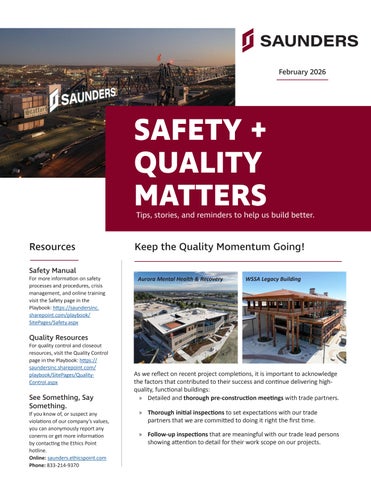

SAFETY + QUALITY MATTERS
February 2026
Tips, stories, and reminders to help us build better.
Safety Manual
For more information on safety processes and procedures, crisis management, and online training visit the Safety page in the Playbook: https://saundersinc. sharepoint.com/playbook/ SitePages/Safety.aspx
Quality Resources
For quality control and closeout resources, visit the Quality Control page in the Playbook: https:// saundersinc.sharepoint.com/ playbook/SitePages/QualityControl.aspx
See Something, Say Something.
If you know of, or suspect any violations of our company’s values, you can anonymously report any conerns or get more information by contacting the Ethics Point hotline.
Online: saunders.ethicspoint.com Phone: 833-214-9370


As we reflect on recent project completions, it is important to acknowledge the factors that contributed to their success and continue delivering highquality, functional buildings:
» Detailed and thorough pre-construction meetings with trade partners.
» Thorough initial inspections to set expectations with our trade partners that we are committed to doing it right the first time.
» Follow-up inspections that are meaningful with our trade lead persons showing attention to detail for their work scope on our projects.
Aurora Mental Health & Recovery WSSA Legacy Building
Communication Timing for Critical Scopes
The Quality Department can help with initial inspections when project teams provide constant communication of critical scopes starting and when critical work will be buried.
Phone calls, emails, and text messages are great ways to get ahold of the Quality Department to inform the team so they can coordinate when to be onsite and conduct initial inspections. Calendar invites are also welcomed, but if something gets pushed, please notify them so they can reschedule accordingly.
CONTACT THE QUALITY DEPARTMENT:

Brad Hynes, Quality Director b.hynes@saundersinc.com
303.875.0349

Brandon Goshorn, Quality Control Manager b.goshorn@saundersinc.com
970.471.9316
QUALITY SHOUTOUT
The Amble
The Amble project team has demonstrated exemplary performance in the execution of a complex project under challenging circumstances. Throughout the project, the team consistently rose to the challenges presented, maintaining a strong focus on quality, performance, and adherence to best practices. Their commitment to doing the work right the first time, despite constraints and obstacles, reflects a high standard of professionalism and teamwork.
Great job to the entire Amble project team for their dedication, attention to detail, and collective effort in delivering successful outcomes!


Initial Inspections
Initial inspections are critical and often an underestimated component of successful projects. Conducted at key early stages of the project, these inspections establish the foundation for quality, performance and risk management throughout the life of a building. When performed correctly, initial inspections help align project teams, identify issues before they become costly, and protect owners from long-term operational and liability concerns.
Without this early reference point, deficiencies can go unnoticed until problems are embedded deep within the structure or enclosure, making corrections far more expensive and disruptive.
THE BENEFITS:
For Owners: Early inspection can significantly reduce long-term maintenance costs, warranty claims, and legal exposure.
For Saunders: Provides documentation that work began in compliance with the project requirements, helping manage professional and contractual risk.
Many of the most expensive building failures — water intrusion, air leakage, premature material deterioration, and mold — can be traced back to early-stage construction decisions or overlooked details. Initial inspections help mitigate these risks by verifying that critical assemblies are started correctly and that installers understand the performance requirements of the building systems.
Initial inspections are not about slowing down construction, they are about preventing rework. Addressing issues early is almost always faster and less costly than tearing out completed work. When expectations are clearly communicated and verified at the beginning of construction, crews can work more confidently and efficiently.
QUALITY SHOUTOUT
Stanley Film Center
Superintendent Michael Babb at the Stanley Film Center in Estes Park, Colo., consistently communicated with Quality Control Manager Brandon Goshorn, regarding the belowgrade elevator pit waterproofing installation.
The date kept getting pushed, but Michael continued to notify Brandon along the way. On the day of installation, Brandon was able to be onsite to conduct an initial inspection with the team. This inspection was critical, as the waterproofing membrane installation exhibited substantial deficiencies. The membrane wouldn’t have stopped much ground water if it was left as is and poured over. All parties were able to align, move things around, repair the substrate, and get the waterproofing re-installed the following morning in accordance with the manufacturer’s instructions to keep the concrete on schedule.

This proves the importance of initial inspections and how important they are for certain scopes of work. Especially for work that is only exposed a couple of days before it is buried. Trust in our trade partners is important, but it must be supported by thorough verification and review processes.
Let’s Talk About Yesterday SAFETY
Part of the daily discussion and taking advantage of operational learning is reviewing what actually happened yesterday and how we can improve.
» Discuss what went right yesterday.
» Discuss what the needs are for today by discussing yesterday’s activities.
» Discuss any Quality or Safety issues that came up during yesterdays shift and how you can mitigate them.
Logistics Matter

The Castle Rock Sports Center (CRSC) team has been hyper-focused on managing logistics, prior to project start and weekly during construction, and are seeing some great benefits to safety and quality including:
» Separating trades eliminates overhead load hazards.
» Work flow continues without interruption.
» Struck-by hazards reduced by separating deliveries.
» Crane boom separation with three cranes running at the same time.
» Good morale on the project when everyone is productive.
