1
ii
The Mines and Railroads of Wisconsin A Story of Discovery, Expansion, and Innovation by Beverly Vaillancourt, M.Ed for the Sauk County Historical Society Contributors: Bill Schuette and Paul Wolter
iii
Sauk County Historical Society 900 2nd Avenue PO Box 651 Baraboo, Wisconsin 53913 saukcountyhistory.org Unless otherwise noted, photos courtesy of the Sauk County Historical Society ISBN 979-8-9866497-3-3 ©2024 Sauk County Historical Society Press Printed by Minutemen Press, Baraboo, WI, USA All rights reserved. No part of this work may be reproduced, stored in a retrieval system, or transmitted in any means, electronic, recorded, or otherwise, without the express prior written consent of the Sauk County Historical Society.
iv
Dedication This book is dedicated to Bill Schuette. Bill is a talented photographer, videographer, and writer. Over the years he has captured and shared the happenings of Sauk County through the lens of his camera and through his pen. He has spent countless hours digitizing thousands of historic photos donated to the Sauk County Historical Society (SCHS). Because of his efforts, the SCHS historic photo collection is now fully accessible to the public. Bill has placed great effort into making sure Sauk County veterans are remembered and that the story of Sauk County's Civil War soldiers is told. He, in every way, forwards the mission of the Sauk County Historical Society. For his tireless work and dedication to the preservation and sharing of history, we thank him.
“The mission of the Sauk County
Historical Society is to preserve, protect, maintain and disseminate the history of Sauk County."
v
To the Student "That's a great idea!" is a comment that sparks change. The sharing of ideas leads to creative ways to solve difficult problems. When people share ideas, they are working together. They are collaborating and functioning as a team. New laws, new machines, and new ways of communicating all come from the sharing of ideas. The digging of mines and the building of railroads across Wisconsin was hard work that required the muscle and ingenuity of many. Teamwork and the sharing of ideas were needed to overcome barriers and get the job done. When things went wrong, such as a mine filling with water, it took the brillance of teamwork to find a solution and make sure the solution work without delay. People shaing ideas, rebounding from failure, and solving difficult problems combine to tell the fascinating story of the mines and railroads of Wisconsin. In this course you are asked to keep a History Journal as you read about the mines and railroads of Wisconsin. In your History Journal you should list questions you have, draw diagrams, and plan projects. Every historian keeps a journal, sometimes in their back pocket! They make notes on what has been discovered and jot down ideas they would like to explore and share. They also write down ideas shared by others. Your History Journal is driven by curiousity. It is a placed filled with facts and thoughts. And, it belongs to you. We hope you enjoy the story of the mines and railroads of Wisconsin. As you read through this important story, think of what it must have been like to be a miner being lowered deep underground with just a candle for light, or a worker laying track through the forests of Wisconsin or across its rivers. What challenges did the workers face? How difficult was the work? Why did they persist through the most difficult of times? How were the lives of the people of Wisconsin changed as mines were worked and railroads were built? This is the story of real people, real events, and real challenges. It is the story of people who made a difference, and helped to build the Wisconsin you know today. Should you have any questions, email education@saukcountyhistory.org.
vi
Contents Chapter 1 ������������������������������������������������������������������������������������������������������������ 1 Connections ����������������������������������������������������������������������������������������������������������� 1 A Story Waiting to be Told ���������������������������������������������������������������������������������������������� 2
Chapter 2 ������������������������������������������������������������������������������������������������������������ 7 Turning Points in History ���������������������������������������������������������������������������������������� 7 Copper Discovered at Reedsburg ������������������������������������������������������������������������������������� 9
Chapter 3 ��������������������������������������������������������������������������������������������������������� 11 From Furs to Mines to Railroads �������������������������������������������������������������������������� 11 Beaver Pelts ����������������������������������������������������������������������������������������������������������������� 12 From Fur to Mining ������������������������������������������������������������������������������������������������������ 14
Chapter 4 ��������������������������������������������������������������������������������������������������������� 15 Mining in Wisconsin ����������������������������������������������������������������������������������������������������������� 15 Metals Mined in Wisconsin ����������������������������������������������������������������������������������������� 16 Spoon Decorah ������������������������������������������������������������������������������������������������������������� 19 Captain Roberts Mine �������������������������������������������������������������������������������������������������� 22
Chapter 5 ��������������������������������������������������������������������������������������������������������� 23 Lead Mining ������������������������������������������������������������������������������������������������������������������������� 23 Word Power ������������������������������������������������������������������������������������������������������������������ 23 Early Lead Mine ������������������������������������������������������������������������������������������������������������� 24 Be a Badger ������������������������������������������������������������������������������������������������������������������ 27
Chapter 6 ��������������������������������������������������������������������������������������������������������� 33 Iron Mining in Wisconsin ����������������������������������������������������������������������������������������������������� 33 Iron Ore Mining in Sauk County ����������������������������������������������������������������������������������������� 34 Mining Near North Freedom �������������������������������������������������������������������������������������� 36 Charcoal Production ����������������������������������������������������������������������������������������������������� 39 vii
Chapter 7 �������������������������������������������������������������������������������������������������������� 41 Building Communities ��������������������������������������������������������������������������������������������������������� 41 Railroads in Wisconsin ��������������������������������������������������������������������������������������������� 41
Chapter 8 �������������������������������������������������������������������������������������������������������� 47 Changing Times ������������������������������������������������������������������������������������������������������������������ 47 The Closing of Depots ���������������������������������������������������������������������������������������������� 52
Chapter 9 �������������������������������������������������������������������������������������������������������� 55 The Crossbuck
�������������������������������������������������������������������������������������������������������������� 55
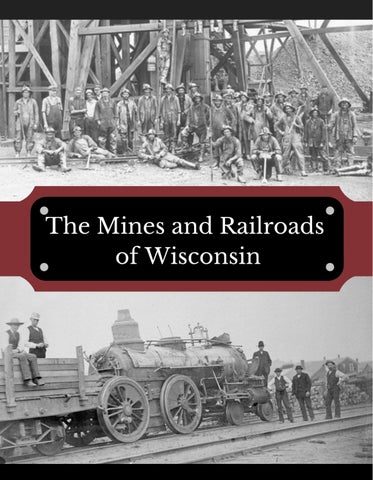
Wisconsin miners circa 1900
viii
Chapter 1 Connections
Welcome to the history of the railroads and mines of Wisconsin. This story has its beginnings in the fur trade of the 1700s. It is the story of conflict, of settlement, of loss, and of gain. Central to the story are laws that gave the federal government control over mining lands once held by the Sac (Sauk), Winnebago (Ho-Chunk), Meskwaki (Fox) and other Indian Tribes. The laws also caused the forced removal of Wisconsin's Indigenous Peoples from areas in Wisconsin that were rich in natural resources to areas west of the Mississippi River. Throughout the book you will have the opportunity to read original documents and look at photographs and drawings made by people who experienced the events that are part of Wisconsin's history. These original objects and documents are called primary sources. They give us a peek into the past. As you read the story of mines and railroads in Wisconsin, think about how communities grew during the 1800s. Think about how peoples' lives changed. Think about who benefited from the changes and who was harmed. History is the story of those changes and how they came together to build Wisconsin's communities.
primary - first, most important Word Power 1
A Story Waiting to be Told History is told in many ways. Since we live in the present, we rely on individuals who study history to help us understand what happened in the past. History is more than just dates and events. It is the story of real people who lived real lives who made a real difference. So, how are their stories told?
Curators are individuals who catalog historical items found in a collection. These are called artifacts. When curators receive a photo, for example, they carefully document the details in the photo. Such details might include the possible date the photo was taken, its location, and specific items shown. The work of curators is very important in helping us understand history. They document facts through their descriptions and research. Curators work for museums and historical societies.
What conmection between the growth of mines and railroads does this historical photograph show?
Historians build on the work of curators and add a great amount of their own research
to write about history. Historians help us understand the people, events, and changes that define history by putting together the pieces of the history puzzle. Historians use primary source documents, such as the maps and letters, to explain the events and their impact on people and communities. When we read what historians have written about history, we are reading what is called a secondary source.
Storytellers use past events to weave a story that holds both fact and fiction. They may base their story on a real person from the past and include events that actually happened. However, the story is the creative work of the storyteller. This is called historical fiction. 2
Be a History Detective As you read this book you will make many discoveries. You will use information gained from primary and secondary sources to experience how mines and railroads helped to build Wisconsin's communities. Along the way, your curiosity may just lead to a new discovery about your community and the people in the past who shaped it. Watch for the Sauk County Historical Society History Detective throughout the book.
Let's begin our discoveries with reading parts of a diary written by Jared Fox. He wrote his diary as he traveled westward from 1852 to 1854.
Jared Fox married Bathsheba Babcock in 1827. They
had five children. In 1847 he helped to build a flour mill in the new village of Delton (today Lake Delton, Wisconsin). He also helped build a group of stores in the village. In 1852 Jared decided to head west. He believed he could find a better life in California or Oregon. This was a common idea in the 1850s as many headed to western lands to mine for gold or to farm the fertile soils found in Oregon. His story carries the same hopes and dreams of those coming to Wisconsin to mine for lead or iron. Jared Fox returned to Wisconsin after his two years of travel. As you read his diary entries, think about what might have made him decide to return to his family and resettle in Wisconsin. Look for clues about the communities he discovered in his travels. The diary begins on Aprl 12, 1852, when Jared, his brother Levi, and his friend Charles leave by horse and wagon from Delton. They first go to Baraboo and then to Dubuque, Iowa. Grammar and spelling are left as he wrote them. May 18, 1852 fair but the wind blew cold all day. Came 12 miles to Loopfork of the Platte to the ferry. Could not ferry short of 4 days. 3
June 14, 1852 Started at 6 in the forenoon passed one grave marked C.W. Campbill died 1850, passed two dead oxen and lots of bones of oxen heretofore...Plenty of names carved and painted on the rocks and signs of more dead oxen in afternoon. Very sand, hard travelling. Grass very poor and has been for the last 100 miles. Camped in Sweetwater. Made twenty miles. July 23, 1852pr Fine day, It is hard saying which way we travel most whether up or down, right or left. More signs of timber. Crossed water 25 times today. Plenty of bushes near the water...Passed 2 dead oxen. Soil loose some better. There is 5 trains ahead of us, 1 mule, 2 hors, 2 ox trains, 55 trains in all. 25 miles. August 8, 1852 Horses looked as if they would die. Gave them a little flour as we done a few times before... August 15, 1852 We are in Oregon...so after 4 months and 3 days wandering we have reached the settlement with our horses, 3 in number, and dog all alive...oh how thankful out we to be, and others sick and starving and have lost their teams. October 11, 1852 ...started toward Olympia. This is a gloomy day yet I like the country as well as any I have seen. I made 24 miles [alon] with a pack. I passed one house and met a few strangers. November 17, 1852 Got in to Portland after breakfast, 50 miles. It rained all night. Look around town till afternoon them came out 2 miles to Mr. Longs and worked till night digging potatoes for one dollar. January 12, 1853 Nine months snce I started from home. Rained hard all night. Rained little and shined some this day. Went to the steam mill and back. 4 mines in all. Start to fill a bed cost 6 dollars. February 14, 1853 Bought a canoe for 30 dollars and a barrel of flour for 40 dollars and some tools. Cold and rainy. Things look gloomy. Got underway down the Sound. Made 25 miles... October 18, 1853 Had very rough sea. Water broke in had to bail out. Got around, had to get out in the salt water 2 cold as ice to keep her off and not break to pieces. No fire or a mouthful to eat from early in the morning till after dark. We got to Coveland in rough water almost every side up and the wind and rain beating us hard and we so we and cold that I got so dizzy that I could hardly stand by. Hard work, wet, cold, and hungry, but here we met frineds to help us get our traps out and warm and feed us. 4
April 11, 1853 This day I have been from home one year...I am now on Whitby's Island and have done nothing and have come to nothing. I have spent all I had and more too...I am disappointed in all I try to do...I can hardly say I feel satisfied. I don't know what I am to do in the future...I have always worked hard and have not spent my money for that which I did not need. I have endavored to get an honest living...I am among strangers and ragged and without funds to any amount...I hope another year will find me in a better condition to be a comfort to my family, but I cannot hope to see them in that time. I find I have traveled 5850 miles since I left home and spent near 360 dollars. July 2, 1853 Feel old and want to go home but don't know what to try to do. Look over things and papers and fix some things a little. I think I will try for California. September 17, 1853 At day break was at Sacramento, 145 miles. Did not see the country only to see that it was flat and bushes along the river banks. We got around once. Saw a man who kept a lake house at Madison, Wisconsin. Got my effects on to a wagon top of a load of grapes for Grass Valley...We made 20 miles...Country rolling, very little low oak for wood and brush for fence. Very little farming done... November 11, 1853 Got home before noon, making 72 miles in all this trip. A mile out of town I met a man on horseback who inquired if my name was Fox. I told him yes. Says he from Walworth Co. Wis. Yes and who should it be but Allen that used to clerk for John F. McKee of Delavan and studies with Dr. Blanchard and went to Rockford to complete his studies and he is now established in Grass Valley. January 20, 1854 Very cold but clear. We went up on to the hill where we have a pile of loose shingles and built a fire and thawed and tried to do something but it went slow and at evening our timber at the house is so frozen that we can't work it. Our potatoes are forzen and it is about all we can do to keep warm and we begin to think of abandoning the business. April 8, 1854 Mostly clear till it was near night and air felt like rain. At shingles as usual. Sawed off 4 logs and finished the sawing on the [firs] three over the ravine. Not well...quit before sundown and made bread. July 4, 1854 Charles done our washing in the forenoon and went to town for the Atlantic mail today in the afternoon and came home at night with 3 letters for me. I read them over and some how I felt much affected. I felt weak and some sick and Charles and I conclueed it best for me to try to get home and he stay till fall.
5
July 11, 1854 Finished fixing my things and...went to town and parted from Charles a little above Winchesters mill. I felt sorry for him. Got a bowl of bread and milk for 3 bits [about 36 cents] and lodging on hay for 50 cents at the Bates house. July 14, 1854 Paid my fair to New York on the steamer Sierra Nevada $140. Sent letter to Levi Fox. July 15, 1854 Got on board of the steamer Sierra Necada in the afternoon and at 5 o'clock sailed for San Juan...Some wind and fog today and rough out at sea. Got out before dark and left California I suppose forever. July 27, 1854 Landed in San Juan, a very little pretty bay. Landed at daylight, 11 days and 10 hours from San Francisco. We left the ship on a whale boat and then near the shore took passage on the shoulders of a native. Walked a little way on foot, then rode a mule 12 miles over a good road...Arrived at Virgin Bay at noon....The forest is so dense...saw a few parrots... We went on the steamer called Central America in an iron boat. The water is very rough...This steam runs across the Lake Nicaragua 90 miles down on the river some 30 miles. July 29, 1854 Supposed to be near 200 miles taking all the hooks and crooks from the Pacific to the Atlantic, 80 or 90 of Lake after the 12 of land and 120 of river. We saw several monkeys...The river that we came down is very crooked and considerable current...waiting for steam to arrive from New York...This is my first sight of the Atlantic Ocean or the [Caribean] Sea. Just at night the steamer Star of the West came in and in one hour the passengers were on board and out to sea. August 7, 1854 Got into New York at day break and took a room...50 cents. Breakfast 38 cents...Paid for ticket from New York to Milwaukee, Wisconsin on the New York and Erie Rail Road $19.50. August 10, 1854 Arrived in Milwaukee pm. Fine trip. Took train car for Madison...and arrived at 1/2 past ten at night. Fare 3 dollars. Paid for grub at Milwaukee 15 cents. Stayed at Madison Hotel, bill 50 cents. August 11, 1854 Took stage coach for Baraboo. Arrived at Baraboo 4 o'clock, fare $2. Took Delton express to Delton and arrived at home before sundown and glad to be blessed with the privilege of meeting my family and friends once more on this side of the grave. Fare 50 cents. 6
Chapter 2 Turning Points in History Turning points are events that signal change for the people of a region. They also
signal changes in how a region's resources, such as timber, are used. Examples of turning points include the forced migration of Indigenous People during the 1800s to areas west of the Mississippi River, the farming of wheat, and the introduction of electricity to a community. Turning points are like a set of gears with the gears representing different changes. Just as one gear moves the next gear, one change can cause other changes to occur. As you learn about the mines and railroads of Wisconsin, watch for turning points.
How might this community have benefited from having train service? Why would the start of train service be a turning point for this community?
The story of mines and railroads is the story of ups and downs, starts and stops, and all too often boom to bust. It is the story of the impact of change to the region's environment, economy, and settlement. It is the story of turning points.
Word Power
turning point - an event that changes the course of history
7
Driving Question Let's get started with a driving question. A driving question is the main question to think about while reading. A driving question sparks other questions. A driving question is how History Detectives start on their journey to discovery facts about fascinating people and events from the past. Driving Question: How did the digging of mines and the building of railroads impact the people living in Wisconsin during the 1800s? Write the driving question in your History Journal. Consider this. If you gained wealth from the growth of mines and railroads, then the industries were viewed as quite good. If the industries bought you hardship, then they were viewed as quite bad. Whichever the view, without a doubt, both the digging of mines and the coming of railroads were significant turning points in Wisconsin's history. The story or railroads and mines in Wisconsin is a fascinating story about new and exciting technologies that made work easier and machines far more powerful. It is the story of changes. 1. What kind of impact did the building of railroads and mining have on the Indigenous Peoples of the region? 2. How did fur trading lead to the growth of mines in Wisconsin? 3. How did the growth of mines in Wisconsin lead to the growth of railroads across the state?
Railroads helped to build communities across Wisconsin.
8
The following is the story of the Reedsburg Copper Mine. It was written by historian Bill Schuette. This story captures the get rich quick dream people believed would surely come true if one worked hard with a never quit attitude, and with a bit of luck tossed in for good measure.
Copper Discovered at Reedsburg by Bill Schuette
During the mid-1800s, pioneers from the East were moving west in search of new lands to populate and raise their children. Some were also looking for a new adventure, and still others were seeking the wealth of the western lands. One of those wealth-seekers was Don Carlos Barry, who came to the Baraboo area with Henry Perry in 1844. They were looking to start a lumber business and erected a saw mill there. Lumber forests were located to the north, and so Barry and Perry headed in that direction to investigate a potential location on Big Creek. Upon their return, they stopped at Reedsburg. Hearing of the possibility that copper had been found there, Barry noted that, “On our return, I discovered, where water had washed away the earth, what I supposed to be copper ore.” They immediately changed their plans and filed a claim in Section 1 in the Town of Reedsburg. Henry Perry died shortly thereafter and the next spring Barry returned to the area, along with two partners he had recruited who had been miners at Mineral Point, “...to assist me in opening our copper mine,” noted Barry. “We raised about two tons without much expense, it being the deepest about four feet from the surface,” he said. That load gave out when they hit sand rock. But they were not deterred and continued to dig a deeper shaft that summer. Barry found two seams of ore in crevices as he dug down. Rumor was that a Mr. Kendall, who owned a copper mine and smelting business at Mineral Point, offered Barry $1,500 for the mine, which he refused. After having dug around 32 feet—following the deposit down a seam which eventually petered out—they abandoned the mine due to water seepage and a lack of funds to continue.
9
Barry had the two tons of ore hauled to Mineral Point to sell, getting ninety dollars a ton. That would be approximately $2,300/ton in today’s dollars, for a total of $4,600 for his two tons of ore. A typical laborer of that era earned about $5 per week. In August of 1845, a rumor spread throughout Sauk County that another large load of copper ore had been discovered about ten to twenty feet below the surface, and it was of sufficient richness to make it worth digging. William Canfield, in his Outline Sketches of Sauk County, wrote that, “Upon a certain day all of Sauk County, with mining tools, was astir for the copper diggings, each person trying to get there before the other. The next day proved it a hallucination, and the copper fever soon abated.” However, that was not the end of the mining era in Sauk County. Other settlers, including David Reed, heard that there was iron to be found in the county, and that was one of the primary attractions that persuaded them to relocate here. That mine was, of course, located at Ironton. Today, Copper Creek, east of Reedsburg, is the only remaining remnant of the copper diggings which caused so much excitement in the mid-1800s in Reedsburg and the Sauk County area.
Copper Creek in Fall, 2022, Reedsburg, Wisconsin, Photo courtesy Bill Schuete 10
Chapter 3 From Furs to Mines to Railroads French fur trader re-enactor photo courtesy Bill Schuette
European fur traders arrived in Wisconsin in the early 1600s. Among them was Jean Nicolet. He may have been the first European to arrive near northern Wisconsin in 1634. What he discovered was an area rich in beaver. By 1650 fur traders worked directly with Indigenous People throughout Wisconsin. The Indians traded beaver, otter, and other animal pelts for beads, knives, blankets, guns, and other goods.
Original painting by Frances Anne Hopkins (1838 - 1919) Library and Archives of Canada, public domain
voyageur - a French fur trader Word Power 11
Beaver Pelts The main trading post in the later 1600s was at Fort Michilmackinac (present day Mackinac, Michigan). Here goods were moved by canoe from Quebec (Canada), and distributed to smaller fur trading posts in Wisconsin. In return countless number of beaver pelts made their way to Montreal and then to Europe. The beaver pelts were made into beaver hats popular among the wealthy.
beaver hat poster image: public domain
1832 image source: https://www.nps.gov/ articles/beaverhat.htm
12
Conflict over control of land and its resources resulted in the British declaring war on France in 1756 (French and Indian War). Each country sought to gain control over valuable areas rich in fur-bearing animals. Some Indian tribes took sides with the French. Others with the British. Agreeing to fight with the French or British may have depended on which foreign country offered the Indians hope of retaining their native lands. The success of the British in the French and Indian War resulted in the removal of French soldiers from Canada and the loss of French control over lands in Canada. It also meant British control of the fur trade throughout the region beginning in 1760 and lasting until 1815. The fur trade was extremely profitable, first for the French and then for the British. Yet the opposite was true for the Indigenous Peoples of Wisconsin. In the end, the fur trade dramatically and forever changed the lives of the Indians living throughout the region. Foreign control of the fur trade was a major turning point for the Sauk, Fox, Ho-Chunk and other tribes living in Wisconsin.
History Detective Question How did the fur trade impact the growth of mining in Wisconsin?
In the late 1600s when fur traders and explorers, such as Nicolas Perrot, frequented the Mississippi River region, they noticed lumps of lead on the ground. They also noticed lead among the belongings of Indians in the region. Lead is a metal that is gray in color and can be easily heated and molded to make products. Lead is usually found in galena. Galena is an ore, or a rock made up of more than one mineral. The British were very interested in lead. Soon bars of lead would be used as currency as part of the fur trade. In 1788 Canadian fur trader Julien Dubuque secured a land grant from the Sac (Sauk) and Meskwaki (Fox) Indians for an area of present day Iowa and Wisconsin along the Mississippi River. In 1805 Dubuque reported extracting twenty to forty thousand pounds of lead. Soon Dubuque and other fur traders in the region, such as Jesse Shull and George Davenport, turned their attention to lead mining.
13
From Fur to Mining In 1804 the federal government and the Sac and Meskwaki signed the Treaty of St. Louis. The treaty conveyed all Sac and Meskwaki lands east of the Mississippi River to the federal government. The Tribes stood firm that the treaty had been negotiated by men not authorized by their tribal councils to speak for the Sac and Meskwaki, and thus it was not a valid treaty. The treaty included the cessation of land along the Rock River. This included the important village of Saukenuk located near present day Sauk City. Treaties with other Indian Nations followed. The treaties resulted in the forced removal of Indigenous Peoples from their native lands in Wisconsin. While the treaties promised that goods and money would be delivered to displaced Indians, Indians resented and often resisted being removed from their homelands. Moreover, the goods and money promised to the various Indian tribes often went unpaid. By 1822, US Troops were sent into the region to curb Indian hostilities resulting from encroachment onto their lands by newly arrived settlers. Soon the federal government began issuing mining leases to fur traders and others who had settled in the lead region of Wisconsin. By 1850, many of the Indigenous Peoples of Wisconsin had been forcibly removed. By 1850 Wisconsin beaver and other fur-bearing animals had been hunted close to extinction. The once robust fur trade in Wisconsin came to an end. Wisconsin, now attracted settlers hoping to mine lead, zinc, copper, and iron. By the mid 1800s, the Wisconsin fur trade had been replaced by mining, farming, and the growth of railroads.
14
Chapter 4 Mining in Wisconsin Background Wisconsin has a long history of mining. Long before the early 1800s, pioneers had moved to western Wisconsin hoping to become rich from finding galena hiding in plain site on the ground and under the surface. How far down miners needed to mine, and how much could be found and removed, was a big question for miners, and one not easily answered. Yet, the sheer will to succeed was far stronger than fear of failure. They studied the ground and dug wherever they hoped to find lead.
Think Like a History Detective What was mined? Galena was the main source of lead. Several small mines could be found across southwest Wisconsin between 1820 and 1850. Mining brought would-be miners to the region from near and far, and built communities such as Platteville, Dodgeville, and Shullsburg. What might a miner look for when deciding where to start digging for galena?
sourdough - an experienced miner Word Power 15
Metals Mined in Wisconsin
Zinc was found in old lead mines
in southwestern Wisconsin. The richest type of zinc ore was called "black jack." Zinc mining in southwest Wisconsin started around 1850.
The iron ore mined in central Wisconsin was of a lower grade. Much of it was mined for its red pigment used to produce the red paint found on barns and railroad cars. Higher grade Iron was found in northern Wisconsin.
Copper is a highly sought mineral
because it is a high conductor of heat and electricity and easily molds into other shapes. It was mined mostly in northeast Wisconsin.
Galena is a gray mineral that is quite
brittle. Galena is a source of lead, as well as silver. It crystalizes to form cubes. Lead is easily extracted from galena simply by applying heat to the ore using a wood fire.
16
What did it take to be a miner? Mining has always meant a commitment to hard work and determination. Mining in the early 1800s was very difficult and dirty work. At first mining required a simple pick and spade for digging, a great deal of persistence and physical strength, and the ever-present dream to strike it rich. People would move to mining communities to find work and new opportunities.
These lead miners are most likely grading galena by letting smaller rocks fall through the holes in a drum. photo courtesy Wisconsin Historical Society IM9078 As miners looked over the land, they hoped to find a vein of ore that went long and deep. It was an investment of time, labor, and sometimes all the money hopeful miners had to pursue their quest for mineral wealth. Mining was a rags to riches story for some, and a story of great disappointment and financial ruin for others.
17
How did mining transform Wisconsin? The story of mining in Wisconsin begins with the story of the mining of lead. It also is the story of how life for the Indigenous People of Wisconsin changed dramatically in a matter of two decades.
"Europeans had known of the presence of lead ore
in the upper Mississippi since the 17th century. For hundreds of years, the Ho-Chunk, Mesquaki (Fox), Sauk and other Indian tribes had mined lead that was easy to find. French fur trader Nicolas Perrot began trading in the lead mined by Indians in the 1680s. When the French withdrew from the area in 1760, Indians guarded the mines carefully, revealing their locations only to favored traders such as Julian Dubuque. Settlement in the region remained slow until a series of treaties between 1804 and 1832 ceded all Indian lands south of the Wisconsin River to the U.S. The treaties coincided with a strong demand for lead. Lead was widely used in the manufacture of pewter, pipes, weights, paint and ammunition for the firearms of the expanding U.S. military.
The transformation of the region from native lands to start up mines in the early 1800s brought thousands of settlers from other parts of the United States and from Europe to Wisconsin. Some came from as close as Missouri, others from eastern states such as New York, and some from as far away as Cornwall, England, and other places in Europe. For them, mining meant a new life and fresh opportunity. Miners began moving to southwestern Wisconsin in earnest in the early 1820s. By 1829 some 4000 men were trying their luck at lead mining.
What changes do you think mining brought to the lives of the Indigeneous Peoples of Wisconsin?
18
Spoon Decorah Spoon Decorah was a member of the Ho-Chunk (Winnebago). In 1889 he shared
what his life was like in the early 1800s as pioneers began moving onto land the Sauk, Fox, and Winnebago Indians called home. The account was retold by Moses Parquette, an interpreter, and then transcribed. Because of this, some of the words used by the interpreter may not have the exact meaning as intended by Spoon Decorah. As you read the narrative below consider the impact lead mining had on the Indigenous People living there at the time. Also consider the role mining and timber had behind the force removal of Indigenous People from Wisconsin. When Spoon Decorah refers to the Big Father, who or what does he mean? Why is the Big Father of utmost importance to the Indians living in areas that had an abundance of lead? ... Our people once owned the lead mines in Southwestern Wisconsin. I have seen Winnebagoes working in them, long before the Black Hawk War. There were a good many at work in this way, nearly all the time in summer. Some dug lead for their own use, but most of them got it out to trade off to other Indians for supplies of all sorts. They made lead-mining their regular work. Every fall and spring hunters would go down to the mines and get a stock of lead for bullets, sometimes giving goods for it and sometimes furs. When the whites began to come among the mines, the Big Father' said to his Winnebago children: "I want this land and will have my own people to work it, and whenever you go out hunting come by this way, and you will be supplied with lead." But this agreement was never carried out by the Big Father or his agents. Never was a bar of lead or a bag of shot presented to us. This was a very great sorrow to our people. For many years there was much sorrowful talk among the Winnebagoes, at the manner in which the Big Father had treated them, with regard to the mines. No, we never saw any of our lead again, except what we paid dearly for; and we never will have any given to us, unless it be fired at us out of white men's guns, to kill us off." Source: DeKaury, Spoon. "Narrative of Spoon Decorah." Collections of the State Historical Society of Wisconsin (Madison, Wis. : State Historical Society of Wisconsin, 1895): 13
19
Going Down Mining lead underground in the early 1800s meant that miners needed to be lowered into the ground and lead ore needed to be removed from the mine. The answer the windlass. A windlass was used in mining to raise and lower heavy loads. Men above ground would unwind a rope wrapped around a cylinder and the miner would be lowered into the mine. When the rope was rewound, up came ore or the men at the end of the mining day. A series of pulleys made the job easier.
More than one miner could be lowered into a mine when the ropes held a special tube. However, the space was tight and being lowered into the mine came with its own set of dangers. What do you think it felt like to be lowered into a mine? What do you think it was it like mining deep underground where the only light came from candles attached to a miner's hat?
images courtesy of Wisconsin Historical Society (IM8990 & IM129204)
20
Think Like a History Detective Take a close look at the photo of the two men holding candles in the lead mine. Miners had special hats on which the candles were placed or attached to the mine wall to free up use of their hands.
Courtesy of the Wisconsin Historical Society (IM2214)
Now take on these roles:
Curator: Make a list of at least 5 things you notice in the photo. Historian: Write a sentence that includes two facts about what is happening in this photo.
Storyteller: Imagine that you are one of the men shown in the photo. Write a
paragraph of what it is like to be in the mine. Remember a historical storyteller combines fact and fiction. Use the facts from what you wrote as a curator and historian to become a story
21
Captain Roberts Mine Captain Roberts Mine, also known as the Freedom Mine, is found in the Town of Freedom in central Sauk County. It first opened in 1910 to extract iron ore.
Mysteriously the mine was abandoned in 1911 with everything left inside including the tools and equipment. The mine was one of the last ones where miners tried to extract iron ore, However, like many of the mines in this area, water constantly filled the mine. Because of this, mines would eventually close. This was the fate of the Captain Roberts Mine. Over one hundred years later that water has preserved things making for a unique chance to see what an early 20th century iron ore mine looked like. From the pick ax left in the ore cart still on the tracks to the pneumatic drill stuck in the side-wall of the mine, the Captain Roberts Mine is frozen in time. In 2021 Evan Kovacs of Marine Imaging Technologies (https://marineimagingtech. com) went into the water-filled mine. What he discovered was a story lost in time.
To view this video go to: https://saukcountyhistory.org/mines-and-railroads
22
Chapter 5 Lead Mining photo courtesy Wisconsin Historical Society IM331833
In 1718 Guillaume Delisle, a French cartographer, or map maker, noted the location of mines in southwest Wisconsin on his hand drawn map. What can you tell about the location of lead mines from this map?
source: http://hdl.loc.gov/loc.gmd/g3700.ct000666
Word Power
claim - a section of land with mineral wealth that is sold to an individual
23
Early Lead Mine Lead could be found on and near the earth's surface across a region that would become the states of Wisconsin, Illinois, Iowa, and Missouri. Lead became important in the making of bullets for firearms provided to Indian tribes by French Fur Traders and later by the British. The guns were used both to hunt animals and for intertribal warfare. Indians used their knowledge of lead to heat and mold it into bullets for their new weapons. Lead also became an important trade commodity. The trade of both fur and lead played a critical role in relations between tribes and in conflicts between the British and French. Fur traders in the late 1700s were quick to learn how the Indians extracted lead from lead ore. Writings from 1815 by John Shaw, who set up a trading post near Prairie du Chien, describe this process.
A hole or cavity was dug in the face of a sloping piece of ground, about two feet in depth and as much in width at the top. This hole was made in the shape of a mill-hopper and was lined or faced with flat stones. At the bottom, or point of the hopper, which was about eight or nine inches square other stones were laid across grate-wise. A channel or eye was dug from the sloping side of the ground downward to the bottom of the hopper. The channel was about a foot in width and in height and was filled with dry wood and brush. The hopper being filled with mineral and the wood ignited, in a few minutes the molten lead fell through the stones at the bottom of the hopper and thence was discharged through the eye over the earth."
Source: https://tinyurl.com/m3y9cbcr
Lead mining attracted thousands of men to southwest Wisconsin. While the mines thrived, so did communities. When the lead ran out, many miners left the area for new opportunities elsewhere, and once busy places grew quiet. 24
When did lead mining by pioneers begin in Wisconsin? A marker erected near Shullsburg, Wisconsin, in 1955 by the Wisconsin Historical Society reads as follows:
Grant, Iowa and Lafayette counties were once the center of a lead mining boom. Indians had sold lead to early traders, but there were few [Euro-American] miners here in 1820. Mining brought in a large part of the 37,000 population credited to the three counties in 1850. Prospecting was done by practical men with little aid from mineralogical experts. Their tools were the shovel, pick, gad or crowbar, hand-drill and blasting powder. Mines were lighted by candles set in gobs of fire-clay which would stick to any part of the rock wall. Some of the miners spent the winters in caves or hurriedly prepared dug-outs and were nicknamed “Badgers.” Many of the once thriving mining centers are now ghost towns, only their refuse dumps and pock-marked land bearing the evidence of the old mining days.
Shullsburg was one of several communities that grew and benefited from the mining of lead. Shullsburg was named for Jesse W. Shull who arrived in the area in 1818 to buy furs from the Indians for Jacob Astor of the American Fur Company. He built a trading house first in Galena (Illinois) and then in 1820 where Shullsburg is today. Along the way he became aware of the presence of lead throughout the region.
25
Another lead mining community was Platteville, Wisconsin, named for the Platte River. Galena was discovered in the Platteville area in the 1820s. Soon after the region experienced a mining boom, and the economy of Platteville grew. Lead, or "gray gold" as it was often called, resulted in increased migration to the region, the growth of businesses, and the promise of a better life. Suddenly, everyone was a miner out to strike it rich.
Miners working in an underground lead mine in Platteville, Wisconsin photo courtesy Wisconsin Historical Society IM3785
What was it like to be a lead miner? It didn't take long for news of new diggings to become public, and the race was on to claim a lead mine for your own. However, where might lead be found? Finding lead meant listening to sourdoughs, men who had knowledge of the lead mining, and learning from them about abandoned mine sites. A lease (up to five years) to mine was needed from the federal government, after which a cabin was built and possibly a smelting furnace. An alternative was to just live in a tent and mine as a squatter near a hopeful claim. Then came digging with pick and spade. Would-be miners worked hour after hour hoping to find enough lead to pay their expenses and then some.
26
surface mining image courtesy Wisconsin Historiacl Society IM8988
In some places, a lucky miner might find some lead in plain view above ground. In other cases finding lead meant surface digging. However, lead mining also meant heading underground to dig out the galena that wove its way through layers of earth.
Be a Badger Mining was an intense activity. If you had the time and money to build a cabin, you were one of the fortunate miners settling in southwest Wisconsin. However, miners often spent all they had in their quest for lead and were either too poor or too busy to build a winter shelter.
These miners simply lived out the winters inside burrows they had dug into the side of a hill where they were looking for lead. For this they earned the name "badgers." Badgers are short-legged animals that live throughout Wisconsin. They live undergrown in burrows they dig using their sharp claws. 27
The following excerpt is from a newspaper article written by P. Woodhouse, Bloomington, Wisconsin, and published in the Bloomington Record on May 25, 1910. It is a first hand account of what it was like to try to strike it rich in the mid 1800s near the Mississippi River in southwestern Wisconsin.
"On a little flat where we dwelt a cluster of miners cabins stood, eleven or twelve in all. Three of them were occupied by families and I often wondered how a man could follow mining and support a family...There was not a person in our little community during the years I lived there who discovered enough lead ore to pay for the labor expended in the search for it, but they lived somehow, until worn out and discouraged...they [moved away]. We came to Wisconsin to better our condition in life, to stay and grow up with the country, ever hoping and striving for something better. My brother and I worked for two years at what we called prospectIng to strike a deposit of mineral but failed every time. A small part of the time we tried our luck in some of the old mines that had long before been worked out, and sometimes we would get quite a bunch of mineral which helped to keep our family going, but at the end of two years we were not one dollar ahead. Ours was the experience of many miners. But hard luck could not always last; with perseverance and industry, we were bound to win. From this old mine we secured fifty thousand pounds of mineral, which was worth about $15 per thousand. This mine...was discovered when a tree blew down and the soil clinging to the roots brought to the surface a quantity of small float mineral where the main body of ore cropped out on a lower ground, and large blocks or ore were found within two feet of the surface. In the body of the tree a swarm of bees had made their home, which gave rise to the name, 'The Old Bee Lead.' These veins of mineral ran east and west, often continuing for long distances and yielding a vast quantity of ore. This old mine turned out about l50,000 pounds of lead with at the time only about $5 per thousand. It was worked east about three hundred feet. ...At the end of the three hundred feet they came to a halt, as the lead ran against solid stone wall. ...Three hundred feet from where this range closed we opened it again on the east side and raised a large amount of mineral, closing again within a few feet of where it game out on the west side."
28
Think Like a History Detective Write the following questions and their answers in your History Journal. 1. How would you describe the life of a mining family at this time in history? 2. What was the push to get into mining? What was the pull to avoid getting caught up in the rush to mine?
lead miners photo courtesy Wisconsin Historical Society IM72646
How long did the lead mining boom last? Southwest Wisconsin soon became a leading producer of lead. By 1840 miners in Wisconsin extracted more than half of all lead mined in the United States. Yet, by the mid 1840s lead mining began to decline. In 1849 gold was discovered in California, and the Gold Rush began. Many lead miners left Wisconsin to mine for gold in California. Other miners simply left mining and instead turned to farming Wisconsin lands. By 1860 lead mining came to a halt and was replaced by family farms found throughout the fertile soils of southwest Wisconsin. Wheat became an important crop. By the 1860s Wisconsin had become one of the highest producers of wheat in the country. 29
In an undated newspaper article written by Walter Pollock, titled "Wisconsin Lead Mines: A Region Once the Mecca of Hosts of Fortune Seekers," Pollock looks back at the boom and bust of lead mining in the first half of the nineteenth century. He describes the change from mining to agriculture in the Grant County region.
"It was only after the settlers had suffered the disappointments which are always the portion of a large majority of fortune seekers in a new mining country that they made a virtue of necessity and turned their attention to the cultivation of the earth's surface rather than the exploration of the 'hidden places.' The result is that the lead region, which was formerly thought to be valuable only for mining purposes, now produces a surprising amount of grain and live stock... But, though agriculture has in the main taken the place of mining, as a vocation, there are many farmers who combine the two industries to their profit. When the last load of corn has been housed in the autumn, the fall plowing done, and the cattle turned into the fields to glean the fodder that has been left behind, ... then the agriculturist dons his suit of brown jeans and becomes a miner. He shoulders his pick and shovel, and making his way to a corn field whiles away the dull autumn months in searching for a "lead." He may 'strike it rich' within fifteen or twenty feet of that surface, and the chances are that if he discovers a 'crevice' it will yield him more profit during the winter months than his farm has made in five years... As many of the stores in the towns of the lead region, lead ore is as much a legal tender for the purchase of articles needed by the farmer-miners as are butter and eggs...The 'mineral' as it is called, frequently forms a part of the same wagon-load with those customary farm commodities, and is often in fact a product of the same farm-yard. It is as easily convertible into sugar and tea and coffee, as the products of the cow and the chicken..." source: https://www.wisconsinhistory.org/Records/Newspaper/BA14278
30
Think LIke a History Detective
1. What does this photo show about the work of lead and zinc miners? 2. What are five fascinating details you found in this photo?
Write the answers in your History Journal. What is another question you could ask when looking at the details in this photo? Write a question of your own in your History Journal.
photo courtesy Wisconsin Historicl Society IM72668
Mining...the Story Continues The end of lead mining in places like Platteville and Dodgeville was not the end of mining in Wisconsin. Old lead mines began to yield zinc, and so as the country found itself embroiled in the Civil War (1861 - 1865) there was a revival of mining in southwest Wisconsin that carried itself into the next century. By 1846 over 155,000 people called Wisconsin home, far beyond the 60,000 needed for statehood in 1848. By 1850 the population had soared to over 300,000, a doubling in just 4 years. Wisconsin was a place to settle, farm, and build new communities. Mining interests turned to Sauk County and the mining of iron ore. 31
Wisconsin Historical Society IM42835
The map above shows the location of lead mines in southern Wisconsin in 1839. 1. Can you find the Wisconsin River? 2. Can you find the dotted line that separates Wisconsin from Illinois? 3. What do you think each dot on the map indicates? 4. What are all of the squiggly lines on the map? 5. Can you find Cassville? 6. Can you find Galena? 7. Where would Platteville be on this map?
32
Chapter 6 Iron Mining in Wisconsin
Iron Ore
Iron mining had its start in Sauk, Dodge, and Jackson counties in the 1850s. Iron was first mined near the Iron Ridge (Mayville District) in 1849 - the same year as the gold rush in California. Newspapers in the late 1800s promoted mining in northern Wisconsin in the Gogebic District. Most iron mining happened in small underground mines. Iron mining was very active in the Baraboo district in the early 1900s with three underground mines. Iron mining ceased in the Baraboo District around 1930. The Jackson County Iron Company mine closed in 1982. This was the last iron mine to close in Wisconsin.
Wisconsin Department of Natural Resources
bonanza - an exceptionally large and rich
mineral deposit, a provitable mine
Word Power 33
Iron Ore Mining in Sauk County Iron mining took on great importance in Sauk County, Wisconsin. It began in a small village called Ironton located in the northwest corner of Sauk County. It is not certain who first discovered the iron fields at Ironton, but Jonas Tower, from Crown Point, New York, is credited with starting iron mining in Sauk County. According to an account found in H.E. Cole's 1918 "History of Sauk County," Tower's interest in iron began in Mayville, Wisconsin, in 1850. In 1854 he traveled to Reedsburg to meet with William Reed and turned his interest to the Town of Ironton. He believed iron was in abundance throughout the area and purchased several hundred acres of land between 1855 and 1858 at a cost reported as $3000.
Can you find the village of Ironton on this map drawn in 1859?
34
pig iron
Jonas Tower began erecting houses, a mill, and smelting furnaces on the land where the village of Ironton exists today. The mine and all of its operations employed about 150 men, including many who moved to Wisconsin from New York to be part of the mining efforts. H.E. Cole tells us, "A company store, blackmsith, and repair shops were now a part of the equipment, and the whole formed a unique scene." The ore-bed was located about a mile south of the furnace in Ironton, so the raw ore was loaded onto small cars which ran on tracks between the two locations. Pig iron from the mine sold as far as Chicago for $60 to $90 a ton. According to H.E. Cole, "Oxen were used to haul the crude ore from the mine...Strong teams...took the long hauls over difficult, sometimes almost impassable roads to the nearest shipping points---Mauston, 20 miles, and Lone Rock, 30 miles away. In 1870 the Northwestern railraod was extended from Madison to Sparta, and the business was brought into closer connection with the outside world." 35
Mining Near North Freedom Between 1885 and 1887, while digging water wells near North Freedom, farmers struck what was quickly identified as a layer of iron ore. This was some twenty miles southeast of Ironton. Soon, individuals from Wisconsin and Minnesota started mining companies and began claiming farmland for iron ore mining. One successful, but short-lived, iron mine was the Douglas Iron Mining Company near LaRue (3 miles southwest of North Freedom). LaRue was named after William G. LaRue who formed the Sauk County Land & Mining Company with his partners Herman Grotophost and Robert Whiteside. Together they purchased some 800 acres of land for $84,000. As exploration for iron ore progressed, LaRue sold mining rights and leases. Soon small mining companies formed and the quest for mining iron ore began in earnest throughout the area.
Cahoon Mine 1911-1919 located one mile south of Baraboo (approximately 400 feet deep)
36
When iron ore was found, it was analyzed for its quality. Lower grade iron ore was called "paint rock." Much of the ore that came from the Douglas Mine in Sauk County was paint rock. This ore was used for the manufacture of red paint. The production of paint made from iron ore had its start in Sauk County in 1885 when Edmund Brewster and his son Frank sold "mineral paint" made from their mine near North Freedom. Soon they had a thriving paint business. The Chicago North Western Railroad invested in securing a steady supply of paint ore. Paint made from low grade iron ore proved to be low cost, resisted peeling, and was highly durable. The popular paint was used on barns and on the railroad's wooden freight cars.*
C & NW RR, putting the finishing touches on a rebuilt caboose, Proviso yard, Chicago, Ill. 1943
Deering Harvester needed iron for its machine production and became interested in land near what was the Douglas Mine. The business deal that developed became the Illinois Iron Mining Company. In 1902 International Harvester Company signed a 50 year lease for both the Illinois and La Rue Mines. Soon the area attracted other wealthy Chicago investors.* In the early 1900s Sauk County looked to be a rich source of iron ore, and an area that certainly attracted quite a bit of attention from both the mining and railroad industries. It seemed like the future was bright for anyone involved in iron ore mining in Sauk County.
* source: Mid-Continent Gazette, Vol. 36, No. 4, December 2003, page 8.
37
Water in the Mines A great deal of time, effort, machinery, and money was invested by several mining companies that sprung up in Sauk County. Companies such as United States Steel Corporation, Pittsburgh Steel, and International Harvester all had financial interests in Sauk County mines at one time. However, by 1911 many mining operations were abandoned. The cause? Water. The mines would quickly fill with water leaving the area a muddy mess, and making mining all but impossible.
Many a hopeful mining operation in Sauk County was scuttled because of hundreds of gallons of water pouring into the mine every minute. While mines like the Douglas Iron Mine and nearby Illinois Mine used pumps to remove the water, it was a costly process that simply turned mining for iron highly unprofitable. Look at the photo of the miners inside the Cahoon mine shaft. What are three words that could be used to describe what it was like to work in an iron mine in Sauk County in the early 1900s?
38
Charcoal Production Iron mining spurred other industries, one of which was coal production. Farmers turned to being lumberjacks as they cleared their forest land to turn timber into charcoal. For a while, it was welcomed income for farmers whose livelihood depended on the sale of crops and cattle, and thus dependent on the whims of the weather. "Iron furnaces were economic centers; they required ore, limestone, and charcoal. All three meant a large labor force and a settlement for the workers. Charcoal production was labor-intensive and accounted for nearly a half of a typical labor force, [including] the woodcutters who harvested the wood...
Converting wood into charcoal, called charcoal burning, was an industry to itself with its own set of skills. The smoke produced from charcoal kilns by charcoal burners (colliers) was a common sight throughout the nineteenth century anywhere pig iron was produced. That included Ironton."* *To read more about coal production and view additional images, go to https://saukcountyhistory.org/coal-burning-in-sauk-county. 39
Iron Mining in Sauk County Ends The Cahoon Mine was the last major iron mine in Sauk County. It began with financial backing from investors in Pittsburgh, Pennsylvania. Four diamond drills were used at the mine. The Chicago and North Western railroad built a railroad spur from Baraboo to the mine. Iron ore was shipped from the mine from 1916 - 1918. The mine closed in 1919, but continued to ship stockpiles of iron ore until 1925. The railroad spur was removed in 1929 and all activity at the mine stopped.*
* source: Mid-Continent Gazette, Vol. 36, No. 4, December 2003, page 33
40
Chapter 7 Building Communities Railroads in Wisconsin Railroads built communities across Wisconsin. bringing goods to people near and far. The coming of the railroad meant great change for a region, including growth of a city's population and of its economy. The railroads brought new jobs and sparked new businesses in a region. People moved to railroad communities for work and for opportunities. In railroad terms, bake a cake means to build up steam, to move faster. You could say steam locomotives also baked a cake when it came to the fast pace of change that happened in communities after the coming of the railroad.
Think what it was like to clear the forest, cross rivers, and find ways around rocky areas to lay the rail for trains. Each 8 foot long railroad tie, or the wooden support for the track, weighed from 100 - 300 pounds. Then came the steel railroad track that was placed across the railroad ties. Each weighed about 40 - 60 pounds per foot. That's a lot of weight to carry and place. And, that's just one short 8 foot piece of railroad! Laying railroads was a very difficult job.
bake a cake - train building up steam Word Power 41
The train comes to Baraboo! H.E. Cole in his 1918 writings about Sauk County gives us a peek into what it was like in 1871 when the train arrived in Baraboo for the first time. "The Chicago & North Western Road was complete to Baraboo on Friday, September 8, 1871, and on Tuesday, the 12th, the grand celebration took place. There were music, speaking, canon-firing and great rejoicing generally. It is estimated that 10,000 people were present... On either side of the track...hop vines were wreathed until the poles were entirely clad with green. On the top of the columns rested a broad arch...in the center stood a flagstaff, from which floated a banner." By March, 1872, the train stopped at Bloom (North Freedom) Ableman (Rock Springs). It cost 25 cents to travel from Baraboo to Bloom.
People waiting at the Baraboo Depot for the train to arrive, circa 1895.
42
Did everyone in Wisconsin want the railroad? Take a look at the map below drawn by W.B. Mumbrute in 1855. It appeared as an advertisement in the Wisconsin Pinery (newspaper) in Stevens Point, Wisconsin. It shows both existing and proposed railroad lines. Some of the proposed lines were never built. Often smaller railroads had to purchase land from farmers on which to lay their tracks. Not all land owners wanted the railroad to come through their community. Some simply refused to grant any right of way to the railroads. Some farmers mortgaged, or got a loan from the bank based on the value of their farm, for money to invest in the railroads. For many unfortunate farmers, the promised railroad track was never laid and instead the company that had received the investment failed.
Map image courtesy Wisconsin Historical Society IM 2578
43
Think Like a History Detective Why do you think some welcomed the railroad while others did not?
44
A poem published in the The Republic on September 13, 1871, shares the feelings of many people living in Baraboo at the time. The
A Railroad At Last For many years we've waited To hail these gladsome skies, When with iron hands united, A bright morning should rise; When through this lovely valley, One should should gather fast, To swell the thrilling chorus, We've a Railroad here at last. We've a Railroad here at last, friends, A Railroad here at last. Come shout the song, the theme prolong, Nor think of sorrow past. For the glorious day has come, friends, No cloud can overcast, We've a Railroad, a Railroad,
45
All honor to those worthies, Who strove with might and main, Through many disappointments, This blessing to obtain, With them we'll raise the chorus, Nor think of troubles past, For here, right here, before us, Is the iron horse at last. Throughout this happy valley, May joy and gladness dwell, And peace and industry unite, Our gratitude to swell, And thus our past forebodings, Unto the winds we'll cast, For we've a Railroad, a Railroad, To Baraboo at last. The Republic, Baraboo, Wisconsin, September 13, 1871
46
Chapter 8 Changing Times The coming of the railroad in Baraboo is the story of growth at run 8, which is an old railroad term that means moving at full speed. New jobs, new businesses, new houses, new technology all signaled prosperity for growing communities. It is a story that was told across Wisconsin as trains transported iron, wheat, timber, textiles, and other goods between rural areas and the cities. Trains replaced the horse and cart for moving goods and stage coach businesses for passenger travel. Importantly, laying railroad tracks replaced an interest in building plank roads that would have made it easier for horse drawn carts loaded with goods to be hauled to market. It seemed like the railroad business was a sure investment and would continue to grow at a rapid pace. And, that's exactly what happened in the late 1800s.
run 8 - a train moving at full speed Word Power 47
Railroad track was laid to serve the mining industry, and later wheat farmers and the timber industry, in Wisconsin. Lead, zinc, iron ore, and copper needed to be moved quickly from where it was mined to where it was processed, quite often hundreds of miles away. That required a sure transportation system. Railroads applied for charters and looked for investors in financial centers such as New York and in Europe. Railroads also asked local government and area farmers to invest money for the building of railroads. Yet, while the focus through the late 1800s was on building railroads, Wisconsin communities experienced another whirlwind of change in the early 1900s with the arrival of the automobile. The 1880s saw the beginnings of the Good Roads Movement. What seemed most important at the time was helping farmers get their products to market. Roads that turned to mud made travel very difficult. Moving goods by train could be expensive. In 1911, Wisconsin passed the State Aid Road Law. With that, often used roads were paved with gravel. This was a huge improvement over rutted dirt roads. Then, in 1916 a system of highways was established across the state. Highway 13, or Lucky 13 as it was called by resort owners, wove its way from Beloit in southeast Wisconsin to Bayfield by Lake Superior in nothern Wisconsin. It became a popular tourist route.
1920 registration plate from a Model T Ford owned by a Wisconsin family
The automobile industry dramatically changed rail service. The auto allowed people to travel with independence on their own time. Sunday afternoon drives became a popular family time. The age of the automobile certainly had arrived. By the 1920s thousands of automobiles were owned by residents of Sauk County. Automobile ownership would soon impact railroad passenger service.
48
Muddy roads made delivery of goods difficult for area farmers and businesses.
Automobiles, commonly called horseless carriages in the early 1900s, changed the way people traveled and required the building of better roads.
Railroads brought tremendous economic development and significant population shifts to Wisconsin. It included the growth of a new economy built on Wisconsin's timber resources. Yet, the story of railroads is also the story of communities forever changed once railroads reached a point where they no longer could turn a profit. When mines closed or passenger service was not used as much as before, railroads abandoned tracks and closed train depots. The impact on communities when the railroad left town was in many cases devastating. The once hopeful investment of community labor and money in the railroad brought untold hardship to private investors.Importantly the closing of a railroad had a significant impact on area farmers, especially on farmers who had mortgaged their farms to invest in a railroad. The loss of the railroad meant the loss of a family farm for many farmers when a railroad was not able to make payments on its debts and declared bankruptcy. Many farmers had risked it all believing the railroad would turn a profit and they would earn money on what they had invested in the railroad. Instead farmers were left holding worthless pieces of paper showing ownership of shares that no longer had any value. 49
Below is an excerpt from The Railroads of Wisconsin, 1827-1937. The entire book is archived by the Wisconsin Historical Society. It explains the connection between the timber industry and railroads. The book explains that loggers cleared trees from large areas in northern Wisconsin. As you read the excerpt that tells about railroad industry in Wisconsin in the early 1930s, think like a History Detective. What was the impact of the timber industry on railroads in Wisconsin?
The...American railroad system was...built in the period from 1827 to 1915...The first Wisconsin railroad was chartered in 1847...At least two factors have had an... influence on the railroad development of the state, first: its geographical position between the Great Lakes and the Northwest and, second: the vast timber resources of the north half of the state. A substantial agricultural and industrial traffic, plus the trunk line business to and from the Northwest, is sufficient to maintain nearly 7,000 miles of main track steam railroad. Fully 87 percent of this mileage is operated by the state's three dominant carriers: the Northwestern, Milwaukee and Soo Line systems... In addition to the common-carrier roads of Wisconsin there are several private logging railroads still in operation. Their number is but a fraction of those operating in Northern Wisconsin 15 or 20 years ago... There are some forty-odd incorporated railroads operating in the state at various times in the past which have now been completely abandoned. In one or two cases parts of their lines were sold before the balance of the line was dismantled.
50
According to records compiled by James Kaysen and published in The Railroads of Wisconsin, in 1936, the Chicago and North Western railroad claimed the longest miles of rail at 2175 miles, though small railroads that served farming markets and ran passenger trains struggled to keep running. The Cazenovia Southern Railroad Company, for example, began service in 1909 and included almost 6 miles of track (much of it once laid by local farmers) between La Valle and Cazenovia. The purpose of the line was to connect the Chicago and North Western railroad with places such as Richland Center and Lone Rock. However, following severe flooding in 1935 that damaged several bridges which proved too costly to repair, service was suspended and the track eventually removed. There was a strong sense of loss when the Southern Cazenovia Railway Company fully abandoned its line in 1937. If you travel Highway 58 from La Valle to Cazenovia today, you will be traveling across parts of the old railroad bed.
Cazenovia Southern Railroad Company train and depot
Washed out bridge and ruined train track.
51
Think Like a History Detective 1.) What impact do you think the loss of the railroad had on the economy of communities once found along a railway? 2.) What types of businesses may have been affected?
The Closing of Depots Eventually depots in Baraboo and other Sauk County communities like North Freedom and La Valle no longer were needed and were sold to become commercial or residential spaces. Some were just allowed to decay and eventually torn down. Other depots were converted to new uses, such as visitor centers for tourists. Below photos of Baraboo Train Depot as it originally looked in the early 1900s and in 2018, years after had been converted to a warehouse.
The depot was purchased by the Sauk County Historical Society in 2020. Plans are to restore the building to its original look, with use as exhibit and community space.
52
In 1995 The Chicago and North Western Railroad faced its own financial difficulties and merged with the Union Pacific Railroad. Thus ended a railroad company that had at one time controlled 5000 miles of track in seven different states, and had gotten its start way back in 1859. It was a long run for a railroad that early on took advantage of the financial woes of other railroads to expand and grow. Now it was its turn to become part of another railroad company.
Many railroads survived the ups and downs of changing markets and adapted. Passenger lines changed to freight lines. According to the Wisconsin Department of Transportation, Wisconsin has preserved about 625 miles of abandoned rail lines. Today they operate as shortline and regional freight railroads. Other abandoned railways became trails for public use such as the 400 Trail that weaves its way between Reedsburg and Elroy, and then connects to other trails where trains belonging to the Chicago and Northwestern Railroad once traveled. Nationally, there are about 140,000 miles of train track carrying about $80 billion in freight every year to and from markets across the United States. 53
Think like a History Detective
54
Chapter 9 The Crossbuck A crossbuck installed where a train crosses a roadway is in many ways more than just a warning sign that a train may be coming down the track. It also signals potential changes for a community, including growth of new businesses, new settlements, an improved economy, and important turning points in history.
Word Power
crossbuck - X-shaped sign where railroad tracks cross a roadway 55
Think Like a History Detective The story of the mines and railroads of Wisconsin is told in the many photos, documents, and personal experiences sharecd by miners, farmers, railroad workers, and merchants. What story is told by each of the following photographs? Who are the main characters in the story? What is the setting? What do you think happened before the photograph was taken and then after? Think about all that you have learned about the mines and railraods of Wisconsin. What are the changes to the lives of the people of Wisconsin, told by each photograph? What can we learn about history from each photograph?
56
57
58
59
60
Think like a history detective. What stories do these photos tell? What details do you find in the photos to help tell their story?
61
Index
E
A
economy 7
abated 10
Europe 12
abundance 34
excerpt 28, 50
American Fur Company 25
extinction 14
artifacts 2
F
B
financial 17
Badgers 25
financial centers 48
bankruptcy 49
Freedom Mine 22
Baraboo 3
French and Indian War 13
Baraboo Valley 44
fur trade 1
boom to bust 7
G
C
galena 13
Cahoon Mine 36, 40
Guillaume Delisle 23
Captain Roberts Mine 22
H
Cazenovia 51
hallucination 10
Cazenovia Southern Railroad Company 51
H.E. Cole 34
cessation 14
Historians 2
Herman Grotophost 36
charcoal 39
historical fiction 2
charters 48
horseless carriage 49
Chicago and North Western 40
I
Copper 9
Illinois 24
Cornwall, England 18
Illinois Iron Mining Company 37
crevices 9
Indigenous Peoples 1
crossbuck 55
investors 37
Curators 2
Iowa 3
D
iron ore 16
Dodge 33
Iron Ridge 33
Douglas Iron Mining Company 36
Ironton 10
driving question 8
J Jackson 33 62
Jackson County Iron Company 33
region 7
Jacob Astor 25
remnant 10
Jared Fox 3
Richland Center 51
Jean Nicolet 11
Robert Whiteside 36
Jesse W. Shull 25
rumor 10
John Shaw 24
run 8 47
Jonas Tower, 34
S
Julien Dubuque 13
Sac (Sauk) 1
L
Sauk County 3
LaRue 36
Sauk County Land & Mining Company
36
La Valle 44
secondary source 2
lead 3
Shullsburg 15
loan 43
smelting 9
Lone Rock 35
Spoon Decorah 19
M
steam locomotives 41
Meskwaki (Fox) 1
Storytellers 2
mortgaged 43
T
Moses Parquette 19
transformation 18
N
Treaty of St. Louis 14
natural resources 1
Turning points 7
New York 6
U
Nicolas Perrot 13
Union Pacific Railroad 53
North Freedom 36
V
O
vein 17
ore 9
W
P
wealth-seekers 9
Platte River 26
whirlwind 48
Platteville 15
William G. LaRue 36
Prairie du Chien 24
Winnebago (Ho-Chunk) 1
primary sources 1
Z
prosperity 47
zinc 14
R 63
What must it have been like to work in a mine underground with only a candle to light your work area? What must it have been like to lay railroad track through the forest or across a river on a newly built bridge? What changes did the digging of mines and the building of railroads cause for the Indigenous Peoples who had lived on lands across Wisconsin for generations? The story of mines and railroads in Wisconsin is one of hard work, perseverence, cultural upheaval, invention, technology, and the building of communities. It is the story of great change influenced by Wisconsin's timber and mineral resources. It is the story told through photographs, diaries, and new laws. It is the story of the human experience.
"Let the Past Enrich Your Present" About the Author Beverly Vaillancourt is a educator, author, and instructional designer. She is intrigued by the lives and times of the past that combined to build the present. She has taught in both public and private schools, created project based curriculums, and designed professional development for teachers. She believes strongly in the importance of history education for those of all ages, and is delighted to tell the story of the history of mines and railroads in Wisconsin.