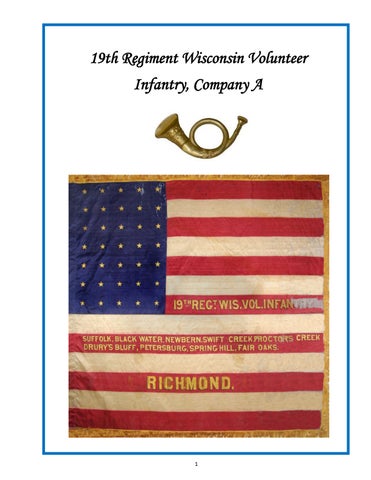
19th Regiment Wisconsin Volunteer Infantry, Company A
1
19th Regiment Infantry Wisconsin Volunteer, Company A Soldier’s Stories Researched and compiled from various sources by William C. Schuette 2020—2023
The thumbnail tintype soldier’s photos in this publication are curtesy of the Reedsburg Public Library unless otherwise indicated.
© William C. Schuette
2
Soldier’s Index Apker, James Reed 42 Bingman, Isaac N. 47 Castle, James C. 54 Castle, Julius 60 Chandler, Charles A. 65 Cheek, Robert 71 Clark, Charles O. 80 Clark, Samuel D. 87 Cohoon, Lewis H. 92 Cooper, George S. 100 Curtis, James E. 103 Danforth, Clarence A. 106 Day, Charles E. 113 Dwinnell, Eugene A. 118 Dwinnell, Osgood H. 126 Ellinwood, A. Preston 140 Emser, Peter 147 Evers, Christopher 154 Faller, John 159 Fosdick, James E. 166 Fosnot, John H. Jr 170 Fosnot, Joseph C. 176 Fowler, Henry Dodge 181 Gardner, Cyrus 186 Gardner, Nelson S. 189 Godfrey, Albert 198 Garrigan, Patrick 202 Grote, Henry 208 Hafer, Michael 214 Hanes, Ephraim M. 218 Herbel, Jacob 223 Hobby, William D. 227 Hollingshead, John 234 Holton, Thomas J. 241 Horsch, William 247 Howard, Sidney A. 251 Kennedy, Benjamin 255 Kennedy, Chauncey 258 Kennedy, Clark H. 263 Lee, Byron B. 267
Leonard, Edward L. 271 Mallow, William 280 Mallow, Jesse M. 283 Mallow, John 289 Markee, James 292 Mead, George 297 Millard, Eleazer 303 Miller, William E. 310 Paddock, George J. 315 Palmer, Edgar L. 322 Palmer, Ferris B. 329 Peitzsch, Walter O. 333 Pettis, Amos 341 Pettis, Frank 347 Pitts, Benjamin S. 359 Pitts, Newman W. 364 Rathbun, Alva 370 Reynolds, William T. 375 Robinson, Henry E. 381 Sanborn, Daniel, Jr. 386 Searls, Sylvester 390 Sheldon, Charles F. 395 Sheldon, Dwelton M. 401 Steese, William 406 Stocks, John H. 410 Strong, Rollin M. 417 Stull, James Huston 425 Swetland, Artemus G. 430 Swetland, Seth 434 Swetland, William F. 438 Swetland, William T. 442 Tator, Henry A. 445 Thorn, John R. 451 Thorn, Richard 457 Tuttle, Albert Clark 462 Warner, Robert T. 469 Werron, John W. 475 Winchester, Franklin 479 Winnie, Menzo 484
3
THE NAME The term “civil war” comes from the Latin phrase bellum civile, which translates to “war of or pertaining to civilians,” and was first used to describe the Roman civil wars of the 1st century BCE. Northerners have also called the Civil War the “war to preserve the Union,” the “war of the rebellion” (war of the Southern rebellion), and the “war to make men free.” Southerners may refer to it as the “war between the States” or the “war of Northern aggression.” CONSCRIPTION When the American Civil War began, neither the Union nor the Confederacy relied on conscription to fill the ranks. A draft was not necessary at the onset because men in both the North and the South initially volunteered in large numbers for the war they believed would be over by summer. As the war dragged on through 1861 and into 1862, however, men proved less willing to enlist in the increasingly violent and protracted conflict. For this reason, both the United States and Confederate States enacted conscription in 1862. The Union was experiencing similar manpower issues. On July 17, 1862, the militia acts of the late eighteenth century were reinstituted. These laws required all able-bodied men between the ages of eighteen and forty-five to serve in the local units of their state militias. In the decades prior to the Civil War, these laws were rarely enforced; state militias, such as they were, served more as social clubs than military units, with parading and picnicking more common than artillery and musketry drill. In the first year of the war, the militia system was the template to organize volunteer recruits into local regiments. Now, states would be legally required to fill quotas apportioned by the War Department. These troops were to serve for up to nine months. Like the Confederate conscription act, the Union’s state militia draft of 1862 achieved only moderate results. A more permanent procedure would be needed to provide necessary troops. To this end, President Lincoln signed the Enrollment Act on March 3, 1863, which called for a Federal draft that summer. Federal conscription was wildly unpopular and led to violence in many locales, most famously in New York City, where eleven African Americans were killed by angry mobs in July 1863. Immigrants and the poor were especially resentful of the methods used by wealthier citizens to avoid service. From Wikipedia CIVIL WAR VETERANS Over the course of the Civil War, from 2.1 to over 2.4 million men served in the United States Armed Forces. In addition, from 850,000 to over 1,000,000 men served for some period of time in the Confederate Army and Navy. Significantly, of the men who served in the United States Army, over 180,000 were African Americans; another 24,000 blacks served in the United States Navy. More than 86,000 white men from Confederate states served in the United States Army. About 620,000 servicemen died in combat or from wounds or disease, but hundreds of thousands of soldiers returned to their civilian lives transformed by their memories of battle, the enemy, and military life.
4
5
Posters similar to these, would have been seen throughout the North. The need for able-bodied men 18 through 45 to help put down the rebellion, was paramount.
6
The Call to Arms The Civil War, The War of the Rebellion, or the War Between the States, began in 1861, and was ostensibly, a fight to free the slaves of southern plantation owners. It divided the union, as well as families, and caused the death of more than 620,000 Americans.
The Call to Arms was raised by Abraham Lincoln, and northern states responded with the enlistment of young men, and old. Men on horseback rode through Reedsburg shouting, “The War has begun. Troops have attacked Ft. Sumter.” That fateful date was April 12, 1861. At once in the livery stables, barber shops, and across line fences, farmers and shop keepers could talk of nothing else. None of them — Irish, German, English, Canadian, Scotch — had ever known slavery in their upbringings. The idea that “Slavery is wrong,” had been taught them by their parents. “People should not be owned and worked like oxen and horses.” All that summer while farmers were shocking oats, cutting hay, and weeding potatoes, the talk continued. Townspeople gathered on street corners discussing the war. “Let's get into this war and free those slaves. It won't take long, maybe a couple of months.” An article in the 1880 History of Sauk County noted, “The responses to the call were immediate and of the most encouraging character…..No state in the Union was more prompt in sending forward volunteers than was Wisconsin, and no part of Wisconsin responded with greater vigor than did Sauk County.” Recruiting stations were set up in all the major cities in the county, and men were sent from town to town, looking for volunteers. Again, the 1880 History of Sauk County recounts their travel to Reedsburg: “Arriving at Reedsburg, the Sauk County Rifleman (for such was the name by which these first recruits were known) stopped at the Alba House, where a grand reception awaited them.” Speeches were made by prominent citizens, and ten recruits were enrolled. “The boys returned to their homes to await the call of the Governor, to whom their services had previously been offered.” That call soon arrived, and the men were ready. These first recruits came primarily from the towns of Reedsburg, Baraboo, Winfield, Woodland and Westfield, and became part of the Nineteenth Regiment, as Company A. Co. A was organized in Reedsburg in the fall of 1861, with R.M. Strong as captain, Henry A. Tator and Alexander P. Ellenwood as first and second lieutenants, respectively. The company was assigned to the 19th Regiment, then organizing at Racine, and spent the winter there. The men suffered a great deal from the cold, the barracks being far from comfortable. In April, 1862, the regiment went to Camp Randall, Madison, and guarded confederate prisoners until June. Then it was ordered to Virginia, where large forces were gathering for the mighty struggle for Richmond. It is doubtful whether any man in the regiment dreamed at this time that its flag would be the first union flag to float over Richmond, and that that would not occur until almost two years later. The regiment soon reached Norfolk, Virginia, in which city and vicinity it was destined to remain until April, 1863, doing picket guard and provost* duty. This duty was performed in a manner that won the praise of the commanding officers, although it was little to the liking of the men. The 19th did more provost duty than any other Wisconsin regiment during the war. *Military police. 7
An advance outpost or guard for a large force was called a picket. It was a scattered line of soldiers well in advance of the main army’s encampment, but within support distance. It was considered to be one of the most hazardous duties that an infantry could be assigned, as they were the first to be attacked by the enemy, and more likely to be killed, wounded or captured. The following extract from “Wisconsin In The War,” tells something of the service the regiment was called upon to perform and is interesting, as well in conveying an idea as to what service in the army sometimes called for: On the 14th of April, 1863, the Nineteenth received orders to march without tents to Suffolk to reinforce that place, as an attack was expected from Longstreet’s corps. They marched at ten o’clock in the evening, reached Suffolk at midnight, went two miles farther, through a heavy rain and intense darkness, to the camp of the 21st Connecticut, where about half of the men obtained shelter among the friendly soldiers of that regiment, and the other half suffered exposure to the cold and drenching rain until morning. They had six hundred men for duty. At five in the evening they were ordered to Jericho Creek, where they pitched their tents, which had now been brought forward. At midnight they were ordered under arms, and four companies were directed to march. It was very dark, the roads were bad, and it rained in torrents. The party proceeded seven miles, floundering through the mud as best they could, wading swollen creeks, where one man came near drowning, and immediately entered on picket duty when they reached their destination. One night they spent in the rifle pits on the Nansemood River. Another night one hundred and sixty men, in nine hours, built a corduroy road three hundred yards over a deep marsh, and a rough bridge over a creek ten yards in width, carrying the timber and rails for them on their shoulders from half to three-fourths of a mile. At one time half their number, while exposed to a cold rain, had neither rest nor refreshment for thirty-six hours. One night they pitched tents in obedience to orders, and in an hour, by order, struck tents and prepared to march; then, in obedience to new orders, pitched tents again—two companies being posted as pickets—and at ten o’clock the same night set out on a six miles’ march through deep mud; that accomplished, rested two hours, chiefly in the mud, and then at three o’clock in the morning went into line of battle. That done, they stacked arms, and at daylight engaged in building an earthwork, named “Fort Wisconsin,” here they labored until noon of the next day. Soon after one hundred and fifty men were reported sick; surgeons had resigned; no field officer was with the regiment except Col. Sanders; three line officers were detached from service and four others were sick. Soon after this the regiment was sent to Newbern, N.C., and there engaged in outpost duty and participated in a number of minor but sharp fights.
8
In 1864, the regiment returned to Virginia and engaged in the bloody conflicts before Petersburg and Richmond. At the battle of Fair Oaks, near Richmond, October 27, 1864, a portion of the regiment went into the fight with eight officers and 190 men, and but 44 escaped death, injury or capture. The flag of the 19th was the first to float over Richmond, when the city fell. Early in the morning of April 3rd, the regiment started hurriedly for Richmond. The men did not know the meaning of the movement. It was simply a question of marching as fast as their legs could carry them. They passed deserted rebel entrenchments and literally ran four or five miles into the city. The flag was run up over the city hall and the regiment was soon hard at work restoring order in the panic stricken and burning city. Co. A bore an honorable part in the services rendered by the regiment. Captain Strong became colonel of the regiment and H.A. Tator became captain. Failing health compelled him to resign and he was succeeded by A.P. Ellenwood, the Reedsburg schoolmaster who took a number of his pupils to war.
Ruins in front of the Confederate capital in Richmond, VA, in 1865. This is a scene which the 19th Wisconsin Regiment might have seen when they entered the city on April 23, 1864, to raise their flag over city hall—the first regiment to do so.* *Other regiments claim to have been the first to place their stars and stripes atop the Richmond capital. Another source says that two Richmond citizens were the first to do so. At one of the reunions of the Wisconsin 19th, Company A, it was mentioned that Co. A was, indeed, the first to place its flag on the pole above the capital building. This statement was made by one or more of the actual soldiers who had been there, so it lends some credence to their claim. There were two flag poles on the building, but the real truth may never be known.
9
Regimental History of the Wisconsin 19th Infantry Nineteenth Infantry. — Cols., Horace T. Sanders, Samuel K. Vaughn; Lieut. -Co1s., Charles ‘Whipple, Rollin M. Strong, Majors, Alvin E. Bovay, Amos O. Rawley. This regiment was organized in the winter of 1861-62, at Camp Utley, Racine, and was ordered to Camp Randall on April 20 to guard Confederate prisoners sent from Fort Donelson. It was mustered in April 30, 1862, left the state June 2, and was on garrison duty at Norfolk, Va., until April 14, 1863. It was then on picket and guard duty at various points for about two weeks, when it was assigned to duty at West Point and Yorktown until the middle of August, and at Newport News until Oct. 8. It was then divided by companies for outpost and picket duty at points near New Berne, N. C, and was in several small engagements with the enemy. It was ordered to Yorktown, April 28, 1864, and on May 12 the right wing, acting as a skirmish line, covered the 3d brigade. It accompanied the general advance upon Fort Darling, carried the first line of the enemy's works, and occupied the road in the rear of Fort Jackson, where the next day the regiment was united. It was compelled to fall back by the furious assault of a heavy force, but it did so in good order. It took part in the operations about Petersburg, doing siege and picket duty in the trenches. In August the veterans were sent home on furlough but returned in October, and participated in the engagement at Fair Oaks, a force of less than 200 men being engaged and suffering a loss of 136 wounded and captured. They were joined by the non-veterans and the regiment was kept on picket duty in front of Richmond until April 3, 1865, when it entered the city and planted the regimental colors upon the city hall. It was on provost duty at Richmond, Fredericksburg and Warrenton until Aug. 4, and was mustered out at Richmond Aug. 9, 1865. Its original strength was 973. Gain by recruits, 187; substitutes, 54; veteran reenlistments, 270; total, 1,484. Loss by death, 136; desertion, 46; transfer, 152; discharge, 345; mustered out, 805. From “The Union Army”, by Federal Publishing Company, 1908, Volume 4.
An envelope which was available for soldiers to use for their letters home. 10
Reedsburg and the Upper Baraboo Valley by Merton Krug 1929 HISTORY OF COMPANY A, 19TH REGIMENT, W. V. I. Rollin M. Strong having received a commission from Governor Randall, resigned the office of sheriff which he then held, returned to Reedsburg, and commenced enlisting a company called the “Independent Rangers”. They proposed to unite with the Independent Regiment which the War department had authorized Colonel Horace T. Sanders of Racine to raise, and get in if possible as Company A. The independent nature of the movement, together with the personal popularity of the recruiting officer, soon filled the company to maximum. Rollin M. Strong was elected captain, Henry A. Tator first lieutenant, and Alex. P. Ellinwood, second lieutenant. They remained in this village for preparation and drill until Sunday, January 26, 1862, when they were ordered into camp in Racine, by Way of Kilbourn, to which place they were conveyed in sleighs by our citizens. The regiment entered Camp Utley, Racine, January 27. Company A was mustered into service February 22. By an order from the War department the day previous, abolishing all independent regiments, Colonel Sanders’ organization was entered as the 19th regiment of Wisconsin Infantry. While at Racine the company was quartered near the shore of Lake Michigan, and suffered considerably from the chilling winds off that body of water. On the 20th of April the regiment was ordered to Camp Randall, Madison, to guard a thousand prisoners who had recently been captured at Fort Donaldson. Camp Randall, being the ground of the State Agricultural Society, was surrounded by a high and solid board fence enclosing some twenty acres. The barracks were near the fence, while the quarters of the 19th regiment were in the central portion of the grounds. A guard was constantly on duty on the outside of the camp, as also on the inside, between the prisoners and the quarters of our troops. No intercourse [i.e. contact] was allowed between them and the soldiers except in the line of duty. 11
AT NORFOLK About the first of July, 1862, they were ordered to report to General Viele at Norfolk, where, and in the vicinity of which, they remained, in the performance of garrison and outpost duty, until April 14, 1863. This regiment performed more of this species of service, it is said, than any other of our state troops. Although the men sometimes complained that they were kept so long from more active service in the field, yet they performed their duties with fidelity. Norfolk was a city of about 15,000 inhabitants, with the suburban town of Portsmouth with a population of 10,000, and nearly all were in deep sympathy with the rebellion. The regimental guard, which had preceded the 19th in those cities, was understood to have a good supply of “rosewater treatment” in dealing with the spirit of Rebellion among the people, and in which the commandant of the post, General Vielie, seemed to have more or less sympathy. The spirit of contempt and hatred towards the Yankee soldiers was especially manifested on the part of the women—the men not daring to give expression of their feeling. The women manifested their hostility more by acts and sneers and grimaces, than by words. An incident related by Sergeant C. A. Chandler illustrated their manners. Having business through the city one day, he saw in advance of him, upon the sidewalk, three young women conversing. As he approached they spread themselves across the entire walk, evidently intending to crowd him off the curbstone into the street; but he marched directly along, upon the outer portion of the walk, brushing quite hard their clothing and jostling the person of the most impudent of the trio, whereupon she snarled out some expression of contempt for the Yankee soldiers. The sergeant stopped, and, turning to the young women, he told them that the soldiers had rights in that city as well as they—that it was useless to crowd them into the gutter, and it would be much better to succumb to their fate than to resist; to which they made no reply and he passed on his way. The soldiers would sometimes hang out the United States flag over the sidewalk in front of their quarters if for no other purpose than to see the women leave the walk and take to the street or pass to the other side, as they approached it. At one time, upon one of the large thoroughfares, some of their number hung a flag over the walk on each side of the street, so that to pass under it or take to the street and mingle with passing vehicles was the only alternative. This treatment on the part of the troops restrained these acts of hostility and contempt towards them, and their rights were soon outwardly respected. Company A, with the regiment, continued efficient service in Norfolk, in guard and picket duty—a favorite with the law and order portion of the citizens. They were commended by The Union, a newspaper published in the city, for “their exemplary conduct and quiet bearing”. By their gentlemanly and quiet deportment, they commended the respect, and by their vigilance in the discharge of duty they excited the wholesome fear of those who hated them. New Year’s Day of 1863 the slaves became free under the Emancipation Proclamation of President Lincoln. It was a great day in Norfolk. The negroes had a big procession in commemoration of the event. A serious outbreak was feared by the excited populace. Extra guards were posted for preserving order and quelling the first symptoms of an outbreak; but none occurred. During the day the regiment called upon General Vielie, at his quarters, under whose command they had served eight months. He made an appropriate addressed and commended them in these words: “Trusted with important duties and responsibilities, you have not in any instance failed to fulfill them. Stationed among those who felt little kindness toward you, you have daily exhibited a noble forbearance. ‘When no courtesy was shown you, you have not failed magnanimously to show pity towards the many misguided people whom the enemy have left here unprotected, who have made petty efforts to annoy you.”
12
General Dix, the commandant of that department, had previously in a letter addressed to Governor Salomon of our state, made honorable mention of the regiment, and commended their conduct as creditable to themselves and honorable to the commonwealth from which they came. SIEGE of SUFFOLK
Upon the banks of the Nansamond, about thirty miles from Norfolk, is the little village of Suffolk. As the junction of the two railways, it was an important strategical point and was held by General Peck with a force of 14,000 men. By the capture of the rebel mail he learned of an intended surprise upon his forces by Longstreet, one of the most able and daring of the rebel commanders. “Longstreet, Hill, and Hood came rushing upon our lines,” says Abbott’s History, “with five divisions of the rebel army, expecting to sweep all resistance before them. They were met with solid shot, bursting shells and bristling steel. They had not cherished a doubt of their bravery to cross the narrow Nansamond, seize the railroad in the rear at Suffolk, capture the city in its garrison with all its vast stores and then, after a holiday march, to occupy Portsmouth and Norfolk.” General Peck was on the alert, obtained a few wooden gunboats from Admiral Lee, threw up defenses and sent to Norfolk for guns and troops. On the 14th of April, 1863, the Nineteenth received orders to move to Suffolk to re-enforce the place—started by train at ten o’clock P. M.—reached the place at three o’clock A. M.— disembarked—went two miles further in a drenching rain and Egyptian darkness, to the camp of the 21st Connecticut, a large detail of whose men were out on picket duty, where most of our men obtained shelter, in the tents of the friendly soldiers, and the others were exposed to the severity of the storm until morning. They now had six hundred men on duty. At five in the evening an order was received to march to Jericho Creek where they pitched their tents, which had now been brought forward. One night they spent in rifle pits on the Nansamond—boys had their first sight of rebels in arms— anxious to get a shot at them. Saturday night, April 21 a large detail was made from Company A under Sergeant C. A. Chandler and one hundred and sixty from the regiment under Lieutenant Ellinwood and another officer, to build a corduroy road three hundred yards over marsh, and a rough bridge over a creek thirty feet in width for the transportation of cannon, to a piece of rising ground in the marsh. [A corduroy road or log road is a type of road or timber trackway made by placing logs, perpendicular to the direction of the road over a low or swampy area. See below.] This was affected that night and the one following. The soldiers carried much of the timber for the road from half to three-fourths of a mile.
13
On Friday night previous Company A with five others had marched down the river and gone into rifle pits [A short trench or excavation with a parapet of earth in front to shelter one or more riflemen] under command of Major Bovay, opposite the rebel battery at Hill’s Point, on the Nansamond. The battery consisted of five splendid brass, guns, four of them twelve-pound howitzers, and one twenty-five pounder. [The pondage refers to the weight of the cannon ball.] General Peck proposed to take this battery and sent to Major Bovay for his men to join with other troops in the enterprise. Major Bovay pleaded that they were unfit for a dangerous expedition, having always been on guard and picket duty and never under fire, and thus obtained a countermanding order. When his men heard of this, they were fired with indignation at their commander and called him a granny unfit for his position. They were anxious for active work, and were just ready for such a daring feat. Other troops—two hundred in all—were detailed for the enterprise, under command of Colonel John E. Ward of the 8th Connecticut, who crossed over on a gunboat, landed unexpectedly, rushed up the river bank and along a ravine, charged upon the rear of the fort and captured men and guns without firing a shot. This spirited little affair has an honorable place in the history of the war and throws a sublime military glory around the actors in it. The men of the Nineteenth felt deeply chagrined, not only because they were not permitted to share in the hazard and the honor of the enterprise, but also because the conduct of Major Bovay gave countenance to a false charge preferred against them of shirking duty and grumbling, which resulted in the publication of an order of the general commanding soon after, relieving them from duty on the line of the river defenses and ordering them to camp at Suffolk-—an order no doubt given in a moment of petulance arising from the incorrect statement of one of his staff officers who fell out with Major Bovay. Major Alvan Bovay, who From April 25th to April 30th [1863] Company A, with Captain Strong, later in life founded the were on picket duty in rifle pits on the Nansamond——the first thirty-six hours in the rain without tents and without rest except what they could get Republican Party. lying on the ground in their wet chilled condition. Here they built and manned Fort Wisconsin. There was a rebel battery on the west side of the river, about three-fourths of a mile from them, between which and the river stretched a wide strip of marsh covered with a growth of tall grass, through which the rebel sharp-shooters could crawl, concealed, to the river bank and fire upon our men. Various unavailing efforts were made to shoot over combustible material and ignite the grass, when Nelson Gardner and Ephraim Haines of this town volunteered to swim the river, which was twenty-five rods wide, and set fire to the grass. Their offer was accepted by Captain Strong, and, concealing matches in their hair and wearing their hats, they leaped over the ramparts, plunged into the river, swam over unobserved by the enemy, set fire to the grass, rested a short time under the bank, and swam back in safety, although subject all the way to a shower of balls from the enemy’s battery, and an enfilading fire from the guns in the rifle pits down the river. This dangerous feat was honorably mentioned in the history of the war, although the name of but one of the boys is given. [See their story on the next page.]
Seventeen-year-old Reedsburg soldiers Nelson Gardner, left, and Ephraim Haines helped save their unit during the Civil War.
14
Reedsburg Teens Civil War Heroes The Civil War, which began in 1861, still had another year to go in the summer of 1864. The Union army was nearing Petersburg, Virginia, which began a year-long siege of the southern city. It was trying to keep supplies from reaching the nearby Confederate capital of Richmond, the capture of which would put an end to the conflagration which had wracked the nation for almost five years. Thousands of Wisconsin soldiers were involved in the effort to surround the city and bring the South to its knees. Wisconsin’s 19th Regiment, Company A, was one of those units which was called upon to help route the Rebels. Company A of the 19th was made up primarily of men and boys from and around Sauk County, who had heeded the call in February of 1862, and joined up to help save the Union. In June of 1864, General Grant tasked Company A with the job of tearing up the Petersburg railroad tracks which carried food and equipment to General Robert E. Lee’s Army of Northern Virginia, in preparation for the siege of Petersburg. This railroad, called “Lee’s Lifeline,” carried supplies, and sometimes Union prisoners, south, so it was vital to the Confederate Army in its ability to sustain its war efforts. The troops of Company A had been transported up the Blackwater River on three gunboats and were waiting to return to their headquarters after having completed the job of crippling the Rebel rail lines. On June 15, 1864, they were camped on a point of the river to await the return of the gunboats for their trip back to their camp. Unfortunately, Confederate General Longstreet and his troops had “taken up position on one side of river and had stationed sharpshooters on a point projecting into the river to pick off pilots of the gunboats if they tried to stream down the river.” The point was covered with tall marsh grass which protected the sharpshooters, and the boats were stranded upstream. The colonel of Company A called for two volunteers to swim across the river and set the marsh on fire to “route the Rebs from their position.” Two teenage boys, both from Reedsburg, stepped forward and volunteered to do the job. They were Nelson Gardner and Ephraim Haines, both 17 years old. Their heroic story was recounted later, during a reunion of Wisconsin’s 19th Regiment, Company A. “They tied matches wrapped in oilcloth in their hair, and under the cover of heavy fire dove into the river. By swimming under water most of the way they reached the other side safely and set fire to the marsh. “Although hundreds of shots were fired at them, they escaped unharmed and returned to their own lines.” The Rebels realized they had been defeated and retreated from their position along the river, which allowed the gunboats to safely steam down the river and retrieve the troops of Company A. The boy’s stories do not end there. Tragically, Haines was picked off three weeks later, on July 5, 1864, while standing in a Union trench, and Gardner was captured during the Battle of Fair Oaks— during which several of Company A’s soldiers were either killed or captured—in October, 1864. Gardner was later exchanged for a Confederate soldier, and survived the war. He was awarded a medal for his bravery.
15
Soon after, Company A, with a brigade of other troops, were for about two weeks on a reconnaissance toward the Black-Water. Their rations failing, they were obliged to forage on the country. They found a crib of corn concealed in a swamp and carried it to a rebel mill. The miller refused to grind and they gave him the alternative of surrendering his mill to their use or being returned to headquarters as a prisoner. He chose the former. There were two millers in Company A, William Sweatland and William D. Hobby, and they ground the corn. They confiscated pigs from the woods and lived in southern fashion, on “hog and hominy” for several days. From May 23 to June 17 [1863] the regiment was at Norfolk performing ordinary fatigue duty and drilling. June 18th it was at Norfolk and encamped outside the old fortifications, until the 25th, when it was ordered to Test Point, where it remained until July 8th, when it received orders to return to Yorktown. AT YORKTOWN Yorktown is on the York river, fifteen miles above Fortress Monroe. The stream is about a mile in width, and the harbor will float the largest ships of war. It was strongly fortified during the revolution. It was here that Lord Cornwallis surrendered an army of 7,000 men, with their munitions of war, to General Washington in October, 1781, which “secured from Great Britain an acknowledgment of our independence as a nation.” The old fort contained an area of about twenty acres. In the early part of the war of the rebellion the confederates built a new fort, inclosing the old one and containing some forty acres. With these and some other works, they frightened McClellan, when on his famous pick-and-spade expedition up to the peninsula in 1862, to spending a month in retrenching before he dared move upon their works. Just as he got ready to go the enemy vanished, much to his disappointment and chagrin. This village of some half-dozen houses is within the fort. Two of them built of brick, bore the marks of solid shot thrown into their walls during the bombardment by our army previous to Cornwallis’ surrender. The 19th, which occupied the fort in conjunction with several other regiments, were stationed in the northwest portion of the grounds, which had been used by the rebels as a kind of Ghehenna—or a place for the burial of horses and mules. The regiment was supplied with Sibley tents. For the purpose of getting a better circulation of air, stakes were driven into the earth and the tents pitched upon the top of them.
A Sibley Tent Exterior and Interior
16
There was a fine spring outside the fort but permission could not be obtained from General Wistar to bring water from it. Sickness began to prevail. Rations were given away to the colored people. One old man, formerly a slave, who said he lived there in the days of the Revolution and remembered those scenes, received a hundred loaves at one time. The ranks were thin and Hampton Hospital filled. During four weeks in which the encamped here, four hundred out of about seven hundred were sick with miasmatic fevers [probably malaria]. Col. Sanders made several requests to General Wistar, the commandant of the post, for the removal of his regiment to a healthier location; and, although there seemed to be no good reason why it should not be done as there was no enemy within sixteen miles, his applications were unheeded. Col. Sanders finally succeeded, through his skill as a lawyer, in obtaining an order from higher officials, for their removal to Newport News, from which place one hundred fifty men were at once ordered to Hampton Hospital. The few left outside of the hospital were all partial invalids, unfit for “severe duty.” From this recital we can see that in war the suffering is by no means confined to the battlefield, or to active service before the enemy, and that immense suffering may come to an army from the wanton disregard of the health and life of its troops by a single officer. On the 10th of October, 1863, the regiment left Newport News on transport, for Newbern, N. C.
This Civil War lithograph shows Fort Yorktown in late 1863, including such details as the Union gunboats patrolling the York River and the tent cities where the garrison lived. Used as a hospital, the Nelson House can be seen at center. (Courtesy of the Virginia Historical Society)
17
Soldering In North Carolina By Private Thomas Kirwan Massachusetts 17th Regiment, Company K Late summer of 1862…This excerpt contains a description of what the New Bern, Evan’s Mill encampment would have looked like when the Wisconsin 19th Regiment, Company A, unit was stationed there later in 1864. About a mile further on, after passing through a narrow belt of woods, we came out upon Evan’s plantation. On our right was a field of some eighty acres, about half of which was covered with a young growth of apple trees. On the left was a field of about twenty acres, at the further end of which was the plantation house, with its Negro huts, surrounded with the inevitable grove of elegant shade trees. Just opposite the front gate of the mansion, the road turned sharp to the right, and on looking ahead, we beheld a block-house, nearly completed, in the rear of which was the encampment, and our future abode. Upon reaching the block-house, the road took a turn to the left, down a short, steep hill, skirting the bank of a stream, which it crossed on a rude plank bridge, still turning toward the left.
Original photo of the New Bern, NC, Evan’s Mill encampment of Wisconsin’s 19th, Co. A in 1864. Colorized by John Klecker, New Bern, NC, 2018 After crossing the bridge, a grist mill lay on the right, and about 69 yards on the left, on the dam of a magnificent pond of water stood a large saw mill, which ran two sets of saws when in operation. It was then idle, the dam having broke away. The road, after crossing the flume of the grist mill led on to the Negro village--quite a collection of comfortable houses built on each side of the cross road, which led to Pollocksville. Just before coming on to the Pollocksville road, in a field to the right was a large cotton gin and press. At the intersection of these roads was our outpost in the day time, the guard being drawn in to the mills at night. On entering the front gate, I was struck with the size and beauty of an immense beech tree, whose wide extending branches covered a circle of over 190 feet in diameter and in, Yankee fashion, I immediately computed that if cut down it would make over five cords of firewood. It must have proved a cool and inviting shade for the planter and his family in the summer time. Approaching its huge trunk, I observed that the Yankee jackknife had been at work and covered it with the representative names of men from nearly every United States regiment that had ever been in the department. Besides the huge beech there were numerous other trees—elm, cedar, chaney—and the beautiful flowering althea. The house was an ordinary two story one, containing about 7 rooms, set on brick blocks about three feet from the ground, and serving as a cool place of resort for the pigs, fowl, and youthful, curly-headed Negroes, during the heat of the day. This, together with the plantation attached of some 10,000 acres, seven or eight hundred of which were cleared, together with the mills…
At the back of the mansion house were two Negro huts, where those who were domestics were lodged. The body of the Negroes were lodged as mentioned about a mile away. 18
Adjoining the Negro-huts attached to the mansion were the various outhouses and stables, behind which the land sloped to waters of the tortuous stream which emptied into the mill-pond further down. To my view Evan’s Mills at first appeared a lonely place; but a further acquaintance with it materially altered my opinion. Were it not that the restraints which discipline imposes upon the soldier, living in this place would be quite agreeable.
Original photo of the mansion house and headquarters at New Bern, NC, Evan’s Mill encampment of Wisconsin’s 19th, Co. A, in 1864. Colorized by John Klecker, New Bern, NC, 2018 The following description of the events at New Bern is taken from the “History of Reedsburg and the Upper Baraboo Valley” by Merton Edwin Krug, 1929. NEWBURN, N. C. At this place they landed on the eleventh. This is one of the finest towns in the state, containing about five thousand inhabitants and situated at the confluence of the Neuse and Trent rivers. The rebels considered it an important position and had strongly fortified it early in the war. It was wrested from their hands by the bravery of the Union troops under Generals Burnside and Commodore Goldsborough in February, 1862.
Upon the arrival of the regiment in Newburn, Company A was assigned to outpost and picket duty at Evans’ Mill on Brice Creek, eight miles south of the city. At that place was a saw and flourmill and a large plantation which had belonged to General Evans of the rebel army. 19
The officers were quartered in the Evans mansion, and the soldiers in barracks erected for the purpose. From west and south there was but one place of access, on account of intervening swamps, and that was across the milldam, and, this enabled the company to hold the position against superior numbers of the enemy.
At the time of the attack upon Newburn on the first of February, 1864, Company A was attacked by a brigade of cavalry and a battery of artillery. They sent to Newburn for reinforcements and received three companies of cavalry and a twelve pound howitzer with men to man it. With this assistance they held the rebels in check three days. Captain Tator who was in command of the outpost and who was an efficient officer, sent out cavalry scouts several times a day to watch the enemy and ascertain their position and what they were doing. At one time they found them building a bridge, evidently for the purpose of bringing over their artillery for an attack; but a severe shelling from the howitzer stopped the enterprise. It is probable that the manifest boldness and daring of the Union troops led the enemy to the conclusion that the force at the outpost was superior to what it was in fact. On the morning of February 3rd, Captain Tator received orders from General Palmer, commanding at Newburn, to fall back to the city, soon after which, the rebels, guided by a Sesesh planter named Wood residing in the neighborhood marched around the swamp on the south and coming in on the rear, took possession of the place. Company A was thus fortunately saved from being taken prisoner. Upon their evacuation of the place, they burned the barracks and other property which they could not take. The rebels destroyed other property, and undertook to burn the Evans mansion but the fire was extinguished before much damage was done. The confederates soon abandoned the position and Company A was reinstated. In rebuilding their barrack they tore down some buildings formerly used as slave cabins. In one of them was found an old rebel payroll, on which the name of Wood as a recruiting officer appeared, whereupon Lieutenant Ellinwood and a small detail of men went out to his plantation and brought him in as prisoner. He was sent to Newburn and thence delivered to the tender mercies of General Butler, commandant at Fortress Monroe, who ordered him into confinement at the ripraps.
This picture was taken from a side view of the house while Gustavus was garrisoned there, March - May 1863, about five months before the Wisconsin 19th arrived. 20
In the latter part of April, 1864, the regiment was ordered to Yorktown, where a week was spent in reorganizing the army. Company A was placed under the command of Captain Tator. H. A. Tator had entered as a lieutenant but he had previously been made a captain. So had First Lieutenant Ellinwood. Captain Strong had been advanced to lieutenant colonel and the Nineteenth regiment put under his command. They were then assigned to the third brigade under Colonel Sanders, first division under General Brooks, the eighteenth army corps, under General Baldy Smith, the army of the James, under General Butler. Accompanied by a few gunboats the whole army was taken by transports to City Point and Bermuda Hundred, where they landed May 16, taking the rebels completely by surprise. The whole movement was admirably planned and executed. From May 5th to the 9th the army lay at Bermuda Hundred, except a portion of the troops who were engaged in digging lines of entrenchment across the peninsula, from the James to Appomattox, a mile or so from their confluence. On the eleventh and twelfth, the nineteenth, with other troops, tore up and destroyed eight miles of the Richmond and Petersburg railroad, burning the ties and bending the rails.
On Friday, May 13, [1864] the Nineteenth assisted in taking a line of rebel works in front of Fort Jackson, and on the next day another line of works still nearer where George Fosnot was wounded. These entrenchments were in the neighborhood of Drury’s Bluff on the James. About four o’clock in the afternoon of Saturday the rebels got their range and two men of the regiment were killed by shells. On Sunday loud cheering was heard by the Nineteenth along the lines toward Richmond. Through rebel prisoners, afterwards taken, they learned that General Beauregard, with his troops from Charleston, had arrived, and that Robert E. Lee and Jefferson Davis were then reviewing their forces. On Monday morning, May16, there was a dense fog and the rebels were early on the advance. Companies A and E of the Nineteenth were nearer the rebel lines than the others. Colonel Strong, wishing to ascertain their position, had given orders for their retreat to a position of greater safety, and started on a reconnaissance. When but a short distance from his regiment he found himself captured by four stalwart Tennesseans. They were lost in fog and did not know the direction of their own troops from whom they were separated. Colonel Strong at once entered into familiar conversation with them and expressed a desire to be taken immediately within their lines, as he had been without rest for forty-eight hours and greatly needed sleep. Reposing confidence in him as their guide they were adroitly led in the 21
direction of his regiment, which were lying down. When near his own men, he asked to be released from the grasp of his captors sufficiently to take out his handkerchief. The instant he was free he bounded toward his regiment and gave a command: “Attention!” he cried in such a tone that they arose and leveled their rifles at the Tennesseans. “Don’t fire,” they cried out. Soon they were sent to the rear as prisoners expressing their satisfaction that they had fallen into the hands of the Union troops. During the day the rebels pressed upon our troops and drove them at all points. In the afternoon the Nineteenth was ordered to dislodge the enemy, who were concealed in timber. To do it they were obliged to march eighty rods across an open field, exposed all the way to a raking fire. For some reason they were not ordered to charge upon them as quick as usual. During the day the regiment lost thirty-two in killed and wounded. Company A lost B. S. Pitts, killed, and V. T. Reynolds, J. H. Stull, A. D. Tuttle, John Fosnot, John Thorn, II. C. Fregles, Charles Day, [died soon thereafter] wounded. It was noticed that nearly all who were at that time wounded died, even where they suffered but slight flesh wounds, which led to the “suspicion that the shots of the enemy were poisoned.’ The regiment was ordered to Point of Rocks on the south of the Appomattox and some ten miles from Bermuda Hundred. Benjamin Pitts Charles Day While there they were on a raid upon the Richmond and Pittsburg railroad, and tore up and destroyed some six or eight miles of the track. Some of the men were detailed to guard a baggage train sent to Grant’s armory at Cold Harbor. On the twentieth of June [1864] they were ordered into the trenches southeast of Petersburg. These trenches were the advanced line, next to the enemy. They were on duty forty-eight hours and off the same length of time. They were relieved at midnight and ordered on duty at the same hour, so that they had but one night of unbroken rest in four. While on duty they were exposed constantly to the shells of the enemy both night and day. During the day they suffered from sharpshooters. June 29th S. Searl was killed while reading the Baraboo Republic. A ball, glancing from the limb of a tree, pierced his head. July 5th W.W. Holton was wounded and Ephraim Haines also, the latter mortally by a sharpshooter. About the same time, and near the same spot, a ball from the same direction passed between the legs of Sergeant C. A. Chandler. July 13th Corporal A. H. Cahoon was wounded by a shell. August 16th C. A. Danforth was severely wounded by a sharpshooter while eating his supper, the ball passing in at the shoulder and out through the Sylvester Searl left cheek, shattering the lower jaw.
Robert Cheek
Ephraim Haines
August 7th R. Cheek was also killed by a sharpshooter. August 13th the veterans, two hundred fifty in number, left on a furlough of forty days. Soon after the non-veterans were ordered to Norfolk to engage in provost guard duty. Upon the return of the veterans from their furlough, about the first of October, they were ordered to report at Chapin’s farm, on the north of the James, before Richmond. On the evening of October 26th, the men of the Nineteenth, with Butler’s eighteenth corps, moved out from the line near Dutch Gap Canal, advanced northward, and the next day, in the afternoon, stormed the old Fair Oaks battlefield. They easily would have taken the defenses had not the enemy learned of their movement and sent reinforcements rapidly from Petersburg. The Nineteenth Regiment advanced with the other troops, to assault the rebel works. 22
Lieutenant Colonel Strong said of this: “The regiment emerged from the pine, and came out on a clear open field, about three hundred yards from the works. As we broke cover the rebels opened on us furiously with artillery, and cut us up badly. Upon seeing the rebel works the boys cheered lustily, and advanced rapidly, closing up the breaks in the ranks made by the artillery and preserving a splendid line. Thus, for about one hundred yards, where we were met by a perfect tornado of shot, shells, canister and minnieballs directly in our faces, mowing us down by scores. The regiment advanced, mere fragments of the line remaining, dead and wounded covered the ground passed over. The few brave boys pressed forward with the same old cheer, and closed upon the colors. The order “lie down” was given. Flesh and blood could go no further. Nothing could withstand the perfect blast of lead and iron that most murderous, devouring fire. We laid down, thin as possible, no power to move forward or backward, or to assist in the least, our wounded comrades. The same fearful, telling fire was passing over us. To raise a head was death; a hand, to be hit. It was raining now, fine rain-mist and the early dark of a rainy evening was slowly enveloping us, and our earnest prayer was, “night or Blucher”, when beyond our left a yell was heard and the hurried tramp of men, and we were surrounded and prisoners.”
Wisconsin’s 19th Regiment, Company A, fought in the Battle of Fair Oaks, where many men were killed or wounded. Harper's Magazine, on page 523 of the 16 August 1862 issue.
The regiment numbered eight officers and one hundred and ninety men who went into the fight. Fortyfour men only came back. Colonel Strong was wounded by a sharpshooter as he was making observations to see if there was any chance for his men to get to the rear after the order to lie down. His leg was amputated in Libby Prison. Company A went in with thirty-six men and came out with thirteen. Corporal A. Rathbun was wounded so near the edge of the field that he was brought off on a stretcher. [He died several days later.] Sergeant C. A. Dwinnell was wounded in the head, thigh, left arm and right hand, the latter severely, a minnieball passing through it, and yet he backed off the field, some sixty rods, drawing his knapsack, and escaped to a place of safety. Two balls in addition passed through his clothing. Sergeant C. A. Chandler escaped from the field entirely unharmed in this manner. When he received the order to lie down, he saw a furrow near, and dropped into it. The field had been sowed to wheat the summer previous and weeds grew up after the Alva Rathbun harvest. This furnished some protection. He raised his head several times to look over the field and saw men attempt to run to the rear, but uniformly they fell after a short distance. He discovered also that when he raised his head, he attracted a shower of balls, and found it necessary to lie low. 23
After a time, he began to back down the furrow, drawing his knapsack for some twenty rods, when the rising ground brought him in full view of the rebel works. He then got up and ran obliquely across the field, to a ditch some twenty rods distant, which he remembered to have passed over as they advanced to the charge. During all the time he was running there was a perfect storm of bullets whistling around him. He had no doubt that hundreds were fired at him alone, and yet not one touched his person, and but one his clothing. Once in the ditch he escaped without difficulty. Edward L. Leonard was in this battle but in a company of sharpshooters. They crept along a ditch to a position of about twelve rods from the rebel fort where they lay and picked off the gunners. Occasionally the rebels would pour an ineffectual charge of grape or canister at them. William Miller was mortally wounded in this battle. When the prisoners were being taken from the field he asked the rebel guard to permit one of them to remain and take care of him. He was answered that it could not be allowed, but that some of his own men would be along soon and take care of him, which was no doubt done as he died in Richmond a few days subsequently. Sergeant F. B. Palmer, whose family resided in Reedsburg during the war, was killed during the action, but none of his comrades saw him fall. He carried the guidon [flag] on the William Miller right of his regiment and next to the 148th New York regiment. A soldier of the latter told E. A. Dwinnell that he was shot through the head. Major Vaughn escaped from the battlefield just as the rebels were charging out to secure their prisoners and was in charge of the regiment at Chapin’s Farm during the winter. On the morning of April third, 1865, the Nineteenth with their brigade, was the first to enter Richmond, and their flag was the first to float over the captured capitol of the dead Confederacy. “Then the regiment Sgt. Ferris Palmer was ordered to advance upon the works before the city, the men expected to storm it, but found them evacuated. During the Civil War, the 19th Co. A Wisconsin suffered 2 officers and 41 enlisted men killed in action or who later died of their wounds, plus another 3 officers and 115 enlisted men who died of disease, for a total of 161 fatalities.
The 19th Regiment, Co. A of which was raised in this county, arrived at Madison yesterday, to be mustered out. A reception was given it jointly with the 33rd Regiment, which arrived there at the same time. The 19th, it will be remembered, claims the honor of being the first regiment that unfurled the flag of the Union in the rebel capital upon its evacuation by Lee. May, 1865
24
Several of the soldiers of the Wisconsin 19th Regiment, Company A, were captured or killed during the Battle of Fair Oaks. Below is a brief summery of that battle. *
The Battle of Seven Pines, also known as the Battle of Fair Oaks or Fair Oaks Station, took place on May 31 and June 1, 1862, in Henrico County, Virginia, as part of the Peninsula Campaign of the American Civil War. It was the culmination of an offensive up the Virginia Peninsula by Union Maj. Gen. George B. McClellan, in which the Army of the Potomac reached the outskirts of Richmond. On May 31, Confederate General Joseph E. Johnston attempted to overwhelm two Federal corps that appeared isolated south of the Chickahominy River. The Confederate assaults, although not well coordinated, succeeded in driving back the IV Corps and inflicting heavy casualties. Reinforcements arrived, and both sides fed more and more troops into the action. Supported by the III Corps and Maj. Gen. John Sedgwick's division of Maj. Gen. Edwin V. Sumner's II Corps (which crossed the rainswollen river on Grapevine Bridge), the Federal position was finally stabilized. Gen. Johnston was seriously wounded during the action, and command of the Confederate army devolved temporarily to Maj. Gen. G.W. Smith. On June 1, the Confederates renewed their assaults against the Federals, who had brought up more reinforcements, but made little headway. Both sides claimed victory. Although the battle was tactically inconclusive, it was the largest battle in the Eastern Theater up to that time (and second only to Shiloh in terms of casualties thus far, about 11,000 total). The Battle of Seven Pines–Fair Oaks resulted in heavy casualties for both sides: approximately 5,000 for the Union and 6,100 for the Confederates. Gen. Johnston's injury also had profound influence on the war: it led to the appointment of Robert E. Lee as Confederate commander. The more aggressive Lee initiated the Seven Days Battles, leading to a Union retreat in late June. Seven Pines therefore marked the closest Union forces came to Richmond in this offensive. From Wikipedia
This image shows the retreat of Franklin's corps at the Battle of Fair Oaks, 29 June 1862. From the original source description in Harper's Magazine, on page 523 of the 16 August 1862 issue.
25
The battlefield at Fair Oaks, VA
Freshly dug graves, in the foreground, are visible near a pair of old frame houses in Fair Oaks, Virginia. More than four hundred soldiers were buried here after the Battle of Seven Pines–Fair Oaks which took place from May 31 to June 1, 1862, during the Civil War. The battle was an attempt by forces under Confederate general Joseph E. Johnston to prevent the Union Army of the Potomac under George B. McClellan from reaching the outskirts of Richmond. As a result of poor coordination, communications failure, and a confused command structure, the battle ended in a stalemate, with heavy casualties for both sides—approximately 5,000 for the Union and 6,100 for the Confederates. During the fighting on May 31 Johnston was severely wounded, first by a musket ball in the shoulder and then by artillery shell fragments in the chest. Confederate president Jefferson Davis took the opportunity to place his military advisor, General Robert E. Lee, in command of the Confederate army, a position he would retain for the remainder of the war. Photo credit: Original Author: George N. Barnard Created: June 1862 Medium: Wet collodion glass-plate negative; one half of stereograph Courtesy of Library of Congress Prints & Photographs Division
26
The battlefield at Fair Oaks, VA
Twin houses on the battlefield, with a 32-pound field howitzer* in the foreground, at Seven Pines (Fair Oaks), Virginia, photograph by George N. Barnard, June 1862. Library of Congress, Washington, D.C. (LC-B8171-0471 DLC)
*Large field cannon are named by the size of the shot they are capable of firing. Here, the 32-pound field howitzer can fire cannon balls weighing up to 32 pounds.
27
After the battle of Fair Oaks, VA
The army of the Potomac-burying dead and burning horses at Fair Oaks Station, Virginia.Sketched by Mr. A. R. Waud. Source: Illustration from Harper's Weekly, July 19, 1862, page 453.
Battle field at Fair Oaks.—Bringing the wounded soldiers to the cars of the Richmond and York Railroad. From a sketch by our special artist. Source: Illustration from New York Illustrated News, June 28, 1862, page 116. 28
Baraboo Republic February 8, 1865 THE NINETEENTH.
This regiment, since the disastrous fight at Fair Oaks, has been gradually getting itself into shape again, and may now be regarded in excellent condition. Its present effective strength is about 400. Major Yaughn is winning an enviable review as an able and efficient commander, and is well supported by staff and line officers. The surgical department is in charge of Dr. Dodge, of Janesville, than whom there is not a more faithful and skillful surgeon in the army. Dr. Diefendorf, our major surgeon, is on duty at Chesapeake hospital. We are comfortably hutted for the winter, and are enjoying a good degree of quiet. Picket firing is entirely dispensed with along our lines, and only an occasional report of a gun is heard in the vicinity of Dutch Gap. The boys, or the non-veteran portion of them, are anxiously looking forward to the time— the- 19th of April next— when they shall doff the uniform of Uncle Sam and return to civil life. And may we not all anticipate a day not far distant, when our sacrifices and sorrows on the behalf of our torn and bleeding country shall be at an end— when peace shall have been restored to our stricken land— when our national sins shall have been purged away, and every inch of American soil shall have been consecrated to freedom. Then, all of disaster and suffering— all of loss and trial — all of mourning and sorrow — shall be submerged in the swelling tide of joy. C o n s t a n t i n e. Baraboo Republic March 29, 1865 Out of Prison— Corp. John Faller and T.J. Johnson of the 19th Regiment, who were captured last October, at the battle of Fair Oaks, returned to their homes in this place last week. They were first taken to the “Libby” in Richmond, where they were kept for eight days, and then transferred to the prison at Salisbury, N. C. We are sorry that John Faller is seriously ill, in consequence, doubtless, of the treatment received at the hands of the rebels.
Baraboo Republic Aug. 9, 1865 We were joined by another party from Baraboo, which included the gallant Lt. Col. Strong [below], of the 19th Regiment, who lost a leg at the battle of Fair Oaks in 1864.
29
This, and the next several pages, describe the battles in which the Wisconsin 19th, Company A, was involved
30
Several of the soldiers of the Wisconsin 19th Regiment, Company A, fought at or were captured during the Battle of Fort Darling at Drewry’s Bluff Drewry's Bluff - Key to the River Defenses
Drewry's Bluff, named for local landowner Captain Augustus H. Drewry, rose 90 feet above the water and commanded a sharp bend in the James River, making it a logical site for defensive fortifications. On March 17,1862, the men of Captain Drewry's Southside Artillery arrived at the bluff and began fortifying the area. They constructed earthworks, erected barracks, dug artillery emplacements, and mounted three large seacoast guns (one 10-inch Columbiad and two 8-inch Columbiads) in the fort. On May 9,1862, Norfolk fell to Union forces. The crew of the C.S.S. Virginia, forced to scuttle their vessel to prevent her capture, joined the Southside Artillery at Drewry's Bluff. Commander Ebeneezer Farrand supervised the defenses of the fort. He ordered numerous steamers, schooners, and sloops to be sunk as obstructions in the river beneath the bluff. Six more large guns occupied pits just upriver from the fort. Men worked around the clock to ensure a full state of readiness when the Union fleet arrived. The Federal squadron steamed around the bend in the river below Drewry's Bluff early on the morning of May 15. The force, under Commander John Rodgers, consisted of five ships. The ironclad Galena and gunboats Port Royal, Aroostook, and Naugatuck joined the famous Monitor to comprise Rodgers' force. At 7:15 a.m. the Galena opened fire on the fort, sending three giant projectiles toward the Confederate position. The five Union ships anchored in the river below the fort. When Confederate batteries in the fort replied, the whole vicinity shook with the concussion of the big guns. Southern infantry lined the banks of the river to harass the sailors. On the Monitor, the rifle balls of the sharpshooters "pattered upon the decks like rain." On the bluff the defenders encountered several problems . The 10-inch Columbiad recoiled so violently on its first shot that it broke its carriage and remained out of the fight until near the end. A casemate protecting one of the guns outside the fort collapsed, rendering that piece useless. After four long hours of exchanging fire, the "perfect tornado of shot and shell" ended. With his ammunition nearly depleted, Commander Rodgers gave the signal to discontinue the action at 11:30. His sailors suffered at least 14 dead and 13 wounded, while the Confederates admitted to 7 killed and 8 wounded. A visitor wrote that the Galena "looked like a slaughterhouse" after the battle. The massive fort on Drewry's Bluff had blunted the Union advance just seven miles short of the Confederate capital. Richmond remained safe. From the Web site of the Richmond National Battlefield Park
31
Several of the soldiers of the Wisconsin 19th Regiment, Company A, fought at or were captured during the Battle of Fort Darling.
View from within Fort Darling of the James River taken during the Civil War. Library of Congress photo.
Battle of Drewry's Bluff, from Harper's weekly 1862 32
The Battle of Drewry's Bluff/Fort Darling May 12-16, 1864 in Chesterfield County, Virginia Bermuda Hundred Campaign
The Union landing at Bermuda Hundred on May 5th seriously threatened both Richmond and Petersburg. Confederate authorities, facing the numerically superior Union Army of the James, rushed reinforcements to the crucial railroad center of Petersburg. The former Massachusetts politician, Maj. Gen. Benjamin F. Butler, commanding the Federals, lacked ability and initiative. for 5 days, Butler catiously lumbered across the peninsula between the James and the Appomattox rivers. Repulsed at Swift Creek on the 9th, Butler withdrew to a defensive position across the Bermuda Neck. Butler's retreat behind his newly constructed works enabled Gen. P.G.T. Beauregard to assume the offensive. With 18,000 troops, he hoped to lure Butler's 39,000-man army from behind their strong line. Beauregard sent 7 brigades under Maj. Gen. Robert F. Hoke to Drewry's Bluff, the Confederate works overlooking the James River, 5 miles below Richmond. Butler complied on the 12th, advancing northward toward Hoke. Leaving behind 2 infantry divisions and sending his cavalry on a raid against the railroads, Butler marched with 15,000 infantry of the XVIII and X Corps. Butler had decided to threaten the Confederate capital. By the morning of the 13th, the Federals had pushed the Confederates from their outer works into the main line at Drewry's Bluff. The shallowness of the river, however, prevented an attack by the Union moniters. The cautious Butler settled into a defensive posture on the 14th, with Maj. Gen. William F. Smith's XVIII Corps on the right and Maj. Gen. Quincy A. Gillmore's X Corps on the left. Butler formulated an attack for the 15th but cancelled it because he preferred to hold his troops for a strong defense.
Leaving only a garrison at Petersburg, Beauregard arrived at Drewry's Bluff on the 14th. Reinforced by troops from Richmond and North Carolina, he rapidly organized the 10 brigades at his disposal into 3 divisions and ordered an attack for the 16th. At 4:45 A.M. that morning, Maj. Gen. Robert Ransom's 4 brigades charged into Smith's right flank. Charles A. Heckman's brigade, capturing 400 Federals, 5 flags, and the brigade commander. Ransom halted; his organization was gone and his ammunition low. Hoke, delayed by the fog, soon attacked Gillmore's lines. The Federals stubbornly fell back, but again the fog disorganized the Confederate attackers. Gillmore counterattacked into a gap between the Confederate brigades, halting the Confederate advance. By 10:00 A.M., Beauregard's brigades had been spent and Butler began withdrawing. Maj. Gen. W.H.C. Whiting, with 2 Confederate brigades, had been ordered to attack Butler's rear. Whiting halted before one of the Union divisions left behind at Walthall's Station. Whiting's lack of aggressiveness and a heavy rainstorm allowed Butler to reach his works across the neck of the peninsula. On the morning of the 17th, the Confederates arrived opposite the Union works. Beauregard sealed the neck of Bermuda Hundred, effectively encasing Butler on the peninsula. The grave threat to Richmond and Petersburg had been temporarily eliminated. From Wikipedia
33
The Battle of Drewry's Bluff/Fort Darling May 12-16, 1864 in Chesterfield County, Virginia Bermuda Hundred Campaign
One of the 8 inch columbiad guns at Fort Darling
34
Baraboo Republic November 16, 1894
35
The Battle of Fair Oaks Described by the father of one of the combatants.
36
Tintype Photographs during the Civil War A tintype, also known as a melainotype or ferrotype, is a photograph made by creating a direct positive on a thin sheet of metal coated with a dark lacquer or enamel and used as the support for the photographic emulsion. Tintypes enjoyed their widest use during the 1860s and 1870s, but lesser use of the medium persisted into the early 20th century and it has been revived as a novelty and fine art form in the 21st. Tintype portraits were at first usually made in a formal photographic studio, like daguerreotypes and other early types of photographs, but later they were most commonly made by photographers working in booths or the open air at fairs and carnivals, as well as by itinerant sidewalk photographers. Because the lacquered iron support (there is no actual tin used) was resilient and did not need drying, a tintype could be developed and fixed and handed to the customer only a few minutes after the picture had been taken. The tintype photograph saw more uses and captured a wider variety of settings and subjects than any other photographic type. It was introduced while the daguerreotype was still popular, though its primary competition would have been the ambrotype. The tintype saw the Civil War come and go, documenting the individual soldier and horrific battle scenes. It captured scenes from the Wild West, as it was easy to produce by itinerant photographers working out of covered wagons. It began losing artistic and commercial ground to higher quality albumen prints on paper in the mid1860s, yet survived for well over another 40 years, living mostly as a carnival novelty. The tintype's immediate predecessor, the ambrotype, was done by the same process of using a sheet of glass as the support. The glass was either of a dark color or provided with a black backing so that, as with a tintype, the underexposed negative image in the emulsion appeared as a positive. Tintypes were sturdy and did not require mounting in a protective hard case like ambrotypes and daguerreotypes. From Wikipedia
Civil War photographer, his wagon and tent at Cold Harbor, Va., 1864. (Library of Congress)
37
Tintype Photographs during the Civil War Tintype photographs were one-of-a-kind. There were no negatives from which additional images could be made. When the photographer placed a chemically treated sheet of tin (actually, it was made of thin iron) into his camera, took the picture, and developed it, the image came out as a positive. If a soldier wanted an additional picture for his family or friends, the photographer would have to take additional photos. When a soldier’s image is projected through the single lens of a camera onto the film, it will be upside down, and flipped right to left. The recipient can simply turn the photo right side up, however the image will remain flipped right to left. It’s like seeing yourself in a mirror. You can notice that effect in the two images below. The lettering on the soldier’s cap is backwards. In order to rectify this situation with the Reedsburg Library images of these Civil War soldier’s photos, I have digitally flipped these images right to left so that they appear in the correct perspective. The images from the collection of Spenser Davis, have not been digitally flipped, and they appear as the soldier would have received them from the photographer.
This is the tintype as a Civil War soldier would have received it from the photographer.
This tintype image has been digitally flipped right to left for clarity.
38
A Real Thumbnail Photograph The term “Thumbnail photo” may well have derived its origin from these small Civil War photographs which were taken of combat soldiers. You will notice that the actual image of Reedsburg’s drummer boy, Frank Pettis, is about the size of Lincoln on the penny. The battlefield photographer provided these small images so that a soldier would have a remembrance to send home. Some of these photos were the last image of soldiers who would never return home. They were also convenient to carry as soldiers often moved from place to place.
Actual size
Enlarged for clarity
Many of the original thumbnail photos had cracks and blemishes on them, due to their age of 150 years. I have been able to digitally enhance a number of them. See above. However, some are in much worse condition, and my abilities were not sufficient to improve their appearance. 39
40
The images on the following pages were taken of the 19th Wisconsin Infantry, Company A soldiers, during the Civil War. Not all of the soldiers had their photos taken, or their images were lost during the past 150 years. Also available to the soldiers, were small albums with included the photos of their comrades-in-arms. Several of these photo albums have been preserved by area collectors. Other collections, such as the one at the Reedsburg Library, are now loose thumbnail photos.
This four-lens, wooden bellows tintype camera by which inexpensive photographs were made on coated iron metal plates. The thumbnail images were placed into individual cases for customers. Studio and traveling photographers used this type of camera for portrait photography in the 1860s during the Civil War era. Photographers were making tintypes in America from the mid-1850s through the early decades of the twentieth century. This camera could make up to four identical images in one portrait sitting. Negatives were not in use at the time which would eventually make it possible to produce more images of the same scene or individual. From the National Museum of American History
This 3 1/4 X 2 inch photo album would have contained the thumbnail photos which were taken by the photographer. This one belonged to Frank Pettis— drummer boy for the 19th.
41
Corporal James Reed Apker
Born September 14, 1839—Died July 5, 1915 Buried Pine Eden Cemetery, Juneau County, WI 42
Photo at right from Find A Grave, posted by Wayne Apker
Photo above from the collection of Spencer Davis.
43
44
45
James Apker Residence when enlisted: Wonewoc, WI Enlisted: February 22, 1862
Age at Enlistment: 23 Veteran, Corporal Mustered Out: May 15, 1865 Unit: Wisconsin 19th Brigade Company A From History of Sauk County 1880
46
Private Isaac N. Bingman
Born 1845—Died 1925 Buried Mount Vernon Cemetery, Vernon Co. Wisconsin 47
From the photo collection of Mabel (Bingman) Brohmer
48
Standing, center back: John Bingman. Front, L-R: Lora Isaac, Eva Mary (Renick), Mable Bingman.
49
Private Isaac N. Bingman Residence when enlisted: Reedsburg, WI Mount Vernon Cemetery
Enlisted: February 22, 1862
Vernon County, Wisconsin
Age at Enlistment: 17 Veteran Prisoner October 27, 1864, Fair Oaks Battle*
Find A Grave Posts by Susanna Parrish
Mustered Out: May 20, 1865 Unit: Wisconsin 19th Brigade Company A From History of Sauk County 1880
50
51
52
53
James C. Castle Born July 27, 1833—Died January 31, 1895
Buried Green Wood Cemetery Reedsburg, WI 54
James C. Castle James C. Castle
Residence when enlisted: Reedsburg, WI Enlisted: March 4, 1862 Age at Enlistment: 29 Veteran Mustered Out: August 9, 1865 Unit: Wisconsin 19th Brigade Company A From History of Sauk County 1880
55
56
57
58
James C. Castle
Photo posted on Find A Grave By Brian Lichte
59
Corporal Julius Castle Born November 18, 1843—Died February 22, 1926 Buried in Lake View Cemetery, Chetek, Wisconsin
60
61
62
Corporal Julius Castle Corporal Julius Castle
Residence when enlisted: Reedsburg, WI Enlisted: February 22, 1862 Age at Enlistment: 19 Veteran Mustered Out: August 9, 1865 Unit: Wisconsin 19th Brigade Company A From History of Sauk County 1880
63
Corporal Julius Castle
Photos from
Find A Grave By Lawrence W. Dawson 64
Sgt. Charles A. Chandler
65
Sgt. Charles A. Chandler
66
History of Sauk County 1880
67
History of Sauk County 1880
68
69
Charles A. Chandler Transferred Captain Company A, Independent battery, June 12, and mustered out August 9, 1865. From History of Sauk County 1880
70
Private Robert Cheek Born Unknown—Died August 7, 1864 Killed in action, by a sharpshooter, Petersburg, VA 71
Private Robert Cheek Residence when enlisted: Madison, WI Enlisted: February 22, 1862
Killed: August 7, 1864 at Petersburg, VA Unit: Wisconsin 19th Brigade Company A From History of Sauk County 1880
History of Sauk County 1880
72
Private Robert Cheek
History of Reedsburg and the Upper Baraboo Valley By Merton Edwin Krug 1929
73
Private Robert Cheek
Sunday July 27, 1862 Camp Randall Dear Father i take up my pen to write you a few lines you see i am in camp Randall i have inlisted in the 19th Regiment and i want you to sign the papers which you will find enclosed if you do i will send you twenty five Dollars to pay your Harvest hands with if you Sign it please send it back Directly if you don’t sign i shall go some where to share-farm it any more you will see what is wanted and you will sign all three of them you can get anybody to witness it you are a mind to you may send it back to Madison if i have started it will be forwarded to me to the Regiment i shall start i guess Wednesday you may Direct Robert Cheek Madison David Wis A kiss for Emma from Rob Cheek P.S. The 19th are at [furlough?] Norfolk VA. This is all the way i can help you i will send you ten dollars a month every month Rob
[Note: He did not use periods, nor capitalize the personal i.] Two years later he was killed in action by a sharpshooter in Petersburg, VA 74
History of Reedsburg and the Upper Baraboo Valley By Merton Edwin Krug 1929
Private Robert Cheek
75
Private Robert Cheek
Cheek, Robert, Private, Company A, 19th Wisconsin Infantry. Died August 7, 1864, at Petersburg, VA. Killed in rifle pit.
76
77
Robert Cheek is not buried here. He died in Petersburg, Virginia and is buried in Poplar Grove National Cemetery. This marker is a memorial stone. See next page.
78
Poplar Grove Cemetery, Dinwiddie County, Virginia, where Robert Cheek is buried. 79
Charles O. Clark Born 1848—Died November 20, 1891
80
81
Charles O. Clark Charles O. Clark Residence when enlisted: Cato, Wisconsin Enlisted: February 13, 1862 Age at Enlistment: 19 From Co. K Mustered Out: August 9, 1865 Unit: Wisconsin 19th Brigade Company A From History of Sauk County 1880
82
Source: Manitowoc Historical Society
83
84
85
Charles O. Clark
Old Clark Mills Cemetery, Cato, Wisconsin Photo posted by Bev Rockwell
Charles O. Clark is the son of Samuel D. Clark, who also served in the Wisconsin 19th, Co. A 86
Samuel D. Clark Born Vermont Died March 27, 1877
Buried Old Clark Mills Cemetery, Cato, WI 87
Samuel D. Clark Samuel D. Clark
Residence when enlisted: Cato, Wisconsin Enlisted: February 13, 1862 From Cato, WI Mustered Out: August 9, 1865 Unit: Wisconsin 19th Brigade Company A & K From History of Sauk County 1880
88
89
Samuel D. Clark
Photo left, Find A Grave by Joanne Morehouse Photo below, Find A Grave by Bev Rockwell Buried in Old Clark Mills Cemetery, Cato, WI
90
Samuel D. Clark
Photo from the Wisconsin Veteran’s Museum Madison, WI
91
Sergeant Lewis H. Cohoon 16 Aug. 1841 — 17 July 1913 Original photo colorized by John Klecker, New Bern, NC 2019
92
May not be him, below
From History of Reedsburg and the Upper Baraboo Valley
93
1st Sergeant Lewis H. Cohoon Residence when enlisted: Washington Township, Sauk Co. Enlisted: February 22, 1862
Age at Enlistment: 21 Wounded: July 13, 1864 First Lieutenant: June 21, 1865 Mustered out: August 9, 1865 Unit: Wisconsin 19th Brigade Company A From History of Sauk County 1880
Drummer Boy, Frank Pettis, seated on the lap of Lewis Cohoon at Evan’s Mill, New Bern, NC, in 1864
94
95
96
Sergeant Lewis H. Cohoon
97
98
Lewis H. Cohoon Rose Hill Cemetery Kissmmee, Osceola County, Florida
Find A Grave Photos submitted by Cecil Bingham
99
George S. Cooper Born 1837—Died February 18, 1905
100
George S. Cooper George S. Cooper
Residence when enlisted: Woodland Township, Sauk Co. Enlisted: February 22, 1862 Prisoner: October 27, 1864, at Fair Oaks Mustered out: July 31, 1865 Unit: Wisconsin 19th Brigade Company A From History of Sauk County 1880
Photo from the Spencer Davis Collection
101
George S. Cooper
102
James E. Curtis
103
James E. Curtis James Curtis
Residence when enlisted: LaValle, WI Enlisted: February 22, 1862 Veteran Mustered out: August 23, 1865 Unit: Wisconsin 19th Brigade Company A From History of Sauk County 1880
104
105
Private Clarence A. Danforth Ca. 1844 — 14 December 1927 106
Private Clarence A. Danforth From the collection of Spencer Davis
107
108
History of Reedsburg and the Upper Baraboo Valley By Merton Edwin Krug 1929
Private Clarence A. Danforth
Continued on next page 109
History of Reedsburg and the Upper Baraboo Valley By Merton Edwin Krug 1929
Private Clarence A. Danforth
110
Private Clarence A. Danforth Private Clarence A. Danforth
Residence when enlisted: Reedsburg, WI Enlisted: January 7, 1862 Age at Enlistment: 18 Wounded: Petersburg, Mustered out: April 29, 1865, Term Expired Unit: Wisconsin 19th Brigade Company A From History of Sauk County 1880
111
112
Private Charles E. Day
Died June 16, 1864 of war wounds 113
From History of Reedsburg and the Upper Baraboo Valley By Merton Edwin Krug 1929
Private Charles E. Day
114
Private Charles E. Day
Private Charles Day
Residence when enlisted: Reedsburg, WI Enlisted: February 22, 1862 Wounded: May 16, 1864, right leg amputated Died: June 16, 1864 of wounds, Hampton, VA Unit: Wisconsin 19th Brigade Company A From
History of Sauk County 1880
115
116
117
Cpl. Eugene Ashley Dwinnell Born: November 30 1842—Died: May 7, 1901
Buried: Oak Hill Cemetery, North Freedom, WI 118
History of Sauk County 1880
Cpl. Eugene Ashley Dwinnell
119
History of Sauk County 1880
Cpl. Eugene Ashley Dwinnell
120
Corporal Eugene A. Dwinnell Residence when enlisted: Reedsburg, WI Enlisted: February 22, 1862 Age at Enlistment: 20 Veteran Wounded: October 27, 1864 at Fair Oaks Discharged: February 13, 1865, Disability Unit: Wisconsin 19th Brigade Company A From History of Sauk County 1880
From Find A Grave, Posted by Spencer Davis 121
Cpl. Eugene Ashley Dwinnell
Oak Hill Cemetery, North Freedom, WI Photos from Find A Grave, posted by Oscar Sandstrum
122
Cpl. Eugene Ashley Dwinnell
2/10/1886 Baraboo Republic NORTH FREEDOM . The donation party at Hackett’s Hall, Tuesday, was a very pleasant gathering. The chicken pie and coffee were exceptionally good —receipts about $40. Mr. Eugene Dwinnell and wife were in attendance at the donation. After supper, when Mr. Dwinnell went to get his team, he found they were not where he had left them. He at once started in pursuit and found them at home, not in the barn, but banging on the gate post, they having turned in a little too quickly. The tie straps were hanging, the horses blanketed and no harm done.
1860 U. S. Census
123
124
125
Private Osgood H. Dwinnell Born: Dec. 1, 1840—Died: Oct. 17. 1906
126
From the collection of Spencer Davis Private Osgood H. Dwinnell Residence when enlisted: Reedsburg, WI Enlisted: February 22, 1862 Veteran Prisoner: October 27, October 27, 1864 at Fair Oaks Mustered Out: June 21, 1865
Unit: Wisconsin 19th Brigade Company A From History of Sauk County 1880 127
Private Osgood H. Dwinnell
Stationed at Evans Mill New Berne, North Carolina
128
Private Osgood H. Dwinnell
This ring was found by historian and metal detectorist, John Thorne in 1995, near New Berne, North Carolina. Private Osgood H. Dwinnell was stationed at Evan’s Mill in 1864 with the Wisconsin 19th Infantry, Company A, when he lost the ring. During the Civil War soldiers identification tags were optional, so soldiers sometimes had their own ID rings made to help identify them should they be killed on the field of battle. The inscription reads: O.H.D. 19 WIS CO A It belonged to Osgood H. Dwinnell
129
Private Osgood H. Dwinnell
130
Private Osgood H. Dwinnell
131
Private Osgood H. Dwinnell
132
Private Osgood H. Dwinnell
133
Private Osgood H. Dwinnell
134
135
Private Osgood H. Dwinnell
136
Private Osgood H. Dwinnell
137
Private Osgood H. Dwinnell Until 2020, Osgood’s grave was marked by the vertical stick in the center of the photo. See next page for update.
Brandon Municipal Cemetery Brandon, Manitoba, Canada
Photo by Jodi Bonnett
138
Photo by Sandy Jasper
In June, 2021, Osgood Dwinnell finally received a proper Civil War tombstone. The tombstone was provided free, by the U.S. Government, through the efforts of William C. Schuette, the Veteran’s Administration of Baraboo, Wisconsin, and the generous help of the Brandon Cemetery Administrator, Sandy Jasper.
139
Second Lieutenant Alexander Preston Ellinwood Born September 9, 1833—Died February 6, 1900
Buried Green Wood Cemetery, Reedsburg, WI
140
Second Lieutenant Alexander P. Ellinwood
Image posted on Find A Grave by Chris VanBlargran
Image posted on Find A Grave by Kent Gebhard
141
Second Lieutenant Alexander P. Ellinwood
G.A.R. photo from the Reedsburg Old Settlers Collection
Others in this photo are: #1 George Mead, #17 Charles F. Sheldon; #22 William Swetland; #26 Frank Winchester; #27 Joseph Fosnot; #30 Henry Grote; #31 D.M. Sheldon; #32 A.P.. Ellenwood
Alexander P. Ellenwood #32 142
Second Lieutenant Alexander Preston Ellinwood
From the collection of Spencer Davis
Image below, posted on Find A Grave by Kent Gebhard
143
144
The Battle of Fair Oaks 145
Second Lieutenant Alexander P. Ellinwood
Located in Green Wood Cemetery, Reedsburg, WI Blk 4 - Lot 15 - Gr 5 Posted on Find A Grave by Spencer Davis
Posted on Find A Grave by Chris Van Blargran
146
Peter Emser Born November 11, 1827—Died January 21, 1898 Buried in Green Wood Cemetery, Reedsburg, WI 147
Peter Emser
G.A.R. photo from the Reedsburg Old Settlers Collection
Others in this photo are: #1 George Mead, #17 Charles F. Sheldon; #22 William Swetland; #26 Frank Winchester; #27 Joseph Fosnot; #30 Henry Grote; #31 D.M. Sheldon; #32 D.M. Ellenwood Peter Emser Residence when enlisted: Reedsburg, WI Enlisted: March 4 1862 Age at Enlistment: 35 Veteran Prisoner: October 27, October 27, 1864 at Fair Oaks Mustered Out: June 21, 1865 Unit: Wisconsin 19th Brigade Company A From History of Sauk County 1880
Peter Emser #14 in photo above 148
149
The Battle of Fair Oaks (Seven Pines) where Peter Emser was captured. 150
Peter Emser
Dorothy & Peter Emser
Reedsburg Old Settlers Collection
151
Peter Emser
152
153
Christopher Evers December 1839 — August 2, 1912
154
Christopher Evers
155
156
Christopher Evers Christopher Evers
Residence when enlisted: Westfield Twp, Sauk Co. WI Enlisted: February 22, 1862 Veteran Mustered Out: August 9, 1865 Unit: Wisconsin 19th Brigade Company A From History of Sauk County 1880
Christopher Evers— 2nd from bottom 157
158
Corporal John Faller Born November 2, 1842—Died May 17, 1881
Buried Rock Hill Cemetery, West Baraboo, Wisconsin
159
Corporal John Faller
160
Corporal John Faller Find A Grave photo left, by Joan Find A Grave photo below by L. Kopet
Rock Hill Cemetery, West Baraboo, Wisconsin
161
162
Corporal John Faller
Photo, right, from the collection of Spencer Davis
163
Baraboo Republic September 24, 1884 A BRAVE COLOR-BEARER The Kindly Feeling of the Confederate Officer Who, with Difficulty, Made Him a Prisoner – Correspondence Showing the Mutual Admiration of Brave Men From the Columbus (Ohio) Dispatch Montgomery, Ala., Aug. 31, 1884 A year ago while attending the exercises of the reunion of the Ohio Ex-Prisoners of War, at Newark, O., I heard Judge J.B. Foraker in a speech to the survivors say, that of all the associations and friendships he had formed in his childhood days, school days, college days and business life, those made during the war outweighed them all, and to him were the dearest of any in life. I have heard others make this remark, and the spirit manifested at reunions, and the joy of meeting old war acquaintances seems to more than bear out all these statements. It was while sitting at the Union Depot at this point, one evening not long ago, and talking on this subject with a veteran railroad conductor, Mr. James Bell, of the Atlanta & West Point road, that that gentleman said to me, “I would give most anything to know where John Fowler, color-bearer of the 19th Wisconsin Infantry is.” Mr. Bell then related how, while a member of the 9th Georgia confederate army, he was out near Oak Ridge, Va., foraging, that he fired down a ravine, and was surprised to see about one hundred men rise up and surrender to him, of course never for a moment thinking but that a thousand men were at his back. Among this number was the color bearer of the regiment, who made a big fight for his colors and showed true grit, but finally concluded to be marched off a prisoner. Mr. Bell said to me, “That plucky color-bearer was the bravest man I ever met, and I have never seen or heard of him since that day.” I suggested that possibility I might find Fowler for him, but Mr. Bell had his doubts. Without letting Mr. Bell know my plans, I wrote a short note to Peck’s Sun at Milwaukee, Wis., stating that any readers who knew of John Fowler, color-bearer of the 19th Wisconsin Infantry, would confer a favor by addressing James Bell, Atlanta, Ga. I did not meet, Mr. Bell until about two weeks after, when he came to me with a pleasant face wreathed in smiles and said, “Well, some one from some where away up in Wisconsin writes me a postal card that a lawyer named Philip Cheek, at Baraboo, Wis.—a brother-in-law—can tell me about John Fowler, of the 19th Wisconsin.” I suggested that he write at once to Mr. Cheek, and here is the reply he received a few days ago; Baraboo, Wis. August, 1884 James L. Bell, Atlanta, Ga.: “Sir—Your card received in due season, and I should have replied ere this, but was at Minneapolis at the National Encampment of the G.A.R., in command of the Department of Wisconsin, hence the delay. John Faller, (sometimes called Fowler) was a corporal of the Co. A, 19th Wisconsin Infantry, and color-bearer, and was captured with his regiment at Fair Oak, Va. From there he was taken to Libby and Belle Island, afterwards to Salisbury, N.C. where he remained until they were all released. By the aid of comrades, he got home, but was reduced that his friends did not recognize him, and mentally an imbecile. He remained so for two months before he was able to recognize his mother. From that time, he did what he could as a farmer, of support himself and family, which consists of a wife and two children, one born since his death. The people here were kind to him, and his town, Freedom, Wis., elected him town treasurer each year for five years, which helped him financially. In May, 1884, he was attacked with a disease resulting from scurvy, which carried him over to the other shore. “To say that he was esteemed where he was known is only to tell you that the Post of the Grand Army of the Republic at Freedom is called ‘The John Faller Post.’ His early death was the result of the imprisonment in the pens of the Confederacy, and one of the things that are to be regretted. The company of which he was a member was raised in this country. My only brother was a member of this company, and was killed in August, 1864, in the trenches before Petersburg.
164
“It is a source of gratification to us, his relatives and friends, to have the testimony of his gallant foe of the Seventh Georgia testify to his gallantry as a soldier. His officers all speak of him as one that could be trusted under the most trying circumstances, and was always reliable. I often heard him tell of the capture of his regiment and that there was no get out of it. “Am sufficiently acquainted with railroad work to know you have prospered, and am glad to know the fighting men get to the front, and I think the boys on both sides have shown by their pluck and industry since the war that they were of the best stuff from which brave soldier are made. I was a soldier in the ole Iron Brigade, Co. A, sixth Wisconsin Infantry. Hoping to meet you sometime personally, I wish you success in your efforts.” Respectfully, Philip Cheek, Jr. “P.S.—I will see his widow and get his photo and send you.” It would be useless to attempt to convey to paper Mr. Bell’s feelings on the receipt of the above letter, and his own ideas in the letter to Mr. Cheek are given here with: “Atlanta, Ga., Aug. 30th, 1884 “Philip Cheek, Baraboo, Wis.: Dear Sir—Your letter received several days ago, and it is with a feeling that none but old soldiers can feel that I write you—a feeling that buries deep the old sores and differences of twenty years ago. To say that the bravery of John Faller was indelibly stamped in my memory is to simply state that I only met Faller once, and spoke to him simply to learn his name, but the flight of years can never efface the gallantry he displayed at his capture. He says there was no get out of it, which is true, but that made no difference with him. He was game all the same. I never was afraid but that John Faller would come to the front, as he was made of the right stuff and I wish to say here, it was to the Western soldiers that the credit belongs for the hardest and best fighting. We of the South fought for what we believed to be right, and since the fate of wars decided the question, on one can say but what the South has stood loyally to her promises, and I know I voice the sentiment of every true Southern citizen when I say that the boys down here would turn out and fight now just as hard for the stars and strips as they did over twenty yeas ago for the stars and bars. It was after years of wondering where Faller was that I was at last able to find anything about him, and then too, after the heroic color-bearer ‘Is resting on Fame’s Eternal Camping Grounds,’ but it is with pleasure that I learn his name is to be perpetuated in having a G.A.R. Post named after him, and to that Post I desire you to tell them of a Confederate soldier’s admiration for the bravery of their honored namesake. The true soldiers of the North and South settled down to the battle of life at the close of our unpleasantness, and have tried to forget all the unpleasant and remember only the pleasant things that occurred during that eventful period, and to-day one can see the Union and Confederate soldier, in the avocations of life, working for success, side by side, as hard as they did twenty years ago when face to face. To his honored wife and children convey my kindest regards and well wishes for their welfare, and say to them for me, that like Montgomery, of Revolutionary fame, they need never blush for the name of Faller. “I should be pleased to have John Faller’s picture, which I would prize as a token that recalls a scene never to be effaced from memory’s tablet, and you can rest assured that if ever I get within 500 miles of North Freedom, I will visit John Faller post, G.A.R. Respectfully yours, Jas. L. Bell” No words your correspondent could utter would add to the touching beauty of the incident, and is one of those little things that is happening every day to cement the friendship of the North and South in bonds of everlasting strength. F.L.C.
165
James E. Fosdick 1834—5 Sep. 1874 166
James Fosdick Residence when enlisted: Westfield Twp, Sauk Co. WI Enlisted: February 22, 1862 Veteran Prisoner: October 27, 1864, Fair Oaks Mustered Out: May 11, 1865 Unit: Wisconsin 19th Brigade Company A From History of Sauk County 1880
167
168
169
John H. Fosnot Jr Born 1842—Died December, 1929
Buried in Green Wood Cemetery, Reedsburg, Wisconsin
170
John H. Fosnot
Spencer Davis Collection
John H. Fosnot Residence when enlisted: Reedsburg, WI Enlisted: February 22, 1862 Age at Enlistment: 20 Veteran, Corporal, Sargent Wounded: May 16, 1864 Mustered Out: August 9, 1865 Unit: Wisconsin 19th Brigade Company A
171
172
From History of Reedsburg and the Upper Baraboo Valley By Merton Edwin Krug 1929
John H. Fosnot
173
174
John A. Fosnot
Green Wood Cemetery Reedsburg, Wisconsin
175
Joseph C. Fosnot 26 Feb. 1846—18 June 1925 Buried in Green Wood Cemetery, Reedsburg, Wisconsin
176
Joseph C. Fosnot
G.A.R. photo from the Reedsburg Old Settlers Collection
Others in this photo are: #1 George Mead, #17 Charles F. Sheldon; #22 William Swetland; #26 Frank Winchester; #27 Joseph Fosnot; #30 Henry Grote; #31 D.M. Sheldon; #32 D.M. Ellenwood
Joseph Fosnot Residence when enlisted: Freedom, WI Enlisted: January 28, 1862 Wounded: May 16, 1864 Discharged: May 20, 1865 from wounds Unit: Wisconsin 19th Brigade Company A From History of Sauk County 1880
Joseph C. Fosnot #27 in photo 177
Joseph C. Fosnot
178
Wis State Journal 20 Dec. 1929 179
Joseph C. Fosnot
Green Wood Cemetery, Reedsburg, WI
180
Henry Dodge Fowler Born April 1, 1840—September 4, 1943
Buried in Fowler Prairie Cemetery, Elroy, Wisconsin
181
Henry Fowler enlistment is #8 above.
Sibley Tent, the home of many soldiers during the war.
182
183
Henry Dodge Fowler
184
Henry Dodge Fowler
Henry D. Fowler Residence when enlisted: Burns, WI Enlisted: December 30, 1863 Age at Enlistment: 22 From Company E Mustered Out: August 9, 1865 Unit: Wisconsin 19th Brigade Company A From History of Sauk County 1880
185
Corp. Cyrus Gardner
186
Corp. Cyrus Gardner Corp. Cyrus Gardner Residence when enlisted: Sheboygan Falls, WI Enlisted: February 13, 1862 From Company K Mustered Out: August 9, 1865 Unit: Wisconsin 19th Brigade Company A From History of Sauk County 1880
187
188
Private Nelson S. Gardner Born 1 January,1846—Died 24 July, 1909
189
Private Nelson S. Gardner Residence when enlisted: Reedsburg, WI Enlisted: February 22, 1862 Veteran Prisoner: October 27, 1864, Fair Oaks Mustered Out: May 11, 1865 Unit: Wisconsin 19th Brigade Company A From History of Sauk County 1880
190
Nelson S. Gardner
191
192
Nelson S. Gardner
Bottom line on Civil War marker, right, reads: “19th Wis. Inf.”
193
From History of Reedsburg and the Upper Baraboo Valley By Merton Edwin Krug 1929
Private Nelson Gardner
194
Private Nelson Gardner
From the collection of Spencer Davis
195
Private Nelson Gardner Buried in the Clark Gardener Sr. plot # 143 in the original section
I believe this to be the final resting place of Nelson A Gardner, son of Clark Gardner Sr. and Mary Moriah. Some have his place of burial under the name Nelson B. Gardner in Albion, Michigan. I do not think that is the correct person. The burial records of Lakeview cemetery lists only the name Nels Gardner. I think it is more probable that Nelson would be buried next to his father Clarke Sr., His brother Clark Jr., and his son Willis, who are all buried in the same plot along with Clark Jr's wife Emma Aikens Gardner, and Itaska Smith Gardner, the wife of Willis. I know of no other Gardner family members named Nels or Nelson that could be buried here. 1850 Nelson first appears in a census, 5 years old in Metomen, Fond du Lac county, Wisconsin. 1855 The family is still living in Metomen, Wisconsin. The Wisconsin State census only records his father Clark. 1860 census of Goodhue county, Minnesota has Nelson living with his father Clark Sr., and mother Moriah. Also in the family is Nelson's brother's Andrew, Clark Jr., and David. 1870 census of Maxville Wisconsin has Nelson living with his brothers, Clark Jr., and David, on same page as his brother Andrew, along with the parents Clark Sr., and Mary Gardner. Also next door to Nelson is Cornelius Davis and daughter Lovina, who will be Nelson's first wife. (Nelson B. Gardner, buried in Albion, Michigan, is enumerated in 1870 Albion as a law student). Nelson married Lovina Davis in November of 1870, in nearby Gilmantown, Wisconsin. 1875 finds Nelson and wife, with son Willis Gardner, across the Mississippi river, in Lake City, Minnesota. Willis was born in Central Point in 1874. Central Point was a town just north of lake city in Goodhue county that no longer exists. 1880 appears to have Nelson back in Maxville, Wisconsin, divorced, living near his former brothers-in -law James and Elias Davis. His son Willis is living with his uncle Clark Gardner Jr. (Nelson's brother) in Chippewa county, Wisconsin. 1883 Nelson marries Effie L. Marriner in Lafayette, Chippewa County, Wisconsin. 1885 has Nelson living in Chippewa Village, Chippewa county, Wisconsin listing 2 males and one female. 1895 Wisconsin state census lists Nelson with two other males in the household and no females in Chetek, Wisconsin, near his brother Andrew. 1900 I have not found Nelson. May have died. (Nelson B. Gardner of Albion, Michigan is married to wife Mittia for 23 years in 1900, with father and mother born in Connecticut) From Find A Grave by Michael Jensen 196
Private Nelson Gardner
197
Private Albert M. Godfrey 1842 — 1916 198
Private Albert Godfrey Albert Godfrey
Residence when enlisted: Portsmouth Enlisted: December 8, 1862 From Company E; Transferred to 2nd US Volunteers March 1, 1865 Unit: Wisconsin 19th Brigade Company A From History of Sauk County 1880
199
200
201
Patrick Garrigan Born March 3, 1834—Died May 25, 1906
Buried in Old St. Mary’s Catholic Cemetery Mayville, Wisconsin 202
The Fair Oaks battlefield where Patrick Garrigan was captured.
203
204
205
Patrick Garrigan Patrick Garrigan
Residence when enlisted: Reedsburg, WI Enlisted: February 22, 1862 Age at Enlistment: 28 Veteran Prisoner: October 27, 1865 at Fair Oaks, VA Mustered Out: June 21, 1865 Unit: Wisconsin 19th Brigade Company A From History of Sauk County 1880
206
Patrick Garrigan
Find A Grave Posts by Eric Old St. Mary’s Catholic Cemetery Mayville, Wisconsin
207
Corporal Henry Grote Born February 11, 1839—Died November, 1915
Buried St. Peters Lutheran Cemetery, Reedsburg, WI
208
Corporal Henry Grote
G.A.R. photo from the Reedsburg Old Settlers Collection
Others in this photo are: #1 George Mead, #17 Charles F. Sheldon; #22 William Swetland; #26 Frank Winchester; #27 Joseph Fosnot; #30 Henry Grote; #31 D.M. Sheldon; #32 D.M. Ellenwood
Corporal Henry Grote Residence when enlisted: Winfield Twp., WI Enlisted: February 22, 1862 Age at Enlistment: 23 Veteran Wounded: October 27, 1864 at Fair Oaks Mustered Out: August 9, 1865 Unit: Wisconsin 19th Brigade Company A From History of Sauk County 1880
Henry Grote #30 in photo 209
210
Corporal Henry Grote
From History of Sauk County 1880
211
Corporal Henry Grote
Photos, right and below, posted on Find A Grave by Cherri Tree
St. Peters Lutheran Cemetery Reedsburg, Wisconsin
212
Corporal Henry Grote
Baraboo Weekly 11 Nov. 1915
213
Private Michael Hafer
214
Private Michael Hafer
215
Trenches at Vicksburg. Harper’s Weekly June 27, 1863
216
M. Haefer From the collection of Spencer Davis
217
Private Ephraim M. Hanes Born 1847—Died July 5, 1864 Buried Hampton National Cemetery Hampton, Virginia 218
Private Ephraim M. Hanes
219
220
Private Ephraim M. Hanes
Private Ephraim Hanes Residence when enlisted: Reedsburg, Sauk County, WI Enlisted: March 31, 1862 Age at Enlistment: 15 Veteran Died: July 5, 1864, Portsmouth, VA, of wounds received at Petersburg Unit: Wisconsin 19th Brigade Company A From History of Sauk County 1880
From History of Sauk County 1880
221
Private Ephraim M. Hanes
222
Pvt. Jacob Herbel Born March 19, 1842—Died December 2, 1898 Buried Estates of Serenity Cemetery, Marion, IN 223
Pvt. Jacob Herbel
Jacob Herbel Residence when enlisted: Reedsburg, Sauk County, WI Enlisted: February 22, 1862 Age at Enlistment: 20 Veteran Mustered Out: August 9, 1865 Unit: Wisconsin 19th Brigade Company A From History of Sauk County 1880
224
Pvt. Jacob Herbel
Find A Grave Photo by LYong
225
Pvt. Jacob Herbel
Right, from the collection of Spencer Davis, below, from the Wisconsin Veterans Museum
226
Private William D. Hobby Died July 31, 1863 at Yorktown, VA
Buried Yorktown National Cemetery Yorktown, Yorktown County, VA 227
Private William D. Hobby Private William D. Hobby Residence when enlisted: Reedsburg, Sauk County, WI Enlisted: January 20, 1862 Died: July 31, 1863, Yorktown, VA of disease Unit: Wisconsin 19th Brigade Company A From History of Sauk County 1880
From History of Sauk County 1880
228
229
230
From History of Reedsburg and the Upper Baraboo Valley By Merton Edwin Krug 1929
Private William D. Hobby
231
From History of Reedsburg and the Upper 1929Baraboo Valley By Merton Edwin Krug
Private William D. Hobby
232
Private William D. Hobby
233
Private John Hollingshead 234
Private John Hollingshead John Hollingshead
Residence when enlisted: Woodland Twp., Sauk County, WI Enlisted: February 22, 1862 Veteran Mustered Out: August 9, 1865 Unit: Wisconsin 19th Brigade Company A From History of Sauk County 1880
235
236
Draft Record
237
Private Charles Holt 238
Draft Notice
239
Private Charles Holt
Charles Holt Residence when enlisted: Reedsburg, Sauk County, WI Enlisted: February 22, 1862 Veteran Mustered Out: August 9, 1865 Unit: Wisconsin 19th Brigade Company A From History of Sauk County 1880
240
Thomas Jefferson Holton Born February 6, 1842-Died December 22, 1913 Buried in Green Wood Cemetery, Reedsburg, WI 241
242
Thomas Jefferson Holton Thomas J. Holton
Residence when enlisted: Baraboo, Sauk County, WI Enlisted: February 9, 1864 Age at Enlistment: 22 Mustered Out: August 9, 1865 Unit: Wisconsin 19th Brigade Company A Also: Wisconsin 23rd Infantry, Company F From History of Sauk County 1880
From History of Sauk County 1880 The above listing may not have been the Thomas Holton in the photos because of the different unit listed in this entry compared to the list from the History of Reedsburg and the Upper Baraboo Valley 1929 243
244
Thomas Jefferson Holton Obituary Thomas Jefferson Holton, a pioneer resident of the town of Winfield, and one of the many from here who went to the front during the years of the Civil War, passed away Wednesday, December 13th, at the home of his eldest brother's family in the town of Dellona, where he had made his home for several years. Deceased was born in Fowler, Ohio, February 6, 1842. He came to this section when as a boy of 12, and grew to manhood in the town of Winfield. February 8, 1864, he enlisted in Co. A. 19th Inf., and went to the front where he served during the remainder of the war, receiving his discharge July 6, 1865. Returning from the army he went to Minnesota where he was united in marriage to Elisabeth Luce January 1, 1866. Two sons were born to them, both passing away in September, 1897. The wife died the following year. Following these sad events Mr. Holeton returned to Wisconsin and since that time has made his home with relatives here. One sister survives. The funeral was held Friday December 15, at the home, interment being in Greenwood cemetery. Taken from the Reedsburg Times of 22 Dec 1922. *The obit from the Reedsburg Free Press contains: He had two sons, William dying in infancy and Clarence living to be 28 years old dying in Sept. 1897 and his wife dying in March 1898.
Find A Grave photos posted by Joan
245
Thomas Jefferson Holton
246
William Horsch Died July 29, 1864 Buried Hampton National Cemetery, Hampton, VA 247
William Horsch William Horsch
Residence when enlisted: Reedsburg, Sauk County, WI Enlisted: February 22, 1862 Died: July 29, 1864 at Hampton General Hospital of disease Unit: Wisconsin 19th Brigade Company A From History of Sauk County 1880
From History of Sauk County 1880
248
249
William Horsch
Find A Grave Photo provided by Ron Steward
250
Sidney A. Howard Died October 16, 1902
Buried in Dayton National Cemetery, Dayton, OH
251
Sidney A. Howard
Sidney A. Howard Residence when enlisted: LaValle, Sauk County, WI Enlisted: March 4, 1862 Veteran Mustered Out: August 9, 1865 Unit: Wisconsin 19th Brigade Company A From History of Sauk County 1880
252
253
Sidney A. Howard
Find A Grave photo Posted by Dwaine Desselle
254
Benjamin Kennedy (Possibility) 1831 — 8 February 1894 255
Wood Cemetery, Tomah, Monroe Co., Wisconsin
256
257
Private Chauncey Kennedy 21 December 1821 — 29 December 1904
258
Private Chauncey Kennedy Chauncey Kennedy Residence when enlisted: Madison, WI Enlisted: November 28, 1862 Mustered Out: August 9, 1865 Unit: Wisconsin 19th Brigade Company A From History of Sauk County 1880
259
260
261
262
Clark H. Kennedy 4 February 1841– 10 September 1887
263
264
Clark H. Kennedy
Clark H. Kennedy Residence when enlisted: Baraboo, Sauk County, WI Enlisted: February 22, 1862 Age at Enlistment: 21 Veteran Mustered Out: August 9, 1865
Unit: Wisconsin 19th Brigade Company A 265
Clark H. Kennedy
Woodlawn Cemetery Sparta, Monroe County, WI Find A Grave Photos provided by Tom Mauer
266
Byron B. Lee 1805—1906 Buried Walnut Hill Cemetery, Baraboo, WI 267
268
Byron B. Lee Residence when enlisted: Sparta, WI
Enlisted: December 16, 1863 Age at Enlistment: 38 Veteran, Corporal Mustered Out: August 9, 1865 Unit: Wisconsin 19th Brigade Company A From History of Sauk County 1880
269
270
Private Edward L. Leonard Born May 18, 1843, Fort Plane, N.Y. - Died June 18, 1913 Buried Green Wood Cemetery, Reedsburg 271
Private Edward L. Leonard Another old soldier rests in our cemetery, in its quiet camping ground after the battles of life are over. E. L. Leonard was born May 18th 1843, at Fort Plane N.Y., but the pioneer spirit that has done so much for the development of all the great North-west swept him with his family s they came in the tedious march of the wagon train to far off Wisconsin, settling in Sauk County and making Reedsburg their immediate home. When the awful struggle of the Civil War summoned the men who loved their flag and country to spring to her defense, his generous impulsive heart was among the first to enlist at Baraboo, the county seat. He served faithfully for more than three year, most of the time in active service, meeting the dangers of trials incidens [sic] to the soldier’s life with gallantry and fortitude. He survived the perils and upon the close of the war, returned to Reedsburg. He was not content to remain idle accustomed energy and industry acquired and followed the trade of a barber. Oct. 25, 1865, he was married to Miss Susie Perry of Reedsburg, and here made his home for the following ten years. Some of the friends of those days yet remain and speak in kindly estimate of his character. Though quick of temper he was just as ready and conscientious to make amends. He loved hunting and outof-door sports and the country then gave opportunity for the lover of rod and gun. He here became a member of the Baptist church, but later in life and at the time of his death with his family was identified with the Presbyterian church. And it is a matter of singular coincidence that the pastor officiating at Minneapolis as well as at his old home, bore the name of Wilson. In 1875 he removed to Minnesota, settling at Windom where he remained for twenty-five years, then making his final move to Minneapolis some wo years since. Declining heal the and old age caused him to discontinue his shop work. His final illness was brief, following a stroke of paralysis. He died June 16th, leaving a wife now seriously ill and four sons. But one of them was able to be present at his funeral and he spoke tender words in behalf of the family at his father’s grave. The funeral service was conducted at the home of James Honan, whose wife was a sister of the deceased. The beautiful and impressive burial service of the Masonic fraternity of which he was a member was used at the cemetery at the conclusion of the service at the home. Reedsburg Free Press – July 3, 1913
Edward L. Leonard was buried in Green Wood Cemetery, Reedsburg, WI. Block 6—Lot 6— Gr 5. Find A Grave Memorial ID: 120835604
272
Private Edward L. Leonard
Private Edward Leonard Residence when enlisted: Reedsburg, WI Enlisted: March 31, 1862 Age at Enlistment: 19 Veteran Mustered Out: August 9, 1865 Unit: Wisconsin 19th Brigade Company A From History of Sauk County 1880
273
Private Edward L. Leonard
>>
274
Samuel Leonard and his two sons were also forty-niners. His sons were Alfred F. Leonard , later a grocer on Main Street, and John Leonard. They were accompanied by George Huffnail. Mr. Hoffnail and Alfred F. Leonard were married with children, and had come with the intention of opening a farm. They staked their claim in Winfield, but soon Mr. Hoffnail bought Mr. Leonard’s interest in the tract and the latter returned to the village where they established several businesses. History of Reedsburg and the Upper Baraboo Valley by Merton Krug 1929, P. 29
Private Edward L. Leonard
275
Private Edward L. Leonard
276
Private Edward L. Leonard
Private Leonard is buried to the right of the small marker. Green Wood Cemetery, Reedsburg, WI. A GAR stone has been applied for through the US Government
277
Pvt. Jesse B. “Jack” Mallow Sr.
Jesse Mallow Sr. Residence when enlisted: Lyndon, WI Enlisted: February 24, 1862 Age at Enlistment: 48 Died: April 4, 1864 at Hampton, VA
Unit: Wisconsin 19th Brigade Company A From History of Sauk County 1880 278
Pvt. Jesse B. “Jack” Mallow Sr.
Pine Eden Cemetery Wonewoc, Wisconsin Photo posted by “Volunteer”
Jesse Sr. was first buried in Hampton National Cemetery, Grave 3958, in Hampton, Virginia, where he died. Stone at right. He was later moved to Pine Eden Cemetery, Wonewoc, Wisconsin, above. Photo posted by S.R.F.
279
Private William Mallow
280
281
Private William Mallow William Mallow Residence when enlisted: Wonewoc, Sauk County, WI Enlisted: February 22, 1862 Veteran Mustered Out: August 9, 1865 Unit: Wisconsin 19th Brigade Company A From History of Sauk County 1880
282
Cpl. Jesse M. Mallow 26 September 1842 — 24 September 1910 283
284
Cpl. Jesse M. Mallow
285
Jesse M. Mallow
Corporal Jesse M. Mallow Residence when enlisted: Wonewoc, Sauk County, WI Enlisted: February 22, 1862 Mustered Out: August 9, 1865 Unit: Wisconsin 19th Brigade Company A From History of Sauk County 1880
286
From History of Reedsburg and the Upper Baraboo Valley
Jesse M. Mallow
By Merton Edwin Krug 1929
287
From History of Reedsburg and the Upper Baraboo Valley
Jesse M. Mallow
By Merton Edwin Krug 1929
288
John Mallow D. 26 June 1923
289
290
Baraboo Republic 28 June 1923
John Mallow Residence when enlisted: Reedsburg, WI Enlisted: January 10, 1862 Wounded: June 22, 1864 Prisoner: October 27, 1864 at Fair Oaks Mustered Out: April 29, 1865
Unit: Wisconsin 19th Brigade Company A
Kenosha Evening News 23 June 1923
291
James Markee Born: January 26, 1842 Died: October 12, 1862 of Disease in Norfolk, VA Photo collection of Spencer Davis
292
James Markee Photo collection of Spencer Davis
293
294
295
James Markee Died: October 2, 1862 Hampton National Cemetery Hampton, Hampton City, VA
296
George Mead
297
298
Baraboo Republic 20 Feb. 1907
299
300
George Mead
G.A.R. photo from the Reedsburg Old Settlers Collection
Others in this photo are: #1 George Mead, #17 Charles F. Sheldon; #22 William Swetland; #26 Frank Winchester; #27 Joseph Fosnot; #30 Henry Grote; #31 D.M. Sheldon; #32 D.M. Ellenwood
George Mead Residence when enlisted: Reedsburg, Sauk County, WI Enlisted: January 13, 1862 Age at Enlistment: 25 Discharged: September 7, 1862, Disability Unit: Wisconsin 19th Brigade Company A From History of Sauk County 1880
George Mead #1 in photo above 301
George Mead
302
Corporal Eleazer Millard Born November 10, 1845 Died January 23, 1918 Buried Lake View Cemetery, Barron County, WI 303
Eleazer Millard, a veteran of the Civil War and pioneer of Barron County, was born Nov. 10, 1845, in Plymouth Township, Janesville, Rock County, Wisconsin, son of Chauncey and Rhoda (Douglass) Millard, both born in New York and of English and Scotch ancestry. The family moved to Sauk County, Wisconsin in 1856, and to Barron County in 1872, where the father died at the age of 75 and the mother at the age of 72. Eleazer spent his childhood in Plymouth, later moving in 1860, with his parents to Reedsburg, Sauk County and there completed his schooling. In 1861, at the outbreak of the Civil War, he enlisted at the age of 16 in Company A, 19th Wisconsin Volunteer Infantry and served throughout the Civil War. He was in the Wilderness campaign, participated with his regiment in the taking of Richmond, and was present at the surrender of General Lee at Appomattox, Virginia. After the war Eleazer resumed farming first for his father and then for others. For a time, he also worked in the woods. He came to Barron County in 1871 and secured 160 acres of wild land in Dallas Township. He broke the land, erected buildings, constructed fences, acquired equipment and stock, and successfully carried on general farming for many years. In the spring of 1900, he sold out and acquired a home with a few acres of land in the west part of the city of Chetek where he raised sufficient food for his family and kept a horse and a cow. Later failing health handicapped his efforts. Active in public affairs he served as a member of the county board for several terms and for a time was an alderman in the city. Fraternally, he was a member of the Masonic order and the G.A.R. He died June 23, 1918, in Chetek, aged 77 years, 7 months and 2 days, and was buried there in Lakeview Cemetery. His gravestone there is inscribed "Father E. Millard Co. A. 19th Wis. Inf. 1845 -- 1918." On Nov. 4, 1868, Eleazer was united in marriage to Lillias Stillick, in a Presbyterian ceremony, at Baraboo, Sauk County, Wisconsin. Lillias was born June 10, 1849, in Ohio, daughter of Nathaniel and Sarah (Saulsbury) Stillick, both born in Vermont. She died July 8, 1940, in Chetek, aged 91 years, and 28 days, and was buried there next to the remains of her husband in Lakeview Cemetery. Her gravestone is inscribed "Mother Lillias Millard 1849 - 1940." Their five children, all born in Wisconsin, were: Mayne, b. 8 Jul 1871, died 6 May 1878; Guy, b. 20 Jul 1873, d. 3 May 1879; Ethel, b. 14 Apr 1876, d. 14 Apr 1878; Fay, b. 5 Feb 1881, d. 12 Jul 1885; & Hazel Millard, b. 11 Dec 1892. Mayne, Guy, Ethel & Fay Millard all died in infancy of diphtheria. Hazel graduated from Cheek High School in the class of 1909. She then entered the Wisconsin State Normal School at Superior, graduated with the class of 1911 and taught school for three years. In 1914 she entered Lawrence College at Appleton, Wisconsin, where she graduated. She then taught English in the Chetek High School. The names and dates of birth of the above children were found in Eleazer's pension file at the National Archives on a form dated March 19, 1915. At that time, he indicated that the first four children were deceased. Their dates of death were taken from their gravestones in the Millard plot in Lake View Cemetery. [Abstracted in part from Eleazer's pension file at the National Archives, Washington, DC and The History of Barron County, Wisconsin, pages 562/563, published in 1922 by H.C. Cooper, Jr. & Co., Minneapolis, Minnesota.] 304
Eleazer was a Civil War veteran who served as a Corporal in Company A, 19th Wisconsin Infantry. He enlisted December 19, 1861, at Reedsburg, Sauk County, Wisconsin, to serve three years as a Private in the 19th Wisconsin Infantry. On March 4, 1862, he was mustered into Federal service with Company A at Milwaukee, Wisconsin. At that time, he was listed as a 19-year-old, 5'7" tall farmer, with brown hair, blue eyes and a light complexion. Born in Rock County, Wisconsin.
On the muster roll of Mch/Apr 1863, it was noted that Eleazer was detailed to the 4th Wisconsin Battery. On July 12, 1863, he was returned to Company A at Yorktown, Virginia, by order of Brig. General Rufus King. On December 31, 1863, he was mustered out of Federal service at New Berne, North Carolina, in order to reenlist the next day as a veteran volunteer, thereby qualifying for the $400.00 reenlistment bounty. At that time, he was listed as a 21-year-old, 5'9¼" tall farmer, with dark hair, brown eyes and a black complexion, born in Rock County, Wisconsin. On August 9, 1865, he was mustered out of Federal service with Company A at Richmond, Virginia. On the muster out roll it was noted that he was due $240.00 of his re-enlistment bounty.
Posted on Find A Grave by Lawrence Dawson Corporal Eleazer Millard Residence when enlisted: Winfield Township, Sauk County, WI Enlisted: March 4, 1862 Age at Enlistment: 20 Veteran Mustered Out: August 9, 1865
Unit: Wisconsin 19th Brigade Company A From History of Sauk County 1880 305
306
Pension Application
307
Corporal Eleazer Millard
Lake View Cemetery Chetek, Barron County, Wisconsin Photos posted on Find a Grave By Lawrence W. Dawson
308
Corporal Eleazer Millard
309
Private William E. Miller 1825 — November 1, 1861
310
From History of Reedsburg and the Upper Baraboo Valley By Merton Edwin Krug 1929
311
From History of Reedsburg and the Upper Baraboo Valley By Merton Edwin Krug 1929
312
William E. Miller Residence when enlisted: Winfield Township, Sauk County, WI Enlisted: March 4, 1862 Veteran
Wounded: & Prisoner: October 27, 1864, Fair Oaks Died: November 1, 1864, Richmond, VA, of wounds Unit: Wisconsin 19th Brigade Company A From History of Sauk County 1880
Photo from the Sauk County Historical Society Collection, Baraboo, WI
313
There is no record of this burial at https://gravelocator.cem.va.gov/ngl/ index.jsp?cemetery=N874 which is a list of cemetery records and stones, therefore there is no gravestone that bears his name. Likely he was buried as one of the 5,691 Unknowns. 314
Private George Josiah Paddock Born May 17, 1843—Died March 18, 1924
Buried Walnut Hill Cemetery, Baraboo, WI
315
316
Private George Josiah Paddock
317
Private George Josiah Paddock Residence when enlisted: Baraboo, Sauk County, WI Enlisted: February 22, 1862
Age at Enlistment: 19 Veteran Mustered Out: August 9, 1865 Unit: Wisconsin 19th Brigade Company A
Photo, right, from Find A Grave, posted by Spencer Davis
Walnut Hill Cemetery, Baraboo, WI Photos from Find A Grave, Posted by KJS 318
Private George Josiah Paddock
319
Private George Josiah Paddock
320
Private George Josiah Paddock
321
Edgar L. Palmer 1842 — November 15, 1928 322
323
Edgar L. Palmer
324
Edgar L. Palmer Edgar L. Palmer
Residence when enlisted: Baraboo Sauk Co., WI Enlisted: March 4, 1862 Veteran Mustered Out: August 9, 1865 Unit: Wisconsin 19th Brigade Company A From History of Sauk County 1880
325
Edgar L. Palmer
The GAR ribbon on the left (see previous page) is the one warn by Edgar L. Palmer. The one below (not in the Sauk County Historical Society collection) is an original similar to the one on the left.
326
Edgar L. Palmer
327
Edgar L. Palmer
328
Sergt. Ferris B. Palmer Born 1840—Died October 27, 1864
Buried: Mountain Ridge Cemetery Royalton Center, N.Y. 329
330
Sergt. Ferris B. Palmer Sergt. Ferris B. Palmer Residence when enlisted: LaValle, Sauk Co., WI
Enlisted: February 22, 1862 Age at Enlistment: 22 Veteran Killed in Action: October 27, 1864 at Fair Oaks, VA Unit: Wisconsin 19th Brigade Company A From History of Sauk County 1880
331
Sergt. Ferris B. Palmer
Buried: Mountain Ridge Cemetery Royalton Center, N.Y. Photo posted by Margaret R. Davis, Find A Grave
Photo left, from the collection of Spencer Davis
332
Walter O. Peitzsch July 13, 1844 — 22 April 1924
333
Walter O. Peitzsch From collection of Spencer Davis
334
Walter O. Peitzsch
Walter O. Pietzsch Residence when enlisted: Baraboo, Sauk Co., WI Enlisted: January 26, 1862 Veteran Mustered Out: June 23, 1865
Unit: Wisconsin 19th Brigade Company A From History of Sauk County 1880
335
Walter O. Peitzsch
336
Walter O. Peitzsch
Baraboo Republic 26 Jan. 1898
337
Walter O. Peitzsch
338
Walter O. Peitzsch According to records at the Wisconsin Veteran’s Museum, “Walter Peitzsch was taken prisoner at the battle of Dutch Gap Canal and later released from prison after General Sherman’s march to the sea. He served as senior vice commander of the GAR from 1914-1915.” Dutch Gap was originally the name of the neck of Farrar's Island slightly less than 500 feet wide, which was bounded on both sides by the James River. In the region around Farrar's Island, from Drewry's Bluff to the confluence of the Appomattox River below Bermuda Hundred, the James River originally had broad, meandering stretches and hairpin turns. During the American Civil War, Union troops started to construct a larger canal at Dutch Gap late in 1864. Among their workers were paid African-American laborers from the Freedmen's Colony of Roanoke Island. They had been freed by Union forces and were pressed into service away from their base off the mainland of North Carolina. By that time, some freedmen were serving as soldiers in the United States Colored Troops. They took part in the military action at Dutch Gap. The Union Army intended to cut off the large curl of the James threatened by Confederate forts, such as Battery Dantzler where Confederate forces had installed two seven inch Brooke rifles, two ten-inch Columbiad guns, and two siege mortars overlooking Trent's Reach to prevent the U.S. navy vessels from approaching the Confederate capital at Richmond.
The canal was finished in April, 1865. From Wikipedia. 339
340
Amos Pettis (Pettyes) Born: May 4, 1816—Died: July 4, 1880 Buried: Douglas Cemetery, Marquette Co., WI
341
342
Amos Pettis (Pettyes)
From Find A Grave Photo by Jamrose14 Douglas Cemetery, Marquette Co., WI
343
Amos Pettis
344
345
Amos Pettis Musician Amos Pettis Residence when enlisted: Reedsburg, Sauk Co., WI
Enlisted: January 6, 1862 Age at Enlistment: 46 Mustered Out: February 22, 1865, Term expired Unit: Wisconsin 19th Brigade Company A From History of Sauk County 1880
The fife and pipe once used by Amos Pettis Owned by Jacque Stordant Ramsey, great great granddaughter of Amos Pettis 346
Frank Pettis Born: January 22, 1850—Died: August 15, 1918 Buried in Green Wood Cemetery, Reedsburg, WI 347
Frank Pettis
Colorized by John Klecker New Bern, NC
Frank Pettis with his drum. Photo below from his obituary
Musician Frank A. Pettis Residence when enlisted: Reedsburg, Sauk Co., WI Enlisted: February 22, 1862 Age at Enlistment: 12 Veteran, Drummer Mustered Out: August 9, 1865 Unit: Wisconsin 19th Brigade Company A From History of Sauk County 1880
348
349
350
Frank Pettis
Frank Pettis, right Unknown boy on left Photo taken in Reedsburg, WI Photo from the collection of Jacque Storandt Ramsey Photo colorized by John Klecker New Bern, NC
Blockhouse at Evan’s Mill, New Bern, NC, where the Wisconsin 19th, Company A, was stationed Photo colorized by John Klecker, New Bern, NC 351
Frank Pettis
Original photo at the Reedsburg Library Frank Pettis on the lap of Lewis H. Cohoon, left. On duty at Evan’s Mill New Bern, NC Photos colorized by John Klecker New Bern, NC
352
This Civil War drum in the collection of the Sauk County Historical society, is similar to the one that Frank Pettis would have carried during his enlistment in the Union Army
353
Frank Pettis
Green Wood Cemetery 2017, Reedsburg, WI
Flags of the Wisconsin 19th Regiment
354
Frank Pettis
Drummer boy, Frank Pettis, center left with his drum, has been immortalized on a portion of a wall which was erected in Reedsburg’s Veteran’s Memorial Park 355
Frank Pettis
Green Wood Cemetery Reedsburg, WI 2019
356
Reedsburg Times Press – October 25, 1907 A HAPPY REUNION Army Comrades Have Joyful Meeting LIVE OLD DAYS OVER
Members of Co. A. 19th Wis. Meet and have Banquet in Honor of Visiting Comrade Sketch of the Company A re-union, the significance of which cannot be appreciated except by who shared army hardships and dangers, was held here last Saturday by a number of the survivors of Co. A, 19th Wisconsin Infantry, the meeting being held on account of the presence in the city of Clarence Danforth of Tocoma, Wash. Mr. Danforth stopped here on his way home from an extended visit in the East and particularly to the scenes of the 19th Regiment’s operations in Virginia. He had much to tell his comrades of the old battlefields, some of which are scarcely changed after a lapse of more than forty years. The presence of Frank Pettyes of Camp Douglas, the drummer boy of Co. A, added to the pleasurers of the occasion. The veterans, a number of ladies and guests met at the home of A.S. Brooks and proceeded to hotel Grand, where Landlord Noyes had nicely decorated the dining room with flags and had a fine dinner ready for them. A jolly dinner hour followed by a season of visiting and reminiscences will long be cherished in the memory of those present. Those who partook of the banquet were: C.A. Danforth, Mr. & Mrs. Frank Pettyes, Mr. & Mrs. C.F. Shelden, Mr. & Mrs. D.M. Shelden, J.C. Fosnot, Henry Grote, W.T. Swetland, A.J. Brooks, A.S. Brooks, Nelson Payne, Mrs. H.C. Ellenwood, Mrs. P.M. Winne, Miss Alma Winnie and Mr. & Mrs. George Seamans. Mr. Payne belonged to the 19th, but not to Co. A, and Mr. Brooks is regarded as a member by adoption, his regiment, the 2nd Pa. Heavy Artillery, serving with the 19th before Petersburg. Co. A was organized in Reedsburg in the fall of 1861, with R.M. Strong as captain, Henry A. Tator and Alexander P. Ellenwood as first and second lieutenants, respectively. The company was assigned to the 19th Regiment, then organizing at Racine, and spent the winter there. The men suffered a great deal from the cold, the barracks being far from comfortable. In April, 1862, the regiment went to Camp Randall, Madison, and guarded confederate prisoners until in June. Then it was ordered to Virginia, where large forces were gathering for the mighty struggle for Richmond. It is doubtful whether any man in the regiment dreamed at this time that its flag would be the first union flag to float over Richmond, and that that would not occur until almost two years later. The regiment soon reached Norfolk, Virginia, in which city and vicinity it was destined to remain until April, 1863, doing picket guard and provost duty. This duty was performed in a manner that won the praise of the commanding officers, although it was little to the liking of the men. The 19th did more provost duty than any other Wisconsin regiment during the war. The following extract from Wisconsin In The War, tells something of the service the regiment was called upon to perform and is interesting, as well in conveying an idea as to what service in the army sometimes called for: On the 14th of April, 1863, the Nineteenth received orders to march without tents to Suffolk to reinforce that place, as an attack was expected from Longstreet’s corps. They marched at ten o’clock in the evening, reached Suffolk at midnight, went two miles farther, through a heavy rain and intense darkness, to the camp of the 21st Connecticut, where about half of the men obtained shelter among the friendly soldiers of that regiment, and the other half suffered exposure to the cold and drenching rain until morning. They had six hundred men for duty. At five in the evening they were ordered to Jericho Creek, where they pitched their tents, which had now been brought forward. At midnight they were ordered under arms, and four companies were directed to march. It was very dark, the roads were bad, and it rained in torrents. The party proceeded seven miles, floundering through the mud as best they could, wading swollen creeks, where one man came near drowning, and immediately (Continued) 357
entered on picket duty when they reached their destination. One night they spent in the rifle pits on the Nansemood River. Another night one hundred and sixty men, in nine hours, built a corduroy road three hundred yards over a deep marsh, and a rough bridge over a creek ten yards in width, carrying the timber and rails for them on their shoulders from half to three-fourths of a mile. At one time half their number, while exposed to a cold rain, had neither rest nor refreshment for thirty-six hours. One night they pitched tents in obedience to orders, and in an hour, by order, struck tents and prepared to march; then, in obedience to new orders, pitched tents again—two companies being posted as pickets—and at ten o’clock the same night set out on a six miles’ march through deep mud; that accomplished, rested two hours, chiefly in the mud, and then at three o’clock in the morning went into line of battle. That done, they stacked arms, and at daylight engaged in building an earthwork, named “Fort Wisconsin,” here they labored until noon of the next day. Soon after one hundred and fifty men were reported sick; surgeons had resigned; no field officer was with the regiment except Col. Sanders; three line officers were detached from service and our others were sick. Soon after this the regiment was sent to Newbern, N.C., and there engaged in outpost duty and participated in a number of minor but sharp fights. In 1864, the regiment returned to Virginia and engaged in the bloody conflicts before Petersburg and Richmond. At the battle of Fair Oaks, near Richmond, October 27, 1864, a portion of the regiment went into the fight with eight officers and 190 men, and but 44 escaped death, injury or capture. As stated before, the flag of the 19th was the first to float over Richmond, when the city fell. Early in the morning of April 3rd, the regiment started hurriedly for Richmond. The men did not know the meaning of the movement. It was simply a question of marching as fast as their legs could carry them. They passed deserted rebel entrenchments and literally ran four or five miles into the city. The flag was run up over the city hall and the regiment was soon hard at work restoring order in the panic stricken and burning city. Co. A bore an honorable part in the services rendered by the regiment. Captain Strong became colonel of the regimen and H.A. Tator became captain. Failing health compelled him to resign and he was succeeded by A.P. Ellenwood, the Reedsburg schoolmaster
The blockhouse at Evan’s Mill, New Bern, NC, where Frank Pettis and his unit served
358
Corp. Benjamin S. Pitts 1844 — 16 May 1864
359
360
361
Benjamin S. Pitts Benjamin S. Pitts Residence when enlisted: Reedsburg, Sauk County, WI Enlisted: March 31, 1862 Veteran Missing in Action: May 16, 1864 at Drury’s Bluff, VA Unit: Wisconsin 19th Brigade Company A From History of Sauk County 1880
362
363
Newman W. Pitts Born in 1840. Died Salisbury Prison January 16, 1865
364
365
366
Newman W. Pitts Newman W. Pitts Residence when enlisted: Reedsburg, Sauk County, WI
Enlisted: March 4, 1862 Veteran Wounded: May 18, 1864 Prisoner: October 27, 1864, Battle of Fair Oaks, Virginia Died: January 16, 1865, at Salisbury, N.C. Unit: Wisconsin 19th Brigade Company A From History of Sauk County 1880
367
Salisbury Prison, Rowan County, North Carolina. This Confederate prison is depicted here in a 1886 lithograph, North Carolina Collection, University of North Carolina, at Chapel Hill Library. This is where Newman Pitts died. 368
Newman W. Pitts
369
Corporal Alva Rathbun Died November 5, 1864
370
From History of Reedsburg and the Upper Baraboo Valley By Merton Edwin Krug 1929
Corporal Alva Rathbun
371
Corporal Alva Rathbun Corporal Alva Rathbun
Residence when enlisted: Reedsburg, Sauk County, WI Enlisted: February 22, 1862 Died: November 5, 1864 in Hampton, VA Hospital from wounds received at Fair Oaks Unit: Wisconsin 19th Brigade Company A From History of Sauk County 1880
The Battle of Fair Oaks & Darbytown Road (also known as the Second Battle of Fair Oaks) was fought October 27–28, 1864 in Henrico County, Virginia, as part of the Richmond-Petersburg Campaign of the American Civil War. In combination with movements against the Boydton Plank Road at Petersburg, Maj. Gen. Benjamin Butler attacked the Richmond defenses along Darbytown Road with the X Corps. The XVIII Corps marched north to Fair Oaks where it was soundly repulsed by Maj. Gen. Charles W. Field's Confederate division. Confederate forces counterattacked, taking some 600 prisoners. The Richmond defenses remained intact. Of Lt. Gen. Ulysses S. Grant's offensives north of the James River, this was repulsed most easily. Union casualties were 1,603, Confederates fewer than 100. From Wikipedia
372
Corporal Alva Rathbun
373
374
Private William T. Reynolds
375
376
377
From History of Reedsburg and the Upper Baraboo Valley By Merton Edwin Krug 1929
Private William T. Reynolds
378
Private William T. Reynolds Private William T. Reynolds
Residence when enlisted: Winfield Township, Sauk County, WI Enlisted: February 22, 1862 Veteran Wounded: May 16, 1864 Mustered Out: Absent sick when regiment was M.O. Unit: Wisconsin 19th Brigade Company A From History of Sauk County 1880
379
380
Private Henry E. Robinson—Drummer 1845 — 1917 Walnut Hill Cemetery, Baraboo, WI 381
382
Private Henry E. Robinson
383
Private Henry E. Robinson Private Henry Robinson Residence when enlisted: Norfolk, VA Enlisted: November 27, 1862 Age at Enlistment: 17 Mustered Out:: August 9, 1875 Unit: Wisconsin 19th Brigade Company A From History of Sauk County 1880
Walnut Hill Cemetery
Baraboo, WI Photo by Brian Lichte
384
Private Henry E. Robinson
Baraboo Republic 8/3/1881 Henry E. Robinson was taken with a severe attack of bilious colic at the court house on Saturday last. It appears he went there to sell a farm, and while having the papers made out was attacked so violently that he had to be taken home, being unable to walk. He was not able to deposit the money in the bank, but had to leave it in the office. He has since been confined to bis bed. Baraboo Republic 9/10/1884 “This is no one crop country.” Last Monday morning Henry E. Robinson gave us a snow ball, a second crop production from his trees that was perfect as regards bloom and shape but a little smaller than the first ones. We also bear of crab apple trees that are blossoming the second time. Baraboo News Republic 9/17/1884 Henry E Robinson, drummer and blacksmith, found Monday evening a package containing a new three - bladed jackknife, a pair of scissors, a thimble, some buttons and two spools of thread — a whole notion store except the clerk — which the owner can have by calling for them.
Baraboo News Republic— 11 Oct. 1917
385
Daniel Sanborn Jr. Died March 20, 1865
Buried Annapolis National Cemetery Annapolis, Maryland 386
387
388
Daniel Sanborn Jr.
Find A
Daniel Sanborn Jr. Residence when enlisted: Marston, WI Enlisted: March 4, 1862 Veteran Wounded: October 27, 1864 at Fair Oaks VA
Died: March 20, 1865, Annapolis, MD
389
Private Sylvester Searls Killed in Action June 29, 1864, Petersburg, VA Buried Popular Grove National Cemetery Dinwiddie County, Virginia
390
391
392
Private Sylvester Searls Sylvester Searls
Residence when enlisted: Baraboo, WI Enlisted: January 7, 1862 Veteran Killed: June 29, 1864 at Petersburg, VA Unit: Wisconsin 19th Brigade Company A From History of Sauk County 1880
393
Private Sylvester Searls
Photo from the collection of Spencer Davis
394
Charles F. Sheldon September 2, 1841— February 1922
395
396
Charles F. Sheldon
G.A.R. photo from the Reedsburg Old Settlers Collection
Others in this photo are: #1 George Mead, #17 Charles F. Sheldon; #22 William Swetland; #26 Frank Winchester; #27 Joseph Fosnot; #30 Henry Grote; #31 D.M. Sheldon; #32 D.M. Ellenwood
Charles F. Sheldon Residence when enlisted: Westfield Twp, WI Enlisted: January 17, 1862 Age at Enlistment:21 Mustered Out: April 29, 1865, Term expired Unit: Wisconsin 19th Brigade Company A From History of Sauk County 1880
Charles F. Sheldon # 17 in photo above
397
Charles F. Sheldon
Spencer Davis Collection
398
Charles F. Sheldon
399
400
Dewelton M. Sheldon 1838—October 1921 Buried Green Wood Cemetery, Reedsburg, Wisconsin 401
402
Dewelton M. Shelden
G.A.R. photo from the Reedsburg Old Settlers Collection
Others in this photo are: #1 George Mead, #17 Charles F. Sheldon; #22 William Swetland; #26 Frank Winchester; #27 Joseph Fosnot; #30 Henry Grote; #31 D.M. Sheldon; #32 D.M. Ellenwood
Dewelton M. Sheldon Residence when enlisted: Reedsburg, WI Enlisted: February 15, 1862 Mustered Out: April 29, 1865, Term expired Unit: Wisconsin 19th Brigade Company A From History of Sauk County 1880
Dewelton M. Shelden #13in photo above 403
Dwelton M. Sheldon
404
Dwelton M. Shelden
Green Wood Cemetery Reedsburg, Wisconsin
Photos by Bill Schuette
405
Private William Steese 406
407
Private William Steese
William Steese was discharged from the 19th Wisconsin Infantry Regiment, Co. A, February 13, 1863, due to a disability.
408
Private William Steese William Steese Residence when enlisted: Reedsburg, WI
Enlisted: February 14, 1862 Discharged: February 18, 1863. Disability Unit: Wisconsin 19th Brigade Company A From History of Sauk County 1880
From the collection of Spencer Davis 409
Private John H. Stocks Born: 1848 in England — Died: July 20, 1892
410
Private John H. Stocks
Wrong Photo. This is Frank Pettis
John H. Stocks Residence when enlisted: Chicago, IL Enlisted: September 27, 1862 Age at Enlistment: 14 Mustered Out: June 23, 1865 Unit: Wisconsin 19th Brigade Company A From History of Sauk County 1880
411
412
John H. Stocks
413
Charles H. Stone 26 June 1843 — 16 October 1894
Charles H. Stone Residence when enlisted: Reedsburg, WI Enlisted: January 1, 1862 Discharged: January 7, 1864, Disability Unit: Wisconsin 19th Brigade Company A From History of Sauk County 1880
414
Charles H. Stone
415
Charles H. Stone
416
Lieutenant Colonel Rollin M. Strong Born: 1830 — Died: October 11, 1897 Buried: Green Wood Cemetery, Reedsburg, WI 417
Lieutenant Colonel Rollin M. Strong
Lieutenant Colonel Rollin M. Strong Photo from Find A Grave Posted by Spencer Davis
Baraboo Republic Aug. 9, 1865 We were joined by another party from Baraboo, which included the gallant Lt. Col. Strong, of the 19th Regiment, who lost a leg at the battle of Fair Oaks in 1864.
418
Green Wood Cemetery, Reedsburg, WI From Find A Grave, posted by Spencer Davis 419
Lieutenant Colonel Rollin M. Strong
Green Wood Cemetery Reedsburg, Wisconsin Photos on Find A Grave Left Photo posted by Spencer Bottom Photo posted by Joan
420
From History of Reedsburg and the Upper Baraboo Valley By Merton Edwin Krug 1929 421
From History of Reedsburg and the Upper Baraboo Valley By Merton Edwin Krug 1929
Lieutenant Colonel Rollin M. Strong
422
From History of Reedsburg and the Upper Baraboo Valley By Merton Edwin Krug 1929 423
Lieutenant Colonel Rollin M. Strong
424
James Huston Stull October 8, 1835 — April 20, 1912
Buried Elmwood Cemetery, Waterloo, Iowa Notice the earrings that he is wearing. I could find no information on why. 425
From History of Reedsburg and the Upper Baraboo Valley By Merton Edwin Krug 1929
James H. Stull
426
427
James H. Stull
James H. Stull Residence when enlisted: New Buffalo Enlisted: December 16, 1863 Age at Enlistment: 28 Wounded: May 16, 1864 at Ft. Darling Discharged: February 20, 1865 for wounds Unit: Wisconsin 19th Brigade Company A From History of Sauk County 1880
428
Elmwood Cemetery Waterloo, Black Hawk County, Iowa
Tombstone photos from Find A Grave Posted by Mary E.
429
Artemus G. Swetland (Possibly) Musician 6 January 1833 — 30 January 1915
Only Swetland photo in the Reedsburg Library collection that doesn't look like the other three Swetland soldiers 430
431
Artemus G. Swetland
Artemus G. Swetland Residence when enlisted: Winfield Township, Sauk Co. WI Enlisted: February 8, 1864 Musician Mustered Out: May 19, 1865 Unit: Wisconsin 19th Brigade Company A From History of Sauk County 1880
432
Artemus G. Swetland
Oak Grove Cemetery—Detroit Lakes, Minnesota Find A Grave photos by Linda Johnson
433
Private Seth Swetland
434
435
436
Private Seth Swetland
Private Seth Swetland Residence when enlisted: Winfield Township, Sauk Co., WI Enlisted: January 10, 1863 Discharged: July 21, 1863, Disability Unit: Wisconsin 19th Brigade Company A From History of Sauk County 1880
437
William F. Swetland
438
William F. Swetland
439
440
William (F) Swetland Not sure if it’s William F, or William?
G.A.R. photo from the Reedsburg Old Settlers Collection Others in this photo are: #1 George Mead, #17 Charles F. Sheldon; #22 William Swetland; #26 Frank Winchester; #27 Joseph Fosnot; #30 Henry Grote; #31 D.M. Sheldon; #32 D.M. Ellenwood
William Swetland Residence when enlisted: Winfield Township, WI Enlisted: March 4, 1862 Unit: Wisconsin 19th Brigade Company A From History of Sauk County 1880
William Swetland #22 in photo above 441
2nd Lieut. William T. Swetland 1843 — December 1923
442
443
444
First Lt. Henry A. Tator April 23, 1826—September 24, 1869
Buried: Green Wood Cemetery, Reedsburg, WI 445
446
Green Wood Cemetery, Reedsburg, WI Photos from Find A Grave
Posted by Vicki C. 447
First Lt. Henry A. Tator
1st Lt H.A. Tator Photo from the collection of Spencer Davis
Below, from History of Sauk County 1880
448
First Lt. Henry A. Tator
449
First Lt. Henry A. Tator From History of Sauk County 1880
450
John R. Thorn 1836 — 11 March 1888
451
From History of Reedsburg and the Upper Baraboo Valley By Merton Edwin Krug 1929
452
453
454
455
John Thorn John Thorn
Residence when enlisted: Reedsburg, Sauk Co., WI Enlisted: February 27, 1862 Wounded: May 16, 1864 Mustered Out: April 29, 1865 Term expired Unit: Wisconsin 19th Brigade Company A From History of Sauk County 1880
Janesville Daily Gazette 16 Feb. 1914
Chippewa Herald Telegram 8 July 1894
456
Richard Thorn February 20, 1842 — October 11, 1926 Buried Maple Creek Cemetery #1, New London, Wisconsin 457
458
Richard Thorn
459
Richard Thorn
From Find A Grave Photo, left, posted by Salvarsan
From Find A Grave Photo, right, posted by Darleen J. Chipman
460
Richard Thorn
Richard Thorn Appleton (WI) Post Crescent, Fri. Feb. 13, 1925, Page 8: "Bear Creek - General debility caused the death of Richard Thorn, Civil war veteran and pioneer of Bear Creek township, on Thursday afternoon. Mr. Thorn was born on Feb. 20, 1842, at Alexander, N.Y. where he spent the early years of his life. As a young man he came to Bear Creek, where he enlisted in the Nineteenth Wisconsin regiment shortly after the outbreak of the Civil war. After serving three years and ten months, he received a wound in his hand and was honorably discharged. "After receiving his discharge [he] went to Reedsburg. He married Miss Elizabeth Holt, at Baraboo in April, 1866, and from there returned to Bear Creek where he settled on a farm near the village. Mr. and Mrs. Thorn dwelt on the farm they hued out of the wilderness for 60 years, and six years ago Mr. Thorn retired and moved into the village. "Mr. Thorn is survived by his widow, two sons, Frank and Isaac Thorn of New London, a daughter, Mrs. Mable Williams of Bear Creek, a brother, Isaac Thorn of Bear Creek, A sister, Melissa Holt, Rhinelander, 11 grandchildren, and 4 great grandchildren. "The funeral will be held at 10:30 Monday morning from the Methodist church here and interment will be to Maple Creek Cemetery."
From Find A Grave Richard Thorn Residence when enlisted: Reedsburg, Sauk Co., WI Enlisted: February 22, 1862 Age at Enlistment: 19 Veteran Wounded: October 27, 1864 at Fair Oaks Mustered Out: August 9, 1865 Unit: Wisconsin 19th Brigade Company A
461
Albert Clark Tuttle — 1903
462
Albert C. Tuttle
Images from the Sauk County Historical Society photo collection
463
464
465
Baraboo Republic 23 Dec. 1903
466
Enlistment Roster 467
Albert C. Tuttle
Albert C. Tuttle Residence when enlisted: Baraboo, Sauk Co., WI Enlisted: December 14, 1863 Wounded: May 16, 1884 at Fort Darling Discharged: January 30, 1865 for disability Unit: Wisconsin 19th Brigade Company A From History of Sauk County 1880
468
Sergt. Robert Tuttle Warner 12 August 1842— 28 March 1924
469
Sergt. Robert T. Warner From the collection of Spencer Davis
470
471
Sergt. Robert T. Warner Residence when enlisted: Baraboo, Sauk Co., WI Enlisted: December 30, 1861
Age at Enlistment: 20 Mustered Out: April 29, 1864 Term Expired Unit: Wisconsin 19th Brigade Company A From History of Sauk County 1880
472
Sergt. Robert T. Warner
Robert T. Warner Grand Army of the Republic Cemetery Snohomish, Snohomish County, Washington, Row M5
Photos posted on Find A Grave by C&P LaPlante Files
473
Sergt. Robert T. Warner
WARNER ROBERT T CIVIL WAR VETERAN Everett Daily Herald 3-31-1924 Robert T. Warner, 81 years old, a resident of Everett for 21 years died at the home of his brother Ed Warner Friday evening. Mr. Warner was born in Plymouth, Conn., August 12, 1842. He was an active member of John Buford post of the Grand Army of the Republic, which he served as adjutant, Everett lodge No. 137 F.& A.M. and the Everett Knights of Pythius lodge. Mr. Warner was a member of the Snohomish County Bar association for many years and continued active in his profession until his death. He joined the Knights of Pythias lodge while residing at Watertown, S.D. taking out membership in 1892. At Watertown he was associated with Judge Gordon, now of Seattle, in the practice of law. The Everett man enlisted in the union forces in December, 1861 a member of Company "H", 19th Wisconsin Volunteer infantry and was discharged April, 1865, after Lee's surrender at Appomattox. Mr. Warner is survived by his brother and a sister, Mrs. Mary E. Swain of Chicago. Funeral services will be held from the chapel of Challacombe & Fickel Wednesday afternoon at 1:30 o'clock, the Rev. C.H. Burdick officiating at the chapel and the Everett lodge No 137. F.&A.M., at the grave. The active pallbearers will be Masonic members of the Pythian lodge. They are H.D. Cooley, Benjamin W. Sherwood, M.H. Bridgham, Harvey Wilson, T.A. Stiger and John T. Rogers. Interment will be in the G.A.R. cemetery at Snohomish. Snohomish GAR Cemetery: Warner Edwin C. 80 Feb. 13 1927 GAR 40th Wi Inf. Co. E Wagoner Warner Robert T. 81 Mar. 28 1924 GAR 19th Wi. Vol Inf. Co. A SnoCo: "The Karyn Project" American Civil War Soldier Name: Robert T Warner Residence: Baraboo, Wisconsin Enlistment Date: 30 December 1861 Side Served: Union State Served: Wisconsin Unit Numbers: 3069 3069 Service Record: Enlisted as a Sergeant on 30 December 1861. Enlisted in Company A, 19th Infantry Regiment Wisconsin on 30 December 1861. Mustered out Company A, 19th Infantry Regiment Wisconsin on 29 April 1864.
474
Private John Wesley Werron November 1, 1819 — October 23, 1893 Buried in Westfield German Methodist Cemetery 475
John & Maria nee Moog Werron and Wesslie and Annie
Mary (Moog) and John Werron
476
From Find A Grave Posted by
William C. Schuette
John Wesley Werron Residence when enlisted: Reedsburg, Sauk Co., WI Enlisted: March 4, 1862 Age at Enlistment: 43 Veteran Mustered Out: August 9, 1865 Unit: Wisconsin 19th Brigade Company A From History of Sauk County 1880
477
478
Private Franklin Sylvina Winchester 28 April 1841 — 31 August 1916
479
Private Franklin S. Winchester
G.A.R. photo from the Reedsburg Old Settlers Collection
Others in this photo are: #1 George Mead, #17 Charles F. Sheldon; #22 William Swetland; #26 Frank Winchester; #27 Joseph Fosnot; #30 Henry Grote; #31 D.M. Sheldon; #32 D.M. Ellenwood
Franklin S. Winchester #26 in photo above
Private Franklin S. Winchester Residence when enlisted: Reedsburg, Sauk Co., WI Enlisted: February 22, 1862 Veteran Prisoner: October 27, 1864, Fair Oaks Mustered Out: May 13, 1865 Unit: Wisconsin 19th Brigade Company A
480
481
482
Private Franklin S. Winchester
483
Menzo Winnie November 9, 1840 — February 14, 1892 Buried in Green Wood Cemetery, Reedsburg, WI
484
Menzo Winnie Residence when enlisted: Reedsburg, Sauk Co., WI Enlisted: December 19, 1861 Discharged: January 21, 1864, Disability Unit: Wisconsin 19th Brigade Company A From History of Sauk County 1880
485
486
Pension Application
487
488
Menzo Winnie Photos in Find A Grave Green Wood Cemetery, Reedsburg, WI Posted by Vicki C
Inscription on left
Photo, below, by Bill Schuette
Inscription, left Born in Schoharie Co. N.Y. Resided in Wisconsin since 1845 Enlisted in Co. A 19th Reg. Wis. Vol. Inf. Dec. 19, 1861 Dis. at New Bern, N.C. Jan. 21, 1864 Half mast the flag A heart brave and stout Surrenders at last One more mustered out 489
The newspaper articles on the following pages, have been gleaned using the research application Historical Newspapers from 1700s—2000s at newspapers.com
Hanging inside the German Methodist Church on the corner of Hwy D and Rock Elm Rd.
Photograph by Jessica Kruse Shen, 2010
490
Baraboo Republic 27 July 1864
Baraboo Republic 9 Nov. 1864
491
492
REVIVE OLD TIMES: October 24, 1907 One of those rare reunions which always leaves a bright spot in memory's casket was held last Sat. by a number of members of COMPANY A, 19th. WIS. VOL. INF. This company was remarkable in a number of ways and has some records which are hard to duplicate in the magnificent service in the whole Union Army. Of the one hundred five men originally enlisted there were but seventeen left at the final close. The forenoon was spent in the G.A.R. hall visiting and at noon all went to the Hotel Grand for dinner. The members present were: J.C. Fosnot, Henry Grote, W.T. Swetland, D.M. Shelden, Frank Pettyes, A.L. Brooks, C.F. Sheldon, C.A. Danforth of Company "A", A.L. Brooks the adopted member of the regiment, and the following invited guests:-Nelson Payne Mrs. H.C. Ellinwood, Mrs. C.F. Sheldon, Mrs. Frank Pettyes, Mrs. D.M. Shelden, Mrs. P.M. Winnie and daughter Alma and Mr. and Mrs. G.J. Seamons. Clarence Danforth who was a guest of the local members of the company, now lives in Tacoma, Wash. where [he] has accumulated enough of this world's goods so that he can spend his declining years in peace and happiness. But with all the enjoyment to be found in a comfortable home and congenial surroundings, he says he yearned often for the companionship of his former comrades, and well did he improve the times while in this vicinity and not a single one was slighted. At the close of the war he returned to Reedsburg, but lived here only a year when he moved west and with the exception of a few days spent here in 1881, has not been back since. Mr. Danforth had been to Virginia where he visited many of [the] scenes, battle fields and places of historical interest, made famous by the army of which his company had a lively part. He has many views, relics and other tokens which were of intense interest to his former comrades and none the less enjoyed by the others present, so the time passed all too quickly. The company also had the honor of having one of the youngest, if not the youngest enlisted member in the state. His name is Frank Pettyes, and he enlisted with his father eleven days before he was twelve years old. He went with the company to the front and when his term expired he re-enlisted and served till the close of the war, taking his discharge April 9, 1865. He is now in the milling business near Camp Douglas, respected and honored as s citizen. Only one other musician of the thirty in the 19th regiment is now living as far as can be learned. Mr. Grote had kept a memorandum of the doings of the company while in the service, but they were burned out at the time his house was destroyed by fire several years ago. (Reedsburg Free Press)
493
The [Baraboo] Evening News 6 Aug. 1910
494
Baraboo Weekly News 495
17 Oct. 1912
Baraboo Weekly 14 October 1915
496
Baraboo Weekly News 11 Nov. 1915
497
A list of Civil War veterans living in Sauk County at the time of the 1885 state census.
498
3,794 Wisconsin soldiers were killed in action or mortally wounded, 8,022 died of disease, and 400 were killed in accidents. The total mortality was 12,216 men, about 13.4 % of total enlistments.
499
Researched, compiled & produced by William C. Schuette Reedsburg, Wisconsin
500