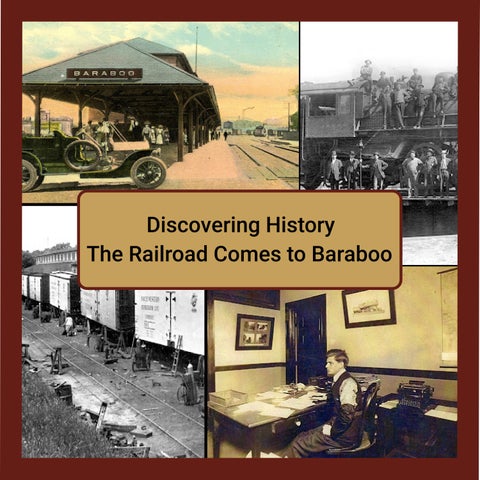
Discovering History The Railroad Comes to Baraboo
Discovering History The Railroad Comes to Baraboo by Paul Wolter & Beverly Vaillancourt M.Ed design by PowerUp Design, LLC
images courtesy of the Sauk County Historical Society
Sauk County Historical Society 900 2nd Avenue PO Box 651 Baraboo, Wisconsin 53913 saukcountyhistory.org ©2023 Sauk County Historical Society Press Printed by Minutemen Press, Baraboo, WI, USA All rights reserved. No part of this work may be reproduced, stored in a retrieval system, or transmitted in any means, electronic, recorded, or otherwise, without the express prior written consent of the Sauk County
Words to Know brakemen
income
canopy
insulated
clerks
opportunity
conductors
population
dispatchers
produce
employees
products
engineers
rail yard
expanded
repairmen
firemen
restaurant
first floor
restoration
freight
roundhouse
goods
Sauk County Historical Society 1
The Railroad Comes to Baraboo When the first train arrived in Baraboo in 1871, it was a big event, and a major turning point. Products made in Baraboo, like furniture and lumber, could be transported to places far away for sale without having to haul the goods there by horse or oxen. Products from other places could be transported to Baraboo much quicker, as well. People could move from place to place without having to ride a horse or travel in a wagon. Travel became faster and easier. This helped Baraboo grow as more people moved to Sauk County to live and work. The growth of the railroad in Sauk County is the story of change to the area. For some it meant noise and unwanted changes. For others, it meant progress and opportunity. The coming of the railroad is the story of how the railroad changed the lives of the people of Sauk County.
Discovering History
2
Baraboo rail yard 1886 The population of Baraboo in 1871 when the train arrived was about 2,000 people. In just nine years the population of Baraboo almost doubled to about 4,000 people. Many railroad workers settled in Baraboo. The city certainly expanded because of the railroad. The drawing of Baraboo on page 2 was made in 1886. The city was much larger than just a few years earlier. By 1886 Baraboo had many more houses, stores, schools, and churches. At the bottom of the 1886 drawing is the Baraboo rail yard. Look carefully at the drawing on this page. What rail yard details can you find? 3
A New Train Depot Comes to Baraboo In 1902 a new two-story brick depot and office building was built in Baraboo. The first floor had rooms for people to wait for trains and even a restaurant where they could get a meal. Outside there was a special roof, called a canopy, that was 300 feet long to shelter people while they got on and off the trains.
• Why do you think the railroad built such a large depot in Baraboo in 1902? • What types of new jobs did the depot bring to the people who lived in and near Baraboo? 4
The upstairs of the new building had offices for the railroad division managers, dispatchers, and clerks. The offices upstairs in the depot building were where managers oversaw all the employees of the railroad, set schedules, and kept trains on time. Imagine what it was like to take care of all the train schedules in 1902. There were no computers or cellphones then. People had to keep track of everything using paper and pencil. Notice all the papers on and under the clerk’s desk. What type of skills do you think the clerk needed? Baraboo became home to nearly 400 railroad employees in 1902, including brakemen, firemen, conductors, engineers, dispatchers, repairmen, and management staff. Railroad jobs added a lot of income to the local economy as railroad workers spent money on things they needed for their homes and families. Many houses were built and stores were expanded to supply all of the workers with useful goods. 5
Look carefully at the historic photos all of the workers who were needed to keep the trains in repair. These photos were taken at the Baraboo roundhouse. Notice the tracks moving out in a circle. A train would be sent from the main track onto a turntable, and then onto one of the roundhouse tracks. From there it would moved into a roundhouse stall where it could be repaired. Can you find the roundhouse in the drawing on page 3? What kind of sounds do you think the workers heard while they were hard at work repairing the trains?
6
The railroad provided opportunities for other jobs created in Baraboo. For example, one Baraboo company took railroad cars and insulated them so that cold foods and produce could be shipped inside them. This company employed over 100 people and could produce three insulated cars a day.
building insulated train cars
Can you identify five different items in the photo needed to build train cars? 7
As tracks were built across Sauk County and to other places in Wisconsin, depots were built in communities. Here the trains would stop to drop off goods and pick up passengers. Stores opened, mills were built, churches were built, and children attended one-room schools. Near each small community people farmed the land. Why might having a depot in a small community where trains stopped help the community to grow?
Pictured here are depots that once were found in La Valle (upper left), Prairie du Sac (upper right) and Sauk City (lower left). • What is the same about each depot? • What is different? 8
Around 1900 cars started to become available for purchase in Baraboo. By the 1920s there were thousands of cars in Sauk County. People started to ride the train less and less, and instead used their own cars. • What do you notice about the car in the photo? • What do you notice about the people waiting for the train to arrive? • Why might families prefer to drive somewhere rather than take the train? 9
Things slowly changed. In 1963 passenger trains stopped coming to Baraboo. Soon the depot no longer was used for passengers or as offices and was sold. Today the old depot is still standing but is not used. The canopy where people could wait outside for the train was removed and the windows were filled in. There is good news, though. Ownership of the Baraboo Depot was turned over to the Sauk County Historical Society in October 2020. Plans are to restore the Depot to the way it looked in 1902. It is a very big restoration project.
10
Trains still come through Baraboo carrying freight. Yet, most of the buildings that were once used by the railroad in Baraboo have been torn down. The railroad played a key role in the growth of Baraboo and Sauk County. When it arrived in 1871 it connected Baraboo with big cities. Baraboo also was chosen to be a division headquarters, or main office, for the Chicago & North Western Railroad. Because of this, hundreds of jobs were available in Baraboo for over 60 years. Railroad employees and their families lived in Baraboo and helped the city grow. 11
Think about It
• Open your History Journal. • Write the definitions of the Words to Know. • Write two or three sentences that tell how railroads increased job opportunities for the people of Sauk County? • Write two sentences that tell why the people of Baraboo welcomed the coming of the train. • Write two or three sentences that tell how railroads helped to build communities in Sauk County. • Add one interesting idea to your History Journal. Share your idea with someone else. 12
Projects • Create a poster from 1880 encouraging the people of Baraboo, Wisconsin, to ride the train to Madison, Wisconsin. Be sure to add a drawing of a steam locamotive to your poster. You may also want to draw the depot. • Find out more about steam locomotives. Did they all look the same? How did they change over time? When did they stop being used? What replaced the steam locomotive? • Build your own model train set using train tracks and old model trains. Many of these items can be found in antique stores, online, or even in local stores. Become a model train collector! • Write a diary entry for someone who just experienced seeing the first train arrive in Baraboo in 1871. Use your History Journal for your diary entry. • Learn more about the restoration of the Baraboo Depot by going to https:// saukcountyhistory.org/baraboodepot. To ask questions about the progress of the depot’s restoration, email history@saukcountyhistory.org. • Think up a project of your own about the railroad. What can you do to help others learn more about the railroad?
13
My History Journal _______________________________________________________________________________ _______________________________________________________________________________ _______________________________________________________________________________ _______________________________________________________________________________ _______________________________________________________________________________ _______________________________________________________________________________ _______________________________________________________________________________ _______________________________________________________________________________ _______________________________________________________________________________ _______________________________________________________________________________ _______________________________________________________________________________ _______________________________________________________________________________ _______________________________________________________________________________ _______________________________________________________________________________ _______________________________________________________________________________ _______________________________________________________________________________ _______________________________________________________________________________ _______________________________________________________________________________
My History Journal _______________________________________________________________________________ _______________________________________________________________________________ _______________________________________________________________________________ _______________________________________________________________________________ _______________________________________________________________________________ _______________________________________________________________________________ _______________________________________________________________________________ _______________________________________________________________________________ _______________________________________________________________________________ _______________________________________________________________________________ _______________________________________________________________________________ _______________________________________________________________________________ _______________________________________________________________________________ _______________________________________________________________________________ _______________________________________________________________________________ _______________________________________________________________________________ _______________________________________________________________________________ _______________________________________________________________________________
My History Journal _______________________________________________________________________________ _______________________________________________________________________________ _______________________________________________________________________________ _______________________________________________________________________________ _______________________________________________________________________________ _______________________________________________________________________________ _______________________________________________________________________________ _______________________________________________________________________________ _______________________________________________________________________________ _______________________________________________________________________________ _______________________________________________________________________________ _______________________________________________________________________________ _______________________________________________________________________________ _______________________________________________________________________________ _______________________________________________________________________________ _______________________________________________________________________________ _______________________________________________________________________________ _______________________________________________________________________________
My History Journal _______________________________________________________________________________ _______________________________________________________________________________ _______________________________________________________________________________ _______________________________________________________________________________ _______________________________________________________________________________ _______________________________________________________________________________ _______________________________________________________________________________ _______________________________________________________________________________ _______________________________________________________________________________ _______________________________________________________________________________ _______________________________________________________________________________ _______________________________________________________________________________ _______________________________________________________________________________ _______________________________________________________________________________ _______________________________________________________________________________ _______________________________________________________________________________ _______________________________________________________________________________ _______________________________________________________________________________
Baraboo, Wisconsin