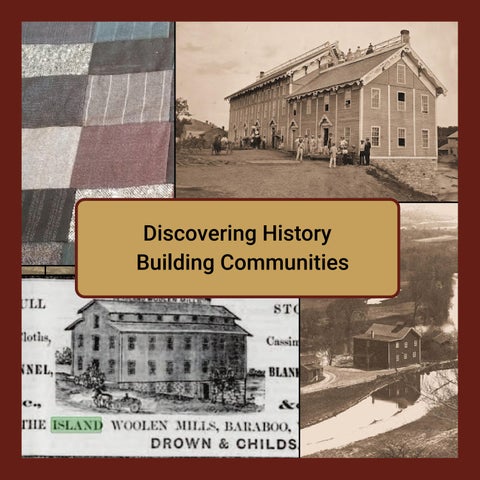
Discovering History Building Communities
Discovering History Building Communities by Paul Wolter & Beverly Vaillancourt, M.Ed design by PowerUp Design, LLC
images courtesy of the Sauk County Historical Society
Sauk County Historical Society 900 2nd Avenue PO Box 651 Baraboo, Wisconsin 53913 saukcountyhistory.org ©2023 Sauk County Historical Society Press Printed by Minutemen Press, Baraboo, WI, USA All rights reserved. No part of this work may be reproduced, stored in a retrieval system, or transmitted in any means, electronic, recorded, or otherwise, without the express prior written consent of the Sauk County
Words to Know
Ash-Walnut Street Bridge
millrace
automobile
Oak Street
communities
pumping station
employees
Sauk County History Center
George Brown
wooly mammoth
grist mill harness idle looms machinery
1
Building Communities Island Woolen Mill Communities grew in Sauk County where industry grew. Mills were one of those important industries. Mills were built near dams to harness the power of water. One important mill in Baraboo was the Island Woolen Mill. The machinery at the mill turned wool from sheep into yarn and then the yarn was woven into cloth. The buildings of the mill straddled a millrace which created the “island” for which the mill had been named back in 1863 when it started operation. By the late 1860s the company had about 36 employees and was producing up to 10,000 yards of cloth per month or about 100,000 yards per year. This was enough cloth to stretch from Baraboo to Madison.
Discovering History
2
A loom like this was part of the machinery of the Island Woolen Mill. The loom in this photo was used at the Reedsburg Woolen Mill. The Reedsburg Woolen Mill was located next to the Baraboo River and also powered by the flow of water. Giant machines called looms were used to weave the wool yarn together. The looms were run by water power from the Baraboo River. 3
The fabrics from the Island Woolen Mill were used to make blankets and clothing. In later years, the wool fabric was sold to automobile makers for use in car interiors. The mill did not make clothing but made the fabrics for them. This picture at right shows fabric samples for men’s suits sewn together as a quilt.
The Island Woolen Mill grew to become the largest employer in Sauk County for many years, employing hundreds of people. The mill closed in 1949 and the buildings sat idle. A fire later destroyed many of the buildings and the rest were torn down, except for one. 4
The office building for the Island Woolen Mill was not damaged by the fire and was saved. Today it is the Sauk County History Center. The building reminds us that there was once a large mill here run by water power from the Baraboo River. The mill produced wool fabric for over 85 years. If all of the fabric the mill produced was put together, end to end, it would easily circle the earth!
5
The Mills of Baraboo In 1844 George Brown built a dam further down the Baraboo River from the Island Woolen Mill, near what today is Oak Street. Can you find the dam in this section of Canfield’s 1872 map?
While George Brown and his workmen were digging a hole for the foundation of the sawmill they found the skeleton of a woolly mammoth from thousands of years ago. They measured the skeleton and determined that the mammoth had once been 36 feet long.
6
The dam at Oak Street helped power a sawmill and furniture factory for many years. The photo below of the dam is from 1866 and is one of the oldest pictures of Baraboo. In the background the large building is the Bassett Grist Mill. Can you find it? In the middle is the Ash-Walnut Street Bridge. Can you find the bridge? What other things do you see in the photo? Why is it important to preserve old photos like this one of the dam at Oak Street?
Today the dam and mill are gone but there is still a bridge at the Ash-Walnut Street location. 7
Patrick Bassett built his large grist mill along Water Street at the Oak Street dam in 1855. A grist mill turned wheat and other grains into flour. Mr. Bassett’s grist mill produced tens of thousands of barrels of flour every year. The Reedsburg Woolen Mill was built in 1882. The building stood four stories high and had 32 looms. The wool fabric produced in Reedsburg was considered very special. Much of the wool was sold in Chicago. Electricity came to the mill in 1902. The mill once was the largest employer in Reedsburg. How did the mill help to build the Reedsburg community? The mill closed in 1967. All but the office building burnt down in 1968. Today only the office building remains and is used as a store. 8
The dam built near Circus World once provided water power for a saw mill, woolen mill, and grist mill. One of the mills even made socks out of wool yarn. What was made at the mill shown in the photo? How can you tell?
In 1886 a special building was built at this site. Here water power was used to pump water from nearby springs to a large tank on the north side of Baraboo. The tank was used to supply water to houses and businesses in Baraboo. Before this time everyone had to get water from their own well. The water pumping station is shown standing by the smokestack in this photo. The water is from the Baraboo River. 9
In Baraboo water from the Baraboo River was used to pump clear spring water for people to drink and to use for washing. Indoor plumbing was new at this time. Special rooms called bathrooms were designed so that bathtubs, sinks, and toilets could use water from the city water system pumped by water power from the Baraboo River. Also new at this time was the idea of bringing electricity into homes or businesses. Before electricity people lit their homes with candles or oil lamps. The electric light bulb changed life for many people.
source: https://tinyurl.com/2cbsuyky
Water from the dams turned wheels. The wheels were connected by large belts to generators which made electricity. What kind of changes do you think the people of Baraboo experienced once they could light their homes and businesses with electric light bulbs? 10
For over 100 years the dams built across the Baraboo River provided water power for Baraboo businesses. With that water power, people made different types of products out of wood, wool, grains, and other materials. The dams also provided water power to pump water to city homes and businesses and to make electricity. The ability to capture water power is one of the main reasons European settlers came to Wisconsin. After the dams and mills were built people came to work at them. Other settlers came to provide goods and services to the first settlers. Homes and businesses were built. Communities grew. The Baraboo you know today had its start with the dams and mills that once were found along the Baraboo River. 11
Think about It
• Open your History Journal. • Write the definitions of the Words to Know. • Write two to three sentences about how mills helped to grow communities. • Write two to three sentences to explain changes electricity brought to Baraboo. • Write two to three sentences why you think all the dams that were built across the Baraboo River were removed. • Add one interesting idea to your History Journal. Share your idea with someone else. 12
Projects • Visit the Sauk County History Center at 900 Second Avenue in Baraboo to learn more about the Island Woolen Mill. Come prepared with 5 questions to ask about the history of the mill. • Visit the Sauk County Historical Society Museum at 531 4th Avenue, Baraboo to learn more about how people lived in the early 1900s when they first had electricity and running water. You will need to email history@ saukcountyhistory.org to request a time to visit the museum. • Learn more about woolly mammoths. Where will you look? Create a poster about the woolly mammoth with information that you learned. You can download and use the image of the woolly mammoth skeleton, if you’d like. Be sure to use your best handwriting and make your poster colorful. • Go to the https://saukcountyhistory.org/photo-collections Find images of mills. Take screenshots of the images. Use the screenshots to create a collage of the mills once found in Sauk County. • Think up a project of your own about mills. What can you do to help others learn more about the history of mills and dams in Wisconsin?
13
My History Journal _______________________________________________________________________________ _______________________________________________________________________________ _______________________________________________________________________________ _______________________________________________________________________________ _______________________________________________________________________________ _______________________________________________________________________________ _______________________________________________________________________________ _______________________________________________________________________________ _______________________________________________________________________________ _______________________________________________________________________________ _______________________________________________________________________________ _______________________________________________________________________________ _______________________________________________________________________________ _______________________________________________________________________________ _______________________________________________________________________________ _______________________________________________________________________________ _______________________________________________________________________________ _______________________________________________________________________________
My History Journal _______________________________________________________________________________ _______________________________________________________________________________ _______________________________________________________________________________ _______________________________________________________________________________ _______________________________________________________________________________ _______________________________________________________________________________ _______________________________________________________________________________ _______________________________________________________________________________ _______________________________________________________________________________ _______________________________________________________________________________ _______________________________________________________________________________ _______________________________________________________________________________ _______________________________________________________________________________ _______________________________________________________________________________ _______________________________________________________________________________ _______________________________________________________________________________ _______________________________________________________________________________ _______________________________________________________________________________
My History Journal _______________________________________________________________________________ _______________________________________________________________________________ _______________________________________________________________________________ _______________________________________________________________________________ _______________________________________________________________________________ _______________________________________________________________________________ _______________________________________________________________________________ _______________________________________________________________________________ _______________________________________________________________________________ _______________________________________________________________________________ _______________________________________________________________________________ _______________________________________________________________________________ _______________________________________________________________________________ _______________________________________________________________________________ _______________________________________________________________________________ _______________________________________________________________________________ _______________________________________________________________________________ _______________________________________________________________________________
My History Journal _______________________________________________________________________________ _______________________________________________________________________________ _______________________________________________________________________________ _______________________________________________________________________________ _______________________________________________________________________________ _______________________________________________________________________________ _______________________________________________________________________________ _______________________________________________________________________________ _______________________________________________________________________________ _______________________________________________________________________________ _______________________________________________________________________________ _______________________________________________________________________________ _______________________________________________________________________________ _______________________________________________________________________________ _______________________________________________________________________________ _______________________________________________________________________________ _______________________________________________________________________________ _______________________________________________________________________________
Sauk County, Wisconsin