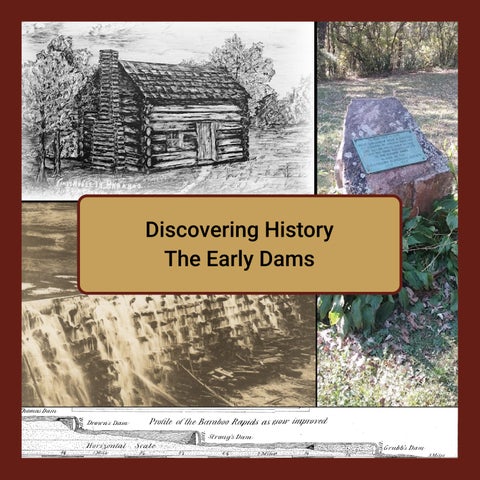
Discovering History The Early Dams
Discovering History The Early Dams by Paul Wolter & Beverly Vaillancourt, M.Ed design by PowerUp Design, LLC
images courtesy of the Sauk County Historical Society
Sauk County Historical Society 900 2nd Avenue PO Box 651 Baraboo, Wisconsin 53913 saukcountyhistory.org ©2023 Sauk County Historical Society Press Printed by Minutemen Press, Baraboo, WI, USA
All rights reserved. No part of this work may be reproduced, stored in a retrieval system, or transmitted in any means, electronic, recorded, or otherwise, without the express prior written consent of the Sauk County
Words to Know
Abe Wood
lead
Baraboo River
Madison
Baraboo Valley
mill
copper
millrace
effigy mounds
New York
free-flowing
oxbow
Illinois
Vermont
iron ore
Virginia
Kentucky
Wallis Rowen
Lake Monona
water wheel
1
The Early Dams Early Dam Builders Abe Wood was born about 1800 in Kentucky and came north at an early age. By 1837 he lived by Lake Monona near Madison before coming to the Baraboo Valley. Abe Wood built the first settler’s home in Baraboo in the fall of 1838 or 1839 on a hill above the Baraboo River.
Painting by E.S. Shrapnel , 1898, {PD-US}
Discovering History
Abe Wood’s home was a log cabin that looked much like the drawing on this page. The cabin was about 12 feet by 14 feet and had a dirt floor inside. Abe needed to cut the trees for his cabin. He carefully notched the logs so they would fit together. He then had to fill in the gaps between the logs of the home to keep out the wind, rain, and snow. 2
For several years Abe Wood lived in the cabin with his wife Sarah and their daughters Hannah and Margaret. The cabin disappeared many years ago but the spot is marked at Ochsner Park with a boulder. In 1839 Abe Wood partnered with Wallis Rowan to build the first dam and saw mill along the Baraboo River. Wallis Rowan was born in Kentucky about 1800 and married Elizabeth “Betsy” Metcalf in 1818 in southern Illinois. The couple had at least nine children. The family moved every few years as Wallis Rowan tried his hand at various jobs. Rowan was known as a miner, trader, innkeeper, scout, farmer, and mill owner. In 1840 Wallis Rowan brought his wife and family to live in the area. At the time the area was fully forested. 3
The construction of the first dam on the Baraboo River brought settlers from regions east of Wisconsin to the Baraboo Valley. They built their homes near the Baraboo River. Plans were made for more dams. Recall that long ago the mound builders built effigy mounds near the Baraboo River. Hundreds of years later the Ho-Chunk built their villages along the Baraboo River near the mound sites. Why do you think people settled along rivers, such as the Baraboo River?
The Baraboo River watershed is the area from where water drains into the Baraboo River. The Baraboo River is about 120 miles long. It starts in Monroe County to the northwest and travels downstream through Juneau, Sauk, and Columbia Counties. 4
People came westward from Kentucky, Vermont, New York, Virginia, and other places. They sought to make a new life in areas along the Baraboo River. Some settlers came to Wisconsin to mine for iron ore, lead, and copper. Others came to start businesses where dams had been built. These businesses could use the flow of the water to turn water wheels. The turning of the water wheel would then turn other gears in mills. Inside the mill grain would be ground into flour or logs would be sawed into lumber for building homes and stores.
Baraboo’s settlement began near the river and expanded as businesses grew and homes were built. Whre do you thnk dams were built across the Baraboo River? Water wheel turned by the flow of water source: PublicDomainPictures/17901
5
Dams Dams were built across rivers to capture water power. The water moving toward the dam would develop a strong flow, or movement. The stronger the flow, the more water power. These dams were made with rock, logs, and heavy clay soil packed in layers. Heavy rains and flooding could wash out poorly constructed dams.
A section of Canfield’s 1872 map showing the fall of water of three earthen dams built across the Baraboo River in Baraboo. How far did the water fall?
This dam was built with logs. How long do you think it took to build this dam? Why was building a dam a very difficult job? 6
The building of dams was a huge job. It took many people working together to build them. A dam was needed to run a mill. Flour, lumber, and other items were made in the mills. The mill was important to the farmers and businesses working and living in the area. When a dam washed out from heavy rains, the entire community got together to rebuild it as quickly as possible.
This is a photo of an earthen dam built at La Valle in Sauk County. It was bullt with rocks, logs, and heavy clay packed in layers. The mill used water power to turn the gears of the flour mill. The first dam in La Valle washed out from the Baraboo River flooding in 1898. It was quickly rebult by the community. Why did people feel it was important to rebuild the dam as quickly as possible? 7
Millraces Sometimes special trenches were dug to increase the flow of water to power a mill. These special trenches, called millraces, moved water from the river in a downward flow to the mill. A millrace is circled on the map below. The flow of water powered the Island Woolen Mill in Baraboo. What two words make up the word millrace? What does the word tell you about the flow of the water to the mill? This section from Canfield’s 1872 map also shows where the river forms an oxbow. This is a sharp bend in the river. Why do you think the mill was named the Island Woolen Mill? What does the name tell you about its location? What does its name tell you about what was made at the mill?
8
Building Communities The building of dams and the building of mills together built communities. The dams provided power for the mills. The different mills provided flour, material, furniture, lumber, wool fabric, and other items for the people of the communities found along the Baraboo River. The mills ground grain for farmers to feed their animals. The mills also provided jobs for people living in Sauk County’s growing commuities.
Black Hawk grist mill 1908
People moved to areas where there were mills. Here people started other businesses, such as general stores where people could buy fabric, dishes, and clothing. Soon railroads came to communities such as Baraboo, North Freedom, Reedsburg, and La Valle. Today all the dams are gone. Yet, knowing about their history helps us understand how communities along the Baraboo River got their start and why they grew. 9
The Removal of the Dams on the Baraboo River Problems with the dams built across the Baraboo River were discovered in the 1970s. Engineers who studied the dams felt the dams were no longer safe and should be removed. They also believed that removal of the dams would increase the fish populations in the river and be good for the over health of the river. Not everyone agreed with the removal of the dams. They felt the dams had been part of the communities for decades and should remain. Yet, many of the dams needed repair. • What happens when a dam needs repairs and the price tag to make the repairs is just too high? • What happens if the mill has been closed for a long time and the dam no longer serves a purpose? • What happens when scientists say that fishing would be better and the river would be healthier if the dams were removed?
Dam near the Island Woolen Mill, Baraboo
10
In 2001 the Linen Mill Dam in Baraboo was the last dam removed across the Baraboo River. It took some time before people started to see positive changes in the River. At first all that showed were lower river levels and muddy river banks. But then the river started to recover. The Department of Natural Resources did a study of the river. This is what the scientists found: •
Before dam removal 23 species of fish were found.
•
Three years after removal of the last dam 78 species of fish were found.
•
Populations of aquatic insects improved.
Today the Baraboo River is believed to be the longest restored free-flowing river in the United States. The river corridor has become a popular place to kayak and canoe. The river is helping to once again build the economies of communities along the river through recreation, new housing, and park development.
The Baraboo River photo courtesy Seth Taft
11
Think about It
1. Open your History Journal. 2. Write the definitions of the Words to Know. 3. Write two to three sentences about why dams were first built on the Baraboo River. 4. Write two to three sentences that tell why dams were important to the growth of communities. 5. Write two to three sentences about how earthen dams were built. 6. Add one interesting idea to your History Journal. Share your idea with someone else. 12
Projects • Mills powered by the flow of water worked as a series of gears turning other gears. Investigate how a bike works. Create a diagram of how one gear moves another and another to turn the bike’s wheels. • Learn more about water wheels. How do they work? Can you think of a way to build a water wheel using a plastic bottle, straws, and plastic cards to show how a water wheel works? • Later mills used water turbines instead of a water wheel. Find more about water turbines. Make a drawing of a water turbine and a water wheel. Explain how each works. • Email history@saukcountyhistory.org and ask for a photo of an artifact (something used long ago) related to how water powered Baraboo. Study the details in the photo. Share its story with others. • How is water power still used today? Search for hydroelectric power at the library or on the Internet to learn more. Share what you learned with your class. • Think up a project of your own about water power. What can you do to help others learn more about how water power works.
13
My History Journal _______________________________________________________________________________ _______________________________________________________________________________ _______________________________________________________________________________ _______________________________________________________________________________ _______________________________________________________________________________ _______________________________________________________________________________ _______________________________________________________________________________ _______________________________________________________________________________ _______________________________________________________________________________ _______________________________________________________________________________ _______________________________________________________________________________ _______________________________________________________________________________ _______________________________________________________________________________ _______________________________________________________________________________ _______________________________________________________________________________ _______________________________________________________________________________ _______________________________________________________________________________ _______________________________________________________________________________
My History Journal _______________________________________________________________________________ _______________________________________________________________________________ _______________________________________________________________________________ _______________________________________________________________________________ _______________________________________________________________________________ _______________________________________________________________________________ _______________________________________________________________________________ _______________________________________________________________________________ _______________________________________________________________________________ _______________________________________________________________________________ _______________________________________________________________________________ _______________________________________________________________________________ _______________________________________________________________________________ _______________________________________________________________________________ _______________________________________________________________________________ _______________________________________________________________________________ _______________________________________________________________________________ _______________________________________________________________________________
My History Journal _______________________________________________________________________________ _______________________________________________________________________________ _______________________________________________________________________________ _______________________________________________________________________________ _______________________________________________________________________________ _______________________________________________________________________________ _______________________________________________________________________________ _______________________________________________________________________________ _______________________________________________________________________________ _______________________________________________________________________________ _______________________________________________________________________________ _______________________________________________________________________________ _______________________________________________________________________________ _______________________________________________________________________________ _______________________________________________________________________________ _______________________________________________________________________________ _______________________________________________________________________________ _______________________________________________________________________________
My History Journal _______________________________________________________________________________ _______________________________________________________________________________ _______________________________________________________________________________ _______________________________________________________________________________ _______________________________________________________________________________ _______________________________________________________________________________ _______________________________________________________________________________ _______________________________________________________________________________ _______________________________________________________________________________ _______________________________________________________________________________ _______________________________________________________________________________ _______________________________________________________________________________ _______________________________________________________________________________ _______________________________________________________________________________ _______________________________________________________________________________ _______________________________________________________________________________ _______________________________________________________________________________ _______________________________________________________________________________
La Valle, Wisconsin