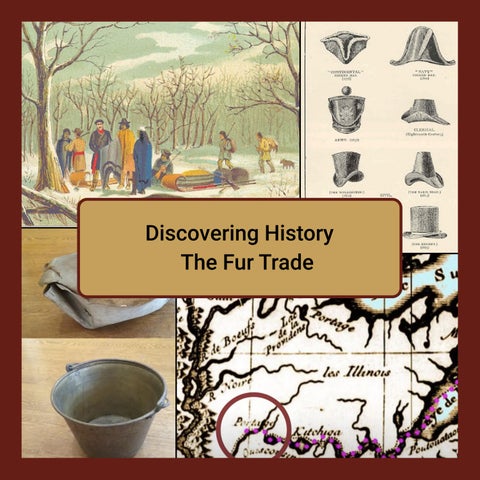
Discovering History The Fur Trade
Discovering History The Fur Trade by Paul Wolter Contribution by Beverly Vaillancourt, M.Ed design by PowerUp Design, LLC
images courtesy of the Sauk County Historical Society
Sauk County Historical Society 900 2nd Avenue PO Box 651 Baraboo, Wisconsin 53913 saukcountyhistory.org ©2023 Sauk County Historical Society Press Printed by Minutemen Press, Baraboo, WI, USA All rights reserved. No part of this work may be reproduced, stored in a retrieval system, or transmitted in any means, electronic, recorded, or otherwise, without the express prior written consent of the Sauk County
Words to Know
Atlantic Ocean
government
Canada
Great Lakes
England
Indigenous Peoples
exported
kettle
felt
Lake Michigan
Fort Michilimackinac
Lake Superior
France
military
Francois Barbeau
portage
fur traders
regions
goods
1
Early Trade Beginning in the mid 1600s, French-speaking fur traders from Canada (FrenchCanadians) set up trade relationships with the Indigenous Peoples living near the Great Lakes. The fur-traders from Canada traded items that were helpful to the Indigenous Peoples for the skins and fur of animals. After trading goods, or things of value, the fur-traders would take the animal skins back to Canada. The animal fur would be used to make hats and other products that people in Europe highly valued and bought.
Discovering History
Painting by E.S. Shrapnel , 1898, {PD-US}
2
Trade Goods Francois Barbeau was a French-Canadian fur trader in the mid 1700s. He traded with the Indigenous Peoples living near Lake Michigan and Lake Superior. Eventually Francois Barbeau built a trading fort where the Baraboo River and Wisconsin Rivers meet. The trade goods that Barbeau brought included axes, knives, guns, fire starters, blankets and pipes. He also brought special items, such as paint, trade beads, mirrors, and pieces of copper. One item that was highly prized was the kettle. Indigenous Peoples made kettles out of clay or bark as shown on the top photo. Water was placed in the kettle and heated by dropping stones from a fire into the water. A metal kettle was much easier because it allowed water to be heated right over the fire. It was not long before Indian tribes depended on the fur trade for goods they needed and Europeans depended on the Indian tribes to supply them with furs.
3
Beaver Fur
North American Beaver
Beaver Fur Beaver was a very popular animal fur. Because the fur is waterproof, beaver pelts were highly valued for making hats of all kinds. Indigenous Peoples also traded fur from minks, foxes, wolves, squirrels, and rabbits in exchange for goods. The fur traders exported the furs across the Atlantic Ocean to England and France where they were sold. Beaver hats were very popular between 1650 and 1850. They were especially popular in England and France. 4
Hat makers in England and France turned beaver fur into a type of cloth called felt. Hatmakers fitted the beaver felt over hat forms where it was pressed and steamed to form a hat. The beaver felt was used to make hats of many different styles. Beaver hats played an important role in European society. Wearing a beaver hat was a sign of wealth. Men who held positions in government, in the military, and wealthy business owners all wore beaver hats of some shape or style. During the 1700s millions of beaver hats were exported from England and France to places as far as Russia and South America. The poster shows some of the hats made from beaver felt. Which hats do you think were worn by soldiers? Which hats were worn by businessmen? 5
An End to the Active Fur Trading The English and French competed for control of the fur trade. Each country wanted to control large sections of land in North America. This led to conflict between the two European countries. The fur trade also caused conflict between different Indian tribes as they tried to control areas for the hunting of fur-bearing animals. The fur trade had a huge impact on the population of the beaver. Decades of overhunting of beaver caused a strong decline in the beaver population in the Great Lakes region. A slowing of the fur trade in the late 1700s caused hardship for the Indigenous Peoples living in the Great Lakes region. The many tribes had grown dependent on the income and on the guns, blankets, and tools gained from trading furs. Fur trading had changed the way of life for Indigenous Peoples. For many tribes, years of fur trading resulted in the loss of tribal lands. By the mid 1850s changing clothing styles caused a drop in the value of beaver fur. Several European fur companies closed their doors. The trade in beaver furs in the late 1800s was not at all like it had been some 200 years earlier.
Trading Forts Trading forts were important for the fur trade. Trading forts were built along water routes in the Great Lakes region beginning in the early 1600s. Here fur traders arrived in canoes filled with animal pelts to sell for goods to be used for themselves and for future trade with the Indians. One important trading fort for the Great Lakes region was Fort Michilimackinac. 6
The Naming of Baraboo and the Fur Trade Fort Michilimackinac (Missilimakinac) was built in 1715 where Lake Huron and Lake Michigan meet. Today the area is part of Mackinaw City in Michigan. It was an active trading fort until 1783.
Fort Michilimackinac, source: https://upload.wikimedia.org/
In 1749 French-Canadian Francois Barbeau built a trading post near modern-day Portage where the where the Fox River and the Wisconsin River come close enough together to walk between them. In 1750 he and his men loaded their furs into a canoe and made their way to Fort Michilimackinac. It is reported that he returned to his trading post, but history is uncertain about what exactly happened to Francois Barbeau. You may have noticed that Baraboo and Barbeau are said in much the same way. Information from documents written in 1766 hint that the Baraboo River was named after Francois Barbeau. 7
Over time the spelling of Barbeau’s was written in different ways. Finally “Baraboo” became the official spelling. No one knows if the change of spelling was on purpose. It could be that someone’s writing of Barbeau was hard to read and so it was copied incorrectly. It could be that someone decided to spell Baraboo the way some people pronounced Francois Barbeau’s name in French. It could be for another reason. That interesting part of the story of how Baraboo got its name is lost to history.
Francois Barbeau found the Wisconsin River at what today is Portage. To portage is to carry your canoe over land between rivers. 8
French-Canadian fur traders moved their furs to a trading post by canoe. What kind of problems do you think they might have had along the way?
Shooting the Rapids, painted by Frances Anne Hopkins in 1879, public domain [PD-US]
The river was named Baraboo first and many years later a village was laid out and given the same name. The village grew and eventually became a city. The name Baraboo reminds us of the history of the fur trade. It also reminds us of the connections between cultures made in this area over 270 years ago!
Original plat map for the Village of Baraboo
9
Study the fur trade routes in North America. What do you notice? Why were water routes important to the fur trade?
Used with permission: Wisconsin Historical Society (357)
10
The map shows the location of fur trading sites from 1760 - 1815. What do you notice about the location of the sites? Can you find the portage site where the Fox River and Wisconsin River meet?
Used with permission: Wisconsin Historical Society (268)
11
Think about It
• Open your History Journal. • Write the definitions of the Words to Know. • Write one sentence that explains how furs were transported from one place to another in the 1700s. • Write three sentences about fur trade. • Write a paragraph explaining why the fur trade was important to FrenchCanadian fur traders and to the Indigenous Peoples. • Add one interesting idea to your History Journal. Share your idea with someone else. 12
Projects • Use the local library or school library to find stories about French-Canadian fur traders in the 1700s. Write a one paragraph summary of what you discovered. • Using a modern map of Wisconsin, chart the Baraboo River from its headwaters northwest of Sauk County, through Sauk County, and ending where it meets the Wisconsin River. • Determine the distance Barbeau traveled from Quebec to Portage using the scale shown on a modern map. • Create a diagram showing how the fur trade worked. • Read more about Francois Barbeau by searching for a book in the public library called A Man Called Baraboo by M. Richard Tully, copyright 2007. Share what you learned with your class. • Think up a project of your own about the Baraboo River. What can you do to help others learn more about the Baraboo River?
13
My History Journal _______________________________________________________________________________ _______________________________________________________________________________ _______________________________________________________________________________ _______________________________________________________________________________ _______________________________________________________________________________ _______________________________________________________________________________ _______________________________________________________________________________ _______________________________________________________________________________ _______________________________________________________________________________ _______________________________________________________________________________ _______________________________________________________________________________ _______________________________________________________________________________ _______________________________________________________________________________ _______________________________________________________________________________ _______________________________________________________________________________ _______________________________________________________________________________ _______________________________________________________________________________ _______________________________________________________________________________
My History Journal _______________________________________________________________________________ _______________________________________________________________________________ _______________________________________________________________________________ _______________________________________________________________________________ _______________________________________________________________________________ _______________________________________________________________________________ _______________________________________________________________________________ _______________________________________________________________________________ _______________________________________________________________________________ _______________________________________________________________________________ _______________________________________________________________________________ _______________________________________________________________________________ _______________________________________________________________________________ _______________________________________________________________________________ _______________________________________________________________________________ _______________________________________________________________________________ _______________________________________________________________________________ _______________________________________________________________________________
My History Journal _______________________________________________________________________________ _______________________________________________________________________________ _______________________________________________________________________________ _______________________________________________________________________________ _______________________________________________________________________________ _______________________________________________________________________________ _______________________________________________________________________________ _______________________________________________________________________________ _______________________________________________________________________________ _______________________________________________________________________________ _______________________________________________________________________________ _______________________________________________________________________________ _______________________________________________________________________________ _______________________________________________________________________________ _______________________________________________________________________________ _______________________________________________________________________________ _______________________________________________________________________________ _______________________________________________________________________________
My History Journal _______________________________________________________________________________ _______________________________________________________________________________ _______________________________________________________________________________ _______________________________________________________________________________ _______________________________________________________________________________ _______________________________________________________________________________ _______________________________________________________________________________ _______________________________________________________________________________ _______________________________________________________________________________ _______________________________________________________________________________ _______________________________________________________________________________ _______________________________________________________________________________ _______________________________________________________________________________ _______________________________________________________________________________ _______________________________________________________________________________ _______________________________________________________________________________ _______________________________________________________________________________ _______________________________________________________________________________
The Meeting of the Baraboo and Wisconsin Rivers
Google Maps