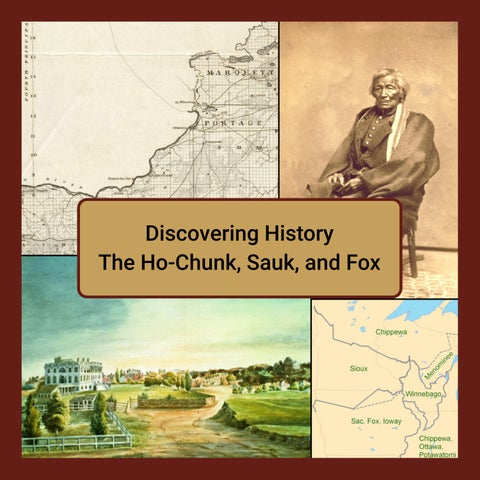
Discovering History The Ho-Chunk, Sauk, and Fox
Discovering History The Ho-Chunk, Sauk, and Fox by Paul Wolter & Beverly Vaillancourt, M.Ed design by PowerUp Design, LLC
images courtesy of the Sauk County Historical Society
Sauk County Historical Society 900 2nd Avenue PO Box 651 Baraboo, Wisconsin 53913 saukcountyhistory.org ©2023 Sauk County Historical Society Press Printed by Minutemen Press, Baraboo, WI, USA All rights reserved. No part of this work may be reproduced, stored in a retrieval system, or transmitted in any means, electronic, recorded, or otherwise, without the express prior written consent of the Sauk County
Words to Know American Revolutionary War
Jean Nicolet
Baraboo River
Jonathan Carver
Black Hawk
militia
Chief Nąąga
Mississippi River
Chippewa
Sauk City
disputes
Sauk County
Fox (Meskwaki)
Sauk (Sac)
goods
Treaty of 1837
Ho-Chunk
Winnebago
Indigenous Peoples
Yellow Thunder
1
The Ho-Chunk, Sauk, and Fox In 1634 French explorer Jean Nicolet was one of the first European explorers to come to shore at what is now Wisconsin. Nicolet came in contact with the Ho-Chunk, possibly at Red Banks near what is today Green Bay, Wisconsin. In time the country of France claimed all of what we know today as Wisconsin. France claimed the large region as a territory of France. A territory is an area claimed by a country.
Discovering History
What Indian tribes once lived in region that became known as Wisconsin?
2
Later the country of Great Britain claimed the area after it won a war against France. In 1783, following the American Revolutionary War, the United States government claimed the area. By the 1820s settlers from Europe and from the eastern part of the United States were pushing westward and looking for new places to live.
Treaties Beginning in the 1820s the United States government began entering into land agreements with the Indigenous Peoples of Wisconsin. The agreements, called treaties, set down the boundaries of where the Ho-Chunk lived. The United States also made agreements about land boundaries with other Indigenous Peoples in Wisconsin. The map shows the regions settled by the different Indian Tribes. The area designated for the Ho-Chunk, earlier called the Winnebago, included much of southern Wisconsin.
3
Representatives of several Indian tribes signed treaties with the federal government in the early 1800s. The treaties called for the removal of Indigenous Peoples from their land in exchange for money and goods. Not everyone agreed to leave their native lands. Many felt the treaties did not represent the wishes of the members of the various Indian tribes.
Chief Nąąga In 1828 Chief Nąąga traveled to Washington D.C. with other Ho-Chunk chiefs. Chief Nąąga spoke for the Ho-Chunk. The United States government saw the Ho-Chunk as its own separate nation. This meant the chiefs could sign treaties for all the Ho-Chunk people. Chief Nąąga met President John Quincy Adams at the White House. They talked about land disputes and treaties. The Ho-Chunk often were forced to sign treaties with the United States government. With each treaty they lost more land. These treaties were not in the best interest of the tribe. They forced the Ho-Chunk to move away from where the Ho-Chunk had lived for centuries. Washington DC in the early 1800s
4
In 1829 the Ho-Chunk signed a treaty giving up their land in southwestern Wisconsin where settlers were mining lead. The settlers were breaking the law by mining lead on Ho-Chunk land. However, the United States government did little to stop them. Instead, the United States government offered to purchase the land from the Ho-Chunk for money, guns, cloth, and other supplies. It also promised to pay debts the Ho-Chunk had with traders in the area. Many of the promises made to the Ho-Chunk by the United States government in 1829 were not kept.
The Ho-Chunk Lose More Land Just three years later, in 1832, the Ho-Chunk gave up all of their lands south and east of the Wisconsin River. They were given land in Iowa. During this time some of the Ho-Chunk people lived along the Baraboo River.
This map from 1830 shows the land that would become Sauk County. It is also one of the first maps that shows the Baraboo River. On this map, the river is labeled as Bonibau’s Creek. Can you find it? The map shows the Winnebago (HoChunk) villages along the Baraboo River. Can you find them? 5
The Ho-Chunk Lose More Land … Again In 1837 the Ho-Chunk were forced to sign a treaty that stated they must give up all of their land in Wisconsin in exchange for land in Iowa. The chiefs were told they would be able to stay in Wisconsin for another eight years. In fact, the treaty said eight months.
What happened next? The map shows the Wisconsin and Fox Rivers as the dividing line between land open for settlement (south and east) and lands where Indigenous Peoples live (north and west). After the Treaty of 1837 was signed, land that is now Baraboo and Sauk County was opened to settlers from Europe and from states to the east. Not all the Ho-Chunk, however, agreed to move out of Wisconsin. Beginning in 1840 military troops were brought in to collect and move the Ho-Chunk to land west of the Mississippi. 6
Chief Yellow Thunder Chief Yellow Thunder was an important Ho-Chunk chief in the area. He was one of the signers of the 1837 Treaty. Yellow Thunder is spelled Wakąjaziga in the Ho-Chunk language. Yellow Thunder was forced to move to land west of Wisconsin. In 1840 Chief Yellow Thunder, along with many other Ho-Chunk, walked back hundreds of miles to their native homeland in Wisconsin. They believed that the treaty was not fair and that some of the HoChunk men who signed the treaty did not have the right to sign it. In all, the Ho-Chunk felt the treaty was not done in an honest way. In 1847 Yellow Thunder did something very important. He purchased 40 acres of land north of Baraboo near the Wisconsin River. He then became a landowner under the U.S. system of land ownership.
Chief Yellow Thunder
7
As a landowner Yellow Thunder was less likely to be removed from his homeland. His property was also a gathering place for many other Ho-Chunk people. While many Ho-Chunk relocated to what today is Nebraska, others stayed in Wisconsin. Because of this, the United States government saw the Wisconsin Ho-Chunk as a separate tribe from their relatives who settled in Nebraska. Over the years, the Ho-Chunk Nation purchased its own land. Many Ho-Chunk in Sauk County live on land that is owned by the Ho-Chunk Nation.
Today the Ho-Chunk live, work, and go to school in communities across Wisconsin especially in Sauk and Jackson Counties. The tribe’s headquarters are in Black River Falls. Ho-Chunk youth look to the future. They have many ideas of how to preserve their culture. They feel that it is important that their cultural traditions and language are not lost. Joe White Eagle, Jr., Olivia Anderson, and Kristin K. White Eagle (Joe’s Mother)
8
The Sauk and Fox Over 250 years ago the Sauk (Sac) living here saw a group of birchbark canoes floating down the Wisconsin River filled with men exploring the area for the British government. The leader of the expedition was Jonathan Carver. He wrote in his journal: “This is the largest and best built Indian town I ever saw. It contains about ninety houses, each large enough for several families. These are built of hewn plank neatly jointed, and covered with bark so compactly as to keep out the most penetrating rains… The streets are regular and spacious … The land near the town is very good. In their plantations, which lie adjacent to their houses, and which are neatly laid out, they raise great quantities of Indian corn, beans, melons.”
Jonathan Carver 1710 - 1780
During the 1730s the Sauk had become allies of the Fox (Meskawki). After twenty years of war with the French, the Fox had been reduced to a few hundred people. The Sauk and Fox fled west of the Mississippi River during the last unsuccessful campaign of the French against the Fox and their allies from 1733 to 1735. When the fighting subsided, the Sauk returned to lands east of the Mississippi around 1740 and established a village in what today is Sauk City on the Wisconsin River next to a great prairie where they flourished for about 40 years. 9
The Sauk left the village around 1780 due to increasing pressure from the Chippewa and moved south near other Sauk living in the Mississippi River valley at places like Saukenuk, the great Sauk village on the Rock River.
Black Hawk
The Treaty of St. Louis in 1804 with the Sauk and Fox, who were by this time considered one tribe by the US Government, stated the tribes must give up all land east of the Mississippi River.
1767 - 1838
Many Sauk and Fox believed the treaty to be unfair, including a warrior named Black Hawk. Starting in 1829 Black Hawk led a group of Sauk and Fox men, women, and children back to the area of the great village of Saukenuk where he had been born. The action led to a series of battles known as the Black Hawk War. Black Hawk and his group were pursued by militia groups as they tried to escape to the west side of the Mississippi River, losing hundreds of Sauk along the way due to the fighting and harsh conditions. The Black Hawk war ended in 1832. Today the Sauk (Sac) and Fox (Meskwaki) Nations live in Oklahoma, Missouri, Kansas, Nebraska, and Iowa, as well as in Wisconsin and in other states. Sauk County, Wisconsin, is named for the Sauk who once lived on the land that makes up the Sauk Prairie region. Prairie du Sac and Sauk City would be named after the Sauk and together known as Sauk Prairie. 10
Primary Sources
This Winnebago (Ho-Chunk) Village drawing was originally published in 1854. It was drawn by Seth Eastman. He was an artist who recorded the daily life of the Winnebago and Sioux Indians through his art. What do you see in the drawing? Look very closely. There is a lot of detail to find. List five things you notice in your History Journal. This is a photo of a Ho-Chunk village. The photo was taken over 100 years ago. The woman is preparing a deer hide. • What do you find in the photo that also is in the drawing? • What is in the photo that is not in the drawing? How do these two primary sources help us learn more about how the Ho-Chunk lived long ago? 11
Think about It
1. Open your History Journal. 2. Write the definitions of the Words to Know. 3. Write two to three sentences about Ho-Chunk settlement in Wisconsin. 4. Write two to three sentences about the Sac and Fox settlement in Wisconsin. 5. Write a paragraph explaining why it is important to know about the 1837 Treaty and the challenges faced by Indigenous Peoples in the early 1800s. 6. Add one interesting idea to your History Journal. Share your idea with someone else. 12
Projects • Read about Chief Yellow Thunder. What five things can you share with others? Go to https://saukcountyhistory.org/yellow-thunder • Visit Yellow Thunder Memorial on County Hwy A west of Baraboo. Read the informational signs found along the pathway. What can you share with others about the Yellow Thunder and the history of the Ho-Chunk? • Write a letter to President John Quincy Adams explaining why the Ho-Chunk should not be moved from their native land. What date will you place on your letter? • Visit the site of the Indian Council House and Cornfield Mounds. Signs explaining the sites are located next to the parking lot at Circus World Museum in Baraboo. • Invite a member of the Ho-Chunk Nation to speak to your class about cultural traditions practiced by the Ho-Chunk. • Think up a project of your own about Indigenous Peoples. What can you do to help others learn more about Indigenous Peoples?
13
My History Journal _______________________________________________________________________________ _______________________________________________________________________________ _______________________________________________________________________________ _______________________________________________________________________________ _______________________________________________________________________________ _______________________________________________________________________________ _______________________________________________________________________________ _______________________________________________________________________________ _______________________________________________________________________________ _______________________________________________________________________________ _______________________________________________________________________________ _______________________________________________________________________________ _______________________________________________________________________________ _______________________________________________________________________________ _______________________________________________________________________________ _______________________________________________________________________________ _______________________________________________________________________________ _______________________________________________________________________________
My History Journal _______________________________________________________________________________ _______________________________________________________________________________ _______________________________________________________________________________ _______________________________________________________________________________ _______________________________________________________________________________ _______________________________________________________________________________ _______________________________________________________________________________ _______________________________________________________________________________ _______________________________________________________________________________ _______________________________________________________________________________ _______________________________________________________________________________ _______________________________________________________________________________ _______________________________________________________________________________ _______________________________________________________________________________ _______________________________________________________________________________ _______________________________________________________________________________ _______________________________________________________________________________ _______________________________________________________________________________
My History Journal _______________________________________________________________________________ _______________________________________________________________________________ _______________________________________________________________________________ _______________________________________________________________________________ _______________________________________________________________________________ _______________________________________________________________________________ _______________________________________________________________________________ _______________________________________________________________________________ _______________________________________________________________________________ _______________________________________________________________________________ _______________________________________________________________________________ _______________________________________________________________________________ _______________________________________________________________________________ _______________________________________________________________________________ _______________________________________________________________________________ _______________________________________________________________________________ _______________________________________________________________________________ _______________________________________________________________________________
My History Journal _______________________________________________________________________________ _______________________________________________________________________________ _______________________________________________________________________________ _______________________________________________________________________________ _______________________________________________________________________________ _______________________________________________________________________________ _______________________________________________________________________________ _______________________________________________________________________________ _______________________________________________________________________________ _______________________________________________________________________________ _______________________________________________________________________________ _______________________________________________________________________________ _______________________________________________________________________________ _______________________________________________________________________________ _______________________________________________________________________________ _______________________________________________________________________________ _______________________________________________________________________________ _______________________________________________________________________________
Sauk City, Wisconsin
Google Maps