UBC MBA Technology & Analytics Leadership Career Track Courses

Page 1


UBC MBA: Technology & Analytics Leadership Career Track

Supplemental Courses

Students must complete at least one of the following additional courses as part of the Technology & Analytics Leadership Career Track. It’s important to note that electives, including track and general electives, are not necessarily offered every year and are subject to change.

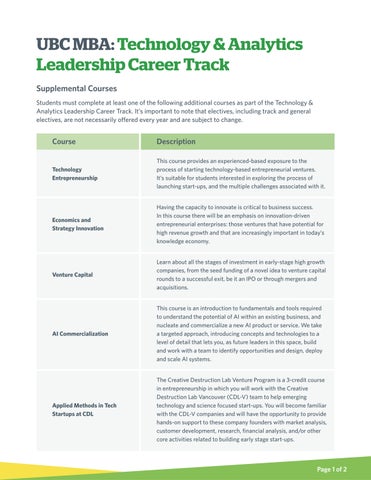
Course Description

Technology Entrepreneurship

Economics and Strategy Innovation

Venture Capital

AI Commercialization

Applied Methods in Tech Startups at CDL

This course provides an experienced-based exposure to the process of starting technology-based entrepreneurial ventures. It’s suitable for students interested in exploring the process of launching start-ups, and the multiple challenges associated with it.

Having the capacity to innovate is critical to business success. In this course there will be an emphasis on innovation-driven entrepreneurial enterprises: those ventures that have potential for high revenue growth and that are increasingly important in today’s knowledge economy.

Learn about all the stages of investment in early-stage high growth companies, from the seed funding of a novel idea to venture capital rounds to a successful exit, be it an IPO or through mergers and acquisitions.

This course is an introduction to fundamentals and tools required to understand the potential of AI within an existing business, and nucleate and commercialize a new AI product or service. We take a targeted approach, introducing concepts and technologies to a level of detail that lets you, as future leaders in this space, build and work with a team to identify opportunities and design, deploy and scale AI systems.

The Creative Destruction Lab Venture Program is a 3-credit course in entrepreneurship in which you will work with the Creative Destruction Lab Vancouver (CDL-V) team to help emerging technology and science focused start-ups. You will become familiar with the CDL-V companies and will have the opportunity to provide hands-on support to these company founders with market analysis, customer development, research, financial analysis, and/or other core activities related to building early stage start-ups.

Course Description

Growing and Exiting a Venture

New Product Development

Customer Analytics

Managerial Decision Modeling & Analytics

Supply Chain Analytics

Whether you are a co-founder, a manager, an employee, or another stakeholder, in this course you will shift your focus from survival to planning and executing growth strategies. Your goal is to help the organization overcome the many hurdles ahead, successfully scale up for growth considering new products, markets, geographies, and customers, and to potentially prepare for exit.

Learn industry best practices for developing new products and services and the factors that influence success and failure at each stage of development. Topics include market discovery, market validation, product design, stage gates, concept testing, and new product forecasting.

New technologies continue to disrupt and revolutionize how finance functions are performed. This course covers a range of topics that illustrate how FinTech providers and users employ technology to create new financial products and transform financial services.

You will develop a deep understanding of customer centricity and its implications for the firm, learn about state-of-the-art methods for calculating customer lifetime value and customer equity, and develop the analytical and empirical skills that are needed to judge the appropriateness, performance, and value of different statistical techniques that can be used to address issues around customer acquisition, development, and retention.

This course primarily focuses on prescriptive analytics, which involves learning how to formulate and solve challenging decision problems, using specialized software. It does not cover the topics of predictive analytics, such as machine learning, artificial intelligence, and regression.

Learn about the use of analytics techniques to help managers address problems and challenges that arise in the context of supply chain management. These techniques will include regression, classification, and clustering.

Fintech

Turn static files into dynamic content formats.

Create a flipbook