

SaTH Improvement Information Brochure
Introduction
Across the Shropshire, Telford and Wrekin Community and Hospitals NHS Group, the quality of care we provide for our patients and communities is at the heart of every decision we make. The improvement approach embedded across both SaTH and Shropshire Community Health Trust (SCHT) reflects this commitment, ensuring that improvement is not an addon, but a fundamental part of how we work.
We are proud to support colleagues in improving organisational performance and patient outcomes. Wherever you work across our Group, we are committed to offering a welcoming, supportive, and inclusive environment through our improvement training and development programmes. The SaTH Improvement Team already works closely with colleagues in the SCHT Quality Team, and as our Group model evolves, we look forward to strengthening these partnerships further for the benefit of both patients and staff.
The Improvement Hub has been established to empower colleagues at all levels with the confidence, capability, and knowledge to test change and deliver meaningful improvements. Through this offer, we reaffirm our commitment—both as a Trust and as a Group—to building a culture of continuous improvement that is shared, owned, and demonstrated by every colleague, every day.
This booklet is designed to support you in taking the first steps on your improvement journey. It provides practical information on how to contact the team, access training, and understand the methodologies and tools used consistently.
Together, we are improving the lives of our patients, supporting our communities, and strengthening the way we deliver care every day. Continuous improvement is not a destination, but an ongoing journey, and it is through the dedication, ideas, and commitment of our colleagues that this journey continues to move forward.
Thank you for the part you play in driving improvement and helping us build a culture where high-quality care and positive patient outcomes remain at the heart of everything we do.
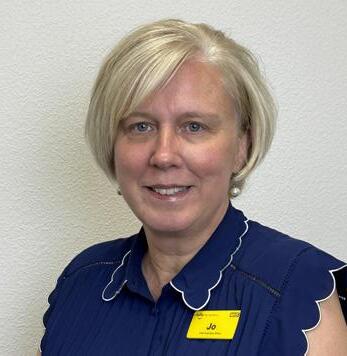
JoWilliams
Jo Williams GROUP CHIEF EXECUTIVE
Meet the Improvement Hub Team

James Owen Deputy Director of Improvement
Mobile: 07595 464015
Email: james.owen@nhs.net

Rebekah Tudor Service Improvement
Business Partner
Tel: 01743 261000 Ext 3104
Email: rebekah.tudor@nhs.net
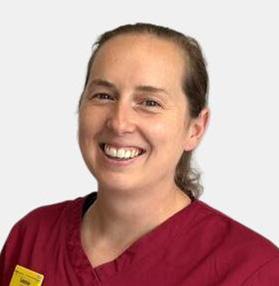
Leonie Seager Consultant Orthodontist and Clinical Lead for Improvement
Email: leonie.seager@nhs.net

Shelbey Fenton-Cook Service Improvement Business Partner
Tel: 01743 261000 Ext 3104
Email: s.fenton-cook@nhs.net
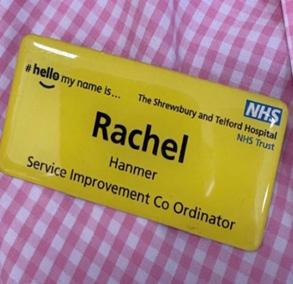
Rachel Hanmer Service Improvement Co-ordinator
Tel: 01743 261000 Ext 3104
Email: rachel.hanmer@nhs.net
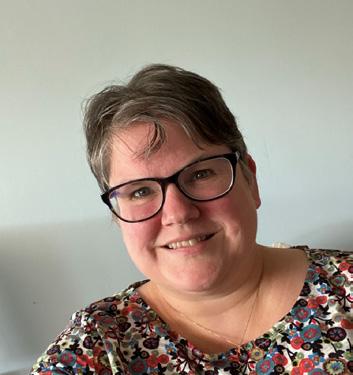
Gemma Styles Service Improvement
Business Partner
Tel: 01743 261000 Ext 3104
Email: gemma.styles@nhs.net

Laura Wild Service Improvement
Business Partner
Tel: 01743 261000 Ext 3104
Email: laura.wild8@nhs.net
Deb Stephens Improvement Hub Administrator
Tel: 01743 261000 Ext 3104
Email: deb.stephens@nhs.net
How to Contact the Improvement Hub
sath.improvementhub@nhs.net
SaTH Improvement Hub
01743 261000 Ext. 3104
Where to Find Us
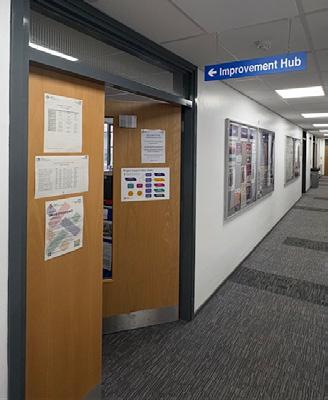
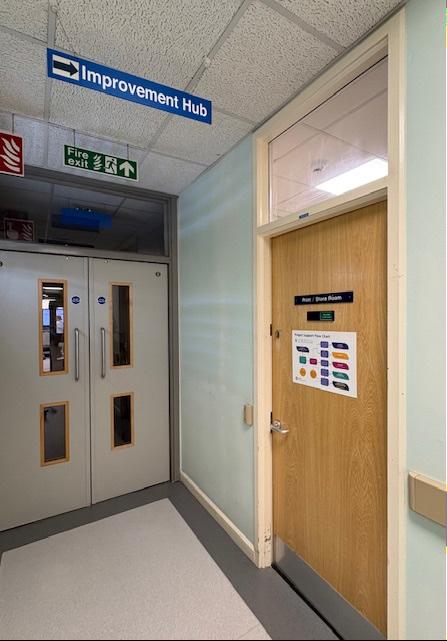
The main Improvement office is based in the SERII building at RSH. We are in Room 2 on the ground floor to the right hand side of reception.
At PRH we have an office in the education centre based diagonally opposite the library (the last door on the right hand side of the corridor.
However we are happy to come to where you work to discuss how we can help you test changes and make improvements in your service.
Where to Find the Improvement Hub Intranet Page
From the Intranet homepage, scroll down to the ‘Our Services & Departments’ box. Then click on the Improvement Hub link. This will take you to the main Improvement Hub page.
From there, you can look through resources, find links to training videos & read the latest news from us.
& Departments
Services & Departments
Project Support Flowchart
The Project Support Flow Chart, is designed to help all colleagues decide which team would be best to support them in their work. It can be used by any of the five teams to direct colleagues who come to them to the right support, or by individual colleagues to decide who to initially approach for support.
Project Support Flow
It is important to remember that colleagues can be supported by multiple teams for their projects as often they will cross over, for example following an audit, someone may want to do a piece of improvement work before they re-audit. In this case they could be supported by the Audit team and the improvement team.
Don’t forget, more than one team might be involved in your project!
Are you implementing a mandated solution or working on a Transformational Project?
Ask for advice from any service
Are you asssessing the standard of care?
Are you assessing the standard of care?
Ask advice from Research, Audit, Improvement Hub or Organisational Development
Improvement Tools
Model for Improvement
Foundational tool that should be used for every improvement project by answering the three questions and using PDSA to test out your ideas.
What are we trying to accomplish?
How will we know that our change is an improvement?
What changes can we make that will result in the improvement we seek?
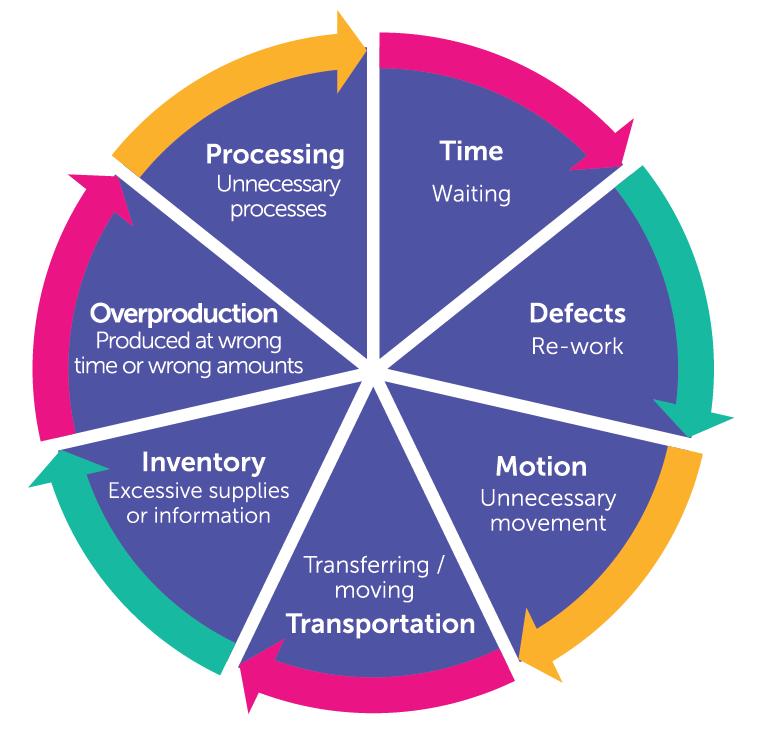
Waste Wheel
Taiichi Ohno’s 7 Wastes
Tool to support colleagues identify areas of concern that would benefit from improvement.
SMART Aims
Linked to Model for Improvement, a SMART aim ensures rigour to any improvement work by ensuring you have considered a specific, measurable, achievable, realistic goal that can be delivered in the time you have available.
S
M
A
R
TBITESIZE VIDEO
SMART Aims
SPECIFIC - have you been specific about what you want to improve?
MEASURABLE - have you included a numerical target?
ACHIEVABLE - is it achievable?
RELEVANT - does it relate to patient outcomes? Can you link it to the strategic aims of your organisation?
TIME-BOUND - have you included a timeframe for the project?
Include the scope, don’t try to eat the elephant in one go
Involve stakeholders
Link to strategic objectives
Be prepared to modify the aim
What’s your elevator pitch?
Don’t include solutions, focus on underlying problems
Stakeholder Analysis Template
A tool used to consider all colleagues that will be affected by the change and how to effectively communicate with them during your project.
A tool that is used for many improvement activities which results in a safe and organised working environment.
SELF DISCIPLINE Maintain standards
SORT Unnecessary from the necessary
A strategy that helps to keep our workplace safe and organised Reduces time spent looking for items that should be readily available
BITESIZE VIDEO
SIMPLIFY Make places for necessary items
Idea Sorting Priority Matrix
Generating ideas for change is essential to improvement (see the bitesize video of a good way of doing this), but not every idea is one that you will want to trial. Use the ideas sorting matrix to help you prioritise which to test out based on level of difficulty versus the impact the change will have. 7 Ways
SaTH Improvement Topics
These bitesize videos are helpful as a reminder of key topics to SaTH’s Improvement Method. Use your phone to scan the ‘QR codes’ to gain access to the videos. If you need any help with your improvement projects, please contact the Improvement Hub sath.improvementhub@nhs.net
SaTH Improvement topics QR Codes
FUNDAMENTALS: These videos detail the content we cover on our SaTH Improvement Fundamentals course. They will help you when you are starting out on your improvement journey.
These bitesize videos are helpful as a reminder of key topics to SaTH’s Improvement Method. Use your phone to scan the ‘QR codes’ to gain access to the videos. If you need any help with your improvement projects, please contact the Improvement Hub (sath.improvementhub@nhs.net)
Starting Out – Key topics to consider at the start of the project’s planning phase Plan: Use the below videos to help you understand your current state, ensure the team is ready for change and use a Project Brief to plan your interventions




Topics to help with change, or to help you ‘Do’ your change Do: Use the below videos to help you understand how your team feel about change, and use creative techniques to generate new ideas



Topics to help ‘Study’ the impact of your change Study: Write up the results of the intervention and use the video to help you with ensuring you have used effective measures to prove your hypothesis

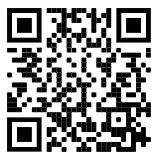
Topics to help ‘Act’ after you have tested a change Act: Write up conclusions and next steps and use the video to help you understand how to make your improvement sustainable

Kubler-Ross
SaTH Improvement Practitioner QR Codes
These bitesize videos are helpful as a reminder of key topics to SaTH’s Improvement Method. Use your phone to scan the ‘QR codes’ to gain access to the videos. If you need any help with your improvement projects, please contact the Improvement Hub (sath.improvementhub@nhs.net)
PRACTITIONER: These videos detail the more advanced aspects of our SaTH improvement methodology which we teach in our SaTH Improvement Practitioner course. These concepts can help you when leading an improvement project.
Starting Out – Key topics to consider at the start of the project’s planning phase Plan: Use these videos to help you understand your current state and ensure the team is ready for change




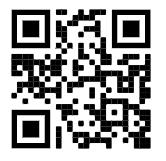


Topics to help with change, or to help you ‘Do’ your change Do: Use the below videos to help you gain peer support with your projects and use further creativity tools to help you gain the buy-in for your ideas, as well as use tools to future proof your improvements
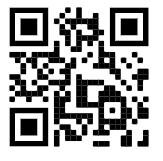


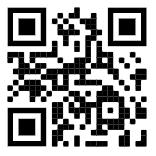

Topics to help ‘Study’ the impact of your change Study: Understand how Daily Management can support you to ensure you keep on track with your improvements, communicate them with your team and achieve your goals

Topics to help ‘Act’ after you have tested a change Act: To support you to sustain your projects consider incorporating the tools below into your daily routine



Genba Walks
SaTH Improvement Training
SaTH Improvement Training is aligned with the Trust’s leadership training offer and is a cornerstone of the cultural work being undertaken at the Trust.
The aim of the programme is to build capacity and capability across the organisation that results in colleagues being involved in supporting and leading the improvements needed to achieve our goal of “Moving to Excellence".
SaTH Improvement training consists of the following:
• Introduction to SaTH Improvement (15 minute video)
• Fundamentals of SaTH Improvement (1-day face to face training)
• SaTH Improvement Practitioner (4 month course consisting of 4 sessions)
• Quality Management Systems (QMS) (12 week programme of support)
To learn more about our training offer, please watch the following short videos, and follow the LMS link below to book your place:
Introduction to SaTH Improvement
The ‘Introduction to SaTH Improvement’ is aimed at all colleagues within SaTH to gain a basic understanding of the philosophy of continuous improvement, with a focus on the key tool that we use, the ‘Model for Improvement’.
The session is designed to provide an awareness of our improvement method at SaTH and how everyone is encouraged to get involved in making the changes necessary to achieve our vision.
Who Should Attend?
The Introduction session is designed for all colleagues.
Content:
• Have an awareness of SaTH’s Improvement methodology and how you can be engaged in improvement.
• Understand how colleagues feel about improvement.
• Have an awareness of the Model for Improvement and PDSA.
• Be aware of the need for measurement.
• Have an awareness of training available & ongoing support.
Programme Delivery:
A video has been made that is recommended to be watched by all new colleagues as part of your induction. All colleagues currently employed by SaTH will be encouraged to watch the video within the next 6 months.
More information can be found here - https://intranet.sath.nhs.uk/ improvementhub/Introduction_to_improvement_training.asp
Fundamentals of SaTH Improvement
The course has been designed to be accessible to colleagues at all levels, and will provide them with the philosophy, tools, and concepts that they can use within their own work areas to make small incremental improvements. The aim of the course is to enable colleagues to practice improvement. Who Should Attend?
The course is designed for all colleagues within the Group
Content:
• Have an awareness of Improvement methodology and how you can be engaged in improvement.
• Have an understanding of the Model for Improvement and PDSA.
• Understand how to identify Waste within your areas.
• Have an awareness of how to interrogate a problem
• Understand how colleagues feel about improvement & generate ideas.
• Knowledge of 5S principles to enable you support a 5S activity.
• Be aware of the need for measurement and types of measures used in continuous improvement.
• Have an awareness of how we document improvement.
Programme Delivery:
The fundamentals course will be delivered over one day of face-toface learning. There is also an E-Learning option available via LMS. If you require this course as a bespoke session for your team please talk to the improvement team.
More information can be found here - https://intranet.sath.nhs.uk/ improvementhub/Improvement_Fundamentals_training.asp
SaTH Improvement
Practitioner
The Practitioner course aims to give you the practical tools and help to complete a project using structured improvement methodology. At the end of the course, you will produce a case study, detailing work you have undertaken to test changes where you work.
Designed to be undertaken after our 1 day Fundamentals course, the practitioner course provides an advanced understanding of our improvement tools and techniques that will enable you to follow the ‘Model for Improvement’ by ensuring you are clear on what you are trying to accomplish (Aim), you are able to evidence if your change has had an impact (Measures), and you have been able to identify suitable changes that you can test to see if they make an improvement to your service (Changes).
During the course you will be provided with coaching support from a member of the Improvement Hub and will identify a project prior to commencing the course, that you will then complete throughout the programme. This will culminate in a case study that you will showcase at the monthly SaTH Improvement sharing huddle
Who Should Attend?
The course is designed for all staff groups. To start the course delegates will have had to have completed the Fundamentals course and have agreement and support from their manager to attend, time to commit to improvement work and support from a manager or supervisor as required to help make changes where you work.
Content:
• Complete a project brief for your chosen project.
• Have a deep understanding of the Model for Improvement and PDSA.
• To practice identifying Waste within your areas.
• Use Mistake Proofing techniques to reduce defects in your work area.
• Have an awareness of facilitation tools and techniques that will support you to engage with your team to understand a process/ problem.
• To have the knowledge and skills to collect, display and use different types of measures in support of an improvement project.
• Write a case study in a poster format and showcase at the monthly SaTH Improvement sharing huddle.
Programme Delivery:
The course will consist of 4 1-day face to face taught sessions over 4 months.
More information can be found here - https://intranet.sath.nhs.uk/ improvementhub/Improvement_practitioner.asp
Following completion of the practitioner course you will become an Improvement Champion.
This role is essential to creating a culture of continuous improvement across the group.
You will:
• Encourage colleagues to utilise the Improvement Hub to support their improvement activity and test change.
• Use the language and philosophy of the SaTH Improvement method, including promotion of the use of Improvement Boards as a local communication tool
• Attend the monthly improvement huddle
• We will enable an ongoing Commitment to improvement after the practitioner course you will be offered quarterly CPD sessions.
• Provide a Champion logo for you to display on your email signature
Quality Management Systems (QMS)
Quality Management Systems training is a 12 week supported programme to guide a team through the set up and use of a Quality Management System for improvement.
Who Should Attend?
This course is for multiple members of a team to come together and decide how to use these principles to help them improve their services. If you are interested in starting this journey with your team, please contact the Improvement Hub.
Expectations of the team:
BITESIZE VIDEO
• To complete training and coaching programme
• To identify measurable aims for your service
• To create a driver diagram and leader standard work
• To introduce a weekly improvement huddle to the team around an improvement board
• To introduce a monthly performance review meeting and report
Commitment from the improvement team:
• To engage with teams about readiness for change prior to QMS training
• To provide training and coaching support
• To provide templates for all tools
• To encourage ongoing use of tools and methodology
• Ongoing support to test change ideas that improve metrics
Programme Delivery:
The programme consists of two 4 hour taught sessions followed up by nine weeks of coaching support and finishing with a ‘learning the lessons’ session on week 12.
More information can be found at: https://intranet.sath.nhs.uk/ improvementhub/qms.asp
Qu a lity Im p rovement
Reason
Why?
Missed Doses in Commun
Produced by: Luc Quality Improvement Project da
A theme in missed doses was reported at Ludlow Hospital in September 2023, which highlighted the need for quality improvement.
Project started in April 2024 due to delay.
PLAN
The aim of this project is to reduce the number of missed doses identified on Dinham Ward (Ludlow Community Hospital) from 20% noncompliance to 5% or less. We will aim to achieve this by introducing a post-it note process to assist with handover of medications.
Implementations included:
Re-introduce drug tabards
Post-it notes on drug charts
Chart checking at the point of handover
DO
Audit completed across one month to identify scale of concern.
Met with ward staff –identified reasons why missed doses occur (including human factors) and discussed potential improvement initiatives:
• Re-introduce drug tabards
• Post-it notes on drug charts
• Chart checking at the point of handover
• Communication with ward manager was extremely beneficial towards project success
Problems included: Communication between project team and staff working within the environment
Making QIP a priority over daily workload challenges
Changes to management on ward led to delay in starting project and current manager involved in project now on ML.

STUDY
Re-audit time doses month
Recent in missed with reason
Acknowledgements & References : Emma Byrne, Ward Manager @ Ludlow Community Hospital
nity Hospital Settings
y Manning
ate: 24th September 2024
AIM

The aim of this project is to reduce the number of missed doses identified on Dinham Ward (Ludlow Community Hospital) from 20% non-compliance to 5% or less. We will aim to achieve this by introducing a post-it note process to assist with handover of medications.
Re-audit completed June 2024 –showed 100% improvement at of audit. However, this audit only captured the missed doses on the ward on that day. A repeat audit across one month is required to identify more accurate results.
Number of ‘missed doses’ incidents reported at Ludlow Hospital
ACT
ADAPT
Continue to monitor. Measure again after WM goes on maternity leave.
Repeat audit over one month to compare data to previous audit data.
Spaghetti diagram of drugs round to identify potential areas for improvement.
Administration document requires amendments. (EMPA improve data gathering in future)
Recent incident report data has shown that there is an increase missed doses being reported again at Ludlow, discussions Ward Manager have been held and she has identified a reason for this.
Once continuous improvement is identified, aim to roll out at other community hospitals.

Hospital / Adam Davies, Pharmacy Technician
Quality Improvement
Title: C Collaborative Excellence: Enhancing Pa and SHR
As part of the every day
Produced by: J emma B rown, Quality Improvement Project
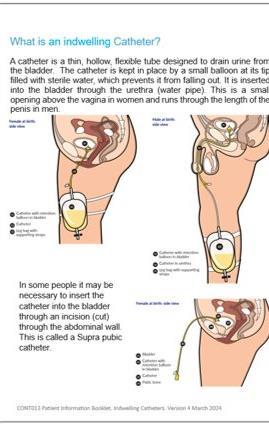
Background: Several patient discharge incident reports indicated missed opportunities for referrals to community nursing regarding essential catheter care and required equipment.
Patient Safety: These gaps posed safety risks for patients needing ongoing catheter management.
Quality Improvement: A group SATH and Shropcom QI project was launched to address these issues, enhance system learning, and streamline catheter care processes.
Plan Group MDT Approach, Actions and Outcomes
• ShropCom and SaTH to create a multidisciplinary group to improve catheter discharge and patient experience.
• Collaboration will enable joint planning, process review, and a better understanding of issues like missed referrals and inadequate discharge equipment or instructions.
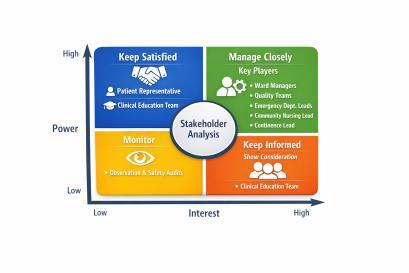
• Identification of Key stakeholders from both organisations,
• Virtual meetings to address patient incidents, review data, and evaluate processes.
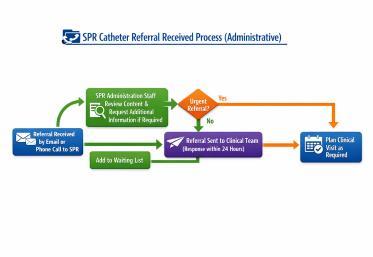
• Analysis of incident data in the group will lead to measurable improvements, including process developing maps, enhanced referral pathways, and revision of checklists and documentation.
• The group efforts aim to reduce safety incidents, increase appropriate community nursing referrals, improve discharge communication, and strengthen staff knowledge of catheter care.

DO:

• Successful launch of the project, featuring digital catheter care pathways and comprehensive stakeholder analysis.
• Enhanced communication and patient care through digital pathway sharing by SHROPCOM.
• Staff training prioritised accurate completion of discharge documentation, supported by quality initiatives.
• Virtual meetings facilitated discussion of incidents and process reviews among key participants.
• Updated patient guides and booklets now meet accessibility standards, with plans for wider distribution.
• Patient information resources will be accessible via staff intranet and public websites.
• Incident data highlighted frequent missed handover opportunities, prompting focus on education and process improvement in A+E and inpatient wards.
• Referral pathways and discharge checklists reviewed and refined to enhance communication.
• Project adapted in response to data and stakeholder feedback, addressing patient safety and discharge

atient Catheter Care Discharges Across SATH ROPCOM
N ancy M oreton and Sarah Venn
Project date: 01/10/2025
STUDY

By 01/04/2026, we will work collaboratively to improve the discharge process for patients with catheters, ensuring a seamless transition from the acute trust to the community trust. Our objective is to decrease patient safety incidents related to catheter care by 50% and to guarantee that all patients are referred to the appropriate community nursing service with the necessary equipment. We will communicate this project to enhance staff awareness and understanding of the discharge and catheter care procedures and ensure effective planning for trials without catheters for all eligible patients .
ACT
The QI project remains ongoing, with the working group continuing to offer opportunities for regular data review, sharing patient incident information, and integrating lessons learned. To illustrate the progress made so far regarding incident numbers, please refer to the chart below, which summaries the incidents recorded in the five months before the project began compared to the five months during the working group’s activities and the progress achieved.
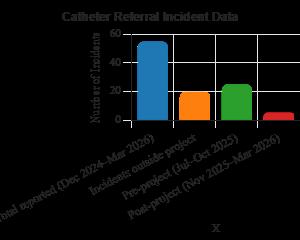
This chart demonstrates a substantial drop in catheter referral incidents following the commencement of the project: from 25 in the five months before to only 5 in the five months after, highlighting the effectiveness of targeted process improvements and education initiatives.

In the Act/Adopt phase of the QI PDSA cycle, the continued implementation of the project demonstrates a strong commitment to patient safety and quality improvement. The ongoing review of incident data, coupled with regular working group meetings, ensures that learning is shared and improvements are embedded across the team. Looking ahead, the planned12 month , follow-up evaluation will provide valuable insights to inform future practice and highlight successes to patient safety and divisional committees.
Next steps for consideration include exploring opportunities to expand the project, focusing particularly on
• increasing the number of patients receiving timely trials without catheters,
• reducing the prevalence of long-term catheters,
• minimising catheter-associated urinary tract infections within the critical 12week post-discharge period.
• Minimise catheter-associated urinary tract infections in the first 12 weeks postdischarge.
By maintaining momentum and fostering a culture of continuous improvement, the QI initiative is set to deliver tangible benefits for

SaTH Improvement Hub
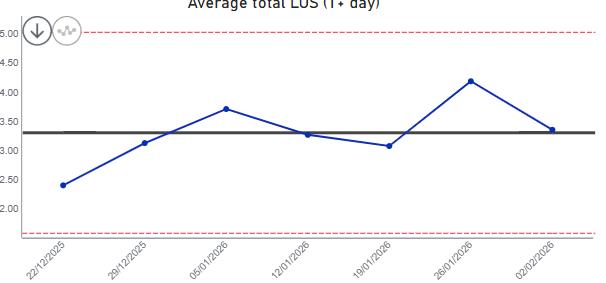
Ward 25 opened on 22nd December 2025 with an initial 18 bed footprint followed by an additional 18 beds opening 29th December 2025. The ward forms part of the General Internal Medicine pathway and was designed to support de-escalation of the emergency department by delivering a high-functioning rapid turnout unit.
PLAN DO STUDY
Two Quality Management System (QMS) workshops were held - one with consultants and nursing leaders, and one with the wider nursing team. Across both sessions, the focus was to establish a clear and shared understanding of:
Ward culture and what “success” looks like for a rapid turnover unit.
Shared aims for Ward 25 and how teams will work collectively towards them.
Standard work and an agreed rhythm of the day, including behaviours, expectations, and escalation routes.
Criteria for operating as a rapid turnover ward, including patient selection and clinical pathways.
These sessions resulted in coproduced standards, a defined daily cadence, and a collective understanding of how Ward 25 should function to optimise patient flow.
Ward 25 has now been open for 7 weeks. Early signs show promising progress as well as challenges.
To keep the length of stay (LOS) within 3 days post-acute intervention, criteria was developed and shared with the ward and a pull model was developed to ensure patient selection was within criteria.
Best practice was implemented during board round to ensure referrals were sent, investigations reported and blood results shared – this has supported earlier senior clinical decision making, and much faster potential to definite discharge turnaround.
Consultant-to-consultant referrals have led to faster response times and increased same-day in-reach.
Use of virtual ward and Outpatient
Parenteral Antimicrobial Therapy (OPAT) has been high, and the integrated front door team are now in-reaching to support referrals.
Consultants are also fully utilising the new General Internal Medicine (GIM) outpatient clinics.
STUDY
Ward 25 since opening due to the shift from walking ED/AAU/acute
• Too few patients
• Increase in inappropriate LOS.
• Unsustainable
• Current push
• Inappropriate
• Increase in patients
• Increase in patients
One of the biggest consultant presence later, late-arriving same day.
ACKNOLEDGEMENTS & REFERENCES | Suresh, Sana, Mona, Richel, Siji, Chinelo, Jey, Johnson, Michael, Elizabeth, Stacy, Michelle, CSS
25 LOS
Capacity and Flow
S. Fenton-Cook
January 2026
Sustain the following for a period of 90 days from ward opening 22nd December 2025:
• LOS: 72 hours post acute intervention
• Pre 12:00 discharges: 35%
• Pre 17:00 discharges: 80%
• PW0 discharges: 75%
opening has remained at a LOS of 72 hours, raising slightly in recent weeks from pull model to push. Initial pull model (consultant + ward manager ED/AAU/acute floor) led to: patients flowing through the acute floor from ED. inappropriate patients being diverted to 22SS, negatively affecting their
Unsustainable having senior members of the team off ward multiple times a day model trial showing: patients arriving before handover. patients requiring therapy (despite agreed “no therapy provision” criteria). patients requiring social care input, slowing discharge.
biggest contributions to maintaining within 72 hours has been the consistent presence on the ward throughout the day. Because consultants remain on site results can be reviewed immediately and plans for discharge agreed the
ACT
Current and planned actions include:
Refinement of the Ward 25 SOP and criteria, with consideration to:
• Expanding criteria to include patients needing therapy for equipmentonly needs.
• Accepting patients requiring small packages of care within a local footprint.
• Further testing of push vs pull model, balancing:
• Patient suitability
• Timing of flow
• Impact on other areas
IMPROVING PAIN SCORE
SaTH Improvement Hub
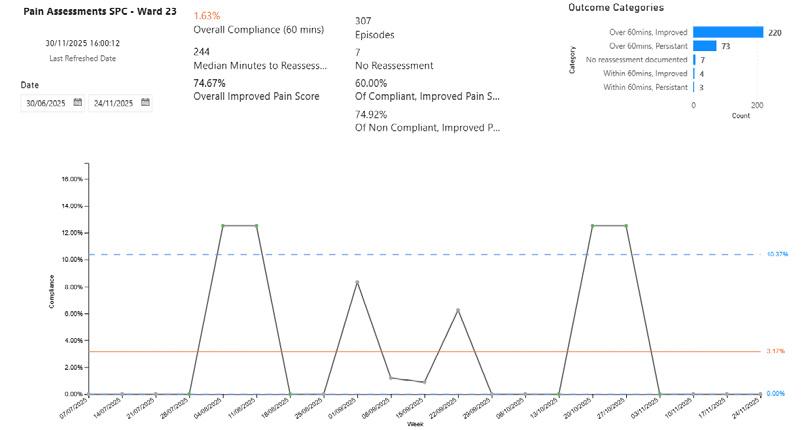
SaTH Trust guidelines recommend reassessment of pain within an hour of intervention. From July 2025 to October 2025, Ward 23 documentation of pain score reassessment within 60 minutes for patients with scores >4 had a compliance rate of 2.13% with a median time of 244 minutes for reassessment. It was not possible to tell whether this was because pain was not reassessed after interventions or whether it was assessed but simply not documented.
PLAN DO STUDY
The proposed intervention was to display posters and deliver teaching to educate on the requirements for pain assessment.
The compliance rate and median time to reassessment was then monitored weekly with an SPC chart before and after the teaching was delivered and before posters were displayed.
The following meetings were arranged to discuss this intervention:
- On 12th September 2025, a meeting was had with a member of the pain team following correspondence about the project to discuss the compliance rate and to recommend and create tools ( e.g. teaching sessions, posters) to aid in overcoming the barriers and achieving a compliance rate of 50% by 2nd December.
- On 5th November 2025 meeting with the ward manager and senior ward nurses to discuss the current compliance rate and possible barriers to reassessment or documentation.
A refresher training session on pain reassessment was carried out for ward 23 nursing staff at their nightly handover on 11th November 2025.
A ”PAINT” campaign was started to encourage reassessment compliance, and posters spreading awareness of the campaign were published and displayed at vantage points on the ward.
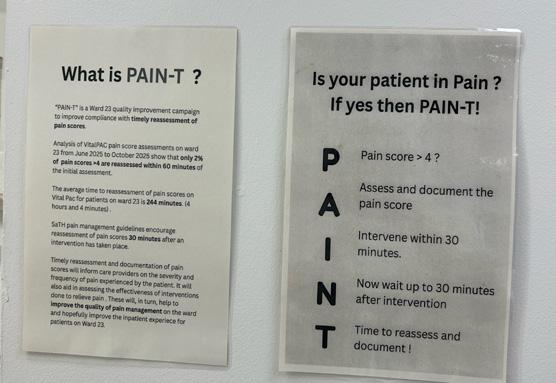
Weekly compliance rates were announced to nursing staff to update them on their progress.
STUDY
Before the teaching of ward 23 with reassessment 2.13%.
It was expected that proposed interventions rate will increase, however by the end of the project the compliance rate decreased even further 1.63%. Feedback from nurses identified the as barriers to achieving compliance:
Human Factors:
• High workload
• Task interruptions
• Cognitive overload Workflow Gaps:
• Pain escalation document reassessment
• No digital place
• Poor visibility of
• Software limitations
• No algorithmic
• System design treats evaluation.
REASSESSMENT ON WARD 23
Pain Score Reassessment Compliance Rate
Gloria Udzu
December 2025
session and poster publication, the overall compliance rate reassessment of initial pain scores >4 within 60 minutes was with the interventions this however project had further to from the following achieving and staffing pressures interruptions during drug rounds and observations overload leading to missed reassessment steps
To improve compliance with documentation of reassessment of pain scores of 4 and above within 60 minutes of initial assessment to 50% by 2nd December 2025.
ACT
relied on verbal communication so no obligation to reassessment place to document interventions of pending reassessments limitations ( CareFlow/VitalPAC) alert when pain score ≥4 treats pain as a static value not a clinical process requiring
Another meeting with the ward manager and senior nurses will take place on 9th December 2025 to discuss the results of the project and the training and posters will be revised. Compliance rates will be monitored for 4 more weeks and reassessed again.
A meeting will be organised with the pain team to discuss the results of the project and possible additions to the pain assessment training programmes. The following recommendations will also be made:
Proposed system enhancements on VitalPAC to support clinical workflow such as
1. Automatic alerts for moderate pain >4
2. Mandatory documentation of intervention given and time and result of reassessment.
Safety-critical escalations ( e.g. repeated pain scores >7 triggers a review).
SaTH Improvement Hub
Increasing the number of elective procedures that can be performed directly shortens the time patients wait for treatment. The Theatre List Allocation aims to improve theatre utilisation to 97% by aligning theatre sessions with the highest-volume waiting lists. This targeted scheduling ensures that available capacity is used where it’s most needed.
PLAN DO STUDY
The team engaged in discussions to generate ideas on how to improve the process of theatre utilisation.
It was agreed that the team would trial implementation of a stable rolling theatre schedule. Stable allocation allows teams to plan ahead with confidence. Theatre lists are predictable and booking teams can confirm patients earlier, reducing last minute changes and cancellations.
When lists are stable, patients can be scheduled earlier and with greater certainty. This reduces anxiety, improves pre-operative preparation, and minimises the risk of last-minute cancellations.
A review was undertaken of the theatre list and sessions allocated based upon clinical demand and waiting list size.
A rolling two week rota was developed and the list allocation rules updated. The new theatre timetable has enabled all 15 elective theatres to open for the first time since the pandemic.
Speciality teams are now required to assign surgeon names by Week 6 rather than Week 4 as previously mandated. If a surgeon is not allocated then the session is offered out to another speciality.
The list allocation began 31/03/2025 and has been utilised each week.
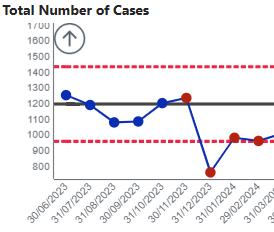
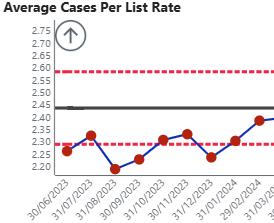
The theatre timetable improvement in the
• Total number
• Total number
• Percentage of patients being
• Theatre utilisation
ACKNOWLEDGEMENTS & REFERENCES | Bookings Team, Jas Williams, Grace Allsobrook, Stacey Evans (Theatre Session Co-Ordinators), Theatres, Pippa Howard, Natasha Little (Theatre and Inpatient Scheduling Services Manager), Ella-Louise Moore (Assistant Operations Manager), Chris Weston (Business Information Team), Rebekah Tudor (Service Improvement Team). This project would not be possible without all key members of the team working together.
st Allocation
Planned Care
Kevin Lloyd / Ella-Louise Moore / Natasha Little
July 2025
AIM
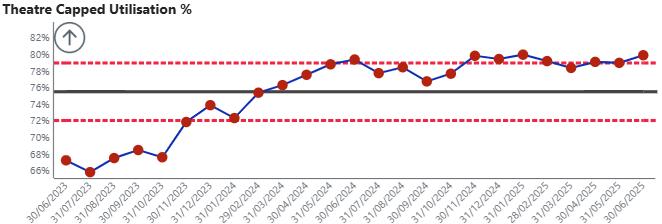
To improve the percentage of utilised theatre sessions to 97% by 31/07/2025.
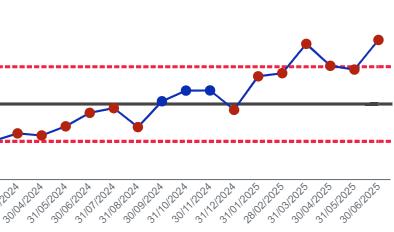
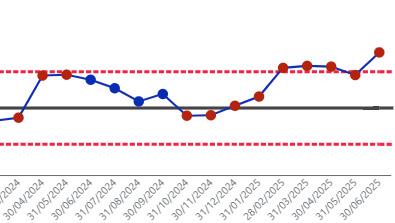
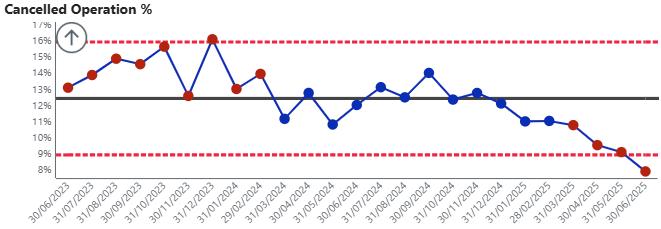
timetable has been in use for 3 months and has resulted in statistically significant the following metrics: of cases (have increased above control limits) of cases per list (Sustained improvement at and above control limit) of cancelled operations has demonstrated a significant reduction with 8% of being cancelled in June 2025. utilisation remains stable with further room for improvement.
ACT
The theatre list planner is going to be ADOPTED. Small changes will be made to speciality allocation in order to maximise the session utilisation in line with demand. This process will continue to be monitored as part of the theatre task and finish group and updated as required. Further review to take place in December 2025.
Howard, Rosie Smith, Dan Bothwell, Kevin Lloyd (Theatre Performance Manager), Anaesthetics Team, Speciality Teams, Ward Teams, Flow Team, Pre-Op, Team), Raj Uppal and Natalie Allen (PMO Team), Sai Annadurai (Consultant Anaesthetistella), Saurav Chakravartty (Consultant Upper GI & Bariatric Surgeon),
Trial of Decaffeinat
Theme | Produced by | Case Study Date |
Recent studies have evidenced that a reduction in caffeine consumption has led to reduced falls in a series of care homes by 30%
PLAN DO STUDY
The plan was to introduce a trial of decaffeinated coffee and tea onto ward 25 for a period of three months, as published research suggested that this would reduce the number of falls.
Falls data would be collected throughout the trial.
Discussions were held with our research colleagues to ensure that the test of change was done in keeping with ethics and was not overstepping into research.
Due to the increased cost of decaffeinated drinks (£67.59 per month for ward 25 so £202.77 for a three-month trail) support was gained from SaTH Charities to help with the funding for the trial.
Engagement from the staff team was sought via their involvement in a blind taste test. There were 6 coffee drinkers in total – 5 of which identified the decaffeinated as their preferred coffee and 5 tea drinkers in total – 3 of which identified the decaffeinated as their preferred tea.
It was agreed that the trial would take place between January 2025 and March 2025 and be run on an opt out basis, (patients were told that drinks provided would be decaffeinated and that if they wanted caffeinated drinks, they needed to request them).
Although patients taste of the decaffeinated not support that it
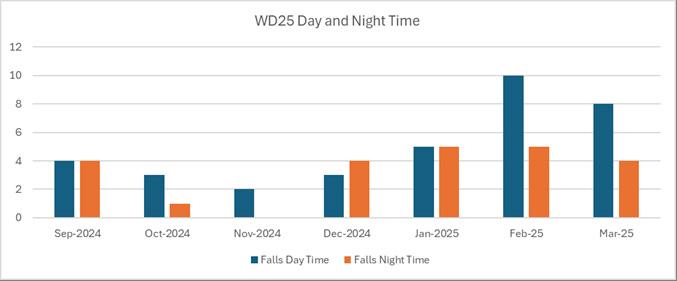
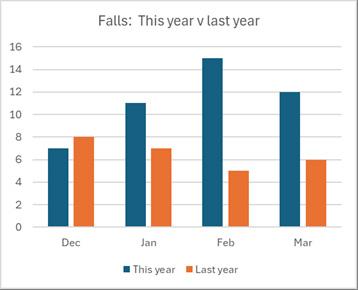
The data shows that: but were higher that last year.
Proportion of falls are less at night.
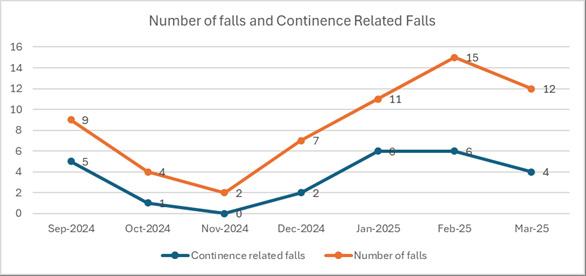
Continence related with the increase in The last 2 months repeat falls on WD25. ward 25, despite being risk may not have trial.
ACKNOWLEDGEMENTS & REFERENCES | With thanks to all the staff and patients on ward 25, in particular our housekeeping
ed Drinks on Ward 25
Falls prevention
report that they prefer the decaffeinated drinks the data does has led to a reduction in falls. that: Falls decreased in March that before the trial/this time when comparing day vs night related falls has not gone up in line in falls, this is a positive. there have been a lot of WD25. This possibly means that being an area with a high falls been the best place for the
AIM
To reduce the number of falls on Ward 25 at Royal Shrewsbury Hospital By 15% by 31st March 2025
Clare Walsgrove, Lynette Williams, Mandie Esp, Mandy Leverington and Gill Joseph June 2025 housekeeping team.
ACT
There are queries about if the trial would have been more successful with a different cohort of patients, however both the quality matron and the reconditioning lead are leaving their posts in SaTH and therefore, given the cost involved, it has been decided to ABANDON a further trial at the current time. Although there is no reason to believe that the decaffeinated drinks were the reason that falls increased, they certainly did not result in a reduction of falls.
Culture
At its core organisational culture is the shared experience of how it feels to work here. It is not posters, presentations or strategies, it is what happens consistently within the day to day activities of the organisation.
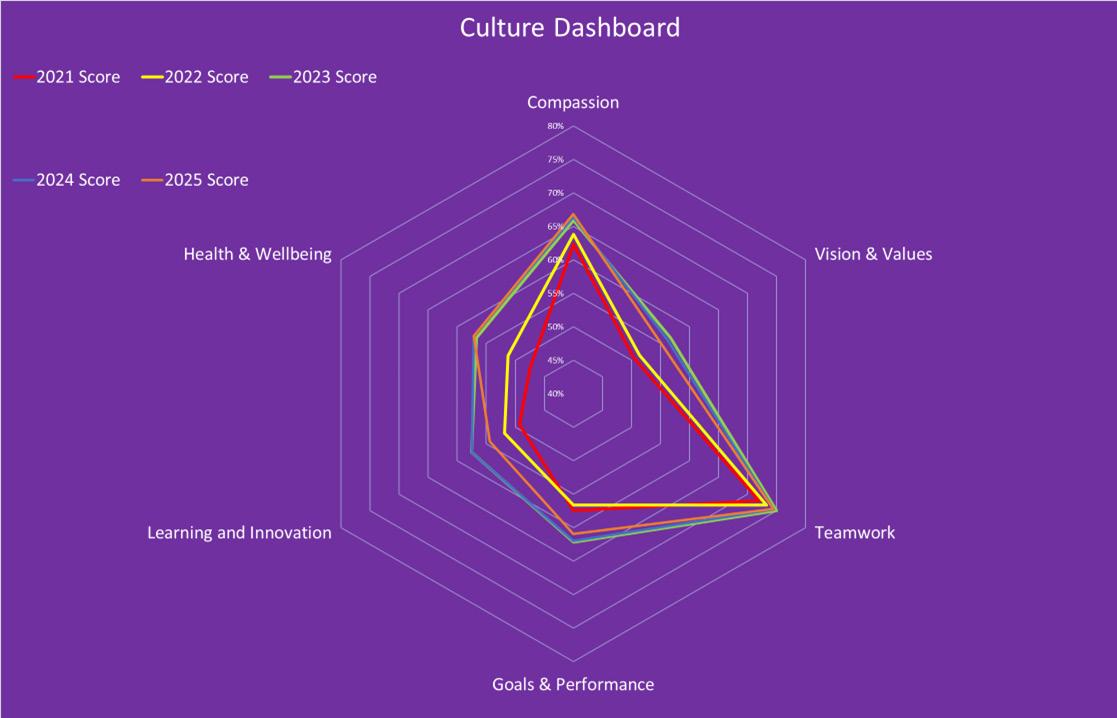
The current Culture Dashboard below was established in 2022, it was created using data and information from the Staff Survey. It identifies six key themes that are important to the Trust.
In 2026 we are embarking on a new chapter for the organisation as we transition into the group model, brining The Shrewsbury and Telford Hospital Trust and Shropshire Community Health Trust together under its new name; Shropshire, Telford and Wrekin Community and Hospitals NHS Group.
To support the group model, approach a programme of cultural transformation will be commencing, this will enable the two organisation’s to work in a more collaborative and cohesive way and thus providing better care and services to our patients.
Our Vision and Values
The Shrewsbury and Telford Hospital NHS Trust is an organisation that strives to provide high quality, safe care for our patients in an environment which our staff are proud to work in.
Our Vision
We believe that by adhering to our Vision and working with our Values in mind we can behave in a way which will ensure the right results for the people that matter most - our patients and their families
Our Values
Our Trust Values provide a guide for our daily lives which we are all expected to uphold, both at work and when we are representing the Trust.
Our Values were developed by staff and our patients, so they represent what is important to us within the organisation and the way we should all behave towards patients, carers, visitors, partners and each other.
You will see our Values throughout the Trust; they are not just words on a page, they represent what we are about here at SaTH. We want patients and their families to say that the care and service they receive from all of us is consistently high-quality, safe, effective and personalised, so the feelings behind the Values shouldn’t come as a surprise to anyone working in the NHS.
The reason why it is important that they are clearly written down is so we all know what’s expected, and none of us are surprised if we are asked to explain any unacceptable behaviour. Ultimately, if we follow our Values, we will provide services that are better for our patients and better for each other.
Our Vision
“To provide excellent care for the communities we serve”
Our
Values
Partnering Ambitious Caring Trusted
Working effectively together with patients, families, colleagues, the local health and care system, universities and other stakeholders and through our improvement alliance, with UHB and our improvement partnership with Sherwood Forest.
Setting and achieving high standards for ourselves personally, and for the care we deliver, both today and in the future.
Embracing innovation to continuously improve the quality and sustainability of our services.
Showing compassion, respect and empathy for our patients, families and each other, caring about the difference we make for our community.
Open, transparent and reliable, continuously learning, doing our best to consistently deliver excellent care for our communities.
Par tnering Ambitious Caring Trusted
Values and Behaviour Framework
Taking into account all the feedback from the second online conversation, the new behaviours framework for SaTH below.
Behaviours (Do’s)
We work collaboratively to achieve team goals & priorities.
We help each other with a ‘can do’ attitude that supports team morale and motivation.
We actively listen to make sure we understand & where possible, we make the right decisions based on what we learn from others.
We are innovative and communicate about our barriers to change and we work together as a team to make improvements.
We ensure everyone feels safe to speak up and put forward their ideas.
We set high standards and we celebrate and recognise each other’s and the team’s successes together.
Behaviours (Don’ts)
We don’t work in silo’s.
We don’t undermine other people or teams.
We don’t ignore people when they need support.
We don’t avoid tackling issues that impact patients, families and colleagues.
We don’t dismiss ideas; When ideas for improvement are put forward, we seek support, make a plan and take action to try new things.
We don’t tolerate poor standards, and we recognise that we are all responsible for upholding high standards at our Trust.
We treat all people with civility and respect, valuing each other to enhance team morale, so it has a positive impact on patient care. We are inclusive; ensuring everyone feels part of the team with shared goals to achieve together.
We are kind to each other, our patients and community.
We treat each other fairly, recognising the importance of every role within our Trust.
We are open and honest, and encourage people to speak up whilst respecting confidentiality, continuously learning. We take responsibility & are accountable for our actions and decisions.
We don’t tolerate bullying or harassment.
We don’t tolerate people being disrespectful or rude.
We don’t turn a blind eye to poor behaviour.
We don’t blame others.
We don’t over promise and under deliver.
We don’t keep making the same mistakes.



NHS Knowledge and Library Services
Taking the heavy lifting out of evidence searches
Do you need a hand with your Evidence Searches?
Contact your Knowledge and Library Service:
Telford Health Library
01952 641222 Ext: 4440
sath.telford.library@nhs.net
Shrewsbury Health Library 01743 492512
sath.shrewsbury.library@nhs.net
Library Website www.library.sath.nhs.uk
Notes, Thoughts and Ideas
SaTH Improvement Hub
SaTH Improvement Hub
Copyright © The Shrewsbury and Telford Hospital NHS Trust 2026
Version 5 - 05/26