Impact Report 2023-24
Transforming lives, protecting our planet


Together, we help others and help protect our planet
Impact Report 2023-24
Transforming lives, protecting our planet
Together, we help others and help protect our planet
Today, The Salvation Army is at the forefront of positive social and environmental impact. Salvation Army Trading Company Ltd (SATCoL) was established in 1991 and has evolved from our parent charity’s interests in reuse and recycling, charity shops and other community-based initiatives.
We have continued to build on our work and it has been another remarkable year. Our colleagues have engaged in initiatives which further support our parent charity, provide innovative solutions to our partners and serve our communities across the UK.
In the Financial Year 2023-24, we raised over £11.2m for The Salvation Army and over £4.1m for our partners’ charities and other causes. We have achieved much in the year:
• We opened 10 new donation centres, and refurbished 9 high street charity shops. In total we served around 6m customers in our stores, providing affordable and good quality products.
• Along with our partners, Project Plan B, we opened the first commercial-scale, post-consumer polyester recycling plant known as Project Re:claimTM. We also enhanced our FibersortTM technology.
• We collected 67,000 tonnes of clothing and 18,000 tonnes of other items - this positively contributed to 453,000 tonnes of avoided emissions.
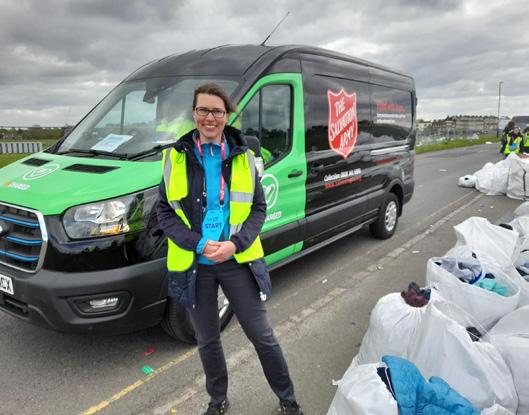
• We were announced as the official clothing collectors for London Marathon Events Ltd – for the London Marathon alone, we collected over 30,000 items of clothing which were sent to our shops to be reused in the UK to raise funds for our charity.
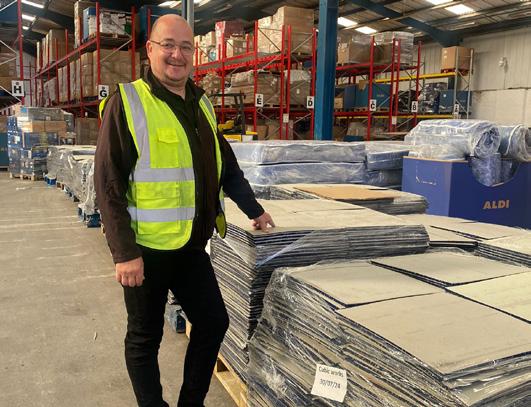
• We received wide-spread praise for two new initiatives – our Flooring Reuse and GiveITBack (IT Reuse) schemes.
• We issued thousands of FREE clothing vouchers from our stores across the UK – 5,195 were redeemed in the past Financial Year (an increase of 76% on the previous year).
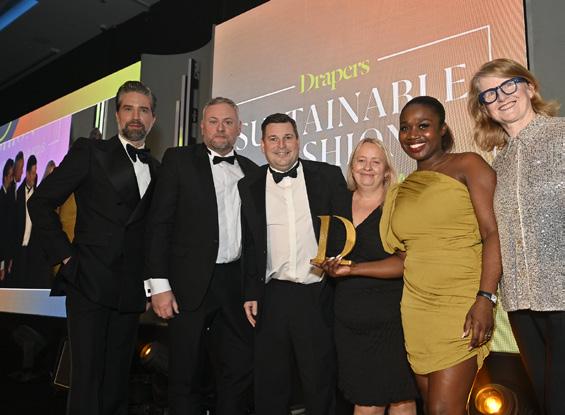
• We received recognition for our work, including awards from the Charity Retail Association and Drapers.
You can read more about our work, and how we make a positive social and environmental impact, in this report.
We are extremely grateful for your continued support, thank you.
SATCoL’s social, environmental and financial highlights for the year 2023-24
People
5,195 (+76% YOY) FREE clothing vouchers redeemed
6m (+9% YOY) customers served in our shops
1,210 paid colleagues
How your support helps
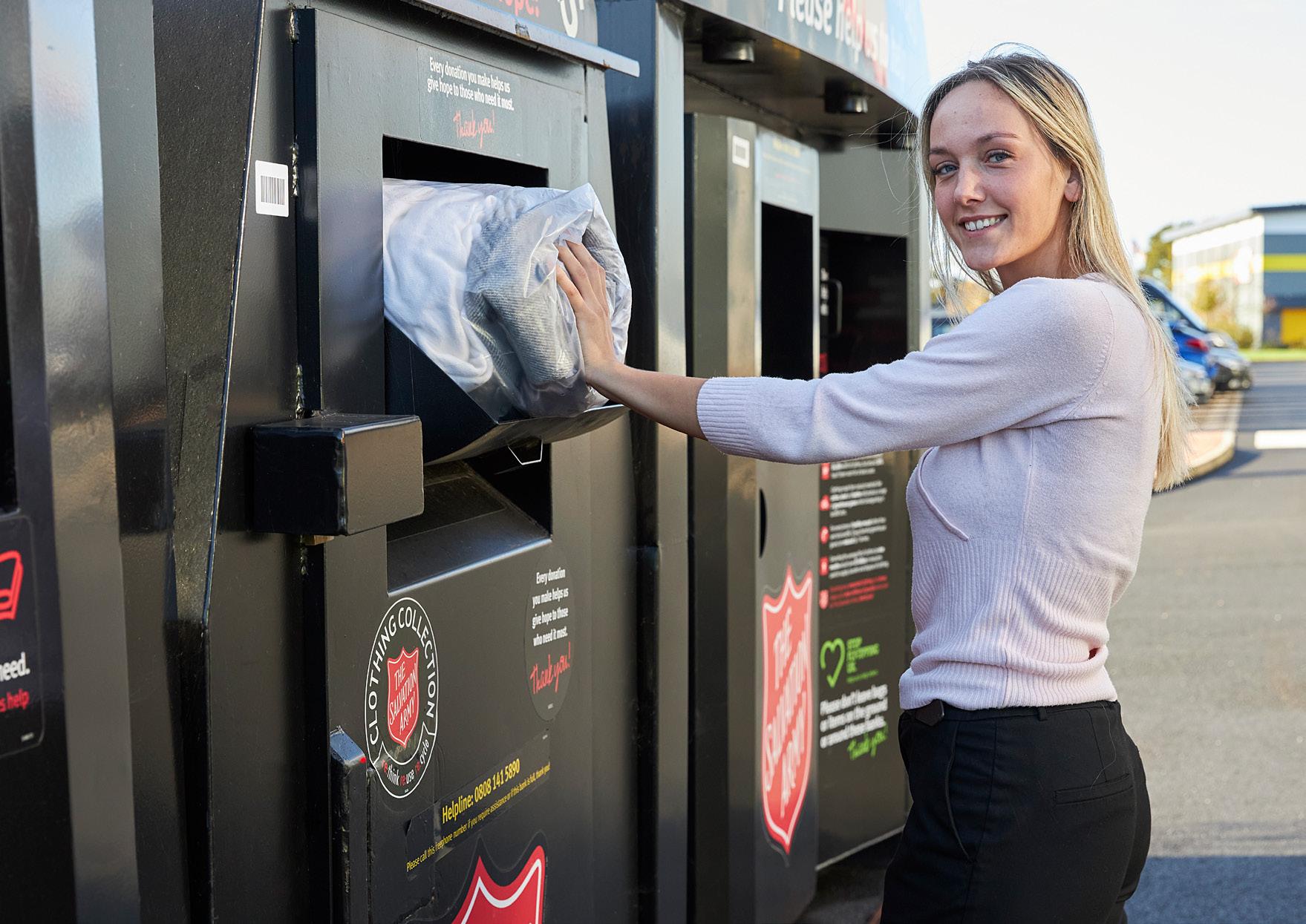
Your generous donations support people in communities across the UK, and they make a positive environmental impact.
Some of our top priorities, therefore, are to encourage and enable more people to donate through our conveniently located clothing banks and stores, and new corporate partner services such as our world-leading technologies and processes that are transforming textile reuse and recycling.
We focus on educating people on reuse, recycling and the circular economy. We took part in UK-wide campaigns including Sustainable Fashion Week and Volunteers’ Week. Our stores across the UK put on displays to educate and engage their local communities about our work, and many hosted tea parties to say ‘thank you’ to our volunteers who play an enormous role in our success.
Download our FREE Reuse, Repurpose, Restyle magazine: Restyle Magazine - Salvation Army (salvationarmytrading.org.uk)
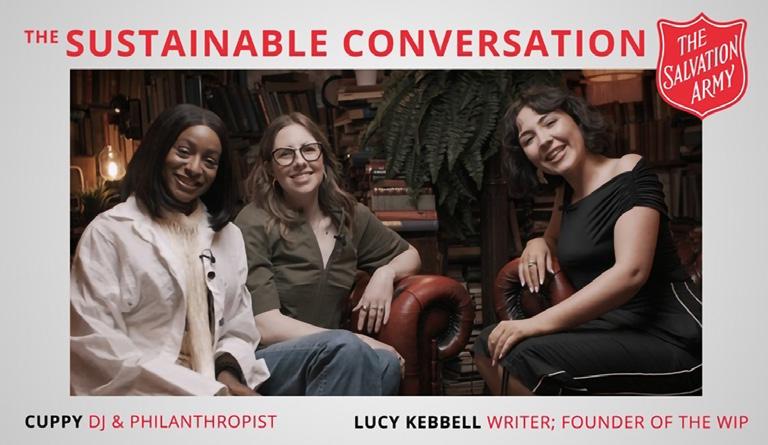
Listen to our Sustainable Conversation podcast series 2, which featured guests from fashion, TV and music, and leading advocates for sustainable fashion
Find the SATCoL podcast series on Apple, Spotify or by visiting SATCoL TV: www.satcol.org/satcol-tv
Support our work in reuse and recycling by visiting your nearest donation point or store: www.salvationarmytrading.org.uk/find-us/
Interested in volunteering? Start your journey with us: www.salvationarmytrading.org.uk/support-us/ volunteering
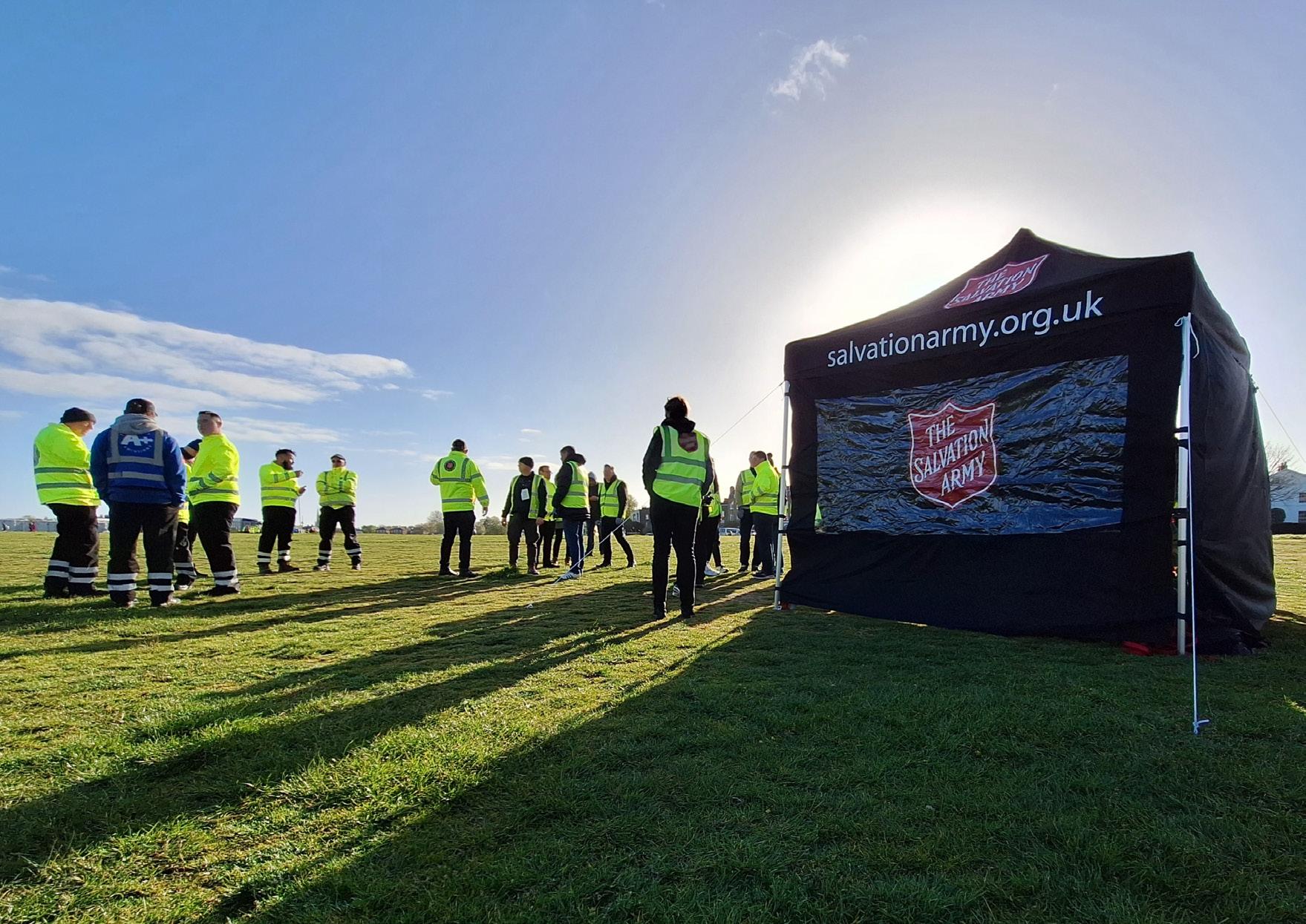
Our team arrived early in the morning to prepare for the London Marathon event
A large part of our work is in reuse and recycling.
We encourage the reuse and recycling of textiles and other items through our nationwide network of charity shops, donation centres and clothing banks. We work with community groups, large organisations, local authorities, schools, colleges and individuals - all who share our aims to help others and help protect our planet.
We are continually innovating and introducing new services. In the past year we:
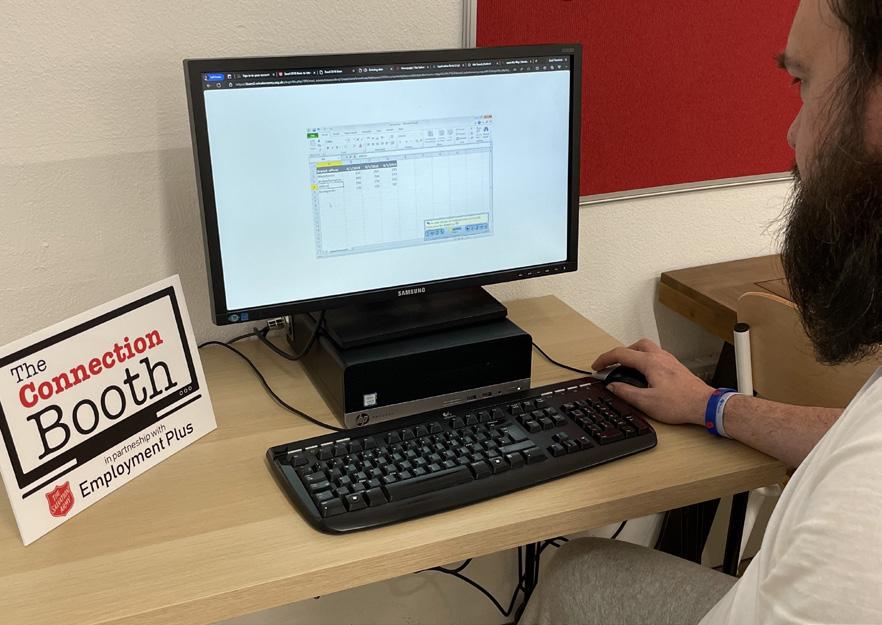
• Hosted the first Connection Booth, utilising donated and refurbished devices from our GiveITBack Programme.
Working together with The Salvation Army’s Employment Plus team, we aim to close the gap on digital exclusion and offer skills training. See page 13.
• Achieved wide-spread praise for our Flooring Reuse Programme, a scheme which provides a practical solution for pre-used carpets whilst helping those in need. See page 13.
• Became part of a major project known as ACT UK (Automatic-sorting for Circularity in Textiles) working alongside partners including WRAP and Tesco. We have invested in 20 clothing collection sites, providing newly designed ‘wear again’ and ‘worn out’ clothing banks and are monitoring the results. This will feed into future innovative textile collections and recycling sorting processes.
• Opened our post-consumer polyester recycling plant known as Project Re:claimTM – the first commercial-scale operation designed to recycle post-consumer and end-of-life textiles.
Read more on page 15.
8,400+ clothing banks
40+ donation centres
4 processing centres
420+ corporate partners
1,210
200+ high street charity shops employees
400+ Recycle with Michael school collections
5,195 volunteers

Each year, our parent charity provides a safe space and bed for around 3,000 people every night in Salvation Army Lifehouses
The funds we raise as the trading arm of the charity support the work of The Salvation Army. In communities across the UK, Salvation Army officers, volunteers and employees are helping those struggling to make ends meet, or providing opportunities to help transform lives. Below is just a small snapshot of our parent charity’s work across the UK:
• In Hamilton, near Glasgow, a service run by The Salvation Army with South Lanarkshire Council, has provided safe spaces for Ukrainian refugees and helped them make a home from-home in the most difficult of circumstances.
• In Bangor, Northern Ireland, The Salvation Army’s Befriending Service reached out to people who are lonely and depressed. One service user said: “Having someone I can speak to or go out for a walk with has changed my life completely.”
• In Bicester, Oxfordshire, our charity is providing young adults with special educational needs the opportunity to gain catering and hospitality skills at a community café.
We have a ‘help others’ approach to everything we do. In addition to the funds we raise, colleagues in our Central Support and Processing Centres, as well as our Collectors and shop colleagues, work closely with Salvation Army churches and community projects across the UK offering other direct support. Here are just some of the ways we help:
• Last year 5,195 FREE clothing vouchers were redeemed in our stores by people and families in need – a 76% increase on the previous year.
• Our Clothing Collection Division supported bereaved families and friends by responding to 447 requests for home collections.
• In the last financial year, we raised over £11.2m for The Salvation Army, plus over £4.1m for our partners’ charities and other community-based initiatives.
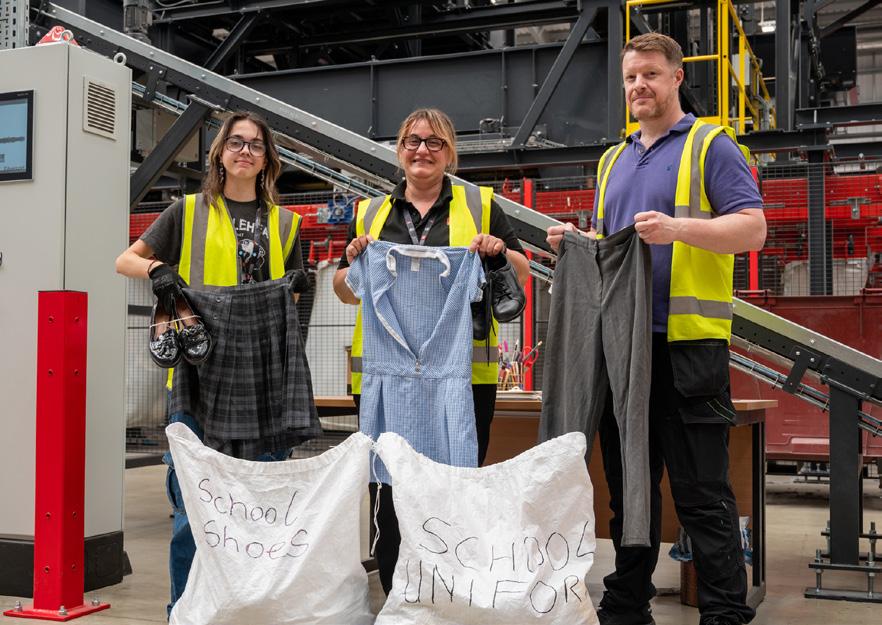
• Our Clothing Collection Division and stores provided hundreds of FREE school uniform items to school children and families.
• We collected from over 400 schools via our Recycle with Michael scheme, and hosted over 100 students at our Processing Centres to support their learning in textile reuse and recycling.
• By end of March 2024, over 3,000 denim tote bags have been upcycled from old and unwearable jeans by prisoners at HMP Five Wells, and sold in our shops.
• 188 of our volunteers moved into paid employment
5,195 FREE clothing vouchers redeemed
6m customers served in our shops
£4.1m raised for our partners
188 volunteers moved to paid employment
£11.28m raised for The Salvation Army
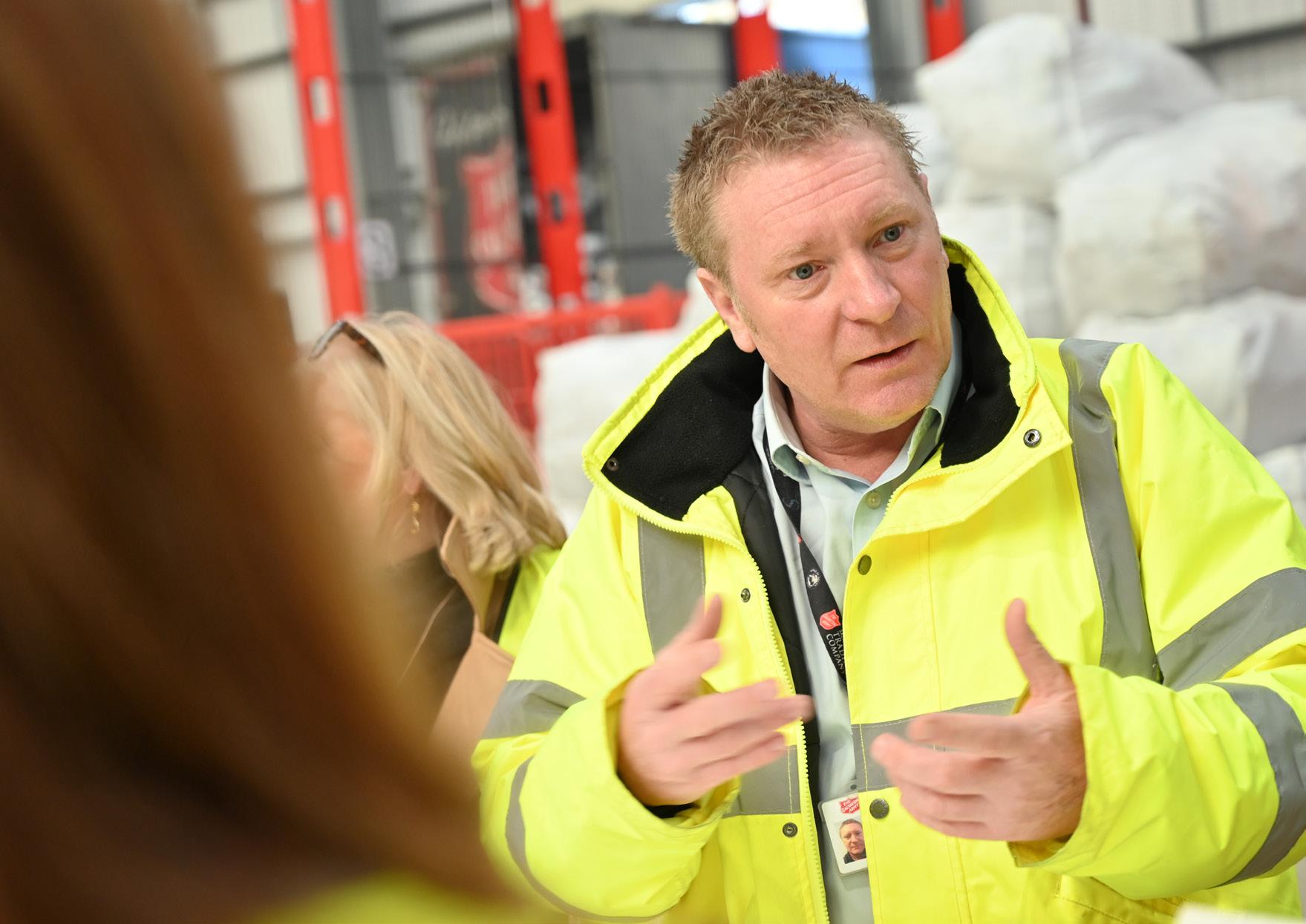
SATCoL is uniquely placed in helping donors, corporate partners and community groups to reuse and recycle:
• Our nationwide network of clothing banks and stores provide easy access to donation points.
• Our 240+ charity retail stores, which includes our growing network of donation centres, offer good quality products at affordable prices for communities, and a ready-made market for corporate partners who want to repurpose items responsibly.
Working with organisations and local authorities, we offer professional and trusted services:
• Our Corporate Partnership team respond quickly to requests, delivering solutions in all aspects of overstocks, customer take-back collections, returned and end-of-range stock management.
• Our large nationwide network eliminates transport and logistics costs.
• Our investments in modern processing centres and new technology mean we are able to offer new ways of reusing and recycling textiles on a commercial scale, never before seen in the UK and unique to SATCoL.
Working with organisations and local authorities, we offer professional and trusted services:
• Our accredited ITAD (IT Asset Disposal) scheme, known as GiveITBack, provides a secure service to organisations who can also give back to the community.
• Our Take Back Schemes offer partners instore and online options for their customers to donate unwanted textiles in a convenient way.
• Our Flooring Reuse Programme provides affordable carpets to people and a sustainable way for organisations to divert unwanted and good quality flooring from disposal.
Below are some highlights from SATCoL’s work in reuse and recycling:
67,000 tonnes
67,000 tonnes of textiles collected in our shops and clothing banks last year.
453,000 tonnes
Through our reuse and recycling schemes, we helped to avoid 453,000 tonnes of carbon emissions.
This is the equivalent to taking 305,000 cars off the road.
This also helps avoid 58.6 billion litres of water used in clothing manufacture, equivalent to 586 million bath tubs of water.
18,000 tonnes
18,000 tonnes of nonclothing items collected and repurposed each year.
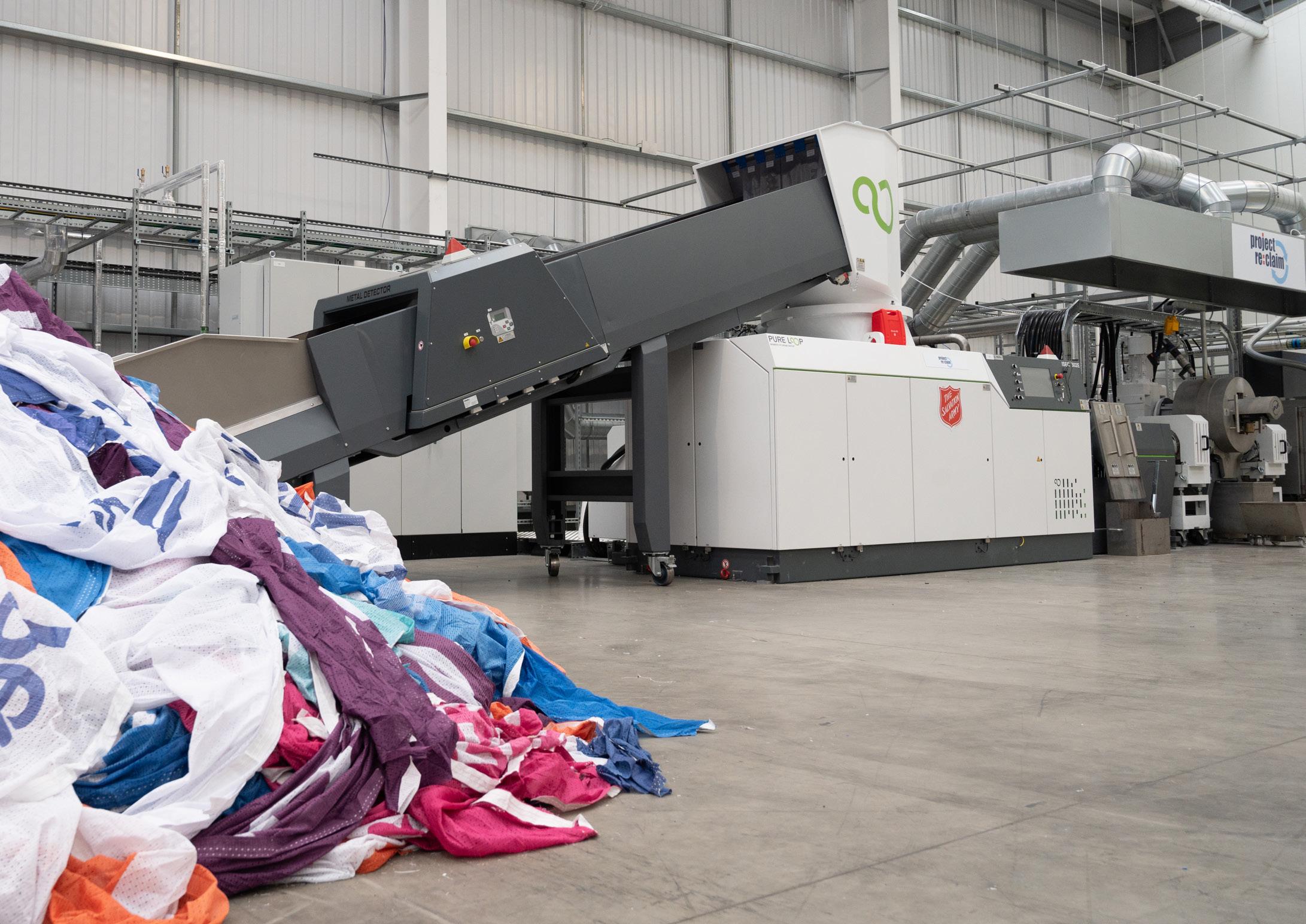
SATCoL has invested heavily in world-leading innovations including FibersortTM, the UK’s only automatic sorting process that accurately identifies and sorts second-hand garments by fibre type, and Project Re:claimTM, the first commercial-scale polyester recycling plant designed to recycle end-of-life textiles. Project Re:claim is a joint venture with Project Plan B, and our technology partner PureLoop (part of Erema Group).
Both Fibersort and Project Re:claim are based in The Salvation Army’s Processing Centres in Kettering, Northamptonshire UK.
In the past year, we have:
• Extended the Fibersort line to increase capacity and efficiency in sorting donated textiles.
• Commenced polyester recycling at scale and successfully produced polyester pellets and yarn to go into the production of new garments.
• Developed a case study, on behalf of our partner Project Plan B, based on school uniform provider David Luke’s ground-breaking fully recyclable ‘circular’ school blazer that is designed to go through Project Re:claim.
• Achieved several prestigious industry awards for our work in environment and sustainability.
Tim Cross, CEO at Project Plan B, said:
We now have the technology to enable garments to be recycled without any separation of the garment, making it an efficient recycling process. We are working with companies, such as David Luke, to introduce 100% recyclable and 100% recycled garments that do not compromise on design or quality, and yet are much kinder to the environment.
Majonne Frost, Head of Environment & Sustainability at SATCoL, said:
Our vision is to enable companies to produce uniforms, corporate wear, fashion garments and textile ranges using recycled polyester. We have the infrastructure to collect donations at scale and we now need companies to step up. This is an opportunity for companies to make a commitment to significantly reduce their environmental impact.
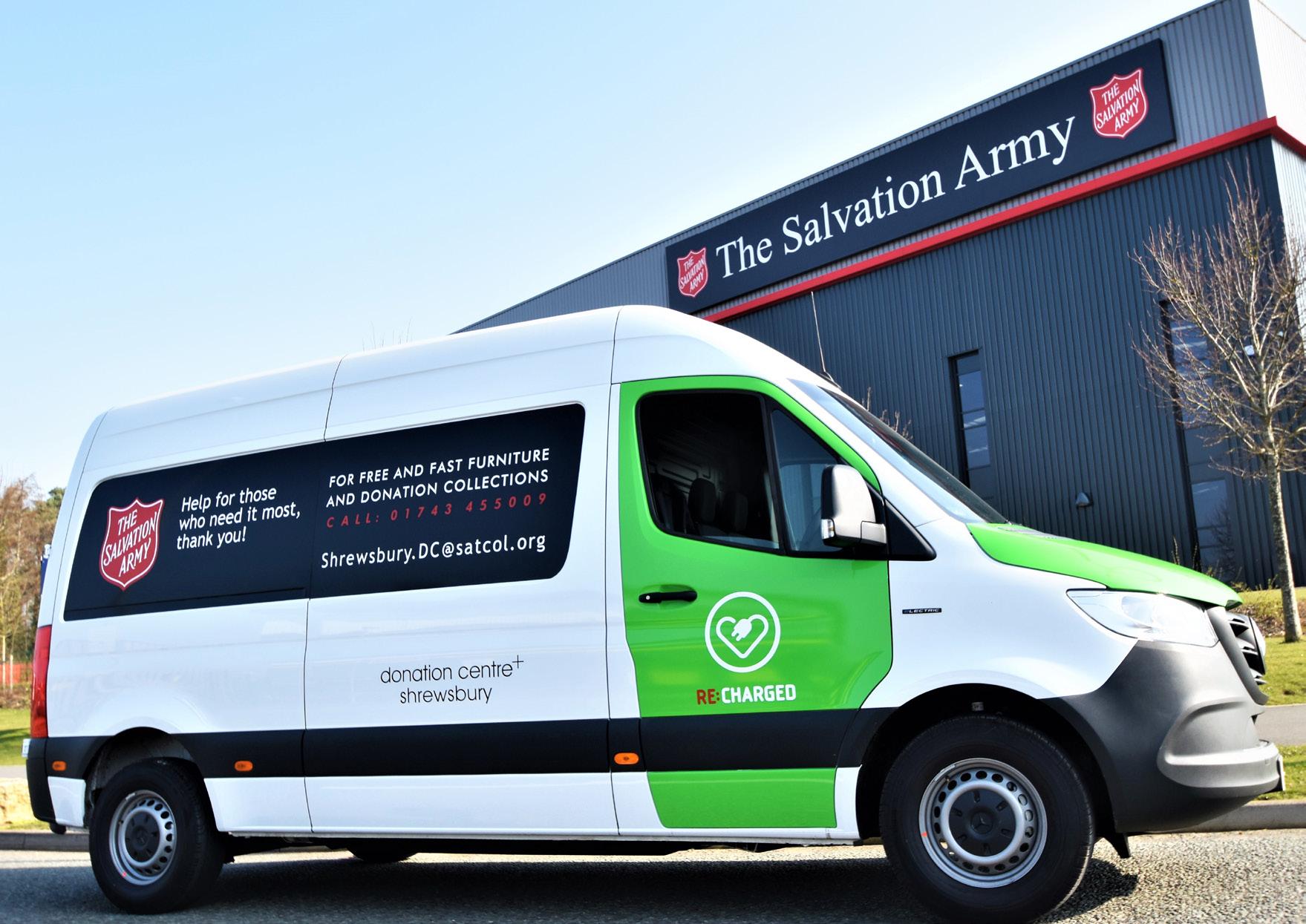
Our own carbon emissions are relatively small, especially when compared to the amount of carbon emissions we help our customers avoid through enabling them to purchase second-hand items, rather than buying new. Nonetheless, we need to play our part. SATCoL has set stretching targets to reach net zero and reduce our carbon emissions by 90%, by 2040.
Over the past year we have made some great progress against our targets. Here are some of the highlights:
• 13% reduction in operational carbon emissions*
• 67% of our company cars are electric and 28% hybrid (total 95%, up from 92% last year)
• 7 more electric vans added to our shop fleet, taking the total to 16 vans (25% of retail fleet)
• Started an EV trial with 4 vans in our clothing collection division
• 99% our shops now have LED lighting installed (up from 85% last year)
• Continued to source 100% of electricity from certified renewables, now via Ecotricity
• 14 colleagues took part in an e-bike trial at our Kettering Processing Centre and we introduced our Cycle to Work scheme
• Launched our Procurement Sustainability Programme which sets out minimum environmental standards
• Our parent charity announced a Climate Emergency Declaration on World Environment Day, 5th June 2023
• Introduced two new Environmental awareness courses, with 234 colleagues completing module one, and 230 completing module two
• Our Energy Efficiency course has been completed by 451 colleagues (an increase of 38% from last year)
• Continue to increase electric vans in our fleet
• Progressing our Solar PV Installation Programme
• Continue the roll-out of our Procurement Sustainability Programme
* This covers energy use in our buildings, own fleet and business travel by car, compared to our 2019/20 baseline
13% reduction in operational carbon emissions
67% of company cars are electric 99% shops converted to LED lighting
100% electricity from certified renewables
Read more about our targets and progress online: www.salvationarmytrading.org.uk/howwehelp/impact
A
very small snapshot of our broad and far-reaching work in the past year

Main picture: As part of ACT UK (Automatic-sorting for Circularity in Textiles) working alongside partners including WRAP and Tesco, SATCoL developed an engaging and targeted campaign to encourage people to donate to our banks.
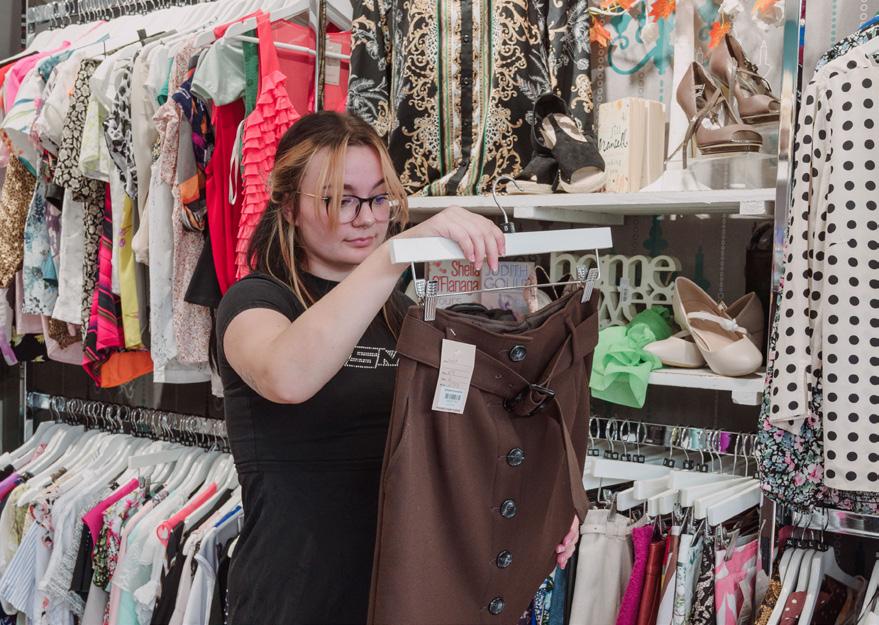
Opposite (clockwise from top left): SATCoL colleagues volunteer at the London Marathon. We served 6m customers in our stores - an increase of half a million on the previous year.
Thousands of items were collected and provided for free as part of Salvation Army and SATCoL school uniform pop up shops across the UK. We launched our Connection Booth at our Gorseinon donation centre, which provides donated IT equipment, and helps people connect with the digital work in their search for work.
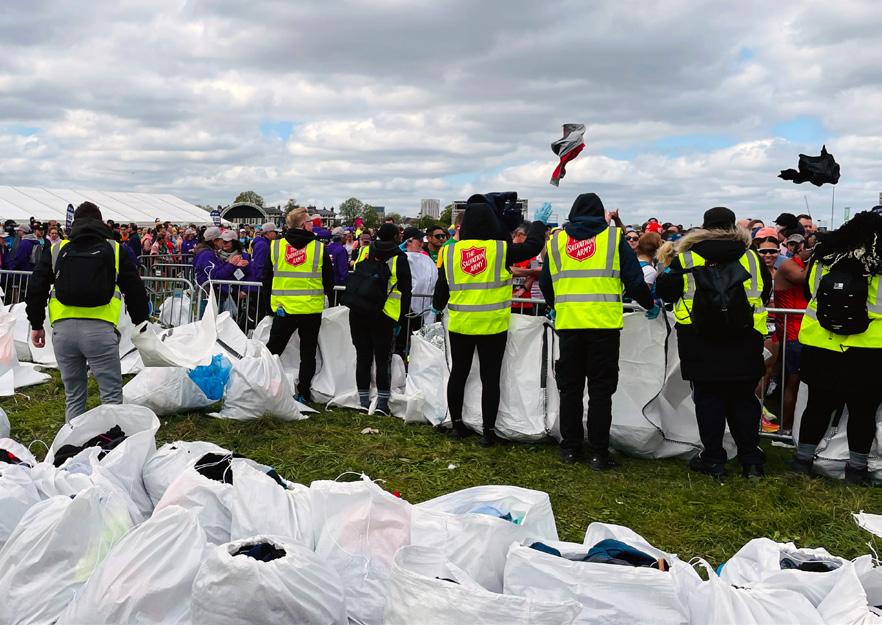
London Marathon official collector Sustainable and affordable shopping