
Social and Environmental Impact Report
Transforming lives, protecting our planet


Together, we help others and help protect our planet
Executive Summary
Helping others is at the heart of The Salvation Army’s mission. Our charity has a long history of helping the most vulnerable people in our society. The Salvation Army also has a long track-record in reuse and recycling – repurposing items for the benefit of others and making the most of our planet’s precious resources. Today, The Salvation Army is at the forefront of positive social and environmental impact.
We are Salvation Army Trading Company Limited (SATCoL) and, as the trading arm of our parent charity, we have raised over £80m for The Salvation Army over the past 10 years. This report provides you with an overview of our work today, in terms of social and environmental impact, and shows some of the ways we help our communities and our planet.
In the last year alone, we have raised over £10.8m for The Salvation Army, over £3m for our partners’ charities and other community-based initiatives, and helped almost 3,000 individuals and families through our free clothing voucher scheme. We have also collected 65,000 tonnes of clothing and diverted these items to good uses. Combined, our work has seen 440,000 tonnes of avoided carbon emissions in the financial year 2022-23. Read more about SATCoL’s impact on our triple bottom line dashboard (page 5) and throughout this report.
Thank you for your continued support.
Our impact

SATCoL’s social, environmental and financial highlights for the year 2022-23
Triple Bottom Line Dashboard
People
2,959 FREE clothing vouchers redeemed
5.5m
Your impact
We could not do what we do, and raise the millions of pounds each year to help those in need, without the help of our donors, customers, corporate partners and colleagues.
Your generous donations support people in communities across the UK, and they make a positive environmental impact.
Some of our top priorities, therefore, are to encourage and enable more people to donate through our conveniently located clothing banks and stores, and new corporate partner services such as our Take Back Schemes and IT Reuse Service.
We focus on educating people on reuse, recycling and the circular economy. We also want to empower people to get involved through volunteering, or by visiting one of our growing number of open-format donation centres, where you can see the sorting process first hand.
Want to get more involved?
Here are just a few ways you can learn more or get involved:
Listen to our Sustainable Conversation podcast series with fashion industry leaders and influencers, including journalist, broadcaster and environment reporter Lucy Siegle.
Find the SATCoL podcast series on Apple, Spotify or by visiting SATCoL TV: www.satcol.org/satcol-tv
Support our work in reuse and recycling by visiting your nearest donation point or store: www.salvationarmytrading.org.uk/find-us/
Interested in volunteering? Start your journey with us: www.salvationarmytrading.org.uk/supportus/ volunteering

Every donation makes a difference
A large part of our work is in reuse and recycling.
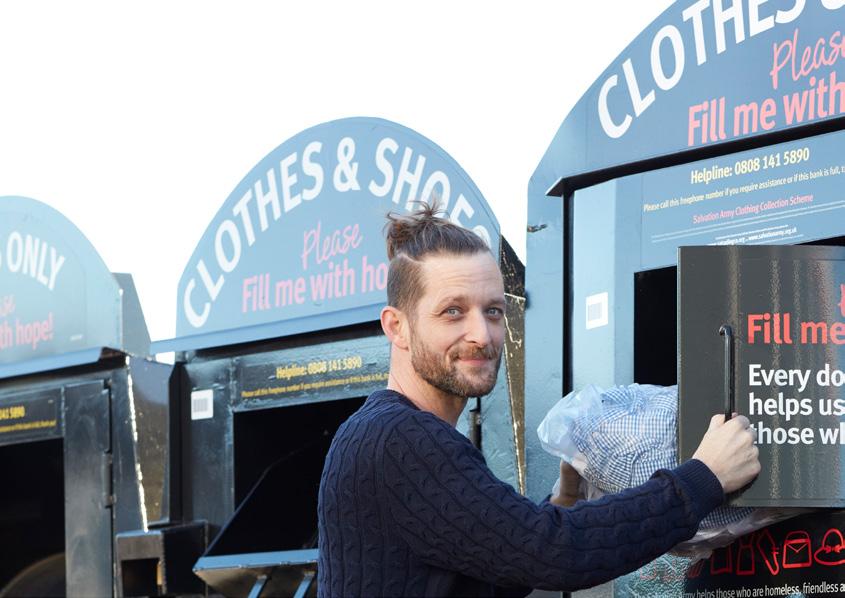
We encourage the reuse and recycling of textiles and other items through our nationwide network of charity shops, donation centres and clothing banks. We work with community groups, large organisations, local authorities, schools, colleges and individuals, all who share our aims to help others and help protect our planet.
We always provide for those in need first and each year we distribute tens of thousands of donated goods, at no cost, directly to people through our shops, via our parent charity or other charities and community groups that come to us for help.
In the past year we have opened new donation centres and new clothing bank sites – giving people more opportunities to reuse and recycle. In June 2023, we announced the opening of our post-consumer polyester recycling planta world first. Read more on page 15.
We take the responsibility of repurposing the donations we receive from members of the public and our partners seriously. SATCoL has led the way in raising standards across the textiles reuse and recycling sector. Items we are not able to sell in our shops are sold to trusted companies, ensuring that second-hand items are made available at affordable prices wherever they are most needed or are recycled for other purposes. We undertake regular Code of Conduct audits with our partners and we are a founder member of TRUST (Textile Recyclers Universal Standard).
8,000+ clothing banks
40+ donation centres
4 processing centres
436 corporate partners
1,060
200+ high street charity shops employees
382 Recycle with Michael school partnerships
4,438 volunteers
Transforming lives in the community
How we help others
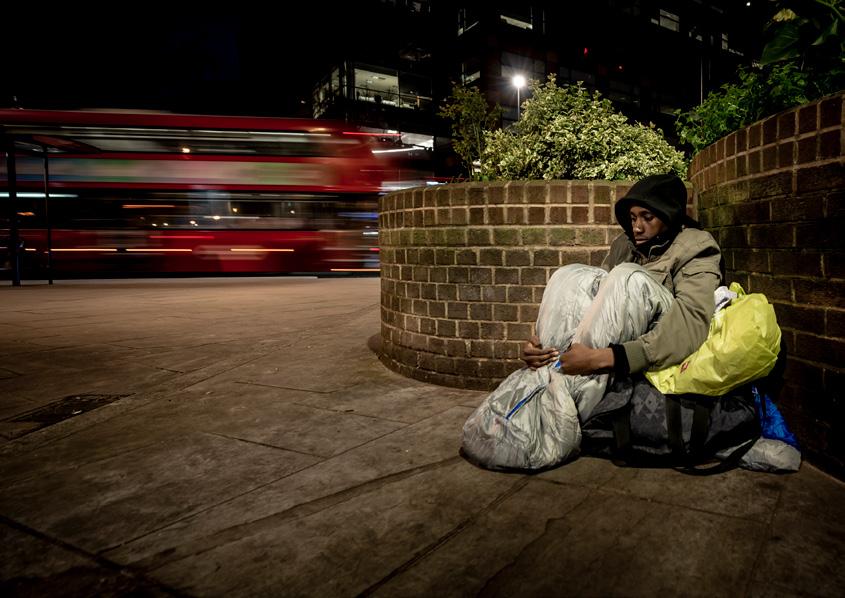
The funds we raise as the trading arm of the charity support the work of The Salvation Army. Here are just some of the ways in which our parent charity has supported those in need in the past year:
• 86 Lifehouses provided 3,151 bed spaces per night
• 26 emergency response vehicles responded to 300 call outs
• 13,000 people were helped through the Employment Plus Services
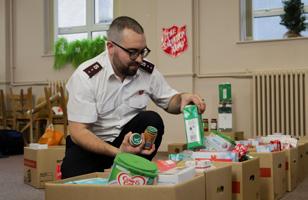
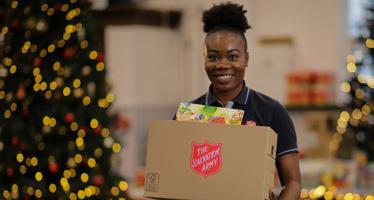
• Around 76,000 Christmas gifts were given to children in vulnerable families
• 8,830 victims of modern slavery and human trafficking were supported
• 12 residential homes for older people provided over 400 beds
• Over 1,000 cases, with an 89% success rate, were dealt with by the Family Tracing Service
• More than 2,250 refugees and people seeking asylum were supported by Salvation Army churches and centres
We have a ‘help others’ approach to everything we do. In addition to the funds we raise, colleagues in our Central Support and Processing Centres, as well as our Collectors and shop colleagues, work closely with Salvation Army churches and community projects across the UK offering other direct support. Here are just some of the ways we help:
• Last year 2,959 FREE clothing vouchers were redeemed in our stores by people and families in need, including refugees arriving from Ukraine and other parts of the world
• Our SATCoL shops served over 5.5 million customers last year, offering affordable items to their communities
• In the last financial year, we raised over £10.8 million for The Salvation Army
• In addition, we raised £3.25m for our partners’ charities and other community-based initiatives
• We supported 387 education programmes, from primary school to higher education
• 44 of our stores worked with The Salvation Army’s Anti-Human Trafficking & Modern Slavery Unit
• 133 of our volunteers moved into paid employment
2,959 FREE clothing vouchers redeemed
133 volunteers moved to paid employment
5.5m customers served in our shops £10.87m raised for The Salvation Army £3.25m raised for our partners
Sustainable solutions
How we help protect our planet
SATCoL is uniquely placed in helping donors, corporate partners and community groups to reuse and recycle:
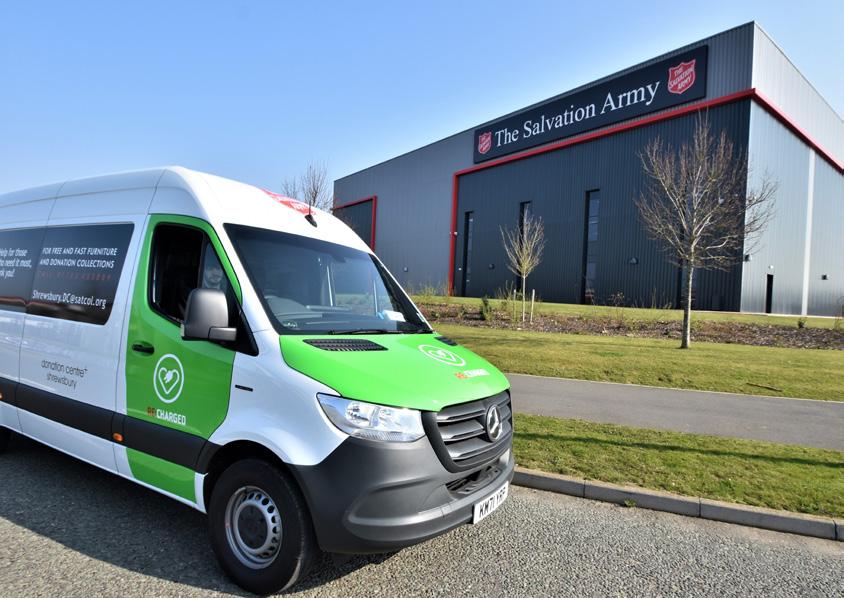
• Our nationwide network of clothing banks and stores provide easy access to donation points.
• Our 240+ charity retail stores, including our new donation centre+ concept, offer good quality products at affordable prices for communities, and a ready-made market for corporate partners who want to repurpose items responsibly.
Working with organisations and local authorities, we offer professional and trusted services:
• Our Corporate Partnership team respond quickly to requests, delivering solutions in all aspects of overstocks, customer take-back collections, returned and end of range stock management.
• Our large nationwide network eliminates transport and logistics costs.
• Our investments in modern processing centres and new technology, mean we are able to offer new ways of reusing and recycling textiles, on a commercial scale, never before seen in the UK and unique to SATCoL.
Below are some highlights from SATCoL’s work in reuse and recycling:
65,000 tonnes
65,000 tonnes of textiles collected in our shops and clothing banks last year.
440,000 tonnes
Through our reuse and recycling schemes, we helped to avoid 440,000 tonnes of carbon emissions.
This is the equivalent to taking 305,000 cars off the road.
This also helps avoid 58.6 billion litres of water used in clothing manufacture, equivalent to 586 million bath tubs of water.
11,000 tonnes
11,000 tonnes of non-clothing items collected and repurposed each year.
250 million items
Overall, an estimated 250 million items, including clothing and other textiles, furniture, bric-a-brac, electrical items, are reused and repurposed each year through SATCoL’s various schemes.
Closing the textiles loop
It is estimated that, globally, less than 1% of clothes contain recycled clothing content1. SATCoL is leading the way in creating a circular textiles economy where more unwearable items can be recycled back into the supply chain. We have made significant investments in technology and are working with partners to provide solutions to textile recycling.
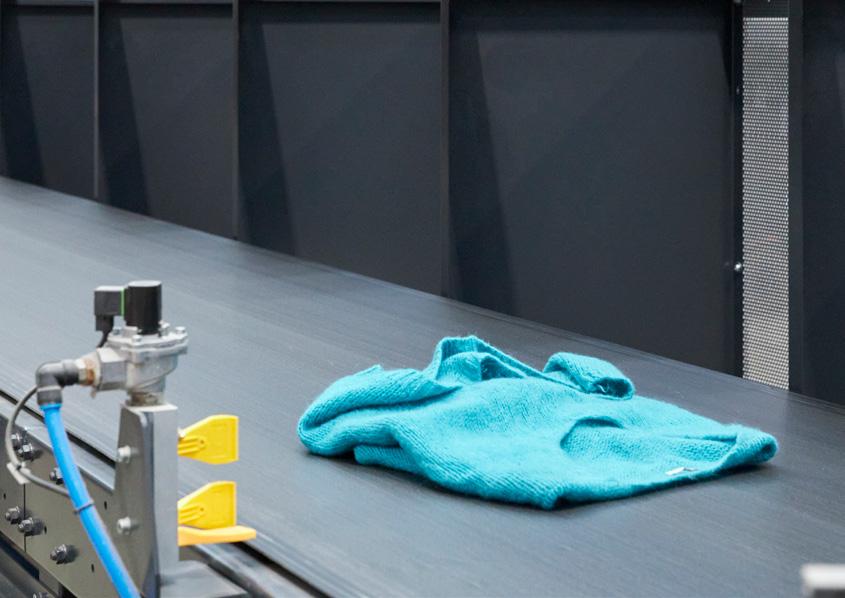
In 2021 we installed FibersortTM, a technology which automatically sorts garments by their fibre type. Located at our purpose-built processing centre in Kettering, the technology is a first in the UK. Last year, Fibersort sorted over 500,000 worn-out items.
In 2023, we announced our new joint venture with corporate wear specialists Project Plan B. The venture, known as Project Re:claimTM , is the world’s first textile polyester recycling technology that will take worn (post-consumer) garments and recycle them back into reusable materials at commercial scale.
Both Fibersort and Project Re:claim support our ambitions to become the first charity in the UK to have a Fibre Farm which will aim to provide second hand recycled garments back into the supply chain and thus reduce the burden on the planet’s finite resources.
Tim Cross, CEO at Project Plan B, said:
We need a seismic change in how garments are designed and produced. Polyester textile recycling is one of the biggest opportunities to reduce the harmful impact of
producing garments and this new technology is the first proven commercial scale system that has been designed to cope with the challenges of recycling post-consumer clothing.
Majonne Frost, Head of Environment & Sustainability at SATCoL, said:
Each year, SATCoL enables the reuse and recycling of over 250 million products but there are always items which are too damaged and we cannot resell and they are often garments made from polyester. With the recycling technology we can give these clothes a new lease of life. So when your favourite jumper is worn-out, we will take it and turn it into polyester pellets, ready to be turned back into a new jumper. This is the future of fashion.
project re claim
1Ellen MacArthur Foundation (2017) A New Textiles Economy: Redesigning fashion’s future
Being accountable
Reducing our own carbon emissions

Harvesting solar power: In July 2022, 20 solar panels were installed at our Kettering donation centre. The panels will generate over 7,000 kWh per year which will cover over 10% of our electricity consumption at the donation centre. In the sunniest months they can generate over 50% of consumption.
Even though our own carbon impacts are relatively small compared to, for example, a retail business selling new goods, we need to play our part and are committed to reducing our emissions as quickly as possible.
Over the past year, we have made significant progress on our buildings and transport footprint:
• 12% reduction in operational carbon emissions
• 70% of company cars are electric
• 85% of shops converted to LED lighting, enabling significant energy savings compared to traditional light bulbs
• 100% electricity from certified UK renewables
• In January 2023, we designed and launched an Energy Efficiency online course for all colleagues to encourage greater understanding of how to be more energy aware and reduce consumption at work and home. So far, 333 colleagues have completed this course.
• Removed approx. 325 HGV trailer loads from the road by moving 75% of the Scottish trailer journey to rail (equivalent to reduction of around 158 tonnes of greenhouse gas emissions)
Actions planned for next year:
• More than doubling our electric van fleet in our charity shop division
• Electric van trial in our clothing collection fleet
• Convert remaining shops to LED lighting
• Progressing our donation centre solar PV installation programme
• Replacing remaining LPG gas-powered forklift trucks with electric powered trucks
• Continue to encourage video conferencing to minimise business travel for meetings and encourage public transport
Read more about our targets and progress online: www.salvationarmytrading.org.uk/howwehelp/impact
12% reduction in operational carbon emissions
70% of company cars are electric 85% shops converted to LED lighting
100% electricity from certified UK renewables

Our work
A very small snapshot of our broad and far-reaching work
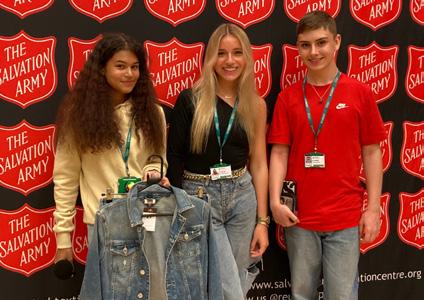
Main picture: Three tonnes of second hand donations have been sorted and repurposed into bespoke fashion items by Year 2 Fashion Students as part of our collaboration with Winchester School of Art. Opposite (clockwise from top left): 1,500 denim tote bags have been upcycled from old and unwearable jeans by prisoners at HMP Five Wells, and sold in our shops; Ukraine refugees arriving in Scotland were among beneficiaries of our FREE clothing voucher scheme; students at Tresham College learn about our work in sustainable fashion and raise funds through our charity pop up shops; our Sunderland donation centre team supported The Salvation Army’s Christmas Present Appeal which, in 2022, distributed around 76,000 donated gifts.
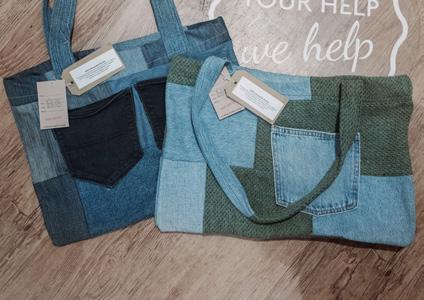
HMP Five Wells bags
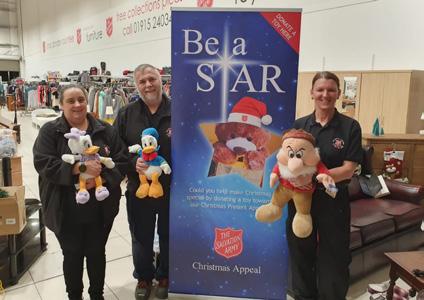
toy appeal
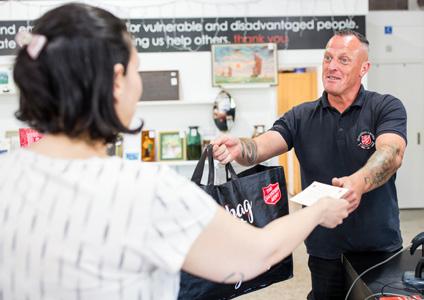
Ukraine vouchers
Christmas
Tresham College pop-up