SASKATCHEWAN ASSOCIATION OF WATERSHEDS Whe r e Wa te r , We lln e ss & Co m munitie s Me e t Aa
IN THIS ISSUE: THE BENEFIT OF INCORPORATING LEGUMES INTO CROP ROTATION FOR IMPROVED NITROGEN By adding legumes to crop rotations, grain producers can naturally boost soil nitrogen, cut fertilizer costs, and build long-term resilience into their farming systems.
LAKE STEWARDSHIP DOESN’T STOP WHEN THE WATER FREEZES Eco-buffer shelterbelts work year-round—but in winter, they quietly reduce wind stress, manage snow, and provide critical shelter for livestock and wildlife alike.
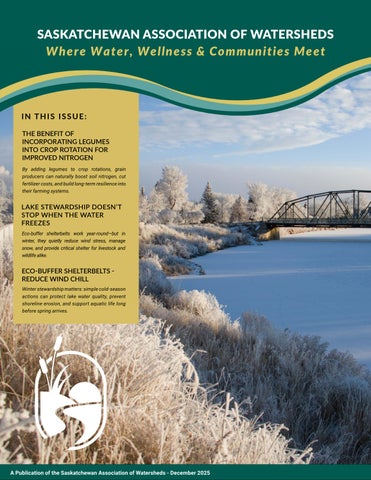
ECO-BUFFER SHELTERBELTS REDUCE WIND CHILL Winter stewardship matters: simple cold-season actions can protect lake water quality, prevent shoreline erosion, and support aquatic life long before spring arrives.
A Publication of the Saskatchewan Association of Watersheds - December 2025
1
TABLE OF CONTENTS
UPCOMING EVENTS JANUARY 2026
The Benefit of Incorporating Legumes 3 into Crop Rotations for Improved Nitrogen
Jan. 13-15 - Western Canadian Crop Production
The Value of Climate Change Adaptation 4 Planning for Saskatchewan Communities
Jan. 14 - Livestock Watering Strategies
Show, Prairieland, Saskatoon Workshop, Hodgeville Community Centre,
Lake Stewardship Doesn’t Stop When the Water Freezes
4
Aquatic Invasive Species Spotlight: Goldfish
5
Eco-Buffer Shelterbelts - Reduce Wind Chill
5
Hodgeville Community Centre, Hodgeville
Off-Site Watering Systems Benefit Aquatic Habitats
6
FEBRUARY 2026
Hodgeville Jan. 28 - Winter Watering Strategies Workshop, Royal Canadian Legion, Fort Qu’Appelle Jan. 29 - Rotational Grazing Workshop,
Feb. 11 - Saskatchewan’s Lake Stewardship Summit, Holiday Inn Express & Suites Saskatoon East, Saskatoon
2
THE BENEFITS OF INCORPORATING LEGUMES INTO CROP ROTATIONS FOR IMPROVED NITROGEN
Effective nitrogen (N) management is a cornerstone of
25–75 lb of plant-available nitrogen to the next crop. This
profitable and sustainable grain farming. As fertilizer prices
reduces the amount of synthetic fertilizer needed for crops
fluctuate and environmental stewardship initiatives increase,
like wheat and canola—lowering input costs while minimizing
many producers are looking for strategies that maintain yields
the risk of nitrogen losses through leaching, volatilization, or
while reducing reliance on synthetic nitrogen. Incorporating
denitrification.
legumes into crop rotations is one of the most practical and Beyond nitrogen supply, legumes contribute to improved
proven approaches for improving on-farm nitrogen efficiency.
soil structure and overall soil health. Their root systems help Legumes—including
peas,
lentils,
chickpeas,
soybeans,
enhance soil aggregation and porosity, leading to better water
a
infiltration and rooting conditions for subsequent crops.
unique symbiotic relationship with rhizobia bacteria that
Legume residues also increase soil organic matter, supporting
fix atmospheric nitrogen into plant-available forms. Unlike
microbial activity and long-term fertility. This improved soil
cereals, which must rely on soil reserves or applied fertilizer,
function often translates into better yield stability across
legumes can meet much of their own nitrogen needs through
variable moisture conditions.
and
various
forage
legumes
such
as
alfalfa—form
this natural process. As legumes grow, they add organic N to the soil through root nodules, fallen leaves, and crop residues.
Legume rotations also play an important role in integrated
This biologically fixed nitrogen then becomes available to
pest and disease management. Breaking up continuous
subsequent crops as residue breaks down, helping to lower
cereal rotations disrupts disease cycles such as Fusarium
fertilizer requirements for the following season.
and reduces pressure from grass weeds that thrive under back-to-back grain cropping. Incorporating legumes into grain
For grain producers, this nitrogen credit can be substantial.
rotations is not just an agronomic benefit—it’s an economic
Depending
and
and environmental advantage. By harnessing biological
management, legumes can contribute the equivalent of
nitrogen fixation, farms can improve soil fertility, reduce
on
the
species,
growing
conditions,
fertilizer costs, and build a more resilient cropping system for the long term. The Saskatchewan Association of Watersheds supports the adoption of incorporating legumes in rotation through the Saskatchewan Watershed Environmental Agriculture Program (SWEAP). Funding for this project has been provided by Agriculture and Agri-food Canada through the Agriculture Climate Solutions- On Farm Climate Action Fund (OFCAF).
CLICK HERE FOR MORE INFO ON SWEAP
3
THE VALUE OF CLIMATE CHANGE ADAPTATION PLANNING FOR SASKATCHEWAN COMMUNITIES
LAKE STEWARDSHIP DOESN’T STOP WHEN THE WATER FREEZES
Extreme variability and weather events are already reshaping life across Saskatchewan, and communities are feeling the effects through rising temperatures, shifting precipitation patterns, and more frequent extreme weather events. Saskatchewan is projected to experience warmer, wetter, and more volatile conditions in the coming decades, including increased hailstorms, flooding, droughts, and tornadoes. These changes pose risks to public safety, infrastructure, water systems, and local economies. Adaptation planning helps communities anticipate these challenges rather than react to them, strengthening their ability to cope with and
Winter is a critical time for maintaining water quality
recover from climate related stressors.
because
pollutants
introduced
during
this
season
can
persist under the ice until spring thaw. Activities such as Adaptation planning is also essential for protecting critical
minimizing the use of road salt near shorelines, preventing runoff
infrastructure and municipal services. Many Saskatchewan
from livestock areas, and properly storing fuels and chemicals
communities are renewing or expanding public transit, roads,
help reduce contamination risks. These proactive measures
water systems, and sewage networks that must be designed
ensure that when ice melts, the lake remains healthy for aquatic
to withstand future climate conditions. The provincial
life and safe for recreational use.
government’s
Prairie
Resilience
strategy
emphasizes
resilience as the ability to adapt and continue to grow despite
Winter conditions can lead to shoreline erosion, especially
climate pressures. By integrating climate projections into
during freeze-thaw cycles and fluctuating water levels. Lake
land use planning, emergency management, and asset
stewards
management, municipalities can reduce long-term costs and
vegetation buffers and avoiding unnecessary clearing or
avoid damage that would otherwise strain local budgets.
construction during cold months. These buffers stabilize
can
protect
shorelines
by
maintaining
natural
soil and prevent sediment from entering the lake, which is Finally, adaptation planning builds community capacity and
vital for preserving habitat quality and preventing turbidity
ensures long-term sustainability. SAW has completed three
issues that can harm fish and other organisms once the
adaptation plans for the NW, NE and SE Watershed Districts.
ice recedes.
Adaptation planning empowers communities of all sizes— villages, towns, and cities—to make informed decisions that
Many species rely on lakes even in winter, from overwintering
protect residents, support economic stability, and preserve
fish to birds seeking open water areas. Responsible stewardship
natural ecosystems. As climate impacts intensify, proactive
includes avoiding disturbances to these habitats, such as
planning becomes not just beneficial but essential for
excessive snowmobile traffic or ice fishing practices that
safeguarding Saskatchewan’s future. To view the plans, visit
leave waste behind. Winter is also an ideal time for planning
www.saskwatershed.ca.
through
restoration projects, assessing nutrient management strategies,
the Environmental Damages Fund’s Climate Action and
and engaging communities in stewardship education. By taking
Awareness Fund, administered by Environment and Climate
action during the off-season, lake stewards set the stage for a
Change Canada. For any inquiries, please contact ccap@
healthier ecosystem throughout the year.
Funding
was
saskwatersheds.ca for more information.
4
provided
AQUATIC INVASIVE SPECIES SPOTLIGHT: GOLDFISH
ECO-BUFFER SHELTERBELTS – REDUCE WIND CHILL
Goldfish (Carassius auratus) may seem like harmless pets, but once released into lakes, rivers, or storm ponds, they quickly become a destructive invasive species. They feed on native fish eggs, larvae, and aquatic plants, while also competing with native species for food and space. As they forage, goldfish stir up sediments at the bottom of a waterbody and block sunlight that native plants need to survive. Their high reproductive rate—
Eco-buffer shelterbelts, which are strategically planted rows
hundreds of eggs at a time—allows them to spread rapidly and
of trees and shrubs, provide significant benefits during winter
dominate new habitats. In the wild, goldfish grow far larger than in
by reducing wind speed and wind chill. Harsh winter winds
home aquariums, sometimes reaching up to 38 centimeters long.
can increase energy demands on animals and lead to stress or even mortality in extreme conditions. Shelterbelts create a
In Saskatchewan, goldfish have already been reported in
natural barrier that moderates wind exposure, helping animals
Qu’Appelle and Wascana lakes, Wascana Creek, and storm
conserve body heat and reducing the need for additional feed
ponds in Saskatoon. More than 450 kilograms of goldfish were
or energy inputs.
recently removed from just three storm ponds in Saskatoon. Without action, these contained systems risk becoming stepping stones
In addition to shielding against wind, eco-buffer shelterbelts
for goldfish to spread into larger waterways such as the South
help manage snow distribution across agricultural landscapes.
Saskatchewan River, threatening both biodiversity and water quality.
By slowing wind velocity, these buffers reduce the formation of large snowdrifts on roads, farmyards, and critical infrastructure
The City of Saskatoon is using Rotenone, a targeted fish
areas. This makes winter travel and farm operations safer and
management tool, to remove invasive goldfish. Rotenone is safe
more efficient. Controlled snow deposition also benefits soil
for people, pets, and wildlife, but it prevents fish from absorbing
moisture retention for spring planting, as snow trapped near
oxygen from the water, causing them to die. While this method
shelterbelts melts gradually and infiltrates the soil rather than
is effective at reducing existing populations, preventing releases
running off.
in the first place is the most important and long-term solution. Winter can be a challenging season for wildlife, but eco-buffer The core of the problem is pet release. Goldfish are hardy and
shelterbelts provide essential cover and food sources during
long-lived, but they should never be put into ponds, lakes, rivers,
this period. Dense vegetation offers refuge from predators and
or storm drains. If you can no longer care for an aquarium pet,
harsh weather, while certain species of shrubs and trees supply
safe and responsible options include rehoming through pet stores,
berries and seeds that sustain birds and small mammals. By
aquarium societies, schools, or local online groups. Aquarium
supporting biodiversity even in the coldest months, shelterbelts
water and plants should also be disposed of indoors through
contribute to a more resilient ecosystem and strengthen the
wastewater drains rather than being poured outdoors. Together,
ecological services that benefit agriculture year-round.
we can stop the spread of invasive species.
INFO ON AQUATIC INVASIVE SPECIES
INFO ON ECO-BUFFERS
5
OFF-SITE WATERING SYSTEMS BENEFIT AQUATIC HABITATS
OFFICE LO C ATI ON S Our office locations are open Monday to Friday from 9 AM to 4 PM (closed 12 PM - 1 PM).
HE AD OFFICE 300B - 99 Diefenbaker Dr., Moose Jaw, SK
SOUTHWEST DISTRIC T OFFICE 1 Airport Road, Swift Current, SK
MAILING ADDRESS Box 1177, Moose Jaw, SK, S6H 4P9 For the past two years, SAW has been working with landowners in the Milk River and Lower Qu’Appelle watersheds to implement off-site livestock watering systems to improve aquatic habitat. This project is in partnership with Fisheries and Oceans Canada
CONNEC T WITH US
and the Water Security Agency. Off-site watering systems, which provide livestock with water away from natural streams and ponds, play a crucial role in protecting aquatic habitats. By reducing direct animal access to waterways, these systems minimize the introduction of sediments, nutrients, and pathogens into aquatic ecosystems. This leads to improved water clarity and quality, which benefits fish, amphibians, and other aquatic organisms that rely on clean water for survival and reproduction. When livestock are kept away from streams, riparian zones—the vegetated areas along waterways—remain intact and healthy. These zones act as natural filters, trapping sediments and absorbing excess nutrients before they reach the water. Healthy riparian vegetation also stabilizes stream banks, reducing erosion and maintaining the structural integrity of aquatic habitats. This stability creates better conditions for species that depend on consistent water flow and shelter provided by these vegetated buffers. Off-site
watering
indirectly
promotes
biodiversity
by
maintaining the ecological balance of aquatic habitats. Cleaner water and stable banks support diverse communities of fish, macro-invertebrates, and plants, which in turn sustain birds and mammals that depend on these ecosystems. By reducing stressors such as pollution and habitat degradation, off-site watering enhances the resilience of aquatic ecosystems against climate variability and human impacts, ensuring longterm sustainability for both wildlife and agricultural operations.
6
S AW M A I N P H O N E N U M B E R 1 (306) 541 - 9902 EMAIL ADDRESS info@saskwatersheds.ca