![]()


4 HOME FRONT
A Greeting from the Publisher
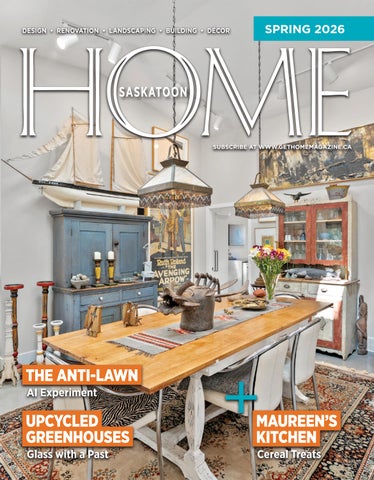
7 THE HOUSE THAT LOVE BUILT
An Acclaimed Sculptor’s Home Alive with Art
~ Photo Scott Prokop

19 THE ANTI-LAWN AI EXPERIMENT
A Tech Mind Meets a Tired Yard
~ Photo Greg Miller

29 UPCYCLED GREENHOUSES
Glass with a Past
~ Photo Rachel Bergsma
37 MAUREEN’S KITCHEN
Cereal Treats: Easy to Make, Easier to Eat
THE HOUSE THAT LOVE BUILT PAGE 7
“One of the most charming aspects of Doug’s new home is that every piece of art is displayed separately in its own perfect place.” – Elaine Malkin
~ Photo Scott Prokop
~ Photo Brevoort Park ON
41 HOMETOWN REFLECTIONS
Saskatoon’s Urban Forest


The sun is out, the melt has begun and a new fresh year is underway. And 2026 starts off with a jam-packed issue of HOME, full of all the landscape, design, architecture and history our readers can count on throughout the year.
We visit a thoughtfully planned home built as a true labour of love by a well-known award-winning sculptor. Come see a beautifully landscaped yard put together with the help of not-so-secret weapon, and take a look at the way old windows destined for the landfill are transformed to begin a new life with new purpose. And stop a moment to appreciate Saskatoon’s beautiful canopy of trees. The city didn’t always look so green. Our resident historian Jeff reveals the decisions that took us from treeless prairie to today’s urban forest. A timely warning for homeowners given the threats facing our elms. Remember the joy that was Saturday morning cartoons with a bowl of cereal? Our resident foodie Maureen dishes up happy memories with a few grown-up versions of your favourite childhood breakfast.

We know you’ll be inspired by these intriguing stories and by the offerings from all the wonderful businesses featured in this issue. Our neighbours who share their stories, and our advertisers who support local publishing, are the lifeblood of HOME. We cannot thank you all enough. We love being able to share these Saskatoon stories with you. As always, if you have suggestions for content or if you’d like to advertise with us, please get in touch. Happy reading!
OWNER & PUBLISHER
Receive every issue of HOME right in your mailbox for $20/year by subscribing at www.gethomemagazine.ca
Issue 73, Spring 2026
ISSN 1916-2324
info@saskatoon-home.ca
Publishers
Amanda Soulodre
Rob Soulodre
Editor
Karin Melberg Schwier
Contributors
Julie Barnes
Rachel Bergsma
Ashlyn George
Maureen Haddock
Greg Miller
Jeff O’Brien
Scott Prokop
Karin Melberg Schwier
The booking deadline for advertising in the Summer 2026 issue is April 18, 2026 Contact Amanda for more information. Email: amanda@saskatoon-home.ca Phone: 306-373-1833 Text: 306-717-0663
Saskatoon HOME is printed four times a year. Subscribe to receive every issue direct to your mailbox for $20/year. Visit www.gethomemagazine.ca
Connect with us: www.saskatoon-home.ca www.facebook.com/saskatoon.home /saskatoon.home

Saskatoon HOME is published by: Farmhouse Communications
Telephone: 306-373-1833 info@saskatoon-home.ca www.saskatoon-home.ca
No part of this publication may be copied or reprinted without the written consent of the publisher.
Publications Mail Agreement # 41856031


BY: KARIN MELBERG SCHWIER
PHOTOS: SCOTT PROKOP
To grasp sculptor Douglas Bentham’s hands in greeting is like being enveloped in a firm, worn baseball glove. A big man with big hands, knuckles gnarled by over fifty years of bending, welding, twisting and shaping steel, brass, bronze and wood into constructivist art. Small pieces inspired by Picasso and Matisse, soaring
25-foot pieces that can only be displayed outside the height constraints of his workshop, all Doug’s pieces repeat bold, linear forms and a primitive feel, abstracts that often invoke a personality, a humanity, inviting viewers to examine with “childlike fascination.”
His installations are found in private collections and public
spaces throughout North America. A nod to poet Robert Hayden’s observation that art is pain outlived, Doug’s grip is firm despite having broken a finger or two in the pursuit of his art “with no time to get them fixed,” and “maybe a little arthritis.”
Multi-award winner Doug is still driven to sculpt—he’ll
be 79 in April—now with perhaps a greater urgency since one of his most recent projects is complete. A house built for his wife Bonnie.
The First Prairie School In 1973, Doug and Bonnie— high school sweethearts who met at Aden Bowman Collegiate—bought


See why you shouldn’t mess with a good process:

what was once a 1930 country schoolhouse 20 km south of Saskatoon. They had been looking for an old school or church with space—and height—for Doug to exhibit his sculpting work.

Aside from adding twins Luke and Megan in 1971, they added on to the schoolhouse three times over the next 54 years. The home was featured in a 2006 issue of Architectural Digest entitled “Prairie School.”
“My parents always seemed to need more space to display the art and objects they enjoyed,” explains Luke. “While never 100 percent completed, it was comfortable and had rooms which brought the prairie environment closer.” A natural pond, prairie grasslands and wildlife were visible from multiple areas of the house.
The bond with this location was “intense,” Luke adds. But with some serious health problems looming, a decision had to be made.
“The driving force to build the new house for my parents came out of the desire to
keep them in the country environment they loved and had spent their lives in.”
As Bonnie’s rheumatoid arthritis began to worsen and Doug had emerging health concerns, they decided greater accessibility was in the cards. The new build is on the property just down from the original, next to the studio Doug built in 2004.
The plan was that they could comfortably remain at home but now on one-level, surrounded by the art the couple collected—and Doug created—over the years. She’d be close to offer her opinion on Doug’s latest sculptures, close to son Luke and his family who moved into the original house. Maybe take an ATV ride now and then through the 80 acres they set aside as wildlife preserve, and merely enjoy her beloved prairie views through the expansive windows in the new house.
“So we built it for her,” says Doug.
The Seed for Sculpture
Doug originally intended to study architecture at the University of Saskatchewan. It didn’t agree with him. What

he was drawn to was fine arts.
“I planned to be an architect,” he explains. “But I just hated the engineering process, failing physics, failing math. I was no prodigy, but I enjoyed art classes. I don’t know,” he muses, with a grin. “Maybe it was drawing nude models that seemed more interesting than failing physics.”
The seed for sculpture had been planted years before when his father built a hot rod for Doug, who was 16. When Doug saw what could be done with metal, he felt a growing fascination. Ultimately, he knew that being a sculptor and artist was going to be more satisfying. “It might have been a logical move, but it wasn’t very smart in terms of setting myself up to earn a consistent living.”
Maybe some of that architectural study paid off as Doug threw himself into designing a new house. Son Luke, owner of LiveModern Homes and a carpenter himself, handled the construction as general contractor. The project began in September 2022 and completed in November 2023.

Doug’s mantra, “I like steel,” is clearly evident not only in his sculpture—not to mention his collection of Airstream trailers—but in the new home design. The steel exterior was one of the first features selected, influenced by Nova Scotian architects MacKay-Lyons Sweetapple’s Leahey House.
The exterior corrugated metal walls and roofing “may be the next new thing,” muses Doug of the industrial aesthetic. “Since the California fires and increasing climate change, people are thinking more about new builds with fire retardant materials.” The fact that it is virtually zero-maintenance, Luke adds, was part of the plan to support his parents.
“Dad spent many hours, probably too many, constructing a scale model of the house which he dropped on the draftsman’s desk,” Luke recalls. “The key was accessibility and low upkeep.”
At 2,400 square feet with an 800 square foot attached garage, half of the new home is identical in floor


plan to the old house, but on one level. Built on a slab foundation, it was designed with boiler-system heated polished concrete floors throughout with forced air for backup heat, cooling and ventilation.
“It was more of a commercial type of build. We wanted to create a more airy, gallery type space and maximize wall space for art,” says Luke. Vaulted high ceilings provided challenges since bulkheads weren’t an option. The attic space was used to hide services, water and HVAC ducting since that was not possible in the floors. Each of the two bedrooms has an ensuite, and there is a half bath. Door openings are wide to accommodate a wheelchair, and an accessible walk-in shower was included. Natural light was a must-have, so many windows and skylights were installed. The surrounding 130 lineal feet of wood decking, while not fire-proof, was built such that Bonnie and Doug could spend time outside without navigating steps. It also adds some warmth to the metal exterior.
“My parents designed the kitchen to be identical to the first house,” says Luke. The original Douglas Fir cabinets had mellowed into a warm glow so we brought them over and reinstalled. Mom loved that kitchen.” The pine beams in the room are a reminder of the natural wooded spaces outside and duplicate those in the original house.
The yellow colour for the exterior doors and light sconces is “the most complimentary within the range of grays and silvers offered by stainless, galvanized surfaces,” Doug notes. “It’s a distinct colour, but seems just right. In making art, the colour tends to find you, not
the other way around.” It’s also a hue that frequents the folk art, upholstery and movie posters inside.
The couple moved in a year after the project began. Then it was time to fill the new house with art “to the brim.”
A Hunter and Gatherer
It takes a special sort of person to live with a collector and while Bonnie was not an artist herself, she appreciated it. She was co-founder and co-owner of The Gallery/Art Placement in Saskatoon for 37 years, while Doug created, sought and scavenged. As a metal artist, he still finds it difficult to pass by a junkyard without having a poke around, invariably hauling home some choice bits. In what others see as rusted refuse and everyday metal objects, Doug sees potential.
The material fuels his own sculpture, but all along the way, he’s been compelled to collect other works of art.
“I learn from all the stuff I collect,” he says. “Sometimes you can see the influence in my work of particular folk art pieces and other things I bring home. I have so many ideas in my head, but I’m sure some of these work their way in there.”
To walk into the Bentham home is to be immersed in colour, texture, historical handmade creations, Doug’s own sculptures, the artwork of friends. It’s not a curated collection coordinated by theme, origin or colour, but neither is it simply a hodgepodge of stuff. Each piece is something that has intrigued him.
“Elaine Malkin, whose spouse is architect and artist Mel Malkin, wrote to me something I treasure. ‘One of the most charming aspects of your new home is that


every piece of art is displayed separately in its own perfect place,’” Doug says. “She further wrote that the house is ‘heartbreakingly beautiful and its views out to our beloved prairie are superb in every direction.’”
The collection was installed by Levi Nicholat and Donald Roach, co-owners of Art Placement. What Doug hoped to achieve in each room is a setting with the light and the landscape defining it. “Every object supports its neighbour, and is reinforced by the architecture.” Beyond that, he says, “I collect what I think is interesting.”
Take the 600-pound round rock (seen in photo to the left) he became enamored with at a farm sale near Krydor. It wasn’t in the sale, but the Ukrainian farmer was persuaded to take 40 dollars and a forty of rye. The farmer’s sons used stacked 2x6s to lever it up into Doug’s truck. How did he get it into his house? “It’s a ball.” He chuckles. “I rolled it.”
The Bentham collection of Doukhobor, Ukrainian, Polish and German Mennonite furniture and artifacts handmade in the 1800s and 1900s have been picked from
across the western prairie provinces. The Glenbow Museum in Calgary will borrow six pieces for a display of early ethnic artifacts. The loan is for five years, Doug says, but “at my age, I told them they better have my kids’ contact information.”
He laughs and says Luke worries that he continues to accumulate, and cites the newest growing collection of handmade milk stools.
“Collecting is a wonderful habit,” he admits. “Sometimes I get started on something and all of a sudden I have a dozen of them.” His interests also include North American indigenous, African, Oceanic and Central American folk art, primitive masks and other objects, picked up because “I think they’re really cool.”
“I like the eccentricity of some, so unusual. Some are so weird,” he says, touching pieces as he walks through the house. “Folk art tells so much about the different cultures. It shows what the people believed was important.”
The concrete floors are scattered with colourful early southwest textiles, Navajo saddle blankets, throws, rugs; there are so many,


he swaps them out every couple of weeks. There is art created by friends, by artists he admires. Large-scale and smaller pieces show the variety in his own metal work.
The striking and extensive collection of framed hand-coloured silent movie posters pop in vibrant focus illuminated by ceiling lighting, hung on white gallery walls. There are poster-sized pieces as well as massive billboards. Collectors worth their salt are often as proud of the origin of their finds as they are of the items themselves. Doug is no different.
“A house was being torn down in Gravelbourg in the 1960s,” Doug explains. “As the walls started coming down, all these movie posters were revealed. The homeowner had operated the movie house in town and used these as building paper when he built the house.” The posters are in remarkably pristine condition with only a few nail holes and cutouts for bare lightbulbs used to illuminate
the coming attractions.
“Funny these are handpainted in beautiful, vibrant colours to advertise silent, black and white movies.”
The Nest as Sanctuary
The accessible home was to be not only a place of refuge, functional and easy to navigate, but also cozy and familiar. Doug wanted to surround Bonnie with all those lively colours and textures of their collected art, bought, scavenged and created during their 62 years together.
“It was a good omen when they looked out the window right after moving in. There was a moose and her calf looking right back at them,” Luke recalls. “But Mom’s health began to suffer and she didn’t get to enjoy her new home for as long as we hoped. But she loved it.”
She spent her last days at the new rural Cozy Nest Care Home near Dundurn, a few minutes’ drive from the Benthams’ acreage.
“Moving her wasn’t


what we wanted, but it was the next best thing,” Doug says. “In the care home’s familiar rural setting, she was able to watch the coming of spring, and the return of the geese and songbirds.” She died at 78 in May last year; the family plans to spread her ashes on their wildlife refuge across the road this spring.
It is not without irony when this man, known for massive, soaring sculptures of steel and iron, who built a sanctuary of metal for his wife, gently plucks a delicate Baltimore oriole nest from a nail on his studio wall. It’s dwarfed between his gnarled thumb and forefinger.
“Look at this,” he marvels. “The intricacy. Birds are Mother Nature’s architects. What they were able to accomplish hovering in the air, weaving a tiny safe place. Art is everywhere you look if you just want to see it.”
Karin Melberg Schwier


New Homes Starting at $425K+
That’s $100K–$200K LESS than similar homes in Saskatoon.
Full-sized lots, walking paths, water features, and schools nearby.
Weekend escapes? Blackstrap Provincial Park is just 10 minutes away.
We’re opening limited VIP spots for Saskatoon buyers to get early access to:
Choose your lot before public release
Pick your preferred home style and size
Lock in your possession date before others even hear about it


Sales & Customer Service
Edgewater Homes
Ehrenburg Homes
North Prairie Developments
Housing Awards
Best Multi-Family Project
Meridian Development
North Prairie Developments
North Ridge Development Corp
Community & Leadership
Durabuilt Windows & Doors
Ehrenburg Homes
North Prairie Developments
North Ridge Development Corp.
Marketing Awards
Ehrenburg Homes
North Prairie Developments
North Ridge Development Corp
Pacesetter Homes
Security Building Supplies
Rooftopper Membership
Recruitment Champion
Conrad Ehr
Best Detached Production Home
Bella Vista Developments
Edgewater Homes
North Ridge Development Corp.
Best Attached Production Home
Edgewater Homes
Ehrenburg Homes
North Prairie Developments
Pacesetter Homes
Ambassador Award
Frank Long

Best Custom Home
Bella Vista Developments
Hometown Homes
Maison Design + Build
Renovation Awards
Alair Homes
Bronze Homes
Centennial Kitchen & Bath
Hometown Homes
Miller Contracting Ltd
Best New Home Space Awards
Edgewater Homes
Mavrik Home Builders
Warman Homes


BY: ASHLYN GEORGE
early days of computers entering music production. He eventually owned a recording studio, later working in advertising and video production as digital tools reshaped creative industries.
More recently, while working with a First Nations Community, Greg spent significant time training an AI model on the history


and etiquette required to discuss Indigenous issues. It gave him firsthand experience on how adaptable and instructional AI could be.
Around the same time, he found himself staring at his yard. He toyed with the idea of clover for years but never quite committed. Eventually, circumstances aligned and Greg decided to treat his yard the same way he’d approached new technology throughout his life—with curiosity and a willingness to experiment.
Rather than downloading a generic landscaping plan, Greg set up a dedicated AI model and gave it a very specific role as horticultural advisor.
He fed it details about his property as a Zone 3B


growing zone, a map of the yard, latitude and longitude, fence height and building dimensions and locations. He even accounted for how the sun’s angle changes over the growing season, shifting where shade and sunlight fall from spring through autumn.
Then he set the criteria, including no pesticides, minimal mowing and watering and growing plants while sustaining insects, birds and wildlife that would benefit.
The AI responded with detailed recommendations of what to plant, where to plant it and when to cut things back in the fall. As the seasons progressed, Greg updated the model with what he’d completed so the AI could tailor its advice down to specific areas of the yard and the plants living there.
But the relationship wasn’t blind trust. Before investing his money in the updated yard, Greg cross-referenced the AI’s recommendations
with local experts at Saskatoon greenhouses where he was going to purchase the plants.
“If I’m going to drop $300, I’d like a human to say it’s a good idea, too,” he laughs.
Not every suggestion worked perfectly. The AI recommended ferns for several shaded areas. The soil, light and moisture were right, but what the model didn’t predict was wind.
Greg’s yard, shaped by outbuildings and fences, funnels gusts into certain areas. After a particularly windy month, several of the ferns were shredded.
“I blame AI less for that,” he says. “Frankly, I can’t expect it to know wind patterns in the yard. Maybe someday.”
The experience reinforced an important lesson that AI is a powerful assistant, not a perfect authority. Observation, adjustment and human judgment still very much matter.

Partner with our experienced team to transform your existing home or bring your dream home to life from the ground up. Whether you’re looking to reimagine what you have or start fresh, we’re here to guide you through every step of the journey. Let’s connect and explore how we can turn your vision into reality.
9 - 3342 MILLAR AVE, SASKATOON 306-979-9944 | BUILDBELLAVISTA.COM
@bellavistadevelopments


The physical lawn transformation began with a deliberate act of destruction. Greg hired a local service to power-rake his lawn aggressively, churning up the top layer without tilling the soil and disrupting the underground ecosystem. Then he walked around with a bag of clover seed under his arm and sprinkled it on the ground.
“The clover took the very first season I planted it,” he explains. “It sprouted and was a full-fledged crop.”
Greg adopted what he calls a “forest floor” philosophy of unkept but lush and beautiful. The clover’s leaf size helped retain moisture, cutting water use to a fraction of what a traditional lawn requires. In the autumn, he lets leaves fall and decompose naturally. For Greg, what grows, grows.
The most dramatic change has been ecological, not visual. By mid-summer, the clover and thyme hum with pollinators. A variety of bees and insects Greg
had never noticed before dominated the space. Earthworms were abundant and birds arrived, followed by rabbits, who consider clover a favourite food.
Greg responded by building bee hotels and adding safe water sources. He even modified the little free library in his front yard to create a hidden rabbit hutch beneath it, complete with a small peephole so curious kids wandering past can take a peek.
Greg initially worried about how his front yard would be received, especially in a neighbourhood of traditional lawns. But the response has been overwhelmingly positive. People stop to ask questions while others simply appreciate seeing a real-world example of an alternative.
For Greg, the project reshaped not only his yard but his understanding of AI’s role in everyday life.
“It’s magical in many ways,” he says. “But


it’s only as good as the data it has ingested to have this ‘intelligence.’”
What excites him most is how AI changes the way people can access knowledge. It has shifted from searching articles to providing specific yet conversational answers. At the same time, he’s mindful of misinformation, privacy and the importance of asking where information comes from.
Each morning, coffee in hand, Greg scans the yard to see what bloomed overnight. Looking ahead, he has no grand plans. "I am content to let Nature take the lead. It was always my ’what grows, grows' vision. I look at AI as just being there to help advise alongside human oversight."
Ashlyn George


Designed with families in mind, our innovative communities bring neighbours together and enhance everyday life. Enjoy safe, thoughtfully planned neighbourhoods with parks, trails, ponds and convenient access to schools, shops and transit. Find the perfect place to call home with lot options available in Aspen Ridge, Brighton, Kensington and Parkridge.


Find a Builder View Available Lot Inventory


BY: JULIE BARNES PHOTOS: RACHEL BERGSMA
At a time when new materials are readily available, choosing to build with what already exists is a deliberate act. For furniture maker Rachel Bergsma, sustainability isn’t a trend but a natural extension of her respect for craft and time-worn materials. By building greenhouses
from reclaimed windows —each bearing fingerprints, weathering and subtle imperfections—she gives old pieces new purpose, keeping them out of landfills and returning them to the prairie landscape as stunning new structures filled with sunlight.
“It started with a mix of
curiosity and reverence for old materials,” says Rachel, as she explains what first drew her to building the greenhouses. The windows carry a sense of history, she says. “I was drawn to the idea of giving them a second life that still lets light in.”
As the owner of Sawdust & Smoke, Rachel explains that
furniture making “teaches you to respect joinery, proportion and movement— especially wood movement.” She approaches greenhouse construction the same way: “Each joint matters, every connection needs intention and the structure has to feel balanced, not just strong.”

Rachel built her first greenhouse in 2022 for a client who supplied a collection of antique windows. The project took three months from layout to installation to completion.
She typically sources the windows for her greenhouse clients. Her go-to sources are Facebook Marketplace and small town renovation projects, which she often hears about through word-of-mouth.
“Small town renovation projects are often gold mines,” she says, noting that older homes tend to yield higher-quality windows than large urban demolitions. Her tastes lean toward Victorian and art deco styles for their beauty and character, and she typically avoids modern and composite materials.
Rachel looks for glazing
that’s in solid condition, but says individual panes can often be replaced affordably through local glass shops when needed. “The glazing might need a little work here and there, but if there’s no rot in the frame, it can be salvaged.”
Years of working with reclaimed materials in her furniture practice guide Rachel’s approach to her greenhouse projects.
“Adjusting as you go is key, and leaving room for some movement,” she says. Working with salvaged materials also means accepting a degree of unpredictability.
“Nothing is uniform,” she adds. “Nothing is guaranteed, and you have to be willing to adapt constantly without losing structural integrity or visual cohesion.”


One of the first questions Rachel asks her clients is how they intend to use their greenhouse.
“You have to remember that these are greenhouses, not four-season rooms,” she says. “Functional greenhouses are largely cold rolled steel frames with poly pulled over, to allow light to enter and to retain heat and moisture. My structures work best when not sealed perfectly.”
With reclaimed materials, she adds, moisture intrusion is always a possibility. “For the style of greenhouse I build, there is an assumed amount of maintenance that will need to be done—these structures take some care.”
For Rachel, designing and building are inseparable processes. “I’m not much of a planner—the details


tend to take shape as a solution to a problem.”
Some of her favourite design moments emerge from structural challenges— and turning them “into a showpiece.”
When windows don’t align perfectly, that’s where creativity comes in.
“Transoms, filler panels and custom trim pieces can turn a mismatch into a design feature rather than a flaw,” she says.
Clients typically explain a feeling they want to achieve rather than a fixed plan, Rachel says. “We collaborate, but the windows always have the final say.”
Every project begins with a solid foundation. “Even if that is simply compacted gravel and some 4x4 or 6x6 semi-buried,” she says. This anchors the structure against wind uplift.
The greenhouse frame is then securely fastened to the base, forming the primary structural support. Rachel works from the outside


When building with upcycled materials, it’s important to “let the design emerge from what you have, rather than what you imagine.”

in—building the basic wall sections first, placing the windows and finally framing around them with careful attention to spacing, balance and symmetry.
The essentials, Rachel says, are good clamps, quality sealants, a reliable level and a willingness to dry-fit everything before committing.
“Measuring twice is not optional with reclaimed work."


“Using materials that are reclaimed from old homes, or even job site leftovers, is a great way to create a new structure and divert material from the landfill,” says Rachel. “Especially with heritage materials, some people don’t see the same value, while others may over-value them.”
Her greenhouses can be found throughout the


province, and as far away as Eastern Ontario, where she built one for her sister using dramatic Gothic arched windows salvaged from a church fire.
“It’s now a place where my sister hosts workshops for fresh picked flowers and wreath making,” she says.
Her clients feel a strong emotional connection to the finished structures. “They don’t just see a structure— they see a story—a space that feels alive. They see
the possibilities of what they’ll use it for and the people they’ll connect with,” she adds.
“From windows salvaged from family homes, to pieces that survived decades of prairie winters, every greenhouse carries fragments of other lives,” Rachel says. “And that’s part of their magic.”


BY: MAUREEN HADDOCK
Almost everyone has a recipe for Rice KrispieTreats or Puffed Wheat Cake
Cereal cakes are often the first recipes young cooks try. Some puffed wheat cakes have a rich dark
chocolate coating. I prefer Caramel Puffed Rice Cake. These recipes, along with other recipes for cereal treats, are available at www.getabiggerwagon.com. Adapting old recipes by
adding or substituting new ingredients means family members with special dietary needs or preferences can be accommodated. If you can’t find a preferred cereal, substituting another cereal
can yield interesting results. Let your imagination be your guide.
Maureen Haddock
Mix the following ingredients in a large, microwave-safe bowl.
SAUCE INGREDIENTS
1/3 cup melted butter
2/3 cup brown sugar
1/3 cup thick syrup (I prefer Rogers Golden)
Microwave the above mixture for 4 minutes, stirring once or twice during cooking. I usually stir at 2 minutes, 3 minutes and again at 4 minutes. Lower-wattage microwaves might require 5 minutes. This mixture should be deep golden but not dark brown.
OTHER INGREDIENTS
Stir the following into the hot butter mixture. 1/2 teaspoon vanilla extract 1/4 teaspoon baking soda
Stir well, then add:
6 cups of Rice Chex
Keep folding the Rice Chex into the caramel sauce until the sauce is well distributed over the cereal.
Return the bowl to the microwave and cook for 1 minute, stirring halfway through. If you prefer this mixture to remain soft and gooey, stop cooking at 30 seconds.
Once cooked, spread Caramel Chex onto a cookie sheet lined with a silicone baking mat or parchment paper. Let cool. When the treat is fully cooled, break it apart and store it in an airtight tin or glass jar to keep it crisp and crunchy.

Measure six cups of puffed rice (not Rice Krispies) into a large bowl.
INSTRUCTIONS
Mix the following ingredients in a saucepan, bring to a boil over medium heat and boil for two minutes.
SAUCE INGREDIENTS
1/2 cup thick syrup (I prefer Rogers Golden)
1/2 cup butter 1 cup brown sugar 1 teaspoon vanilla
Pour the boiled brown sugar sauce over the puffed rice and mix well.
I pressed the caramel cereal mixture into a 7-by-11inch cake pan. If you want thinner squares, use a 9-by-13-inch pan. Cool the cake and cover it with plastic wrap to keep it moist.
In the early 1960s, my parents tried a small serving of Nuts and Bolts at a friend’s house. Every Christmas, from 1961 onward, they made a huge batch and shared gift bags of Nuts and Bolts with friends. Once my parents passed on, my nephew made a spicier version of this treat. I’m sharing this recipe as a baseline so you can create your own.
INGREDIENTS
12 cups Cheerios
6 cups Shreddies
400 grams stick pretzels
Set the oven to 200°F.

1 ½ kilograms salted peanuts
1 pound of butter


Fill a large roaster with this mixture.
Cut half of the butter into slices and cover the top of the mixture. Stir often, to distribute the butter as it melts. Add the remaining butter once the first half has melted. Cook the Nuts and Bolts for at least 2 hours, stirring every 30 minutes.
Once the mix is completely cool, scoop it into a tin or glass jar to keep it dry and crunchy. It can also be left uncovered, in a serving bowl.


We love Butterscotchies! This is the easiest, most delicious recipe I have ever made. My vintage recipe for this treat involves melting toffee over cornflakes. My husband likes eating toffee this way because he’s less likely to loosen a filling. Buy toffee or make your own. I use weight measurements because shrinkflation is real.
INGREDIENTS
130 grams of toffee (I have used Fantastic Microwave Oven Toffee, but I also love MacIntosh Toffee.)
This is a small but tempting recipe; I have no willpower.
INGREDIENTS
4 cups Gluten-Free Cheerios
2 cups Rice Chex


1 tablespoon butter
1 tablespoon milk
2 cups Kellogg’s Corn Flakes or a gluten-free flaked corn
In the top of a double boiler, melt the toffee, milk and butter. No cooking required; just melt the ingredients.
If you don’t have a double boiler, melt the ingredients in a heatproof bowl over a pot of boiling water.
When the toffee mixture has melted, add the cornflakes to the pot. Using a spatula, gently fold the cornflakes into the melted toffee until completely coated.
Drop small mounds of the mixture by teaspoon onto parchment paper and place the treats in the fridge to harden. You can use a mini muffin pan to make portions even. I often double this recipe.
2 cups pretzel twists by Glutino
1 package MadeGood Star Puffed Crackers, Cheddar flavour
1 cup roasted, salted pumpkin seeds
1/3 cup butter, halved
Preheat the oven to 200°F.
In a large baking pan or roaster, mix all the ingredients together. Cut half of the butter into pieces and dot the top of the mix. Place the mixture in the oven and stir after 30 minutes. Add the remaining butter after the first 30 minutes. This smaller batch seemed done after 90 minutes.
Your family can create your next batch. Some want more butter. Some don’t want pumpkin seeds. Encourage them to think of substitutions.

Crossmount is a 55+ aging-in-place community settled into 480 acres of natural prairies. Located 5 km south of Saskatoon on Lorne Avenue (Highway 219), all homes are built on one level, without any stairs, for safe aging-in-place. Health services are available if health needs change and homes are security monitored so residents can travel with peace of mind. Home maintenance, snow removal, garbage and recycling pick-up, and landscaping are taken care of by our considerate staff.
Residents in the Crossmount community can enjoy community gardens, a pet-friendly environment with spaces to walk dogs, numerous activities and clubs, on-site doctors and medical clinic, and lots of fresh air and sunshine. As well, residents have access to our agri-tourism area with a restaurant, creamery, cidery and event venue. This area, known as The Glen, is also open to the public.
House sites in our newest neighbourhood of independent homes are available. For further information or to secure your future home please email info@crossmount.ca, phone 306-374-9890 or connect through our website. Crossmount’s newest communit y has


BY: JEFF O’BRIEN
Saskatoon has plenty of nicknames already. But if wanted another one, it could undoubtedly be the “City of Trees.”
They’re everywhere. By the river and on residential streets. In parks and golf courses, school grounds
and cemeteries. Along major roadways. Circle Drive, the original design of which included a green belt, boasts thousands of trees. There are afforestation areas like Richard St. Barbe Baker, and “Remnant Tree Stands”— naturally-occurring stands
of aspen and other species clustered around spots where the water pools. In fact, there are about 160,000 publicly-owned trees in Saskatoon with tens of thousands more on private property. In the oldest neighbourhoods, the tree
canopy covers more than 25 per cent of the total area.
The Treeless Prairies
It wasn’t always this way. When what is now the City of Saskatoon was established in 1883, new arrivals often bemoaned the


desolation of the “treeless prairies.” This wasn’t a completely accurate description, of course. The riverbank was thickly vegetated and many parts of what’s now Saskatoon were littered with bush and trees huddled around the many small sloughs that peppered the area. But there was plenty of treeless prairie, too, and the little copses of spindly native trees weren’t really a forest in the Eastern Canadian sense of the word, so perhaps they can be forgiven for being less than charitable. But it didn’t take long for newcomers to start planting trees.
The first calls for a municipal tree planting program came in August of 1903, when what is now the downtown area was officially incorporated as the Town of Saskatoon. In an editorial, the newspaper included “tree-planting” as one of the eight most pressing policy matters for the new Town Council to consider, along with fire protection, clean water and garbage disposal. The following year, 1904, the newspaper continued to press for the planting of trees, extolling their many virtues in providing shade and enhancing the attractiveness of homes both large and small, adding: “Our residence [sic] streets, too, would be improved were an avenue of trees planted on each side...” Council agreed, and that spring it struck a “Tree Planting Committee” and authorized the planting of trees along Spadina Crescent in what’s now River Landing. In 1908, the by-now annual tree planting program

was brought under the supervision of the newlycreated Parks Commission, which in 1909 planted 2,000 trees in city parks and streets, including on Spadina Crescent, and in Caswell Hill, Nutana and Riversdale. In
1910, the Parks Commission hired our first “City Gardener,” Alfred H. Browne, charged with maintaining our growing urban forest. By the end of 1912, the Commission had planted an estimated 30,000 trees here, including

10,000 each in 1911 and 1912, the peak years of the city’s pre-First World War real estate boom.
In 1911, Minnesota landscape designers Morell and Nichols were hired to submit plans for several
Saskatoon parks, including Ashworth Holmes, Buena Vista, Idylwyld and Wilson Parks, as well as the “City Park” (as Kinsmen was then called). Here, trees were planted along the old racetrack, a legacy of
Making every season of life comfortable.
THE INFINITY® VARIABLE-SPEED HEAT PUMP WITH GREENSPEED® INTELLIGENCE

Introducing the future of home comfort. The Infinity® Variable-Speed Heat Pump with Greenspeed® intelligence delivers outstanding efficiency and quiet operation all year around, even when outdoor temperatures are subzero. It’s a smarter way to make every moment comfortable.
Explore how we’re enhancing life at home. Carrier.com/HP

the years when the park was home to the Saskatoon Exhibition. Today, the track is long gone. But you can still trace its path in the trees that once lined it.
Early planting plans in Saskatoon included poplars and maples, evergreens of various sorts, mountain
ash and cottonwoods and of course lilac, honeysuckle and caragana. But it was the American elms that were most prized. Tall and elegant, long-lived and native to North America, with beautiful, spreading canopies, they were eagerly sought after for boulevard
trees in particular. In 1923, when the Memorial Avenue of Trees was first planted in Woodlawn Cemetery, there was no discussion as to what sort of trees would be used.
This decision would come back to haunt us when the dreaded Dutch Elm

Disease began wreaking havoc on North American elms. The continued health of Saskatoon’s elm forest, which now numbers about 37,000 trees, including both American and Siberian elms, is a tribute to our determination to protect our urban forest.
In 1912, Saskatoon was a city destined for greatness. But a global recession in 1913 and the outbreak of war the year after knocked the wind out of our sails. Except for sporadic maintenance and the odd bit of boulevard planting, the urban forest was woefully neglected for the next 15 years. But by 1927, the city was booming again, and in 1928 alone, the Parks Board, as it was now called, planted 10,000 trees, with plans for a new City Nursery at Avenue P and 33rd Street.
But the reprieve was short-lived, and the urban forest again suffered during the 1930s and ’40s, in a city hammered by depression, drought and war. But every bust has its boom, and as Saskatoon grew in the post-war era, so did its urban forest, with new neighbourhoods, new parks, new streets and new trees.
From the beginning, vandals have posed a threat to the urban forest. A letter to the newspaper in 1904 complained about the cutting of trees on the Nutana riverbank, demanding that the full weight of the law be brought down on those responsible. In 1911, the city planted a grove of young evergreens in the ravine at the north end of Kinsmen Park, where the Spadina Crescent Bridge is, with the idea of transplanting them elsewhere after they got bigger. But as they grew, enterprising citizens, appreciating their value as free Christmas trees, began raiding the little forest, forcing the city to put up placards declaring that they were protected. (Regular readers of this magazine will recall that President Murray Park in Varsity View suffered similar Yuletide depredations after it was planted with spruce trees in the 1950s.) Attacks on the city’s trees were bad enough that in 1914, the Parks Commission ran newspaper ads offering rewards for information about people cutting or damaging trees.
One solution was to have a dedicated parks patrolman. For more than 25 years, from the 1920s until his retirement in 1953, Constable Jack Warr patrolled the city’s parks and riverbanks, first on a bicycle and later on a motorcycle, alert for vandals, hooligans and unsavoury behaviour.
Of course what we all want to know is, “Where is Saskatoon’s oldest tree?” In the absence of verifiable records for specific trees, and without actually cutting them down to count the rings, it’s
difficult to say for certain. According to our friends at Saskatoon’s SOS Trees Coalition (the erstwhile SOS Elms) the best candidates may have been two old cottonwoods that once grew at 412 - 11th Street East, across from Nutana Collegiate, which were known to have been planted in 1903. Unfortunately, these had to be removed in 2014 when the risk of falling limbs became too great. Currently, one of Saskatoon’s largest trees is a cottonwood at 231 - 8th Street East (between Melrose and McPherson) with a diameter of more than five feet, which may have been planted when the house was built in 1913. Two American elms, one at 727 Temperance Street and the other, the “Centurion Tree,” at 214 Poplar Crescent, are estimated to have been planted in 1914. Are these the oldest trees in Saskatoon? Maybe not. But they’re probably close.
The urban forest of today represents a considerable investment in time and money. But what have they done for us lately, all these trees, beside requiring regular watering and a whole bunch of raking every year?
The truth is that trees make a city a better place to live. They provide shade and block the wind, reducing the heating and cooling costs of buildings. They keep down the dust and filter out air pollutants. They make our cities quieter. They reduce the urban “heat island” effect: the well-documented tendency of cities to be several degrees hotter than the surrounding countryside. They hold


soil and reduce runoff from heavy storms. They provide habitat for birds and other wildlife. And they remove excess carbon dioxide from the atmosphere and store it. Saskatoon’s urban forest sequesters three quarters of a billion metric tons of carbon. The dollar value of our public trees alone is estimated at more than half a billion dollars.
They also enhance our privacy. When we moved into our new house 25 years ago, my wife suggested we cut down the big blue spruce in the front yard, a tree as old as the neighbourhood itself. “Describe the house across the road,” I said. “I can’t see the house across the road,” she answered.
We kept the tree.
Jeff O’Brien


There is no accurate inventory of privatelyowned trees in Saskatoon. SOS Elms undertook a multi-year project in the 1990s to identify and map every mature tree. While some of the data was released, most was lost when the project manager, who maintained the inventory on his home computer using a program he wrote himself, suddenly passed away.
A City report at the time of printing this issue warns that there were 41 new cases of Dutch Elm Disease in Saskatoon in 2025, a tenfold increase over 2023. With more expected in 2026, it’s “highly likely that the disease is now endemic in Saskatoon.” Homeowners can go to www.sostrees.ca to find out how they can help prevent the spread.
Clear the clutter this spring!
If you have used oil and antifreeze materials taking up valuable space in your garage, shed or Quonset, now is the time to clear them out!
Find your nearest drop-off location on our website


For over 20 years, r ock r idge Homes has built custom homes defined by craftsmanship, collaboration, and care. Known for thoughtful design, exceptional craftsmanship, and a collaborative approach, each Rock Ridge home is tailored to reflect how you live today and for years to come. With over two decades of experience and a reputation built on integrity, now is the perfect time to start planning a home that’s distinctly yours— designed wit H care, precision, and pride in every detail.
Contact Jason today to start the conversation.