
SARDA AG RESEARCH AGRICULTURAL SHOWCASE AUGUST 5 & 6, 2026
WHAT IS HAPPENING IN 2026? WELCOME TO THE TEAM DENYS! APRIL 2026
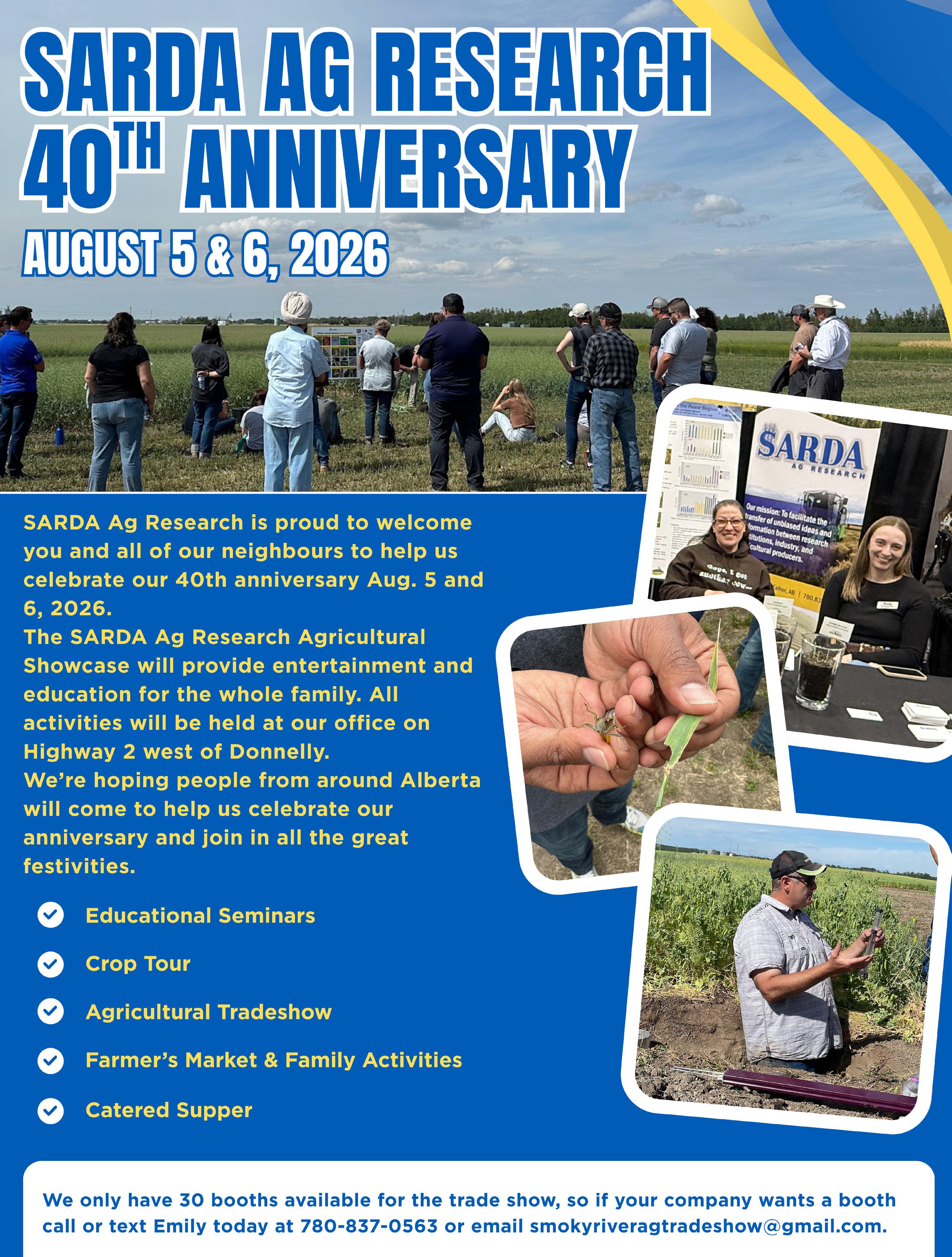

SARDA AG RESEARCH AGRICULTURAL SHOWCASE AUGUST 5 & 6, 2026
WHAT IS HAPPENING IN 2026? WELCOME TO THE TEAM DENYS! APRIL 2026
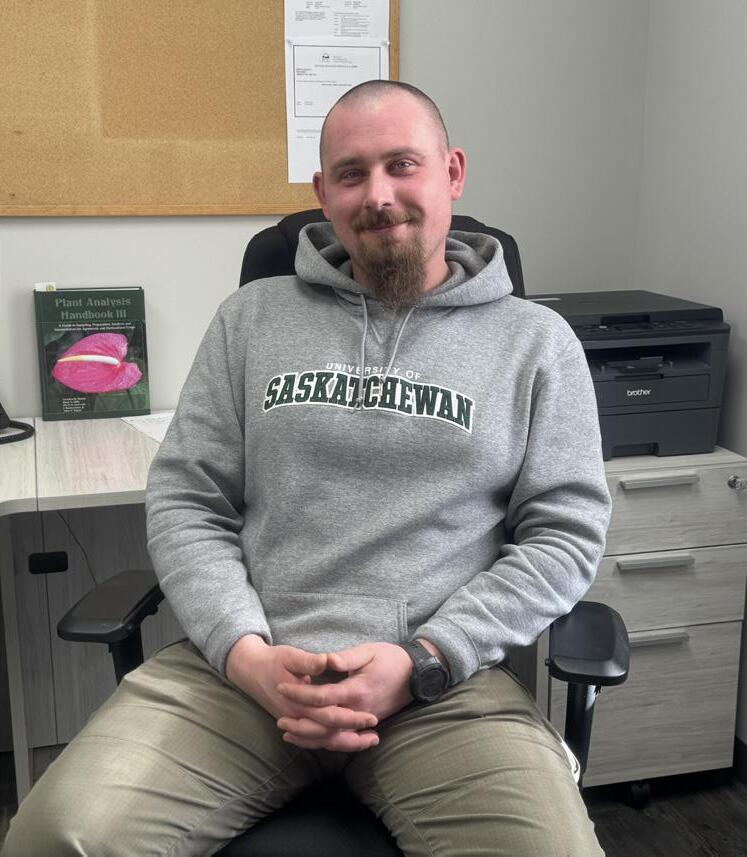
SARDA Ag Research is pleased to introduce the newest member of its team, Agronomist Denys Solskyi.
Denys joined the team in February as a Research Scientist, and he brings a wealth of experience with him to help conduct and facilitate research projects for SARDA.
“It all happened unexpectedly,” says Denys of his move to SARDA. “For the last two years I was farming cranberries in the lower mainland in Delta, and I got a call from Endale, one of SARDA’s employees, notifying me that they had an opening.”
Denys says he was excited to learn about the position as it was a good fit for the education he completed at the University of Saskatchewan, where he had experience in crop physiology and nutrient efficiency research. Denys’s education began in Ukraine at the National University of Life and Environmental Science where he earned a Bachelor of Science Degree in Agronomy and then he completed his Master of Science in Agriculture at the University of Saskatchewan.
“It’s an interesting opportunity and closer to what I have my university education in,” says Denys of his new position. “I’m happy to be back in an area that has four seasons, I really missed the snow.”
Denys was born in Kyiv, Ukraine, but when he was three years old his family moved to a small city just outside the capital. He moved to Canada in September 2018 for English as a second language as a 10week course, while he was improving his language skills at the University of Saskatchewan, he met his future supervisor that helped to get Denys into the master’s program.
“I have a master’s in crop physiology,” says Denys. “I did experiments and wrote a thesis on nitrogen-use efficiency in Canola. For five years I did that in Saskatoon.”
Denys feels his transition to the Smoky River Region and SARDA is a perfect fit for his background and he looks forward to hitting the ground running with research projects in the summer.
He adds that agriculture is a prominent career choice in his family, his Paternal Grandmother was on agricultural boards in Soviet Union, and his father runs a Ukrainian branch of a Dutch company that sells horticulture seeds. Denys also says he travelled throughout Ukraine with his father, observing different farms and agricultural operations since he was a little kid.
“I love nature and being outside,” says Denys. “I already saw an aurora and I’m glad I got to see it.”
Denys says he’s excited to learn his new job in upcoming months and he’s eager to be part of the team at SARDA. He says he’s eager to help implement and manage the various projects that will be done at SARDA in the future.

Whitney Boisvert - SARDA Ag Research Board Secretary
SARDA Ag Research team is full of agricultural enthusiasts, and that enthusiasm extends to the board that helps to govern and lead its crew.
A notable asset to the team is the SARDA Ag Research Board Secretary Whitney Boisvert, whose upbringing in Tisdale, Saskatchewan helped to nurture her passion for agriculture.
“I grew up on and around my parents’ and grandparents’ farm,” says Boisvert. “It was basically my whole lifestyle when I was little.”
Whitney says she was immersed in all the intricacies of agriculture at a young age but initially took a different path after high school.
“I went to Lakeland college out of high school in 2011, where I took a two-year diploma in Wildlife and Fisheries conservation,” she says. “I then transferred to University of Saskatchewan, where I completed two more years to get a degree in Ag, with a Major in Soil Science.”
While living in Saskatoon, she worked at a canola greenhouse breeding for two summers. She says she was working with a PhD student taking different cultivars and manually breeding them to make new varieties.
“It was my favourite job,” she exclaims, adding that research has always been her biggest draw in agriculture. “We did the whole process from seedling to harvest, monitored and took notes.”
Luckily for the region, Whitney fell in love with a fellow from Girouxville and was easily persuaded to bring her agriculture knowledge to the Smoky River Region after graduating in 2015.
“I moved here to be near my boyfriend at the time, now my husband Darcy,” she explains, adding that the region also offered a plethora of ag jobs that were right up her alley.
When Whitney first moved to the area in 2016, she worked as an Agronomist for Richardson Pioneer in Nampa for just over a year. She then switched over to AFSC working in crop insurance for two years.
“Then I had my two kids and didn’t go back to work after,” says Whitney, adding that she helped with her family’s farm books for a while and then ran her own store in Girouxville/Falher.
Whitney says her husband Darcy farms full-time with his brother and dad.
“They do custom agronomy and grow pedigree seed as a side business through the farm,” Whitney says. “They farm about 4,000 acres. Canola, barley, peas and sometimes hemp. Darcy also does custom agronomy for Smoky Hemp.”
The pair have two children: a six-year-old son and a two-year old daughter. Her son is in fulltime kindergarten (Maternelle) and her daughter attends a day home in Falher. She says she’s currently busy learning a different type of science to keep up with her little boy, dinosaurs are his current obsession, with a future aspiration of becoming a paleontologist.
Winagami Provincial Park is also a huge draw for the family, Whitney says they love to spend time there with her husband’s family.
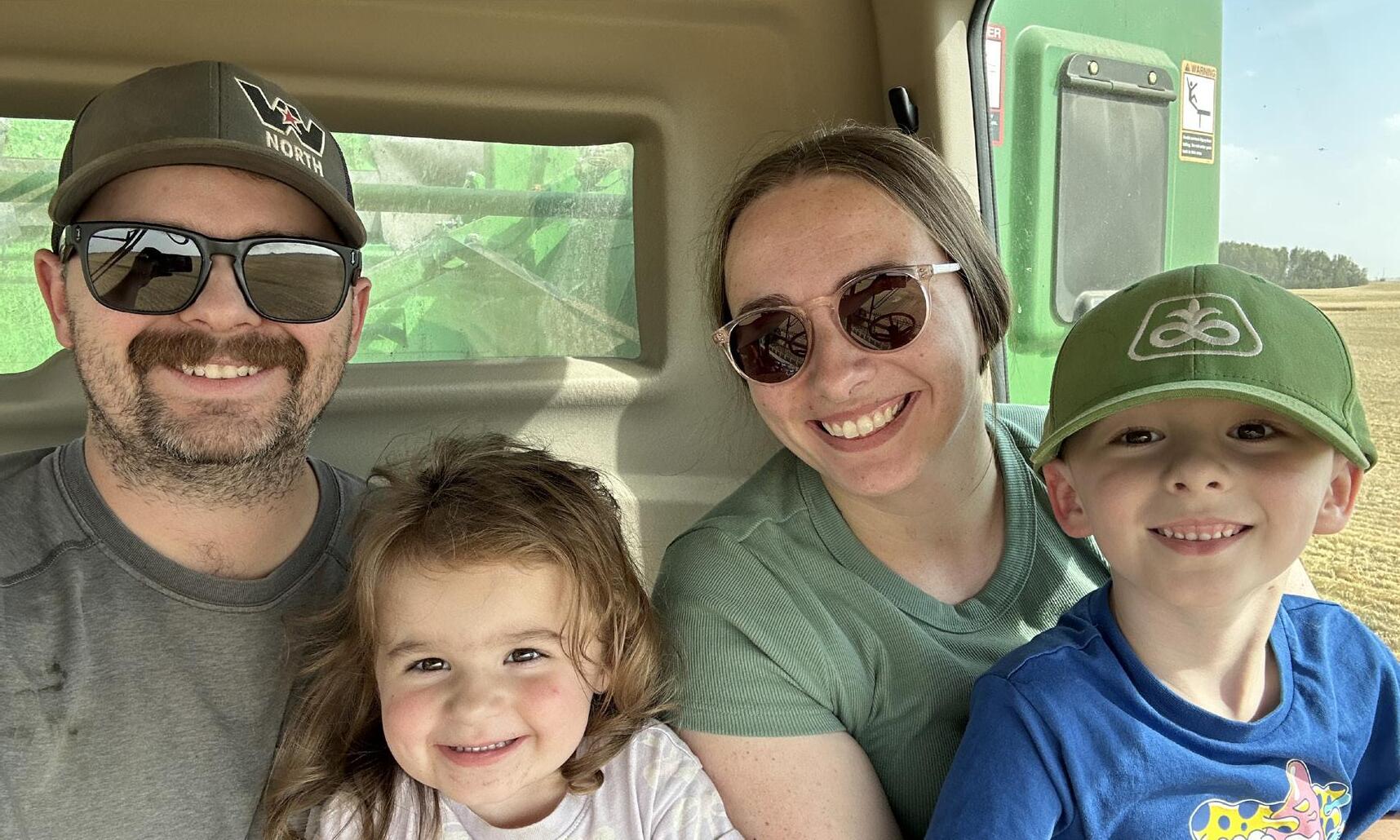
Whitney says her appreciation for SARDA Ag Research was discovered through her husband.
“Darcy worked at SARDA before he started farming full time,” she says. “I joined the board in 2021 when I wanted to be more involved with agriculture again but didn’t want a full-time job because I had kids. I was excited to be involved with research again. It’s interesting and I like that everything is small scale and different, it doesn’t get boring.”
Whitney says SARDA is a great asset to local farmers, because the team helps to provide options in diversifying crops.
“We have a lot of wheat and canola in the area, which may start getting bad with diseases and weeds,” she says. “For soil health, we need to diversify from the types of crops we have. SARDA grows different crops, rotations and practices. They’re getting ahead of the farmers to help provide them alternatives.”
She says SARDA helps to introduce new crops to producers, shows them how to grow them and market the crops here. The team also provides connections to resources for producers.
“I like being involved with SARDA because I like to see different things, different plants, do the field walks, talk to scientists, and learn new information,” Whitney says. “I like what SARDA is doing, I like that it’s concentrating both on trials on varieties that will suit farmers right now and also trials on different plants and procedures/processes that will help farmers in 5 to 10 years.”
She adds that she thinks SARDA does a good job having a range of types of trials.
“It would be nice to see expansion if they can acquire extra funding and personnel,” she says. “People should support SARDA because without agriculture and farmers we would lose a lot of industry and businesses.”
Whitney urges people to support SARDA Ag Research by attending SARDA events, attend webinars, follow social media pages, subscribe to the newsletter, and to make sure to attend the Trade Show.
Endale Tafesse PhD
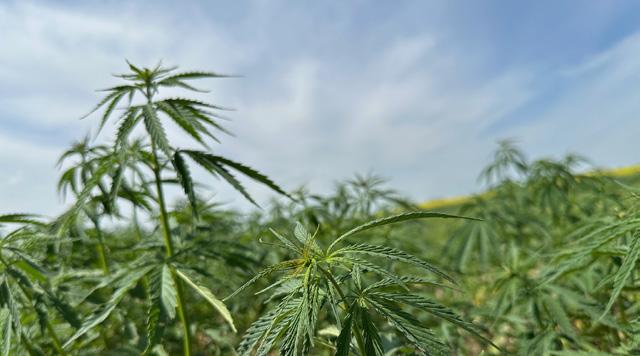
In 2026, approximately 1,500 small plots will be established across our research locations in the region. Our annual crop research program will include spring wheat, barley, oats, peas, faba beans, flax, lupins, canola, and industrial hemp.
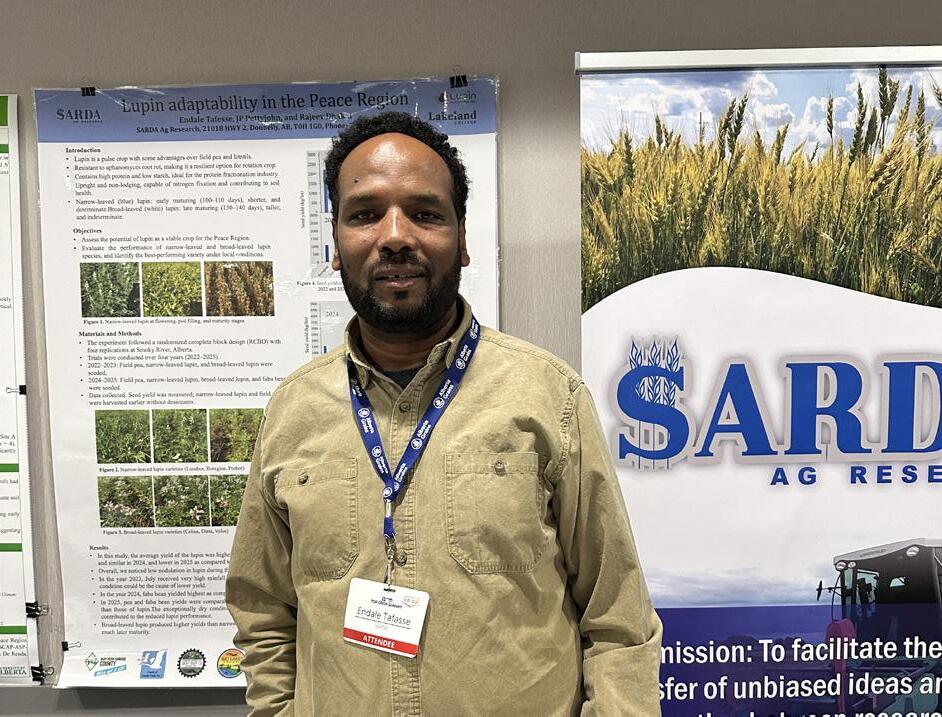
SARDA Ag Research is preparing for another active and grower-focused field season in 2026.
Building on the momentum of 2025, our program will once again deliver a combination of small-plot and field-scale trials designed to generate practical, regionally relevant agronomic information for Peace Region producers.
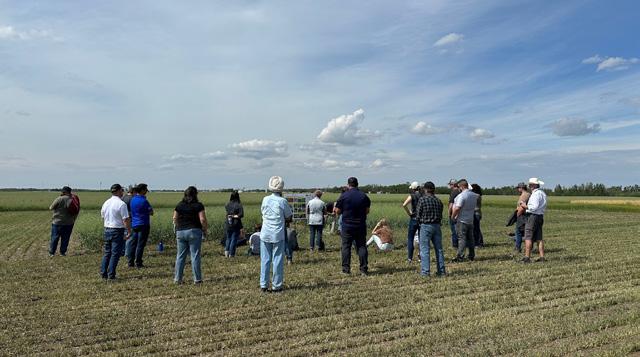
Key Research Trials for 2026 will incude:
1. Regional Variety Trials (RVTs) of wheat, barley, oats, flax, peas, and faba beans in collaboration with commodity commissions.
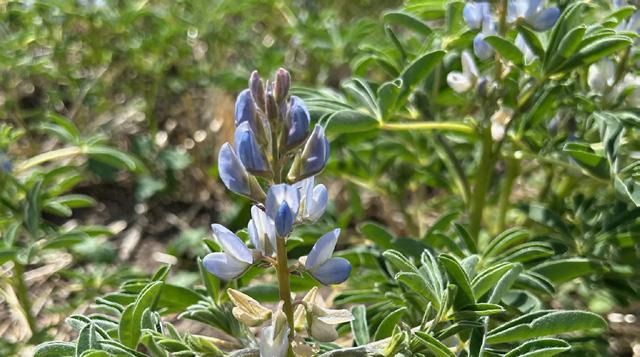
2. Lupin adaptability trials for seed and forage production in collaboration with Lakeland College and Lupin Platform Inc.
3. Lupin fertility trials evaluating phosphorus, potassium, and sulfur rates.
4. Lupin seeding rate trials to determine optimal plant populations.
5. Industrial hemp trials focusing on seed treatment options, as well as retting time and method evaluations.
6. Intercropping studies under the Peace Region Living Labs project, including pea intercropping with canola and wheat, and lupin intercropping with canola and wheat.
In addition to small-plot research, SARDA will continue working with local producers through the Peace Region Living Labs initiative to conduct field-scale demonstrations. These on-farm trials allow us to evaluate beneficial management practices under real production conditions.
SARDA is also collaborating with industry partners to assess crop nutrition programs, soil amendments, variety performance, and crop management products. We are pleased to continue working with Koch, BASF, Alpine, ASLE, and Calcium Products, and we welcome Annelid Soil Solutions as a new industry collaborator in 2026.
Key research studies in 2026 will include:
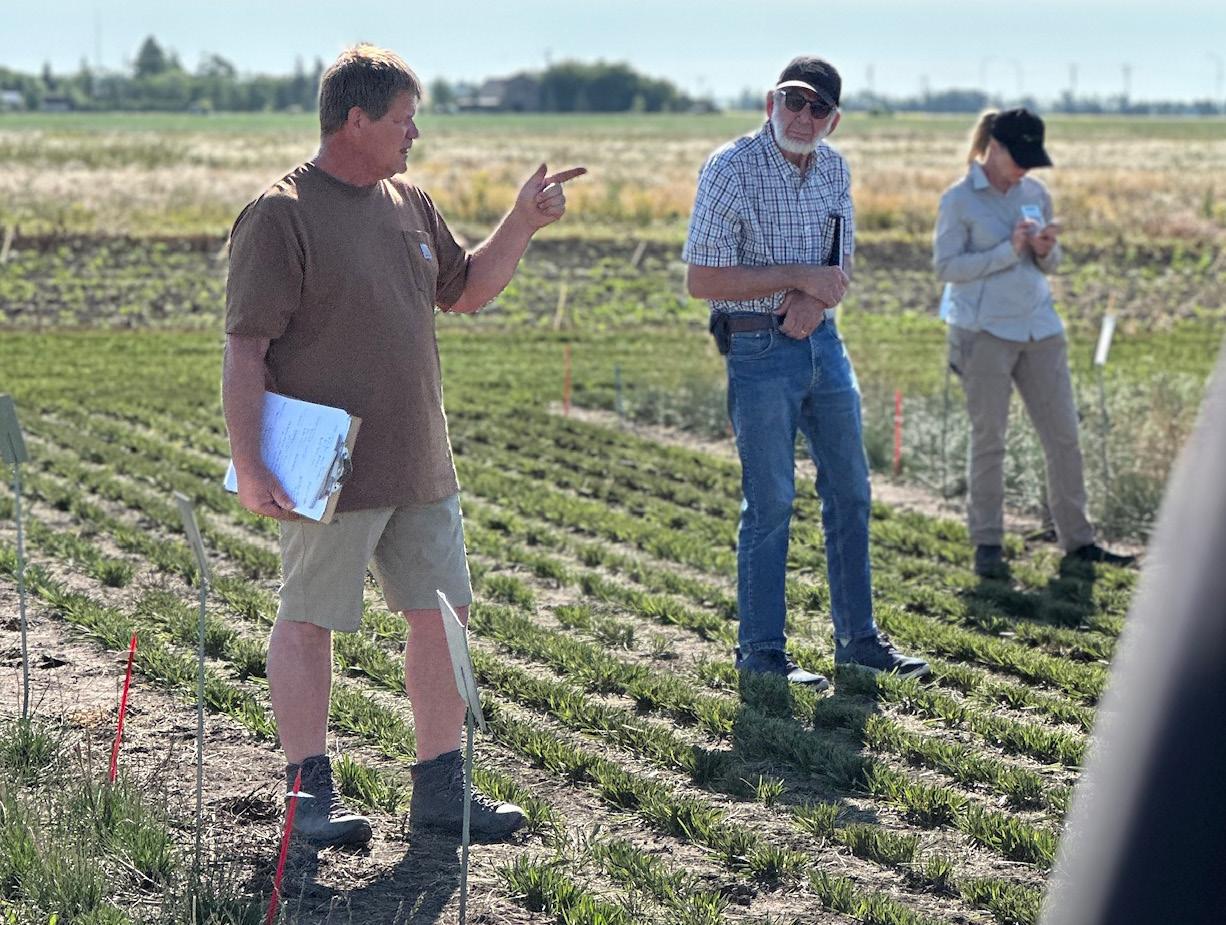
1. Establishing eight grass species with glufosinate tolerant canola (year 3 of 3).
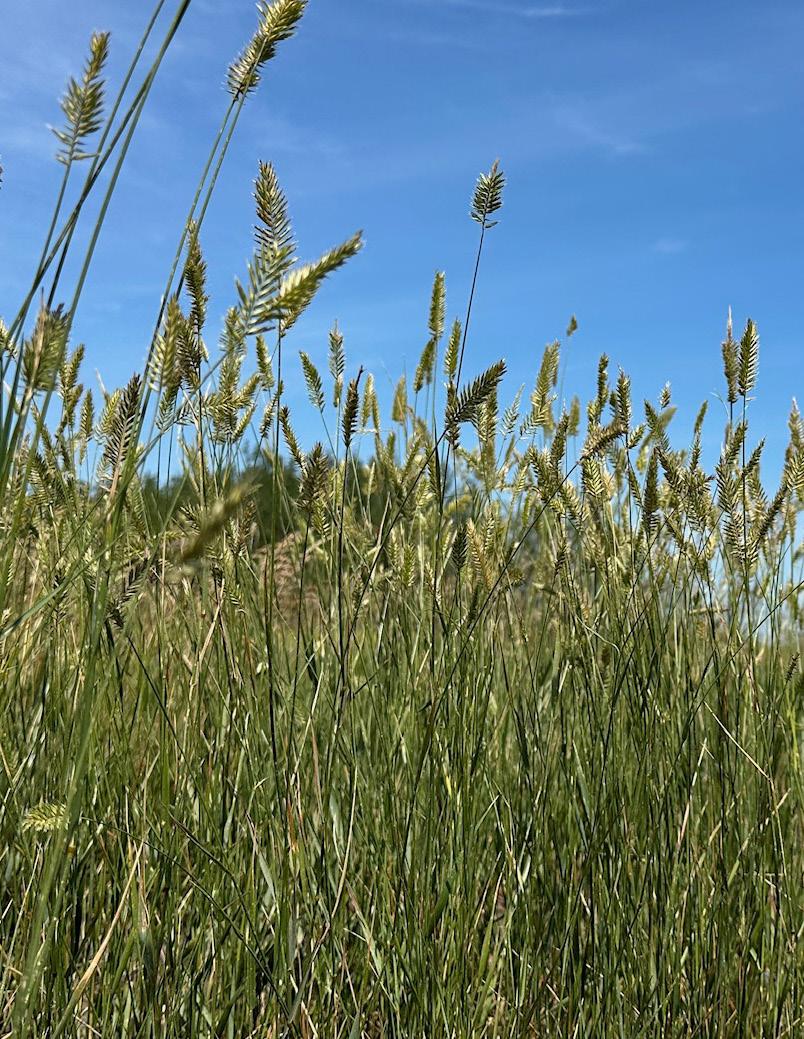
2. Effects of plant growth regulators on crested wheatgrass.
3. Effects of top dressing additional UAN and rates of Moddus growth regulator on perennial ryegrass and tall fescue seed crops (year 1 of 2).
4. Evaluation of new red and alsike clover varieties for seed yield potential (year 1 of 2).
5. Evaluation of herbicide Olympus for managing foxtail barley in grass seed crops.
6. Tolerance of established crested wheatgrass to herbicides Axial, Simplicity and Cirpreme XC.
7. Timing, rates of nitrogen in the form of urea and urease inhibitor on timothy, creeping red fescue and meadow bromegrass seed yields.
8. Tolerance of grasses to pre-seed applications of herbicide Prospect and Paradigm-Pre.
9. Managing herbicide resistant wildoats in annual crops.
Peace Region Perennial Ryegrass Seed Production
Calvin Yoder, Peace Region Forage Seed Association (PRFSA) and SARDA Ag Research, Doug Thiessen, Foster's Seed and Feed, Ashley Heft, Foster's Seed and Feed, Maria Reschke, PRFSA
Read more by scanning the code!
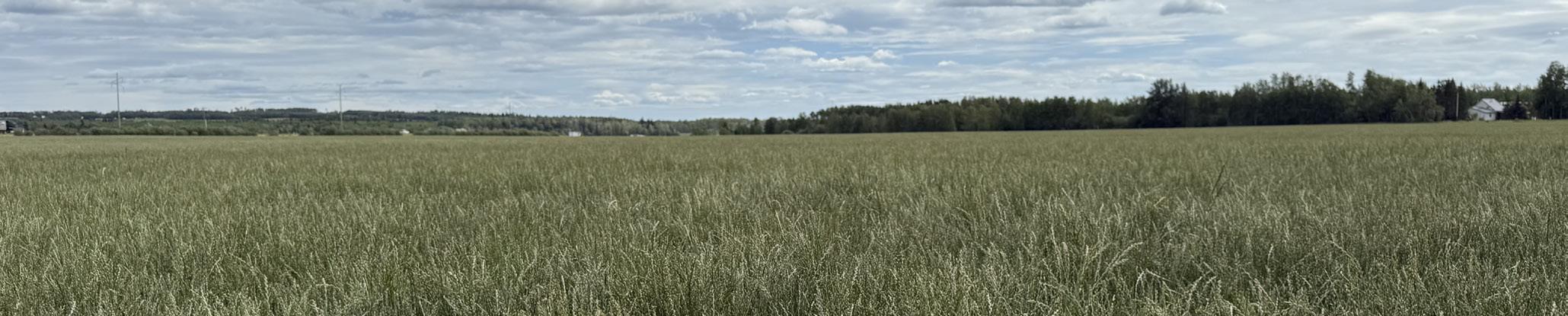
In 2026 PRFSA trials will be located on growers fields and behind the SARDA Ag Research shop in Donnelly, AB. Locations include Hythe, Crooked Creek, Whitemud, Girouxville, Spirit River, La Glace and Valhalla. See the latest issue of The Seed Head
We
Simon
Leonard
Whitney
Kenny
Alain
John
Gilles
Dave
Dale
Alain Blanchette
Jason Javos
Vance
Calvin