December 2025
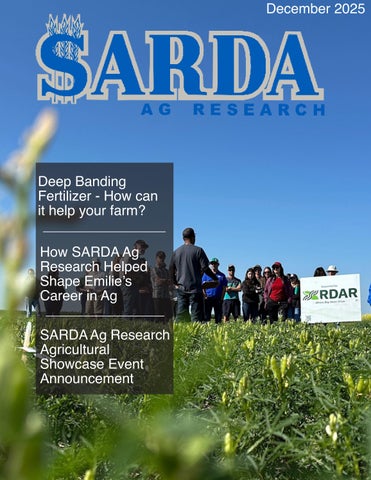
Deep Banding Fertilizer - How can it help your farm? How SARDA Ag Research Helped Shape Emilie’s Career in Ag SARDA Ag Research Agricultural Showcase Event Announcement
Board Members Simon Lavoie Leonard Desharnais Whitney Boisvert Mathieu Bergeron Kenny Stewart GP - VACANT Alain Anctil
John Vinette Gilles Roy Dave Berry Dale Nelson Marty Tissington Alain Blanchette Jason Javos
Staff Members Vance Yaremko Calvin Yoder P.Ag. Endale Tafesse PhD Victor Gauthier Amber Fennell Megan Allard (on leave) JP Pettyjohn Trista Boissonneault Simon Garant
Executive Director Forage Seed Specialist Science Director Field Technician Field Technician Research Coordinator Research Coordinator Field Technician Field Technician
Thank you to our supporters!
2
Table of Contents Cold Storage Building is Up Deep Banding Phosphorus Fertilizer Plant Growth Regulator Effects on Seed Yield of Timothy How SARDA Ag Research Helped Shape Emilie’s Career in Ag Annual Crop Update Forage Crop Update Forage Crop - User Requested Minor Use Label Expansion Thank You To Our Funders Upcoming Events
3 4 7 8 10 11 12 13 13
Cold Storage Building is Up In November & December the cold storage building was delivered and assembled providing much needed protection from critters and the elements for SARDA Ag Research equipment. Board Members were able to take a walk through the new cold storage facility before the overhead doors were installed. Everyone is very excited to have this building ready for use and would like to thank the Government of Alberta for supporting SARDA Ag Research.
3
Deep Banding Phosphorus Fertilizer Normand Boulet - trial between 2021 - 2024 Part of what makes SARDA Ag Research so successful is the relationship between agricultural producers in the region and its team. A project that has been worked on over recent years is testing deep banding and its benefits to producers. Deep banding is a technique that injects nutrients like phosphorus and potassium four to six inches below the soil surface. This method is done once every three years and helps to make nutrients available to plant roots, specifically on no-till or reduced-tillage land. The hope is that deep banding will reduce costs and labor by simply reducing the annual applications. “In normal practice, a farmer would deep band fertilizer, typically Nitrogen, and usually in the fall to have it in place for the following year’s crop,” explains grain farmer Norm Boulet. “Deep banding the nutrient speeds up seeding by reducing the amount of products we have to deal with through the drill at seeding. By deep banding, we put nutrients into the soil bank for the roots of the crop to access when it’s needed.” Boulet is working on a trial with SARDA, deep banding phosphorus fertilizer with enough injected in the soil for four years of normal use. He explains normally 50lbs per acre would be placed of 11-52 phosphorus fertilizer at seeding, but for the trial 200 lbs per acre was deep banded, with the intention of not having to use more fertilizer for four years. “SARDA was testing a practice change which could help farmers to seed their crops more quickly in the spring by having one crop nutrient already in place,” Boulet says. “For farmers like us (at the time) we had a small cart with only three compartments on our air drill. If we didn’t have to place the phosphorus at seeding time, it would allow us to carry more seed, or other types of fertilizer and extend the number of acres per tank, which would allow fewer stops to fill.” Boulet says if this practice worked, it would also allow the farmer to purchase fertilizer in the fall when prices are lower, band them into the soil and save significantly on input costs. He says he was intrigued to learn more about the practice after attending a SARDA Ag Research Summer Tour where the practice was explained. “At that time SARDA was in its second or third year of the trial and to that point no yield loss had been experienced,” Boulet notes. “It intrigued me. I think that’s an important point, ‘no yield loss had been experienced’, usually as farmers we are chasing yield, if we change to a different seed variety or add a micronutrient, we are trying to increase our yields.” Boulet says his practice was about saving time and potentially saving money, if farmers could get a deal on fertilizer. “Also, Ag Canada research says that in the great majority of cases seeding early gives the best yields so if a farmer can seed more quickly, then their crop can establish sooner and take greater advantage of the soil moisture before the weeds or evaporation gets it,” he says.
Boulet says with SARDA’s help, his family farm established a 50-acre trial in one of their fields. He says they had some Phosphorus fertilizer left over, so they deep banded 200 lbs/ac in the fall of 2021. “That would normally be enough for four crops because 50 lb/ac is our typical annual application,” Boulet notes. “The SARDA trial had looked at three years and saw no yield loss, but we wanted to do four years because we have a four-year crop rotation and we thought it made sense to have all our crops involved in the trial.” Boulet explains 11-52 is the commonly available fertilizer farmers use to provide crops with the required nutrient Phosphorus. Monoammonium phosphate (MAP) is 11 percent Nitrogen and 52 percent P205. He explains when applied at 50 lbs per acre, it provides 5.5 lbs/ac Nitrogen and 26 lbs/ac Phosphorus. “We were shooting for four to five inches deep but ended up more like three to four inches deep,” Boulet says. “We wanted to ensure it was low enough it wouldn’t be disturbed and brought to the surface with our normal seeding or tillage operations, but not so deep the plant roots wouldn’t find it when the crops required it. Phosphorus is quite immobile in the soil, and our heavy clay tends to trap nutrients in place. I don’t know that we would consider this practice if we farmed a very sandy soil.” Boulet says the yields and the grain quality tested after using deep banding, (inclusive of protein, bushel weight, and grade), were not significantly affected or changed with the use of deep banding. “We harvested strips on and off the treatment area and weighed the samples using the grain cart which is equipped with scales,” Boulet says. “We were not expecting a yield increase but were concerned that as the Phos was used up over time, we might see a yield decrease. 2025 was the fourth year and yields were still the same on the trial and the normal practice of applying 50 lbs/ac 11-52 at seeding.” Boulet says the major benefit, if adopted on their farm, would be less product handling in the spring and thus extending the number of acres seeded per tank. He says this would allow them to seed crops more quickly, potentially taking advantage of soil moisture. “The second anticipated advantage would be to purchase nutrients at lower fall fertilizer prices which could be put into the soil bank rather than carrying it over in bins,” he says. “Unfortunately, fertilizer prices jumped drastically the year following the trial establishment and adopting it didn’t seem to make economic sense for us.” Boulet notes that farmers who are feeling the time crunch in the spring, especially people using smaller carts with only two or three compartments, could find deep banding a good fit. “If I were to be offered a very good price on MAP in the fall and had the time to deep band the product, I would certainly consider it,” he says. “If it were a very good price, I would consider banding four years’ worth of Phosphorus on all our farm.” Boulet says in his family’s farming operation they do a one in four sulphur application, broadcasting 100 lbs per acre of Elemental Sulphur (ES) on 25 percent of their acres every year. “We do this to ensure our soils have sufficient Sulphur to meet our crop needs, and to reduce the fertilizer we have to put through the drill, and tender to the drill at seeding,” he explains. “Elemental Sulphur needs to be broadcast so it can be weathered and broken down in the soil by microbes to be plant available.If we were to couple the ES application with a deep banding of Phosphorus, doing 25 percent of our acres every year we could significantly reduce the fertilizer going through the drill at seeding, do more acres per fill, and it would reduce the number of trucks needed in the field and how often they need to be filled. We could seed more acres per day and potentially gain yield by ensuring our crops have more spring moisture available to them.”
5
Deep Banding Phosphorus Fertilizer cont’d Boulet says the main takeaways of the trial were pretty evident after the four-year period. “We were not expecting to increase yield with the practice change, we were just hoping there would be no yield loss,” he says. “There was no measured yield loss or quality loss from the deep banding, deep banding Phosphorus could benefit a farmer by streamlining the seeding process, and could be a financial benefit if the fall price of MAP were to be significantly lower than the spring price, and this was a good example of small plot research being taken to field scale and giving the same results.” Farming Smarter out of Lethbridge also conducted an identical trial on a field in their community. It was a joint project to determine if deep banding would work in the two areas.
Photos provided by Normand Boulet featuring three years of his four year deep banding trial with Phosphorus established in 2021. The photos were taken in in 2022, 2023, and 2024.
Once in Three-Year Deep-Banding and Annual Shallow-Banding of P, K, Cu Fertilizer Effects on Crops and Soil Nutrients SARDA Ag Research would like to acknowledge Farming Smarter for their tremendous support and partnership in the Deep Banding trials both small and larger scale. Partnering with other research organizations helps to broaden study areas and grow knowledge between communities and reseachers.
6
Plant Growth Regulator Effects on Seed Yield of Timothy Surendra Bhattarai, Hari P. Poudel, Nicole P. Anderson, Calvin L. Yoder ABSTRACT Timothy (Phleum pratense L.) is a cool-season perennial forage grass species widely utilized for animal feed and fodder in temperate regions of the world. Timothy is one of the main forage grass crops grown for seed in the Peace Region of western Canada. Timothy performs well under well-fertilized and high-moisture soils, but seed production fields are prone to lodging under such conditions. Lodging in grass crops reduces seed production through self-shading, which limits successful pollination, fertilization, and seed fill. In this study, we investigated the effects of two plant growth regulators (PGRs), chlormequat chloride (CCC) and trinexapac-ethyl (TE), on plant height, lodging, seed weight, and seed yield of timothy for 8 site-years. The study encompassed 5 years at one site with crop stands in their first to fifth year of seed production and 3 years at a second site with crop stands in their first to third year of seed production. The PGRs were applied alone (TE and CCC) and in a mix (TE + CCC) at the 2–3 node (Biologische Bundesanstalt, Bundessortenamt, and Chemische Industrie [BBCH] 32–33) and early heading (BBCH 51–52) growth stages. The application of PGRs (TE, CCC, and their mix) at two different growth stages showed a differential decrease in lodging and plant height and an increase in seed yield in all but 1 site year. Among the PGR treatments, CCC applied at the BBCH 32–33 was the most effective in increasing seed yield and economic returns of timothy.
Scan to read the full article
Small plot combining timothy in Sunset House 2025
7
How SARDA Ag Research Helped Shape Emilie’s Career in Agriculture Emilie Aubin Summer Student 2021 - 2023 Being a summer student for SARDA Ag Research can change the trajectory of your future, much as it did for Emilie Aubin just a short few years ago. “I worked as a summer student for SARDA in the summers of 2021, 2022, and 2023,” says Aubin. “I initially decided to apply because I had a lot of friends working there. Once I learned more about SARDA’s research and their impact on the local agriculture industry, I knew it would be a great way to get some hands-on experience.” Aubin says when she first started as a summer student with SARDA, she was enrolled in a Bachelor of Science degree program at King’s University in Edmonton, majoring in biology and minoring in chemistry. Little did she know that her experience working with SARDA would change the direction of her future career. “Working at SARDA helped me realize how necessary agricultural research is for the industry,” Aubin explains. “I found the work much more interesting than my studies at the time, and it inspired me to pursue a path more closely aligned with agriculture. I also wanted to find a career that allowed me to return home.” Aubin was raised in the Smoky River Region, which is known as the municipality with the second most arable acres in Alberta and an area that boasts its long growing hours in the summer. “Working at SARDA definitely allowed me to obtain more knowledge about the research side of the industry, which is very different from production farming,” says Aubin. “It deepened my appreciation of the ‘invisible support’ farmers get from small plot research farms and drove me to not only come back to the farm but also work towards obtaining my Professional Agrologist (P. Ag.) designation.” Aubin says working at SARDA helped foster a greater knowledge of different crop varieties grown in the Peace Region, weeds, diseases, chemical applications, and general research practices. She says it was a great balance of hands-on fieldwork and technical learning. “Growing up on a farm gave me a strong understanding of crop production, but SARDA showed me the research and innovation side of agriculture that drives the industry forward,” she says. “It helped me appreciate the years of science and testing that go into improving yields and maximizing efficiency for producers. Aubin urges other young people to take the opportunity to become a summer student for SARDA, noting that it’s a job that cannot be compared to any other summer job available. “The work SARDA does is super important and the summer student position is good place to start for anyone interested in agriculture,” Aubin says. “It’s also a rewarding summer job where you get to work outdoors, learn from experienced co-workers, and gain insight into an industry that’s such an important part of life in the Peace Region.”
8
How SARDA Ag Research Helped Shape Emilie’s Career in Agriculture cont’d Aubin’s time with SARDA inspired her to switch her educational path. She recently finished a Crop Science degree at the University of Alberta and is now working as a Sales Agronomist at St. Isidore Co-op in Falher. “The knowledge I gained about small-plot research was extremely valuable when I worked for BASF’s Technical Services team in the summer of 2024,” she says. “My understanding of crop protection products, fertilizers, and agronomic practices has also been a huge asset in both my studies and my current role.” Aubin says two of her favourite jobs while working for SARDA was seeding and spraying, noting that she felt them to be the most rewarding tasks and a great way to see the progression of plots through the season. She adds that SARDA’s work is a huge benefit to people throughout the region. “Having a research farm right here in the Smoky River Region is a major advantage for local producers,” says Aubin. “SARDA does tons of work behind the scenes to test varieties and practices suited to our unique growing conditions. The Peace Region has a distinct climate and a shorter growing season, so having localized research is very valuable.” Aubin concludes that research organizations help to advance the agricultural industry, with trials and data helping companies develop new products and management practices that enable farmers to grow more efficiently and profitably.
If you are interested in a job as a summer student with SARDA Ag Research, please reach out to the team at 780-837-2900 or email Executive Director Vance Yaremko at manager@sarda.ca.
9
Annual Crop Update Endale Tafesse PhD SARDA AG RESEARCH completed a busy
and productive 2025 field season, delivering trials on annual crops including cereals, pulses, oilseeds, and industrial hemp, as well as perennial forage and turf seed research. Over 1,500 small plots were established near Donnelly and Debolt, with additional forage seed trials conducted on growers' fields in the Donnelly, Girouxville, Whitemud, Debolt, Spirit River, Valhalla, and Hythe areas.
Industry Trials In collaboration with industry partners, SARDA Ag Research conducted trials on wheat, canola, peas, and barley. Main objectives included variety trials for canola yield and quality, soil amendments to enhance fertility, plant vigor, soil pH and organic matter content, and fertility trials (mainly nitrogen source and rate) on wheat and canola.
Annual Crops Research Key research focuses for annual crops in 2025 included: 1. Regional Variety Trials (RVTs) on wheat, barley, oats, peas, faba beans, and flax, testing elite genotypes for yield and other agronomic benefits in the Peace Region.
Challenges and Outcomes
2. Lupin adaptability trials for both seed and forage production.
The 2025 season received substantially less rainfall and experienced higher temperatures than longterm averages. These exceptionally dry conditions affected crop performance, making it difficult to fully realize yield potential and treatment effects. Despite these challenges, we observed meaningful treatment differences in most studies, providing necessary data for management decisions.
3. Lupin fertility trials (phosphorus, potassium, and sulfur rate trials) to understand fertilizer rate effects. 4. Lupin seeding rate trials to determine optimal plant populations. 5. Industrial hemp trials focusing on seed treatment options and retting time and methods.
Overall, the 2025 season delivered one of SARDA Ag Research's most diverse and grower-centered research programs. The results will support growers with independent, regionally relevant agronomic information as they plan for the year ahead.
6. Peace Region Living Lab (PRLL) small-plot intercropping studies, including pea and lupin intercropping with canola and wheat, along with on-farm Best Management Practice demonstrations to improve economic and agronomic benefits to the Region.
10
Forage Crop Update Calvin Yoder P. Ag IN THE 2025 GROWING SEASON trials
were conducted on producer fields as well as in the location directly behind the SARDA Ag Research shop in Donnelly. Producer locations included: Hythe, Crooked Creek, Whitemud, Girouxville, Spirit River and Valhalla.The research was performed and measured throughout 35 trials and 280 treatments with a total of 1104 plots.
Turf & Forage Seed Crops Research Key research in 2025 included: 1. Establishing eight grass species with glufosinate tolerant canola. 2. Effects of growth regulators on smooth brome, meadow brome and crested wheatgrass. 3. Effects of top dressing additional UAN and rates of Moddus growth regulator on perennial ryegrass seed yields. 4. Evaluation of new red and alsike clover varieties for seed yield potential. Seeded but did not establish. This trial will be re-seeded in 2026. 5. Evaluation of the herbicide Olympus for foxtail barley control in grass seed crops. 6. Tolerance of established creeping red fescue, smooth bromegrass, meadow bromegrass and crested wheatgrass to broad-leaved herbicide Talinor. 7. Tolerance of established crested wheatgrass to grassy weed herbicides Axial, Simplicity, Olympus, Assure II and Centurion.
9. Tolerance of perennial ryegrass to pre-seed applications of herbicide Prospect and Paradigm-Pre. 10. Effects of nitrogen fixing products on perennial ryegrass. 11. Effect of forms of spring applied nitrogen: Urea, Urea+Agrotain and AXAN (ammonium nitrate+sulphur) on Timothy Seed Yields 12. Managing herbicide resistant wildoats in annual crops. A large portion of the PRFSA/SARDA Ag Research Turf and Forage Seed Program is to evaluate weed control and crop safety of herbicides on grass seed crops. Grass seed crop herbicide tolerance trials involve applying treatments at 1 and 2x rates recommended that would be used in annual crops. Visual ratings, seed yields, seed weights and germination are collected. Trials are also conducted on how some herbicides control specific weed issues in grass seed crops. On the next page are two recent User Requested Minor Use Registrations (URMULE) that were generated with the help of data collected from SARDA Ag Research trials.
8. Timing, rates of nitrogen, and urease inhibitor on timothy, creeping red fescue and meadow bromegrass seed yields.
11
Forage Crop - User Requested Minor Use Label Expansion User Requested Minor Use Label Expansion (URMULE) Cirpreme A Herbicide (florasulam+halauxifen) on Grass Seed Crops Submitted by Calvin Yoder, Turf and Forage Seed Specialist, PRFSA and SARDA Ag Research December 15, 2025 In March 2025 the Pest Management Regulatory Agency approved the minor use registration for the use of Cirpreme A (florasulam+halauxifen) on both seedling and established timothy grown for seed and forage production. The pre-harvest interval between application and harvest is 60 days. Cirpreme A on established timothy had been selected at the Minor Use Priority Setting Meeting in Ottawa in March of 2019. URMULE - User Requested Minor Use Label Expansion for the use of Cirpreme A Herbicide (florasulum and halauxifen), Reg. No. 34180, for the control of labelled weeds on timothy for forage, seed and hay production Cirpreme A can be tank mixed with Lontrel XC which makes Cirpreme XC. PRFSA and SARDA Ag Research conducted five tolerance trials over a five year period on established timothy for seed production using Cirpreme XC (florasulam+halauxifen+clopyralid) applied at the 1x and 2x rate registered on wheat and barley. Tolerance of timothy to Cirpreme XC was good at both rates. Seed yields dropped off slightly when MCPA ester was added to Cirpreme XC. Cirpreme A and Cirpreme XC with or without MCPA ester will have a nice fit in controlling a number of weeds in seedling and established timothy grown for seed production. Please note that herbicides with clopyralid should be avoided on timothy if the hay or straw is destined for the export market. In September 2025 the Pest Management Regulatory Agency approved the minor use registration for the use of Cirpreme A (florasulam+halauxifen) on seedling creeping red fescue, established creeping red fescue and seedling bromegrasses grown for seed production. URMULE - User Requested Minor Use Label Expansion for the Use of Cirpreme A Herbicide (florasulam and halauxifen), Reg. No. 34180, for the Control of labelled weeds in seedling and established creeping red fescue (D.3.2 2024-1190) and seedling bromegrass grown (D.3.2 2024-1198) for seed, forage and hay Trials conducted in the Peace Region showed established creeping red fescue seed crops to have excellent tolerance to Cirpreme XC with or without MCPA ester. Please note that Cirpreme XC applied to established bromegrasses has resulted in seed yield losses and should be avoided. We look forward to having these URMULE placed on the labels in the near future. Both these products will be used by Peace Region grass seed growers. Factsheets are available summarizing Peace Region trials on the effects of Cirpreme XC on established timothy, creeping red fescue and bromegrasses at the PRFSA website.
12
Thank You To Our Funders
As always, various producers and industry partners have supported and supplied seed to SARDA Ag Research for conducting research trials. We are grateful for their support and want to extend our warm gratitude.
Upcoming Events
Contact us at: info@sarda.ca 1-780-837-2900 Find us online at: www.sarda.ca
Follow us on social media: @SARDAAgResearch Sign up for our SARDA Ag Research emails: