

![]()


Most Americans agree that our rights aren’t provided by the government. After all, the Declaration of Independence states that all people are “endowed by their Creator with certain unalienable rights.” But what precisely are these unalienable rights, and how do they relate to the U.S. Constitution? This issue has perplexed and, at times, troubled many, particularly as the Supreme Court has read into the “due process clause” of the Fourteenth Amendment various unenumerated rights. In some cases, such as an ostensible ‘right’ to an abortion, one would be hard-pressed to reconcile these rights with a belief in a Christian “Creator” who brought into existence all persons in His image and likeness. Is it possible in the absence of a Creator to have a coherent and foundational vision of rights? Can history provide an adequate guide to the meaning of our rights? These questions remain at the heart of debates about what it means to be a person within the American constitutional order.

OWNER/PUBLISHER
Chad Beatty
MAGAZINE DESIGNER
Kacie Cotter-Harrigan
ADVERTISING DESIGNER
Jocelyn Lucey
CONTRIBUTING WRITERS
Chad Beatty
Becky Bruehl Bestul
Colleen Coleman
Jim Feipel
Jodie Fitz
Paul Forte
Trevor J. Ganzi
Mary Harp-Jirschele
Stacey Kutsch
Sharon Levesque
Lauren Maxwell
Katherine Morna Towne
Thomas J. Nuttle
Ralph Vincent
PHOTOGRAPHERS
Benjamin Moore
John Bestul
Becky Bruehl Bestul
Care2Grow
Yvette Forte
Emily Rose Grisham
The Studios of Ave Maria
Brian Tietz
®
EDITORIAL/PHOTOGRAPHY
518-248-2080 | cbeatty@oilwellpublishing.com
SALES
Chad Beatty cbeatty@oilwellpublishing.com
PUBLISHED


A resident of Ave Maria since building a home here in 2015, Becky Bruehl Bestul is an award-winning, former print and broadcast journalist from Wisconsin who later entered the business world. After retiring from corporate management, Bestul sought the Florida sunshine with her husband, John Bestul. She immersed herself in the community supporting a number of volunteer activities. Writing is her first love and she looks forward to sharing the stories of the area. The Bestuls live in Maple Ridge with their two dogs. They enjoy hosting friends and family (especially their grandchildren) and introducing visitors to the uniqueness of Ave Maria.

Originally from Chicago, Illinois, Jim was elected as a Member to the PGA of America in October of 2000. In 2005, Jim moved to Naples, Florida, where he accepted the position of Head Golf Professional at Tiburon Golf Club. Jim was also a golf instructor at the Rick Smith Golf Academy at Tiburon Golf Club, where he was able to learn and teach alongside PGA tour Instructor Rick Smith. In October of 2022 an opportunity came about to join the Del Webb community as the new Director of Golf at Panther Run Golf Club. In the past 3 years, Jim has assembled a truly unique team of golf professionals who provide instruction to players of all ages and skill levels. This year Jim will be inducted into the Quarter Century Club of the PGA of America for 25 years of service being a PGA Member!

Paul is a writer originally from Edinburgh, Scotland. He is a graduate of the Edinburgh Napier University with a degree in English Literature, Journalism, Communications and Media Studies. After graduating, he embarked upon a career as a columnist, feature writer and editor. Upon moving to the United States, Paul turned to freelance writing and, while living in East TN, he enjoyed writing for the ‘Visiting the Smokies’ magazine, showcasing one of the most popular vacation spots in Eastern US. To relax Paul enjoys finding new spots to eat breakfast with his wife, Yvette and playing games.

An Italian American chef from Ave Maria, Trevor has over 15 years of experience. Coming from backgrounds of Michelin recognized restaurants from farm to table to classic french, we know how to cater to all personalized requests. Specializing in Italian, French, American, and Mediterranean cuisines. Owner of Ganzi Hospitality LLC that works in 10 different states that brings events to your home with a private chef experience or food truck Capeesh Italian Street food for a more casual event.

Mary started playing with her dad’s L.C. Smith manual typewriter as a child in the 1960s, and followed him into the newspaper business as a teenager. After 20 years in smoke-filled newsrooms chasing ambulances for stories, she joined the world of corporate communications where her passion for non-profits was born. She went on to run two private family foundations helping to solve world problems, one person at a time. She and her husband Jeff found their retirement nirvana in Ave Maria five years ago and haven’t missed Wisconsin winters one little bit.

Sharon has been an active member of the Ave Maria community both professionally and personally since relocating to SWFL in 2018. As a full-time REALTOR®, Sharon has consistently won awards as a top producing agent. She is a mom of three adult children and is fondly known as Nana to her two grandchildren. Coming into the real estate industry five years ago, Sharon sought to understand God's mission in her new career. Having worked for the Church previously, she began to understand that she was called to serve God's people in real estate. Serving her customers in her capacity as a REALTOR® with Realty ONE Group MVP and previously with MVP Realty has become her passion.

Lauren Maxwell, Executive Vice President of "MAXWELL MORTGAGE TEAM" at CrossCountry Mortgage, is known for her catchphrase, "Financing the world one loan at a time." With 37 years of experience, she specializes in FHA, VA, USDA, and conventional loans. Serving Ave Maria and Naples, she is the top female loan originator at CrossCountry Mortgage, closing over 4,100 loans totaling $1.3 billion since 2018.

Kate is wife to a really good man and mom to their seven sons, as well as a professional writer, college-level writing tutor, and high school Spanish teacher. Her work has appeared both in print and online in such places as the Saratoga TODAY family of publications, CatholicMom.com, Nameberry, and Mothering magazine; she also wrote a book entitled Catholic Baby Names for Girls and Boys: Over 250 Ways to Honor Our Lady (Marian Press, 2018). You can email her at kmtowne23@gmail.com.

Tom Nuttle is an independent licensed and insured Medicare agent here in the state of Florida. Owner of NLTA Health Insurance and Consulting, LLC, Tom has worked and consulted nationally for numerous health care providers and insurance carriers specializing in finance and contract negotiations. A native of Buffalo NY, Tom Nuttle currently resides in Del Webb, Naples with his wife Kathleen and their youngest son Andrew.

Ralph Vincent enjoys writing about casual home entertaining. For him its all about making entertaining easy and in sync with Florida's laidback lifestyle. His food and craft cocktail recipes reflect this vibe, and he is thrilled to share them in Simply Ave Maria magazine.


Greetings my fellow Ave Marians,
While you may be picking up this edition in April, May or June, I am writing my letter toward the end of Holy Week. It has been a beautiful Lent, and I am looking forward to the Easter celebration.
One thing I will take from this 40-day period is that the spirit of sacrifice and growth should not end at Easter. If we continue in our journey, using what we have learned, imagine what next year’s Lent can look like. Now multiply that compounding growth times the next 10 years!
I heard a wonderful quote last Saturday at our weekly TMIY meeting (That Man Is You):
“A What, without a When, is a Never.” In other words... don’t spend all your time coming up with countless ‘Whats’ and never apply any ‘Whens.’
Next month I am going to pick one ‘What’ with a definitive ‘When.’ Say a prayer for me.
Some readers get confused with all the different print products in town. My publication, Simply Ave Maria, is a high-end quarterly lifestyle magazine. We publish the following editions:
Winter January Spring April Fall September Holiday November
We distribute the magazine at about 40 spots in town. Have you ever wondered where we go through the most magazines? Answer: Ace Hardware, The Bean, Ave Religious Gifts & The Welcome Center.
So, how did I come to publish a magazine in Ave Maria? Well, I have been in the media industry for about 33 years. In 2006 I launched my own publishing company in upstate NY, in a little city known as Saratoga Springs. Please don’t confuse that with
NY City…we are a small resort community nestled in the foothills of the Adirondack Mountains. We publish the local community newspaper and a number of high-end lifestyle magazines very similar to Simply Ave Maria. Some of our titles are: Simply Saratoga; Saratoga Bride; Equicurean; and our newspaper Saratoga TODAY. When we moved to Ave Maria in 2024, this format of magazine just seemed like the perfect fit for our new home.
I hope you enjoy spending your time reading Simply Ave Maria magazine. As always, we couldn’t offer this free to the public without our great advertising partners, so please stop in and visit them.
God bless.
- Chad
Chad Beatty, Owner & Publisher
cbeatty@oilwellpublishing.com 518-248-2080

APRIL 16-18
MAY 03
MAY 10
SUNDAY & WEDNESDAY PICKUP SOCCER
North Park
For Ave Maria adult residents who want to play and have fun. Contact Radu Cugutt at 239-961-1887.
ALL’S WELL THAT ENDS WELL
Donahue Family Black Box Theater
Prince Building, Ave Maria University
Evening shows begin at 7 p.m.; matinees begin at 2 p.m. shakespeareinperformance.net/tickets
Ave Maria Parish
This free concert is held from 3 – 4 p.m. Visit AveMariaParish.org for more information.
Support our small-town businesses today by shopping at any local Ave Maria business, save your receipt and bring it to The Secret Ingredient to receive 25% off one regularly priced item and a receipt from Oil Well Brewery gets you 35% one regularly priced item.
*One per customer and Publix receipts do not qualify for a discount.
MAY 14 AND JUNE 11
10 – 11 a.m.
Join Kim Twiss at the Master Association to hear an update from the team at the Ave Maria Master Association on current happenings. Please visit AveMariaMasterAssociation.com for more information.
MAY 16
Ave Maria Waterpark
A day full of fun while being safe! From 10 a.m. – 1 p.m., you’ll have a chance to learn important water safety tips as well as get fitted properly for bike helmets and more! Please visit AveMariaMasterAssociation.com for more information.
21 AND JUNE 18
Whether you are new to Ave Maria or want to learn more about the structure of Ave Maria, from 5:30 – 7 p.m. you’ll have a chance to meet with members of our team and your new neighbors. Light refreshments served.
Please visit AveMariaMasterAssociation.com for more information.
25
Ave Maria Veterans Memorial, Ave Maria Blvd.
Begin the day by honoring our military veterans who died in service to our country. This important ceremony begins at 9 a.m.
South Park, 10 a.m. – Noon
Join the community to celebrate those who have served to keep us safe. Enjoy food options, games, family activities and music. Bring your lawn chair or picnic blanket and enjoy the holiday with the community.
MAY 15
Purchase any pizza at Oil Well Craft Beer and spin the wheel to win a prize which include free soda, free upgraded pretzel, $2 off drafts, free cheese pizza and more.
04
Ave Maria Veterans Memorial, Ave Maria Blvd. At 9 a.m. commemorate our founding and bring the family to hear the reading of the Declaration of Independence.

WRITTEN BY STAFF REPORTER
It is no secret that society is in an etiquette decline. Here are some simple reminders that each of us can teach our children, and implement ourselves, to do our part in raising the bar.


• When dining with others, wait to eat until everyone has been served and is at the table.
• When eating bread, place a dab of butter on your bread plate, break off a small, bite-sized piece of bread with your fingers, and butter only that piece just before eating it. Never bite directly from the whole roll.
• When dining with children in a restaurant clean up the mess they make. Don’t let them rip up napkins, straw wrappers, etc.
• Never press others to imbibe alcoholic drinks.
��• Keep your hands off the glass of doors, display case windows, and mirrors in other’s homes or in businesses.
• When being thanked for something, instead of saying ‘no problem” respond with “It was my pleasure.”
• Let others go in/out of the door before you.
• Keep your shoes clean and polished.
• Have a firm handshake and make eye contact.
• Ask others about themselves before talking about yourself.
• Men walk on the street side of the sidewalk when walking with children/women.
• Adults walk on the street side of the sidewalk when walking with children.
• Try to compliment character instead of appearance.
• Be patient when walking behind older or disabled people. Don’t rush past them.
• When staying in a hotel, have respect for the housekeepers. Don’t leave your room a mess.
• Don’t post pictures of others on your social media without their permission.


Cooking with kids is about much more than making a meal—it’s an opportunity to build lifelong skills, encourage healthy eating habits, and create meaningful family connections. When children are invited into the kitchen, they gain confidence, curiosity, and a better understanding of where their food comes from.
Encourages Healthier Eating
Kids who help prepare meals are more likely to try new foods, especially fruits and vegetables. Hands-on involvement builds familiarity and reduces food hesitations.
Builds Life Skills
Measuring, following steps, and timing tasks help develop math, reading, and problem-solving skills— all while having fun.
Supports Independence and Confidence
Completing a recipe gives children a sense of accomplishment and pride. Even small tasks help kids feel capable and included.
Creates Positive Food Memories
Cooking together strengthens family bonds and turns mealtime into a shared experience rather than a chore.
Ages 2–4
• Washing fruits and vegetables
• Stirring ingredients
• Tearing lettuce or herbs
Ages 5–7
• Measuring ingredients
• Cracking eggs
• Assembling simple snacks
Ages 8–12
• Chopping soft foods (with supervision)
• Following simple recipes
• Using small appliances with guidance

• Wash hands before cooking
• Review basic knife and heat safety
• Assign age-appropriate tasks
• Keep the kitchen organized and clutter-free
Teaching safety alongside cooking builds awareness and responsibility.
• Talk about where foods grow
• Explore colors, textures, and flavors
• Let kids choose a fruit or vegetable to feature
• Celebrate creativity—even if it gets a little messy
Mistakes are part of learning, and curiosity should always be encouraged.
• Start with no-cook recipes or snacks
• Try themed meals (color day, veggie of the week)
• Cook with seasonal ingredients from local farmers’ markets
• Keep recipes simple and repeat favorites


• 1 cup mixed berries, frozen
• 1 traditional flatbread or tortilla, whole grain preferred
• 1 ½ teaspoons tapioca, uncooked
• 1/2 teaspoon cinnamon
• 1 – 2 tablespoons whipped cream cheese
• 1 tablespoon honey
• Non-stick cooking spray
INSTRUCTIONS:
Pre-heat the oven to 375 degrees. Stir the frozen berries, tapioca and cinnamon together.
Stir the cream cheese and honey together. Spread a thin layer of the cream cheese and honey mixture onto half of the flatbread or tortilla. Add the berry mixture on top of the cream cheese spread. Fold the flatbread in half. Place it onto a non-stick baking sheet sprayed coated with the non-stick cooking spray.
Bake for 15 - 20 minutes.
Top it off with yogurt glaze:
Yogurt Glaze: Stir together 3 oz. Plain yogurt, 1 tablespoon of milk, 1 tablespoon of honey and 1/2 teaspoon of vanilla extract.
When kids cook, they’re not just learning how to prepare food—they’re learning how to care for their bodies, make thoughtful choices, and enjoy real food. These early experiences can shape a healthier relationship with food that lasts a lifetime.
Cooking together doesn’t have to be complicated. Start small, keep it fun, and enjoy the time spent creating something nourishing—together.
Learn more about Jodie at jodiefitz.com, founder of Better Bites Foundation or visit betterbitesbunch.com
(14 years later.)

WRITTEN BY KATHERINE MORNA TOWNE
Years ago — nearly fourteen years ago — I wrote an article called “What’s Two Weeks?” It was so long ago, in fact, that the issue it was published in isn’t available online and my own copy is buried somewhere in my desk area, so I’m going on memory here, but what I remember is that I wrote about the idea that there seems to be something about the span of two weeks being the amount of time one needs to transition from one phase to another. Specifically, I wrote about potty training. That article was inspired by a conversation I’d had with a friend who’d gone through pottying with two or three of her own kids by that point, and how she told me back then (back when I was thinking about introducing the potty to my oldest) that when she felt like it was the right time, she basically just hunkered down at home with the potty kid and prepared for two weeks of accidents and frustrations. In her experience, after two weeks it was pretty much smooth sailing. I really latched onto this two-week idea! Even though on the one hand, I felt like, “Ohmygosh TWO WEEKS?? I will never survive this,” I could also see that, in the grand scheme of things, two weeks is nothing!

Two weeks turned out to *not* be my boys’ timeline for the potty-learning phase, but I have thought of that twoweek idea so many times since then — even if it isn’t exactly accurate, it does point to the facts that (1) it takes time to adjust to new things and circumstances, and (2) it’s okay (and necessary) to be patient with yourself.
Probably the most frequent example I have of this is when school finishes for the summer. Even though we’re all wildly excited that school is done, it takes some time to get into the summer rhythm. The well-oiled machine that we become by May every year comes grinding to a halt, and it takes some time to get the summer machine fired up. During that time, that same lack of schedule or plan for the day or week that I so looked forward to during the school year starts to frustrate me as the house falls apart, laundry gets backed up, and kids start to feel bored. But after just a short time, it all shakes out and we get into our summer groove and life is good! (Until school starts back up and we go through the whole process again. In that case, I always feel like we’re not truly back into solid and smooth school mode until Thanksgiving.)
I work on a semester schedule, so I have large chunks of time off between Christmas and the end of January and again from May until the summer session in July, and for most of August. Each time the semester ends, I feel like I sit on the couch for days trying to figure out what I’m supposed to be doing. When the semester starts back up again, I feel like everything is out of control until I settle back into my work rhythm.
I saw it happen with my oldest over Christmas break as well. He was away at college for the fall semester, and even though he did come home some weekends, coming home for the five-week Christmas break was an adjustment! Going from classes during the semester to work during break, from one roommate at school to two at home, from independence to everyone in your business isn’t easy! And I’m sure there was an adjustment for him again when he went back for the spring semester.
I keep thinking of the phrase, “Give yourself grace,” which I quite like — it’s gentle and patient and often soothes me when I’m feeling scattered and unmoored by the end of one schedule or phase and the beginning of another. I thought of it when I read the recent news that tidying-maven Marie Kondo doesn’t tidy so much now that she has children — I don’t know a lot about her, but when I heard that I thought, “She’s giving herself grace,” adjusting to the realities of her current situation. There’s definitely something to be said for managing and relaxing expectations during challenging times!
It's funny that this is what was on my mind this month, as this month marks one year since my youngest last wore diapers — the last time I thought about “two weeks” in regard to potty training. (It wasn’t two weeks for him!) Now I’m thinking about it in terms of my job and my son’s college experience and this coming summer, when my no. 2 will have his senior photo taken and prepare to apply to college.
Oh man. I’m pretty sure two weeks isn’t going to be nearly long enough for this mama to adjust to my next boy moving on.


WRITTEN BY STACEY KUTSCH, DDS, MS BOARD-CERTIFIED PEDIATRIC DENTAL SPECIALIST

With the opening of Ave Smiles this Spring, Ave Maria will soon have its first pediatric dental office.
Some parents may be wondering what’s the difference between a general (family) dentist and a pediatric dentist? Maybe more importantly, why place so much emphasis on baby teeth?

Basically, pediatric dentists are the pediatricians of dentistry. Pediatric dentistry is an age-related specialty that provides both primary and comprehensive preventive oral health needs for infants and children through adolescence; this also includes those with special health care needs. To become this specialty provider, a dentist must complete 2-3 years of advanced education beyond dental school. The training period focuses on:
• Growth and development
• Child psychology
• Preventive care and restorative treatment
• Traumatic dental injuries
• Behavior guidance techniques from tell-show-do
• All levels of sedation
• Treatment of complex dental needs for both healthy children and those with medical or intellectual compromise.
One of the biggest differences that parents will notice in a pediatric dental office is an environment tailored especially for children. From colorful décor, games and television for distraction, prizes, kid-friendly equipment and terminology, pediatric dentists go the extra mile to make the environment welcome for even the most nervous little patients.
The American Academy of Pediatric Dentistry recommends all children receive their first dental visit at the time of eruption of the first tooth and no later than age one. By establishing a dental home in the earliest years, the pediatric dentist can guide parents in understanding the child’s oral development, offer oral hygiene tips and tricks, and guide healthy eating habits.
Tooth decay is the most common chronic childhood disease. One in four 2-5 year-olds have experienced tooth decay. That number jumps to nearly 50% of preschool children with tooth decay in certain geographical locations. Numerous studies report that tooth pain is a major cause of missed school days and can lead to delayed learning and poor performance in school. An estimated 51 million school hours per year are lost due to dental-related illness.


STACEY KUTSCH, DDS, MS
You may not know this, but primary (baby) teeth and young permanent teeth are much more susceptible to decay than mature permanent teeth. Tooth decay starts as a white spot on the tooth that can progress to a cavitation (hole) within a matter of months. Left untreated, the bacteria in the cavity spread to the nerve of the tooth, and from there can cause a serious infection. This infection can be as mild as swelling around the tooth or could lead to a life-threatening facial infection requiring an emergency tracheotomy. Dental infections can also become septic and travel through the bloodstream to infect major organs, leading to a lifetime of morbidity and even death.
Prevention is the best method to keep these harmful bacteria from wreaking havoc. Despite our best efforts in prevention, cavities do occur. Pediatric dentists are the experts in targeted strategies not only to prevent but utilize the least invasive technology to treat dental caries. At Ave Smiles Pediatric Dentistry, a powerful CO2 laser, called Solea, is used to remove the cavity without drilling and prepare the tooth for fillings and even crowns without the use of local anesthesia (i.e., numbing). This amazing technology is utilized by only a handful of pediatric dental offices in Florida and will soon be just a golf-cart drive away for those children in our community.
For more information on Ave Smiles visit avesmiles.com.

WRITTEN BY THOMAS J. NUTTLE
What would you say are the 5 most important retirement factors to address as we age? Some might say it’s easy to “age gracefully” when you live in the beautiful state of Florida. That may be true, but even in sunny Southwest Florida it’s wise to prepare well in advance for all the deadlines and little details we will eventually face.
Outside of growing our faith in preparation for what lies ahead of us after this world, we could probably all agree that Financial Planning is #1. Do we fully understand the limits of our savings plan and our expected sources of income?
I’ll vote #2 is Healthcare.
Year after year, healthcare costs continue to outpace inflation and are expected to do so for the foreseeable future. Assuming you have qualified for Medicare, by working at least 10 years in the United States, there are many things to consider. If you are fortunate to have secured long-term care insurance earlier in life, do you understand the benefits and limits of what your policy covers?
The third might be Lifestyle; Where you want to live; what hobbies you will pursue; how you will stay active – not only in body but mind and spirit as well.
“Before anything else, preparation is the key to success.”
– ALEXANDER GRAHAM BELL

Fourth would be Legal Matters like estate planning, wills, and powers of attorney. You’ve worked hard from your money and property, so it is only natural that you want to maintain control if you become incapacitated or die. If you lived in another state or have had family changes, you ought to have your legal documents updated. The peace of mind in organizing legal matters is good for our personal health. No one wants to cause a burden on others or create family conflict as we age and eventually die.
And last-but-not-least on my list is Social Connections. We may be getting old, but we still want a strong support network. It’s very common that our greatest social support outside of family is work. Understanding the social void that retirement creates, and planning accordingly is likely the area most of us overlook. At this stage in life there is a good chance that family and work connections are no longer near where we live.
It’s no surprise that all 5 of these topics are intertwined both financially and socially. Having said that, I would argue that healthcare is the aging factor where we most underestimate the amount of control we will have. It’s not just about the amount of “coverage” in premiums that we pay. We cannot “buy health” but we can take steps to help improve how we live in the choices we make.
While topics 1, 2 and 4 are best addressed by consulting a professional, at the end of the day it’s up to us to help create our own destiny.
A former client and doctor friend of mine from Buffalo revealed to me the secrets of long-term health:
1. Don’t smoke
2. Exercise regularly
3. Pick the right parents!
Well, 2 out of 3 isn’t bad!
We can’t control our genes, but we can make smart decisions about how we treat our bodies and help preserve the well-being of our families and communities.
For more information about Medicare or healthcare in retirement, Thomas Nuttle can be reached at: 239-922-5118 • thomasjnuttle@gmail.com


WRITTEN BY MARY HARP-JIRSCHELE
PHOTOS PROVIDED
A family project can be as simple as baking cookies or building a dog house. But when Ave Maria University graduates Dan and Lillian Bielinski said they were going to engage their six children (and a seventh on the way) in an all-hands-on-deck family effort that would dovetail into their homeschooling curriculum, they meant business.
Big business. The movie business.
Dan and Lillian are 2009 graduates of AMU and they now make their home in Bismarck, North Dakota.
“We’ve found it a great place to raise a family,” Dan said. “And quite unexpectedly, it’s a great place for my career.” That career involves making movies.
Real-deal, high-end, full-length feature movies.
Bismarck is home base for Canticle Productions, a thriving film production company that is dedicated to telling “powerful stories of sacrifice, faith, and perseverance that honor the land, history, and people of North Dakota,” as stated on its website (www.canticle-productions.com).
Dan founded Canticle Productions and has produced five feature films thus far. The most recent involved the entire Bielinski family in a variety of ways. Hazel’s Heart was released nationally on Dec. 23, 2025, and tells the real-life story of three siblings who are headed home from school when a severe blizzard hits. For 25 hours, Hazel struggles to keep her younger siblings alive in freezing temperatures.


“Our children’s participation in the movie made for the building of a lot of life skills,” Dan said. Two of the children – 13-year-old Xavier and 9-year-old Genevieve – had acting roles. The other four got very handy with drills, paintbrushes and the like. “They know how to build things now,” Dan said. “At 9 years old, Nicholas became adept at being a carpenter’s assistant. Even our 2-year-old learned how to handle a broom. This all took homeschooling to a new level.”
Lillian’s role in the production of the film was extensive. She was in charge of catering – three meals a day, six days a week, weeks on end, up to 200 people at a time. “And it wasn’t like catering a church picnic,” Dan said, obviously proud of his wife’s work. “On top of the sheer numbers needing to be fed, we were flying in professionals from around the country and some of them have some pretty specific dietary requests.”
Dan’s role as producer involved everything from “booking hotel rooms, securing rental cars, and keeping the bathrooms functional - to ensuring that we had the financial backing necessary to succeed,” he said.
“Keeping the bathrooms functional??” Consider the fact that Hazel’s Heart was filmed in an old abandoned bigbox retail store – a K-Mart – that had been vandalized over the years. There was an excessive amount of work to be done to ready the 100,000-square-foot site for production. “Let’s just say that virtually nothing was working, from the toilets to the lights,” Dan said.


Once the building was considered habitable, movie sets were constructed inside. “Sixty percent of the movie is a whiteout blizzard, so we created a big white box in which that could happen,” Dan said. “We walled it in, painted it white and brought in haze, fog and artificial snow. We pulled in massive schoolhouse sets, horses, bobsleds, actors, cameras, lights…”
A company called Snow Business out of Los Angeles was hired to coordinate the artificial snow and ice. “Here we are in the middle of North Dakota and we have to create winter inside the building,” Dan said. “This semi pulls up to our K-Mart with pallets and pallets of different kinds of artificial snow. We conducted a series of snow tests in pre-production to find the right visual look. There is no book on how to make a snowstorm in a K-Mart, so we had to find our own way!”


Watching the movie now, no one would know that the actors were inside a building, dressed in heavy winter wool clothing, and actually sweating during scenes where they were supposed to be freezing to death, literally. Their clothing was lined with ice packs to try to cool them down, but it didn’t always work. To help people understand what it took to create real-life scenes and situations in the movie, Dan’s company assembled a fascinating documentary on the making of Hazel’s Heart. (www.hazelmovie.com/documentary)


All of the activity at “the old K-Mart” obviously had people in the city of Bismarck abuzz. “The community reception was very positive,” Lillian said. “We had a lot of friends who would come and help. There was a real sense of family in doing this, beyond our own.”
“The movie industry is difficult – it’s hard to have families,” Dan said. “Practically, it’s just hard. I hope, in our own small way, that we were able to give witness to family life being possible within the industry.”
Lillian is a shining example of how work and family can mesh. She said, “In this industry, people are away from their homes a lot and they don’t think they can have a family and do this kind of work. Then they come here and see what we do – how we are involved as a family –and they remark, ‘Oh, you mean we CAN have a family and do this, too.’”
Dan noted that there are hundreds of names in the film’s end credits “because it takes an army to make a movie. Pros were flown in for the key positions in cast and crew, but there were plenty of opportunities for the Catholic community members to contribute to the process.”
The end result is a stunning story. “Being a father, a husband and Catholic, I believe in the power of storytelling,” Dan said. “It’s fulfilling to me to shepherd the telling of these kinds of stories about courage and tenacity and perseverance. Hazel’s story is one of Christ-like sacrifice – laying down your life for the ones you love - and it resonates very much with us. We feel a strong attachment to these stories as a family.”
For more information:
www.hazelmovie.com will show you the streaming platforms for where you can find Hazel’s Heart.
To watch a documentary about the making of Hazel’s Heart, go to: www.hazelmovie.com/documentary
Learn about Canticle Productions’ movies at www.canticle-productions.com. www.grainofwheatproductions.org will tell you how to support the Bielinski’s future film work.


With five films under his belt, there are 12 more on the horizon. In the meantime, Dan balances that work with his “day job” as Director of Dramatic Arts in the School of Arts & Sciences at the University of Mary in Bismarck. He was recruited to the Benedictine university and heartily accepted, knowing the power of Catholic education in part because of his experience at Ave Maria University.
At AMU, Dan majored in English Literature and Lillian in Music. They met in 2005 when AMU was located in Naples, prior to the town of Ave Maria and the college campus being built. They were among the first students on the campus in 2007. “So we saw Ave Maria, the town, at its very inception,” Dan said. “It was an absolute ghost town compared to what it is today. We came to Ave two years ago to visit and the ‘then and now’ is incredible. It’s like living in Disneyland now! So beautiful.”
“We loved our time at AMU,” Lillian said. “We have very fond memories. It was a beautiful and important time in our lives. The connection with professors and other students was really very special.” In January of this year, Dan was invited to return to campus with his son Xavier, who stars in Hazel’s Heart, to host a showing of the movie on campus. To be able to share the campus and town with his son was very special.
Dan says he “loves to work with ‘solid’ human beings,” and he knows firsthand that AMU has a wealth of them. While
on campus two years ago, Dan met Bryn Baldasaro and Steven Bean, AMU students who were interested in his journey and his work. That connection led to Bryn serving as set dresser and props master for both Hazel’s Heart and Medora: Empress of the Badlands, which is another impressive Bielinski production due for release this spring. And Steven served as production assistant with Medora: Empress of the Badlands.
Dan is proud of the fact that Canticle Productions is dedicated to “producing beautiful work, not to making 50-million-dollar independent films that star A-list Hollywood talent. Yes, we fly great talent in from around the country, and we find fantastically talented pros to help in the production, but the dream is just to bring beautiful stories into the world.
“Making a movie is an uphill climb every time,” he continued. “Every project takes years of your life to complete. It was Lillian who helped me to understand how we could all work on this together – as a family. Every single one of us is contributing in a meaningful way. The children are important members of our team and not just there to watch others work.
“Giving your children a sense of worth and value is incredibly important and we think it’s critical to develop that kind of family/work culture. We pray it will continue!”
Dan said.


WRITTEN & PHOTOGRAPHED BY BECKY BRUEHL


In 1914, the Robert Roberts family, including seven children, moved into a log cabin in a remote area that would later become Immokalee. They brought 300 head of cattle with them from Ona, Florida. Two more children were born in that log cabin while the family lived there for 12 years, after which they moved into a two-story home they built on their land.
Today, you can get a glimpse of what their lives were like on the property preserved as the Immokalee Pioneer Museum at Roberts Ranch. The free museum is part of the Collier County museum properties. It’s managed by Immokalee native, Helen Midney.
Even locals are surprised to find and visit the museum, Midney said in a recent interview, sitting at a picnic table outside the visitor center. “This isn’t the traditional sandy beach concept of Florida that I think a lot of people have.”
The museum is located just down from Popeye’s restaurant and across from the Immokalee Veterinary Clinic on Roberts Avenue. It’s a 13-acre time capsule of Florida’s cattle ranching history and heritage.
“People who are outdoorsy think about the swamps... or the Everglades,” Midney said. “But places like this represent some of the original ranches that were here that helped kind of put southwest Florida on the map.”
Roberts made a land swap deal with the prior owner, Midney said. He felt he could expand his cattle business in what would become the Immokalee area. “It took them three days to get down here with their seven children and ox cart-drawn wagons, driving 300 head of cattle,” she said. “There were no roads. Those people knew how to read the land for the high ground and not get caught in a bog, you know, not lose other animals and not lose their children.”
They had one son and six daughters when they arrived; another daughter and son were born while they lived in the log cabin. They built up their cattle empire and grew citrus, according to Midney. After 12 years in the log cabin, Roberts built a home on the property, with locally produced lumber that you can tour as part of the museum visit.
While the Roberts were early settlers, the land itself was occupied even before they arrived. “We know it was part of the Kalusa Greater Empire going back about a thousand years,” Midney said. “After them, we know we had different groups, and the Seminole, as well, came through this area. They would camp and live off this land.”
The indigenous people called it Gopher Ridge for the abundance of gopher tortoises. The first non-indigenous settler was Charles Hendry. He became a famous cattleman in the area and actually built the log cabin where the Roberts family originally lived. Remnants of the log cabin remain on the property today. It was first permanently settled by a member of Hendry’s cow cavalry band, who was named William Allen, in 1872. He lived there for many years. Immokalee was once called Allen’s Place.
The Roberts family was a founding and life-long member of Immokalee’s original First Baptist Church, which was moved to the museum site and restored to become the visitor center. It features a rotating display and artifacts for visitors. Maps provide information for a self-guided tour of the grounds.


“I found the visit very interesting. I didn’t know anything about the area, how people lived, the industry and commerce… I was surprised by the ranching and agriculture.”

—Tamara Steiner, museum visitor from Wisconsin
Crews were busy planting new citrus trees on the museum grounds in February.
The museum received a grant to plant nearly 150 citrus trees according to the Roberts planting plan. The museum staff had aerial maps of the property from the 1950s through the 1970s to guide them, according to Midney.
“We followed their original planting plan with the spacing as if we would drive a truck through it to pick the fruit,” she said.
“We did our best to recreate that, but also using modern technology and modern science knowledge. So the trees will be wearing those protective covers so they’ll look like little ghosts. They’re white bags to keep an invasive insect that carries a disease off them.” The grounds also include several varieties of mango trees, some planted by the Roberts family.

Located about 15 minutes from Ave Maria at 1215 Roberts Ave. W, Immokalee


FREE ADMISSION: Open Tuesday – Saturday, 9 a.m.- 4 p.m. Closed all national holidays 239-252-2611 • colliermuseums.com


Midney said she is proud of her hometown's agricultural and ranching history. The area provides a large share of the country’s winter tomatoes, and there is still significant cattle ranching, which helps support land conservation and wildlife corridors in the state. The original cattle brought to Florida centuries ago were referred to as cracker cows, and the men who worked them, cracker cowboys (or cow punchers or cow hunters), in reference to the “crack” of their whips as they drove the cattle. Midney said she knows how to crack a whip and is teaching other staff the technique.
The two youngest Roberts children, Bobby and Mildred, who were born in their parents’ log cabin, spearheaded the effort to preserve the property. Their parents had died in the 1960s, leaving more than 100,000 acres of the Roberts Red Cattle Company to their children.
“This was the original homestead; they wanted this to be preserved for the future. The younger daughter, especially, Mildred, she worked with the county and with the state to help get this place funding…she donated half the property,” Midney said. “We’re able to hold on to these acres today and for the future…in perpetuity.”
Every March, the museum holds a Jamboree and a cattle drive down Immokalee’s main street to celebrate the local history. “Local cattlemen and women participate and usually drive between 100 to 200 head of cattle down Main Street till we get here (the museum),” Midney said. “And then it’s like a big festival and party, music, all that good stuff.”
And the cattle boss for the last several years? Her name is Heather Cleckler, the granddaughter of Bobby Roberts, the baby boy born in the Roberts log cabin all those years ago.


WRITTEN BY MARY HARP-JIRSCHELE | PHOTOS BY CARE2GROW
is a man of many talents. He’s a sought-after custom carpenter whose motto is, “You dream it; I make it real.” And, he’s a fungi expert who grows 400 pounds of medicinal and gourmet mushrooms a week, just minutes away from Ave Maria.
Russell Hollander, a Chicago native who moved to Florida with his parents as a youth, is an engaging entrepreneur who says he has a natural inquisitiveness that has spurred the growth of both Hollander Custom Creations and Care2Grow. “I am just naturally curious,” he said. “It’s just who I am.”
He’s also a thoughtful guy who once bought a gift that became a turning point in his life, personally and professionally. A mushroom-growing kit intended for his friend, Anthony, was stored in a closet until the holidays arrived. “One day I went in my closet and blue oyster mushrooms were growing out of the cardboard box,” he said. “That’s when I learned that it was a ‘ready to fruit’ kit,” rather than a bag of soil that needed to be planted. The blue mushrooms were very intriguing. I have always been interested in mushrooms, and that experience led me to growing them on my kitchen counter.”
Fast-forward to today, Hollander is now an amateur mycologist – someone who studies fungi, which are living organisms that produce mushrooms. He has the vocabulary of a scientist when it comes to how he grows them and what Care2Grow produces beyond simply the mushroom itself. And he has a farmer’s love of the land as he shepherds the process from spawn (a living fungal culture) to hundreds of pounds of many-colored and multi-shaped mushrooms a week.
Hollander specializes in medicinal and gourmet mushrooms such as oyster, reishi, shiitake and lion’s mane, among others. The mushrooms are grown from 100% pasteurized oak sawdust and a unique combination of gypsum, soy hull, wheat bran and rice bran. Basically, it’s BBQ wood pellets with a few more things added to encourage mushroom growth.


medicinal benefits of mushrooms have been known for centuries and have been used in healing practices throughout the world. In fact, the reishi mushroom is known as “The Mushroom of Immortality.” Hollander says that he is walking proof of the benefits of mushrooms. “I started growing oyster mushrooms and moved into reishi and lion’s mane because I was looking for the health benefits,” he said. “I was a mess. I was overweight, I had arthritis and eczema. For me, a lot of this was a journey to get healthy. My gut was unhealthy and reishi mushrooms helped heal me and became a big part of my health and wellness.”

As Hollander became healthy, he began to explore how to share that knowledge with others. After becoming interested in fungi in 2014, he began studying and attending small-farm classes through the University of Florida county extension program (IFAS) in 2017. “The Small Farmers Network taught me about the licensing, legal and business side of things,” he said. He was intent on finding a job with someone who was growing mushrooms, the lone caveat being he didn’t want a long commute. “It had to be within a two-hour drive from Naples. But there was no one,” he said. “Even right now, there is only one other person who grows mushrooms (commercially) in this area, and we’re now friends. We even generate spawn for both farms. We used to do it separately, but today we do it together.”


Hollander’s path to farming took him to a mushroom festival in 2018 and that’s when he got “really excited,” he says. He bought a 48-by-8-foot trailer – the kind a semi would haul – and began to rehab it on his property in Golden Gate, in an area known as North Belle Mead. He walked away from his thriving carpentry business for three years to establish the farm.
“I started my first crop in December 2019 and had my first harvest on New Year’s Day 2020. I had six restaurant partners, and things were rolling,” he said. “And then COVID hit. They all closed up and I had 21 days’ worth of mushrooms to sell, so I went to the Third Street South Farmer’s Market and sold them there.”
Hollander still sells his products at that market, but you’ll find much more than the fungi itself at his booth. Care2Grow does small-batch production of an adaptogenic herbal mushroom tea called Mindful Brew, Lions Main Coffee and six types of tinctures, which are concentrated extracts of the mushroom fruit body that offer specific health benefits.
The mushroom-growing process is a lot more involved than you might imagine when you’re doing it on the scale of Care2Grow. Anyone can grow mushrooms from a storebought kit because all the pre-work has been done. In fact, Hollander explained how he once experimented with growing mushrooms out of an old Yellow Pages phone book, just to see if it would work – and it did. But the Care2Grow process is not that simple and is organic.
It all begins with Hollander’s own “redneck-engineered machine” that fills heat-resistant bags with a combination of wood pellets and water, which turns into a solid block, about the size of a 10-pound bag of flour. Those blocks are then steamed to 200+ degrees in another Hollandermanufactured piece of equipment. “That pasteurization process kills anything that doesn’t belong in the growing environment,” he said. After the blocks are “cooked,” they are cooled down and loaded into the long and narrow trailer that has been converted into a workspace and laboratory. The trailer becomes a “clean room” – an isolated place, well-controlled from contamination and actively cleansed. That’s where sorghum seeds are mixed with the fungus in the cooked blocks, which are then moved into an adjacent trailer, where they are incubated. It takes as little as 21 days to grow certain types of mushrooms. Hollander says shitake takes the longest to grow and adds that reishi also takes a long time but it produces for a long time, too.
Even after more than a decade, Hollander still enjoys eating the fruits of his labor as much as growing them. And he’s not the only one – there are a number of restaurants, a food truck and a specialty market that handle his products. You can find specifics at www.care2grow.com or head to the Third Street South Farmer’s Market in Naples on Saturdays from November to May from 7:30-11:30 a.m.


WRITTEN BY CHAD BEATTY
PHOTOS BY THE STUDIOS OF AVE MARIA, THESTUDIOSOFAVEMARIA.COM
Known for its effectiveness in realistic combat, Brazilian Jiu-Jitsu (BJJ) took the world by storm in the late 1990’s. The date was November 12, 1993, and the event was the Ultimate Fighting Championship, AKA the UFC. The new event pitted skilled fighters of various disciplines against each other in a round robin format, to determine the superior style. In that event, a skinny Brazilian named Royce Gracie systematically worked his way through a field of much larger opponents. The script was always the same: close the distance, execute a takedown, achieve position, and apply a leverage-based submission forcing his opponent to tap out (give up).
Royce Gracie followed up that night’s performance with similar results in subsequent tournaments, solidifying the family’s style as a beautifully efficient combat art for practitioners of all sizes.
Three decades later Brazilian Jiu-Jitsu has spread across the globe, and submission grappling tournaments take place virtually every weekend somewhere in the country.

My goal is to cultivate discipline and structure to build confidence, create a sense of community, and develop practical self-defense skills while promoting overall health and fitness.” “


AVE MARIA JIU-JITSU
If you are looking to become a proficient practitioner of this art, and join the prestigious lineage of the Gracie family, you are in luck. Ave Maria Jiu- Jitsu has a cadre of black belt instructors who trace their lineage to the legendary Renzo Gracie.
Led by owner and head instructor, Kenny Costa, Ave Maria Jiu-Jitsu offers classes for boys, girls, men and women of all ages. “At Ave Maria Jiu-Jitsu, we pride ourselves on being more than just a team—we are a close-knit family” stated Costa.
At Ave Maria Jiu-Jitsu they teach Brazilian Jiu-Jitsu, Mixed Martial Arts and Submission Grappling. At the core of their system is Brazilian Jiu-Jitsu. Jiu-Jitsu employs the use of holds, chokes, throws, joint-locks, kicks, and strikes.
Although students initially learn Jiu-Jitsu techniques one at a time, the essence of Jiu-Jitsu is the ability to flow quickly from one technique to another to control an attacker. This style allows for a smaller person to defeat a much larger attacker, making it excellent for women who are often taken to the ground during assaults.
While the mission of Ave Maria Jiu-Jitsu is to provide world-class training, Costa views Jiu-Jitsu as much more than just a combat art. “My goal is to cultivate discipline and structure to build confidence, create a sense of community, and develop practical self-defense skills while promoting overall health and fitness.”


In November 2025, the academy relocated to their new full-time location behind Publix. They now offer training 7 days a week, with multiple classes available most days. “As a coach, I am especially proud of the progress the children are making,” stated Jason Kurek. “Ave Maria Jiu-Jitsu gives children more than technique, it gives them discipline, respect, and a mental framework for life.”
Using their ‘Talk, Tell, Takedown’ approach, children learn that courage starts with words; wisdom involves asking for help; and physical defense is always a last resort.
As mentioned earlier, the academy also offers a variety of adult classes ranging from basic Jiu-Jitsu and self-defense to realistic MMA training. If you are a mom or dad, young or old, and you are looking to walk the streets with more confidence, or simply add a new workout to your routine, step onto the mats at Ave Maria Jiu-Jitsu and begin your journey. For more information visit avemariajiujitsu.com


Sharing her message of faith, prayer, and forgiveness

WRITTEN BY BECKY BRUEHL BESTUL
PHOTOS
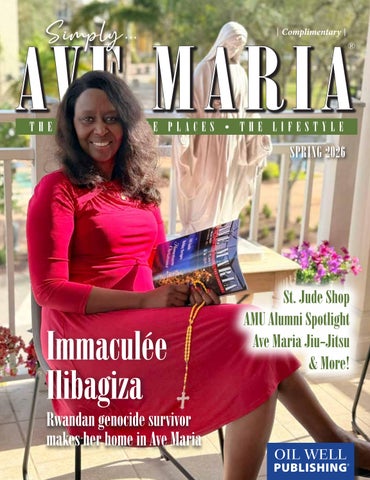
Eight times, the murdering gangs searched the pastor’s home where Immaculée Ilibagiza was hiding, hunting for her with bloodied machetes. Immaculée silently prayed to God to protect her and the seven other women crammed in a tiny bathroom, the door covered and hidden on the other side with only the pastor’s wardrobe.
Rwanda government soldiers, trained militia, and gangs of former friends and neighbors chanted while they hunted. “Kill them, kill them, kill them all, kill them big and kill them small…” Eight times the gangs searched inside the pastor’s house, tearing up carpet, going into the attic, flipping bed mattresses. Eight times they came inside the house, and most days and nights they passed by within earshot just outside the house on their killing spree. For 91 days, the terrified women silently hid in the four-foot-long by threefoot-wide bathroom, where they barely fit and had to take turns standing up or moving in any way.
Immaculée didn’t know it yet, but her mother and father, two of her brothers, and most of her extended family and friends had already been horrifically murdered.
It was April in 1994. The 24-year-old Immaculée, was home from college, visiting her parents and two of her brothers. A third brother was studying out of the country. Then the Rwandan president’s plane had been shot down, and longsimmering ethnic violence erupted. Over the period of the next 100 days, more than a million men, women, and children would be slaughtered, their bodies stacking up along roadsides, their homes burned. Those killed by the
radical Hutu Tribe majority were members of the Tutsi Tribe or moderate Hutus.
Immaculée and her family were Tutsis, although as a child, she wasn’t even aware of which tribe she belonged to or even that there were different tribes. She believed she lived in a beautiful paradise. In her loving home, within her prominent, Catholic family, there was no racism or prejudice, she wrote in her book, Left to Tell, published in 2006.
As she grew older and the tensions rose, she heard of and began to see small acts of aggression against Tutsis. A popular radio station spewed out anti-Tutsi propaganda and called for “Huto Power.” Tutsis were demonized, called “cockroaches” and blamed for any Hutu woes. Hutus were warned not to trust Tutsis. In her book, Immaculée wrote that she and her friends on her college campus tried not to dwell on the media reports and that she looked forward to visiting her family for Easter.
After her arrival home, however, the country fell into anarchy after it was reported that the president had been killed. Violence spilled out of the major cities and into the countryside. Immaculée’s father sent her to the pastor, a Hutu friend, to find refuge in his home.
As she left her parents, her father pressed a red and white rosary into her hands. “Keep it always, Immaculée,” he told her. She carried nothing else but the clothes on her back. Thus began the three-month odyssey of terror in that tiny bathroom with seven other Tutsi women whom Immaculée did not know before they were squeezed together and the door was shut.
Sitting on her condo balcony overlooking the Ave Maria town center on a beautiful January day, Immaculée said it wasn’t hard to remember those difficult days in the bathroom. “There’s a piece of me that is like, you won. Jesus won. The prayers won. It was almost impossible to think of the possibility of surviving,” she said. “But the rosary is that powerful.”
“One day He will call me as He called my family,” Immaculée said. “But in the meantime, He showed me that He’s worth every effort to fight with and to fight for and to trust and to love.”

Every day in the bathroom, the challenge was to live for the next minute or next hour. “We were being hunted every second of the day,” she said. “Our ‘sin’ was our tribe, so you can’t run away from that, so the challenge was literally making it to the next minute physically. Emotionally, the worst was to think of when we came out…how would we live? Would we even be allowed to live again in this country?”
The pastor had 10 children, two of whom lived with him when the anarchy began, but all the adult children and their families returned to the home due to the war. Immaculée estimates there were about 30 members of the pastor’s family in the four-bedroom house, and most of them did not know the women were hiding in their father’s bathroom. The women had to be absolutely silent; they learned to communicate through hand signals and facial expressions. They could only flush the toilet when the toilet on the other side of the wall was flushed. They were fed scraps so no one would become suspicious. And Immaculée prayed. “I remember saying, okay, God, just show me one thing. Are you there? Can you stop them? Can you even hear me, or is it too late to pray to you?” When the soldiers first came and stopped right outside the bathroom, but did not find the women, she felt she had her sign. She later asked the pastor for a Bible and read it every day. “I just wanted to do whatever God wanted. That was me saying ‘yes’ to Him. I started praying the rosary my father gave me.” She said she felt peace in her heart.
Even if the gangs came into the house searching for her, if she was praying, she could trust that God would not let the women be found. She said she almost felt that the Virgin Mary was physically sitting with her in that bathroom, and when the soldiers or the gangs came into the home, while she felt Mary was still there, she felt Christ in protection over her. She tried to channel the trust she found in her faith to the other women in their most harrowing moments. During a search, while deep in prayer or dreaming, Immaculée describes in her book how Jesus appeared before her and told her to have faith. “Trust in me, and you shall live.” And then Immaculée saw a giant cross of brilliant white light stretching from wall to wall in front of the bathroom door.
While still in the bathroom, Immaculée got some books from the pastor and taught herself English, knowing that would help her find a job after the war. And eventually, after 91 days, the Tutsi army secured the country with French peacekeepers, and the women made their way to safety. Immaculée learned her family had been murdered. She was able to find her mother’s and one of her brothers’ remains to rebury on her father’s property. She had to write to her third brother, who was away at school, and share that they were the only survivors.
Immaculée knew her family was at peace, but she still felt sorrow about the way they died. It haunted her until she had a dream of them in a peaceful, beautiful place. Her brother told her in the dream that they would be waiting for her, and until then, she must “love, and you must forgive those who have trespassed against us.”
She awoke singing, and from that night forward, she said her pain of the loss of her family eased. The leader of the gang, who had murdered her mother and one of her brothers, had been incarcerated. She went to jail to see him. The battered man couldn’t face her. She was overwhelmed with pity and told him that she forgave him. The jailer who had brought the murderer to her was incredulous. He asked her how she could do that. “Forgiveness is all I have to offer,” she replied.
While Immaculée worked at the United Nations (UN) in Rwanda, she met Bryan Black, an American. He had traveled to Rwanda to help set up the International Criminal Tribunal for Rwanda, the UN court prosecuting those responsible for planning the genocide. They married and came to America, where their daughter, Nikeisha, and their son, Bryan, Jr., were born. They lived in Manhattan. Immaculée worked at the UN and wrote her memoir of the genocide when she found snatches of time to write between working and raising her family. Three days after she finished the book, having no idea how to take the next steps, she was contacted by a publisher.
In that first book, Immaculée wrote that she believes God spared her life for a reason. “He left me to tell my story to others and show as many people as possible the healing power of His love and forgiveness.”
Today, she continues to write; she is a professional speaker who travels the world and leads pilgrimages to Marian apparition sites. She became a naturalized U.S. citizen in 2013.


Long-standing ethnic tensions following independence, civil war begins in 1990, Arusha Peace Accords signed in 1993
BEFORE 1994
Born in 1972, grew up in a close Tutsi family, studied engineering/computer science in Kigali, aware of tensions but hopeful for peace

President Habyarimana’s plane is shot down; organized killings begin across the country Violence reaches her area; her father sends her to hide with a Hutu pastor; she is separated from her family

APRIL 6-7 1994
About 100 days of mass violence; Tutsis and moderate Hutus targeted; international community fails to intervene, the Rwandan Patriotic Front (RPF) created by Tutsi exiles, advances
APRIL-JULY 1994
Hides in a small bathroom with seven women for about 91 days; lives in silence and fear; relies on prayer and mental strength

Immaculée was invited to Ave Maria for the first time in the spring of 2024 to speak at Ave Maria University. “I don’t know if they knew what they did, but I was so glad they kept me for three days,” she said. “So, during those three days, I was visiting around, I went to mass with the students and…like wow, you know this is a beautiful city, and there’s an adoration. I asked how many times do you adore?” When her hosts told her it was a 24-hour adoration, she was impressed. In New York, her parish held an hour of adoration a day. “And here it was 24 hours. So that really attracted me a lot.”
Immaculée was impressed by how kind the people were and how clean the town was. She saw people walking around the lake and praying the rosary; she saw all the statues of Mary on the front lawns. “It was just like a piece of heaven, like this is almost a dream.”
Since Immaculée is a public speaker and writer, she said she can work and travel to speak from anywhere. And her husband, Bryan, was retiring from his career with the U.N. So Immaculée started talking to her family about Ave Maria, and she prayed.
“I speak around the world every two weeks. Every week, I’m somewhere new,” she said. “I’ve been in every state of this country, and I see many beautiful places, San Diego, Hawaii, Florida, many corners. But I’ve never been attracted to live somewhere else.” Ave Maria was the first place where she felt she could move to from Manhattan. “There was something calling me,” she said.
RPF captures Kigali; genocide ends; the country is left devastated
JULY 1994
Comes out of hiding; learns most of her family was killed; survives physically but faces deep loss
National rebuilding begins; reconciliation and justice processes introduced
AFTER 1994
Later leaves Rwanda; moves to New York, writes Left to Tell; becomes a speaker on forgiveness and healing
2024 Rwanda is stable, and continues to be ruled by RPF party Is invited to speak at Ave Maria University, Florida; moves family to Ave Maria before year-end
But still, she wasn’t sure. She continued to pray about it. “And then I had a dream about God. ‘Move before the end of the year.’ Just like that.”
She brought her family to visit Ave Maria, and they liked it. A second dream encouraged Immaculée to leave New York, so they bought a condo and moved in November 2024.
The university students have been very kind, Immaculée said. “They are helpful to each other and to me, who is a stranger who just came. You can feel there is a spirit of The Lady everywhere.” Immaculée is named after the Virgin Mary and holds a special place in her heart for her.
The priests at AMU were helpful to the family, Immaculée said, and they met some new friends who very quickly opened their arms to them. “I’m like, ‘who are you?’ These people who are so sweet?”
Immaculée said she’s realistic and knows that nowhere can be perfect, but so far, she’s only seen the beautiful things about Ave Maria. When the family lived in New York, if she had a couple of weeks off work, she would travel back to Rwanda to visit. “Now I’m like, I’m going to Ave Maria, I have no desire to run away every 10 days I have a holiday.”
Do people recognize her in Ave Maria? “Once you write and you speak, there are always people going to know you, especially in the Catholic world,” she said. “I don’t think I can walk the circle without somebody saying, ‘I read your book, I heard you speak here and there.’” Immaculée doesn’t see herself as famous or a celebrity like a pop singer. But being recognized because of her story is part of who she is.
“My message is a message that brings people to God…if you have things you wish the world to know, I’m not going to do that by hiding. Although I don’t want to highlight myself in any way,” she said. “I don’t want to put myself in people's faces because this is their home. I came to join them. I just want to be one of them.”
Immaculée’s daughter will be getting married later this year, and her son is thinking about joining the seminary. Her niece, the daughter of her one surviving brother, who is now living back in Rwanda, plans to attend AMU.
So there is family and laughter, and the rosary being said on her Ave Maria condo balcony. A far cry from that tiny bathroom in Rwanda where she hid for three months during a horrendous genocide.


• Left to Tell: Discovering God Amidst the Rwandan Holocaust (with Steve Erwin), 2006
• Led by Faith: Rising from the Ashes of the Rwandan Genocide (with Steve Erwin), 2008
• Our Lady of Kibeho: Mary Speaks to the World from the Heart of Africa (with Steve Erwin), 2008
• The Boy Who Met Jesus: Segatashya Emmanuel of Kibeho, (2012)
• The Rosary: The Prayer That Saved My Life (with Steve Erwin), 2013
• A Blessing in Disguise Miracles of the Seven Sorrows Rosary, 2023
“I literally had a dream from Jesus, telling me that when I came out of the bathroom, everyone would be killed. He told me, ‘If you continue to love me and to trust me, I will be there for you.’”
Immaculée Ilibagiza leads several pilgrimages a year to visit Marian apparition sites, locations where the Virgin Mother has appeared. “I learned the importance of pilgrimages when Our Lady appeared in Kibeho in 1981,” Immaculée writes to her email followers. “Not only did she invite us to go on these trips, but she literally gave us a new word, ‘Pilgrimage’ in our native language, which she called, ‘Ingendo Nyobokamana,’ which means, ‘Trips that lead to God.’
The remaining 2026 trips scheduled include:
• Kibeho/Rwanda: August 9-19
• Medjugorje: September 15-21
• Kibeho/Rwanda with Franciscan University: August 31- September 11
• Kibeho/Rwanda: November 22 - December 2
For more information visit immaculee.com


WRITTEN BY PAUL FORTE | PHOTOS BY YVETTE FORTE
Walking through the vibrant corridors of Tin City today, it is easy to be swept up in the sensory delight of the experience. The air is a humid blend of salt spray and the sugary scent of fresh monkey bread; the soundscape is a mix of clinking glassware from waterfront decks and the distant hum of outboard motors. Yet, for this bustling commercial hub in the heart of Naples, the path to becoming a premier tourist destination was anything but easy. To walk these tin-roofed boardwalks is to walk on ground that has endured centuries of transformation, from the seat of a powerful indigenous empire to a gritty industrial outpost, and finally, to a symbol of modern Floridian resilience.

Long before the first European hull broke the horizon of the Gulf of Mexico, this region was the domain of the Calusa. Unlike the agricultural tribes of the interior, the Calusa were a maritime powerhouse. They didn't plant corn or beans; they "harvested" the estuaries. They were master engineers who built a sophisticated society based on the bounty of the Gordon River and Naples Bay.
Often referred to as the "Shell Indians," the Calusa used discarded

However, the arrival of French and Spanish explorers in the 1500s signaled the beginning of the end. While the Calusa resisted colonization with legendary ferocity, they could not fight the invisible invaders: Smallpox and Measles. By the mid-1700s, the population was decimated. When Spain eventually ceded Florida to England in 1763, the few remaining Calusa were relocated to Cuba. They left behind a pristine, untouched wilderness that would remain largely quiet for another century.
mollusk shells, clams, conchs, and oysters, as the literal foundation of their civilization. They built massive mounds and ridges that served as high ground during storm surges, some of which still exist in the region today as silent monuments to their ingenuity. They fashioned crude but effective tools from shells: hammers, adzes, and anchors. At their peak, they were a fierce warrior class that controlled most of South Florida, traveling in massive dugout canoes that could navigate both the shallow mangroves and the open sea.
The 1800s saw Florida transition from a wild frontier to a beckoning land of opportunity for American entrepreneurs. In the late 1880s, the area was officially surveyed, and the reports were glowing. The surveyors were struck by the turquoise waters and white sands, famously comparing the region’s natural beauty to the Bay of Naples in Italy.
This comparison was more than just poetic; it was a marketing masterstroke. Kentucky Senator Stuart Williams and his business partner, Walter Haldeman—the owner of the Louisville Courier-Journal— saw a "winter playground" in the making. They formed The Naples Company with the intent of drawing the elite of the Gilded Age down to the tropical frontier.


To make the area accessible, they built the first Naples Pier in 1888, stretching 600 feet into the Gulf. This pier became the lifeline of the community, serving as the primary landing point for steamships bringing in supplies and wealthy tourists. However, the dream almost collapsed before it truly began. Property sales were sluggish, and the company began to drown in debt. In a dramatic turn of events, the company was put up for auction on the steps of the courthouse. Haldeman, refusing to see his vision die, bid on the company himself and became the sole owner. Under his guidance, Naples began to solidify its reputation as a sanctuary for the Northern wealthy.
The dawn of the 20th century brought a new titan to the scene: Ed Crayton. A wealthy developer from St. Petersburg, Crayton purchased Haldeman’s interests in 1914 and set about dragging Naples into the modern era. He was the catalyst for the region’s infrastructure, bringing in the first reliable electricity and, eventually, the Atlantic Coast Line Railroad. Crayton’s most enduring industrial legacy, however, was the development of the riverfront area that would become Tin City.
In the 1920s, this was not a place for shopping; it was a gritty, hardworking hub for the local fishing and shelling industry.
The "city" consisted of a collection of functional buildings with corrugated tin roofs (hence the name) where local fishermen brought their hauls of clams and oysters for processing.
During this time, Crayton, along with advertising mogul Barron Collier, was instrumental in the completion of the Tamiami Trail. This road finally linked Tampa to Miami, cutting through the Everglades and opening Naples up to the burgeoning

world of automotive tourism. While Crayton passed away in 1938, his wife, Lindsey, inherited his vast holdings and managed them with a steady hand until the late 1950s, ensuring that the character of the waterfront remained intact even as the rest of Florida began to boom.
By the 1970s, the industrial demand for local clam processing began to wane. The "tin-roofed shacks" on the Gordon River were at a crossroads: they could be torn down for modern condos, or they could be reimagined.
In 1976, the buildings were connected and transformed into the Old Marine Marketplace at Tin City. The developers leaned into the "quaint rustic charm" of the original structures, preserving the tin roofs and weathered wood walkways while painting the buildings in the vibrant, tropical hues that have since become iconic. It was a perfect marriage of history and commerce, offering a "Old Florida" atmosphere that stood in stark contrast to the manicured luxury of nearby Fifth Avenue South.


Being situated directly on the Gordon River provides Tin City with its beautiful views, but it also places it in the crosshairs of nature's most violent storms. The history of Tin City is a history of rebuilding.
In recent memory, Hurricane Irma (2017) brought significant flooding, but it was Hurricane Ian in 2022 that provided the ultimate test. Ian’s massive storm surge sent several feet of saltwater into the shops and restaurants, destroying inventory and threatening the structural integrity of the historic boardwalks. The recovery was a grueling, month-long process of "muck outs" and drying. In a bizarre twist of fate, just as the complex was preparing to celebrate its grand reopening after Ian, a car accidentally crashed into one of the buildings, adding a literal "hit" to an already difficult year.
Most recently, Hurricane Helene in 2024 again tested the area’s defenses. Yet, each time, the shop owners and the city have rallied. The resilient spirit of the old fishing village remains unbroken. Today, Tin City is more than just a mall; it is a living museum of the Naples spirit. It currently houses over thirty independent boutiques, ranging from high-end nautical art to quirky souvenir shops.
A visitor’s journey usually begins with the scents. The Monkey Bread Factory acts as a culinary magnet, pulling people in with the smell of cinnamon and sugar. From there, one can wander through aisles of fragrant handmade soaps and candles, or browse endless collections of seashells that would have made the Calusa proud.
For the hungry traveler, the options are steeped in local tradition. Pinchers and Riverwalk serve up fresh-off-the-boat grouper and stone crab claws, allowing diners to watch the boats cruise by on the Gordon River. For a more casual bite, M&M’s Café offers classic fish and chips and some of the best specialty ice cream in the county. As if that wasn’t enough, you can also get a taste of Italy at Tin City Slice, where as the name says, you can get handmade, gourmet pizza while also shopping at the indoor Italian market inside.
From the shell-tools of the Calusa to the steamships of the Gilded Age, and from the grit of the oyster-processing plant to the vibrant marketplace of today, Tin City is a testament to the fact that while the storms may come, the heart of Naples remains anchored deep.


WRITTEN BY STAFF WRITER PHOTOS PROVIDED
On January 22, 1996, Army Major John Bestul arrived in Bosnia and Herzegovina as part of a UN peacekeeping force. Major Bestul combines his experiences oversees, along with many years living in northeast Wisconsin, into the fast-paced adventure novel…Z7.
Q. How long did it take you to complete the novel?
A. The actual writing took 12 years, but in some ways 30. I was in Bosnia when the real Zvornik 7, as referenced in the title, was arrested. I was at the unit's higher headquarters on site that day and am quite familiar with the specifics. The opening photography chapter came to me in a dream. I then merged the two incidents. The first two-thirds of the book came quickly, and then I stalled, not knowing how to bring it to a conclusion. During COVID, I picked it up again, but couldn't finish it. Finally, about a year ago, I got inspiration for the ending and put it to paper.
Q. Tell us about the writing process.
A. "Write what you know" is a phrase I kept hearing. For this book, I stayed pretty close. As I said, I served in Bosnia and Herzegovina. I was a television reporter and familiar with the path through small markets to big markets. I spent most of my adult life in northeast Wisconsin, including having a cottage north of Green Bay.
As I write, I try and imagine the action or conversation in my mind and then write what I see in my mind. Then I go back and flesh out any details to bring things to life. They talk about method acting as using personal experiences to bring life to characters. You might call me a method writer.
Q. Where did you do most of your writing?
A. The early chapters were written whenever I had a chance while living in northeast Wisconsin. The important, final chapters, editing, and final preparation were completed in our office here in Ave Maria.
I have a Chromebook that lets me work wherever I am and save it to the cloud.
Q. Do you see another novel on the horizon?
A. I inadvertently opened myself up to a sequel. The final line of the book's epilogue was meant to just be a fun little twist. Then people began asking me to follow it up. (Don't go right to the end to see what I mean, you may not get the twist.) I am currently visualizing where the book goes next, and have already sketched out the beginning of an explanation for the last line. I hope to complete this in less than 12 months, not 12 years.
Q. If your novel becomes a screenplay and makes it to Hollywood, who would be your choice for the main character?
A. Initially, I was thinking a cross between Steve McQueen and Daniel Craig would be appropriate for the main character. As I thought about it more, I think the main male character would be played by Damian Lewis (Homeland, Band of Brothers) and the female lead, maybe Robin Wright (Forrest Gump, Princess Bride).
Q. Can you give our readers a quick synopsis of the story?
A. Sure, the main character is Will Oleson. Oleson has spent a career working as a government operative throughout the world. Now forced into retirement, he moves into a family cottage in the Wisconsin northwoods and takes up nature photography. When the FBI comes along with a fairly simple photography job, things take a surprising turn.
Will is now thrown into an adventure involving a possible serial killer, federal investigators, and a TV newswoman Will knew during his college days.


Z7 incorporates a fictionalized version of a historical event in the Balkans with the beauty of northern Wisconsin. The book is currently available on Amazon in electronic and paperback formats.

Born and raised in Wisconsin, Bestul graduated from the University of Wisconsin-Platteville with a degree in Radio and Television Broadcasting and worked as a news reporter in La Crosse. After earning a Master of Science degree in Educational Media from the University of Wisconsin-La Crosse, he began as a state consultant in educational technology and later as a school technology coordinator. Bestul served at the European Command in Germany in support of Desert Storm and was a member of the IFOR peacekeeping forces in Bosnia and Herzegovina, attached to the 2nd Brigade, First Armored Division. Since retirement, Bestul and his wife, Becky, reside in Ave Maria, FL. They have three children and eight grandchildren.
WRITTEN BY CHAD BEATTY | PHOTOS PROVIDED

When I first met Greg DiCocco and his wife Elaine at The Bean, little did I know I was having coffee with a family that has made chairs for Popes and has been featured in The Washington Post! It’s true, one of Ave Maria’s newest families has a rich history within the Catholic world, and a mission rooted in faith.
For six decades, their company, St. Jude Shop, has been a trusted name in religious goods, liturgical design, and Catholic family values. Founded by Greg’s parents, Lou and Norma DiCocco in 1965, the company has grown into a nationally respected ministry serving churches and faithful individuals across the United States.
“Throughout the decades we have remained committed to one mission: Serving Christ in the World,” stated DiCocco.
The name of the company, St. Jude Shop, is a story unto itself. In 1963, Norma DiCocco (Greg’s mother) found herself expecting her fifth child. After four consecutive boys, Norma was ready for a daughter. With deep faith she turned to prayer, invoking the intercession of St. Jude, the Patron Saint of Impossible Causes. On October 28, three weeks past her due date and on St. Jude’s feast day, she gave birth to a baby girl, whom she gratefully named Jude Thaddeus. That moment became the seed of something much larger; a mission rooted in faith, prayer, and purpose.


Just two years later, in 1965, Lou and Norma opened the first St. Jude Shop in Havertown, Pennsylvania. Motivated by their deep love for the Catholic Faith and the growing needs of the faithful in the postVatican II era, they envisioned a store that would provide devotional items, books, and the latest liturgical resources to local parishes and Catholic homes. Fittingly, the store opened its doors on October 28, 1965…again, St. Jude’s feast day!
What started as a small family store expanded rapidly, thanks to their commitment to prayer, community, and staying ahead of spiritual and liturgical needs.
For the DiCocco family, the St. Jude Shop was never just a business, it was a vocation. Guided by prayer and a desire to serve the Church, Lou and Norma traveled to Europe to develop relationships with artists and manufacturers, bringing unique religious art and goods directly to the American Catholic market. The small storefront soon grew to accommodate vestments, metalware, and sanctuary furniture, along with essential consumables such as altar bread, sacramental wine, and devotional candles.
St. Jude Shop also became a major national distributor of cut palm. They distribute more than 20 tons annually for Palm Sunday celebrations across Catholic, Christian, and Orthodox communities nationwide.

“We source our palms from trusted suppliers who uphold strong values of environmental care and social responsibility,” stated DiCocco. “As part of this mission, our suppliers donate acres of untouched native brushland to the Florida and Texas Land Conservancy, preserving vital wildlife habitats.” He added “Each year, this partnership helps create hundreds of jobs in one of the most economically challenged regions of the United States, reflecting our dedication to living out the Corporal and Spiritual Works of Mercy.”

“We distribute more than 20 TONS of palm annually for Palm Sunday.”
In 1981, Lou Sr. responded to the oil crisis and rising candle costs by inventing the Lux Mundi Oil Burning Candle: a safer, cleaner, and longer-lasting alternative to traditional wax candles. This patented product became a nationwide success.
With this growing network, Lou III (Greg’s youngest brother) recognized the evolving needs of parishes and founded St. Jude Liturgical Arts Studio, a division specializing in custom artwork, church furnishings, restorations, and full sanctuary design-build services. From handcrafted stained glass to marble altars, St. Jude Liturgical Arts has helped design and restore churches across all 50 states and internationally, including prestigious works for:
• The Basilica of the National Shrine in Washington, D.C.
• Mother Angelica and the EWTN Network
• The World Meeting of Families (2015) liturgical furnishings
To further preserve sacred heritage, the family launched the Liturgical Exchange, a curated platform showcasing sacred items from closed churches and religious institutions. Each piece, rich in spiritual and historical value, is reverently repurposed and offered for sale, often at a fraction of the original cost. This program offers parishes, chapels, and individuals a meaningful opportunity to preserve and extend the life of these cherished items in new worship settings.


Pope Benedict XVI Papal Chair on display at the National Basilica of the Immaculate Conception in Washington, D.C.
As I mentioned in the first paragraph, the DiCocco family had the privilege to serve the Pope; not just one, but multiple, as well as Saint Mother Teresa!
On October 8, 1995, St. Jude Liturgical Arts received a VERY special request. John Paul II would be leading a prayer service at the Cathedral of Mary Our Queen, in Baltimore MD, and he needed a Papal chair. “I knew that the chair’s design and fabrication would be fitting for a Pope, and later a Saint.” DiCocco said. “But for it to win a prestigious award for Art and Craftmanship in Liturgical Furnishings, from the American Institute of Architectural Design, was an added bonus and made our work so rewarding.”

While that project seemed to be a once-in-a-lifetime opportunity, it would not be the last special request the DiCoccos’ received, or the last Pope they worked with.
In April 2008 Pope Benedict XVI left the ‘Chair of Peter’ in Rome to visit the United States. He was meeting with 350 Bishops in the crypt of the Basilica of the National Shrine of the Immaculate Conception in Washington D.C. and he needed a chair worthy of a Pope. Once again, the DiCoccos’ were tasked with creating a Papal Chair; and once again they went above and beyond for the assignment. Lou DiCocco fondly recalled a meeting he had with Pope Benedict XVI asking him if he liked the chair. The Pope responded “Oh, yes, very much so” in his heavy German accent. This chair is now on display at the National Basilica of the Immaculate Conception in Washington, D.C.
In preparation for the World Meeting of Families in 2016, a new Papal Chair was commissioned for the closing Mass in Philadelphia. St. Jude Liturgical Arts (SJLA) was once again entrusted with the task of designing and fabricating a chair worthy of a Pope…Pope Francis to be exact. The outdoor celebration drew more than one million attendees, and the chair “is preserved and displayed in our expansive, over 10,000-square-foot showroom, located in Havertown, PA.”
Last but certainly not least, the DiCoccos’ had the privilege of designing special tabernacles for Mother Teresa when she was awarded the Nobel Peace Prize. DiCocco shared, “Not only were we excited for her award, but we were honored and thrilled to be commissioned to design and


supply over fifteen tabernacles to many of her convents throughout the United States.” While serving Popes is an honor, there is something distinctly heartwarming about helping Mother Teresa in her mission.
Moving forward, as the battle of good vs. evil rages on in the world around us, the DiCocco family is ready, willing and able to assist us in our spiritual warfare.
There is so much more to say about them and their companies, but space is running out. For more information on any of their companies visit their websites: stjudeshop.com • stjudeliturgicalarts.com liturgicalexchange.com • giftswithlove.com


WRITTEN BY SHARON LEVESQUE, REALTOR

In our previous installment we talked with Caleb McConnell, founder and owner of Gulfside Media, who shared with us why hiring a professional photographer, when selling your home is a good idea. He shared that the vast majority of people searching for a home do so on the internet, which makes the old saying, “first impressions are lasting impressions,” more true than ever before. Caleb noted that photographs done professionally attract more attention and interest. He also shared how home sellers might best prepare their homes for viewing both on photographs and in person. In this installment we will complete our discussion with Caleb who is going to tell us about how evolving technologies are being used to give potential buyers a fresh new perspective on homes available on the market.
Even though drone photography is not necessarily a new bit of technology, Caleb notes drones are now commonly used and help with, “...showcasing large properties, waterfront homes, or unique locations. It provides context and perspective that ground-level photos can’t.” He continues, “It's pretty much a standard now, which is why it's included in even our ‘base’ package.” While drone photography is common it may be a good idea to check with any photographer you or your Realtor hires to see if they offer such a service. In addition, your Realtor will want to be sure their photographer, doing drone work for commercial use, as in real estate, is licensed to fly a drone. This assures customers that the photographer has passed a specific knowledge test, registered their drones, and adheres to strict operational rules set forth by the FAA. The advent of artificial intelligence(AI) has brought about some dynamic changes to real estate photography. In previous installments we discussed staging when you're thinking about selling your home. We explored what kinds of things to add to or take out of the home but what if the house

you're selling is empty? This is where AI can be helpful. When asked if an empty home can be “furnished” using AI, Caleb said, “Yes, virtual staging using AI is an excellent option for vacant homes. It helps buyers visualize scale and functionality without the cost of physical staging. When done correctly, it’s a powerful marketing tool.” You can find numerous examples of AI “staged” homes on the internet.
Another advancement in technology has been 3D “walkthroughs.” These "walkthroughs" allow people to view the layout of a home without ever actually visiting the home. Caleb explains, “3D tours are becoming increasingly popular and allow
buyers to explore a home remotely. They’re especially useful for out-oftown buyers and help pre-qualify interest before showings. These really took off in the COVID days when a lot of homes were being sold site unseen. 81% of consumers say a 3D tour makes it easier to visualize the property.” Anything that can make it easier for people to see themselves in the home can be a significant advantage when selling a home.
In a final note regarding professional photography, Caleb suggests, “Twilight or night photos can be incredibly effective for certain properties. They add drama, warmth, and emotion — especially for homes with exterior lighting, pools, or scenic views. When used strategically, they can elevate a listing and make it more memorable. We spoke about first impressions earlier, Twilights excel at that.”
In conclusion, professional photography can go a long way in making a home attractive to potential buyers both close to home and far away. If you’re thinking of selling your home and if you're working with a Realtor or not, take time to seriously consider how much value professional photography can bring to the process.


WRITTEN BY LAUREN MAXWELL, CROSSCOUNTRY MORTGAGE
For many homeowners, a mortgage represents more than a monthly payment— it’s a long-term financial strategy that shapes stability, opportunity, and future wealth. As your home value rises and your loan balance decreases, you build equity, one of the most powerful financial tools available to you. Understanding how to use that equity wisely—and whether paying off your mortgage early is the right move—can help you make confident decisions about your financial future.
Home equity is the difference between your home’s current market value and what you still owe on your mortgage. Over time, appreciation and consistent payments work together to grow this equity, often becoming the homeowner’s largest source of long-term wealth.
What makes equity so valuable is its flexibility. Many homeowners use it to fund renovations, consolidate highinterest debt, cover education expenses, or create a financial safety net. Others leverage equity to invest in a second property or diversify their financial plan. There are several ways to access equity, including a cash-out refinance, a home equity line of credit (HELOC), or a home equity loan. Each option offers different benefits, repayment structures, and levels of flexibility. The right choice depends on your goals and your longterm financial strategy.
As equity grows, many homeowners begin to wonder whether eliminating their mortgage entirely is the next smart step. Paying off your loan early can bring tremendous peace of mind, reduce longterm interest costs, and free up monthly cash flow—advantages that feel especially meaningful as you approach retirement or prioritize financial simplicity.
However, early payoff isn’t ideal for everyone. Using large amounts of cash to eliminate your mortgage may reduce your liquidity, leaving less available for emergencies, investments, or home improvements. If you have a low interest rate, your money may work harder for you elsewhere. And depending on your tax situation, you may lose certain deductions by paying off the loan too soon. For many homeowners, a balanced approach—such as making one extra payment per year or rounding up monthly payments—can offer meaningful savings without sacrificing financial flexibility.
Your home is both a place to live and a cornerstone of your financial life. Whether you’re considering tapping into your equity or exploring early payoff, the smartest decisions come from understanding your full financial picture.
Let’s explore the best options for your needs and make a plan that fits your financial future.
Ready to start? Let’s connect!
Lauren Maxwell, Maxwell Mortgage Team – CrossCountry Mortgage Executive Vice President 239-596-0500 Lauren@MaxwellMortgageLoans.com


Imust say…this year’s color collection is sophisticated, refined and full of luxury!
I immediately fell in love with the balance between deep couturier hues embracing craftsmanship and refinement to captivating, natural colors offering an irresistible urge to layer effortlessly! In design, we’re seeing a greater emphasis on tailored spaces. The idea of having what is seen as the go-to solution such as saved images from Pinterest and Houz is fading. Moving into 2026, there’s a yearning to explore individuality over popularity. Greater offerings for custom sizeable furniture, hand crafted cabinetry, artful tile and more! At any price point, however, paint can change your interior world faster than any other purchase! Let’s see how these colors for 2026 can change yours!
For Color of the Year, Benjamin Moore chose Silhouette AF-655 aligning interiors to a higher degree with the fashion industry. Just as there’s an increased attentiveness in suiting or fabrics used for suits, this desire is now heavily translating into wall color. Andrea Magno, Director of Colour Marketing & Design at Benjamin Moore stated, “…it’s the resurgence of timeless pieces; and the growing interest in the brown color family, Silhouette embodies these qualities with its depth and luxurious blend of burnt umber and delicate charcoal undertones. Like a perfectly tailored suit, this hue has the versatility and softness to bring a space from expected to exceptional.” Don’t let the “browns” of the past haunt you…this color is deeper, refined and balanced with red undertones to hold its own in any space! With a leaning also toward charcoal, the color pairings with gray undertones settle beautifully in unison.

Swiss Coffee OC-45
For a complimentary white, one of my personal favs is Swiss Coffee OC-45. Its greige profile is on the warm side, resting effortlessly with rich wood elements in a room. As a custom cabinet designer, I swoon over the perfect lush white wall that focuses attention on fine furniturequality wood cabinets or rests quietly on painted cabinets as a backdrop for books, treasured items and collectables. Either way, its frothed cream leaves one with a sensation to reach out and almost sneak a flavor!


Adding an artful balance of color to this year’s repertoire, Raindance 1572 hits the mark for a balanced steel gray with blue/green undertones that exude relaxation and calm! Early morning sunrise hours draws out the blossoming blues and greens while the afternoon sun saturates this color welcoming a luxurious green gray. Just as natures flora changes with the day, so this humble blue/ green offers a rich addition to interiors for cabinetry, furniture and walls…and don’t forget the ceiling! Personally, I think this is the perfect color for my two hand-me-down children’s twin headboards for my grandchildren’s room! Where might you use it?


First Crush CSP-310
Looking for something a bit more subtle? Try First Crush CSP 310, infused with a hint of blush, this color offers an unassuming backdrop for colors to pop forth. Quiet, subdued and restful… in daylight its color all but disappears. Indirect sunlight pulls more of the beige tones forward, offering a soft warmth without overwhelming a space and the decor within. Don’t be shy, pair this wall color with Raindance 1572 for window trim and wainscot and let Swiss Coffee OC-45 hover above softly for a finish.


Batik AF-610
Moving into a more sophisticated, dusty violet-mauve is Batik Af-610. In the late 80’s and into the early 90’s, this color was insatiable…heck… I even had a velour love seat and sofa in this hue! Don’t let the rose tone fool you into thinking this is too feminine, It’s a cozy, welcoming neutral with undertones of gray and brown creating a peaceful calm in any room of your home!


For a more earthy, unpretentious and enduring space, be rest assured that Southwest Pottery 048 will calm your senses and create harmony. It’s reddish-brown clay tones seems almost palatable …like an earthy glass of wine…one with nature. This grounded pigment is a perfect background for natural woven floor coverings, rich knitted fabrics dyed in golds, deep teals and coffee. Surround yourself in comfort visually…

Narragansett Green HC-157
Now, if you love a more bold, dramatic color…no need to step any further than Narragansett Green HC-157 from the Historical Collection (also known as Navy Masterpiece 1652). It’s blackened teal influence is forged with rich, dark blends of green and blue with robust black undertones… It’s grounding and foundational! Use for all five walls of a room or cast its rich palette in high gloss on office shelving and trim. Don’t underestimate its stately effect in a room!


Sherwood Tan 1054
For the perfect backdrop to tranquility, allow the classic hue of Sherwood Tan 1054 to nestle your space in simplicity. It’s undertones of brown, earthy red and hints of warm gold all combine to offer a chic traditional space, tailored for today’s lifestyle. This color is perfect for cabinetry, Trim work with lighter walls or even a dramatic ceiling above deeper, moodier spaces. Also known as Wild Mushroom CC-336, its iconic warm tan hue is reminiscent of the perfect cashmere coat…go-witheverything kind of color yet adding a touch of vitality beyond your typical beige.
Are you inspired to explore YOUR individual direction? Break out of where you’ve been and move into where you want to be? Remember, you can quickly update any space with a mere roller and paint. Don’t let 2026 go by without moving ahead with your project that’s been benched waiting to achieve perfection all at once. Design is more than a weekend-and-done deal. It’s a culmination of life, experiences and collections. Be inspired by a painting, an antique you cherish from a favored aunt or…or just maybe…one of these colors.
Until next time my friends, Until next time my friends,

Colleen Coleman of CMC Design Studio LLC
Certified Kitchen & Bath Designer
Certified Aging in Place • True Color Expert
Contributing Interior Design Editor Saratoga TODAY Publications
National Award Winning Designs
colleen@cmcdesignstudio.net
@cmcdesignstudiollc
“Creating Environments for Life” TM


Ideas for relaxed entertaining your guests will love...and you will too!


For me, a relaxed brunch with my family and friends is one of the most enjoyable ways to greet Spring. I have put together a menu of delicious and easy to make seasonal dishes you can prepare for your own Spring inspired celebration.
Let’s start out with a great drink in two versions. My Orange Mint Julep is a refreshing cocktail and sure to put everyone in a festive mood. And my Orange Mint Julep Mocktail is a sophisticated non-alcohol alternative with delicious flavor and complexity.

Now on to our main course. My Lemon Ricotta and Asparagus Frittata is a scrumptious dish filled with fresh flavor. Even better it is so easy to prepare!

Serve it alongside my cool, crisp Romaine and Strawberry Salad with Almonds and Honey Vinaigrette. All you need to add is a ready-made fruit salad and pastries and you are set to go!
I hope you enjoy these recipes. As I always say, have fun in your kitchen cooking and making drinks for the people you love and remember ... it doesn’t have to be perfect, it just has to taste good!
Ingredients
Ingredients for one drink
• 2 ounces of bourbon whisky
• 1/2 ounce of agave nectar
• 1/2 ounce of fresh orange juice
• 4 sprigs of fresh mint and more for garnish
• 1 thin orange slice for garnish
Directions
Pour the agave nectar, mint and orange juice into a cocktail shaker and muddle with a long-handled spoon or cocktail muddler. Add the bourbon and 1 cup of ice to the shaker, secure the lid and shake it vigorously for about 30 seconds. Strain into an ice filled julep cup or rocks glass. Garnish with the orange slice and a mint sprig and enjoy!

Ingredients
Ingredients for one drink
• 2 ounces of regular or sugar free ginger ale
• 1/2 ounce of agave nectar, may omit if using regular ginger ale
• 1 ounce of fresh orange juice
• 4 sprigs of mint and more for garnish
• 1 thin orange slice for garnish
Directions
Pour the agave nectar, mint and orange juice into a cocktail shaker and muddle with a long-handled spoon or cocktail muddler. Add 1 cup of ice to the shaker, secure the lid and shake it vigorously for about 30 seconds. Strain into an ice filled julep cup or rocks glass and pour in the ginger ale. Garnish with the orange slice and a mint sprig and enjoy!

• 1 bunch of fresh asparagus (about 1 pound or so) washed and woody ends snapped off
• 12 large eggs
• Zest of 1 lemon
• 1 & 1/2 cups of ricotta cheese
• 1/2 cup of grated Asiago cheese plus 1/4 cup to sprinkle on top
• 1 teaspoon of kosher salt
• 1/2 teaspoon of ground black pepper
• A pinch of dried red pepper flakes
Preheat your oven to 350 F. Butter a 9 x 13 baking dish. Cut the asparagus into bite size pieces and spread over the bottom of the baking dish. In a medium size bowl combine ricotta and ½ cup of Asiago cheese, lemon zest, salt, pepper, and red pepper flakes. In a large bowl whisk the eggs until the whites and yolks are well blended. Stir the cheese mixture into the eggs until combined and pour over the asparagus in the baking dish. Sprinkle 1/4 cup of the grated Asiago cheese over the top. Bake for 20 to 30 minutes or until the eggs are set and a toothpick inserted in the center comes out clean. Remove from the oven and cool for 15 minutes. Cut into squares to serve.
Ingredients
• One 9-ounce bag of prewashed romaine lettuce salad mix
• 1 cup of hulled and thinly sliced fresh strawberries
• 1/4 cup of sliced almonds
• 1/2 cup of extra virgin olive oil
• 1/4 cup of white wine vinegar
• 3 tablespoons of honey
• 1/4 teaspoon of kosher salt
• A pinch of black pepper

Directions
In a small bowl whisk together the white wine vinegar, honey, salt, and pepper. Whisk in the olive oil until combined and refrigerate. Just before serving combine the romaine salad mix, strawberries, and almonds in a chilled serving bowl and toss to combine. Drizzle with the Honey Vinaigrette and toss lightly to coat the salad. Serve remaining vinaigrette alongside the salad.


TREVOR J. GANZI, PRIVATE CHEF
"In The Comfort Of Your Home" • Capeesh Italian Street Food (Food Truck)
One of my favorite Italian restaurant staples is Rigatoni Alla Vodka. It’s quick, tasty and almost a one pan dish. As a kid, penne vodka and chicken parm were always my "test" to see if I liked a restaurant or not, and it was always a good reason to venture out and try new things. This recipe is used in many famous trendy restaurants, and it doesn’t matter if you are a fan of rigatoni, penne, or the pasta of your choice… just make it.

• 1 lb (450g) rigatoni (or penne if you prefer; rigatoni holds the thick sauce better)
• Kosher salt (for pasta water and seasoning)
• 3–4 tbsp unsalted butter (divided; adds richness)
• 2–3 tbsp extra-virgin olive oil
• 1/2 medium onion (yellow or sweet), finely diced (about 3/4 – 1 cup)
• 3–4 garlic cloves, finely minced or grated
• 1/2 tsp – 1 tsp red pepper flakes (or 1– 2 tsp Calabrian chili paste/ peppers in oil for authentic heat; adjust to taste for spiciness) (optional)
• 1/4 – 1/2 cup tomato paste (use a 6-oz can; start with 1/4 cup for milder, up to 1/2 cup for deeper flavor)
• 1/4 – 1/2 cup vodka (good quality; it cooks off but enhances the tomato)
• 1 cup heavy cream (or up to 1½ cups for extra creaminess)
• 1/2 – 1 cup reserved pasta cooking water (key for silky texture)
• 1/3 – 1/2 cup freshly grated Parmesan cheese (plus more for serving)
1. Boil the pasta water: Bring a large pot of heavily salted water (like the ocean) to a boil. Cook the rigatoni according to package directions until al dente (usually 1-2 minutes less than package time, since it’ll finish in the sauce). Before draining, reserve at least 1 cup of starchy pasta water. Drain the pasta and set aside.
2. Start the base: While the water heats/boils, heat 2 tbsp butter + 2 tbsp olive oil in a large skillet or wide pot over medium heat.
3. Sauté aromatics: Add the diced onion with a pinch of salt. Cook 4-6 minutes, stirring occasionally, until softened and translucent (don’t brown too much).
4. Add garlic and spice: Stir in the minced garlic and red pepper flakes (or Calabrian chili). Cook 1-2 minutes until fragrant (don’t burn the garlic).
5. Toast the tomato paste. Add the tomato paste. Stir and cook 4-7 minutes on medium heat, letting it “toast” and darken slightly (it’ll stick a bit and caramelize—this builds sweet, intense flavor). Stir frequently.
6. Deglaze with vodka: Pour in the vodka. Scrape up any browned bits from the pan bottom. Let it simmer and mostly cook off (1-3 minutes; the alcohol evaporates, leaving flavor).
7. Build the creamy sauce: Lower heat to medium-low. Stir in the heavy cream. Simmer gently 3-5 minutes to thicken slightly. Taste and adjust salt/pepper (add sugar if too acidic).
8. Combine pasta and finish: Add the cooked rigatoni to the sauce along with ½ cup reserved pasta water. Toss vigorously over medium heat for 1-2 minutes to emulsify (the sauce will get glossy and clingy). Add more pasta water if needed for silkiness.
9. Enrich and serve: Stir in the remaining 1-2 tbsp butter and grated Parmesan until melted and incorporated. This creates that luxurious finish. Taste and adjust seasoning/spice.
10. Plate: Serve immediately in bowls. Top with extra grated Parmesan, a drizzle of olive oil, more chili flakes/Calabrian if you want extra heat, and torn basil if using

WRITTEN BY JIM FEIPEL, PGA DIRECTOR OF GOLF
PHOTOS PROVIDED
WHAT IS A HYBRID GOLF CLUB AND WHY SHOULD YOU USE ONE?
So... let’s have a conversation about hybrids and no we are not talking about vehicles.
If you have a 3, 4, or 5 iron in your golf bag these days you most certainly are complicating the game, and your scores are rising at an alarming rate. Lately I’m certain that you have played a round of golf and one of the players in your foursome has made the comment that they have switched over to hybrids and they couldn’t be happier. Quotes like “There so easy to hit” or “These clubs seem to almost swing themselves” or “They are so forgiving and I took those long irons out of my bag entirely”, are why players are seemingly happier and posting better scores because of this club change.
WHAT IS A HYBRID?
A hybrid is a combination of fairway wood head combined with then length of a long iron. The club design takes the guess work out of how to hit a shot from 160 yards to 210 yards depending on the level of player you are. When you strike the ball with a hybrid club, it provides a sense of ease that instantly provides high launch and considerable distance, to accuracy that doesn’t always require you to hit the sweet spot of the club face every single time. What you end up with is a club that is very versatile and forgiving and who is looking for that out of their mid length clubs. In the photo you can see how much more mass and weight there is at the bottom of the club. Hybrids also help players who have a tendency to want to sweep the ball versus a player who wants to dig the ball.


Short answer is everyone! High handicappers love these clubs for consistency. Mid handicappers also find consistency while adding the ability to get the ball to stop on the greens in their approach shots. Low handicappers use these as well for the above reasons and they’re easy to hit. Plain and simple. I will say though, if you’re a good iron player remain a good iron player because it comes naturally to you.
The hybrid clubs are essentially the mid-length clubs which require the following…
• Stand a touch further from the golf ball due to length of club
• Neutral grip
• Normal posture which will have a slight tilt from the hip down to the ball
• Ball position will be middle, to slightly forward of middle, as it relates to the center of your feet.
NOTE: The biggest mistake with the hybrid is that the player will play the ball forward because they believe that they are holding a fairway wood which is considerably longer. Players that get the ball too far forward will tend to top the ball or begin to laterally slide to get to the ball and will end up changing the face angle at impact causing many inconsistencies. Also because when the player has the ball position so far forward this will cause a player to get body weight loaded on the front leg. This is bad because it does two things: 1 – It will promote a steep take away that will help you top the ball, and 2 – There will be no transfer of weight to the rear leg to load power and deliver a proper strike to the bottom of the ball in the forward swing.
Waving to you from another fairway!


