Preston Singletary - A Clockwork Raven - Traver Gallery
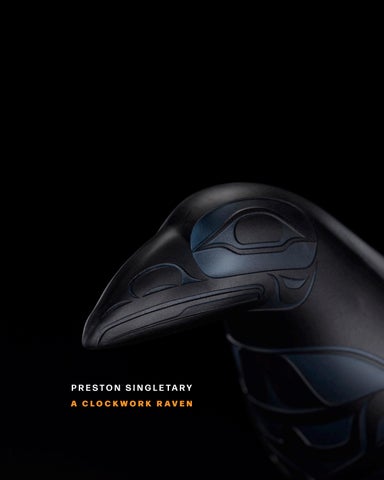
A CLOCKWORK RAVEN PRESTON SINGLETARY
New Raven Stories for Our Current Time
Artwork by Preston Singletary
Words by Garth Stein
Photography by Russell Johnson
PRESTON SINGLETARY
A CLOCKWORK RAVEN
TRAVER GALLERY | APRIL 2026
introduction
Preston Singletary has long been recognized for his pioneering role in translating the visual language of Tlingit culture into the medium of glass, creating works that bridge ancestral knowledge and contemporary form. In this major new exhibition, Singletary extends that dialogue through narrative itself, presenting fourteen newly imagined Raven stories developed in collaboration with novelist Garth Stein. Each sculpture in the exhibition draws from these stories, echoing the deep tradition in Tlingit art in which visual forms—Raven, transformative beings, elemental forces—serve not merely as decoration but as vessels for storytelling, philosophy, and cultural memory.
Raven, the central trickster-creator figure in Tlingit cosmology, has always been a character capable of crossing boundaries: between human and animal, sacred and mischievous, creation and disruption. In these new narratives, Raven enters the contemporary world with the same irreverent curiosity that defines the traditional creation cycles. Some stories situate Raven in the landscape of present-day Seattle, while others confront global concerns such as climate change, technological transformation, and genetic modification. Through humor, provocation, and mythic logic, the stories bring ancient narrative structures into conversation with the urgent questions of modern life.
The works in this exhibition translate those narratives into Singletary’s signature sculptural language—bold forms, luminous surfaces, and graphic compositions that draw from Northwest Coast design while embracing the expressive possibilities of glass. Together, the stories and the objects form a new mythic cycle: one that honors the continuity of Tlingit storytelling while asserting its vitality in the present moment. This exhibition marks a significant milestone in Singletary’s career, revealing an artist not only interpreting tradition but actively expanding it, creating space for Raven to inhabit the complexities of the contemporary world.
We are very proud to present this remarkable body of work at Traver Gallery, and to share these new artworks and stories with you, our collectors and friends.
opposite:
Raven’s Laboratory, 2026
27.5 x 24.5 x 16 inches made in collaboration with Josh Kopel
GREASE FEAST
IT BEGAN as a way to save the world from itself. Or rather, to save the People of the World from their own self-destructive nature. For the People had grown sick verily—they were pale, bloated, hairless things covered with rashes, bags under their eyes, hardly an immune left to speak of! They had forgotten the healing power of the sun. Worse, they had forgotten the healing power of Liquid Sunshine, as Raven called the oil from fermented fish heads, which the Tlingit had depended upon to stay healthy throughout the long winters since the Beginning of Time. Or at least, since their Beginning in the Course of Time.
He set to work building a rendering facility to provide this essential oil for his people. Perhaps if he fed the people the oil, they would become healthy again long enough to feed him! Raven worked hard for many nights until he finished his contraption: an old canoe perched high on a scaffolding of tree branches, filled to the brim with salmon heads rotting beneath the moon; a funnel draining the ooze into a tub of boiling water, separating the slimy bits from the fat; more chutes and channels, more fire, ever more pipes and gutters and basins; ladles for skimming; and then oil rising golden in cedar boxes, glistening.
Raven could wait no longer. He dunked his head into a box of the purest oil, still warm, and he stayed like that for many minutes. When he lifted his glistening head, the people gasped—for he looked so young! Raven preened as the oil dripped down his feathers.
“May we have some?” the people asked. “We want to look young like you!”
Raven swayed slightly in the wind. He was drunk on the healing power of the oil.
“I’m not sure the quality is good enough yet,” Raven said. “I’d better check again.” And he dunked his head into the box of oil once more.
When he next emerged for a breath, he looked like a younger Raven still, and the people cried out. “Let us have the healing oil!” they cried.
“This is not about me,” Raven said, pulling over a pipe and aiming the stream of oil directly into his mouth. “It’s about your safety.” He settled himself back against a cedar tree and opened his beak. The famously fatty fermented salmon oil flowed down his gullet. His eyes rolled back in his head. And he mumbled, over and over, “Quality control, quality control. We must maintain the quality control...”
Strange Dream, 2026
23.5 x 8 x 8 inches
LAZY RAVEN / STRONG RAVEN
Raven lolled on his back, bloated, the fish oil pumping ceaselessly into his belly. He couldn’t move, couldn’t think, and the contraption pumped: glug-glug. As the oil pooled between his feathers, Raven remembered the Old Story about the Lazy Boy.
The Lazy Boy was lazy, as you can imagine. He never did his lessons and never did his chores. He always had something more important to do, which was to be lazy! He was so good at being lazy, that everyone called him Lazy Boy, and nobody respected him.
But Lazy Boy was not lazy at all. Lazy Boy was training himself in the Old Ways. He bathed for hours in the icy water to force his body to be strong and to endure great pain and discomfort. And when the sea lion blocked the mouth of the river and tormented the village by stealing all the fish, and when the hunters failed to kill the sea lion with their harpoons, when the elders wept in despair and the old women pulled out their hair, the Lazy Boy walked into the surf, grabbed the sea lion by its flippers, and tore it in two, right down the middle.
The people saw what he had done, and they didn’t call him Lazy Boy any longer. After that, they called him Strong Man, for that is what he was.
Raven—greasy, bloated, dreaming—woke with a start. He rolled away from the rendering machine. Fat. Shiny. Full of misplaced ambition. He waddled to the rocks, spotted a seal, and lunged. He pulled. He grunted. He tore with all his might. Yet not even a squeak emitted from the seal, who merely blinked, unimpressed.
So Raven hurled himself into the bay and grabbed hold of a soggy log. Together, they drifted out with the tide.
Where the log took him—that is another story. Heh.
Lazy Raven/Strong Raven, 2026
18.5 x 18 x 24.25 inches
Earth Prayer, 2026 19.25 x 18 x 19 inches
THE SORROW LOG
The sea carried them—Raven and the log—through the silent fog. Raven clung with wings drooping, heavy with despair. The log floated without protest, as only the most sorrowful things can.
After a long time, Raven said, “You’re a quiet companion.”
The log replied, “I am full of sorrow. Which is why I am so soggy.”
Raven blinked. “I, too, am full of sorrow. I, too, am soggy.”
And so they floated together, saying little, each carrying the other.
Eventually, Raven lifted his beak and said, “I have been wet long enough. I think we should land on that shore over there.”
He guided them to shore. He built a small fire. It crackled and danced like something newly born.
“Come join me by this fire and warm yourself,” Raven said to the log. The log hesitated. “I am afraid.”
Raven realized the source of the log’s anxiety.
“You are far too soggy to burn,” Raven said. “And also, you are my friend, and I do not burn my friends. And also, you should know—one day you will be burned. It is how we return to the earth—through fire. One day we will all burn and our ashes will feed the land.”
The log, hearing this, crept close. The warmth touched him. As he dried, the sorrow inside him lifted—slowly, gently, without pain. The sorrow floated upward, steam from wet bark.
Raven, drying his feathers, felt his sorrow rise, too. Away it went into the air, into the smoke, into the fire. Where all good stories go.
SHADOW RAVEN
Raven flew hard. He flew far. He shed feathers and illusions. When he stopped, the sky looked like rain, and the ground looked like Seattle. But looks can be deceiving.
He circled once, then again. The sky still looked like rain, and the ground still looked like Seattle. But nothing else looked right. As he flew by the tall buildings of Downtown, he saw that they were empty and dark. Where had all the people gone? He swooped down to the street and saw that it was full of people! Not of bustling commerce. Not of urban fabric or spiritual alignment. But of despair. Dozens, hundreds of people, thousands, a sea of them, cold and lonely, sleeping on the sidewalks, piling on top of each other for warmth, humming to themselves to block out the crying of children. No longhouse. No hearth. No fire. No stories. A soup of the misbegotten.
Raven landed in Pioneer Square near the totem pole, which had been stolen from his People long ago, and at the top of which is perched a carving of himself. He had to admit, he’d aged well.
The streets were muddy. A man stood before him. Grungy, bearded, with black wings stitched from garbage bags, bits of fabric, and caution tape, strapped to his back with bungee cords.
Raven cocked his head. “Who are you?”
The man looked up, eyes like obsidian, a smirk like driftwood.
“I am Raven,” the man said.
Raven fluffed his feathers. “But I am Raven.”
“That’s right,” the man said.
“You cannot be me, because I am me,” protested Raven.
The man stood. His wings clanked and creaked. “And yet... I am you,” he said. Raven blinked. “That’s impossible.”
The man stepped close. He smelled of cedar smoke and bus exhaust. “Raven, brother,” he said. “You know as well as I: Nothing is impossible!”
Shadow Man, 2026
16 x 9 x 10 inches
RAVEN’S INDICTMENT
Raven was completely astonished, but he also was completely flattered by the idea that he would have such a devoted sycophant, for the vagabond man who looked like him also looked a little like George Clooney. And everybody likes George Clooney.
“Why are these streets so muddy?” Raven asked.
“The vengeance of the tidal flats—” the vagabond man began.
“Which were filled in by that troublemaker, city founder Henry Yesler,” Raven finished. “To satisfy his thirst for profit,” the vagabond man added.
“What is your name, friend?” Raven asked after a moment of consideration. “As we haven’t met.”
“I am Shadow Raven,” said Shadow Raven.
“Ah,” Raven cooed. “You sound like me, but as a Special Edition!”
Shadow Raven grinned.
“Let us go then, you and I,” quoth Raven. He bent down and picked up a corner of the sidewalk with his beak, lifting the curb and peeling back the pavement. Raven followed Shadow Raven down into the belly of the City, the Underground, where crumbling brick walls wept with rain, and the light came violet and soft through round glass eyes set into the sidewalk above.
“This is the Underscene,” said Shadow Raven.
Tables, chairs, people in chairs. It was a bar, a nightclub. Food eaten, glasses clinking, the world humming with meaningless conversation. A little man in a tuxedo standing at a microphone on a stage, lit by a thick beam of light.
“Please welcome to the stage our special guest!” he barked and the audience hushed. “The one, the only! The Rascal of the Underworld, the Trickster of the Hegemony, the Ghost in the Machine! Welcome to the stage, The Talented Mr. Raven!”
The people went wild with cheers of expectation.
“That’s our cue,” said Shadow Raven.
“Our cue?” wondered Raven. “I’m new here. That was your cue!”
“You can’t expect me to go up there by myself,” said Shadow Raven. “As a Shadow, I’m obliged to stick with you at all times.”
Raven harrumphed. “I don’t think I like my Shadow,” he said.
“Nobody does,” said Shadow Raven.
Raven was ushered to the stage. A spotlight bloomed. A drumbeat pulsed, slow and steady, like a heart under a ribcage. Then they called to him. Voices from the shadows. Thin, weak voices. “You gave us cleverness when we needed courage.” “You opened a box and called it a gift.” “You stole the sun and then sold tickets to the fire.”
Raven blinked.
“Is this… comedy?” he asked.
The crowd laughed. Hard. Sharp. True.
“It’s called a ‘roasting,’” said Shadow Raven. “Don’t worry—it ends with fire!”
Raven tried to speak. His voice caught in his throat, somewhere between a caw and a confession. In the hush, Raven looked out at faces—maskless, wounded, wrought of steel and sorrow. He opened his beak.
“People…can’t we all just get along?”
Silence followed. But only for a moment, before the speakeasy cracked open with a laugh that was both wry and worn.
Shadow Raven leaned in close and whispered.
“That’s the hardest—and the truest—trick of all.”
Between Worlds, 2026 13.5 x 20 x 14.5 inches
RAVEN AND THE SLEEPING CITY
On the stage beneath Pioneer Square, Raven sat under the purple glass light, surrounded by shadows in folding chairs.
The voices came sharper now.
“You taught us to trick the world—then blamed us for being clever.”
“You gave us language—and mocked us for misunderstanding.”
“You flew away when the fire spread. You hid from us.”
The masked crowd roared. And from their seats, his children rose—dozens of them—squawking, screeching, beautiful and broken. Each bore his eyes. Each bore his greed. Each bore his hunger.
SLEEPING CITY
From the wings, a tide of baby octopuses crawled, gliding across the damp stage to a mother-figure collapsed and pale—her arms limp, her suckers dim. They fed off the corpse of their mother. Raven wept.
“She gave herself,” he whispered. “Like that man on the cross. Like I—”
But no one heard him. The crowd howled louder. Then came the spiral. The sound dropped out. Raven was flying through the empty city. The towers of Seattle opened like skeletons. Office chairs stared from windows like hollow eyes. Desks sat untouched. Suits draped on hangers like skins never worn.
Below, in alleys and under overpasses, humans lay in piles. Cold and bone-thin. Using each other as blankets. As shields. They covered themselves with shards of hope.
And Raven saw it plain: They do not simply starve each other—they set the table first. Lay the plates, slice the bread, and make the hungry watch. Mirth becomes the blade. Laughter, the salt. And the ache—the ache is fed. Raven screamed.
The city did not answer.
Sleeping City, 2026 15 x 24 x 5 inches
He fell. Hard. Right into a cloud of pot smoke and techno beats.
The drum of HempFest pulsed in the air like a forgotten prophecy. Raven rose, trembling, and took the mic.
“People of the city! You are beautiful! You are broken! You are mine!”
“I gave you language and fire and opposable thumbs—”
“I built the first canoe and invented sarcasm!”
“I—”
But the crowd wasn’t listening. They were vibing. Eating gummies. Dancing on LED wings. Live streaming nothing to no one.
Raven looked around. Feathers askew. Eyes wild with truth.
And someone said, “Is that guy okay?”
Emerald City, 2026
25.75 x 14 x 10 inches
RAVEN IN DREAMLAND
Back at HempFest, Raven flailed. “You have to FEEL the weeping!” he cried. “Not scroll past it. Not spark up to forget. You must weep like rain!”
But the people only laughed. One gave him a joint. Another offered trail mix. Then a voice pierced the haze. High, distant, realer than real: “RAAAAY-VEN!”
Raven turned. The world warped and the colors bent. And suddenly—Raven was in Dreamland.
DREAMLAND
The sky was tall. The rivers ran like glass. And the trees grew from memory. Atop one tree— far above the canopy—Beaver sat, wedged between branches, tail twitching, eyes wide.
“RAAAAY-VEN!” Beaver called again. “Can you help me? My good friend Porcupine put me up here and left me!”
Raven cocked his head. “Why?”
“No reason!” said Beaver, indignant.
Raven floated closer, wings slow. “The True Truth will set you free.” Beaver squirmed. Then sighed.
opposite: Dreamland, 2026
28 x 15.5 x 15.5 inches
BEAVER’S QUEST
“Porcupine and I were best friends. Always together. But sometimes… his quills fell off. And I’d step on them. It hurt.”
Raven nodded. “So you got mad.”
“When he called and said, ‘Let’s go play,’ I took him on my back to the middle of the marsh. I left him there.”
“And how did he get away?”
“He called on Wolf, who summoned the North Wind. The lake froze. He walked to safety.”
NORTHERN WOLF (AND PORCUPINE)
Raven frowned. “And then he stuck you in the tree. But if you are friends, why do you treat each other so?”
Beaver hesitated. Porcupine appeared from the trees, rubbing his quilled back.
“Friendships change,” they both said.
Raven shook his beak.
“Situations change,” Raven said. “Friendships are forever. Remember that!” And with those words, Beaver slid down the tree trunk in shame and healing. His broad tail scraped the bark, carving gashes, ridges, roughness— And that is why some trees wear scars. Not from the wind. Not from fire. But from the long, hard lesson of regret.
THE CANNIBAL GIANT
Raven soared through Dreamland, his mind full of sorrow and suspicion.
“The People have forgotten how to act,” he explained to himself rather pedantically. “They’ve become prey waiting to be eaten. They do not even struggle.”
He watched them from above as they stood in their lines, staring into their mirrored rectangles, muttering questions to invisible ears.
“They don’t even care what the answers are,” Raven said, aghast. “Just give them something to believe for ten seconds.”
Raven suspected the kushtaka of being behind this devastation of the human soul. The kushtaka—those shape-shifting mind thieves of old. Or maybe DARPA. Or probably both. So he cornered a kushtaka near a stream. It looked up, startled, mid-fish.
“Mind controller!” Raven accused.
The kushtaka shrugged. “I don’t even have Wi-Fi,” it said, and vanished in a puff of moss.
THE BOUNDARY CROSSER
Raven moved on and soon he smelled smoke.
He came upon the Cannibal Giant, hunched by a great fire. Next to him were sacks—dozens, maybe hundreds—stacked like winter stores.
“What’s in those?” Raven asked.
The Giant grinned. “Pre-packaged organic snacks. Just heat ’n’ eat!” Raven poked one. It twitched. He opened it—
“Gak!”
Inside the sack was a human. Blinking. Docile.
“Are all of these people?” he asked.
“How did you collect so many?” Raven wondered.
“They are!” the Giant bragged.
The Giant licked his lips. “They checked the box without reading the Terms and Conditions,” he said.
Raven stared. “Huh.” He stood still for a moment. Then: “You know I can’t let you eat all these people.”
The Giant rose, massive and shadowing the trees.
“And how will you stop me, Black Bird? Who are you without your Black Bird Army?” Raven cut him off. “Who is Achilles without his tendon?”
The Giant blinked. Then looked down slowly. One of the sacks twitched again. A woman inside it whispered: “I read the Terms.”
And everything began to shift.
Boundary Crosser, 2026 11 x 30 x 8.5 inches
THE END OF THE CYCLE
“Who is Achilles without his tendon?” Raven asked the Giant. “Who is Samson without Delilah? Who is Oedipus without his club foot? We define ourselves by our flaws as much as by our higher qualities.”
The Cannibal Giant scratched his head. “Huh?”
Raven moved fast. He kicked a log. The fire surged. He flapped hard, knocking the Giant off balance. The Giant toppled into the flames, his fur igniting, he roared: “Raven! I will eat you yet!”
The fire answered with a crackling hiss.
The people crawled from their sacks and watched, stunned silent as the Giant immolated.
When the Giant’s fire had burned out, Raven gathered the ashes in a woven basket. He scattered them into the wind, across field and forest, hoping never to see the Cannibal Giant again. Little did Raven know the Giant’s ashes would become mosquitoes. And from that day forward, the blood of the People would never be safe from the Giant’s tiny minions. Not while they slept. Not while they danced. Not even while they dreamed.
Bummed, Raven flew back to the beach.
There, lolling in the surf, was his old friend, Killer Whale.
“Why are you called a killer?” Raven asked. “You have never killed a man, as far as I know.”
Killer Whale rolled gently with the tide.
“We killed men once,” Killer Whale said. “But then we were commanded by our creator to never kill People again.”
Raven blinked. “And who is your creator?”
“Natsilane,” said Killer Whale. “His brothers paid the price of his vengeance. We pay the price of his remorse.”
He paused.
“Raven, the cycle of violence can be stopped if the Will is present. If there is no Will, the People will become like cannibals and eat each other until there are none left.”
Raven scowled.
“I don’t like this game anymore,” he said.
Killer Whale shrugged. “It’s your dream. Wake up, if you like.”
And with that, Killer Whale slipped beneath the surface. The water closed, smooth as sleep.
Raven rolled over in his bed. The pillow smelled faintly of cedar and sorrow. A mosquito whined near Raven’s ear; he slept on.
Noble Truth, 2026
11 x 21 x 6 inches
acknowledgements
Thank you to Sean Albert, Celine Rabago, Brittany Shanta, Terri Rau, Lydia Singletary, Ross Richmond, Trumaine Mason, Jeremy Bosworth, Josh Kopel, Karsten Oaks, David Walters, Chris Stenzel, Russell and Barbara Johnson, Åsa Sandlund, Garth Stein. Thanks to Richard Whitely from the Corning Studio. Special thanks to Bill Traver and Sarah Traver, Samantha Skidmore, Deborah Adler and Tony Wolverton from Traver Gallery.
And deep thanks to all the collectors and supporters of my work.