Joseph Southall
A Late Romantic
Joseph Southall
A Late Romantic Paintings and Works on Paper
by Joseph Southall, RWS, NEAC, RSBA
(1861-1944)
12th – 27th May 2026
Ground Floor, 6 Mason’s Yard, Duke Street, St James’s, London SW1Y 6BU
MOORE-GWYN
BRITISH ART
Front and rear cover:
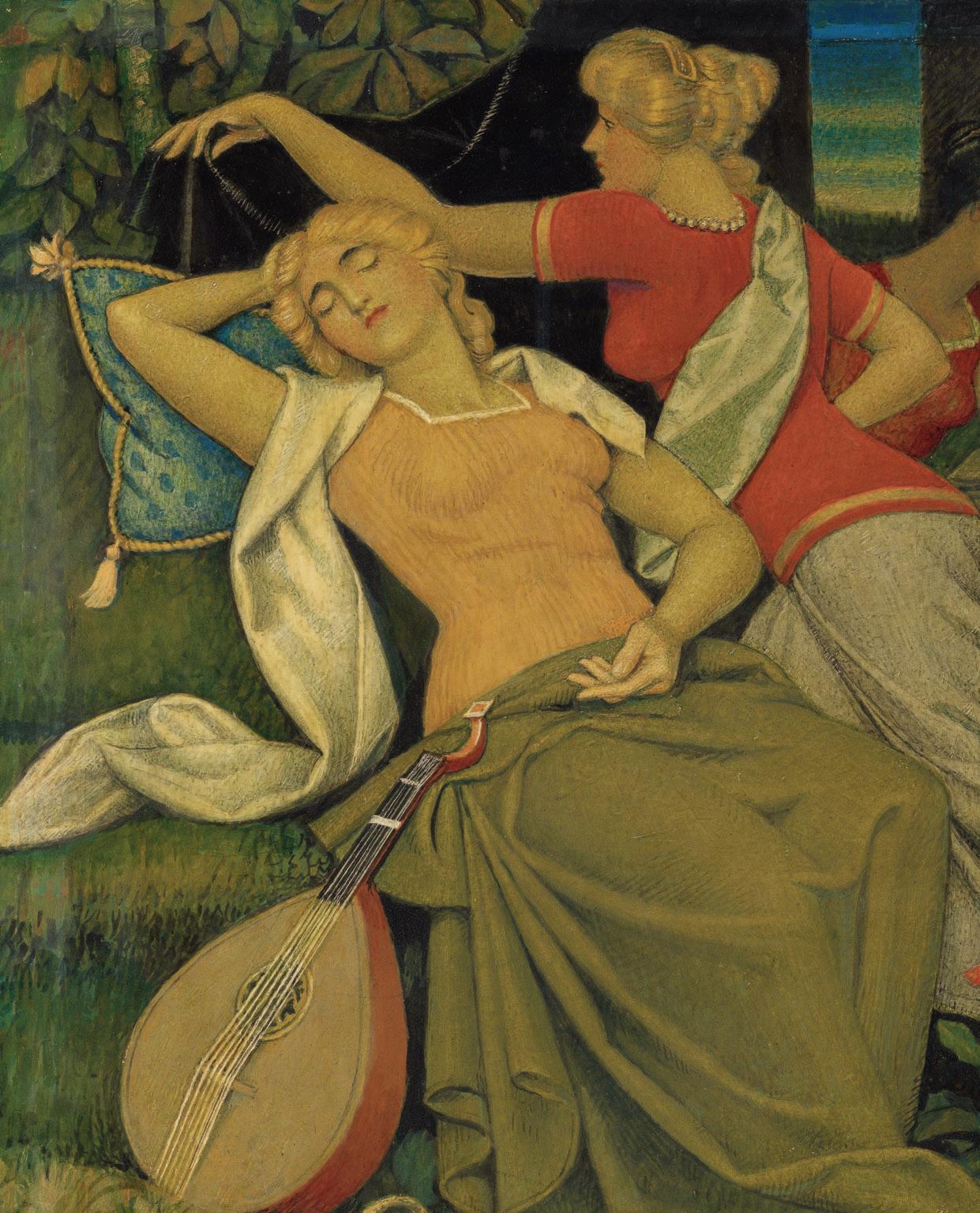
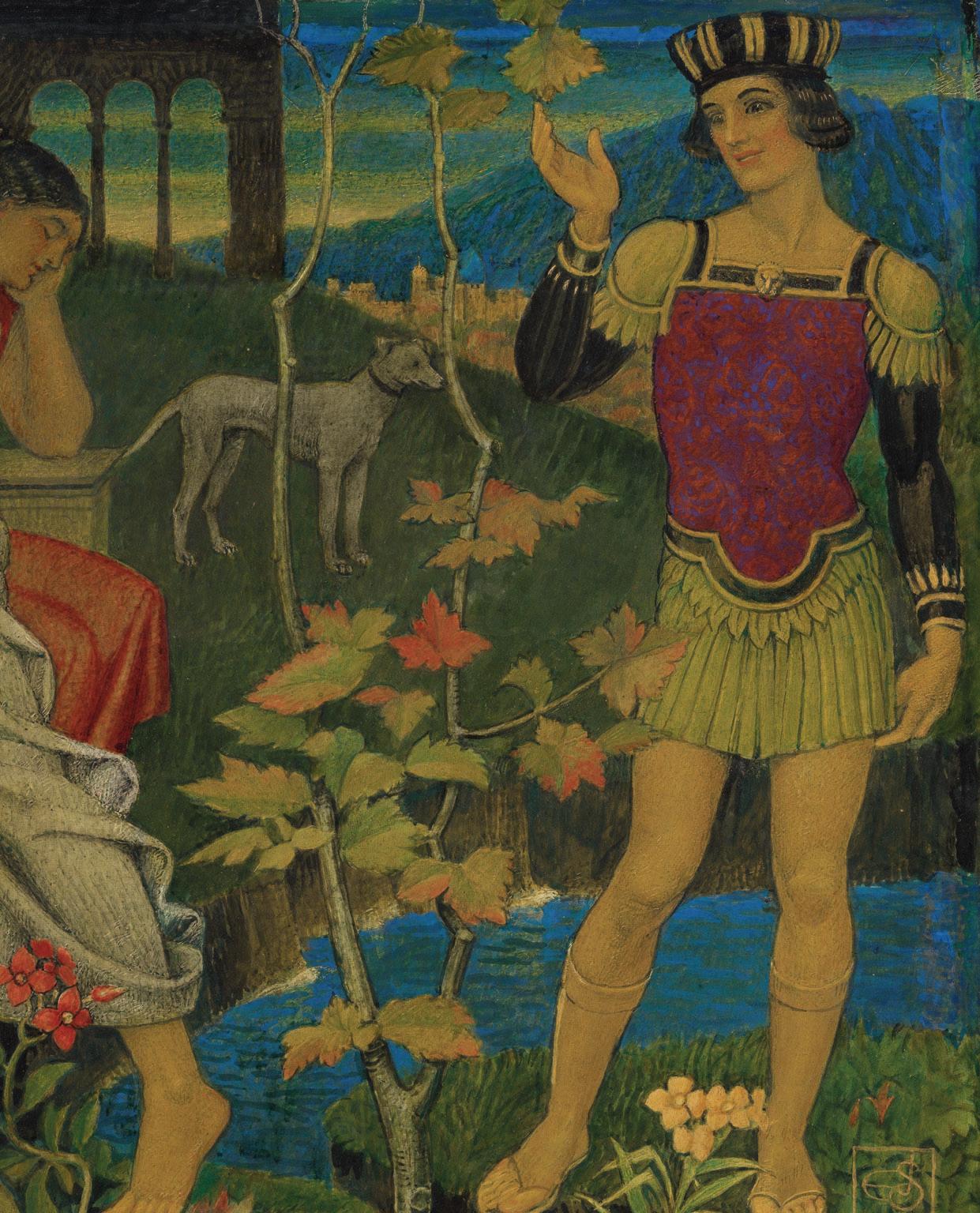
[Detail of cat.15] Cymon and Iphigenia, 1942
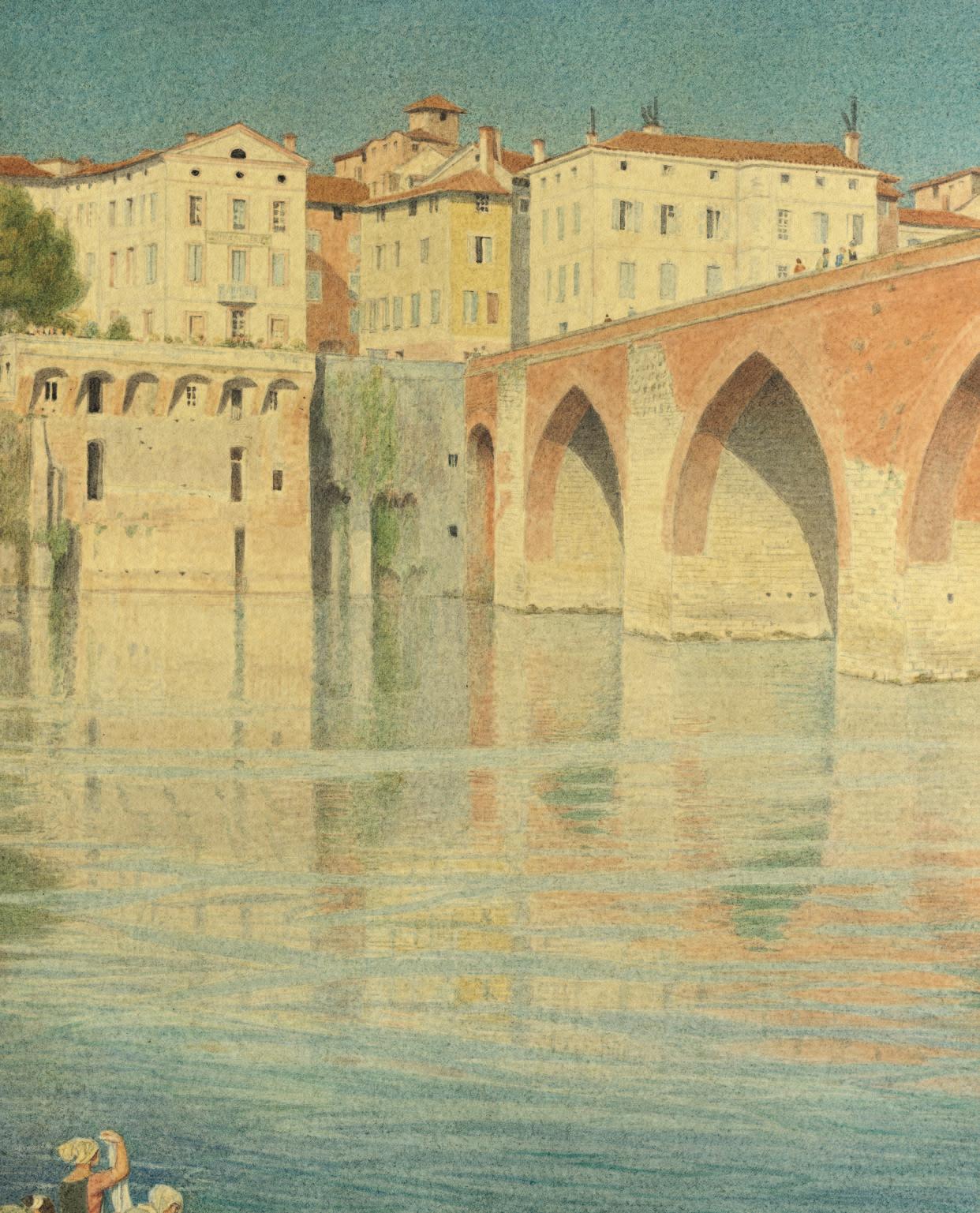
Opposite page: [Detail of cat.41] The Tarn at Albi
HARRY
The following abbrevations may be used in this catalogue:
Birmingham Museums & Art Gallery, Joseph Southall 1861-1944 Artist-Craftsman, 1980 = “Birmingham Catalogue”
Birmingham City Museums & Art Gallery, Memorial Exhibition of works by the late Joseph Edward Southall, RWS, NEAC, RBSA (1861-1944), with an introduction by Maxwell Armfield, Birmingham, 1945 = “Memorial Exhibition”
Introduction
The decade prior to the outbreak of the First War was a period of artistic turmoil in Europe: Monet painted his Thames series between 1899-1904, Picasso’s Demoiselles d’Avignon dates from 1907, Sickert’s Camden Town Murder 1908 and Southall’s The Agate, a double portrait of himself and his wife Bessie, from 1911. The latter, now in the collection of the National Portrait Gallery, depicts the couple on the beach at Southwold, he formally dressed in collar and tie, behatted and clad in plus-fours, while Bessie, equally be-hatted, wears a dress down to her ankles and a light cape. It is the English equivalent of that great American icon, Grant Wood’s American Gothic, but that was not to be painted for another two decades. Although the painting has always been titled The Agate, Bessie is almost certainly holding a piece of amber which is often to be found washed up on the shores at Southwold, and is a handy ‘tool’ employed in the polishing of gesso-work and gilding, a craft carried out by Bessie who worked in partnership with her husband in these crafts as she worked on many of the frames, especially those for his most important exhibition works.
Although Joseph Edward Southall was actually born in Nottingham his father died when he was only a year old, and his mother moved back to her native Birmingham taking young Joseph to his grandmother’s home in Edgbaston, thus all his formative years were spent in that city - the burgeoning second city of the Empire and the fiefdom of the ambitious Joseph Chamberlain and his family. At seventeen he was articled to the architectural practice of Martin and Chamberlain, responsible for most of the neo-gothic public buildings in the city. Meanwhile he attended evening classes at the School of Art. However, after four years with Martin & Chamberlain he decided to leave and to devote himself full-time to painting rather than architecture, and it was at this period he first came across the Arundel Society’s prints and was particularly impressed by one depicting the late fourteenth century Wilton Diptych, which alerted him to the beauty of true rather then neo-gothic art and architecture. This, combined with his reading of Ruskin’s St Mark’s Rest, set him on the course he was to follow for the rest of his life. In 1882 he and his mother toured northern France looking at gothic architecture and visiting such cities as Rouen, Amiens and Bayeux: the following year they went to Italy specifically to see the Carpaccios in Venice, but also took in Pisa, Florence, Sienna, Rome and Milan, and it was in the Campo Santo at Pisa that he first encountered the work of Benozzo Gozzoli, an experience he was never to forget.
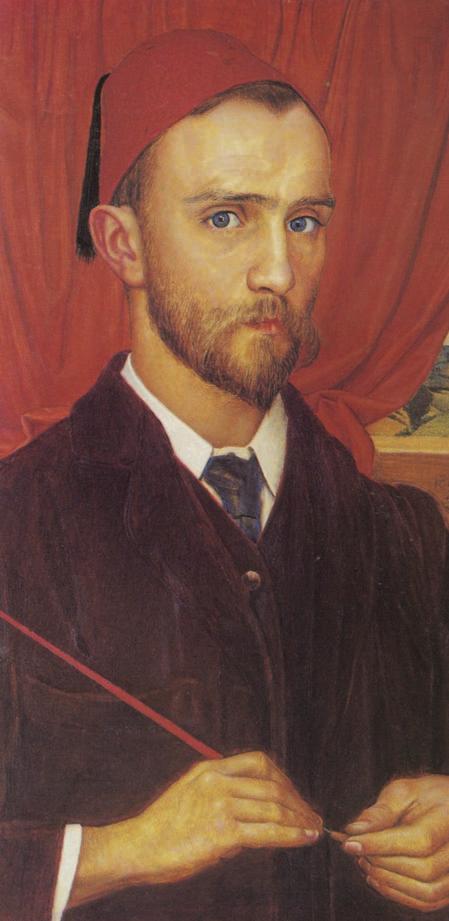
Man with a Sable Brush (Self Portrait), 1896, Tempera (private collection)
On returning to Birmingham he continued his studies at the School of Art, making a particular study of early Italian painting, a practice in which he was encouraged by Ruskin who invited him to Brantwood and, later by Burne-Jones, whom he met in 1893, and William Morris who visited the School of Art that year and invited him to Kelmscott Manor. At the same time he commissioned Southall’s fellow-student, Charles Gere, to draw the frontispiece to News from Nowhere. Burne-Jones advised him to use ‘strong deep colour‘ and to draw constantly, especially drapery. With regard to the latter he needed little encouragement and had already developed the habit of constantly having a sketch book in his pocket and of drawing wherever he happened to be whether it was on the Grand Canal in Venice or the beach at Southwold, the hill towns of Tuscany or Birmingham Town Hall.
By nature and by practice throughout his life Southall was a deeply conservative radical both in his art and his politics. While the ‘fashionable‘ world, encouraged by his fellow-quaker, Roger Fry, was discovering Post-Impressionism, Southall doggedly pursued his study of the early Italian masters and his experimentation with the techniques of painting in tempera, which he said took him eight years to master. One of his earliest masterpieces in the medium was New Lamps for Old, (Birmingham Museum & Art Gallery) dating from 1900-01, of which there is a study in the current exhibition, in this ambitious work he was clearly following Burne-Jones’s advice to use ‘strong deep colour‘.
In addition to drapery Southall was especially fascinated by hats and headgear in general, and painted at least two self-portraits in which is wearing a fez, while in Cymon and Ipigenia he has Cymon wearing the most bizarrely exotic headgear, reminiscent of many of the figures in New Lamps for Old. As to drapery he loved the curves and shadow-play created by the folds in dress or fabric. While no prude he was happy to paint from the nude when so required, but was always more interested in the overall design and the richness of colour that could be wrought from a judicious use of fabrics and textiles rather than naked flesh. The old fishermen at Southwold in their home-spun are every bit as much grist for his mill as the late Victorian and Edwardian ladies of Birmingham, and tempera was the ideal medium in which to achieve his aim. However, tempera, by its very nature, is a medium to be used in the studio rather than en plein air, unlike oil paint or watercolour, which are both flexible and easily transported, so sketching became an important part of his regular practice wherever he was, whether in France or Italy or his regular summer haunts in England - Southwold almost invariably in July, but also Fowey in Cornwall,and it was not just the figures he drew, and often tinted or worked over in watercolour, he was just as interested in the flora, fauna and architecture of the locality. The visual material recorded in sketches, such as those that constitute the main body of this exhibition, provided him with the detail and vocabulary he required not only for his most ambitious subject paintings, but also for smaller works which he exhibited regularly at exhibitions of the tempera society and other institutions.
Peyton Skipwith
Early work
Joseph Southall was born in Nottingham to a family with deep Quaker roots on both sides. Within a year, his mother widowed, he moved to be near his grandmother in Edgbaston – the part of Birmingham that would remain his home for the rest of his life. His artistic career (aside from school and evening classes) was born not from the more rarified world of the art school, but as an articled clerk with the Birmingham architectural firm Martin and Chamberlain. This useful early experience lent him the invaluable skill of architectural draughtsmanship, an introduction to the ideas of John Ruskin (the firm’s partner J.H.Chamberlain was a close associate of Ruskin) and to the Arts and Crafts Movement. He did not love his time there, describing life in the architectural office as “like a prison to me” although he held his colleagues there in high regard as “capable craftsman who could carve statues and paint frescoes”. Freed from this he travelled to Italy in the following year (1883) – the beginning of a lifetime of European travel and intimate study of Italian art of the Quattrocento and early Renaissance. These experiences lead to an early experiment in painting in tempera which would be abandoned before being picked up again in the following decade. In 1883 he attended Birmingham School of Art where he met his fellow artist Arthur Gaskin – a lifelong friendship that would help mould a distinctive Birmingham style of artistic craftsmanship. The early work here ranges from one of the artist’s earliest works in tempera, through the more traditional late Victorian watercolour style that defines some of his very early work.
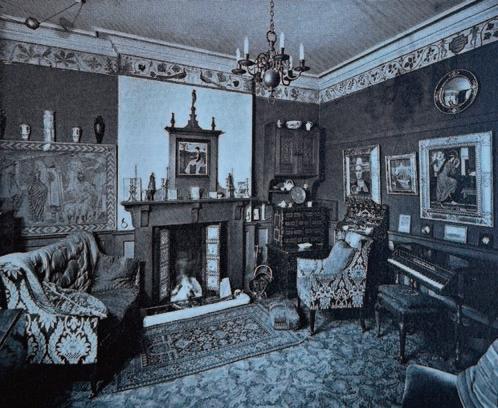
Fig.1: the drawing room of the Southall Home in Edgbaston, c.1930s
CAT. 1 (OPPOSITE)
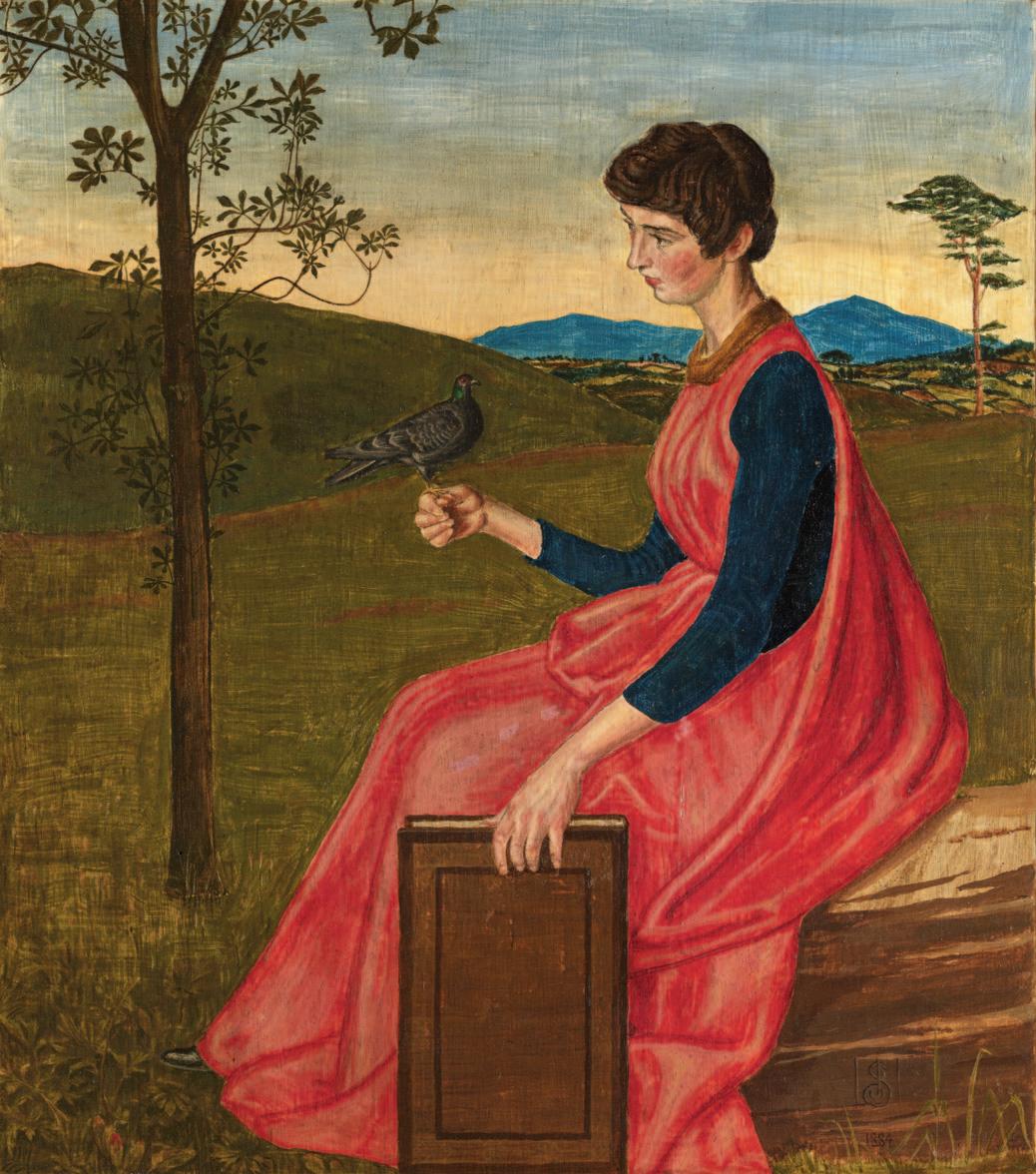
Humility
Signed with monogram and dated l.r.: JES/1884
Tempera with gold paint on panel, 41.5 by 36.5 cm (16 by 14 ¼ ins)
Provenance: the artist’s own collection, Charlotte Road, Edgbaston until c.1947; American Private collection
Literature: Birmingham Museums & Art Gallery, Joseph Southall 18611944 Artist-Craftsman, 1980, p.45 (visible in photograph), p.89 under section (a)
This important, recently re-discovered work is perhaps the artist’s most successful attempt at tempera following his first engagement with the medium in 1883. The painting belonged to Southall for his entire life and was set within an overmantle in the artist’s drawing room in Charlotte Street, Edgbaston (see fig.1, above). The picture disappeared following Anna’s death in 1947 ending up in an American private collection. Its subject of Humility is signified by the presence of the dove, perched on the sitter’s hand, a significant theme in Christian iconography. The landscape to the background is strongly influenced by the Italian Quattrocentro art he had encountered in Italy in the previous year. Although tempera as a medium was not unknown in Britain (and had been promoted through the work of William Blake, his follower Samuel Palmer and John Spencer Stanhope amongst others) it was yet to gain a significant foothold in British art. The present work, by one of the medium’s great and most thorough students, heralds the way for a more significant revival at the turn of the following century, of which Joseph Southall was a central part.
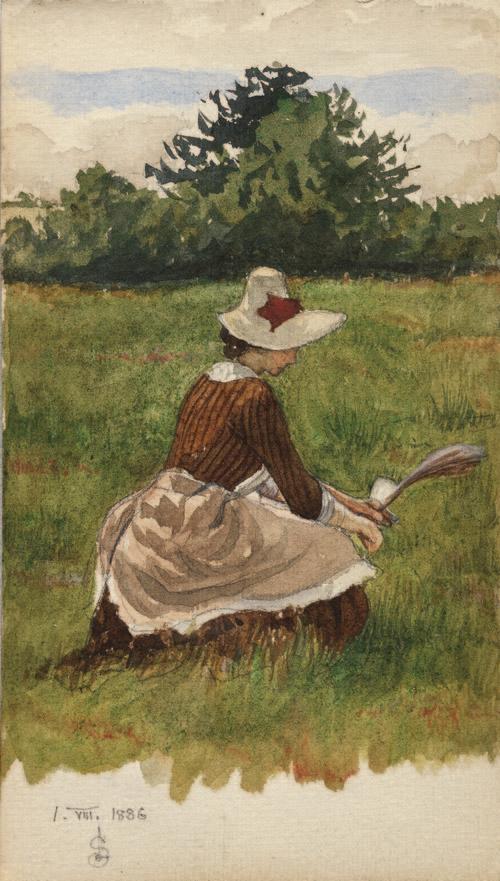
A Woman Gathering Beach Grass
Signed with monogram and dated l.r.: 1.viii.1886/JES
Watercolour and pencil, 17.5 by 11 cm (6 ¾ by 4 ¼ ins)
Provenance: the artist’s estate; private collection
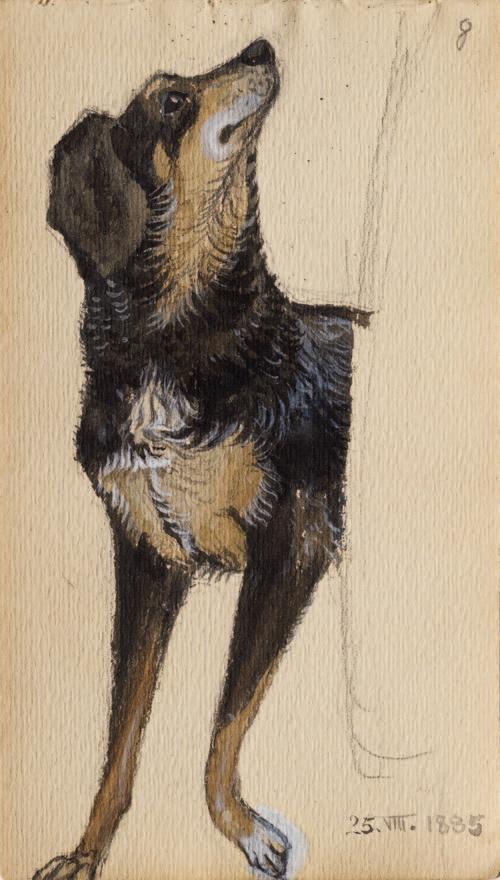
Study of a Dog (probably after an Italian Old Master)
Dated l.r.: 25.VIII.1885
Watercolour with bodycolour over pencil, 17.5 by 10 cm (6 ¾ by 4 ins)
Provenance: the artist’s cousin Isabel Harlock and thence by descent
CAT. 2
CAT. 3
CAT. 4
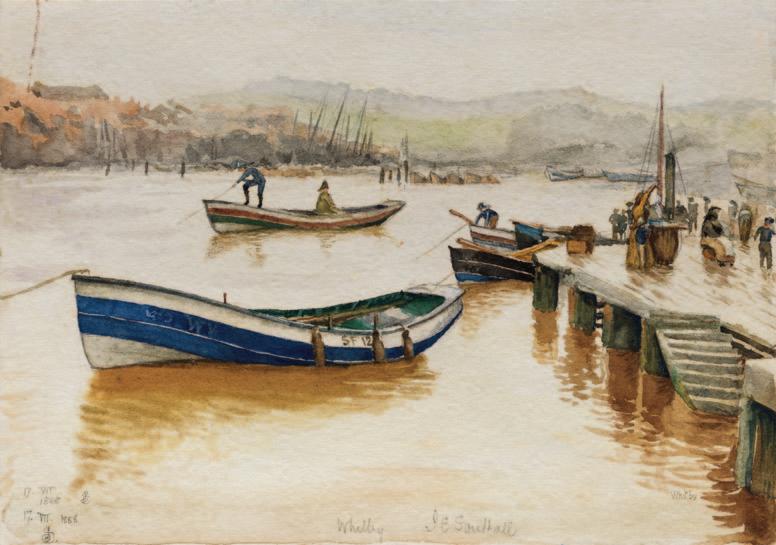
Fishing Boats at Whitby
Signed and inscribed with title l.c.: Whitby/J.E.Southall and dated (twice) l.l. 17.VII.1888
Watercolour, 18 by 25.5 cm (7 by 10 ins)
Provenance: the artist’s cousin Isabel Harlock and thence by descent
CAT. 5
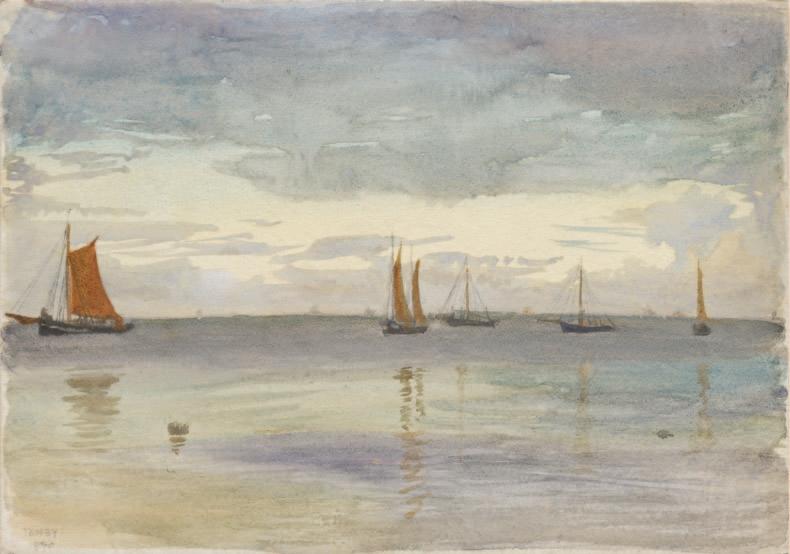
Shipping off Tenby, West Wales
Inscribed and dated l.l.: Tenby/1890
Watercolour, 18 by 25 cm (7 by 9 ¾ ins)
Provenance: the artist’s cousin Isabel Harlock and thence by descent
Mythological and Religious Work
A turning point in the artistic life of Joseph Southall can be dated to his first trip to Italy in 1883. There, on seeing the work of Benozzo Gozzoli in Pisa and Vittore Carpaccio in Venice, he resolved to dedicate himself to painting in tempera. After early struggles with the medium, he grew into one of the great masters of it in British art of the era, becoming perhaps the most significant figure in the tempera revival in English art, also helping him define the style of the Birmingham Group of Artists and Craftsmen of which he was a central member. His encounter with Italian art and tempera also played a central part in his subject matter –particularly the mythological and religious subject matter that is the heart of his most ambitious and impressive work. Alongside Classical mythology such as Ariadne in Naxos and Bacchus and Ariadne, were The Decameron by Giovanni Boccaccio, the fairy tale world of Beauty and the Beast and the Tales of the Arabian Nights.
In both style and subject, Southall relied on the important early influence of his mentor Sir Edward Burne-Jones, later developing his subject matter through the artistic style that would define him, into the decorative (mainly tempera) paintings that are perhaps his finest contribution to British Art. Although his Quaker background was to a degree at odds with religious painting, it also nevertheless provided subject matter for some remarkable works in tempera (enhanced by his own decorative frames and use of gold ground) amongst them St Dorothea and Her Two Sisters Refusing to Worship the Idol, for which there are two studies (Cat 6 and 7).
CAT. 6 (OPPOSITE)
Study for “St Dorothea and Her Two Sisters Refusing to Worship the Idol”, 1901-2
Inscribed, dated and signed l.l.: Study for St Dorothea/vi.1901/JES further signed and dated (l.l.)
Pencil on prepared paper, 38 by 28.5 cm (15 by 11 ¼ ins)
Provenance: Abbott and Holder
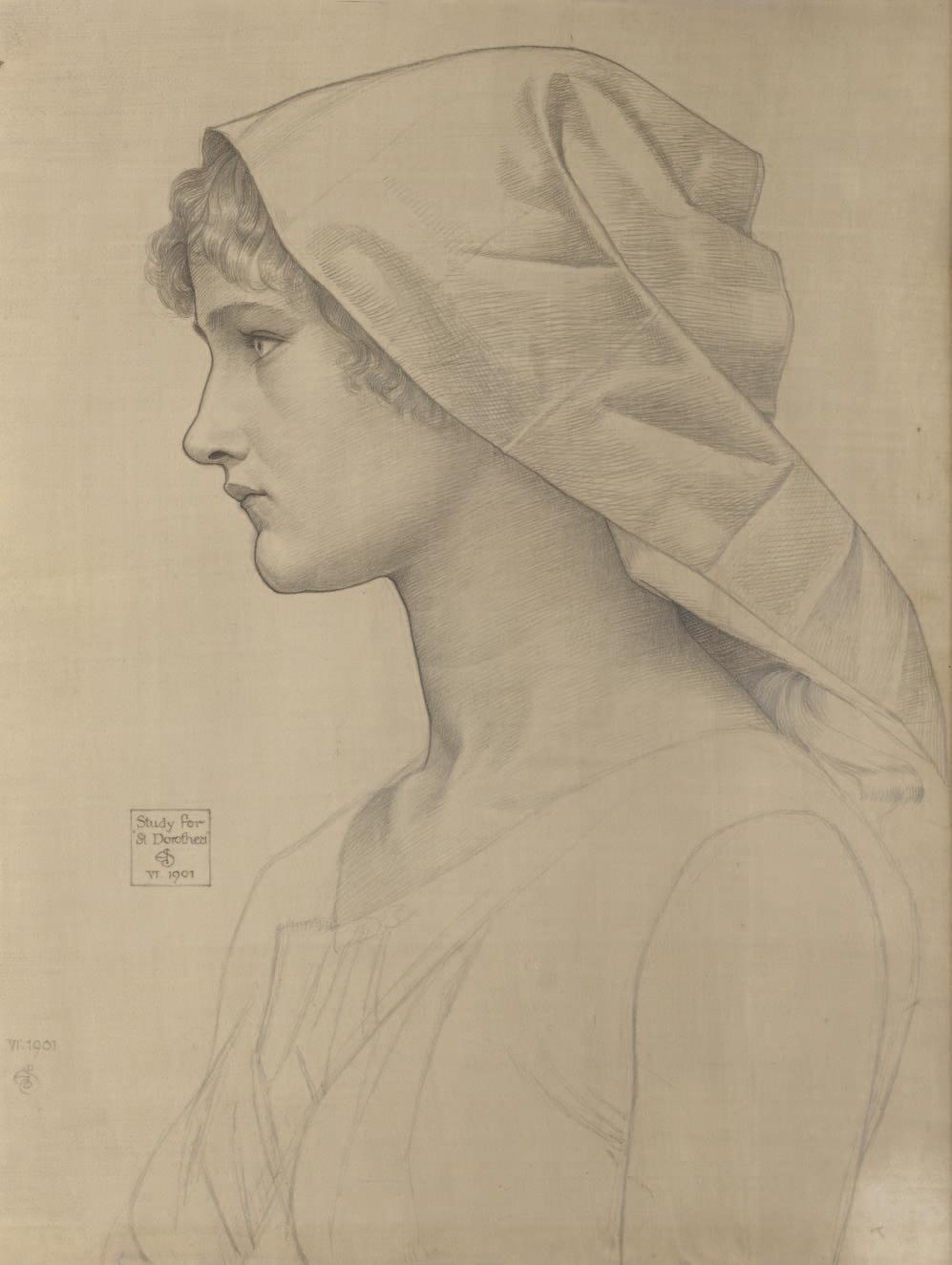
Southall’s tempera painting St Dorothea and Her Two Sisters refusing to Worship the Idol is one of the artist’s most impressive and ambitious works in the medium. Painted at the height of his career between 1901 and 1902, the work was exhibited in the Summer exhibition at the New Gallery that year, later being owned by the prominent Bradford citizen Asa Lingard who lent it to the 1925 show to celebrate twenty five years of the Cartwright Hall there. St Dorothea of Cappadocia was a third century saint, martyred for refusing to renounce her Christianity (reconverting her sisters just prior to their own execution). In his Birmingham catalogue entry on the painting, George Breeze observed: “St Dorothea exhibits the true serenity of saint, only enhanced by the lack of tension resulting from the judge’s command.” (Birmingham Catalogue, p.46, no.C1). These two beautiful and contrasting studies for the central figure of St Dorothea herself bear witness to the mastery of Southall’s portrayal.
CAT. 7 (OPPOSITE)
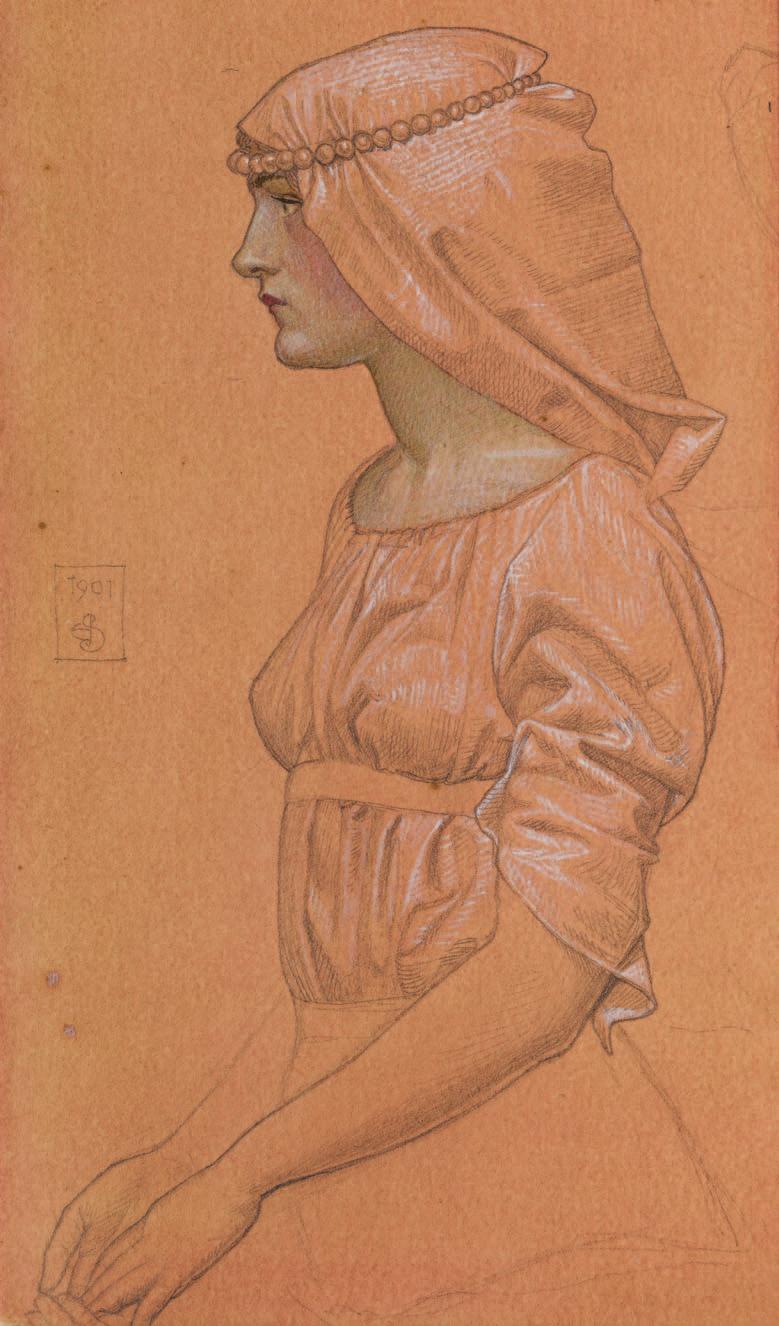
Study for “St Dorothea and Her Two Sisters Refusing to Worship the Idol”, 1901-2
Signed with monogram and dated c.l.: JES/ 1901 and inscribed (verso) Study for St Dorothea Watercolour, bodycolour and pencil on pink paper, 26.5 by 13 cm (10½ by 5 ins)
Provenance: Hartnoll & Eyre (by 1969); Michael Gillingham; Sotheby’s, London, The Gillingham Collection, 1 April 2000, lot.329; Campbell Wilson, London
Exhibited: Birmingham Museums & Art Gallery and London, Fine Art Society: Joseph Southall 1861-1944
Artist-Craftsman, 1980, no.C1 (i)
Literature: Birmingham Museums & Art Gallery, Joseph Southall 1861-1944 Artist-Craftsman, 1980, p.47 (no.C1(i))
In its entry in the Birmingham Catalogue (see literature alongside) George Breeze describes the present work as “An exquisite example of Southall’s drawing, this study differs from the final work in the head-dress and folds of the drapery…”.
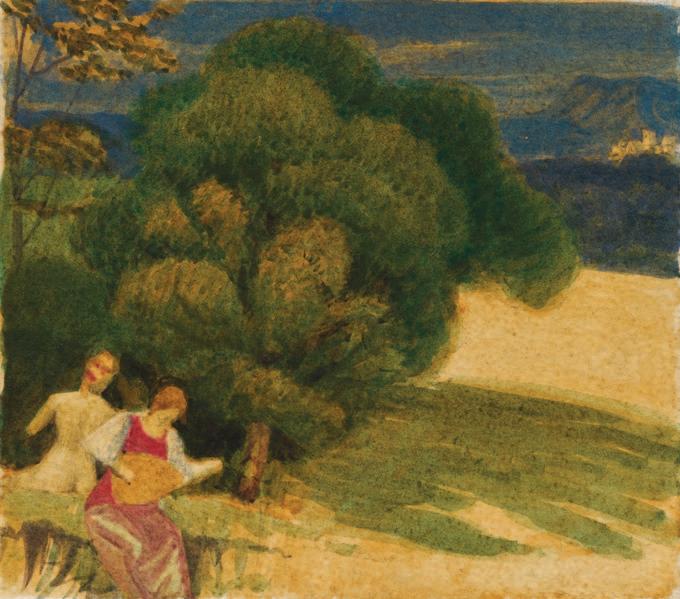
“Sacred and Profane Love”, possibly an Idea for Music (1912)
Inscribed indistinctly, dated and signed u.l..: Tempera/Lefranc?/vi.1911 and inscribed (verso)
Formalin/ vii.28
Watercolour, 13 by 14.5 cm (5 ¼ by 5 ¾ ins)
Provenance: the artist’s cousin Isabel Harlock and thence by descent
The presence of two female figures (one nude, one playing a mandolin) exactly mirrors the central composition of his 1912 tempera painting Music (Private Collection) and may be an early study for this decorative picture that he painted in the following year. The strongly Giorgionesque quality of the landscape is also indicative of the lifelong influence that Venetian Art of the late fifteenth/early sixteenth century had on Southall. The artist regularly applied formalin (a solution of formaldyhide) to his pictures which helped in maintaining the stability of the medium.
CAT. 8
9
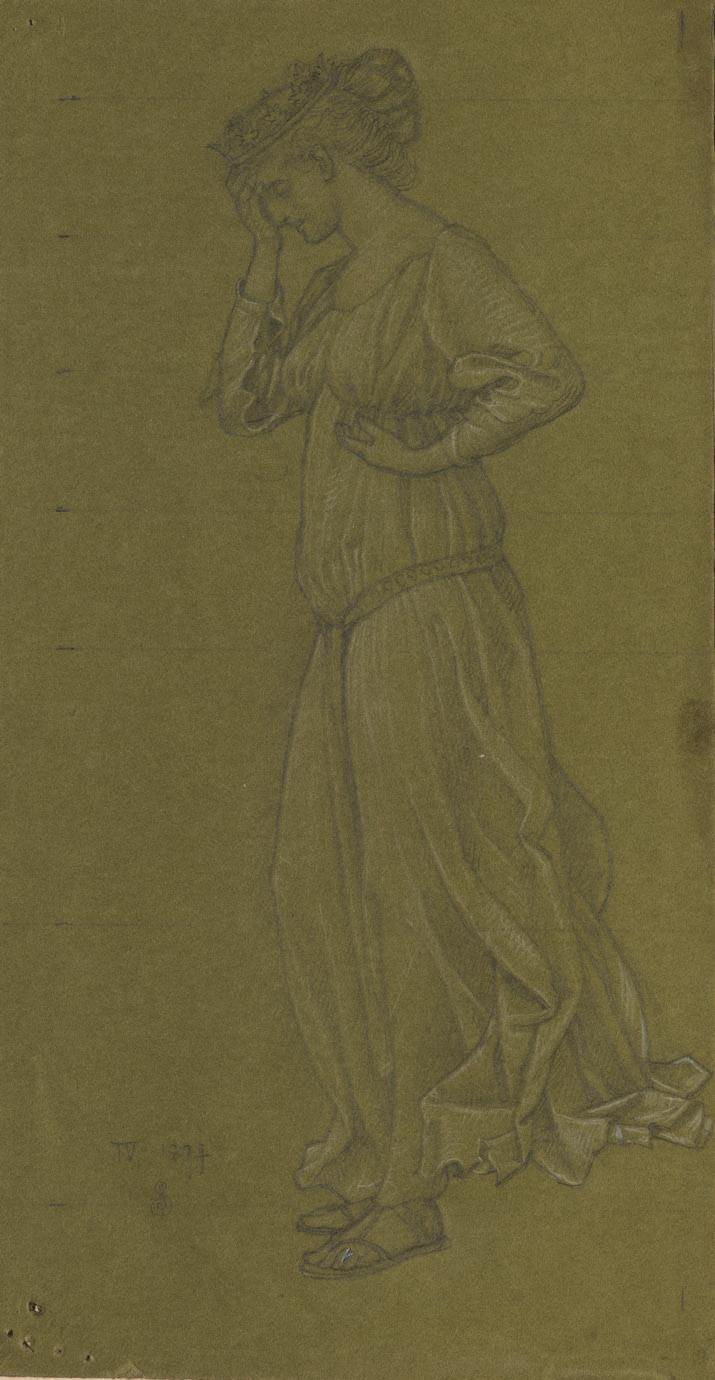
Drapery Study, 1894
Dated and signed l.l.: iv.1894/JES and inscribed under mount Drapery Study with the artist’s address on backboard (verso)
Pencil and white chalk on green paper, 25 by 13 cm (9 ¾ by 5 ¼ ins)
CAT.
CAT. 10
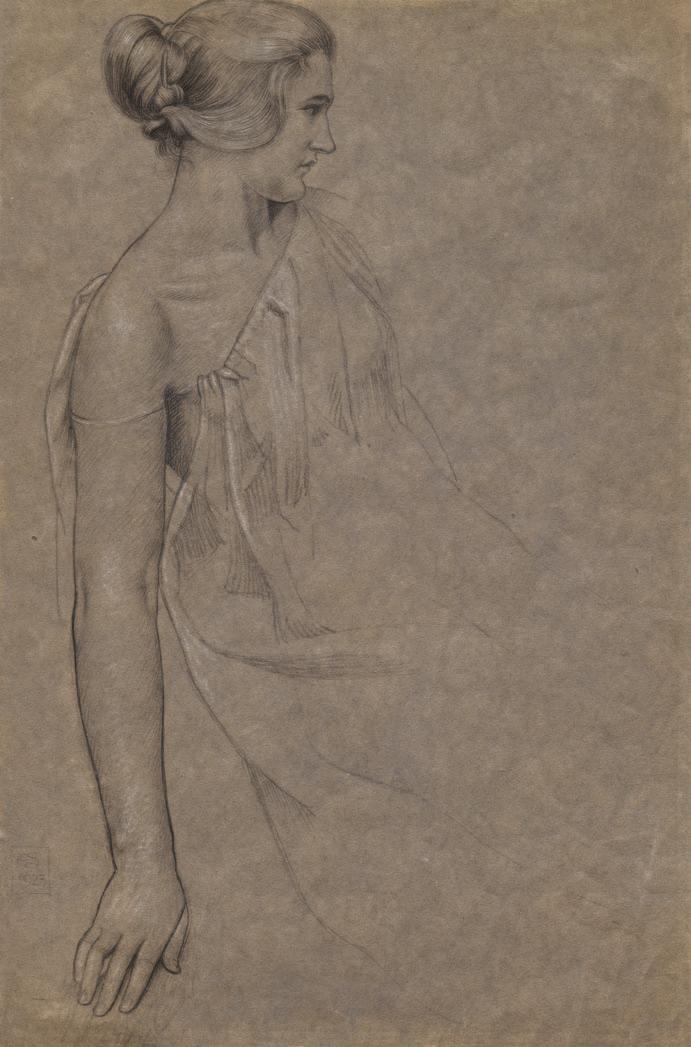
Study for the figure of Ariadne for “Ariadne in Naxos”
Signed with monogram and dated l.l.: JES/1923
Pencil and white chalk on buff paper, 38.5 by 26 cm (15 ¼ by 10 ¼ ins)
The legend of Ariadne in Naxos was a favourite mythological subject of Southall who painted it on a number of occasions: an initial painting in 1902, a tempera picture on linen from 1925 (now in the Birmingham Museums and Art Gallery (fig.2 below)) and a related version in oil in the same year. The present study relates to the Birmingham painting, which hung above the fireplace in the artist’s own dining room until his wife’s death in 1947. The present study differs slightly from the final painting, particularly in the pose of Ariadne’s left hand, dress and head-dress, but nevertheless sets up her distinctive final pose with her low hanging right arm.
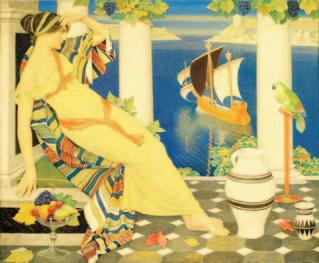
Fig.2: Ariadne in Naxos, 1925, Tempera (Birmingham Museums and Art Galleries (acc.1948P3))
CAT. 11
Study of Pigeons for “Beauty Seeing the Image of her Home in the Fountain”, 1897-8
Signed with monogram and dated l.l.: 1897/JES and inscribed l.l. Pigeons for “Beauty at the Fountain” bought by Laurence Hodson/ New Gallery 1898
Watercolour with bodycolour and pencil, 13.5 by 10 cm (5 ¼ by 4 ins)
(frame size 21 by 17.5 cm)
Provenance: the artist’s cousin Isabel Harlock and thence by descent
The present work is a study for the pigeons perched on the fountain to the right of Southall’s 1897-8 tempera painting Beauty Seeing the Image of Her Home in the Fountain (collection of The Wilson Art Gallery and Museum, Cheltenham) (fig.3, below)). According to notes by Southall from the time, the artist took the painting to Sir Edward Burne-Jones on 24 November 1897 just prior to its completion, who took issue with the face but “admired the rest very much (and) liked the “little chap” on the fountain and the pigeons VERY much also her hands and arms…”
(quoted Birmingham Catalogue, under cat.no.B3, p.34).
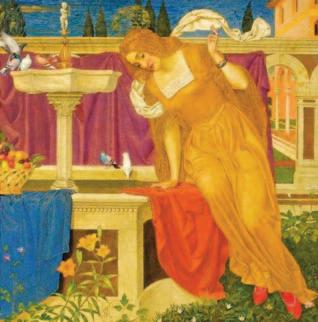
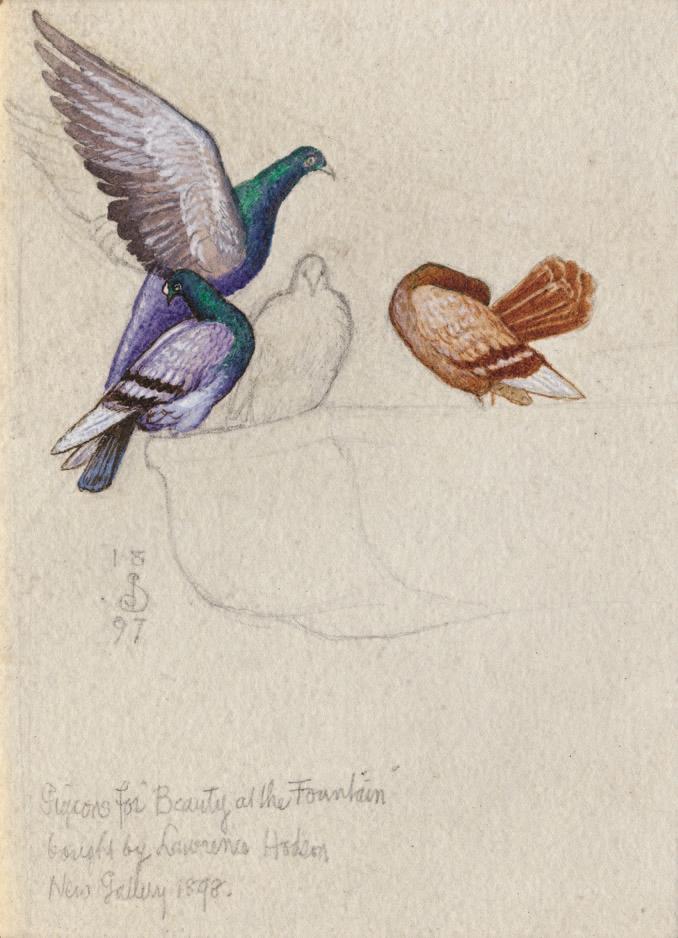
Fig.3: Beauty Seeing the Image of her Home in the Fountain, 1897-98, Tempera (Private Collection)
CAT. 12
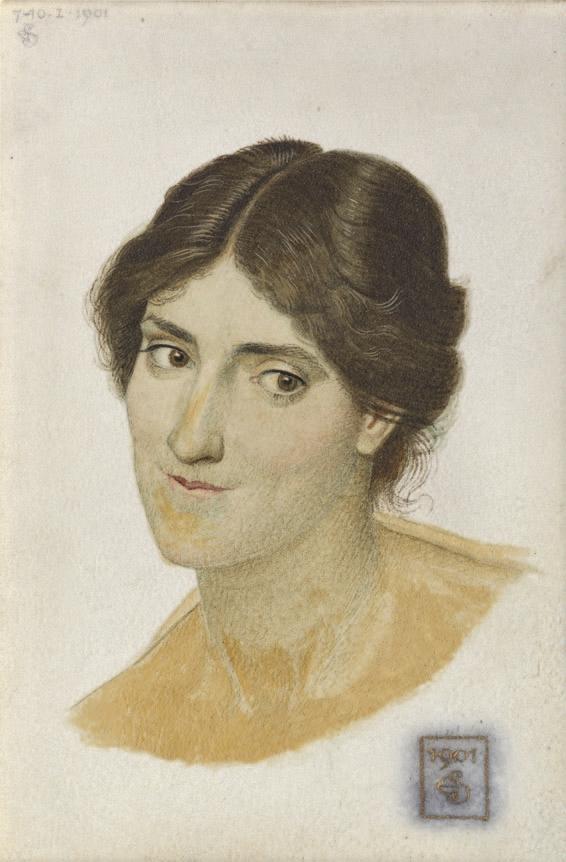
Study for “New Lamps for Old”, 1900-01
Signed with monogram and dated in gold l.r.: JES/1901
Watercolour over traces of pencil, 12.5 by 9 cm (4 ¾ by 3 ½ ins)
Provenance: the Piccadilly Gallery, London
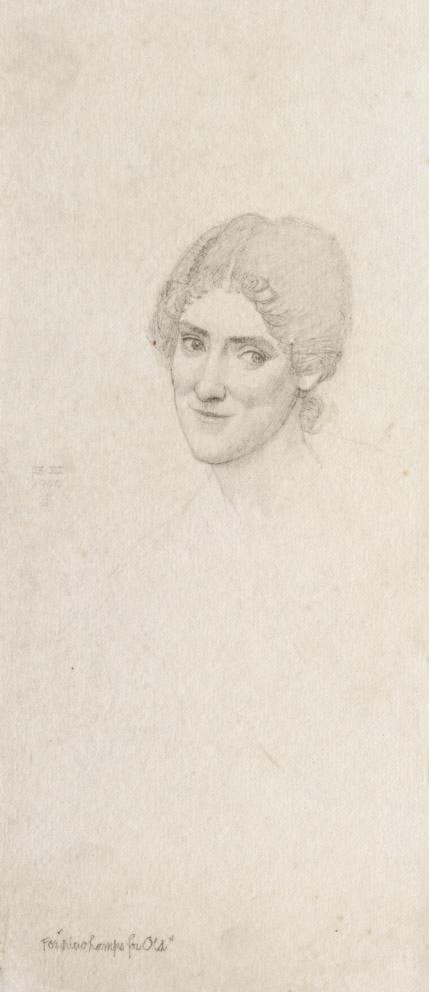
The subject is from a scene from the story of Aladdin from the Tales of the Arabian Nights. Despite the theme involving the trickery of a magician in which he exchanges his new lamps with Aladdin’s magical old lamp, it has been suggested that the title deliberately chimes with the dawn of the twentieth century. The final tempera painting is full of personal significance for Southall, depicting many of the artist’s Birmingham Quaker associates (to the background - somewhat in the manner of a Venetian sacra conversazione) as well as fellow artists. This and the following work are a study for the female figure to the centre left of the final picture.
CAT. 13
Study for “New Lamps for Old”, 1900
Signed with monogram and dated l.l.: 23.xii.1900/JES inscribed l.l. beneath the mount for new lamps for old Pencil, 6.5 by 12 cm. (10 ½ by 4 ¾ in.)
Provenance: the artist’s cousin Isabel Harlock and thence by descent
CAT. 14
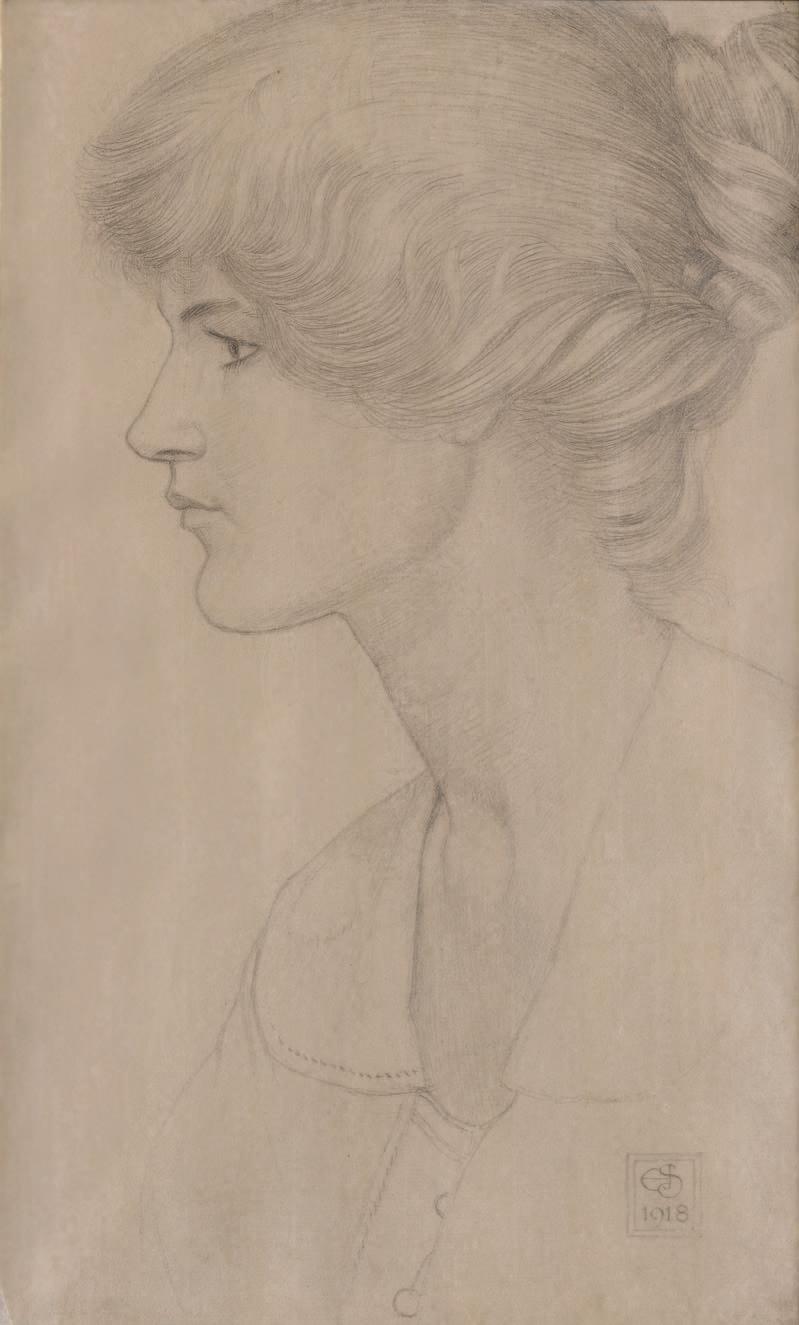
Portrait of the model for Hope for “Belgium
Supported by Hope”, 1918
Signed with monogram and dated l.r.: JES/1918
Pencil, 30 by 18.5 cm (11 ¾ by 7 ¼ ins)
Exhibited: The Fine Art Society, 2005, Sixty Works by Joseph Southall (18611944) from the Fortunoff Collection, Ext.Cat.
Although previously identified as a study for a portrait of Southall’s patron Janet Hutchinson, the present work bears a very close similarity to the figure of Hope in the Wartime work Belgium
Supported by Hope (Tate Gallery, acc.T03699).
Southall dedicated much of World War One to the pacificist causes that his Quaker background demanded of him. This left little time for painting. Belgium
Supported by Hope is one of the main exceptions and is an allegory for the re-building of the country following its ravages under its German invasion during the previous four years.
15
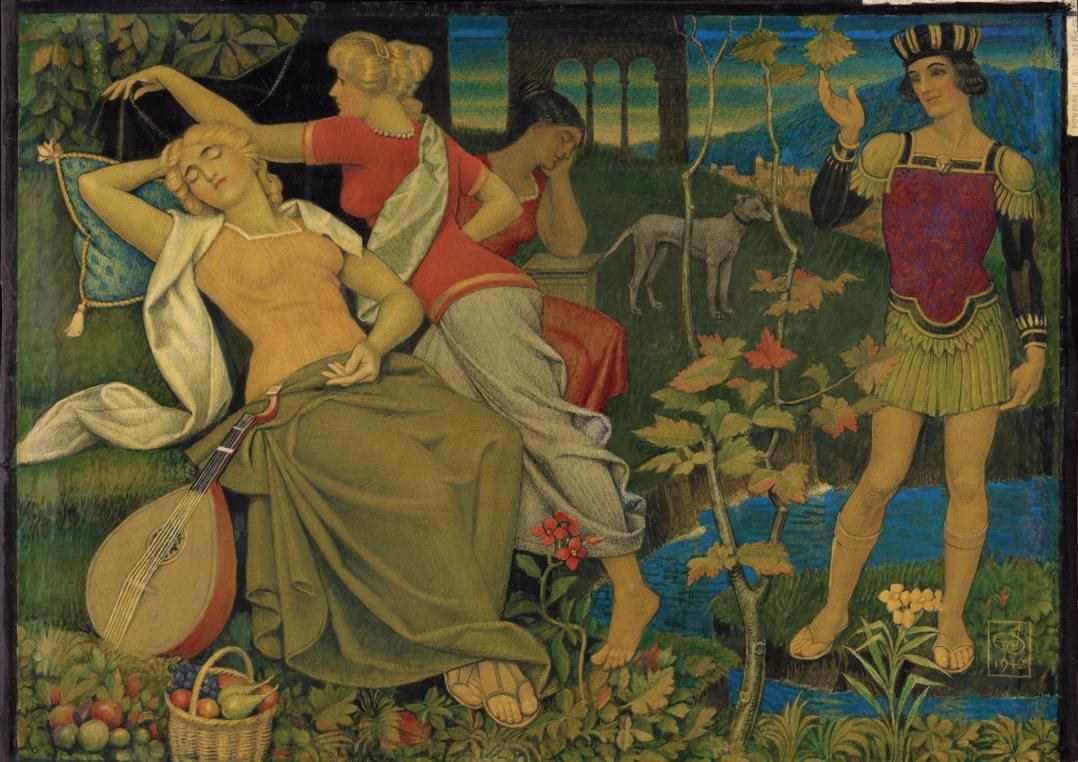
Cymon and Iphigenia, 1942
Signed with monogram in gold and dated l.l.: JES/1942 and inscribed by the artist in pencil (verso) ‘FORMALIN ALL OVER’ and further inscribed (verso) ‘CYMON AND IPHIGENIA EGG, painting begun 18.V.1942 Finished 26 IX 1942’, Tempera on board, 33 by 46.3 cm (13 by 18 ¼ ins) Exhibited: London, New English Art Club, Winter 1942, no.246
The fourteenth century story collection by Giovanni Boccaccio known as The Decameron was a perhaps unsurprising source for an artist who had held a lifelong interest in medieval and Renaissance Italian culture. Southall had used the collection as an inspiration for his earlier tempera painting Sigismonda Drinking the Poison of 1896-8 (Birmingham Museums and Art Gallery (acc.1948P49)) and would have also been aware of the story of Cymon and Iphigenia from earlier versions by Reynolds, Millais and Leighton. In the story Cymon, the boorish son of a nobleman, encounters the sleeping Iphigenia by a fountain. As well as awakening his desire, the meeting moves him to improve his own character in order to prove his worthiness to her. Southall’s Cymon and Iphigenia is one of the artist’s last significant mythological subject pictures, finished in the middle of the second world war, two years before his death. Despite the late date, the picture is evidence of the artist’s enduring genius in his use of the tempera medium and of the decorative Romantic style that he had made so much his own.
Southall and Portraits
Joseph Southall was a noted and highly talented portrait artist. Quaker beliefs lead to a natural wariness of the vanity of portraiture although there are many examples of earlier Quaker portraits including those of William Penn, the Quaker founder of Pennsylvania and Elizabeth Fry, the great prison reformer. By the late nineteenth-century it had become a more acceptable practice and one excelled in by Joseph Southall. He made numerous informal portrait drawings and sketches of his friends and family and he was commissioned to make formal portraits, including those of members of many prominent Quaker families. The results being some exquisite and precise portraits that owe much to the influence of his studies of early Italian art.
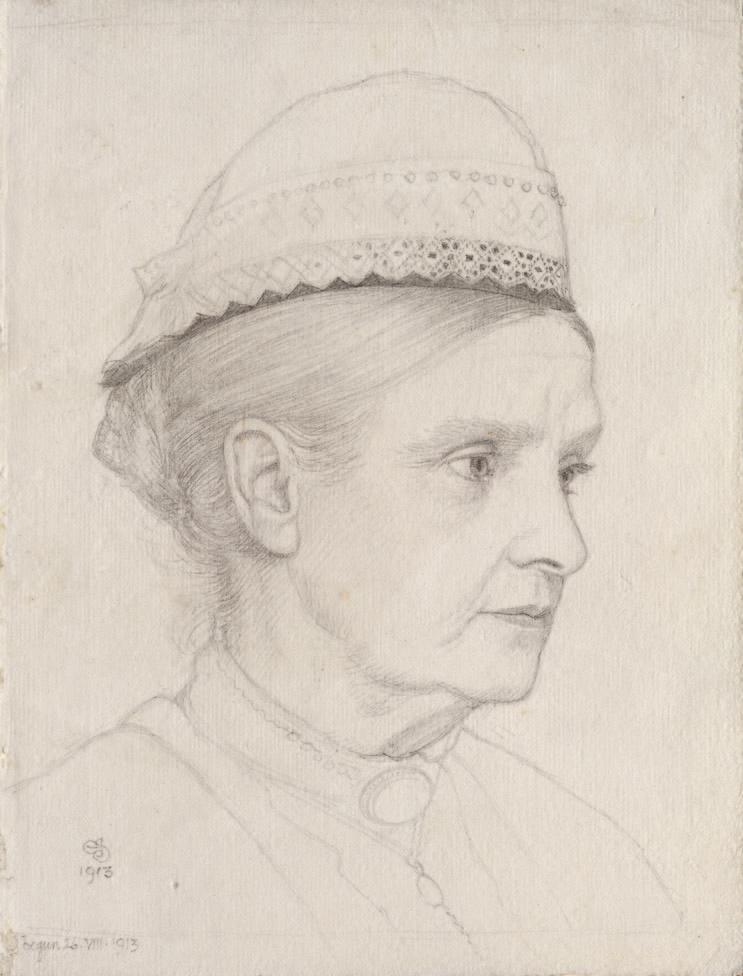
CAT. 16
Portrait of the Artist’s Mother
Signed, inscribed and dated l.l.: JES/1913/begun 26.viii.1913
Pencil, 20 by 15 cm (7 ¾ by 6 ins)
Provenance: the artist’s cousin Isabel Harlock and thence by descent
Southall was the only child of Joseph Sturge Southall and Eliza Maria Baker, both parents coming from prominent Quaker families. His father tragically died shortly after his birth and his mother then returned with her only son to live with her own family in Edgbaston on the outskirts of Birmingham. Southall considered his 1902 portrait of his mother (now in the collection of Birmingham Museum & Art Gallery) to be his finest work. The present 1913 drawing of his mother shows her in a similar white lace widow’s cap and wearing the same brooch pinned at her neck. The Ruskin Lace cap was almost certainly designed by Joseph Southall and worked by his mother who exhibited a number of pieces at the Arts and Crafts Exhibition Society.
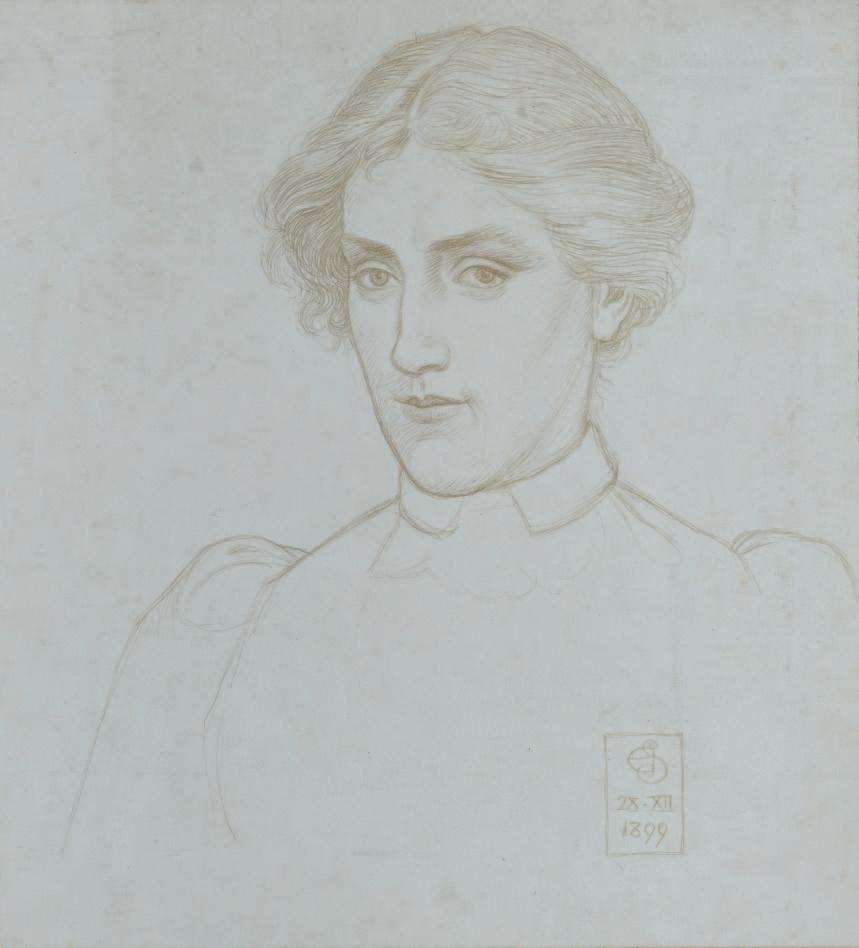
CAT. 17
Portrait of the Artist’s Cousin, Isabel Harlock
Signed with monogram and dated l.r.: 28.xii.1899/JES
Gold point on prepared paper, 18 by 16 cm (7 by 6 ¼ ins)
Provenance: the artist’s cousin Isabel Harlock and thence by descent
Southall made drawings in both gold point and silver point and considered gold point to be superior as the metal did not oxidise. The technique of metal point drawing dates from the fifteenth century. It is made by drawing with a fine point of soft metal upon a specially prepared textured ground which results in a delicate line of the metal. It is a demanding and time-consuming process for the draughtsman, as although it produces beautiful lines, it is very difficult to correct or amend.
CAT. 18
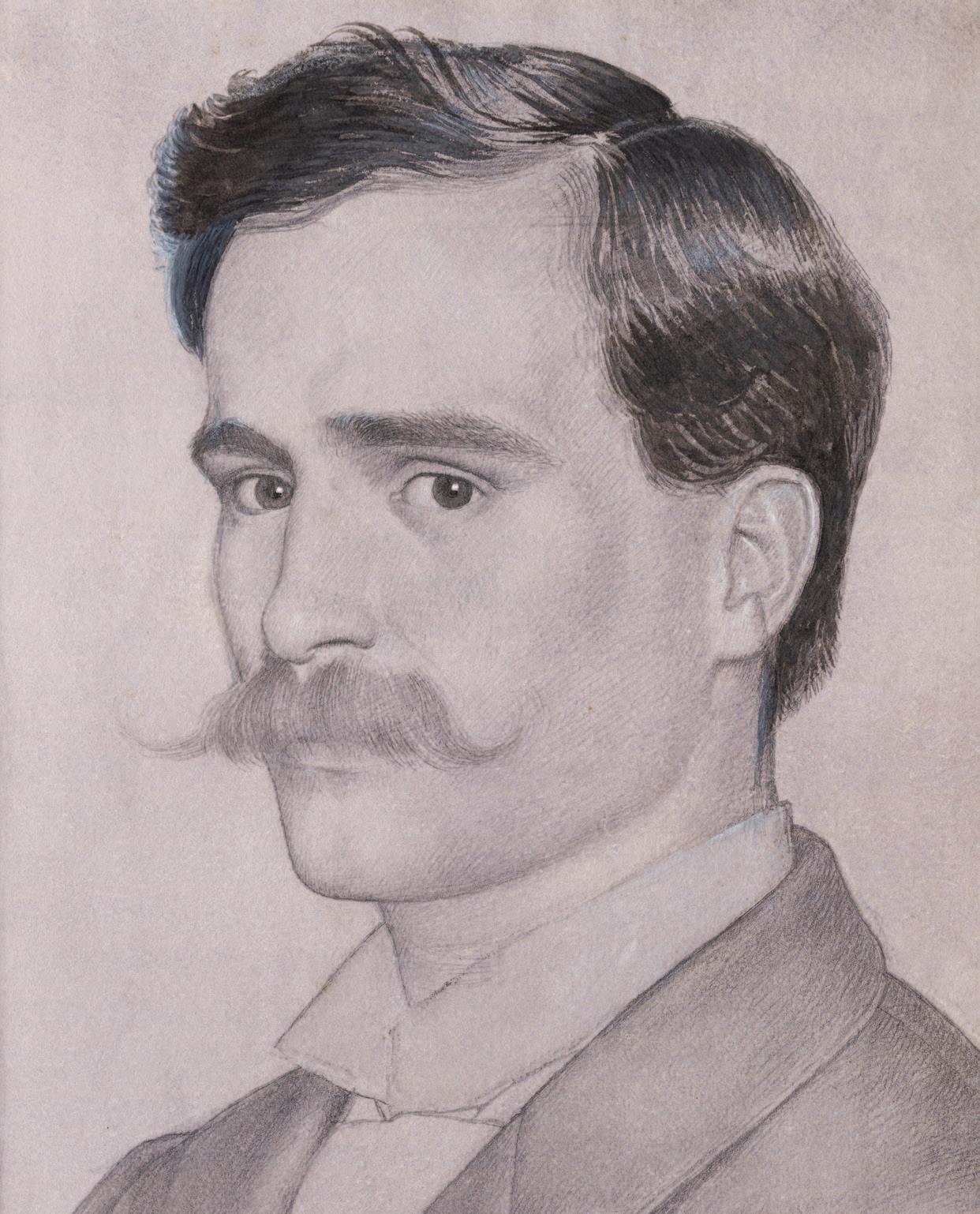
Portrait of Arthur Gaskin
Signed with monogram and dated l.r.: JES/1896-7
Pencil and grisaille watercolour on grey paper, 39 by 27.5 cm (15 ¼ by 10 ¾ ins)
Provenance: Lyndon Goodwin Harris; Abbott and Holder, London; Sean O’Lubaigh Collection
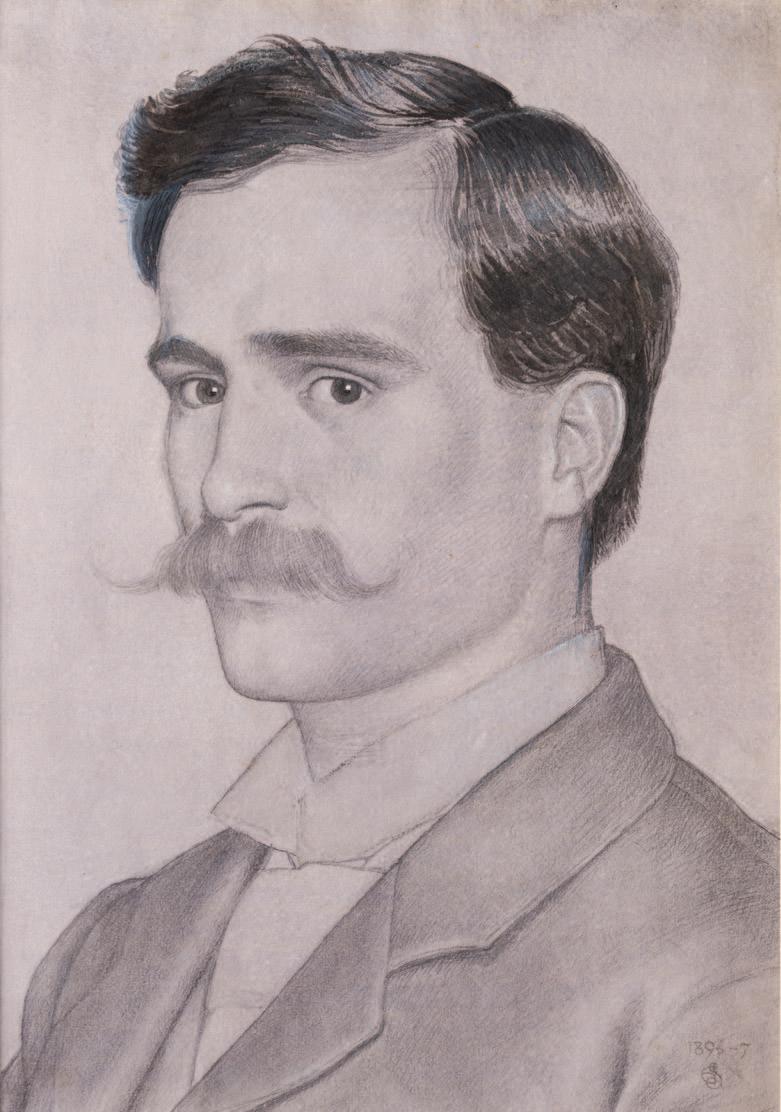
Arthur Joseph Gaskin, RBSA (1862-1928) was one of Joseph Southall’s closest friends. They met in 1883 when both were studying at the Birmingham School of Art. It was also at the School of Art that Gaskin met his future wife, Georgie Cave France. Along with Southall they became founding members of the informal group of artists and craftsmen known as the Birmingham Group. Probably best known for their Arts and Crafts jewellery, Arthur and Georgie Gaskin began designing and making pieces together in 1899. In addition, they produced enamels, silver work and book illustrations. Birmingham Museum and Art Gallery hold a very large collection of their work.
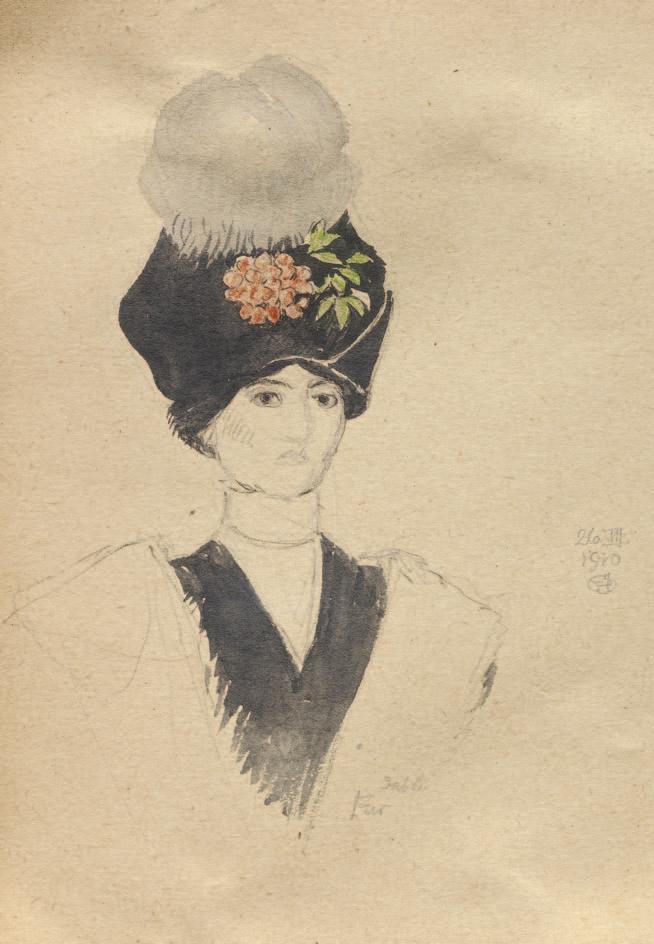
19
Portrait of a Lady in Sable Fur
Signed with monogram and dated l.r.: 26.iii.1910 and inscribed with title l.c. Sable Fur
Watercolour and pencil, 16.5 by 10.5 cm (6 ½ by 4 ¼ ins)
Provenance: the artist’s estate; private collection
CAT.
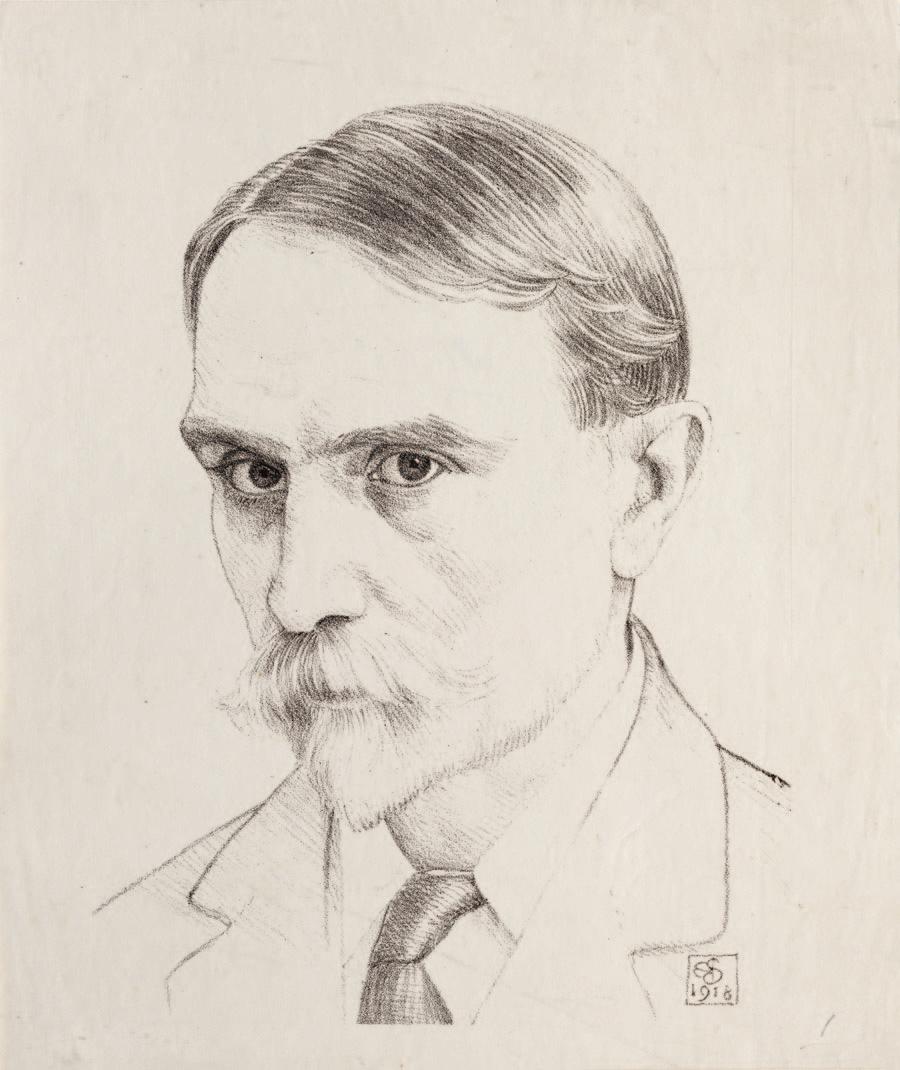
CAT. 20
Self Portrait, 1918
Dated and signed within the plate l.r.: JES/1918
Lithograph, 23 by 19 cm (9 by 7 ½ ins)
Provenance: the artist’s cousin Isabel Harlock and thence by descent
Although this self-portrait pre-dates his 1925 tempera selfportrait (collection of Birmingham City University) it shows the artist in very much the same pose. Southall made a number of self-portraits including Man with a Sable Brush (1896, private collection), Self-Portrait Wearing a Fez (1933, Royal Birmingham Society of Artists) and perhaps most famously The Agate, his large full length joint portrait showing him standing with his wife on Southwold beach (1911, National Portrait Gallery, London.)
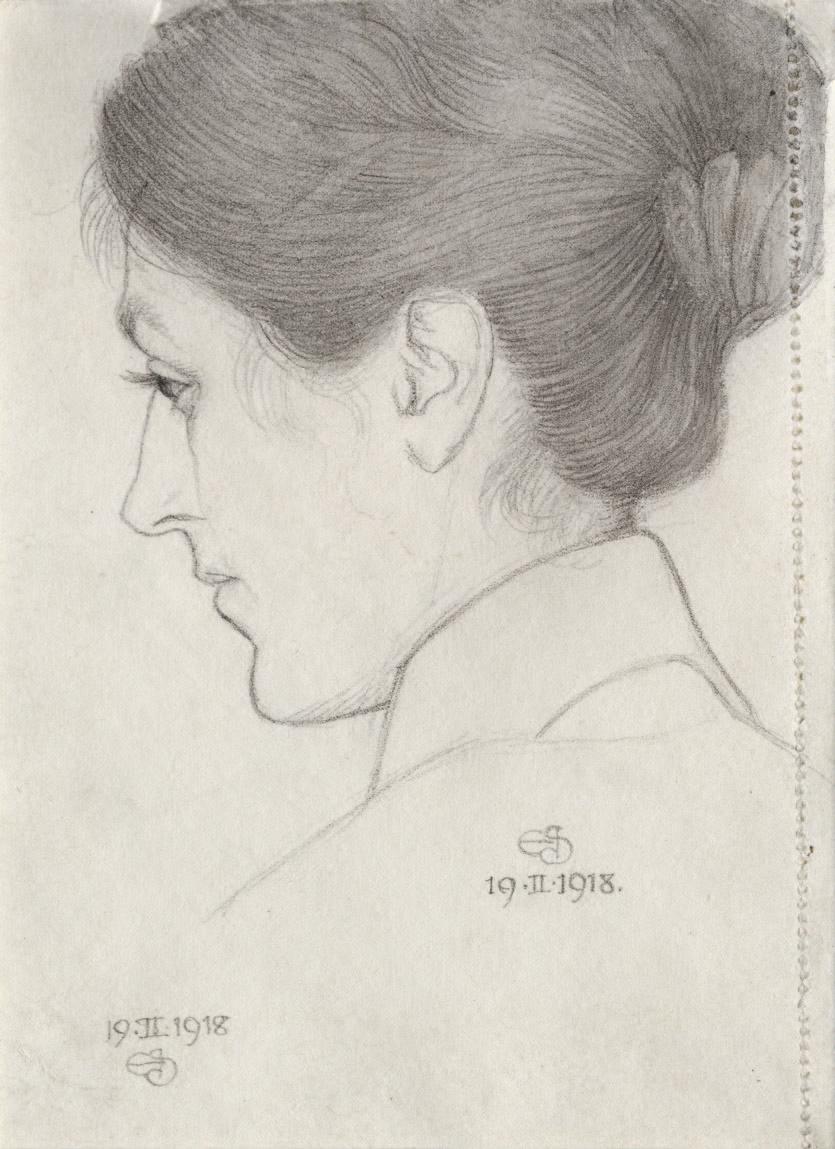
Portrait of a Lady in Profile, possibly Isabel Harlock
Signed with monogram and dated (twice): 19.ii.1918/JES
Pencil, 14.5 by 10.5 cm (5 ¾ by 4 ¼ ins) (frame size 36.5 by 32 cm)
Provenance: the artist’s cousin Isabel Harlock and thence by descent
CAT. 21
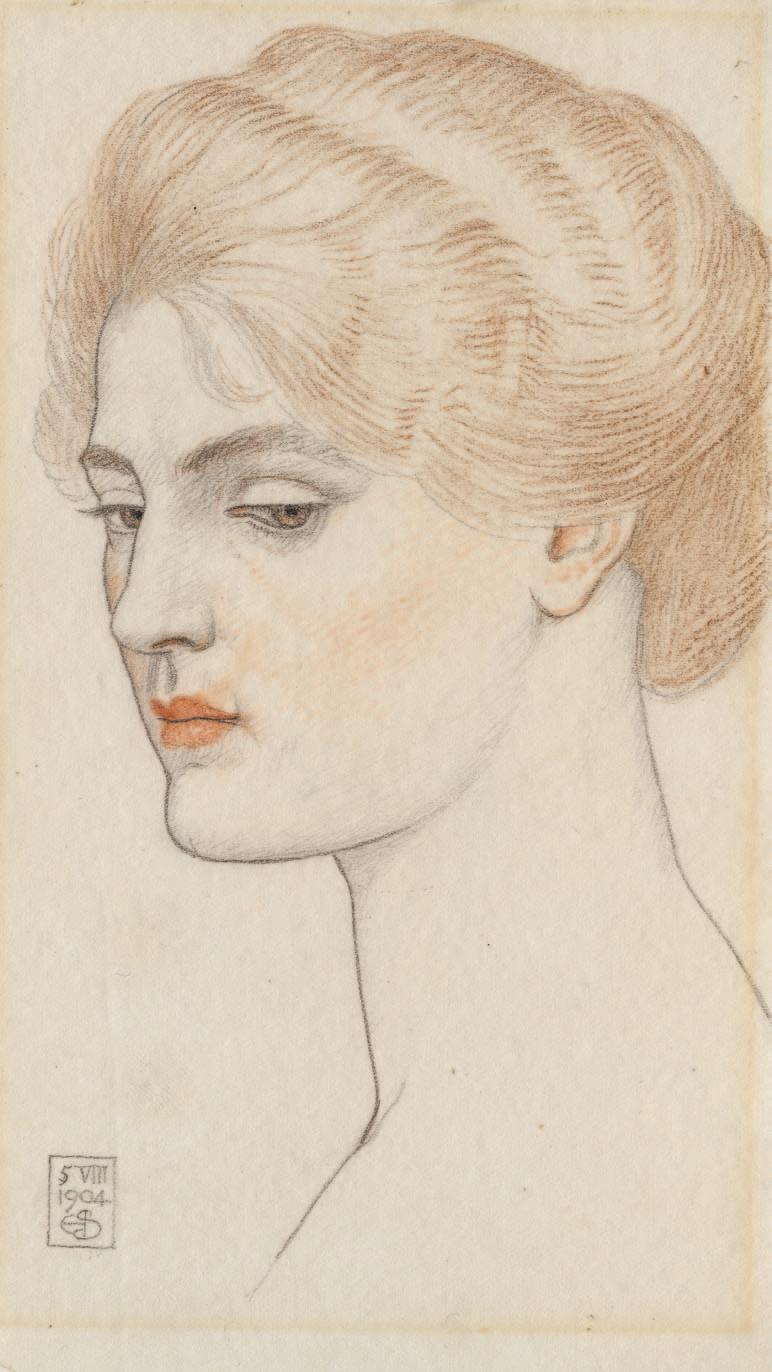
Portrait of a Girl with Red Hair
Signed with monogram and dated l.l.: 5.viii.1904/JES
Coloured chalks and pencil, 17.5 by 10 cm (6 ¾ by 4 ins)
Provenance: the artist’s cousin Isabel Harlock and thence by descent
CAT. 22
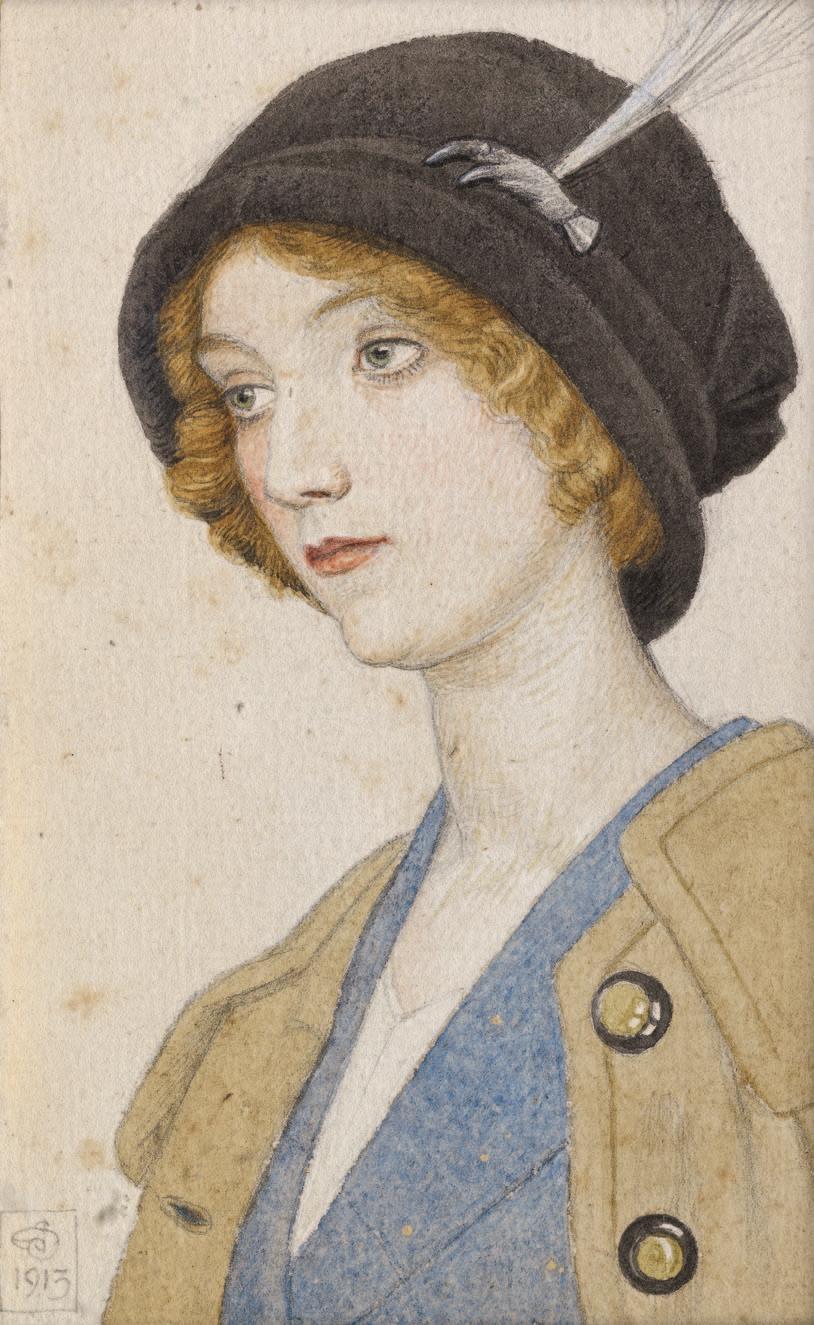
23 Girl in a Black
Signed with monogram and dated l.l.: JES/1913
Watercolour over pencil heightened with white, 17 by 10.5 cm (6 ¾ by 4 ¼ ins)
Provenance: the collection of Lyndon Goodwin Harris; the Maas Gallery
CAT.
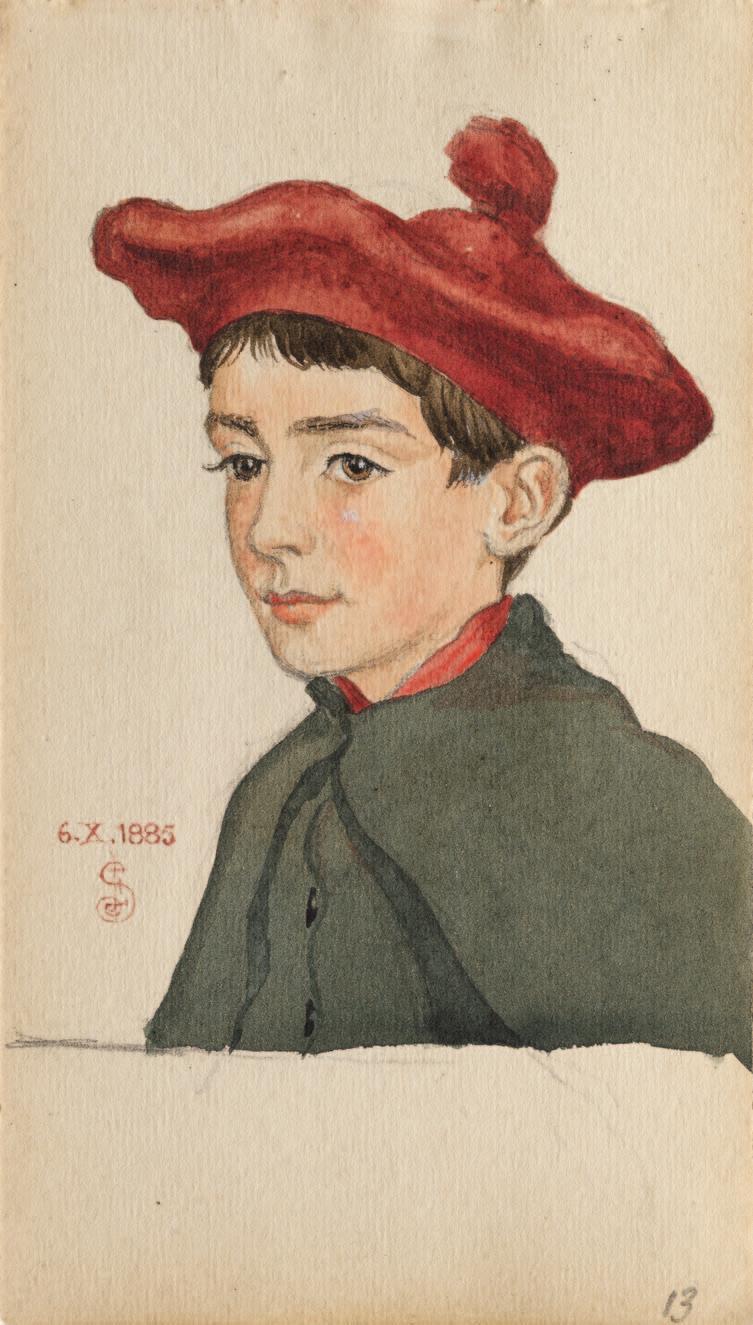
Hat
Signed with monogram and dated l.l.: 6.x.1885/JES
Watercolour over traces of pencil, 14 by 10 cm (5 ½ by 4 ins)
Provenance: the artist’s cousin Isabel Harlock and thence by descent
CAT. 24
Boy in a Red Beret
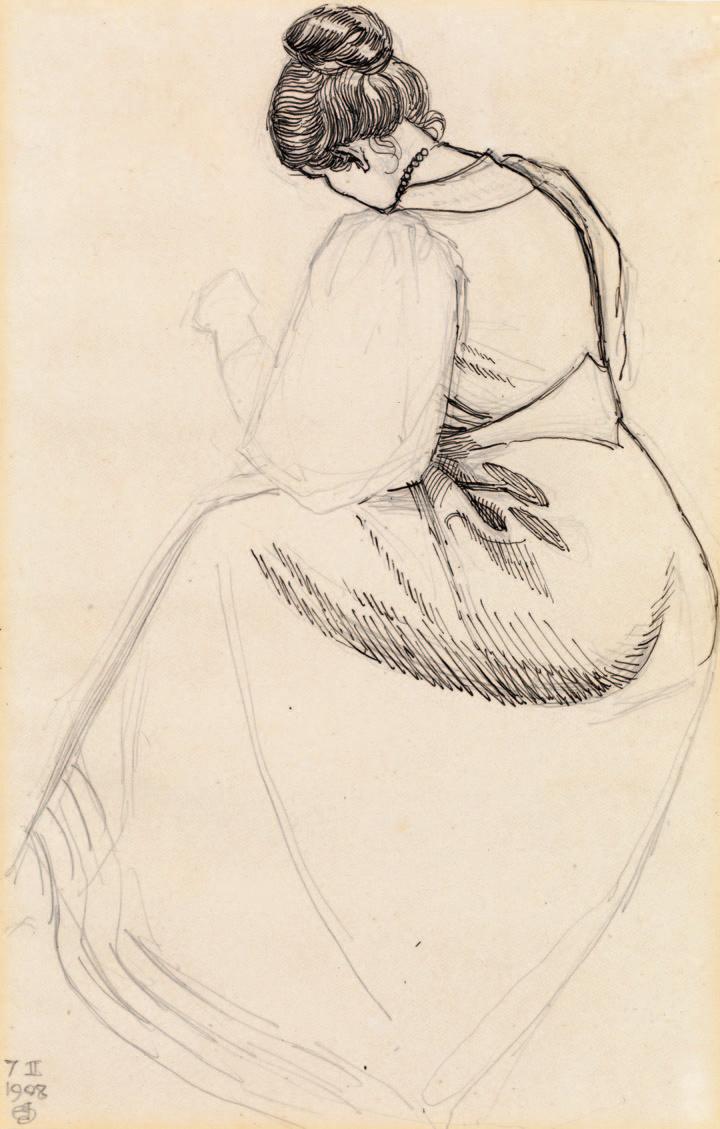
CAT. 25 Study for “Bessie at her Work Table”, 1908
Signed with monogram and dated l.l.: JES/7/II/1908
Pen and black ink with pencil, 20 by 13 cm (8 by 5 ins)
Provenance: Abbott and Holder Ltd
A red chalk drawing of the same composition showing the artist’s wife Bessie at work was previously with Liss Llewellyn Fine Art from the artist’s estate (now Private Collection). Their cataloguing for the work stated: “Bessie was a gilder and the creator of Joseph Southalls frames. This possibly shows her at work on a frame, incising ornament into the gesso before gilding.”
CAT.
26
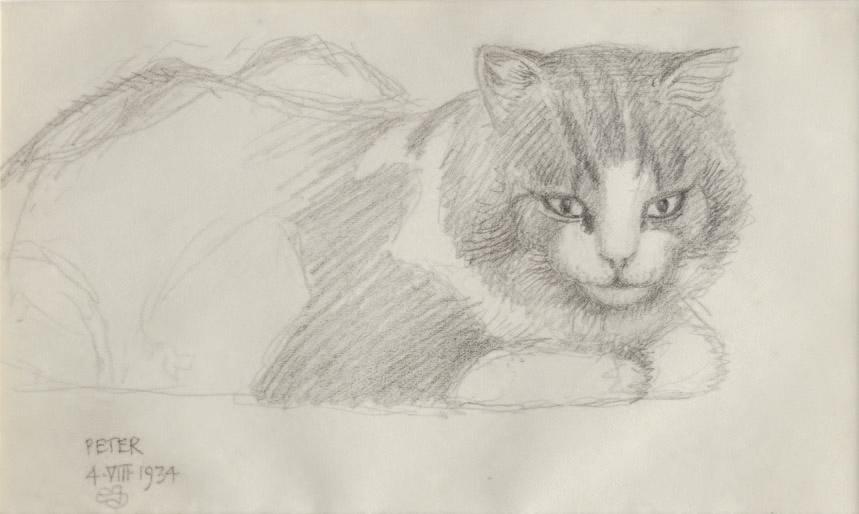
Study of the Artist’s
Cat, Peter
Inscribed, dated and signed:
Peter/4.viii.1934/JES
Pencil, 10 by 17 cm (4 by 6 ¾ ins)
Provenance: the artist’s cousin Isabel Harlock and thence by descent
CAT. 27
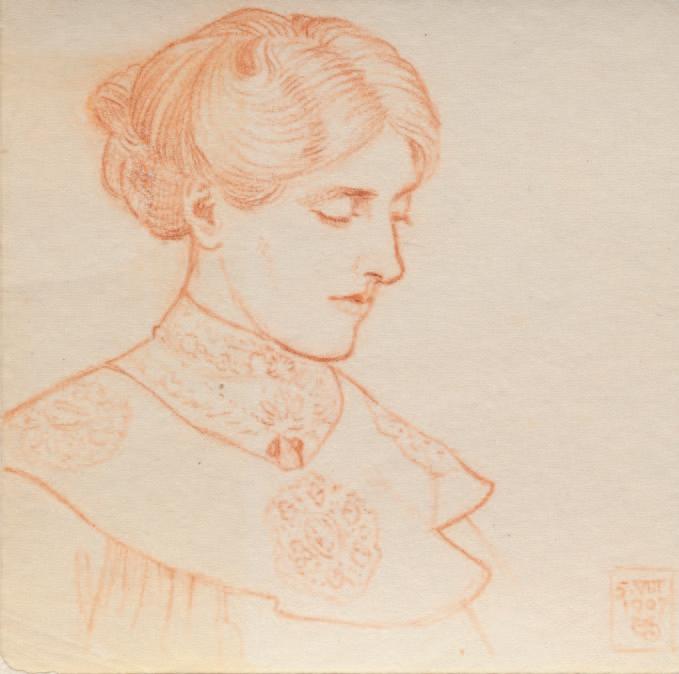
Portrait of a Lady
Dated and signed l.r.: 5.viii.1907/JES
Red chalk, 10.5 by 10.5 cm (4 ¼ by 4 ¼ ins)
CAT. 28
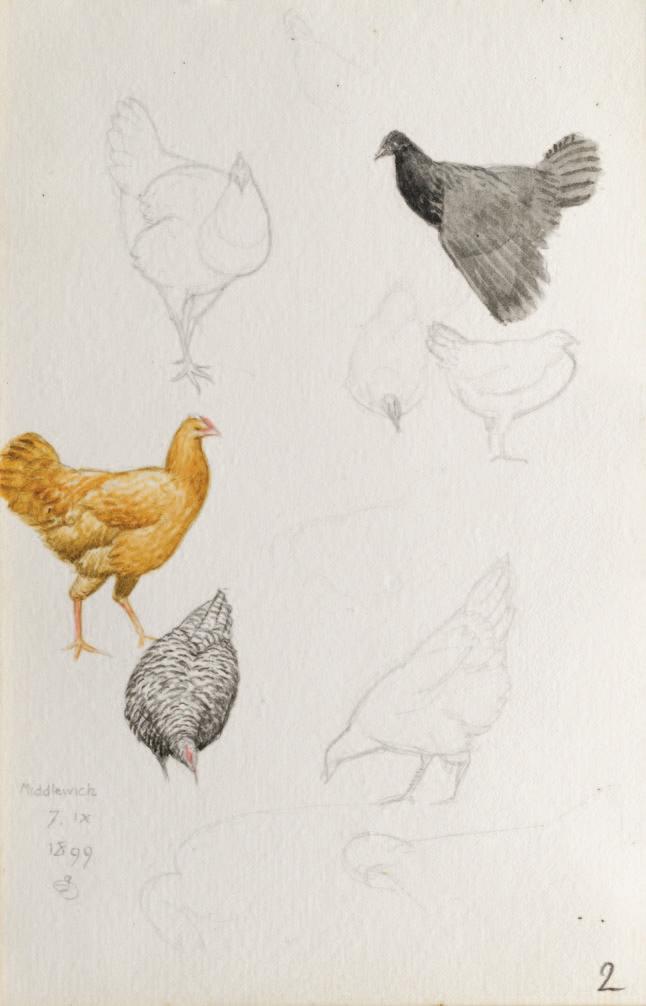
Studies of Hens, Middlewick
Inscribed, dated and signed with monogram l.l.: Middlewick/ 7.ix 1899/ JES
Pencil with watercolour, 17.5 by 11 cm (6 ¾ by 4 ¼ ins)
Provenance: the artist’s cousin Isabel Harlock and thence by descent
CAT. 29
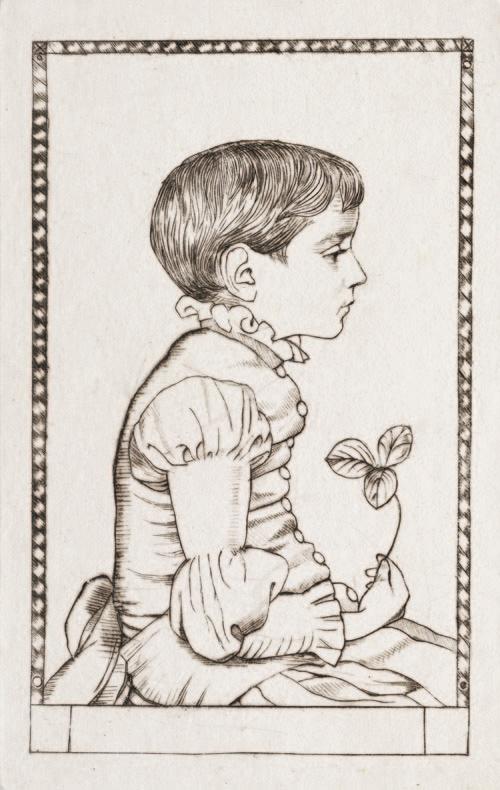
Young Boy Holding a flower
Etching, 157 by 100 mm (6 ¾ by 4 ins)
30
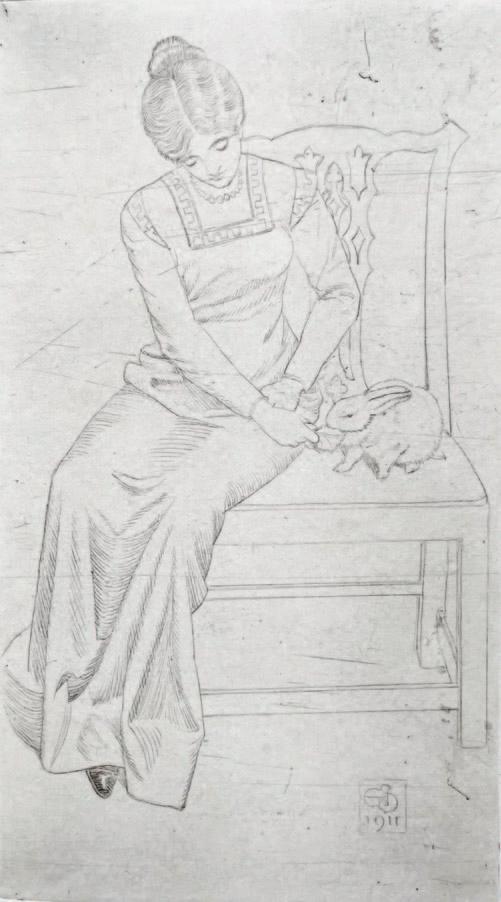
Girl Feeding a Rabbit
Signed with monogram and dated: 1911 (within the plate)
Inscribed in pencil Drawn and engraved by Joseph E.Southall
Drypoint, 200 by 115 mm (7 ¾ by 4 ½ ins)
CAT.
Work in the United Kingdom
Southall’s travels took him across the United Kingdom, including to Scotland and Wales, the outskirts of his own city of Birmingham and the Cotswold landscape near his friends John Drinkwater, Henry Payne and Charles March Gere. But it is for the contrasting coastal landscapes of Southwold in Suffolk and Fowey in Cornwall that he is best known and where Southall and his wife holidayed nearly every year. These subjects highlight his enduring fascination with water, as well as the day-to-day life of his fellow English holidaymakers. Such paintings were amongst the most commercial in the artist’s own lifetime.
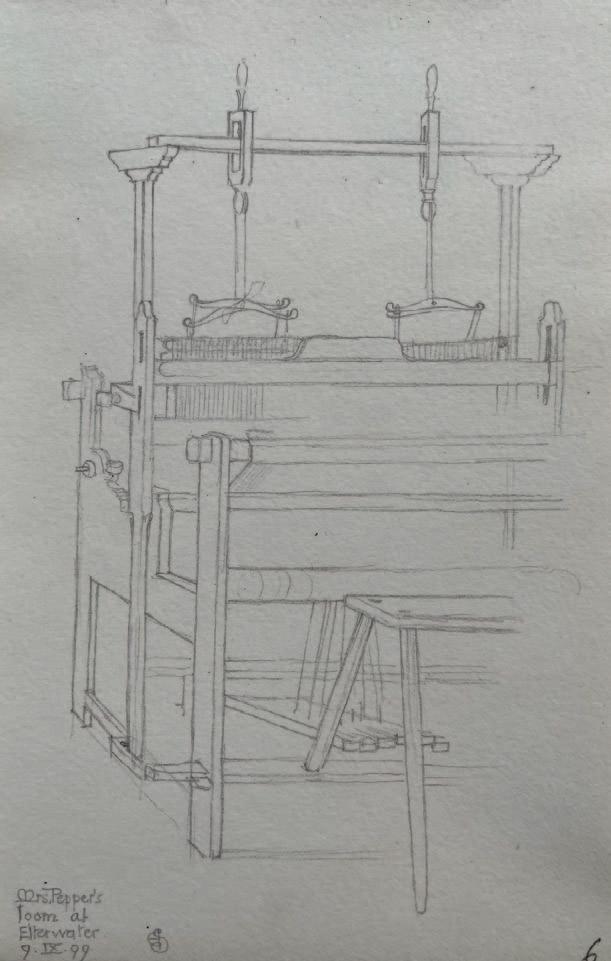
CAT. 31
Mrs Pepper’s Loom at Elterwater
Signed with monogram and dated l.r.: 9.ix.99/JES and inscribed with title l.l.
Pencil, 17 by 10.5 cm (6 ¾ by 4 ins)
Provenance: the artist’s cousin Isabel Harlock and thence by descent
Elizabeth Pepper became manager of Langdale Line Industry in the late 1880s. The industry was set up in Westmoreland, Cumbria by Alfred Fleming and supported by Ruskin. It produced hand woven linen for a form of embroidery and cutwork known as Ruskin lace. A craft practiced by Southall’s mother.
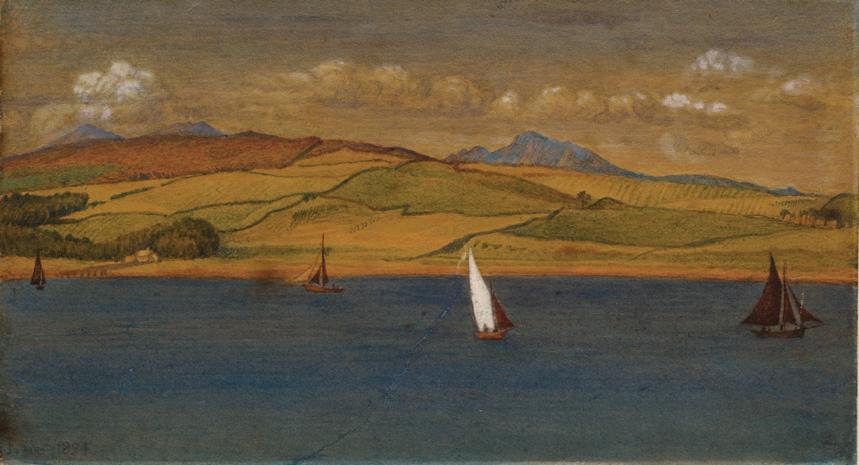
Great Cumbrae from Largs, Ayrshire
Indistinctly inscribed and dated l.l.: Largs/1894 and further dated and signed beneath mount l.r.: 4.ix.1894/JES and inscribed with title beneath mount l.l.
Watercolour heightened with white, 8.5 by 16 cm (3 ¼ by 6 ¼ ins)
Provenance: the artist’s cousin Isabel Harlock and thence by descent
CAT. 33
Bull Bay, Anglesea, 1902
Inscribed, dated and signed with monogram beneath mount l.l.: Bull Bay/viii.1902/JES
Watercolour over traces of paper, 10 by 12.5 cm (4 by 5 ins)
Provenance: the artist’s cousin Isabel Harlock and thence by descent
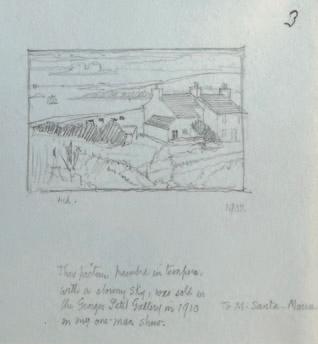
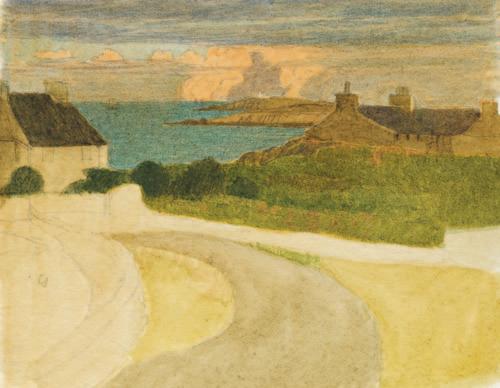
A page in a sketchbook (see fig.4) with a thumbnail sketch of a related composition to the present work is accompanied by the following inscription in the artist’s hand: “This picture, painted in tempera, with a stormy sky, was sold in the Georges Petit Gallery in 1910 in my one-man show.”
Southall’s retrospective at the George Petit Gallery in 1910 was probably the most significant of his career, cementing his importance as a figure in British Art beyond his own shores.
CAT. 32
Fig.4
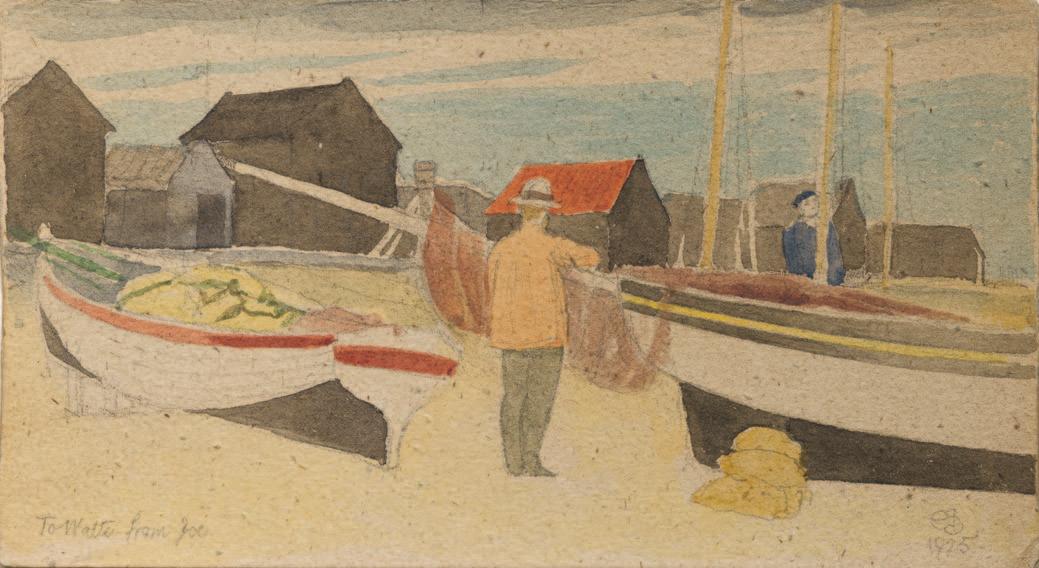
Boats on Southwold beach
Signed with monogram and dated l.r.: JES/1925 and inscribed l.l.: To Walter from Joe further signed with monogram (verso) 9.vii.1925/JES
Watercolour over traces of pencil, 9 by 16.5 cm (3 ½ by 6 ½ ins)
Provenance: the artist’s cousin Walter Harlock and thence by descent
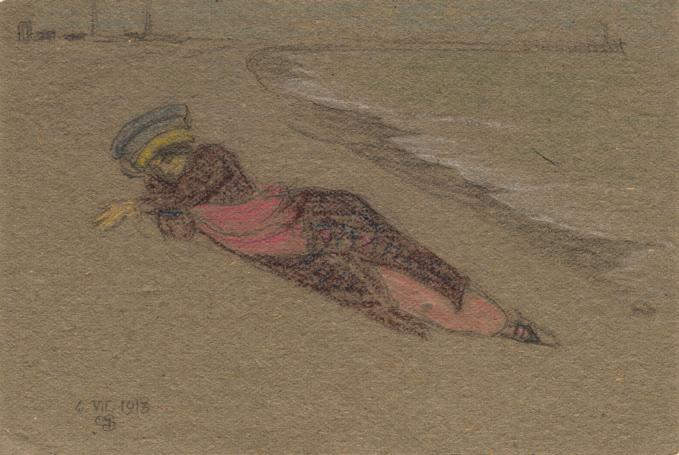
A Girl Reclining on Southwold Beach
Dated and signed l.r.: 6.vii.1913/JES
Coloured chalks on buff paper, 11 by 17 cm (4 ¼ by 6 ¾ ins)
Provenance: the artist’s cousin Isabel Harlock and thence by descent
CAT. 34
CAT. 35
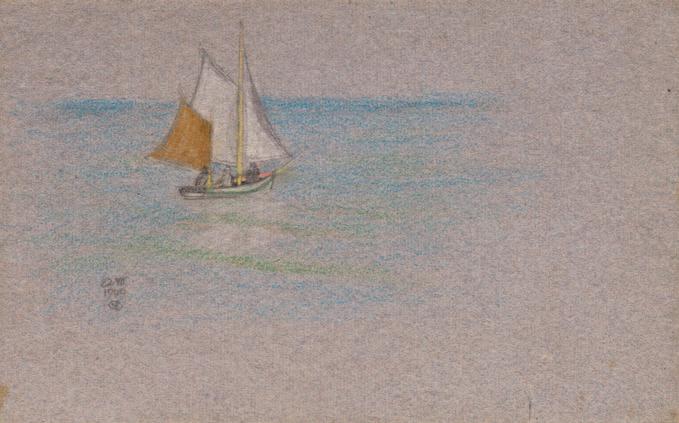
Study of a Sailing Dinghy
Dated and signed l.r.: 22.vii.1909/JES
Coloured chalks on grey paper, 8.5 by 16 cm (3 ¼ by 6 ¼ ins)
Provenance: the artist’s cousin Isabel Harlock and thence by descent
CAT. 37
Women at the Counter at Warwick House Department Store, Birmingham
Inscribed, dated and signed with monogram: Warwick House/26.VI.1912/JES
Coloured chalks on buff paper, 22 by 26 cm (8 ½ by 10 ¼ ins)
Provenance: the artist’s cousin Isabel Harlock and thence by descent
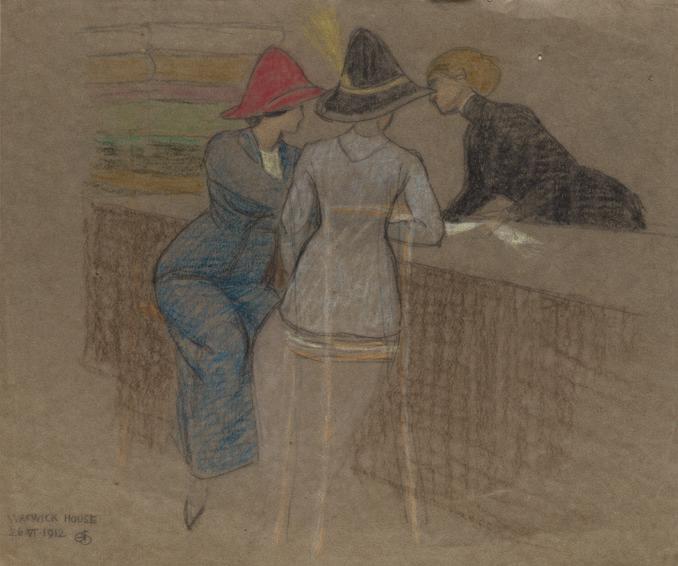
Warwick House on Birmingham’s New Street was the city’s first department store and was completed to ornate Georgian-style designs in 1839. By the early twentieth century it housed the department store Marshall & Snelgrove. The building was extensively damaged by bombing in World War Two and rebuilt in the 1950s.
CAT. 36
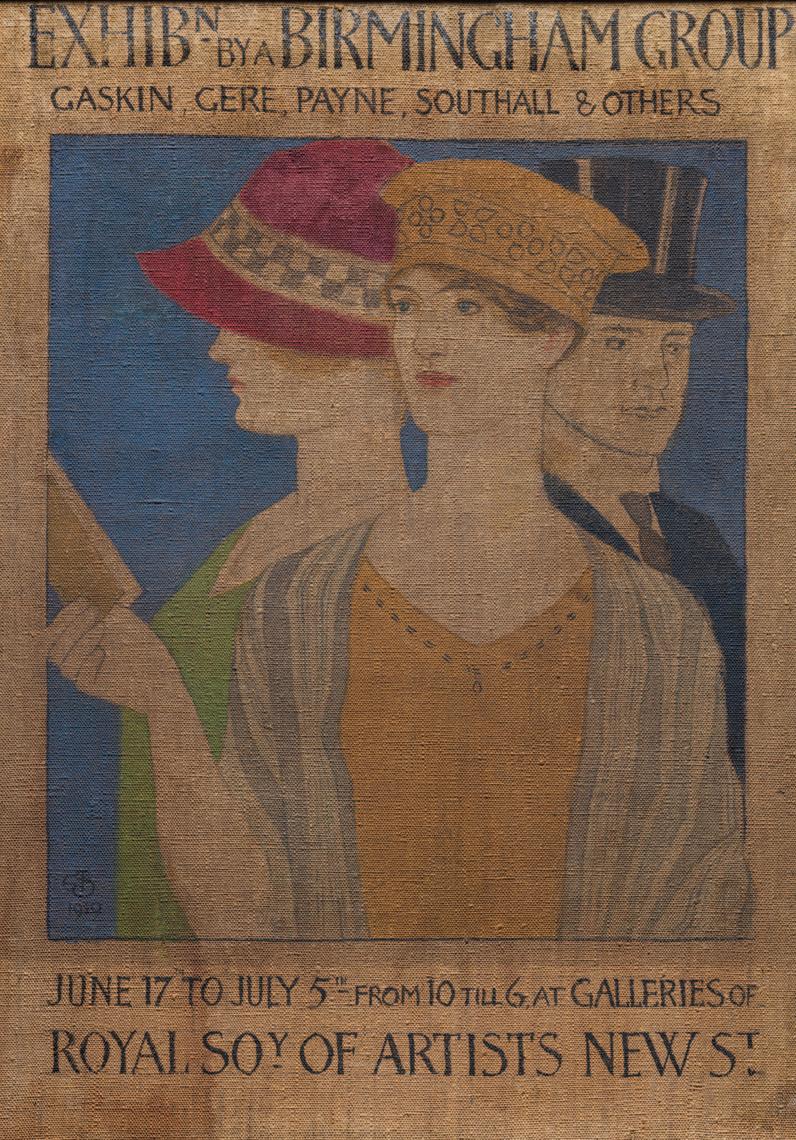
The Birmingham Group of Artist-Craftsmen had been founded in 1907 with the committed intention of furthering the ideas of the Arts and Crafts Movement. Southall’s co-founders included many of his close friends and associates, amongst them Arthur Gaskin, Charles March Gere, Henry Payne and Bernard Sleigh. This poster for the society’s second exhibition in 1919 is remarkable in its very survival, reminding of us of Southall’s interest in the more everyday, including contemporary fashion and design.
Visitors to an Exhibition: Design for a Poster
Signed with the artist’s monogram and dated l.l.: JES /1919
Inscribed: EXHIBN BY A BIRMINGHAM GROUP / GASKIN, GERE, PAYNE, SOUTHALL & OTHERS in the upper margin. Inscribed JUNE 17 TO JULY 5TH–FROM 10 TILL 6, AT GALLERIES OF / ROYAL SOY OF ARTISTS NEW ST. in the lower margin. Tempera on hessian, 85.5 by 63.5 cm (33 ¾ by 25 ins)
Provenance: Peter Nahum (the Leicester Galleries)
Minchinhampton, Gloucestershire
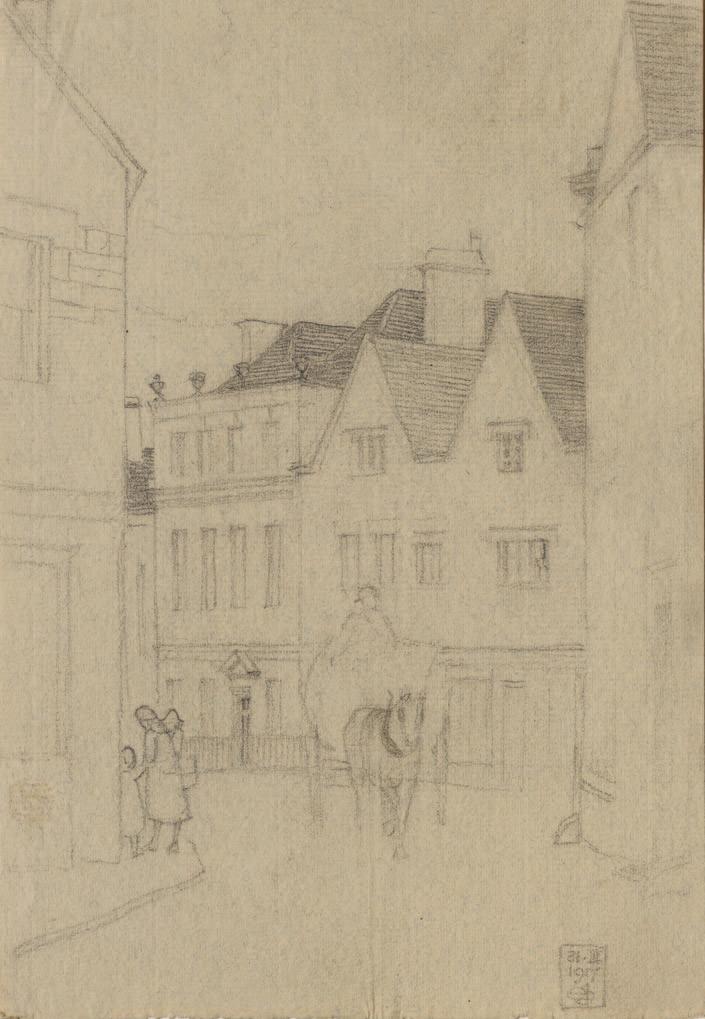
Signed with monogram and dated l.r.: 31.iii.1917/JES
Pencil, 22 by 15 cm (8 ½ by 6 ins)
Southall regularly travelled to the area of the southwestern Cotswolds near Stroud. His close friend Charles March Gere lived in Painswick, whilst Henry Payne lived on the edge of Amberley only two miles or so from the market town of Minchinhampton. He may also have accompanied Arthur Gaskin on this trip as there are several views of the neighbouring village of Box painted by Gaskin and also dated 1917. This unusual, oblique view of the town was drawn before the demolition of the buildings to the right of this drawing to make way for the town’s Memorial Cross.
Journeys in Continental Europe
From the early 1880s, when Southall first journeyed to France with his mother, there was scarcely a year that did not involve a trip to Europe. With the exception of an early trip to Ghent in 1887, the majority of the works below come from expeditions to his two favourite European countries: France and Italy. Southall’s early architectural training and devotion to the work of John Ruskin, naturally drew him to the buildings of their great cities (most evident in his Venetian work) and to observe structural details – in particular bridges which he painted with close attention to detail, often obliquely, helping to create unusual compositions. Such works (as well as those of the Italian lakes) also bear witness to Southall’s consummate skill as a painter of water helping him provide (as George Breeze has observed): “…the chance to depict reflections and currents…. The patterning in such passages of water is almost abstract, and in some respects, Southall’s work is not far removed from that of his contemporaries.” (Birmingham Catalogue, introduction, p.16). Alongside the protracted periods of painting, Southall’s diaries and sketchbook notes reveal the importance of these trips in aiding his earnest study of the great Italian Old Masters and of tempera painting – never missing a chance to view the great works contained in the churches, Palazzi and museums of the towns and cities he visited.
France & Belgium
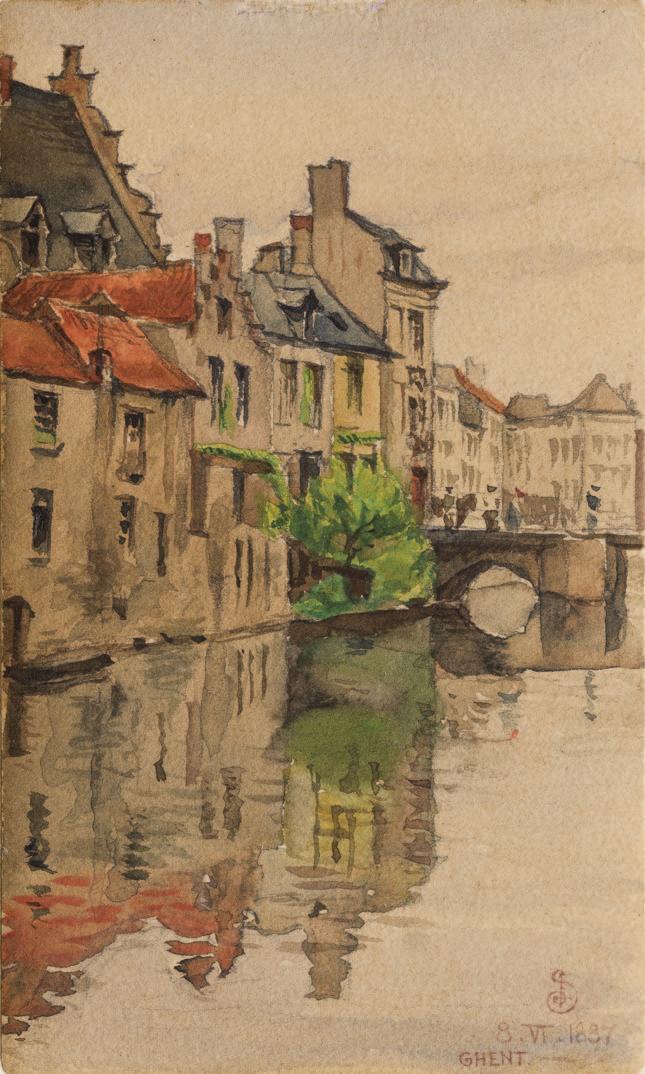
CAT. 40 Ghent
Inscribed, dated and signed l.r.: JES/8.vi.1887/Ghent
Watercolour, 15 by 9 cm (6 by 3 ½ ins)
Provenance: the artist’s cousin Isabel Harlock and thence by descent
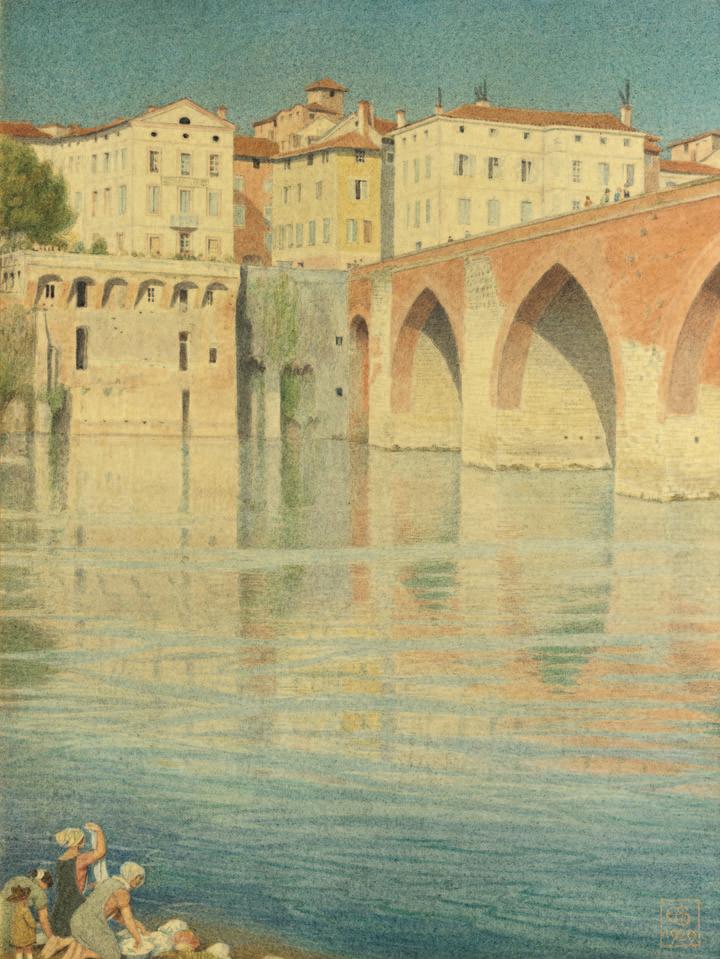
The Tarn at Albi
Signed with monogram and dated in gold l.r.:JES/1929 inscribed with title on original backboard
Watercolour, 37 by 28 cm (14 ½ by 11 ins)
Provenance: the Fine Art Society, London, 1946
Exhibited: London, Royal Watercolour Society, c.1930
Southall and his wife made an Autumnal trip to France in September and October 1929 –taking in Paris, Lille, Cahors, Cordes and Albi. The particular seasonal light of Southern Europe greatly appealed to him – as is so evident in the beautiful Autumn glow of the present watercolour, which depicts the southern French town’s great medieval bridge from below. A similar work, but from a higher vantage point across the river, was acquired by Southall’s fellow Birmingham Quaker and philanthropist, Paul Strangman Cadbury, in 1930.
CAT. 41
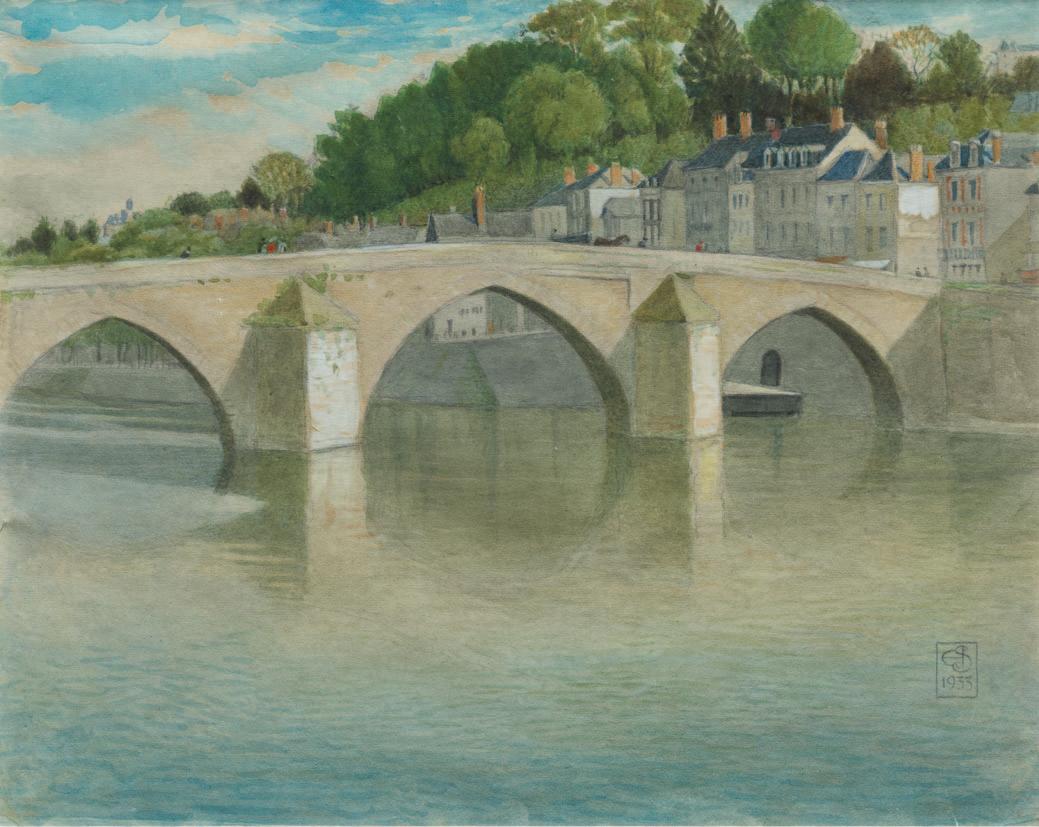
Pont Vieux over La Mayenne at Laval
Signed with monogram and dated l.r.: JES/1933
Watercolour, 24 by 30 cm (9 ½ by 11 ¾ ins)
Provenance: with the Piccadilly Gallery, London
The fine thirteenth century Pont Vieux (also known as Pont Saint-Julien or Pont de Mayenne) was the only bridge that crossed the Mayenne river at Laval until the early nineteenth century. Southall painted this view of it in a trip to France in April and May 1933, also taking in Paris, La Rochelle and Angers.
CAT. 42
Italy
CAT. 43
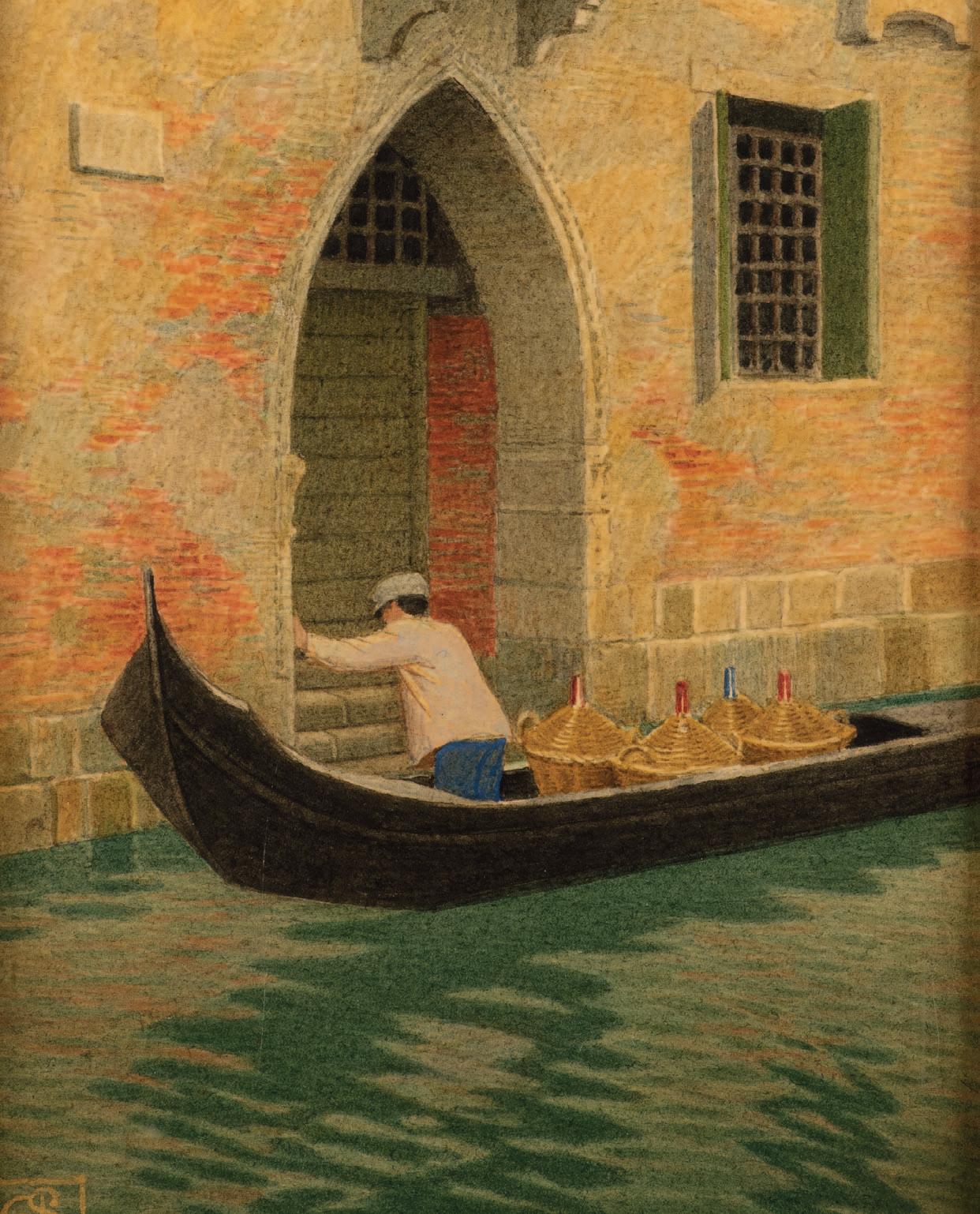
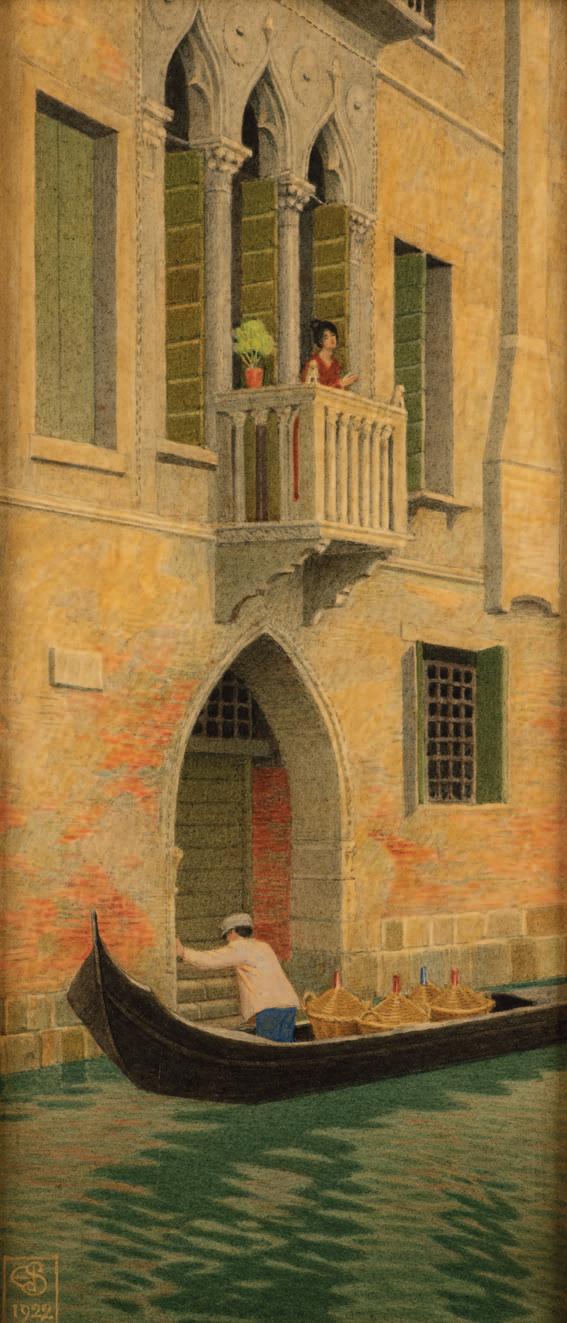
Gothic Palace, Venice
Signed with monogram and dated l.l.: JES/1922 further inscribed with the artist’s address on the original backboard Watercolour, 32.5 by 14.5 cm (12 ¾ by 5 ¾ ins)
Exhibited: Alpine Club Gallery, London, Paintings and Drawings in Tempera, Watercolour and Pastel etc. by Joseph Southall, with an introduction by John Drinkwater, 1922, no.1; Manchester City Art Gallery, (date not known), no.722
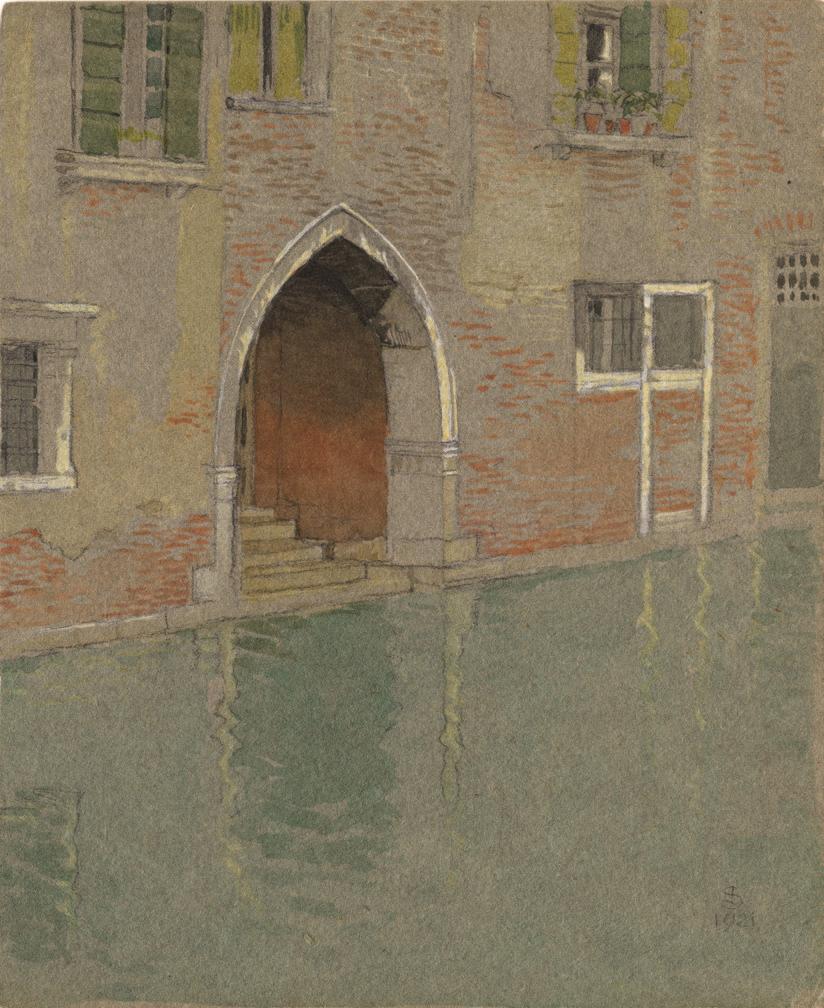
Signed with monogram and dated l.r.: JES/1921
Watercolour over pencil, 16.5 by 13.5 cm (6 ½ by 5 ¼ ins)
Provenance: the artist’s cousin Isabel Harlock and thence by descent
CAT. 44
Canal Steps, Venice
Dated l.l.: 8.v.34
Watercolour and pencil, 17 by 11 cm (6 ¾ by 4 ¼ ins)
Provenance: the artist’s cousin Isabel Harlock and thence by descent
CAT. 45
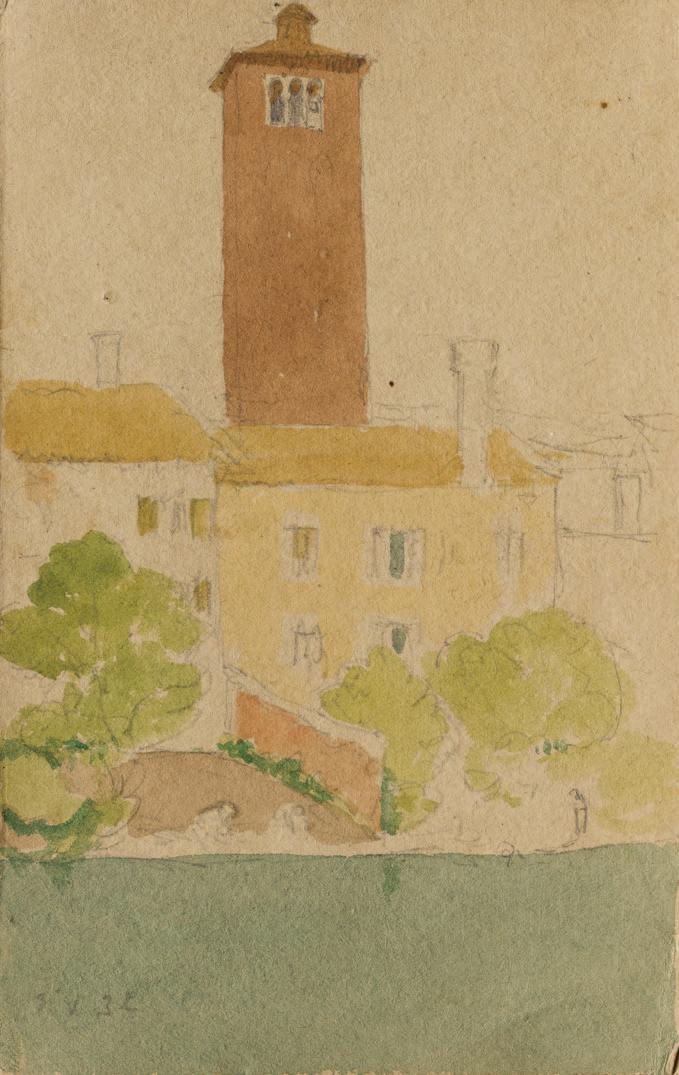
Red Campanile, Venice
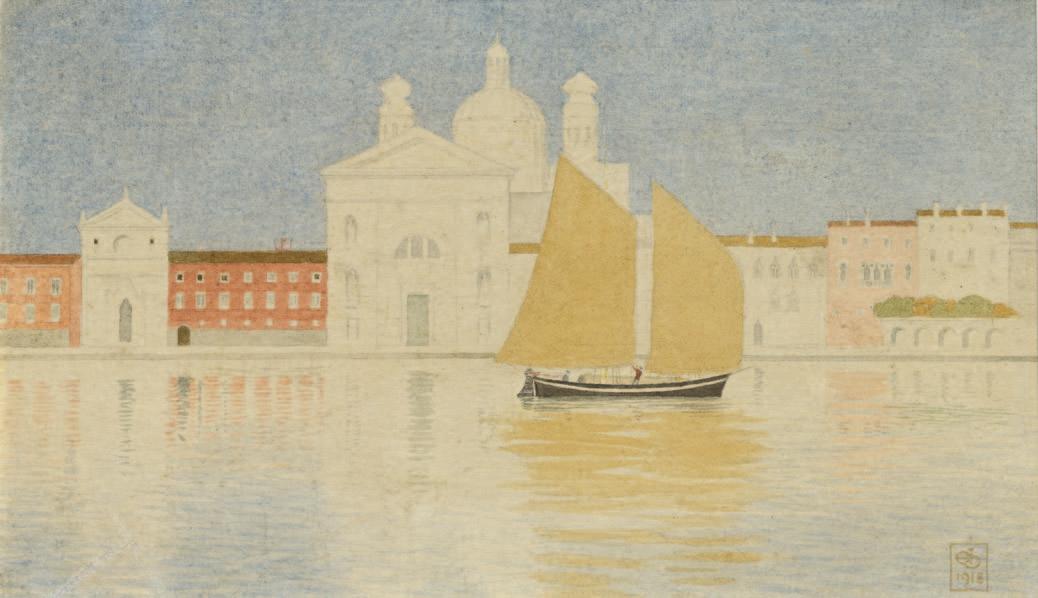
Santa Maria della Presentazione,
Signed with monogram and dated l.r.: JES/1918
Watercolour, 17.5 by 29.5 cm (7 by 11 ½ ins)
Provenance: the collection of Lyndon Goodwin Harris; Christie’s, South Kensington, 24 Jan 2007, lot.196
CAT. 46
‘La Zitelle’, Venice
CAT. 47
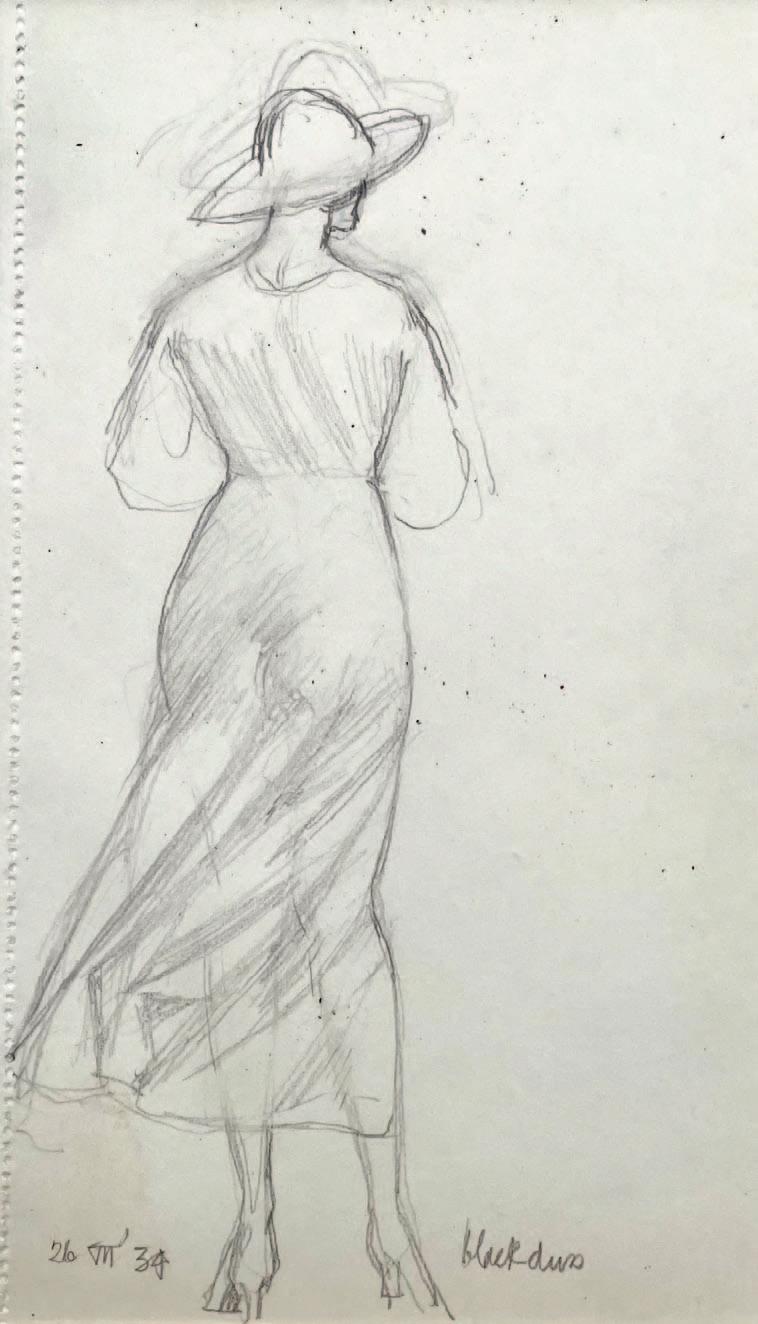
Girl in a Long Dress
Dated l.l.: 26.vii.34 and inscribed
l.r. Black Dress
Pencil, 16.5 by 10 cm (6 ½ by 4 ins)
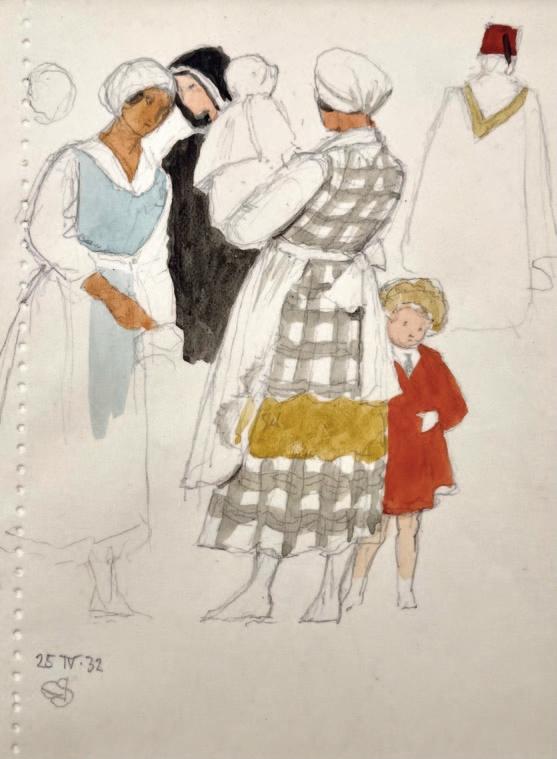
Studies of the Crowds in the Piazza San Marco for “The Lion of St Mark Venice”
Signed with monogram and dated l.l.: 25.IV.32 / JES
Watercolour and pencil, 14 by 10 cm (5 ½ by 4 ins)
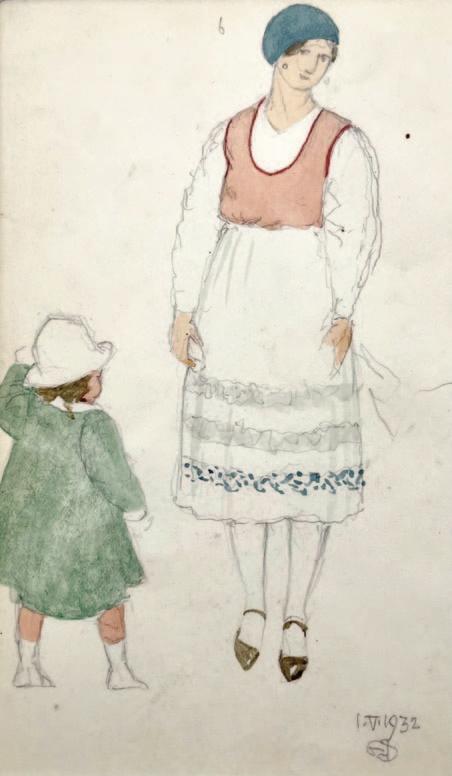
The following works (cats.48-51) are studies for Southall’s watercolour The Lion of St Mark, Venice now in the City of Birmingham Museum and Art Gallery (acc.1933P462). Diary notes in a sketchbook from his trip to Venice in April 1932 reveal his taxing cultural schedule from the visit to the city, taking in trips to Scuole San Rocco, San Giorgio degli Schiavioni and San Giovanni in Bragora. On the day before the execution of the present sketch he visited the Accademia with express purpose of locating Bonifacio Veronese’s “Dives and Lazarus”, eventually finding it in the museum’s restoration room.
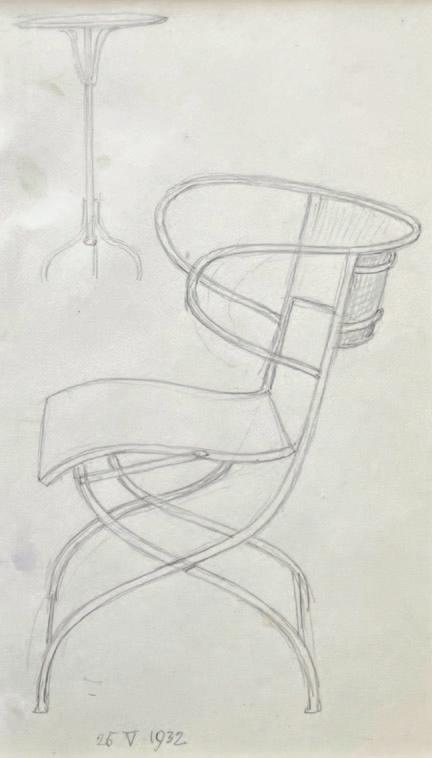
CAT. 49 Café Chair and Table, Venice
Dated l.c.: 25.v.1932
Pencil, 17 by 10 cm (6 ¾ by 4 ins)
The chair in this drawing appears to the far right of the 1932 watercolour The Lion of St Mark, Venice (see note on cat. 48).
CAT. 48
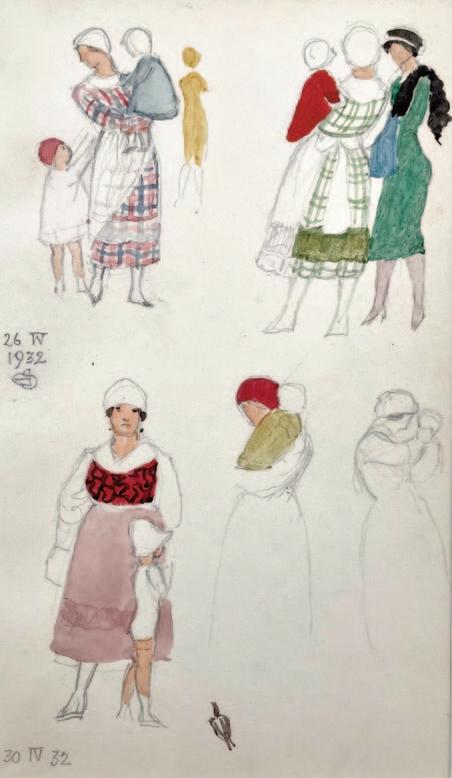
Figure Studies of Women with Children, Venice
Dated and signed with monogram c.l.:26.IV.1932 / JES
Dated again l.l.: 30.IV.32
Watercolour and pencil, 16 by 9 cm (6 ½ by 3 ½ ins)
CAT.
A Venetian Woman and Child
Signed with monogram and dated l.r.:1.VI.1932 / JES
Watercolour and pencil, 16.5 by 10 cm (6 ½ by 4 ins)
CAT. 50
51
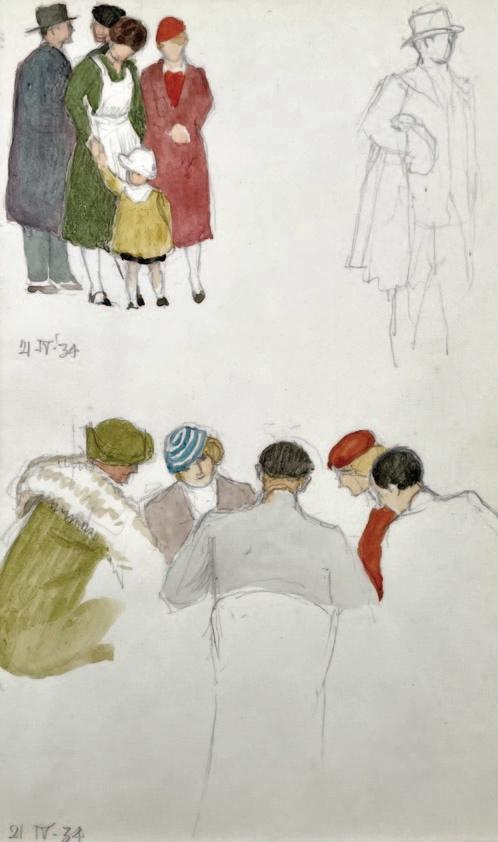
Studies of Crowds and figures seated at a Café, Venice
Dated twice 21.IV.34
Watercolour and pencil, 16 by 10 cm. (6 ¼ by 4 ins)
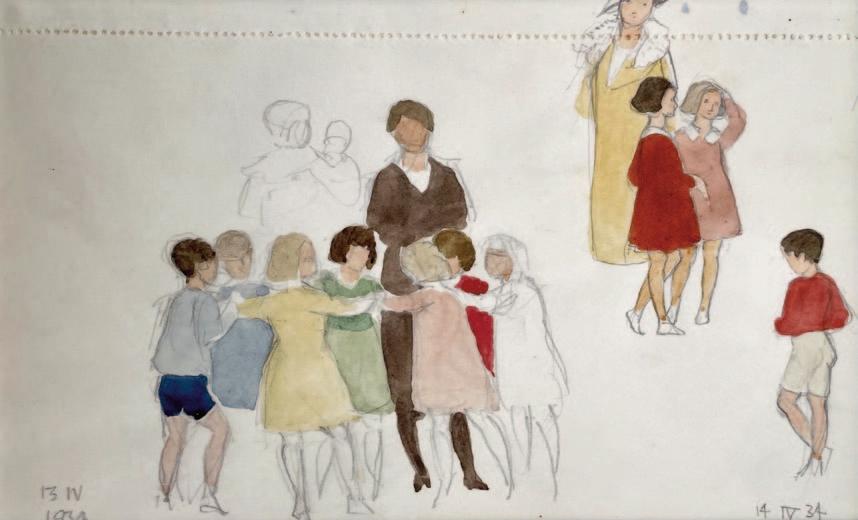
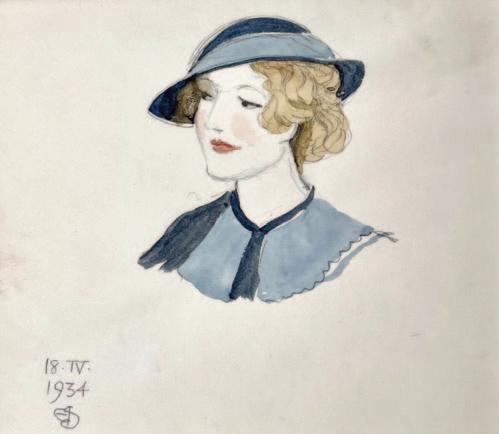
The following group of works (cats.52-55) are studies and study ideas for the painting Through the Arches of the Piazza of 1934 (Memorial Exhibition, no.5). This watercolour, alongside the earlier The Lion of St Mark, Venice, are unusual compositions for the artist in their particular focus on the busy bustle of the crowds and families in the heart of the city.
Diary notes the artist made in sketchbooks from the visit (in April and early May 1934) suggest that his primary interest was, despite this, not so much Venice’s people as its churches, museums, Palazzos and Scuole – home to the art that held such a central importance to his career.
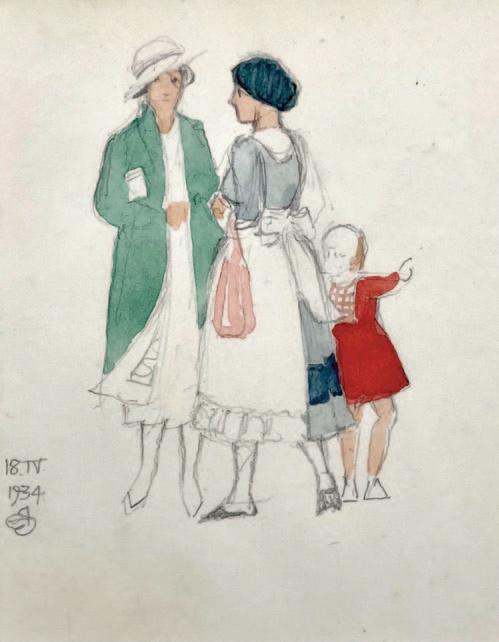
Two Women and a Child, Venice
Signed with monogram and dated l.l.: 18.IV / 1934 / JES
Pencil and watercolour, 10 by 8 cm (4 by 3 ins)
CAT. 52
CAT. 53
54
Children in the Piazza, Venice
Inscribed beneath the mount: Piazza Dated l.l. and again l.r.: 13.IV 1934
Pencil with watercolour, 10.5 by 17 cm (4 by 6 ¾ ins)
CAT. 55
Study of a Girl in a Blue Hat, Venice
Signed with monogram and dated l.l.: 18.iv.1934/EJS
Watercolour and pencil, 9.5 by 11 cm (3 ¾ by 4 ¼ ins)
CAT.
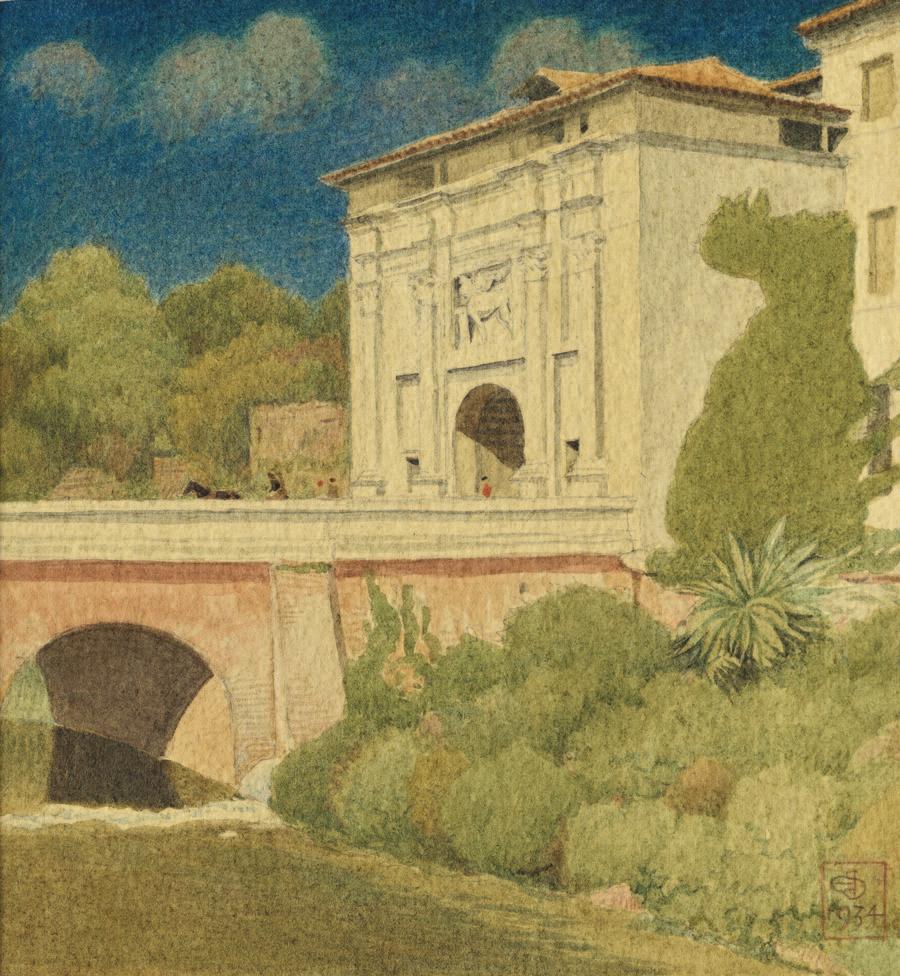
Signed with monogram and dated l.r.: JES 1934; inscribed with title on the backboard Watercolour, 19 x 17.5 cm (7 ½ by 7 ins)
Literature: Maxwell Armfield, The Work of Joseph Southall, The Old Water-Colour Society’s Club, 1946, vol 24, illus op. p.34.
Southall and his wife visited Treviso in May 1934. A diary note in a sketchbook labelled “3A Venice” (previously in the Harlock Collection) records a day in the town on 8th May 1934: “Treviso. Wonderful little Museo Civico (sic). Grand picture of Vincenzo della Destri in beautiful condition. Glorious frescos from Modena. Bellini cleaned. Old Duomo – beautiful pictures by Girolamo da Treviso quite untouched glowing golden. Fine frescos by Pordenone.”
CAT. 56
Porta Cavour, Treviso
CAT. 57
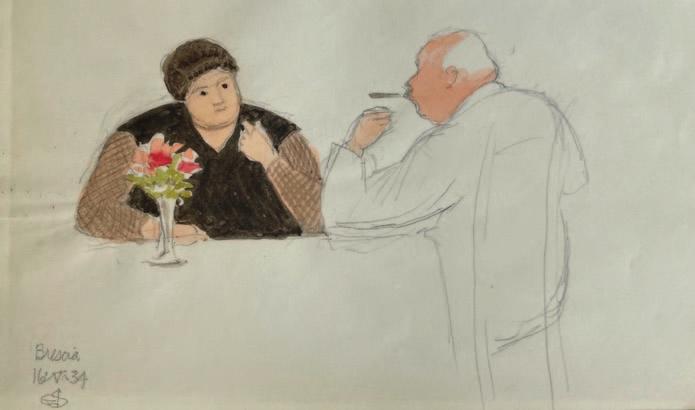
A Couple in a Café, Brescia
Inscribed, dated and signed: Brescia/16.v.34/JES
Watercolour over pencil, 10 by 16.5 cm (4 by 6 ½ ins)
Southall and his wife travelled on to Brescia in May 1934, following his visit to Venice in April and early May of the same year. They were in Treviso about a week earlier on 8th May (see cat.56).
CAT. 58
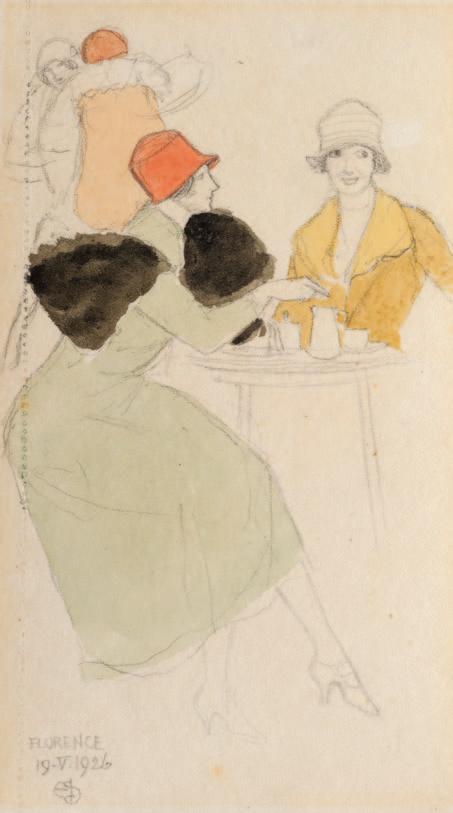
Women in a Café, Florence
Inscribed, dated and signed l.l.: Florence/ 19.v.1926/JES
Watercolour and pencil, 17 by 10 cm (6 ¾ by 4 ins)
Provenance: the artist’s cousin Isabel Harlock and thence by descent
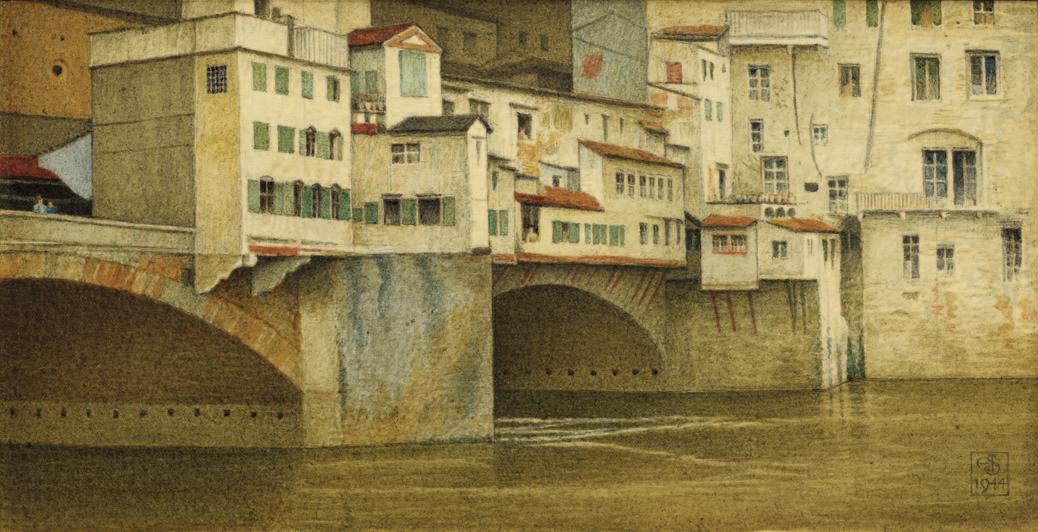
Ponte Vecchio, Florence
Signed with monogram and dated l.r.: EJS/1944 and further inscribed on the backboard, Joseph Southall/ 13 Charlotte Rd / Edgbaston / Birmingham
Watercolour, 16 by 31 cm (6 ½ by 12 ¼ ins)
Exhibited: London, Royal Watercolour Society, c.1944 (where acquired by P.L.Watson)
CAT. 59
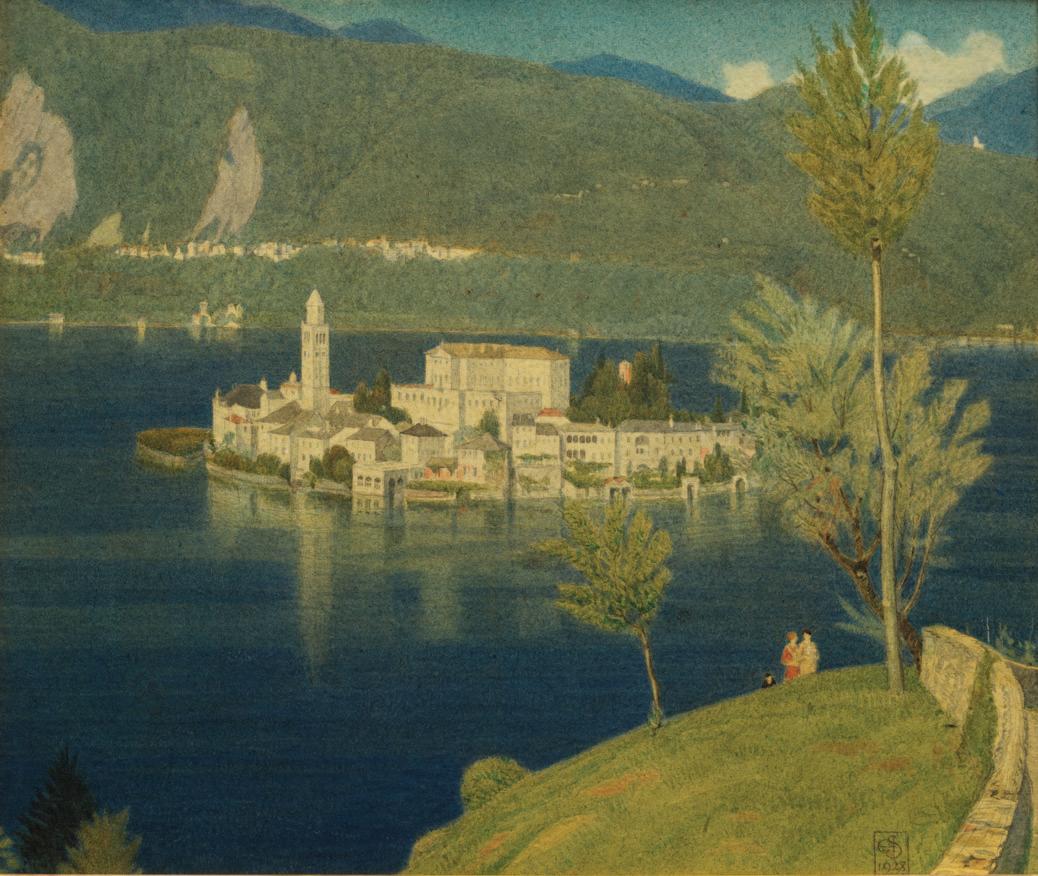
Isola San Giulio, Lake Orta
Signed with monogram and dated l.r.: JES/1928
Watercolour, 29 by 34.5 cm (11 ½ by 13 ½ ins)
(frame size 40.5 by 46 cm)
Provenance: purchased for 45 guineas from the New English Art Club, Summer 1929; the Fine Art Society, London Exhibited: London, New English Art Club, Summer 1929, no.220
CAT. 60
Banbury - Southall and the Baker and Harlock Families
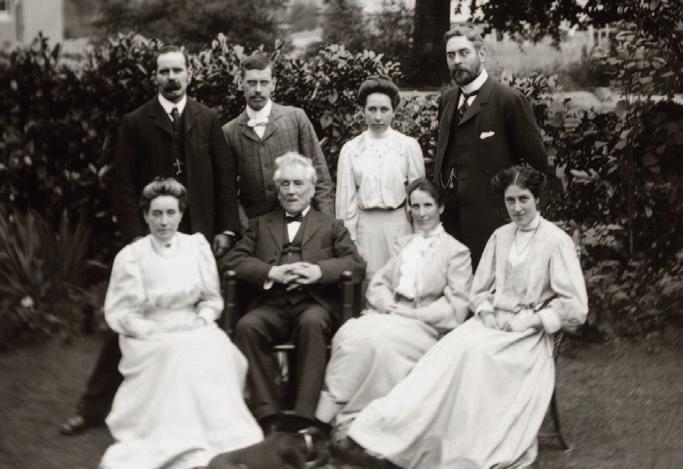
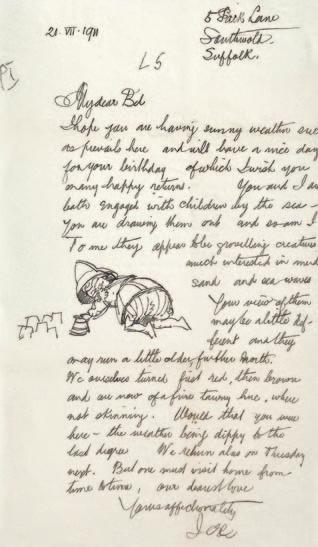
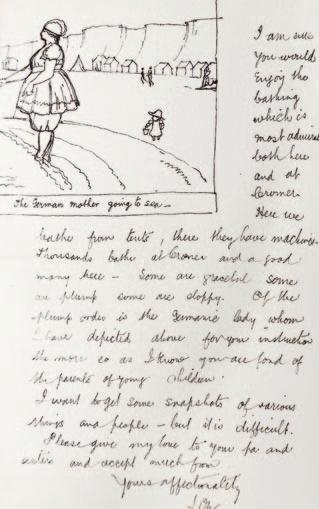
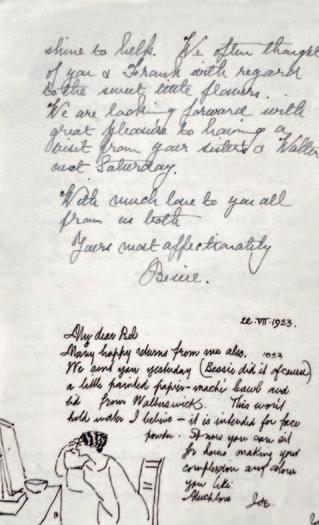
Joseph Southall married his first cousin Anna Elizabeth “Bessie” Baker. Because of their close relationship they decided not to marry until later in life and not to have children. They therefore were drawn to the children of their near relations, being particularly close to the Harlock children of Banbury. John Harlock, a Quaker, had established a successful drapery business in Banbury’s Market Place in the late 1840s. In 1851 he married Anne Baker, sister to Eliza Maria, Joseph’s mother and therefore also sister to John Edward Baker, Bessie’s father. The Harlocks had six children, the youngest being Ellen Isabel, born in 1876. Her mother sadly died the year after her birth and it was natural that Joseph and Bessie would be particularly sympathetic to the situation of their young motherless cousin. The Birmingham and Banbury branches of the family would often holiday together, Southwold being a particularly favoured destination. Their closeness to the young Ellen Isabel is illustrated in their charming and amusing exchange of letters, several of which are included in this catalogue (cat.no.61).
Banbury was in easy reach of Birmingham by train and Joseph made many visits to his Oxfordshire cousins. During these visits he made a number of watercolours and studies of his family and the busy market town that was their home. Two of the most notable watercolours of Banbury are: Harlock’s Drapery Shop, Market Place, Banbury, 1905-6, present location unknown, The Green, Banbury, 1920, private collection (see cat.67 for a study for this work) and Autumn in Banbury, 1935, private collection (cat.no.68). He also made a number of drawings and sketches of the town and portraits of his Harlock relations and their friends.


Above: The Harlock Family in their garden at The Lawn, Banbury. John Harlock is seated centre, Walter Harlock stands behind him, second from left. Ellen Isabel Harlock is seated front right.


CAT. 61
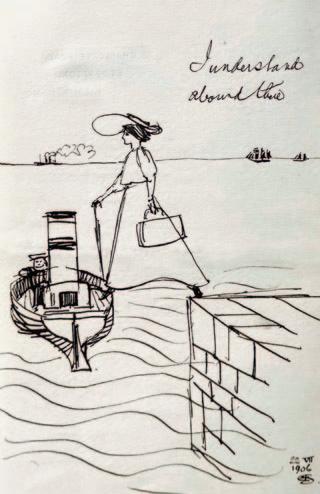
A large and important Collection of Letters from Joseph Southall (and a few by his wife Elizabeth) to Southall’s cousin Isabel Harlock
Dating from the 1890s through to the late 1930s, written from the artist’s home in Birmingham as well as from holidays in Southwold, Cromer and elsewhere. The majority illustrated with humorous drawings and sketches by Joseph Southall.

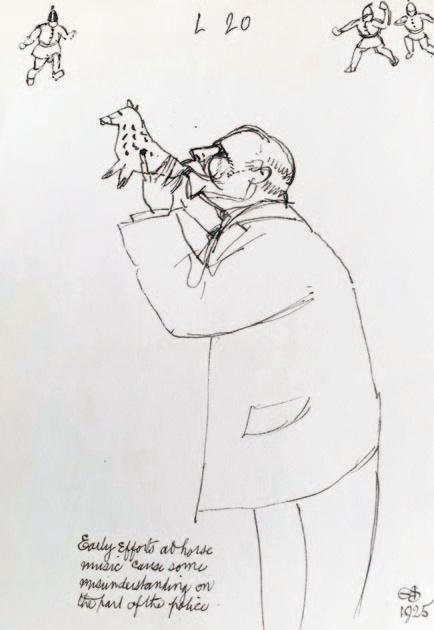
CAT. 62
Portrait of the Artist Playing Horse Music and Pursued by Police
Signed with monogram and dated l.r.: JES/1925
Inscribed l.c.:Early efforts at horse/music cause some/ misunderstanding on/ the part of the police
Inscribed on the reverse: With many thanks for the Bolshevik horse/and love from Joe Pen and black ink, 16 by 11.5 cm (6 ¼ by 4 ½ ins)
Provenance: the artist’s cousin Isabel Harlock and thence by descent
Southall regularly executed swift sketches within the pages of his letters to his friends and family. Such drawings offer a degree of humour and spontaneity that is less apparent in much of his exhibited art. This self portrait cartoon comes from one of Southall’s many letters to his cousin Isabel Harlock.
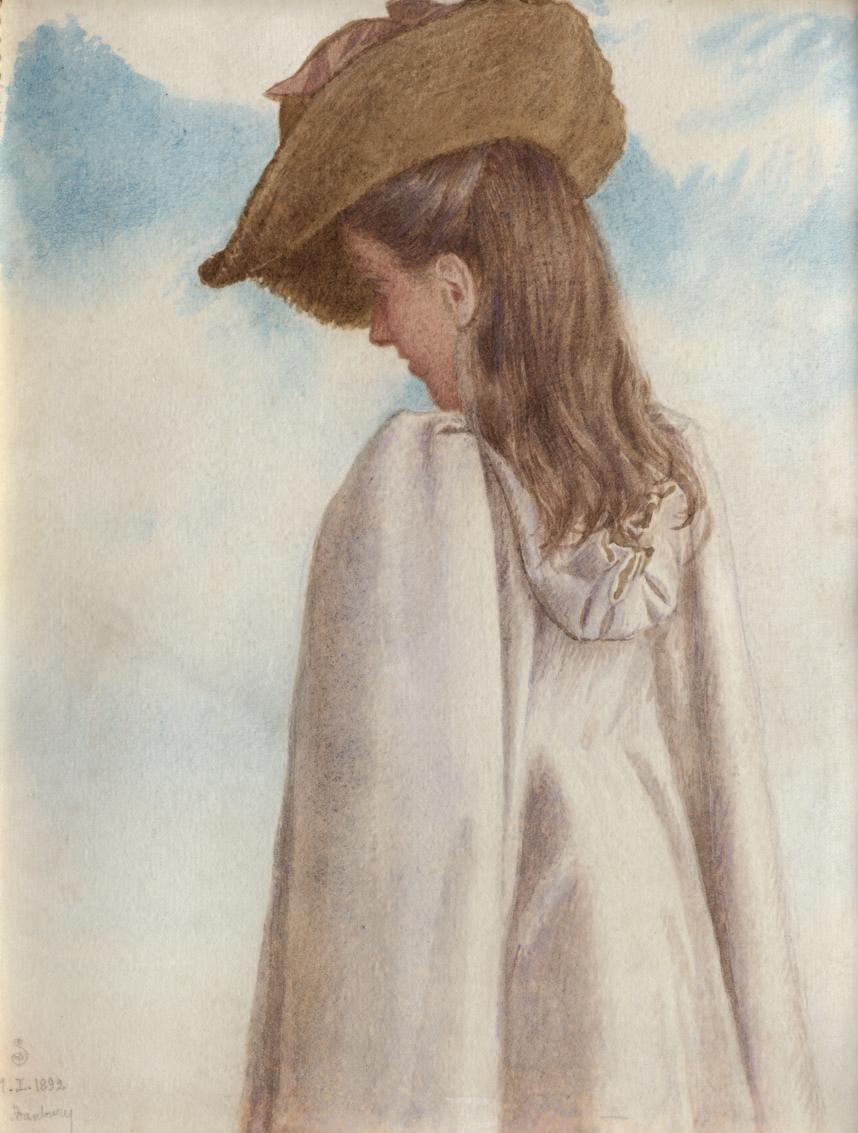
63
Signed with monogram, inscribed and dated l.l.: 11.i.1892/JS/Banbury
Watercolour, 28 by 22 cm (11 by 8 ¾ ins) (frame size 35 by 29 cm)
Provenance: the artist’s cousin Isabel Harlock and thence by descent
A study for the present work is in a sketchbook from 1891-92 now in the collection of the British Museum (acc.2017,7020.8).
Study of a Girl in a Hat and Hooded Cloak
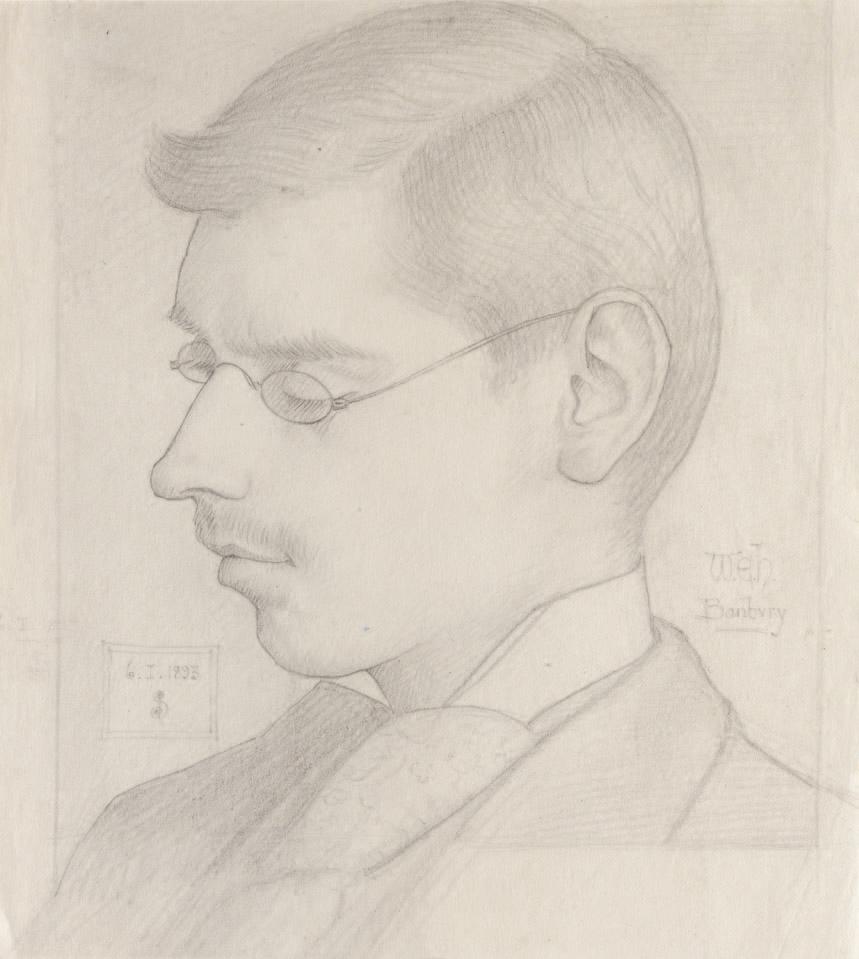
CAT. 64
Portrait of Walter Harlock
Inscribed l.r.: WEH/Banbury and signed and inscribed l.l.: 6.i.1893/JES
Pencil, 21.5 by 19.5 cm (8 ½ by 7 ¾ ins)
Provenance: the artist’s cousin Isabel Harlock and thence by descent
Walter Ernest Harlock (1866-1951) was the third son of John Harlock and Anne Baker, therefore first cousin to both Joseph and Bessie Southall. Born in Banbury, he studied at Manchester and London Universities before taking a professorship as a lecturer in English at Uppsala University and at the Royal Swedish Naval College in Stockholm where he remained until his retirement. A noted lexicographer, he published Swensk-Engelsk Ordbok (Swedish-English Dictionary) in 1904 and a larger revised edition in 1936. In Sweden he was awarded the Order of North Star.
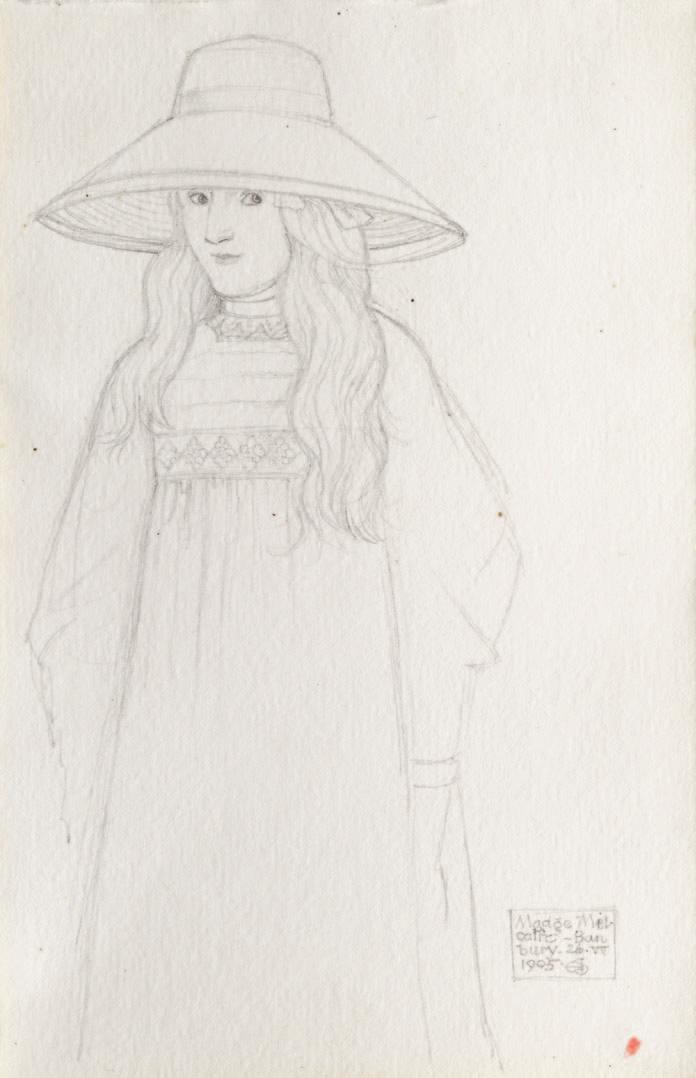
CAT. 65
Portrait of Madge Metcalfe in a Hat
Inscribed, dated and signed l.r.: Madge Metcalfe/Banbury/ 26.vii.1905/JES
Pencil, 17.5 by 11 cm (6 ¾ by 4 ¼ ins)
Provenance: the artist’s cousin Isabel Harlock and thence by descent
Margaret Metcalf was the daughter of Leonard Metcalf, the accountant and manager of the busy Banbury wharf of the Oxford Canal. She was born in 1896 and she would therefore have been aged nine at the time of this portrait. The Metcalfs lived in Banbury Market Place, close to John Harlock’s drapery shop and it is likely they may have been family friends.
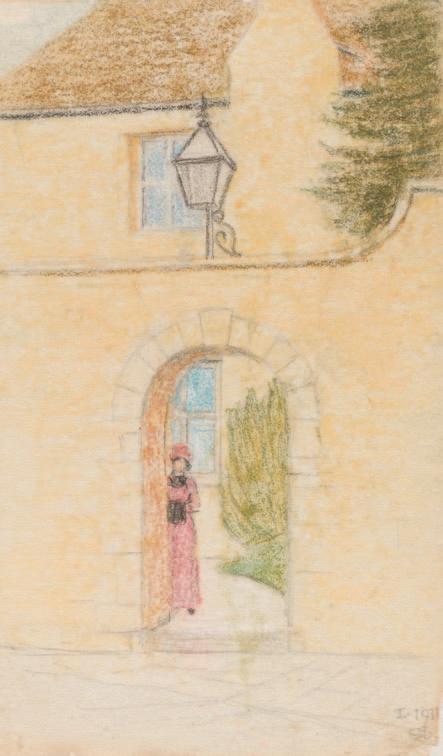
The Entrance to the Quaker Meeting House, Banbury
Dated and signed l.r.: i.1911/JES
Coloured chalks, 16 by 9.5 cm (6 ¼ by 3 ¾ ins)
Provenance: the artist’s cousin Isabel Harlock and thence by descent
Banbury’s Quaker Meeting House is situated behind a high wall in the north-west corner of Horse Fair. The piece of land has belonged to the Quakers since 1654 and the present building dates to the seventeenth century with later additions and developments.
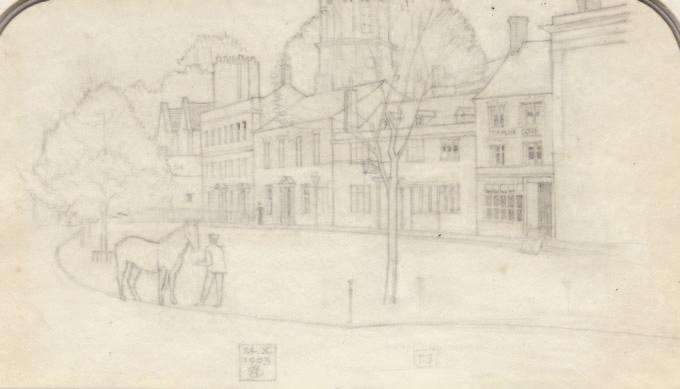
Study for “The Green at Banbury”
Signed with monogram and dated l.c.: 24.X.1903 JES
Pencil, shaped top, 10 by 18 cm (4 by 7 ins)
A study for the 1920 watercolour of the same subject exhibited at the New English Art Club Exhibition, 1920-21, no.85 (private collection).
NOT FOR SALE
CAT. 66
CAT. 67
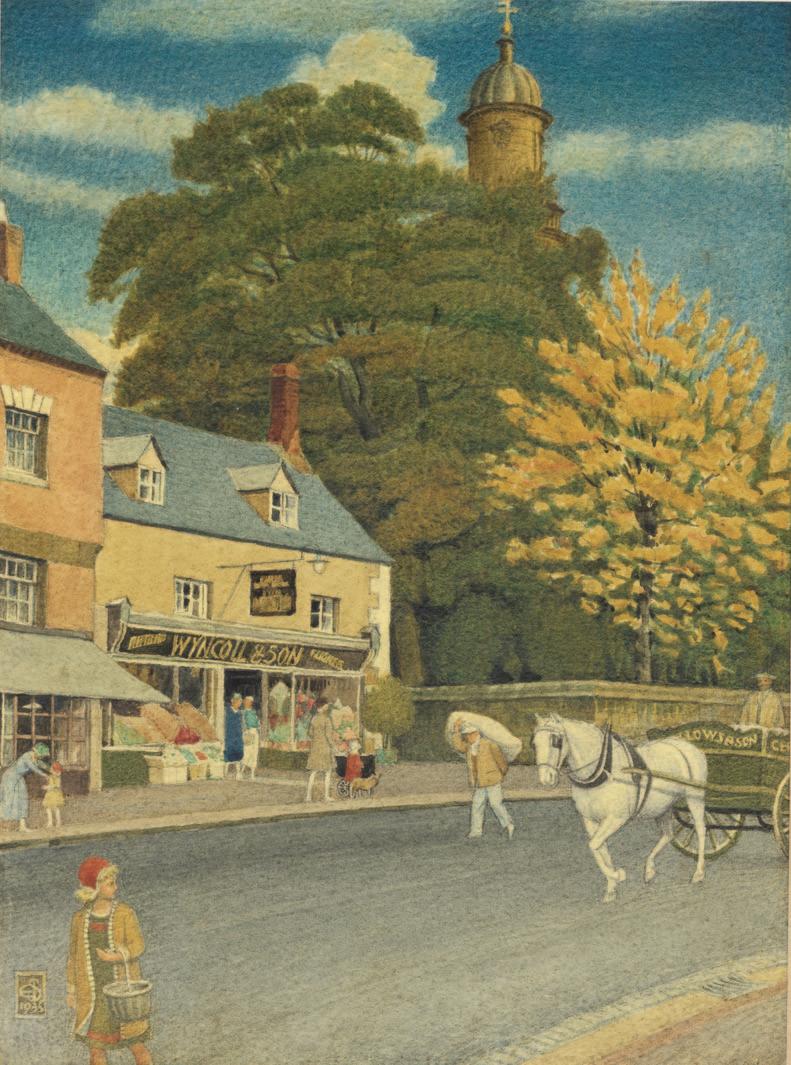
CAT. 68 Autumn in Banbury
Signed with monogram and dated l.l.: JES / 1935; inscribed with title on the backboard Watercolour, 28 by 20.5 cm (11 by 8 ins) (frame size 52.5 by 43.5 cm., 20 ¾ by 17 in.)
Provenance: Heather Newman, Painswick; private collection Exhibited: Paris Salon, 1940; Bournemouth Art Gallery
The tall tower of Banbury’s St Mary’s church is seen above the plain trees of the church yard from North Bar, looking south-east. The scene is little changed today although Wyncoll & Son’s green-grocers is now a Thai restaurant.
NOT FOR SALE
CAT.
69
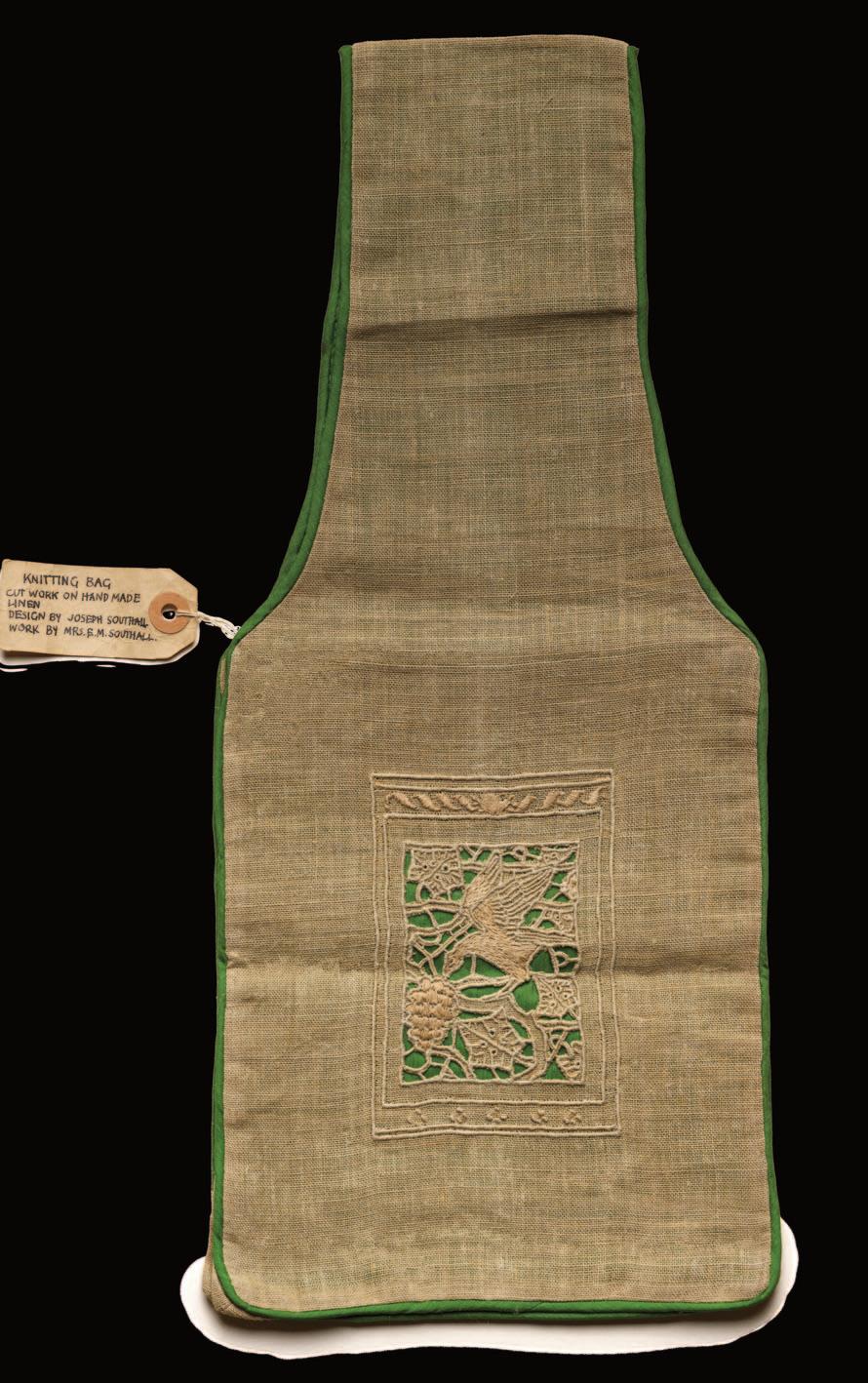
Eliza Maria Southall (1833-1922)
Knitting bag with Ruskin Lace inserts designed by Joseph Southall
Bears original inscribed label:
Knitting Bag / Cut Work on hand made / linen / Designed by Joseph Southall / Work by Mrs E M Southall 45 cm (17 ¾ ins) (length)
In the 1870s John Ruskin and his friend Albert Fleming set up a textile industry in the Lake District for the weaving of Langdale Linen. Fleming’s housekeeper, Marion Twelves, oversaw the creation of this small weaving industry in Elterwater followed by a linen workshop in Keswick which opened in 1889. Twelves experimented with Sicilian and Greek embroidery which became known as Ruskin Lace. Southall’s designs for Ruskin Lace were worked by his mother, Eliza Maria Southall, and were frequently exhibited at the Arts and Crafts Exhibition Society.
Tel: +44 (0)77 7594 3722 sarah@sarahcolegrave.co.uk www.sarahcolegrave.co.uk
Wigginton, Near Banbury, Oxfordshire (by appointment)
Tel: +44 (0) 7765 966256 harry@mooregwynfineart.co.uk www.mooregwynfineart.co.uk
Ground Floor, 6 Mason’s Yard, Duke Street, St James’s, London SW1Y 6BU
Monday-Friday: 11 am – 6 pm (or at other times by appointment)
By appointment, Chalford, Gloucestershire
Acknowledgments
We are most grateful for the assistance of the following people in the preparation of this catalogue: George Breeze, Peyton Skipwith and Stephen Wildman
Copyright 2026
Opposite page: [Detail of cat.18] Portrait of Arthur Gaskin