JOHN ARMSTRONG
UPSTONE
JOHN ARMSTRONG 14th October – 11th November 2026
UPSTONE
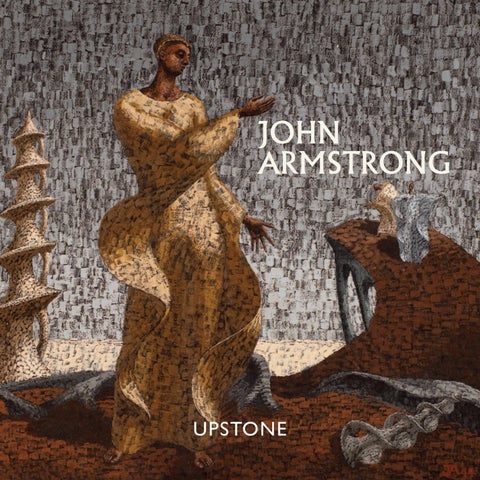
Front cover: [cat.6] Growth and Form 1944 Back cover: [cat.13] Arum Reflection 1955 Opposite: John Armstrong beside his Shell Mex panels 1933 1
JOHN ARMSTRONG
The paintings brought together in this exhibition encompass a particularly rich period in Armstrong’s career and in European history. There is also a striking cohesiveness to them. Classical myth, ruined cities, the theatre, the shadow of war, and the natural world continually overlap. Nothing in Armstrong’s art is quite simply what it appears to be. Objects and figures acquire other meanings and associations, often relating the ancient world to the anxieties of the present. Yet these are also exceptionally beautiful paintings, distinguished by Armstrong’s exquisite sense of colour, his highly individual handling of paint and, perhaps above all, his remarkable understanding of light. Armstrong had received a thorough classical education at St Paul’s School, and his attachment to the myths and history of antiquity remained with him throughout his life. This acquired an added seriousness from his own experience. He served for four years in the Royal Field Artillery during the First World War, first in Egypt and then in Macedonia, encountering at first hand both the remains of the ancient world he had studied and the destructive power of modern warfare. He had passed from the apparent security of Edwardian England into a conflict that overturned the assumptions of his generation.
Among the earliest works in the exhibition are the exceptional pair Paris and Helen, painted in c.1937 and exhibited together at the Lefevre Gallery in December 1938. The story could hardly be more appropriate to Armstrong. Helen, celebrated as the most beautiful woman in the ancient world, and Paris, the Trojan prince who carried her away, stand at the beginning of a chain of events that culminated in the destruction of Troy. Beauty and desire become the predestined agents of catastrophe. It is a rare pleasure to see the two paintings reunited. Armstrong presents the figures with great economy, simplified almost to the point of archaism. Yet their incised draughtsmanship, scratched through the painted surface, gives them a distinctly modern character. Ben Nicholson was also exploiting scratched and incised lines at this date, while artists in Paris increasingly treated the painted surface as something to be scored, scraped and physically worked. Armstrong uses the device entirely in his own way. The delicacy of the drawing against the roughened surface makes the figures appear at once ancient and startlingly modern. Helen in particular has a wonderfully monumental presence, an archetype of classical beauty rendered with an almost naïve simplicity.
Opposite: [cat.9] Detail from Cosmetics c.1952 3
Fig.1. Henry Moore’s Reclining Figure (1933) at the Unit One exhibition 1934.
Figure and Wild Plants on a Hillside (cat.2), dating from the first half of the 1930s, reveals a quite different aspect of Armstrong’s early modernism. At first sight its strange interlocking shapes appear almost abstract, but they resolve themselves into two figures, one associated with a sheaf of corn or grasses and entwined with ivy or some creeping plant. Armstrong delights in the ambiguity between the human figure and biomorphic form. The tiny stylised head of the central figure, its projecting nose and great draped body recall both Cycladic sculpture and the increasingly abstract human figures Henry Moore was making in the 1930s (fig.1). Moore and Armstrong were brought together in Unit One, formed by Paul Nash in 1933, and it is easy to see why Nash recognised in Armstrong an artist equally committed to a new modern art. Yet the painting also looks backwards. The vegetation, corn and monumental earthlike forms suggest ancient ideas of fertility and the continuity of human and natural life without illustrating any particular myth. The scrubbed and modulated tempera surface gives the painting a wonderfully lively texture. Classical antiquity, the natural world and the new biomorphic language of European modernism are already becoming inseparable.
4
By the end of the decade Armstrong had developed a private vocabulary of destruction: ruined buildings, fragments of sculpture, blasted trees and torn posters. In works such as Pro Patria (1938), these motifs give concrete form to his growing concern with the fate of civilisation. Armstrong had worked on Korda’s 1936 film of H. G. Wells’s influential Things to Come, with its prophetic vision of European cities devastated by aerial bombardment, and could scarcely have been unaware of newsreel images of towns destroyed during the Spanish Civil War. He subsequently became an Official War Artist and painted bombed buildings and churches on the British home front, but this imagery had entered his work before the war began. Strikingly, these motifs did not disappear when the Second World War ended. They acquired a new relevance in the early 1950s with the Cold War, the nuclear arms race and the Korean War. Armstrong’s destroyed and deserted cities now belonged not simply to recent memory but to a possible future. This is the world of Cosmetics (cat.9). A classical statue, apparently a Roman emperor or military commander, stands improbably intact amid the remains of a ruined city. Behind it a great painted mouth grins from a peeling advertisement for cosmetics. The conjunction is both absurd and disturbing. The statue represents the inherited culture and authority of the ancient world; the advertisement the superficial appetites of modern consumer society. Yet both inhabit the same ruin. The remains of antiquity and the detritus of modern advertising have become equally fragile once the civilisation which sustains them has collapsed. The Square (cat.7) develops the idea in a more ambiguous and visually seductive way. It is one of Armstrong’s most haunting urban paintings. On the right, sunk into shadow, a sculptural group appears to show a satyr pursuing or
embracing a woman. The building behind it is cracked and decayed. Across the square the café awnings remain cheerful, the coloured tables and chairs are still set out and brightly coloured posters cover the walls. Yet there is nobody there. The unsettling character of the painting lies precisely in the fact that nothing has happened. We cannot tell whether some catastrophe has already occurred or whether the silence anticipates one. The contrast between the seductive colour of the café and the gathering darkness turns an apparently ordinary Mediterranean scene into something psychologically much less secure. Few of Armstrong’s paintings demonstrate more brilliantly his ability to make unease beautiful. Such paintings demonstrate Armstrong’s knowledge of European Surrealism while also showing why he resisted being described simply as a Surrealist. Armstrong shared with Paul Nash, his fellow member of Unit One, an interest in the imaginative and metaphysical possibilities of the visible world. His deserted squares, irrationally extended spaces and fragments of antique sculpture inevitably recall Giorgio de Chirico, whose work was prominently exhibited in London at the International Surrealist Exhibition of 1936 and again in 1949. Yet Armstrong was never an imitator. His art is more often allegorical than irrational, bringing objects together not to destroy meaning but to multiply it. In Leda of 1952 (cat.8) these connections between ancient mythology and modern experience become especially concentrated. It is one of Armstrong’s most remarkable inventions, bringing classical mythology and contemporary urban life together with complete assurance. The union of Leda and Zeus, disguised as a swan, is displayed on a brilliantly illuminated billboard above a wet modern street. From the eggs produced by the union would come Helen and, in some versions of the myth, Clytemnestra, and with Helen the beginnings of the Trojan War. Another pair of
eggs appears in the nest balanced upon the head of the naked modern Leda below. Ancient catastrophe is carried quite literally into the modern world. The passers-by pay no attention. They hurry beneath their umbrellas, apparently unaware and uncaring of the story unfolding above them. Armstrong explained the umbrella in a statement written for his 1951 Lefevre Gallery exhibition as symbolising the inadequate beliefs under which mankind attempted to shelter from a gathering storm. Yet Leda is far more than an ingenious piece of symbolism. It is an exceptionally beautiful painting. The rhythm of the pale umbrellas, wet street, illuminated brickwork and isolated naked figure are held together by Armstrong’s brilliant orchestration of light. Electric lamps blaze against the night sky while the building at the far right turns abruptly around a corner into darkness. There is something of Magritte in the eerily precise brickwork, drainpipe and nocturnal sky, an ordinary corner of the modern city made suddenly mysterious. Armstrong’s command of lighting was fundamental to the emotional power of his paintings. His extensive experience as a designer for theatre and ballet, and for Alexander Korda’s film company, gave him an intuitive understanding of how artificial illumination could isolate a figure, transform an ordinary object or alter the emotional tenor of a scene. He also observed that the illumination in his Harlequin pictures might suggest either dawn or dusk, ‘the end or the beginning of an era’, leaving us deliberately uncertain which. That ambiguity is magnificently evident in the large Harlequin of 1950 (cat.12). At almost four feet high it has an imposing physical presence and was commissioned for the bar of the original Berkeley Hotel, Mayfair. The figures of the Commedia dell’Arte had a distinguished history in
5
modern painting: Picasso repeatedly used Harlequin and Pierrot as figures of artistic identity, while Gino Severini painted Commedia figures at Montegufoni in Tuscany in the early 1920s. Armstrong’s Harlequin is different. The great solitary figure is romantic but strangely melancholy, beautifully dressed and dramatically illuminated against a stage-like landscape. His elaborate costume and elegant silhouette catch the fading light, while the long shadow behind him introduces an unmistakable note of uncertainty. He belongs to a world of spectacle, fantasy and romance which seems already to be slipping away. There is an expression of lyrical melancholy here, beautiful yet poignant, as though beauty and merriment themselves are passing into the gathering darkness. Armstrong described the clown as ‘the image of frustration’, fighting battles which ultimately amount to nothing. The Commedia figures share something with the Neo-Romantic sensibility found elsewhere in British art of the 1940s and ’50s, but Armstrong’s combination of theatre, symbolism and complex layers of allusion is entirely his own. Alongside these figurative allegories Armstrong was developing a quite different way of painting. During the war he increasingly built his surfaces from separate square-ended touches of colour, allowing a darker ground to remain visible between them. The technique can look superficially like mosaic or Divisionism, but neither comparison quite describes the distinctive shimmering surface Armstrong achieves. Colour seems to flicker across the picture. Shells and Sun of 1943 (cat.5) is one of the most beautiful and original early expressions of this new manner. Its imagery is reduced to elemental forms: sun, land, sea and shells. The great spiralling shells are simultaneously natural objects and abstract structures, suggesting an underlying order in organic life. An apparently simple object becomes
6
the starting point for a larger chain of ideas. These concerns relate to D’Arcy Wentworth Thompson’s celebrated On Growth and Form (1917), which examined the mathematical and physical principles underlying natural forms, including the spiralling structures of shells. Armstrong transforms such ideas into something intensely poetic.There is almost a creation myth here: sun, sea, earth and organic life brought together in a mysterious elemental landscape. The idea reaches one of its most eloquent expressions in Growth and Form of 1944 (cat.6), a painting of exceptional imaginative power. A monumental figure rises from a landscape filled with spiralling and organic structures. With one arm extended she seems almost to call the surrounding forms into existence, as though presiding over an act of creation. Her twisting drapery assumes the character of organic growth while recalling the great draped figures of classical sculpture. Armstrong collapses a rich range of associations into a single image: natural evolution, human creation and the inheritance of antiquity. There are affinities with Henry Moore, whose fascination with the monumental and draped figure was deeply indebted to ancient sculpture. The date is important. Armstrong painted Growth and Form in 1944, while Europe was still being destroyed. Against destruction Armstrong sets creation. The structures of nature grow, evolve and regenerate; the ancient past survives and is remade. The innumerable touches of paint themselves seem to accumulate and coalesce into larger forms, as though the picture were being generated before our eyes. By the early 1950s mankind’s capacity for destruction had again become increasingly explicit. The superb pair of gouaches The Drummer and The Cannonade (cat.10, 11), both painted in 1953, address the madness of human conflict with remarkable economy. Although modest in scale, they
The comedy is black. The combatants carry wooden swords like children’s playthings, while elaborate helmets and headdresses obscure their vision. They are soldiers, actors and children simultaneously, blindly pursuing a conflict whose purpose appears to have been forgotten. Armstrong himself made the point explicit in a poem written for The Battle of Propaganda, in which the protagonists pursue competing flags and ideologies, ‘blindfold in this mad nursery of a world’. The Battle pictures transform the ceremony of militarism into pantomime: uniforms become fancy dress and swords become toys. The humour prevents the paintings becoming polemical, but beneath it lies profound seriousness. What gives these paintings their continuing force is the tension between beauty and anxiety. Armstrong was not an illustrator of political ideas. The pleasure of looking is integral to their meaning: the luminous colour and theatrical elegance of Harlequin, the shimmering surface of Shells and Sun, the haunting spatial construction of The Square, the electric lights, wet brickwork and rhythm of umbrellas in Leda. Their beauty draws us into worlds that are more complex, and often more disturbing, than they first appear.
Above: John Armstrong
have the compression and authority of major paintings and belong to the same imaginative world as Armstrong’s larger Battle paintings of the period, including The Battle of Propaganda and The Battle of Religion.
Across these years Armstrong created a pictorial language entirely his own. His paintings absorb Classicism, Surrealism, Neo-Romanticism, theatre, film and the experience of modern war without belonging wholly to any of them. Beneath them runs a persistent concern with the fragility of civilisation and mankind’s capacity for destruction, but set against this is a belief in the endurance of art, memory and the forms of nature beyond the disasters of history. Armstrong could make the familiar mysterious, the ancient modern and anxiety extraordinarily beautiful. Robert Upstone
7
[cat.1]
Algerian Landscape (2) c.1930 Oil on canvas 17 x 21 inches (43.2 x 53.3 cm) Signed with initials b.r.
8
[cat. 2]
Figure and Wild Plants on a Hillside c.1930-35 Tempera and pencil on board 25 x 19 ⅞ inches (63.5 x 50.5 cm) Signed with initials b.r.
9
[cat. 3]
Helen c.1937 Tempera on board 20 ⅞ x 15 inches (53 x 38 cm) Signed with initials b.r.
10
[cat. 4]
Paris c.1937 Tempera on board 20 ⅞ x 15 inches (53 x 38 cm) Signed with initials b.r.
11
[cat. 5]
Shells and Sun 1943 Tempera on board 20 x 29 inches (50.8 x 73.7 cm) Signed with initials and dated b.l.
12
[cat.6]
Growth and Form 1944 Tempera on panel 49.53 x 67.95 cm (19 ½ x 26 ¾ inches) Signed with initials and dated b.r.
13
[cat. 7]
The Square 1952 Oil on canvas 20 x 30 inches (50.8 x 76.2 cm) Signed and dated b.l.
14
[cat. 8]
Leda 1952 Oil on canvas 18 x 30 ¾ inches (45.7 x 78.1 cm) Signed and dated b.r.
15
[cat. 9]
Cosmetics c.1952 Oil on canvas 10 x 12 inches (25.4 x 30.5 cm)
16
[cat. 10]
The Drummer 1953 Gouache 16 x 12 inches (40.6 x 30.5 cm) Signed b.r.
17
[cat. 11]
The Cannonade 1953 Gouache 16 x 12 inches (40.6 x 30.5 cm) Signed b.r.
18
[cat. 12]
Harlequin 1950 Oil and wax on board 48 x 26 ¼ inches (121.9 x 78.7 cm) Signed with initials b.r.
19
[cat. 13]
Arum Reflection 1955 Oil on canvas 20 x 15 inches (50.8 x 38.1 cm) Signed and dated b.r.
20
CHRONOLOGY
1893
Born in Hastings
1934
Exhibits with Unit One at The Mayor Gallery
1957
Solo exhibition at The Leicester Galleries
1894-12 Brought up in West Dean at the Estate Vicarage
1935-9
Designer for Alexander Korda’s films at Denham Studios
1961-3
Paints mural for Royal Marsden Hospital
1963 1938
Moved to Essex; solo exhibition at Lefevre Gallery
Solo exhibition Molton & Lords Gallery
1964
Solo exhibition Shell Mex House
1966
Elected Associate of the Royal Academy
1973
Dies
1975
Memorial exhibition at the Royal Academy, touring to City Museum & Art Gallery, Plymouth, Harris Museum & Art Gallery, Preston and Laing Art Gallery, Newcastle upon Tyne
2017
Major retrospective exhibition at Penlee House Gallery & Museum, Penzance, touring to Atkinson Art Gallery, Southport
1907-12 St Paul’s School 1912-13 St John’s College, Oxford 1913-13 St John’s Wood School of Art
1940-44 Official War Artist 1914-18 Served in Royal Field Artillery in Egypt and Macedonia
1945
1919-20 St John’s Wood School of Art 1928
1929
1931
1933
Designed the Labour Party election Manifesto cover and poster; moves to Lamorna, Cornwall; solo exhibition at Lefevre Gallery
First solo exhibition at The Leicester Galleries
1947
Solo exhibition at Lefevre Gallery
Solo exhibition at The Leicester Galleries
1951
Exhibited at the Festival of Britain; solo exhibition at Lefevre Gallery
Designer for the first production of the ballet Façade Completes murals for Shell-Mex House
1953-55 Paints mural for Bristol Council Chamber 1955
Returns to London
21
CATALOGUE
[cat. 1]
Algerian Landscape (2) c.1930
[cat. 5]
Oil on canvas 17 x 21 inches (43.2 x 53.3 cm) Signed with initials b.r. Catalogue Raisonné no. 100 [cat. 2]
Figure and Wild Plants on a Hillside c.1930-35
Tempera on board 20 x 29 inches (50.8 x 73.7 cm) Signed with initials and dated b.l. Catalogue Raisonné no. 261 [cat. 6]
Tempera and pencil on board 25 x 19 ⅞ inches (63.5 x 50.5 cm) Signed with initials b.r. Catalogue Raisonné no. 143 [cat. 3]
[cat. 4]
Helen c.1937
Growth and Form 1944 Tempera on panel 19 ½ x 26 ¾ inches Signed with initials and dated b.r. Catalogue Raisonné no. 289
[cat. 7]
The Square 1952
Tempera on board 20 ⅞ x 15 inches (53 x 38 cm) Signed with initials b.r. Catalogue Raisonné no. 178
Oil on canvas 20 x 30 inches (50.8 x 76.2 cm) Signed and dated b.l. Catalogue Raisonné no. 440
Exhibitions Paintings by John Armstrong, Alex. Reid & Lefevre, London, Dec. 1938 (40)
Exhibitions John Armstrong 1893-1973, Royal Academy, London, Feb.-April, City Museum & Art Gallery, Plymouth, May-June, Harris Museum & Art Gallery, Preston, June-July, Laing Art Gallery, Newcastle, August 1975 (113); Cornwall 1945-1955, New Art Centre, London, 1977 (4).
Paris c.1937 Tempera on board 20 ⅞ x 15 inches (53 x 38 cm) Signed with initials b.r. Catalogue Raisonné no. 177 Exhibitions Paintings by John Armstrong, Alex. Reid & Lefevre, London, Dec. 1938 (39)
22
Shells and Sun 1943
[cat. 8]
[cat. 9]
Leda 1952
[cat. 11]
Gouache 16 x 12 inches (40.6 x 30.5 cm) Signed b.r. Catalogue Raisonné no. 472
Exhibitions Artists of Fame and Promise, Leicester Galleries, London, Aug.-Sept. 1952 (96); John Armstrong 1893-1973, Royal Academy, London, Feb.-April, City Museum & Art Gallery, Plymouth, May-June, Harris Museum & Art Gallery, Preston, June-July, Laing Art Gallery, Newcastle, August 1975 (114); John Armstrong, New Grafton Gallery, Barnes, March-April 1984 (9).
Exhibitions John Armstrong 1893-1973, Royal Academy, London, Feb.-April, City Museum & Art Gallery, Plymouth, May-June, Harris Museum & Art Gallery, Preston, June-July, Laing Art Gallery, Newcastle, August 1975. (119, as ‘The Swordsman’). [cat. 12]
Harlequin 1950 Oil and wax on board 48 x 26 ¼ inches (121.9 x 78.7 cm) Signed with initials b.r. Catalogue Raisonné no. 392
Cosmetics c.1952 Oil on canvas 10 x 12 inches (25.4 x 30.5 cm) Catalogue Raisonné no. 452
[cat. 10]
The Cannonade 1953
Oil on canvas 18 x 30 ¾ inches (45.7 x 78.1 cm) Signed and dated b.r. Catalogue Raisonné no. 439
Exhibitions Society of Mural Painters First Exhibition, Arts Council, 1950 (4, repr.).
The Drummer 1953 Gouache 16 x 12 inches (40.6 x 30.5 cm) Signed b.r. Catalogue Raisonné no. 471 Exhibitions John Armstrong 1893-1973, Royal Academy, London, Feb.-April, City Museum & Art Gallery, Plymouth, May-June, Harris Museum & Art Gallery, Preston, June-July, Laing Art Gallery, Newcastle, August 1975 (118).
[cat. 13]
Arum Reflection 1955 Oil on canvas 20 x 15 inches (50.8 x 38.1 cm) Signed and dated b.r. Catalogue Raisonné no. 524
Catalogue Raisonné: Andrew Lambirth, Annette Armstrong & Jonathan Gibbs, John Armstrong: The Paintings, London, 2009
Photography: Justin Piperger | justin@justinpip.com Design: Sarah Garwood Creative | www.sarahgarwoodcreative.com Printed by: Zenith Print Group | enquiries@zenithprintgroup.com
23
[cat. 1] Detail from Algerian Landscape (2) c.1930
UPSTONE ROBERTUPSTONE.COM