GUY PEPPIATT FINE ART
BRITISH DRAWINGS AND WATERCOLOURS MASTER DRAWINGS NEW YORK JANUARY 2026
BRITISH DRAWINGS AND WATERCOLOURS MASTER DRAWINGS NEW YORK 30TH JANUARY TO 7TH FEBRUARY 2026 EXHIBITING AT THE ARADER GALLERIES, 1016 MADISON AVE BETWEEN 78TH AND 79TH ST Guy Peppiatt Fine Art Ltd Riverwide House, 6 Mason’s Yard Duke Street, St James’s, London SW1Y 6BU Tel: +44 (0) 7956 968 284 guy@peppiattfineart.co.uk www.peppiattfineart.co.uk
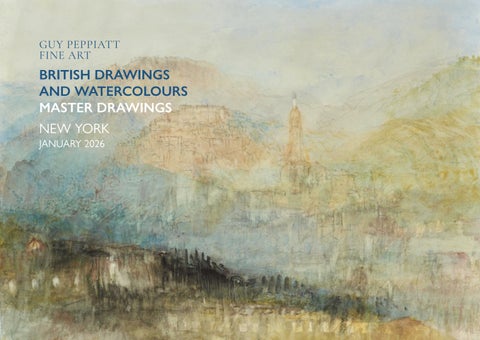
Front Cover: (39) Joseph Mallord William Turner, R.A. (1775-1851)
Heidelberg, Germany Opposite: (11) Charles Hayter (1761-1835)
Members of the Maty Family in a Theatre Box Rear Cover: (37) Edward Lear (1812-1888)
Self-Portrait watering Flowers 1
1 John Vanderbank (1694-1739) Study of a Lady seated on an elaborate Chair With collector's mark on backing Pen and grey ink and washes over pencil on laid paper 17.1 by 13.2 cm., 6 ¾ by 5 in. Provenance: With P. & D. Colnaghi, London; John Daniel Tilford (b.1978) (Lugt no.4498) Vanderbank was widely regarded as the natural successor to the pre-eminent portrait painter, Sir Godfrey Kneller (1646-1723) in whose Academy he studies from 1711. He was also an accomplished draughtsman and developed a parallel career as a notable book illustrator. However, his success was effectively derailed by his love of high living. Vanderbank's father had been a Huguenot tapestry weaver who, on his death, left a substantial legacy to his family. This relative wealth appears to have encouraged Vanderbank to adopt the lifestyle of a gentleman and to live well beyond his means. In 1724, he ran away to France to escape debtors' prison and, on his return, he had to live within the liberties of the Fleet Prison, until his brother Moses was able to discharge his debts. Whilst at Kneller's Academy he met the French artist Louis Chéron (1660-1725), who moved to England circa 1695, after studying in Rome. In 1720, Chéron and Vanderbank broke away from Kneller to establish their own Academy at St Martin's Lane, where studying Old Master Paintings, rather than engravings was encouraged in order to understand human form and posture. Furthermore, a greater emphasis was placed on careful, detailed drawing from life rather than just producing rapid, schematic sketches that had, until then been the usual practice.
2
The present drawing demonstrates the extraordinary vivacity of line characteristic of Vanderbank's draughtsmanship. It does not appear to relate to any known portrait.
2 Katherine Read (1723-1788) Portrait of a Boy in Van Dyck costume Half-length Pastel 59.7 by 44.3 cm., 23 ½ by 17 ½ in. Provenance: With the Sabin Galleries Ltd, London (as by Francis Cotes); Ernest W. Franklin, Charlotte, North Carolina, 1968 Katherine Read was a member of a prominent Jacobite family, her uncle was Sir John Wedderburn, who was executed for his part in the uprising following the battle of Culloden of 1745. Probably due to their Jacobite connections, Read was sent first to Paris in circa 1751, before travelling onto Rome, where she remained until 1753. Whilst in Italy she honed her skills as a portraitist, mainly in pastels. In May 1753, she returned to England travelling via Florence, Venice (where she met Rosalba Carriera, whose work she had long admired) and Paris. Read settled in London and rapidly established herself as one of the most accomplished and sought after pastel portraitists of the period. Members of the Royal Family, including Queen Charlotte, the Prince of Wales and Prince Frederick, as well as many of the most fashionable members of society, all sat to Read. By the mid 1770s however, Read’s popularity was fading and in 1777, she left England, intending to establish herself in Madras. Her brother William was a surgeon for the East India Company. In October 1778, her failing health led the artist to leave India and return to England, but two months into her return voyage, Read died and was buried at sea. The present portrait demonstrates the artist’s delicate and assured handling of her chosen medium and her extraordinary facility for capturing different textures of the costume of the young sitter in the seventeenth century so-called Van Dyke costume which was popular in the mid eighteenth century.
3
3 Lady Diana Beauclerk (1734-1808) Portraits of Young Boys Half length, one looking left, the other right A pair, pastel Both 44.2 by 34.5 cm., 17 ¼ by 13 ½ in. Provenance: By descent in the Spencer family at Woolbeding House, Midhurst; Bequeathed to Henry Arthur Lascelles, Wooldbeding House (1842-1913) in 1873; By descent in the Lascelles family at Woolbeding until sold, Sotheby’s London, 19th October 1970, lot 63, bt, Winifred Williams; Mrs Franklin, Charlotte, North Carolina, USA Exhibited: London, Gerald N. Norman Gallery, 1971
These are likely to be portraits of the artist’s children, George Richard, Viscount Bolingbroke (1761-1824) and Frederick St John (1765-1844) dating from circa 1770. They descended in the artist’s family at Woolbeding House until they were sold at Sotheby’s in 1970 with a number of other works by Beauclerk. The sale also included a portrait of George with a pug (lot 52) (now untraced). An earlier portrait of George learning to write was recorded at Lydiard Park in 1992. A portrait of the artist’s daughters, Mary and Elizabeth, was sold at Sotheby’s on 15th July 1999, lot 51. Lady Diana Beauclerk’s brother Lord Robert Spencer (1747-1831) bought Woolbeding House in 1791. It descended in the Spencer family to his illegitimate daughter Diana Bouverie (b.1786 to his mistress Harriet Bouverie whom he married in 1811). Diana Bouverie (1786-1873) married George Ponsonby (1774-1863) in 1812 and bequeathed Woolbeding House to their relations, the Lascelles, on her death. The house was given to the National Trust but the Lascelles family continued to live at Woolbeding until 1969 shortly before the present pictures were sold at Sotheby’s in 1970. Lady Beauclerk was born Lady Diana Spencer and was the eldest daughter of Charles Spencer, 3rd Duke of Marlborough. She grew up at Blenheim Palace and made copies of the pictures there from a young age. In 1757 she married the 2nd Viscount Bolingbroke but he
4
was serially unfaithful so, controversially for the time, she left him for her lover Topham Beauclerk (1739-1780). This led to divorce in 1768 and she married Beauclerk two days later. They moved in court circles and Lady Diana’s closest friends were the countesses of Pembroke and Spencer and the Duchess of Devonshire. Horace Walpole, Lord Orford, was also a close friend of the couple and the diarist Joseph Farington recalls his views of them: ‘Lord Orford mentioned many particulars relative to the late Mr. Topham Beauclerc [the celebrated wit]. He said He was the worst tempered man He ever knew. Lady Di passed a most miserable life with him. Lord 0, out of regard to her invited them occasionally to pass a few days at Strawberry Hill. They slept in separate beds. Beauclerc was remarkably filthy in his person which generated vermin. He took Laudanum regularly in vast quantities. He seldom rose before one or two o'clock.’ After his husband’s death, she moved into Devonshire Cottage in Richmond. She was well known for her drawings of children and infant cupids and bacchantes, some of which were engraved by Bartolozzi, and she also produced designs for Wedgwood pottery. Walpole was a great admirer of her work and built a room at Strawberry Hill to house her drawings. She appears to have drawn few portraits – most of the surviving examples are of family and friends. Her work is in the V. and A., the Royal Collection and the British Museum.
5
4 William Pars, A.R.A. (1742-1782) The Great Villa at Quintili, Rome Pen and grey ink and watercolour over traces of pencil 20.5 by 28.3 cm., 15 ½ by 18 ½ in. Provenance: Miss Descret, Broadwater, Sussex; Anonymous sale, Christie's, 19th March 1985; Anonymous sale, Sotheby's 5th June 2008, lot 192; Private Collection, UK Born in London, Pars began his working career as a portait painter until in 1764 he was appointed draughtsman on an expedition to Greece and Asia Minor organised by Chandler and Revett on behalf of the Society of Dilettanti. Many of the resulting watercolours were engraved for the Society's publication Ionian Antiquities and are now in the British Museum. Pars had first visited Rome with Lord Palmerston in 1766. In 1775 Pars was able to return, when he became the first beneficiary of a new award established by the Society of Dilettanti, enabling an artist to spent time studying in Rome. Pars became a central figure in the group of British artists in Rome, which included Francis Towne, Thomas Jones, John Robert Cozens and John ‘Warwick’ Smith. Pars remained there for the last seven years of his life, dying aged only 40, from a chill caught whilst sketching at Tivoli. The Villa dei Quintili lies just over five miles outside the ancient boundary of the city of Rome on the Via Appia Antica. Built by two brothers, Quintilius Valerius Maximus and Sextus Quintilius Condianus, in the 2nd Century A.D., the villa complex was so large that for centuries it was believed locally to have been the site of Old Rome.
6
5 Mary Mitford (c.1770-1850) Dumbarton on the Clyde, Scotland Signed and inscribed verso: Dumbarton castle, approaching from Glasgow/Mary Mitford Watercolour over pencil on laid paper 27 by 44.8 cm., 10 ½ by 17 ½ in. Provenance: With Richard Ivor, London, where bought October 1989; By descent to the present owner Mary Mitford was a talented amateur artist whose work only became known when a group of drawings appeared on the London art market in 1989. Since then various other drawings have come to light. Mary's younger brothers, Colonel William Mitford (17441827) and John, 1st Baron Redesdale (1748-1830) are both known to have been taught by William Gilpin (1724-1804). Whether Mary studied under Gilpin as well is unclear, although it is possible to see Gilpin's influence in some of her work. It has been suggested that she may have been a pupil of William Marlow (1740-1813) and although as Kim Sloan has noted ‘her manner of drawing trees and buildings is very close…he was not known to have taken pupils’ (Kim Sloan, ‘A Noble Art’ Amateur Artists and Drawing Masters c.16001800, 2000, p. 187). The ancient castle of Dumbarton, founded in c.1220, guards the point where the River Leven meets the River Clyde. It was initially built to withstand attack from the Norwegians who at the time ruled the Hebrides and the Islands in the Clyde. Its last defensive use was during the Second World War.
7
6 Alexander Cozens (1717-1786) Tree Study Inscribed lower left: Drawn by Alexr Cozens Senr Grey wash on prepared laid paper 19.5 by 25.5 cm., 7 ½ by 10 in. Provenance: Anonymous sale, Sotheby’s London, 2nd May 1962, lot 29, bt. Spink for £40; Stanhope Shelton (1908-1983); Raymond Lister (1919-2001); Private collection, London
Cozens was highly regarded not only as an artist but, almost more importantly, as an educator and thinker on art. Following his return from Italy in circa 1749, he took up a teaching post at Christ’s Hospital, a position he held for four years. He was later appointed drawing master at Eton College (which he held for twenty years) and where he taught and influenced generations of collectors and amateurs, including Sir George Beaumont. He also established a flourishing private practice including teaching the Royal princes. Throughout his life he formulated and developed methods to help both professional and amateur artists, which he disseminated more widely through the publication of several treatises including, The Principals of Beauty relative to the Human Head, 1778 and A New Method of Assisting the Invention on Drawing Original Compositions of Landscape, 1786. This varied practice enabled him to shape the artistic practices and collecting ideas of subsequent generations and collectors including William Beckford, Viscount Nuneham (later 2nd Earl Harcourt) and his sister Lady Elizabeth Lee. He also profoundly influenced professional artists, both contemporary and younger emerging artists, including Joseph Wright of Derby, Thomas Gainsborough, John Constable, J.M.W. Turner, Thomas Girtin, George Romney and his own son John Robert Cozens.
8
Cozens was fascinated by composition, tone, light and shadow, form and shape and partly in order to enable him to explore these ideas, and partly possible the result of his training as an engraver, the artist abandoned colour almost completely in his drawing. The present drawing demonstrates the artist’s fascination with trees, not merely as generic staffage for his landscapes, but as worthy of subjects in their own right and is grounded firmly in direct observation of the natural world. Although Cozens further employed such observations in his landscapes of the imagination, thus weaving entirely imaginary compositions into reality. In 1771, he published The Shape, Skeleton and Foliage of Thirty Two Species of Trees for the Use of Painting and Drawing. As Rhian Addison notes, ‘Alexander’s etching knowledge allowed him to translate the various species of trees from pencil, ink and watercolour to a metal plate for Thirty Two Species of Trees. In turn, Alexander was able to disseminate his knowledge and methods to a far greater audience than those in academia. Trees were a single factor in a multitude of elements that Alexander studied, formulated and published. They are, however, the single most common factor in his landscapes, projecting the emotion of the scene to through composition, weight and movement’. (Rhian Addison, The Educators of Trees: Alexander and John Robert Cozens, Manchester, 2017, p.3 https://documents.manchester.ac.uk/display.aspx?DocID=32832).
9
7 Alexander Cozens (1717-1786) A Coastal Landscape Signed lower left, Alexr. Cozens on original mount Pencil and grey wash on a prepared ground, with the artist's wash line border 13.1 by 16.7 cm, 5 ¼ by 6 ½ in. Provenance: With Spink-Leger Pictures, London, 1999; Christie’s, London, 20th November 2003, lot 12; Private collection, London Exhibited: London, Spink-Leger Pictures, Castles in the Air, Drawings by Alexander Cozens and Victor Hugo, 25th May to 11th June 1999, no. 2 Literature: Spink-Leger Pictures, Castles in the Air, Drawings by Alexander Cozens and Victor Hugo, exhibition catalogue, 1999, no. 2
10
The present landscape with steep, rugged cliffs descending into the sea demonstrates the artist’s extraordinary ability to transfer onto paper the lively landscapes of his imagination. Cozens was fascinated by scenes like the present landscape, as evidenced by several similar subjects of rugged coastal scenes formerly in the Oppé Collection, now Tate Gallery, London. Cozens undertook a trip to Italy in 1746 and the surviving sketchbook is filled with depictions of craggy cliffs and mountains, as well as river valleys and decaying classical ruins. Cozens sought not just to capture realistic landscape subjects, rather he wanted to convey emotion through landscape and as such many of his landscapes were of his imagination, conceived as a vehicle for expressing his ideas. His ideas and art place him a key figure in the development of landscape painting in the 18th and early 19th centuries. Of the various systems that Cozens formulated, his most celebrated and influential was his blot technique, where he
encouraged his pupils to compose landscapes using ink blots as the basis for a drawing, and then working these up into fully conceived compositions. He first set out his ideas in his Essay to Facilitate the Inventing of Landskip (1759) and expanded these into A New Method of Assisting the Invention in Drawing Original Compositions of Landscape (1786), which not only laid out his theories but contained 16 aquatint plates of blots. He wrote, a ‘blot is not a drawing but an assemblage of accidental shapes, from which a drawing might be made…in nature forms are not distinguished by lines, but by shade and colour’. In part, he was inspired by the Renaissance master, Leonardo, who recommended looking at even cracks in a wall, or patterns in stone for inspiration: ‘With the swiftest hand make all possible variety of shapes and strokes upon your paper, confining the disposition of the whole to the general form in the example, which you choose for your style of composition’.
11
8 Paul Sandby, R.A. (1731-1809) Eton College from across the river Thames Gouache over traces of pencil 54.6 by 76.2 cm., 21 ½ by 30 in. Provenance: Col. R.C. Allhusen; Mrs. V. Bourke; Anonymous sale, Christie’s, London, 9th December 1949, lot 31, bt. Leggatt Bros for 720 gns.; Private collection, U.K. Literature: Anne Lyles and Andrew Wilton, The Great Age of British Watercolours 1750 – 1880, exhibition catalogue, Royal Academy, London, 1993, p. 308, no. 256 (illus. pl. 51). Exhibited: Newcastle, Laing Art Gallery, on loan 1975 to 2014; London, Royal Academy of Art, The Great Age of British Watercolours 1750 – 1880, 15th January to 11th April 1993, no. 256
12
Sandby is often called the ‘Father of British watercolour painting’ as he was probably one of the first artists to realise the commercial possibilities of landscape views of country houses and antiquarian sites in watercolour. In 1747 Paul and his older brother Thomas were sent to Scotland by the British government to produce landscape watercolours for a Military Survey. On their return, Thomas moved to Windsor where he was employed to oversee landscape design in Windsor Great Park and in 1764 he was appointed Deputy Ranger. This was the start of a life-long connection with Windsor and Eton for both brothers. Paul first exhibited Windsor views in the 1760s and continued to produce them throughout his life with many now being in the Royal Collection (see Jane Roberts, Views of Windsor – Watercolours by Thomas and Paul Sandby from the Collection of her Majesty Queen Elizabeth II, 1995). The foreground figure groupings are typical of Sandby’s work as is the medium. Sandby is known to have owned gouaches by the Italian landscape artist Marco Ricci (1676-1730) who is an evident influence.
This is a view looking north-west across the river Thames from Windsor to Eton College. The large building is Eton College chapel which was commissioned by the school founder King Henry VI in 1440. To the right are the College buildings with the tallest being Lupton’s Tower built 1514 to 1520. Sandby drew the view looking the other direction, from Eton across the Thames to Windsor Castle, on a number of occasions. An example is the near pair to the present work, of the same size, signed and dated 1802, which was sold at Bonham’s as part of the collection at Hooton Pagnell Hall on 1st December 2015, lot 84 for £218,500. Other versions of this view are in the Royal Collection. Another view of Eton from the Thames entitled ‘Eton - a view from Crown Corner’ was sold at Lawrence’s on 18th January 2013, lot 1509 for £120,000 – an aquatint of this view was published in 1776. A smaller view of Eton chapel from the south-west was sold at Sotheby’s on 30th November 2000, lot 7 for £32,700.
13
9 (right) John Flaxman, R.A. (1755-1826)
10 (far right) John Flaxman, R.A. (1755-1826)
‘Our Father who art in Heaven’
Portrait of Harriet Mathew, wearing a lace cap
Inscribed upper centre: Our Father which art in Heaven Pen and grey ink and grey wash over pencil on laid paper 19.9 by 14.7 cm., 7 ¾ by 5 ¾ in.
Inscribed lower centre: Harriet Mathew and with inscription lower right, J. Flaxman, with unidentified collector’s mark F upper left Pencil 19 by 15.5 cm., 7 ½ by 6 in.
Provenance: With P. and D. Colnaghi, 14 Old Bond Street, London; Private Collection Eight lithographs of illustrations to the Lord's Prayer by Flaxman were published after his death by Richard Lane in 1835. The original drawing by Flaxman for one of these, entitled ‘But Deliver us from Evil’, was recorded with Chris Powney in 1979 (see David Bindman (ed.), John Flaxman R.A., exhibition catalogue, 1979, no.146, p.123, ill.). A second titled ‘Lead us not into Temptation’ was in an exhibition at the Heim Gallery in 1976 (see Heim Gallery, John Flaxman, exhibition catalogue, 1976, no.25).
Provenance: Probably from an album, or a collection, of perhaps some fifty drawings by Flaxman and others, assembled and originally mounted in a similar way with gilt borders in or shortly after 1864 (the date of the watermark on one of the drawings’ mounts) Edward Croft-Murray C.B.E. (1907-1980) and by descent; Anonymous sale, Christie’s London, 9th July 1996, lot 19; Anonymous sale, Sotheby’s London, 25th November 1999, lot 30 Literature: Iolo A. Williams, ‘An Identification of some Early Drawings by John Flaxman’, Burlington Magazine, CII, June 1960, pp.246-9, illustrated, fig.27.; G.E. Bentley, Jun., Blake Records, 1969, pl.V. Harriet Maria Mathew (1765–1798) was the daughter of the Rev. Anthony Stephen Mathew (1733-1824) and his wife, also Harriet. They were known as patrons of artists, especially of Flaxman and through him, William Blake (1757-1827). According to the engraver and biographer, John Thomas Smith (1766-1833) the Mathews first encountered the young artist in his father’s plaster-cast workshop reading Latin, and Harriet senior is credited with introducing Flaxman to the world of classical antiquity through the works of Homer and Virgil (John Thomas Smith, Nollekens and his Times, Vol. 2, 1828). The Mathews held regular literary salons at their home, 27 Rathbone Place and Blake is known to have recited his poetry at these. J. T. Smith who regularly attended these gatherings, praised the ‘most agreeable conversaziones’ and described his hostess ‘as not only a great encourager of musical composers…but truly kind to young artists’.
14
Sometime in about 1797, the sitter in the present drawing married Baron Silfverhjehm, Secretary to the Swedish Ambassador. According to Joseph Farington’s diary entry for 6 August 1798 ‘Miss Mathew daughr. of Revd. Mr. Mathews, was it sees privately married abt. a year before Her death to Baron Silverghem who was Secretary to Baron Noleken’. Her obituary in Gentleman’s Magazine, noted that on March 28 1798 Harriet had died age 32. Apparently that she was ‘a young lady of the most uncommon and brilliant talents and accomplishments…Her elegant and various acquirements were rendered doubly attractive by the unaffected modesty and innumerable graces of her manners, the exquisite refinement and sensibility of her mind, the universal benevolence of her heart’. There are several known portraits of members of the Mathew family by Flaxman: two of the Reverend Mathew, aged about 45, one in pencil the other in red chalk, which probably date to circa 1780 and were formerly in the collection of the Flaxman scholar, Iolo Williams. A further portrait of his wife, Harriet Mathew senior, which has been dated to slightly earlier, between 1773-5, once belonged to the sculptor John Henry Foley (1818-1874) and is now in the British Museum, London. A portrait of Henry William Mathew (brother of the present sitter) is with Mark Brady, New York. Iolo Williams noted that these drawings belonged to a larger group of Flaxman drawings, some of which must have been laid down in an album with gilt edges in, or shortly after, 1864. Williams recorded fifteen sheets were numbered from 3 to 46; some were mounted on stiff paper whilst others, including the Mathew portraits, were unmounted. Some of the drawings, including the present work, bear an inscription, John Flaxman, which as Williams has noted is not a signature. (Iolo A. Williams, op. cit., p.246). Several of the drawings, including the present work, bear a capital “F” in the upper right corner. It seems that this refers to a previous owner, perhaps Foley, who on the death of the printmaker Maria Denman (fl. 1808–1861), Flaxman’s sister-in-law, selected about four hundred Flaxman drawings from her estate. Denman had inherited Flaxman’s estate on his death.
15
11 Charles Hayter (1761-1835) Members of the Maty Family in a Theatre Box With inscription on a label verso, Painted by Charles Hayter – /at Uxbridge and with a list of the sitters (in a later hand) Pastel 38.7 by 52.3 cm, 15 ¼ by 20 ½ in. Exhibited: Nicholson Gallery, 1943 The present pastel depicts members of the Maty family in a theatre box, possibly at the Theatre Royal, Covent Garden in the mid 1790s. From left to right are: Mrs Matthieu Maty, née Mary Dolon de Ners, Mrs Roger Jortin, née Louisa Maty (1746-1809) Miss Justamond, Mrs Marthe ‘Patty’ Maty (1758-1837), sister of Miss Justamond, Mrs James Tattersall, while she was still Mrs Richard Tayler, née Jane Louisa Justamond (1774-1848), Mrs J. O. Justamond, née Ann Gillette Maty (b.1748), Mrs De Ners, Mr Richard Tayler (17401815). The age of the sitters in the portrait suggests that it dates from the 1790s. It may show a box at the Theatre Royal, Covent Garden on the site of the current Royal Opera House. The Theatre Royal was destroyed by fire on 20th September 1808 and a new theatre was opened in 1809. This in turn burnt down in 1856 and the current theatre opened in 1858 becoming known as the Royal Oper House in 1892.
16
This is an unusually large and elaborate work by Hayter who is best known for his miniatures. Charles Hayter the son of an architect, entered the RA schools at the end of January 1786, age 24. He also had a private teaching practice and taught perspective to Princess Charlotte (1796-1813). In 1813, he published his Introduction to Perspective and in 1828, A New Practical Treatise on the Three Primitive Colours. There is an endearing description of Hayter in Henry Crabb Robinson’s diary, which records ‘he is a character. He is self-educated, but is a sensible man, and blends humour with all he says. And his affection for his children, one of whom is already a promising young artist, gives a kind of dignity to his character’ (Thomas Sadler, ed., Diary, reminiscences and correspondence of Henry Crabb Robinson, London, 1869, vol. II, p. 205). All three of Hayter’s children became artists, George, later Sir George (1792-1871), Anne (1795-1854) and John (1800-1895).
12 Thomas Rowlandson (1756-1827) A Good Vintage Signed lower right: T. Rowlandson Pen and ink and watercolour over pencil 25.8 by 21.5 cm., 10 by 8 ½ in. Provenance: With Lowell Libson Ltd, London, 2016; Private collection, London Literature: Huon Mallalieu, Many faces of a great Regency caricaturist, The Times, 18th June 2016, ill. During the 18th Century there was a growing interest in the ‘science’ of physiognomy and how the study of the face could tell the innermost character of that person. Rowlandson found in this a rich seam of humour. However, his interest appears to have been far more than merely mining the subject for amusing visual puns. There are several carefully observed drawings which, whilst gently humorous, are more serious explorations of the subject. In the present watercolour, the pleasure the artist takes in depicting and exaggerating the features of the figures for emotional and visual effect is evident. The careful positioning of the heads gives free reign to the artist’s expressive use of pen line. As Adrian Bury noted, ‘Here is a draughtsman who wrote all things with a running pen in the most sensitive calligraphy’ (see Adrian Bury, Rowlandson Drawings, 1949).
17
13 Thomas Rowlandson (1756-1827) A Game of Cribbage Signed lower right: Rowlandson 1818 Pen and brown and grey ink and watercolour Circular 34.9 by 36.7 cm., 13 ¾ by 14 ½ in. Provenance: Ray Livingston Murphy (1923-1953), his Estate sale, Christie's, 19th November 1985, lot 103; Anonymous sale, Christie's, 9th April 1991, lot 76; By descent to the present owner Literature: Lowell Libson Ltd, Beauty and the Beast - A Loan Exhibition of Rowlandson's Works from British Private Collections, exhibition catalogue, 2007, p.64 Gambling subjects were close to Rowlandson's heart and he is known to have frittered away most of his wealth on gambling and especially the dice game Hazard. He would frequently gamble all night losing huge sums (see Matthew and James Payne, Regarding Thomas Rowlandson, 2010, pp. 170-171). Rowlandson seems to have used circular compositions mainly for sporting and gambling subjects and they may have been intended for the decoration of screens (for examples, see John Hayes, Rowlandson Watercolours and Drawings, 1972, nos. 41 and 126 and Lowell Libson, op. cit., no.25). It has been suggested that the current drawings were painted for the Prince Regent to go on a screen at Brighton Pavillion which was being refurbished by the architect John Nash at the time. Rowlandson is said to have produced a set of screen decorations for the Prince Regent (see A.P. Oppé, Thomas Rowlandson: His Drawings and Water-Colours, 1923, p.21). Byron is also said to have commissioned four similar drawings from Rowlandson depicting the sports of England (see Martin Hardie, Water-Colour Painting in Britain, vol. I, 1966, p.213).
18
14 Thomas Rowlandson (1756-1827) A Game of Dice Signed lower centre: Rowlandson Pen and brown and grey ink and watercolour Oval 32.4 by 32 cm., 12 ¾ by 12 ½ in. Provenance: Ray Livingston Murphy (1923-1953), his Estate sale, Christie's, 19th November 1985, lot 104; Anonymous sale, Christie's, 9th April 1991, lot 76a; By descent to the present owner
19
15 Henry Edridge, A.R.A. (1769-1821) Portrait of George Carnegie, Lord Rosehill, with his brother the Hon. William Carnegie, as children Full-length standing in a landscape with the sea beyond Signed and dated, lower left: Edridge 1800 and inscribed on original backboard: George Lord Rosehill 9 years of age/William Hopetoun Carnegie 6 years of age/…. Rosehill Novbr 1800 Pen and grey ink and grey washes over pencil 29.2 by 22.2 cm., 11 ½ by 8 ¾ in. Provenance: By descent from the sitter until sold at Sotheby's, 11th November 1993, lot 61; With Agnew's London, 1994; Anonymous sale, Christie's London, 4th June 2008, lot 25 (1 of 2); By descent to the present owner Exhibited: Agnew's London, 121st Annual Exhibition of Watercolours and Drawings, 28th February to 25th March 1994, no. 24
20
The two boys, aged nine and six respectively, were the two eldest sons of Admiral William Carnegie, 7th Earl of Northesk (1756-1831) and his wife Mary Ricketts, of Longwood, Hampshire. George Carnegie was lost at sea in 1807, off the Rodrigues Island in the Indian Ocean aged 15. His younger brother William became 8th Earl, on the death of his father and died in 1878, at the age of 84.
16 William Alexander (1767-1816) The Mandarin of Tourane with his pipe-bearer Signed with initials and dated '95 and with inscription verso: Mandarin of Toron [sic] with Pipe bearer Watercolour over pencil 22.2 by 17.5cm; 8 ¾ by 6 ¾ in. Provenance: Roger Makins, 1st Baron Sherfield (1904-1996); Private collection, USA Literature: Sir G. L. Staunton, An authentic Account of an Embassy from the King of Great Britain to the Emperor of China, London 1796, pl. 16 Engraved: By James Caldwall, 12 April 1796, for Sir G.L. Staunton, An Authentic Account… 1976, pl. 16 Alexander is likely to have studied under Julius Caesar Ibbetson (1759-1817), before enrolling at the Royal Academy Schools in 1784. It was probably through Ibbetson that Alexander was recommended for the post of junior draughtsman in Lord Macartney's embassy to China in 1792-4, Ibbetson having turned the role down for himself. This extended visit provided a lasting source of inspiration for Alexander and provided the bulk of images of China and its people that were available to the British public. Indeed for over fifty years, his images of China were widely borrowed by book illustrators and by interior decorators in search of exotic themes. Between 26th May and 16th June 1793, Macartney's Embassy anchored off Tourane (Da Nang, southern Vietnam). On 3rd June, a number of important dignitaries visited the ship and Alexander recorded in his Journal: ‘This morning a Mandarine from court…came on board to see our ship…with another of inferior rank who sat a few minutes while I made a slight sketch of him… I persevered in keeping the sketch, so he went out in a huff’ (S. Legouix, Image of China; William Alexander, London, 1980, p.9). Alexander executed individual sketches of the 'Inferior Mandarin' and his 'Pipe-bearer' of 'Cochin China' both dated 1793, see Sotheby's 1st April 1976, lots 5 and 6, with the latter is now in Maidstone Art Gallery. Alexander combined the two portraits into the present drawing, which was the model for plate 16 in Staunton's Account. John Barrow observed that the pipe-bearers not only carried their masters' pipes, tobacco and betel but invariably acted as homosexual companions to their mandarins (John Barrow, Travels in China… London, 1804, pp. 149-50). Aeneas Anderson remarked on the unusual dress of the Cochin Chinese servants wearing trousers ‘tucked up to the knee and no shoes or slippers; their legs were entirely naked’ (Aeneas Anderson, A Narrative of the British Embassy to China, London, 1795, p. 51). 21
17 John Sell Cotman (1782-1842) The Vaults Below Slingsby Castle, Yorkshire Inscribed upper left: Slingsby Castle augst 4 1803 and numbered lower right 18 Brown wash over pencil on laid oatmeal paper 24 by 31.3 cm., 9 ½ by 12 ¼ in. Provenance: Anonymous sale, Sotheby's, 7th June 2006, lot 364; Private Collection, UK Literature: Miklos Rajnai, John Sell Cotman 1782-1842, Arts Council Exhibition Catalogue, 1982, pp. 56-7; David Hill, Cotman in the North - Watercolours of Durham and Yorkshire, 2005, pp. 48-61, ill. pl. 53 This drawing dates from the first of Cotman's three tours of Yorkshire in 1803, 1804 and 1805. These tours led to a transformation in his style which earlier had been heavily influenced by Thomas Girtin (1775-1802) and which culminated in his watercolours of the Greta, probably the greatest of his career. Cotman had met the antiquary Sir Henry Charles Englefield in London who provided an introduction to his sister Ann Cholmeley of Brandsby Hall, Yorkshire. With his fellow artist Paul Sandby Munn, Cotman arrived at Brandsby on 7th July using it as a base from which to explore Yorkshire. He stayed until 22nd September in exchange for drawing lessons for the four Cholmeley daughters. The present drawing is dated 4th August and was used as the basis for a finished watercolour ‘The Vault of Slingsby Castle’, dated 1804 and now in a private collection. Slingsby Castle was in fact a Jacobean mansion a few miles north of Castle Howard built for Sir Charles Cavendish in 1630-40. Cavendish was a Royalist who fled to the continent in 1644 and the house may never have been inhabited. The ruins are now in the care of English Heritage but are not open to the public.
22
18 Cornelius Varley (1781-1873) Barmouth Vale from the banks of Cader Idris Signed lower left: CVarley 1803 and inscribed with title Watercolour over pencil 29.5 by 46.1 cm., 11 ½ by 18 in. Provenance: With P. & D. Colnaghi, where bought 28th March 1973; By descent to the present owner Literature: P. & D. Colnaghi, Drawings and Watercolours by Cornelius Varley, exhibition catalogue, 1973, no.90, ill. plate XXXVII Exhibited: London, P. & D. Colnaghi, Exhibition of Drawings and Watercolours by Cornelius Varley, 21st February to 16th March 1973, no.90 Largely self-taught as an artist, Cornelius Varley began drawing in about 1800, when he accompanied his elder brother John into the countryside, exploring and recording the natural world. Previously, Cornelius had trained as a lensmaker, with his uncle Samuel, a watch and instrument maker and these dual careers in science and art continued throughout Cornelius' life. Cornelius undertook his first trip to North Wales during the summer of 1802 with his brother John and the architect and geologist, Thomas Webster. The success of this visit inspired him to return the following year, when he travelled with fellow artist, Joshua Cristall.
23
19 John Constable, RA (1776-1837) The Artist’s Children Playing with a Toy Boat Oil on millboard 13 by 15.5 cm., 5 ¼ by 6 ¼ in. Provenance: Private Collection 2012 until 2024
This recently rediscovered oil sketch forms part of a series of charming alla prima studies made by Constable of his young family in the early 1820s. These pictures, all clearly spontaneous in their conception, were usually executed on small pieces of millboard or discarded panel. They give a touching insight into Constable’s status as a devoted family man. The present scene almost certainly depicts the artist’s three eldest children: John Charles (1817–1841), Maria Louise (1819–1885) and Charles Golding (1821–1879). It is probably set in the artist's residence on Charlotte Street and shows the artist’s eldest son directing his younger siblings in a game involving a toy boat being blown by bellows in a wooden tub. Whether a coincidence or not, Constable's third child, Charles, developed a nautical obsession at a young age and would depart for the East Indies and China at the age of only fourteen. He later rose to the rank of Commander in the Indian Navy. Comparable studies of the artist’s family include a sketch of Constable’s wife Maria with their two eldest children from c.1820 now in the Tate (no. T03903) and a humorous picture of his daughter Maria Louise peering from behind a curtain dressed as BoBeep (see G. Reynolds, The Early Paintings and Drawings of John Constable, 2 vols, London 1996, p. 242, no. 20.88A (text), reproduced in colour fig. 1388 (plates)). Constable was clearly engaged by the humour and ingenuity of his children as they played, on one occasion executing a swift watercolour sketch of two of them constructing a Heath-Robinson style vehicle made up of chairs and a rocking horse (fig.1). Probably originally part of a letter, he proudly comments below the watercolour : “All this is entirely his own invention.”
24
Fig.1 John Constable, RA (1776-1837), A Drive in the Nursery: John Charles and Maria Louisa Constable, c.1821, watercolour over pen and ink, 8.5 by 19 cm (Private Collection)
25
20 David Cox (1783-1859) Shrimpers near a Beached Ship at Low Tide Watercolour 11.6 by 17.8 cm., 4 ½ by 7 in. Provenance: John B. Manly, 1890; With the Cotman Gallery, Birmingham as ‘Calais Sands’; Anonymous sale, Sotheby's, London, 31st March 1999, lot 134; Private collection, Switzerland; Private collection, London Exhibited: Birmingham Museum and Art Gallery, David Cox Exhibition, 1890, no. 297 as ‘Sea-Shore’ This watercolour which dates from the 1830s may be a view on Calais Sands. Cox visited the Continent on three occasions – to Belgium and Holland in 1826 and to Northern France in 1829 and 1832.
26
21 David Cox (1783-1859) Crossing Lancaster Sands Signed, lower left: David Cox Watercolour over pencil 26 by 37.9 cm., 10 ¼ by 14 ¾ in. Provenance: Private collection, Oxfordshire The dramatic sand crossing of the Lancaster Sands at the head of Morecambe Bay inspired many artists. However, the two most closely associated with the subject are J.M.W. Turner (1775-1851), who crossed the sands in 1816 and David Cox. Cox first visited Lancaster in July 1834 and returned both the following year and in 1840. Between 1835 and 1847, he produced a number of watercolours and oils inspired by the vast coastal stretch. In the present watercolour the artist has chosen to depict cattle being driven across the sands in groups, into the setting sun, which must have been a perilous undertaking, even in clear, calm weather. The vast expanse of sands that stretch across the head of Morecambe Bay and are referred to as both Lancaster Sands and Ulverston Sands, as Lancaster lies on the Eastern shore and Ulverston to the West. It is the largest intertidal area in the UK, where twice a day, the ebbing tide exposes 120 square miles of mudflats and sand, which is completely covered at high tide. Although used regularly on foot, mounted and by coach from the Middle Ages and as can be seen in the present watercolour, marked out by ‘brobs’, laurel branches stuck into the sand, it is a highly risky journey, with shifting channels, areas of quicksand and racing tides, that can easily cut off unwary travellers. Travel was only undertaken with the help of a guide, to help the traveller across the most dangerous parts of the sand. The route is no longer used routinely, although there are guided walks. However, as Thomas Pennant noted in 1772, when travelling from Chester to Scotland that when the weather was bad, or the tide was on the turn, the experience was very different: ‘A melancholy ride of eleven miles; the prospect on all sides quite savage, high barren hills indented by the sea, or dreary wet sands, rendered more horrible by the approach of night.’ (Thomas Pennant, A tour in Scotland, and voyage to the Hebrides, 1772, p.25).
27
22 David Cox (1783-1859) Shipping on the Thames Estuary Signed on sail: D. Cox Watercolour over traces of pencil heightened with bodycolour and scratching out 15.6 by 22.6 cm., 6 by 8 ¾ in. Provenance: Bought at the Fine Art Society, London, by 1962; By descent until 2019 This dates from circa 1830 when Cox drew a number of boats on the Thames Estuary.
28
23 David Cox (1783-1859) Fishermen on the Thames at Bugsby’s Reach, Blackwall Signed lower left: D. Cox Watercolour over pencil heightened with touches of bodycolour 18.7 by 25.3 cm., 7 ¼ by 10 in. Provenance: Bearne's Auctioneers, Torquay, 1984; With Anthony Reed, London, 1986; With Lowell Libson Ltd, London, 2006; Christopher Cone, his sale, ‘A Green and Pleasant Land – Two Centuries of British Landscape Painting’, Sotheby’s, London, 22nd May 2014, lot 114, where bought by the present owner Bugsby’s Reach is a stretch of the river east of the City of London near Greenwich. In the distance are visible the towers of Greenwich Hospital. Cox drew a number of similar watercolours of fishermen on the Thames in the late 1820s and early 1830s.
29
24 Thomas Shotter Boys, O.W.S. (1803-1874) The Café de l’Amitié and l’Ancient Hôtel of Prince Frederick, Brussels Signed and dated, lower left: T. Boys./1830 Watercolour heightened with bodycolour over touches of pencil 15.7 by 24.6 cm, 6 ¼ by 9 ¾ in. Provenance: Anonymous sale, Christie’s, London, 10th July 2014, lot 207, where bought by the present owner; Private collection, London
30
During the early 1830s, Boys travelled round Europe gathering material for his Picturesque Architecture in Paris, Ghent, Rouen, etc. which was published in 1839. He was in Belgium during the late summer of 1830, when he got caught up in the short-lived but successful Belgian Revolution. Following the end of the Napoleonic Wars, the Northern and Southern Netherlands (Belgium and Holland respectively) were united into a single state, at the Congress of Vienna in 1815. However, the different factions within the state were unhappy: the Catholics resented interference from the Protestant king, William I, in clerical matters and the liberals wanted greater freedom. The factions united and revolution erupted in Brussels. Initially William I sent in his troops, but on 27th September 1830, following four days of heavy fighting, the troops were driven out of the city. As a result, the Northern Netherlands separated and a Provisional Government declared independence on 4th October. The following year, Leopold I of Saxe-Coburg was offered the crown as King of the Belgians and in early November, a diplomatic conference was held where the Belgium state was officially recognised by the other major European states.
The Café de L' Amitié was the main meeting place for politicians, writers and artists in Brussels at the time and adjoining it was Prince Frederick's palace. It became the target for the Netherlands military and was badly damaged during the conflict, as evidenced in the present watercolour, with the obviously pitted stonework and shattered features and the remains of a carriage in the foreground. However, Boys has contrasted the devastation with the calmness of the view down the road to the right and the figures engaged in daily activity. Boys painted several views of Brussels at this time, but few reflect the turmoil which must have surrounded the artist during the brief conflict. There is a another watercolour of the Hotel de Bellevue and the Café de l'Amitié seen from the Park, (see James Roundell, Thomas Shotter Boys, 1974, pp.76-7, plate 14) which also bears testament to the recent uprising, although in the latter it is only really hinted at with the inclusion of a cannon and some slight damage to one of the buildings.
31
25 George Fennel Robson (1788-1833) Durham Cathedral from across the River Wear Watercolour over pencil heightened with bodycolour, stopping out and scratching out 67.1 by 44.8 cm., 26 ¼ by 17 ½ in. Exhibited: Possibly, London, Society of Painters in Water-colours, 1832, no. 200, as ‘West Front of Durham Cathedral’
32
Robson was born in Durham but was in London by 1804 and first exhibited at the Royal Academy in 1807. He travelled extensively in the north of England and Scotland and exhibited frequently at the Old Watercolour Society. His first trip to Scotland was financed by the sale of a print of a View of Durham and he produced several views of his home city including the present large-scale, dynamic watercolour. His works are often characterised by dramatic light, or stormy effects, such as captured here with the dramatic, dark sky, rainbow and play of light across the spectacular architectural details of the West façade. In 1819, aged just 32, Robson was elected President of the Society of Painters in Oil and Watercolours, having gained a considerable reputation as a watercolourist of note and for his ability to rival oil painting with his bravura technique in capturing dramatic and atmospheric effects with a delicacy and subtlety. Robson became instrumental in developing the large-scale exhibition watercolour in response to growing public interesting in the medium. The critics of
the time devoted much time to acclaiming Robson’s prowess with one writing in 1827, ‘Mr Robson has justly estimated his powers, for the breadth and massiveness of his style are peculiarly adapted to the representation of the more grand and imposing effect of nature.’ Robson died early, at the age of just 45, and the Minute Book of the Society of Painters in Water Colours recorded the members’ grief at the loss of their ‘revered excellent friend and fellow labourer’. Robson has chosen to depict Durham Cathedral from across the River Wear, looking toward the West End and the Galilee Chapel, which was added in the 1170s. The distinctive towers which rise above the cathedral were added in c.1200 and are of architectural significance, with their bases open to the aisles and nave, rather than closed off. This large watercolour may be the work exhibited at the Society of Painters in Water-colours in 1832, no.200 as ‘West Front of Durham Cathedral'. It was bought by Mrs Swindell of 9 Fortiss Terrace, Kentish Town, London for 25 guineas.
33
26 Charles Bentley (1806-1854) Shipping off Scarborough Signed lower right: C. Bentley 1838 Watercolour heightened with scratching out 31.7 by 46.9 cm., 12 ½ by 18 ½ in. Provenance: With the Walker’s Galleries, London, 1970; With John Spink; Private Collection, UK Exhibited: Walker's Galleries, London, 1970, no. 10 The present watercolour depicts shipping leaving Scarborough harbour. The town is clearly visible nestled at the bottom of the cliffs with St Mary's Church and the ruins of Scarborough Castle on the skyline above the town. Bentley’s work is influenced by his youthful study of Bonington’s engravings. He specialised in marine subjects of the coasts of Britain and France.
34
27 William Callow, R.W.S. (1812-1908) Rheinfels and St. Goar, from the Castle of Katz, on the Rhine Signed lower centre: W. Callow 1839 Watercolour over pencil heightened with bodycolour, stopping out and scratching out 47.8 by 64.6 cm., 18 ¾ by 25 ¼ in. Exhibited: London, Society of Painters in Water-colours, 1839, no.258, sold for 25 guineas This is a view looking north-west up the Rhine from Burg Katz towards Burg Rheinfels and the town of St Goar. The castle which was originally built in the late 1300s, stands in a dominant position above the Rhine. Callow shows it in ruins after it was bombarded by Napoleon in 1806 – it was rebuilt in the late 1890s and is privately owned. Callow visited Switzerland and Germany on his first tour of central Europe in the autumn of 1838. He records in his diary: ‘Next proceeded on foot to Bacharach and Pfalz, passing many old castles romantically situated on the tops of hills overlooking the river, and reached Oberwesel, with its fine castle of Schonburg. At the hotel I tried to speak German, and on asking for some wine, they brought me some cold meat. Continued my walk to St. Goar, and crossed the river to see the castle of Katz. Proceeded along a path beside the river to Boppart and Coblenz, where I crossed the bridge of boats to visit Ehrenbreitstein (H.M. Cundall (ed.), William Callow – an Autobiography, 1908, p.70). An on-the-spot sketch of this view dated 9th October 1838, was sold at Christie’s South Kensington on 11th March 2014, lot 348.
35
28 William Callow, R.W.S. (1812-1908) View of Naples from near Posilippo, Italy Signed lower left: W. Callow 1849 Watercolour over pencil heightened with bodycolour and stopping out 37.3 by 55 cm., 14 ½ by 21 ½ in. Provenance: With J. Leger & Sons, 13 Old Bond Street, London, August 1949 The present watercolour is likely based on a sketch drawn by Callow on his first tour of Italy in the summer of 1840. He wrote in his autobiography: ‘Afterwards I left for Naples, stopping a night at Terracina by the way, and reached Naples on the following day, visiting Herculaneum and Vesuvius. Next I took the railway to Castellamare and walked to Torre del Greco, where I hired a donkey and went to Castel Lettere and Gragnano; afterwards to Pompeii, in which place I was greatly interested. From there I returned to Torre del Greco, and back by rail to Naples. On the next day I took the steamer ‘Francisco Primo’ for Marseilles.’ (edited by H.M. Cundall, William Callow – an Autobiography, 1908, p.79). A watercolour from a similar viewpoint, ‘Distant view of Naples – early morning’, was bought by Prince Albert at the Society of Painters in Water-colours exhibition in 1852 and is now in the Royal Collection (RL 25175). It was published as an engraving in 1856. Callow exhibited ‘On the Chiesa, Naples’ at the same place in 1850.
36
29 William Callow, R.W.S. (1812-1908) View of the Ca' Foscari on the Grand Canal, Venice Signed and dated lower left: Wm Callow 1854 Watercolour over traces of pencil 32.3 by 47.7 cm., 12 ¾ by 18 ¾ in. Provenance: Anonymous sale, Christie's, 21st November 2002, lot 63; With John Spink; Private Collection, UK This is a view looking south-west down the Grand Canal from near the San Toma to Sant'Angelo traghetto stop. In the centre is the gothic palazzo Ca' Foscari now the main building of the Ca' Foscari University of Venice. Callow exhibited a view looking down the Grand Canal from the Ca' Foscari at the Society of Painters in Water-colours in 1855, no.169. Callow first visited Venice in 1840 when his visit coincided with Turner and they were staying in the same hotel. Callow wrote in his diary: ‘The next time I met Turner was at Venice, at the Hotel Europa, where we sat opposite at meals and entered into conversation. One evening whilst I was enjoying a cigar in a gondola I saw Turner in another one sketching San Giorgio, brilliantly lit up by the setting sun. I felt quite ashamed of myself idling away my time whilst he was hard at work so late’ (William Callow - an Autobiography, edited by H.M. Cundall, 1908, pp.66-67). He returned to the city on his honeymoon in 1846. Venice was Callow's favourite city and his Venetian views are his most sought after pictures.
37
ALL PROCEEDS FROM THE SALE OF THIS PICTURE WILL BENEFIT TURNER’S HOUSE, TWICKENHAM
30 William Turner of Oxford (1789-1862) Study from Nature at Bullingdon Green near Oxford Signed verso: Study from nature, Bullingdon near Oxford/W.T. Watercolour over pencil heightened with bodycolour 23.5 by 45 cm., 9 ¼ by 17 ¾ in. Provenance: With Agnew’s, 1996; Private Collection Literature: Thos. Agnew, English Watercolours and Drawings – 123rd Annual Exhibition, 1996, no.77, ill. Exhibited; London, Thos. Agnew, English Watercolours and Drawings – 123rd Annual Exhibition, 4th to 29th March 1996, no.77
38
Bullingdon Green was a large area of pasture of around a hundred acres stretching from Headington to Horspath and Cowley and now subsumed as part of Oxford. In the eighteenth century it was a popular area of horse-riding and cricket. The notorious Oxford Bullingdon Club started out, in 1780, as a cricket club on Bullingdon Green. G.V. Cox records in 1805: ‘The game of cricket was kept up chiefly by the young men from Winchester and Eton, and was confined to the Old Bullingdon Club, which was expensive and exclusive’ (Reminiscences of Oxford). The first recorded cricket match on the Bullingdon Green cricket match took place in 1843 between the University of Oxford and the MCC. Cricket fixtures continued there until 1879.
Sandycombe Lodge was the home of J.M.W. Turner between 1813 and 1826. Now a registered charity, it is open to the public but receives no public funding. For more information or to support their fundraising campaign see www.turnershouse.org.
39
31 William Turner of Oxford (1789-1862) View looking over the Groves of Yew Trees in Kingley Bottom near Chichester Signed lower right: W. Turner/Oxford and signed and inscribed on old backing: View looking over the Groves of Yew trees in Kingly Bottom near Chichester./No.8/W. Turner/16. St. John's St Oxford. Watercolour over pencil heightened with touches of bodycolour and gum arabic 36.9 by 54.3 cm., 14 ½ by 21 ¼ in. Provenance: Thomas Toller, 6 Grays Inn Square, 1848; Private collection, UK Exhibited: London, Society of Painters in Water-colours, 1848, no.256, bt. Toller for 8 gns. Kingley Bottom is now part of the Kingley Vale nature reserve which is famous for its ancient yew trees. An 1870s Gazeteer describes it as follows: ‘Kingly-Bottom, a narrow vale in West Stoke parish, Sussex; under Bow Hill, 4 miles NW of Chichester. It is picturesquely wooded; and it is said to have got its name from a slaughter of kings or leaders of invading Danes, in a battle with them by the men of Chichester, about the year 900. Four large barrows in its N hill-flank are thought to mark the graves of the slain kings’ (John Marius Wilson, Imperial Gazeteer of England and Wales, 18702). The spire of Chichester Cathedral and the English Channel are visible in the distance. Turner of Oxford drew a number of similar panoramic views on the South Downs. Another view of Kingley Bottom by Turner of Oxford is in the collection of the Victoria and Albert Museum.
40
32 David Roberts, R.A. (1796-1864) The City of Edinburgh at Sunset Watercolour over pencil heightened with bodycolour 31.7 by 42 cm., 11 ½ by 16 ½ in. Provenance: Sir Reginald Cathcart of Carleton, 6th Bt. (1838-1916); Anonymous sale, Sotheby's Gleneagles, 28th August 1970, lot 252; A Scottish Noble Family until 2024 This view of Edinburgh is taken from New Gaol - looking west towards North Bridge. North Bridge, which links the Old and New Towns of Edinburgh, was originally built between 1763 and 1772 and was replaced in 1896. Underneath is Edinburgh's Waverley station which was called North Bridge station when it opened in 1846. To the left is the distinctive spire of St Giles's Cathedral with Edinburgh Castle beyond. A smaller earlier version of this view dated 1821 was exhibited at the Barbican Centre in 1986-7 (see Helen Guiterman and Briony Llewellyn, David Roberts, 1986, p.100, no.27) and a view of the Castle looking east is in the National Gallery of Scotland. 41
33 Joseph Mallord William Turner, R.A. (1775-1851) Study of the Head of a Moorhen Watercolour over traces of pencil heightened with bodycolour and scratching out on laid paper 8.9 by 11.5 cm., 3 ½ by 4 ½ in. Provenance: Given by the artist to Amelia Hawksworth (1808-1885), the niece of Turner’s patron Walter Fawkes (1769-1825); By descent until sold at Cheffin’s, 25th November 2015, lot 462, where bought by the present owner
42
This is one of a group of watercolours of birds drawn by Turner between 1815 and 1825 for Walter Fawkes and his family. Walter Fawkes (1769-1825) was one of Turner’s closest friends and most important patrons between 1803 and Fawkes’s death in 1825. Turner was a regular visitor to Fawkes’s house at Farnley Hall near Otley in West Yorkshire from 1808 and there was a room reserved there for his own use whenever he wanted it. Fawkes’s collection of Turners eventually numbered around 200 in all. Between 1816 and 1819, Turner produced almost forty finished watercolours of the house, grounds and neighbourhood, which are still at Farnley Hall. There are also a number of sketchbooks of drawings executed at Farnley and the surrounding are now in the Tate Gallery. Turner produced twenty drawings for Fawkes’s five volume Ornithological Collection which included details relating to over 250 species of birds, many accompanied by a watercolour illustration.
Others are illustrated by engravings taken from other books or bird feathers. It was put together by members of the Fawkes family between 1815 and 1820. Turner’s drawings were removed from the albums on the advice of John Ruskin after Turner’s death in 1851 and remained at Farnley until they were sold to Leeds City Art Gallery in 1984. This present watercolour is part of a group of bird studies which were drawn for other members of the Fawkes family, in this case Amelia Hawksworth, Walter Fawkes’s niece. She is known to have owned two game studies by Turner (see Ann Lyles, Turner and Natural History – the Farnley Project, exhibition catalogue, 1988, nos. 59 and 63) and three studies of bird’s heads (op.cit., nos. 36, 37 and 61). Amelia, the daughter of Walter’s brother Francis Hawksworth of Barmbro Grange near Doncaster, is known to have helped Turner collect feathers. Amelia married Captain George Hotham in 1844 and died in 1885.
43
34 Richard Parkes Bonington (1802-1828) The Quay at Rouen Pencil and brown wash 17 by 15.5 cm., 6 ¾ by 6 in. Provenance: John Henderson (1797-1878); Anonymous sale, Sotheby’s, 19th March 1981, lot 178; By descent to the present owner John Henderson was a collector and archaeologist who bequeathed much of his collection to the British Museum, the National Gallery and Oxford University. His father also John Henderson was an amateur artist and early patron of Turner and Girtin. The rest of his collection was sold at Christie’s on 16th February 1882 and included ten lots of works by Bonington. This drawing may be lot 32 which was described as ‘View in a French Town’ and bought by Agnew’s. The foreground figures in the present work relate to a group of figure studies of fisherfolk drawn by Bonington as preparatory sketches for a group of marine pictures which he begun in spring 1824 (see Patrick Noon, Richard Parkes Bonington – the complete Drawings, 2011, nos. 75 to 158). 44
35 Edward Lear (1812-1888) A view of Subiaco, Italy Signed and dated lower right: Edward Lear. del. 1842 and inscribed lower left: Subiaco Pencil on blue paper, heightened with white 25.4 by 35 cm., 10 by 13 ¾ in. Provenance: Anonymous sale, Sotheby’s London, 15th February 1961, lot 55 (2 in the lot); By descent to the present owner Lear arrived in Rome, aged twenty-five, in December 1837 on his first overseas tour. Apart from two brief visits to England he remained there for ten years. This fine early drawing show the influence of the drawing master and watercolourist James Duffield Harding (1798-1863). By the mid 1840s Lear had developed his own unique style for which he is best known. Subiaco lies directly east of Rome. This view is taken from the west of the town with the Ponte di San Francesco in the foreground. Built in 1358 it has a span of 121 feet over the Aniene river. On the hill behind is the large Rocca Abbaziale or Abbot’s Castle dating from medieval times.
45
Three self-portraits by Edward Lear (1812-1888) nos. 36-38 Lear frequently illustrated his letters and manuscripts with humorous drawings and self-portraits. However, as Vivian Noakes has noted Lear’s first depiction of himself as ‘perfectly spherical’ was in a letter to his close friend Chichester Fortescue (1823-1898) in July 1860 and from then on, such caricatures became increasingly prevalent in his correspondence. His first known self-portrait, however, was a straightforward depiction, in a letter dated 1st October 1831, although with a parrot on his top hat (Morgan Library and Museum, New York). According to Noakes, his increasing girth encouraged his rounded caricatures but was further rooted in childhood. As, his sister Ann recalled in a letter to another brother Fred in 1847: ‘Do you remember…what I used to call you many years ago? Your constant increase in circumference reminds me again of the Norfolk Biffin – what a fine specimen of this rounded fruit you must represent!! I think I see you now how you used to run round the room after me when I compar’d you to the flat spreading Norfolk Apple’ (Vivien Noakes, Edward Lear 1812-1888, 1985, p.185). From this date, Lear’s rounded caricature became an illustrative signature in his writings. To the ball-shaped body, he usually added buttons to denote clothing, stick arms and legs, a long tangled, jutting beard and characteristic round spectacles. He captured himself in all sorts of poses, bouncing, floating, balancing, perched and rolling. Sometimes, as with cat. no.38, he cleverly adjusted his form, so that it became something other, here a bird-like figure, with his coat forming wings and his stick legs becoming bird-like.
46
This analogy continued into his writing as well, when in 1879, he and a Miss Bevan, the daughter of the British Vice-Consul in San Remo wrote the humorous poem ‘How Pleasant to know Mr Lear’ in which Lear is described: "….His mind is concrete and fastidious, His nose is remarkably big; His visage is more or less hideous, His beard it resembles a wig… …His body is perfectly spherical, He weareth a runcible hat…’’ A great deal of Lear’s vast correspondence to his family and friends survives and in many of these, Lear’s pure joy in words and his extraordinary ability to manipulate and play with language is evident. The fragmentary letters, nos. 36-38, to an unidentified correspondent, or correspondents demonstrate this wonderful gift, as well as giving tantalising clues to events in Lear’s life, when they might have been written and to who. In two letters there are references to Godalming. Sarah, one of Lear’s sisters married Charles Street, whose family home was Birtley House, Bramley, near Godalming, whilst in the late 1860s, Alfred and Emily Tennyson built Aldworth House, Blackdown, near Haslemere, about 11 miles south of Godalming. Lear, who had been a regular guest of the Tennysons at Farringford, their house on the Isle of Wight, stayed with the Tennysons in 1869, shortly after the
house was completed, although Lear and Tennyson sadly quarrelled and the two men became estranged (Lear however, remained in close contact with Tennyson’s wife Emily and his sons Hallam and Leonard). Lear even considered purchasing land and building his own house nearby, before he settled in San Remo (Jenny Uglow, Mr Lear, A Life of Art and Nonsense, 2017, p. 415). In one letter, no.36, there is a tantalising reference to a Ralph and it is possible, given the reference to Godalming later in the same letter, that Lear was talking about his friend, the architect Ralph Nevill (1845-1917), son of his lifelong friend William Nevill, who established his practice in Godalming in 1870.
36 Edward Lear (1812-1888) Self-Portrait with two Watering Cans Pen and brown ink 20 by 13.3 cm., 7 ¾ by 5 ¼ in. Provenance: David and Nancy Perth, 17th Earl and Countess of Perth The partial letter reads: ‘I wish Ralph were doing better than I fear he is. I don’t expect to make any stay of length in England, but you may imagine I shall come & look up at Godalming. Yrs affectionately,’ See the introduction on p.46 for more on the possible identification of ‘Ralph’. The present fragmentary letter was possibly written from Italy and appears to be discussing a proposed trip to England. From the early 1870s, when the artist settled in San Remo and built Villa Emily, Lear paid shorter visits to England.
47
37 Edward Lear (1812-1888) Self-Portrait watering Flowers Signed as part of the letter, From your affct friend,/Edward Lear. and further inscribed: Last Portrait/of Mr. Lear a watering of his flowers – (from a Photograph) Pen and ink 11 by 13.4 cm., 4 ¼ by 5 ¼ in. Provenance: David and Nancy Perth, 17th Earl and Countess of Perth The present letter appears to have been written shortly after Christmas with Lear capturing his beloved servant, friend and travelling companion Giorgio Kokali’s ideas of English Christmas food. Kokali became Lear’s manservant in Corfu in the spring of 1856 and remained with the artist until his death in August 1883. He accompanied Lear on all his travels and would dress in the costumes that Lear collected during their journeys and act as a model for the figures in Lear’s paintings. The two became close and Lear mourned his death, writing to Emily Tennyson, ‘I wish I could think that I had merited such a friend’ (Emily Tennyson, 18.viiii.83, MS. Tennyson Research Centre, Lincoln). The fragment verso reads: ‘sulky quiet. And my good old Serv.t George, - who having been brought up in an English/family, believes we English can’t exist without certain Xmas food – …for me a whole Turkey!!! & a round plum pudding!!!!!! The former, (2…) … last, hot, cold, fried, grilled, hashed, curried and what not, for a least a fortnight; the latter for no end of time – as 2 my eat an inch a day, not liking to hurt my good man’s feelings by declining it altogether. Our railway’s open – i – e – trains have gone’. Recto: ‘for them … maketh … I am/Ever your afftc friend,/Edward Lear/Last portrait.of Mr. Lear, a/watering of his flowers – (from a photograph)’
48
38 Edward Lear (1812-1888) Self-Portrait riding an Elephant Pen and ink 10.4 by 13.4 cm., 4 by 5 ¼ in. Provenance: David and Nancy Perth, 17th Earl and Countess of Perth Fragment of letter verso: ‘First, I will look over your letter to … any points that should be noticed; & afterwards I will tell you something “very particular” that has happened to E.L. – I ain’t swallowed a spider - … not a bluebottle fly: - & I waint married, & …likely to: & nobody has gone & left me 10,000£ -; - but for all that something has happened to me:- To return to your letter: I trust that … before now you are out of trouble about G.N.- I as an old friend, have but one line of opinion :-if a son speculates – let him do so on his own work, If you have lost your 500£ I shall be grieve & shall not think well of master G. any more, …’ Fragment of letter recto: ‘…& Godalming grace, do write as soon as you can on seeing this - & don’t stay till you can as fill up a big sheet, - but write all you can as soon as you can. I will now tell you what has happened to me can you guess at all by this picture? Have you not heard me speak’. This fragmentary letter was probably written between 1873 and 1875, when Lear spent 15 months travelling through India and Sri Lanka. In 1871, Lear’s old friend Thomas Baring (1826-1904), 1st Earl of Northbrook had been appointed Viceroy and invited Lear to India as his guest. It was the longest, and last, of Lear’s extensive journeys. Lear who by the time he arrived in India was 62 years old, was initially reticent about visiting, having just settled into his new home in San Remo. However, he received much encouragement from his friends, as well as several commissions for paintings of Indian subjects. He was captivated by what he discovered, writing in his diary on 22 November that he felt ‘nearly mad from sheer beauty & wonder of foliage! O new Palms!!! O flowers!! O creatures!! O beasts!!...anything more overpoweringly amazing cannot be Conceived!! …Colours & costumes & myriadism of impossible picturesqueness’ (Lear, Edward, 1812-1888. Edward Lear diaries, 1858-1888. MS Eng 797.3 (16)., Houghton Library, Harvard University, Cambridge, Mass.). There are several caricatures of Lear riding elephants in letters to his friends, including in a letter to Lady Waldegrave on 25 October 1873, just before his arrival in the subcontinent. (Somerset Record Office).
49
39 Joseph Mallord William Turner, R.A. (1775-1851) Heidelberg, Germany Watercolour over pencil heightened with touches of bodycolour and stopping out 23.3 by 29 cm., 9 by 11 ½ in. Provenance: Alexander Joseph Finberg (1866-1939); Howard Bliss (1894-1977); With Spink & Sons, London, where bought in 1950 as ‘Bellinzona’; By descent to the present owner Literature: Georg W. Költzsch, William Turner – Licht und Farb, exhibition catalogue, 2001, p.354, no.171, ill. Exhibited: Essen, Folkwang, William Turner – Licht und Farb, 15th September 2001 to 6th January 2002, no.171; Zurich, Kunsthaus, William Turner – Licht und Farb, 1st February to 26th May 2002, no.171
50
This important late watercolour has been in the same private collection since 1950. It has only been exhibited once since then, in 2001, when it was re-identified as a view of Heidelberg. It depicts the classic view of the city looking south across the river Neckar from the Neuenheim side as painted by many other nineteenth century artists. The spire of the Heiliggeistkirche or church of the Holy Spirit is prominent in the centre with Heidelberg castle on the hill behind to the left. Turner visited Heidelberg at least four times, the first being in 1833 when he made around fifty pencil sketches of the city in the Heidelberg up to Salzburg sketchbook (TB CCXCVII). This watercolour is likely to date from 1841-2 and may be based on sketches of Heidelberg in the Berne, Heidelberg and Rhine sketchbook (TB CCCXXVI) of 1841 although he also passed through the city in 1840 and 1844. Turner visited Germany and travelled down the Rhine every year from 1839 to 1844 with Switzerland usually his final destination. An unusually large colour study of Heidelberg taken from further along the river Neckar, in the Turner Bequest, is dated 10th March 1841 (TB CCCLXV 34). Turner drew watercolours of Heidelberg from this viewpoint on a number of occasions. The squarer size of this sheet relates to ‘Heidelberg, Moonlight’, one of his sample studies dating from 18412 (TB CCCLXIV 325) (see Cecilia Powell, Turner in Germany, 1995, no..130, ill. p.200). His sample studies were small but quite highly finished works produced to show to clients in the hope that they would commission a larger finished work of the same subject. They were mainly Swiss views based on recent sketchbook studies. A large finished view of Heidelberg taken from the same viewpoint was produced in the early 1840s for the purpose of engraving (sold at Sotheby’s New York on 31st January 2013, lot 101 for $4,562,500), although the engraving was not published until 1st June
1846 (see Cecilia Powell, op.cit., no.128, pp.197-8, ill.). A related watercolour presumably commissioned by a client as a result of the engraving is in Manchester City Art Gallery (see Powell, op.cit., no.129, p.199, ill.). Turner’s final visit to Heidelberg was from 24th to 27th August 1844. The roll sketchbooks he used on this tour are larger and he used watercolour as well as pencil (see Powell, op.cit., nos. 138-144, pp. 208-213). An early owner of this watercolour was Alexander Finberg, an artist and art historian specialising in the work of Turner.
51
40 George Arthur Fripp, R.W.S. (1813-1896) Hadleigh Castle on the Coast of Essex Signed lower right: George A. Fripp and signed on label attached to the backboard: 3/Hadley Castle/coast of Epsom/George Fripp Watercolour over pencil heightened with bodycolour and scratching out 50.5 by 71.6 cm., 19 ¾ by 28 in. Provenance: William Balston, Springfield, Maidstone, 1855 Exhibited: London, Society of Painters in Water-colours, 1855, no.58, bt. Balston for 40 gns as ‘Hadley Castle, Coast of Essex'
Fripp is likely to have been inspired by John Constable’s famous painting of Hadleigh Castle which has the same viewpoint. Constable’s painting, now in the Yale Center for British Art, was exhibited at the Royal Academy in 1829 but Fripp may have seen it when it was sold at Christie’s on 13th June 1851, lot 46. Bristol-born Fripp travelled extensively throughout Britain, as well as spending seven months with William James Müller in Europe in 1834. He exhibited intermittently at the Royal Academy between 1838 and 1854 and regularly at the Old Watercolour Society from 1841. He became a member of the Society in 1845 and served as Secretary between 1848 and 1854.
52
41 William Williams of Plymouth (1800-1895) A wooded River, Devon Signed lower left: W. Williams/Plymouth. 1849./the. A.... Devon Watercolour over pencil heightened with bodycolour 33 by 26.5 cm., 13 by 10 ½ in. William Williams was born in Perryn, Cornwall but moved to Plymouth, Devon at a young age. He is best known for his coastal and river scenes in Devon in both oil and watercolour.
53
42 Andrew Nicholl R.H.A. (1804-1886) The City of Kandy and Temple containing the Sacred Relic, Buddha’s Tooth, Sri Lanka Signed lower left: A. Nicholl and inscribed with title verso Watercolour over pencil heightened with bodycolour stopping out on wove paper watermarked: J Whatman/ Turkey Mill 47 by 69.5 cm., 18 ½ by 27 ½ in. Provenance: The Albany Gallery, London; Private collection since the 1980s
54
One of Nicholl’s key patrons in Ireland, Sir James Emerson Tennent (1804-1869) was the Colonial Secretary in Ceylon between 1845 and 1850. He appointed Nicholl to teach landscape, painting, scientific drawing and design at the Colombo Academy. Nicholl left for the Island in August 1846 and remained there until 1849 or 50. In July 1848, Nicholl travelled with a small party from Colombo to Kandy to meet up with Emerson Tennent and the botanist George Gardner (1810-1849), with whom he was going to tour the rest of the Island. Kandy was an ancient kingdom in the centre of the Island and was the stronghold for resistance against the Portuguese, Dutch and the British. In 1852, Nicholl published a detailed, poetic and evocative account of his tour of the Island in two parts in vol 40, of the Dublin University Magazine. Nicholls described ‘the mountain capital of the kings…situated in an amphitheatre of hills and lofty ranges of rocky and wooded mountains… bounded on the south by a picturesque lake, nearly a mile in length, and about 200 feet in width, encircled by a road which affords a delightful drive and cool air to the European residents’ (Andrew Nicholl, ‘A Sketching Tour of Fine Weeks in the forest of Ceylon – Its Ruined Temples, Colossal Statues, Tanks, Dagorahs, etc’, Dublin University Magazine, vol. 40, 1852, p. 529)
The present watercolour depicts Kandy from the opposite side of the lake, which according to Nicholl afforded the ‘finest and most picturesque view of Kandy … with its interesting temples, palaces, and dagobahs, embosomed in a thick grove of cocoa palms; undulating wooded hills, rising in mid-distance, clothed with coffee bushes from base to summit, and bounded by the Kadagonava range’ (ibid.). The building below the two palm trees, is the Sri Dalada Maligawa and houses the holy relic of the tooth of the Buddha, which was apparently brought to Sri Lanka in the 4th Century. It proved an eventful tour, as Nicholl, who had stayed behind the rest of the party at Arandhapoora, to sketch the ruins there, was travelling back to Kandy, when he met a group fleeing an uprising, where a rebel king had been crowned. Nicholl fled back to where he came from, pursued by supporters of the rebel king and returned to Colombo by boat. Despite the dramatic ending, Nicholl regarded the trip as ‘the most interesting I ever had in my life, and though attended with both danger and fatigue, yet the enjoyment which I derived from it far more compensated for the hardship of the journey, and will ever be considered by me the most delightful of all my sketching excursions, either at home or in distant lands’ (op. cit, p.700). Emerson Tennent published a two-volume account of Ceylon, which is still regarded as an authoritative work on the history and geography of the Island. Nicholl provided several illustrations for the publication and also exhibited several paintings of the country at the Royal Academy between 1849 and 1854.
55
43 William Wyld (1806-1889) Venice from the Riva degli Schiavoni Signed lower left: W Wyld Watercolour heightened with touches of white and scratching out 10.5 by 18 cm, 4 by 7 in. Provenance: Private collection, UK This is a view looking northwest from near the Public Gardens with the Doge’s Palace, Campanile and domes of St Mark’s Basilica visible. A large oil by Wyld with a similar viewpoint was sold at Rosebery’s on 22nd November 2023, lot 202 for £18,000. A diplomat and later winemerchant who spent most of his life in France, Wyld began his career in 1826 as Secretary to the British Consul in Calais, where he was a pupil of Francia. Strongly influenced by Bonington whose work he knew, Wyld visited Algeria in 1833 in the company of the French artist Horace Vernet. He travelled extensively in Italy in the 1830s and became well known for his views of Venice. 56
44 William Henry Hunt O.W.S. (1790-1864) Sunday Afternoon Signed lower right on the chest: W HUNT Watercolour heightened with bodycolour and scratching out 29.3 by 33.4 cm., 11 ½ by 13 in. The present watercolour demonstrates the artist’s technical virtuosity, building up layers of watercolour and dryly applied thick bodycolour, as well as employing fine stippled brush strokes of both bodycolour and pure pigment. He has also employed scratching out to create patches of light and shadow. The artist James Orrock (1829-19130) recorded Hunt’s working with a knife to scrape back pigment and reveal the surface of the sheet, which he either left as a highlight, or would dot the scrapings with pure colour ‘like mosaic work’ (John Witt, William Henry Hunt (1790-1864 – Life and Work with a Catalogue),1982, p.69). The figure of the young woman is probably the artist’s wife Sarah. Not much is known about her - she was a much younger cousin on his mother’s side. She was just 18 when the couple married in September 1830 and is described as being kind and gentle. They had one daughter, Emma, who was born either in 1831 or 1832. Hunt appears to have been close to his in-laws, his father-in-law was a miller and farmer in Bramley, near Basingstoke and he often stayed with them as a child, to escape to a cleaner and healthier environment. From 1851, Hunt rented a farmhouse nearby and the family spent their summers there where he seems that many of his later interior subjects were painted. Following Sarah’s death in November 1857, her sister kept house for the artist, until his death. The chest of drawers, table, mirror and bed all appear in several other interior watercolours, including Girl reading at a window, dated 1832, in the collection of the Duke of Norfolk, Arundel Castle and Sunday Morning in the collection of the Huntingdon Library, San Marino.
57
45 Helen Allingham R.W.S. (1848-1926) Portrait of a Lady on the stairs at Whittington Court, Gloucestershire Signed lower right Watercolour heightened with white 36 by 27.5 cm, 14 ¼ by 10 ¾ in.
Helen Allingham (née Paterson) trained first at the Female School of Art, Bloomsbury, before entering the Royal Academy Schools in 1867 (her aunt, Laura Herford, had been the first female to be admitted to the Schools in 1860). While studying she started working as an illustrator, to support herself whilst studying - and in January 1870 was employed as a founding staff member, and the only woman, on The Graphic, a new illustrated weekly magazine. By 1872, with sufficient commissions to support herself, Allingham left the R.A. schools to concentrate on her illustrations. On her marriage to the Irish poet, William Allingham (1824-1889), Helen was able to abandon her career as an illustrator and devote herself to watercolours. The Allinghams were at the centre of artistic and literary London life; they knew many of the leading lights including Sir Edward Coley Burne-Jones and William Morris, as well as Alfred Lord Tennyson, Thomas Carlyle and John Ruskin who was a particular champion of her work. In 1881, the Allinghams moved to Sandhills in Surrey, near the renowned garden designer Getrude Jekyll, who became a close friend. Her fellow artist Miles Birket Foster was also a near neighbour. It was whilst in Surrey that Allingham began to produce the cottage subjects for which she became particularly renowned. In 1886, she was invited to hold an exhibition of her Surrey Cottages, at the Fine Art Society. It was so successful that she held a second exhibition just six months later and thereafter exhibited twice a year, most years until 1913. With the rapid industrialisation
58
of Britain at the time, its expanding population and the growth of the railways, many of the traditional country cottages were being demolished or modernised and there was a desire to capture these before they disappeared completely. Following her husband’s death, Allingham had to work hard to support her three children. She was able to charge high prices for her work and received regular commissions, exhibited widely, travelled and collaborated on several publications including Marcus B. Huish’s Happy England, published in 1903 and Stewart Dick’s The Cottage Homes of England, published in 1909, for which she produced 64 watercolours. After World War I, her work began to be viewed as old fashioned and sentimental and although she shifted emphasis and embarked on different subject matter, these were not as popular as her cottages had been previously. The present watercolour depicts the oak staircase of the Tudor manor, Whittington Court, which lies about five miles east of Cheltenham. The staircase predates 1637 and the dog-gate which can be seen at the top of the first section of steps, a rare early example of such a feature. From about 1880, the house was lived in by Cyrus Dobell, one of the brothers of the artist Briton Riviere’s wife, Mary Alice, who along with her husband were close and longstanding friends of Allingham’s. Allingham visited the village of Whittington in 1873 and 1880 and there are several sketches of the village and surroundings in her sketchbooks. She returned in the 1890s and depicted the main street of the village, with its stone cottages, a watercolour of which is now in Christchurch Art Gallery, New Zealand.
59
46 Horatio Gordon Robley (1840-1930) Portrait of Chief Tuterei Karewa, Ngāti Maru Tribe, New Zealand Head and shoulders, wearing a traditional pihepihe, his face decorated with a moko or facial tattoo Signed lower right: H.G. Robley, inscribed along the lower edge: TUTEREI KAREWA / Chief Thames Ngati maru tribe and further inscribed on a label attached to the reverse: No3 of Maori Collection / 1864 / Portrait of TUTEREI KAREWA / Ngati Maru tribe Thames / partly tattooed –[T]hame[s] 64 back of pot[trait] Watercolour over pencil Sheet 28.5 by 20.5 cm., 11 ¼ by 8 in. Provenance: Acquired in New Zealand circa 1985 by the father of the present owner; Private Collection, UK
60
The sitter in this portrait was an important Maori chieftain and warrior. He was the son of Ruangakau, a chief of Ngāti Maru, survivor of the Battle of Tōtara Pā, and Te Waimihi of Ngāti Whanaunga and Te Tini-o-Toi. In the 1860s, Chief Karewa was involved with negotiations between the Maori tribes and the European powers with regard to land ownership in New Zealand. Records indicate that, in response to European interests in gold prospecting on their lands, Karewa was a key participant in meetings of chiefs of the Hauraki region. Correspondence from 1863 offers details from these meetings in which Chief Karewa acknowledged European control over certain regions but maintained that the Hauraki chiefs had independent land rights. Given that these negotiations took place in 1863 and that the present portrait was executed the following year, Robley probably chose to portray the chieftain as one of the most influential members of the negotiations.
Horatio Robley was a Major-General in the British army who saw service in New Zealand, Mauritius, South Africa and Sri Lanka. He was also an artist of considerable talent. Robley arrived in New Zealand in January 1864 and during the Tauranga Campaign in 1864, Robley made a remarkable series of sketches and paintings, which are now in the National Library of New Zealand. He immediately took a deep interest in Maori culture and language and the present work appears to be amongst the earliest which he executed. During his time in New Zealand, Robley met a Maori woman, called Herete Mauao, with whom he had a son, named Hamiora Tu Ropere. In addition to the present image, Chief Tuterei Karewa was depicted by Robley on at least two other occasions. Both of these images seem to derive from the photographs taken by Arthur James Iles (1890-1920). The present work appears to depict the chieftain as a significantly younger man, when he has dark rather than silver hair. Chief Karewa wears a pihepihe, which was a type of cloak adorned with pokinokini or cylindrical tags made of flax. The facial moko referenced whakapapa or genealogical lines and acknowledged the status of an individual.
61
47 Frederick Richard Lee, R.A. (1798-1879) Burnham Beeches, Buckinghamshire Inscribed on label attached to the backboard: Burnham Beeches/F.R. Lee R.A. 1851 Watercolour over pencil heightened with bodycolour 32.2 by 49.5 cm., 12 ½ by 19 ½ in. Lee was highly regarded in his lifetime, establishing a hugely successful career as a landscape painter. He enrolled as a student at the Royal Academy schools in 1818, was elected A.R.A. in 1834 and R.A. four years later. He worked mainly in oil – this is a rare finished watercolour. Lee exhibited regularly at the Royal Academy and the British Institution, until he retired from the Royal Academy in 1871, preferring to spend his last few years indulging his great passion, sailing. His success as an artist, enabled him to buy a yacht, which he sailed as far as the West Indies, South Africa, and Mauritius and even to Australia and Tasmania at the age of 74.
62
48 Charles Wirgman (1832-1891) A Japanese Girl Signed lower right: Charles Wirgman and inscribed lower centre: jeune fille Watercolour over pencil 21.2 by 12.9 cm., 8 ¼ by 5 in. Provenance: Sir Francis Grant, P.R.A. (1803-1878); By descent Wirgman worked for the Illustrated London News in London before leaving for China in 1856 to cover the Second Opium War. In 1861 he moved to Yokohama, Japan where he married a Japanese woman and remained until his death. He was one of the first European artists to visit Japan after the ending of restrictions on Western visitors in the 1860s. He published the first magazine in Japan, the Japan Punch, between 1862 and 1887, illustrated with his own cartoons. From 1864 to 1867 he worked in partnership with the photographer Felice Beato as ‘Beato & Wirgman, Artists and Photographers’. In the 1860s he accompanied the British envoy Sir Ernest Satow on a series of journeys around Japan which became Satow’s Diplomat in Japan.
63
49 Walter Greaves (1846-1930) Whistler at his easel, putting the finishing touches to the Portrait of his Mother Signed lower right: W. Greaves Watercolour and black chalk with touches of bodycolour 22 by 33 cm, 8 ½ by 13 in. Provenance: Private collection, UK until 2025 Exhibited: London, Dover St. Arts Club, 1959
64
The present watercolour depicts Whistler putting the finishing touches, to what was to become one of the American artist’s most celebrated works, Arrangement in Grey and Black no. 1, or Whistler’s Mother, painted in 1871 (now Musée D’Orsay, Paris). Walter Greaves and his brother Harry first met Whistler in 1863, when the latter moved almost next door, to 7 Lindsey Row, Chelsea. The Greaves brothers were boatmen and were employed by Whistler to take him on the Thames and explore the river and its surroundings at different times of the day and night. Their father, also a waterman, had done the same for J.M.W. Turner. Already practicing artists, the Greaves brothers became Whistler’s studio assistants, collecting his art supplies and helping to prepare his pigments and his canvases. The two men were hugely influenced by the more successful artist, not only adopting a bolder, looser style in their art, but they even emulated his fashionable way of dressing, wearing similar hats and gloves and even sporting small moustaches. As Whistler became increasingly successful and moved to a more affluent area, he drew back from his friendship with the Greaves brothers and then following his marriage in 1888, he ceased all communication.
Whistler was a regular subject for Walter, in pencil, pen or chalk as well as in paintings, captured in all moments, from large full-length portraits, elegantly attired against a backdrop of the Thames, or at work in his studio, as in the present work. Apparently, Whistler’s mother, who moved to London in 1863, was popular with Greaves and the opportunity to depict both Whistler and his mother would have appealed to the artist. Greaves continued to paint, following his estrangement from Whistler, however, he struggled to find success and lived in poverty for much of his later life. In 1911, the Goupil Gallery staged an exhibition of Greaves work, which achieved notable critical and commercial success, until Whistler’s biographers accused Greaves of plagiarism, destroying Greaves’ reputation and forcing him to live as a recluse. However several artists including Sir George Clausen, Augustus John and Walter Sickert, rallied round the artist and Clausen saw to it that the Royal Academy paid Greaves an annual pension of £50. In 1921, William Rothenstein and Augustus John staged another, successful, exhibition of his work which led to Greaves being elected an honorary member of the Chelsea Arts Club.
65
50 John Piper C.H. (1903-1992) At Lewknor, Oxfordshire Signed lower left: John Piper Pen and ink and watercolour Sheet size: 20.4 by 26 cm., 8 by 10 ¼ in. Image size: 17.6 by 22.2 cm., 7 by 8 ¾ in. Provenance: Graham Slater (1927-2024) Engraved: By the artist as a lithograph for ‘English, Scottish and Welsh Landscape’, 1944, pl.V, facing p.43 Piper travelled extensively throughout Britain and abroad in search of suitable landscape and architectural subjects. However, he found much inspiration in his beloved Oxfordshire. In 1935, the artist moved to Fawley Bottom, near Henley-on-Thames and remained there until his death in 1992. Lewknor lies at the foot of the Chilterns, about five miles south of Thame. Piper was particularly fascinated by buildings that had fallen into a state of disrepair, as Frances Spalding noted, ‘Piper thought that buildings were like people, they had personalities and characters, and that like people, they should be allowed to both live and die’. (Frances Spalding, John Piper, Myfanwy Piper, Lives in Art, 2009, p.172). The pleasure that the artist found in the forms, textures and shapes of the decaying barn is evident in the characteristically lively ink lines and carefully balanced tones. The present work, which dates from 1944, shows the influence of Samuel Palmer (1805-1881) which is most evident in Piper’s monochrome works of the 1940s. Piper was in fact central to championing the rediscovery of the earlier artist’s work, which along with William Blake inspired a generation of landscape artists working in the 20th Century, including John Minton, Paul Nash and Graham Sutherland, who were looking for new ways to depict landscape and to convey ideas of spirituality through nature. Such was the power of the artist over the later generation that Sutherland described him as ‘a sort of English Van Gogh’. Piper was particularly inspired by Palmer’s Shoreham period work, with its intense palette and use of line to create a poetic vision. The mystical qualities inherent on Palmer’s work of the period, resonated with Piper’s desire to capture a sense of spirituality in his own work. The present work was lithographed by the artist in 1940. Piper later included a view of the church of St Margaret’s Lewknor, in his Retrospective of Churches, 1964, as ‘Textured Walls, Traceried Windows’. 66
51 Edward John Burra (1905-1976) The Dancing Party Signed lower right: EJ Burra Pen and brown ink on laid paper watermarked Homburg 48.7 by 41.8 cm., 19 by 16 ½ in. Burra studied at the Chelsea School of Art and later the Royal College of Art from 1923 to 1925. He became known for his large, highly imaginative, watercolour painting using strong colouring. Travelling widely, he depicted Paris in the roaring twenties and New York during the ‘Harlem Renaissance’ of the 1930s, staying in New York for three months in September 1933. He visited Spain twice in the 1930s and had to flee the country in July 1936 when war erupted. He was deeply affected by Spanish Civil War which led to a series of macabre watercolours depicting the dark side of humanity. This is one of a series of interior scenes by Burra executed in pen and ink and dating from circa 1930. They were not preliminary sketches for paintings but appeared to be recollections of events he witnessed. They feature groups of figures dancing, listening to music and flirting. They include ‘Jazz Fans’ (Government Art Collection), ‘Scene with Figures’ (Tate Gallery) and ‘Rue de Lappe’ (Mayor Gallery, London) – each were included in the recent major Burra exhibition in the Tate Gallery, London (see Thomas Kennedy and Eliza Spindel (ed.), Edward Burra, exhibition catalogue 2025, p.62-64, ill.).
67
52 Kate Elizabeth Olver (1881-1960) Study of the Artist’s Model Carmen Inscribed upper left: Carmen Pencil 23 by 19 cm., 9 by 7 ½ in. Olver used a model known as ‘Carmen’ in a number of paintings, most notably in a portrait in the Russell-Cotes Art Gallery, Bournemouth entitled ‘Casque d’or’ which translates as ‘Golden Helmet’, a reference to her golden hair. The portrait, and presumably this drawing, are datable to circa 1930. Olver exhibited a red chalk titled ‘Carmen’ at the Society of Women Artists in 1937, no.544.
68
Kate Olver was born in London and was the daughter of a Harley Street dentist. She studied at the Royal Academy from January 1901 and exhibited at the R.A., Society of Women Artists, the Royal Glasgow Institute and the Paris Salon. She was married to the artist and author Charles Samson Higgins (1893-1980).
53 Isabel Codrington (1874-1943) Study of a Woman smoking Watercolour over pencil 77.7 by 50.3 cm., 30 ½ by 19 ¾ in. Isabel Codrington Pyke-Nott was born near Barnstaple, Devon and enrolled at the Royal Academy School in 1889, at the age of just 15. She first exhibited at the Royal Academy in 1891 and continued to exhibit regularly until about 1912. She used her maiden name following her marriage to her first husband, the journalist and art critic Paul Kondoy (1872-1933) in 1901. They had wide circle of friends including the poet, Ezra Pound, the portrait-painter Philip Alexius de Laszlo and the artist-traveller and former Whistler pupil, Mortimer Menpes. In 1913 Codrington married the art dealer Gustavus ‘Dan’ Mayer, of P. & D. Colnaghi’s in London. Whilst her children were young, she stopped exhibiting for a few years, only beginning again in circa 1918, when she was in her 40s. At this point she dropped the Pyke-Nott from her name. She continued to exhibit regularly, in London including the Royal Academy, as well as in provincial galleries. She also exhibited in Paris throughout the 1920s and 1930s and received an honourable mention in 1923, at the Salon des Artistes Français. Notable solo exhibitions included the Knoedler Galleries in Paris and the Fine Art Society in London in 1926 and 1927. Writing in the Fine Art Society catalogue, Frank Rutter described her work as ‘fresh, direct and natural’ and ‘thrilled by the beauty of colour and texture … she convinces us that … commonplace objects are lovelier than pearls.’ She was a highly accomplished artist, who worked in both oil and watercolours producing insightful and sensitively wrought portraits and figure studies, such as the present watercolour, as well as interiors, still-lives and landscapes. She was particularly renowned for her sensitive depictions of rural life and landscape and for her refined draughtsmanship and assured use of colour. An article on her work appeared in The Studio in 1925, where she was described as being ‘in the forefront of the movement’ to secure recognition for women in the fine arts.
69
INDEX A Alexander, William (1767-1816) Allingham, Helen (1848-1926)
Cat No. 16 45
B Beauclerk, Lady Diana, (1734-1808) Bentley, Charles (1806-1854) Bonington, Richard Parkes (1802-1828) Boys, Thomas Shotter (1803-1874) Burra, Edward John (1905-1976)
3 26 34 24 51
C Callow, William (1812-1908) Codrington, Isabel (1874-1943) Constable, John (1776-1837) Cotman, John Sell (1782-1842) Cox, David (1783-1859) Cozens, Alexander (1717-1786)
27, 28, 29 53 19 17 20, 21, 22, 23 6, 7
E Edridge, Henry (1769-1821)
15
F Flaxman, John (1755-1826) Fripp, George Arthur (1813-1896)
Cat No. 9, 10 40
G Greaves, Walter (1846-1930)
49
H Hayter, Charles (1761-1835) Hunt, William Henry (1790-1864)
11 44
L Lear, Edward (1812-1888) Lee, Frederick Richard (1798-1879)
35, 36, 37, 38 47
M Mitford, Mary (c.1770-1850)
5
N Nicholl, Andrew (1804-1886)
42
O Olver, Kate Elizabeth (1881-1960)
52
P Pars, William (1742-1782) Piper, John (1903-1992)
Cat No. 4 50
R Read, Katherine (1723-1788) Roberts, David (1796-1864) Robley, Horatio Gordon (1840-1930) Robson, George Fennel (1788-1833) Rowlandson, Thomas (1756-1827)
2 32 46 25 12, 13, 14
S Sandby, Paul (1731-1809)
8
T Turner, Joseph Mallord William (1775-1851) Turner of Oxford, William (1789-1862)
33, 39 30, 31
V Vanderbank, John (1694-1739) Varley, Cornelius (1781-1873)
1 18
W Williams of Plymouth, William (1800-1895) Wirgman, Charles (1832-1891) Wyld, William (1806-1889)
41 8 43
Guy Peppiatt Fine Art Ltd Riverwide House, 6 Mason’s Yard Duke Street, St James’s, London SW1Y 6BU Tel: +44 (0) 7956 968 284 guy@peppiattfineart.co.uk www.peppiattfineart.co.uk
Opposite: (8) Paul Sandby, R.A. (1731-1809)
Eton College from across the river Thames
Design: sarahgarwoodcreative.com
GUY PEPPIATT FINE ART Riverwide House, 6 Mason’s Yard, Duke Street, St James’s, London SW1Y 6BU