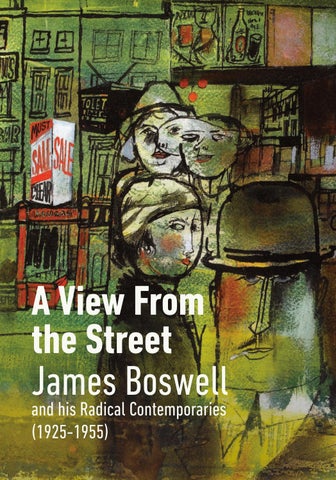
A View From the Street James Boswell and his Radical Contemporaries (1925-1955) 2
A View From the Street James Boswell and his Radical Contemporaries (1925-1955) 12th - 23rd October 2026
6 Mason’s Yard, Duke Street, St James’s, London SW1Y 6BU
HARRY MOORE-GWYN BRITISH ART
Front cover:
[cat.29] Hylton’s Fish Bar Rear cover:
[cat.32] The Blue Lamp Opposite page:
[Detail of cat.1] The Boxing Match 1
James Boswell, an intelligent, well read, sociable, frustrated painter reckoned drawing was second best but drew extraordinarily well. He came to London from New Zealand in 1925 to go to the Royal College of Art to study painting, failed to see eye to eye with William Rothenstein who threw him out – twice. He might have been better off in the Design School with Nash, Bawden and Ravilious which would have made a different story but he was determined to be a painter. In 1932 he joined the Communist Party to which he was never fully committed because wouldn’t toe the party line. He accepted his painting wasn’t as good as it should be, dumped his unwanted paintings overnight on the doorsteps of houses in Fitzroy Square and abandoned painting for fifteen years turning instead to freelance commercial art which he did surprisingly well despite disliking it. Around 1928 he began attending lithography classes at the Central School of Art where an inspiring teacher, A S Hartrick, taught students everything they should have been taught at the Slade and the RCA. In 1933, Hartrick recommended James Fitton for the position of tutor for evening classes which filled with students, including James Boswell, who all treated it as a private club. Out of this emerged the Artists International Association, the AIA, committed, intelligent artists intent upon denting the apathy which beset the British who appeared unable to see the fascist wood for the conservative trees. Despite misgivings by writers, the AIA took on the task of supplying illustrations for Left Review which, without them, might have been a bit heavy going. The James’s (Fitton, Holland, Boswell, Lucas), Pearl Binder and Cliff Rowe made cartoons and lithographs, usually to please themselves and Left Review published everything. They were beautifully drawn, savage cartoons about politicians, the rich and corrupt businessmen such had not been seen since the days of Gilray. From somewhere, James Boswell unleashed an uncharacteristic delicacy of touch although some years later he wrote that he didn’t like this work and was confused about it’s purpose. He acquired a family and necessity pushed him into a full time job in the advertising department of Shell Oil whilst continuing to do left wing book jackets and cartoons for the Daily Worker and to create lithographs at the Central to please himself; a substitute for the painting he had abandoned.
2
Early in 1941 Boswell was called up, trained to become a radiographer and began to draw the war as he saw it and how it affected him, filling sketch books with soldiers being soldiers, cartoons and a series of devastating anti-war drawings ridiculing the iniquity, bull, thoughtlessness, greed and indifference of officers and the demands of clergy; unique, apoplectic and more or less unpublishable at the time. James was not an official war artist – his politics saw to that but it did leave him free to record the war as he saw it, unsanitised, warts and all – not at all what the authorities wanted. In 1942 he went to hot, dusty Iraq, was bored and drew and taught his mates to draw too - his drawing got better and better. 1944 he was back in the UK working for the Army Bureau of Current Affairs (ABCA) and he turned his sketch book drawings into larger watercolours which were shown at an AIA gallery in Charlotte Street. Demobbed in 1946, he returned to Shell then became art editor of Lilliput and spent three glorious years having a good time as well as starting to paint again although these paintings were more like illustrations in oil than anything else. In 1952 he became editor of the house magazine for Sainsbury’s, a part time job which was interesting, lucrative and left him with a lot of free time to paint. He went back to square one and explored technique, how to control paint, canvas and brushes. His life became a progression of rooms, Fauve room, Monet room, Matisse room, Chagall room, Jackson Pollack room (very quickly abandoned because he never had anywhere in which he could make that amount of mess). Each room he explored then abandoned, retaining what he wanted, discarding what he didn’t, moving seamlessly into the next room, repeating the process and never turning back. Eventually he discovered himself; what he created was unique to him but it took a long time to get there. Throughout his life, his drawings and his paintings were different, drawings reflecting what was required or what he could see, paintings reflecting how he felt, dark when life was difficult; illuminated when he was content. By the early sixties the painter in him had finally achieved a personal largely abstract style of his own using coarse sand from the beach at Brighton, pvc and metallic paint. Earlier paintings were dark and troubled as was his life at the time but this was yet another room which finally he was able to abandon, his final paintings were full of light and hope, his final drawings some of the best he ever achieved. This lovely, genial man died in 1971, far too early but he was happy. Sal Shuel
3
Works by James Boswell (1906 - 1971) The provenance for all works by James Boswell is the artist’s estate unless otherwise indicated. AIA = Artist’s International Association
CAT. 1
The Boxing Match Inscribed l.l.: Derriere les decors de l’immense nature Brush and Indian ink, 57 by 45 cm (22 ½ by 13 ¾ ins)
This early work by James Boswell from c.1927, forms part of a series of unpublished illustrations for Charles Baudelaire’s Fleurs du Mal. The collection (comprising most of Baudelaire’s writing from 1840 until his death in 1867) was highly influential in Symbolist and Modernist art in the following five or six decades. Its themes of decadence and suffering are ones that clearly emerge in Boswell’s own art in the 1930s. The text here is apparently a mis-quote from Baudelaire’s text which reads: “Derriere les decors De l’existence immense” (Behind the backdrops of immense existence). 4
CAT. 2
Harbour Scene Inscribed l.r.: Emporte-moi Wagon! Enleve-moi fregate! Brush and Indian Ink, 58 by 46 cm (22 ¾ by 18 ins)
Another illustration for a text from Baudelaire’s Fleurs du Mal. The text here “Emporte-moi Wagon! Enleve-moi fregate!” translates as “Take me away, carriage! Carry me off, frigate!”. 5
CAT. 3
The Fall of London: Waterloo Lithograph, 1933 133 by 95 mm (5 ½ by 3 ¾ ins)
Boswell’s famous set of eight lithographs The Fall of London were made the in the same year as the AIA’s foundation in 1933. Here the artist laid bare the implicit consequence of the spectre of fascism against the backdrop of his depressed city. William Feaver has written of the series: “Here was the long-awaited apocalypse: looting and mass panic, as familiar landmarks – Waterloo, the British Museum, a Lyons Corner House and London Bridge – toppled” (Feaver, op cit, p.5). The set were exhibited in the Peace Pavilion at the Paris Exposition Internationale 1937 and sets are held by the British Museum and the Tate Gallery. 6
CAT. 4
The Fall of London: The Horseguard Lithograph, 1933 133 by 95 mm (5 ½ by 3 ¾ ins)
CAT. 5
The Fall of London: Museum Lithograph, 1933 133 by 95 mm (5 ½ by 3 ¾ ins) 7
The Left Review
CAT. 6
Hatton Garden Luncheon or Businessmen Lithograph, 1934 190 by 250 mm (7 ½ by 10 ins) Literature: Left Review, November 1934; Morris, Lynda & Radford, The Story of the Artists International Association, (1933-1953), Museum of Modern Art, Oxford, 1983, p.20 (illustrated)
Within a year of the AIA’s foundation and in the wake of its success, The Left Review emerged, a magazine largely backed by the Communist Party, with cartoons commissioned from James Boswell (who was its art editor), as well as his friends James’ Fitton and Holland amongst others. Only lasting until 1938, it nevertheless spawned some fine satirical cartoons, the artists given free-rein to satirise the government and establishment of the day. Hatton Garden, Empire Builders and others are typical of Boswell’s work for the publication, executed in the artist’s own George Grosz-influenced style.
8
CAT. 7
Leicester Square Signed, titled, and dated by the artist: Leicester Square/James Boswell/36 Lithograph, 1934 213 by 213 mm (8 ½ by 8 ½ ins)
The artist/illustrator (and Boswell’s friend) Paul Hogarth has written: “The great depression of 1929-1936 made James Boswell the draughtsman of the history of those years and of the decade afterwards.”
CAT. 8
Soldier, Soldier 294 by 264 mm (11 ½ by 10 ½ ins)
This rare lithograph of which there are only five known impressions is one of the artist’s most explicit digs at the establishment from around the time of the launch of the AIA. 9
CAT. 9
His Majesty’s Servants Inscribed with title l.l. and signed and dated l.r.: James Boswell/1934 further inscribed with title l.l. Brush with pen and ink, 29 by 24 cm (11 ¼ by 9 ½ ins) Literature: Roger Blackley, James Boswell, 1906-1971: Graphic Works of the 1930s from the Collection of the Auckland City Art Gallery, exhibition catalogue, Auckland City Art Gallery, 1985 Arnold Rattenbury, James Boswell: Artist Against Fascism, exhibition catalogue, Manchester City Art Gallery 1986, p.4 (reproduced p.4); James Boswell: Extracting the Dream Reality, exhibition catalogue, Austin/Desmond Fine Art, London 1999
The facial types in His Majesty’s Servants (of which this is the original drawing for the related print), appear to have provided inspiration for the later work Empire Builders (Tate P01823) (1935). Roger Blackley has suggested that this print was made in response to the 1934 Incitement to Disaffection Act which made it an offence to seduce a servicemen from his “duty or his allegiance” (Blackley, op cit, p.2). “The Act, widely criticised at the time as an unnecessary restriction of freedom of speech, eventually led to the foundation of the National Council for Civil Liberties.” (entry on Tate Gallery website). We are also grateful to Andy Friend for pointing out that this is Boswell’s take on Edith Tudor-Hart’s famous photograph Sedition, showing secret police monitoring a Trafalgar Square demonstration against the related bill. Both Tudor-Hart’s photograph and Boswell’s illustration appeared in the Left Review in 1935 (see Andy Friend, Comrades in Art: Artist’s Against Fascism 1933-1943, Thames & Hudson, 2025, p.62). 10
CAT. 10
The Empire Builders Lithograph in two colours, 1935 259 by 219 mm (10 ¼ by 8 ¾ ins)
Boswell exhibited The Empire Builders at the AIA Soho Square show “Artists Against Fascism and War”. Andy Friend (see exhibition text for Towner Art Gallery Exhibition) has pointed out its connection to the Italian colonial expansion of those years, which culminated in the invasion of Abyssinia in October 1935. Impressions of this work are held in the Tate Gallery, the Victoria and Albert Museum and Auckland Art Gallery in New Zealand. 11
CAT. 11
A Shilling a Day Lithograph, 1935 435 by 287 mm (17 by 11 ¼ ins) An Illustration for Left Review Literature: Frances Carey & Antony Griffiths, AvantGarde British Printmaking 1914-1960, BMP 1990, no.119.
The writer TH Wintringham reviewing Social Scene (the exhibition that launched the Artist’s International Association in October 1934) in Left Review said of Boswell ‘… he succeeds in his street scenes by the solid, normal, seen individuals that make up his groups, their attitudes, the caps they wear as if they had been born in them. And those who saw the first issue of the Left Review will realise; the man can draw’. Sal Shuel writes of the present lithograph: “a soldier and his pregnant wife. In 1935 a private in the army was paid a shilling a day. He also got meals, accommodation and health care and his family received benefits but it wasn’t a living wage.”
CAT. 12
Two Women in a Pub, c.1938 Pen and ink, 26 by 22 cm (10 ¼ by 8 ¾ ins) 12
An Uneasy City
CAT. 13
Market Scene, c.1937 Lithograph, 483 by 410 mm (19 by 16 ins)
Sal Shuel writes about her father’s street scenes, some of the finest and most distinctive work he did in the decade from about 1938 to 1948: “James, who never liked the tube, used taxis, buses and trolleybuses. The 24 bus took him to Camden Town, Soho and Charing Cross Road, the 639 trolley bus to City Road and Moorgate and the 513 to Holborn Circus. All the drawings which filled his sketch books were on those routes, corridors through London which became familiar to him. If his buses didn't go there, neither did he.”
CAT. 14
Parr’s Stores Lithograph, 1937 483 by 410 mm (19 by 16 ins)
Boswell was strongly attracted to Camden, not far from where he lived (initially in Chalk Farm, before moving to Hampstead). It is the inspiration for many of these street scenes. Eric Hobsbawn remarked that Camden ‘isn’t as flamboyant as Stepney or Shoreditch, or as grim as Canning Town; it is just ordinary. That is why Boswell’s pictures show its people doing nothing specially Camden Townish, but simply the sort of things that are being done in scores of neighbourhoods in Inner London’ (quoted in Austen/Desmond Fine Art, James Boswell: Extracting the Dream Reality, exhibition cat., 1999). 13
CAT. 15 (LEFT)
The Station Signed and dated within the lithographic plate Lithograph, 1939 195 by 190 mm (7 ¾ by 7 ½ ins)
This is one of a series of six, on different aspects of British culture, commissioned for the British Pavillon of the New York World’s Fair (1939-40). The artist depicts himself here with a copy of the Daily Worker. Sal Shuel has identified the setting as the now disused former Marlborough Road Tube Station in St John’s Wood.
CAT. 16
The Champ Inscribed with title l.r.: The Champ bears inscription on backboard The Champ/1940 Wash over pen and ink, 29 by 46 cm (11 ½ by 18 ins)
Dating from c.1937 (despite the inscription on an earlier backboard), it depicts a game of darts in a London pub. 14
CAT. 17
Under the Arches Lithograph, 1939 305 by 180 mm (12 by 7 ins)
One of only three known impressions of this rare lithograph.
CAT. 18
Free Speech, 1939 Inscribed with title l.l. Wash over pen and black ink, 18 by 18 cm (7 by 7 ins)
This is the preparatory drawing for the lithograph exhibited in the British Pavillion at the New York World’s Fair (1939-40). It depicts Speaker’s Corner on the edge of Hyde Park, then, as now, a refuge for freethinking artists and thinkers everywhere. 15
CAT. 19
Chalk Farm Bus Station Lithograph, 1938 350 by 415 mm (13 ¾ by 16 ¼ ins)
This lithograph shows the bus terminus at Chalk Farm station with the Adelaide Tavern behind.
16
CAT. 20
A Quiet Evening or Café Rouge Lithograph, c.1938 305 by 254 mm (12 by 10 ins)
With its barrage balloons and taped windows, A Quiet Evening (also known as Café Rouge) anticipates the War that would soon cast its shadow over the street scenes Boswell depicted so broodingly in his Pre-War lithographs. Andy Friend has pointed out that barrage balloons were a feature in the London skies as early as May 1938, suggesting an earlier date for this print than has previously been suggested. 17
CAT. 21
Hygienic Stores, c.1938 Pen and black ink heightened with white, 57 by 37 cm (22 ½ by 14 ½ ins)
Sal Shuel describes the present work as a “Street scene somewhere on the fringes of respectability in W1”. Like many of Boswell’s street scenes the exact topography is hard to pin-point (and that is no doubt partly the point). Even shop signage is not a guaranteed help in location-finding as he would frequently use the names of his friends on the name boards of establishments. 18
CAT. 22
Welcome to the Great Metropolis, 1938 Pen and ink with wash, 27.5 by 39.5 cm (10 ¾ by 15 ½ ins)
Boswell worked this drawing into a lithograph with this title, an example of which is held by the Auckland Art Gallery. Showing houses backing onto a London railway line, its location has never been identified despite the distinctive ‘Globe’ Cinema is showing a film and the distant hoarding “Hobbs and Taylor”.
19
CAT. 23
The Circus has arrived, 1946 Watercolour over ink, 35 by 50.5 cm (13 ¾ by 19 ¾ ins)
These essentially imaginary scenes are probably based (albeit only very partly) on the area of north London near Hampstead. Boswell’s use of watercolour highlights his Neo-Romantic qualities as an artist, with the kind of brooding skies and empty vistas that are seen in his middle eastern War work.
20
CAT. 24
The Circus is Coming, 1946 Watercolour over ink, 35 by 50.5 cm (13 ¾ by 19 ¾ ins)
21
CAT. 25
Punch and Judy, no.3 Inscribed with title (verso) and dated: 1945 Watercolour over Indian ink, 51 by 35 cm (20 by 13 ¾ ins)
Boswell was fascinated by subject matter from the Italian Commedia dell ‘Arte. Punch and Judy in particular feature in a number of works, the artist perhaps being attracted to the essential violence of these two characters. It is perhaps no coincidence that Boswell’s depictions of the subject date from the final year of the Second World War. 22
CAT. 26
A North London bomb site in the rain with children Dated indistinctly: l.r.: 1948 Pen and black ink with watercolour on peach-coloured paper, 26 by 37 cm (10 ¼ by 14 ½ ins)
23
CAT. 27
The Popular P.Mann Dining Rooms, c.1947 Bears inscription and date in pencil (to reverse of panel): Hanwell Street ? /NW1/C.1947 Oil on panel, 40.5 by 57 cm (16 by 22 ½ ins)
24
CAT. 28
Grand Clearance Sale Bears inscription (on backboard): London Scene No.2 Brush with Indian ink and watercolour, 55 by 42 cm (21 ½ by 16 ½ ins) 25
CAT. 29
Hylton’s Fish Bar Signed l.r.: Boswell Watercolour and gouache over pen and ink, 16 by 24 ins (40.5 by 61 cm)
The present work is Boswell’s interpretation of the vibrant street life of Camden Town, a part of London that the artist loved and knew well. It is a rare example of a fully coloured watercolour of this type of subject. From the early 1940s Boswell would pass through this part of London on the 24 bus route and he painted many views of the area, often incorporating parts of Kentish Town and Mornington Crescent into the same cityscape. This picture was probably painted in the early 1950s just after the artist had started working for the Sainsbury’s house magazine. It is possible that Hylton was the name of an associate of the artist from the early 1950s.
26
CAT. 30
The Ring, Blackfriars With inscription l.r.: 1 D/E ½ tone s/s J.S.Journal. pp.16/17/ cat 2 Soft pencil with wash, 23.5 by 34 cm (9 ½ by 13 ¼ ins) Provenance: the artist’s daughter
A drawing from Sainsbury’s Magazine from the early 1950s. The Ring in Blackfriars was a famous twentieth century boxing venue.
27
CAT. 31
It Always Rains on Sunday Original Film Poster, 1947, 73 by 98 cm (28 ¾ by 38 ½ ins)
The individual world conjured up in Boswell’s street scenes found its most popular expression in the fine posters the artist designed for Ealing Studios in the later 1940s. These reached their height in the poster for the film “It Always Rains on Sunday”, amongst the finest film posters ever produced by Ealing Studios. A classic Camden Town painting by Boswell provides the poster’s backdrop, although the film was set in the East End. An original version of the girls appeared in Lilliput in 1947 and is now in the Victoria and Albert Museum.
28
CAT. 32
The Blue Lamp Original Film Poster, 1949, 57 by 42 cm (22 ½ by 16 ½ ins)
Boswell followed “It Always Rains on Sunday” with a poster for another Ealing film The Blue Lamp. A procedural police drama, it inspired the Dixon of Dock Green series which ran for two decades from the mid-1950s.
29
CAT. 33
Going Home, Chalk Farm Road, Camden Town, 1952 Inscribed with title to reverse of board, dated and signed: James Boswell/7 Pembroke Ave/Hove 3/1952 Oil on board, 57.5 by 68 cm (22 ¾ by 26 ¾ ins)
In the early 1950s Boswell turned his focus from drawing and printmaking back to painting. A small group of works from the period look at some of the urban social subjects that occupied him in the previous two decades, of which Going Home, Chalk Farm Road and Herrings are fine examples. The same poster-splattered wall on Chalk Farm Road appears on a related drawing “Guatemala”.
30
CAT. 34
Herrings, 1955 Signed and dated l.l.: Boswell/55 Oil on board, 76.5 by 61 cm (30 by 24 ins)
Before Boswell left London for Brighton he produced several paintings like this, all based upon aspects of everyday life of London and Londoners and in particular around Brick Lane (as in the present painting). 31
CAT. 35
The Beach at Shoreham Signed and dated l.l.: Boswell/53 Oil on board, 39 by 49 cm (15 ¼ by 19 ¼ ins)
The beaches on the Sussex were a popular excursion for the artist whilst still living in London in the early 1950s – he would move to nearby Hove later in the same decade. The linear forms of the beach shingle, wooden groygnes and posts point to the artist’s evolution towards abstraction in the following decade.
32
CAT. 36
Football Signed and dated l.r.: Boswell/53 Watercolour and gouache over pen and ink, 35 by 51 cm (13 ¾ by 20 ins)
Boswell had memorably depicted a football match (humorously under driving rain) in the lithograph The Winning Side which was issued as a School Print for the Festival of Britain in 1951. The present watercolour is altogether more stylised and reflective of the art of its decade – pointing towards the abstraction that would emerge in the art of his final decade.
33
Artists of the AIA
CAT. 37
Paul Nash (1889-1946) Meeting Place Signed l.r.: Paul Nash inscribed with title (l.l.) and further inscribed u.l. from edition 25 Wood engraving, 114 by 152 mm (4 ½ by 6 ins) Provenance: with the Redfern Gallery in 1961 from acquired by Alan Collingridge
One of Nash’s most celebrated and effecting wood engravings, The Meeting Place depicts a scene is the home of the artist Claude Lovat Fraser’s parents in Buntington in Hertfordshire. Nash was one of the most influential artistic figures of the inter-war years and an inspiration to many politically-motivated artists. He took part in the Anti-War Exhibition in 1933 and sponsored Artists Against Fascism and War in 1935. He exhibited with the AIA from 1934 to 1942. Nash was also active on the selection committee for the AIA’s 1937 Grosvenor Square Exhibition and in 1939 he became a founder member of the AIA advisory council. 34
CAT. 38
Paul Nash (1889-1946) The Open Tomb Stamped with the Paul Nash Trustees Estate stamp (under mount) Verso: Tailpiece to Urn Burial (on p.53) Pencil, 14.5 by 8 cm (5 ¾ by 3 ¼ ins) Provenance: with Alexander Postan Fine Art in 1973 Exhibited: Alexander Postan Fine Art, Paul Nash, an exhibition of watercolours, drawings and prints from “Urn Buriall and the Garden of Cyrus”, 15-28 May 1973, no.1
Nash worked out many of his most visionary visual ideas in the illustrations he produced for an edition of Thomas Browne’s Urn Burial and the Garden of Cyrus in the early 1930s. The unease of many of these illustrations, particularly the present one, aptly reflect the unsettled backdrop of the early 1930s.
35
CAT. 39
Sir William Coldstream (1908-1987) A Portrait of Fiona Signed l.r.: Coldstream Oil on canvas, 61 by 46 cm (24 by 18 ins)
Coldstream wrote of the post-depression years: “Through making money much harder to come by, it caused an immense change in our general outlook…Everyone began to be interested in economics the politics… It was no longer the thing to be an artist delighting in isolation”. Sir William Coldstream, How I Paint, The Listener, 15 September 1937, p.570 (quoted Andy Friend, pp.90-91). Highly influential as the founder of the Euston Road School in 1937, he was elected to the AIA central committee in 1938. 36
CAT. 40
Claude Rogers (1907-1997) Spring in Bloomsbury Signed and dated l.r.: C.Rogers/1948 Oil on canvas, 58 by 61.5 cm (22 ¾ by 24 ins) Provenance: the artist’s family Exhibited: London Group, 1948
Alongside William Coldstream and Victor Pasmore, Rogers was the driving force behind the Euston Road School, which was launched in 1937. The school’s aims were motivated by a self-conscious move away from abstraction towards figurative art (a “new realism” as they described it) – a move partly driven by an aim to make contemporary art more accessible to the wider public. Rogers’s work was rarely overtly political, but nevertheless featured in the Whitechapel show Unity for Artists for Peace, Democracy and Cultural Development in 1939. His colleagues William Coldstream and Graham Bell were both AIA members and the movement and its influence held great sway in the febrile artistic world of the mid-century. This view is taken from the artist’s painting room in Bloomsbury looking onto Taverton Street below. A near identical version of this composition, but under snow, is in the Ashmolean Museum, Oxford (acc.WA1948.71). 37
CAT. 41
Mary Adshead (1904-1995) View from the Artist’s Window, Stockholm, 1936 Signed l.r.: Mary Adshead and inscribed with title and dated (to reverse of panel) Oil on panel, 45 by 36 cm (17 ¾ by 14 ins)
The painter and muralist Mary Adshead, was a prominent participant in Anti-fascist shows of the 1930s, exhibiting with the AIA and the Artists Against Fascism and War show from 1935. This view from the window of the studio she shared with her husband Stephen Bone in the mid-1930s, has a strikingly uneasy, empty, quality which is oddly reflective of its time. 38
CAT. 42
Ethelbert White, RWS (1891-1972) Lynmouth, Devon Signed l.r.: Ethelbert White Watercolour over soft pencil, 26 by 33 cm (10 ¼ by 13 ins)
White’s bohemian existence (spending much of his time living from a caravan and pursuing an interest in folk music) also manifested itself in his progressive principles as an artist. He supported the AIA and other left-leaning exhibiting societies in 1930s, including those supporting the Spanish Republican cause during the Civil War.
39
CAT. 43
Stanley Roy Badmin (1906-1989) Poplar Grove, Sydenham Signed l.l.: S.R.Badmin/25 Watercolour over pen and ink, 16 by 10 cm (6 ¼ by 4 ins)
Badmin joined the AIA in 1936, serving on its central committee in the late 1930s and early 1940s. He also served on the committee that helped launch the “Everyman Prints”, produced with the express aim of helping collectors of even the lowest budgets to buy original art. His urban scenes focus more on the everyday life of suburbia, including roads near his home in Sydenham and elsewhere in south London. He later contributed to the Recording Britain project in the 1940s and produced celebrated work for the Shell Guides in the Post War years. 40
CAT. 44
Stanley Roy Badmin (1906-1989) Crescent Lane, Clapham Common Inscribed with title and signed with initials l.l.: S.R.B Watercolour over pen and ink, 16.5 by 18 cm (6 ½ by 7 ins)
41
CAT. 45
Lowes Luard (1872-1944) Up the Gallops, Newmarket Signed l.r.: L.D.Luard Titled and inscribed on labels on backboard Coloured chalks, 48 by 60 cm (19 by 23 ½ ins) Exhibited: London, New English Art Club, Winter 1937, no.110; London, Royal Society of British Artists, Winter 1938, no.308
42
CAT. 46
Lowes Luard (1872-1944) Out of the Depths Signed l.r.: L.D.Luard and with label to reverse on backboard: L.D.Luard/10 Hall Road/ London NW8 Wash with pen and sepia ink, 33 by 21 cm (13 by 8 ¼ ins) Exhibited: City Art Gallery, Manchester, Civil Defence Artists Exhibition, 1942, no.7
The painter Lowes Luard earned his reputation as an equine painter, chronicling the work of the mighty Percheron work-horses helping re-model the banks of the Seine in Paris in the early years of the twentieth century. His interest in human social subject matter to some extent mirrors his portrayal of the plight of the horse, such as in this powerful depiction of a rescue from a bomb site in World War Two. He was a member of the AIA, serving on its Central Council from 1939 and acting as its extremely effective treasure in the early 1940s. 43
CAT. 47
Hans Feibusch (1898-1998) Africa – Design for a Travel Poster Gouache, 38 by 25 cm (15 by 9 ¾ ins)
Feibusch was a founder member of the AIA who as a German Jew had direct experience of Nazi persecution prior to his move to England in 1933. He was a talented commercial artist, producing posters for Shell (amongst others) in the 1930s. After the War he became one of the most prolific muralists in English churches. 44
CAT. 48
Eric Mellon (1925-2014) War Weapons Week Design for a Poster Gouache, 56 by 37 cm (22 by 14 ½ ins)
The potter Eric Mellon began his artistic training as a printmaker book proudcer, studying from the end of the War at Central School of Art and Crafts. Central had trained many of the key AIA figures, amongst them James Fitton and Pearl Binder. The AIA lent particular support to the work of commercial artists, organising the touring exhibition Poster Design in War-Time Britain in 1943. 45
Arthur Wragg Two key progressive 1930s political publications were the magazines Tribune and Peace News. James Boswell was a regular contributor to both - another was the Manchester-born illustrator Arthur Wragg. Wragg stood apart from the AIA and its members (perhaps on account of his devout Christianity) but he was as hard hitting as any of them, particularly on themes of pacificism and deprivation. The remarkable work he did as a black and white illustrator in the 1930s is second to none. In the same year the AIA was founded (1933), Wragg produced the book Psalms for Modern Life. It ran to several reprints, selling millions of copies worldwide. Taking text from each of the 150 Old Testament Psalms of David he produced modern re-imaginings of the central moral messages in each of the Psalm texts. Several of the drawings below are Wragg’s original illustrations for the book.
CAT. 49
Arthur Wragg (1903-1976)
The Patient Gentlemen of England Inscribed with title (under mount) Brush and Indian ink with collage on artist’s board, 23 by 19 cm (9 by 7 ½ ins)
Collage employing newspaper text was a regular feature in political art of the 1930s. Wragg’s newspaper text references widespread unrest across Continental Europe, his title “The Patient Gentleman of England” implicitly praising the working class English man. 46
CAT. 50
Arthur Wragg (1903-1976) “And in My Prosperity, I Said, I shall not be Moved” Inscribed (under mount): Ps 30 “and in my prosperity, I said, I shall not be moved” Brush and Indian ink on artist’s board, 22 by 15 cm (8 ¾ by 6 ins) Literature: Psalms for Modern Life, Interpreted with Drawings by Arthur Wragg, with an introduction by H.R.L.Sheppard, Selwyn and Blount, 1933, illustration for Psalm 30 47
CAT. 51
Arthur Wragg (1903-1976) Our Children’s Future Brush with pen and Indian ink, 22 by 15 cm (8 ¾ by 6 ins) Literature: Moberly, Walter T. Report for 1943-1944, The Oxford House, 1944. First Edition, illustrated as the back of the cover wrapper; Arthur Wragg, The Lord’ Prayer in Black and White, J.Cape, 1946
Oxford House, a community arts centre in Bethnal Green, was founded in 1884. At the time, it was founded for graduates from Keble College, Oxford, to tackle urban poverty. 48
CAT. 52
Arthur Wragg (1903-1976) Wherewithal shall a young man cleanse his way? Inscribed (under mount): Ps 119 Wherewithal shall a young man cleanse his way? Brush and Indian ink on artist’s board, 22 by 15 cm (8 ½ by 6 ins) Literature: Psalms for Modern Life, Interpreted with Drawings by Arthur Wragg, with an introduction by H.R.L.Sheppard, Selwyn and Blount, 1933, illustration for Psalm 119 49
CAT. 53
Arthur Wragg (1903-1976) Yesterday, Today and Forever Inscribed (verso): Yesterday, Today and For ever/ Christ’s Power in History Brush and Indian ink on artist’s board, 22 by 15 cm (8 ½ by 6 ins) 50
CAT. 54
Arthur Wragg (1903-1976) Daily Commute Inscribed with the text from Psalm 104:3: Man goes forth to his work and to his labour until evening Pen with brush and Indian ink, 21.5 by 13.5 cm (8 ½ by 5 ¼ ins) Literature: Psalms for Modern Life, Interpreted with Drawings by Arthur Wragg, with an introduction by H.R.L.Sheppard, Selwyn and Blount, 1933, illustration for Psalm 104 51
Tel: +44 (0) 7765 966256 harry@mooregwynfineart.co.uk www.mooregwynfineart.co.uk
Ground Floor, 6 Mason’s Yard, Duke Street, St James’s, London SW1Y 6BU Monday-Friday: 11 am – 6 pm (or at other times by appointment) By appointment, Chalford, Gloucestershire Acknowledgments We are grateful to Andy Friend whose wonderful exhibition Comrades in Art closes at the Towner Gallery in Eastbourne at around the time this catalogue is published and to Neil Jennings for his invaluable help on Boswell’s prints and his advice in general. Above all we are grateful to Sal Shuel, James Boswell's daughter, for her unfailing help with every aspect of this project and always generously sharing her unparalleled knowledge and insight into her father's work.
Copyright 2026
Photography by Adam Carter Designed by Sarah Garwood Creative sarahgarwoodcreative.com 52
Opposite page:
[Detail of cat.49] Arthur Wragg (1903-1976) The Patient Gentlemen of England